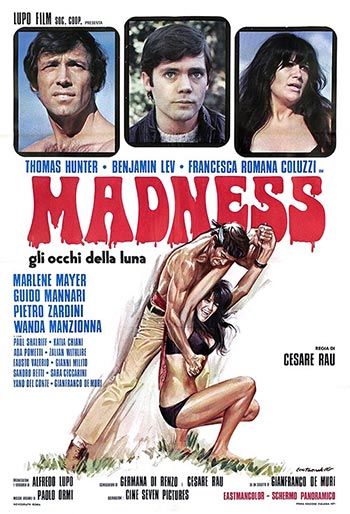
Paolo Lupi (Thomas Hunter, The Vampire Happening and the writer of The Final Countdown) convinces two older patients in the asylum he is trapped at to escape. One is quickly found, the other is run over by a car and Paolo manages to escape to a country home where he hides as a party starts. When everyone drops acid, he goes to work and they wake up to find a dead girl. They decide to bury her in the garden to stay out of trouble, but he’s still in the house. And they’ve left another girl, Francesca (Francesca Romana Coluzzi, who was Red Sonja‘s mother) alone in the house.
What kind of movie is Madness? Is it giallo? Is it a rape revenge film? A poliziotteschi? A musical with all the dancing? Who can say?
Is Paolo even the real murderer? And have you ever seen such a sad orgy before?
Director Cesare Rau only made this one movie. He was a second unit director on Death Walks In Laredo, but there’s not much else info on him. Of the writers, Alfredo Lupo has the most credits, and they include being the production manager of Reflections in Black under the name…Cesare Rau? Are they the same person?
The only thing I don’t have questions on is that the theme of this movie, “Madness,” was composed by Black Sunday Flowers, which is really Paolo Ormi, who was the musical director for The Strange Vice of Mrs. Wardh and contributed to the soundtracks of Terror Force Commando, Bárbara and The Porno Killers.
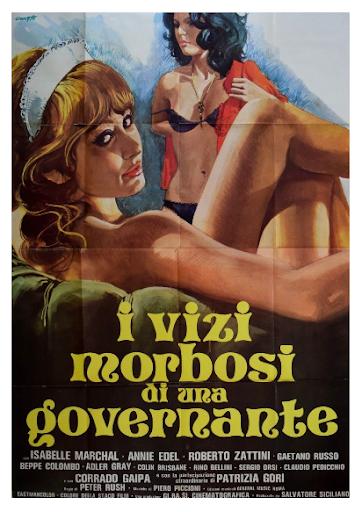
Sure, that’s a pretty lurid title — the Italian title I vizi morbosi di una governante translates as Morbid Vices of a Housekeeper — and trust me, this lives up to it, what with an older woman using a mentally challenged man and a teenager sexually — not at the same time! — and then a game of charades which is mostly people yelling out the names of films while everyone else gropes one another.
There are more than a lot of camera zooms in here, as well as bad sartorial choices and even worse life ones. When Ileana and her bunch of hip friends — their words not mine — gather at a gothic castle owned by a wheelchair-bound older relative of one of the girls, things get pervy, weird and murdery, just as you’d expect.
If you are a hip friend or have hip friends (at which point that makes you a hip friend), then you should take this warning: do not go to hang out in gothic castles. Nothing, in my movie — not life — experience says that things will go well.
Meanwhile, two of these with it pals are using Chinese treasures to smuggler heroin — as you do — while Elsa the party girl ends up with both of her eyes torn out, just like Ileana’s mother had done to her by a relative who has lost his mind and is possibly prowling the catacombs of the castle.
This would be the last film that Filippo Walter Ratti would direct. You may have seen his other movies, including Mondo Erotico, Operation White Shark and Night of the Damned. Screenwriter Ambrogio Molteni also wrote the two Black Emanuelle movies, as well as Yellow Emanuelle, Sister Emanuelle and Violence in a Women’s Prison.
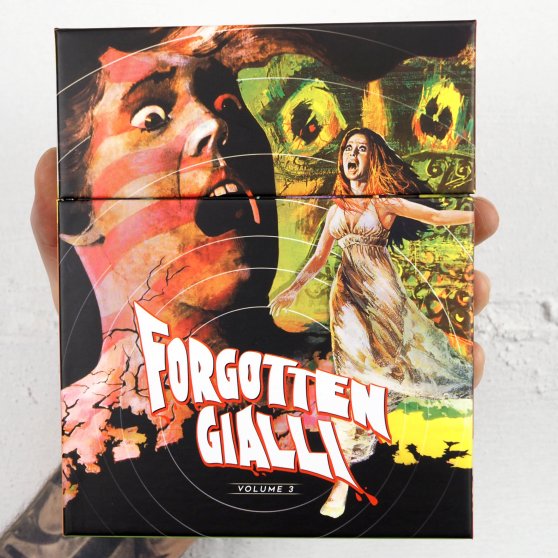
This appears along with Murder Mansion and Autopsy on Vinegar Syndrome’s Forgotten Gialli Volume 3 complete with a new scanned and restored 4k version from its 35mm original camera negative and an interview with Giuseppe Colombo. Or you can watch it on Tubi.
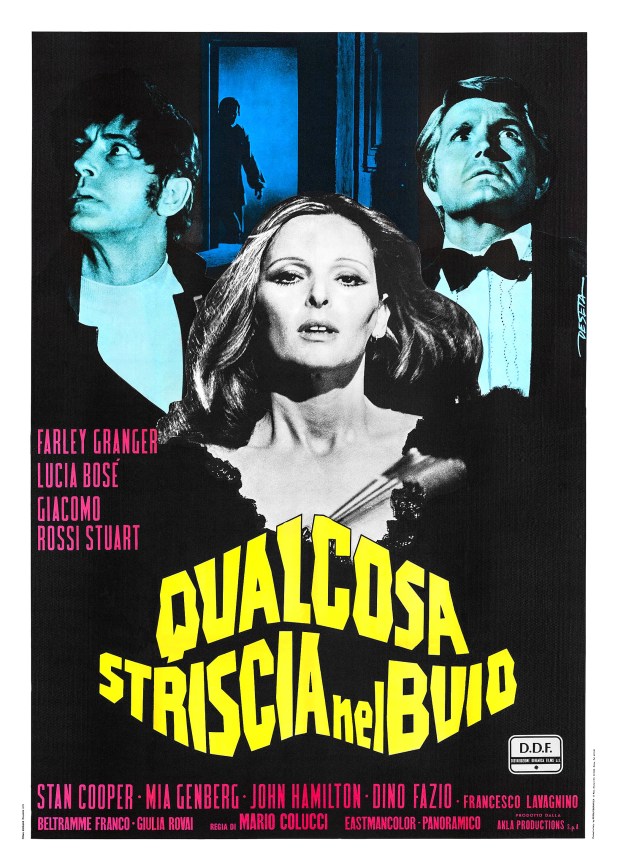
Qualcosa Striscia nel Buio may mean Something Crawls in the Dark, but the inexact translation of the original title is what this played in the U.S. as.
A series of travelers are headed out into a foreboding evening — it was a cold, dark night — when they realize that a washed-out bridge means that they’re all finding shelter in the same house that was once the home of a lady occultist. The cars contain all manner of individuals with their own reasons for being out in the storm, like the two detectives transporting a restrained Farley Grainger, a fighting husband and wife, and a surgeon and his assistant.
Of course, one of these folks will decide to conduct a seance and that’s the point where everything falls to pieces. The result of this occult ritual is that everyone becomes possessed and starts acting like Ecstasy-loving maniacs. And with the phone lines not working, the bridge out and a storm outside — and now inside an emotional weather outburst happening — the movie transitions from giallo to outright gothic horror.
There’s also a butler named Joe who just happens to keep a pantsless woman who he occasionally makes love to, as well as a POV camera view that keeps happening, making this film stand out from the giallo pack somewhat as the ghost takes over each person, making them give in to their desires and even stopping clocks dead.
“Exorcism…the Occult…A Horror-Filled Night In A House Of Terror!” Writer and director Mario Colucci only directed one other movie, Revenge for Revenge, that he also wrote, directed and acted in. There are some interesting actors other than Granger here, such as Italian Neorealist actress Lucia Bosè (she’s also in Arcana), Giacomo Rossi Stuart (Kill, Baby, Kill; The Night Evelyn Came Out of the Grave), Angelo Francesco Lavagnino (who is in Fulci’s Beatrice Cenci as well as Orson Welles’ Othello and Chimes at Midnight) and Loredana Nusciak (Maria, the lover of Django) appearing as the photo of the lady of the house, who we are to believe is the ghost.
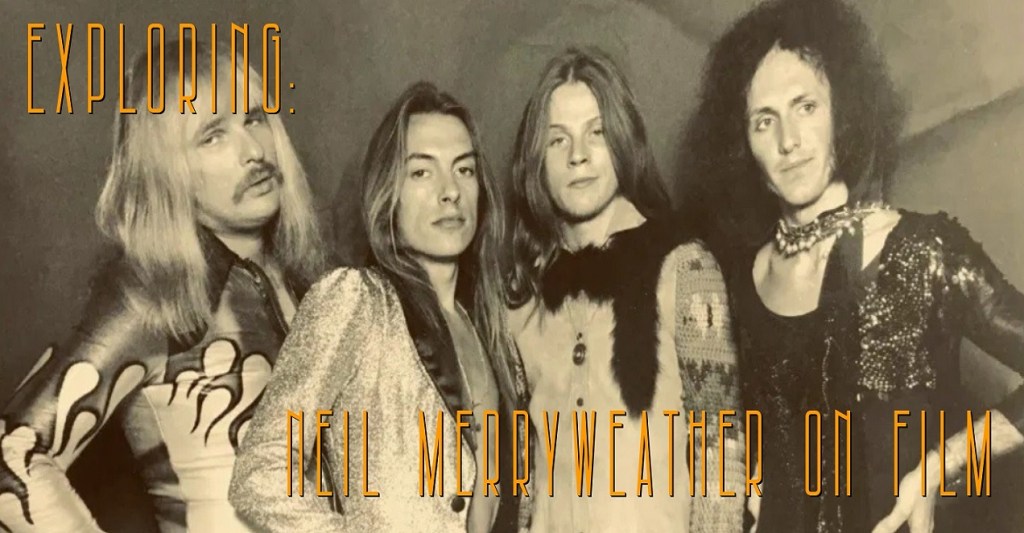
Neil Merryweather, left, James Newton Howard, right, with the Space Rangers/Neil Merryweather Facebook.
Canadian rock singer, bass player and songwriter Neil Merryweather, born on December 27, 1945, recorded and performed with musicians including Steve Miller, Dave Mason, Lita Ford, Billy Joel, and Rick James.
He passed away on March 29, 2021, in Las Vegas, Nevada, after a short battle with cancer.
Neil Merryweather, influenced by David Bowie with his Ziggy Stardust and the Spiders from Mars project, achieved his low-selling, yet critically acclaimed creative peak of seventies excess with two heavy-psych space-rock albums from his Space Rangers project, released in 1974 and 1975.
Devotees of early-seventies glam-rock and proto-metal obscurities may note the similarities in artwork and sound on the Space Rangers to that of the later, John Entwistle-fronted rock opera of the Flash Fearless vs. the Zorg Women(October 1975) project featuring Detroiter Alice Cooper; the album itself inspired by Bowie’s Ziggy persona.
A Canadian singer and bassist, Neil Merryweather got his professional start with the Just Us, which released 1965’s “I Don’t Love You b/w I Can Tell” on Quality Records (the label had a major Canadian and U.S. chart hit with “Shakin’ All Over” from the Guess Who). Merryweather eventually joined Rick James (later known for his 1981 disco-funk smash, “Superfreak”) in the Mynah Birds (which featured Neil Young and Bruce Palmer, who had already left for Buffalo Springfield) and recorded the August 1967 single, “It’s My Time,” at Detroit’s Motown Studios. Upon the departure of Rick James, Merryweather kept the Mynah Birds active with fellow Canadian Bruce Cockburn (later known to U.S. radio and video audiences for the singles “Wondering Where the Lions Are” from 1980 and 1984’s “If I Had a Rocket Launcher”; Neil and Cockburn also played together in Flying Circus).
Neil’s bandmate in Mama Lion — and its harder-edge version, known as Heavy Cruiser, sans Lynn Carey — keyboardist James Newton Howard, became a go-to Hollywood soundtrack producer. You’re heard his work since the early ’80s — most notably with Wyatt Earp, Batman Begins, The Dark Knight, I Am Legend, and Red Sparrow.
Merryweather then established Mama Lion with lead vocalist Lynn Carey and signed with Ripp’s Family Productions (also the home to Billy Joel). After issuing two Janis Joplin-inspired, psychedelic-blues n’ soul efforts with Preserve Wildlife and Give It Everything I’ve Got (both 1972), Mama Lion — sans Carey — became the harder, blues-rocking Heavy Cruiser. Their critically acclaimed, two album stint with Heavy Cruiser and Lucky Dog (1972) attracted the attention of a more industry-reputable managerial suitor, Shep Gordon (he also attempted to sign Iggy Pop; he lost to Danny Sugerman). Gordon wanted to sign and book Heavy Cruiser as Alice Cooper’s opening act. Sadly, Artie Ripp and Shep Gordon didn’t get along, and the Gordon-Cooper deal soured. Along the way, Merryweather was offered — and turned down — the bassist spot in Crosby, Stills, Nash & Young.
After assisting Billy Joel in the studio on an early demo of “Piano Man,” which led to Joel signing with Columbia Records, Merryweather devised the glam-inspired, proto-metal Space Rangers project around the then high-tech Chamberlin keyboard, also electronically augmenting the band with a then-groundbreaking use of Octivators and Echoplexes. Initially recording with Capitol, Merryweather issued Space Rangers (1974), then Kryptonite (1975), on Mercury.
Billy Joel, with Neil Merryweather and Heavy Cruiser (Rhys Clark and Alan Hurtz) jamming on “Heart of Gold.”
After losing Iggy Pop and Merryweather, Gordon signed Detroit guitarist Dick Wagner, formerly of the Frost, with his new endeavor, Ursa Major, which featured Billy Joel in its embryonic stages.
Ursa Major became Cooper’s opening act and Wagner wrote “Only Women Bleed.”
Tim McGovern, the drummer in Mama Lion and the Space Rangers, would find success as a guitarist. Starting with the L.A new-wave band the Pop, and then with the Motels, McGovern found MTV success with “Belly of the Whale,” as the frontman for the Burning Sensations. They placed their cover of Jonathan Richman and the Modern Lovers’ “Pablo Picasso” on the punk-influenced soundtrack for 1984’s Repo Man.
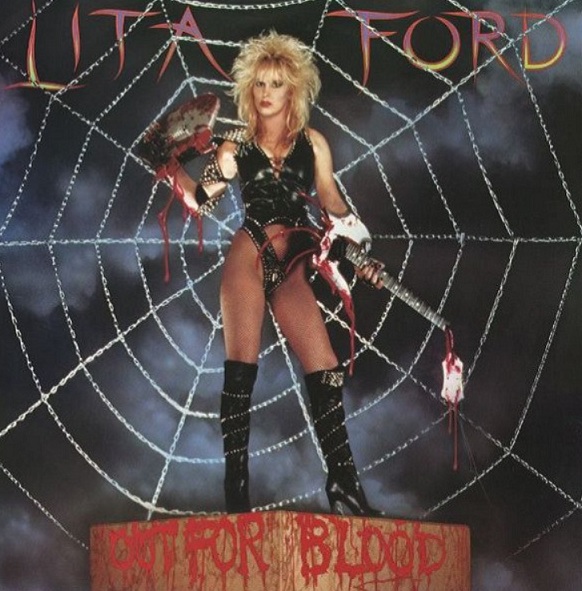
Merryweather, sensing the changing times, adopted a pop-rock, new-wave sound with Eyes, a Holland-based band featuring ex-members of the Nina Hagen Band* and Herman Brood’s Wild Romance*, which released Radical Genes on RCA Records. However, Merryweather returned to his heavy-metal roots — inventively streamlining and glamming the “old sound” for a wider, commercial appeal — as the manager, bassist, and chief songwriter for the solo career of ex-Runaway Lita Ford on her progenitive hair-metal debut, Out for Blood.
Leaving the industry after the Ford project, but not leaving his creative side behind, Merryweather forged a career as an award-winning painter, sculpture, and photographer and worked in the creative department for the City of Los Angeles Department of Public Works. As the calendar flipped to the 21st century, Merryweather returned to the music business, composing music for teen-oriented television shows and, with ex-Space Rangers Mike Willis and Jamie Herndon, made plans to enter the studio for a new, third Space Rangers album. His other music projects — formed with ex-Space Ranger Jamie Herndon and ex-Lita Ford drummer Dusty Watson were known as Hundred Watt Head and The La La Land Blues Band.
His last project, prior to his passing, was a third album with Janne Stark, formerly the guitarist with Swedish New Wave of British Heavy Metal upstarts Overdrive, which released the classic hard rock albums Metal Attack (1983) and Swords And Axes (1984). You can learn more about the Merryweather Stark band — and their albums Carved in Rock (2018) and Rock Solid (2020) — at their official Facebook page. You may leave condolences at Neil Merryweather’s personal Facebook page, which will continued to be managed by his survivors.
Neill completing one of his many artworks/courtesy of Neil Merryweather Facebook.
And, with that, let’s roll the films — and TV series — of Neil Merryweather!
The Seven Minutes (1971)
Leave it to Russ Meyer — of Beyond the Valley of the Dolls fame — to be the only filmmaker to realize the soundtrack potential of the musical scope that is Neil Merryweather. And the potential behind the well-researched, sexually-charged novels of screenwriter Irving Wallace (his early ’60s books, published by Simon & Schuster — The Chapman Report, The Prize, The Man, and 1976’s The R Document — were all adapted, as was The Seven Minutes, by others).
While Russ Meyer’s name immediately says “sex,” the film carries a deeper meaning on the effects of pornography and its relationship to issues regarding freedom of speech: it’s also a meta-movie: about a book, The Seven Minutes, purported as the “most obscene piece of pornography ever written.” A district attorney on the political fast track for a senatorial seat uses the book’s erotic infamy to indict a college student for a brutal rape and murder, as well as the book store owner who sold the book to the student.
Typical of a Meyer film, while it lacks his usual “tits and ass” (demanded by the studio), the casting is B&S About Movies-crazed: In addition to Meyer’s wife and 20th Century Fox Studios’ contract player Edy Williams, the cast features Yvonne De Carlo, John Carradine (the last decent film he was in), the always-welcomed Charles Napier, a self-playing Wolfman Jack, and in another early role, Tom Selleck (Daughters of Satan).
As for Neil Merrryweather: “Midnight Tricks,” from his pre-Mama Lion joint album with Lynn Carey — Vacuum Cleaner (1971) by the concern Merryweather & Carey — appears in the film. (Neil’s works with Heavy Cruiser and Mama Lion were distributed by the Paramount Studios-imprint, Family Productions.)
The duo’s relationship with Meyer goes back to the smut-auteur recruiting Lynn Carey for the Stu Phillips-produced soundtrack to Beyond the Valley of the Dolls (Battlestar Galactica ’78 is one of his many); Lynn sings (“Find It” and “Once I Had You”) for that film’s character in the faux band, The Carrie Nations, along with Barbara “Sandi” Robison. While Lynn’s voice appears in the film, for legal reasons, she does not appear on the subsequent, original soundtrack album.
As a child actress, Lynn appeared in the ’60s series The Man from U.N.C.L.E and Lassie; in the early ’80s, she had a stint on the U.S. daytime drama, Days of Our Lives. She made her lone film appearances in Lord Love a Duck (1966; with Roddy McDowall) and How Sweet It Is! (1968; with James Gardner). Lynn’s attempt at moving into ’80s AOR (think ’80s glam-bent Heart) led to her songs appearing in I Married a Centerfold (1984), Challenge of a Lifetime (1985), Radioactive Dreams (1985) (“All Talk” appears in the film, but on the soundtrack), Hollywood Harry (1985), and Combat High (1986).
Lita Ford: Out for Blood (1983)
By the mid-70s, Neil resided in the Netherlands, where, through Chrysalis Records in London, he set up an imprint, Clear, in cooperation with the Dutch company, Dureco. While developing new acts out of Chrysalis’ studios in Miami and Los Angeles, he released his 12th album, his three-years later follow up to Kryponite (1975) by the Space Rangers, with the solo album, Differences (1978). He then formed the more timely, new-wave outfit Eyes, which released their lone album, Radical Genes.
Then, with new wave and punk on the downward stroke and glam metal on the rise: a new musical adventure called forth. . . .
You know the story: Lita Ford was a member of the Runaways (duBeat-e-o). Joan Jett was fed up with Cherrie Currie (The Rosebud Beach Hotel) as the frontwoman. Currie was tired of being pushed on back burner. Joan wanted to take the band in a punk vein (which she did: with members of the Clash and the Sex Pistols, which morphed into her solo debut, Bad Reputation). Lita wanted to take the band in a metal direction, which Joan hated.
So, Neil, as he did with Lynn Carey, first with the Vacuum Cleaner duo project, and their two albums with Mama Lion, found a new muse for his next musical direction: a creative detour that returned to his ’70s hard-rock roots first explored in the bands Heavy Cruiser and the Space Rangers.
As the mastermind behind a new, full-metal Lita, Neil served as her manager and producer (Billy Joel’s ex-Svengali, Artie Ripp, co-produced). In addition to playing bass — his career instrument of choice — Neil wrote four of the albums nine cuts: the album’s title cut song (posted above), “Ready, Willing and Able,” “Die for Me Only (Black Widow),” and “On the Run.” If you know Neil’s artistic side: he designed all of his own albums covers, costumes, and stage shows throughout his career: Out for Blood for blood was no exception: he constructed the chain-web, the cover, and the band’s outfits; he also designed the MTV video single.
Sadly, his partnership with Lita Ford was short-lived. The experience was such that Neil retired from the business to work as a graphic artist — his second biggest love — for government agencies in Los Angeles and Las Vegas. He went on to win numerous awards for his paintings and multi-media pieces.
Ash vs. Evil Dead (2016)
What can we say about this Equinox (1970) inspired franchise from Sam Raimi that hasn’t already been said? Well, we finally worked up the courage to say something about the film that started it all, Evil Dead (1981) — at least Sam “the Bossman” Pacino did — of the highly-influential “Midnight Movie” splatter fest.
As for the series, itself: we touched base with the Bruce Campbell-starring series as part of our “Lee Majors Week” tribute blowout — as Lee appeared as Brock Williams, Ash’s pop, in the second and third seasons of Starz’s Ash vs. Evil Dead.
As for the Neil Merryweather connection: “Star Rider,” from the Space Rangers’ 1975 second and final album, Kyrponite, appears in “Home”; the first episode of the series’ second season, it served as the introduction to Lee’s character.
So, wraps up our exploration of Neil’s all-too-brief connection to film.
You can discover and listen to Neil’s catalog on his official You Tube page. There are also numerous uploads of his albums by his many, worldwide fans.
We previously explored the soundtrack work of the late Eddie Van Halen — as well as his lone acting gig — with our “Exploring: Eddie Van Halen” on Film” feature.
* We reviewed Nina Hagen and Herman Brood’s dual-acting roles in the film Cha-Cha (1979).
About the Author: You can learn more about the writings of R.D Francis on Facebook. He also writes for B&S About Movies and publish music reviews and short stories on Medium.
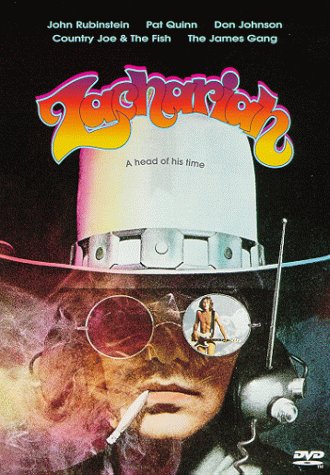
“The first electric Western” is the kind of movie that could have only have come out in 1971.
How else do you explain a musical Western that is based on Hermann Hesse’s novels Siddhartha and Narcissus and Goldmund that stars — and has music by — the James Gang (featuring Joe Walsh, playing Job Cain’s Band), White Lightnin’ (a Cream soundalike band that Old Man’s Band), New York Rock ‘n Roll Ensemble (a classical baroque rock group that includes Michael Kamen (who did incidental music for Lifeforce but is probably better known for all those Bryan Adams songs that your mom loved), Marty Fulterman (AKA Mark Snow, who composed the X-Files theme) and Dorian Rudnytsky, plus two rock musicians Brian Corrigan and Clif Nivison, as Belle Starr’s band) and Country Joe and the Fish as the Crackers?
This is a movie with no less than five writers**:
Joe Massot: This filmmaker is best known for George Harrison’s Wonderwall, as well as starting Led Zeppelin’s The Song Remains the Same before being sacked and subbed by Peter Clifton*. Massot was inspired to make this movie when he followed the Beatles to study with Maharishi Mahesh Yogi. When he got there, only George*** and John were there, locked in a meditation duel.
Phil Austin, Peter Bergman, David Ossman and Philip Proctor: Better known as The Firesign Theater, who was called “the Beatles of comedy” by no less a source than the U.S. Library of Congress, this surreal comedy group existed to remind us that “Everything You Know Is Wrong.” Again, only in the 70s and not today, but they became famous through radio and comedy albums.
After finding a mail-order gun in the desert, Zachariah (John Rubinstein) and his best friend Matthew (Don Johnson) leave behind their small town and decide to become gunfighters. They start to follow the Crackers and Zachariah shows that he’s an able gunfighter, but when challenged by the deadly gunfighter drummer Job Cain**** (Elvin James, who played drums for John Coltrane, Charles Mingus and Miles Davis), Zachariah decides to leave behind this life, worried that at some point he and Matthew will end up killing one another.
Zachariah’s vision quest takes him to the Old Man who lives alone in the desert and refuses the violence of the west. He tells him of the town of El Camino, a place where pleasure — and Dick Van Patten — is readily available, including the carnal delights of Belle Starr (Pat Quinn, who played Alice in Alice’s Restaurant). But hedonism isn’t what our protagonist is into either. So he wanders back to the Old Man who teaches him the mantra “Hurry up and die.”
On the other hand, Matthew has moved up in the world of crime and has plans of taking over from Cain. He travels to El Camino where he meets Zachariah, who takes up his gun again and angers the Old Man so much that he claims that he will never speak with him again.
The conclusion takes both men into town where the death of Cain — and possibly both of our heroes — hangs over the proceedings. Can Zachariah’s love for his friend save both of them?
Director George Englund was married to Cloris Leachman for nearly twenty-five years and also made The Ugly American and produced the post-apocalyptic film The World, the Flesh and the Devil.
I have no idea why people aren’t losing their minds over this movie every single day. It’s a head film about cowboys who carry guitars along with their guns and where a man — a black man in 1971! — can shoot another man dead before playing a two-minute drum solo. Just imagine if the role went to the musician it was originally intended for, legendary maniac Ginger Baker.
*Strangely enough, Clifton had one of the missing NASA films of Neil Armstrong taking mankind’s first steps on the moon. Wait, what? Yes, believe it or not, Clifton has forgotten that he had the film, keeping it for twenty years in a safe as part of his personal film collection. He had originally ordered the film for just $180 from the Smithsonian and had forgotten to return it. The rest of the original NASA tapes have been lost somewhere in the U.S. and the hope is that Clifton’s part of the overall library will lead researchers to the rest.
**AFI reports that the Firesigns publicly rejected the film because their original script had been changed so much. Massot, who was to be the director, resigned over artistic differences.
***According to Levon Helm, Harrison discussed making Zachariah as an Apple Films project starring Bob Dylan and The Band. At one point, Cream’s drummer Ginger Baker and The Band were also to be the main actors in this movie.
****The sound was so poorly recorded here that New Orleans session drummer Earl Palmer had to play an ADR and hit every single bear. You can hear Palmer play on everything from Little Richard’s “Long Tall Sally” and Richie Valens’ “La Bamba” to “You Send Me” by Sam Cooke, Jan and Dean’s “Dead Man’s Curve,” “River Deep – Mountain High” with Ike and Tina Turner and Tom Waits’ “Whistlin’ Past the Graveyard.” He was also the session drummer for plenty of TV theme songs like The Flintstones, Green Acres, The Brady Bunch, Midnight Special and Mission: Impossible. At 72 years of age Palmer played with Cracker in the video for “I Hate My Generation.” When lead singer David Lowery asked Palmer if he would be able to play along with the songs, he looked at the one-time Camper Beethoven singer and bassist before simply saying, “I invented this shit.”
EDITOR’S NOTE: Obviously, I liked this enough to watch it twice.
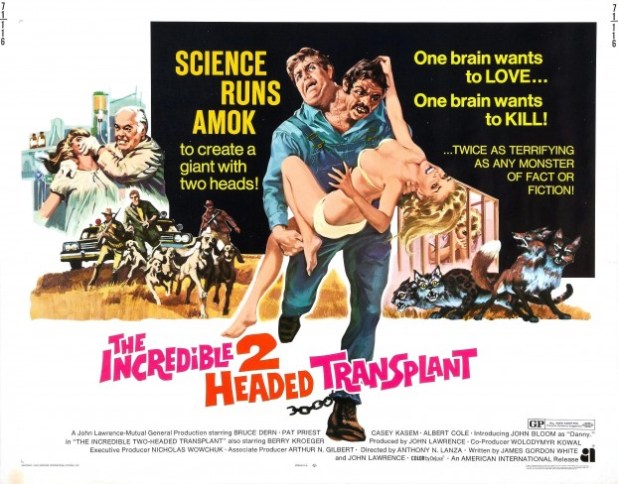
What was in the water of the early 70s to make this movie and The Thing with Two Heads within a year of one another?
This one has Bruce Dern putting the head of a serial killer onto the body of the son (John Bloom, who was the monster in Dracula vs. Frankenstein) of the man who he has just murdered, because that’s how movie science works. What happens when you combine the head of a murderer with the head of a manchild with the mental capacity of an eight-year-old and an extremely powerful body? You get murder and mayhem.
Second Marilyn Pat Priest gets kidnapped and Casey Kasem comes to the rescue and you know, I’m a huge fan of movies where Casey show up, like Disco Fever, in which he tries to find cocaine in the carpet of a nightclub inside an airplane.
American-International Pictures put this on a double bill with Scream and Scream Again, but poor Bruce Dern had his check bounce and when he went to the set the next day to get paid, there was no set left.
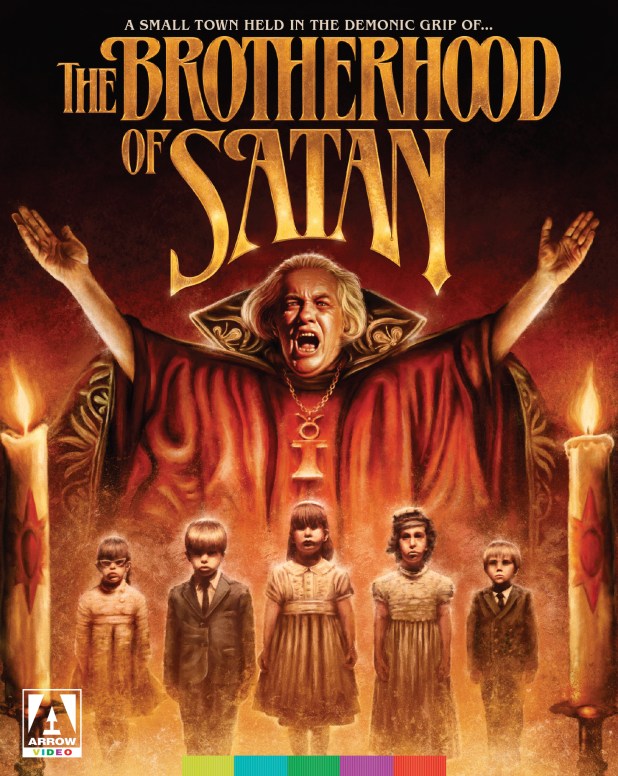
We’re all over this movie. Dustin Fallon reviewed it for us. So did R. D Francis. Sam took a shot at it and even appeared with Groovy Doom and Drive-In Asylum’s Bill Van Ryn on Scream Queenz to dish on its Satanic majesty.
Now, Arrow Video has released this 70s shocker on blu ray and we couldn’t be more excited.
Ben is a recent widower, but hey — he’s taking his new girl Nicky on a road trip and making out with her whenever he can. Unfortunately, that trip also has his daughter K.T. (fake Jan Geri Reischl) along for the ride and she’s perfectly ready to drip sticky melted snow cone all over her new mommy’s face and ruin some side of the road necking.
The journey takes them to the town of Hillsboro, where the townspeople have been hiding from a great evil that seems to be killing everyone and making their children go missing. And the murders? Well, toys are involved and people are reduced to madness just by confronting the evil in their midst.
Strother Martin is Doc Duncan, who is either the human behind all of this or Satan himself and man, he’s great in this movie. Everyone is. It’s a low budget drive-in film, sure, but it’s also astoundingly sure of itself and a film that presents itself with great intelligence. It has one hell of an exploitation title but also has so many disquieting moments that will stay with you long after you finish watching.
The new Arrow Video release has a great looking version of the film, plus brand new audio commentary by writers Kim Newman and Sean Hogan, a video essay by David Flint entitled Satanic Panic: How the 1970s Conjured the Brotherhood of Satan, an exclusive new interview with actors Jonathan Erickson Eisley and Alyson Moore, plus original trailers and TV and radio ads.
As he broke down several comic book characters setting, origin, characters and their motivations, he realized that these elements all added up to create what he calls a storytelling engine. This makes it simpler for writers to make no end of stories. To wit: the better the engine is built, the easier it is to write a new story.
The engine can also shift and Batman is a great example. The character started as a takeoff of The Shadow, a very hard-boiled detective before getting softer with the introduction of Robin, the 50s science fiction era and the 60s pop art Batmania fad. By the 70s, however, Batman had grown to become the hairy-chested love god with Neal Adams art, battling an international army of assassins and even falling for one of them. At this point, Batman has grown to have so many different versions — or engines — that you can approach the character in nearly any fashion.
Hellboy was the first character that I consciously studied with this theory in mind. Hellboy has his backstory of being the son of the devil destined to bring about the end of everything, yet he was adopted and brought into an occult task force that fights monsters just like him. Within this sentence, you can see an infinite array of storytelling ideas.
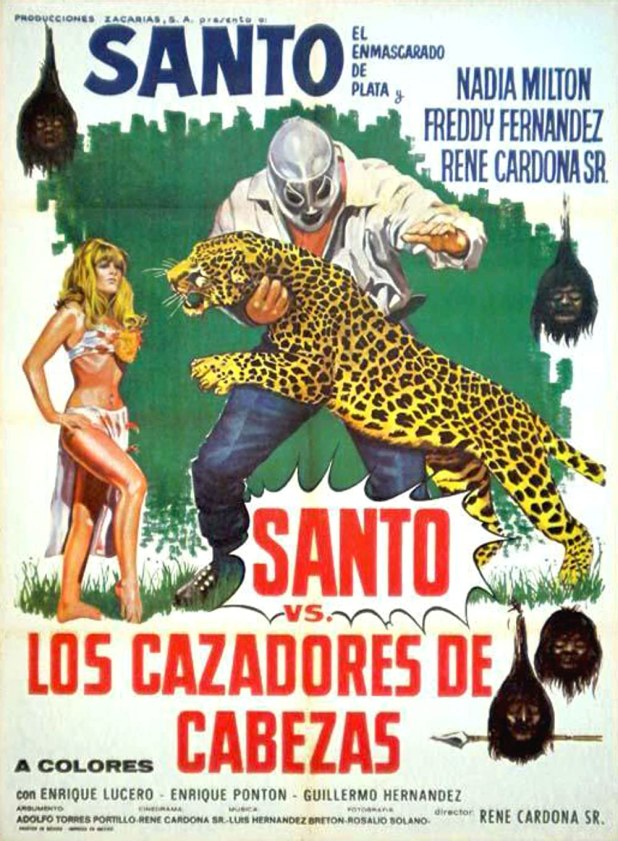
Santo is the maestro of the storytelling engine. Just look at all he can do. First and foremost, he’s a capable fighter who can defeat just about any foe in hand-to-hand combat. He’s also an inventor who has created video screens before smartphones and even time machines. His enemies start with other wrestlers and gun-toting gangsters, but also have in their number aliens, a blob, vampires, werewolf women, a cyclops, witches and even Mexican folk characters. And the narrative shifts of his films allow them to fit into nearly any genre, from Italian-style western to Eurospy, karate film to Eurospy.
Now we can add the mondo to the films of Santo.
The Jivaros are the descendants of the Incas, the ancient indigenous people of Mexico whose empire and treasures were stolen by Spain. One of them, Tirso, has already tried to stab Santo with a bamboo dagger. Now, he wants to kidnap a wealthy explorer’s daughter, shower her with riches, give her the title of the Bride of the Sun, then sacrifice her to their gods.
Santo does a lot of walking in this and a lot of fighting nature, going mano a garra with alligators, jaguars, vampire bats and native tribesmen who launch a monkey into a piranha-filled river* at one point.
I say that this is a mondo because large stretches of it deal with the “other” that exists within the jungle and the strange customs of another race. It also looks to the Bond films for inspiration as this has plenty of travelogue — and walking — scenes.
*Don’t worry. This was directed by René Cardona not Ruggero Deodato. Then again, Cardonna did make Night of 1000 Cats.
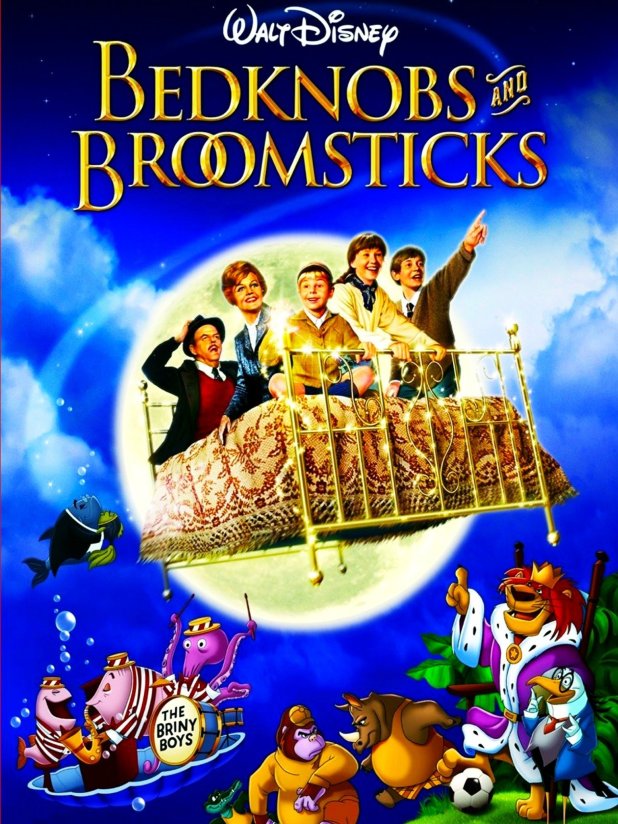
Based on Mary Norton’s The Magic Bedknob; or, How to Become a Witch in Ten Easy Lessons and Bonfires and Broomsticks, this film developed in the 1960s when it looked like Mary Poppins wouldn’t get made. Due to its similarities to that movie—Julie Andrews was considered for the lead in this, but she hesitated, and Angela Lansbury got the role—it was put on hold.
As the Sherman brothers’ contract with the Disney studios was about to end, they were brought back to work on this film, bringing back the song “The Beautiful Briny” meant for Mary Poppins.
Taking place during the Blitz or World War II, Bedknobs and Broomsticks is the story of the Rawlins orphans, who are evacuated from London to the countryside and the care of Miss Eglantine Price (Lansbury). They decide to run away, but watch their temporary foster parent fly on a broomstick and decide to stick around.
She tells the chldren that she’s learning witchcraft to protect the UK from the Nazis and is currently a student at the school of Professor Emelius Browne (David Tomlinson). When she discovers that the school is shutting down, she travels to find the professor and discover the final spell she needs to learn to become a witch.
It turns out that Browne is a showman more than a sorcerer and made up all of the spells, but they all still work when Price casts them. She must travel to Portobello Road to locate the rest of the book cut in half to get the final spell. It turns out that the rest of the spell is engraved on the Star of Astaroth, a sorcerer’s medallion given to a pack of wild animals that were given the power to speak. The group enters an animated world where Browne can spirit away the treasure.
Yet things will become dark when they return home and the children consider that the two magic users could be their parents. And darker still when the Nazis finally attack. Will the skills that Price has learned be enough to protect them all?
The film originally ran 141 minutes. That said, the Radio City Music Hall premiere had to work in the theater’s elaborate stage show, so 23 minutes were cut from the film. Those lost scenes include nearly all of Roddy McDowall’s character and three songs, “A Step in the Right Direction,” “With a Flair” and “Nobody’s Problems.” “Portobello Road” had seven minutes cut out before the movie as restored as part of its twenty-fifth anniversary, with Lansbury and McDowall redubbing their voices. Sadly, Tomlinson was too ill to record, so Jeff Bennett recorded his lines.
I totally enjoy that this is a more occult-based Mary Poppins. Crowley, who invented the V for Victory symbol, would be proud.
Editor’s note: We originally covered this film on March 27, 2019, but want to bring it back to our readers’ attention, particularly as Arrow Video has released an amazing new UHD version of the film.
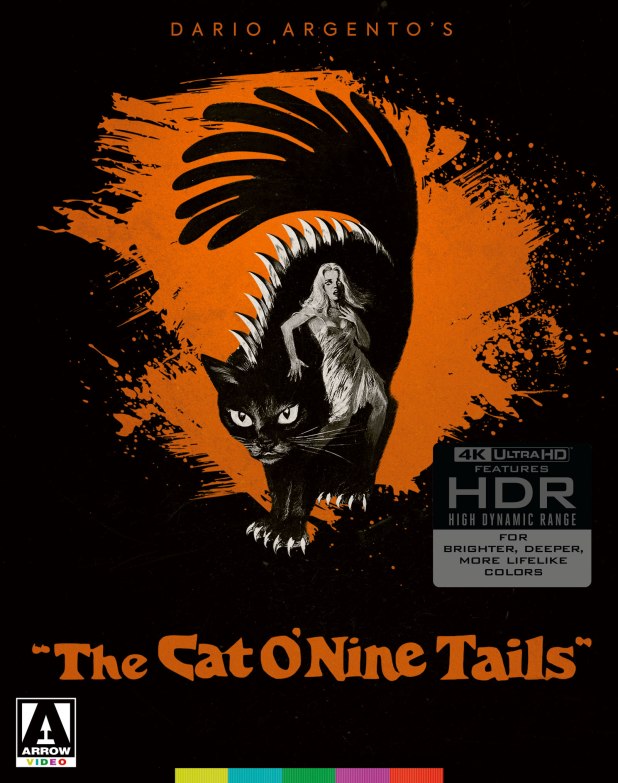
The second in Dario Argento’s “Animal Trilogy” with The Bird with the Crystal Plumageand Four Flies on Grey Velvet, this film isn’t one of the director’s favorites and it failed to follow up on the success of the first film in the United States, although it was very popular in Italy. It’s filled with a lot more humor — it still has plenty of shocking moments — and kind of meanders around. But there’s still so much to enjoy.
Franco “Cookie” Arno (Karl Malden) is a blind man who is obsessed with solving puzzles. One comes to him in real life as he walks at night with his niece Lori. They overhear a man plan to blackmail someone, then that man breaks into the Terzi Institute. We meet our second hero, the reporter Carlo (James Franciscus) when he investigates the affair.
The head of the institute, Dr. Calabresi, looks at his files in his office and phones someone who agrees to meet with him. He tells his fiancee Bianca (Rada Rassimov, the sister of Ivan, which you can tell by her eyes) that whatever was taken could be a big step forward. As the doctor waits on a train platform, he’s pushed off a train platform. This brings the two heroes together and starts a string of murders, as anyone connected to the mystery is quickly killed.
It turns out that the Terzi Institute is able to isolate the chromosomes that point to evil tendencies within people and they have a miracle drug that can change that. Carlo also becomes involved with Professor Terzi’s daughter Anna and they’re followed by both the police and the killer.
From milk being poisoned to dead bodies being searched in the middle of the night inside a crypt, the noose tightens around our heroes’ necks, with even Cookie’s niece being kidnapped and in danger. And oh yeah — his girlfriend and her adoptive father have had an incestuous relationship for years.
There’s a rooftop battle that may or may not take out one of the protagonists — the movie doesn’t even tell us — and finally the killer is knocked down an elevator shaft, his hands bleeding as he tries to grab the cable to stop him. It’s one of the few moments of sheer awesome in this film, but hints that greatness is in the future of Argento’s films.
Arrow Video’s new release of The Cat o’Nine Tails hasa 4K restoration from the original negative by Arrow Films that has been released as a 4K (2160p) UHD Blu-ray presentation in Dolby Vision. The film has audio commentary by critics Alan Jones and Kim Newman, plus there are new interviews with Argento, co-writer Dardano Sacchetti, actress Cinzia De Carolis and production manager Angelo Iacono. The package also has script pages for the lost original ending, translated into English for the first time; the original Italian, international and US theatrical trailers; an illustrated collector’s booklet featuring an original essay on the film by Dario Argento and writing by Barry Forshaw, Troy Howarth and Howard Hughes; a fold-out double-sided poster featuring original and newly commissioned artwork by Obviously Creative; six double-sided, postcard-sized lobby card reproduction artcards and limited edition reversible packaging. You can get it from MVD.







 B&S About Movies
You must be logged in to post a comment.