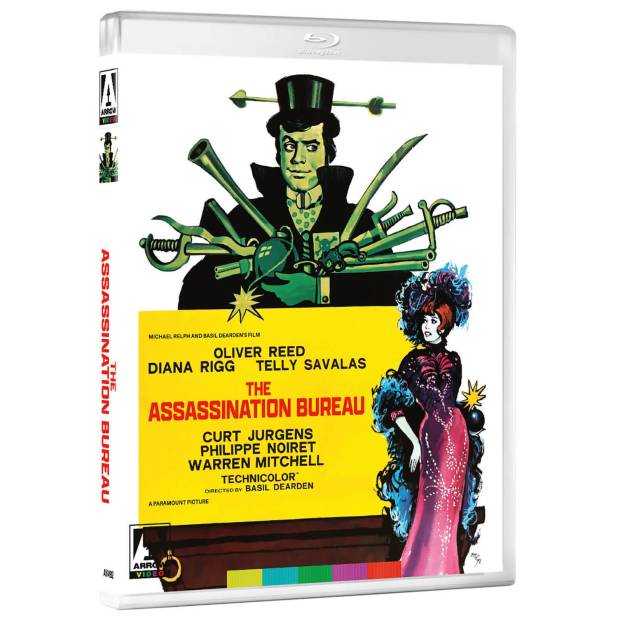
ARROW BLU RAY RELEASE: The Assassination Bureau (1969)

Based on an unfinished novel by Jack London published posthumously — it was finished by Robert L. Fish — in 1963, this Basil Dearden-directed movie was written by Michael Relph and Wolf Mankowitz. Reporter and women’s rights champion Sonia Winter (Diana Rigg) doesn’t just want to expose the Assassination Bureau Limited, she wants to destroy them and have its chairman, Ivan Dragomiloff (Oliver Reed), assassinated.

This delights Dragomiloff, who goes back to the teachings of his father, who started the killing cabal and said that they needed to only kill people who deserved to be killed. Now, his father’s colleagues kill for money instead of reasons of morality, so he dares them: accept Winter’s contract and kill him before he murders them.

From Paris and Zurich to Venice and Ruthenia, they battle the killer elite in humorous battle, climaxing in the entire Assassination Bureau — and their true leader, Lord Bostwick (Telly Savalas), who was Winter’s boss who got this whole business started — to protect the world’s leaders as they enter peace talks while a bomb-bearing zeppelin hovers overhead.

Later this same year, Rigg and Savalas would battle again in On Her Majesty’s Secret Service.

I really had fun with this movie, as sure, it’s a 1969 big budget and somewhat aged spy epic from a time unfamiliar to my American eyes. But man, Rigg is a delight and Oliver Reed is wonderful. And Telly seems to be having a great time, too.

The Arrow Video release of The Assassination Bureau has new audio commentary with authors Sean Hogan and Kim Newman; Right Film, Wrong Time, a 30-minute appreciation by critic, broadcaster and cultural historian Matthew Sweet; a trailer; an image gallery; a reversible sleeve featuring two original artwork choices and an illustrated collector’s booklet featuring new writing on the film by Katherine McLaughlin and a set of six reproduction lobby cards from the original release. You can get it from MVD.

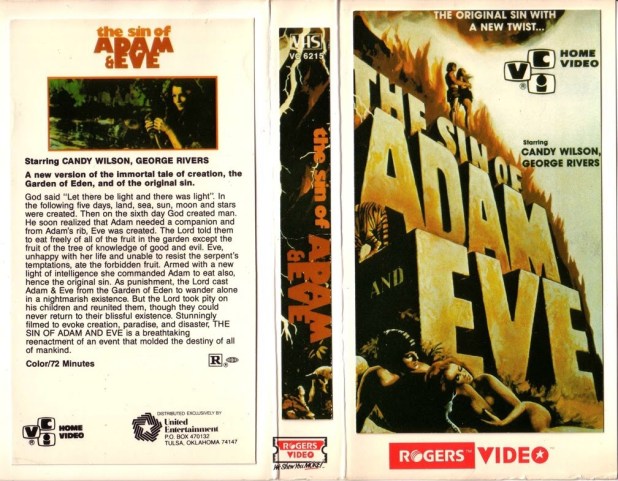
NEW WORLD PICTURES MONTH: The Sin of Adam and Eve (1969)

Miguel Zacarías is the same Michel Zacharias that executive produced Demonoid and The Bees, but before that he directed fifty-five films and wrote fifty-one. He directed and wrote this film and must have really enjoyed bringing religious films to the screen, because he also directed Jesus: Nuestro Senor, Jesus: el Nino Dios and Jesus, Maria Y Jose.

Yet this movie was sold in America by New World and that was probably because for most of the movie, Jorge Rivero (billed as George Rivers; you may know him as Mace from Fulci’s Conquest or from the Santo movies he co-starred in like Operation 67 and El tesoro de Moctezuma or the movie Fist Fighter and Fist Fighter 2 where he played the amazingly named C.J. Thunderbird) and Kandy (sold in America as Candy Wilson; she only appeared in one other film, Si vous n’aimez pas ça, n’en dégoûtez pas les autres, which translates as If You Don’t Like It, Don’t Disgust Others) are naked for the entire movie. Other than Kandy’s long hair spirit gummed to her chest and strategically placed scenery to keep one from seeing full frontal, this movie doesn’t skimp on the naked time, but then again, Rivero and Kandy have nearly perfect bodies.

This movie is set inside what 1969 thought the Garden of Eden looked like and after that apple gets bit into, well, it also turns into the best stock footage available as well as animal madness and this being Mexico, one can imagine that the ASPCA was nowhere near the set of this movie. There’s also a moment when giant flaming wooden daggers literally rain down, keeping Adam and Eve from finding one another until the end, when they have found loincloths and I’ve never been more upset about original sin.

Supposedly, Kandy was an American tourist lured into being in this movie. Can a Biblical film be sleazy? God bless you, Mexico.

ARROW BLU RAY RELEASE: The House That Screamed (1969)

Spain’s first major horror film production, The House that Screamed—AKA La Residencia and The Boarding School—was based on a story by Juan Tébar. Because the cast included both English and Spanish actors, the film was shot in both languages and then dubbed into English in post-production.

Directed and written by Narciso Ibáñez Serrador (Who Can Kill a Child?), it takes place at a school for girls—reforming them and making them acceptable wives for their future husbands—in 19th-century France run by Headmistress Señora Fourneau (Lilli Palmer). Teresa Garan (Cristina Galbó, The Living Dead at Manchester Morgue) is a newcomer to the school and instantly notices just how strange of a place it is. For example, she always feels like she’s being watched.

Fourneau rules the school by the whip—quite literally, she has no problem beating her students into submission—and has Irene Tupan (Mary Maude), an older student, as her near WIP second-in-command.

Yet things are not alright. Students keep going missing, Teresa is bullied when the girls discover that her mother is a prostitute, and Luis (John Moulder-Brown), Fourneau’s son, is in love with Teresa despite the rules of her mother, who believes that none of these girls are good enough for him. He was once interested in Isabelle (Maribel Martín, The Blood Spattered Bride) until his mother roughly helped his face and intoned, “These girls are not good enough for you. What you need is a woman like me!”

That’s when the film literally goes Psycho, wipes out a main character, and the narrative transforms an antagonist into the protagonist. The horror, however, is nowhere near over for anyone. That idea of Luis finding a woman just like his mother haunts the headmistress.

This gorgeous movie predates Argento’s Bird With the Crystal Plumage by a few months and Suspiria by eight years. It’s as much a slasher as a gothic horror movie and works as both, and it has elements of Giallo and Women in Prison films. Yet, above all, it remains classy and has lush colors, incredible cinematography and luscious interiors, making this quite the furniture movie. Even better, you can see the film that was taken from it. Pieces might be a tribute movie, even if it’s not a movie discussed all that often in the U.S.

I hope that the new Arrow Video release can change that.

It comes with a brand new 2K restoration from the original negative by Arrow Films along with an audio commentary by critic Anna Bogutskaya. Extras include interviews with John Moulder-Brown, Mary Maude, Juan Tébar, the director’s son Alejandro Serrador and Spanish horror maestro Dr. Antonio Lázaro-Reboll. There’s also alternative footage from the original Spanish theatrical version, trailers, TV, radio spots and an image gallery. It comes inside a reversible sleeve featuring original and newly commissioned artwork by Colin Murdoch and has an illustrated collector’s booklet featuring new writing on the film by Shelagh Rowan-Legg and double-sided fold-out poster featuring original and newly commissioned artwork by Colin Murdoch. You can order The House That Screamed from MVD.

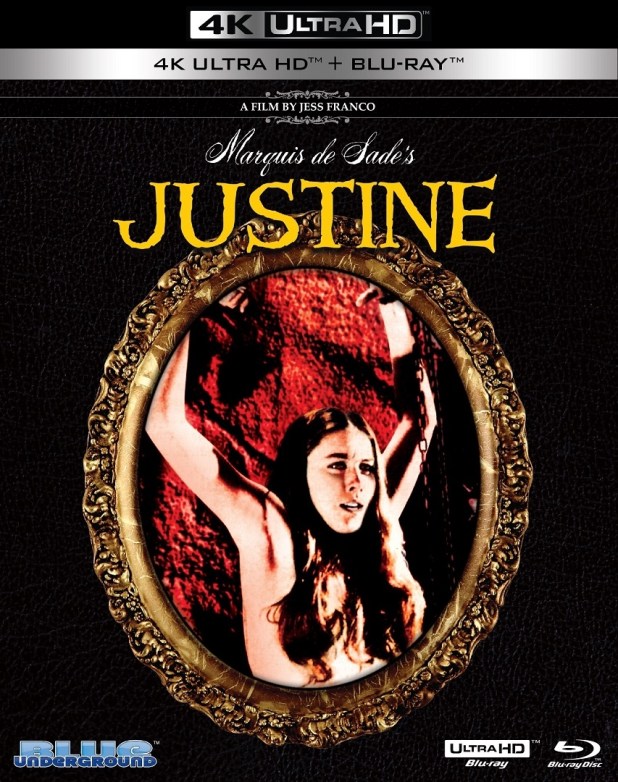
BLUE UNDERGROUND 4K RELEASE: Marquis de Sade: Justine (1969)

EDITOR’S NOTE: This was originally on the site during the first Jess Franco month on February 1, 2022. I’m excited, though, because it’s been released on 4K UHD by Blue Underground.

The Blue Underground 4K UHD released oh Marquis de Sade: Justine has a brand-new 4K restoration from the uncensored original camera negative with Dolby Vision HDRand loaded with extras, including the alternate Deadly Sanctuary cut in HD for the first time ever.

It also has new audio commentary by film historians Nathaniel Thompson and Troy Howarth, an interview with Jess Franco and writer/producer Harry Alan Towers, Stephen Thrower discussing the film, an interview with Rosalba Neri, the French trailer, a poster and still gallery and in addition to the Deadly Sanctuary version, the shorter U.S. edit of the film in HD.

You can get it — and should — from MVD. 

After The Blood of Fu Manchu, producer Harry Alan Towers and Jess Franco wanted to make a more adult film and this movie was the result, made with a million dollar budget, which isn’t much for some people but would be one of Franco’s largest budgets.

There were still some issues, like how Rosemary Dexter (Eye in the Labyrinth) was supposed to play the lead, yet she was moved to the smaller role of Claudine when Romina Power was chosen by a Hollywood moneyman to play the lead. Franco was unhappy with her in the movie, saying “most of the time she didn’t even know we were shooting” and that he had to rewrite the story and move away from DeSade as she was so hard to reach.

Justine and Juliette (Maria Roma) are sisters who live in a convent, a place they’re taken from when he dies and leaves his gold behind. While Juliette goes to stay at Madame de Buisson’s (Carmen de Lirio) house of ill repute, learning the skills of the oldest business, her sister Justine goes to the church, where a priest introduces her to du Harpin (Akim Tamiroff), who hires her on as a maid, but it’s all a scheme to steal from his master and use her as a stooge, yet Justine escapes prison thanks to Madame Dubois (Mercedes McCambridge, can this movie have more great actors in it? Yes, it can.).

While all this is going on, Juliette and another prostitute named Claudine (yes, Rosemary Dexter who was supposed to be the lead) kill their boss and a client, stealing gold and going on the run all the way to Madame Dubois. The men there end up trying to assault her more innocent sister, as she runs to the home of an artist named Raymond (Harald Leipnitz) before being caught in the murderous games of the de Bressacs (Horst Frank and Sylva Koscina), which ends up getting her branded with an M — for murderess — on her breast.

I kind of love that every decision that Juliette makes is stuff like killing people and drowning her crime partners while Justine ends up trapped in all manner of Little Annie Fanny situations like being kidnapped by Father Antonin (Jack Palance) and his order of ascetics. Instead of studying and meditating, they’re making filthy love to anything that moves. When Father Antonin offers to free Justine from this world by making her a sacrifice, but she escapes yet again, finally finding her way back to her sister.

Meanwhile, the Marquis de Sade (Klaus Kinski) has hallucinated this all while stuck in prison, obsessed as always with female flesh. I mean, when Rosalba Neri is in the story you’re imagining, wouldn’t you? Also — just as a warning — Rosemary Dexter was 16 when she made this. Fair warning.

People often ask me, “What’s the one Jess Franco movie I should watch?” Depending on how well you can handle this material, this would be the best produced of his movies, filled with gorgeous settings, period perfect costumes, a wonderful Bruno Nicolai score and perhaps the most focused Franco I’ve seen, despite the fact that he wasn’t getting to make the movie that he wanted to make. And if you’re a maniac, I have a bunch more to tell you about.

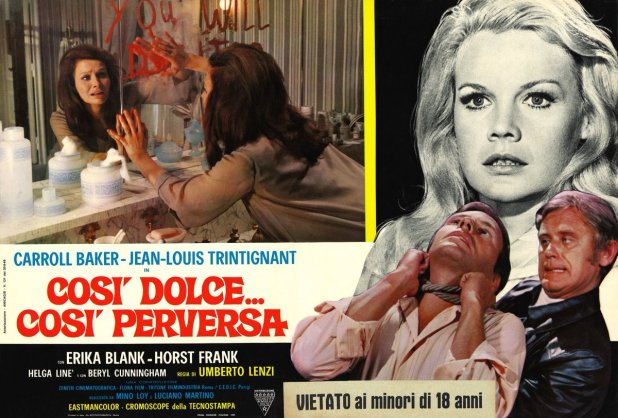
Cinematic Void January Giallo 2023: So Sweet…So Perverse (1969)

EDITOR’S NOTE: Cinematic Void will be playing this movie on Tuesday, January 17 at the Music Box Theatre in Chicago, IL (tickets here). For more information, visit Cinematic Void. It’s also available in The Complete Lenzi/Baker Giallo Collection set from Severin, which has plenty of other great films like OrgasmoA Quiet Place to Kill and Knife of Ice.

Umberto Lenzi’s early giallo — before the Argento-influenced Seven Blood Stained Orchids — feel more like film noir than the standard films of the genre. Speaking of that same movie, it would also use the J. Vincent Edward song “Why.” And while we’re discussing influences, this movie is definitely feeling all sorts of Les Diaboliques.

Jean (Jean-Louis Trintignant, Amour) is a rich socialite who has come to the aid of Nicole (Carroll Baker!), a gorgeous woman mixed up with Klaus (Horst Frank, The Dead Are Alive). Sure, Jean is married, but that doesn’t stop him from falling for her, even when he learns that she’s been paid to kill him. Of course, his wife Danielle (Erika Blanc!) is mixed up in this, but Nicole is smarter than she seems. Beryl Cunningham (The Salamanders) is also in this as a dancer and Helga Line (Nightmare Castle) is on hand as well.

This was produced by Sergio Martino and has a screenplay by Ernesto Gastaldi, the writer of The Whip and the BodyThe PossessedThe Sweet Body of Deborah and All the Colors of the Dark. And check out that Riz Ortolani score!

This is a classic giallo with so many of the finest actresses of the form and perhaps its best writer scripting.

AMANDO DE OSSORIO WEEK: Pasto de fieras (1969)

Tino (Ángel Luis Nolías) is an orphan who lives with his uncle Quico (Xan Das Bolas) and works as a shepherd, but one night everything goes wrong. His dog gets killed by a car and his sheep are stolen by a circus who wants to use them for tiger food, so he decides to run away to America.

Based on a story by José Antonio de la Iglesia, this was directed and written by Amando de Ossorio and would be followed up the same year by his first entry into horror, Fangs of the Living Dead. He also worked in other genres than just slow motion Knights Templar whipping and killing women, including the westerns La tumba del pistolero and Hudson River Massacre, as well as the crime movie Las alimañas.

AMANDO DE OSSORIO WEEK: Fangs of the Living Dead (1969)

EDITOR’S NOTE: Here’s to an entire week of the movies of Amando de Ossorio. This was on the site originally on May 17, 2022 but this post has expanded writing.

When this played a triple bill with Curse of the Living Dead (Kill, Baby, Kill!) and Revenge of the Living Dead (The Murder Clinic), anyone upset by these three films was offered free psychiatric care. Amando de Ossorio did more than just create the Blind Dead and direct The Loreley’s Grasp. He cared about your mental health.

Sylvia (Anita Ekberg, perfect as always) learns that she’s now a countess and has inherited a castle, even if the locals are horrified by the very mention of its name. Yet things get strange when she arrives, as both her uncle Count Walbrooke (Julián Ugarte) and the maid Blinka (Adriana Ambesi) claim to be vampires. There’s also some non-consensual whipping.

The entire family is cursed and Sylvia must remain at the castle — she’s the reincarnation of the witch Malenka — and she must stay unmarried or the curse will get worse. Her fiancee still comes to save her and stabs the count in the heart. If you saw it in Spain, it’s all a hoax but the bad guy dies anyway. In other countries, there’s an ending where he really was a vampire. I can hear Americans saying, “If I’m gonna come see Fangs of the Vampire, there better be vampires. Them Spaniards already fooled me with Frankenstein’s Bloody Terror, a movie that had no Frankensteins in it!”

Also known as Malenka, the Vampire’s Niece, this also has Diana Lorys (Blue Eyes of the Broken DollSuperargo and the Faceless Giants) and Paul Muller (Lady FrankensteinShe Killed In Ecstasy) appearing in the cast. Ugarte was making his name as a vampire actor, as the year before he played Dr. Janos Mikhelov, the vampire opposite Paul Naschy in The Mark of the Wolfman, the aforementioned Frankenstein’s Bloody Terror.

NIGHT GALLERY: Pilot episode

There’s never been a better TV anthology — when it’s firing on all gears, that is — than Night Gallery. Sure, The Twilight Zone is a classic, but there are moments on this show that are still terrifying nearly fifty years later.

I remember as a kid I had a book called The TV Guide Book of Lists that I devoured. I kept coming back — and being afraid — of a list by Anton LaVey that inscribed the ten most Satanic TV shows of all time. Night Gallery was all over that list and for good reason. This show lives up to the quasi-religion he set forth on Walpurgisnacht, April 30, 1966.

“Good evening, and welcome to a private showing of three paintings, displayed here for the first time. Each is a collector’s item in its own way—not because of any special artistic quality, but because each captures on a canvas, suspended in time and space, a frozen moment of a nightmare.”

With those words, host Rod Serling would walk out of a gallery filled with paintings by Thomas J. Wright and Jaroslav “Jerry” Gebr. He created the series along with Jack Laird and one of the reasons why this show isn’t seen in the same light as The Twilight Zone is because Laird loved goofy humor in his horror, so there are “blackout” sketches interspersed throughout the show. Serling hated those scenes with a passion, saying “I thought they distorted the thread of what we were trying to do on Night Gallery. I don’t think one can show Edgar Allan Poe and then come back with Flip Wilson for 34 seconds. I just don’t think they fit.”

The show was part of a rotating anthology series called Four in One. This 1970–1971 television series rotated four separate shows, including McCloud, SFX (San Francisco International Airport) and The Psychiatrist. Only McCloud and Night Gallery were renewed and became full series for the 1971-1972 season.

One of the other reasons why this show isn’t held in higher esteem is because so many people never saw it in its original form. In order to increase the number of episodes that were available for syndication, the 60-minute episodes were re-edited for a 30-minute time slot, with many segments severely cut and changed, along with extended new scenes using cut or stock footage. Then, in an even greater indignity, twenty-five episodes of the Gary Collins-starring series The Sixth Sense were added to the syndicated version with Serling filming newly filmed introductions. That show was also an hour originally, so that means that they were also edited into oblivion.

Premiering on NBC on November 8, 1969, Night Gallery began with three stories and aired as a TV movie. “Eyes” and “The Escape Route” are based upon novellas Rod Serling wrote for the book The Season to Be Wary in 1967.
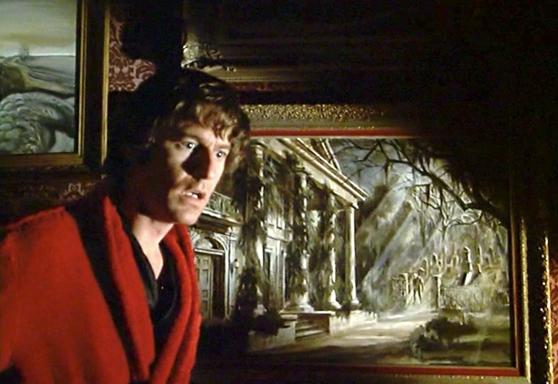
Serling starts the series by stating “Good evening, and welcome to a private showing of three paintings, displayed here for the first time. Each is a collector’s item in its own way—not because of any special artistic quality, but because each captures on a canvas, suspends in time and space, a frozen moment of a nightmare. Our initial offering: a small gothic item in blacks and grays, a piece of the past known as the family crypt. This one we call, simply, “The Cemetery.” Offered to you now, six feet of earth and all that it contains. Ladies and gentlemen, this is the Night Gallery…”

Directed by Boris Sagal (who died when he literally walked the wrong way into a helicopter blade while filming the TV miniseries World War III), “The Cemetery” was written by Serling. It stars Roddy McDowell as Jeremy Evans as a man who murders his uncle to inherit his money and also gains the services of that man’s loyal — and now enraged — butler Osmond Portifoy (Ossie Davis). The effective terror within this episode is achieved with a painting of the family grave that keeps changing, along with great cinematography, editing and sound design that tells us that something undead — maybe — is coming for Jeremy.  His last words, “What in God’s name is happening?”, are actually voiced by John Badham in an overdub.
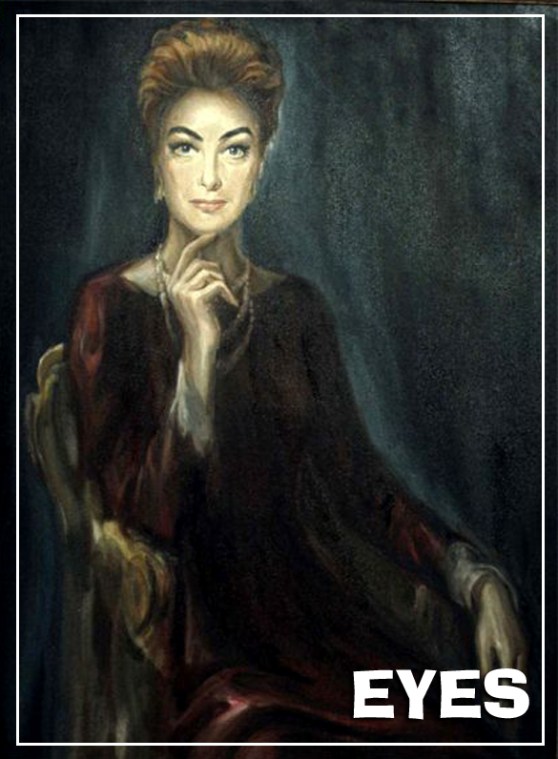
“Eyes” starts with this narration: “Objet d’art number two: a portrait. Its subject, Miss Claudia Menlo, a blind queen who reigns in a carpeted penthouse on Fifth Avenue—an imperious, predatory dowager who will soon find a darkness blacker than blindness. This is her story…”

This was the directorial debut of 22-year-old Steven Spielberg, as well as one of the last acting performances by screen legend Joan Crawford. When she discovered that the young Spielberg would be directing her, Crawford called Sid Sheinberg, vice president of production for Universal Television, to demand that he be replaced but he talked her into taking a chance on him.

Despite her early reservations, the director and star got along well and stayed in touch until her death in 1977.  In fact, before filming, she gave a speech to the crew informing them that she had worked with Spielberg previously and asked them to treat him with the same respect they would garner for an older and more seasoned, director.

Crawford would later say that she loved Rod Serling and his writing, yet remembered that “…his dialogue was the hardest to memorize. There’s a rhythm to his words and if you change one of them, the rhythm is off and you can’t remember.”

She plays Claudia Menlo, a rich woman who has received the eyes of a gambler through loan sharks and has blackmailed Dr. Frank Heatherton (Barry Sullivan) into a surgery that will give her sight for just one day. Surrounded by all of her favorite possessions, she doesn’t realize that a blackout is about to come for New York City.
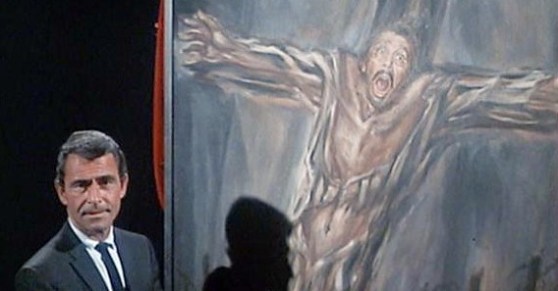
Finally, “The Escape Route,” directed by Barry Shear, begins with this speech: “And now, the final painting. The last of our exhibit has to do with one Joseph Strobe, a Nazi war criminal hiding in South America—a monster who wanted to be a fisherman. This is his story…”

Richard Kiley is Joseph Strobe, a former German soldier on the run after World War II. He makes his way to a museum much like the night gallery that Serling occupies for the series. He speaks to a concentration camp survivor named Bleum (Sam Jaffe) and soon realizes that he was once in charge of the life and death of Bleum’s friends and family. Strobe finds peace in the museum, pulling himself into a dream of fishing through one of the paintings. The next day, Bleum recognizes Strobe, who kills him and must run again from authorities, finally coming back to the gallery and seeking the fisherman painting only to find his horrible final judgment within a painting of a crucified man.

In case you haven’t picked it up yet, I love this show. Between its strange electronic theme — which is different in the original pilot — and the fact that there’s a painting for each story, this has a look and feel unlike any series. Well, except for Guillermo del Toro’s Cabinet of Curiousities, which is directly influenced by this show.

If you love Night Gallery, without reservation I recommend Rod Serling’s Night Gallery: An After-Hours Tour by Scott Skelton and Jim Benson.

Skelton and Benson also created The Art of Darkness, which collects and speaks on all of the paintings used for the show. Sadly, both books are now out of print and quite expensive.

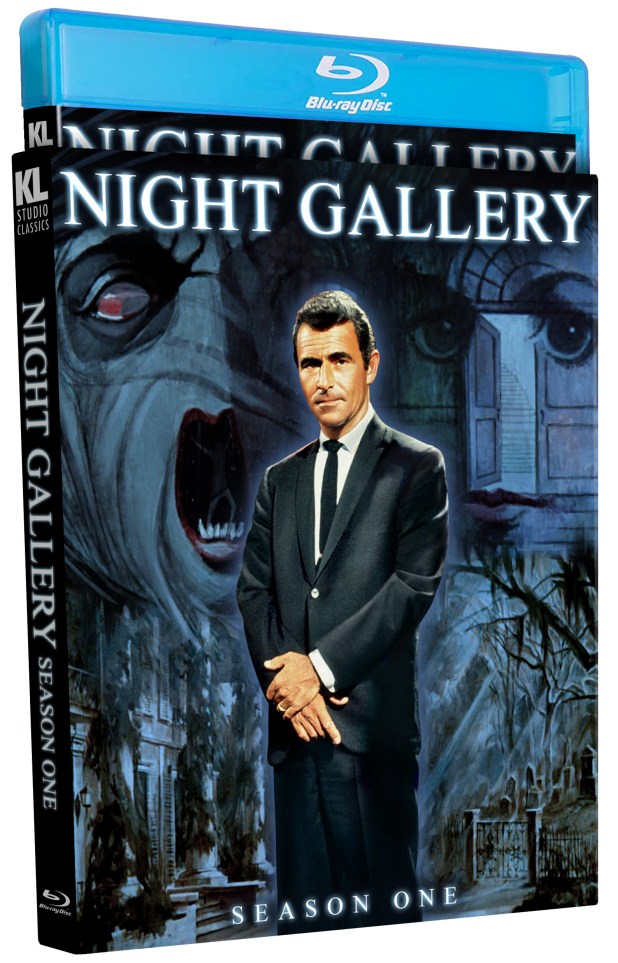
You can get the best quality version of this series from Kino Lorber, who have blu ray sets available of season 1, season 2 and season 3. I still have the gigantic DVD sets that came out for the show and these are a marked improvement on this already awesome collections.

I’m looking forward to writing about each episode in season one. What’s your favorite episode?
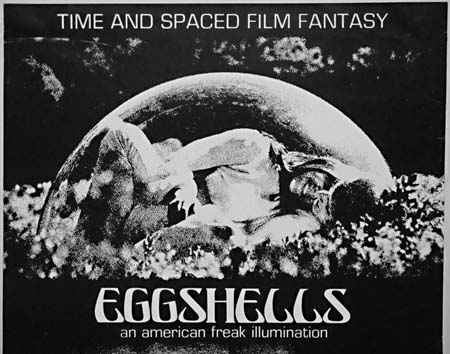
2022 Scarecrow Psychotronic Challenge Day 12: Eggshells (1969)

12. IT’S A REAL FREAK SCENE, JACK: A groovy 60’s grinder.

Tobe Hooper’s first movie, which he co-wrote with Kim Henkel, is a story about a weird house in Texas, which is definitely a theme Hooper would come back to, but this one has a strange presence in the basement that starts influencing the hippies who have decided to live there.

Until the 2009 South by Southwest Festival, this movie was thought lost. What people saw was aJean-Luc Godard-influenced film that those in Austin in 1969 said was, well, Austin in 1969. It’s also a shambling, shaggy narrative where time doesn’t matter, where you take a long tour of the city, where things go fast, go slow, go weird, go introspective. Two couples, one established, one new, have to navigate a tumultuous time.

People take baths. Have psychedelic love scenes. Drive cars into fields, attack them, blow them up. Balloons appear in the woods. A man swordfights himself. It’s just what you’d expect from a movie made in 1969 that doesn’t want to be a Hollywood tale of hippies but one made by and for.

It starts with a woman coming to Texas on the back of a truck, wishing for big dreams. His next film would end with a woman leaving Texas on the back of a truck, escaping from a nightmare.

KINO LORBER BLU RAY RELEASE: The Oblong Box (1969)

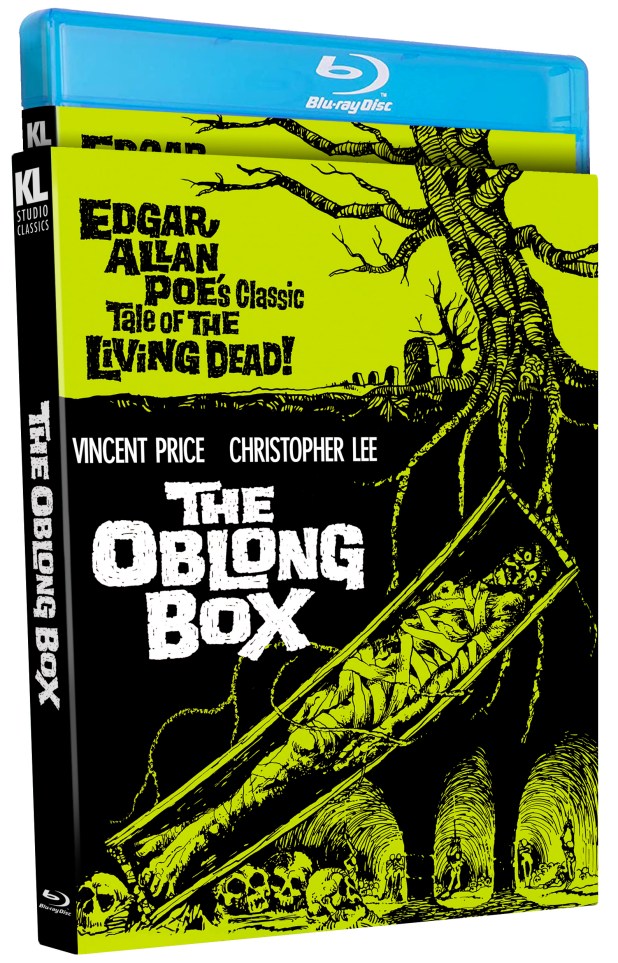
EDITOR’S NOTE: This originally ran on the site on July 8, 2021. The new Kino Lorber release has commentary by film historian Steve Haberman. Edgar Allan Poe’s Annabel Lee narrated by Vincent Price, radio ads and the trailer. You can get it from Kino Lorber.

Based on the Edgar Allan Poe short story “The Oblong Box,” the script for this movie by Lawrence Huntington and Christopher Wicking also brings in plenty of other Poe themes like masked men, premature burial and, well, voodoo. Which has nothing to do with Poe, but hey — this is the first time Christopher Lee and Vincent Price were in a movie together, so let’s just ignore that.

While in Africa, Sir Edward Markham (Alister Williamson, who usually is in a supporting role) has his face ruined in a voodoo ceremony — shades of how The Great Kabuki (Japanese version) got his facepaint — and is kept locked up by his brother Julian (Vincent Price). The secret is that the crime that he was punished for — killing a child — was really the fault of his brother. Now, he wears the scars for the crime he did not commit.

He soon gets the family lawyer and a witchdoctor (Harry Baird, Cool It Carol) to help him fake his death, but his brother buries him — but first, a proxy as nobody wants to see what Sir Edward has become — before going off to marry his true love Elizabeth (Hilary Dwyer, which means that Matthew Hopkins finally got to have his way with Sara).

Meanwhile, Sir Edward is dug up — still alive — and given to Dr. Newhartt (Lee) to use as an experimental autopsy. The facially deformed madman blackmails the doctor and starts murdering nearly everyone he meets. By the end of this movie, numerous people have been horribly killed and both brothers are sentenced for their crimes, if not by the law, then by karma.

Sadly, this movie was to reteam Witchfinder General director Michael Reeves with Price. That film led to a renaissance of Poe films from AIP. However, Reeves fell ill while working on the film. He was also going to make an adaption of H.G. Welles’ When the Sleeper Wakes with AIP. He’d die a few months later of an accidental drug overdose. Instead, this was directed by Gordon Hessler, who also made Pray for Death and Kiss Meets the Phantom of the Park.

The pro-black scene of the slaves rising up against Sir Edward was enough to get this movie banned in Texas, which happened within several of our lifetimes. The world changes eventually, right?