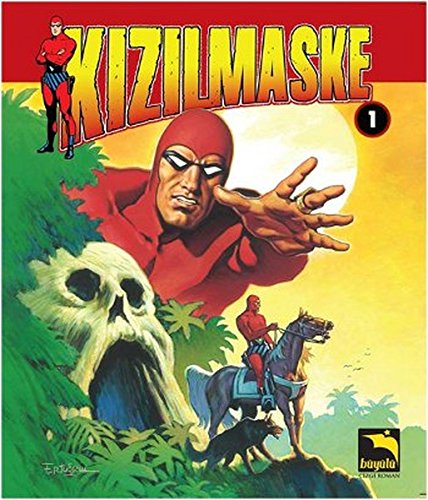
This is not the only remake of Lee Falk’s The Phantom that was made in Turkey. This version is Red Mask, which basically gives you a Street Fighter-style palette swap of the Ghost Who Walks. There’s also another Kizil maske that came out that very same year directed by Çetin Inanç. You can tell the difference because the former movie has a ripoff of the James Bond theme while the latter takes the Secret Agent Man theme. There’s also the 1971 movie Kizil Maske’nin Intikami (The Phantom’s Revenge).
The second Inanç-directed film also has a bad guy who looks like a Klan member with lightning bolts all over his hood and a Phantom that doesn’t even try to disguise that he’s completely taking the look and not caring about intellectual property. Actually, I kid, he has on a rad leather jacket and kind of looks like Dominic Fortune and there you go, that’s a reference that proves why I do a small website and am not shared out by the film Twitter universe just yet.
Also, all of these Turkish films are way better than the Billy Zane movie, which I refer to as Slam Evil! instead of its real title.
According to How the World Remade Hollywoodby Ed Glaser, I learned that the Phantom was a big deal in Turkey. While he’s purple in the U.S., he was originally intended to be grey. To make things somewhat confusing, in other counties, the Ghost Who Walks shows up in different colors: blue in Scandanavia, green in Australia and red in Turkey. Hence the title of this film.
And if you’re wondering where those hooded bad guys come from in the Çetin Inanç-directed movie, Inanç’s former boss was Yilmaz Atadniz, who directed Kilink: Soy ve Oldur. That’s the very footage these characters are cut and pasted from before we get to the movie’s main villains, “Al Capone” Arif and Fu Manchu. An Arabian Fu Manchu at that.
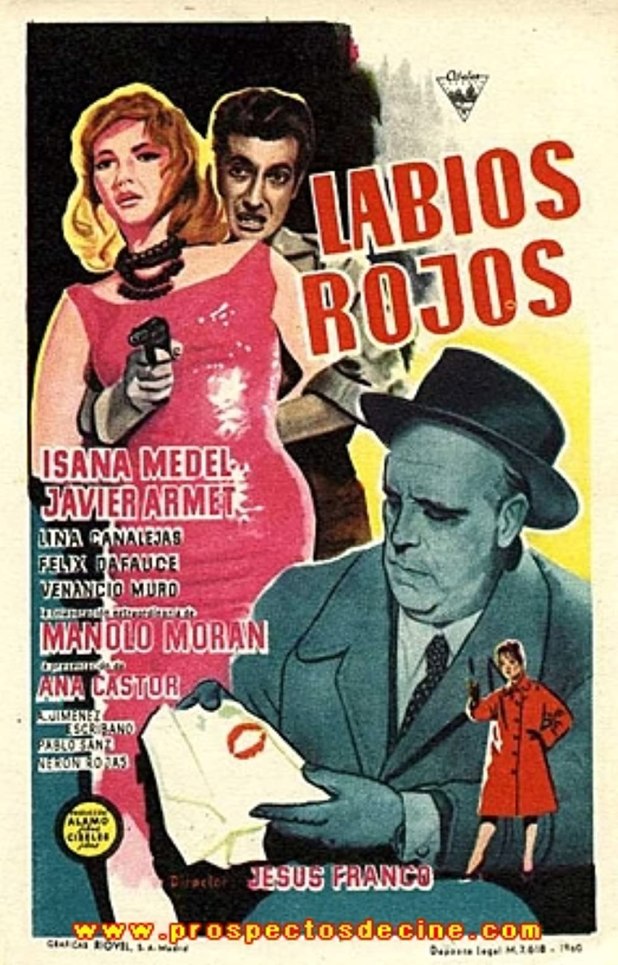
If we are to place our faith in the Jess Franco universe, it’s in the knowledge that there are heroes and there are villains. Regina and Diane would be on the side of good, even if they kind of bumble their way through most of their adventures. From Two Undercover Angels and Kiss Me Monster to Two Spies In Flowered Panties, Franco would return to these lady agents more than once.
Franco’s second movie, this has the detective duo seeking stolen diamonds — yes, this happens all the time in Franco Earth — and hey, if the men can’t solve it, they sure can.
This is way more chaste — understatement — than any of the Franco movies to follow. But it’s infused with some of his loves, like jazz, gorgeous dancing women and noir. It’s a good start and perhaps, at some point soon enough, there will come a break with reality, the discovery of a muse and the knowledge that you can really zoom a camera when you want to.
I’ve been wanting to see this movie for years and held off, because there’s no way that it can live up to the imagery of the sculpture of a giant woman with a teeth-like door between her thighs that opens to reveal a skeleton that falls out, its head rolling toward camera. But somehow, someway, this movie is even stranger and better than that bravura moment.
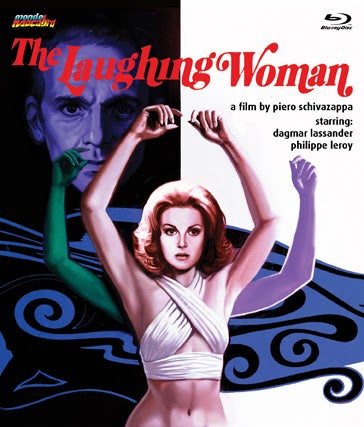
Maria (Dagmar Lassander) works in the office of Dr. Sayer (Philippe Leroy), who claims to be working in philanthropy but really believes in an increasingly wild series of conspiracies like how every woman in the world is against him and they’re all collecting the sperm of men so they can get rid of them after harvesting their life-giving sperm and that governments are planning on making men obsolete.
After having a drink with Sayer, Maria wakes up chained to a bed and his prisoner, being told that he can make her do anything he wants and when he’s done, like so many other women, he will just get rid of her, move on and do it all over again.
Directed and written by Piero Schivazappa, this movie takes the expected BDSM idea that an independent woman is going to enjoy pushing her boundaries and fall for her captor and instead flip it like a kink-friendly Arabian Nights, as Maria keeps talking and pushing and prodding Sayer, making him question who he is and what he’s doing.
The world that this happens inside is the kind of future that we were promised and never got, a push-button retro tomorrow that never got here, filled with starkness, strange human forms and swimming pools that are either havens for torture or passion. There’s also a strange bed that Maria soon learns allows Sayer to sleep next to her even when she thinks she’s all alone. And then he makes her make love — with his direction — to his exact mannequin duplicate.
How strange is it that there’s a major inversion before the end of this movie, between who is in charge and who controls who and the traditional top and bottom roles and wow, when Maria pulls off her short wig — Sayer had previously chopped all of her hair — to reveal her flowing locks again, it’s beyond perfect. I was ready for what would happen, but somehow still so happy that it all played out this way, because yes, it has to play out this way.
Sometimes, style and substance fight it out and argue and no one wins. And other times, they just decide to just stop fighting and start fucking and the results are glorious. This would be that time.
Mondo Macabro’s blu ray of this movie is the region-free world blu ray premiere, with a 1080p presentation from a 4k restoration of the original camera negative. It has a choice of English or Italian audio, with optional English subtitles, as well as an interview with writer/director Piero Schivazappa, commentary by Kat Ellinger, a video essay on the film’s production design by Rachael Nisbet, an animated foto-novel by Jacques Spohr and the trailers for the movie. You can get it from Mondo Macabro.
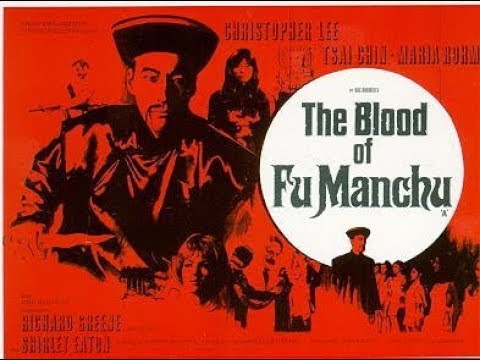
You know that we love movies with multiple titles, so how about these ones? Fu Manchu and the Kiss of Death, Kiss of Death, Against All Odds and best of all, Kiss and Kill. The fourth movie in the Fu Manchu series produced by Harry Alan Towers, this movie finds Jess Franco pulling off an amazing movie: he used scenes featuring Shirley Eaton from his movie The Girl from Rio without telling her. She didn’t learn that she was in a Fu Manchu movie for several years.
Somewhere in the jungle, Dr. Fu Manchu (Christopher Lee) has found a lost Amazon city that has a deadly venom that can only kill men yet gives women the kiss of death. Of course, they have to be bit by venomous snakes to get this power and mind-controlled, but you know, this may not be the goofiest plan that Fu has come up with. Can I call him Fu? Is that too familiar and am I assuming our friendship?
You can tell when Franco is into the movie. Spoiler warning, it’s when women are tied up or when the gorgeous and deadly Lin Tang*, the daughter of Fu Manchu shows up surrounded in light and smoke. Or when Maria Rohm appears in a cowboy hat and chaps? You know that’s when Jess Franco is being, well, Jess Franco.
Look, this movie was made for less than some movies spend on donuts. Also, yes, Christopher Lee is in yellow face and the entire Fu Manchu thing is super racist and there’s a lot to unpack there, but let me give you some advice: if you are watching Jess Franco movies for life lessons and good taste, you’re doing it wrong.
*How amazing is it that Tsai Chin not only was a Bond girl twice (You Only Live Twice and Casino Royale), as well as two Marvel Cinematic Universe characters (Melinda May’s mother on Agents of S.H.I.E.L.D. and Walpo in Shang-Chi and the Legend of the Ten Rings), the role of Auntie Lindo in the film The Joy Luck Club, Auntie in Memoirs of a Geishaand an international recording artist whose song “The Ding-Dong Song” was a big hit?
Not only did Eiji Tsuburaya co-create Godzilla, he was the man who brought us Ultraman. His Tsuburaya Productions continues to own the rights to the various Ultra series that have spun off from the original show such as Ultraman Gaia, Ultraman Dyna, Ultraman 80 and The Ultraman.
Tsuburaya considered this series his best work, as it was about people, rather than vehicles and special effects. He was inspired by the word of Gerry Anderson and sadly, the public didn’t watch the show as much until the second show, Fight! MightyJack, added aliens and monsters.
How much did Tsuburaya love this show? The Mighty Jack team logo is the same logo for Tsuburaya Productions.
Mighty Jack is a team of special agents that was put together to fight the evil Q — hey, how weird is that? — that is using hot ice to create weapons to take over the world. How can ice that doesn’t melt destroy humanity? Is that any stranger than the real Q — or unreal Q — which has convinced people that long-dead political leaders are ready to come back and stand for values that are the exact opposite of any they held in their real life?
Might Jack is also the name of their incredible flying submarine. But all we’re getting over here is epsiode one and six of the TV show, edited by Sandy Frank Productions, and making no sense. These kinds of movies allowed me to see plenty of cool Japanese series in my youth but as an adult, I realize that I’m only getting a remixed version of something that is much better in its original form. So I can either explore it more or laugh at it and I’d rather choose to always learn more.
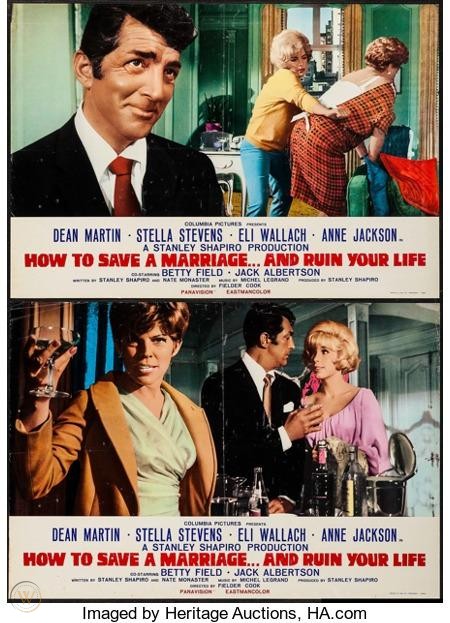
David Sloane (Dean Martin) is an confirmed bachelor. However, he’s worried about the marriage of his friend Harry Hunter (Eli Wallach), who is having an affair. So David decides to steal away his friend’s mistress, thinking that it’s his employee Carol (Stella Stevens, in a part originally intended for Marilyn Monroe; by doing this movie, Jerry Lewis refused to speak to Stevens for nearly twenty years).
Yet he has the wrong woman — it’s really Carol’s neighbor Muriel (Anne Jackson, who in real life was the wife of Wallach). You can just bet that hijinks ensue, especially when the mistresses begin to engage in collective bargaining agreements.
So yeah — these old Dean Martin sex comedies are beyond dated, but to me, they’re something akin to eating the junkiest of junk food on a snow day. They remind me of watching movies on old UHF channels in the 70s, lying under a blanket and wondering what it’d be like to be a grown-up. Hey little kid me — it stinks. Just watch Dean Martin movies and never grow up.
Fielder Cook, who directed this movie, also was behind the 1971 TV movie The Homecoming: A ChristmasStory, which let to the series The Waltons. It was written by Stanley Shapiro, who also wrote Pillow Talk and Dirty Rotten Scoundrels.
I Dream of Jeannie was created and produced by Sidney Sheldon* and it seems like for a long time, he was the only person that believed in it. He originally wanted the first season to film in color — it was one of only two shows on NBC at the time not in color, but special photographic effects employed to achieve Jeannie’s magic weren’t technologically advanced enough to be in a full range of colors yet — but NBC did not want to pay it.
It was $400 an episode.
The network and Screen Gems didn’t think the show would make it to a second season. But Sheldon saw that ABC’s Bewitched was a success and bet on the show.
He was right. It was in the top 30 shows for almost every year that it was on before becoming a syndication powerhouse.
In the pilot episode, “The Lady in the Bottle”, astronaut USAF Captain Tony Nelson (Larry Hagman) lands his one-man capsule Stardust One on a deserted island in the South Pacific. While wandering the beach, Tony notices a strange bottle** that moves by itself. When he rubs it, smoke and a genie (Barbara Eden) pop out.
Tony’s first wish is to be able to understand her, then for a helicopter to rescue him. Jeannie, who has been trapped in the bottle for 2,000 years, falls in love with him and follows Tony back home where she soon breaks up his engagement with his commanding general’s daughter, Melissa. It seems like this was a storyline being set up for the long game, but Sheldon realized that this romantic triangle didn’t have much rope.
Tony keeps Jeannie in her bottle until he realizes she needs a life of her own, which is mostly her using her genie powers to try and make his life better. He worries that if anyone finds out that she exists that he won’t get to be part of NASA, but his worries lead him to being investigated by psychiatrist U.S. Air Force Colonel Dr. Alfred Bellows (Hayden Rorke) with the only person — at first — that knows his secret being Major Roger Healey (Bill Daly).
Unlike many of the sitcoms of the era, I Dream of Jeannie had multipart story arcs (which were created to serve as backgrounds for national contests). For example, nobody knew when Jeannie’s birthday was and the guessing game led to a contest, with the answer being April 1. There was also a four-episode event where Jeannie was locked in a safe on the moon and fans had to guess the combination to save her and another where Tony was replaced and had to be found. But there are also several long storylines, like Jeannie’s evil sister also named Jeannie, Jeannie’s ever-changing origin story which includes Eden’s first husband Michael Ansara as the Blue Djinn, Jeannie taking over the crown of her home country Basenji and so many more.
Supposedly, Hagman was so hard to work with that the producers seriously considered replacing him with Darren McGavin. They even wrote out a story with Tony losing Jeannie and McGavin finding her, but it never ended up happening. In her 2011 book Jeannie Out of the Bottle, Eden wrote, “Larry himself has made no secret about the fact he was taking drugs and drinking too much through many of the I Dream of Jeannie years and that he has regrets about how that impacted him.”
When there were two TV movies in the 80s, Hagman didn’t return. In I Dream of Jeannie… Fifteen Years Later his role was played by Wayne Rogers and as he’s on a space mission in I Still Dream of Jeannie, he’s simply written out and Hagman’s Dallas co-star Ken Kercheval took over as Jeannie’s master. There was also a cartoon called Jeannie that aired from 1973 to 1975 that had Julie McWhirter (who in addition to being the voice in so many cartoons is also the wife of Rick Dees) play Jeannie, “Curly” Joe Besser as Babu a genie in training and Mark Hamill as Corey Anders, a high school student.
Eden has also gone on the record as saying that she never connected with another actor in the same way as she did with Hagman. They’d reunite for the 1971 TV movie A Howling in the Woods.
Why did the show end? It was still near the top thirty after all. Well, Eden believes that there were enough episodes for syndication already and the ratings had gone down after Jeannie and Nelson got married in season 5. No one except for the network wanted that and it eliminated the romantic tension of the show.
I grew up watching this show multiple times a day, often paired with its one-time rival Bewitched. Just going back through these — the original 8 episodes with Paul Frees narration instead of the theme song are a revelation — has made the end of the year doldrums so much better.
You can get all 139 episodes on the Mill Creek I Dream of Jeannie The Complete Series blu ray set. You’ll get hours and hours of fun for a really great price at Deep Discount.
*Sheldon was inspired by the movie The Brass Bottle, which has Tony Randall’s character get a genie played by Burl Ives. Randall’s girlfriend was played by Eden.
**The bottle is actually a special Christmas 1964 Jim Beam liquor decanter containing “Beam’s Choice” bourbon whiskey. How weird is that?
Is Hayley Mills a giallo queen? Let’s examine the evidence: She’s in the Agatha Christie movies Endless Night and Appointment with Death, as well as the Sidney Hayers psychological thriller Deadly Strangers. Heck, That Darn Cat! has a lot of elements of confused identity and mishearing critical evidence. You know, if The Parent Trap was slightly askew, you could see its tale of twins who never knew the other existed uniting to ruin relationships as an Italian thriller.
The jury is out on Ms. Mills being a giallo star — maybe if she’d made a voyage to Italy at some point — but Twisted Nerve really feels like it could fit into the post-Bava pre-Argento world of detective movies that were coming out of that country.
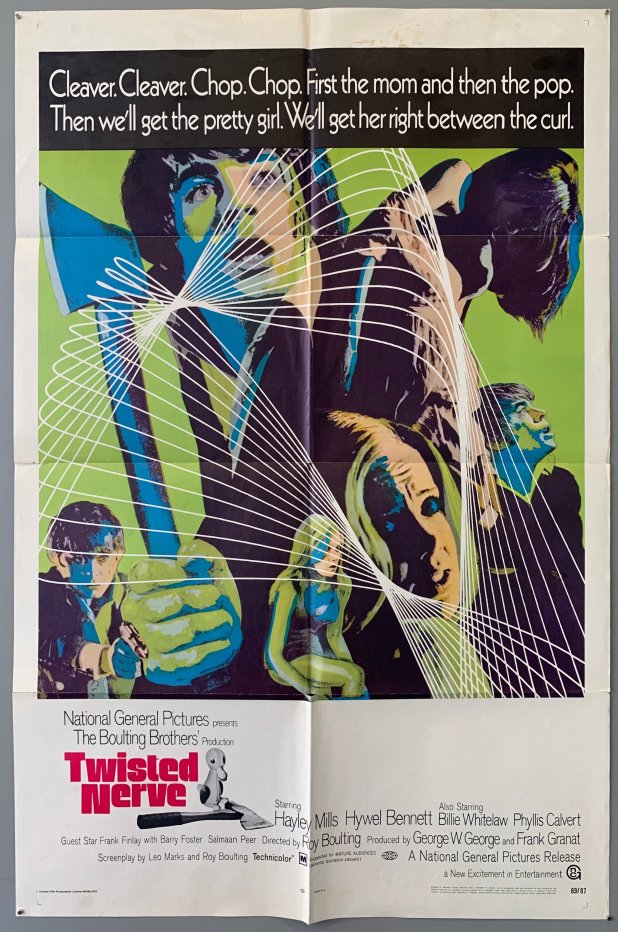
Martin Durnley (Hywel Bennett, who was also in Endless Night and The Family Way with Mills) is a rich young man with an invalid brother and a mother who has moved on to her new husband. So what else does he have to do than to become someone else, the mentally challenged Georgie, and start shoplifting toys and acting like a child? Especially if it gains the interest of Susan?
This movie pushes all the buttons, starting — instead of ending! — with a square up reel* that apologizes for suggesting that mentally retarded people are murderous. It then doubles down thanks to a scene where Martin sensually rubs his own chest while staring at a stack of male muscle magazines. And oh yeah — he’s obsessed with Susan enough to stage this charade yet when her neglected mother attempts to Mrs. Robinson him, he dispatches her with an axe. There’s also a shocking moment — for Susan — where Martin just casually disrobes in front of her and instead of her reacting with any arousal, she’s just confused and perhaps even upset as his alien nature makes seeing him in a sexual manner incredibly strange.
Yet even when he gets to touch her, it’s as if he can’t. Martin once had control over Georgie and thought it was all a ruse, but it looks like now he’s lost control.
I love that this movie has pretensions toward art. It quotes “Slaves” by George Sylvester Viereck — “No puppet master pulls the strings on high. Proportioning our parts, the tinsel and the paint. A twisted nerve, a ganglion gone awry predestinates the sinner and the saint.” — while also keeping one foot firmly in the world of exploitation. I mean, the tagline is “Cleaver. Cleaver. Chop. Chop. First the mom and then the pop. Then we’ll get the pretty girl. We’ll get her right between the curl.”
Even if you haven’t seen this movie, you may know its Bernard Herrmann score, which was whistled by Elle Driver as she attempted to kill The Bride in Kill Bill.
*”In view of the controversy already aroused, the producers of this film wish to re-emphasise what is already stated in the film, that there is no established scientific connection between mongolism and psychiatric or criminal behaviour.”
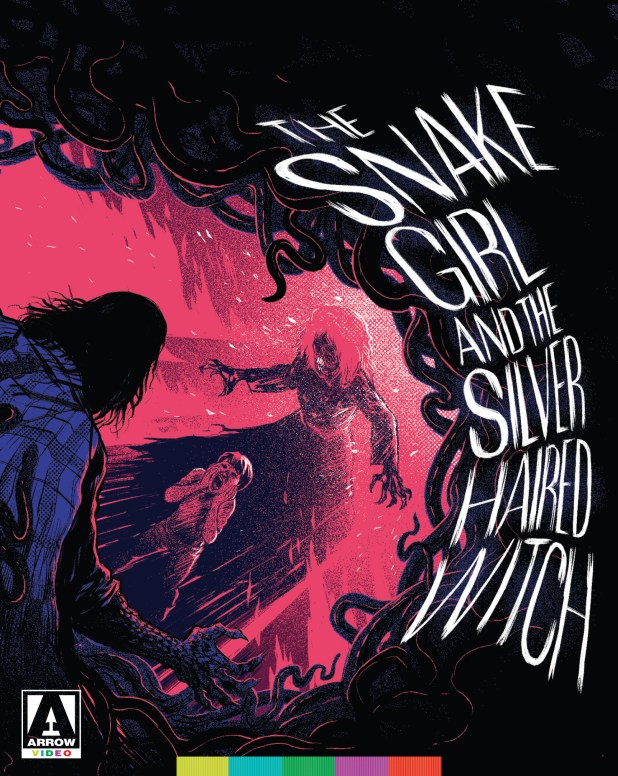
Take Noriaki Yuasa, the director of the original eight Gamera movies, and pair him with Kazuo Umezu, who created The Drifting Classroom, and have them make a movie that should be for kids but is the type of motion picture that destroys minds and reaps souls (and is filled with nightmarish visions and brutal murders).
Sayuri has returned to her family after years in an orphanage but trouble has followed her. Before she even arrives, a maid dies of a heart attack, her mother has amnesia from a car wreck and her sister won’t leave the attic, all while her father ignores them to study poisonous snakes and a fanged figure haunts her dreams.
Soon, our heroine is staying up in that attic with her scarred sister who tells her that she just wants to taste her hands and who breaks her dolls and oh yeah, rips a frog in half and throws it in her face. Yes, a kid-friendly movie.
And an amazing one at that.
The Snake Girl and the Silver-Haired Witch is making its worldwide blu ray debut and home video premiere outside Japan thanks to Arrow. This release also has commentary by film historian David Kalat, an interview with manga and folklore scholar Zack Davisson, a trailer and an image gallery.
It’s also available on the ARROW player. Head over to ARROW to start your 30 day free trial (subscriptions are available for $4.99 monthly or $49.99 yearly). ARROW is available in the US, Canada and the UK on the following Apps/devices: Roku (all Roku sticks, boxes, devices, etc), Apple TV & iOS devices, Android TV and mobile devices , Fire TV (all Amazon Fire TV Sticks, boxes, etc), and on all web browsers at https://www.arrow-player.com.
“The industry is in bad shape. The people in Hollywood don’t care about films. They’re only worried about lining their pockets.” — The Tinseltown wisdoms of Peter Carpenter
Courtesy of Amazon and IMDb.
These two, lost Peter Carpenter movies have dogged us long enough!
It’s time we complete the review quartet of Pete’s four films, which includes his two writing and producing Wiseauian vanity efforts: his debut, Blood Mania (1970) and Point of Terror (1971). How much do we love Blood Mania? Well, during our month-long, February 2021 Mill Creek Box Set tribute, B&S buddy Bill Van Ryn of Groovy Doom/Drive-In Asylumreviewed it for the ‘Creek’s Grindhouse Greats set, while our friend Eric Wrazen of Festival de la Bête Noire took a second crack at it for the set.
Courtesy of Bill Van Ryn, we know that Peter Carpenter had been selected by Russ Meyer for a small role in Vixen! after Carpenter’s then girlfriend included a photo with him as part of her audition materials. A role alongside Dyanne Thorne in 1970’s softcore drama Love Me Like I Do followed, and Carpenter’s later, one-two punch of his self-produced Crown International-starring vehicles of Blood Mania and Point of Terror, made with producer Chris Marconi, undoubtedly represented a bid for establishing Peter as a working actor—a Hollywood commodity, even. A career never manifested, and Carpenter disappeared. Despite rumors that he vanished because he died, he actually simply left the movie business, although he did pass away at the too-young age of 56—in Alhambra, Los Angeles County, on April 2, 1996, under his birth name: Joseph Nathaniel Carpenter, a former enlistee of the U.S. Air Force (thanks to Mike Perkins for that bio-postscript).
As Mike Justice of the Eerie Midnight Detective Agency site correctly pointed out: Peter didn’t do much in the way of acting in these films—but, in both, he did show a natural predilection for portraying a horny, muscular man who will stop at nothing to get laid. And I’ll have to add that quality carried to its zenith, with Pete as the red-jump suit clad n’ hip-swingin’ Tom Jones wannabe in Point of Terror.
So, how we ended up here, QWERTY’ing away in the B&S About Movies cubicles about these first two Peter Carpenter films is a tale of the coolness that is B&S About Movies. And this ain’t no trope of a tale we’re telling: B&S is a family of movie lovers who love film for film—a gaggle of crazy bastards and lazy sods who write for the love of film, money in our pockets for the efforts, be damned. (In fact, it’s how our newly-posted review of The Beast (1988) came together: reader feedback to our site. Ditto for our recent “Ancient Future Week” reviews of Future-Kill (1985) and Robo Warriors (1996): reader input.)
B&S reader and uber Peter Carpenter fan, Mike Perkins, a professional librarian, reached out to us upon discovering our review of Point of Terror with questions and some new, Pete-Intel. The Perk came to tell us he’s been working with B&S About Movies’ long-time friend and contributor Mike Justice to set the record straight on Peter Carpenter’s life and career.
It all began with Mike Justice asking the February 22, 2016, question in his article: Lost Actor: What Ever Happened to Peter Carpenter? on his site. So, Mike Perkins, the insane-uber Carpenter fan he is, started digging. And the two-Mikes’ investigations led to Mike Justice posting the follow up article: Lost Actor Found: Who Was Peter Carpenter? on March 7, 2021. Then Mike Perkins took it a step further by setting up a Flickr photo tribute page, finally convincing the IMDb to updated Peter Carpenter’s page, and setting up an all-new Find A Grave tribute page. Yeah, the Mighty Perk is working on that Peter Carpenter Wikipedia page, you know it!
Courtesy of Mike Justice.
The one thing we’re all in agreement on: Peter Carpenter was Tommy Wiseau before Tommy Wiseau was Tommy Wiseau making his The Room vanity project. And that Rudy Ray Moore was the blaxploitation version of Peter Carpenter—remembering Moore took the vanity route with Dolemite. And that we need a Peter Carpenter biographical dramedy, à la The Disaster Artist and My Name Is Dolemite. And that Jason Segel—as first suggested by The Great Protrubero, one of Mike Justice’s readers—should star.
Like I told Justice: If Netflix can bank roll Jack Black as the financial-scamming Jan “The Polka King” Lewen in a bioflick, then a Peter Carpenter film can be done.
Does anyone know how to reach James Franco and Seth Rogen? A Peter Carpenter movie—Point of Stardom—starring Jason Segel as Pete, must be done—if only to get Segel into a fringed, red-jump suit. And, in the way-back machine: Judge Reinhold.
Just think of it: A world where Peter Carpenter never left the business—and Peter, instead of Judge Reinhold—ended up as one of the (many) boyfriends of Elaine Benis on Seinfeld—or Carrie Heffernan’s gynecologist on The King of Queens (i.e., Judge, again). Why did you leave the business, Pete . . . the castings you missed . . . you could have been “the Close Talker” on Seinfeld! And yes, B&S readers: we’re accepting your casting suggestions for Dyanne Thorne and Russ Meyer in the comments section, below.
In fact, speaking of castings and Jack Black: If there’s ever a Paul Naschy biopic made, Jack Black is the man for the job. From Pennsylvania’s “Polka King” to Spain’s “Werewolf King”? Jack can do it!
And . . . Jack Black can be Russ Meyer to Jason Segel’s Peter Carpenter!!!
“Uh, the ‘rails,’ R.D. We talked about this. The rails. You’re friggin’ off them, again. Please get back to the movie,” Sam “The Boss Man” Panico, implores me.
Sorry, Sam . . . the Peter Carpenter love is, eventually, gonna getcha.
So, yeah. Bill Van Ryn. Eric Wrazen. Mike Justice. Mike Perkins. Sam “the Blender Master” Panico, and yours truly: We are family, and by golly, we’ll get the job done and solve The Case of Peter Carpenter. Get this: for the fun. We’re fracked up that way. And by hook or by crook, we will get that movie made, too.
Let’s roll Vixen! and Love Me Like I Do. To the aisle seats, Robin!
Peter Carpenter? In the bioflick Point of Stardom. A missed casting coup: Judd Reinhold as Peter Carpenter in Fast Times in Hollywood.
Vixen! — The Review
“The story of a girl who loves the joy of being alive.” — Now that’s how you pitch an X-rated movie
Yeah, you’re heard of this movie in the annals of X-rated films: it was the first film to be given the rating due to its sex scenes. Yes. It was a huge box office success ($8 million against $73,000) that not only inspired 20th Century Fox to green-light Beyond the Valley of the Dolls (Doh!), it also triggered the “Golden Age of Porn” with the likes of the equally successful Behind the Green Door, Deep Throat, and The Devil in Miss Jones. Howard Avedis, who we just did week-long tribute on, dove into the golden showers with this take on the trend with The Teacher. And speaking of teachers: Earl Barton’s Russ Meyer-wannabe, the sleazy drive-in take-a-shower-after flick, Trip with the Teacher, was his lone attempt at some “golden age” sexploitation.
Erica Gavin* (later of Meyer’s Beyond the Valley of the Dolls; stellar in Jonathan Demme’s Caged Heat for Roger Corman) is Vixen Palmer: an oversexed (big surprise), bored ne’er-do-well hottie stuck living in a Canadian mountain resort town with her naive, wilderness bush pilot husband (Larry Buchanan stock-player Garth Pillsbury, Mistress of the Apes).
While he’s off on assignments, flying tourists on fishing trips, the divine Ms. Palmer manipulates anyone and everyone to get her jollies: including an uptight, vacationing husband and wife flown by her husband, as well as a Canadian Mountie (cue Peter Carpenter to the set). Vix even dabbles in incest with her rough n’ tumble biker brother, Judd (because all Drive-In B-movie programmers must have a biker; played by Don Stroud lookalike Jon Evans). But Vix draws the line at interracial love: she won’t do the hoochie-mama with Judd’s black, riding buddy (Harrison Page, who carved a still-going, extensive U.S. TV career). Oh, and everyone has opinions on communism to go with their insights on the sexual revolution.
Sigh . . . sex and political dissertations with a side of racism: an exploitation Reece’s Peanut Butter Cup packed with M&M’s (or is that Skittles) if there ever was one.
When it comes to skin-flicks—and Meyer’s oeuvre, on whole—Vixen! is a solidly produced flick that’s well-directed with engaging cinematography. Courtesy of Erica Gavin going so over-the-top, along with Meyer working in messages on racism, communism, Vietnam, draft dodging, and the sexual revolution amid the nekked parts, this is not, not-an-entertaining flick. In fact, instead of flinching in repulsion, you actually laugh—with, not at—the film. How can you not chuckle, when Vixen and her brother lament on their special showers back when they were 12—as they have a nekked shower-sex reunion? (Note: Adult Film purveyor Shaun Costello also worked a Vietnam subtext into his early porn/proto-slasher, 1973’s Forced Entry; fellow adult industry warhorses John Howard and Justin Simonds later cross-pollinated the genres with the SOV-nasty, 1986’s Spine.)
Look, this ain’t no 2 1/2 hour Zack Snyder zombie romp with the always career-bitching Dave Bautista: it’s a 70-minute skin flick from the limits-pushing Russ Meyer. (It could be worse: this was sliced to 63-minutes in other parts of the world.) So what’s not to likely? Take a chance, you analog masochist, to get your fix of Peter Carpenter strippin’ off that Royal Canadian Mounted Policeman’s uniform. Your own heart-breaking sighs for Peter, may vary.
Ugh. No trailers to embed. So log onto You Tube to watch them HERE and HERE. The DVDs abound, even on Amazon. Online streams. Yes. On torrent sites: don’t do it.
Love Me Like I Do— The Review
“I thought I was safe as long as I kept my eyes wide open and my knees tied together.” — Another satisfied Peter Carpenter conquest
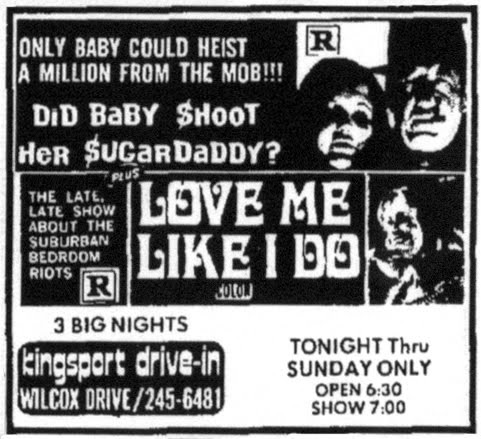
Writer and director Jean Van Hearn shot seven sexploitationer skinners between 1961 to 1973: Eternal Summer, Nymphs Anonymous, We, a Family, The House Near the Prado, The Hanging of Jake Ellis, Did Baby Shoot Her Sugar Daddy?, and this one—the only one starring Peter Carpenter. Oh, and Dyanne Thorne. Did we mention that Dyanne impressed Pete, here, so he cast Dyanne as his lead in his forth and final film, Point of Terror? We just did.
Courtesy of Temple of Shock in their review of Did Baby Shoot Sugar Daddy?
So . . . if you need films with soft-core kink titillations, trannies, way-too-many strippers, a world where women seduce men—while another man is dead, stuffed under a bed—all done at an Ed Woodian ineptness that makes a Doris Wishman joint look better that it should, then Van Hearn’s always-hard-to-plot-follow, seven-film oeuvre should be on your watch list.
Now, back to the Peter Carpenter love.
Sharon Sloane (Dyanne Thorne, in a bad wig) is a loyal, seemingly content suburban wife with a nice husband, Bill (Peter Carpenter, in his first leading man role), house and family—and she throws mod-swingin’ backyard parties. Well, things were content: Sharon just discovered—as a way to deal with the stress of his business ready to collapse in a takeover by his partner, Keith (the one and done Paul Flemming)—ol’ hubs cheats on her with the local, neighborhood nympho, Nanette (Maria De Aragon**, Blood Mania for Peter; the lead in 1972’s The Cremators). So, Sharon—while she attends to the woe-is-me problems of her horny-divorcee best friend (Lynne Gordon, her final film was Robert Redford’s The Hot Rock for Peter Yates)—does the only logical thing: she goes off the deep end. And so does everyone else.
Sharon pops off a couple o’ rounds at Bill’s squeeze, Nanette? Check.
Bill’s business partner, Keith, wants not only the business, but Sharon? Check.
Does Keith fail at goading Sharon into adultery, so he rapes her? Check.
Does she like it? Check.
Does Bill, the cheater, beat the hell out of Sharon for cheating? Check.
Divorce? Stressed out little ones? Check and double check.
Sharon and Keith run off to Las Vegas—and Sharon, the girl who won’t commit adultery—turns into the very nympho her ex, Bill, enjoys. Checky check check.
Just wow. If this is what the sexual revolution of the ’70s did for film . . . then we need Estus Pirkle to break out the bible to inspire Ron Ormond to get the cameras rolling to get our souls in check.
Look, if you’re a Peter Carpenter fan—and you were able to make it through the movie-where-nothing-happens stylings of Blood Mania, but enjoyed the mania where-everything-happens of Point of Terror—sans the musical numbers and slasher overtones of that later sex opus—then there’s something here for you to do on a Friday night.
Thanks to our bud, Mike Justice, while we do not have an online stream of the full movie to share (there’s a few torrent-to-porn uploads out there: don’t do it: unless you’re into virus alerts and site redirects), you can watch these two clips from the film HERE and HERE (but embedded, below). You want the DVD? Well, the DVDLady has multi-regional DVD-rs, if you absolutely must have it.
I’m excited! Let’s make this Peter Carpenter bioflick happen!
About the Author: You can read the music and film reviews of R.D Francis on Medium and learn more about his work on Facebook. He also writes for B&S Movies.
* Did you know Erica Gavin has an official website? True story. Check it out at ericagavin.com. The link will take you into a deeper plot synopsis and backstory on Vixen!, as well as direct you to her insights on her other films.
** Maria De Aragon was under the Greedo make-up, hassling Han Solo at the Mos Eisley Spaceport in Star Wars? Is that urban legend?




 It’s also available on the ARROW player. Head over to






 B&S About Movies
You must be logged in to post a comment.