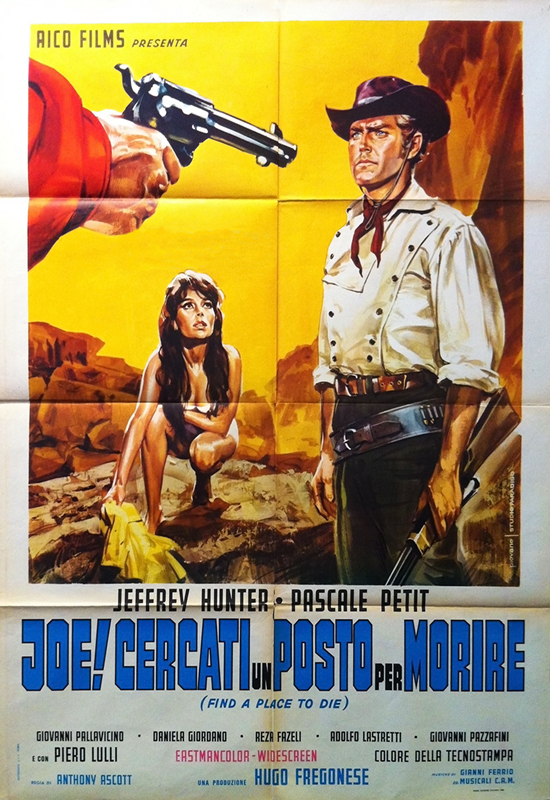
Joe… cercati un posto per morire! (1968)

Find a Place to Die is a remake of the American western Garden of Evil. After a long fight with a gang of killers led by Chanto (Mario Dardanelli), Lisa (Pascale Petit) escapes with her life while her husband does not. She hires a former Confederate officer named Joe Collins (Jeffrey Hunter) and another gang to gain revenge. But all that gold that Lisa and her husband had found — plus her beauty — put everyone against each other.

There’s also the crazy character of Reverend Riley, a man of the cloth who doesn’t deny himself the pleasures of the flesh. Played by Alfredo Lastretti, he’s the best part of this movie.

Director Giuliano Carnimeo made Light the Fuse… Sartana Is Coming, Have a Nice Funeral on Me, Amigo… Sartana, Sartana’s Here… Trade Your Pistol for a Coffin and I Am Sartana, Your Angel of Death under the name Anthony Ascott, as well as They Call Him CemeteryThe Case of the Bloody Iris and Ratman. He co-wrote the film with Lamberto Benvenuti, who made The Legacy of Caine.

Sadly, a year after this movie, Hunter was injured in an explosion gone wrong making the crime movie Cry Chicago (¡Viva América!). On his way back to the U.S., he went into shock and couldn’t speak or move. Doctors could only find a displaced vertebra and a concussion, yet within seven months, he would suffer an intracranial hemorrhage while walking down the stairs at his home, crack his skull and die after brain surgery was not successful. He was only 42.

You can watch this on Tubi.
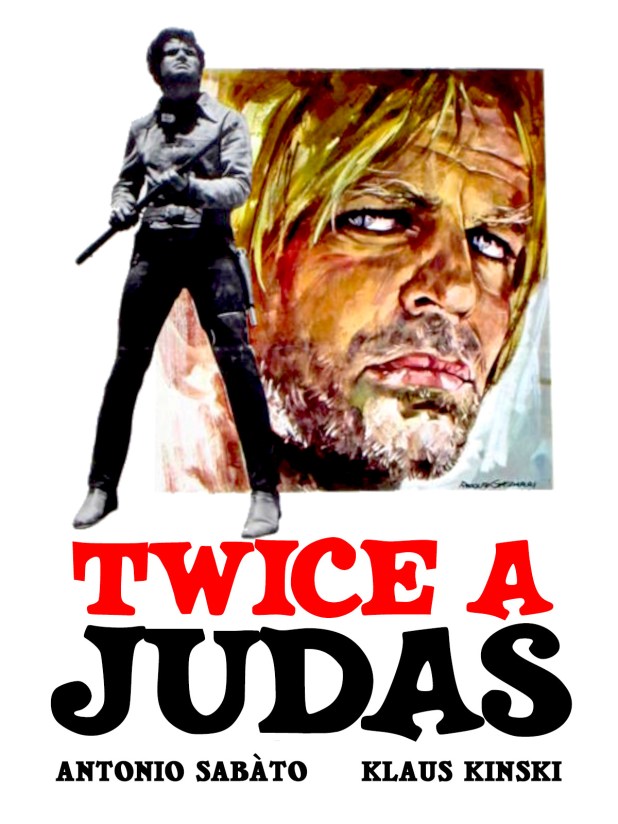
Due volte Giuda (1968)

Luke Barrett (Antonio Sabato) wakes up next to a dead man and no memory of how he arrived at this point. The bullet meant to kill him just grazed him, giving him a concussion and amnesia. He rides into town and learns that he and his partner Donovan were just about to kill his brother Victor (Klaus Kinski) for cash. How did he get here? And what happens after?

Twice a Judas was shot by Aristide Massaccesi, who we all know and love, and features Claudia Rivelli as Luke’s wife. She’s Ornella Muti’s sister in real life.

The strangest thing about this movie is that the bank that is trying to remove Victor is presented as being for the people, which we all know in no way can be true. Maybe they’re just a little less horrible than Victor, a land owner who wants his land, he wants it farmed and then he wants everyone else’s land too.

Director Nando Cicero mostly made comedies, while writer Jaime Jesús Balcázar wrote The Devil’s Honey, Jess Franco’s The Castle of Fu Manchu and Goldface, the Fantastic Superman.

You can read another take on this movie as part of Drive-In Friday: Kinski Spaghetti Westerns.

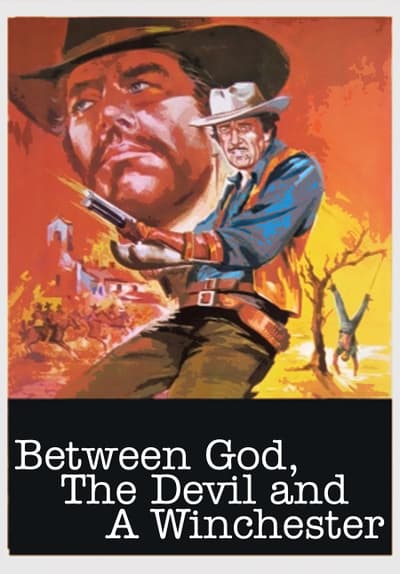
Between God, the Devil and a Winchester (1968)

Between Between God, the Devil and a Winchester and the Italian title of this movie, Anche nel west c’era una volta Dio (God Was In the West, Too, At One Time), I think that it has my favorite Italian western title. And despite a tagline promising “A orgy of bloodletting that very few will survive,” it’s actually an adaption of Treasure Island but with horses and cowboys.

Directed by Marino Girolami (Zombie Holocaust) and written by Tito Carpi (MartaTentacles), Manuel Martínez Remís and Amedeo Sollazzo (Primitive LoveTwo MafiosI Against Goldginger), this movie works, with the desert sands being the seas and outlaws taking over for pirates. Treasure remains treasure.

Future Godfrey Ho victim Richard Harrison plays Father Pat Jordan, who recognizes that the stolen gold belongs to a mission and makes the mission his. Gilbert Roland plays the Long John Silver — he has an iron arm instead of a wooden leg — as Juan Chasquisdo. There are even eyepatches and hooks for hands out here in the west.

Sadly, the movie doesn’t ever really get exciting despite the two titles that it has. It’s a boy’s adventure when you need Italian westerns to be filled with blood.

You can watch this on Tubi.

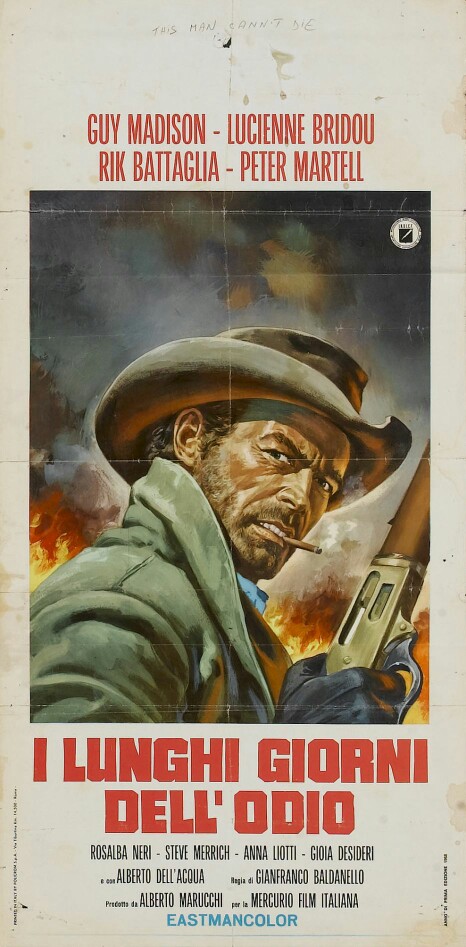
I lunghi giorni dell’odio (1968)

Known as This Man Can’t Die and Long Day of Hate, this Italian Western stars Guy Madison, who had been the title character in the TV series The Adventures of Wild Bill Hickock, as Martin Benson, a Civil War veteran and former outlaw who is trying to clean up his act by working as an undercover agent for the U.S. Army.

He’s already helped capture and execute three members of the gang he’s snuck into — he sends the reward and guns home to his father, a man who still looks at him as a criminal — but he’s tired of this life. Yet his hard work will get his captain promoted and he’s forced to stay working.

The gang learns that Benson was the man who has done them wrong, so they find out where his family lives and murder his parents and assault his sister, leaving her mute. When his brother Daniel finds one of the gang members near death, he decides to nurse him back to health so he and his brother can get revenge.

Maybe Benson’s life isn’t going so well. That said, Rosalba Neri is his girlfriend. There are worse things, right?

Director Gianfranco Baldanello — who often worked as Frank G. Carroll — also directed Colt In the Hand of the DevilDanger!! Death Ray, Man with the Golden Winchester and Very Close Encounters of the Fourth Kind. He also wrote the giallo The Girl In Room 2A but mostly worked as an assistant director. He also co-directed The Uranium Conspiracy with future Cannon Pictures boss Menahem Golan.

This movie has more nudity than several Italian westerns put together. That’s really all it has to make it stand out, other than the two great titles.

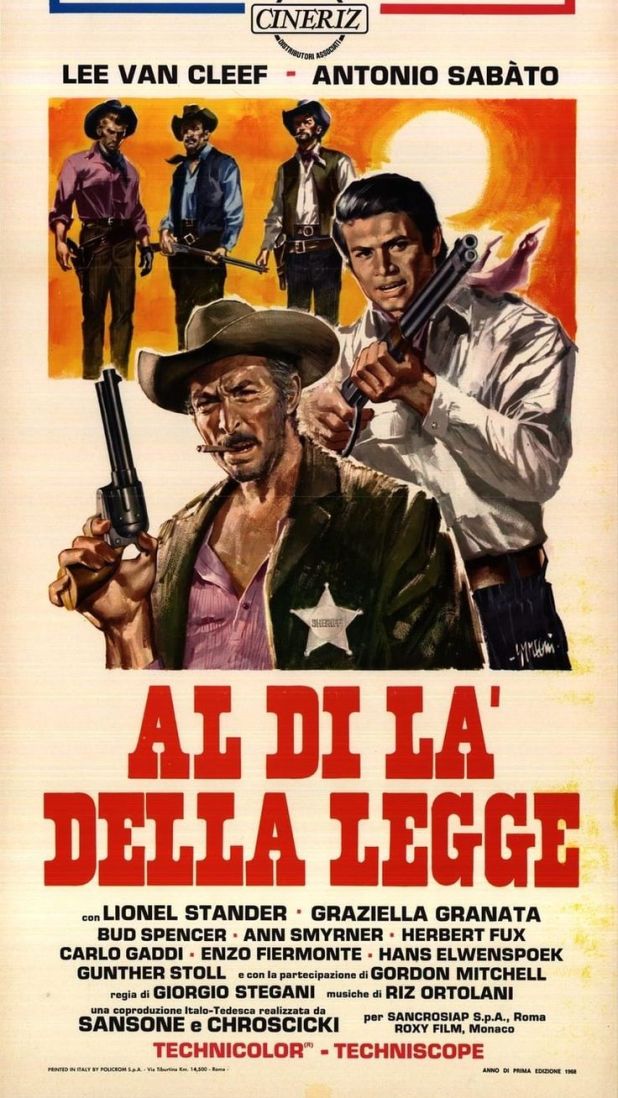
Al di là della legge (1968)

Billy Joe Cudlip (Lee Van Cleef) is not a good man. But he’s conflicted. Sure, he’s just robbed a stagecoach of $12,000, but he feels like he owes something to the man his crimes have hurt the most, a Czech immigrant named Ben Novack (Antonio Sabàto) who was supposed to deliver that money to hard working miners.

When another gang attacks the next shipment of money — led by Gordon Mitchell — and the sherrif is killed, things change for Cudlip. He’s offered the job of lawman, which his partners Preacher (an astounding Lionel Stander, trapped in Europe thanks to the blacklist) and freed slave Al (Al Hoosman, an amateur heavyweight boxer who fought in World War II and then settled in Germany, where he became an actor in thirty films) think will be quite helpful when it comes to taking all the town’s silver.

Except that the gangs that come to town are way worse people than Cudlip. He now feels compelled to protect the men, women and children of Silvertown, which goes against everything he believes in. Sooner or later, he’s going to have to choose between Ben and the town or Preacher and Al.

In a genre made up of loners who disappear after they get their bloody revenge or save a town, this is a rare Italian western with a hero who finds that he belongs. As the film closes, with his star cast aside, Ben stops him and says, You are not alone, Cud. You have us — you always did. You are our friend. And our sheriff.”

Director Giorgio Stegani only made nine movies, but he wrote one that made a major impact: Cannibal Holocaust.

This is also worth watching just to see Bud Spencer without his beard.

You can watch this on YouTube.

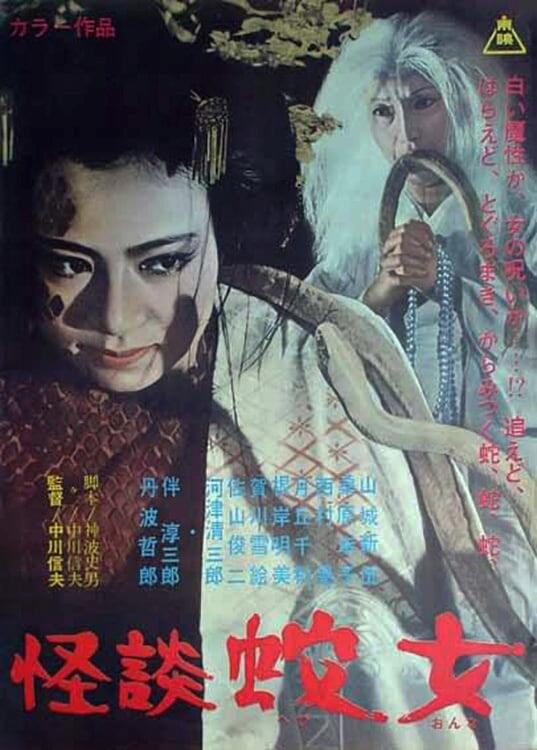
Kaidan hebi-onna (1968)

When a poor farmer named Yasuke dies, all of his fields are taken — legally if not ethically — by landlord Chobei Onuma. That man now takes Yasuke’s wife Sue and daughter Asa as servants to work off his debt, an action that introduces Chobei to the ghost of the farmer. He orders their home destroyed and a gigantic snake appears before being killed — a bad omen in Japanese culture and but the start of the curse.

Asa and Sue are abused not only by Chobei but also by his Masae and son Takeo. Sue tries to protect another snake but pays for that act with her life, leaving her mother alone to deal with the sexual advances of her new master’s son. Yet the ghosts haven’t left and while rich men may rule the physical world, they have no say over the supernatural one.

Directed by Nobuo Nakagawa (Jigoku) and written by Fumi Konami (Female Prisoner #701: Scorpion), this may not be the all-out shock that later Japanese horror would spray all over the screen, but it has moments of eerie calm amongst the otherworldly.

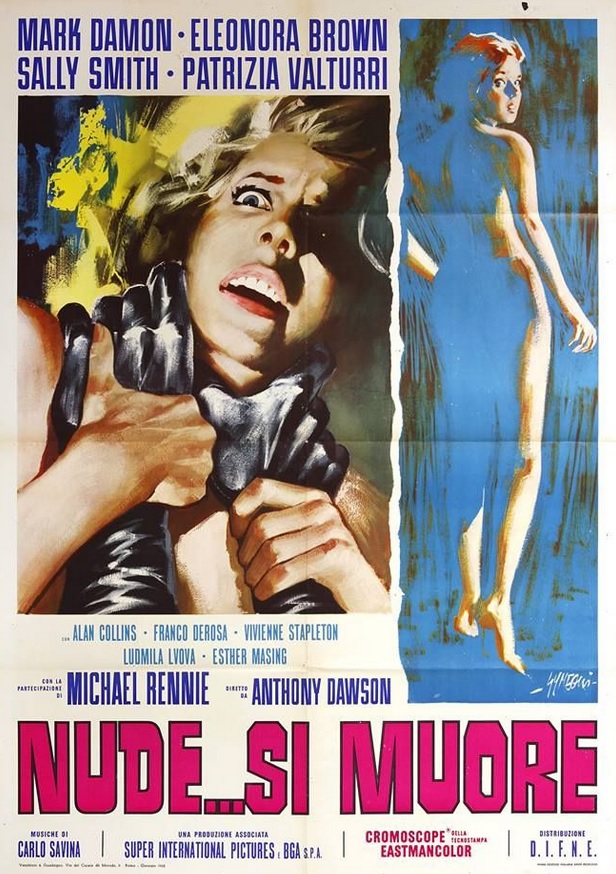
Nude… si muore (1968)

Naked…You Die (AKA The Young, the Evil and the Savage) is a pretty fun early giallo with good direction by Antonio Margheriti.

Yet it was very nearly was a Mario Bava movie.

According to Tim Lucas’ Mario Bava: All the Colors of the Dark, Bava was hired by Lawrence Woolner — the distributor of Hercules in the Haunted World and Blood and Black Lace in America — to direct a movie about a killer stalking a school. Cry Nightmare was going to be the title and Bava wrote the script with Brian Degas and Tudor Gates (BarbarellaDanger: Diabolik).

Lamberto Bava told Lucas that “Just a short time before the filming was to begin, Mario Bava had an argument with the producers and he abandoned the film.” As for Margheriti, who met Woolner when he distributed Castle of Blood, he said “I think Mario was busy at that time, working on Diabolik or something.”

Either way, locations were already secured, cast and crew had been hired and a theme song had already been recorded.

The drowned body of a woman is placed in a truck going to St. Hilda College. There, only seven students, two teachers — Mrs. Clay (Ludmilla Lvova) and Mr. Barrett (Mark Damon — Headmistress Transfield (Vivian Stapleton) and gardener La Foret (Luciano Pigozzi) are present.

Soon, the killing begins with Betty Ann being strangled and found by Lucille (Eleonora Brown in her last film until coming out of retirement in 2018), who is having an affair with Barrett. When she tells him to come see the body, it’s already gone, so they decide to leave the school.

The killings kick into gear with Cynthia (Malisa Longo, Ricco the Mean Machine) being killed in front of the gardener, who is soon killed as well and Denise (Patrizia Valturri) too. There’s also amateur detective Gillie (Sally Smith) on the case and Inspector Durand (Michael Renne from The Day the Earth Stood Still) trying to stop the killings.

All the girls wear similar uniforms — and outfits that change scene by scene — and nobody wonders why an older teacher can play Big Bad Wolf with Little Red Riding Hood and get away with it.

The aforementioned theme song “Nightmare” by Powell and Savina (Don Powell, who played Emanuelle’s father in Black Emanuelle 2 and did that film’s soundtrack, along with Carlo Savina, who composed the music for The Killer Reserved Nine SeatsLisa and the DevilFangs of the Living Dead and so many more) and performed by Rose Brennan owes royalties to Neal Hefti.

Perhaps even wilder is the fact that the movie informs us that Gillie may be the daughter of James Bond.

Giallo would change in a few years to be bloody, sleazier and stranger. That said, this is a great example of an early version of this style of movie.

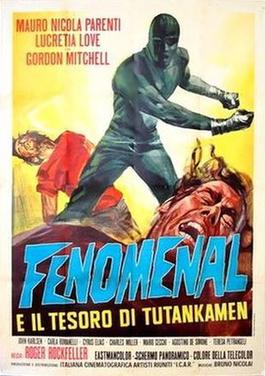
Phenomenal and the Treasure of Tutankhamen (1968)

Directed by “Monsieur Cannibal” Ruggero Deodato under the name of Roger Rockfeller, this is a movie that even its director admits that he “didn’t give a shit about the film.” Deodato went on to claim that the producer and star of this film, Nicola Mauro Parenti, was “too stiff, a dog of an actor; I treated him like shit on the set, but then he called me again for Zenabel.” This was also his first directing job.

This is a fumetti movie not based on any existing character, but obviously in the same world as Kriminal and Danger: Diabolik. Unlike those movies, Phenomenal is the hero and he’s going up against Gordon Mitchell and his gang to keep the treasures of Egypt — the title does not lie — safe. There’s a lot of sitting around and talking where there should be action, but one look at the hero’s costume — a turtleneck and a stocking mask — shows you how inspired this was. Look — not everyone can do Eurospy or comic book action adventure.

That said, the Bruno Nicoli score is quite nice and it’s never a bad thing to spend 90 minutes with Lucretia Love, who was also in The Killer Reserved Nine SeatsDr. Heckyl and Mr. Hype and Enter the Devil.

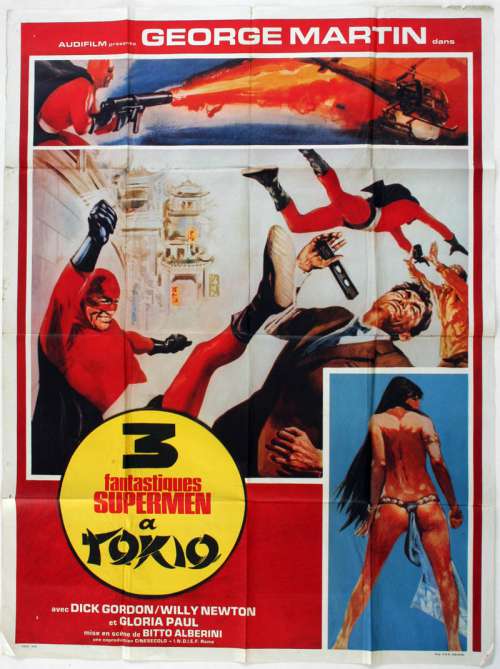
3 Supermen a Tokyo (1968)

The Supermen series — this is the second in the series — was such a big deal that the series would become popular in Germany and Turkey, with each country making their own remixes of the movies. This is shot Italian style — exteriors in Japan, interiors back home.

The only movie in the series — outside of the aforementioned localized remakes — to never make it to America, this one has the Supermen seeking a miniaturization weapon in Tokyo, which is an excuse to chase women and eat lots of food, including a fried chicken dinner that ends up being dog, perpetuating that horrible racist urban legend.

Bitto Albertini replaces Gianfranco Parolini as director, while the first movie’s Tony Kendall, Brad Harris and Aldo Canti are now played by Jorge Martin (who is also in 1970’s Supermen and 1973’s Three Supermen of the West), Willi Colombini (Pollux from the Steve Reeves Hercules) and Sal Borgese (Superbug, the Craziest Car in the WorldSuper Fuzz), not for the better. That said, when the miniaturization ray just turns the cast into kids, well…that’s pretty funny (and works in the budget).

Gloria Paul plays an enemy agent in this and was nearly Domino in Thunderball, so that at least gives this some Eurospy credit.

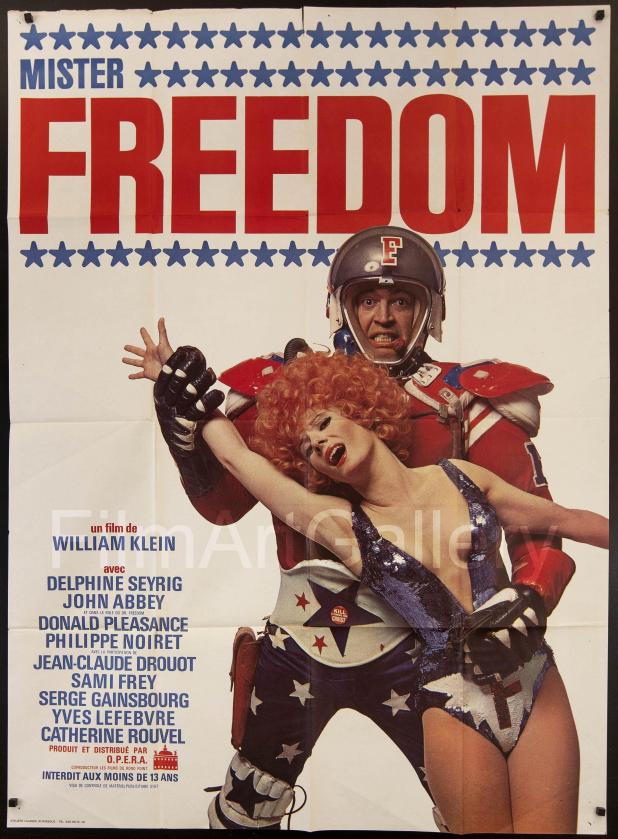
Mr. Freedom (1968)

William Klein settled in Europe after serving in World War II and achieved widespread fame as a fashion photographer for Vogue. Ranked 25th on Professional Photographers list of 100 most influential photographers, he directed Who Are You, Polly Magoo?, The Model Couple and several documentaries in addition to this movie, which critic Jonathan Rosenbaum wrote was “conceivably the most anti-American movie ever made.”

Mr. Freedom (John Abbey) works during the day as a beer drinking cop and at night as a government-sanctioned vigilante. He’s called to the Freedom Tower, which houses the military-industrial complex — to meet with Dr. Freedom (Donald Pleasence!) who wants him to go to France and find the killer of Capitaine Formidable and bring France back to the side of capitalism or die trying, as he’s equipped with a nuke that can wipe out the country instead of letting it fall to the Communists.

Mr. Freedom joins forces with Capitaine Formidable’s widow Marie-Madeleine (Delphine Seyrig, who made a film version of the SCUM Manifesto and Be Pretty and Shut Up, a pre-#MeToo 1977 film that featured Shirley MacLaine, Maria Schneider and Jane Fonda and concerned how women were treated within filmmaking), where he learned that their plan had been to run houses of ill repute to gain intelligence, a plan he endorses, as well as forming his own army that will stop Communism in France and build a “white wall of freedom” around the U.S. — decades before red hats and whitewashed fascism came back in fashion.

He also battles the Russian Stalinist Muzhik Man and Chinese Maoist Red China Man — which upset Marxist-Leninist folks at the 1968 Avignon Festival — and gets a secret tranceiver put into his teeth which sends Communist messages into his brain. This leads to the hero — or villain — building a secret base from which his operatives can start attacking Commiunism, which basically means being criminals themselves and causing anti-US demonstrations.

Mr. Freedom goes Kent State and fires a machine gun into a crowd of peaceful protestors, which causes Marie-Madeleine to reveal that she’s a double agent and killed her own husband. Mr. Freedom kills her just as the demonstrators attack his base and kill his followers. Seeing that France neither wants nor deserves American democracy, Freedom activates his bomb, which only kills himself.

Is it any accident that Mr. Freedom is wrapped up in the red, white and blue, plus football pads?

This feels like an indictment of comic book Hollywood four decades before that was even a thing.