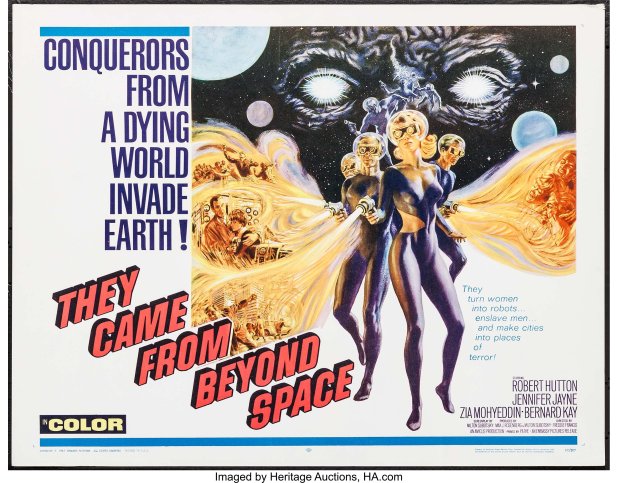
MILL CREEK SCI-FI CLASSICS: They Came from Beyond Space (1967)

This played double bills with — The Terrornauts. And much like that movie, this one has a great poster that advertises a movie I want to see more than the one that I actually watched.

Based on Joseph Millard’s The Gods Hate Kansas, this was directed by Freddie Francis for Amicus. He claimed that the studio spent all of the budget for this on the aforementioned The Terrornauts, leading to an inferior film.

This one is about the Master of the Moon (Michael Gough!) spreading a “Crimson Plague” that wipes out a whole bunch of humanity so that the government will send the bodies of the victims to the moon to hide what really happened to them, at which point he will bring them back to life and use them to fix his spaceship.

It’s a really complicated plan that gets torn apart at the end by hero Dr. Curtis Temple, who basically tells the Master that if he’d just asked for help, humanity would have done it. This causes one of the most powerful beings in the galaxy to just start crying.

Supposedly this was Anwar Sadat’s favorite movie. I only have IMDB as a source for this, but I find that absolutely hilarious and have decided that it must be true.

Don’t have the box set? You can watch this on Tubi.

Spagvemberfest 2023: Requiescant (1967)

Also known as Kill and Pray, this comes from director Carlo Lizzani, who also made Un Fiume di Dollari. It starts with a massacre of Mexican people as they are betrayed aby Confederate soldiers under the command of Ferguson (Mark Damon). Only a young boy survives, running into the desert where he is raised by Father Jeremy (Ferruccio Viotti) and grow into a holy man who is also incredibly good with a gun.

His stepsister Princy (Barbara Frey) rebels against her family and joins a traveling circus and the boy (Lou Castel) sets out to find her, getting the name Requiescant for the words he says every time he shoots someone. It basically means “go in peace” and he’s atoning for each murder while providing last rites.

He finally finds his sister in San Antonio, a town now run by Ferguson and a place where his stepsister is forced into sexual slavery by Fergusson’s henchman Dean Light (Carlo Palmucci). Once he learns who is in charge, he joins the cause of Father Don Juan (Pier Paolo Pasolini, who also worked on the script and yes, that’s the same person who made Salo). Holy men sometimes need to kill, at least in the Italian West.

Damon is a revelation here, appearing as if he has walked out of a gothic horror movie all in black with his pale skin, literally treating everyone around him like they mean nothing. There’s a scene where he strangles his wife while Dean watches where he seems aroused as he shouts “She died well, Dean. It was a beautiful moment for her.”

I love the idea that these religious men have had enough and need to speed up God’s vengeance.

This was written by not just the director and Pasolini, but also Franco Bucceri (My Dear Killer), Renato Izzo (Tentacles), Adriano Bolzoni (Sonny and Jed),  Armando Crispino (The Dead Are Alive) and Lucio Battistrada (Autopsy).

You can watch this on Tubi.

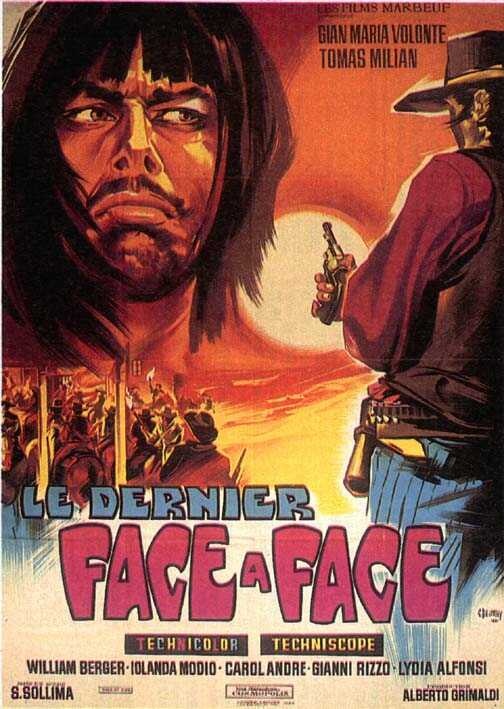
Spagvemberfest 2023 : Face to Face (1967)

Known in the UK as High Plains Killer and in Germany as Hallelujah, The Devil Sends His RegardsFace to Face is the second of three Italian Westerns by Sergio Sollima. He also made Violent City and Devil in the Brain. It was written by two Sergios, Sollima and Donati, who also scripted OrcaAlmost Blue and Holocaust 2000.

In the time after the Civil War, Civil War, Brad Fletcher (Gian Maria Volonté, who was in A Bullet for the GeneralA Fistful of Dollars and For a Few Dollars More) quits his job teaching history at Boston University. His tuberculosis would do better in Texas, he thinks, and he makes his way out West. As the movie begins, he’s a liberal — Volonté was an extreme left wing activist — who thinks violence has no meaning. Then he meets the criminal Solomon “Beauregard” Bennet (Tomas Milian). When he tries to give the man a drink, he’s captured and taken into a hideout in the middle of nowhere.

There, he learns how to shoot a gun as Bennett recovers from his injuries. Instead of finally going back to Boston, he soon is part of the gang, along with Charley Siringo (William Berger), Aaron Chase (José Torres), Jason (Frank Baña) and Vance (Nello Pazzafini). He even kills a man to save Bennet.

They’re joined by Maximillian de Winton (Ángel del Pozo) and stay in Puerto de Fuego, a world of no laws, criminals and outsiders. As the gang leaves for a train robbery, Fletcher stays behind and has an affair with Vance’s woman Maria (Jolanda Modio). When the gang comes back, Fletcher kills Vance in self-defense.

Fletcher also starts to take over the gang, setting up a robbery dressed as everyday folks that gets spoiled when a kid recognizes Bennett. At that point, Charley reveals that he’s a lawman and kills Jason, Maximillian and Aaron. He also captures Bennett and only Fletcher and Maria escape. She dies and he goes mad due to all the death — Maria and the kid who fingered Bennett — and betrayal. He transforms the somewhat oasis of Puerto del Fuego into a wretched hive of scum and villainy that has a posse led by Zachary Shawn (Aldo Sanbrell) coming to town to kill everyone. Bennett gets there too late to stop them.

By the final scene, the good man has become a criminal and the gunfighter has started to atone for his past. That said, they have to get through an entire posse if either of them is going to survive, as well as deal with Charley. I love that Bennett is around violence all the time and it’s become a habit while Fletcher comes to learn that his brains, when combined with a willingness to do horrible things, can make him stronger and wealthier than he was back East. The West changes them both.

That’s beyond obvious when Fletcher kills another turncoat, tying him to a cross and putting a gun to his head, blasting his brains out without a thought. Obviously, his illness is no longer bothering him.

Sollima used his experiences in fighting with the anti-fascist resistance in World War II to make this movie, remembering how he saw children be brave and adult men be cowards. He also pushed his actors by using their real-life differences. Volontè was a Communist and Milian left Cuba when Castro took control. He also made them box one another before shooting.

CHILLER THEATER MONTH: The Eye Creatures (1967)

EDITOR’S NOTE: The Eye Creatures was on Chiller Theater on Saturday, June 5, 1971 at 1:00 a.m. and April 22, 1972.

Directed by Larry Buchanon and written by Paul W. Fairman, Robert J. Gurney Jr. and Al Martin, The Eye Creatures is based on Fairman’s “The Cosmic Frame” and is a remake of American-International Pictures’ Invasion of the Saucer Men. It was made in Dallas for $25,000 as a series of remakes that would fill in AIP’s TV packages. They had Jonn Ashley, who took up most of the budget, but his wife left him just before they made the movie.

Buchanan told Fangoria, “We got John Ashley on the weekend that his wife Deborah Walley said goodbye to him. And here I am with him on the set the next morning; he was in bad shape. Deborah had gone over to Arkansas on an AIP publicity junket for one of those “Beach Party” things, and John asked me if he could fly up and see her. I said, “John, we just started!” I sat down with him and worked it out, I shot around him for two days while he tried to reconcile with her. It didn’t work. But it did work for me in that when he came back, he worked his tail off. I told him he had to make a break— he had a little money— and go as far away from Deborah as he could get. And we talked long into the night, about shooting, casting and making movies. I don’t think we ever stopped on that picture. We would work all day and talk all night. And then he went off to Manila and began making those Bamboo-girl pictures and made a fortune.”

Buchanan also made In the Year 2889 (a remake of Day the World Ended), Zontar, the Thing from Venus (a remake of It Conquered the World); Curse of the Swamp Creature (a remake of Voodoo Woman); Creature of Destruction (a remake of The She-Creature); It’s Alive!,  Mars Needs Women and Hell Raiders (a remake of Suicide Battalion) for AIP. All of these movies went straight to late night horror shows on UHF channels.

AIP told him, “We want cheap color pictures, we want half-assed names in them, we want them eighty minutes long and we want them now.”

Project Visitor should be used to search for UAPs, but the horny soldiers use it to watch teenagers like Stan Kenyon (Ashley, who was a 33-year-old teenager in this movie) and his girlfriend Susan Rogers (Cynthia Hull) make out. When she tells him that she thinks someone is watching them, he tells her that everyone in every car is watching each other. Maybe later, they’ll watch some other couples. 1967 is wild.

As they pull out of lover’s lane, they hit and kill an alien with their car. The alien body ends up getting used in a get rich plan and the government looks for it. It. turns out that the aliens plan on attacking the town but the teens soon learn that bright light destroys them, so everyone stops dry humping and shines their headlights on the eye creatures, destroying them.

If you watch The Ghost In the Invisible Bikini, the eye creature shows up. There’s a lot more recycling in this movie, as the UFO scene is from Invaders from Mars and music is taken from Attack of the 50 Foot Woman, Beach Party and The Hypnotic Eye.

You can watch this on Tubi.

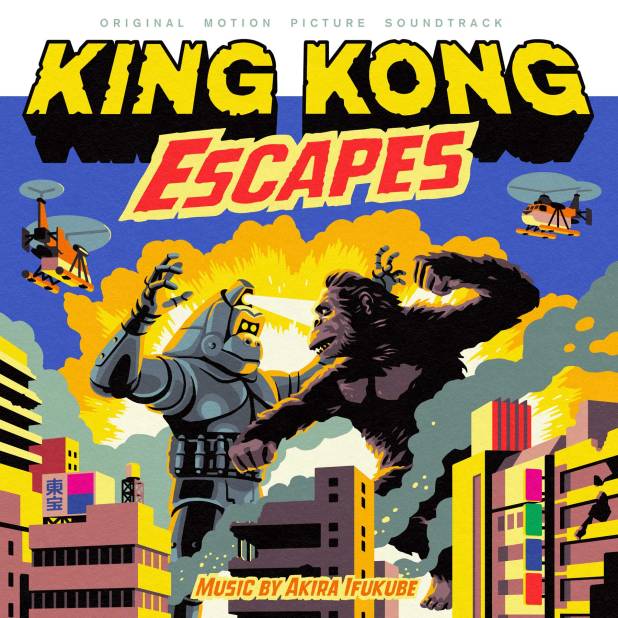
CHILLER THEATER MONTH: King Kong Escapes (1967)

EDITOR’S NOTE: King Kong Escapes was on Chiller Theater on Saturday, October 17, 1973 at 11:30 p.m. It also aired on November 9, 1974; July 10, 1976; July 30, 1977 and September 2, 1978. 

After 1962’s Godzilla vs. King Kong, Japan had not had enough of the big ape. After all, Kong was the first beast to both defeat and not be killed by Godzilla. Four years later, Toho paired up with Rankin/Bass, the creators of Rudolph the Red Nosed Reindeer and The King Kong Show, a cartoon where Kong battled aliens, monsters and mad scientists. Interestingly, the designs for that show were by Jack Davis of EC comics fame. The show was the first cartoon produced in Japan for American audiences and was so successful, Rankin-Bass partnered with Toho for a first film called Godzilla vs. the Sea Monster (or Ebirah, Horror of the Deep which is a much better title). Rankin-Bass rejected this movie as a starring role for Kong, but a lot of moments throughout point that the script was barely changed when Godzilla entered the picture. He’s revived by lightning (Japanese Kong, for some reason, gets power from the cloud…err, clouds) and the big lizard is in love with female character Dayo, which is also a Kong trait.

Finally, Rankin-Bass consented to this film, featuring Dr. No. No, not the Bond villain, but a character from the cartoon, here played by Hideyo “Eisei” Amamoto, who you may know as Dr. Shinigami/Deathgod from Kamen Rider. His voice is from Paul Frees, who listeners will recognize from many a Rankin/Bass holiday special. Interestingly enough, the German distributor of Toho’s movies often used Dr. Frankenstein’s name to sell these new monsters, claiming that he was creating all of them. So in Deutschland, the doctor goes by Dr. Frankenstein to try and tie all of these together. What does this have to do with the Frankenstein monster in Frankenstein vs. Baragon and his spawn in War of the Gargantuas? Absolutely nothing, thanks for asking!

Dr. Who’s boss is Madame Piranha, who works for an undisclosed country that wants weapons. She’s played by Mie Hama, who would go on to play Kissy Suzuki in You Only Live Twice (1967). Dr. No has invented a mechanical Kong that malfunctions just before getting that oh-so elusive Element X.  Instead of rebuilding the robobeast, No decides he needs the real Kong. Again, you may ask why. You are permitted after all. However, I have no answer for you. These things just happen in these films and you shouldn’t be watching a kaiju movie if you’re looking for logic, dear reader.

Meanwhile, Carl Nelson — our hero — and his sub get to Mondo Island, where Kong lives. Almost instantly, Kong falls in love with Fay Wray analog Lt. Susan Watson and prepares to fight Gorosaurus (who shows up again in the greatest of all Toho movies, 1968’s Destroy All Monsters!). For some reason, this beast fights like a kangaroo, but Kong gives him a headlock takeover and demonstrates a kaiju form of MMA ground and pound, punching the rubbery dino again and again until a giant mutant Big John McCarthy moves him away. Just kidding. Kong beats his chest, picks up the girl and the humans just watch and wonder what to do next. They find a very Commander Scarlet mini-sub and Kong gives chase, finally being delayed by a sea monster.

Actually, come to think of it, Carl Nelson is thisclose to Admiral Nelson, commander of the mini-sub Seaview on the TV series Voyage to the Bottom of the Sea (1964-1968). Coincidence?

Here’s why I love this movie. In this scene, Kong’s head has grown to way larger than before proportion. Continuity be damned, by the next scene, as he catches up to the big sub, his head is back to normal and his eyes are not bugging out. Everyone finally figures out that Kong will listen to Susan and all is as well as it can be when you’re dropping anchor off Mondo Island, which one assumes is relatively close to Monster Island.

Remember Dr. No? Well, he comes back and takes Kong from the island, even killing an old man just to do so. He also wants you to know he has nothing to do with the Timelord, even if he does look like a Japanese John Pertwee. Kong is gassed and lifted away to complete the retrieval of Element X. Some flashing light and hypnotism later and Kong is all ready to mine away, using a set of headphones that Dr. No speaks orders into.

Those wacky Germans we mentioned before? Well, in their versions of the movies, both Jet Jaguar and Mechagodzilla are referred to as King Kong. Again, you’ll have that why question in your head and the answer is simple. King Kong is a marquee name, no matter if he’s properly named or not.

But I digress. Our human heroes (this would be the time that a child version of the author would tune out until the giant monkey was ready to actually do something) seek out Kong, who looks stoned as he mines in an ice cave. The headset breaks and Kong stops listening, which means that Dr. No needs Susan, because she’s the only one Kong will listen to. If only they hadn’t had that press conference telling that to the world!

While all this is going on, Madame Piranha puts the moves on Carl Nelson, who is all super stoic and not having any of this, well, monkey business. He won’t turn on his friends, so Dr. No slaps him around and makes some threats. Kong, well, escapes by swimming in the cold Arctic waters all the way to Tokyo. The Madame decides that even she can’t deal with Kong fighting his mechanical doppelganger and wants Dr. No to just chill. Obviously, something else happened, because she decides to free the good guys.

Just in time — Mecha-Kong and Kong are about to tear Tokyo apart. Susan tries to use reason, but Mecha-Kong has flashing lights and gets Kong all baked again. Seriously — watch this movie and dispute my findings, if you will. One thing leads to another and it’s on like Donkey Kong. No — it’s on like King Kong! This is why you showed up for this movie — two dudes wearing rubber suits dressed as giant gorillas dropping buildings on one another.

Madame Piranga makes her move on the nefarious doctor, but after a slow chop-socky dance and some fighting between an end table, she gets shot in the arm. Yes. The arm. Meanwhile, Tokyo Tower is being ascended and destroyed by our ape combatants. Kong rescues the girl and climbs to the top where they invent the Skywalkers match that the NWA would use for the Great American Bash twenty years later.

Kong wins and then goes one further by tracking down Dr. No’s ship and killing him. Yes — this is a G-rated movie. Then and only then does he give up on civilization and swim away.

Toho had intended King Kong to return for 1968’s Destroy All Monsters, but the rights had lapsed. The Kong suit shows up as Gorilla on the Toho show Go Greenman! (1973-1974) Weirdly enough, Toho had hoped to use Mecha-Kong to battle Godzilla, but when Turner Home Entertainment bought the rights, they decreed that Kong (and anyone looking like him) should not appear in a Japanese monster movie. Boo. Hiss.

All said, this is a pretty entertaining film. Don’t expect CGI quality. In fact, don’t expect any quality. Expect to be entertained and with a runtime of a little over 80 minutes, you honestly won’t waste much time. You are free to giggle at the silly Kong costume, but remember that in the mid 1970s, your author had big Coke bottle glasses and a bowl haircut and lived for this movie. He may still love it just that much.
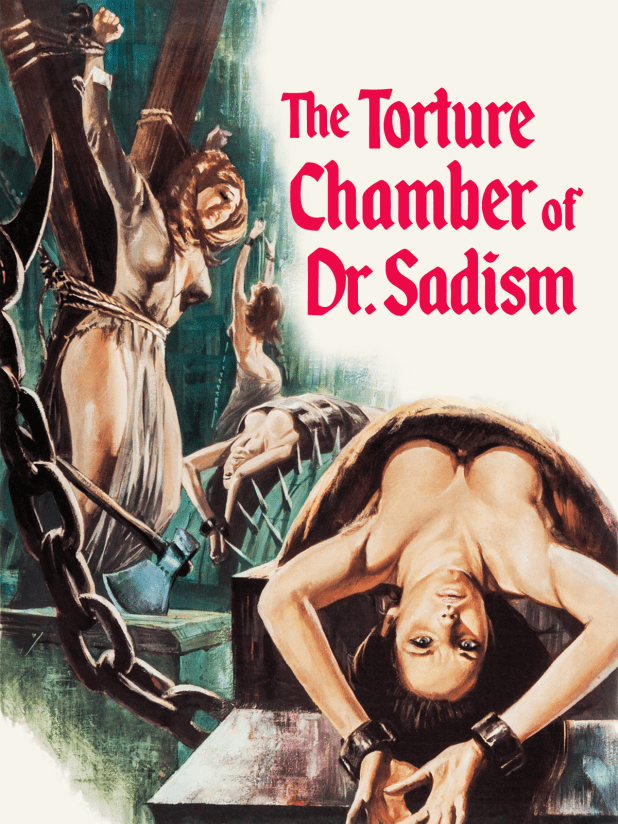
CHILLER THEATER MONTH: The Torture Chamber of Dr. Sadism (1967)

EDITOR’S NOTE: The Torture Chamber of Dr. Sadism was first on Chiller Theater on Saturday, November 24, 1974 at 11:30 p.m. It also aired on Saturday, January 24, 1976.

I can’t believe that this movie aired on regular television.

This has some great AKA titles, such as The Blood Demon, The Snake Pit and the Pendulum, Castle of the Walking Dead and Crimson Demon in Rhode Island, as the word blood was banned from ads. Hemisphere Pictures released it on a double bill with The Mad Doctor of Blood Island, which was called The Mad Doctor of Crimson Island in bloodless areas.

Drected by Harald Reinl (The Strangler of Blackmoor Castle, The Return of Doctor Mabuse), it’s based on The Pit and the Pendulum, kind of. It’s also about Count Regula (Christopher Lee), who is charged with the murder of twelve women and then drawn and quartered. And beheaded. And he gets better.

Baroness Lilian von Brabant (Karin Dor, Assignment Terror) and her lawyer Roger Mont Elise (former Tarzan Lex Barker) have been invited to the Blood Castle. She plans on getting her inheritance and he wants to learn who his parents were. They also meet a profane monk named Fabian (Vladimir Medar) and hear the story of Count Regula, who demanded revenge on his enemies before he died.

The Baroness and her maid Babette (Christiane Rücker, Frankenstein’s Castle of Freaks) are abducted by hooded men while riding through the woods filled with human body parts hanging from trees, a horrific scene that is made even more frightening by its low budget high concept lunacy.

Once everyone is trapped in the castle, the Count’s servant Anatol (Carl Lange, Creature With the Blue Hand) brings Regula back with his face destroyed. Behind a mask, he claims that he will take his last victim, the Baroness, and become alive. Everything goes nuts, as the Baroness not only is placed into a snake-filled hole painted with “The Last Judgement” from “The Garden of Earthly Delights by Hieronymus Bosch, she’s also menaced by scorpions, spiders, bugs and vultures. It gets amazing because every time you think that they can’t top the last animal, another jumps on her. Roger escapes from the pendulum, saves Babette from an iron maiden water trap and uses the iron cross of the Baroness to destroy the bad guys.

This movie is absolutely incredible. Like, I get excited just thinking about it.

You can watch this on Tubi.

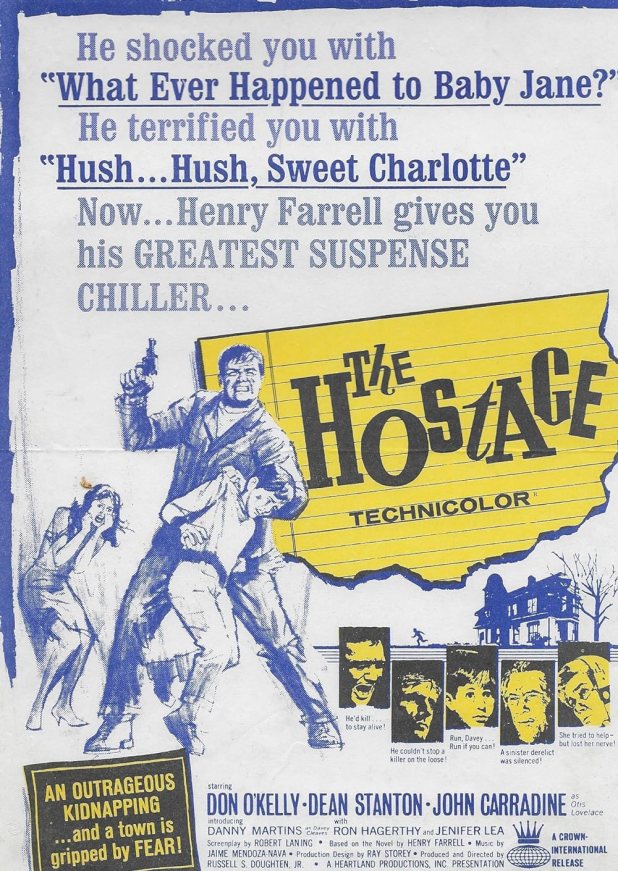
CHILLER THEATER MONTH: The Hostage (1967)

EDITOR’S NOTE: The Hostage was first on Chiller Theater on Saturday, February 5, 1977 at 11:30 p.m. It also aired on the show on August 18, 1979, January 31, 1981 and February 27, 1982.

Lots of Henry Farrell’s stories got turned into movies. Hush…Hush, Sweet CharlotteSuch A Gorgeous Kid Like MeHow Awful About Allan, The House That Would Not DieWhat’s the Matter with Helen?The Eyes of Charles Sand and, most famously, What Ever Happened to Baby Jane?

His first book, The Hostage, was turned into this low budget Crown International film, which was directed by Russell S. Doughten Jr., who would go on to executive produce the entire A Thief In the Night series of Christian pre-millennial madness. God bless you, Mr. Doughten, for all you have given to me.

A kid named Davey Cleaves sneaks onto a moving truck driven by the bonkers man named  Bull (Don Kelly, a TV star who died young as this is his final movie) and his partner Eddie (a very young Harry Dean Stanton).

John Carradine shows up, as he does at least seventeen times a week in movies that I watch, as does Ann Doran, whose career started in the silent era.

This was the first movie ever shot in Iowa. What a joy for the state when a drunken John Carradine was arrested in Des Moines, as he was disturbing the peace by loudly acting out various Shakespeare plays.

You can watch this on Tubi. Or You Tube.

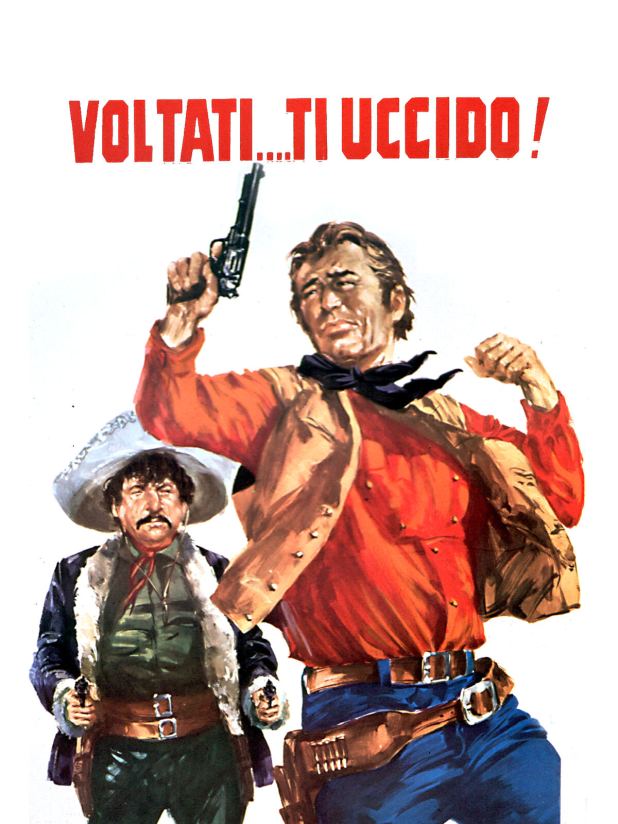
THE FILMS OF RENATO POLSELLI: Voltati… ti uccido (1967)

Voltati… ti uccido (Turn Around… I’ll Kill You) — also known as Winchester Bill and If One Is Born a Swine — was directed by Alfonso Brescia and written by María del Carmen Martínez Román (Crypt of the Vampire, Jess Franco’s Vampiresas 1930Django Kill… If You Live, Shoot!) and Renaro Polselli.

Ted Shaw (Conrado San Martín) owns most of the goldmines in town, other than just one, the mine of old Sam Wilton (Spartaco Conversi). Shaw sends bandits to take care of the elderly mine owner, but he didn’t count on him hiring Winchester Billy Walsh (Richard Wyler AKA Richard Stapley, The Girl from Rio, Dick Smart 2.007) to protect him. Then, Bill must fight Mexican outlaw El Bicho (Fernando Sancho, Return of the Blind Dead).  

He does have the help of several brothers who get tortured and buried up to their necks while the enemy army bears down on them. Luckily, good saves the day.

I’m always amazed at the longevity of Italian creatives. Brescia would go on to make movies in nearly every genre, often using the name Al Bradley. There’s the strange Ator sequel Iron Warrior, his run of Star Wars clones such as Star Odyssey (see this article for more on those movies), giallo (Ragazza tutta nuda assassinata nel parco, the late in the game Omicidio a luci blu with David Hess and 90s crush Florence Guérin), poliziotteschi (Napoli serenata calibro 9), mondo (Nel labirinto del sesso) and even the space, porn and ripoff hybrid The Beast In Space.

As for Polselli…well, I just spent an entire week on his movies.

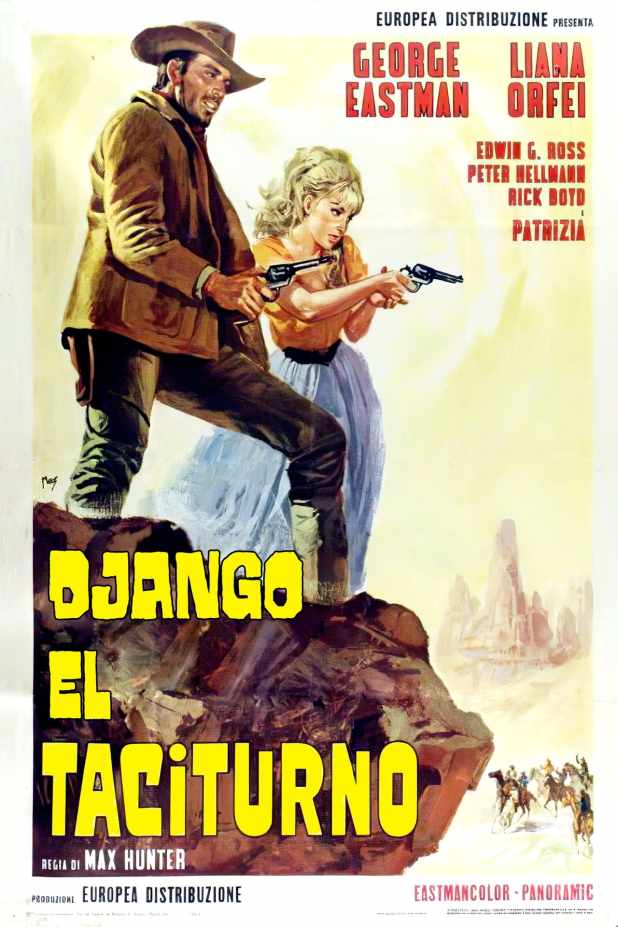
THE FILMS OF RENATO POLSELLI: Django Kills Softly (1967)

Bill il taciturn (Silent Bill) was directed by Max Hunter AKA Massimo Pupillo (Lady Morgan’s Vengeance, Bloody Pit of Horror, Terror-Creatures from the Grave) and had the traditional big team of Italian writers, including Lina Caterini (the editor of The Girl Who Knew Too Much and Blood and Black Lace), Paul Farjon, Marcello Malvestito (the editor of The Last Blood and Assassination In Rome), none of whom had much writing experience before or after this movie. They were joined by the person who came up with the story for this film, Leonide Preston, who is really Renato Polselli.

Yes, the same lunatic who made Delirio caldo and La verità secondo Satana.

It was retitled to Django Kills Silently or Django Kills Softly, as the original script had Bill (or Django for Americans) be the strong and silent type. He’s played by future baby eater George Eastman, who decided. to rewrite the script. This isn’t his first Western or even his first Django, as he was also in Django Shoots First (and he’s also in Django, Prepare a Coffin and W Django!).

According to the invaluable Spaghetti Western Database, “Eastman declared that director Pupillo had asked him to play the hero in the taciturn style of Clint Eastwood, but Eastman, who had studied the classics and was a screenwriter himself, thought this was a bad idea and made up his own lines, for the most part improvising them on the set. While the character was turned into a more talkative version of the taciturn Bill, the title wasn’t changed, causing a lot of confusion and leading to some oddly inadequate titles in other languages.”

This feels like a totally made up comment, as this movie was obviously made without live sound, so no one would have known what Bill or Django was saying anyway and it would need to be dubbed! In fact, he was dubbed by Tony La Penna.

Regardless, let’s discuss the film.

The movie starts with a massacre of an entire family. It’s brutal and seems like the kind of action that often happens in the Italian West. Bill/Django is visiting the border town of Santa Ana but the person he was to meet is already dead. He learns that the town is caught between Thompson (Luciano Rossi) and a bandit named El Santo (which yes, is a bit disconcerting seeing how many lucha movies I watch; he’s played by Domenico Maggio). That means that our hero is ready to pull a little A Fistful of Dollars/Yojimbo/Last Man Standing on the two and get ahead for himself.

He also teams up with a gunfighter named Miguel (Spartaco Conversi) and a mute man named Pedro (Antonio Toma). There’s also a woman to save, Linda (Liana Orfei, Mill of the Stone Women) and the normal torture that the Italian Western hero must endure.

It’s not the most Italian of Italian Westerns, feeling trapped in the pre-Leone days, but it’s fun seeing the gigantic Eastman try and play a hero.

Space Monster Wangmagwi (1967)

ABOUT THE AUTHOR: Exploitation-film historian A.C. Nicholas, who has a sketchy background and hails from parts unknown in Western Pennsylvania, was once a drive-in theater projectionist and disk jockey. Currently, in addition to being a writer, editor, podcaster, and voice-over artist, he is a regular guest co-host on the streaming Drive-In Asylum Double Feature and contributes to the Drive-In Asylum fanzine. His upcoming essay “Emanuelle in Disney World and Other Weird Tales of a Trash Film Lover,” detailing bizarre and hilarious stories about midnight movies, grindhouses, and exploitation films, will appear in the next issue of Drive-In Asylum.

In the past few decades, the Korean film industry has taken off. Director Park Chan-wook has an enviable filmography with Oldboy, Decision to Leave and Stoker. And Bong Joon-ho, Korea’s best director, helmed The Host, Okja and Snowpiercer before Parasite became the first foreign-language film to win the Oscar for Best Picture. As well as Parasite’s also winning Best International Feature Film, Bong collected Oscars for Best Director and Best Original Screenplay. Korean films stand tall in world cinema. But it wasn’t always this way. Once upon a time, there was a Korean monster movie that tried to copy the success of King Kong and Godzilla. Thought lost for decades, Space Monster Wangmagwi (1967) escaped from the Korean Film Archive. It played the 2022 Fantasia International Film Festival in Montreal ahead of its first DVD release anywhere. Read further—if you dare—to learn more about a film that will never be confused with any of the great masterpieces of Korean cinema.

Space Monster Wangmagwi, filmed in glorious black-and-white, opens with a shot of a star field in outer space—or more correctly, what looks to be lights shining through pinholes punched in black construction paper to simulate stars. A paper mache spaceship powered by the flame of a matchstick appears, and we meet some aliens from planet Gamma, wearing the ugliest spacesuits you’ve ever seen. The aliens are headed to conquer earth. Their plan, which will turn out to be poorly planned, involves dropping Wangmagwi, a five-foot-something monster, on earth, where, as the Gammarians have calculated, he will grow 100 times his normal size and conquer the planet while under their remote control.

Wangmagwi, literally meaning “devil king” in Korean, lands on earth and does grow to enormous size. I suppose he’s some sort of reptile man, but it’s hard to tell because the monster suit is the worst I’ve ever seen: It looks like paper mache randomly thrown on some Korean guy wearing bedroom slippers with glued-on claws. This formidable space monster starts knocking over miniature buildings, which, while not as nice as the stuff Toho was doing at the time, doesn’t look too bad. But the film’s foley effects are horrendous. Collapsing buildings sound like pots falling out of a kitchen cabinet. 

We next meet someone who should be our hero—but isn’t—a pilot called away from his bride-to-be on the eve of their wedding to fight the monster. He ultimately figures very little in the plot, a bizarre screenwriting choice. 

But the most off-putting and bewildering aspect of the film is its attempts at humor. At one point, when we see the multitude of extras trying to escape the space monster, folks are literally running in circles. This is bluntly intercut (the editing of this film looks like it was done in the dark with children’s plastic scissors) with scenes of two friends who have an idiotic bet about who will be more frightened by the monster, a woman giving birth, and a guy looking for a newspaper so that he can find a quiet corner amidst the chaos to evacuate his bowels. I shit you not. (The punchline is that after he finds a newspaper and takes his dump, the escaping throng pushes him down onto his own excrement. Charming.) 

Our ostensible hero, a small boy, winds up in Wangmagwi’s ear canal. The kid then cuts Wangmagwi’s eardrums while yelling things like “I made you deaf, bastard” and urinates inside the monster’s skull. (I couldn’t make this up if I tried.) Seeing these hijinks left me slack-jawed and appalled. And I thought the scene in that other 1967 Korean monster film, Yongary, Monster from Deep, where the monster was sprayed with itching powder and rolls around in his death throes in a riverbed before bleeding from his anus and dying was the worst thing I’d ever seen in a kaiju eiga. I just don’t get the Koreans’ humor or their fixation on bodily fluids.

Meanwhile, with all this destruction happening, the air force is scrambling its jets, but they don’t attack Wangmagwi. The high command doesn’t want to endanger the populace (more like that would involve special effects that the filmmakers didn’t have the money for or skill to pull off). Anyway, before the fleet of stock-footage jets has to appear in the same shot as the monster, the alien commander intones “it looks like our shrewd plan has failed” (Shrewd plan? These aliens are friggin’ morons.), and he gives the order to have the monster self-destruct, which it does. Happy ending.

I was emotionally scarred by Space Monster Wangmagwi, but I’m glad I saw it… as a form of masochism, I guess. (I’m terrified that I’ll start hallucinating scenes from it the next time I drink too much absinthe.) It’s that rare thing: a perfect object. Perfectly bonkers. Check it out—if you dare—on Tubi.