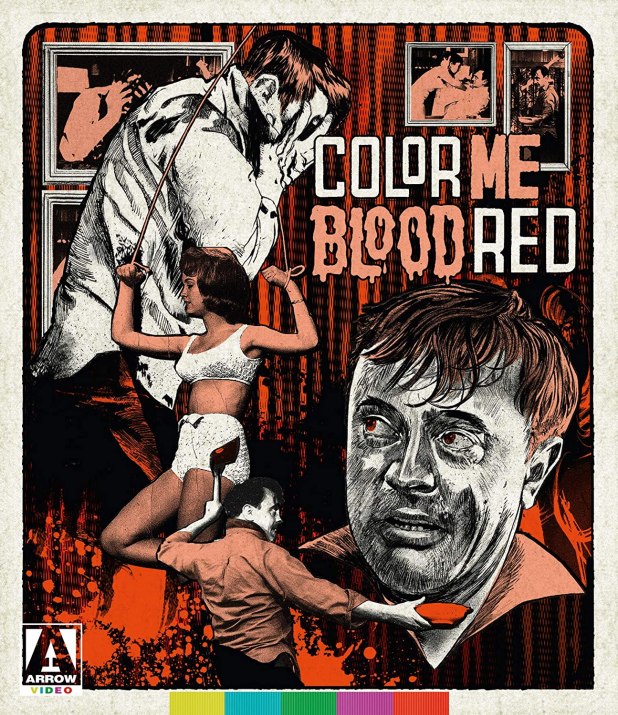
Part of Herschell Gordon Lewis’ so-called Blood Trilogy with Blood Feastand Two Thousand Maniacs!, this one concerns Adam Sorg, an artist who is seeking the perfect color red for his latest masterpiece. While conventional science would tell you that blood would turn brown when it dries, in this movie, it remains the same garish tone that an Italian giallo would feature.
Color Me Blood Red and A Bucket of Blood are essentially the same basic film, except that where Roger Corman keeps much of the violence off-screen, you’re here for a Lewis film to see blood and organs splash all over the screen. You’re not here for subtlety.
Gordon Oas-Heim is positively unhinged here as the lead. It’s kind of amazing that years later, he’d play Manford the butler on The New Monkees. He also shows up in Lewis’ Moonshine Mountain as the sheriff (he used the stage name Adam Sorg here!) and also is in Andy Warhol’s Bad.
This would be the last film from the duo of Lewis and David F. Friedman. There were plans to make a fourth in the series — Suburban Roulette* — but Friedman thought they’d done all they could when it came to gore. He’d move on to make roughies and nudie cuties like A Smell of Honey, a Swallow of Brine; 7 Into Snowy and The Acid Eaters, as well as Love Camp 7 and Ilsa She-Wolf of the SS using the name Herman Traeger.
You can watch this on Tubi or get the Arrow Video blu ray from Diabolik DVD. That has audio commentary by Lewis and Friedman, as well as Something Weird as a second bonus film. If you don’t have the gigantic Lewis box set, this is a great purchase.
*Lewis would end up making a movie with this title in 1968.
American-International Pictures had made some money in the U.S. with Mario Bava’s Black Sunday and Black Sabbath. It just made sene for Samuel Z. Arkoff and James H. Nicholson to gain more control by producing the films themselves instead of just buying the rights.
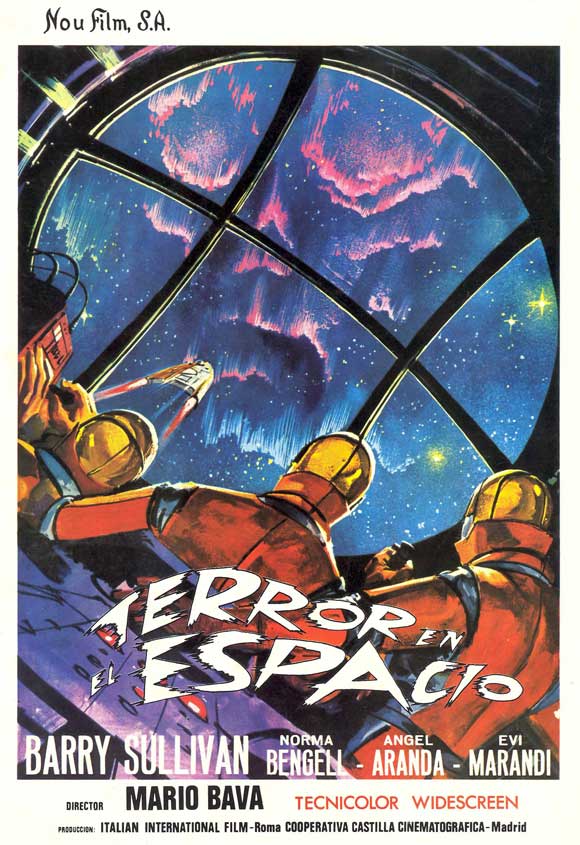
Working with Italian International Film and Spain’s Castilla Cooperativa Cinematográfica, AIP provided the services of writer Ib Melchior (The Angry Red Planet) to create the American version of this movie, which was based on Renato Pestriniero’s short story “One Night of 21 Hours.”
This movie was quite literally the Tower of Babel, as each major cast member performed in their respective languages: Barry Sullivan spoke English, Norma Bengell spoke Portuguese, Ángel Aranda Spanish and Evi Marandi Italian. And the low budget would have made a cheap-looking movie with any other director, but Bava was the master of in-camera effects and flooding his sets with color and fog. In a Fangoria article, he would say, “Do you know what that unknown planet was made of? A couple of plastic rocks — yes, two: one and one! — left over from a mythological movie made at Cinecittà! To assist the illusion, I filled the set with smoke.”
When 1979’s Alien came out, those that had been exposed to Bava’s work would let people know that many of the ideas in that film came directly from this modest film with its $200,000 budget — I know Joe Bob, everyone lies about budgets. While Ridley Scott and Dan O’Bannon would claim for years that they had never seen this movie before, the writer would later say, “I stole the giant skeleton from the Planet of the Vampires.”
Want to know how I know those claims are true? From the very start of this film, two large ships — the Galliott and the Argos — in deep space respond to an SOS call and are lured to a planet where alien beings either take their bodies over or murder them. The crew of the Argos instantly begins murdering one another — with only Captain Markary (Sullivan) able to pull his crew out of madness. When they arrive at the other ship, everyone is already dead, including Markary’s brother.
Soon, the bodies of the dead are walking as if alive, the ships are damaged beyond repair, and crew members are getting wiped out (look for a young Ivan Rassimov — later of the giallos The Strange Vice of Mrs. Wardh and All the Colors of the Dark, and the Star Wars clone The Humanoid — as one of them!).
While this film is 55 years old, I have no interest in ruining the ending for you. Instead, I want you to sit and bask in its colorful glow, awash in fog and mystery, with pulpy science fiction heroes running around in fetishy costumes and discovering skeletons that could in no way be human. It is everything that is magic about film.
Atlas — the comic company that tried to challenge Marvel and DC in the 1970’s — combined I Am Legend with this film to create the comic Planet of the Vampires. Much like all of their books, it only ran three issues, but the first one boasts a cover with pencils by Pat Broderick with Neal Adams-inks and other issues have great work by Russ Heath. The first issue was also written by future G.I. Joe mastermind Larry Hama. I have no doubt that Atlas did not pay AIP for the rights to this.
— Sam Panico
In 1972 Marvel Comics founder and publisher Martin Goodman left Marvel, selling the company in 1968—a company which he founded in 1939. When Marvel failed to honor Goodman’s retirement agreement to allow his son Chip to run the company, Goodman Sr. created Seaboard Periodicals and the Atlas Comics imprint in June of 1974 to go head-to-head with Marvel.
And by April of 1975—it was all over.
During Seaboard’s ten short months of existence, they published between two to four issues across 31 titles (comics and magazine-periodicals) for a total of 72 issues. In addition to creating original superhero characters, Seaboard attempted to acquire the rights to Japan’s Toho Studios’ stable of monsters, such as Godzilla, along with TV’s then popular Kolchak: The Night Stalker (check out our “Exploring: Dan Curtis” featurette) and a series of pulp-action spy novels.
Another one of Seaboard’s choices for adaptation came courtesy of Charlton Heston’s back-to-back hits with Planet of the Apes (1968; check out out “Ape Week” of reviews of the franchise), The Omega Man (1971) and Soylent Green (1973) (check out our September 2019 “Atomic Dustbin” of Apoc film reviews)—so began the legal processes to acquire the rights to and create a comic book version of Richard Matheson’s I Am Legend.
And Matheson refused.
So Seaboard’s staff of writers and artists came up with their own variant of Matheson’s tale: a hybrid of Planet of the Apes and The Omega Man that also bared a striking similarity to Yul Brenner’s New York-based post-apocalyptic entry: The Ultimate Warrior (1974). And, of course, as Sam pointed out, the writers at Seabord dumped a heaping, radioactive helping of the Master Bava’s Planet of the Vampires into the atomic dustbin for good measure. (You don’t think so? Check out those black leather-yellow piped uniforms in Bava’s film against the white-blue piped uniforms of the Ares IV crew.) And, as with their rips of those 20th Century Fox and Warner Bros.’ apoc properties, Seaboard didn’t pay AIP a dime for the rights.
And while surely John Carpenter was influenced by those four films, an apocalypse film critic can’t help but wonder if Carpenter read those three mid-1975 comic issues of Seaboard’s Planet of Vampires in creating his vision of a dystopian Big Apple for his own game-changing science fiction film: Escape from New York (1981)—all that was missing was The Empire State Building’s use as an architectural spine to support a domed city on the isle of Manhattan.
And Sergio Martino didn’t pay AVCO Embassy a dime.
And, as Sam explored, a whole bunch of people ripped off Alien (read a rundown of his reviews of those Alien rips HERE and HERE) . . . which ripped off Planet of Vampires . . . and no one paid Dan O’Bannon a dime. So it all evens out. Bava wins the apoc sweepstakes.
You can watch Bava’s incredible film on Amazon Prime.
— R.D Francis
About the Authors: Sam Panico is the proprietor of B&S About Movies. You can learn more about the writings ofR.D Francis on Facebook. He also writes for B&S Movies.
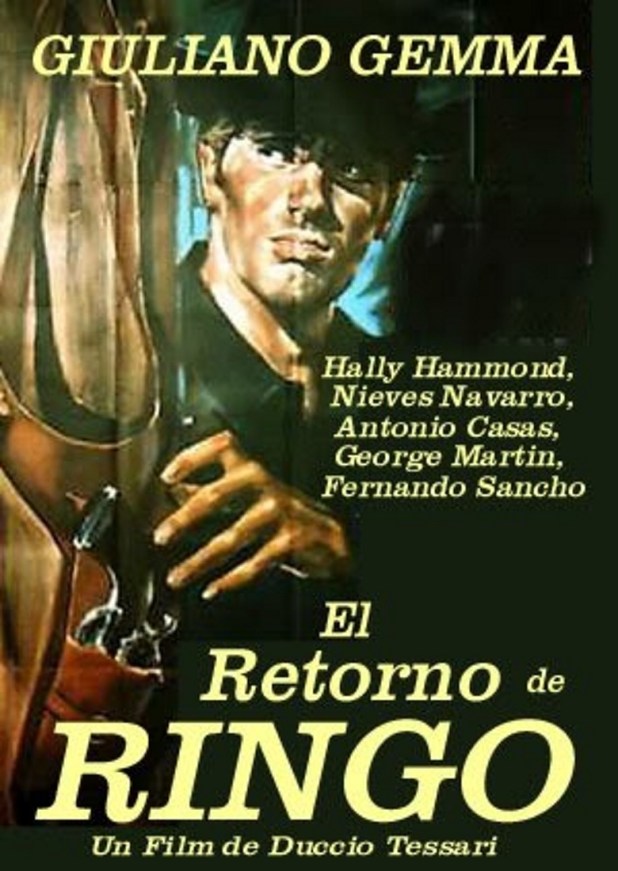
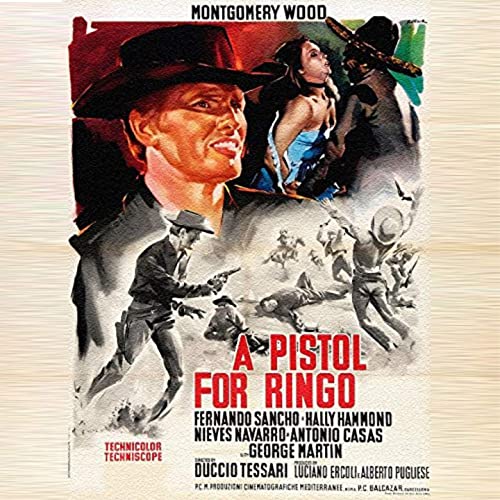
This film was Italy’s third highest grossing film in 1965 behind For a Few Dollars More and the original film, A Pistol for Ringo. Here, Captain Montgomery “Ringo” Brown (Giuliano Gemma) comes back to his homestead to find his family decimated, his property stolen by Mexican bandits and his fiancee about to marry Paco Fuentes, the villain behind all this.
If you’re like, hey, is this an Italian Western version of The Odyssey, you’re right.
While Nieves Navarro doesn’t reprise her role from the first Ringo film, she does play the tarot card-reading saloon girl Rosita. Antonio Casas also comes back in a different role as a sheriff who has been dominated by the gang and hey — Lorella DeLuca is also in both movies.
Actually, this movie is totally different from the original to the point that the more cynical of us could just believe that they threw the Ringo title on it after the original was such a success.
That doesn’t mean you shouldn’t watch it. It’s definitely a worthy Western packed with rich drama and plenty of satisfying violence. When asked to pick his top twenty Italian Westerns, Quentin Tarantino selected this as number ten.
Instead of a silent Man with No Name, Tessari based Ringo on the real-life Johnny Ringo and created a well-dressed, talkative cowboy who drank milk while so many others enjoyed whiskey. It helped that he had such a great talent in Giuliano Gemma, who would go on to play Arizona Colt and also appear in Westerns like Day of Angerand Long Days of Vengeance. He was billed here as Montgomery Wood.
Ringo starts the movie in prison for killing four men in a gunfight. He is released only if he rescues a land baron and his daughter from a gang of bandits led by Sancho.
Sancho also has an evil girlfriend named Delores who gets her claws into the land baron and tries to save her man through her feminine wiles. That makes perfect sense when you realize that she’s played by giallo queen Nieves Navarro (Death Walks at Midnight, All the Colors of the Dark, Death Walks On High Heels).
Known as Ballad of Death Valley in the U.S., where it was a success, this movie begat an official sequel, The Return of Ringo, as well as numerous Ringo titled films.
It’s theme song by Morricone also rose to number one on the Italian music charts.
Ringo’s motto is “God created all men equal, the Colt made them different.” Your mileage may vary for the many Italian Westerns made in the wake of Leone’s success. This is one of the better examples of the genre.
You know how it is at B&S About Movies: discussing mainstream, Tinseltown-made movies is anathema. So when we started digging into the antecedents of The Fast and the Furious franchise for this tribute week, you know we’re heading to the VHS shelves stocked with the films directed by Daniel Haller (Die Monster, Die, Devil’s Angels, and The Dunwich Horror), William Asher (Johnny Cool and “Beach Movies”), and Richard Rush (Hells Angels on Wheels, Psych-Out, The Savage Seven) that star the actors we care about, i.e., Frankie Avalon (Blood Song), Fabian (Disco Fever, Kiss Daddy Goodbye), Mimsy Farmer (swoon . . . Four Flies on Grey Velvet, The Perfume of the Lady in Black, Autopsy), Annette Funicello, and Diane McBain (Maryjane, The Mini-Skirt Mob, The Delta Factor). So, yeah, we’re going to review Thunder Alley (1967), The Wild Racers (1968) and Fireball 500 (1966) in quick succession. We’d be derelict in our reviewing duties if we didn’t inhale anything with the Corman-AIP stank on it*. (Ditto for Jim Drake’s (Police Academy 4: Citizens On Patrol) 1989 car-crash homage, Speed Zone.)
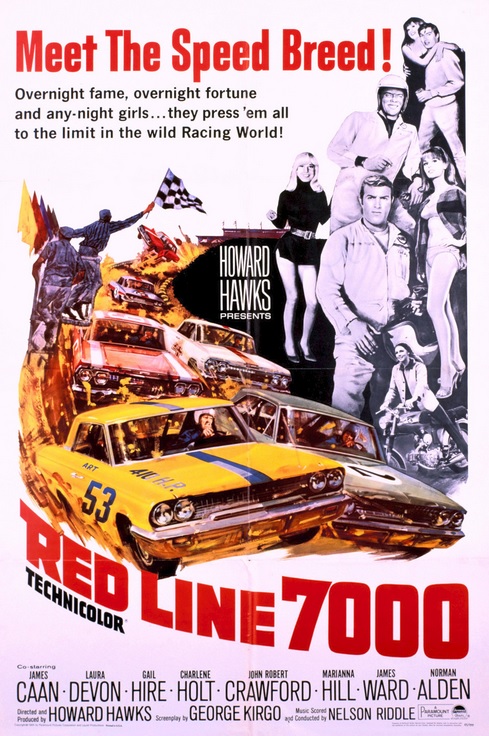
So while this “mainstream” film is directed by Howard Hawks and released by Paramount Pictures, we’re breaking those mainstream-rules since this racing “epic” features an early starring role for James Caan (who did this and the space “epic” Countdown and water “epic” Submarine X-1 . . . on his way to the apoc-epic Rollerball. . . oh, and some mob-movie called The Godfather).
But don’t let Caan’s presence and the iconic name of Howard Hawks fool you: This is pure Elvis-as-a-race car driver-via-process shots tomfoolery, ala Viva Las Vegas (1964), Spinout(1966), and Speedway (1968), without the singing. Hawks should have cast Frankie Avalon and Fabian, and dumped it in Drive-Ins, and called it a day. At least it would have turned a profit, like those abysmal (yet adoring) Elvis race romps.
“We gotta win this race . . . lemonade, that cool, refreshing drink.”
It’s true: The days of Hawks wowing us with the gangster classic Scarface(1932), the war epic Sergeant York (1941), the noir must-see The Big Sleep (1946), his one-two punch oeuvre with John Wayne of Red River (1948) and Rio Bravo (1959) (yeah, we know they also did ’62s Hatari, ’67s El Dorado, and ’70s Rio Lobo), and — the big daddy of sci-fi — The Thing From Another World (1951), were clearly behind him. Critics weren’t kind then, and retro-critics aren’t kind now, to this NASCAR romance-saga — and as someone who watched all of the Hawks-Wayne films with his dad (and loved them): I can honestly say this truly is the weakest film in the Hawks catalog.
In the backwash of Hawks-Paramount Pictures’ production, John Frankenheimer (Birdman of Alcatraz, The Manchurian Candidate, the blimp-disaster Black Sunday) put together the superior Formula One-centric Grand Prix (1966) with James Garner (chronicled in document, The Racing Scene). That Metro-Goldwyn-Mayer film “blew the doors off” Paramount’s Red Line 7000, with a $20 million gross against $9 million, making it one of the Top-Ten grossing films of 1966, which earned a DGA Award for Outstanding Directing in a Feature Film — even though it featured real-life, stock-shot racing footage, just like the Hawks racing drama.
As with Tom Cruise developing his love of car racing into Days of Thunder(1990), Steve McQueen — himself an accomplished racer of Porsches — produced his affection for France’s 24 Hours of Le Mans with Le Mans (1971) for 20th Century Fox. As with Red Line 7000, and unlike Grand Prix, McQueen’s racing epic — even though it filmed all of its racing footage “on-location” during the 1970 Le Mans race — failed at the box office, making less than its $8 million budget. Ditto for Paul Newman who made Winning (1969), his Indy 500-dreamer race romp with James Goldstone (TV movie heaven with Cry Panic and the amusement-disaster Rollercoaster) for Universal.
And what’s our analog god of all things UHF and VHS have to say about all this racing tomfoolery: Quentin Tarantino has stated that he’d “rather saw off his fingers” than sit through Winning, as it was worse than Steve McQueen’s Le Mans. He’s also said that if he was to direct a racing movie (Please do! Don’t let Once Upon a Time In Hollywood be the end?), it wouldn’t be pretentious, like Grand Prix, it would be like Red Line 7000, with it’s soap-opera-everyone-trying-to-sleep-with-everyone-else storyline, but fun — and play like a really great Elvis Presley race movie.
And Quentin loves his cars (in movies) and didn’t miss that Red Line 7000 features the then “new” 1965 Shelby GT-350 speeding on the track and that one of the characters drives a 1965 Cobra Daytona Coupe. In his own Once Up a Time in Hollywood, Quentin broke production protocols and used over 2000 vintage rides in the film: the average film uses between 300 to 500 cars. To that “racing end”: Cliff Booth (Brad Pitt) drove a 1962 Volkswagen Karmann Ghia, Abigail Folger (Samantha Robinson) drove a 1969 Pontiac Firebird, and Tex Watson (Austin Butler) drove a 1959 Ford Galaxie.
So, am I out of line saying that I’m waiting for Humphrey Bogart to crawl out of the cockpit, unzip the flame retardants, and jump into the Holiday Inn sack with Lauren Bacall?
That’s how outdated (even back in the early UHF ’70s) this racing romp feels to me, with the horses traded out for cars and the western wastelands for circular asphalt. And that Nelson Riddle score! Talk about wanting to saw off fingers . . . and ears. Where’s that swingin’ n’ screechin’ Dick Contino (Daddy-O, Girls Town) jazz score when you need it? (The ‘Con bagged Leigh Snowden from The Creature Walks Among Us, so he’s a “cool cat” in my book.)
But that’s the plot, sans the horses and Nevada dirt: everyone is trying to bed everyone else except their own girlfriends, either punching out or trying to kill their romantic rivals. And in between: they race via process shots via stock footage (including several high-profile crashes) filmed at the Atlanta Motor Speedway, Darlington Raceway, Daytona International Speedway, and Riverside International Speedway — A.J Foyt’s violent crash at Riverside earlier in 1965 served as the “death” of Caan’s team mate at Daytona. The “romance” gets so heated that Caan’s Mike Marsh trades paint with Dan McCall (Skip Ward of Ann-Margret’s Kitten with a Whip, Elvis’s Easy Come, Easy Go, and the box-office bomb Myra Breckiridge) and tries to kill him on the track.
On the casting side: George Takei, on his way to where no man has gone before, is Kato, a member of Caan’s pit crew. And no disrespect to the mighty Jonathan E., but how cool would it have been to see Paul Mantee of Paramount’s Robinson Crusoe on Mars (and the Bond rips A Man Called Dagger and That Man Bolt) in Caan’s role (who was also a Paramount contract player)?
Again, it all comes back to the actors we want to see: Paul Mantee. Do you remember Paul on Seinfeld as the Health Inspector busting Poppy for peeing and not washing his hands? And — surely Sam will give me shite — we’re back to my “Six Degrees of Seinfeld” foolishness, again.
Sorry, kids. No freebies. Not even on TubiTV and Vudu. You’ll have to settle for an Amazon Prime VOD.
* Long threatened, we finally rolled out that Roger Corman tribute month to his New World Pictures shingle in March 2023. Clicking through will populate all of those reviews.
About the Author: You can learn more about the writings of R.D Francis on Facebook. He also writes for B&S About Movies.
This film is based on the life of ascetic 5th-century Syrian saint Simeon Stylites, who lived for nearly 40 years on top of a column. It was directed by Luis Buñuel after he had to take his second exile in Mexico, as his movies were lambasted by the government and the Vatican.
Along with Viridiana and The Exterminating Angel, these movies form a trilogy of films that are critical of religion and star Silvia Pinal and Claudio Brook.
Simón has lived for 6 years, 6 weeks and 6 days in the midst of the desert atop a pillar, praying for spirital purification. Then, an assemblage of priests and townspeople offer him a new pillar and a chance at priesthood. He claims that he is unworthy before climbing up to his new perch.
But first, an amputee asks him to give him back his hands. As soon as Simón heals the man, he slaps his child and says that he is unimpressed with the religious man. He then either judges or ignores the other people who come to him.
Interestingly enough, that man is Buñuel.
Then, Satan (Silvia Pinal) visits him three times. First, as a cursing girl, hen as Jesus and finally as himself. Time and again he begs our protagonist to come down from the pole before finally moving him to a nightclub in our time, as a dancefloor begins doing the Radioactive Flash. Simón just wants to go home, but Satan says he must stay.
While this film was to be much longer, budget cuts gave it the short run time and what some may see as an abrupt ending. I really enjoyed it, as it feels like some strange parable sent to us from another dimension.
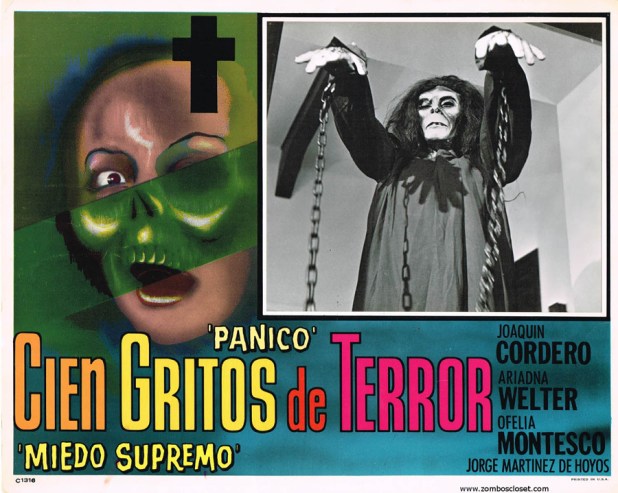
There are two stories here in this Mexican portmanteau. The first, Panico — hey, how about that title — is about a man (Joaquin Cordero, Dr. Satan) who wants to leave his wife for his new lover, but things are not that simple. The second is Miedo Supremo, which is about a man trapped alive in a burial crypt who discovers that he is not alone.
Translated as 100 Cries of Terror, this film is very much an Edgar Allen Poe movie. Director Ramon Obon also wrote The Living Coffin, another movie of Mexico’s Golden Age. Sadly, he died not long after making this movie, the first he directed.
There was a plan in 2014 to remake this movie with Reversal director JM Cravioto. It never was made and I’m probably one of the few people who is still wondering if it will happen.
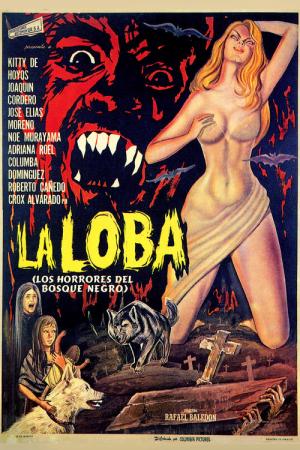
Rafael Baledon also made La Maldicion de La Llorona, yet today I want to discuss this werewolf film, which blows my mind.
Clarisa Fernandez is well-to-do, but is dealing with a curse, which is that she’s a werewolf. Luckily, or perhaps not so much for the humans they encounter, her doctor is a werewolf as well. They fall in love, which seems to be pretty much a happy ending, but not for anyone that knows them.
This is a movie that starts with no dialogue for ten minutes and ends with a werewolf hunting dog saving the say. Honestly, that sounds like the best review I can give this movie, which I adore.
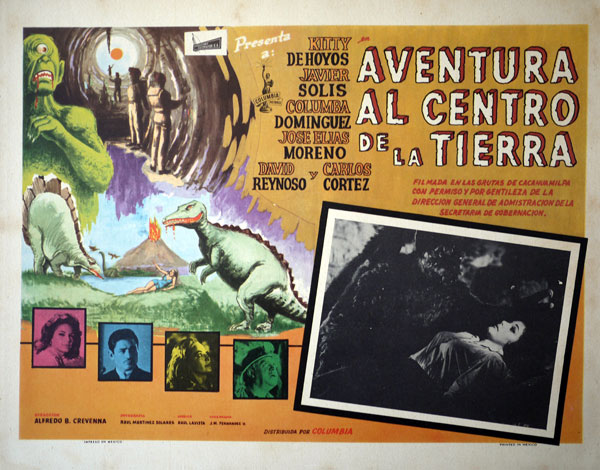
Adventures In the Center of the Earth is the translation for this film, which follows a crew of explorers as they try to find the reason why a young man was killed and his girlfriend driven mad.
Director Alfredo B. Crevenna had a few Santo movies to his credit, but that did not prepare me for this sojourn, as that injured girl joins the brave band who head deep, deep into the Earth, so far down that they meet a cyclops, a spider and a giant bat that falls in love with the aforementioned Hilda Ramirez (Kitty de Hoyos, who was the villainess in the astounding La Loba).
There’s also footage that feels like it didn’t come from this movie at all — one assumes it’s from 1940’s One Million B.C. — and all of the monsters look like they’re in a totally different room and have much better masks when they get their closeups, which only adds to the charm of this movie.
I’ve seen so many movies that go to the center of our world and they are all boring. This one is anything but, so if anyone ever says, “What’s the best center of the Earth movie?” you can confidently answer with this one.
You can watch this on YouTube to see if I’m right.
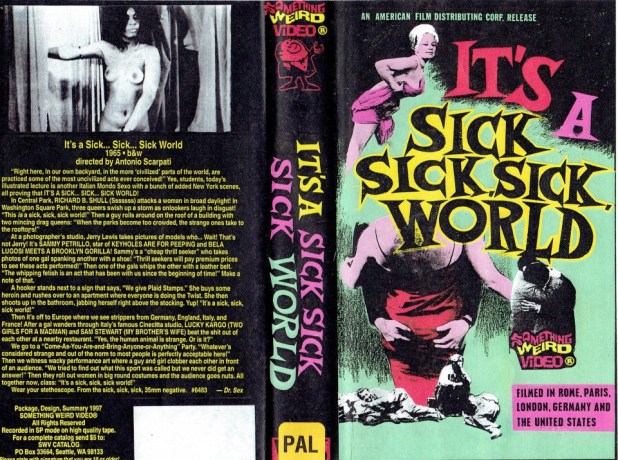
“Right here, in our own backyard, in the more civilized parts of the world, are practiced some of the most uncivilized acts ever conceived!” Antonio Scarpati directed this, a one and done view of the world in 1965, in the time before the internet when life was cheap. Acually, life has always been cheap.
Joel Holt, who would go on the narrorate Paris Topless and two of the Olga movies — as well as direct part of The Wild, Wild World of Jayne Mansfield — is the voice that will take us through this world.
You may notice that nearly none of this movie is real. Like when we’re in Central Park, the rapist is Richard B. Shull from Sssssss and Spring Break. And when we see a photographer taking photos of nude models, that’s Sammy Petrillo, who once teamed with Duke Mitchell to make Bela Lugosi meets a Brooklyn Gorilla. While gay men dance on rooftops, Sammy is taking snaps of girls acting as if Irving Klaw was nearby.
This is a sick world, a place where prostitiutes do heroin while a roomful of people dance the Twist, where Lucky Kargo (The Hookers, Venus In Furs) gets in a brawl with Sam Stewart (Bad Girls Go to Hell), where performance art is really people beating up one another and fat people always get a laugh.
Reality TV has replaced the mondo, but the same scum always rises to the top. I don’t say that as a bad thing. This one is faker than the other, but has that ever stopped me from watching one of these.



 B&S About Movies
You must be logged in to post a comment.