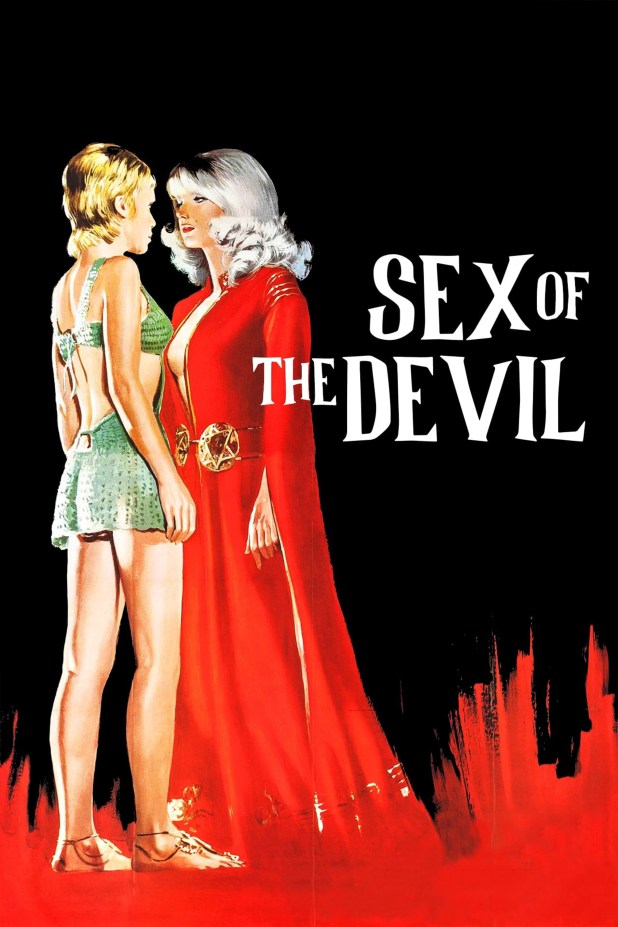
Sex of the Devil (1971)

The marriage between Andrea (Rossano Brazzi) and Barbara (Maitena Galli) is near the end, beyond the saving that a vacation to Istanbul can provide. Yet they go anyway, along with his assistant Sylvia (Sylva Koscina), to a villa whose last tenant, a sculptor named Claudine, hung herself. The housekeeper Fatma (Güzin Özipek) keeps secrets, like how she practically worships the dead woman. Speaking of secrets, Sylvia and Barbara have some of their own, as they have begun their own relationship away from the impotent surgeon husband, who is convinced people are trying to kill him. Also, as this is a fantastic, Claudine’s spirit finds her way to Sylvia.

The last part of the title of this movie — Il sesso del diavolo—Trittico — refers to a triptych or threesome. The film is filled with different versions of three together, such as the couple that arrives at the villa, a past indiscretion and maybe even a new one.

Directed by Oscar Brazzi and written by Sergio Civinini and Paolo Giordano, this film gets the most out of its setting, along with a soundtrack by Stelvio Cipriani that takes its inspiration — well, we can just say taglia e incolla — from Iron Butterfly’s “In-A-Gadda-Da-Vida.”

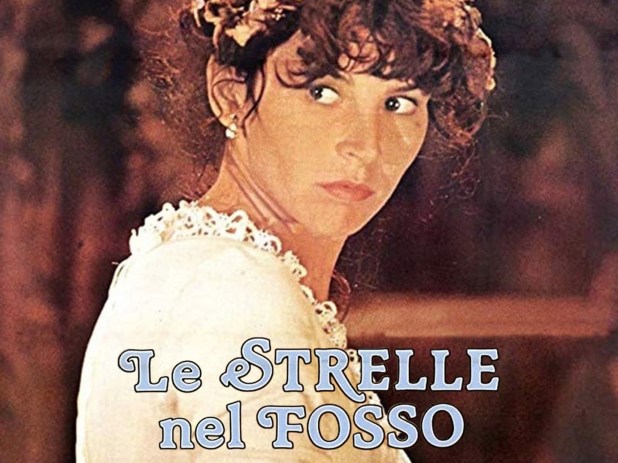
La Strelle nel Fosso (1979)

According to Roberto Curti in his book Italian Gothic Horror Films 1970-1979, director and writer Pupi Avati refused to “oblige to the rules of commercial film-making” and this movie — thought of as improvisational film jazz, mostly written and shot on the spot — was him trying yet again to create his own vision. While his previous TV movie Jazz Band was well-received, none of his movies had made money (there’s a moment in Curti’s guide to 1980s Italian Gothic where Lamberto Bava, while speaking about his film Macabre, says “…a week after the film’s release, the producer told me it was the first Avati production that made any money.).

This begins with a ratcatcher (Ferdinando Orlandi) staying overnight at a farmhouse and telling a young girl a bedtime story. There was once a house in the swamp and in it lived a family — father Giove (Adolfo Belletti) and his sons Silvano (Lino Capolicchio), Marione (Gianni Cavina), Marzio (Giulio Pizzirani) and Bracco (Carlo Delle Piane) — in a place where no woman had been for years. Possibly, this was because Giove’s wife died while giving birth to his fourth son.

One night, a pianist named Olimpia (Roberta Paladini, What Have They Done With Your Daughters?) appeared and in time, each member of the family asked her to marry them. She accepted each of their engagements and the marriages were celebrated throughout the day and night. But the next day, she was gone and they were all dead in a tableau reminiscent of Leornardo’s The Last Supper.

As the ratcatcher finishes his story, we notice that the girl looks just like Olimpia.

Pizzirani remembered that it was not an easy movie to make. “We did not know anything about the story. Pupi showed up at morning, gave us a sheet of paper and we had to study our lines. Sometimes the dialogue lines were not call and response, and I recall having to learn very long parts, deadly difficult speeches which later on I would repeat, improvising upon them a bit. It was traumatic.”

What emerges is a story made of stories and each of those tales deals with how we confront the story we don’t know the ending of. Our own. Avati said, “I have a problem with death and so I tried to make it beautiful, sunny, warm.” Is Olimpia even real? Did the mother die or leave the men alone to their own lives? How much is allegory and how much is actual? Avati always makes me ask so many questions.

You can watch this on YouTube.

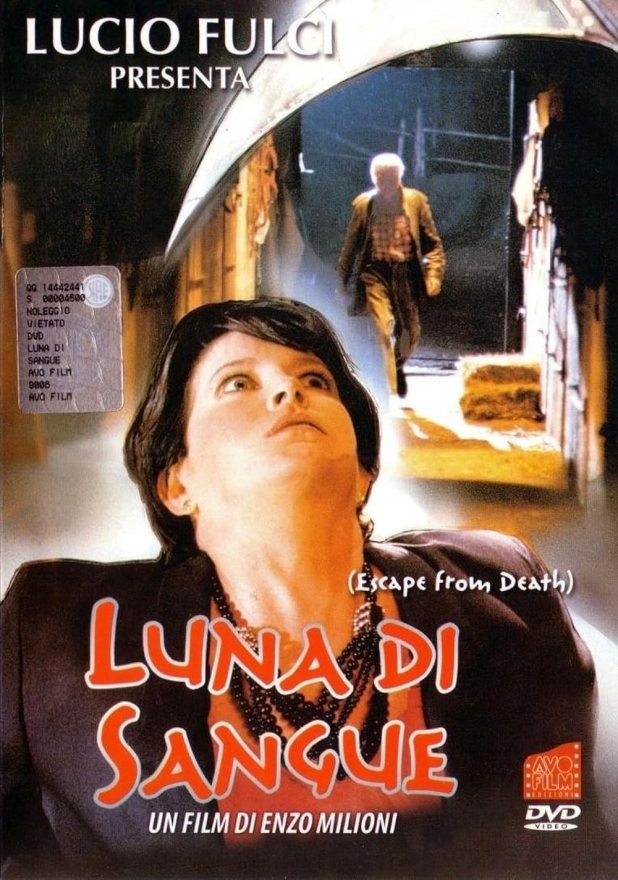
Luna di Sangue (1989)

Ignore the Lucio Fulci Presents, as he had nothing to do with this other than to sign over his name. It was directed by Enzo Milioni, who also made Quello strano desiderio and The Sister of Ursula, and was written by Millioni and Giovanni Simonelli, who directed Hansel e Gretel.

A dying man tells the story of Ann Moffett (Barbara Blasco) and how she found her husband Larry’s dead body only for it to disappear. No one believed her and a year later, a man comes to visit her and claims to be her dead husband.

In case you wondered just how far Milloni can take things, there’s a scene where a farmer catches his mute and potentially mentally deficient daughter Tanya (Luciana Ottaviani AKA Jessica Moore from Eleven Days, Eleven Nights) fooling around with two men in his stable. He chases them off and his daughter then proceeds to kneel before him and commit an act of incestual oral copulation, capped off by someone shooting her in the back of the head, removing his member, which is shot again and then he’s shot in the face.

You may have seen the head being pushed out a window and the head of Annie Belle (House On the Edge of the Park) being sliced off with a scythe in the Fulci compilation that is Cat In the Brain.

How does this all work together in a kind of, sort of giallo? It doesn’t. It has a few murder set pieces that don’t fit in and a story that goes nowhere. Such is life.

You can watch this on YouTube.

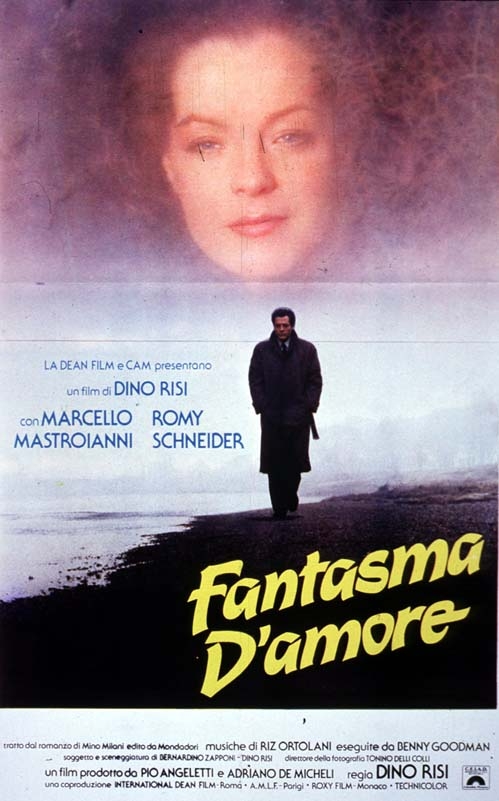
Fantasma d’amore (1981)

Nino (Marcello Mastroianni) is a married man who does taxes. His life is, well, quiet and somewhat boring. And then one day he sees Anna (Romy Schneider), a woman he was in love with decades ago. Time has not been kind to her. He pays for her busfare and she disappears, only to call him that night and offers to repay him. He meets her at her dilapidated apartment, only to learn that she has died three years ago.

His wife Teresa (Eva Maria Meineke) is growing upset with his obsession with the past. Despite him being sure that she is gone, she calls again and asks him to visit her mansion. When she answers the door, she is the same woman he knew years ago, young and vital. She tells him that she still loves him, but can’t make love to him, as she is married to the man who owns this gigantic home, Conte Zighi (Wolfgang Preiss). She changes her mind and says that they should take a boat to where they once would get away to be with one another, except that she disappears by falling into the water. When Nino informs the police, his wife leaves him and a tearful Conte Zighi tells him that his wife died three years before. His servant even takes him to see her gravestone.

At the end, Nino is in a wheelchair in his senior home, watching the sun set. A gorgeous woman comes to bring him inside. It is Anna.

Directed by Dino Risi (Anima persa), who wrote the script with Bernardino Zapponi based on the book by Mino Milani, Fantasma d’amore is about a man who has no passion left, a life which has no joy and only memories, which have become colored by the idea that they are the past, of a great love lost for good to keep him warm in the dark nights of the soul. Yet Anna says to him, “You really believe time exists…time which makes us age, which consumes us, that indeed exists. But inside of me, I’m not aged at all.” The fact that this woman, for a time, loved him is enough to sustain him all the way to the loneliness of the grave.

Speaking of age and remaining young through memory, the Riz Ortolani score features a 72-year-old Benny Goodman playing clarinet.

Mia moglie e una strege (1980)

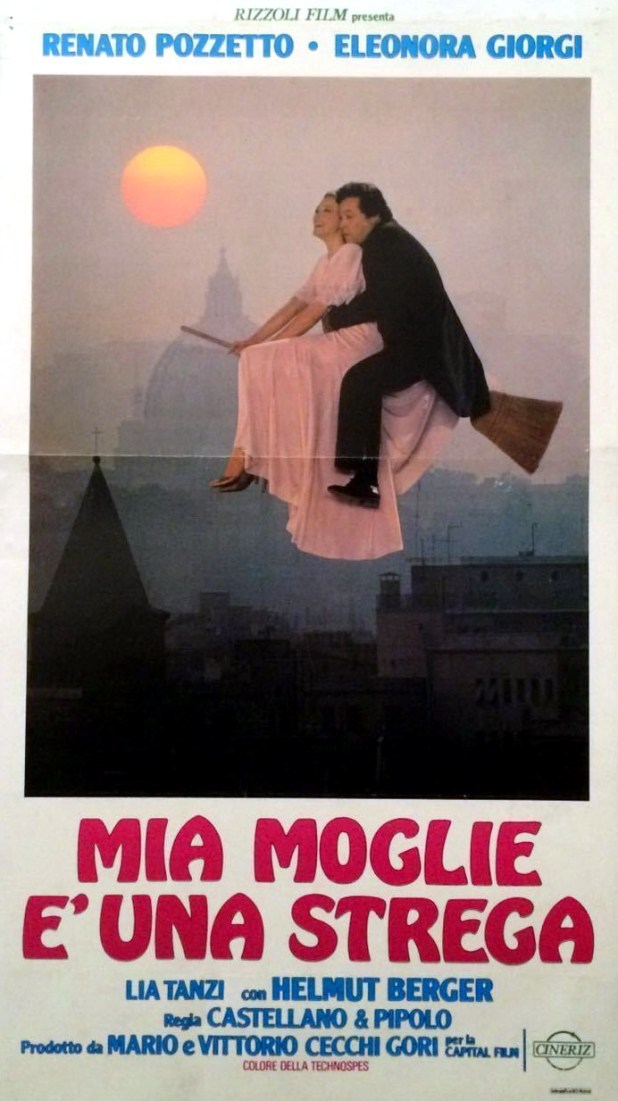
The idea of marrying a witch is a strong one. Generally in most cinema, it is treated as a positive, as seen in I Married a Witch, which was later stolen by television to become Bewitched. Only in Italy would such the start of this story feel as if it were closer to Black Sabbath than the adventures of Darren and Samantha.

The witch Finnicella (Eleonora Giorgi, Inferno) has been sentenced to being burned at the stake by the Catholic church but is brought back to life three hundred years later by her lover, the demon  Asmodeus (Helmut Berger). She is charged with making Emilio Altieri (Renato Pozzetto) fall in love with her — he’s the descendent of the cardinal who doomed her to the flames who would one day become Pope Clement X — and then kill him. Yet when she finally meets him, he’s already in love with Tania (Lia Tanzi, The Suspicious Death of a Minor). Even when she becomes his secretary and wantonly offers herself to him, Finnicella can’t win him to her embrace. He even fires her, at which point she kisses him, but he still stays pure.

That’s when Finnicella realizes that she’s in love with him, even if her demonic master decrees that Emilio must die.

At Emilio’s wedding, she slips a love potion into his champagne. He doesn’t drink, but he acts as if he has and leaves his soon-to-be wife, claiming to be in love with another. Finicella doesn’t believe him, as she thinks it’s just the magic. He proves it, as Tania drank the champagne and has remarried her ex-husband Roberto (Enrico Papa) in the moments they were speaking.

Emilio and Finnicella marry and honeymoon in Paris. As she flies him over the city, having revealed that she is a witch, Asmodeus appears. He reminds her of their deal and why she was brought back to life. She pleads that she is in love, but it gets her nowhere, as the demon guns her down and her husband is blamed for her murder. Finnicella’s ghost begs Asmodeus to fix all of this and he says that a witch could never make him lose his head and proclaims just how smart he is, which ends up with her cutting his head off with a guillotine. Now, holding his head, Asmodeus must release Emilio from prison, erase the crime and bring the witch back to life.

Directed and written by Franco Castellano and Giuseppe Moccia, this was a big success in the Italian box office. If you look closely enough, you can spot Rentao Polselli regular Rita Calderoni, as well as Serena Grandi, Shôko Nakahara (who years later would be in Tokyo Gore Police) and Maria Grazia Smaldone (Libidomania) in small parts.

The best thing about this movie, for me, was the soundtrack. It’s by Detto Mariano, who also did the soundtracks for Miami Golem, War Bus and Titanic: The Legend Goes On. Giorgi sings the title song “Magic” and so much of the feel is disco with distorted guitar; it’s an absolute treat!

You can watch this on YouTube.

Il Bacio Di Una Morta (1973)

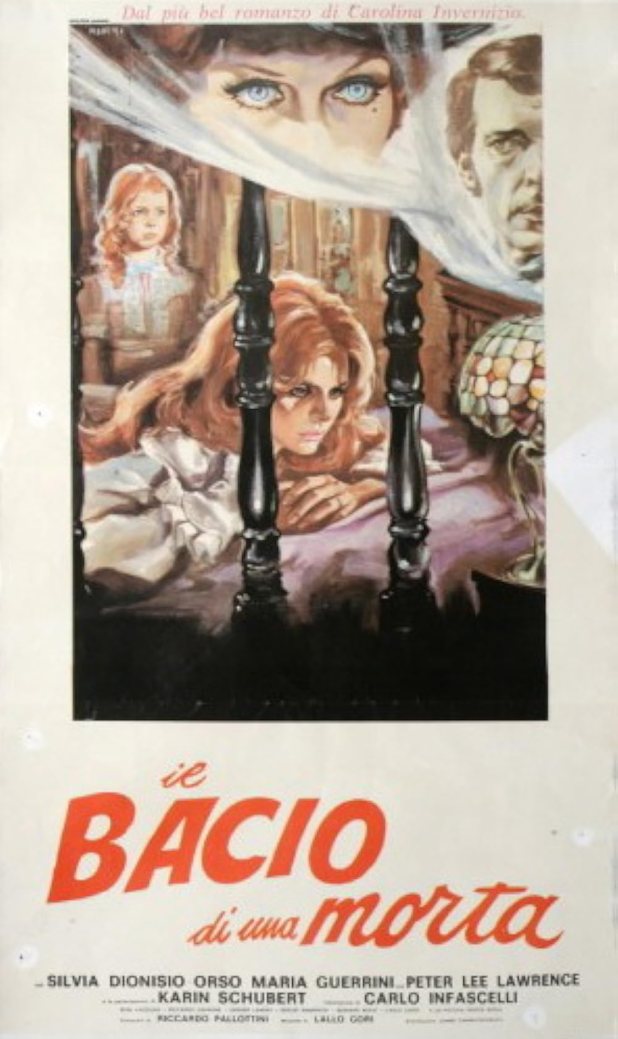
The Kiss of a Dead Woman was directed by Carlo Infascelli (Forbidden Decameron) and would be his last film. It was written by Infascelli, Adriano Bolzoni, Tatiana Pavoni and Gastone Ramazzotti and was based on the same novel, Carolina Invernizio’s Il Bacio Di Una Morta, as the better-known film of the next year, Il Bacio. It was also made into a film in 1949.

The story is the same. It begins with Clara (Silvia Dionisio, Live Like a Cop, Die Like a Man) supposedly dead and her brother Roberto (Peter Lee Lawrence, Killer Caliber .32) saving her by asking to see her body and realizing that she is still breathing. We see in flashback how brother and sister loved one another but she married Count Guido di Lampedusa (Orso Maria Guerrini, The Big Racket), a relationship that seemed good until he fell for singer Yvonne Rigaud (Karin Schubert, Emanuelle Around the World), who plans to take him for her own and murder Clara. Her husband comes to his senses and saves his wife, giving us a happy ending that seems too simple.

That said, this feels more giallo than Mario Lanfranchi’s version of the story with a black gloved poisoner shown in POV shots and even an attempted assault at the close of the story.

Peter Lee Lawrence was the AKA of Karl Hirenbach, a German actor who mainly worked in Italian Westerns. He also appeared in photo comics as Pierre Clement and sadly died of a brain tumor at the too young age of just thirty. As for Karin Shubert, she had a sad life as well. After a career appearing in Italian exploitation films from Westerns to commedia sexy all’italiana and very late Eurospy like Missile X: The Neutron Bomb Incident, she starred in several Joe D’Amato films. That’s not the sad part. That comes in when we learn that she was divorced and her son’s drug addiction led to him having violent outbursts, often directed at her. His treatment was expensive, so she went from posing nude to adult films until retiring in 1994. That year, she tried to mix barbiturates with vodka to escape life but was rescued by neighbors. Two years later, she killed herself by carbon monoxide poisoning.

This movie feels like it was filled with tragedy, as Carlo Infascelli retired after this, as the death of his producer son Roberto was too much. Add to that Riccardo Pallottini, the cinematographer, who was killed in a plane crash while making Tiger Joe for Antonio Margheriti.

Less horror than costume drama, there’s still a lot to like in this film.

Lover of the Monster (1974)

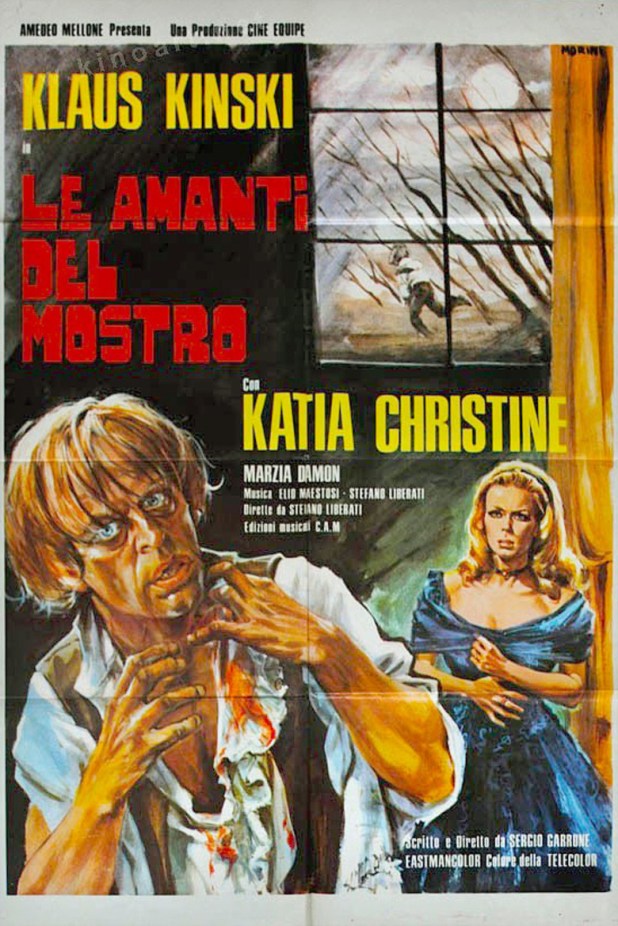
Filmed at the same time as The Hand That Feeds the Dead, this was also directed and written by Sergio Garrone. It uses a similar cast and crew which is why so many confuse these films for each other. They also share some footage, so that is an easy mistake to make.

Anna (Katia Christine) is the heiress to the Rassimov fortune. The Ivan Rassmimov fortune? Well, if they built that crypt for The Hand That Feeds the Dead, they weren’t going to spend more money getting another last name put on it!

She brings her husband Alex (Klaus Kinski) to her family’s home, where he soon finds the diary of — yes! — Dr. Ivan Rassmimov, who learned how to reanimate the dead with electricity. Alex is impotent and despises his rival Dr. Walewsky (Ayhan Isik), who makes no secret of how he wants to cuck his rival. As he works on learning how to defeat death by attempting to bring his wife’s dead dog back, Alex is electrocuted and gets another personality because that’s how science works. He starts killing people, including his wife but he assaults her first because this is an Italian exploitation movie, and then has his conscience come back. A villager has been blamed for his crimes, so he runs to the city to stop an innocent man from being lynched. It’s too late — the man is already dead — and as Alex climbs the gallows, he is shot and killed.

Don’t believe the cast list you see online. Carla Mancini, Alessandro Perrella and Stella Calderoni aren’t in this movie. If you’re one of those people — I walk among you — that try to find Mancini in movies, well, save your time and energy for one of the other 240 movies that she may or may not be in.

This movie is an absolute mess, as production was halted and by the time shooting started again, Kisnki was gone. That’s why so much of it uses POV shots, stand-ins and murder scenes from The Hand That Feeds the Dead. You have to admire that kind of carny ingenuity, right?

Bollenti spiriti (1981)

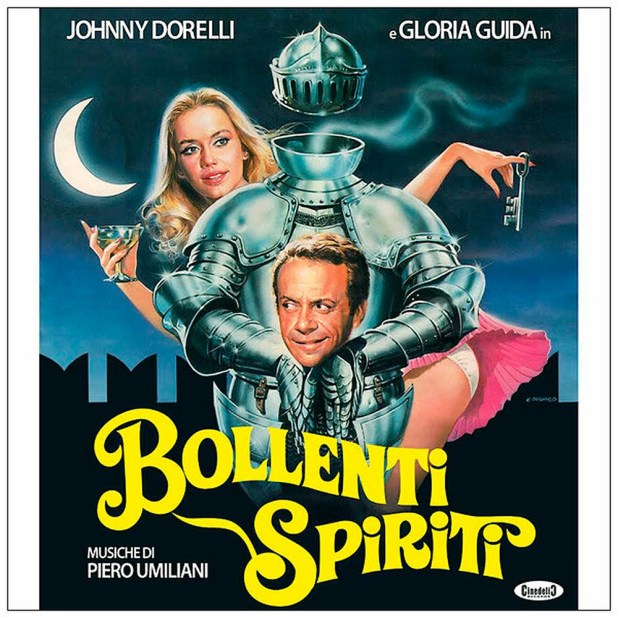
Giovanni (Johnny Dorelli) has inherited a castle from his uncle Ubezio and this will help him escape all his many creditors as a company already wants to buy it for a luxury hotel. The problem? The nurse who took care of his uncle, Marta (Gloria Guida, La casa stregata), has been given a percentage of the property. He works on talking her out of her share so that he can sell, but falls in love. There’s also the problem of the randy ghost of his ancestor Guiscardo (also played by Dorelli) who has had sex and has stayed in the castle for three centuries. And oh yeah — the buyer of the castle? His wife Nicole (Lia Tanzi) is Giovanni’s latest girlfriend.

Directed by Giorgio Capitani and written by Franco Marotta and Laura Toscano, this feels a lot like the other sexy haunted house movies of this time, C’è un fantasma nel mio letto and La casa stregata. There’s also some funny — and sexy — moments with Lory Del Santo (The Great Alligator) as a sex worker hired to relieve the ghost of his virginal burden.

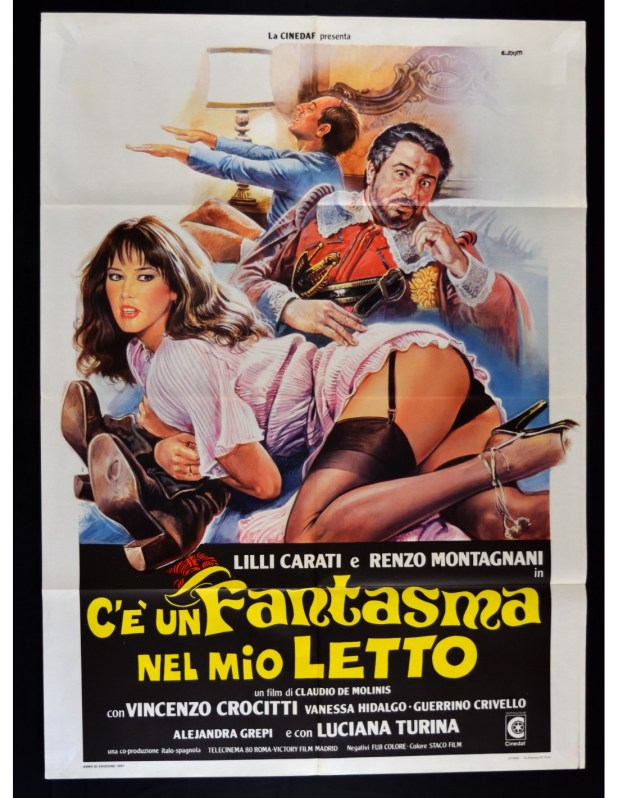
C’è un fantasma nel mio letto (1981)

There Is a Ghost in My Bed was directed by Claudio Giorgi, who worked as an actor in fotoromanzi or photo comic books. It was written by Luis Maria Delgado and Jesus Rodriguez Folga and it’s in the genre of both Italian Gothic and commedia sexy all’italiana.

Camillo (Vincenzo Crocitti) and Adelaide (Lilli Carati) are on their honeymoon in Scotland. They can’t find a place to stay and get lost in the fog, finally finding the ancient castle of the Baron of Black Castle (Renzo Montagnani) and his servant Angus (Guerrino Crivello). Despite being a ghost, the Baron still wants to make love to Adelaide and I mean, have you seen Lilli Carati? Can you blame him? How did Camillo keep from sleeping with her during their five-year engagement?

Carati started her career as the runner-up for the 1975 Miss Italy contest. She started work as a fashion model before starting her career with La professoressa di scienze naturali. Her work was mainly in “school” movies where she was a young teacher or a student who was often nude. She also starred with Tomas Milan in Squadra antifurto and had her biggest success in the film Avere vent’anni (To Be Twenty). She was in four Joe D’Amato movies —  La Alcova, Christina, The Pleasure and A Lustful Mind — before acting in adult films in the late 80s. At that point, she was addicted to cocaine and heroin. She retired from public life in 1990 but returned to acting to play an occultist in Violent Shit: The Movie, which was dedicated to her as she died before it was released.

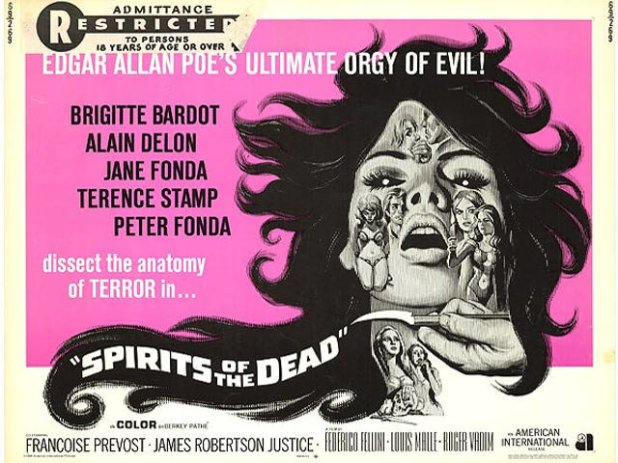
Spirits of the Dead (1968)

Directed by Roger Vadim, Louis Malle and Federico Fellini, this has a different title in Italy, Tre passi nel delirio (Three Steps to Delirium). It’s an anthology that has each director show his own version of an Edgar Allan Poe story.

Vadim starts the film with “Metzengerstein” which is unique in that it’s the only on-screen pairing of Jane and Peter Fonda, who play cousins who have never met due to a family feud. She played Countess Frédérique de Metzengerstein, who has inherited the family castle and leads a life of debauchery. He is Baron Wilhelm, the man who just saved her from a trap in the woods. She falls for him but he wants nothing to do with her life of sin, so she sets his stables on fire, killing him and most of his prized horses, save for a black one that she becomes obsessed with taming. Eventually, the horse carries her into an inferno made by a bolt of lightning.

“William Wilson,” directed by Malle, has Alain Delon as the titular protagonist, a man who has dealt with a twin version of himself his entire life. After he plays cards all night with Guiseppina Ditterheim (Brigitte Bardot), the evil twin convinces people that he cheats. He finally challenges his other self to a duel with a deadly outcome for them both.

In “Toby Dammit,” directed by Fellini, Terrence Stamp plays the actor named Toby Dammit. His career is in ruin and, ironically, he comes to Italy to make a movie — Trente Dollari, an Italian Western — where he will be paid with a Ferrari. He keeps seeing a young girl with a white ball played by Marina Yaru who he becomes convinced is the devil. After he finishes the movie, he gets drunk and speeds his new car around the city until it becomes filled with replacement people and he races into a void, his head chopped off by a wire across the road, and now the girl holds his head. The Ferrari in this story is a reference to the car Clint Eastwood was given for appearing in The Witches.

if this seems to take a lot from Mario Bava’s Kill, Baby, Kill!, Fellini meant it as a tribute. In an interview, Bava said, “That ghost child with the bouncing ball… it’s the same ideas as in my film, exactly the same! I later mentioned this to Giulietta Masina (Fellini’s wife) and she just shrugged her shoulders, smiling and said, “Well, you know how Federico is…””

The difference is that Fellini would be celebrated as a great artist his entire life. And as for Bava, sadly not as much.

There’s a modern reference or coincidence in this story: When Toby Dammit arrives at the Rome airport, a Catholic priest introduces him to the Fratelli Manetti, two brothers who work in film. That’s the artistic name — the Manetti Brothers — of Marco Manetti and Antonio Manetti, who made the recent Diabolik movies.

This movie almost had Luchino Visconti, Claude Chabrol, Joseph Losey and Orson Welles as directors, with Welles and Oja Kodar writing a story that combined “Masque of the Red Death” and “The Cask of Amontillado.”

While Vadim was filming “Metzengerstein,” his friend Terry Southern — who had come to Europe to help him make Barbarella — started talking to Peter Fonda and ended up writing Easy Rider with him on set.