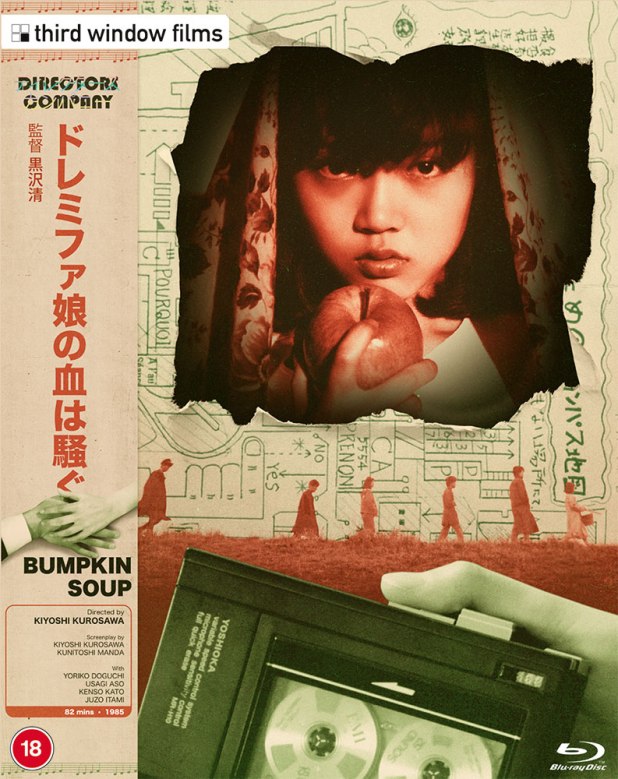
The Excitement of the Do-Re-Mi-Fa Girl has Akiko (Yoriko Doguchi) searching for her hometown love, Yoshioka (Kenso Kato), who has left her behind as he goes to college. But now he’s a mystery, a nobody, a small fish in a much larger pond, and she finds herself in a strange place filled with people too smart for their own good, too sexed up and too strange, such as the professor (Juzo Itami) testing the limits of shame.
According to Japan Society, this was “shelved from a Nikkatsu Roman Porno release for being too bizarre and subsequently re-edited and re-shot.” Directed and cowritten by Kunitoshi Manda and Kiyoshi Kurosawa (Cure, Sweet Home), this is a sex comedy by way of a New Wave of its own by way of a final-act murder of nearly everyone we’ve met — spoilers, huh? — by a girl with a gun singing a lullaby, as well as a lead whose private parts emit some kind of blinding laser when revealed. This is one strange movie, and I love that it was turned in as if the audience for Nikkatsu’s sleaze would be cool with an art film that ends in fog and blood.
The Third Window Films Blu-ray of Bumpkin Soup has extras that include an interview with actress Yoriko Doguchi, a feature length audio commentary by Jasper Sharp, a video essay by Jerry White, author of The Films of Kiyoshi Kurosawa: Master of Fear, a slipcase with artwork from Gokaiju and a Directors Company’ edition featuring an insert by Jasper Sharp that’s limited to 2000 copies. You can learn more on the official site and order it in the U.S. from Terracotta and Diabolik DVD and in the UK from Planet of Entertainment and HMV.
When Keisuke (Jun Etô), a fisherman, stands in the path of progress by land developers, he is killed and his wife, pearl driver Migawa (Mari Shirato) is framed for his murder. Despite being assaulted and sent to an island of brothels, she plans to get bloody revenge on the politicians and criminals who have ruined her life.
Directed by Toshiharu Ikeda (Sekkusu hantâ: Sei kariudo, Evil Dead Trap) and written by Takuya Nishioka, this finds Migawa reborn as a supernatural avenger, a blood-covered heroine carrying a trident, unafraid to kill everyone in her path. Is she dead? Is she alive? What’s the story with her speaking with Buddha or the statue that is buried? You can make this any story that you want, but know that rich, powerful and evil people celebrating their new nuclear power plant will be stabbed and torn apart in the way that only a woman who has lost everything can destroy human beings.
While this has a lot of the female rape and revengeomatic themes of many Japanese pinky violence movies, it has a slower way to get there, only to let loose by the end, as you hope. This is the first time that this movie has been available in the West.
The Third Window Films Blu-ray of Mermaid Legend has extras that include an interview with writer Takuya Nishioka, audio commentary by Jasper Sharp and Tom Mes, a video essay on Toshiyuki Honda by James Balmont, a trailer and a slipcase with artwork from Gokaiju. There’s a Directors Company edition featuring an insert by Jasper Sharp that is limited to 2000 copies. You can learn more on the official site and order it in the U.S. from Terracotta and Diabolik DVD and in the UK from Planet of Entertainment and HMV.
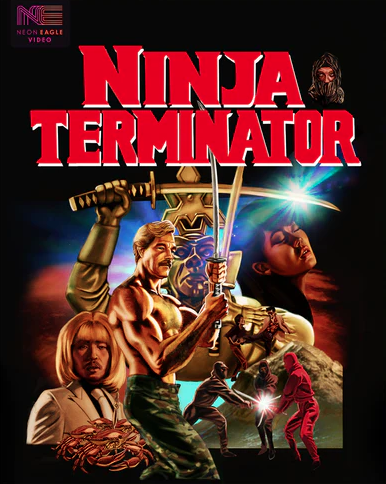
If you owned a Korean film called The Uninvited Guest Of The Star Ferry, it probably wouldn’t sell in the West. But what if you shot new footage of Supreme Ninja having his three greatest warriors — Ninja Masters Tamashi, Baron and Harry MacQueen (Richard Harrison) — celebrate the second decade of his power by assembling the Golden Ninja Warrior and making him impervious from swords, well, then you’d be able to sell that.
Godfrey Ho. Genius or madman? Maybe both?
Two years after the three ninjas took each part of the statue to keep their master from becoming too strong, Karada killed the ninja Tamashi. Baron and Harry were manipulated into battling one another. Will Supreme Ninja take the statue and reign forever?
So yes, that’s the basic plot. What I have not captured- I really don’t know if I can- is how lunatic this movie gets, constantly introducing new characters and ideas and rarely following up on them, like if someone introduced Jack Kirby to manga and then slipped him some amphetamines. I also am writing this under the influence of COVID-19 and the way my brain has been going from lucid to foggy to sleep to pain to being exhausted in a matter of seconds feels exactly like this movie but in a way better way than not being able to breathe and needing to sanitize my hands every ten seconds.
Richard Harrison is a hero. Yes, his career was probably ruined by Godfrey Ho repeatedly re-editing him into movies. I wish there was a way I could send him some cash by Paypal to make up for that because, in this movie, he wears a camouflage ninja suit and talks on a Garfield phone, and honestly, I’ve never seen Robert Deniro do that.
There’s also a scene where one ninja can shoot fire out of his hands and another shoots ice, and you know, that’s no CGI, it’s two dudes putting their lives on the line to entertain you thirty-some years in the digital future. Also, sex scenes that refine the word gratuitous.
The Neon Eagle Video release of Ninja Terminator includes two audio commentaries (one by Kenneth Brorsson and Phil Gillon of the Podcast on Fire Network and another by Asian film experts Arne Venema and Mike Leeder ), interviews with Godfrey Ho and Simon Bond, Ninjamania: How Ninjas Invaded the West, an interview with Chris Poggiali, co-author of These Fists Break Bricks, a trailer and a reversible Blu-ray wrap with alternate artwork. Get it from MVD.
The ups and downs of Renny Harlin’s career are amazing and demand further investigation. How does one recover from Cutthroat Island? As we brace for Harlin’s return with three new The Strangersmovies, this project needs to come to life.
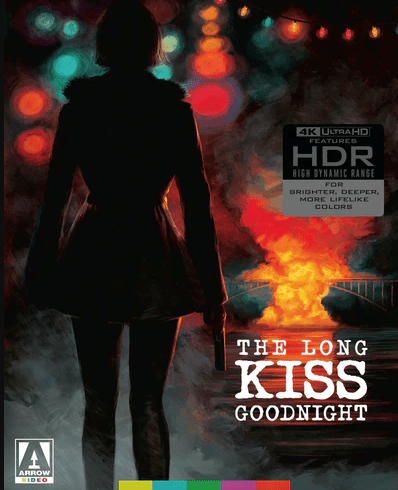
Until then, The Long Kiss Goodnight.
Harlin and his leading lady, Geena David, were married from 1993 to 1998, but she filed for divorce shortly after her personal secretary, Tiffany Bowne, gave birth to Harlin’s first child, Luukas “Luke” Harlin, in August 1997. As the timelines up, some of that affair occurred during the making of this film. I don’t know how that colors your enjoyment of this film.
It did well, but writer Shane Black wondered if it would have done better with a male lead. Some of that is because their past film, the previously mentioned Cutthroat Island, did so badly.
Davis has a fascinating career as well. She told Vulture in 2016, “Film roles really did start to dry up when I got into my 40s. If you look at IMDb, up until that age, I made roughly one film a year. In my entire 40s, I made one movie, Stuart Little. I was getting offers, but for nothing meaty or interesting like in my 30s. I’d been completely ruined and spoiled. I mean, I got to play a pirate captain! I got to do every type of role, even if the movie failed.” Yet where I’ve always admired her is that while she’s attractive, that hasn’t been the main reason why she’s been so remembered, starting back in Tootsie.
In this movie, she plays two sides of the female experience: amnesiac good girl schoolteacher Samantha Caine and unstoppable badass Charlene “Charly” Elizabeth Baltimore. She only fully engages in her real Charly self when she’s nearly drowned on a water wheel while completely nude, which seems like a subject drenched with some subtext. Regardless, she’s the capable one of team she forms with Samuel Jackson’s detective, Mitch Henessey. And yet at the end, she is comfortable enough to put that life behind her again — without amnesia leading her to follow that path — and become a partner to a man and a mother.
The real success of the film is that the people who made it loved what they did. It’s one of Jackson’s favorite films he was in to watch — he was killed in the original cut until an audience member loudly protested during an early test viewing — and Davis said, “I love that movie. My character might be my favorite role—it’s a close call between Thelma and that one. Anyway, that movie came out great and got some good reception, but it didn’t soar to heights, let’s say, perhaps as we wanted it to.” As for Harlin, it’s his favorite of his movies, saying, “…it’s just very simple. It’s a movie that had a really good screenplay, which meant that I was able to get really good actors. It’s always challenging to make a movie, but it sure makes it easier when you have a good screenplay like in that one. When you have characters that are complex, and you have good drama and have some humor and some good action, you kind of have all the ingredients. When you have that you don’t even need some crazy special effects — you just need to let the characters do their thing. It was a great experience.”
The Arrow Video release of The Long Kiss Goodnight has limited edition packaging with reversible sleeve featuring original and newly commissioned artwork by Sam Hadley, an illustrated collector’s booklet featuring new writing on the film by Clem Bastow, Richard Kadrey, Maura McHugh and Priscilla Page, a seasonal postcard and a thin ice sticker. It has so many features, starting with a brand new 4K restoration by Arrow Films from the original 35mm negative approved by director Renny Harlin; two new commentaries (one by Walter Chaw and the other by film critics Drusilla Adeline and Joshua Conkel, co-hosts of the Bloodhaus podcast); a trailer; an image gallery; new interviews with stunt co-ordinator Steve Davidson, make-up artist Gordon J. Smith and actress Yvonne Zima; new visual essays by film scholar Josh Nelson, critic and filmmaker Howard S. Berger and film scholar Alexandra Heller-Nicholas; deleted scenes; archive promotional interviews with director Renny Harlin and stars Geena Davis, Samuel L. Jackson and Craig Bierko; making of and behind the scenes footage. You can order this from MVD.
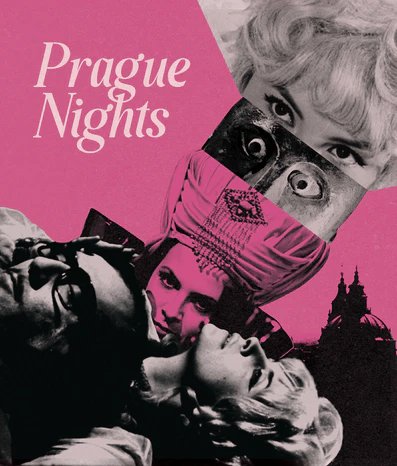
Deaf Crocodile Films, in association with distribution partner Comeback Company, has restored this little seen in the U.S. late 1960s Czech occult/horror anthology. Prazske Noci (Prague Nights) is inspired by Black Sabbath and features episodes directed by Milos Makovec, Jiri Brdecka and Evald Schorm.
I love how they referred to this movie: “a gorgeous and supernatural vision of ancient and modern Prague: caught between Mod Sixties fashions and nightmarish Medieval catacombs, and filled with Qabbalistic magic, occult rituals, clockwork automatons and giant golems.”
I mean, I’m already in love.
Filmed during the 1968 Soviet invasion of Prague, Prague Nights begins with a businessman named Willy Fabricius (Milos Kopecky), who is lonely and lost in a foreign city, looking not for love but for some form of lust. Then he encounters the much younger, more gorgeous, and way more mysterious Zuzana (Milena Dvorská), and they travel through the sleeping city in her vintage limousine. As her driver, Vaclav (Jiríi Hrzan), pulls into a cemetery, she begins to tell him the three stories that make up this movie:
In Brdecka’s chapter “The Last Golem,” Rabbi Jehudi Löw (Josef Blaha) has already created and used a golem, a gigantic silent homunculus from living clay. Emperor Rudolf II (Martin Ruzek) hears of this and wants to use the supernatural being for his own aims, and even when told it can’t be revived, a less moral young rabbi named Neftali Ben Chaim (Jan Klusak) claims he can make it happen. But will his lust for the mute servant (Lucie Novotná) and need to inspire her be his undoing?
“Bread Slippers” — directed by Schorm — introduces us to a countess (Teresa Tuszyńska) who indulges all of her passions, whether for kisses from the maids, the sweetest of cakes or affairs that wouscand,alize her town. She’s pushed twin brothers into a duel for her heart that killed them both and now she’s led Saint de, Clair (Josef Abrham) into death at his own hand. And all because he couldn’t get her the shoes she asked for, shoes made of — you read the title — bread. While the peasants go hungry, the countess decides what they yearn to eat.
Yet a strange shoemaker (Josef Somr) can, and once he delivers them, he steals her away to an abandoned mansion, a place filled with mechanical servants, dust, and cobwebs. A place where she will die—forever with her many victims.
Makovec’s “Poisoned Poisoner” shares the adventures of a murderess in the Middle Ages who kills off sex-crazed merchants set to the music of 60s Czech pop star Zdeněk Liška. Yet what happens when a woman who kills men and takes not only their money and jewelry but their hearts falls for one of her victims?
Prague Nights ends with the truth of Zuzana and why she needed the businessman so severely on this — and only this — night. What we have experienced is. We have experienced. That is so unlike what we’ve seen that it nearly feels animated. s change from black and white to monochromatic to more colors than we can almost stand; cars drive into graves; lovers can be trapped in Hell forever. Yet it all makes your heart and mind and eyes sing. This film is pure magic and yet another film that Deaf Crocodile has put in front of me and won over every fiber of my being with.
This Deaf Crocodile Blu-ray has a new video interview with Czech film critic and screenwriter Tereza Brdečka on her father, Jiří Brdečka (co-director and co-writer of Prague Nights, covering his famed career as a filmmaker, animator and screenwriter; new audio commentary by Tereza Brdečka and Czech film expert Irena Kovarova of Comeback Company; two superb and haunting Jiří Brdečka animated short films: Pomsta (Revenge) and Jsouc na řece mlynář jeden (There Was a Miller On a River); a new essay by Tereza Brdečka on the making of the movie and new art by Beth Morris. You can get this from MVD.
Witness his take on shark movies. He gets what works and then makes the movie fly so it doesn’t feel like even half of its 1 hour, 45-minute length. This is lean, mean and ready to bite.
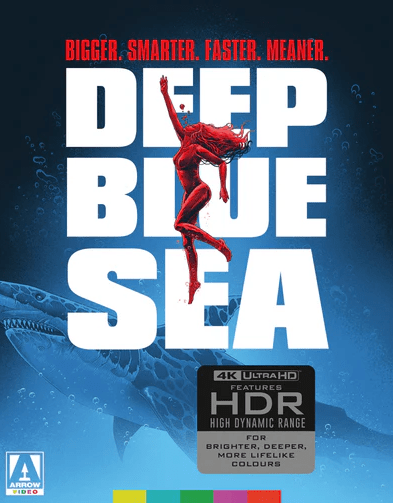
Shot in the same tanks that James Cameron used for Titanic, the idea of this movie is absolutely ridiculous. In a deep sea facility, a team of scientists is using mako sharks to reactivate dead brain cells within patients with Alzheimer’s disease. One of those sharks has already escaped and attacked a boat full of partying teens, so the company behind it all sends Russell Franklin (Samuel Jackson) to investigate.
Doctors Susan McAlester and Jim Whitlock (Saffron Burrows and Stellan Skarsgård) prove their research to Franklin by removing protein complexes from the brain of their biggest shark. Bad idea — one shark is all it takes to mess everything up. It eats up Whitlock’s arm and as he’s being evacuated, inclement weather fouls up everything. His stretcher goes into the shark pen and as one of the sharks grabs it, it pulls the helicopter into the tower, killing anyone who could get the word out that things have gone wrong.
Susan, Russell, shark wrangler Carter Blake (Thomas Jane), marine biologist Janice Higgins and engineer Tom Scoggins (Michael Rapaport) then watch a shark use that very same stretcher to smash its way into the lab, flooding the entire base. Susan then confesses that she and Jim had genetically engineered the brain size of the sharks, which let them harvest more protein. It also made them smarter and deadlier. This is why this movie is wonderful; dumb lapses in science and logic that are glossed over so that more people can be devoured by sharks.
Meanwhile, cook Sherman “Preacher” Dudley (LL Cool J) may have lost his parrot to a shark and almost got cooked in an oven, but he knows the shark’s natural movie predator: explosions. He blows one shark up real good and goes to find the rest of the crew.
When we find the crew, they’re arguing and Russell gives a speech about how everyone has to work together. In any other movie, this is where people would pull it through. Here, a shark emerges and decimates the executive. It’s a moment that will make you stand up on your couch and scream your head off in glee.
What I love about this one is that no one is safe. The people you expect to survive — and the ones you don’t — get killed horribly. If you love watching sharks eat people, good news. This one has it all.
There are a lot of cues to Jawshere: the license plate they find in a shark’s mouth is the same as that movie. And the ways the three sharks are killed — blown up, electrocuted and incinerated — exactly play back the way the shark is killed in Jaws, Jaws 2 and Jaws 3D.
You should totally check this one out. I was actually surprised by how much I loved it. That’s after more than twenty shark movies in a few weeks, so that’s really saying something.
PS: The song LL Cool J does in this film, “Deepest Blue (Shark Fin)” is absolutely insipid. I love it. Do yourself a favor and look up the lyrics.
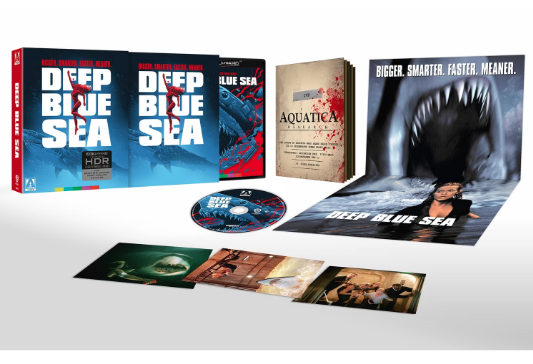
The Arrow Video release of this movie has a brand new 4K restoration of the film from the original camera negatives by Arrow Films approved by director Renny Harlin. There are two new commentaries — one by screenwriter Duncan Kennedy and another by filmmaker and critic Rebekah McKendry — as well as an archival audio commentary by director Renny Harlin and star Samuel L. Jackson. There is also a new interview with production designer William Sandell, a visual essay by film critic Trace Thurman, making of and shark featurettes, deleted scenes with optional audio commentary by director Renny Harlin, a trailer and an image gallery. It all comes inside a reversible sleeve with original and newly commissioned artwork by Luke Preece, a 60-page perfect bound collector’s book containing new writing by film critics Josh Hurtado, Jennie Kermode and Murray Leeder, plus previously unseen production art and designs, a double-sided fold-out poster featuring original and newly commissioned artwork by Luke Preece and postcards from Aquatica. You can get it from MVD.
Do you know why I’ve never done acid? This movie right here. After all, it has an “inspired by true events” square up in the end credits.
After a series of seemingly unconnected murders in Los Angeles, only one link keeps coming up: every single person took the same strain of LSD called Blue Sunshine. The sins of the past decade are ready to come back and destroy the “Me” decade.
Zalman King — yes, the same man who got your mom all tingly after you were put in bed and she watched Showtime’s Red Shoe Diaries — plays Jerry Zipkin, a man accused of the murders who — in true giallo-style — must clear his name. That’s because he was at a party where the murders may have started, complete with a screaming Brion James and Billy Crystal’s brother singing Frank Sinatra songs before he starts throwing women into the fireplace.
If it turns out that you took Blue Sunshine, chances are that you’re about to lose all your hair, go crazy, and start killing everyone in your path. Of course, no one knew this ten years ago when they were all dosing on it back in college. Chromosomal damage can be a real b, you know?
How can you not love a movie whose title is spoken by a parrot? One that has a climactic disco shootout? Or is it so 1970s that it ends up speaking for pretty much the entire decade?
The self-medicating Dr. David Blume, the hard-drinking and hair losing John O’Malley, and Ed Flemming (Mark Goddard, Major Don West from Lost In Space) are all caught up in the grip of the bad trip. The effects sum up Flemming’s political campaign: “In the 1960s, Ed Flemming and his generation shook up the system. Now he’s working within it.” He has become the system. It’s as if the children in Manson’s famous quote- “These children that come at you with knives- they are your children. You taught them. I didn’t teach them. I just tried to help them stand up.” — are even more dangerous when fully grown.
Goddard isn’t the only TV star that shows up, as Alice Ghostly (Esmerelda from Bewitched) makes an appearance.
Writer and director Berman would lend his strange style to other films such as Squirm, Remote Control, Just Before Dawn, and the odd true crime TV show Love You to Death, which starred John Waters as a Grim Reaper attending weddings of partners who would soon kill one another.
The director claims that two major TV networks expressed interest in purchasing the film as a “movie of the week.” The opportunity to get double the budget was appealing. Still, after seeing the edits that the movie would need to be able to play on network TV, Lieberman decided to produce this for theaters.
The Synapse release of this movie comes in a gorgeous box, overstuffed with extras. It starts with a 4K restoration of the original 35mm camera negative mastered in Dolby Vision that has a new surround sound mix supervised by director Jeff Lieberman; two audio commentaries with Lieberman, who also contributes an introduction; an archival 2003 interview with director Lieberman; “Lieberman on Lieberman” video interview; Channel Z “Fantasy Film Festival” interview with “Master of Horror” Mick Garris and Jeff Lieberman; Fantasia Film Festival 4K Premiere Q&A with moderator Michael Gingold and director Jeff Lieberman; two anti-drug scare films, LSD-25 and LSD: Insight or Insanity?, courtesy of the American Genre Film Archive; Jeff Lieberman’s first film The Ringer (remastered in 4K by Synapse Films from the original camera negative); trailers; a stills gallery; liner notes booklet by Lieberman, featuring a chapter on the making of Blue Sunshine from his book Day of the Living Me: Adventures of a Subversive Cult Filmmaker from the Golden Age; a limited edition fold-out poster and limited edition remastered CD soundtrack.
The sequel to 1969’s Fear No Evil, this made for TV movie brings back Louis Jordan as psychiatrist Dr. David Sorrell. Now, he has to help Jolene Wiley (Anne Baxter), who has been targeted by a witch coven led by Leila Barton (Diana Hyland). Jolene’s parents have already been killed and her sister Aline (Carla Borelli) has just overdosed on sleeping pills. Could she be next?
This was supposed to be a series, Bedeviled, but NBC ran Night Gallery instead. They still bought another pilot and this was it.
Along with. his mentor Harry Snowden (Wilfrid Hyde-White), Dr. Sorrell investigates, meeting a friend of Aline, Larry Richmond (Georg Stanford Brown), a Vietnam vet hippie blues singer who may have seen way too much of the cult. As for Leila Barton, she’s working on bewitching Dr. Sorrell and using that to get away with her crimes. This movie sets her up as a potential long-term enemy/lover if the show was ever bought.
Director Robert Day started his career in the UK but made some popular TV movies in the U.S., such as Scruples, The Initiation of Sarah and Death Stalk. This was written by the team of Robert Presnell Jr. (The Secret Night Caller) and Richard Alan Simmons (who developed Mrs. Columbo).
It’s rare that a potential show had two pilots air and the series was never picked up. I can only imagine if this had become a series, not all of the episodes would have aired and it would later be released on a box set after numerous airings on the CBS Late Movie.
Seriously, what drugs is this movie on? How can we return in time and get them, and how great will the high be?
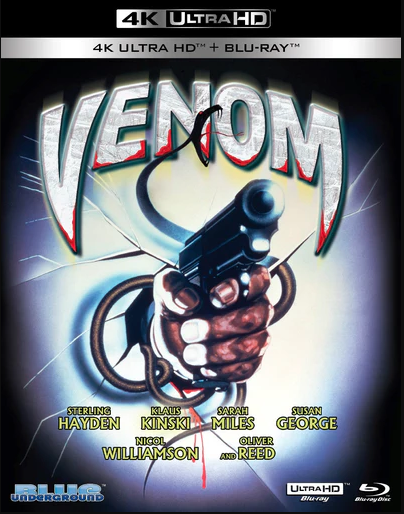
International criminal Jacques Müller (real-life maniac Klaus Kinski) and his lover Louise Andrews (Susan George) kidnap Philip Hopkins (Lance Holcomb), the grandson of hotel chain owner and great white hunter Howard Anderson (Sterling Hayden). It’s easy — Louise works as a maid, seduces chauffeur Dave Averconnelly (Oliver Reed), and gets him into the team without ever thinking through the psychosexual dynamics of the triad that she’s created.
The problem — well, one of many — is that Phillip meant to bring his snake and grabbed a black mamba ready to kill anything and everything. Still, toxicologist Dr. Marion Stowe (Sarah Miles) was late, the switch was off and well, now we have a deadly snake that bites Louise’s face until she dies, leaving the cucker and the cucked to deal with the emotional fallout, as well as Dave just blasting cops when he gets too nervous.
Commander William Bulloch (Nicol Williamson) arrives- you can’t shoot a cop in England without this happening, go figure- and Müller demands a million in different bills and transportation. At the same time, Dr. Stowe brings a case of anti-venom she just whipped up.
That snake wipes out all the bad guys, and the end, well, it bites Müller repeatedly, then they both get shot so many times that you’d think they were a black criminal trying to outrace a white cop on foot, then they both fall off the building. Truly a death that was earned by Kinski.
As you can imagine, Kinski and Reed measured dicks this entire film, constantly trying to outdo each other. This was going to be a Tobe Hooper movie, which is blowing my mind right now, before he was replaced by Piers Haggard, who made The Blood On Satan’s Claw.
Haggard told Fangoria, “I took over that at very short notice. Tobe Hooper had been directing it, and they had stopped for whatever reason. It hadn’t been working. I did see some of his stuff,f and it didn’t look particularly goo.dPlus,s he also had some sort of nervous breakdown or something. So anyway, they stopped shooting and offered it to me. Unfortunately, I had commitments; I had some commercials to shoot. But anyway, I took it over with barely ten days of preparation – which shows. It doesn’t become my picture, it’s a bit in between. . . Oliver Reed was scary at first because he was always testing you all the time. Difficult but not as difficult as Klaus Kinski. Because Oliver actually had a sense of humor. I was rather fond of him; he could be tricky, but he was quite warm, really. He just played games and was rather macho and so on. Klaus Kinski was very cold. The main problem with the film was that the two didn’t get on, and they fought like cats. Kinski, of course, is a fabulous film actor, and he’s good in the part; the part suits him very well. They were both well-cast, but it was a very unhappy film. I think Klaus was the problem, but then Oliver spent half the movie just trying to rub him up, pulling his leg all the way. There were shouting matches because Oliver just wouldn’t let up. None of this is about art. All the things that you’re trying to concentrate on tend to slip. So it was not a happy period.”
Once, at a party at Elaine’s, Kinski bragged about how he and other cast members and crew ganged up on Hooper a couple of weeks into the shoot to get him fired. It must have been a horrific set, as cinematographer Anthony B. Richmond quit simultaneously, and Haggard claimed that the Black Mamba was the nicest person on set.
And oh yeah — Kinski took this movie instead of Raiders of the Lost Ark, telling Spielberg that his script was “moronically shitty.”
As for Susan George, after a career of being menaced by ninjas in the movie that kicked off the craze Enter the Ninja, sharks in Tintorera (while enjoyed a throuple), the locals of Straw Dogs, the dark ending of Dirty Mary, Crazy Larry, The House Where Evil Dwells, the babysitting nightmare Fright and so many other wonderful roles, well, she’s earned our love.
The Blue Underground Ultra HD Blu-ray and HD Blu-ray release of this movie is slithering with extras, such as two audio commentaries (one with director Piers Haggard and the other with film historians Troy Howarth, Nathaniel Thompson and Eugenio Ercolani); new interviews with editor/second unit director Michael Bradsell, makeup Artist Nick Dudman, author and critic Kim Newman and The Dark Side’s Allan Bryce; trailers; TV commercials; a poster and still gallery and a collectible booklet with an essay by Michael Gingold.
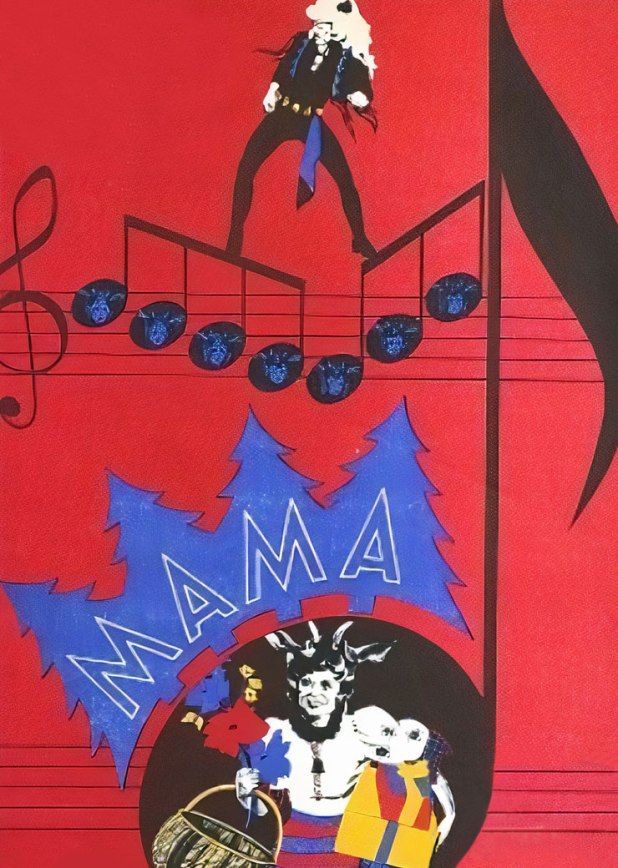
Fairy tales are alike in many countries. This film is based on “The Wolf and the Seven Young Kids” from Grimm’s Fairy Tales, which Russian kids known as “Волк и семеро козлят” (“The Wolf and the Seven Kids”) and Romanian young ones know as “Capra cu trei iezi” (“The Goat and Her Three Kids”). So yes, there are five kids in this, but that feels like splitting the difference.
Directed by Elisabeta Bostan, this was filmed in three languages — Romanian, Russian and English — and features performers from the Moscow Circus, the Moscow Circus on Ice and the Bolshoi Ballet.
It’s also way weird.
Rada (Lyudmila Gurchenko, who was awarded People’s Artist of the USSR in 1983) is gathering fruit in the woods, leaving her children home. She’s watched by Petrika the donkey (George Mihaita), Rassul the lynx (Valentin Manokhin), a young wolf (Savely Kramarov) and leader Titi Suru (Mikhail Boyarsky), who listen to her singing and begin plotting on taking her family from her.
Matei (Petya Degryarov), the oldest child, runs away from home to the fair while Titi Suru keeps trying to sing Rada’s song to the children, convincing them that he is their mother. They are too smart for him — keep in mind, this guy looks like a glam rock werewolf — but when their mother’s voice gets sore from calling for her lost son, they no longer recognize her. Everyone gets kidnapped by Titu Suru and his gang, except that Rada is too smart for him, ice skating with him until he falls into the cold water, only saving him when she has her children safe.
Now, re-read that and get this in your head: the big bad wolf is sexy, always smoking a pipe and looking kind of like Phil Lynott if he were, you know, a wolf. The goat mother — a single mom, mind you — Rada is also quite attractive and every time the two get together, sparks fly. They’re going to get it on. You know it. They know it. But the wolf is a wolf and he wants to steal her children, because for all he protests how much people treat wolves so badly and have preconceived notions of them, he’s also, well, a wolf.
Sure, all the songs sound pretty much the same — I can hear you now, “It’s a leitmotif, you moron!” — but who cares? It’s the 70s and everyone is wearing makeup and everyone has glitter all over them and this is what the children of the world of The Apple are put in front of to be babysat while their parents go do mad coke at Mr. Boogalow’s latest record release.
These songs will get stuck inside your head but you won’t feel bad about that.
There’s also a parrot that is a human with a gigantic rainbow pompadour. The whole world of Ma-Ma feels like no other place on Earth, even starting with all of the actors getting into their costumes together. This will both delight and terrify your child.




 B&S About Movies
You must be logged in to post a comment.