Ghost Story: Episode 2 “The Concrete Captain”

Ed Lucas (Stuart Whitman) has found his wife Kate (Gena Rowlands) the perfect souvenir. The Concrete Captain is a small chunk of concrete with a miniature harpoon in it. Lucky for him — and maybe not so good, really, when you see how it all happens — she loves it.

She’s actually obsessed with it.

The Concrete Captain ends up being real and his ghost thinks that Kate is his long-lost love Katharine. And he’s coming back for her.

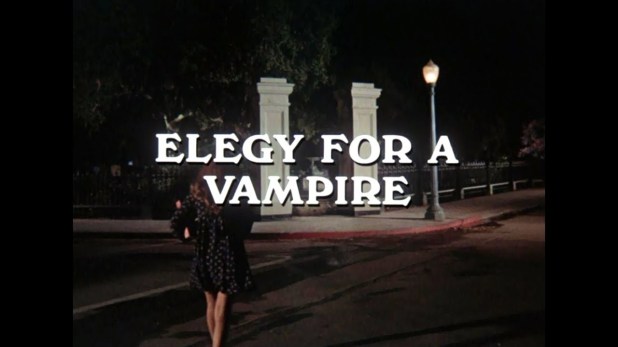
This episode of Ghost Story was based on a short story by Elizabeth Walter, whose story “The Spider” was an episode of Night Gallery, “Fear of Spiders.” Three more of her stories would end up in this series: “The New House,” “Pendergast” (which was called “Elegy for a Vampire”) and “Travelling Companion” (which was called “Time of Terror). The story was adapted by JImmy Sangster and Richard Matheson, which if you think about it, is pretty much as good as it gets.

This was made four years — and plenty of TV work — before Richard Donner would make The Omen and show the world just how good he was. Anyone who watched this episode would already know that, as this gothic ghost story wanders the silent and gray shores of a coastal town that’s been shut down.

Dracula Sovereign of the Damned (1980)

If you think there’s censorship in America today, well, let me tell you…after the comic book trials of the 1950s, in which Dr. Fredric Wertham’s book Seduction of the Innocent led to Congress having trials amidst the belief that comic books caused juvenile delinquency, the Comics Code Authority was born. Every comic needed the code and in order to keep offending comics like E.C. Comics’ Tales from the Crypt from ever rearing their ugly head again, vampires, werewolves, ghouls and zombies were banned. Comics couldn’t even use the words horror or terror in their titles. Even comic book writer Marv Wolfman’s last name was challenged!

It got so ridiculous that when Marvel used zombies in The Avengers, they had to call them zuvembies. They were still undead, they still acted like zombies, yet that spelled got them past the outdated Comics Code.

However, a 1971 provision to the Code stated the following: “Vampires, ghouls and werewolves are allowed when handled in the classic tradition such as Frankenstein, Dracula, and other high calibre literary works written by Edgar Allan Poe, Saki, Conan Doyle and other respected authors whose works are read in schools around the world.”

After the last appearances of Dracula, Frankenstein’s Monster and a werewolf as superheroes in a short-lived line of Dell Comics, comic publishers realized that they could make monster books and as the characters were in the public domain, they could create their own versions of some already beloved characters.

Marvel already had a “living vampire” in Morbius — yes, the same character who is getting his own movie — but the Dracula comic floundered at first with several different writers (Gerry Conway, who went from a Universal-inspired take with major input from editors Roy Thomas and Stan Lee to a Hammer take on the character in the two issues he wrote, followed by two issues by Archie Goodwin and two by Gardener Fox before the aforementioned Marv Wolfman came on board) before gaining traction. Gene Colan was the artist along with Tom Palmer on inks for most of the run, basing his Dracula on Jack Palance, who would end up getting the role in the Dan Curtis TV movie Dracula a year after Colan prophetically started drawing him as the King of the Vampires.

At its height, Tomb of Dracula also had two black and white titles, Dracula Lives! and Tomb of Dracula. Yet even after the series ended in August of 1979, the character would return to battle the X-Men.

Strangely enough, Marvel’s Dracula comic book has more of an honor than just being one of the first Marvel movies. It also introduced the character of Blade, who would be one of the first Marvel film successes in 1998.

In 1980, soon after the end of the series, Marvel’s deal with Toei led to this movie.

The Toei deal began when the CBS Spider-Man series — which only had 13 episodes in America and a few TV movies — became a big success in Japan. Toei, the makers of Kamen Rider, would be the partner to create Marvel-inspired series such as their own Japanese Spider-Man show that gave Japan their own webslinger in Takuya Yamashiro and his giant robot Leopardon.

Marvel also produced the Sentai — think Power Rangers shows Battle Fever J (with characters from multiple countries much like Captain America; Miss America on the show inspired American Chavez — according to this article on Inverse — and the crew even battled a Dracula robot), Denshi Sentai Denziman and Taiyo Sentai Sun Vulcan, which Stan Lee tried and failed to bring to America. Ironically, former Marvel producer Margaret Loesch ran Fox Kids in the 90s, which led to Marvel shows appearing on Fox, as well as a much later Super Sentai series, which was rebranded exactly as Lee had suggested by Saban Entertainment and called Mighty Morphin Power Rangers.

As part of the deal with Toei, two more movies got made: Kyoufu Densetsu Kaiki! Frankenstein and Yami no Teiō: Kyūketsuki Dorakyura orThe Emperor of Darkness: The Vampire Dracula.

In 1983, Harmony Gold released this to American cable as Dracula Sovereign of the Damned. And wow, it’s something else.

The movie starts with no less gravitas than to show us how the universe was formed and the nature of juxtaposition — life and death, heat and cold, light and dark — began. Nowhere is that juxtaposition more felt than in the form of Dracula, who is both alive and dead.

Now making his home in Boston, after being hounded by multiple vampire hunters, Dracula soon interrupts a wedding between a virginal bride and Lucifer, stealing Dolores for his own, yet conflicted as to whether or not he should drink her blood. They end up having a son, Janus, who is killed by the cultists and Satan, but comes back as a being of pure light that also wants to kill his father. Meanwhile, Frank Drake, Hans Harker and Rachel Van Helsing are hunting down the vampire, wanting to end his life for good.

Can you fit more than 40 issues of a comic book into 90 minutes? Well, the makers of this movie sure gave it a try. At one point, Dracula even becomes human and walks the streets of Boston still wearing his cloak, but goes to get a hamburger. It’s also amazing just how much violence, Satanic moments and even nudity that this movie has. It’s also hilariously dubbed and the source material isn’t understood by the people making it, so it’s exactly everything that I want and need it to be.

You can watch this on YouTube.

Ghost Story: Episode 1 “The Dead We Leave Behind”

Originally airing on September 15, 1972, the first episode of Ghost Story has Winston Essex telling us the story of ranger Elliott Brent (Jason Robards).

His wife Joanna (Stelle Stevens) is bored, so he buys her a TV set. But now, all she does is watch her stories and neglects their home. As they argue, Elliot accidentally kills her and buries her behind their cabin. But now, when he turns on that TV, all he sees is her and sees episodes of shows in which she’s been unfaithful to him.

And when the man who she’s been cheating — in video form from beyond the grave — shows up, well, Elliot has to kill him too, right? But after that, when he starts seeing bodies rising from the grave on the screen, things don’t look good at all.

Director Paul Stanley’s career was mainly in television other than the 1959 film Cry Tough, which starred a young John Saxon. This episode came from a story by Robert Sprecht, who created the show The Immortal, and was developed for the TV format by Richard Matheson.

John Kenneth Muir’s Reflections on Cult Movies and Classic TV has a great theory on this episode and how it influenced numerous Stephen King stories from Pet Sematary and The Shining to the “Something to Tide You Over” segment in Creepshow.

Robards — as always — brings up the level of anything he’s in. And Stella Stevens is great in this too. I kind of love how it starts in the middle of their story, which already seems to be spiraling into darkness.

Ghost Story: Pilot Episode “The New House”

Becca and I got obsessed with this show, which lasted for just one season before it was canceled due to low rating. That’s a shame as this show feels like NIght Gallery if it remained all serious and didn’t have the abysmal comedy bits.

Even better, each episode looks like a movie, thanks to the producing skills of William Castle, and feels like one with Hammer scribe Jimmy Sangster overseeing the stories. It’s hosted by Family Affair star Sebastian Cabot as Winston Essex, who works in the elegant Mansfield House hotel, which is truly the Hotel del Coronado, the same place that Wicked Wicked was shot.

There was even a Peter Pan Records album of the show, which sadly only lasted 22 episodes, which includes a mid-season overhaul of the show’s format. We’ll get to that in a few months, but we thought it’d be fun to post each episode weekly and share it with you.

Originally airing on March 17, 1972, “The New House” has a killer TV movie pedigree, as it was directed by John Llewellyn Moxey and written by Richard Matheson. I mean, this is the team that brought us The Night Stalker.

Barbara Perkins (Betty Anderson from Valley of the Dolls and the maid of honor for the wedding of Sharon Tate and Roman Polanski) and David Birney are a couple that’s just bought a new home. As they wait for their child to be born, they learn that their home was once the site of a lynching and a hanged woman named Thomasina Barros is still there, at least in spirit, seeking new life that will allow it to enter our world. New life like, well, the baby that’s due any day now.

The format of this show is great, as the stories are given a full hour — forty-plus minutes with commercials — and the casts are always stellar, the stories frequently frightening and the sets all share a similar backlot feel. There’s also an orange cat in several episodes, which seems like a theme.

You can check out this episode on YouTube:

The Hunt for the Unicorn Killer (1999)

Ira Einhorn (Kevin Anderson) created Earth Day, but yeah, he also killed his girlfriend and kept her in a trunk for a long time. She was found, he never came back home and he was convicted of killing Holly Maddux (played by Naomi Watts) in absentia. Her dad (Tom Skeritt, for the ladies) works hard to bring him to justice in this story of hippie values gone wrong.

Strangely, this is like the fifth William Graham TV movie I’ve watched in the last few days. I’m not complaining. He also made Elvis’ last narrative movie effort, Change of Habit.

This is a typical late 90s ripped from the headlines TV movie about someone who somehow stayed ahead of the law for decades and kept working on being released until he died in jail.

You know, someday I may add up all the hours of TV movies I’ve watched and wonder what I’ve done with my life, but it isn’t going to be today.


Crowhaven Farm (1970)

The ABC Movie of the Week for November 24, 1970, Crowhaven Farm embraces two trends of the 70s. One, the feeling that the hippy movement was over and a return to some small town normlacy was the only way to heal after the last few tumultuous years — indeed, it seems like several decades pass between 1963 and 1969, with tentpole events like the Tate-LaBianca murders and Woodstock occurring a week apart. And the second, and for our purposes most critical piece of the 70s was that the occult was no longer saying mantras and lighting candles and enjoying white witch magic. The true black arts were here, they wanted your soul and they would crush you using your elders. Remember that ironic pin you wore, “Don’t trust anyone under thirty?” Now you’re living it.

Maggie and Ben Porter (Hope Lange, who had an Oscar for Peyton Place and years of TV fame on a much friendly visit into the world of the supernatural, The Ghost and Mrs. Muir; Paul Burke, the lead on ABC’s 12 O’Clock High and Naked City, as well as Lyon Burke in Valley of the Dolls, later found innocent of a racketeering scheme with Harry Connick Jr.’s dad and after that the grandfather of Arrested Development‘s Alia Shawkat) inherit a farm in New England, a place that another family member wants so badly that he heads up before them, nearly hits a ghost girl with his car and dies in a fireball.

Aren’t the young meant for the city? Well, Ben’s been trying to get his art career off the ground. Crowhaven Farm just seems to inspire him. But Maggie can’t stop seeing the past of that town and the 15th century seems even more restrictive and oppressive than the white picket fence Eisenhower America that the Love Generation was running from and now to.

The last remnants of that Love Generation, the weekenders as they call themselves, come to town and use it for a place to swing, baby. And while it seems like Maggie is barren, taking care of a girl named Jennifer (Cindy Eilbacher, who is in Shanks, but also between this movie, Bad RonaldThe Death of RichieThe Force of EvilCity in Fear and The Ghost of Cypress Swamp can lay claim to some degree of made for TV movie royalty) seems to make up for their lack of family.

But ah, Crowhaven Farm is an odd place. And as soon as Old Hollywood shows up, much less John Carradine as an eerie handyman, you know that Maggie is doomed. So while Jennifer attempts to become more than just a daddy’s girl and really daddy’s girl, she’s haunted by the spirits of Satan loving Puritans that she sold out for a child centuries ago, which makes her willing to release herself of her marriage and rush back to the city with the child she wants and without the husband too quick to believe that one of those swingers knocked her up or that she’s been giving it up to her boss.

All this plus a blink and you’ll miss it cameo by Willaim Smith as a policeman!

Director Walter Grauman filmed quite a few TV movies in the 70s, including Daughter of the MindThe Old Man Who Cried Wolf and Are You In the House Alone? Writer John McGreevey’s career started back in 1951, writing two episodes of Lights Out and included movies like Hot Rod Girl and TV like eighteen episodes of The Waltons (my own personal hellscape), Charles & Diana: A Royal Love StoryNight Crossing and The New Adventures of Heidi.

This is the perfect example of what a TV movie can do, providing sinister feelings and true fright within a tight, taunt under two hour runtime.

You can watch this on YouTube.

The House That Would Not Die (1970)

ABOUT THE AUTHOR:  Melanie Novak writes about the Golden Age of Hollywood, infusing her weekly movie reviews with history, gossip, and the glamour of the studio era.  You can read her reviews at www.melanienovak.com and follow her on Instagram @novak_melanie.

Barbara Stanwyck was a legend of the golden age of Hollywood.  From 1929-1964, she starred in 81 feature films, earning four Academy Award nominations for Best Actress and eventually receiving an Honorary Oscar for her lifetime body of work in 1981.  She’s at number 11 on the American Film Institute’s list of the 50 Greatest Female Screen legends.  Her film Double Indemnity (1944) is number 29 on the AFI’s list of the 100 Greatest American Films of All Time, and her films The Lady Eve (1941) and Ball of Fire (1941) are numbers 55 and 92 on the AFI list of the 100 Funniest American Films of All Time.  She was beloved by audiences, directors, co-stars, and especially film crews, who called her The Queen.

In the 1960s, she turned her attention to television, where she won a pair of Emmy Awards for her work on The Barbara Stanwyck Show and her role as the beloved matriarch Victoria Barkley on the western series The Big Valley.

So you’d be forgiven for thinking that by the 1970s, when Stanwyck was nearing her mid-sixties with a mane of pure white hair she refused to dye and nothing left to prove, she’d ride off into the sunset and enjoy a life of leisure.

But if you thought that, you don’t know Barbara Stanwyck.  The orphan from Brooklyn who’d been supporting herself since she was fourteen was not about to go gently into that good night.

Jacques Tourneur, her director on The Barbara Stanwyck Show summed her up when he said, “She lives only for two things, and both of them are work.”1

In October 1970 ABC premiered The House That Would Not Die as their movie of the week, the first of three films Stanwyck would make with producer Aaron Spelling. 

Stanwyck gets top billing as Ruth Bennett, a woman who inherits a two-century old house that’s reputed to be haunted.  She and niece Sara (Kitty Winn) move in, and soon the neighbors are coming to get a look inside the beautiful old house.

Ruth and Sara make fast friends with a pair of potential suitors in Professor Pat McDougal (Richard Egan) and Stan Whitman (Michael Anderson, Jr.)  As a bit of a lark, Ruth allows two of the neighborhood busybodies to host a séance in the house, which sets the ghost story in motion.

The house starts to get creepy—doors open and close without warning, the wind blows wildly, and Ruth has disturbing dreams.  Pat turns unexpectedly violent for a moment, then forgets what he has just done.  Sara’s behavior is the most bizarre of all, and when she attacks and nearly strangles Ruth in the middle of the night, it’s clear she was possessed by a ghost during the séance. 

The pedestrian plot unspools as Ruth, Pat, Sara, and Stan try to unravel the mystery of who is possessing Sara and why.  There’s the requisite visit to the Hall of Records to research untimely deaths in the house, trips to the attic to read through old diaries and family history, and a climactic scene in a dank cellar hiding a secret grave where both Pat and Sara are possessed and turn murderous.

In the end, the ghost’s murderer is identified, justice is done, and Sara is set free as her possessor can finally rest in peace.

It pains me to pan a Barbara Stanwyck film, but this is one to miss.  It doesn’t contain enough scares or twists to disturb or surprise the audience, yet Stanwyck’s professionalism prevents it from being corny enough to enjoy as camp.  Her follow-up film with Spelling, A Taste of Evil (1971) is more entertaining, and Stanwyck really gets to let loose in the final act.

But even if these late additions to her towering resume aren’t worthy of her talents, Stanwyck was still in the game, the top-billed star in these made-for-television movies when most of her contemporaries were sidelined, dead, or relegated to cameo appearances.

Even in schlock like The House That Would Not Die, the Queen stays Queen.


Notes

1 Smith, Ella.  Starring Miss Stanwyck.

Born Too Soon (1993)

You know, I try and watch TV movies to ease the strain of the outside world, so what explains why I spent all this time watching a movie about Emily Butterfield, a little girl who only lived 53 days and the toll it took on the relationship of Fox Butterfield and Elizabeth Mehren?

Is it the crush that I have on Pamela Reed, who plays the mother? Or perhaps the fact that I will watch anything that Michael Moriarty does? Or did seeing Terry O’Quinn’s name in the credits make me stay?

Noel Nosseck also directed the much more prurient films Best FriendsLas Vegas LadyYoungblood and Full Exposure: The Sex Tapes Scandal. He moved on to some level of prestige TV fare like No One Would Tell.

But man, this movie is just a non-stop punch to the heart and soul. I’d advise you not to watch it, unless you’re some kind of monster who likes watching people experience the worst pain of their lives.

Ants (1977)

Guerdon Trueblood, who wrote this, really had quite the resume. The grandson of General Billy Mitchell, the founding father of the U.S. Air Force, he was a dependable writer for TV as well as writing and directing The Candy Snatchers. You can also check out a few other TV movies he wrote like The Savage BeesSST Death FlightTarantulas: The Deadly Cargo and even the theatrically released — and reviled — Jaws 3D.

Ants — also known as It Happened at Lakewood Manor and Panic at Lakewood Manor — was directed by Robert Scheerer, who also made Poor Devil, the “Primal Scream” episode of Kolchak and episodes of Star Trek The Next Generation, Deep Space Nine and Voyager.

Probably the main reason to watch this is Lynda Day George, who we all know and love from movies like PiecesDay of the AnimalsBeyond Evil and Mortuary. But you also get Myrna Loy, Suzanne Somers (just before Three’s Company), Bernie Casey and Brian Dennehy.

As for the Lakewood Manor, a real estate madman wants to turn it into a casino while its owner (Loy) wants to keep it as it is. As it is involves a pit of venomous ants that can’t be destroyed by pesticides and love to murder people. Imagine — millions of ants covering people, who can’t move or they’ll be killed, ants upon ants taking the life of the soon-to-be Chrissy Snow.

In the 70s, I spent most of my childhood worrying that I would be killed by a bug. Now, I’m more sure it’s going to be a heart attack any day now.

This movie is coming out from Kino Lorber in 2022. Yes! I love that those guys keep putting out physical releases of made for TV movies. Please support them.

MILL CREEK BLU RAY RELEASE: I Dream of Jeannie The Complete Series

I Dream of Jeannie was created and produced by Sidney Sheldon* and it seems like for a long time, he was the only person that believed in it. He originally wanted the first season to film in color — it was one of only two shows on NBC at the time not in color, but special photographic effects employed to achieve Jeannie’s magic weren’t technologically advanced enough to be in a full range of colors yet — but NBC did not want to pay it.

It was $400 an episode.

The network and Screen Gems didn’t think the show would make it to a second season. But Sheldon saw that ABC’s Bewitched was a success and bet on the show.

He was right. It was in the top 30 shows for almost every year that it was on before becoming a syndication powerhouse.

In the pilot episode, “The Lady in the Bottle”, astronaut USAF Captain Tony Nelson (Larry Hagman) lands his one-man capsule Stardust One on a deserted island in the South Pacific. While wandering the beach, Tony notices a strange bottle** that moves by itself. When he rubs it, smoke and a genie (Barbara Eden) pop out.

Tony’s first wish is to be able to understand her, then for a helicopter to rescue him. Jeannie, who has been trapped in the bottle for 2,000 years, falls in love with him and follows Tony back home where she soon breaks up his engagement with his commanding general’s daughter, Melissa. It seems like this was a storyline being set up for the long game, but Sheldon realized that this romantic triangle didn’t have much rope.

Tony keeps Jeannie in her bottle until he realizes she needs a life of her own, which is mostly her using her genie powers to try and make his life better. He worries that if anyone finds out that she exists that he won’t get to be part of NASA, but his worries lead him to being investigated by psychiatrist U.S. Air Force Colonel Dr. Alfred Bellows (Hayden Rorke) with the only person — at first — that knows his secret being Major Roger Healey (Bill Daly).

Unlike many of the sitcoms of the era, I Dream of Jeannie had multipart story arcs (which were created to serve as backgrounds for national contests). For example, nobody knew when Jeannie’s birthday was and the guessing game led to a contest, with the answer being April 1. There was also a four-episode event where Jeannie was locked in a safe on the moon and fans had to guess the combination to save her and another where Tony was replaced and had to be found. But there are also several long storylines, like Jeannie’s evil sister also named Jeannie, Jeannie’s ever-changing origin story which includes Eden’s first husband Michael Ansara as the Blue Djinn, Jeannie taking over the crown of her home country Basenji and so many more.

Supposedly, Hagman was so hard to work with that the producers seriously considered replacing him with Darren McGavin. They even wrote out a story with Tony losing Jeannie and McGavin finding her, but it never ended up happening. In her 2011 book Jeannie Out of the Bottle, Eden wrote, “Larry himself has made no secret about the fact he was taking drugs and drinking too much through many of the I Dream of Jeannie years and that he has regrets about how that impacted him.”

When there were two TV movies in the 80s, Hagman didn’t return. In I Dream of Jeannie… Fifteen Years Later his role was played by Wayne Rogers and as he’s on a space mission in I Still Dream of Jeannie, he’s simply written out and Hagman’s Dallas co-star Ken Kercheval took over as Jeannie’s master. There was also a cartoon called Jeannie that aired from 1973 to 1975 that had Julie McWhirter (who in addition to being the voice in so many cartoons is also the wife of Rick Dees) play Jeannie, “Curly” Joe Besser as Babu a genie in training and Mark Hamill as Corey Anders, a high school student.

Eden has also gone on the record as saying that she never connected with another actor in the same way as she did with Hagman. They’d reunite for the 1971 TV movie A Howling in the Woods.

Why did the show end? It was still near the top thirty after all. Well, Eden believes that there were enough episodes for syndication already and the ratings had gone down after Jeannie and Nelson got married in season 5. No one except for the network wanted that and it eliminated the romantic tension of the show.

I grew up watching this show multiple times a day, often paired with its one-time rival Bewitched. Just going back through these — the original 8 episodes with Paul Frees narration instead of the theme song are a revelation — has made the end of the year doldrums so much better.

You can get all 139 episodes on the Mill Creek  I Dream of Jeannie The Complete Series blu ray set. You’ll get hours and hours of fun for a really great price at Deep Discount.

*Sheldon was inspired by the movie The Brass Bottle, which has Tony Randall’s character get a genie played by Burl Ives. Randall’s girlfriend was played by Eden.

**The bottle is actually a special Christmas 1964 Jim Beam liquor decanter containing “Beam’s Choice” bourbon whiskey. How weird is that?