April 25: Bava Forever — Bava died on this day 43 years ago. Let’s watch his movies.
In 1981, RAI-TV in Italy showed six hour-long films based on stories by 19th century horror/fantasy authors that were directed by several Italian genre talents, including Marcello Aliprand (the writer of L’arma, l’ora, il movent), Giulio Questi (Django Kill…If You Live, Shoot!, Death Laid an Egg, Arcana), Giovanna Gagliardo, Piero Nelli, Tomaso Sherman and, most essentially to this article, Mario Bava.
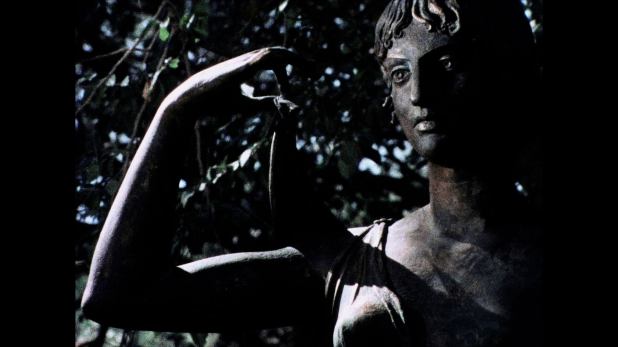
“La Venere Dille” (“The Venus of Ille”) would be the final filmed work that Bava would create and it was written and co-directed by his son Lamberto. Adapted from Prosper Merimee’s story, it starts when a bronze statue of Venus is uncovered. Originally a source of celebration and wonder to the rich and powerful, the workers of the small village see the female carved form as a cursed objet d’art that can move on its own and take on the form of others. Certainly, that’s what happens when Clara’s (Dario Nicolodi, who was also in Bava’s Shock amongst her many, many contributions to cinema) fiancee Alfonso (Fausto Di Bella) places her ring upon its finger while drunk one rainy night.
Meanwhile, an antiques expert and artist named Matthew (Marc Porel, The Sister of Ursula) has been summoned by Alfonso’s father Mr. de Peyrehorade (Fausto Di Bella) to assess the value of the statue. He’s been sketching it for some days before he realizes that he’s been drawing Clara. Or is the statue becoming her?
Shot in 1979 and not aired until after Bava’s death in 1981 (and after Lamberto started making his own movies, including Macabre), this was shot on film and therefore seems of much higher quality than just a TV series. It serves as both a fitting close to Mario’s career and a wonderful gift to his son, as well as an opportunity for the two to work together on a piece of art.
The whole affair looks gorgeous with one moment of rain across the face of the statue and another where Matthew is drawing near it but obviously already obsessed with Clara, the soon-to-be wife of a friend who doesn’t seem to be all that great of a person. The story doesn’t suffer at all from being a TV episode, as at a bit over seventy minutes it has time to stretch out and engage you.
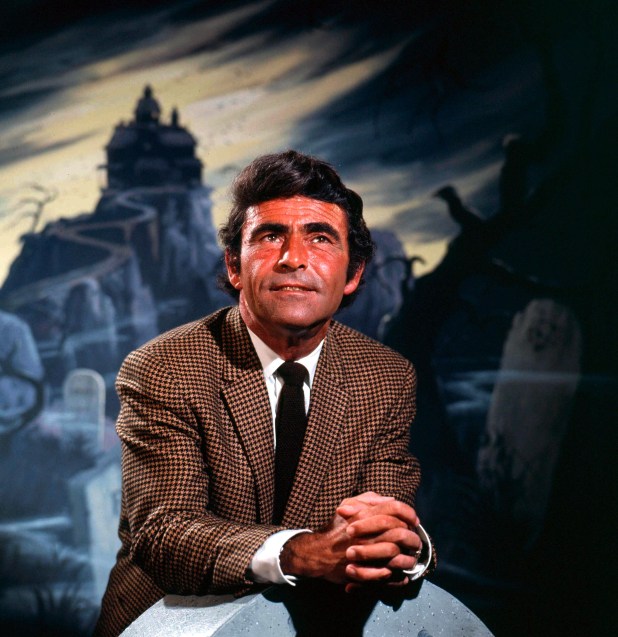
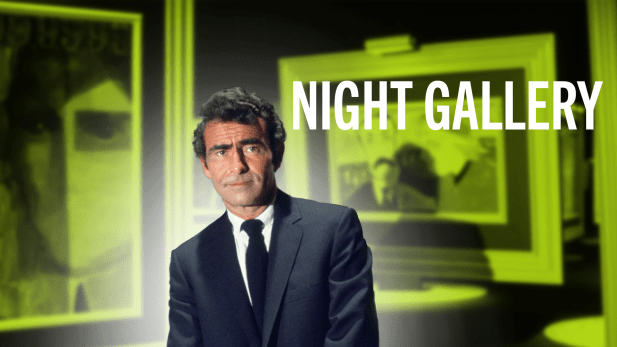
There are three stories in this episode, which often feels like too much, but I promise to be open minded as we get close to the end of the second season of Night Gallery.
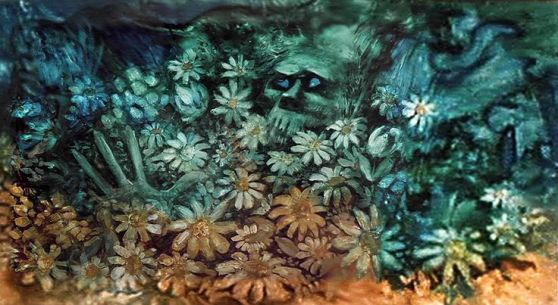
“Green Fingers” was directed by John Badham from a Rod Serling script, which was based on an R.C. Cook short story. Elsa Lanchester (once the Bride of Frankenstein) is Mrs. Bowen, who is great with a garden but in the way of Michael Saunders (Cameron Mitchell), a real estate mogul just going near manic to get his hands on her home and develop the area around it. Yet when he sends a henchman named Crowley (George Keymas) to rough her up, Saunders learns that even in death, Mrs. Bowen can make anything grow. I really disliked how the ending breaks the fourth wall, as this feels more Laird than Serling.
“The Funeral” is about funeral director Morton Silkline (Joe Flynn) planning the final resting moments of Ludwig Asper (Werner Klemperer, Col. Klink). The budget is sky high, the guests include vampires and Jack Laird as Ygor and it’s basically one long blackout gag. Directed by John Meredyth Lucas and written by Richard Matheson, this left a bad taste in my mouth.
The final segment is “The Tune In Dan’s Cafe” and it has some of my favorite art of the entire series. It’s the only directing work of editor David Rawlins and has a script by Gerald Sanford and Garrie Bateson from a story by Shamus Frazer.
Joe and Kelly Bellman (Pernell Roberts and Susan Oliver) have a marriage that, well, is no longer a marriage. The vacation that was to save it failed and they’re left in this blank bar, the only people there, trapped in the void that is their lack of connection. The jukebox comes to like and only plays one song, the sad favorite tune of long gone couple Roy Gleeson (James Davidson) and his girl Red (Brooke Mills). She ratted him out to the police and took the money and ran. Now, that jukebox — every jukebox they put into Dan’s — keeps playing that same song.
Man, I loved this story and how great it looks, with repetitive images of the jukebox being destroyed. It elevated this entire episode.
It’s nice to be surprised by Night Gallery. Stick around when you watch this episode, as the final story really makes it.
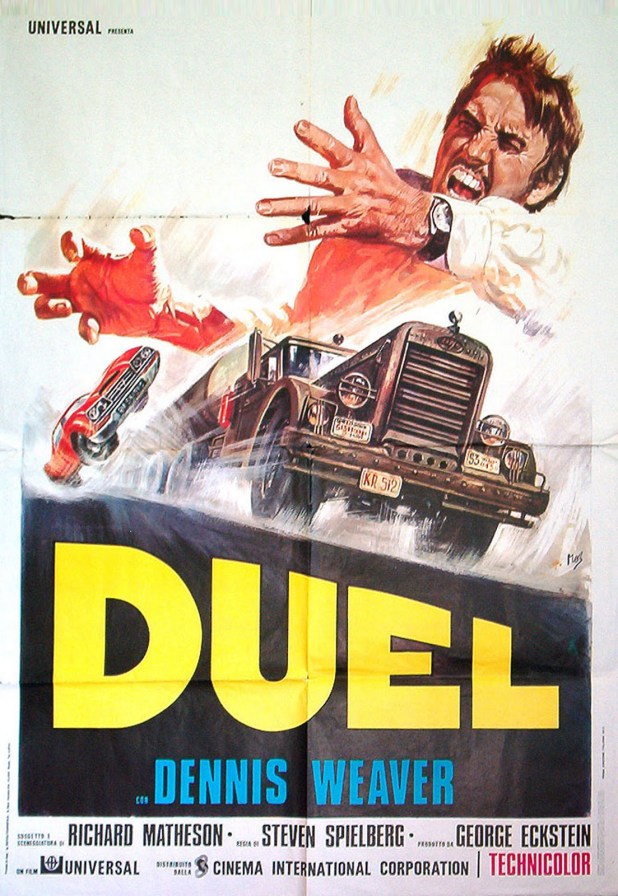
Man, no matter who Dennis Weaver is battling — a Manson-like family against his RV-using vacationing clan (Terror on the Beach), the ghost of his dead daughter (Don’t Go to Sleep) or straight-up Peruvian snow (Cocaine: One Man’s Seduction) — I’m always on his side. He has an everyman quality that is so endearing. no matter how rough TV movies make his existence.
In Duel, the ABC Movie of the Week series for November 13, 1971 — and later an international release in theaters — he’s just a businessman in a Plymouth Valient who upsets the driver — never seen — of a 1955 Peterbilt 281 18-wheeler. It sounds so simple, but that’s what makes it work. There’s little dialogue in the movie with the car and truck pretty much speaking for themselves, as was the intention of its director, a young Steven Spielberg, making his first full-length film after working in series television on shows like Night Gallery, The Name of the Game, Marcus Welby, M.D., Columbo, Owen Marshall, Counselor at Law and The Psychiatrist. Universal signed him to several TV movies, which include Savage and Something Evil before he left TV behind and made The Sugarland Express and the film that would cement his status, Jaws.
Spielberg requested Weaver, as he loved him in Touch of Evil, and even has him use a line from that Orson Welles movie, as he tells the truck driver that he has “another thing coming.”
If you see a version with swearing and more talking, that’s because Universal paid the director to pad it for theatrical release. As for that sound — it seems like a dinosaur — that the truck makes when it dies, it’s the same sound as the shark at the end of the blockbuster Spielberg would later make. He’s said that there is a kinship between the two movies, which are about monsters threatening normal people and the sound effect being used again was “my way of thanking Duel for giving me a career.” It comes from the 1957 movie The Land Unknown.
The other reason this works so well is because of the script by Richard Matheson. He based it on a real story from his life, as a truck tried to run him off the road after a round of golf with Jerry Sohl on the day that JFK was killed. He tried to sell it as a movie for eight years before selling it as a short story to Playboy, where it was published in April 1971. Spielberg said of him, “Richard Matheson’s ironic and iconic imagination created seminal science-fiction stories and gave me my first break when he wrote the short story and screenplay for Duel. For me, he is in the same category as Bradbury and Asimov.”
If you liked this story, so many other Matheson tales have been made into movies: Icy Breasts is his story Someone Is Bleeding, plus there’s The Incredible Shrinking Man, A Stir of Echoes, Ride the Nightmare (filmed as Cold Sweat), The Beardless Warriors (filmed as The Young Warriors), The Comedy of Terrors, The Legend of Hell House, Bid Time Return (filmed as Somewhere in Time), What Dreams May Come, “Prey” which is the “Amelia story in Trilogy of Terror, numerous episodes of Night Gallery and The Twilight Zone, “Steel” (filmed as Real Steel), the “No Such Thing as a Vampire” chapter in Dead of Night, plus the scripts for The Beat Generation, House of Usher, Master of the World, The Pit and the Pendulum, Burn Witch Burn, Tales of Terror, The Raven, The Devil Rides Out, Jaws 3-D, The Night Stalker, The Night Strangler, Dying Room Only, Scream of the Wolf, The Box and so many more. His most filmed story is I Am Legend, which was made as The Last Man on Earth, The Omga Man, I Am Aomega and I Am Legend. He really made his mark in the world with stories that will last forever.
I would dare say that Duel is in the top three of all made for TV movies of all time.
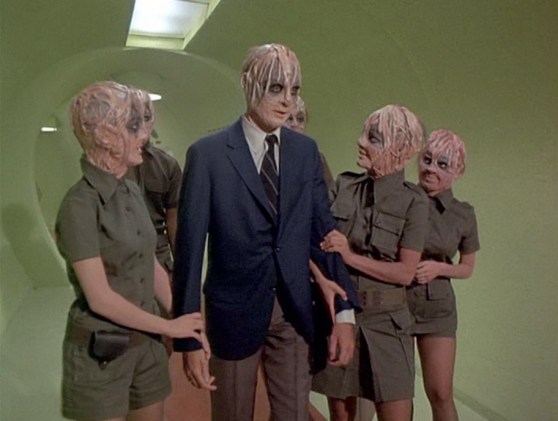
The last episode of Night Gallery for 1971, this episode has a story that harkens back to a Twilight Zone episode yet finds — despite the sheer bleakness of this show — to somehow find happiness where that found dread.
“The Different Ones” has a father by the name of Paul Koch (Dana Andrews) dealing with the Federal Conformity Act of 1993, which means that his son Victor (Jon Korkes) — who has a facial deformity — must be sent away to another planet if surgery can’t help him. Directed by John Meredyth Lucas from a script by Rod Serling, it has the happier ending of Victor finding the happiness that eluded him on Earth. I was waiting for darkness to intrude but instead, this only has light.
“Tell David…” is directed by Jeff Corey and is based on a Penelope Wallace script. On a stormy night, Ann Bolt (Sandra Dee) seeks shelter from the future tech abode of David Blessington (Jared Martin) and Pat (Jenny Sullivan). Yet she soon realizes that David is her son from twenty years from now and he tells her the mistakes she’s made that she must not make again. She must not kill her cheating husband Tony (Martin in a second part) and definitely not kill herself in prison. Yet sometimes, the future is going to happen no matter what we try.
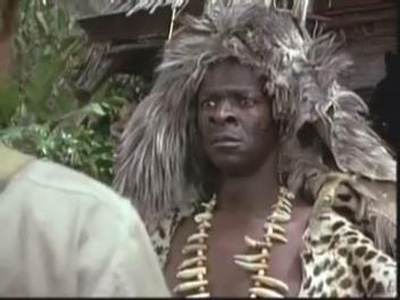
“Logota’s Heads” is about a witch doctor (Brock Peters) charged with the murder of an archaeologist. Directed by Jeannot Szwarc and written by Robert Bloch from an August Derleth story, it also has Patrick Macnee in the cast. Unfortunately, the story has an African witch doctor with shrunken heads, which mainly come from northern Peru and eastern Ecuador. Oh well…
I wish this episode didn’t feel all over the place but at least there wasn’t any comedy moments.
I like the idea of only two stories in an episode of Night Gallery, which gives the tales time to stretch out and, thankfully, avoid the comedy. Well, let’s see what happens.
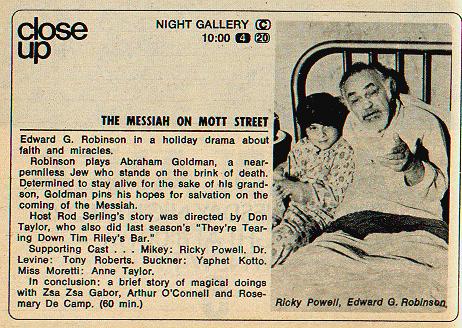
Directed by Don Taylor and written by Rod Serling, “The Messiah On Mott Street” finds Abraham Goldman (Edward G. Robinson) dying on Christmas Eve in the apartment he shares with his nine-year-old grandson Mikey (Ricky Powell). While his doctor Morris Levine (Tony Roberts) wants him to go to the hospital, Abraham is more concerned about the well-being of Mikey, who is an orphan. When the Angel of Death comes to his bed, Mikey runs into the snowy streets looking for the Messiah to save the only person who has been there for him.
He finds Santa Claus and man dressed as Jesus who is preaching the end of all things. As Mikey cowers in fear, he’s saved by a black man named Buckner (Yaphet Kotto) who he feels has to be the Messiah. He begs him to see his grandfather and save him. When they arrive, the Angel of Death has come again and promises that he will come for Abraham at midnight. And while the doctor laughs at the idea of the black man being the Messiah, perhaps happiness can exist even in a Night Gallery episode.
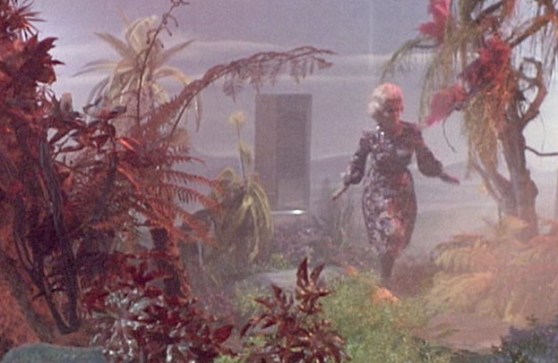
“The Painted Mirror” is directed and written by Gene Kearney. It’s about an antique store owned by Frank Standish (Arthur O’Connell) and Mrs. Moore (Zsa Zsa Gabo) who always seem at odds. When a customer named Ellen Chase (Rosemary DeCamp) brings in an ancient mirror, completely covered in black paint, Mrs. Moore will only carry it on consignment. It obsesses Frank, who removes the paint to reveal a prehistoric scene that viewers can reach into. Of course, this leads to the cruel Mrs. Moore and her dog being trapped there, painted over and inside the past, as a giant dinosaur comes after her.
This episode has one of Serling’s most touching screenplays and some great acting in the first story, so nearly no matter what follows it, it still has to be seen as a well-made episode. Along with Soylent Green, it’s hard to see an obviously ill Robinson play dying men, but he was a working actor who kept appearing in films and television up until his death. As for the second story, the stop-motion animation is really good and it’s a quick and fun installment.
April 6: Viva Mexico — Pick a movie from Mexico and escribir acerca de por qué es tan increíble.
Lucha libre movies were a big deal from the 1950s to 1980s, but kind of went away, ironically at the same time that lucha had a major boom by finally being on TV. Yes, unlike America, wrestling often stayed off TV in Mexico, instead using magazines and newspapers for promotion. That all changed when one of the largest promotions, CMLL, began appearing on the national Televisa network in the early 1990s.
Lucha is very conservative — despite the high flying ring style — and has only changed when renegades left their home promotions. For example, Francisco Flores, along with EMLL trainer Ray Mendoza, broke away from EMLL (the old name for CMLL, which you can consider very similar; it was formed in 1933 and is still around to this day) because they were too restrictive, taking many of the younger wrestlers and those that had not really been pushed — including Fishman, Perro Aguayo, El Canek, Dos Caras and Villano III — and forming the Universal Wrestling Association. While they were the main national competition to CMLL, by the late 80s, the companies were working together and many of their wrestlers left to work for CMLL.
The nail in the coffin of UWA was another renegade, Antonio Peña. The company remained stuck in the past and matchmaker Juan Herrera preferred heavyweight wrestlers who stuck to the traditions of lucha libre, while Peña — who wrestled as Espectro Jr., Dalia Negra, The Rose, Espectro de Ultratumba and Kahoz, a rudo who would invoke evil spirits before his match and release live pigeons before he fought, sometimes even appearing to have bitten the head off of one of them and being covered in blood — was a fan of faster-moving wrestlers like Konnan, Octagon, Mascara Sagrada and the mini-estrella division, in which wrestlers under 5’1″ were not in comedy matches but instead high action battles.
After Paco Alonso, the owner of CMLL, kept ignoring booking ideas, he began negotiations with Televisa. They paid for Asistencia Asesoría y Administración (AAA) and now owned their own lucha libre promotion, leading to an even bigger boom — despite the hardliners claiming TV would ruin their live gates — that only died out when the peso was devalued.
CMLL and AAA are still in business, but man, in the 90s, AAA boasted one of the most exciting rosters ever. In addition to Konnan and Octagon becoming gigantic stars, it was where Rey Mysterio Jr. got his first major fame, as well as having a roster that included Psicosis, El Hijo del Santo, Eddy Guerrero and his partner Love Machine Art Barr, Blue Panther, Cien Caras, Blue Panther, Heavy Metal, La Parka and so many more.
It’s funny — Konnan leaving AAA just followed the same formula — he returned — and CMLL is still considered way too conservative, thirty years after AAA was created.
El Luchador Implacable is a throwback to the other way that lucha libre was once promoted. Stars like El Santo, Blue Demon, Mil Mascaras and more often appeared in movies that were created to draw fans back to the arenas.
It’s about a motorcycle gang that is running wild until they make the mistake of attacking a pro wrestler: Dos Caras Jr.!
Dos Caras Jr. — the nephew of Mil Mascaras — would eventually lose his mask voluntarily when he left Mexico behind to find fame in America as part of the WWE. That said — he did do a few MMA matches with the mask on!
Known as Alberto Del Rio, he became the only man to hold the WWE, WWE World Heavyweight, Impact World, GFW Global, AAA Mega and CMLL World Heavyweight Championship titles. He’s been controversial — that’s putting it mildly — figure due to multiple scandals but is currently back in AAA.
At the time this was made, he was still in CMLL and while there, he would be one of the few of his family members — El Sicodélico Sr., his uncle, was also a rudo — to be a bad guy. He kind of struggled in CMLL as one way that the company changed was that heavyweights weren’t pushed as hard as they were in the pre-UWA days. Unlike most luchadors, Del Rio is 5’6″ and 239 pounds, so he has some size.
Other luchadors that show up in this include Silver King (who was Ramses in Nacho Libre), Rey Bucanero, Hector Garza, Olimpico and Ultimo Guerrero, as well as Rey Myserio Jr. I wonder if some of this movie was filmed while Rey wrestled just ten matches for CMLL in 2001-2002. Mysterio started the year this movie was made by winning the Royal Rumble, then the world title from Randy Orton, becoming a bigger superstar than he ever was before, even if he had to change his name, removing the Jr. as Vince McMahon hates the name as he suffered being called Junior most of his early life.
El Luchador Implacable isn’t bad, but when compared to the movies of lucha libre’s history, it kind of pales in comparison. There are no mummies, no aliens, no werewolves transforming in the middle of the ring.
April 2: Forgotten Heroes — Share a superhero movie that no one knows but you.
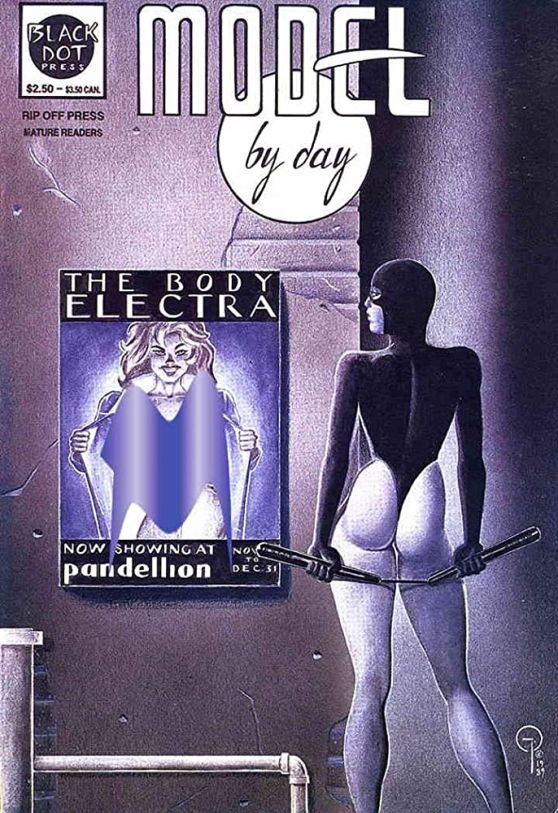
There was actually a Model By Day comic book which ran all of two issues from Rip-Off Press by creator Kevin J. Taylor before somehow getting to be a Fox TV movie. Even crazier, one of its writers, Jeph Loeb, would go on to write comics like Batman: The Long Halloween, Superman for All Seasons, several issues of X-Men and oh yeah, the Heroes Reborn Captain America, Avengers, Iron Man and Onslaught Reborn. His writing partner on this, Matthew Weisman, also wrote Commando and Teen Wolf with Loeb.
Look, after Tim Burton made Batman, Hollywood was crazy for anything superhero. How else can you explain The Phantom and The Rocketeer and The Shadow — I love these movies, but you know, I may be the only one — getting their own movies?
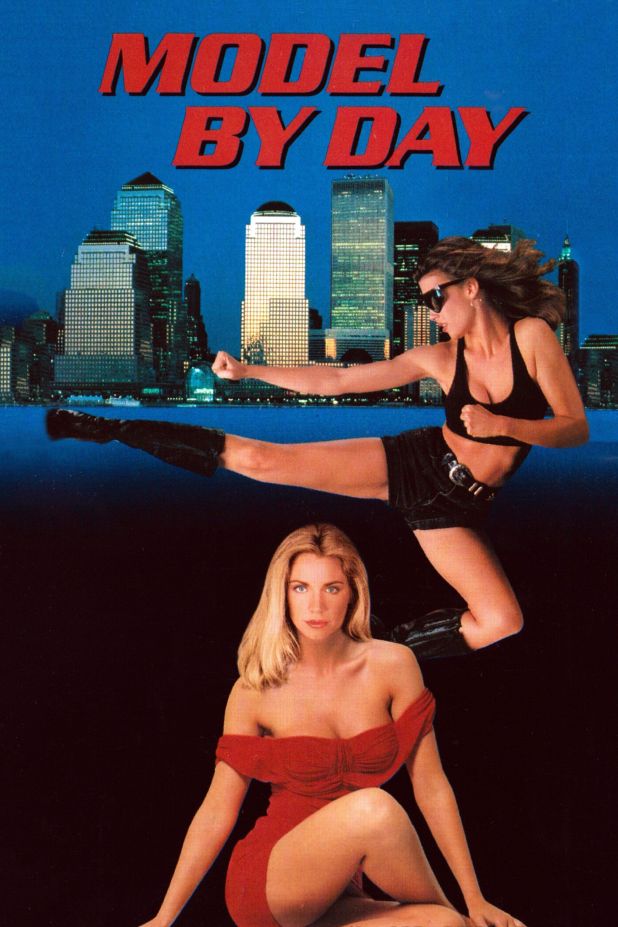
Airing on October 12, 1993, Model By Day stars Famke Jannsen — one day she will be Jean Grey of the Uncanny X-Men — as Lex, who is, you guessed it, a model by day and Lady X, a superhero vigilante of the evening. When her photographer roommate Jae (Traci Lind, Fright Night 2) nearly loses an eye in a carjacking, she uses the Tae Kwon Do she has learned from Master Chang (whitewashing warning, actor Clark Johnson is not Asian) and gets some revenge which means going up against the Russian mob. There’s also another Lady X causing problems, which seems like something you do in the second chapter not the first.
Toronto plays New York City, Kim Coates is a bad guy, Von Flores is the kinda maybe not a bad guy, Stephen Shellen plays love interest Lt. Eddie Walker and I feel like I cast this because Sean Young and Shannon Tweed are both in it. I mean, this is a movie about a comic character who uses handcuffs as her weapon and it’s like, so male gaze that I wondered if I should feel bad about liking it so much but then again, I do watch a lot of Joe D’Amato so I think I’m beyond forgiveness.
Director Christian Duguay also made Scanners II: The New Order and Scanners III: The Takeover, as well as Screamers. The Phillip K. Dick one. Not the one that promises that you will see a man get turned inside out.
This episode brings back more Lovecraft and a Basil Copper story as well in an episode that stays mainly on the side of horror and less of the poor attempts at humor that often ruin this show.
After having Jack Laird bring a Lovecraft story to a previous episode*, host Rod Serling wrote “Cool Air,” which is directed by Jeannot Szwarc. It’s about the strange love story between Agatha Howard (Barbara Rush) and Dr. Juan Munoz (Henry Darrow), a man who must live in a constantly cold apartment. Her father was a professor that wrote often to Munoz and they both refused to believe in the power of death. Szwarc has commented that Lovecraft, as written, was unfilmable. Serling solves that by making this horror actually about romance and loss, even if it leaves Agatha alone in a graveyard, saying “I wonder if I’m mourning something that was or something that might have been.”
I know I go on and on about how this show gets damaged by the attempts at humor, but this story is an example of just how perfect this series can be when it works. It’s not a slavish version of the Lovecraft story, but takes the main ideas and becomes something more suited for the small screen.
“Camera Obscura” is directed by John Badham and written by Serling. It’s about a money lender named Mr. Sharsted (Rene Auberjonois) collecting from a man whose 13% interest has come due, Mr. Gingold (Ross Martin). Gingold has a camera obscura — a darkened room with a small hole through which an image can be projected onto a wall or table — that can see nearly all of London and he uses it to point out the greed that has marked Sharsted’s career. And he has another camera just like it, yet it can send a man back in time to a world of even greedier men whose sins have transformed them into monsters.
“Quoth the Raven” is directed by Jeff Corey and written by Laird. Edgar Allan Poe (Marty Allen) is trying to write and the raven (Mel Blanc) is annoying him. Do I even need to write how this made me feel?
That said, this episode is so strong, one can escape those last few pointless moments.
Finally, an episode of Night Gallery you can savor, as “Pickman’s Model” is one of the better stories that the show would present. Sure, you have to deal with a middling story in the, well, middle, and the Jack Laird blackout segment is predictable flotsam and jetsam, but when you have an opening this strong, that’s why you stay with this show.
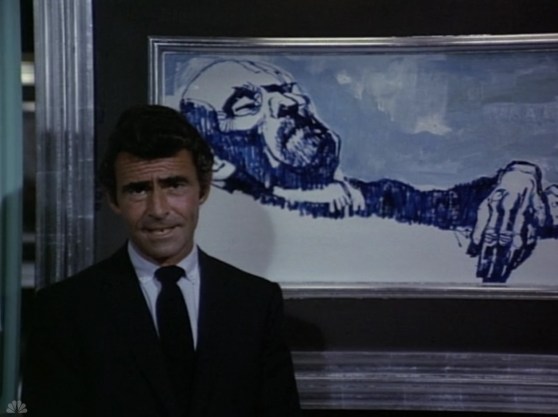
Remarkably, Laird would direct the first segment from a script by Alvin Sapinsley. Based on the H.P. Lovecraft story, this is about Richard Upton Pickman (Bradford Dillman), a painting teacher at a women’s college. Somehow, he keeps his job despite all of his work being so horrific it nearly causes people to pass out. Mavis Goldsmith (Louise Sorel) becomes obsessed with him, despite him trying to remain apart from her. As she tracks him down, she discovers that the creatures in his paintings are horribly real, thanks to special effects by Leonard Engelman and John Chambers, who used the original mold for the Creature from the Black Lagoon to make their monster. Another tie to monster films is that Mavis lives in the same studio backlot house that was once home to the Munsters.
For someone so devoted to humorous vanilla horror, the fact that Laird made more than one Lovecraft story on this show is slightly perplexing. Maybe people really aren’t all good or bad; there are shades of everything.
“The Dear Departed” was directed by Jeff Corey and written by host Rod Serling. Based on a Alice-Mary Schnirring story, it’s about two spiritualist con artists — Mark Bennett (Steve Lawrence) and Joe (Harvey Lembeck) — and the affair Mark is having with his partner’s wife Angela (Maureen Arthur). Once Joe is hit by a bus, their act becomes legitimate, to Mark’s horror.
“An Act of Chivalry” is the absolute nadir of this show, if “Pickman’s” is near the height. Just the dumbest of sight gags and something that denigrates this show to a degree that emotionally bothers me. About the only nice thing you can say is that at least future Electra Woman Deidre Hall is in it.
Ah Night Gallery. Often you are the peak and the valley at the same time.
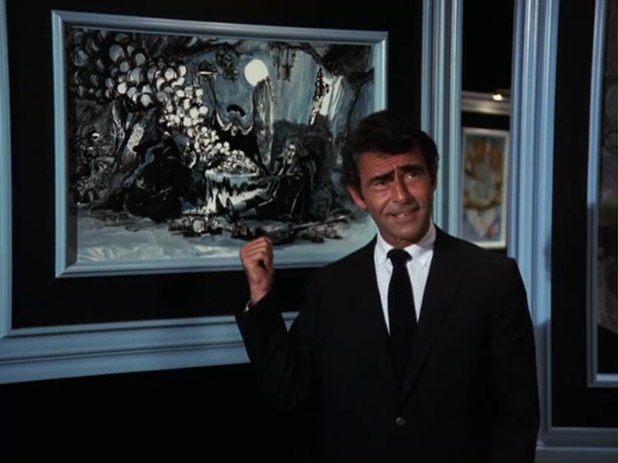
I prefer the episodes of Night Gallery with fewer stories, as it allows each tale time to stretch out and capture you. Sadly, this episode only has host Rod Serling appear as the host; the first segment “The Dark Boy” is directed by John Astin and written by Harland Welles from an August Derleth story and “Keep in Touch — We’ll Think of Something” is directed and written by Gene R. Kearney.
“The Dark Boy” has a widowed schoolteacher named Judith Timm (Elizabeth Hartman) coming to a small town in Montana to take over the one room schoolhouse. She rents a room from sisters Abigail (Gale Sondergaard, the original Wicked Witch of the West from The Wizard of Oz who was replaced because the makeup team could not make her into a suitably ugly witch; she’s also in The Spider Woman Strikes Back) and Lettie Moore (Hope Summers, Mrs. Gilmore from Rosemary’s Baby).
Judith claims she has seventeen students, but one can’t be found in the list of her pupils. It’s the same issue the last teacher dealt with, a dark haired boy of mystery. It turns out that it’s Joel Robb, a child who died two years before who has been haunting the entire neighborhood and everyone in it. She begins to get to know the boy’s father and understand the grief that the man has been living.
“The Dark Boy” is a strong episode and Astin shows some skill as a director.
“Keep In Touch — We’ll Think of Something” is all about a piano player named (Alex Cord) and his obsession with a woman named Claire Foster (Joanna Pettet; she was married to Cord at the time). He dreams of her every night, while her husband dreams of a man with a scarred hand trying to murder him. Strangely, when he finds her — using the police to track her down, claiming that she stole his car — she isn’t nervous about this strange man. She also knows they are destined to be together.
It’s a decent story but struggles following the first story in this episode. Still, two serious stories in one Night Gallery? That’s how it should be.










 B&S About Movies
You must be logged in to post a comment.