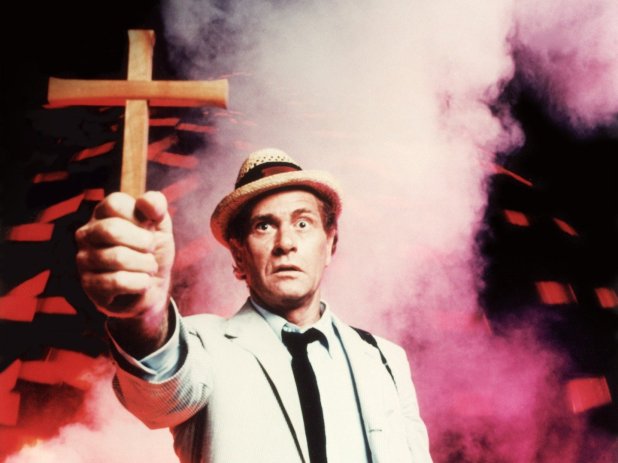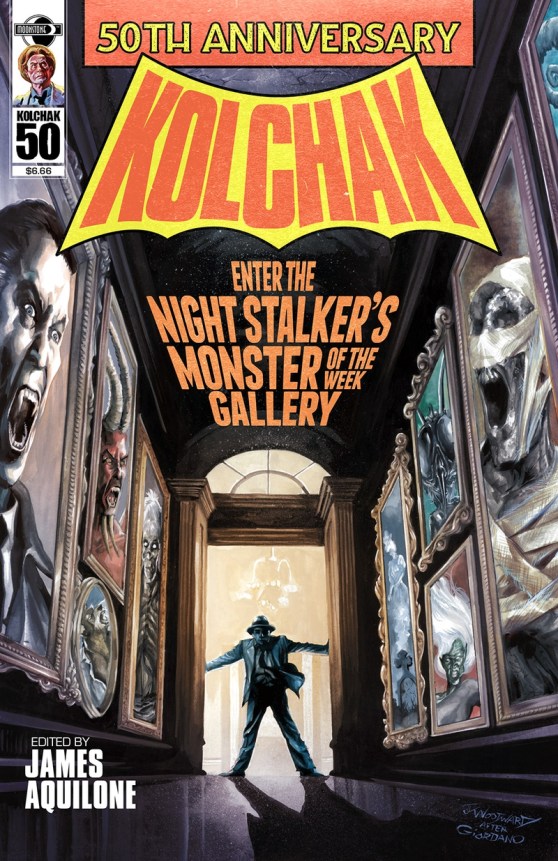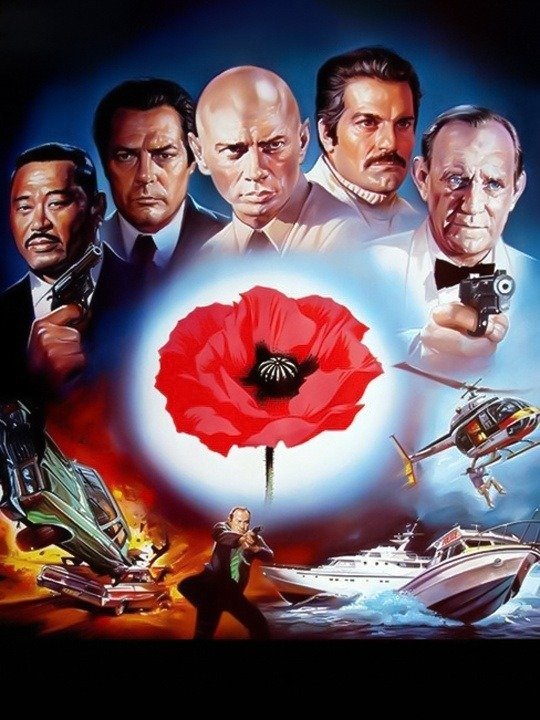
CBS LATE MOVIE MONTH: Kolchak: The Night Stalker: Mr. R.I.N.G. (1975)

EDITOR’S NOTE: This episode of Kolchak: The Night Stalker aired on the CBS Late Movie on July 13, 1979; July 31, 1981 and January 29, 1988.

“I don’t know when exactly I was in this office last. In some ways it seems like I never left. But, no, that’s not right. For at least a few days I was away, far away, in the hands of men with no faces and no names. They broke me down, broke my story down, telling me how it hadn’t happened the way I claimed. At least that’s what I think they did between injections. Memories fade fast enough without chemical help. But if I don’t tell this story now, I don’t think I ever will. Now… what was that date?”

That’s the words of Kolchak that start this episode, one that’s perhaps the closest to the show inspired by Kolchak: The Night StalkerThe X-Files.

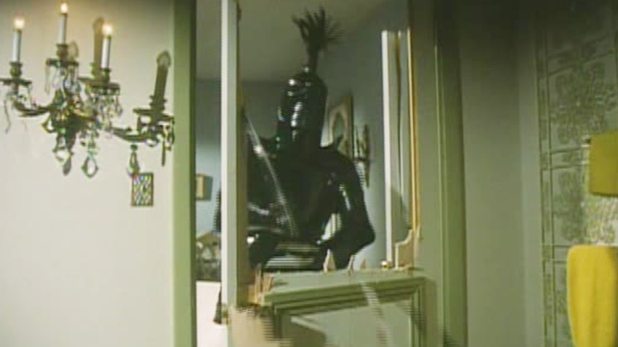
Mr. R.I.N.G. (Craig R. Baxley) is a robot that we see kill one of his creators, leaving behind his widow (Julie Adams). The other person who made him, Dr. Leslie Dwyer (Corinne Camacho), has survived. She tells Carl that Mr. R.I.N.G. wants to be human — indeed, he makes his own face out of mortician’s wax — and yet he can’t stop wiping out human life, throwing around stuntmen as only a monster of the week on Kolchak can.

R.I.N.G. stands for Robomatic Internalized Nerve Ganglia, and the automaton doesn’t want to kill unless threatened. That said, it’s been threatened several times, and even when it wants to give up peacefully, that doesn’t happen. Man is more warlike than the machine it created to wage battles. The problem is that Dr. Dwyer has Mr. R.I.N.G.’s human characteristics and feelings, but studying the readings of St. Thomas Aquinas and Aristotle’s Ethics and finding out you’re a weapon can mess up any robot.

Do you know who made Mr. R.I.N.G.? The Tyrell Institute. One imagines that somewhere, Philip K. Dick is laughing. Well, halfway, as his book Do Androids Dream of Electronic Sheep? doesn’t mention Tyrell, but the movie made from the book, Blade Runner, does.

This episode was directed by Gene Levitt, the creator of Fantasy Island and the director of The Phantom of Hollywood. It was written by L. Ford Neale and John Huff, who also wrote The Hunter’s Moon together.

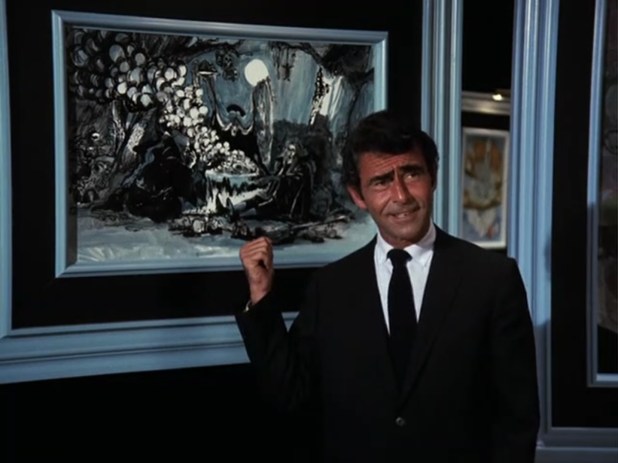
Night Gallery Season 3 Episode 7: You Can Come Up Now, Mrs. Millikan/Smile, Please (1972)

Well, here’s a Night Gallery in season 3 with two stories, which can only mean that one of them is from Jack Laird and, you know…

That said, “You Can Come Up Now, Mrs. Millikan” has some excellent stunt casting.

Henry Millikan (Ozzie Nelson) is an inventor who always has his creations explode right in his face. That happened again before his biggest competition, Dr. Burgess (Michael Lerner). Then, his wife Helena (Harriet Nelson, the wife of Ozzie and, of course, the co-star of Ozzie and Harriet) agrees to help him with his latest invention. She took some poison, and once she dies, he’s going to bring her back to life. As always, the invention doesn’t work, so Henry takes his own life. But the truth is, it did work. And, like always, Helena is running a little late.

Directed by John Badham and written by Rod Serling, based on “The Secret of the Vault” by J. Wesley Rosenquest, this is a playful Night Gallery that doesn’t feel like it came from Serling, but you can remain surprised.

“Smile, Please” is directed and written by Jack Laird. Cesare Danova and Lindsay Wagner excitedly hurry down a staircase, with her excited to be the first person to take a photo of a vampire. If you didn’t guess that the man is a vampire, you don’t know Jack Laird’s work on Night Gallery. The less said, the better.

CBS LATE MOVIE MONTH: The Ivory Ape (1980)

EDITOR’S NOTE: The Ivory Ape was on the CBS Late Movie on May 25, 1984 and May 10 and July 24, 1985.

Rankin/Bass had some experience working with Japanese filmmakers after making King Kong Escapes, the Desi Arnaz Jr. feature Marco, Rudolph and Frosty’s Christmas in JulyWilly McBean and His Magic MachineThe Bushido Blade (which has Mako, Sonny Chiba, James Earl Jones, Richard Boone and Laura Gemser all in the same movie), The Bermuda Depths and The Last Dinosaur there.

The last two movies we mentioned and this one were made with Tsuburaya Productions, the company that brought us Ultraman.

While this debuted on ABC on April 18, 1980, an extended version would later play theaters in Japan.

A rare albino gorilla has escaped somewhere in Bermuda, and the hunter who caught it once before (Jack Palance!) is set to destroy it. Can Steven Keats (Bronson’s son-in-law in Death Wish) and Céline Lomez (originally going to play Linda Thorson’s part in Curtains) stop him in time?

Kotani’s work, including The Bushido Blade, is a fascinating blend of Western and Eastern elements. The film, which stars Richard Boone leading sailors versus samurais under the command of Toshirô Mifune, is a unique exploration of cultural dynamics. If that’s not enough to pique your interest, the fact that Laura Gemser is in it might. Kotani’s diverse filmography also includes Pinku redi no katsudoshashin, a feature-length movie about Mie and Keiko Masuda, two idol singers whose Japanese success was imported to the shores of the U.S. Their song “Kiss in the Dark” reached #37 in America, making them the first Japanese act to chart here since Kyu Sakamoto’s “Sukiyaki” in 1961. Sadly, their Sid and Marty Krofft developed series – The Pink Lady and Jeff – only lasted six weeks on NBC during Fred Silverman’s disastrous year of 1980, which also unleashed the Supertrain on an uncaring television audience. Kotani’s other works include The Last Dinosaur and The Bermuda Depths.

There’s something about the 70s TV movies from Rankin/Bass that’s truly unique. Each one carries a certain level of darkness and palpable sadness, making them the perfect choice for a snowy day in 1981 when all you wanted to do was stay under the covers. They still possess that same strange magic today, evoking a sense of nostalgia and appreciation for the historical significance of these films.

You can watch this on YouTube.
CBS LATE MOVIE MONTH: Kolchak: The Night Stalker: Horror in the Heights (1974)

EDITOR’S NOTE: This episode of Kolchak: The Night Stalker was on the CBS Late Movie on July 6, 1979; July 24, 1981; November 6, 1987 and March 4, 1988.

In a Jewish senior citizens center in Roosevelt Heights — a section of Chicago that could charitably be called lower income — numerous people have died, stripped of their skin by rodents. Harry Starman (Phil Silvers), a resident, believes that the owner of a local Indian Restaurant is a war criminal that has escaped from Germany and is the person painting swastika graffiti all over the Heights.

The restaurant owner shares with Kolchak how to destroy the demon — steel bolts fired from a crossbow. However, he warns Kolchak that the demon can come in the form of someone he knows, a twist that keeps the audience on the edge of their seats.

Directed by Michael Caffey (who directed everything from The Dukes of Hazzard and Trapper John M.D. to The Adventures of Brisco County Jr.) and written by Jimmy Sangster (The Curse of Frankenstein, Jack the Ripper; Scream, Pretty Peggy), this is an episode in which Kolchak reminds us that the demon could be anyone, even advice columnist Miss Emily.

If you’ve ever battled a Rakshasa in a game of Dungeons & Dragons, this episode of Kolchak: The Night Stalker is the reason why. The episode inspired e. Gary Gygax to add the demon to the Monster Manual, a significant moment in the history of the game that connects fans to a shared cultural experience.

Source

John Kenneth Muir’s Reflections on Cult Movies and Classic TV: 08/2018. https://reflectionsonfilmandtelevision.blogspot.com/2018/08/

CBS LATE MOVIE MONTH: Kolchak: The Night Stalker: The Energy Eater (1974)

EDITOR’S NOTE: This episode of Kolchak: The Night Stalker didn’t air on the CBS Late Movie. It wasn’t offered to CBS because ABC made a TV movie from it and “Firefall” and titled it Crackle of Death. As a completist, I’m covering the episode this week.

The new, modern Lakefront Hospital is supposed to save lives. But why don’t its machines work correctly? How are there cracks in the foundation and walls already? And why have so many people died from horrifying deaths in a place of wellness?

These are the kinds of questions that Carl Kolchak would like the answers to.

He gets his answers from one of the foremen who left the construction before it was finished, Jim Elkhorn (William Smith!), who explains that he and the rest of his Native American crew didn’t want to anger Matchemonedo, an invisible bear spirit that Kolchak must send back into hibernation.

Joyce Jilson (Superchick) and Elaine Giftos (Angel) also appear in the cast. Beyond being in danger, they’re two conquests for Elkhorn, who seemingly is as interested in lying down with lovely women as he is in erecting buildings.

The episode’s highlight is when Karl takes two of his paper’s most expensive cameras to get a photo of the monster. Vincenzo stops him and wants to know what’s happening.

Vincenzo: What are you doing with two of our best cameras?

Kolchak: I’m gonna hock ’em, what do you think? You ask a stupid question, you get a stupid answer.

As Elkhorn is helping Karl do research, he translates some French. Smith could do that, as he was fluent in Russian, French, German and Serbo-Croatian, languages he learned while serving as an Intelligence Specialist for the U.S. Air Force during the Korean War.

This episode was directed by Alexander Grasshoff and written by Arthur Rowe, who wrote thirteen episodes of Fantasy Island and nineteen episodes of The Bionic Woman and served as a producer on those shows. It also has scripting by Rudolph Borchert, who wrote five Kolchak episodes.

While not the best episode, this does have Kolchak trying to freeze the basement floors and foundation, which is pretty impressive as he’s just one man against a Native American spirit that has been murdering humans since we first showed up on this planet.

CBS LATE MOVIE MONTH: Kolchak: The Night Stalker: The Spanish Moss Murders (1974)

EDITOR’S NOTE: This episode of Kolchak: The Night Stalker was on the CBS Late Movie on June 29 and October 26, 1979; July 17, 1981; October 30, 1987 and February 26, 1988.

Chicago is filled with supernatural murders. This time, the only thing linking the killings of a sleep research center assistant (Elisabeth Brooks from The Howling!) and the chef of Chez Voltaire is that their chests were crushed, and their bodies were covered with Spanish Moss. Somehow, Kolchak learns that the crimes come from the Cajun myth of Pere Malfait, the Bad Father. Only a spear made of gumwood from the bayou can stop the monster, which Kolchak also finds, and then goes into the sewers to again battle the supernatural.

The monster has come to life thanks to the sleep studies of Dr. Aaron Pollack (Severn Darden), and as one of his patients (Don Mantooth) dreams of the boogeyman, the tactics to help him sleep unleash it in the real world. Kolchak comes up against another Chicago cop who wants none of his monkey business, this time Captain Joe “Mad Dog” Siska, played by Keenan Wynn.

The Spanish Moss Monster is played by Richard Kiel, the same bad guy two episodes in a row. The creature is based on a legend of a soldier who kidnaps, rapes and beheads and hangs a Native American princess from a tree. Her spirit becomes one with the tree, and she hunts down the soldier, killing him with the tree’s roots, which have become one with his hair. There’s also a Florida Moss Man legend of a “large man-like beast with a rank odor and covered with swamp grass” that was seen often in the late 1800s.

This was directed by Gordon Hessler, who also directed Scream, Pretty PeggyCry of the Banshee and Scream and Scream Again. It was written by Alvin R. Friedman and David Chase.

CBS LATE MOVIE MONTH: Kolchak: The Night Stalker: Bad Medicine (1974)

EDITOR’S NOTE: This episode of Kolchak: The Night Stalker was on the CBS Late Movie on September 21, 1979; July 10, 1981 and October 23, 1987.

“F. Scott Fitzgerald once wrote, ‘The rich are different than you and me.’ They sure are. They got more money. But there wasn’t enough money in the world to save some of Chicago’s upper crust members from a fiendish force so dark, it can only be called diabolic.” This quote sets the tone for the episode, hinting at the episode’s focus on the wealthy and their encounter with a sinister force.

With those words, Carl Kolchak embarks on a new episode, delving into the mysterious deaths of two Chicago socialites who killed themselves the same night and lost their precious gems. This leads him to the intriguing Native American legend of the Diablero, a sorcerer amassing a fortune in gems to break its eternal curse.

The highlight of this episode is when Karl goes to battle the legend at the Champion Towers, a luxurious high-rise in Chicago, bringing along a small mirror as seeing its reflection is the only way to stop this monster. Of course, Karl gets spooked and drops the mirror, shattering it and is alone, afraid and up against pure terror.

Despite facing a force that can hypnotize people into doing its bidding, Kolchak finds a mirror in the bathroom, transforms it into a skeleton, and then dusts. In a surprising turn of events, Canadian actor Victor Jory plays Charles Rolling Thunder, a role that might raise some eyebrows. And to top it off, the tribe in this episode, the Yoshone, is a fictional creation.

This episode was directed by Alexander Grasshoff (The Last Dinosaur) and was written by L. Ford Neale and John Huff, both of whom wrote the Burt Reynolds movie The Hunter’s Moon.

The makers of Kolchak must have really liked Kiel, as he would return the next episode to play the Paramafait in the next episode, “The Spanish Moss Murders.”

CBS LATE MOVIE MONTH: Kolchak: The Night Stalker: The Devil’s Platform (1974)

EDITOR’S NOTE: This episode of Kolchak: The Night Stalker aired on the CBS Late Movie on September 14, 1979; July 3, 1981 and February 5, 1988.

Carl Kolchak starts this episode with these sage words: “The old cliche that politics makes strange bedfellows is only too true. At one time or another, various and sundry politicians have found themselves, when it proved expedient, of course, sharing a blanket with the military, organized crime, disgruntled, gun-toting dairy farmers, the church, famous athletes, the comedians – the list is endless. But there was a senatorial race not so long ago right here in Illinois where the strangest bedfellow of all was found under the sheets. The strangest… and certainly the most terrifying.”

Our intrepid reporter, Kolchak, is on a mission to interview the enigmatic Senatorial candidate, Robert Palmer (Tom Skerritt). Palmer, a man seemingly always a step ahead of his opponents, who mysteriously meet their end, is shrouded in scandal. As Kolchak delves deeper, the suspense thickens, and the truth becomes more elusive.

At every one of these deaths, a large dog has been seen. Well, you don’t have to have the investigative skills of Kolchak to figure out that Palmer has sold his soul to Satan for power on Earth, a contract that his wife Lorraine (Ellen Weston) wants him to escape.

Palmer, in an attempt to divert Kolchak’s attention, offers him a contract. But Kolchak’s motivations are not driven by money or escape. He seeks a larger audience and a semblance of respectability. Yet, he is acutely aware that without his investigative work, these aspirations are meaningless. And now, the looming threat of the large dog adds to his moral dilemma.

“The Devil’s Platform,” one of four episodes directed by Allen Baron, is a testament to the mature storytelling of the series. Penned by TV-writing veterans Donn Mullally and Tim Maschler, this episode elevates the narrative to a level where even the Watergate scandal pales in comparison to the entry of Lucifer into the world of politics.

There’s an IMDB fact that Devil Dog: Hound of Hell was originally a sequel to this. That sounds like the kind of BS that lives in the IMDB trivia pages, but it would be nice if it were true.

Sources

Let’s Get Out Of Here!: 31 Days of Monsters!. https://craiglgooh.blogspot.com/2010/10/31-days-of-monsters.html

CBS LATE MOVIE MONTH: Kolchak: The Night Stalker: Firefall (1974)

EDITOR’S NOTE: This episode of Kolchak: The Night Stalker didn’t air on the CBS Late Movie. It wasn’t offered to CBS as ABC made a TV movie from this episode, “The Energy Eater,” and titled it Crackle of Death. As I’m a completist, I’m covering the episode this week.

A doppelgänger, a spirit with a sinister agenda, is at the heart of this episode. It’s targeting musical conductor Ryder Bond (Fred Beir), who has been spotted at crime scenes where victims died from spontaneous combustion. These victims, all colleagues and friends of Bond, draw Carl Kolchak into the mystery.

Carl, after getting to know Bond, decides to assist him. However, he’s in grave danger. If Bond falls asleep, his doppelgänger could emerge and kill, with Carl potentially being the next victim.  Carl uncovers that an organized crime figure named Markoff, who dreams of being a conductor, is the malevolent force behind this. Markoff’s restless spirit is now targeting Bond to take over his life.

Carl must team up with fortune teller Marie (Madlyn Rhue) to combat this evil. Together, they devise a plan to stop the malevolent ghost. This involves a daring act of grave-robbing, using footage recycled from the “The Zombie” episode, and a fiery showdown at the arcade where Markoff died. It’s a risky plan, but their determination is unwavering.

This is one of four series episodes that Don Weis would direct. It was written by Bill S. Ballinger, who also wrote “The Ghost of Potter’s Field” episode of Circle of Fear and the movie The Strangler.

It ends with Carl finally being able to sleep, except it’s in the back of a police car, and he’s hauled off to jail. He closes the story by saying, “Well, I won’t have to worry about the doppelganger any longer. He’s back in his own body and will probably be cremated, which is rather sweet poetic justice for Frankie Markoff. My only worry now is to find Tony Vincenzo to try to raise bail. They’ve got me hooked on some stupid arson charge. But it’s Tony’s night to play cards, and I don’t know where he is. So I think I’ll spend a nice good night’s sleep in the slammer.”

CBS LATE MOVIE MONTH: The Norliss Tapes (1973)

EDITOR’S NOTE: The Norliss Tapes was on the CBS Late Movie on January 23 and May 26, 1975.

Occult investigator Norliss has disappeared, but his legacy lives on in a series of tapes that unfold the gripping narratives of his many escapades, such as his encounter with a widow and her undead artist husband. Originally developed as a series pilot by NBC, it was eventually broadcast as a TV movie on February 21, 1973.

Written by William F. Nolan (Logan’s RunTrilogy of TerrorBurnt Offerings) and produced by Dan Curtis (Dark ShadowsKolchak: The Night StalkerCurse of the Black Widow and pretty much any TV horror you’d see in the 1970s), this was initially entitled Demon.

Sanford Evans, our guide into the mysterious world of David Norliss (Roy Thinnes, Airport 1975, TV’s The Invaders), listens to the tapes that explain Norliss’s sudden disappearance.

A recent case concerned Ellen Cort (Angie Dickinson of TV’s Police Woman), whose husband has come back from the dead. It turns out that before his death from a mysterious disease, he had become involved with Mademoiselle Jeckiel (Vonetta McGee, Blacula), who gave him a scarab that he was buried with. Sheriff Tom Hartley (Claude Atkins!) doesn’t believe any of this, even when James keeps draining the blood of young women and a gallery owner who tries to break into his coffin and take his ring.

Bullets won’t stop the undead man, who’s also created a sculpture made of human blood that will bring the Egyptian deity Sargoth into our world. Our hero, Norliss, is kind of ineffectual, as the undead artist kills Jeckiel, killing Ellen’s sister and raising the demon. He finally stops the monster by setting the studio on fire with everyone inside, the dictionary definition of a pyrrhic victory.

That’s when Evans finishes the tape and wonders if this is Norliss’ last adventure. Nope. There’s another tape, even if the series never happened.  That didn’t stop this TV movie from being aired in syndication and on the CBS Late Movie.