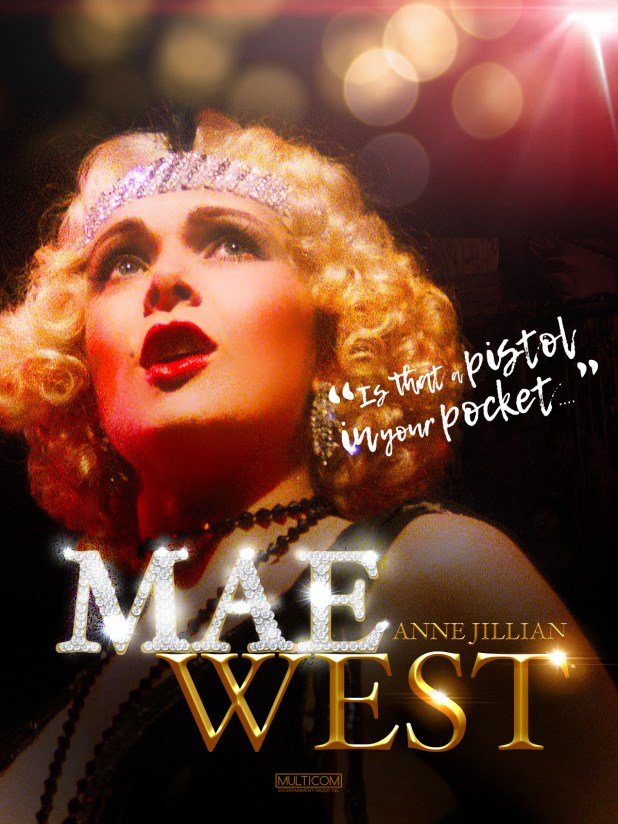
EDITOR’S NOTE: Mae West was on the CBS Late Movie on May 4 and August 11, 1987.
At the age of ten, I had a huge crush on Ann Jillian even if I had no idea why I felt that way.
Now I do and I still have that crush.
Directed by Lee Phillips (The Spell, Sweet Hostage) and written by E. Arthur Kean, this has Jillian as Mae West and takes you through enough of her career to see how she went head-first against small-minded censors. Jillian is great in it and has several performances of West’s songs, too.
James Brolin is Jim Timothy, her manager and former love interest, while Roddy McDowall plays her co-writer Rena Valentine — based on Julian Eltinge — and Piper Laurie is West’s mother Matilda. I wouldn’t depend on this film for factual accuracy, but if you’d like to see JIllian pretty much put on a one woman show, it’ll definitely deliver on that. The costumes are pretty great, too.
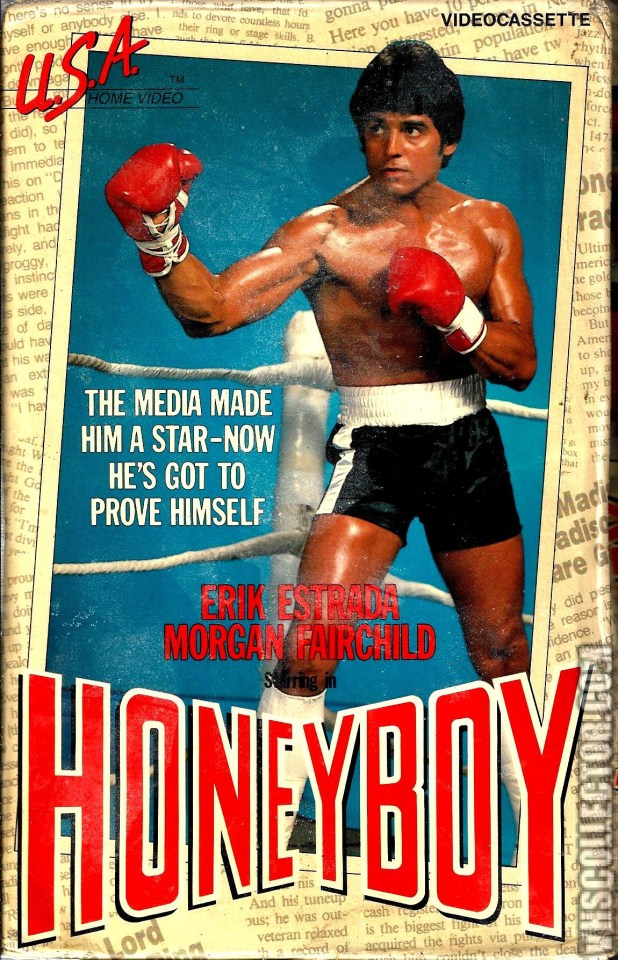
EDITOR’S NOTE: Honeyboy was on the CBS Late Movie on January 29, June 25 and December 21, 1987.
Erik Estrada is pretty much going to get a whole week of movies on this site before too long but until then, let’s look at this movie, in which he plays Rico “Honeyboy’”Ramirez, the son of a boxer (Hector Elizondo) who never made it and walked out on his family.
This was an NBC TV movie of the week and came out while Estrada was fighting with his bosses on CHiPs over his salary. He was replaced on that show by Bruce Jenner, but came back for the last season.
To get to the top, Honeyboy gets a PR agent named Judy Wellman, played by Morgan Fairchild, so this movie had some incredible wattage when it came to early 80s TV starpower. He’s on a quest to win the title from Tiger Maddox (Jem Echollas), who claims that the fight promoter that got Honeyboy this far worked all his fights like pro wrestling matches. Or, you know, pro boxing for the most part.
Of course the third act is all Honeyboy chasing away everyone who got him this far, but if you know boxing movies, you know he’s going to win. I kind of loved the scene between Sugar Ray Robinson — that’s really him — and Honeyboy’s father. Their title match was as far as he got and Sugar Ray is pretty much giving him a little bit of recognition and you can see that Emilio doesn’t want it but really does want it and it’s some masterful acting for such a small moment in such a tiny TV movie and man, I’ve been thinking about it for several days and it still makes me choke up a little.
This was directed by John Berry, who co-wrote the script with Lee Gold. Berry was a member of Orson Welles’ Mercury Theater and ended up blacklisted in 1950. He had agreed to direct a short documentary on the Hollywood 10, the group that had refused to cooperate with the House Un-American Activities Committee as they tried to find Communists in Hollywood. After directing He Ran All the Way, Hollywood 10 member Edward Dmytryk — who had been jailed for contempt of Congress — named Berry as a Communist when he was released from prison as part of his hope to get work in Hollywood again.
Settling in Paris, he co-directed Atoll K, the last comedy film of Stan Laurel and Oliver Hardy, and spent the rest of his career there, even after being permitted to make movies in Hollywood again, like The Bad News Bears Go to Japan.
EDITOR’S NOTE: This episode of Kolchak: The Night Stalker didn’t air on the CBS Late Movie because ABC packaged “it with “Legacy of Terror” as the TV movie The Demon and the Mummy.
The monster of the week this week is a succubus, a demon who reanimates the corpses of freshly dead women to coerce young men into sexual situations, at which point it sucks the life out of them. And best of all, one of Kolchak’s other enemies shows up, Captain “Mad Dog” Siska, played again by Keenan Wynn. He was last in “The Spanish Moss Murders.”
Illinois State Tech is a wacky school, what with Morticia Adams — Carolyn Jones — as the registrar, Jackie Vernon (the voice of Frosty the Snowman and the star of Microwave Massacre) as a coach and Andrew Prine as Prof. C. Evan Spate, the archaeology professor who Carl tries to pry info about the Mesopotamian demoness out of.
It ends as all episodes must with Carl pretty much alone against supernatural evil, trying to smash a stone tablet with a hammer while demonic winds blow in and threaten to overwhelm him. That said, Spate actually covers for him, which is more than anyone else has done in this series.
Vincenzo has plans to turn the paper into an upbeat and dignified place, which seems to suggest that there’s no place for Carl in that world. I wonder what he would have thought about AI content creation.
Directed by Don Weis and written by Michael Kozoll and David Chase, this also played in syndication as The Succubbus.
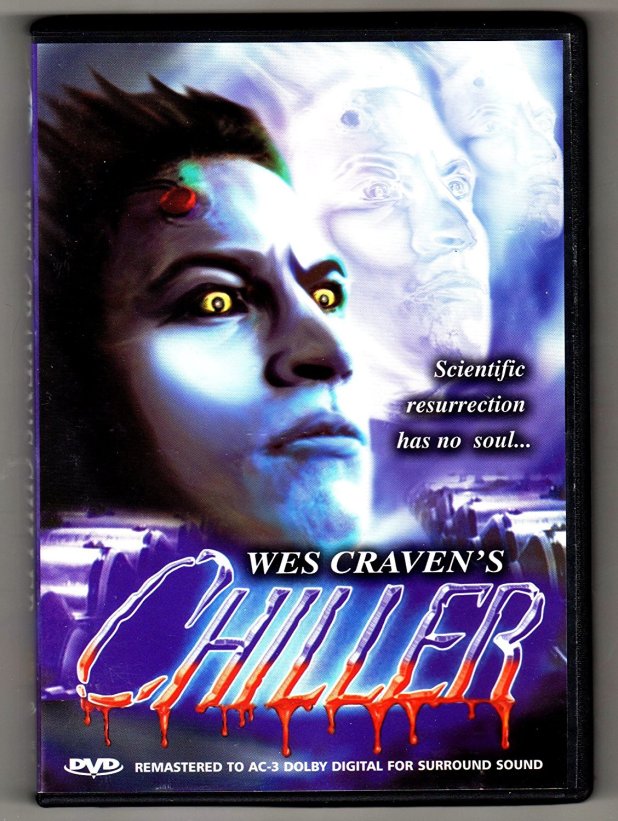
EDITOR’S NOTE: Chiller was on the CBS Late Movie on May 6, 1988.
Miles Creighton (Michael Beck, Xanadu) is frozen at the point of death, but begins to thaw ten years later. His mother decides to see if he can be saved and a miracle surgery brings him back — without a soul! His mother Marion Creighton (Beatrice Straight) doesn’t believe that her son could be evil, much less be killing people, yet it’s true. He even tries to kill friend of the family Reverend Penny (Paul Sorvino) and his stepsister Stacey (Jill Schoelen) is next on his list.
Directed by Wes Craven — this came out on VHS as Wes Craven’s Chiller — and written by J.D. Feigelson (Dark Night of the Scarecrow), Chiller has an amazing moment when the zombie CEO tells the priest ““I’ll tell you what’s on the other side. Nothing. Absolutely nothing. You die and there’s simply darkness. No streets of gold. No harps. No halos. No angels and saints. It’s all here, so you better live it up, holy man, because this is all there is.”
I tend to prefer Craven’s small screen movies to so many of his big screen efforts. This one has a pretty bad script, to be honest, that has some interesting ideas of the beyond and never really shows us some important things, like why everyone thinks Miles is so great. Instead, we only know the blue-faced tyrant strip-mining his father’s company.
That said, if you’re up late, it’s certainly a good movie to be half-awake to.
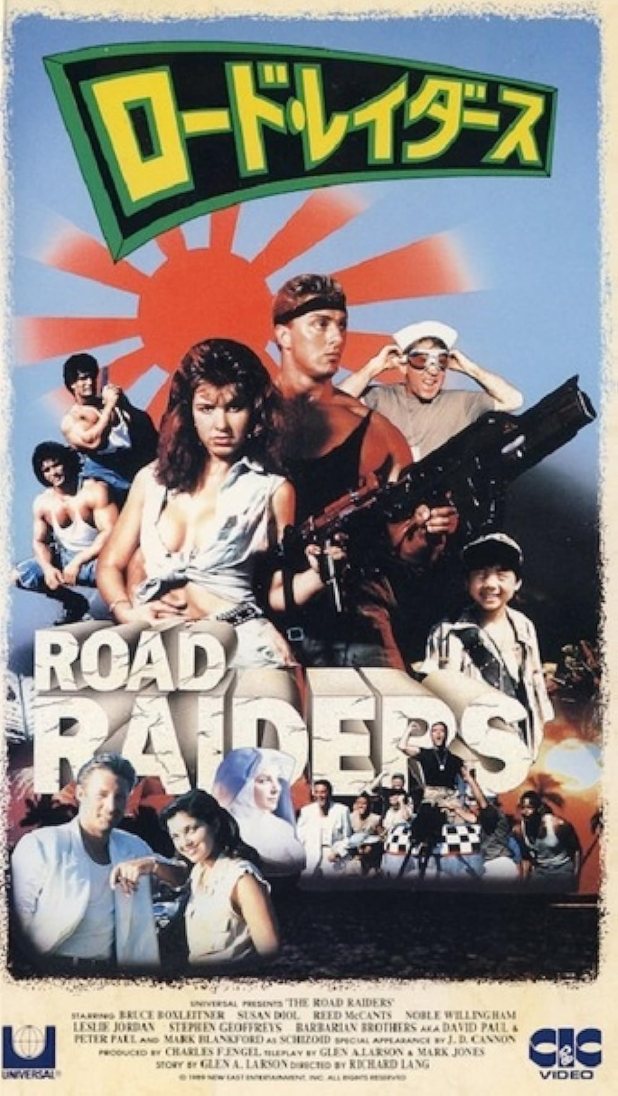
EDITOR’S NOTE: The Road Raiders was on the CBS Late Movie on June 22, 1990.
Directed by Richard Lang and written by Mark Jones (Leprechaun) and Glen A. Larson, The Road Raiders was a pilot that wasn’t picked up and aired as a TV movie.
It stars Bruce Boxleitner — who had just finished Scarecrow and Mrs. King — as Captain Rhodes, a disgraced soldier accused of being a deserter who is hiding from officials in the Philippines during World War II. When an officer comes to arrest him and dies, he takes that man’s identity to get back to the actual fighting. Teaming up with Harlem (Reed R. McCants), Lt. Johanson (Susan Diol), Crankcase (Noble Willingham), Einstein (Stephen Geoffreys), Schizoid (Mark Blankfield) and the twin brother muscle of Black and Blue (David and Peter Paul, the Barbarian Brothers), he just might save the U.S. Army from Japan, which is represented by Clyde Kusatsu, John Fujioka and Tia Carrere.
It feels a little like The A-Team, a bit like The Dirty Dozen, and it’s an anachronistic take on the war. The Barbarian Brothers even drove a monster truck at one point. This all means that if this had been a series in 1989, there’s more than a complete chance that I would have watched every airing.
EDITOR’S NOTE: Poor Devil was on the CBS Late Movie on August 8, 1977.
Sammy Davis Jr. battled racism throughout his career, even from the wings of the stage as his Rat Pack cohorts would call him racist names like smokey.
In an interview with Roots author Arthur Haley in Playboy, the entertainer talked about the first time he came up against his race: in the Army. He was beaten for looking at a white female commanding officer while she was giving him orders, with his body covered with anti-black graffiti and covered in turpentine. That night, as in every night he served, he was still asked to perform for the troops. That’s when Davis learned he’d have to fight to be respected. And once he was in, he’d stay in by any means necessary — even coming off as insincere.
Despite being a member of the Hollywood crowd, Davis still could never be a full member. His romance with white girls like Kim Novak rubbed people the wrong way. And even though he was a large financial supporter of the Civil Rights Movement, he still had a complex relationship with the black community.
For example, he earned plenty of ire when he supported Nixon in 1972. Although he was originally a Democrat and supported JFK in 1960 and RFK in 1968, John F. Kennedy would go on to revoke an inauguration invitation to “Mr. Show Business” because he married white actress May Britt. So maybe his conversion makes sense because Nixon invited him to be the first black guest at the White House.
Once, Jack Benny asked Sammy about his handicap on the golf course. He answered, “Handicap? Talk about a handicap. I’m a one-eyed Negro Jew.”
That said — it’s also believed that Davis was introduced to Anton LaVey’s Church of Satan at an orgy at the nightclub that he owned, The Factory. This also makes sense. There are plenty of stories about how Sammy loved the free-swinging sex scene of the 70s, even learning how to deep throat from the woman who introduced it to the zeitgeist, porn star Linda Lovelace.
Anyways — I could go on about Sammy Davis Jr. He was a fascinating man — who could smoke four packs of cigarettes a day, draw and fire a Colt Single Action Army Revolver in a quarter of a second and was able to both be a parody of himself and parody himself seemingly at the same time. But today, we’re here to discuss a strange TV pilot that Davis was in, one that would lead to him accepting an honorary second-degree membership in the Church of Satan.
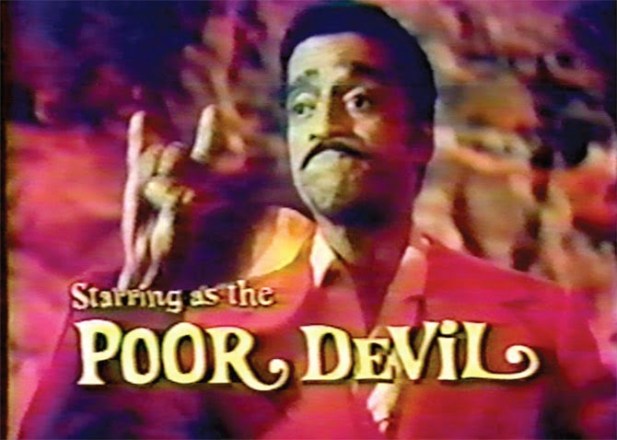
Originally airing on February 14, 1973, on NBC, Sammy would star as Sammy in this series pilot. He’s a demon who has screwed up for the last thousand or so years and now wants to succeed and prove himself to his boss Lucifer, who is played by Christopher Lee. If you don’t immediately stop reading this and go watch this show, allow me to share this photo of Sir Christopher Frank Carandini Lee CBE, CStJ, with a gorgeous head of hair.
To win over his boss, Sammy has to convince Burnett J. Emerson (Jack Klugman!) to sell his soul. In return, he’ll get revenge on his boss (Adam West!) and gain wealth for seven years (and then go to Hell for eternity, which is a lot like Miami, only less humid).
Davis would flirt with The Church of Satan for some time, painting one fingernail red, wearing the Baphomet medallion and flashing the horns from time to time before dropping out by the mid-1970s (around the time that Anton LaVey went into seclusion).
One wonders where this show would have gone if it had become a weekly series. Would the Devil tempt a new celebrity every week? Would Klugman stick around? Would LaVey make a cameo?
All we have is this pilot, which is filled with Satanic imagery, a lack of a laugh track and plenty of early 1970s strangeness. What a weird time to be alive, one that we’ll never truly comprehend today. Still, if all that came of this was this photo of Davis with LaVey and future Temple of Set leader Michael Aquino, I’ll consider it a success.
EDITOR’S NOTE: This episode of Kolchak: The Night Stalker was on the CBS Late Movie on November 9, 1979, August 21, 1981, and December 11, 1987.
Directed by Bruce Kessler and written by Steve Fisher and David Chase, “Chopper” is the kind of Kolchak episode that I love, one where The Bishops biker gang member Harold “The Swordsman” Baker, was decapitated by a rival gang, The Jokers, who were dumb enough to ride around with his head until “The Swordsman’s” ghost came to chop his head off. The gang finally stopped him by putting his head inside his coffin, and everything was normal until a construction project somehow got his head separated from his body.
The old Jokers like Henry “Studs” Spake (Art Metrano) have to look over their shoulders before they lose their heads. Kolchak has to discover the truth, deal with another lousy cop (Captain Jonas, played by Larry Linville from M*A*S*H*) and get out with his head on his shoulders.
Speaking of shoulders, the headless motorcycle rider has shoulders that are a foot above normal. How else would you affect this budget?
Sharon Farrell, who would later be Lone Wolf McQuade‘s wife, as well as Lenore in It’s Alive, Mrs. Mancini in Can’t Buy Me Love and Regina and Samantha’s stepmother in Night of the Comet, is in this episode as is Jim Backus in a cameo as a motorcycle dealer.
EDITOR’S NOTE: Bud and Lou was on the CBS Late Movie on December 25, 1984 (Merry Christmas!) and June 3, 1987.
This movie crushed me as a child. I had always loved Bud Abbott and Lou Costello, watching their thirty-six films on Sunday mornings, right after Ma and Pa Kettle films. Seriously, weekends in Pittsburgh in the 70s and 80s were amazing. You stayed up all night watching Chiller Theater and then woke up late and took in some Abbott and Costello. Ah, memories.
That said, when this aired on November 15, 1978, I excitedly watched it from my parent’s black and white kitchen TV, ready to have fun reliving my favorite memories of the comedy duo. I wasn’t ready to learn how much they hated one another and their foibles. Cut me some slack — I was six.
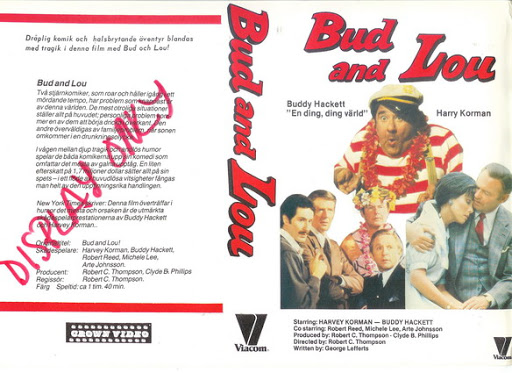
Abbott and Costello are played by Buddy Hackett and Harvey Korman. Interestingly, Hackett and Hugh O’Brian replaced the team when Costello’s health forced them to drop out of 1954’s Fireman Save My Child.
The team came together when Abbott’s original partner was ill and it gelled pretty quickly. The film hints that Bud used to date Lou’s wife — this is unproven — but as we’ve learned from tabloid-style films, facts are rarely important. For example, while they did debut on The Kate Smith Hour on February 3, 1938, they didn’t do the “Who’s On First?” routine until a month later and they had developed their distinctive voices (audiences initially thought they sounded alike until Costello came up with his high-pitched, childish affect).
They debuted their own show, The Abbott and Costello Show, as Fred Allen’s summer replacement in 1940 before joining Edgar Bergen and Charlie McCarthy on The Chase and Sanborn Hour in 1941. That was also the year that their first two films — Buck Privates and Hold That Ghost — debuted (they made their actual first film appearance in 1940’s One Night in the Tropics, essentially playing their greatest hits from burlesque on screen).
By 1942, they were the top box office stars in the country, earning over $789,000 ($12 million in today’s money) that year alone. To show how big of stars they were, a 35-day War Bonds tour in the summer of 1942 earned $85 million dollars ($1,299,767,105 today!) in war bonds purchases. This is important — because soon, the government would come calling for this money and forget all about this. That’s a major part of the film.
Here come the bad parts. Abbott had epilepsy, which in the film just means you have to sit down every once in a while, as well as drink way too much. Costello got rheumatic fever from a military base tour and was bedridden for the rest of 1942 and into ’43, when he returned to radio after a year layoff. That very same day, his infant son drowned in the family’s pool and the comedian was never the same. He was quick to anger and constantly vindictive to the point that a major rift happened when In 1945 a rift developed when Abbott hired a servant who Costello had fired. That led to Costello refusing to speak to his partner except when performing. From them on, they would play separate characters in films, rather than be a team. This led to their loss in popularity when faced with other teams like Martin and Lewis.
Abbott resolved the rift when he suggested naming Costello’s charity the “Lou Costello Jr. Youth Foundation.” Finally some good news — this charity still helps underprivileged youth in the Boyle Heights district of Los Angeles.
Despite their dip in popularity, they still starred in several films with the Universal monsters and hosted The Colgate Comedy Hour. From 1952 to 54, Costello created, owned and syndicated The Abbott and Costello Show, paying Abbott a salary, a point this movie hammers home as proof that any reconciliation was only on one man’s part. That said, the movie totally ignores that this show was a success and aired in reruns for a long time.
The film never gets into the point that the duo was overexposed and worried about creating new material, which is one of the reasons why Universal couldn’t reach a contract with them. They were forced to sell all of their assets to the IRS to pay taxes, a point the movie definitely makes.
After one last film, Dance with Me, Henry and Lou appearing on This Is Your Life, the duo split for good in 1957. Errol Flynn claimed in his autobiography that he was the reason. At a party he had invited Bud, Lou and their families to, he showed hardcore pornography and Bud and Lou both blamed the other. This is skipped by the movie, because how would you explain that on TV in 1978?
The movie makes it seem that Costello died quickly after the pair split, but he lived until 1959, after ten appearances on The Steve Allen Show doing old routines without his partner. He died shortly after finishing his last film, The 30 Foot Bride of Candy Rock.
In 1960, Abbott formed a team with Candy Candido, a voice actor in Disney films. He also did his own voice for the Hanna-Barbera Abbott and Costello cartoons. He died of cancer in 1974.
Let’s go back to me being a kid. I always thought that Lou was the nice one, with Bud being the mean adult, always grumpy with him. Little did I know the truth — or what passes for it in this movie. I remember crying my eyes out during the last scene where Lou dies.
This whole movie is based on the book by Hollywood correspondent Bob Thomas and trust me, it’s as over the top and ridiculous as you hope it is. It’s been said that Thomas got most of his gossip from Eddie Sherman, Abbott and Costello’s longtime manager who had been fired by the duo, so obviously there was a reason why it’s so venomous. It’s also remarkably unfunny in the comedy segments, which is weird when you consider who is starring in it. Arte Johnson and Robert Reed also show up, just to remind you this is a made for TV movie.
Both the book and movie upset Lou’s daughter Chris so much that she wrote the book Lou’s on First to refute many of its claims.
I’m not the only one obsessed by this film. On his podcast, Gilbert Gottfried has brought the death scene at the end up several times. I wasn’t the only one shattered by it, I guess.
I guess if you want to catch up on memories, you should skip TV movies and go right back to the real movies. But as you may have learned by now, I love junk.
EDITOR’S NOTE: Bud and Lou was on the CBS Late Movie on December 25, 1984 (Merry Christmas!) and June 3, 1987.
This movie crushed me as a child. I had always loved Bud Abbott and Lou Costello, watching their thirty-six films on Sunday mornings after Ma and Pa Kettle films. Seriously, weekends in Pittsburgh in the 70s and 80s were amazing. You stayed up all Night watching Chiller Theater, then woke up late and took in some Abbott and Costello. Ah, memories.
That said, when this aired on November 15, 1978, I excitedly watched it from my parent’s black and white kitchen TV, ready to have fun reliving my favorite memories of the comedy duo. I wasn’t prepared to learn how much they hated one another and their foibles. Cut me some slack — I was six.
Buddy Hackett and Harvey Korman play Abbott and Costello. Interestingly, Hackett and Hugh O’Brian replaced the team when Costello’s health forced them to drop out of 1954’s Fireman Save My Child.
The team came together when Abbott’s original partner was ill, and it gelled pretty quickly. The film hints that Bud used to date Lou’s wife — this is unproven — but as we’ve learned from tabloid-style films, facts are rarely necessary. For example, while they did debut on The Kate Smith Hour on February 3, 1938, they didn’t do the “Who’s On First?” routine until a month later, and they had developed their distinctive voices (audiences initially thought they sounded alike until Costello came up with his high-pitched, childish effect).
They debuted The Abbott and Costello Show as Fred Allen’s summer replacement in 1940 before joining Edgar Bergen and Charlie McCarthy on The Chase and Sanborn Hour in 1941. That was also the year that their first two films — Buck Privates and Hold That Ghost — debuted (they made their first film appearance in 1940’s One Night in the Tropics, essentially playing their greatest hits from burlesque on screen).
By 1942, they were the top box office stars in the country, earning over $789,000 ($12 million in today’s money) that year alone. A 35-day War Bonds tour in the summer of 1942 earned $85 million ($1,299,767,105 today!) in war bond purchases to show how big of a star they were. This is important because the government would soon call for this money and forget all about it. That’s a significant part of the film.
Here come the bad parts. Abbott had epilepsy, which in the film means you have to sit down every once in a while, as well as drink way too much. Costello got rheumatic fever from a military base tour and was bedridden for the rest of 1942 and into ’43 when he returned to radio after a year layoff. That very same day, his infant son drowned in the family’s pool, and the comedian was never the same. He was quick to anger and constantly vindictive to the point that a significant rift happened.
In 1945, Abbott hired a servant whom Costello had fired. That led to Costello refusing to speak to his partner except when performing. Then, they would play separate characters in films rather than work together, which led to their loss of popularity when faced with other teams like Martin and Lewis.
Abbott resolved the rift by suggesting naming Costello’s charity the Lou Costello Jr. Youth Foundation. Finally, some good news: this charity still helps underprivileged youth in the Boyle Heights district of Los Angeles.
Despite their dip in popularity, they still starred in several films with the Universal Monsters and hosted The Colgate Comedy Hour. From 1952 to 54, Costello created, owned and syndicated The Abbott and Costello Show, paying Abbott a salary, a point this movie hammers home as proof that any reconciliation was only on one man’s part. That said, the film ignores that this show was successful and aired in reruns for a long time.
The film never gets to the point that the duo is overexposed and worried about creating new material, which is one reason Universal couldn’t reach a contract with them. The movie definitely makes the point that they were forced to sell all their assets to the IRS to pay taxes.
After one last film, Dance with Me, Henry, and Lou appeared on This Is Your Life, the duo split for good in 1957. Errol Flynn claimed in his autobiography that he was the reason. At a party he had invited Bud, Lou and their families to, he showed hardcore pornography and Bud and Lou both blamed the other. The movie skipped this because how would you explain that on TV in 1978?
The movie makes it seem that Costello died quickly after the pair split, but he lived until 1959 after ten appearances on The Steve Allen Show doing old routines without his partner. He died shortly after finishing his last film, The 30-Foot Bride of Candy Rock.
In 1960, Abbott formed a team with Candy Candido, a voice actor in Disney films. He also did his voice for the Hanna-Barbera Abbott and Costello cartoons. He died of cancer in 1974.
Let’s go back to when I was a kid. I always thought Lou was the nice one, and Bud was the mean adult who was always grumpy with him. Little did I know the truth—or what passes for it in this movie. I remember crying my eyes out during the last scene when Lou dies.
This movie is based on the book by Hollywood correspondent Bob Thomas, and trust me, it’s as over the top and ridiculous as you hope it is. It’s been said that Thomas got most of his gossip from Eddie Sherman, Abbott and Costello’s longtime manager, who the duo had fired, so obviously, there was a reason why it’s so venomous. It’s also remarkably unfunny in the comedy segments, which is weird when considering who is starring. Arte Johnson and Robert Reed also showed up; to remind you, this is a made-for-TV movie.
The book and movie upset Lou’s daughter, Chris, so much that she wrote Lou’s On First to refute many of its claims.
I’m not the only one obsessed with this film. Gilbert Gottfried repeatedly mentions the death scene at the end of his podcast, and I wasn’t the only one shattered by it.
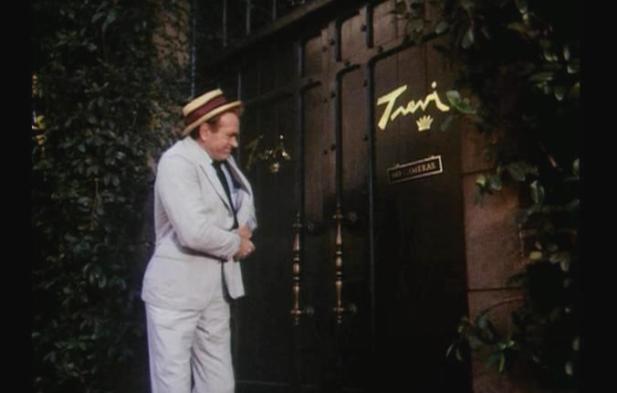
Directed by Don Weis (Beyond Westworld, The Munster’s Revenge) and one of several episodes written by Rudolph Borchert, “The Trevi Collection” has Carl Kolchak find out that fashion model Madeline Parker (Lara Parker, Angelique from Dark Shadows) is an actual witch. On the excellent blog It Couldn’t Happen Here, she told writer Mark Dawidziak that star Darren McGavin gave her some advice: “Nobody really understands the style of this thing. It has to be played seriously, and then the horror will come out naturally.”
She’d already been doing that for years in Collinsport.
She told The Night Stalker Companion, “He kept trying to tell me how to play a witch. It was a fun part, but, to be honest, it wasn’t the most fun acting experience I ever had.”
This episode was made when they were halfway through the season, and one assumes nerves were already shot, what with the long hours and low budgets. At least this episode has a fluffy white cat maul and a model named Ariel (Diane Quick). Another, Melody Sedgwick (Beverly Gill), is killed by a shower that gets way too hot.
The one interesting part is that Carl goes from Madeline helping him to her being the villain. This is a different approach to the show’s formula, and while it’s not an episode I enjoy as much as some of the others, I’ll take any Kolchak over most shows.
EDITOR’S NOTE: Copacabana was on the CBS Late Movie on March 16 and August 1, 1988.
“Her name was Lola; she was a showgirl
With yellow feathers in her hair and a dress cut down to there
She would merengue and do the cha-cha
And while she tried to be a star
Tony always tended bar
Across the crowded floor, they worked from eight til four
They were young and they had each other
Who could ask for more?”
The third single from Barry Manilow’s fifth album, Even Now, “Copacabana (At the Copa),” was written because Mannilow was a regular at the club and asked co-writer Bruce Sussman if anyone had ever written a song about the club. Working with Jack Feldman, Sussman did the words, and Manilow did the music. The result? Mannilow’s first gold record for a song he wrote and his only Grammy, as he won the Best Male Pop Vocal Performance. It peaked at #8 in the U.S. but was a hit worldwide.
Dick Clark asked Manilow to make the movie, which was directed by Waris Hussein and written by James Lipton. Yes, the very same James Lipton you’re thinking of.
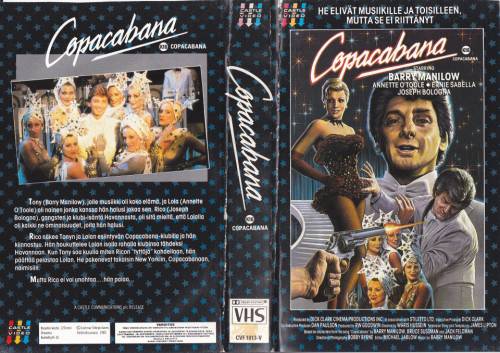
Manilow is Tony Starr, a bartender and aspiring musician who works with Lola Lamar (Annette O’Toole), who becomes a star in Havana working for Rico Castelli (Joseph Bologna). At the same time, Tony gets big at the Copa. The song plays out, and you learn “who shot who,” as the movie ends with an older Lola sitting on a bar stool, drunk and lamenting the loss of Tony and not seeing disco, but instead her dancing with him.
This movie upset my family to the worst of degrees, depressing everyone by the end. I don’t know what we expected, as the song is a downer. But we hoped things would be changed for the movie.




 B&S About Movies
You must be logged in to post a comment.