CBS LATE MOVIE MONTH: The Spell (1977)

EDITOR’S NOTE: The Spell was on the CBS Late Movie on November 22, 1978 and May 15, 1979.

This Brian Taggert (Visiting HoursPoltergeist III and Omen IV: The Awakening) film was originally aired on NBC on February 20, 1977. It was supposedly written before Stephen King’s Carrie. Although it was supposed to be a theatrical film, it was relegated to movie of the week because De Palma’s filmed version got on screen first.

Rita Matchett, a shy, overweight 15-year-old girl, is the central character who, like Carrie, is subjected to bullying. However, her powers manifest much quicker. In a shocking turn of events, as one of the mean girls climbs the rope in gym class, Rita uses her powers to make her fall to her death, setting the stage for a unique and unexpected plot twist.

While Rita comes from a wealthy family, she isn’t close with her sister (Helen Hunt) or her father (James Olson, Father Adamsky from Amityville II: The Possession). Her mother (Lee Grant, who reviewers said deserved better than this movie, but I love this kind of ridiculous TV movie, occult magic, so screw those people) tries to understand her, but once she starts speaking in tongues, all bets are off.

This is the kind of movie where an old woman spontaneously combusts, where the gym teacher (Lelia Goldoni, who, if I was artistic, I’d tell you that she was in Cassavetes’ Shadows, but we all know that she was in the 70’s Invasion of the Body Snatchers and The Unseen) teaches sad teens how to find Satan and the mom ends up having powers too, throwing knives at her daughter in a scene that again has nothing to do with Carrie at all.

Jack Colvin, who plagued David Bruce Banner on the TV version of The Incredible Hulk, and Wright King (Invasion of the Bee Girls) show up. So do some audio cues from the classic Star Trek.

Directed by Lee Phillips, known for his work on The Girl Most Likely to…, this film may be derivative, but it’s a lot of fun.

This is one of the few made-for-TV movies that have come out on DVD. Thank Shout! Factory for that and beg them to release more!

CBS LATE MOVIE MONTH: Kolchak: The Night Stalker: The Ripper (1974)

EDITOR’S NOTE: This episode of Kolchak: The Night Stalker was on the CBS Late Movie on June 1 and December 7, 1979; May 29, 1981; October 2, 1987 and January 8, 1988.

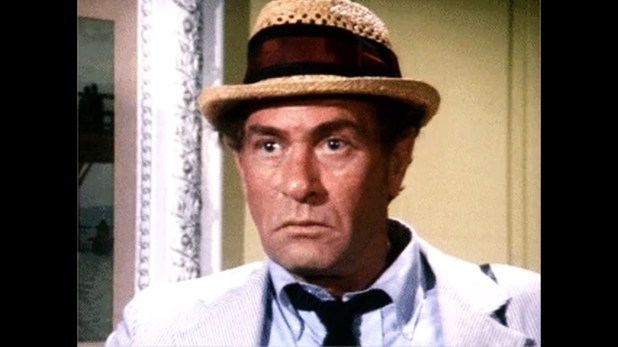
Carl Kolchak, a character I can’t even explain how important he was to two-year-old me. My parents even bought me a straw hat and toy camera so that I could hunt down the monsters in my small Western Pennsylvania hometown. I may never have found any, but I discovered a love for the supernatural that has lasted my entire life. Kolchak, a Las Vegas reporter with a penchant for getting into trouble, was a hero to me. His relentless pursuit of the truth, even when it led him into danger, was inspiring. And his unorthodox methods, like pretending to be the commissioner, stealing a car, and placing several people under citizen’s arrest, were always entertaining.

The character started in Jeff Rice’s unpublished novel The Kolchak Papers — which told the story of the Las Vegas reporter discovering real-life vampire Janos Skorzeny — which was optioned as a movie by ABC in 1972. The Night Stalker is even today one of the best TV movies ever filmed with a dream team of director John Llewellyn Moxey, writer Richard Matheson, producer Dan Curtis and star Darren McGavin.On its first airing, it had a 33.2 rating and a 54 share, which means that 33% of possible viewers were watching it, and 54% of all TVs turned on were tuned to ABC. Those are the kinds of numbers that we will never see again outside of the Superbowl, and perhaps not even then.

A year later, Curtis directed and wrote The Night Strangler, which was written by Matheson. This time, Kolchak had been run out of Vegas and was working in Seattle when he ran into a serial killer who had stayed alive for nearly a hundred years thanks to the blood of his victims. The movie also did well in the ratings, so well that instead of a third movie in which Kolchak would investigate android duplicates—The Night Killers—ABC ordered a weekly series.

The series cannot live up to the movies, but there are some great episodes.

The show aired in the worst time slot, Friday nights at 10 p.m., and then moved to 8 p.m. Before the last four reruns aired on Saturday at 8 p.m., McGavin worked as an executive producer with no credit or pay to try and keep the show’s quality, which exhausted him. He hated that each week there was a new monster, and finally fed up, he asked for his release with two episodes unfilmed. Despite the challenging time slot, the show developed a dedicated fan base who would stay up late or rearrange their schedules to watch it.

For several years, that was it. No more Kolchak.

Then, on May 25, 1979, The CBS Late Movie resurrected Kolchak!

Sure, they started with episode four, but it was back. And then it was gone! The ratings were so strong that CBS decided to save it until the fall. The series played in 1979, 1981 and from 1987 to 1988, missing only four episodes.

That’s because ABC packaged “Demon In Lace” and “Legacy of Terror” as The Demon and the Mummy and “Firefall” and “The Energy Eater” as Crackle of Death. Until 1990, these episodes were kept from the original rotation. They made their return to the series when SciFi aired the show.

Now, let’s journey back to 11:30 p.m., when the rest of America was asleep or about to fall asleep watching Carson and getting into “The Ripper.”

Directed by Allen Baron (who also made the noir classic Blast of Silence) and written by Rudolph Borchert, the story begins with an exotic dancer (Denise Dillaway, The Cheerleaders) being attacked by a man in a cape with a sword cane who is somehow strong enough to throw human beings through the air.

We cut from this to a scene that will become familiar to show fans: Carl’s boss, Tony Vincenzo (Simon Oakland), is now with him in Chicago, screaming at him yet again for the reporter’s latest screw-up. This time, he pretended to be the commissioner, stole a car and placed several people under citizen’s arrest as he was looking into a robbery. As punishment, Carl must write an advice column as Miss Emily.

That’s not where our reporter friend wants to be. His police scanner alerts him to another attack by the man people are calling The Ripper. There, Carl watches the man shrug off several point-blank gunshots, a four-story leap off a building and fighting multiple police officers. Carl would be fired if it wasn’t for the fact that his fellow reporter Updyke (Jack Grinnage) got sick when he even heard about the crimes.

At a press conference, Captain Warren (Ken Lynch) refuses to answer any of Kolchak’s questions but does reveal that The Ripper has sent a letter to another reporter, Jane Plumm (Beatrice Colen). She and Carl compare their research, and he learns that the letter says, “And now a pretty girl will die, so Jack can have his kidney pie.” As he digs deeper into the case, he discovers that there have been murders like this all over the world for decades.

Another crime, another poem — “Jack is resting. Be reborn. To finish up on Wednesday morn.” — and Carl learns something else the police didn’t. A couple hit a man with their car who just walked away. Kolchak saves a scrap of fabric from the accident. Jane is taking things even further, meeting men who claim to be The Ripper.

The cops want Carl out of the way, but The Ripper attacks the squad car he’s in the back of, and even though he’s caught after being stunned by an electric fence, the serial killer tears a jail cell door off its hinges and escapes. Carl figures out that he’s in a house in Wilton Park. There, he finds Jane’s corpse and barely survives when The Ripper attacks him. Luckily, Carl thought ahead and brought electrical gear to disintegrate the killer. Unfortunately, it also burns the Musnter’s house on the Universal backlot he’s been hiding in down to the ground, destroying all the evidence.

Carl closes, ruminating over how he got here all over again, saying, “And here’s the postscript: when they drained that pond, they found nothing – nothing, but some old clothes. For some reason, the police suddenly decided they wanted those and my head. I don’t know how Vincenzo will handle the charges of arson and malicious mischief lodged against me by Captain Warren, but that fire was a big one – a six-alarmer. A blast furnace couldn’t have done a better job: everything gone. The house. My story. The evidence. Like they say: ashes to ashes. One thing survived the inferno, however. There’s enough of it left to read the maker: “Peel’s Footwear, London, Southwest 1.” They’re still there, of course, but they don’t make this style shoe anymore. It was discontinued over seventy years ago. Seventy. Years. Ago.”

Realizing that no one will believe a word he’s written, he pulls the paper from his typewriter and throws it in the trash.

“The Ripper” is a decent first episode that introduces Carl to anyone who hasn’t seen the first two movies and the show’s theme. I’m excited to revisit these, as they are some of my fondest childhood memories.

CBS LATE MOVIE MONTH: Go Ask Alice (1973)

EDITOR’S NOTE: Go Ask Alice was on the CBS Late Movie on April 26 and July 27, 1976.

Originally airing on January 24, 1973, Go Ask Alice is an adaptation of the 1971 book. The film, much like the book, delves into the personal struggles of a troubled teenager, a theme that resonates with many of us. While the book is more of a diary and is written by Anonymous, most people believe that therapist and author Beatrice Sparks wrote it. She’d go on to write several similar books that were also supposed to be the actual diaries of troubled teenagers.

Jamie Smith Jackson portrays Alice, a teenager striving to blend in at her new school, as she confides in her diary. Her quest for acceptance leads her to experiment with LSD at parties, plunging her into a world of substance abuse and family discord. The portrayal of her parents, played by William Shatner and Julie Adams, reflects the societal attitudes towards youth in the 1970s.

Mackenzie Phillips — who would later have drug problems of her own — shows up, and Andy Griffith (the film’s best part), Robert Carradine and Ruth Roman (from The Baby!) all make appearances. Their performances, especially those of Andy Griffith, add depth and intrigue to the film. It’s pretty schmaltzy in parts, but it’s a preachy 1973 TV movie. You kind of expect those kinds of things.

Bonus: You can listen to Becca and I discuss this on our podcast.

Night Gallery Season 3 Episode 5: Specter In Tap Shoes (1972)

After her twin sister Marian hangs herself, Millicent (Sandra Dee) returns home, only to hear Marian – a dancer – tapping across the floor upstairs, footsteps rapping in the room where she left this world.

“Specter In Tap Shoes” was directed by Jeannot Szwarc and written by Gene R. Kearney from a story by Jack Laird. After the death of her twin, Millicent is sure that Marian is still here, as she doesn’t just hear her; she smells the smoke from her cigarettes.

Maybe she should just leave. That’s what William Jason (Dane Clark), a property developer who is a mutual friend of Millicent’s pal Sam (Christopher Connelly, soon to depart for Italy), thinks would be best. She’d get closure and away from all the memories.

Millicent keeps hearing her sister’s voice, urging her to hang herself as well. She stops at the last minute and finds William in her sister’s studio. He demands letters that Marion wrote to him, letters that she somehow can discover immediately. She also finds a revolver that she uses to shoot him.

The logical explanation is that the entire house was wired so William could gaslight Millicent just like he did Marion. But then, how did she know where the letters were?

This is a decent enough episode, but as always, Serling writes the better Night Gallery stories. Szwarc does a good job of making the story mean more than it does.

CBS LATE MOVIE MONTH: Black Noon (1971)

EDITOR’S NOTE: When I first wrote about this movie, I said “If this played on the CBS Late Movie, it would have probably taken two hours and forty minutes with all the commercials. Actually, it did, on August 29, 1972 and March 6, 1975.”

Bernard L. Kowalski has a decent horror pedigree, directing Night of the Blood BeastAttack of the Giant Leeches; Krakatoa: East of JavaTerror in the Sky and Sssssss. Here, he puts the terror on a slow boil and puts Reverend John Keyes (Roy Thinnes, always battling the occult) and his wife Lorna (Lynn Loring, The Horror at 37,000 Feet) against an unseen force bedeviling a small Western town named San Melas. There’s voodoo, devil worship and a mute young girl and a gunslinger possessed by the Left Hand Path.

Ray Milland shows up, proving that Old Hollywood is never to be trusted. Plus there’s Gloria Grahame (Blood and Lace), Henry Silva (Almost HumanMegaforce, the epic Escape from the Bronx), stuntman Stan Barrett, Joshua Bryant (Salem’s Lot), a young Leif Garrett (Thunder Alley) and Jodie Foster’s brother, Buddy.

70s made for TV horror neglects the Old West, so this is a strange film to start with. Then again, it also plays the Troll 2 trick of a town with a backward name and a connection to witches, but it doesn’t telegraph that. The ending — which moves to 1971 — more than makes up for the slow moving last 68 minutes.

Actually, I love dreamy TV movies that seem to take forever to get anywhere.

CBS LATE MOVIE MONTH: Gargoyles (1972)

EDITOR’S NOTE: Gargoyles was first on the CBS Late Movie on May 1, 1973; May 16, 1975 and September 3, 1975.

EDITOR’S NOTE: Gargoyles was first on the CBS Late Movie on May 1, 1973; May 16, 1975 and September 3, 1975.

When I was a kid, I remember asking my dad what movies he thought were scary. He answered Night of the Living Dead and Gargoyles, so I was always nervous to watch this movie. It just looked strange, and in the late 1970s, it wasn’t like I could find it on demand. But the unique storytelling of Gargoyles always intrigued me.

Originally airing on CBS on November 21st, 1972, it was directed by Bill L. Norton (Baby: Secret of the Lost Legend, More American Graffiti) and written by Steven and Elinor Karpf (Devil Dog: The Hound from Hell, The Jayne Mansfield Story), Gargoyles may be uneven, but has moments of pure joy.

It’s one of the first films Stan Winston (Terminator, Aliens) worked on, providing a variety of gargoyle makeup. The look of the creatures is not just terrific, it’s downright amazing, as they don’t all look the same. The leader (Bernie Casey (Felix Leiter in Never Say Never Again, UN Washington in Revenge of the Nerds) has a perfect look that balances a regal bearing with an otherworldly aura. You can see why this won an Emmy. It’s big budget-worthy work on a shoestring budget.

Speaking of budget, the film was shot with just one camera over 18 days, which chased away the original director. Temperatures at the Carlsbad, NM location, baked the cast and crew, reaching 100 degrees or more the entire shoot. So it’s incredible that what emerged is so interesting.

The opening dialogue informs us that Satan lost the war in Heaven, with his children being the gargoyles who rise against man every six hundred years (there’s even an image from Haxan to symbolize the devil). This dialogue is by Vic Perrin (Tharg from the “Mirror, Mirror” episode of Star Trek, and the voice of Metron and Nomad), who also provides the crazy VO for the head, Gargoyle.

We join Dr. Mercer Boley (Cornell Wilde, No Blade of Grass), author of the occult, and his daughter, Diana (Jennifer Salt of Sisters and Son of Sam TV movie Out of the Darkness) as they head off to the desert — and Uncle Willie’s Museum — where they find a skeleton of a creature that Willie (Woody Chambliss of Zero Hour! and The Devil’s Rain!) claims he saw in the hills. The doctor doesn’t believe a word, but his daughter listens to his tales, only to be cut off by the sound of wings and something trying to get into the museum. Whatever it is, it sets off a fire that kills Uncle Willie.

They head to a local motel run by Mrs. Parks (Grayson Hall, who played Dr. Julia Hoffman in Dark Shadows and Carlotta Drake in Night of Dark Shadows), who is never without a drink in her hand (an acting choice by Hall that we can endorse). Two of the gargoyles try to take back the skeleton they’ve rescued from the inferno, but one is hit by a truck. It seems like the doctor sees money in the bodies of these gargoyles, alerting the group’s leader to his plan. He kidnaps Diana, showing her the eggs his people care for and explaining that they just want to live in peace with humans.

Throw in a bunch of motorcycle riders (including Scott Glenn of The Right Stuff and Silence of the Lambs), cops who can’t understand what is going on, the finest hound dogs in the area, an all-out war between humans and Gargoyles with way too much talking and you have this movie. But I can’t dislike it — it’s filled with great moments like the leader making Diana read to him about the historical account of an incubus seducing a woman and the speech he gives to the humans at the end. The closing image of a Gargoyle flying away, clutching a wounded female of his species? Amazing.

It’s worth seeking out, if only to see how horror used to be all over 1970s TV. If you grew up in that era, you have less of a chance of dismissing this movie as dumb.

CBS LATE MOVIE MONTH: The Woman Hunter (1972)

EDITOR’S NOTE: The Woman Hunter debuted as a CBS Movie of the Week on September 19, 1972. It played the CBS Late Movie on October 7, 1974.

The Woman Hunter has an all-star cast, with Barbara Eden in the lead, alongside Stuart Whitman, Larry Storch and Robert Vaughn. Like I said — it’s what I say is an all-star cast.

Most Giallo heroines are characterized by their wealth and potential mental issues. However, in The Woman Hunter, when Dina Hunter (Eden) survives a car accident and plans a trip to Mexico with her husband (Vaughn), who would have thought that the artist she hired to paint her portrait (Whitman) could be a jewel thief and a murderer?

Enrique Lucero, who plays the Commissioner, would go on to try and hunt down Mary, Mary, and Bloody Mary and also appears in The Wild Bunch, Guyana, Cult of the Damned and The Evil That Men Do.

This was written by Brian Clemens (Captain KronosAnd Soon the Darkness) and Tony Williamson (Adam Adamant Lives!The Avengers). It is Clemens’ first U.S. work and Williamson’s only script made over here. It’s directed by Bernard L. Kowalski, who stepped in for John Peyser (The Centerfold Girls). I assume that everyone enjoyed shooting this on location in Acapulco. Larry Storch even brought his wife Norma along.

You can watch this on YouTube.

CBS LATE MOVIE MONTH: She Waits (1972)

EDITOR’S NOTE: She Waits debuted as a CBS TV movie on January 28, 1972. It played the CBS Late Movie on September 12, 1972 and January 14, 1974.

Laura Wilson (Patty Duke, Valley of the DollsThe Swarm) and Mark (David McCallum, Illya Kuryakin on The Man from U.N.C.L.E. and better known to today’s TV audience as Dr. Donald Mallard on N.C.I.S.) haven’t been married long. On their first trip to meet his mother (Dorothy McGuire, The Greatest Story Ever Told), she learns that maybe this marriage wasn’t the best of ideas. Mom has been ready to go nutzoid ever since Mark’s first wife, Elaine, died, and she’s convinced that her ghost is inside her home.

Everywhere Laura goes, she starts hearing Elaine’s favorite song and even her voice. Is she trying to possess her? Or is she just being ridiculous, as the family doctor suggests? The movie never fully embraces the supernatural. It’s more about Mark shutting himself off and not dealing with the past.

The family maid thinks that Mark’s mother is getting worse and worse, with Laura in danger of the very same insanity. And what’s the deal with Mark’s friend David (James T. Callahan, the dad from Charles in Charge)? And can you talk a ghost out of possessing someone just by talking to them?

Director Delbert Mann (Marty) weaves a competent story, penned by Art Wallace, the main writer for TV’s Dark Shadows. It’s a tale that fits snugly into the 1970s, a time when possession, Satan, and the ghosts of murdered wives lurked around every corner. The film’s slow pace is a deliberate nod to the conventions of TV movie horror, inviting you to revel in the nostalgia of a bygone era.

Night Gallery Season 3 Episode 4: Rare Objects

Originally called “Collector’s Items” — a title that spoils the surprise — this episode of Night Gallery feels like it almost belongs on The Twilight Zone.

Directed by Jeannot Szwarc and written by Rod Serling, “Rare Objects” is the story of August Kolodney (Mickey Rooney), an organized crime figure who is barely surviving all of the attempts on his life. A doctor (Regis Cordic) removes the slug that someone put in him and tells him that his blood pressure is so off the charts that even his body could betray him at any minute.

Is there a way out? Well, the doctor knows a guy, but the price is steep.

Dr. Glendon (Raymond Massey) has the criminal to his home, shows him his many collections and invites him to stay, as Kolodney himself is a very rare item. He’ll have a long life free of worry, but he just has to give over anything and everything. But by the time he tries to leave, it’s too late. The drugs in his drink have kicked in and soon he may just live forever, surrounded by Princess Anastasia, Amelia Earhart and Adolph Hitler. Now, he’s a bird in a cage for just one person, no longer a person but instead an object.

Szwarc’s direction is solid and this is tension-filled the whole time. Ah — it’s so good when Night Gallery is great.

Chattanooga Film Festival Red Eye #5: The Haunted (1991)

Jack and Janet Smurl of West Pittston, PA say that a demon was in their house for nearly 15 years between 1974 and 1989, despite the denials of the Catholic Church, psychologists and scientific skeptics. Luckily, they had Ed and Lorraine Warren on their side, who encouraged their beliefs and even helped them write the book that this movie was based on.

Sally Kirkland was nominated for a Golden Globe award for her work in this movie as Janet Smurl. Jack is played by Jeffrey DeMunn, who you may know as Dale from TV’s The Walking Dead. Or if you’re like Becca and never watched that show, you’ll know him as the sheriff from the remake of The Blob.

Louise Latham from Marnie plays the grandmother and George D. Wallace — Commander Cody himself! — is the grandfather, who doesn’t believe any of this is happening but has a great part where he fends off the media on the porch with a rifle.

Joyce Van Patten — the domineering mom from Monkey Shines — shows up as a neighbor, with Stephen Markle and Diane Baker playing the Warrens, way before The Conjuring series of films (I kind of Lorraine also appeared on Road Rules: All-Stars before Hollywood truly came calling). Keep an eye out for the reporter who collapses on the Smurl’s front lawn — that’s Lorraine Warren.

The best part of this movie? The crazy way it visualizes the demonic presence as a black formless bit of nothing that has multiple voices. The funniest? There are numerous moments, but I kind of love that copyright issues meant that when the kids watch Lost In Space, they dubbed over the actor’s voices.

The Chattanooga Film Festival is happening now through June 29. To get your in-person or virtual badge to see any of these movies, click here. For more information, visit chattfilmfest.org and follow us on Facebook, Twitter and Instagram.