“I mean, this is like Star Wars meshed with Porky’s.” — Robert Freese of Videoscope and Rue Morgue
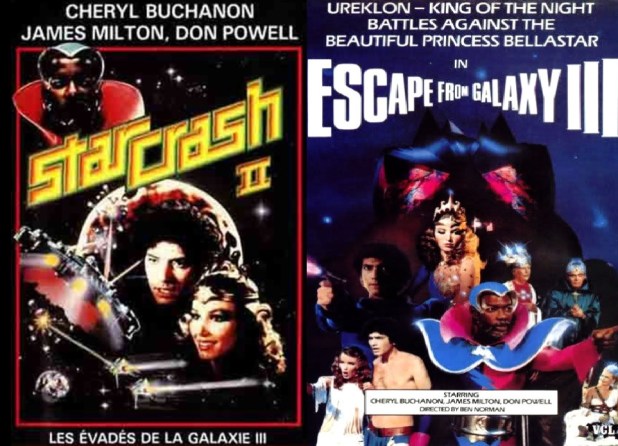
A long time ago, in a galaxy far, far away . . . lost somewhere between Luigi Cozzi’s Starcrash and the Canadian Star Wars rip Starship Invasions . . . this is the tale of Princess Belle Star’s action-filled Escape from Galaxy 3!
And you know what? This tale of Princess Belle Star (remember, the heroine in Starcrash was Stella Star) making her Princess Leia-like escape from the destruction of her home planet at the hands of the Z-Grade Ming the Merciless wanna-be in the mighty Oraclon (played by Don Powell, whose space garb reminds of George Clinton’s Parliament/Funkadelic getups) is one of my all time-favorites.
With the help of a curly-haired hero, Lithan (who looks a lot like Marjoe Gortner’s Akton from Starcrash), they escape to a mysterious, blue planet—a primitive Earth thousands of years in the past. Of course, to the Roman hippie-primitives rejected by casting from an episode TV’s Buck Rogers in the 25th Century, the strange visitors from the skies are gods—who soon discover they’ve acquired Superman-like powers in Earth’s atmosphere. And Belle and Lithan discover the joys of shooting laser beams from their hands, and the pleasures of food . . . and sex . . . and nudity . . . and disco dancing.
And who’s responsible for this so-bad-it’s-good Star Wars dropping rife with bad dialog and worse high-tech jargon (“. . . fire the uranium vapor rockets!” “. . . engage the hyper solar missile systems!”) that would give Glen Larson’s Battlestar Galactica cheese-writers pause?
Huh? No way! Not Adalberto “Bitto” Albertini?
Not the dude from the infamous Italian soft-core sexploitation “classics” Black Emanuelle (1975) Black Emanuelle 2 (1976)? Hey, wait a minute . . . that’s where I saw that Parliament/Funkadelic space emperor before! I knew he looked familiar!
Now, if you made it this far and still haven’t figured it out from looking at this article’s banner and all of the Starcrash references: Escape from Galaxy 3 pilfers all of its effects shots from Luigi Cozzi’s 1978 Star Wars rip-off, leading this pasta-turkey to also be distributed as Starcrash 2. In other markets, it was retitled as Galaxia—to possibly confuse it with Dorothy Stratton’s sex-space comedy, Galaxina? Who knows what goes on in the minds of distributors?
All I know is that EG3 is cheesy-fun . . . and Sherry Buchanan, from the Gialli What Have they Done to Your Daughters (1974), the Spielberg rip, Eyes Behind the Stars (1978), the Jaws rip-off Tentacles(1977), and the stomach-turner Zombie Holocaust (1980) gives me a “Garth Algar,” you know, like when you climb the rope in gym class.
Fellow EG3 fan and B&S contributor Robert Freese, takes a second, deeper look into the production back story of his review of the film as part of its inclusion on Mill Creek’s Sci-Fi Invasion box set. It’s a great read to learn how this mess came to exist . . . from the lips of Luigi Cozzi, himself! But it’s a mess we love, Lou!
Star Wars: Episode IX – The Rise of Skywalker was released theatrically on December 20 in the United States.
About the Author: You can read the music and film reviews of R.D Francis on Medium and learn more about his work on Facebook. He also writes for B&S Movies.
Update: February, 5, 2020: We lost Kirk Douglas today at the age of 103.
His filmography is extensive, with Academy Award nods for 1949’s Champion, 1952’s Bad & the Beautiful, and 1956’s Lust for Life, for which he also won a Golden Globe. And let’s not forget the on-screen impact of his role in 1960’s Spartacus by director Stanley Kubrick and Kirk’s earliest sci-fi, and first Jules Verne, film: 1954’s 20,000 Leagues Under the Sea.
As Kirk’s career advanced into the ’70s and ’80s, he dipped his toes a bit deeper into the realm of horror and science fiction with Jules Verne’s The Light at the Edge of the World (1971), the TV horror-musical Dr. Jekyll and Mr. Hyde (1973), Holocaust 2000 (1977), Brian DePalma’s The Fury (1978), and he closed out his work in those genres with the 1980 time-travel romp, The Final Coundown.
So, to honor Kirk, let’s visit with him once again with this review of Saturn 3 that originally appeared on December 21 as part of our “Star Wars Week” in celebration of the release of The Rise of Skywalker. And, if you missed it, please enjoy our recently-posted review of Holocaust 2000.
Thanks for the film, Mr. Douglas.
What in the hell is one of the icons of the film industry’s “Golden Age,” a three-time Academy Award nominated actor (1949’s Champion, 1952’s The Bad and the Beautiful, and 1956’s Lust for Life), doing in this Star Wars-cum-Alien knockoff—that’s really just a sci-fi retread of Friday the 13th (1980)? More importantly: What is Stanley Donen, the co-director of 1952’s Singin’ in the Rain, doing here?
I am Spartacus! I mean . . . I am Adam! King of Saturn!
Well, you can thank—or blame—British media impresario Sir Lew Grade, the head of ITC Entertainment (you know the ITC logo from Sylvia and Gerry Anderson’s U.F.O and Space: 1999), for giving noted British set designer John Barry (coincidentally, of Star Wars fame) his only directing gig. Grade also gave noted British essayist and memoirist, Martin Amis, his first and only screenwriting gig (well, until 2018’s London Fields, based on his own novel). For Kirk’s co-star—specifically chosen to fill out the revealing, exploitive see-through space suits she was to wear in the film—Grade cast TV actress Farrah Fawcett (Holly 13 from 1976’s Logan’s Run), who only had one starring-role since her breakthrough with Charlie’s Angels: 1979’s ballyhooed detective flop, Sunburn.
So, did you hear the one about the long-in-the-tooth screen icon, a first-time director and screenwriter, and a glorified poster-pin up girl walking into a bar?
It was a recipe for a Titanic-like disaster.
Instead of rising to the box office and critical highs of Star Wars and Alien, Saturn 3 sunk like the Titanic, earning three Golden Raspberry Awards for Worst Picture and Worst Actor nods for Kirk Douglas and Farrah Fawcett.
While John Barry, using his award-winning production skills, conceived a much more lavish vision of the future on the level of Star Wars for his directing debut, Lew Grade was looking for a quick turnaround to cash-in on the Star Wars-inspired sci-fi revival—so the film ended up looking like a slightly more expensive version of the previous, cartoonish ITC productions of U.F.O and Space: 1999.
Then Kirk Douglas and John Barry got into an alpha-male dispute: Douglas won.
Then, Donen, who was on the project as a producer, took the directorial reins. And he disagreed with Grade’s “exploitation elements” and downplayed them. And he was dissatisfied with Harvey Keitel’s performance—Keitel’s characteristic Brooklyn accent, in particular. So Keitel refused to participate in post-production looping and British actor Roy Dotrice (of the “Wish You Were Here” segment from 1972’s Tales from the Crypt) stepped in.
Meanwhile, with Martin Amis’s insightful Adam and Eve allegory set in space—with Douglas and Fawcett’s “Adam and Alex” as space farmers in “Eden” set on a distant Saturn moon base being “tempted” by Keitel’s Captain Benson and his robot, Hector, as the “serpent”—in shambles, Amis ended up using the history of the troubled production as fodder for his next novel.
Money: A Suicide Note, published in 1984, tells the story of John Self (i.e. John Barry) whose film project (i.e. Saturn 3) is wracked with production problems at the hands of a virility-obsessed, aging film star, Lorne Guyland (i.e Kirk Douglas). In 2005 Time magazine included the novel in its “100 best English-language novels from 1923 to the present.” The BBC adapted the book into a critically acclaimed, two-part mini-series starring Nick Frost (Shawn of the Dead, Hot Fuzz) as John Self, in 2010.
During the time of the film’s troubled production, ITC was also producing their big-budgeted, 1980 disaster flick based on Clive Cussler’s 1976 novel, Raise the Titanic, which went “Heaven’s Gate” and ballooned to a $40 million budget, which resulted in production cut-backs on Saturn 3. Both films, along with the production problems and eventual poor box-office showings of The Legend of the Lone Ranger (1981) and the way-too-late disco bomb staring The Village People, Can’t Stop the Music(1980), bankrupt the studio.
Fortunately, NBC-TV, who was obsessed with breaking into the Star Wars marketplace—with their Buck Rogers in the 25th Century series, and their The Martian Chronicles and Brave New World mini-series adaptations, bought the broadcast rights to Saturn 3 in a pre-theatrical release sale for $4 million.
When the film was broadcast on NBC in 1984, a number of scenes (15 total) excised from the theatrical print were restored. It’s this TV print that replays on American nostalgia cable networks, such as Comet and Antenna. So caveat emptor when adding Saturn 3 to your home movie library: both the theatrical and TV prints have ended up on VHS, DVD, and laser disc through numerous imprints: CBS/Fox Video, Polygram, Magnetic, Artisan, ITC Home Video, Geneon, and Pioneer Entertainment. The most recent version from Shout Factory was issued on Blu-ray in 2013. Saturn 3 is also available in a DVD two-pack with ITC’s other sci-fi—and more successful—flick, 1978’s Capricorn One.
Oh! And speaking of old Hollywood guys like Stanley Donen working in the space opera realm: John Hollingsworth Morse, a noted film and television director responsible for an eclectic variety of U.S television series from the 1950s through 1980s (Adam-12,The Dukes of Hazzard, and McHale’s Navy), got his start with the Star Wars precursor, Rocky Jones: Space Ranger. You can read up on JHM’s contributions to the Star Wars cycle of films with our article, “Exploring: Before Star Wars,” and you can enjoy his 1972 horror romp with Tom Selleck (yes, from TV’s Blue Bloods!), Daughters of Satan.
Sure Saturn 3 is on Amazon Prime, Google Play, Vudu, and You Tube for a nominal fee. But do you really want to squander your hard-earned money to see Kirk’s wrinkly ass running around a space station, Harvey in a ponytail, and see Farrah popping ecstasy and frolicking in a transparent space suit while being pursued by a robotic Jason Vorhees? Watch it for free on You Tube.
Star Wars: Episode IX – The Rise of Skywalker is currently in theatres and was released theatrically on December 20 in the United States.
About the Author: You can read the music and film reviews of R.D Francis on Medium and learn more about his work on Facebook. He also writes for B&S Movies.
Since we’re in the midst of a two-week Star Wars blow out in celebration of Star Wars: Episode IX – The Rise of Skywalker, and our “Ape Week” gala in commemoration of Disney announcing their production of a new Planet of the Apes sequel, is forthcoming (the simian fun begins December 29!), we need to take a look at the career of an impressive and successful indie filmmaker who has worked on low-budget homages to both franchises.
New Hampshire’s Brett Piper (Arachnia) is a self-made screenwriter, director, and special effects artist—and proud, self-professed purveyor of “schlock”—who eschews modern CGI for “old school” special effects, such as matte paintings, miniatures, and stop-motion animation. (Dude, you had me at “old school!”)
While Piper’s written, directed, and created effects for eighteen of his own films released from 1982 to 2019, he’s also designed effects for other directors, such as the Ape homages of fellow low-budget indie filmmakers, Mark and John Polonia (we’ll be reviewing the Polonia brothers’ films Empire of the Apes and Revolt of the Empire of the Apes as part of “Ape Week”).
But for this review, let’s take a look at Brett Piper’s debut film: a futuristic adaptation of Jules Verne’s 1874 novel, The Mysterious Island. Hey, if Disney can reboot Jules Verne’s 20,000 Leagues Under the Sea as The Black Hole, then why not a deep-space version of another Verne’s tale? And if it all looks a lot like the Apes rip Planet of Dinosaurs (1977) . . . then it probably is (and that’s a good thing!).
Just keep in mind this Star Wars rip is a grassroots amateur project: it is, in fact, a home movie shot on a shoestring budget—with even less of a shoestring than John Carpenter and Dan O’Bannon’s USC student film, Dark Star (1974). As Sam opined in his review of Piper’s Arachnia (2003): If Piper—and the Polonia brothers—had been around for the regional era of exploitation, each would be making drive-in flicks in the ’70s or direct to video films for the VHS ’80s.
So let’s get the guffaws out of the way.
Yes, we see filament lines suspending the ships. Yes, the sound sometimes unsyncs. The acting is questionable. Is that two-headed snail monster a riot? Do the stop-motion and matte effects send Jim Danforth (The Thing, They Live) running for the exits? Does this home-grown space opera make Alfonso Brescia’s Star Odyssey look like an Oscar Winner?
Oh, hell yes. And it makes Starship Invasions (1977) look like a Lucas Films’ production.
And you know what: I love this movie. For I dig this movie just as much as Sean and Patrick Donahue’s Richard Lynch-starring sort-of-apoc romp, Ground Rules.
I love Mysterious Planet a hell of a lot more than the Roger Corman star drek that is Space Raiders (ugh, that film!). Why? Brett Piper overflows with that same Tommy Wiseau-heart and has John Howard’s tenacity. Sure, their respective films, Mysterious Planet, The Room, and Spine have their (many) flaws, but they each have a special, endearing quality that’s absent from most—if not all—major studio offerings. (And you can add Flywheel(2003), Alex Kendrick’s Christian-message debut film to that list.)
The story is a simple one: Piper leads a “wretched hive of scum and villainy” mercenary crew. After a space battle, their ship encounters a “space-storm” (via—this time, will give you a pass*—an acceptable budget-saving voiceover), and they water-crash on a primitive, uncharted planet. They soon encounter strange, prehistoric life forms (the snail, and the later flying dragon that reminds of 1970’s Equinox, are both actually quite impressive considering the film’s budget), the inevitable scantily clad jungle girl, and the planet’s ruler: an ancient, super-intelligent computer (Ancient computer? Hey, wait . . . that sounds a lot like Brescia’s Cosmos: War of the Planets) who warns the planetwill be destroyed by an asteroid storm.
The questions and answers are simple with this film: Did you enjoy The Evil Dead demon-romp precursor, Equinox(1970), John Carpenter’s debut student film, Dark Star (1974), and James K. Shea’s Planet of Dinosaurs (1977; a review as part of “Apes Week” is on the way)? (I did!)
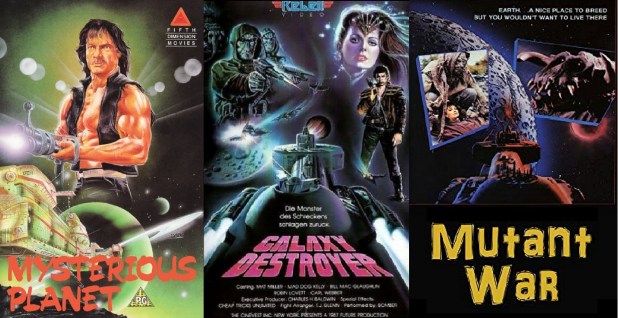
Well, that’s what Piper brings to the table with his, to be quite frank, impressive debut film (that also carries the alternate title of Star Odyssey!?!). His other “Star Wars” films are the much improved adventures of that scruffy nerf herder, Harry Trent: Galaxy Destroyer** (1986; aka Galaxy), and its sequel, Mutant War (1988). All three films are internationally distributed and dubbed, each finding loyal fan bases in France and Germany. (The full films and clips of each can be found on various video sharing sites.)
“You did alright, kid. Good job,” backpats Academy Award-winning stop-motion effects animator Ray Harryhausen to the wide-eyed comic book and sci-fi and horror film geek, Brett Piper. “Don’t get cocky. Now get back to work.”
Brett Piper’s latest sci-fi offering—in conjunction with the Polonia brothers—is 2019’s Outpost Earth. Be sure to check out Brett Piper’s work on his Facebook Fan Page. And we’re not done yet! We’ve been rolling out the “Star Wars Week” film reviews since the 16th and there’s more “Star Wars” film reviews coming up until the 28th, then it’s “Ape Week” at B&S Movies.
* Galaxy Destroyer, which also aka’d as Battle for the Lost Planet, stars Matt Mitler and Denise Coward. Mitler bowed out of the business after his 1985 vanity project, Cracking Up, which he starred, wrote and directed. Coward, who starred in Sig Shore’s Sudden Death (1985), later starred during the 1984-1985 season of CBS-TV’s daytime drama, The Edge of Night. Sig, by the way, also gave us the post-apoc’er, The Survivalist (1987).
** You know me and my pet peeves with voiceovers (with a character’s “inner feelings”) and words-on-screen set ups.
What’s this? A new Piper flick?Hell, yes!
And, we are still not done yet bowing to the Altar of Piper. We’ve dedicated one of our “Drive-In Friday” featurettes to Brett as we screened four of his films, including Queen Crab and Muckman. Yeah, we love ‘the Pipe ’round these analog wilds.
Star Wars: Episode IX – The Rise of Skywalker is currently playing in theaters and was released theatrically on December 20 in the United States.
About the Author: You can read the music and film reviews of R.D Francis on Medium and learn more about his work on Facebook. He also writes for B&S Movies.
Now, get ready for an explosive, galactic fantasy that will take you to the very edge of the universe and into the beyond . . . as Hal Roach Studios brings you . . . Starship Invasions!
“Hey, wait a minute? Hal Roach Studios? You mean the guys that made my dad’s beloved Laurel and Hardy, Our Gang, and The Little Rascals comedies?”
Yep. The very same Hal Roach Studios.
Times were tough enough for ‘70s B-Movie actors, but did George Lucas have to go and make it worse? It’s bad enough the chief wrangler at Skywalker Ranch inspired Sunn Classic Pictures to make the Kessel Run . . . but the studio that created Alfalfa, Buckwheat, Donna, Froggy, and Spanky trying to outrun the Millennium Falcon?
The Force is a bitch.
So, do you want to see Thanksgiving Day parade-style balloons doubling as UFOs? Do you want to see Christopher Lee—yes, Count Dooku from Star Wars: Attack of the Clones and Revenge of the Sith—adorned in a black-stretchy, one-piece spandex Gumby outfit? (Come on, young readers . . . you have to at least know that obscure, ‘70s pop-culture reference if you want to play along with B&S Movies!)
Just when you thought that fighting force of over-grown popcorn-popper robots from The Shape of Things to Come was more than you could bear, here comes our beloved Count Dracula himself, sporting some nifty Gumby-space pajamas emblazoned with a large, green-winged Griffin logo as he commands an inflatable, UFO Earth invasion force. Seriously, this laughable, low-budget Canadian drek couldn’t afford to have Brian Johnson and Douglas Trumbull on the payroll, so the spaceships aren’t models . . . they’re balloons.
. . . Or so we thought. It turns out that there’s a deeper mystery to The Force with this film.
This tale about a UFO expert (Robert Vaughn) abducted by benevolent aliens who need his help to battle evil aliens began as War of the Aliens, so that it “resembled” Star Wars. But wait, we have UFO’s in this, so let’s called it Alien Encounter to align it with Close Encounter of the Third Kind. (Then it found a new life on VHS shelves and TV syndication as Project Genocide.)
The plot, as it is, is reportedly cobbled from “actual UFO accounts” to tell the story about the black-clad Legion of the Winged Serpent (real life accounts repeatedly spoke of black spacesuits emblazoned with winged dragons), a rogue group of human-telepathic aliens from the Orion constellation, led by Captain Rameses (Christopher Lee), who are searching for a new home to replace their recently destroyed home planet. Oh, and according to their study of Earthmen’s sperm: we’re not descended from them: they’re descended from us, puny humans! Oh, and there’s a multi-Intergalactic Space Base deep in our ocean—inside a pyramid!
Seriously, this movie rocks!
Pummeled by critics and sci-fi fans alike for its supposed ineptitude for its inane plot, sloppy make-up, crummy costumes, corny sets and special effects, Starship Invasions is actually director Ed Hunt’s purposeful, sincere homage to recreate the hokey-campy Republic Studios sci-fi serials of the 1940’s.
Unfortunately, Ed Hunt’s nostalgic concept was, it seems, lost on Lee and Vaughn, both great actors who, it seems, made an acting choice to give it their all—and make a silk purse from a sow’s ear: ice cream from crap, if you will. But what Starship Invasions needed was corny, campy acting—in the vein of fellow Star Wars droppings Galaxina or The Ice Pirates—to make it work. It’s their “playing it straight,” Shakespearian acting that ultimately led to the film’s box office and critical demise.
So what we have with this particular Star Wars dropping is a more “realistic” homage to George Lucas’s cherished, Buck Rogers, Commander Buzz Corey, and Flash Gordon serials, than his own tales of Luke Skywalker. So keep Ed Hunt’s intentions in mind and you’ll enjoying watching this charming space opera romp on You Tube.
Starship Invasions isn’t Ed Hunt’s first time at the “UFO conspiracy” rodeo.
In 1976 he crafted Point of No Return, another fictional (based in “fact”) sci-fi thriller about an investigator looking into a series of violent deaths, via suicide and murder, which are “somehow” connected to UFOs and nuclear research (this plot device is also used in Starship Invasions). In 1979 he wrote and directed a documentary proper: UFO’s Are Real, featuring insights from respected military and science professionals.
After venturing into slasher territory with the popular video rental, Bloody Birthday (1981), he was back to using aliens as story fodder with the equally successful, wacked-out horror romp—starring the awesome David Gale (aka Dr. Carl Hill from theRe-Animator series)—The Brain (1988; written by Barry Pearson of Firebird 2015 AD fame.) Both are highly recommended for fans of the ‘80s video fringe.
Seriously. Make it your New Year’s resolution to watch The Brain and Blood Birthday.
Star Wars: Episode IX – The Rise of Skywalker was released theatrically on December 20 in the United States.
About the Author: You can read the music and film reviews of R.D Francis on Medium and learn more about his work on Facebook. He also writes for B&S Movies.
As long as you don’t go into William Sachs’s (The Incredible Melting Man) intentional sci-fi homage that tips its hat to Star Trek: TOS, Star Wars and Alien expecting a “naughty” Spaceballs-styled parody, you might get a few The Ice Pirates-like chuckles. However, regardless of the presence of its adult-centerfold star, don’t expect a variation of the sci-fi porn parody Flesh Gordon (1972). If you’re into porn films that take out the sex and leave in those films’ bad dialog and worse acting: this is your movie. If you’re okay with special effects of the low-budget, Dark Star (1974) variety: this is your movie.
In place of John Candy and Rick Moranis efficiently camping up the joint, and instead of Mel Brooks and Dom DeLuise bringing great bits with the mystical Jew, Yogurt, and the truly icky, Pizza the Hut, we get ‘60s American comedian Avery Schreiber bumbling around as . . . Captain Cornelius Butt. Yes, Captain Butt: it’s like that.
And the homages run deep, so keep those eyes open. Keen sci-fi buffs will appreciate the tribute to the film’s distributor, Crown International Pictures (The Crater Lake Monster) with the crew watching a clip of the 1960 Eastern-Bloc sci-film film, The First Spaceship on Venus, which was a CIP release in the United States.
As far for the “plot”: In the year 3008, Playboy Playmate Dorothy Stratton (who was murdered by her husband-manager shortly after) is the sexy android-computer on the Infinity, an Intergalactic Space Police cruiser—that’s lost in the same lame, special effects galaxy as Battle Beyond the Stars. On their way home after an extended tour of duty, they’re reassigned to journey to the alien world of Altar One to find The Blue Star, a mystical gem that holds unlimited power. Along the way, as they save the galaxy, the crew of the Infinity visits a space brothel of alien women and tussle with a gang that worships Harley-Davidson motorcycles. And will pilot Sgt. Thor (Steven Macht of Nightwing, The Monster Squad, Stephen King’s Graveyard Shift, and the Trancers film series) and Galaxina find true human-robot love?
If there was ever a Star Wars rip that reached the end of the Kessel Run, only to have Boba Fett carbon-frost its ass: this is that movie. This isn’t 2001: A Space Sex Comedy. It’s too “clean” and not “naughty” enough to titillate.
Star Wars: Episode IX – The Rise of Skywalker was released theatrically on December 20 in the United States.
About the Author: You can read the music and film reviews of R.D Francis on Medium and learn more about his work on Facebook. He also writes for B&S Movies.
This is a big week for Star Wars fans, courtesy of the nationwide premiere of Star Wars: Episode IX – The Rise of Skywalker and with Alden Ehrenreich from Solo: A Star Wars Story cast in the lead as John the Savage in Universal Studios’ third adaptation of Aldous Huxley’s 1932 dystopian novel.
Set to premiere in 2020, the Universal co-production with Steven Spielberg’s Amblin Television, unlike Universal’s first two TV movie productions, is being produced as a weekly series. Initially developed for NBC-TV’s SyFy Channel imprint in 2015, the production moved to NBC’s USA Network division. As of September 2019, the currently in-production series is slated to air on the conglomerate’s recently launched online streaming service, Peacock.
Their second, previous version released in 1998 as an 87-minute telefilm starring Peter Gallagher (While You Were Sleeping, NBC-TV’s Law and Order: SVU) and Leonard Nimoy (Star Trek, Baffled!) was derided by critics and sci-fi fans as being “bland” and “boring” and inferior to the 1980 version. The poor reviews are attributed to its script being a greatly abridged version that was “loosely based” on Huxley’s concepts and not a straight adaptation of the novel. (In another Star Wars twist: the 1998 version also starred mainstay U.S Television actor Kristoffer Tabori as John the Savage, who later provided voice work on several Star Wars video games. Under his directorial name, K. T. Donaldson, Tabori helmed the SyFy Channel’s “mockbuster” of Cowboys vs. Aliens: 2009’s High Plains Invaders.)
In the wake of the Star Wars-inspired sci-fi revival sweeping the film and television industries, NBC-TV took another swing of the light saber with their first version of Huxley’s novel that aired on March 7, 1980—a mere three months after their British-produced adaptation of Ray Bradbury’s The Martian Chronicles aired in January.
Keep in mind that Universal—the studio that brought you ABC-TV’s Battlestar Galactica and NBC-TV’s Buck Rogers in the 25th Century—backed this adaptation, so don’t expect a big-budget Blade Runner (1982) dystopia. While BNW ‘80 captures the spirit of Huxley’s novel and maintains its dark, pessimistic tone, and runs long enough to go deeply into the book’s themes, plot and dialog (unlike BNW ’98), it’s undone by its low-budgeted sets and costumes. Thus, you feel like you’re watching a two-part episode of arc of NBC-TV’s cartoonish Buck Rogers in the 25th Century—the same problem that plagued The Martian Chronicles.
Since this was a TV project, NBC stuck with what they knew and hired Pittsburgh-born actor Burt Brinckerhoff, better known for his extensive TV directing resume, which included multiple Emmy Awards for the 1977 to 1982 dramatic series, Lou Grant. The scribe hired to wrangle Huxley’s 300 page-plus sociopolitical lesson into a three-hour film was Doran William Cannon, who penned the original scripts for the the “so bad it’s good” psychedelic all-star comedy Skidoo (1968) and the equally experimental oddball, Brewster McCloud (1970).
Set 600 years in the future, Keir Dullea (2001: A Space Odyssey and the early-‘70s Canadian TV series, and eventual film series, The Starlost) heads the cast as Thomas Grahmbell, the “Director of Hatcheries” who genetically engineers civilians for a well-ordered society. To assure everyone maintains the status quo, citizens are required to ingest mood-controlling drugs, have “sex without love,” and real-life pregnancies are banned. The dissidents to this humanless new order are the free-thinking poet Heimholtz Watson (Dick Anthony Williams; the Blaxploitation classics The Mack and Slaughter’s Big Rip-Off), the bookish oddball Bernard Marx (Bud Cort from Brewster McCloud and the equally quirky favorite, 1970’s Harold and Maude), an old-world “primitive” John the Savage (Kristoffer Tabori), and Linda Lysenko (Julie Cobb; Star Trek: TOS “By Any Other Name” and TV’s Charles In Charge)—who becomes a criminal of the state for having a natural child birth.
Originally intended to air as a two-part, four hour mini-series (including commercials), at the last minute NBC ordered a series of cuts to pare down the film into a one night, three-hour movie, which means a half-hour of continuity-losing logic was excised from the film. However, when it premiered in the U.K on the BBC later that year, it ran in its original, full-length two-part format. So keep those two versions in mind if you decide to purchase a copy for your home library (you’ll want the BBC version). And caveat emptor those grey-market DVD-Rs with laser-printed covers flooding the online marketplace.
So, are the critics and fans right? Is Brave New World ’98 inferior to the 1980 version? You can watch the full NBC-TV 1980 version on You Tube and let us know what you think here on the site or over on our Facebook page.
And save us the aisle seat on Friday. May the Force be with you!
Star Wars: Episode IX – The Rise of Skywalker will be released theatrically on December 20 in the United States.
About the Author: You can read the music and film reviews of R.D Francis on Medium and learn more about his work on Facebook. He also writes for B&S Movies.
A long time ago, on a theatre screen far, far away . . . Sylvia and Gerry Anderson transitioned from children’s marionette-science fiction into adult live-action programming. . . .
If you’ve channel surfed across the retro-cable channels MeTV or Antenna TV (or the early days of the ‘80s cable “Superstations” TBS, WGN, and WOR) you’ve see the reruns of NBC-TV’s highly-rated, family-friendly nature drama The Life and Times of Grizzly Adams starring Dan Haggerty. The program was the first foray by the big screen documentarian purveyor, Sunn Classic Pictures, into the live-action world.
Back in the days before the advent of the multi-channel universe created by cable television, our then “free TV” entertainment world consisted of the “big three networks” of ABC, NBC, and CBS—four if you count public television broadcaster PBS—and a smattering of local UHF channels. And there was only so much airtime on PBS and Saturday and Sunday morning commercial television for nature and documentary programming.
And that’s where Sunn Classic Pictures comes in.
Today’s retro-critics label the defunct studio as the producer of “awful, big screen documentaries.” However, back in the day, Sunn cleaned up at the box office with a series of G-rated nature documentaries and investigative conspiracy films, such as In Search of Noah’s Ark and The Lincoln Conspiracy, along with their big screen adaptations of the best-selling books by ancient astronaut and biblical theorists. If there was a corner of the Earth to be “investigated” and a “conspiracy” to be uncovered, Sunn Classic Pictures was on the case.
Then Sir Lew Grade’s ITC Productions, who backed Sylvia and Gerry Anderson’s kid-oriented forays into sci-fi with Thunderbirds, UFO, and Space: 1999, had a box office hit with what is now the gold standard of sci-fi conspiracy films: 1978’s Capricorn One. (And they had a huge flop with Saturn 3.)
. . . And without some guy named George Lucas and his kooky space opera homage to Flash Gordon, there’d be no Capricorn One.
. . . So with a bunch of conspiracy experience and one live-action TV series under their belt, Sunn decided to make the Kessel Run to Star Wars gold.
. . . To say Sunn Classic Pictures couldn’t make the jump to light speed is an understatement.
Robert Vaughn? You should know better. Yeah, you did okay with Roger Corman’s Battle Beyond the Stars, but didn’t you get sucked into the extraterrestrial boondoggle that was Starship Invasions (1977)? And Darren McGavin? Did you forget about Firebird 2015 AD? And Pamela Bellwood, Gary Collins, James Hampton, Steven Keats . . . Joseph Campanella? You’re all respected and dependable guest actors from all of our favorite TV series and TV movies of the ‘70s? What in the hell are you doing here?
While films such as Hanger 18 captivate old, VHS-era sci-fi ‘n’ horror dogs with youthful nostalgia, the new, youthful fans of the latest editions to the CGI-clogged Star Wars universe will see Hangar 18 for what it truly is: just another bad Star Wars (and Close Encounters of the Third Kind) knockoff that fails to live up to the promises of its far superior poster. No, it ain’t no Laserblast . . . but it ain’t no Capricorn One, either.
A certainly well-cast and acted film (that pre-dates the popular FOX-TV series The X Files), Hanger 18 is, nevertheless, a tedious foray into a so-called “based on a true case” sci-fi thriller about a government cover up—with the always charming Darren McGavin repeating his Kolchak The Night Stalker role—concerning a UFO incident aboard the Space Shuttle. That space accident, in turn, exposes the “truth” about an alien landing and extraterrestrial corpses hidden in the infamous “Hanger 18.”
So, if you can relate to those long ago days of sitting in front of the TV with a bowl of mac ‘n’ cheese with cut-up hotdogs while you watched an endless analog-stream of awful sci-fi movies on your local UHF channels, then you’ll love Hangar 18.
But caveat emptor those syndicated and VHS-reissue attempts to breathe new life into Hanger 18 with the alternate titles of Space Connection and Invasion Force: both with “new” scenes (that add nothing to already unbelievable plotting) and an “alternate” ending (that’s even more ludicrously head scratching than the theatrical ending).
How much do we love this movie? Check out Sam’s July review from last year.
And as for those of you nurtured on the latest crop of post-‘80s Star Wars CGI-fests: you’ve been warned. You can watch the full movie on You Tube.
***
Star Wars: Episode IX – The Rise of Skywalker will be released theatrically on December 20 in the United States.
About the Author: You can read the music and film reviews of R.D Francis on Medium and learn more about his work on Facebook. He also writes for B&S Movies.
With the second Star Wars sequel, The Empire Strikes Back, due in theatres in May, NBC-TV premiered their “Star Wars” in January. While elaborate and well-acted, this ultimately technically unconvincing, sci-fi mini-series was produced by former Amicus Productions’ founder Milton Subotsky for his newly formed Sword & Sorcery Productions. Playing more like an actionless, philosophical story-arc of the British-syndicated Space: 1999 TV series than it did 20th Century Fox’s Star Wars, this three-episode mini-series ran just over four hours at a total of 291 minutes, while the uncut VHS and DVD versions run just over five hours at 320 minutes.
Rock Hudson serves as the commander of the first manned expeditions and colonies on Mars—inhabited by his co-stars of Roddy McDowall (The Planet of the Apes), Darren McGavin (Firebird 2015 A.D, Hanger 18), Barry Morse (of the not-H.G Wells adaptation of The Shape of Things to Come and Space: 1999, aka the theatrical Destination Moonbase Alpha), Bernadette Peters (George Amitage’s Vigilante Force, 1976), Fritz Weaver (Jaws of Satan), Maria Schell (Maya the shape-shifter from Space: 1999), and Nicholas Hammond (TV’s original Spider-Man).
The three episodes each running 97 minutes (1 hour 37 minutes), without commercials, are:
The Expeditions: Episode 1: January 27, 1980
A joint NASA-NATO force sends three manned “Zeus” missions (on Saturn Vs, natch; as with the Star Wars-inspired Capricorn One and Operation Ganymed) to the Red Planet in the years 1999 and 2000—each which meet with failure at the hands of Martians. A third mission in 2001 soon discovers Earth accidentally killed off the last remaining Martians with a strain of chickenpox accidently brought from Earth by the first two crews.
The Settlers: Episode 2: January 28, 1980
A 2004 return to the Red Planet with a fleet of spaceships begins Earth’s colonization efforts—and Earth-bred greed and corruption slowly destroys the colonies. Meanwhile, back on Earth, nuclear war is imminent: Congress cuts the space exploration budget to fuel the war effort and the colonies are forced to evacuate.
The Martians: Episode 3: January 29, 1980
By 2006, Earth is a wasteland—with only a few scattered humans remaining on Mars. With both civilizations destroyed and Earth the less inhabitable of the two, the last remnants of Martians and Earthlings learn to co-exist in the ruins of Mars.
To direct his Star Wars knockoff of the Ray Bradbury 1950 short-story collection scripted by Richard Matheson (of the 1954 novel I Am Legend), Subotsky hired Michael Anderson, he of the Star Wars inspirer, The Dam Busters (1956), and the Star Wars-inspired, Logan’s Run (1976) (along with Doc Savage: The Man of Bronze, Orca, Second Time Lucky, and a 1956 version of George Orwell’s 1984).
Ray Bradbury—as were U.S. TV viewers—was ultimately disappointed with the final product, displeased that Matheson’s script deviated significantly from novel’s plot regarding the history of Earthmen’s life on Mars from the first landing of Viking 1 in July 1976 and up through March 2007. When the creator of the source material calls the subsequent film, “just boring,” you know you have problems.
Is Ray Bradbury right? You can watch the full, first episode on You Tube.
Star Wars: Episode IX – The Rise of Skywalker will be released theatrically on December 20 in the United States.
About the Author: You can read the music and film reviews of R.D Francis on Medium and learn more about his work on Facebook. He also writes for B&S Movies.
If you were a kid in the seventies during the Star Wars-era and loved to spend your Saturday mornings with your bowl of Cocoa Pebbles as you watched Ark II, Jason of Star Command, and Space Academy, then this Canux space opera is for you.
If you cozied up to the TV later that afternoon with your Mac ‘n’ Cheese with cut-up hotdogs as you watched the re-runs of Sylvia and Gerry Anderson’s U.F.O and Space: 1999, or the Canadian-imported The Starlost, then this Canux space opera is for you.
As long as you don’t go into this Canadian response to Star Wars expecting it to be based on the literary work of H.G Wells and you understand that the movie only uses a few character names and the title from the 1933 speculative novel, and that the plot has no relationship to the book’s events, you’ll have a great time with this space romp.
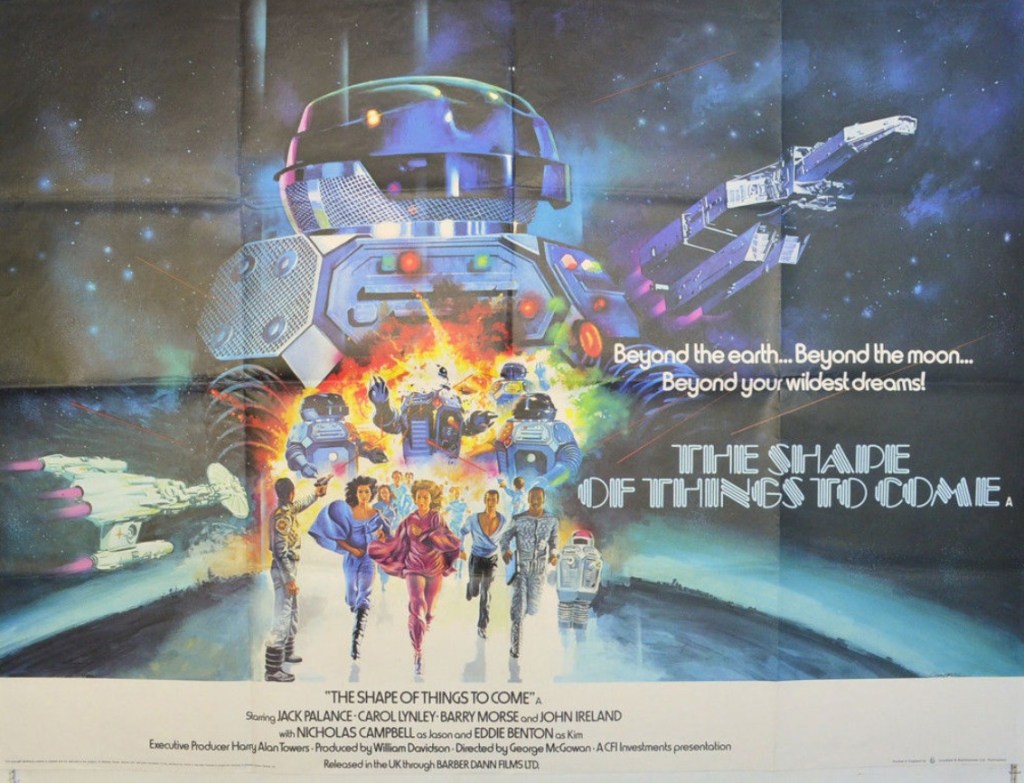
What we do get is George McGowan, of the nature-runs-amok classic, Frogs (1972), directing Jack Palance (!) as Omus the Space Master, clad in some out-of-date Space:1999 garb battling three kids and their robot dog in a script that could have been rejected as an episode-arc of NBC-TV’s Buck Rogers in the 25th Century.
With a fraction of the budget of that Glen Larson production, and its ABC-TV sister series, Battlestar Galactica, The Shape of Things to Come tells the story of a high-tech future replete with spaceships and robots that’s fled a devastated Earth to live in domed cities on the Moon. The colony is run by its Chief Science Advisor, played by Barry Morse from the first season of Space: 1999, alongside the colony’s senator, played by B-Movie exploitation stalwart, John Ireland (!).
The “Han Solo” recruit in these Canux Wars is non-other than Nicholas Campbell (serial killer Frank Dodd in The Dead Zone, Baker County, USA), while the Princess Leia-clone is Carol Lynley from The Poseidon Adventure. Also tagging along for the ride is Anne-Marie Martin, aka Eddie Benton, (of the ABC-TV series Sledge Hammer!, the Canux-horrors Prom Night and The Boogens) as the resident annoying kid replicating the Boxey character from Battlestar Galactica.
Yeah, The Shape of Things to Come isn’t as awful as Space Mutiny (nothing is as bad as Space Mutiny; okay, maybe the Battle Beyond the Stars ripoff/sequel, Space Raiders, is), but wow. If H.G only knew his tale of “future history” would be bastardized as a space opera about a madman being thwarted by a kid and a robot dog. . . .
Star Wars: Episode IX – The Rise of Skywalker will be released theatrically on December 20 in the United States.
About the Author: You can read the music and film reviews of R.D Francis on Medium and learn more about his work on Facebook. He also writes for B&S Movies.
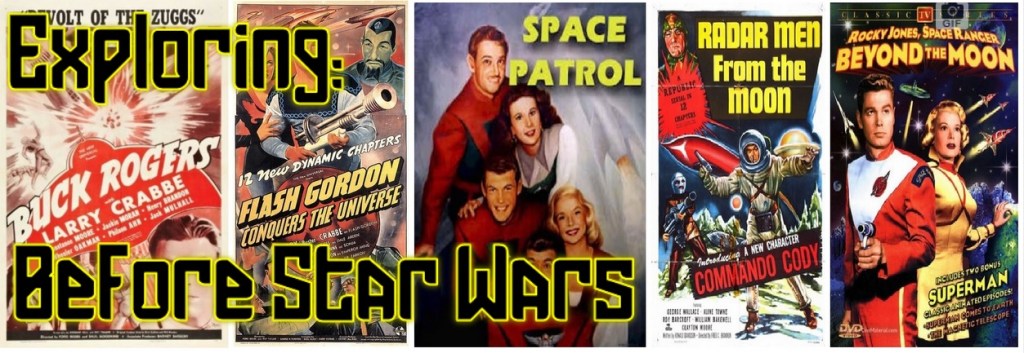
A long time ago . . . on a theatre screen far, far away . . . long before Star Wars: Episode IX – The Rise of Skywalker . . .
It was all George Lucas’s fault. Well, not really. For, in the beginning, the celluloid gods created the Luke Skywalker precursors of Buck Rogers and Flash Gordon.
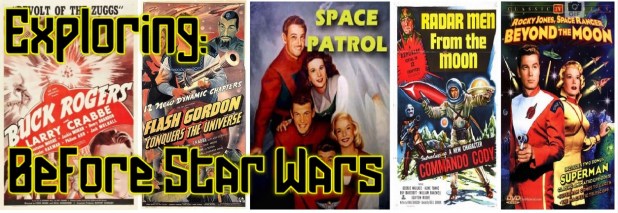
Enamored with a childhood exuberance for Universal’s twelve-chapter Buck Rogers movie-serial (edited into the 1939 theatrical feature Buck Rogers Conquers the Universe) and Alex Raymond’s Flash Gordon books turned into three mini-serials (in 1936, 1938, and 1940; edited into the features Rocketship, Mars Attacks the World, and Conquers the Universe), George Lucas, flush with success from the film homage to his 1950s hot-rod youth, American Graffiti (yes, we linked the sequel), had a dream: creating a big-budgeted, 2001: A Space Odyssey-inspired tribute to the beloved sci-fi hero of his childhood: Flash Gordon.
To a lesser extent: Lucas was also inspired by the early Rocky Jones U.S TV serials, which were edited into features: 1953’s Forbidden Moon, Crash of the Moons, and Manhunt in Space, along with the Commander Cody movie serials, which were edited into 1949’s Lost Planet Airmen and 1952’s Radar Men from the Moon. Another Star Wars antecedent (never turned into feature films) was the 1951 to 1955 TV series Space Patrol with Commander Buzz Corey. (We’ve since reviewed the Jones syndicated telefilms Beyond the Moon and Menace from Outer Space.)
Today’s science fiction (and all) film critics regard 2001 as a classic; however, at the time of its release, Stanley Kubrick and Arthur C. Clark’s homage to the Russian space epics of the late ’50s and early ’60s (see Pavel Klushantsev’s and Mikhail Karzhukov’s films), while technically stunning, both entranced and frustrated film critics and filmgoers—most whom derided the film. (American actor Rock Hudson infamously stormed out of the film’s premiere and exclaimed, “What the hell is going on?”.)
Despite 2001’s ability to transcend its spiritual-and-psychological-confusing themes about a man’s journey through his “inner space” and find box-office success, the major studios held steadfast to their belief: science fiction was a low-budget genre lacking an analogues audience appeal to the westerns and war movies churned out by the majors. And it’s true: There were more, inept Missile to the Moon’s (1958) and Mission Mars’s (1968) and Mutiny in Outer Space‘s (1965; well, that is one is actually pretty good) than there were Forbidden Planet’s (1956) and It! The Terror from Beyond Space’s (1958) on the big screen in the ’50s and ’60s. Then there were the Earth-bound ones, such as Beginning of the End (1957) . . . starring a giant back-projected grasshoppers’ invasion over photographs of Chicago.
Despite George Lucas’s massive critical and financial success with his second movie, American Graffiti, and exhibiting ingenuity in the science fiction genre with his debut feature, THX 1138 (1971), the studios passed on his Flash Gordon-pitch remake. Also impeding Lucas’s dream: he couldn’t secure the rights to the source materials.
Undeterred, Lucas jumped into the kitchen and broke out the pasta pots to cook up his unique version of the beloved space heroes of his childhood in the form of Luke Skywalker; Lucas’s Emperor Ming was a black-cloaked samurai-inspired Darth Vader; his “Errol Flynn” was a smart-ass space jockey named Han Solo; his Dale Arden-inspired damsel: Princess Leia Organa.
And the studios still balked at the idea of Star Wars: The Adventures of Luke Skywalker. Lucas’s idea of Flash Gordon crossed with 2001: A Space Odyssey (and its 1972 cinematic cousin, Silent Running) wasn’t going to happen — at least not within the Hollywood studio system.
So, flush with cash from the success of American Graffiti (and from his later innovations in film special effects and sound), he financed the 20 million dollar budget himself; Star Wars became the most expensively-produced independent movie of all time.
Meanwhile, as George Lucas developed his space opera, another young filmmaker, later to become one of the most successful American television producers in the ’80s, Glenn A. Larson, devised his biblically-influenced space opera: Adam’s Ark. And, as with Lucas, the studios balked at the idea. “Egyptian-influenced ancient astronauts?” exclaimed the cigar-chompin’ studio executive as he relaxed his shiny-wingtips on the edge of his desk. “Get your ‘Erich von Daniken’ the hell out of here, kid.”
In March of 1977, if Star Wars had been the expensive flop that the studio bean counters predicted, Glenn A. Larson’s vision—which became Universal Studios’ 20th Century Fox-counterprogramming Battlestar Galactica (1978)—wouldn’t have been made. And neither would have the beloved Italian space operas permeating the shelves of this writer’s teenaged, video-store n’ drive-in youth.
However, before the term “Italian Star Wars” entered into film journalism lexicon to describe the Lucas-inspired rip-offs of Luigi Cozzi’s Starcrash and Alfonso Brescia’s Star Odyssey (both 1979), there were the pre-Lucas visions of Antonio Margheriti — themselves inspired by the very same inventive and visually stunning Russian space epics that begat 2001: A Space Odyssey.
An Italian journeyman director (known under his Americanized pseudonym of Anthony M. Dawson) known for creating a unique, visual flair in cheaply knocked out horror films, also made numerous Biblical-Historical “peplum” flicks. Then, when James Bond was all the rage, Margheriti created Eurospy knock-offs. Then he made his contributions to Italy’s Spaghetti Westerns cycle. As did any Italian director, Margheriti created his share of Giallo horror films that served as precursors to the American rip-off genre of “Slasher Films” in the 1980s.
When it comes to Italian sci-fi, Margheriti is noted as an innovator in his creation of Italian cinema’s first two outer space movies: 1960’s Space-Men (known as Assignment: Outer Space in American theatres) and 1961’s Il Pianeta degli uomini spenti, aka Planet of Extinct Men (known as Battle of the Worlds in English-speaking countries).
Since Margheriti exhibited Russian-styled innovations with those two films, despite their restrictive budgets (they were no 2001: A Space Odyssey by any means, but they weren’t a Plan 9 From Outer Space either), he was hired by the Great Lion of America, MGM Studios (ironically the “backers” of 2001), to create a series of four “Italian Space Movies” for direct syndication on American UHF television stations. In a shooting schedule that a major American film studio could never pull off today, Margheriti churned out all four films — back-to-back in three months.
Italy’s first “Star Wars” began in 1965. Known as the Gamma One series, Margheriti presented I Criminali della Galassia, aka Criminals of the Galaxy (Wild, Wild Planet in America), I Diafanoidi Vengono da Marte, aka The Diaphanoids Come from Mars (War of the Planets in America), l Pianeta Errante, aka Planet on the Prowl (War Between the Planets), and La Morte Viene dal Pianeta Aytin, aka Death Comes from the Planet Aytin (Snow Devils in America).
As with Space-Men and Planet of Extinct Men experiencing box-office success, the Gamma One series was a syndicated-ratings success on American television — MGM decided they wanted one more. So, upping the ante with a bigger budget, Margheriti teamed with revered Japanese director Kinji Fukasaku (Tora! Tora! Tora!) to create a fifth film for the Gamma One series: The Green Slime (1968; aka Gamma One: Operation Outer Space).
Then Italian director Primo Zeglio decided: Why should Margheriti hog the kitchen? There’s room for one more cook! So, inspired by the old Flash Gordon and Buck Rogers serials, he produced an adaptation of a book from the Euro-popular Perry Rhodan space adventure series with Mission Stardust (1968).
And somewhere in the Mos Eisley Spaceport’s kitchen, between Margheriti’s and Zeglio’s boiling pots of space pasta, the French elbowed their way to the stove with their pre-Star Wars contribution, Barbarella (1968; starring a young Jane Fonda), and Le Monstre Aux Yeux Verts, aka The Monster with Green Eyes (Planet Against Us in English-speaking countries (1961). Even the Italian director of several Hercules flicks, Pietro Francisci, jumped into the black hole with Missione Hydra, aka Mission Hydra (1968; Star Pilot, 1977).
It was after all of these mid-to-late ’60s Italian excursions into space that along came the vastly superior vision of Stanley Kubrick, which made The Green Slime look like . . . well, you know the putrid color and biological goo this writer is about to describe. If The Green Slime, with a budget that rivaled Margheriti’s first four Gamma One films looked like this . . . then how can the perpetually, financially strapped Italian film industry compete with Stanley Kubrick — with its literally Mattel-cum-Hasbro “toys in space” production design?
And that was the end of Italian Space Films on a theatre screen far, far away . . .
. . . At least until the kitchen duties fell to Alfonso Brescia to create the first-out-of-the-gate “Spaghetti Wars.”
Star Wars: Episode IX – The Rise of Skywalker is scheduled to have its world premiere in Los Angeles on December 16, 2019, and will be released theatrically on December 20 in the United States.
Be sure to visit with us on December 28 as we explore the Italian post-Star Wars movies of the ‘80s and wrap up our two-week Star Wars celebration with “Exploring: After Star Wars,” right here, on B&S Movies . . . so get ready for a lot of review links, young Jedi!
Poster images widely available on the web. Typeface overlay by PicFont.
About the Author: You can read the music and film criticisms of R.D Francis on Medium and learn more about his work on Facebook. He also writes for B&S Movies.




 B&S About Movies
You must be logged in to post a comment.