Brainscan (1994)

If you wanted to see an “ancient future” movie directed by a filmmaker who worked on West Side Story (as a script supervisor) and with Elvis Presley on Kid Galahad (as an second assistant director), then this is your movie.

That filmmaker eventually made a film that a Southern California video store clerk later adopted as the name for his home video reissues imprint: the filmmaker was Quentin Tarantino and the movie was ultimate Vietnam revenge flick, 1977’s Rolling Thunder.

Then that filmmaker made the only other movie that we care about starring Edward Furlong. Well, at least for us hard rockin’ video game lovin’ loners who only rented horror movies and devoured copies of Fangoria (the copy of Fangoria magazine where the faux “Brainscan” advertisement appears is Fangoria issue #95/August 1990).
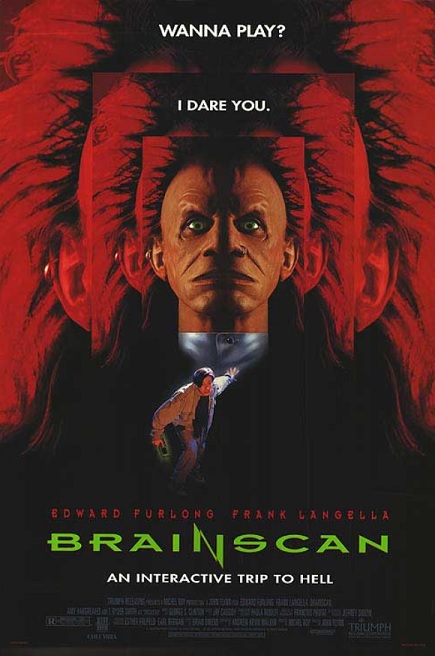
And we remember that movie, not so much for the fact that John Flynn directed it and “John Connor” starred in it, but that noted session musician and soundtrack composer George S. Clinton scored the film and made it sound like a Halloween sequel. Then there’s the fact that alt-rock and grunge was all the rage at the time, and this time, instead of rockin’ on Guns and Roses, John Connor was into (the cool, but second and third string Seattle bands) Mudhoney and Tad, as well as Butthole Surfers and Primus — and a really cool tune “Shapes” from a 4th string Seattle band, Alcohol Funnycar, and Philadelphia’s they-sound-like-they’re-from-Seattle-but-they’re-not-Nirvana Dandelion with “Under My Skin.”

Oh, and some screenwriter from Mechanicsburg, Pennslyvania, out in little ol’ Cumberland County — who wowed us with the noir-slasher Se7en (1995) and gave us the Cage in 8mm (1999) — wrote it. (Check out our “Nic Cage Bitch” career retrospective.) And proving that everyone has to start somewhere in the business: Andrew Kevin Walker’s first job in the business was as a scenic painter on (the utter abysmal) Robot Holocaust (1986). If you know your comics, then you know Walker’s place in the Marvel and DC-verses with his shelved adaptations for Silver Surfer and X-Men, as well as Batman and Superman.
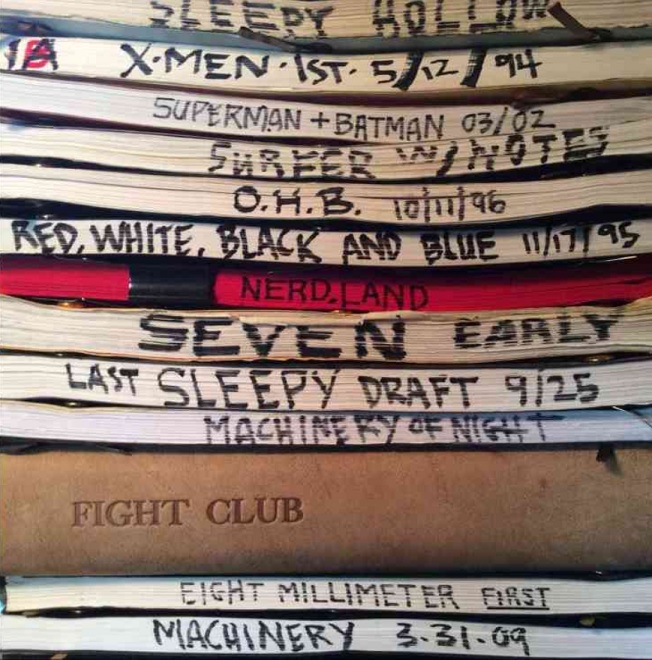
Boy, I can relate. Andrew Kevin Walker QWERTY’ing the midnight oil/image courtesy of The Fincher Analyst.

Okay, enough of the movie and music nostalgia. Now for the behind the scene turmoil.

In “John Flynn: Out for Action,” a 2005 interview by Harvey F. Chartrand for (the awesome) Shock Cinema, John Flynn offered his insights to the film:

“Frank Langella is a prince of a guy and a wonderful actor. He really nailed that character. Frank took what was a routine cop part and lent real depth to it. He played against the tough cop stereotype, played it very gently and softly, but there was a subtext of steel. His Detective Hayden character had a very human concern for the boy, but he was going to find the truth. If it meant the destruction of this boy, so be it.”

Okay, but what about Edward Furlong?

Eddie Furlong was a 15-year-old kid who couldn’t act. You had to ‘slap him awake’ every morning. I don’t want to get into knocking people, but I was not a big Eddie Furlong fan.”

And Andrew Kevin Walker’s script?

“The main interest for me was the Trickster character. The Trickster was the core of the movie and what attracted me to the script. We found this stage actor [T. Ryder Smith] to play the Trickster and he was extraordinary. . . . Walker had thoroughly researched that whole VR scene.”

And that sums it up: We’ve got a great, ominous-appropriate score by George S. Clinton (the whacked musical The Apple, Cheech and Chong’s Still Smokin’). A great soundtrack by then timely-hot grunge-and-not-grunge bands. A great, well-researched script by Andrew Kevin Walker (that gave him his start in the business) directed by John Flynn — in his first horror film — knocking it out of the park. And, as Flynn — and Shock Cinema’s editors pointed out — we have a great villain in The Trickster in T. Rider Smith as “a cadaverous Alice Cooper-like entity who materializes from a CD-ROM computer game.”

Regardless of the problems with Furlong on the set: I think he’s just fine, here (and really good in 1989’s American History X; if that movie was made today, yikes; people would go social media insane over it). But T. Ryder Smith? Just wow and a bag o’ chips. Not since Anders Hove as Radu Vladislas in Subspecies (1991). Sure, The Trickster isn’t a “vampire” in the traditional sense, but I can’t help think Walker was influenced by the Amicus and Hammer vampires of old, as our virtual reality “vamp” is draining the will — the soul — of the user. I see The Trickster as one of the best — right alongside Tom Cruise’s take of Lestat in Interview with the Vampire (1994) — in contemporary film vampires. Is there a little pinch o’ Pinhead from the Hellraiser (1987) franchise, here? Sure. And I always align The Trickster with Sammy Curr (a “backmasked” vampire, if you will) from the “No False Metal” classic Trick or Treat (1986) (now that’s a Groovy Doom Saturday Night Double Feature watch party: Brainscan and Trick or Treat). If Edward Furlong was an aspiring rocker or just a ne’er-do-well metalhead of the Eddie “Ragman” Weinbauer variety. . . .

There’s so much that Andrew Kevin Walker gets right in Brainscan: in fact, everything that the ancient future-cum-erotic thriller Disclosure (Sam and I both take it to task this week; look for them) gets wrong, Walker gets right. Sure, CDs and CD-ROM drives are passé — and you’d be hard-pressed to find a laptop with a CD-drive today . . . well, hell . . . The Trickster spinnin’ those disks on his long finger nails. Just damn. Demi Moore’s evil bitch has nothing on The Trickster. Snake Plissken rippin’ out the analog tape of a K-Mart Kraco cassette of the 1997, John Carpenter-mission-critical variety just ain’t the same. Walker’s script is the prefect amalgamate statement on the Gen-X counterculture’s obsession with rock music and horror movies — an already troublesome mix in itself — colliding with computers and its growing development of violent video games.

Micheal Brower isn’t that far removed from Eddie “Ragman” Weinbauer: both have absentee parents and spend their days in, well, the coolest bedrooms, ever: the kind that only exist in the movies. Only difference: Micheal is ye not plugged into devilish metal music, but the (then) burgeoning world of the Internet and computers — and enthralled by a new subset of that digital-verse: the digitally-created worlds of virtual reality programming.

A mother dead in a car crash. A kid with a permanently disabled leg. A father who escapes into his career. Bullies. One lone friend. And a hot, next door high school classmate that won’t give him the time of day. Childhood trauma. Abandonment. And just plain horny. Perfect pickings for The Trickster because, well, David Lightman is too smart for the VR scam and is starting WW III with a IMSAI 8080. And The Trickster’s already upgraded to a brainfucking Memorex Telex IBM/PC.

Only, Brainscan, the latest in video game technology, isn’t a video game: it’s a murder simulator, a program that encourages one’s most murderous impulses. And young Michael comes to discover: whoever dies in the game, dies in real life. And he’s killed best friend, but Michael’s mind is so scrambled, he doesn’t remember.

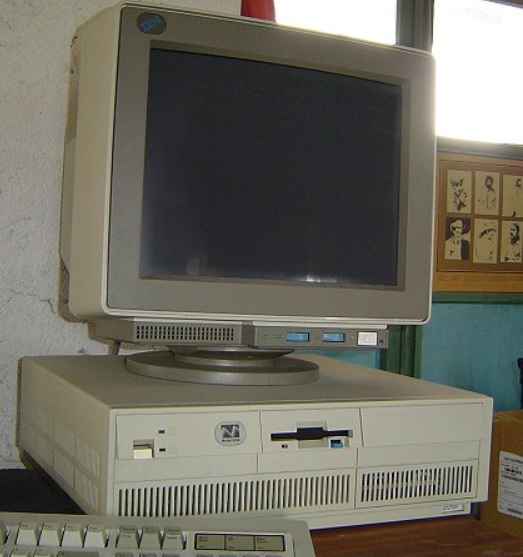
Courtesy of Mastodon PC.

The Trickster — what I love about Walker’s character development in ambiguity — is that we don’t know “what” the host of Brainscan is. As Proteus in Demon Seed (1977) before him, is The Trickster a sentient computer program turned flesh or, as with Max Renn in Videodrome (1983) before him, a manifestation of young Michael’s own needs, wants, vices, and desires? Or is The Trickster just a digitized Freddy Krueger who, instead of dreams, uses the information super highway-expressway into one’s skull?

It’s eerie how Andrew Kevin Walker foretells the forthcoming, 1999 Columbine tragedy — with that cauldron of violence spiced with the occult and satanic-panic — that associated the music of shocker-rocker Marilyn Manson and the industrial/goth bands KMFDM and Rammstein as underlying causes. Then there was the liberal reasoning that the home computer-based video games of Doom, Wolfstein 3D, and Duke Nukem were the causes. To that Columbine end: In addition to Walker effectively researching — and getting it right — the burgeoning virtual reality-verse, I wonder if the legal atrocities of the 1986 West Memphis 3 case, and the seminal British metal band Judas Priest “subliminal messaging” (via their 1978 album Stained Class) teens into murder and suicide, which also bit Ozzy Osbourne in the arse by way of the song “Suicide Solution” from his 1980 debut album, Blizzard of Oz, played into Walker’s screenwriting research.

Just a great film all around, Mr. Walker and Mr. Flynn. A true computer and alt-music time capsule. And a foretelling tale of our today’s online gaming and social media addictions. Beware of the true biblical beast. He’s waiting to plug into you.

Hats off for Sam the Bossman devising an “Ancient Future” theme week inspiring me to rewatch this debut work from Andrew Kevin Walker again, all these years later. And shame on me for not searching the B&S About Movies’ database to see that if we already reviewed this film — ugh, we did, courtesy of Sam back in June 2019, when Mill Creek appropriately double-packed Brainscan with another “ancient future” lost bit n’ bytes romp, Mindwarp (1992), from Fangoria Films/Magazine (!) starring Angus Scrimm and Bruce Campbell. (Ironically, The Trickster is a computerized version of The Tallman from Phantasm, right? Too bad T. Ryder Smith didn’t get a franchise out of this, as he is astounding in his role.)

There’s just too many movies to keep track of . . . and so many more to review. At least I caught myself before rehashing Mindwarp, for it ain’t no Brainscan, but it’s still pretty cool. You can watch Brainscan as a free-with-ads stream on the Crackle online service.

About the Author: You can read the music and film reviews of R.D Francis on Medium and learn more about his work on Facebook.

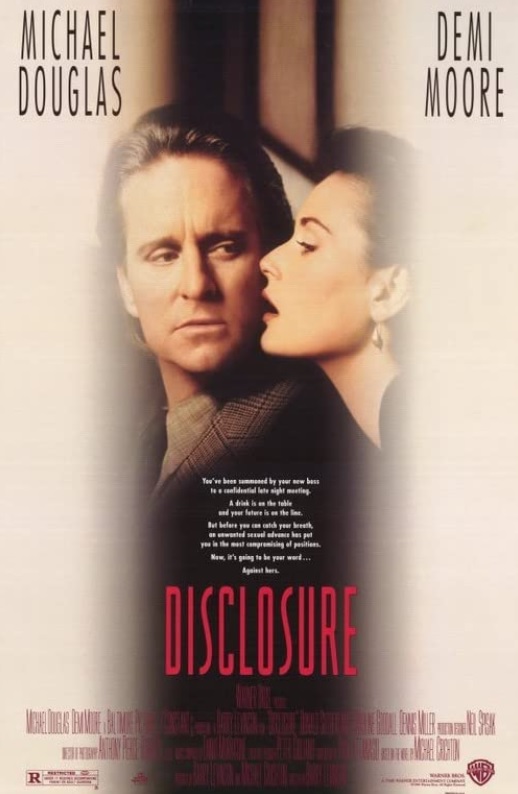
Disclosure (1994) and the Exploration of the “Erotic Thrillers” of the ’90s

When the net meets sex . . . you’re screwed.
— the tagline that never was

“A feather is sexy. A whole chicken is erotic. A rooster will get you into the kinky. Are you into poultry, Nick?”
— the greatest line Catherine Trammel never spoke

While the “video nasty” was our analog-rental de rigueur in the ’80s, it was the titillation of the psuedo-Giallo* and faux noir plotting of the “erotic thriller” that was our fashionable, digital-rental in the ’90s — and their bastardized, low-budget “after dark” soft-core variants of ne’er-do-well successful surgeons, kinked detectives, and tool-literate, hunky-handyman drifters were our required Cinemax/Showtime cable-viewing. Call those ’90s eroticisms what you will: a sexed-up ’50s detective thriller, or an ersatz-porn or a non-psychosexual Giallo of the ’70s, but the genre captured the creative pens of Hollywood and the contractual clauses of A-List talent agents. The first leading man to answer the call to . . . ahem, for the sake of keeping this review clean, we’ll just say, “arms,” for modern Hollywood’s new take on the likes of Double Indemity (1944) was Michael Douglas.

Double Indemity (1944) vs. Basic Instinct (1992).

Can you hear Micheal Douglas salivating Fred MacMurray’s line, “That’s a honey of an anklet you got there, Ms. Dietrichson,” as a widowed Barbara Stanwyck gives him a hint a vagina? Or Fred MacMurray substituting the p-word in lieu of “anklet,” as Babs remembered the anklet, but forgot the undergarments? Ain’t no men in the ’90s gazing at any anklets, baby: the days of Ricky and Lucy Ricardo and Rob and Laura Petrie bunking down in nightstand-separate twins beds are long since over: bring on the WAP. For these are the days that it’s societal acceptable for Cardi B. and Megan Thee Stallion performing a pseudo-lesbian stripper show on national network TV to mass applause and cheers and for musical tributes to the vagina to rise up the charts to Grammy recognition and acclaim.

During that short-lived sex-noir genre of the early ’90s — that crossed Antonioni’s Blow Up (1966) with Bertolucci’s Last Tango in Paris, while adding a soupçon of the Golden Age of Porn’s Deep Throat (1972) and a smidgen of Argento (the faux-noir detective had to start his sex-spiral, somewhere) — the son of Kirk Douglas (Saturn 3) was the crowned king of the bare-bottom courtesy of the one-two box-office hip-thrust of (the lighter fare) Fatal Attraction (1987) (and the amped-up) Basic Instinct (1992). But while Adrian Lyne and James Dearden’s sex frolic was a hit, Glenn Close’s (Ol’ pop, with his Austin Powers-imitation anytime it cable replayed: “It’s a man, baby!” and “What man in is his right mind would cheat on Anne Archer with Glenn Close!”) Alexandra “Alex” Forrest was no match for Sharon’s Stone’s Catherine Tramell — courtesy of that notorious Eszterhas-cum-Verhoeven scene in the police interrogation room. And ol’ Cat was no rabbit-boiling wrist-silting shirking violet: Cat was a full-on Giallo bi-ice picker possessed with Lucio Fulci’s and Umberto Lenzi’s eyeball trauma fetishism.

Ladies and gentleman: we have our blue-print for the “erotic thriller” of the ’90s.

Art department fail: they should have ran an image of a binary bits and bytes curtain in those dead white spaces.

And the pants fell and the legs opened with one Eszterhas-clone after another: Sea of Love (1989) (Okay, that’s more of the Fatal Attraction-variety, but Pacino!), A Kiss Before Dying (1991) (Argh! Don’t sex-remake noir classics!), Poison Ivy (1992) (Eh, if you’re into Drew.), Single White Female (1992) (Standards-and-practices lesbian lore), Color of Night (1992) (Bruce Willis begins his career spiral.), Consenting Adults (1992) (Alan J. Pakula? Dude, you directed Klute and The Parallax View, not to mention scoring Oscar gold nods three times? Why did you do it?), Sliver (1993) (Oh, Sharon, it does not strike twice; the worst of the bunch.), Body of Evidence (1993) (Oh, Madonna! Why, Willem Dafoe. why?), Indecent Proposal (1993) (Robert Redford? Don’t worry, Demi’s returning. . . .), The Last Seduction (1994) (The most underrated of them all!), Jade (1995) (David Caruso quit NYPD Blue, for this?), Showgirls (1995) (Eszterhas and Verhoeven return for a match-made-in-box office-hell.), Wild Things (1998) (Denise Richards ain’t no Sharon Stone.), and The Bondage Master (1996) (the no-one-knows Japanese V-Cinema classic that gets it oh-so-right and is the requisite B&S About Movies “erotic thriller,” if we must pick one.).

It’s curtains for you, Mr. Sanders!

But for this latest installment of one of B&S About Movies’ patented theme weeks — this week, it’s “ancient future” — we picked the third film of Micheal Douglas’s sexual triumvirate — and, if you’re keeping track: tres for Demi with Indecent Proposal and ShowgirlsDisclosure.

Oh, Hollywood, your fascination with the erotic was only matched by your kid-in-the-Radio Shack tomfoolery when you told us the Internet — with a single keystroke — could do anything. You warned of a world were hacks were as easy as a car service or food delivery app-touch away. It would be a world where the introverted and the shut-in; the malcontent bookworm and the bullied brainiac, would lord over the extroverts, telecommuting over phone lines and cyberpunking us as they open their hearts and souls on cyberchats to their digital lovers and digitally-ordered pizzas while us mere analog fools had physical sex and called-in our pepperoni pies.

For it was a time when the thumb drive was not a yet a twinkle in your Commodore 64-eye; it was an epoch-prediction that computer discs would become the linchpin of our existence; when CD-ROMs were lucrative; a world were malevolent hackers were out to erase identities and steal lives, manufacture rap sheets, alter job records, or murder you by infiltrating airline software and crashing your plane. Those who understood Basic HTML and navigated mainframes would master your domain!

Welcome to the world of Disclosure: a world where the clumsy erotic collides with the cyber stupid.

The Review

Tom Sanders (Michael Douglas) pines for a lucrative career promotion as the President of the CD-ROM division (which we now know: he’d be out of job, since you’d be hard-pressed these days to find a laptop with a drive), in lieu of his less-prestigious production line manager gig at DigiCom. Alas, when his company’s merger is about complete, everyone is shocked to learn that ready-to-retire founder Bob Garvin (Donald Sutherland) promoted-transferred the Malaysian-based Meredith Johnson (Demi Moore) — Sanders’s old girlfriend — to the Seattle main office for the job. And, in a role reversal that would never make it through the studio development stages in our post-#MeToo environs: she sexually forces herself on him. And when Sanders rebuffs the advance, her hell-hath-a-woman scorned response for career damage control is to accuse him of sexual harassment. And with a scandal of that magnitude jeopardizing the merger, “to hell with friendship” says Bob Garvin: he sides with Meredith because, it’s always money over friendship. Always. The fact that she’s incompetent and used cheap Malaysian slave labor to jam chips-by-hand instead of by-robot-arm into motherboards, which slowed down the production line stats for Tom and caused him to be passed over, well . . . Meredith is hot and Sutherland, we think, got a “boink” in the deal.

Tom Sanders is screwed . . . or is he?

Thanks to ’90s computer technology, he’s not.

He has DigiCom’s new Virtual Reality Database at his disposal: DigiCom is about to give us a world where we need keyboards no more; monitors are passe; touch screen and wireless technology never was. For now, we simply slip on a wired visor and pair of gloves to enter a digital cathedral of vaulted ceilings and virtual-lit transepts; a digital diocese with narthex after narthex of chambered file rooms rife with VR-cabinets that open with the glance of an eye and, if you’re lost amid the bites and bytes, you can call on an “Angel” to help you glide through the binary codes to save your ass and burn your foes.

Welcome to computer technology and corporate espionage circa 1994: a digital realm where tech giant DigiCom got so much so wrong and so much of what they developed is out out-of-date. There are the clunky mobile phones. The awkward navigation of an in-house e-mail application bogged down with jumbo-sized icons, a spinning “E” screen saver, and giant, unfolding envelopes every time you open an email. The inability — of a cutting-edge tech company that developed a VR-cathedral file cabinet — to trace anonymous emails — mails with espionage Intel that can jeopardize the company’s merger. Oh, DigiCom. How can a company so “cutting edge” develop VR-cathedrals, yet not improve on the design of giant CRT monitors? All this from a tech giant with engineers that decided ditching a WYSIWYG click-and-drag mouse-interface for a visor and gloves to retrieve files made perfect sense. No thanks, DigiCom. It’s Doug Engelbart’s mouse over Tom Sanders’s cathedrals for the win: I’ll just stick to the ol’ Windows Explorer directory tree.

Imagine if Sandra Bullock had to go through all of this VR-catherdal hokum to order a pizza when that HMTL-world she mastered became ancient history future.

Wow, now I’m hungry! Time for me to slip on my brain-computer interface (from Douglas Trumbull’s Brainstorm**) and jam-a-chip into the back of my head (à la Circuitry Man**). I need to order food for my chess date with Hal. Oh, that reminds me: I better log onto the IBM terminal and invite Colossus over (from Colossus: The Forbin Project). Yeah, ol’ Cal already knows, it’s just a social (media) formality.

* We LOVE our Giallo at B&S About Movies, which we blew out in grand style with our “Exploring: Giallo” examination, rife with our reviews to over 70 films. We also discuss ol’ Hal and Colossus, and their “ancient future” brethren, with our “Drive-In Friday: Computers Take Over the World” featurette.

** We’re unpacking Brainstorm and Circuity Man this week.

About the Author: You can learn more about the writings of R.D Francis on Facebook. He also writes for B&S About Movies and publish music reviews and short stories on Medium.

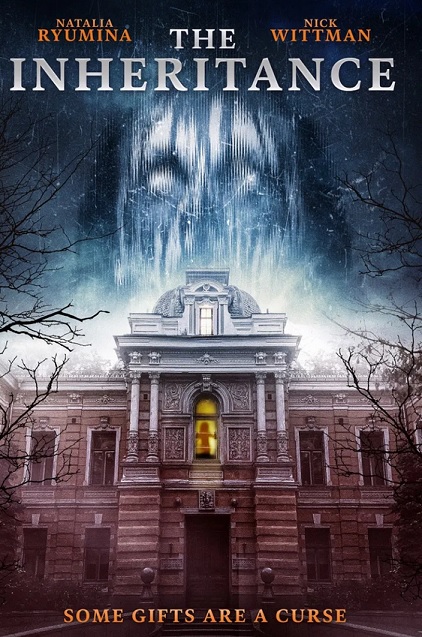
The Inheritance (2021)

Editor’s Note: As of August 2021, you can now watch The Inheritance as a free-with-ads stream on Tubi. As of Winter 2022, it’s appearing on several, U.S.-based Smart TV channels as a free-with-ads stream.

The most enjoyable aspect of today’s indie-streaming films (they’d be direct-to-video back in the analog days of VHS and DVD) and indie distributor shingles like Uncork’d Entertainment is that U.S. audiences are treated with European films — this one from the Ukraine (in English) — that we would otherwise not see on U.S. theater screens and most likely miss on the shelves of our local, back-in-the-day Blockbuster Video.

As with most indie streamers, the budget on this haunted house horror is tight: $500,000. Unlike most indie streamers, the creative team behind it is not of the usual, inexperienced, first-timer variety not adept with the Canon Reds — or shooting on iPhones. As a producer, Chad Barager brought us The Woods (2013), Dark Harvest (2016), and Bitter Harvest (2017); here, Barager makes his feature film writing and directing debut. His co-director and writer, Kevin Speckmaier, has worked as an assistant director on TV’s syndicated Highlander (loved it), USA Network’s The Dead Zone (again, plus Anthony Micheal Hall is great in it), and numerous Lifetime and Hallmark movies (a couple of those cherished B&S About Movies X-Mas flicks). The Inheritance also serves as his feature film debut in the writing and directing chairs.

Latvian-born Natalia Ryumina is a multilingual British actress (including Latvian, Russian, and Ukrainian), who we’ve haven’t seen much on U.S. streaming shores, but amid her 20-so film and decade of credits, you may have seen her best known film, Soldiers of the Damned (2015). American (Indiana) born Nick Whittman made his business bones as a stuntman and transitioned as an actor with the National Geographic/FX series Mars (2016 – 2019); The Inheritance is his leading man debut. (Do you have Apple TV? You can watch Mars for free on that platform.)

So, with that front-of-and-behind-the-camera-pedigree, it’s not a surprise that The Inheritance walked away with a “Best Actress Award” for Natalia Ryumina at the 2020 Paris Art and Movie Awards: for an actor is only as good as the script, the film, and the other actors around them. It’s a tale about Sasha and Peter as they head off to Europe to collect on Sasha’s inheritance: a regal mansion. She soon comes to discover dark family secrets of the paranormal variety in her Ukraine family manor’s walls.

And that’s all I have to say about that, Forrest. This is that one time I am not plot-spoiling the beats. Just watch his film. I loved it and just can’t spoil this one, not this time.

The Inheritance premiered at the Catalina Film Festival on September 18, 2020. You can watch The Inheritance On-Demand and DVD in North America on April 13, 2021 from Uncork’d Entertainment. Producer Firepower Entertainment also gave us the five-episode mini-series Chernobyl (2019) staring the always welcomed Jared Harris and the always great Stellan Skarsgard.

Disclaimer: We were provided a screener by the production company’s P.R firm. That has no bearing on our review.

About the Author: You can learn more about the writings of R.D Francis on Facebook. He also writes for B&S About Movies and publishes short stories and music reviews on Medium.

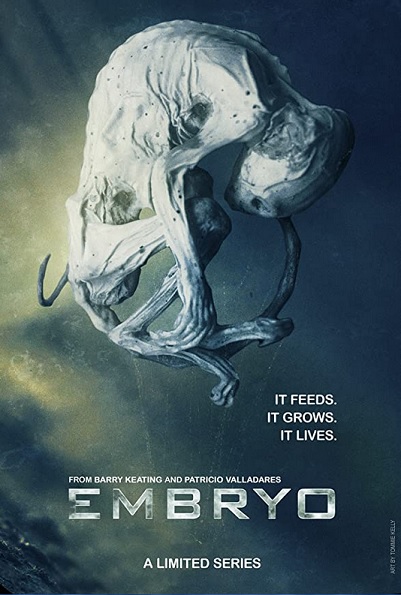
Embryo (2021)

We’ve been receiving a lot of great streamers from South America, as of late. The animated apocalypse of Lava and retro-apoc’in of Scavenger, both from Argentina, really impressed us with their up-against-the-budget class and style. Now we have this Chilean import, shot in Terman de Chillan , that we are grateful Uncork’d Entertainment imported without dubbing, leaving the Spanish intact (with English subtitles).

While The X-Files and The Blair Witch influences are obvious — as well as H.P Lovecraft (see Nicolas Cage’s Color Out of Space) — in this sci-fi horror tale, this latest offering from director Patricio Valladares (the 2011 actioner Toro Loco and the 2012 horror Hidden in the Woods; 2016’s Vlad’s Legacy and 2017’s Robert Englund-starring Nightworld) is not the least bit trope-ridden.

Sure, you’ll reflect on Alien, with its xenomorph impregnation, but since this is B&S About Movies, and this Chilean effort is a low-budgeter, we’re leaning to the sloppier-gooey Inseminoid as our comparison. And there’s a little bit of Cronenberg’s “body horror” flicks injected as well. Valladares efficiently pulls his tale together as a semi-film-cum-SOV camcorder “found footage” narrative that presents an alien abduction portmanteau of three alien-abduction tales. The creator behind Embryo is Barry Keating, a writer who gave us a pretty cool Euro-shot, Monty Markham sci-fi’er, The Rift (2016).

Campers in the Chilean countryside woods of Snowdevil Mountain, known for its extra-terrestrial mysteries, run afoul of otherworldly beings; one of the beings abducts and impregnate Kevin’s girlfriend, Evelyn. As her “child” rapidly grows inside her, the need to satiate her lust for flesh and blood grows, in kind. When she attacks a doctor, Kevin takes Evelyn on the run — and tries to unravel the “found footage” mystery, with a cop investigating the disappearances and rapes on their trail — as they try to find someone to remove “the thing” that’s taking over her body and mind. Tentacles and alien semen caressing human bodies, and flashbacks from 2020, to 2008, to 2012, ensues — with Patricio Valladares accomplishing a lot on very little.

You’ll be able to stream Embryo as a VOD or purchase as a DVD and Blu-ray in North American via Uncork’d Entertainment on April 6, 2021.

Disclaimer: We were sent a screener by the distributor’s P.R firm. That has no bearing on our review.

About the Author: You can learn more about the writings of R.D Francis on Facebook. He also writes for B&S About Movies and publishes short stories and music reviews on Medium.

Dawn of the Beast (2021)

I think I can also speak for Sam that, when we were in college (remember those days, Sam), the last thing on our minds was going into the woods to look for aliens or hairy rugs of the Bigfoot variety. High School was a bitch for us both and college was a weekly proctological exam. So what in the hell is with the ne’er-do-well kids with all the free time to curiosity seek in the woods? Yeah, we know: their thesis paper, etc., bla, bla, and yada, yada. Which is why Sam and I leaned towards the artistic: both visual and written. No cramming on law journals or dissecting or field trips. It was art tables and typewriters and radio studios for us. For nature outside: bad. VCR movie-womb room (with turntables and vinyl): good. And thanks to those VCR binges, we know better: going to the woods in a cabin with friends for an isolated vacation, well, you just end up possessed. Or infected. Or dead. Or worse.

So here we are. And it’s real.

We dig Bruce Wemple, who gave us a pretty cool pair of wooded-mystery steamers with Monstrous (a Bigfoot) and The Retreat (an Indian-myth Wendigo). And he’s giving us a double-dose in Dawn of the Beast. So, it’s sort of a sequel-trilogy. It’s like those ongoing Kaiju movies of old, with one film building onto another, with a creature from one film tag-teaming in the next, as the films keep getting bigger and better as they progress.

In the streaming-21st century — with the Canon Reds and other digital devices — it’s the slasher ’80s all over again. In either era: You’re a new-to-game filmmaker who wants to tell stories. You don’t have the budget to “go big” like the big studios, with fancy sets and props. So, you head off into the woods: the sets are cheap and bountiful. And Wemple uses those wooden environs to his advantage with a skill-set that always gives us an engaging story.

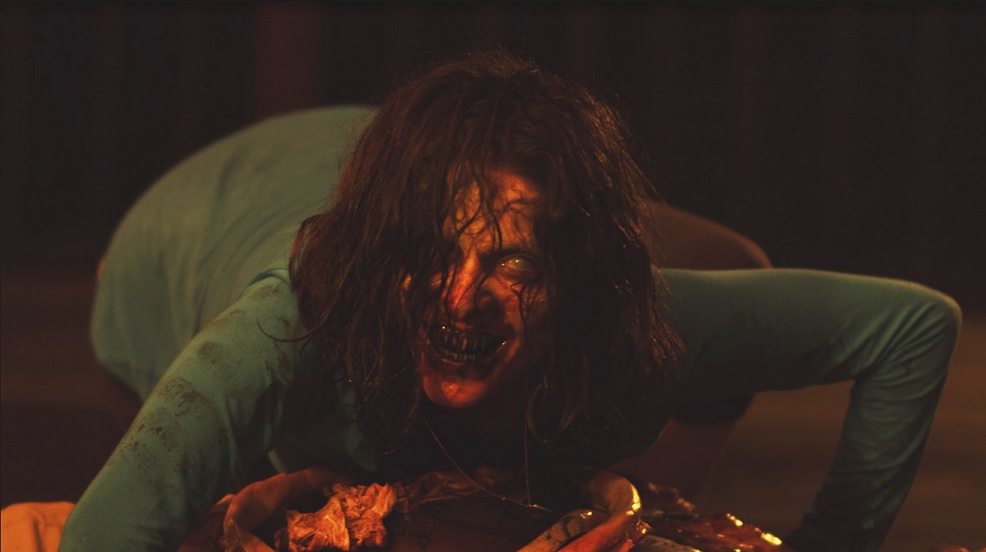
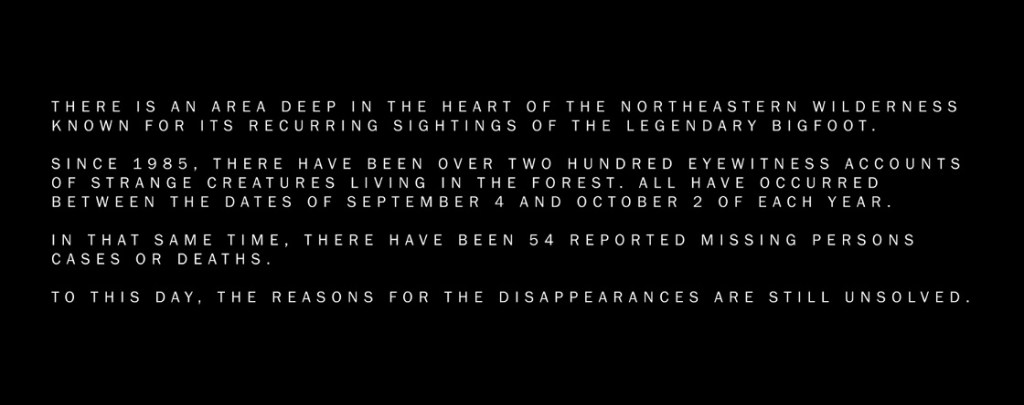
So, those students with their Bigfoot obsession head off into the Northeastern wood, known for its “strange creature sightings,” natch. And the “strange creatures” are double the terror: our Mystery Machine gang not only runs afoul of Bigfoot, but the spiritual Indian creature, a Wendigo. The ancient creature, wooden battle royale, with the kids caught in the middle, ensues (oops, lazy writing, again!).

As you can tell from the film stills, Bruce Wemple has really upped his game: the makeups and effects are against-the-budget stellar. Wendigos, Bigfoots, and Raimi demon possession. Oh, my! Auntie Em! Toto!

Good stuff, once again, Mr. Wemple. Keep ’em comin’!

While we didn’t officially review either for the site, be sure to also stream Wemple’s two previous, upper New York State-based indie-features, After Hours (2016) and Lake Artifact (2019). The welcomed and dependable Anna Shields, who starred in those two films, as well as Monstrous, stars — and pens Dawn of the Beast. Her co-star, Grant Schumacher, also returns from Lake Artifact, Monstrous, and The Retreat. Needless to say, they’re excellent, as always.

Uncork’d Entertainment will release Dawn of the Beast to digital platforms and DVD on April 6, 2021.

Disclaimer: We were sent a screener by the distributor’s P.R firm. That has no bearing on our review.

About the Author: You can learn more about the writings of R.D Francis on Facebook. He also writes for B&S About Movies and publishes short stories and music reviews on Medium.

Virus, aka Day of Resurrection (1980)

If you’re a fan of Asian cinema from Japan, then you know the name of Kinji Fukasaku. In addition to directing the Japanese portion of the Hollywood war film Tora! Tora! Tora! (1970), he directed Toho’s Star Wars hopeful, Message from Space (1978), and the controversial and influential—and his final film—Battle Royale (2000).

After the international failure of Message from Space, Fukasaku set off to make what he hoped would be his masterpiece: an apocalyptic epic based on Sakyo Komatsu’s best-selling novel Fukkatsu no hi, aka Day of Resurrection, intended to rival the likes of Hollywood’s A-List apocalypse pieces such as Soylent Green and The Omega Man and Irwin Allen-styled disaster films such as Earthquake and The Towering Inferno. Westerners—courtesy of their film adaptations—may also know Komatsu’s best-selling Eastern novels Japan Sinks (1973) and Sayonara Jupiter (1982), which were turned into the disaster films Tidal Wave (1973; the U.S. cut featured Lorne Greene from Earthquake) and the space opera Bye, Bye Jupiter (1984). (You may recall Tidal Wave was Roger Corman’s Americanized cut of Japan’s highest-grossing film of 1973 and 1974, Nihon Chinbotsu, aka Submersion of Japan, aka Japan Sinks!, from Komatsu’s best seller.)

Upon its release, Kinji Fukasaku’s Virus was the most expensive film Japan ever produced—at $16 million U.S. It was also one of the country’s biggest box-office failures: even more so than Message from Space.

To make a return on their investment, Toho decided that the film needed to cast familiar western actors—albeit from Hollywood’s B-List—alongside their homeland’s familiar actors to successfully break into the Western markets of Europe and the United States. So an English-speaking international cast featuring Chuck Connors, Glenn Ford, British actress Olivia Hussey, George Kennedy, an up-and-coming Edward James Olmos and Canadian actor Nicholas Campbell, Henry Silva, Bo Svensen, and Robert Vaughn was assembled to star alongside Sonny Chiba and Masao Kusakari. Not only was the cast of an international persuasion, the film was shot on-location, not only in Tokyo, but in various locations in and around Ottawa, Canada, and Halifax, Nova Scotia. The film was supported by the Chilean Navy (Olmos stars as Russian-speaking Chilean), which lent their submarine the CNS Simpson for the production, as did the Canadian Navy, which lent out their submarine the HMCS Okanagan (Connors stars as a British naval officer).

The original cut of the film, which played in the Pacific Rim territories and was intended to play internationally, clocked in at 156 minutes (2 hours and 36 minutes). The film, of course, heavily features Sonny Chiba and Masao Kusakari, as their characters developed during the course of the film through a series of pre-apocalypse flashbacks to their earlier life.

Say it was too long; say it relied too heavily on its Japanese stars; or say that the film’s “blaming” the U.S. and other Western countries for unleashing a deadly pandemic—then nuclear devastation—upon the world was a tad too realistic (the scenes depicting marital law and infected bodies burnt in piles are undeniably dark) and not the dumbed-down Irwin Allen disaster epic with a happily ever after ending that Hollywood was expecting. And there was no way Hollywood was putting a two and a half-hour epic*—filmed mostly in English-subtitled Japanese—into theaters. So, instead of a full, worldwide theatrical release, the majesty of Kinji Fukasaku’s to-be crowning cinematic achievement was cut into a syndicated television version that ran at 108 minutes (1 hour 48 minutes). There’s also a third, shorter TV version that runs seven minutes shorter at 101 minutes (1 hour 41 minutes).

The missing 48 minutes eliminates all of the Tokyo-based flashbacks and most all of the scenes that take place at a remote, isolated Japanese station—which conveniently eliminated all of the English subtitled Japanese. While the 156 minute cut is the suggested watch—which finally seen an official U.S. DVD release in 2006; the original cut is also part of the Sonny Chiba Action Pack—you’re better off, of course, if you can only get a copy of the TV version, watching the longer of TV 108-minute cut. Sadly, the U.S. TV versions—which are now in the public domain on cheapjack DVD sets—reduce Sonny Chiba and Masao Kusakari from the “stars” of the film to peripheral characters; a heart-wrenching scene with the Japanese station making a contact with an orphaned U.S. child begging for help, is lost; Kusakari’s epic trek from a decimated Washington D.C.—which he and Svenson’s soldier tried to stop—is also deleted, which also cuts another great scene with Kusakari carrying a conversation with a burnt-out skeleton—and Jesus Christ on a cross—in a church. And whole scenes are also rearranged, most notably with Chuck Connors’s naval officer’s part not only reduced, but appearing in different parts of the film, depending on the cut you watch.

So, yeah, we’re telling you to watch the original, “too bleak for the U.S.” theatrical cut as Kinji Fukasaku intended. And it’s important to take into account that this is all pre-CGI and shot with practical in-camera effects and seamlessly incorporated stock footage, but those effects—wow, especially those showing the world’s devastated cities, including an overgrown nation’s White House—are stunning set pieces. And if you take the time to watch the original—and are able to, considering our current COVID circumstances, digest a film about a global pandemic unleashed by man’s own greedy stupidity—you’ll agree this is one of the best—if not the best—post-apoc movies you’ll ever watch**.

In a timeline that runs from the year 1982 to 1988, the apocalypse begins as East German and American scientists bicker over the deadly MM88 virus—a virus that absorbs and amplifies other viruses, making them more deadly. Of course, its creation was “accidental,” and it was stolen from a U.S. lab. Successfully recovered, the plane transporting the virus to the states, crashes, and what becomes known as the “Italian Flu,” is unleashed. Oh, and a goody-two shoes lab tech that discovered the truth behind MM88 is murdered to keep it all quiet. (Sakyo Komatsu’s based his book’s “Italian Flu” on the Spanish Flu pandemic of 1918 to 1920, which started in Kansas, USA.)

In a mere seven months, most of the world’s population is dead—and eventually claims the lives of Glenn Ford and Robert Vaughn (starring as the President and VP). Henry Silva (Silva, Ford, and Vaughn are excellent) is their paranoid-mad military Chief of Staff insistent that the new ARS Defense system must be armed to protect a now weakened America from a Soviet invasion. And being the crackpot that he is—after his bosses are all dead, he arms the system just before the flu claims his life.

Seven years later, all that’s left of humanity is 855 men and eight women at Palmer Station Antarctica, as the virus can’t survive in temperatures below 10-degrees Celsius. Their somewhat peaceful existence (women are forced into sexual servitude to propagate the species) is upended when it’s discovered the Soviets also have—and armed—their own ARS system: and one of the missiles is aimed at Palmer Station (because it’s a “secret military base”). Then, if the virus and the threat of nuclear war isn’t enough, the station’s seismological team discovers an earthquake will hit the U.S. eastern seaboard—and the magnitude of the quake will be interpreted by the ARS system as an “attack” and launch its rockets.

So, Bo Svenson’s Major Carter and Masao Kusakari’s Dr. Yoshizumi head off to Washington D.C. on an icebreaker to shut down the ARS. Only they’re too late: the earthquake hits and the U.S. ARS launches—and Carter dies in the earthquake rubble. Then the Soviet’s ARS counterstrikes. The world is destroyed.

And that’s how the TV movie version ends.

The theatrical version continues—with those extra seven minutes cut from the 108-minute TV version—as Yoshizumi treks south across the wastelands back to Tierra del Fuego, Antarctica, where the Earth’s final survivors—from the ocean-bound ice breaker, escaped, and successfully created a vaccine.

As far as this reviewer is concerned: Kinji Fukasaku, in fact, created a masterpiece. And, if you’ve spent any amount of time on the digitized terrains of B&S About Movies and are familiar with the later, collective schlock ‘80s resumes of Chuck Conners (Tourist Trap), George Kennedy (Top Line), Henry Silva (Megaforce), Bo Svensen (Night Warning) and Robert Vaughn (Starship Invasions), you’ll realize that they’re all very good here—and Virus gave them their last great film roles before the Italian and Filipino film industries got their low-budget hooks in them. (Nicholas Campbell and Silva later worked together on the Canux-slasher Baker County, U.S.A; Campbell was “Luke Skywalker” in the Canux-star slop that was The Shape of Things to Come; Olivia Hussey ended up in things like Ice Cream Man.)

You can watch the full-length director’s cut courtesy of Tubi. You can watch-compare to the U.S. TV version on You Tube and the VHS version on You Tube.

* We discussed, extensively, those epic “intermission” films of the ‘60s and ‘70s in our review of the 2021 release of the Australian film Rage.

** We discuss a few of our ’70s apoc favorites with our “Drive-In Friday” tribute to Hollywood’s A-List Apocalypse. Then there’s . . .

Our two part blow out on “end of the world” films.

About the Author: You can learn more about the writings of R.D Francis on Facebook. He also writes for B&S About Movies.

Robot Wars (1993)

Charles Band is one to never keep a good robot down — not when he laid out several million bucks to create his first robot-verse romp in 1989. So the anime-inspired mechs that we know and love are back, along with an all-new, never-seen-before mech: the Lucasian-inspired AT-AT that is MRAS-2, which resembles a mechanized scorpion.

Now, if you read our reviews for the they’re-not-sequels Robot Jox and Crash and Burn (both reviewed this week), then you’re up to speed on the all-over-the-place timeline of the Band-verse that our poly-carbon alloy friends operate in. Adding to the confusion: In the overseas markets, courtesy of the U.S. home video promotional one-sheets touting the tagline: “First, there was Robot Jox . . . ,” this third installment of Band’s live action anime-mechs is known in the overseas markets as Robot Jox 2: Robot Wars. Yeah, we know. Crash and Burn was Robot Jox 2: Crash and Burn in the overseas markets. So, why not suffix Robot Wars with a 3?

Oh, ye poor B&S reader. Why are you overthinking a movie with a giant scorpion robot?

And speaking of overthinking: While Robot Wars takes place eleven years after (in 2041) the events in Crash and Burn (set in the year 2030), this isn’t the future-continuation of that timeline. In fact, the world — instead of being devastated by a nuclear war as depicted in Robot Jox, and the world economic collapse due to man’s dependence on technology ballyhooed in Crash and Burn: now the North American continent was devastated by “the great toxic gas scare of 1993” that’s left large parts of the former United States a barren, desert wasteland. (You know, the same desert wasteland Parsifal, Bronx and Ratchet drove across on motorcycles to the Eurac-backed Big Apple, aka Arizona, U.S.A.) Oh, and let’s not forget the great robot ban of 2015 that decommissioned all the battlebots. (Uh, oh. Are we pinching from Damnation Alley, here? Remember that ’70s post-apoc’er had giant scorpions raised on radioactive fallout.)

And Band changed the sociopolitical backstory, yet again. Gone are the U.S.-led Common Market and the Russian-bred Confederation. And it seems the Independent Liberty Union foiled the tech-oppressive Unicom Corporation. Now, the New World Order is known as North Hemi, which assimilated the United States. The opposing side is the Eastern Alliance. And, at one time, the Hemis and the Alliancers had at it out with their now extinct 120-foot mechs we know and love, hence the great robot ban of 2015. (Uh, oh. Are we pinching from Francis Ford Coppola’s Battle Beyond the Sun? Remember that Corman-hatchet job of the superior Russian space epic Nebo Zovyot (1959) was rewritten by Frank, set in the year 1997 with a world divided into North and South Hemi governments.)

Sadly, all that is left of the once ubiquitous war machine mega-robots is the MRAS-2 scorpion-styled robot, now reduced to being tourist attraction that transports civilians across the wasteland — but still carries a full weapons complement, complete with a laser-tipped tail. Ah, but this isn’t just another wasteland tour: Wa-Lee, an Eastern Alliance dignitary is on board, on his way to negotiate a trade agreement with the North Hemis to manufacture a new line of “mini-megs” for the Eastern Alliance. (Although Danny Kamekona is the only actor from the franchise to act in two of the three Robo flicks, he’s a different character in each.)

That trade agreement is jeopardized when it is discovered the terrorist-based Centros, desert bandits who attack North Hemi transports, are now backed by Eastern Alliance sympathizers. As the story develops, it’s learned that Wa-Lee, and Drake, our Plissken-styled MRAS-2 pilot (Don Michael Paul; he’s since written and directed sequels in the Jarhead, Sniper, Tremors, and Death Race franchises) were once friends, but now enemies. Their animosity boils over when Wa-Lee, with the support of the Centros, hijacks the MRAS-2 and holds its passengers hostage. And with that, Drake faces his fears and climbs back into the cockpit of a reactivated MEGA-1 for some battlebot action. Oh, and a pretty cool, double-turret laser tank (right off the cover of David Drake’s 1979 paperback Hammer’s Slammers) shows up. However, also showing up along the yellow-plotted road is the Bogie and Bacall-styled romantic bickering between Don Michael Paul’s Han Solo-esque scoundrel and Barbara Crampton’s (Re-Animator) Leia-inspired archeologist who helps him resurrect the thought lost MegaRobot — that digs itself out of its subterranean grave in an impressively executed effect.

Yeah, but just a little too late with the effects there, Chuck.

Charles Band was really onto something special with Stuart Gordon’s Robot Jox. Then he fumbled the ball with his two they’re-not-sequels and got ass-smoked by Toho Studios’ hell-of-a-lot-more fun, GUNHED (1989). And team Band (Charles produced while pop Albert directed) most likely realized that fact, as their fourth not-a-sequel, Battle Jox — featuring giant dinosaur-styled robots — was cancelled. (Thank the Lords of Kobol for saving us from that feldercarb. In what logic-verse would man build dinobots, except for some lame-ass toyline for kids 9 and under.)

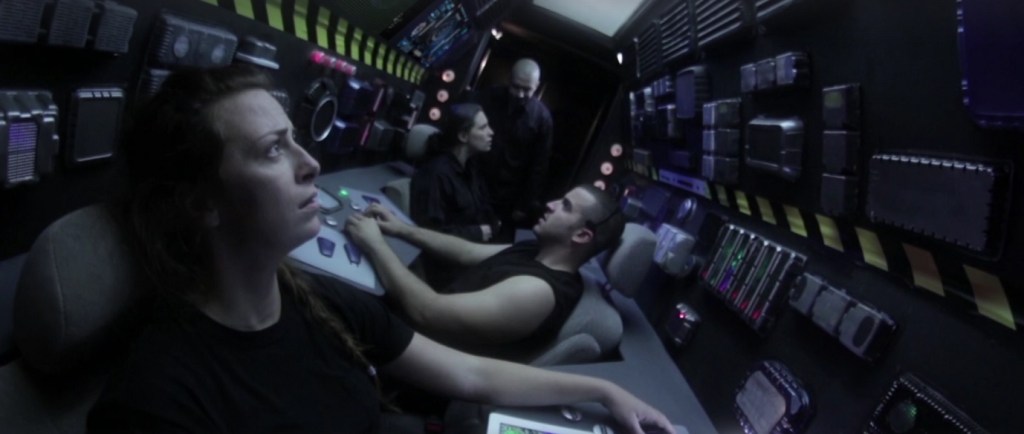
Dave Allen and Jim Danforth really knocked it out of the park with the newly-added Scorpion robot. Double for the special effects team of Greg Aronowitz and Rob Sherwood who designed the robot cockpits. The plate work is also top notch in depicting the rocking of the passenger cabin/cockpit against the landscapes as the scorpion walks. (The VHS has a great documentary vignette — void from the later DVD presses — that explains/demonstrates the plate processes of the film.) It’s when the proceedings get outside of the cockpit — with the Paul-Crampton romancing, Lisa Rinna’s journalist investigating the nefarious goings in the metropolis of Crystal Vista (aka old Los Angeles), and the sociopolitical rambling — that it all goes to feldercarb. Is the third act here, yet? Can we please just get to the robot battle we came for in the first place?

While you’ll notice the Full Moon prop and costume department raiding throughout the film (that looks like leftovers from Spacehunter: Adventures in the Forbidden Zone and Metalstorm: The Destruction of Jared-Syn to me; reviews coming for both, look for them), the proceedings are of the oh-so Buck Rogers plastic-verse variety to the point you’re wondering when a (bitchy-Season 1) Erin Grey or (pudgy-Season 2) Gil Gerard will show up. But we’re grateful for iconic Asian actors Danny Kamekona and Yugi Okimoto bringing their A-Game and selling the silliness with gusto. (They both appeared together in The Karate Kid Part II (1986); along with Don Michael Paul, they also appeared in Aloha Summer (1988).)

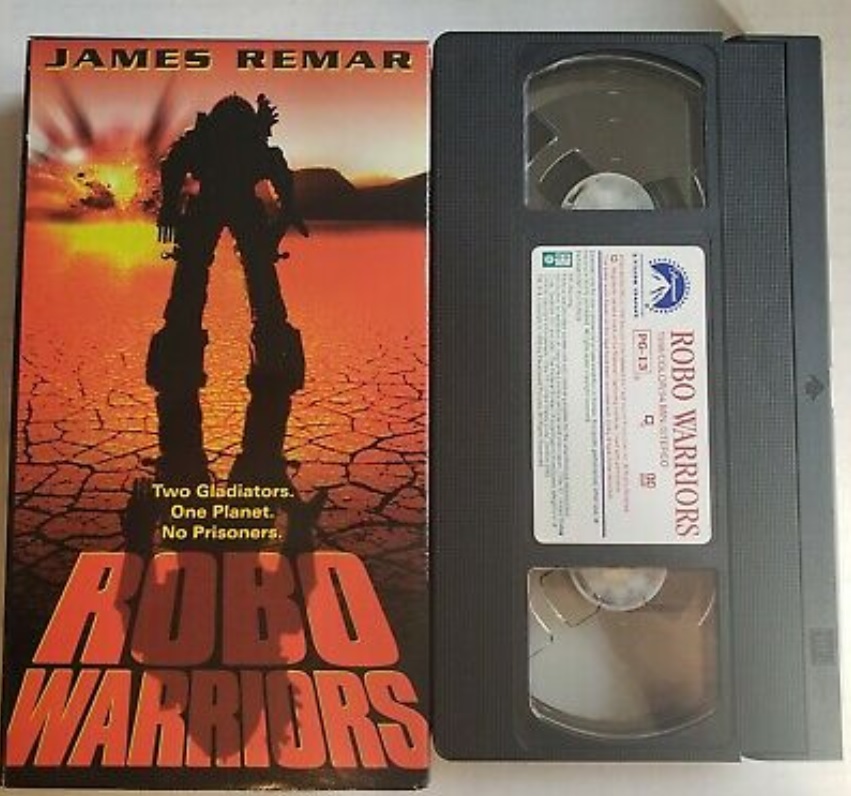
As with its sister films, VHS copies are bountiful in the online marketplace, with the first DVDs issued in 2007 as part of the Full Moon Classics: Volume Two disc set, and then the Full Moon Features: The Archive Collection, with 17 other Full Moon titles. Robot Wars is also double-featured with Crash and Burn on a Shout! Factory DVD issued in 2011. Blu-ray’ers can pick the Full Moon single-movie version issued in 2017. Question is: When are we going to get a three-pack set proper — complete with the VHS documentaries restored?

You can enjoy Robot Wars as a free-with-ads stream on Tubi. Here’s the TV promo spot to get you started.

What this? A fourth Robo flick? You better believe it

About the Author: You can learn more about the writings of R.D Francis on Facebook. He also writes for B&S About Movies.

Crash and Burn (1990)

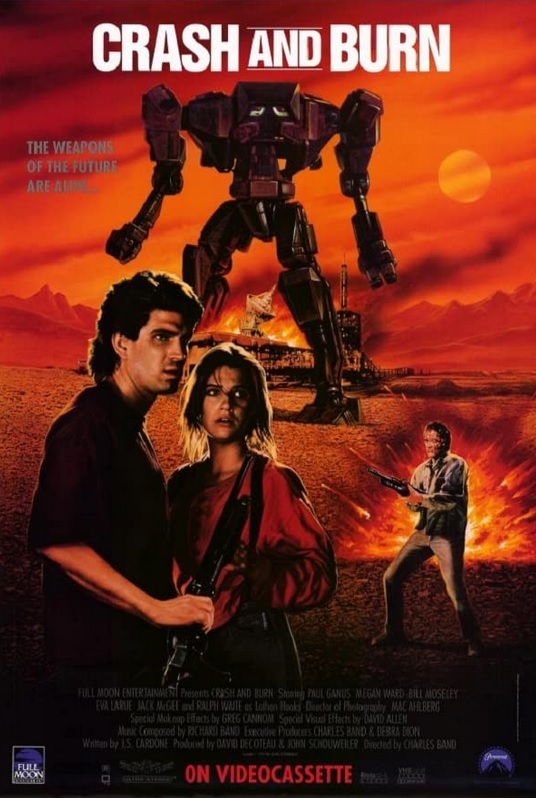
This sequel-but-its-not-a-sequel to Robot Jox — marketed in the overseas markets as Robot Jox 2: Crash and Burn — unlike its predecessor, foregone a U.S. theatrical release and went straight-to-video. As with Roger Corman creating Forbidden World and Space Raiders for the sole purpose of not so much to tell a compelling story, but to maximize his $5 million dollar investment in Battle Beyond the Stars by recycling that dopey Star Wars cash-in’s sets and special effects, Crash and Burn recycles the impressive Dave Allen and Ron Cobb stop-motion animated robots from Robot Jox. Just don’t hit the big red streaming button with the expectations of another anime-mech battle of the robots: at its core, Crash and Burn slaps a sci-fi coat of paint on the plot of Friday the 13th, with that film’s supernatural, woodsy killer, replaced by a James Cameron-inspired, unstoppable, synthetic desert killer.

Why is the tagline “The Weapons of the Future are Alive” in grey-against-red: you can’t read it. Why not go with a black typeset-against-orange?

To make sense of this new, its-not-a-sequel Band-verse: Let’s assume that the post-fifty years-after-the-nuclear war new order created by the two, new world superpowers from the Robot Jox timeline — the Common Market and the Confederation — suffered an economic collapse. That, coupled with the world ravaged by the greenhouse effect and an out-of-control sun creating “Thermal Storms,” allowed for the rise of the powerful Unicom Corporation controlling the world’s marketplace. Blaming the economic instability and collapse on the world’s technological dependency, Unicom banned all human usage of computers and robots. (In this new-verse, the mech-robots were develop for mining operations.)

While we have a pinch of The Terminator here, you’ll also notice an Orwellian pinch of the influential, “ancient future” novel, 1984, with scattered pockets of citizenry operating the “Independent Liberty Union,” a loose resistance movement in authoritarian opposition. One of the last free-speech strongholds against the corporate rule is a battered, over-the-air Public Access television station housed in an abandoned industrial facility, operated by Union sympathizer Lathan Hooks (Ralph Waite of TV’s The Waltons), a one time media executive who moonlights as a revolutionary. And, in a pinch from Alien — if you remember that the Weyland-Yutani Corporation infiltrated the Nostromo’s human crew with a cyborg to harvest alien eggs — Unicom manages to plant Quinn (a great Bill Mosley of Dead Air), a Sythnoid-cyborg operative (he’s the station’s Chief Engineer) among the station’s staff to kill Hooks and shutdown the station.

Keep your eyes open for the great work by a familiar cast of characters actors: John David Chandler of Drag Racer is a scruffy-creepy gas station owner; ubiquitous TV and film character actor Jack McGee (Brad Pitt’s Moneyball) is a slobbering talk show host; Megan Ward of Encino Man is Waite’s granddaughter and studio engineer; a perfectly-stoic-for-the-role Paul Ganus is very good in an early role (and one of his few leading-man roles) as Tyson Keen, a Unicom fuel courier who takes up the with TV station-based rebels after his departure is waylaid by a thermal storm.

For a Charles Band production-edict patched together by producer David DeCoteau (Sorority Babes in the Slimeball Bowl-O-Rama) with a script by J.S Cardone (The Slayer, Outside Ozona), the production quality is high (courtesy of Band’s inventive repurposing of a rusted processing plant that reminds of Ravagers similar against-the-budget architectural redeployment). In addition, the acting on all quarters is solid, Band’s direction is tight and suspenseful, and Cardone crafted an interesting “ancient future” by way of convincing techno-speak and a well-fleshed sociopolitical backstory for a nicely-layered twist to its Alien-cum-Terminator-cum-Friday the 13th plotting. And while the Dave Allen 120-foot robot we came for doesn’t show up until the last throes of the third act, Cardone and Band earn bonus points for — instead of putting the words “July 2030” on the screen to advance the plot, they made a sensible, creative choice to have John Davis Chandler’s character swat a fly that lands on a dated calendar. And, instead of a text scroll or voiceovers (the bane of my screenwriting existence), they have Ganus’s Unicom courier watch Waite’s newscast on a television in the gas station to get us up-to-speed as to “the future” of Crash and Burn. (And since this is all in the Full Moon family: Ted Nicolaou, the director of the studio’s Bad Channels, The Dungeonmaster, Subspecies, TerrorVision and The Dungeonmaster, serves as the editor, here.)

All in all, Crash and Burn isn’t a bad Full Moon flick; it’s one that rates right up there with their vampire variant Subspecies as one of the studio’s best. Well, okay the sci-fi’ers Arena and, especially, the space westerns Oblivion and its even better sequel, Oblivion 2: Backlash, are pretty cool shots from the Full Moon canons, too.

There’s a couple alternatives to owning your own copy of Crash and Burn. Of course, used VHS tapes are bountiful in the online marketplace, with the first DVD version released in 2000 by Full Moon. Then, under the “Charles Band DVD Collection” box set, it was reissued in 2006 with other Full Moon titles. The most recent reissue is a 2011 double-feature DVD with the third, loose sequel, Robot Wars.

You can enjoy Crash and Burn as a free with-ads-stream on Tubi. And look for our reviews of Robot Jox and Robot Wars, this week.

About the Author: You can learn more about the writings of R.D Francis on Facebook. He also writes for B&S About Movies.

Robot Jox (1989)

Editor’s Note: We’re going tech crazy these two weeks, with another “Post-Apoc Week” blowout this week, along with an “Ancient Future Week” to follow, next week.

Robot Jox — and its two pseudo-“sequels,” Crash and Burn and Robot Wars — has that “. . . years after the war . . . the catastrophe” expostional preamble trope we know and love, but unlike the ’70 post-apoc classics Ravagers and No Blade of Grass (from our last apoc blowout), Charles Band’s VHS-loved trio are front-loaded with tech. So consider Band’s robotic-computer baloney as a silicone slice of metal-tasting appetizers for the more present day, “Ancient Future Week” of films running from April 11 to the 17.

Let’s robo-tech this mother!


Before Michael Bay turned Hasbro’s Transformers into a film franchise, there was Stuart Gordon’s Robot Jox, itself inspired by that toyline-cum-cartoon series and the mid-’80s imported Japanese amine series Robotech. Yeah, in the ’80s it was all about combat mech, with giant robots kicking their mech-on-mech carbon-alloy carcasses across the terra firma. All of us ex-Dungeon & Dragons geeks enamored with all thing Lucasian wanted a live-action version of our tabletop BattleTech game brought to life. Gordon inspired us to head into our cobwebby attics and dank basements to pull out our old Rock ‘Em Sock ‘Em Robots game.

Like this . . . only bigger. Make it happen, Mr. Allen.

The man that Charles Band hired to flesh out Stuart Gordon’s live-action mech concept for Empire International Pictures was Nebula and Hugo Award-winning science fiction writer Joe Haldeman. If you grew up loving sci-fi in the pre-Lucasian epoch, you read Haldeman’s best-seller The Forever War (1974). If you were a Trekkie, you read his novel-continuations of the Starship Enterprise’s missions with Planet of Judgement (1977) and World Without End (1979). (Gordon previously worked with Haldeman in producing a failed, four-part TV miniseries based on The Forever War.) To say we were stoked when the news hit the pages of Starlog that Joe Haldeman was bringing, somewhat, our beloved Battletech and Robotech to the big screen, is an understatement. After what George Lucas and his main effects man, John Dykstra, accomplished with Star Wars — and the AT-ATs in Empire — we knew this would be epic.

Oh, how naive we wee lads were: welcome to the not-so-epic, Buck Rogers-inspired plastic-verse fail of . . .

Let’s face it: Empire Pictures’ “low budget” of $7 million was no match for Lucas’s self-bankrolled $20 million for the adventures of Luke Skywalker. And the man creatively hamstrung to bring our dreams of Japanese-styled anime mecha to the big screen was the offspring of model animator gods Ray Harryhausen and Jim Danforth: David Allen.

Allen was a name QWERTY’d often in our pages of Famous Monsters and Starlog, courtesy of his stop-motion work in Sam Raimi’s The Evil Dead inspiration, Equinox (1970), and the Galaxina-precursor-porn-comedy Flesh Gordon (1974). (Of course, we wee lads watched Equinox on UHF-TV; Flesh Gordon had to wait until the midnight movie and home video ’80s arrived.) Together, Allen and Jim Danforth also provided the models for The Crater Lake Monster (1977), while Allen worked on the animated aliens (the best part of the movie) for Laserblast (1978). Also working on the film was Ron Cobb, whose work we knew from Dark Star (1974), Star Wars (1977), and Alien (1979).

So, out on a dry lake bed in the Mojave Desert, Allen and Cobb set off to create an “ancient future” world set fifty years after a nuclear war devastated the Earth. Out of the ashes, a new world emerged with two, new world superpowers: the Common Market, composed of the old U.S.A. and Japan, and the Confederation, composed of Russia and Europe. (Hey, I thought the EURACS fused Asia, Europe, and Africa into a “super continent” in 2019? Parsifal, save us!)

To save what’s left of the Earth, the two nations forged a treaty banning warfare. But, as in the now ancient future of the year 2018 in Rollerball, the peaceful-want not citizens and government officials are restless: they need action and entertainment. And since the same old territorial pissings between the governments still rages and, since no lessons were learned from our past, nuclear faux pas and man still fails at diplomatic unity over land and resources, they do what the Romans do: toss two men into the Colosseum for gladiatorial combat. May the best country win. (Somewhere, in the frames, is a reported adaptation of Homer’s The Iliad. Okay.) Only the men (and women) representing their countries in the ring are “RoboJox,” mech-pilots encased in 120-foot weaponized robots. And just like in Rollerball: these jocks are futuristic football stars. Sadly, while man has grown to the point of the ability to construct eleven-story robots, society is still as sexist and racist as it ever was. Yeah, women are harassed for being mech-pilots . . . how dare females invade our he-man world.

Unlike its two sequels-but-they’re-not-sequels, Crash and Burn, aka Robot Jox 2: Crash and Burn (1990), and Robot Wars, aka Robot Jox 2: Robot Wars (1993) (don’t worry: we’re going to sort that all out in those coming reviews), we laid down our $3.25 to see Robot Jox in our town’s empty duplex cinema. The film barely made over a million dollars against its seven million budget. Curiosity got the best of us, however, and we rented the two direct-to-video-not-sequels, full well knowing we were getting a Corman stock footage rehash of the Battle Beyond the Stars-into-Forbidden World-into-Space Raiders variety: for when you spent seven million bucks on effects, it pays to recycle.

Now, you know that musicians who were kids-teens like us that grew up to form successful bands and came to sample dialog from our mutually-favorite films, is kind of our jam at B&S About Movies. So, as with Rob Zombie utilizing dialog from The Undertaker and his Pals (1966) and My Life with the Thrill Kill Cult creating a new audience for The Brotherhood of Satan (1971), Trent Reznor sampled bits from Robot Jox in “The Becoming” on the Nine Inch Nail’s The Downward Spiral (1994).

You know how it is down at the ol’ road house, Dalton: opinions vary. You can still give me Robot Jox over the mechanized Godzilla-hornswoggle that is Pacific Rim (and Transformers) any day of the week, and twice on Sundays, because, well, a bigger studio and bigger budget doesn’t always mean better. There’s a reason why cult film retrospectives honor and distributors like Shout! Factory digitally preserve Robot Jox: its “ancient future” is by far, the more enjoyable film.

You can get in on the fun with a free-with-ads stream of Robot Jox on Tubi.

Update, May 2023: Arrow has reissued Robot Jox as part of their Enter the Video Store — Empire of Screams set. You can get the extras-packed details with our second take on the film.

About the Author: You can learn more about the writings of R.D Francis on Facebook. He also writes for B&S About Movies.

Future Justice (2014)

There’s nothing like a theme week — in this case, another “Apoc Week” — to expose us to a filmmaker that we’ve never heard of, well, at least not moi. Now, you know all about the B&S love for all things SOV, especially when it comes to the resumes of ’80s direct-to-video purveyors Dennis Devine and Brett Piper. (Why else do you think we dedicated an entire Drive-In Friday feature to both of their careers?) And with the advent of digital technologies, we now have a new guard of shot-on-digital filmmakers that are just as prolific as Dennis and Brett. And one of those filmmakers is Providence, Rhode Island-based writer and director Richard Griffin. During his now 20-year career, Griffin’s produced 29 feature films and 13 shorts in the horror genre. He’s the kind of filmmaker who can pinch out three films in a year without breaking a sweat. And, from what I can see, he’s never not been able to secure worldwide distribution for his product. I bet, if I go to Walmart right now, I’d find a couple of his films in the Wallyworld impulse-buy barrels in the electronics’ aisle.

I have to admit, after looking at over his resume, with retro-inducing titles such as Raving Maniacs (2005), Beyond the Dunwich Horror (2008), Atomic Brain Invasion (2010), Frankenstein’s Hungry Dead (2013), Seven Dorms of Death (2015), and Flesh for the Inferno (2015), I’m diggin’ the Griffin-vibes. I’ll have to see how many of his films I can exhume from the net’s digital coffers for a weekend of couch-grazing. And, as you can see, Richard Griffin loves his horror flicks. But how does he fair in the sci-fi genre?

Let’s fire up that retro-VCR for his lone — so far — sci-fi adventure, Future Justice.

We dig the ’80s retro-VHS cover art.

So, since we are in a digitally-based retro-land, the tentpoles on Future Justice are, of course, the earth-based, ’80s Italian ripoffs of Mad Max and Escape from New York, with a smidgen of George Romero’s The Night of the Living Dead and soupçon of that other Carpenter film (that J.C keeps remaking to lesser and lesser effect, i.e., the utterly shitty Ghosts of Mars), Assault of Precinct 13. And Carpenter’s pre-Assault film comes to play: Dark Star (more on that later). And keepin’ that Carpenter vibe going: you’ll see a touch of Luc Besson’s blatantly plagiarist Plissken romp, Lockout. And since we’ve got a maniacal ex-military man hellbent on ruling the Earth, we’ve got a little of Kevin Costner’s The Postman. But since we are in low-budget land: I’ll take the retro-vibes back a bit further . . . with Invisible Invaders, the 1959 John Agar-starring film that everyone seems to forget inspired George Romero’s zombie romp, which plays a sci-fi angle (of alien spirits possessing dead humans) in lieu of Romero’s later horror angle. And instead of Costner’s apoc-romp, we’ll evoke the cheaper, 1984 Canadian apoc’er Def-Con 4, with that film’s Earth-fallen astronauts besieged by a self-appointed, maniacal ruler run amok in the woods of Nova Scotia.

Now, if you’ve seen Lockout — or any of the countless “space prison” flicks released over the years in the wake of David Fincher Alien 3 (another of this film’s influences; also Fincher’s Pitch Black with its Riddick character comes to play) — then you’re up to speed in the Griffin-verse as we meet the solar system’s most infamous criminal: Python Diamond (screenwriter Nathaniel Silva). After serving out his five-year cryo-sentence on the prison moon of Titan, he’s now ready for transfer back to Earth to complete his sentence. And in mid-transport . . . the five-man military police crew in charge of our reluctant hero loses contact with Earth . . . and comes to discover a nuclear war has devastated the planet.

Of course, with these space marines, Semper Fidelis isn’t their motto: they need Python Diamond on their team — and they’ll see to it his faux-Plissken-ness gets a Hauk-esque full pardon for helping out. And, with that, our Magnificent Six fight their way through the anarchy and come to defend a group of scientists in a warehouse bunker laid siege by the Earth’s now crazed, radiated survivors. Oops, they’ve just lead the paramilitary crazies right to the very scientists trying to save the Earth.

I know, I know. Where’s the logic with these “space prison films” shipping the Earth’s malcontents to the Saturn’s moon to freeze them, then defrost them and ship them back? Hey, don’t blame Griffin: he’s homaging the films that came up with the ol’ prison freezing snafu in the first place. (And don’t get me started on my disdain for Demolition Man and its prison-freeze tomfoolery, which is only matched by my acid-refluxin’ for Starship Troopers . . . and upchuckin’ for Carpenter’s Escape from L.A., but I digress.)

Look, are these apocalyptic proceedings a wee bit plastic and cardboard in appearance? Is the thespin’ wooden to manically over the top? Is the embattled group of outsiders battling against overwhelming odds in a cramped space a bit trope-laden? Of course it is. And you’d be remiss to expect otherwise. However, my jam on this film is that it looks awesome during its time in space, as the in-space set (that’s where the Dark Star comparison comes in) is pretty impressive, considering the film’s reported $20,000 budget. And the CGI, while obvious, is equally against-the-budget impressive than most of the CGI fails of today’s indie streamers. The costumes — especially the black-clad military gear of our space cops — looks good, too (dig the insignias). And the soundtrack by Daniel Hildreth is pretty fine and oh, so very Carpenter-esque evoking.

Is this all as good as Steve Barkett’s and Chip Mayer’s respective, somewhat similar astronaut-returns-to-a-nuked-Earth apoc-romps The Aftermath (1982) and Survivor (1987)? Eh, depends on how far your nostalgia miles may vary.

Not the U.S.S Dark Star, but still impressive, none the less.

Then, after those first 12 minutes are over and everything falls to Earth . . . everything falls apart (at least for moi), as we end up with just a whole lot running around an old warehouse and make-piece paramilitary dolts in fatigues and hockey gear. Granted, kudos are given for Griffin securing a pretty impressive, out-of-commission warehouse — that makes me think of the past inventiveness of Sergio Martino using an abandon yogurt factory for his Eurac headquarters for his not Plissken-romp, 2019: After the Fall of New York. Truth is: Future Justice, if under the thumb of Martino, would have worked great as the further adventures of Parsifal sequel.

That’s not saying the rest of the not-spaceship bound Future Justice is awful, as the film would play nicely on the SyFy Channel or even work wonders in filling up a two-hour block on the national cable channel Comet. I was just left so impressed by Richard Griffin’s inventiveness with his interior spaceship designs, I just wished this was retooled to remain on the spaceship or ended up on a space station-cum-prison. In the end: Griffin does a good job in stretching the most out of his budget and seamlessly mixing practical effects with CGI. If you’re burnt out your re-watches of the apoc-romps of old and you need a new film to watch, you’ve done worse on the scorched plains of the post-apoc terra firmas.

Once you check out the trailer, you can watch Future Justice as a free-with-ads stream on Tubi. We’ve also found an authorized upload — just released on February 14th — courtesy of my You Tube rabbit holin’ on Sci-Fi Central‘s web-channel. There’s a lot of interesting stuff to stream on that Australian-based page, so check ’em out. The DVD release of Future Justice also includes the 2010 short Mutants of the Apocalypse, which apparently served as the test film in creating Future Justice, as well as commentary tracks from the director, cinematographer, and some of the cast.

About the Author: You can learn more about the writings of R.D Francis on Facebook. He also writes for B&S About Movies.

Shameless plug review piggy-backing alert!

Join us for our Drive-In Friday Nights with Dennis Devine and Brett Piper, won’t you?