VIDEO ARCHIVES NOTES: This movie was discussed on the December 6, 2022 episode of the Video Archives podcast and can be found on their site here.
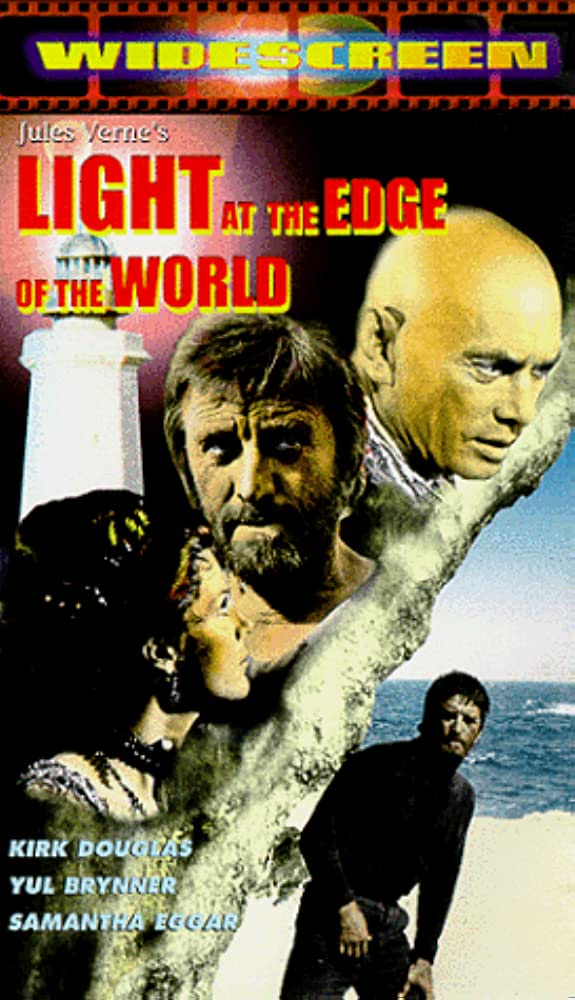
Kevin Billington was the son of a factory worker who ended up marrying Lady Rachel Billington. He was also a director of plenty of TV movies, like a well-considered BBC version of Henry VIII. He ended up directing this international collaboration of French, Spanish and Italian producers. They paid Kirk Douglas an estimated $1 million dollars to star, which is about $7.2 million in today’s money.
Will Denton (Kirk Douglas) runs an isolated lighthouse to hide from a failed romance and the fact that he killed a man in self-defense. The only people he ever speaks to are the crew, Captain Moriz (Fernando Rey) and assistant Felipe (Massimo Ranieri). They watch over a very strategic trade route near the Tierra del Fuego archipelago at the southern tip of South America.
Yet in one horrible moment, it all changes, as Captain Jonathan Kongre (Yul Brynner) and his pirates — they include actors from Sergio Leone’s films, such as Luis Barboo, Víctor Israel and Aldo Sambrell — kill Moriz and Felipe, smash the lighthouse signal and start to loot everything they can. Surviving their attack along with an Italian sailor named Montefiore (Renato Salvatori), they begin to fight back.
Kongre has also made a change in his life. He always kills everyone on the ships that he takes over, but he’s fallen for one of the women on board, Arabella (Samantha Eggar). Denton tries to save her, but when Montefiore is caught and slowly killed, he puts his friend out of his misery, just as Kongre angrily gives the woman to his crew. Denton sinks the ship and it ends up with just the two men, battling each other to the death inside the lighthouse.
If you’re expecting a light hearted Jules Verne adventure, well, this is as rough as it gets. It’s about a broken man trying to just live out his days coming up against a sophisticated villain who loves murder and carnage. I mean, they kill Douglas’ monkey. That’s how horrible the bad guys are. They deserve everything they get.
Will (Tobi King Bakare) wakes up from a bad dream, but in truth, he’s waking up in the hospital. He’s been in a coma for more than a year and has no idea how it happened, where he is or what has gone on while he’s been asleep.
As he regains control of his body and begins to stitch together his mind, he finds his scientist father Richard (Steve Oram) has become more controlling than ever, refusing to allow him to see his mother Amelia (Ramona von Pusch), who also barely survived whatever put them both into intensive care.
Director and writer Sebastien Blanc does a great job of not only establishing Will’s survivor’s guilt but also his feelings of detachment as he’s lost his adoptive mother and it’s hammered home how little Richard wanted a son, much less a black child. The only time they seem to bond is horrifying, as they are bathed in red light as father invites son to hysterically laugh at the things that most upset the both of them,
Of course, the truth — why is Richard seeing so many blonde women? — is closer to The Brain That Wouldn’t Die than a tender drama about reconnection and loss of a parent. It’s more about how far someone will go to keep someone in their life. It might be selling itself as a genre film, sure, but it has a really deep emotional tug within the expected against nature surgical science fiction movie moments.
VIDEO ARCHIVES NOTES: This movie was discussed on the November 22, 2022 episode of the Video Archives podcast and can be found on their site here.
Slithis is a lot like Godzilla. He comes from radiation, he’s green and he wants to make humanity pay. But really, the comparisons stop there.
Shot over twelve fifteen-hour days, Slithis seems like it was hell for the actor who portrayed the monster, Win Condict. He had to be sewn into the rubber Slithis costume at the beginning of every day and stay in it until shooting was done. There were no buttons. No zippers. Only Slithis.
The monster’s rage starts with dogs, who frankly had nothing to do with his condition. Please join our dog Angelo in his protest of movies that use threatening and murdering dogs to cheaply draw our attention.
My biggest question is why is Wayne Connors’ (the hero of the film) wife named Jeff (Judy Motulsky from the little known Idaho Transfer)?
The entire first hour of this movie concerns the boring research and tracking of the creature. By the time they find him, it’s shocking just how well done the costume is. It doesn’t need hidden, so why did we have to wait so long to see it?
No, instead the film forces us to watch a turtle race. I shit you not. You know what? That’s actually kind of awesome that instead of telling a gripping, horror-filled tale, the directorial choice was to show the entirety of a race between animals that are classically known as the slowest around.
How do you survive a Slithis attack? Simple. Join his fan club. He’ll remember you when he’s in your neighborhood.
VIDEO ARCHIVES NOTES: This movie was discussed on the November 22, 2022 episode of the Video Archives podcast and can be found on their site here.
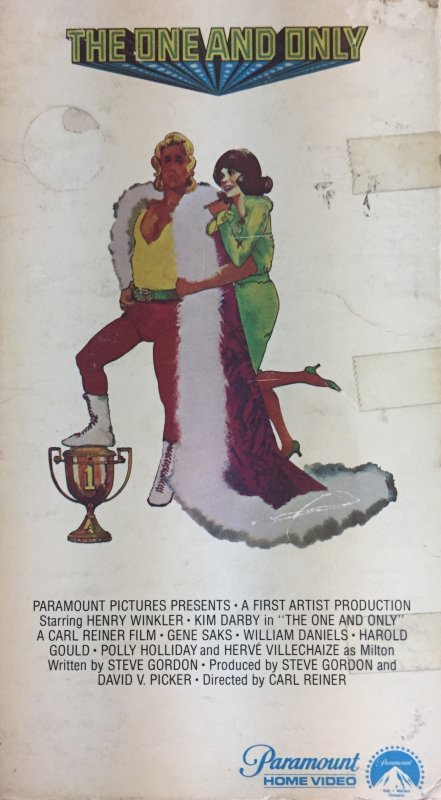
Directed by Carl Reiner and written by Steve Gordon (who would direct his next script, Arthur, and then die at the age of 44), The One and Only has an unlikeable hero at its core. Andy Schmidt (Henry Winkler) is someone who thinks he’s better than everyone at everything he does, out for only himself, even using bit parts as opportunities to ruin everyone else’s work, as long as he gets noticed. He falls for Mary Crawford (Kim Darby), a college student who is already engaged. I have no idea why she falls for him, because there’s nothing there, despite something that she sees below whatever surface Andy has. Somehow, they get married and she has to learn that being the wife of a starving actor is harrowing.
Yet Andy finds something he’s good at. He may not have the build for it, but he’s great at wrestling. He’s brought into the business by little lothario Milton Miller (Hervé Villechaize) and starts working for Sidney Seltzer (Gene Sakes), who drops this knowledge on the audience: “There’s two kinds of people, those who put lampshades on lamps and those who put lampshades on their heads.”
Her parents — William Daniels and another sitcom star who took over the show she was just a secondary character on, Polly Holliday, who played Flo on Alice — don’t approve. And eventually, she gives up on Andy while they come around on him. They even become wrestling fans when he gets on network TV. And he really learns nothing, being the same person no matter what.
The film is well-written — Gordon was a sitcom veteran and writes wonderful dialogue — but you end up caring more about the accouterments of the film more than its characters. That said, it has lots of wrestling cameos, including Hard Boiled Haggerty — of course — as Captain Nemo, Chavo Guerrero Sr. as Indian Joe, ring announcer Jimmy Lennon Sr., Gene LaBelle — of course again — as the world champion, Ed Begley Jr. (not a wrestler, but still good in this) as Arnold the King and “Rowdy” Roddy Piper as “Leatherneck” Joe Grady.
Throughout, Andy keeps trying to find a gimmick that works until finding The Lover, a man who believes that everyone should be in love with him. He understands what wrestler Raven preached about your character. It should be 80% you and 20% of the most idealized version of you, the you that you wish you could be. This movie gets a lot of pro wrestling right — I wrestled for over 25 years in the lowest rungs on the independent wrestling periphery — and the one part that it gets wrong is that most heels are the most giving and nicest people you’d ever meet. The faces, the good guys? They’re usually Andy Schmidt.
What’s amazing is that this movie came out at the height of Winkler’s Happy Days fame and he played a character totally unlike the Fonz. That’s brave and while not the best for this film’s box office, it was for his career. We’re still thinking about him today.
The working title of this movie was Gorgeous George, which makes sense, as “Gorgeous” George Raymond Wagner was a huge star in the early days of television, someone who was the kind of star that even casual non-fans would have known.
Winkler’s parents Ilse Anna Marie and Harry Irving Winkle left Germany in 1939, as they were Jewish people worried about the Nazis. The star told The Wall Street Journal, “At the time, my father, Harry, told my mother, Ilse, that they were traveling to the U.S. on a brief business trip. He knew they were never going back. Had he told my mother that they were leaving Germany for good, she might have insisted on remaining behind with her family. Many in their families who stayed perished during the Holocaust.” His Unlce Helmut was one of them. Knowing that, it’s astonishing that Winkler dresses in a Nazi gimmick in this movie.
But that’s very much in spirit of the carny roots of pro wrestling. It’s heat. And heat draws money.
Oh man! I forgot the best part! Mary Woronov is in this and gets set up with Hervé!
VIDEO ARCHIVES NOTES: This movie was discussed on the November 22, 2022 and November 29, 2022 episodes of the Video Archives podcast and can be found on their site here.
Never trust Chris Sarandon.
I learned this at a young age with Fright Night, but this was before that and you still should never trust him. Don’t trust him in The Sentinel, don’t trust him in The Princess Bride, don’t even trust him as the voice of Jack Skellington.
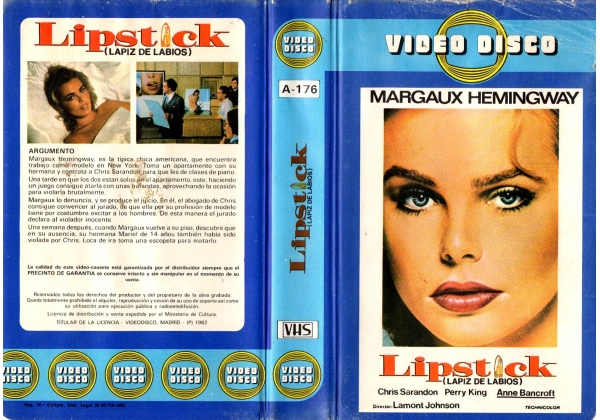
Christine McCormick — played by Margaux Hemingway, herself a supermodel who appeared on the covers of Cosmopolitan, Elle and Vogue as well as serving as the spokesperson for Fabergé’s Babe perfume — is the face of a new brand of lipstick. She also is the guardian of her 13-year-old sister Kathy (Margaux’s sister Muriel, who was also in Star 80 and Personal Best), who has a young girl crush on her teacher, Gordon Stewart (Sarandon). For some reason, he thinks that Christine has the connections to get his music out to the world.
He comes to her beach photo shoot, but there’s no time to chat, and she forgets that they were to meet at her apartment. As he plays his atonal music — more on that in a second — she leaves the room to take a phone call from her lover Steve (Perry King, who really was in some awesome junk and I say that in the best of ways).
Hurt by her seeming rejection, his assault is brutal in its quickness. Saying, “So you fuck priests, too” he shoves a photo of her brother Martin (John Bennett Perry, Matt Perry’s dad) in her face, breaks it and then smears lipstick all over her face, telling her he wants it all over him. He ties her to the bed and takes her — the scene is too male gaze, too beautiful in a way because it’s a disgusting act — and even when they’re caught by Kathy, he suggests that the little girl joins them.
Once free, Christine gets a lawyer, Carla Bondi (Anne Bancroft), who tells her that it won’t be easy to convict him. And it isn’t. Christine’s sexual image as a model, even the fact that she has fantasies and a sex life, is used against her. So when Gordon goes free, it’s no great surprise.
Christine decides that she’s done with California and modeling after one last job. Except that the last job is in the same exact abandoned building where Gordon is rehearsing a synth ballet. He ends up finding Kathy, using her heartbeat as an instrument and then raping her as well. When she gets back to the photo shoot, Christine finds the rifle she had packed — literally, they packed to leave and are doing the photoshoot and then getting out of town — and shoots at Gordon as he tries to get away. As he gets out of the car, she pumps round after round into him. And in the end, no jury will convict her.
But maybe not. Because I believe that everything that happened after the not guilty verdict is in her head. There’s no way that she’d leave modeling literally from her last shoot. The coincidence that Gordon would be in the same building, in a California filled with places to rehearse, is infinite. The idea that she can successfully shoot him so many times in broad daylight and still not go to jail is the kind of fantasy that only appears in exploitation movies. Like Lipstick.
Director Lamont Johnson started as an actor and was mainly known for TV movies like Crash Landing: The Rescue of Flight 232, Crisis at Central High and That Certain Summer, as well as Spacehunter: Adventures In the Forbidden Zone. It was written by David Rayfiel, who was the scriptwriter for The Firm, Havana and the 1995 remake of Sabrina.
Michael Winner turned down producer Dino De Laurentiis’ offer to direct this film and that shocks me. In his autobiography, Winner said that “Chris Sarandon was not a very good actor unless he was playing nut cases.” Then again, he used him in The Sentinel.
Even stranger, in 1998’s Little Men, Muriel Hemingway and Sarandor played husband and wife Jo and Fritz Bhaer.
That’s really fashion photographer Francesco Scavullo shooting the lipstick ads, while the clothes for this movie were designed by Jodie Lynn Tillen, who was the costumer for Messiah of Eviland Lemora! While uncredited, Donfeld also worked on the clothes. He was most famous, perhaps, for creating the TV costume for Wonder Woman.
French singer and music composer Michel Polnareff did the music for this, which is beyond wild. It’s completely unsettling — he also did a disco soundtrack for the film — and when it plays while Gordon assaults Christine, it’s horrifying, setting up his assault of her body, brain and ears as his atonal noise blasts, filling the room with painful beats and shrill screams. Later, when it’s played in court and the jury must hear it, you nearly feel bad for the bad guy but no, he’s absolutely the worst.
Despite critics hating this movie and it failing with audiences, it was remade as Insaf Ka Tarazu, College Girl and Edi Dharmam Edi Nyayam in India and Arzu in Turkey.
The real victim? Margaux. This movie was supposed to launch her career in Hollywood, but Muriel got most of the notice. She would few movies over the next seven years — Killer Fish, They Call Me Bruce and Over the BrooklynBridge, the first movie for Sam Firstenberg — before working in foreign genre movies like Goma-2 and straight to video films like Fred Olen Ray’s Inner Sanctum and Inner Sanctum II, Joe D’Amato’s A Woman’s Secret and Donald Farmer’s Vicious Kisses. Sadly, she became heavily involved in drugs and died at 41 from suicide. Her sister Mariel has always claimed that her death was not self-induced, but instead drugs.
Harlan Ellison, that cantankerous madman of my heart, once said of this movie, “Lipstick panders to the basest, vilest, lowest possible common denominators of urban fear and lynch logic. It is the sort of film that, if you see it in a ghetto theater filled with blacks, will scare the bejeezus out of you. The animal fury this film unleashes in an audience is terrifying to behold. It gives exploitation a bad name; and it has less to do with rape, which is the commercial hook on which they’ve hung the salability of this bit of putrescence, than it does with the cynicism of Joseph E. Levine, a man who probably has no trouble sleeping with a troubled conscience.”
VIDEO ARCHIVES NOTES: This movie was discussed on the November 8, 2022 and November 15, 2022 episodes of the Video Archives podcast and can be found on their site here.
Paddy Chayefsky, who died two years before this movie was released and also who it is dedicated to, recommended an article to director Bob Fosse in The Village Voice. “Death of a Playmate” by Teresa Carpenter told the story of Dorothy Stratton, the Playboy Playmate of the Month for August 1979 and Playmate of the Year in 1980 who was dead by August 14, 1980.
Despite her short career — five movies* (Americathon, Skatetown, U.S.A., They All Laughed, Autumn Born and Galaxina) and four TV appearances (Playboy’s Roller-Disco & Pajama Party, The Tonight Show, Fantasy Island and showing up as Miss Cosmos on an episode of Buck Rogers in the 25th Century) — Stratton went from working in a Dairy Queen to the start of a successful life as a model and actress.
Or so it seemed. She had married the man who got her nude photos to Playboy in the first place, Paul Snider. She’d gone from his manipulations into the world of the Playboy Mansion, where women were prizes for Hollywood stars in Hugh Hefner’s good graces. Meanwhile, her husband acted as her driver, manager and acting coach. You know, a suitcase pimp. He never left her alone and this often meant daily fights and constant criticism.
She alternately was trying to escape the marriage by moving in with Peter Bogdonovich — the director of her last film, They All Laughed — and also telling Snider that they should give this all up and move back home to Canada. He was insanely jealous, despite his own affairs, and was using her for money, even selling the Jaguar she’d been awarded for Playmate of the Year.
Left alone and increasingly unhinged, Snider told friends he was taking up hunting along with having a strange conversation with them about the tragic death of Claudia Jennings, an actress and former Playmate of the Year who had been killed in a car accident. The loss of Jennings, the star of Unholy Rollers and Moonshine County Express, made problems for the editors, as they had to remove her photos — or so Snider remarked — after her death.
Days later, both he and Stratten were dead.
There had already been one movie made about this story — Death of a Centerfold: The Dorothy Stratten Story which starred Jamie Lee Curtis as Stratton and Bruce Weitz as Snider — but Fosse wanted to make this into a theatrical movie.
Mariel Hemingway believed she was perfect for the part of Stratton and didn’t just send letters to Fosse. She called and visited his home and did four readings. And she also had breast surgery, though she claimed that she did it for her and not just the movie.
Eric Roberts was harder to convince, but he came on board as Snider. Cliff Robertson would be Hefner and Carroll Baker would make this her first Hollywood movie since her 1967 return from Europe, playing Dorothy’s mother.
The movie was a fight in public. Bogdanovich, Stratten’s boyfriend at the time of her death, said that Fosse “didn’t know the true story.” That was true. But Fosse claimed his movie was about Snider. That meant that Bogdanovich refused to allow his name to be used in the film — the character played by Roger Rees who is supposed to be him is named Aram Nicholas — and threatened a lawsuit.
Real Playmates are in the mansion scenes, but Hefner refused to allow the movie to be shot in his home.
What emerged was a movie that was challenging. And Roberts was amazing in it. Roger Ebert explained that Star 80 syndrome is when Hollywood will not nominate an actor for portraying a creep, no matter how good the performance is.
While Hefner said that Roberts was perfect, William Sachs — who directed her in Galaxina — said that Snider never spoke to anyone but Stratton and would just have a death stare.
This is a rough watch, as you know throughout that Stratton — who you barely get to know, she’s a gorgeous and naive blank slate — is going to die at the hands of the manipulative man who thinks he’s made her. It’s maybe even rougher knowing that her death scene was shot where she really died.
In the aftermath of her death, Bogdonovich would go through his own tragedies. He buried her with a tombstone that featured a line from Ernest Hemingway’s — the grandfather of this movie’ star — A Farewell to Arms. “If people bring so much courage to this world the world has to kill them to break them, of course it kills them…” He also wrote The Killing of the Unicorn: Dorothy Stratten (1960-1980), a rebuttal to the story this movie is based on, one that claimed that Bogdonovich and Hefner were just as bad as Snider. Bogdonovich doesn’t pull any punches on Hefner in his book. It doesn’t just attack him, it goes after his mansion, his magazine and the Playboy way of life. He also claimed that Hefner assaulted Stratton; he originally used the word raped before lawyers made him change it to seduced.
Hefner fought back by accusing Bogdanovich of seducing Stratten’s younger sister — thirteen at the time of her sister’s death — Louise. He denied this, but then again, the two married in 1988 when he was 49 and she was 20.
A year after the tragic murder-suicide of Stratton and Snider, They All Laughed came out. It wasn’t in theaters all that long, playing a few dates regionally. Wanting his dead lover’s last screen performance to have a chance to be seen by a broader audience, Bogdanovich bought the theatrical rights to the picture and bankrupted himself.
You know who else was hurt by her death? Bryan Adams. The Canadian rocker didn’t just write one song about her — “The Best Was Yet to Come,” the last track on Cuts Like a Knife — but also the song “Cover Girl” with the band Prism. Statton didn’t grow up all that far from where the singer and his co-writer for “The Best Was Yet to Come,” Jim Vallance, grew up. When Bogdonovich died last year, Adams wrote on Twitter: “RIP Peter Bogdanovich. When Jim Vallance and I wrote “Best Was Yet To Come” for Dorothy Stratten after she had been murdered, he sent us a note of appreciation for the song.”
With all his direct to streaming movie, it’s easy to forget what a shark a young Eric Roberts was. This movie was a revelation for me, yet ultimately one that still upsets me. I think all great art should, on some level, do that.
*The movies are renamed in Star 80: Autumn Born is called Wednesday’s Child, Skatetown, U.S.A. is Ball Bearings, Galaxina is just “a sci-fi film, she plays a robot,” They All Laughed is Tinsel Time. There are also some characters in the film who are real people. Playmate Bobo Weller is Terri Welles, Peggy Johnson is Colleen Camp, Billy Joe Batten is Fred Dryer and Vince Roberts is Robert Blake.
Virginia “Ginny” Wainwright (Melissa Sue Anderson, TV’s Little House on the Prarie) is popular, rich and pretty. She’s a member of the biggest clique at the fancy pants Crawford Academy — the Top Ten. These snobbish, rich and rude assholes rule the school and — if you’re anything like me — you’ll celebrate their brutal deaths. Just look at how they act at their local pub, the Silent Woman. Total dicks.
One night, Top Ten member Bernadette (Canadian scream queen Lesleh Donaldson, who has been in several films we’ve featured recently) is attacked in her car by someone without a face. She plays dead, then finds someone she knows. As she explains what has just happened, the real killer slices her throat.
The rest of the gang? They could give a shit. They’re all at the bar, putting mice into old men’s beer. It’s enough to make you want to be the killer and wipe them out. But it gets worse. They play chicken on a drawbridge and are all nearly killed. Ginny even yells “mother!” as the car goes over the opening bridge. Everyone survives, but Ginny runs away, all the way to the cemetery where she tells her mother that she’s been accepted by all of the rich kids.
When she gets home, her father yells about how she’s out past curfew. And while that’s happening, Etienne, one of the Top Ten, sneaks out a pair of her underwear.
The next day, Ginny and Ann arrive late to class, leading principal Mrs. Patterson to put the entire Top Ten on notice, threatening a ban on their favorite bar. Soon, a frog dissection leads to Ginny having flashbacks that she shares with Dr. David Faraday (Glenn Ford, slumming it after a career in films like Superman, Gilda and Pocketful of Miracles), her psychiatrist.
This is where Happy Birthday to Me pulls the rug out from under us — thirty minutes or more into the film. After the accident at the drawbridge, she underwent an experimental medical procedure to restore her brain tissue.
Meanwhile, the Top Ten are thankfully getting bumped off, one by one. Etienne dies like Isadora Duncan, his scarf caught in the wheels of his motorcycle. Greg gets killed lifting weights. Here’s where the film has a bit of a giallo feel — all of the murders are done by black-gloved hands, until Alfred (Jack Blum, Meatballs) follows Ginny to her mother’s grave, only for our heroine to stab him with garden shears. What?!?
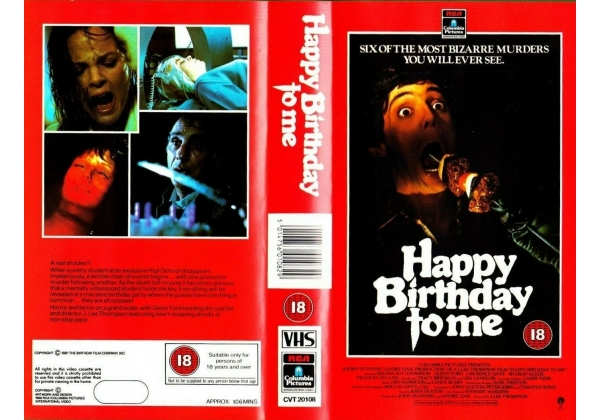
During Ginny’s 18th birthday weekend, her father leaves town, so she goes to a school dance. There, she invites Steve (Matt Craven, Meatballs) home to smoke weed, drink wine and eat kabobs, as you do. However, while feeding Steve, she stabs him in the mouth, a murder so memorable it ended up on the poster and box cover.
The next morning, Ann comes over while Ginny takes a shower and has a major flashback. Four years ago, she was having a birthday party but none of the Top Ten would come. Her mother flipped out, got drunk and tried to take her to Ann’s competing party, where a groundskeeper told her that she would never be anything more than the town whore. Her mother gets drunker and drives off the bridge from earlier in the film, where she drowns and Ginny barely survives.
Ginny begins to think that she has killed all of her friends, including Ann who she finds in the tub. Dr. Faraday has no answers, so she kills him with a fireplace poker.
Whew! What happens next? Well, Ginny’s dad gets home and sees blood all over the place, as well as Amelia (Lisa Langlois, Phobia, The Nest) outside in shock. Running to the cemetery, he sees his wife’s grave has been opened and Dr. Faraday’s body is in it. Then, entering the guest quarters, every one of the Top Ten members’ bodies are arranged around a table, celebrating a birthday.
Ginny arrives with a cake, singing to herself, when she slices her father’s throat. He never sees that his daughter is really there, the only living guest at the party. The second Ginny, the killer, screams about having done all of this for Ginny, but it turns out that she is Ann! The girls are half-sisters, sharing a father! What?!?
Ginny escapes and stabs Ann, just as the police arrive to ask, “What have you done?” The film fades to black — never letting us know if Ginny will be jailed or proven innocent. Then the film closes with a goofy — yet awesome — closing song by Stevie Wonder’s ex-wife Syreeta.
Columbia Pictures went full William Castle promoting this movie, suggesting theaters re-create the film’s closing scene in their lobby, inviting people to celebrate their birthday party while watching the movie, preventing anyone from entering the film during its last ten minutes and also conducting a scream contest for radio stations.
Happy Birthday to Me arrived in theaters at the height of the slasher boom, but it defies expectations. At times, it’s a giallo. At other times, it’s supernatural. And others, it’s a teen comedy. It’s also crazy that such a directorial talent made it — albeit one who was rumored to spray blood all over the set to make the film even gorier — and that Glenn Ford is in a slasher!
VIDEO ARCHIVES NOTES: This movie was discussed on the October 25, 2022 episode of the Video Archives podcast and can be found on their site here.
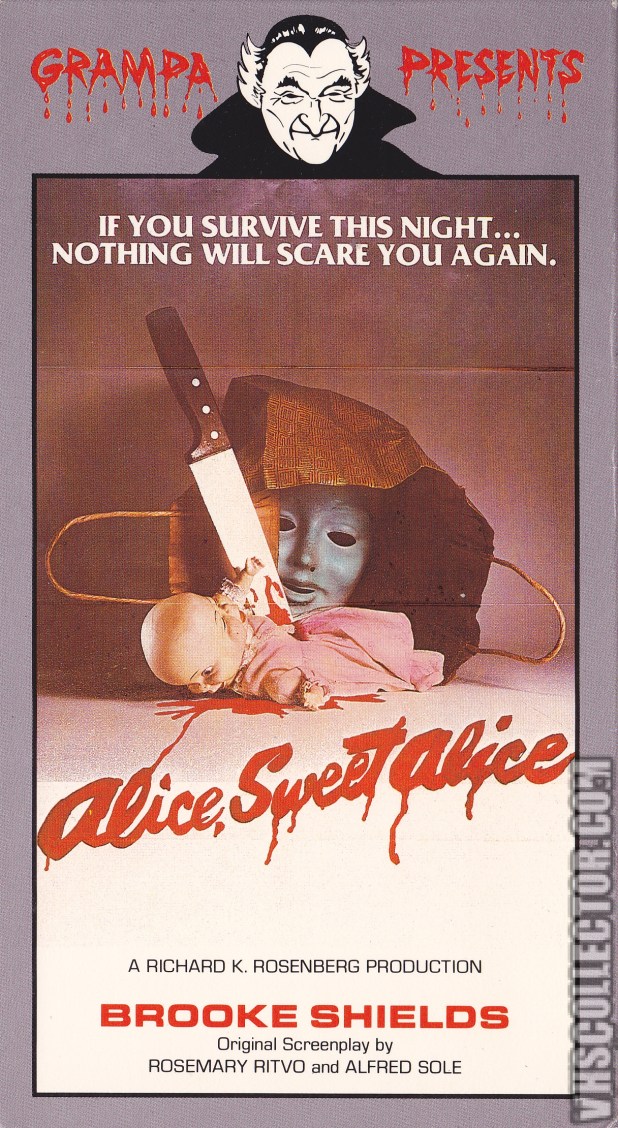
Alfred Sole was an architect who dreamed of making movies. His first film, 1972’s Deep Sleep, which starred Deep Throat‘s Harry Reems and The Devil In Ms. Jones‘ Georgina Spelvin, was made for only $25,000. However, it was ruled obscene and pulled from theaters. His second film — the one we’re about to cover — may not have done well at first thanks to spotty distribution, but thanks to Brooke Shields’ popularity and multiple re-releases under multiple titles, like Holy Terror, Communion and The Mask Murders.
Sole wrote the film with his neighbor Rosemary Ritvo, an English professor who he often discussed films with. A Catholic herself, they would often talk at length about the church in between discussing theater and horror films. Nicolas Roeg’s Don’t Look Now was a huge influence, as is obvious by the yellow raincoat worn by the film’s villain.
The film is set in 1961 Paterson, New Jersey, the hometown of the director, and as such much of it was based on his childhood. In fact, Mrs. Tredoni is directly based on a woman who lived next door to his grandmother who would look after the priests.
While Sole claims he had never seen any giallo before he made this, Alice, Sweet Alice is perhaps the most giallo of all American films before DePalma would make Dressed to Kill.
The film begins with Catherine Spages (Linda Miller, the daughter of Jackie Gleason and the mother of Jason Patric) visiting Father Tom with her two daughters, nine-year-old Karen (Shields) and twelve-year-old Alice (the astounding Paula Sheppard), who are students of St. Michael’s Parish Girls’ School. Father Tom gives Karen his mother’s crucifix as a gift for her first communion, making Alice jealous.
Alice is a wild child, her hair barely tied back, constantly in trouble for all manner of mischief. Is she a bad girl or just a misunderstood little girl dealing with the specter of her parents’ divorce in 1961, a time when this rarely happened and in a heavily Catholic neighborhood where this would surely be judged? Her antics include wearing a clear mask and repeatedly frightening and threatening her sister.
This all ends on the day of Karen’s first communion, when someone in the same school raincoat and mask as Alice kidnaps the young girl, strangles her, rips the crucifix from her neck and then sets her body on fire inside a church pew. This is insanely brutal and allows the viewer to know that this is not a movie prepared to take it easy on you.
At the same time, Alice enters the room and attempts to receive communion while wearing her sister’s veil. It’s never really established as to where she found it and whether or not she knew it belonged to her sister. There are no easy answers here.
Catherine’s ex-husband Dominick (Niles McMaster, Bloodsucking Freaks) comes back for the funeral and fulfills the giallo role of stranger pushed into becoming the detective. Furthering the giallo narrative, the ineffective Detective Spina takes over the case, pursuing the lead that Alice is the killer thanks to the suspicions of Catherine’s sister Annie. This lead seems even more obvious after the killer attacks Annie and Alice is found at the scene, wearing the same clothes.
Alice is sent to a psychiatric institution where it’s revealed that she’s been in trouble numerous times in school, a fact that Father Tom has concealed as he believed he could solve her problems.
The killer tightens her noose around Alice’s neck by luring her father to an abandoned building where she gets the jump on him, beating him with a brick, binding his body and pushing him off a ledge. Before he dies, he’s able to swallow the crucifix that the killer had stolen from his daughter. That’s also when we learn who the killer is, way before the film is over: it’s Tredoni, who sees Dominick and Catherine — and by extension their children — as sinners due to their premarital sex and divorce.
Alice may have been eliminated as a person of interest, but the danger remains. On a visit to Father Tom, Catherine learns that Tredoni lost a daughter on the day of her first communion, which taught her that children pay for the sins of their parents. In her grief, she gave herself over to the church. Her feelings about her calling are confirmed when Father Tom misunderstands her confession.
Finally, Alice’s scheme to leave cockroaches all over frightening landlord Mr. Alphonso neatly ties into Tredoni sneaking in to kill either her, Catherine or both of them. Alphonso is stabbed and the mad older woman runs to the church. Father Todd assures the police he can handle her, but even his mercy and the teachings of the church fail in the face of mania.
The end of this movie shocked me out of my theater seat. It’s visceral in its intensity and the end — where Alice walks away — is even more harrowing.
It’s rare to find a movie that completely destroys an audience. Alice, Sweet Alice did that when it played here to a full house as part of a Drive-In Asylumnight of movies.
In these post-#metoo times, Alice takes on a whole new light. Nearly every male in the movie treats her blossoming womanhood as an invitation, from the lie detector operator who says that when he bound her breasts with the machine it looked like she wanted it to the guard at the children’s home who silently watches her as she meets with her parents. Perhaps even more disquieting is that Sheppard was 19 when this was made. Her only other film appearance is in the equally bizarre Liquid Sky, which is a shame, as she was incredible in both of these equally strange movies.
Alphonso DeNoble, who plays the grotesque Mr. Alphonso, also appeared in Bloodsucking Freaks. While his main career was a bouncer at a gay bar, as his side hustle Alphonso would dress up as a priest and hang around cemeteries, where widows would ask for a blessing and he’d indulge them for a monetary donation.
This film truly lives up to the ninth Satanic Statement: Satan has been the best friend the Church has ever had, as He has kept it in business all these years! And the Satanic Sin of Herd Mentality is obvious. To quote from the actual Chruch, “…only fools follow along with the herd, letting an impersonal entity dictate to you.”
Also, Alice posits that even the pre-Vatican II Catholic Church of 1961 was finding itself ill-equipped to understand the modern world and that people — from the old like Tredoni to the young like Alice — would suffer. Mostly, in the Church, it’s women that do most of that suffering, constantly propping up the male members yet never able to ascend to the power of the clergy, unless they want to be second best sisters.
Even 43 years after its debut, Alice Sweet Alice has the power to destroy. It’s a near perfect film that demands introspection and multiple viewings.
BONUS CONTENT:
For an even better look at this film, Bill Van Ryn of Groovy Doom and the horror and exploitation fanzine DRIVE-IN ASYLUM wrote this article for us last year.
We also had the opportunity to discuss this film with Alfred Sole’s cousin — and the maker of the astounding Desecration — Dante Tomaselli.
VIDEO ARCHIVES NOTES: This movie was discussed on the January 3, 2023 episode of the Video Archives podcast and can be found on their site here.
I’m writing this at 5 AM and feel very confessional, so here it is: by all rights, Sylvia Kristel was my first girlfriend. By that, I mean to say that I never met her, never spoke with her and never will. But in the mid 80s, in my shyest years, the closest thing I would get to losing my innocence was watching late night Sylvia Kristel movies including Emmanuelle, Private Lessons, Lady Chatterley’s Lover and Mata Hari. As I watched this film, I was trying to figure out what I saw in her way back then. My options were limited and even in real life, I had such difficulty even speaking to real women. And then I saw her calves in one scene and it unlocked a sense memory in me. Sylvia Kristel, even her name alone, meant something forbidden yet sophisticated. Maybe I wasn’t above the teen sex comedy watching boys in my high school, but perhaps I was also besotten with a much higher class level of crush.
Also known as Es war nicht die Nachtigall in Germany (It Was Not the Nightingale, a reference to the Verona balcony where Kristel acts out a scene from Romeo and Juliet) and Summer Girl, this is really about Pauli (Ekkehardt Belle), who keeps getting close to losing his virginity and continually having it ruined. Like Yvonne (Teri Tordai), who he also speaks to on a train, only to walk back in on her making love; he later learns that she’s his father’s (Jean-Claude Bouillon) new mistress.
Spending the summer at home after being at boarding school, he must deal with his strange family, which includes his doddering grandmother Mimi (Rose Renée Roth), exhibitionist piano-playing Uncle Alex (Peter Berling), lesbian leaning Aunt Miriam (Giesla Hahn) and her latest conquest, the maid Silvana (Christine Glasner).
And oh yes. Andrea (Kristel).
The last time he saw her, she was a girl. Now, she’s definitely grown into a woman with needs much like his. Yet he’s too shy, too worried, too anxious. There’s even a moment where they may get close on a boat — or maybe his best friend Gerhard (Alois Mittermaier) will — that ends up in tragedy.
Pauli is about as unlikeable as a hero as you can get. He nearly assaults one of the maids, mopes about, is convinced that Andrea is frigid and only comes out of his incel shell when he is given a mercy fuck by his father’s lover. To be fair, that scene is great, as they make love on a bed filled with breakfast food and end up covered with it.
In fact, this movie is obsessed with food. Several scenes involve it being in the bed or smeared on someone’s body and the rich family eats like every meal is La Grande Bouffe.
The film was sold on Kristel, who isn’t the lead, but with taglines like “If you liked her as Emmanuelle you’ll love her as… Julia,” she became its de facto star. Director Sigi Rothemund went from films like this to making TV movies, which is a career path I can respect.
This is the kind of movie where someone’s dad sleeps with the girl their son loves, where a best friend is killed by the hero and no one ever questions it and where the lead can assault women and even smack Kristel with a tennis ball but hey, we’re supposed to like him because you tell us to. I refuse, the rich snot.
VIDEO ARCHIVES NOTES: This movie was discussed on the December 20, 2022 episode of the Video Archives podcast and can be found on their site here.
Rage is directed by its star, George C. Scott, and it’s about Wyoming sheep rancher Dan Logan and his son, whose livestock and lives are ruined by an Army helicopter spraying them with nerve gas. Military doctor Major Holliford (Martin Sheen) keeps them separated, lies to them about their condition and uses this accident as a test to see how the human body reacts to this weapon.
Not well. Because Logan’s son dies and he has hours left on this Earth. Even his family physician Dr. Caldwell (Richard Basehart) can no longer help him. The military answers to no one, no higher power, and as Logan wanders the hospital, he finds his son in the morgue. He wasn’t even told his child is dead and here he is, torn to pieces on a table, examined and studied.
All he has left is a need to destroy, to stop the company that made the gas. And when he returns to the military base, his body has given out and all he can do is fall to the ground, all so Holliford can collect one last blood sample as the dead body of a man caught in the machine is flown away.
Man, 1972 was the most downer of all cinematic years.
Scott may not be the best director, but he’s amongst the finest actors of his time. His near impotence in the face of coverups and the smiling faces of doctors who are going to just keep lying to him, keeping him trapped in the hospital and promising that everything is fine is so real that it created actual anger inside me. Because this feels too real, this feels like it could, can and does happen and people like Logan are the ones ground up and disappeared when things out of their control go wrong.






 B&S About Movies
You must be logged in to post a comment.