VIDEO ARCHIVES NOTES: This movie was discussed on the December 20, 2022 episode of the Video Archives podcast and can be found on their site here.
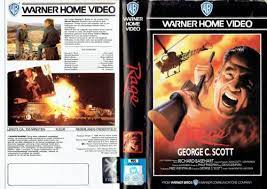
Rage is directed by its star, George C. Scott, and it’s about Wyoming sheep rancher Dan Logan and his son, whose livestock and lives are ruined by an Army helicopter spraying them with nerve gas. Military doctor Major Holliford (Martin Sheen) keeps them separated, lies to them about their condition and uses this accident as a test to see how the human body reacts to this weapon.
Not well. Because Logan’s son dies and he has hours left on this Earth. Even his family physician Dr. Caldwell (Richard Basehart) can no longer help him. The military answers to no one, no higher power, and as Logan wanders the hospital, he finds his son in the morgue. He wasn’t even told his child is dead and here he is, torn to pieces on a table, examined and studied.
All he has left is a need to destroy, to stop the company that made the gas. And when he returns to the military base, his body has given out and all he can do is fall to the ground, all so Holliford can collect one last blood sample as the dead body of a man caught in the machine is flown away.
Man, 1972 was the most downer of all cinematic years.
Scott may not be the best director, but he’s amongst the finest actors of his time. His near impotence in the face of coverups and the smiling faces of doctors who are going to just keep lying to him, keeping him trapped in the hospital and promising that everything is fine is so real that it created actual anger inside me. Because this feels too real, this feels like it could, can and does happen and people like Logan are the ones ground up and disappeared when things out of their control go wrong.
VIDEO ARCHIVES NOTES: This movie was discussed on the September 27, 2022 episode of the Video Archives podcast and can be found on their site here.
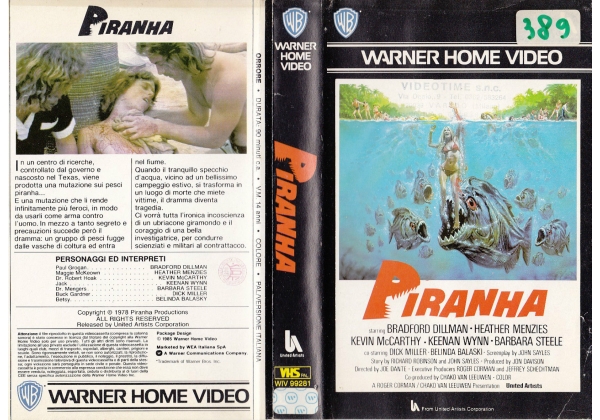
Piranha almost never made it to the theater. Universal Studios had considered obtaining an injunction to prevent it from being released, particularly as they had Jaws 2 out that year, but the lawsuit was called off after Steven Spielberg himself gave the film a positive comment (he also called the film the “best of the Jaws ripoffs”).
Joe Dante is my favorite type of filmmaker. Even when you think you know what to expect, he zigs and zags, giving you genuine surprises and fun at every turn.
The action starts with two teens swimming in the waters of an abandoned military base — as you do. Of course, they’re instantly obliterated by an unseen creature.
Skiptracer Maggie McKeown (Heather Menzies, who beyond being the wife of Robert Urich was Louisa Con Trapp in The Sound of Music and even appeared in an August 1973 Playboy pictorial entitled “Tender Trapp”) is looking for those missing teens and she’s hired Paul Grogran (Bradford Dillman, who battled many an ecological horror in Bug, The Swarmand Lords of the Deep) for help. He’s a drunk and surly mountain man, which in the 1970s makes you a sex symbol.
Why is Grogan so multi-layered? It turns out that Bradford Dillman wasn’t pleased with how flat his character originally was, so he asked writer John Sayles why. The response was that producer Roger Corman never hired good actors, so he rarely wrote nuanced characters. However, Dillman offered Sayles the opportunity to do something deeper, if you’ll pardon the pun.
They discover the abandoned compound where the teens died and discover that it’s a militarized fish hatchery. Maggie drains the outside pool and discovers too late that she’s released Operation: Razorteeth, a strain of piranha made to survive the cold North Vietnamese rivers and win the war in Southeast Asia.
That’s when Grogan realizes that if the local dam is somehow opened, the piranha will attack the Lost River water park and the camp where his daughter is spending the summer. Everybody pays the price for the piranha, like their now crazed creator Dr. Robert Hoak (Kevin McCarthy from Invasion of the Body Snatchers). Soon, the military is involved and our heroes are on the run, trying to warn the media and anyone that will listen that these killer fish are on their way. Nothing will stop them, not even the poison that Colonel Waxman and Dr. Mengers (Barbara Steele!) think will do the job.
Of course, the fish survive and attack the summer camp, wiping out nearly everyone but Suzie thanks to her fear of water. Now, they’re on their way to Buck Gordon’s (Dick Miller, perfect as always) waterpark, where they end up killing Waxman.
Grogan and Maggie come up with a totally ridiculous plan: to use the hazardous waste from the smelting plant to kill off the fish before they spread into the ocean. Our hero, such as he is, must go deep underwater to make this happen and he barely survives, left in a catatonic state at the end of the film.
Dr. Mengers gives the government’s side of the story, downplaying the danger of the piranha and saying there’s nothing left to fear, but as we see another beach, we now hear the sound of the deadly school of fish.
Beyond Dick Miller, this film features plenty of actors that Dante would work with again and again, like Belinda Balaski, the film’s writer John Sayles and the always welcome Paul Bartel. Plus, Francis Xavier Aloysius James Jeremiah Keenan Wynn shows up, but we all know him better as his stage name, Keenan Wynn. And another Invasion of the Body Snatchers alum, Richard Deacon, is here as well.
Piranha is the rarest of films — one that rises above being a simple ripoff and comes close to eclipsing the source material. It’s quick, bloody and fun as hell, with awesome effects from Phil Tippett and the debuting Rob Bottin, who was only 17 at the time.
VIDEO ARCHIVES NOTES: This movie was discussed on the September 27, 2022 episode of the Video Archives podcast and can be found on their site here.
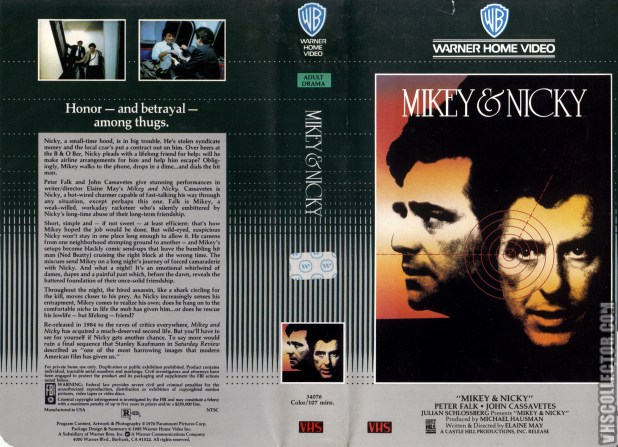
Nicky (John Cassavetes) calls Mikey (Peter Falk) to bail him out of trouble. This happens all the time, but this time, there’s a contract out on his life for the money he robbed from a mob boss. Director and writer May had originally cast Paramount president Frank Yablans as one of the gangsters, but parent company Gulf+Western didn’t think that was funny and made her get someone else.
This was not the end of May’s battles with this movie, the last she’d make for a decade.
The next movie she would direct was Ishtar.
She shot over one million feet of film, three times as much as was shot for Gone with the Wind. At times, she kept three cameras running for hours at a time, all to better capture the spontaneity between Cassavetes and Falk. During one scene, both men left the set and she kept rolling. A camera operator yelled, “Cut!” and she flipped out, as that was her job. He said, “The actors are off the set.” She replied, “They might come back.”
At the end of production, May had gone over budget and lost her final cut, so she kept two reels in her husband’s garage. In response, Paramount played a continuity error-filled version of the movie into theaters for just a few days. Former Paramount acquisitions employee Julian Schlossberg purchased the rights from the studio with May and Falk. It was first shown as the Directors Guild of America Fiftieth Anniversary Tribute in 1986 and at the United States Film Festival’s Tribute to John Cassavetes in 1989.
As for the film, Mikey has to save Nicky from a hitman (Ned Beatty) as well as his own paranoia. They have their lives on the line, but for the killer, it’s just business, and he’s actually losing money when you factor in expenses. But maybe Mikey needs to get away from Nicky to save himself, because there’s a reason why he’s the only friend Nicky has left. And sometimes, being a man means being a better friend to yourself than your best of friends.
Needless to say, I would also just turn a camera on Cassavetes and Falk to see what they would do and just keep it running. May was just as tenacious and explosive as the men she’s captured on celluloid and who cares, decades later, how many feet she shot? More artists should be ready to throw it all away for their craft.
The two fantastic films on this week’s Drive-In Asylum *double feature* are The Slayer and Vice Squad, two 1982 films that show you everything from killer pimps and killer nightmares, to crowded cities and deserted islands, to fires, crashes, impalements of all varieties and maybe even a beheading.
Join Bill and me at 8 PM EST on the Groovy Doom Facebook and YouTube channel.
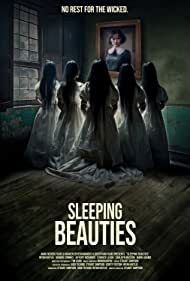
Cahya (Intan Kieflie, an Indonesian Australian actress who actually was pregnant while filming this movie) isn’t living her best life. She’s just lost her husband, she’s running out of money and she’s not far away from delivering her child. Yet she needs work, which brings her to an isolated mansion to be a maid. And that’s exactly the worst place for her to be.
Directed and written by Stuart Simpson (who directed “M is for Mutant” In The ABCs of Death 2.5), Sleeping Beauties brings Cathya into the world of Alfred (Jeffery Richards) and Francesca McCay (Mandie Combe), a brother and sister. They’re rich, so you expect them to be eccentric. But perhaps not this strange.
When she arrives, the McClays argue over her, as they didn’t expect her to be with child. Yet Francesca takes pity on her and allows her to stay. The outgoing maid, Nia (Candice Leask), shows her to her room and tells her that she’s been there for a year and can’t wait to leave. That’s when Cathya notices another maid staring at a wall a floor above her room.
The strange thing of this film is so much of it feels like it’s the 1920s, as the house feels nearly trapped in time, while Cathya always has a mobile phone on her. I like how her texts become part of the picture and are treated well visually. It also seems that the outdoor footage looks way better than the interiors, as the outside nearly feels like it was shot on film — I realize it wasn’t — and natural while the interiors nearly feel like the color is way too forced. Actually, some scenes look way better lit and filmed than others, but I always feel like I’m inordinately attuned to this.
The McClays demand that everything is done the old fashioned way, even if that means cooking rabbit stew in a pot over the stove. It’s also filled with tons of taxidermy, which is never normal, no matter what anyone tells you. And what’s going on with the strange driver (Mark Adams)?
Oh yeah. A psychic who claims to be an owl once told Cathya that she’s different and can manifest spirits around her, those that are gone, and listen to them. Her boyfriend is stuck between worlds and she will eventually be able to say goodbye to him.
For all I’ve said about the look of the film, I have to say that the flashbacks — when Cathya finally sees and touches the ghosts — looks great with really startling images threatening to tear their way into the frame, feeling like oversaturated grindhouse moments.
Of course, Cathya’s employers have killed all of the past maids. That’s who she keeps seeing walking the halls. And they want her to die next. The McClay’s are very Crimson Peak but go a step further by having the skeletons of their parents on an altar, all part of a ritual to become find their way to Heaven by creating a grand guignol nativity scene with Cathya’s baby soon to be the focal point.
While the final effects don’t delight as much as they could — they’re a mix of CGI and puppetry, it appears, and I always err on the site of practical gore — this film does have enough strangeness and attempts at being more than just a simple ghost story. I’d have loved to have seen this with a richer budget, but for what they had, this is quite effective.
VIDEO ARCHIVES NOTES: This movie was discussed on the September 22, 2022 episode of the Video Archives podcast and can be found on their site here.
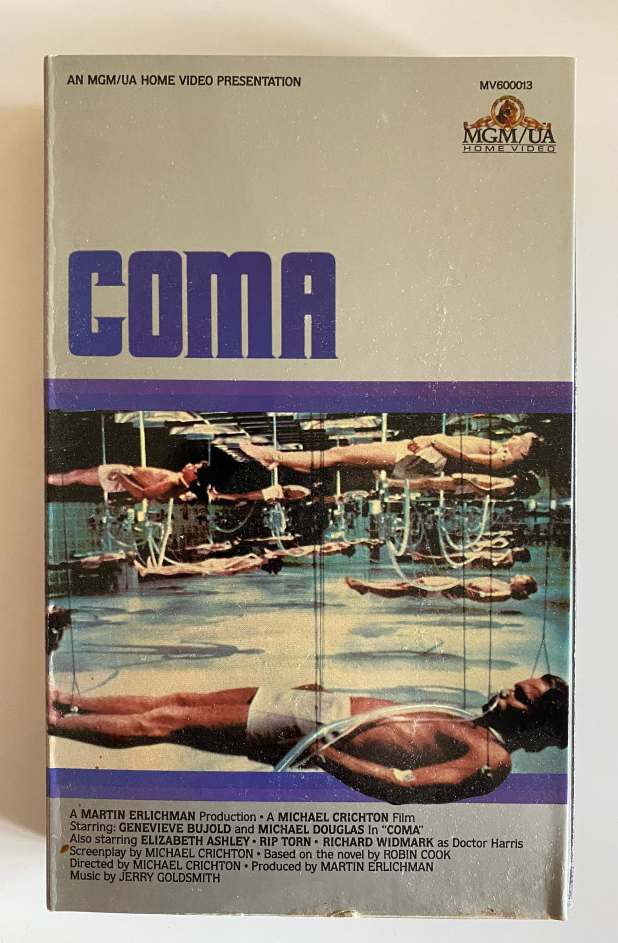
Robin Cook graduated from Wesleyan University and Columbia University College of Physicians and Surgeons before finishing his postgraduate medical training at Harvard. One of his first medical jobs was running the Cousteau Society’s blood-gas lab. He later became an aquanaut with the U.S. Navy’s SEALAB program and reached the rank of lieutenant commander. His first novel, Year of the Intern, was written while he was on the crew of the submarine USS Kamehameha. When that book failed, he studied how best sellers became big books and used those techniques to write Coma, saying “I studied how the reader was manipulated by the writer. I came up with a list of techniques that I wrote down on index cards. And I used every one of them in Coma.”
He said of the book, “I suppose that you could say that it’s the most like Coma in fact that it deals with an issue that everybody seems to be concerned about. I wrote this book to address the stem cell issue, which the public really doesn’t know anything about. Besides entertaining readers, my main goal is to get people interested in some of these issues, because it’s the public that ultimately should be able to decide which way we ought to go in something as ethically questioning as stem cell research.”
Michael Crichton, who directed this, met when Cook when the future Jurassic Park writer was doing post-doctoral work in biology at La Jolla’s Salk Institute. This would be the first movie he’d direct after Westworld.
Dr. Susan Wheeler (Geneviève Bujold and wow, she’s amazing and gorgeous in this) is a surgical resident at Boston Memorial Hospital. One day, her friend Nancy Greenly (Lois Chiles, Moonraker) dies on the operating table during a basic surgery. She starts to take notice of how many otherwise healthy young people are dying in operating room 8. Yet her boyfriend Dr. Mark Bellows (Michael Douglas) thinks it has to be a coincidence.
She tries to investigate but ends up angering Dr. George (Rip Torn), the Chief of Anesthesiology, and Dr. Harris (Richard Widmark), the Chief of Surgery. She begins to feel all alone, even doubting her lover Mark. It’s all connected to the mysterious Jefferson Institute, a place where all of those supposedly dead people are kept alive to be sold to the international human organ black market. Soon, she’s knocked out and being wheeled into surgery herself and headed to OR 8. Can her boyfriend save her in time? I was worried until the credits.
Crichton said, “This is a story that contains many elements of reality: the fear people have of surgery, the fear of dying at the hands of your doctor, phobias about hospitals. Those are very real fears, and so to exaggerate them would not be much fun. My idea was to put the picture together in such a way that the fears are put in a safe prospective, and can be enjoyed as scares, without awakening deeper and more real anxieties.”
Despite Crichton trying not to scare audiences away from hospitals, many physicians and hospital administrators claimed that that was exactly what happened.
You know who did see this movie? Harry Manfredini. That noise that rings out when someone is being stalked would get used by him a year later in Friday the 13th.
VIDEO ARCHIVES NOTES: This movie was discussed on the September 13, 2022 episode of the Video Archives podcast and can be found on their site here.
Hong Kong, Las Vegas, Tokyo, Manila, Mexico and Los Angeles. These are the cities that director Efren C. Piñon takes this action-packed film to. Those are the cities where a gang of blind men has been recruited to become a bank robbing team, all trained by Sally (Leila Hermosa). All working for Johnny Duran (Charlie Davao), they’re being tracked down by Jesse Crowder (Fred Williamson).
The gang of blind men is made up of blinded mobster out for revenge Willie Black (D’Urville Martin), doublecrossed gangster Lin Wang (Leo Fong), former matador who lost his eyes to a bull Hector Lopez (Darnell Garcia), blind from birth magician Amazing Anderson (Dick Adair) and safecracker Ben Guevara (Tony Ferrer). The wild part of this scheme is that the money that is being taken is meant to stop the Domino Theory in Vietnam when the criminals take it from under the government’s nose.
There’s one great reason to watch this all and it’s a line of dialogue that made me laugh more than any other so far this year: “Unit Two to Unit One—it’s going down at the International House of Pancakes!”
Williamson would play the same character in Death Journey and No Way Back, but you don’t need to see either of those movies to enjoy this. I mean, what other movie has a bunch of multiracial blind men all training over and over for a big heist like it’s a lights out Ocean’s 11?
VIDEO ARCHIVES NOTES: This movie was discussed on the September 13, 2022 episode of the Video Archives podcast and can be found on their site here.
Sometimes, I just sit and search through YouTube looking for a movie to watch while I work. Often, that search finds horrible films that I wouldn’t be able to enjoy if I were truly paying attention to them. And sometimes, like with this movie, I end up taking a break from writing and find something I really enjoy.
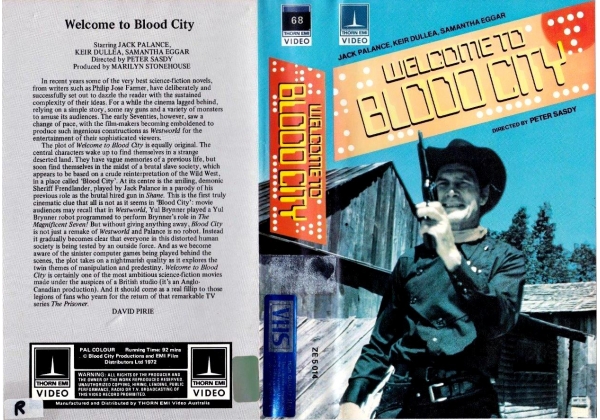
Directed by Peter Sasdy (The Lonely Lady, Taste the Blood of Dracula, Hands of the Ripper), this film was a UK/Canadian tax shelter affair. But don’t hold that against it! Five strangers all wake up at the same time and have no memories of who they are, other than that they are all killers. They must travel to a Wild West town called Blood City.
Once there, they will spend a year in servitude before they can become free. Then, they’ll be able to own a business and work toward becoming immortal — free from constant worry of challenges to the death. They get there by winning twenty challenges. And there’s only one law in Blood City — Frendlander, played by Jack Palance. It’s no accident that the bad guy from Shane is playing this part. Palance might only be known to younger folks from his Oscar turn in City Slickers, but in the 1970’s he was taking whatever parts he could get. And then he’d sink his teeth into them! He’s fabulous in this movie!
Keir Dullea (Black Christmas, 2001, The Haunting of Julia) stars as Lewis, who finds himself coming up against Frendlander over and over again. The real secret of the film? None of them are in this town at all — it’s a virtual reality simulation to determine the best warriors in a future war. So basically, it’s a combination of WestWorld and The Matrix.
Samanta Eggar (The Brood) shows up as a scientist who falls in love with Lewis and inserts herself into the virtual reality experiment. Barry Morse is also in here, who you may remember as Lt. Philip Gerard from TV’s The Fugitive. And Chris Wiggins is in this as well. He was Jack Marshak on Friday the 13th: The Series.
This is totally part of the doomed 1970s genre and the end — where Lewis chooses the fantasy of Blood City instead of the lies of modern life — still rings true today. I completely expected a ripoff of WestWorld and FutureWorld, yet was rewarded with something really good. It’s slow moving, but if you understand that and can see a movie for what it could be versus what it is, I think you’ll enjoy it.
VIDEO ARCHIVES NOTES: This movie was discussed on the August 30, 2022 episode of the Video Archives podcast and can be found on their site here.
My wife wants to go away on a fancy vacation. While horror films have forever enriched my life, they’ve also damaged her chances of going anywhere. The tropics? Have you seen Zombi? A resort like Sandals? I assume that Laura Gemser will show up and I’ll be boiled in a pot. And now, thanks to this movie, we can also cross Mexico off the list.
As much as horror may have curtailed my partner’s opportunity to globetrot, it’s also imparted several important lessons to me. To wit: if your mine is over a Satanic temple where left hands were severed to honor demons and every single worker refuses to go any deeper, perhaps it’s time to find a new mine. And if by chance you discover a miniature coffin with a hand inside it, just leave it where you found it. Don’t take it back to your hotel room. This is why I’ve made it forty-six years on this Earth without being possessed or dealing with a face-melting cult in the desert.
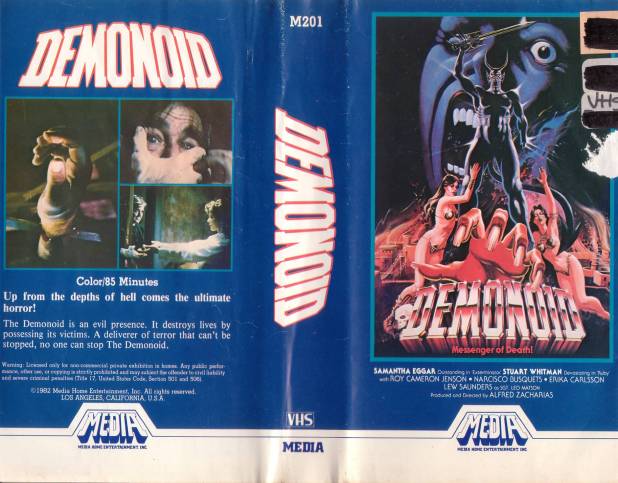
My true joy in the movie Demonoid comes from reading the review that it received when it was released in 1981 and laughing in their prose faces. How can anyone dislike a movie where a possessed man decides that old school Las Vegas is the best place to hide out? Who can dismiss a film where Samantha Eggar obviously dressed herself in some of the most astounding fashions that the early 80s could unleash? The woman wears an ascot and oversized orange counter to explore a mine (let’s be fair, every outfit she wears in this movie are a paradox, somehow both gorgeous and ridiculous at the same time). And damn anyone who speaks ill of Stuart Whitman! This former boxer and soldier had already played Jim Jones — I’m sorry, James Johnson — in Guyana: Crime of the Century, released less than a year after that tragedy? Here, he plays a battling Catholic priest who we just know could win over Ms. Eggar if he didn’t have that pesky collar and angel on his shoulder to worry about.
Maybe they weren’t watching the Mexican cut (Macabra!), which has more dialogue, more death and a different ending? Look, you can’t please all of the people all of the time. And most of those critics, they never got pleased all that much anyways. Demonoid is worth the whole lot of them. Would they dare to feature an ending so downbeat after 98 minutes of rooting for our British heroine? I dare say no. They’d be afraid to insert so many flashing shots of a demon raising his fist, they’d be too concerned about a soundtrack that practically screams in your face and they’d sooner hide behind their film theory books than make a movie in 1981 that feels like it came from 1974.
Demonoid is why I watch movies. Samantha Eggar screaming at the top of her lungs while a mine explodes all around her? There. An appearance by Haji, she of Faster, Pussycat! Kill! Kill!, Bigfoot, Supervixens and the wonderfully titled Wam Bam Thank You Spaceman(whose real name Barbarella Catton wasn’t sexy enough for a stage name)? You got me. Overacting in nearly every scene? I’m riveted. A poster that promised nubile ladies reclining for a fallen angel carrying a gigantic sword? I might have piddled a little.
Keep your Oscar picks and guilty pleasures. I have no such taste or qualms. Give me Demonoid or give me a severed left hand!
This article originally appeared in Drive-In Asylum #13, which you can get right here!
VIDEO ARCHIVES NOTES: This movie was discussed on the August 30, 2022 episode of the Video Archives podcast and can be found on their site here.
Based on the novel The Damned Innocents by Richard Neely, this film was directed and written by Claude Chabrol, a member of the French New Wave (nouvelle vague) group of filmmakers. Chabrol claimed that he was “seized by the demon of cinema,” which led to him writing about film and championing directors like Alfred Hitchcock, who this film owes a debt to.
Chabrol was a massive fan of Hitchcock, even writing a book on the director with Eric Rohmer. On the set of To Catch a Thief, Chabrol and François Truffaut were so starstruck that they walked right into a water tank. Hitchcock would laugh at that for years, even saying years later that the dup were “ice cubes in a glass of whiskey.”
Chabrol’s first movie was the Hitchcock-influenced Le Beau Serge and throughout his career, he would return to the styles of the director and stories of the rich and powerful dealing with murder and scandal.
Louis Wormser (Rod Steiger) has a young wife — Julie (Romy Schneider) — a drinking problem, a bad heart and a case of impotence. He doesn’t even sleep in bed with his wife anymore, so it’s no wonder that she’s started having sex with a writer named Jeff Marle (Paolo Giusti). And even less of a narrative jump that they decide to kill Louis. She hits him with a heavy object, Jeff rolls him into the water and she decides to lay low. But then Jeff disappears with all the money, leaving Julie without a man, without cash and under the watchful gaze of the police.
So just imagine how she feels when Louis reappears, claiming to be cleaned up and in great health. Even stranger, he says that he got a confession out of Jeff and killed him. Now, he wants to be a good husband and they make love just in time for Jeff to come back for her.
Man, can one woman find worse men? Yes, when it’s in a Hitchcockian film like this. I almost claimed it’s a giallo, but the line between Hitchcock, krimi and giallo is so thin, right? Maybe neo noir is the right category? Do we need labels?
This was released in the U.S by New Line, which caused Vincent Canby of The New York Times to say, “I have no idea how much the English dubbing and editing have damaged the original, but the Dirty Hands that opened yesterday at the Forum and other theaters is a junk movie.”


 B&S About Movies