Directed by Gene R. Kearney, who wrote the script based on a story by Kurt van Elting, “The Other Way Out” starts with businessman Bradley Meredith (Ross Martin) returning home from a long vacation with his wife Estelle (Peggy Feury) just in time for his secretary to show him that a go-go dancer that he had some relationship with has died. Even worse, he soon learns that he’s being blackmailed.
He goes the whole way to an abandoned house in the middle of nowhere, having to walk most of the way after crashing his car. There, he meets the grandfather of the dead dancer, Old Man Doubleday (Burl Ives), who puts him through hell to pay for the murder.
That said, if you’re expecting any real twists or turns, there really aren’t any in this story. There are dogs attacking the man and the promised Sonny, instead of being a brutal older brother ends up being a ten year old, but this feels like a ton of putting the pieces on the table and then not a single thing happens with them. Sure, it has a dark tone, but that’s really all it has.
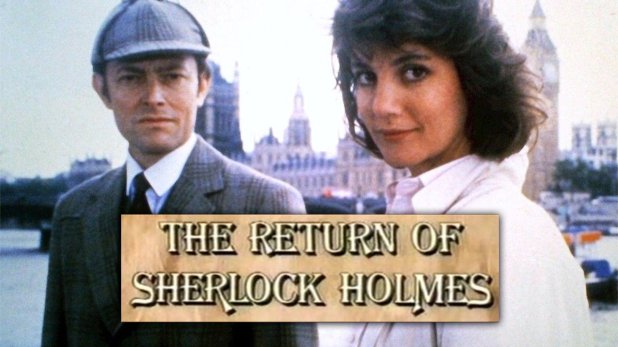
Sherlock Holmes (Michael Pennington) has been taken out of cryogenic sleep by Watson’s ancestor Jane Watson (Margaret Colin), who is a private detective in Boston. He was infected by the bubonic plague by his enemy Moriarty and frozen until a cure could be found.
Using the alias Holmes Sigerson, the detective works with Watson to help her solve her cases. Holmes falls for Violet (Connie Booth), the daughter of a man killed in an FBI robbery, while Watson and an agent named Tobias (Nicholas Guest) have some glances between each other. This was a pilot for a series that was never picked up, so one assumes that Holmes and Watson would have ended up together if the show was ever a longer series. There’s a fun little Murder, She Wrote cameo as one of the characters is reading a book by Jessica Fletcher.
Shayne also wrote the TV movies Sherlock Holmes and the Leading Lady, which starred Christopher Lee as Holmes and Patrick Macnee as Watson, along with Morgan Fairchild and Engelbert Humperdinck, as well as a sequel to that TV movie, Sherlock Holmes: Incident at Victoria Falls. He also created the show Whiz Kids and wrote episodes of the show Legend, in which author Ernest Pratt (Richard Dean Anderson) plays the hero of his books, Nicodemus Legend, with the help of his friend Professor Janos Bartok (John de Lancie).
EDITOR’S NOTE: The Awakening was on the CBS Late Movie on October 31, 1986 and February 25, 1987.
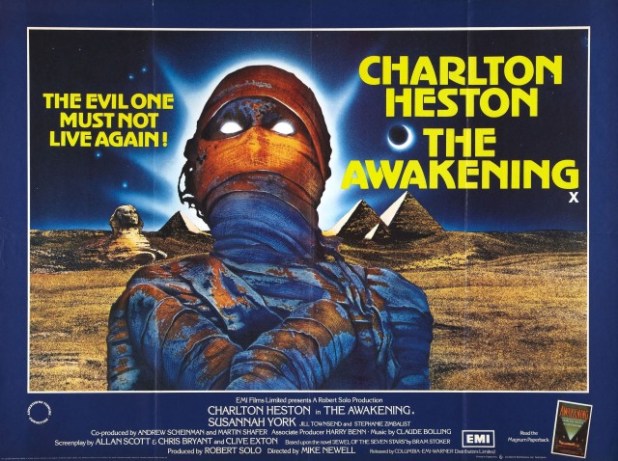
Based on Bram Stoker’s The Jewel of Seven Stars — which was also filmed as an episode of Mystery and Imagination as “The Curse of the Mummy,” Hammer’s Blood from the Mummy’s Tomb and the 90s movie Bram Stoker’s The Mummy — this movie places Matthew Corbeck (Charlton Heston), his pregnant wife Anne (Jill Townsend) and his assistant Jane Turner (Susannah York) in Egypt searching for the tomb of Queen Kara. One could argue that the most exploring Matthew is doing is between the thighs of Jane, but there you go.
When you see a sign that says “Do Not Approach the Nameless One Lest Your Soul Be Withered,” you may want to turn back. Nope, Matthew goes in hard — again, much like with his assistant — while his wife goes into labor. She’s dropped off at a hospital so he can get back to digging and their stillborn child comes back to life once he unearths and opens a sarcophagus.
Eighteen years later and that daughter, Margaret (Stephanie Zimbalist) is looking for her father, who is now married to Jane and still obsessed with the mummy that he found. It’s being destroyed by bacteria, so he gets it sent to England so that he can save it. Of course, the mummy queen wants to be reincarnated inside his daughter, who starts to believe that she really is Queen Kara.
Directed by Mike Newell (who went on to direct Four Weddings and a Funeral and Donnie Brasco) and written by Clive Exton, Chris Bryant and Allan Scott, The Awakening is a big dumb mess, but I kind of like that sometimes. It was recut by Monte Hellman after Newell lost final cut.
The best thing I can say is that this was shot in Egypt with actual locations.
EDITOR’S NOTE: Matilda was on the CBS Late Movie on December 23, 1985.
When Melvin Simon Productions out up half the cash for this movie, they made nearly half a million in profit by selling the TV rights to CBS for $2.5 million, foreign sales which went around $1.6 million and American-International Pictures paid an advance of $1.8 million on the movie.
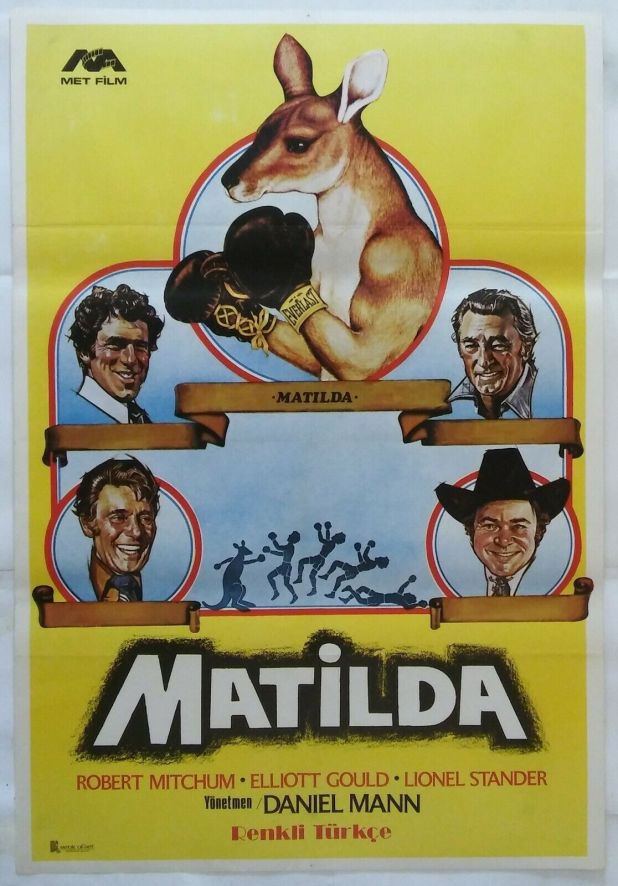
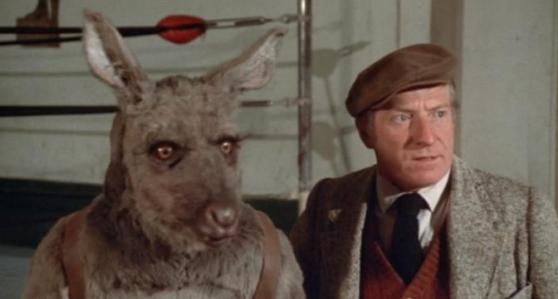
The fact that anyone made any money on this upsets me to no end, because this is amongst the most terrifying movies I’ve ever seen. The decision to not use a real kangaroo and instead spend thirty grand on a suit with Gary Morgan in it will give me nightmares for the rest of my life.
At one point, my wife walked in as the kangaroo had been hit for the first time and started loudly screaming and she said, “Why would anyone watch this?”
I just sheepishly looked at her and she left the room.
Clive Revill plays Billy Baker, the Irish pub owner who somehow gets the ownership of the boxing kangaroo Matilda. He alone has the power to see you in the audience and will speak to you through the fourth wall twice in this movie.
Elliot Gould, who plays Bernie Bonnelli, the man who thinks he can make money off a boxing kangaroo, said of this movie, “When Al Ruddy wanted to buy back my position, my points in the picture, he offered me hundreds of thousands of dollars, which at that point I decided would be bad karma. That was bad judgment on my part.”
I have no idea why Karen Carlson’s character falls in love with him, but I am fascinated by the fact that this movie is filled with so many of my favorite actors: Lionel Stander, Robert Mitchum and even Roberta Collins. Even more amazingly, this came out the same year that Gould made The Silent Partner, so he wasn’t hurting for work.
It also gets Harry Guardino into another animal movie in the same year, as he would also be in Every Which Way But Loose, while Roy Clark takes a break from Hee-Haw to play Wild Bill Wildman.
Directed by Daniel Mann, yes, the same man who made Willard and Our Man Flint, this was written by Timothy Galfas, Paul Gallico and the aforementioned Ruddy. They made a movie that’s supposedly for kids but in which organized crime figures try to cut off the tail of a kangaroo and shameless promoter Gould makes the kangaroo literally do carny shoot boxing against marks in the audience. It’s upsetting, the suit is uncanny valley dead eye nightmare fuel for the rest of your life and, well, at least Mitchum and Gould got to smoke a joint together every day at lunch. I’d make any movie if I got to smoke with Mitchum, the star of one of my favorite movies of all time — The Night of the Hunter — and someone who seemed full of venom and hilarious stories with every interview I’ve ever read. Just don’t get in his way with your camera when he has a basketball in his hands.
EDITOR’S NOTE: This episode of Kolchak: The Night Stalker didn’t air on the CBS Late Movie because ABC packaged “it with “Demon In Lace” as the TV movie The Demon and the Mummy.
“Among the philosophers, the great thinks and the common Joes of this world, no question is more controversial than truth. Remarkable as it may seem, I can attest that the following events did occur, whether you believe them to be true or not.”
Despite this great starting line from Carl Kolchak, this is sadly near the end of the series. Ramon Bieri returns as a cop, but no one realized that in “Bad Medicine” he was Captain Joe Baker, not Captain Webster. It also has the future Boss Hogg, Sorrell Booke, as a taxidermist named Mr. Eddy.
The story revolves around a 500-year-old Aztec warrior rising every 52 years to claim five victims. The mummified form of this monster of the week is played by Mickey Gilbert, who was also the villain in “The Ripper.” But the real reason to tune in is to see Erik Estrada, just a few years away from superstardom as Ponch on CHiPs, playing Pepe Torres. Estrada dressed as an Aztec priest? I’m here for it. He also has on a pink disco suit and plays the flute in a scene, so this is prime Estrada gold for you to mine.
The cast also includes Dorrie Thomson (Policewomen, Operation Petticoat), Merrie Lynn Ross (Class of 1984) and Sondra Currie (who played Zach Galifianakis’ mom in The Hangover movies).
Basically, this episode is very similar to the aforementioned “The Ripper” while giving us Kolchak versus the Aztec Mummy.
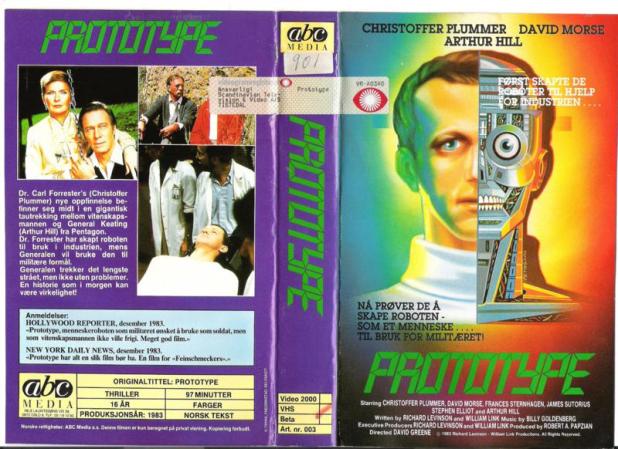
EDITOR’S NOTE: Prototype was on the CBS Late Movie on June 5, 1987 and January 28 and May 12, 1988.
Directed by David Greene (The People Next Door, Madame Sin) and written by the team of William Link and Richard Levinson, who wrote and created Columbo, Mannix, Blacke’s Magic, Scene of the Crime and Murder, She Wrote. They also wrote the movie Rollercoaster and the Doug Henning stage play Merlin.
Michael (David Morse) is a government experiment created by Dr. Carl Forrester (Christopher Plummer) and his team to be more human than human. The doctor sneaks Michael home over the holidays and even takes him shopping, which enrages his bosses. When it becomes clear that the military is planning on using creations like Michael to become killers, Forrester goes on the run, taking Michael back to the college he used to teach at. Michael learns that he has self-determination, which leads him to be the one who makes the final decision about his fate, which is setting himself ablaze like a monk or Richard Lynch.
Don’t be fooled by the artwork that appeared on the VHS boxes for this movie. Those make it seem like this is a Terminator remake remix rip-off. This is as far from that as you can get, a thoughtful movie about what would happen when an artificial human comes to life and self-awareness.
12-year-old Hugo Cabret (Asa Butterfield) has lost his father in a fire and is trying to fix the automaton they made together but can’t find the heart-shaped key that it needs to become alive. He’s living in a railway station with his Uncle Claude (Ray Winstone), who has gone missing and to keep station master Gustave Dasté (Sacha Baron Cohen) from sending him to an orphanage, he keeps fixing the many clocks within the train station.
In order to keep fixing the clocks and his robot, Hugo steals from a toy store. Caught by the owner, he has his notebook taken from him and must work in the store. There, he meets the man’s goddaughter Isabelle (Chloë Grace Moretz) and the two discover that the old man is actually filmmaker Georges Méliès.
This film makes me very emotional, as the first World War and bankruptcy kept Georges from living out his dreams. It takes a young boy, a robot and the realization that his films are seen as works of art and not wastes of time to bring the old man back to his dreams.
Much of the life story of the filmmaker are true: He was inspired by the Lumière brothers’ camera; he really was a magician and toymaker, creating automata; he owned the Théâtre Robert-Houdin) but was forced into bankruptcy and his film stick was melted down. After, he became a toy salesman at the Montparnasse station before history remembered him and he was awarded the Légion d’honneur medal.
Sadly, this movie was a bomb, losing $100 million. But the truth is, in time, that won’t be remembered. The emotion and the joy within this film will.
The Arrow Video 4K UHD release of Hugo is beyond filled with magic. There’s a 4K UHD of the 2D version of the movie and a blu ray version of the 2D and 3D cuts. Plus, the package is incredible, with a double-sided poster with original and new artwork by Tommy Pocket, who also created the sleeve artwork. There’s also an illustrated collector’s book with writing by film critic Farran Smith Nehme.
Extras include commentary by filmmaker and writer Jon Spira, publisher of The Lost Autobiography of Georges Méliès; a trailer; interviews with author Brian Selznick, composer Howard Shore and Ian Christie, the editor of Scorsese on Scorsese; a visual essay by filmmaker and critic Scout Tafoya; French film historian and author Julien Dupuy exploring the life and the legacy of Georges Méliès; film critic and historian Pamela Hutchinson exploring the history of the start of cinema; a visual essay by filmmaker and writer Jon Spira and five archival featurettes on the making of the film.
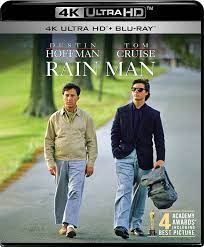
Directed by Barry Levinson and written by Ronald Bass and Barry Morrow (in fact, the characterization of Raymond was based on Kim Peek and Bill Sackter, two savants that Morrow met and had already written about in the script for the movie Bill), Rain Man is the story of how Charlie Babbitt (Tom Cruise) has a brother, the aforementioned Raymond, that he never knew about. Even more vexing, his father has given all of his estate to Raymond.
Once he thinks back to his childhood, Charlie realizes that Raymond was the Rain Man of his childhood, someone that the adult version of himself saw as an imaginary friend. Instead, he was a real person who was eventually put in an institution when their father believed that he tried to scale his younger brother in the bath.
After seeing how Charlie treats his brother, his girlfriend Susanna (Valeria Golino) leaves him. Yet the more time the two brothers spend together, the closer they become, even if Raymond is difficult for him to deal with and costs him his latest deal to sell four collector cars.
Originally, Dennis and Randy Quaid were going to play the brothers, then Bill Murray as Raymond and Dustin Hoffman as Charlie. Luckily, things in our universe worked out the way they did, as I couldn’t see any other actors in these roles. That said, when Hoffman studied Peek’s Savant Syndrome, he felt that the character of Raymond needed more, so he also made the character autistic. As this movie was such a big deal, it led to many in the public thinking that all savants are also autistic or that autistic people are all savants, when only 1 in 200 have these gifts. To be fair, Hoffman was really concerned with his performance, telling Levinson, “Get Richard Dreyfuss, get somebody, Barry, because this is the worst work of my life.” He and Cruise felt like the movie would bomb and called it Two Schmucks In a Car.
This was also filmed during a writer’s strike — completed just hours before it began — which is why the ending wasn’t debated and an alternate ending shot.
I’m fascinated that Sir Michael Caine is such a big fan of this movie because he actually lived it. He found out late in his adult life that he had a brother that he had never met before, one who had been hospitalized due to an extreme case of epilepsy.
The MVD 4K UHD release of Rain Man has a 4K Ultra High Definition version of the movie that was scanned in 4K from the original camera negative and approved by director Barry Levinson, who also provided an audio commentary. There are also two other commentaries, one by Barry Morrow and another by Ronald Bass.
This set also includes a trailer, a featurette on the making of the movie, another on autism, deleted scenes and a limited edition slipcover.
Swamp Thing can trace his roots — yes, it’s a he — back to “It,” Theodore Sturgeon’s short story that ran in the pulp magazine Unknown in 1940. The story is all about a man — Roger Kirk — who dies and is reborn in a swamp.
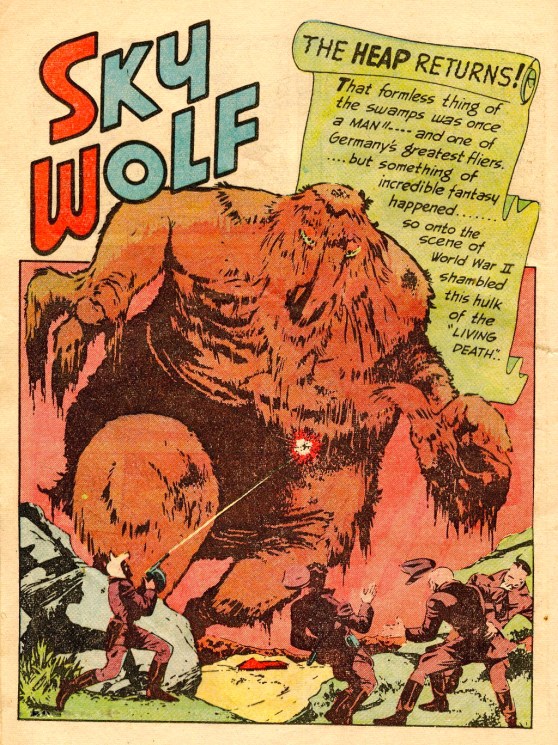
This was an influential tale whose roots — pardon the pun — took hold throughout comic books, which were the younger brother of the pulps. In Air Fighters Comics #3, published in 1942, Sky Wolf (a World War II fighting ace given to wearing the mask of a wolf and helping Airboy battle the Axis) the muck-encrusted form of World War I German pilot Baron Eric von Emmelman returned from the grave in the same way that Roger Kirk did two years before.
Thanks to his immense force of will and the help of the goddess Ceres, as the Baron’s body decayed, he became one with the vegetation of the swamp that he was shot down over. Now, he was more marsh than man, and fought Sky Wolf until discovering the fanaticism of his countrymen.
Before long, The Heap was the heroic star of his own backup in Airboy Comics, with adventures lasting from 1946 to 1953. He’d return in 1986 as part of Eclipse Comics’ reboot of Airboy before being bought by Image Comics, where he’s now part of Todd McFarland’s Spawn Universe.
After EC Comics (the creators of Tales from the Crypt and The Vault of Horror amongst others) and other horror comics publishers were taken to task for their extreme material, the Comics Code Authority outlawed all monstrous characters unless they had literary roots. In fact, until the year 1989, you weren’t even allowed to say the word zombie in a mainstream comic book (Marvel got around this by calling them zuvembies, if you can believe that).
As the CCA relaxed its rules at the start of the 70’s, two different characters that both grew from the Heap started at both Marvel Comics and their cross-town rivals, DC.
Man-Thing was created by Stan Lee and Roy Thomas (who’d go on to write Fire and Ice and adapted plenty of Conan stories, including the one that would be filmed for Conan the Destroyer). A series of conversations led to five different potential origins for the character, with the name being recycled from another character that had already appeared in Tales of Suspense #7 and #81.
Thomas would tell Alter Ego that Lee “had a couple of sentences or so for the concept — I think it was mainly the notion of a guy working on some experimental drug or something for the government, his being accosted by spies, and getting fused with the swamp so that he becomes this creature. The creature itself sounds a lot like the Heap, but neither of us mentioned that character at the time.” Lee also had the name for the character, which would lead to perhaps my favorite comic book title of all time: Giant-Sized Man-Thing.
While you’d think that Man-Thing would be a one-note character — he never speaks and he just kind of shows up in the swamps — but he grew from his first appearance, where he battled Marvel’s Tarzan-esque Ka-Zar to become something much different thanks to the deranged hands of Steve Gerber, who made Man-Thing the center of the Nexus of All Realities, which just so happened to be inside his swamp.
Once biochemist Dr. Theodore “Ted” Sallis and a former co-worker with Dr. Curtis “The Lizard” Connors, the man who would become Man-Thing was working on a version of Captain America’s Super Soldier formula with Dr. Barbara Morse (who would become Hawkeye’s wife Mockingbird, man, I read too many comics as a kid) when techno soldiers from Advanced Idea Mechanics (A.I.M.) and his betraying wife attacked. The result? You guessed it. Fused with the swamp, no brains and a tendency to wander. That said, Man-Thing also gained the ability to burn anyone who felt fear in his presence, so he had that going for him.
Man-Thing became a story engine for Gerber (who contended that he was just a reporter for the very real tales of the character, as he appeared as a fictional character within the comic), who used these stories to introduce sorceress Jennifer Kale, the barbarian Korrek who emerged from a jar of peanut butter, the serial murdering Foolkiller, Dakimh the Enchanter and Howard the Duck. Yep, Gerber’s Man-Thing was pure imagination writ large across the comic book page. After leaving comics, Gerber would write for plenty of cartoons, including Dungeons & Dragons, which his work had a major influence on.
At pretty much the same time, Len Wein came up with the idea for a swamp-based character as he rode the subway. “I didn’t have a title for it, so I kept referring to it as that swamp thing I’m working on. And that’s how it got its name!” Master illustrator Bernie Wrightson (he drew the comic cover for Creepshow) designed the character’s visual image and helped tell his first few adventures.
The Swamp Thing was once Dr. Alec Holland, who was working with his wife Linda to invent a solution for the world’s food shortage problems. After some thugs blew up their lab, his destroyed body was coated in one of his formulas and grew within the swamp, transforming him into a conscious plant with all of his old memories. Of course, once Alan Moore came on board — after this movie brought the character back to comics — we would learn that Swamp Thing was really the latest in a long line of Earth elementals that protect the Green.
If this all sounds like DC was stealing ideas from Marvel — well, they were all stealing from the Heap who was stealing from Theodore Sturgeon — let me blow your mind a little further. Swamp Thing writer Len Wein and Man-Thing’s co-writer, Gerry Conway, were roommates.
Despite the first version of Swamp Thing appearing in House of Secrets #92, Len Wein would later say, “Gerry and I thought that, unconsciously, the origin in Swamp Thing #1 was a bit too similar to the origin of Man-Thing a year-and-a-half earlier. There was vague talk at the time around Marvel of legal action, but it was never really pursued.”
It was decided that this was just a strange coincidence and after a while, the characters became so different, no legal action was necessary.
If you’d like to learn more about the fascinating lives of comic book swamp men, I recommend TwoMorrows’ Comic Book Creator 6: Swampmen.
Whew! I told you all that so I can tell you this: In 1982, Wes Craven wrote and directed an adaption of the comic, long before comic book movies were a thing. His intent was to show the major Hollywood studios that he could handle action, stunts and major stars, all while doing it under his $2.5 million dollar budget. Good news — he succeeded.
A top-secret bioengineering project in the southern swamps is dealing with sabotage, so Alice Cable (Adrienne Barbeau, playing a mix of the comic’s Matt Cable and Abigail Arcade) has been dispatched to replace one of the scientists who has been killed. She soon meets lead scientist Dr. Alce Holland (Ray Wise) and his sister Dr. Linda, who together have developed a glowing plant with explosive properties, as well as a combination animal/plant hybrid.
The real issue is that the secret base is being eyed by the evil Anton Arcane, a paramilitary leader who wants the fruits — and vegetables — of all this labor for himself. He’s played by Louis Jourdan, who is absolutely perfect in the role, oozing menace from every pore while remaining aloof and almost high cultured in his pursuit of evil.
Soon, Arcane’s forces attack, murdering Linda and blowing Alec up real good. However, just like the comic, he now rises as Swamp Thing, played by stuntman DIck Durock (who was also the pie-eating champion in Stand By Me). Now, he must protect Alice and his notes, keeping them both from Arcane.
The movie differs from the comic in that Holland’s formula unleashes whatever dominant personality trait exists within each person. For Holland, it’s the ability to heal and transform his inner strength into outer muscle. Yet Bruno (Nicholas Worth, who played the heavy in plenty of films and lent his voice to the Reaper in The Hills Have Eyes Part II), the biggest of Arcane’s henchmen, becomes a small rat-like creature and Arcane himself becomes a gigantic boar.
Another of Arcane’s henchmen — Ferret, the one who gets his neck snapped by Swamp Thing — is played by David Hess, who was Krug in The Last House On the Left. Also, Karen Price, who plays one of Arcane’s messengers, was Playboy‘s Playmate of the Month for January 1981. I tell you that because it’s her centerfold that appears on the tail of Gyro Captain’s copter in The Road Warrior.
There was one bit of controversy this film caused, more than a decade after it was released.
In August 2000, MGM released this movie on DVD and although it was labeled PG, it actually included the 93-minute international cut, which amps up Adrienne Barbeau’s ample charms and nudity in the skinny dip sequence. Two years after that, a woman rented this film in Dallas for her kids and was shocked and dismayed by what her family saw. Trust me — they should be so lucky!
Durock and Jourdan — along with much of the crew, including producers Michael E. Uslan and Benjamin Melniker — would return in 1989 for Return of Swamp Thing. It’s directed by Jim Wynorski and features Heather Locklear as Abigail Arcane, who heads to the swamp to confront her stepfather Dr. Arcane. He’s been brought back to the dead by the evil Dr. Lana Zurrell (Sarah Douglas, Ursa from Superman) along with an army of mutant Un-Men, all ready to do battle with Swamp Thing.
If anything, that movie gave us more than a series on the USA Network and a cartoon complete with Kenner action figures (of course I bought every single one). It also gave us this, a PSA where Swamp Thing speaks for Greenpeace.
Good news. Today you learned way more than you ever thought you would about 20th century popular fiction involving swamp-based creatures. Would it help even further if I told you that Man-Thing also appeared in a 2005 SyFy movie directed by Brett Leonard (The Dead Pit, The Lawnmower Man, Hideaway)? I sure hope so.
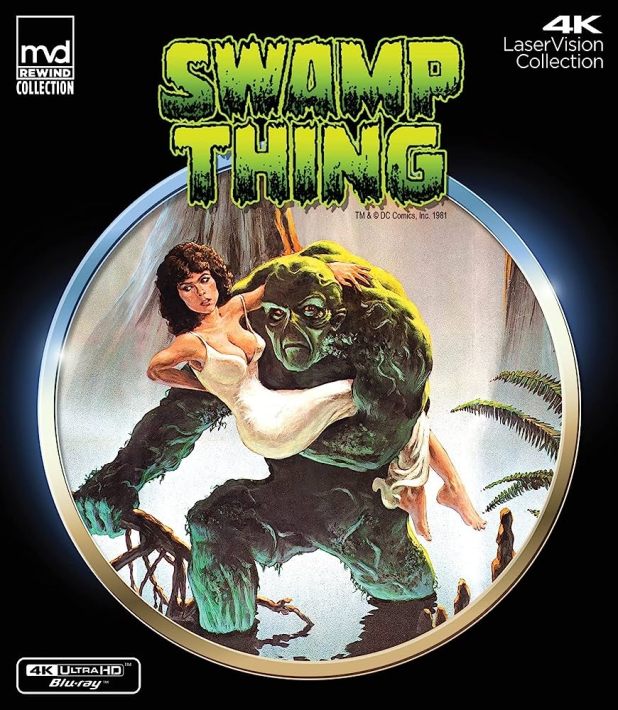
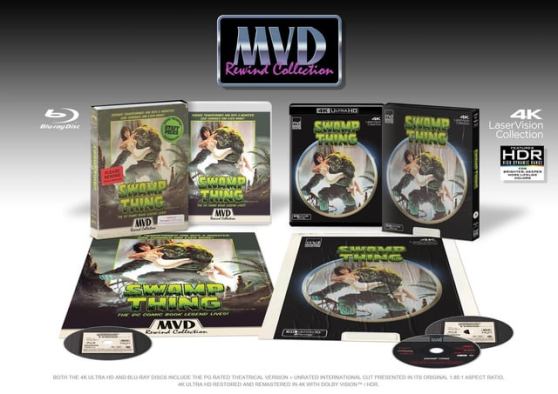
The MVD 4K UHD/bluy ray combo of Swamp Thing include a new 4K restoration — a 16-bit scan of the original camera negative — of the U.S. theatrical PG and unrated international versions of the film. There’s archival commentary by Craven moderated by Sean Clark, as well as alternate commentary with makeup artist William Munn moderated by Michael Felsher. Yoy also get a collectible 4K LaserVision mini-poster and a limited edition slipcover.
Special features include interviews with Adrienne Barbeau, Reggie Batts and creator Len Wein, as well as features on drawing Swamp Thing and Craven’s direction. Plus, there’s a photo gallery of the posters and lobby cards, photos from the film, behind-the-scenes photos and a trailer.
EDITOR’S NOTE: Mae West was on the CBS Late Movie on May 4 and August 11, 1987.
At the age of ten, I had a huge crush on Ann Jillian even if I had no idea why I felt that way.
Now I do and I still have that crush.
Directed by Lee Phillips (The Spell, Sweet Hostage) and written by E. Arthur Kean, this has Jillian as Mae West and takes you through enough of her career to see how she went head-first against small-minded censors. Jillian is great in it and has several performances of West’s songs, too.
James Brolin is Jim Timothy, her manager and former love interest, while Roddy McDowall plays her co-writer Rena Valentine — based on Julian Eltinge — and Piper Laurie is West’s mother Matilda. I wouldn’t depend on this film for factual accuracy, but if you’d like to see JIllian pretty much put on a one woman show, it’ll definitely deliver on that. The costumes are pretty great, too.






 B&S About Movies
You must be logged in to post a comment.