Bleeding Skull’s Top 50 (July 7 – 13) The middle-brow champions of low-brow horror, Bleeding Skull has picked out some of their favorites from the SWV catalog. They neglected to put I Drink Your Blood or EEGAH!on the list, but I think I can forgive them since they included Ship of Monsters.
J.G. Patterson Jr. — full name Jr Junius Gustavious Patterson — was only on our planet for 45 years, but in that time, the North Carolina native worked on She-Devils On Wheels, The Gruesome Twosome and Axe, as well as providing effects for Three On a Meathook and The Electric Chair. He was also an actor in movies such as Preacherman, Moonshine Mountainand Whiskey Mountain.
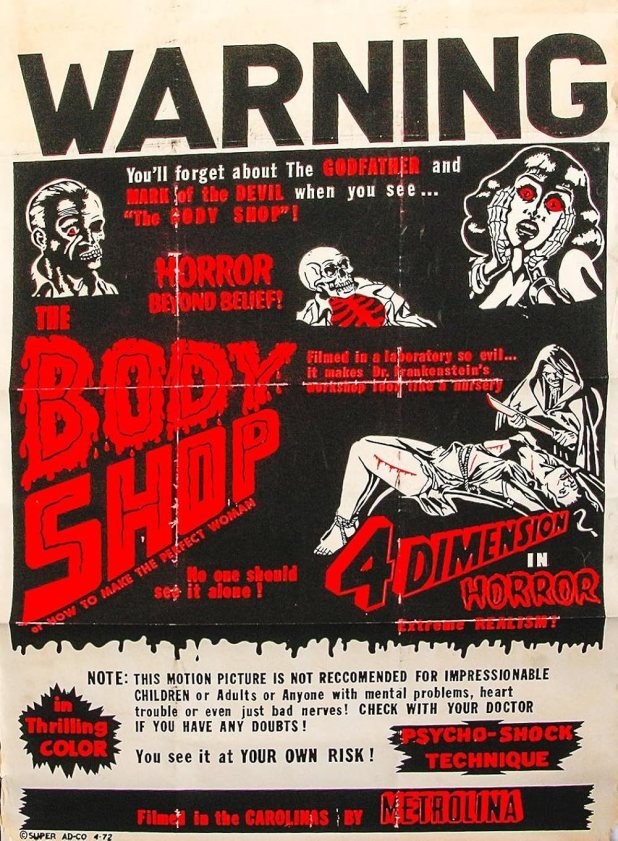
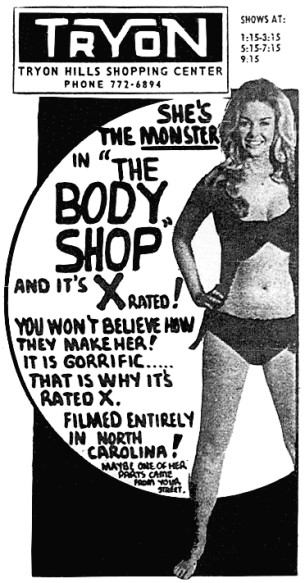
Yet it’s his vanity production — in the best sense of the word — The Body Shop that we’ll be talking about today. In addition to directing, writing and producing this movie, Patterson was also its lead, playing Dr. Brandon. He’s lost his wife in a car crash — shades of The Brain That Wouldn’t Die— so after setting her head ablaze, he decides to just remake her in a perfect body by killing women — again, The Brain That Wouldn’t Die — along with his hunchbacked assistant Greg (Roy Mehaffey).
Patterson got the most important part of being a horror star right. Just like Paul Naschy, he gets to make out with every pretty girl in this movie before killing them and getting to show off his skills at making over the top gore. He also repeatedly cuts to a country star — I use this word in the lowest wattage and I am also not about to refer to the stand up comedian — Bill Hicks, who keeps coming back to tell us that “A Heart Dies Every Minute.”
Hicks may be William T. Hicks, who was also in the Earl Ownsby-produced North Carolina-filmed classics A Day of Judgement, Death Screams and Order of the Black Eagle.
Now that the doctor has Anitra (Jenny Driggers), he wants to keep her away from every other man. He can also control her mind. But you know that women are always smarter than men, even if they are sewn together from the corpses of a model, a secretary and a few other pretty girls.
When this came out on VHS, it had Herschell Gordon Lewis introduce it and the name changed to Dr. Gore. In the credits, it also says that Patterson was America’s #1 magician, which seems like the kind of claim that can be verified. Also known as Shrieks in the Night, this movie is also evidence as to why Patterson died of metastatic malignant melanoma — his death certificate is linked on his IMDB page — because he’s lighting up in every scene, even when he’s in his lab. He also picks his nails with a scalpel, so there’s that.
A few of the ladies in the cast — Jenny Driggers and Jeannine Aber — are also in another North Carolina regional film, The Night of the Cat.
This was also called Anitra while it was being shot. I can tell you that because the clapboard is on screen for a good five seconds. But I loved this. It has 15 gallons of blood in it, which is enough for ten people.
Let me ask you: Does Poor Things have a soundtrack by William Girdler? Does it have the line, “Greg! Put on this lab coat, so they don’t know you’re a hunchback!” Does a cop give up the investigation because the doctor says, “I’m a doctor?” No, it doesn’t. This movie cost a fraction that can’t even be calculated of that Film Twitter darling’s budget and it doesn’t have Bill Hicks and The Reignbeaux singing in a steak house.
EDITOR’S NOTE: Escape from the Planet of the Apes was on the CBS Late Movie on September 6, 1977.
“Apes exist, Sequel required.”
With those words, sent in a telegram from producer Arthur P. Jacobs to writer Paul Dehn, a sequel was set in motion to Beneath the Planet of the Apes.
But hey — didn’t everyone die in a nuclear bomb blast at the end of that movie?
They sure did.
Doesn’t matter.
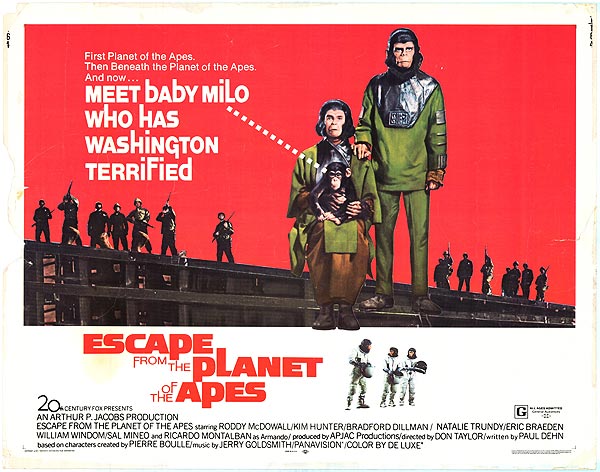
Dehn decided that Cornelius and Zira — along with an inventor ape named Milo — would go back in time with Taylor’s ship. He also consulted Pierre Boulle, writer of the original Planet of the Apes novel, to add more satire to the story. Originally titled Secret of the Planet of the Apes, the results are rather genius, as only three ape actors allowed for a smaller budget while selling director Don Taylor (Damien: The Omen II andThe Final Countdown) on the idea of making the film more humorous.
Cornelius (Roddy McDowall), Zira (Kim Hunter) and Dr. Milo (Sal Mineo!) have escaped the ruin of future Earth and landed back in 1973, where they are taken to the Los Angeles Zoo, where Dr. Stephanie Branton (Natalie Trundy, the wife of producer Jacobs and the only actor to portray every single race in the Apes universe) and Dr. Lewis Dixon (Bradford Dillman!) are set to examine them.
In private, the apes elect to not to let the humans know that they can speak. They also can’t tell them that, you know, they once dissected humans and that everyone else died in the Ape War. But man, those humans act so condescending to Zira and she flips out and shows them just how smart she is. And then she starts talking. And then, well, a mishap allows a zoo gorilla to kill Dr. Milo. Luckily — and in spite of this — Lewis ends up friends with the chimpanzees.
Meanwhile, a Presidential Commission has been formed to investigate the return of Taylor’s spaceship and determine what these apes are all about. Cornelius and Zira become celebrities over night and everyone loves them.
That’s not sitting well with President’s Science Advisor Dr. Otto Hasslein (Eric Braeden, Titanic, Colossus: The Forbin Project), who discovers that Zira is with child and therefore fears for the future of humanity. He gets her drunk — dude, she’s pregnant! — and she reveals all, which means that now it’s time for the government to really interrogate them. After some truth syrum, Zira reveals that yes, she has dissected humans before and yes, she knew Taylor before he died.
Hasslein takes his findings to the President (William Windom), who must agree with the council that Zira’s pregnancy is to be aborted — guess he’s not a Right to Lifer — and that they must both be sterilized. After his child is called a little monkey by an orderly, Cornelius goes wild and accidentally kills the man before they escape.
Branton and Dixon help the apes to escape, where they hid out in the circus run by Senor Armando (Ricardo Montalban!), where an ape named Heloise has just given birth. Zira also gives birth to a son, whom she names Milo in honor of their deceased friend.
Hasslein is more animal than the apes, tracking them to a shipyard. The couple do not want to be taken alive, which suits him just fine. He fires numerous shots into Zira and her baby to the horror of all watching. Cornelius kills him in retaliation before being shot by a sniper. The couple crawl toward each other, touching one another one more time before dying.
Meanwhile, at Armando’s circus, we learn that Zira switched children with Heloise and Milo has survived. As the ringmaster walks away, we hear his first words as he cries for his mother.
Somehow, each Apes film tops the previous one for total downer endings.
It could have been worse — Cornelius and Zira were originally going to be ripped apart by a pack of Doberman Pinschers!
James Bacon shows up here — the only actor to be in all five of the Apes films. He also would go on to write numerous books about Hollywood, including the Jackie Gleason biography How Sweet It Is: The Jackie Gleason Story. This is the only movie in the series where he plays a human being.
Detroit TV announcer — he was mostly on WXYZ-TV — Bill Bonds plays a TV newsman. John Randolph plays a councilman, a role he’d also play in the next film, and he’s in another monkey movie, the 1976 remake of King Kong. M. Emmet Walsh also makes an appearance. And Albert Salmi, who is in Superstition, is here as well.
Sal Mineo found the makeup process very uncomfortable and tiring. Kim Hunter would later say that she and Roddy McDowall had to hug Mineo a lot to console him. He had hoped that this movie would restart his career, as it did McDowall’s, but due to how much he hated the make-up, he was killed off earlier than originally planned. Escape from the Planet of the Apes would be Mineo’s final theatrical film before he was murdered on February 12, 1976 at the age of 37.
EDITOR’S NOTE: The Survivor was on the CBS Late Movie on July 4, 1988.
This is not the 1987 film The Survivor or the 1984 movie Sole Survivor, which is also about an airplane crash with one survivor. It is also not Final Destination, despite Frank Herbert writing the book that inspired this in 1976. He also wrote a lot of books about mutant rats and sadly, only one movie was made from that series, Deadly Eyes, which had dachshunds in fur suits. His books Fluke, Haunted and The Unholy have all been made into movies.
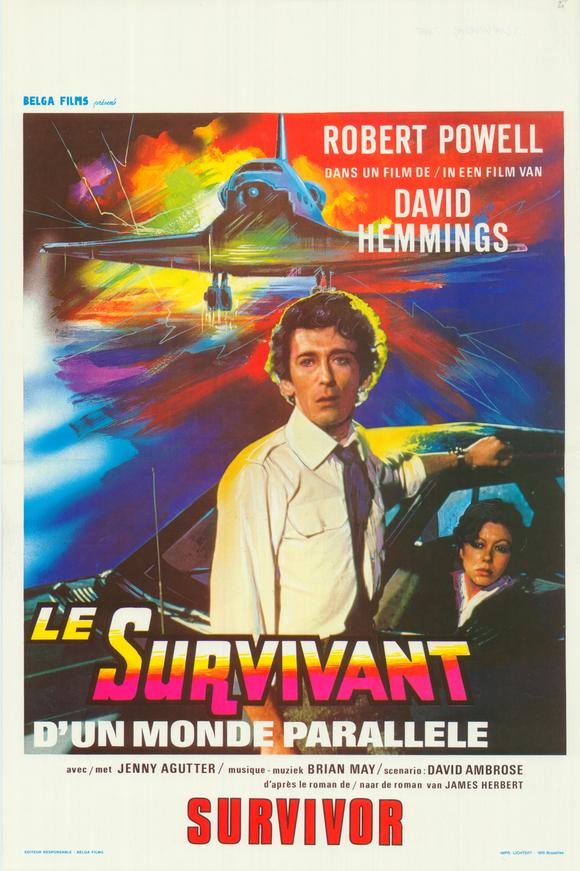
Pilot David Keller (Robert Powell, Harlequin) is the only survivor of the crash of a Boeing 747-200 and he feels responsible for the loss of 300 passengers. He can’t remember the accident but starts having visions that lead him to believe that the crash was no accident. There’s also the matter of little girl ghosts stalked the paparazzi who trail Keller, killing one of them after revealing a scarred face. When his girlfriend tries to develop the photos, another ghost kills her with a papercutter.
After going to a vigil — and being screamed at — Keller meets a psychic named Hobbs (Jenny Agutter). She reveals that she has the same visions and they are overtaken by the emotions they both are possessed by and begin to fight one another.
Working with a priest (Joseph Cotten in his last role), the two learn that the killer was a fellow pilot, Slater (Ralph Cotterill). He saw the people on the plane as just collateral damage to ruin Keller. As they fight, a flaming airplane sets them ablaze and Keller barely walks out, burned up and dying. When crews continue to drag away the parts of the plane, they find his dead body. Was he always there?
Brian Trenchard-Smith cut the Milan Film Market trailer for this, shooting his own footage of Agutter before she even started making this movie. He also directed the trailer that sold the movie to audiences.
When interviewed by David J. Howe, Herbert said of his movies, ““I had nothing to do with those two films. I heard after the event that The Rats had been sold to Golden Harvest who did all those Bruce Lee Kung-Fu films. I sent a note to David Hemmings when I heard he was directing The Survivor to offer my assistance if he wanted it – I didn’t get a reply. I’ve seen them. They’re terrible … absolute rubbish. I can only say don’t blame me.”
That’s right. This was directed by Deep Red star David Hemmings. It was written by David Ambrose, who created the British TV movie and conspiracy nexus point Alternative 3, as well as The Final Countdown, Amityville 3-D, D.A.R.Y.L. and Blackout.
Sadly, Australia’s Actor’s Equity were upset that there were so many overseas cast members and refused to allow Susan George and Samatha Eggar to be in this movie. We nearly got the stars of Tintorera and Demonoid in the same movie?
EDITOR’S NOTE: Necromancy was on the CBS Late Movie on January 6 and June 23, 1977.
If you go to a town named Lilith to live, you should not be surprised that the town is run by devil worshippers. If Orson Welles comes to you in a robe and his name is Mr. Cato, you should not be shocked to learn that he wants to use you to raise his son from the grave. What is surprising is that for a movie promising rituals and raising the dead, Necromancy isn’t all that exciting.
Directed by Bert I. Gordon (War of the Colossal Beast, Picture Mommy Dead), the master of rear projection, this film is all about Lori Brandon (Pamela Franklin, The Legend of Hell House, And Soon the Darkness), a woman who has recently lost a child. She moves with her husband, Richard (Michael Ontkean, Sheriff Harry S. Truman from Twin Peaks) to the aforementioned town of Lilith to start over again.
On the way there, they get in an accident and kill a woman, but it’s totally glossed over because this is 1972. Life was cheap. At least Lori gets a baby doll out of this accident.
There used to be a sign in my hometown that said, “What Ellwood City makes, makes Ellwood City.” The town of Lilith makes one thing: the world’s finest occult paraphernalia. There’s one great scene here with Lori sees her image inside a tarot card, a really evocative scene thrown away in a film that is otherwise less than memorable.
If you’ve seen Rosemary’s Baby, you know exactly how this is all gonna turn out. If you are the star of a 1970’s horror movie — especially if you are Donald Sutherland — expect to die. Horribly.
Much like the devil, Necromancy goes by many names, such as The Witching, A Life for a Life, Horror-Attack, Rosemary’s Disciples and The Toy Factory. When Paragon Video re-released it on VHS in 1982, they chopped out tons of story and dialogue to insert scenes of nude witches like Brinke Stevens and even more Satanic rituals.
As much as I love Orson Welles — we’ll have a whole month of his films at some point, I’m certain — this is not his finest hour. He has some fine speeches, but the material is Mrs. Paul’s level. Beneath him.
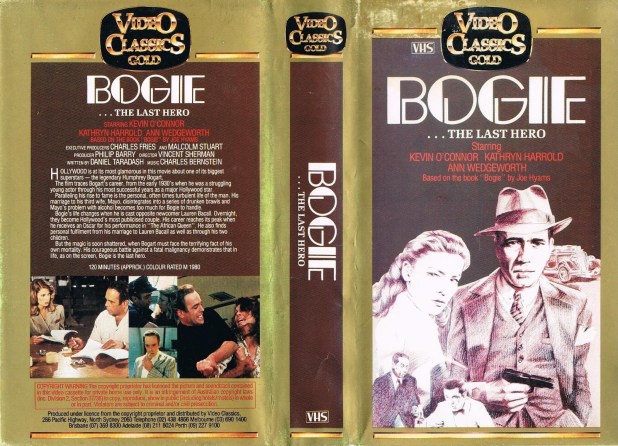
EDITOR’S NOTE: Bogie was on the CBS Late Movie on August 20, 1982.
I have a big weakness for made for TV biopics, often because they’re rarely good and yet that keeps me coming back to them. The blame lies at the feet of the multiple tabloids my grandmother subscribed to as I learned about Liz’s sad last days, Liberace and Rock Hudson’s watermelon diet and who was beating who, who was doing drugs and who was getting surgery.
Based on Joe Hyams’ 1966 novel, Bogie: The Biography of Humphrey Bogart, this stars Kevin O’Connor as Humphrey Bogart, who was my father’s favorite actor. O’Connor has an interesting list of credits, like playing Irijah in The Passover Plot and Woody in Let’s Scare Jessica to Death.
In the roles of the two loves of his life are Ann Wedgeworth (Aunt Fern from Steel Magnolias) as Mayo Methot and Kathryn Harrold (Raw Deal) as Lauren Bacall.
Director Vincent Sherman made The Return of Dr. X, All Through the Night, Crime School, Across the Pacific and King of the Underworldwith Bogie and writer Daniel Taradash wrote Knock on Any Door, so they knew that man. It’s hard to say if this was right, because it seems like it tries to get in so much in such a short time. The transitions where it shows Bogart in his many roles seem like something out of pictures you would get in a Wild West saloon at a theme park. Nothing feels authentic. Much of the film is O’Connor mugging for the camera and trying to get his face to look like the star.
You can spot a young Drew Barrymore as Bogie’s daughter Leslie.
When asked about the movie, his widow Lauren Bacall said, It’s a bunch of crap, and there’s no way to stop it. It’s a crock, unadulterated garbage, and it’s untrue. They’re just going to use him. Jesus, there’s no creativity left in the world. People will do anything for money. Anything.”
Oddly enough, both Bogart and O’Connor died from cancer.
We first encountered The Child at a Halloween party thrown at the palatial Mexican War Streets home of Mr. Groovy Doom himself, Bill Van Ryn. While some folks drank in the kitchen or enjoyed the mix of Goblin and My Life With the Thrill Kill Kult blasting in the sitting room, I was entranced by a film that was playing on the TV. The sound wasn’t turned up, the images all felt like transmissions from beyond and nothing really added up in the movie. “What the hell is this,” I asked. “Oh, The Child!” exclaimed Bill, hurriedly running in to try and explain why he was growing more and more obsessed with multiple rewatches of the film.
Sometime in the 1930’s — which you’d only know from the old cars, as this film feels like an anachronism lost in no particular time — Alicianne has been hired to be the caretaker for Rosalie Nordon, the titular child, who has just lost her mother. Along with her father and brother Len, she lives in a house on the edge of the woods.
Even the trip to the house is strange, with Alicianne’s car breaking down after she drives it into a ditch. A journey through the woods brings her to Mrs. Whitfield, who warns her about the Nordon family. She probably should have listened, as everyone in this family — hell, everyone in this movie — is touched, as they say.
When Alicianne first meets Rosalie, he jack in the box suddenly moves by itself. It’s a very subtle scene that hints that things might not be right here. After all, people have seen Rosalie wandering the cemetery late at night, a place where she brings kittens so that her friends there will do anything she asks. And even dinner is strange, as her father relates a story of Boy Scouts eating a soup stirred with oleander that caused them all to die. Father and daughter have a good laugh at that while Len just seems embarrassed by his family.
Then there are the drawings — Rosalie has been sketching everyone who was at her mother’s funeral, marking them for death. And if she does have psychic abilities, is she using them to reanimate the dead or control them? Or do they just do whatever she wants? The Child wasn’t made to give you those answers. It just screams in your face and demands that you keep watching despite your ever-growing confusion.
Mrs. Whitfield’s dog is taken first, then that old busy body pays the price, with her face getting ripped off as the zombies mutilate her. That gardener has some of mommy’s jewelry, so he has to pay, too. And Alicianne, who was supposedly here just for Rosalie, has started to spend too much time with Len. She’s next on the list.
There are some really haunting scenes as we get closer to Halloween, like a scarecrow come to life and a jack-o-lantern that keeps relighting itself and following our heroine around the room.
Finally, Mr. Nordon starts to discipline his daughter, which leads to Rosalie unleashing all of her powers. She decimates her father, crashes Alicianne’s car and sends zombies to chase her governess and brother all the way to an old mill. Len tries to fight them while Alicianna just screams and screams, but he can’t stop them from dragging him under the building and tearing his face to bloody pieces. As the attack of the zombies stops, Rosalie walks through the door just as our heroine hits her with an axe. She walks outside into the dawn’s light and everything is still. The threat is over.
Written by Ralph Lucas as Kill and Go Hide, The Child isn’t a great movie, but it’s an interesting one. If you ask me, that’s way more important. Some people will get tied up in things like narrative cohesion, good acting and a soundtrack that makes sense. None of those people should watch The Child with you, as they’ll just ruin what can be an awesome experience. This is the kind of movie that takes over, kind of like one of those dreams you have and try to write down the moment you wake up, but it gets lost in the ether of reality. For most of the film, the zombies are barely glimpsed, just seen in the shadows, so they really could just be tramps that live in the cemetery. Or something much worse.
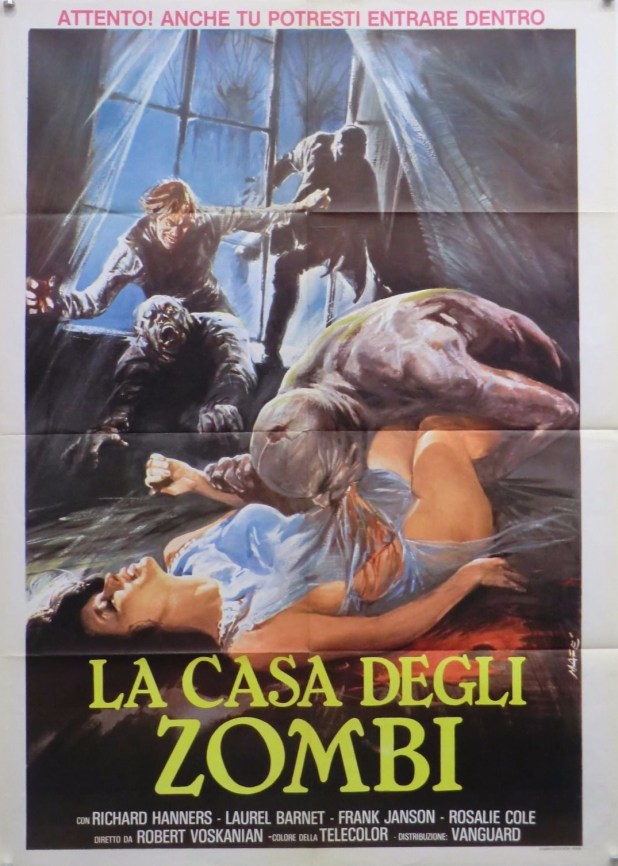
Producer Harry Novak acquired this film and made his money on it, even if director Robert Voskanian and producer Robert Dadashia saw no profit. It’s a story we’ve seen hundreds of times — an interesting movie taken, used and abused by conmen who have no interest in art.
Bleeding Skull’s Top 50 (July 7 – 13) The middle-brow champions of low-brow horror, Bleeding Skull has picked out some of their favorites from the SWV catalog. They neglected to put I Drink Your Blood or EEGAH!on the list, but I think I can forgive them since they included Ship of Monsters.
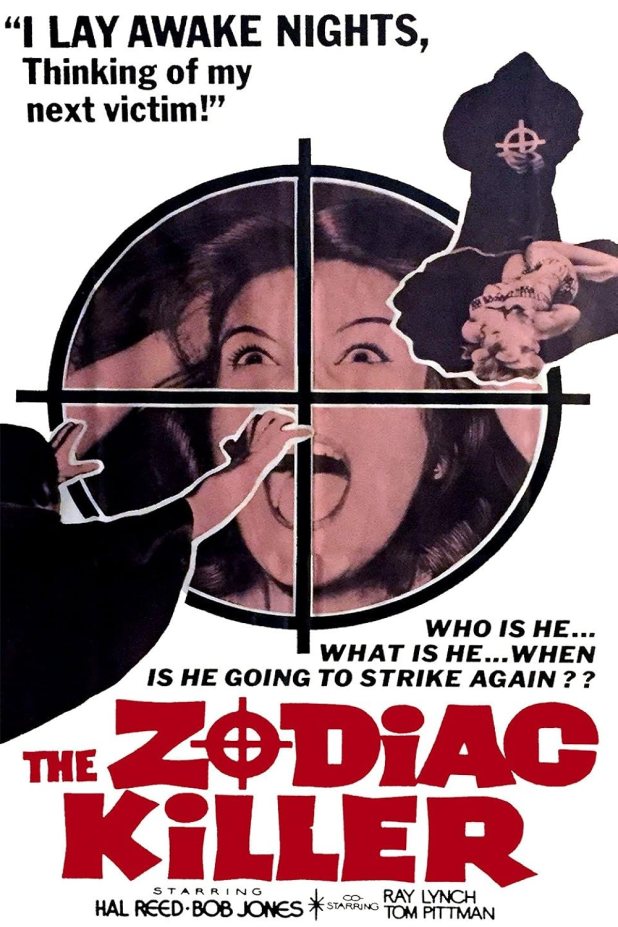
Zodiac Killer is just as much an attempt to catch the never arrested real-life Zodiac Killer as it was to cash in as an exploitation movie.
On its opening night on April 7, 1971 at the RKO Golden Gate Theater in San Francisco, audience members were asked to write their answers to the question “I think the Zodiac kills because …” and drop their entries into a large box. They were told that they could win a Kawasaki motorcycle, but they were also having their handwriting being tested by experts against the actual handwriting of the killer. Members of the cast were waiting to grab and interrogate anyone whose penmanship was suspect.
I don’t see David Fincher doing that.
In the first half of this movie, Grover (Bob Jones) bemoans his life. He’s a drunk and balding tow truck driver who can’t even see his daughter whenever he wants to. He takes her hostage and decides to tell the cops that he’s the Zodiac. She runs away and he gets the due process of being shot a whole bunch of times, his body falling into a swimming pool.
The truth, as shown in the second half, is that the Zodiac is Grover’s friend Jerry (Hal Reed). He’s a Satanist who hates humanity when he isn’t delivering their mail. He blames his crimes on the fact that his father is mentally ill, then his closing voiceover warns the audience that he will never been caught and that there are others just like him.
Along with Another Son of Sam, Zodiac Rapist and even Dirty Harry, the Zodiac was all over 70s cinema. This film’s director Tom Hanson — according to Mental Floss— “had found his niche as the owner of several Pizza Man franchises and a handful of Kentucky Fried Chicken locations.” He spent $13,000 of his money making this movie, which was less about making a good film and more about luring the Zodiac to the theater. He believes that he met the Zodiac at the urinal, when a man next to him said, “You know, real blood doesn’t come out like that.” As for his research, at least Hanson met with reporter Paul Avery, who also gave this quote that started some prints of this movie: “The motion picture you are about to see was conceived in June 1970. Its goal is not to win commercial awards but to create an “awareness of a present danger”, Zodiac is based on known facts. If some of the scenes, dialogue, and letters seem strange and unreal, remember – they happened. My life was threatened on October 28, 1970 by Zodiac. His victims have received no warnings. They were unsuspecting people like you.”
They may have missed the killer despite their plans, as co-writer Ray Cantrell was hiding inside a freezer to watch audience members. He nearly passed out and as he was being rescued, someone left a card that said, “I am the Zodiac, I was here.” No one was able to see who left that message.
There was a documentary called The Zodiac Killer Trap that discussed how Hanson spent years keeping up on the man who he met in the bathroom, who was still alive as of 2019.
As for the movie, it’s as good as $13,000 and amateur filmmaking will allow. It does have Doodles Weaver in an absolute freakout of a performance, ranting and snarling dialogue like “I like ’em plump and juicy and dumb!” A member of Spike Jones’s City Slickers band, a writer for Mad Magazine, the uncle of Sigourney Weaver and a frequent cameo and guest star actor, his full name was Winstead Sheffield Glenndenning Dixon Weaver. You’ll wonder how life led him to be in this movie.
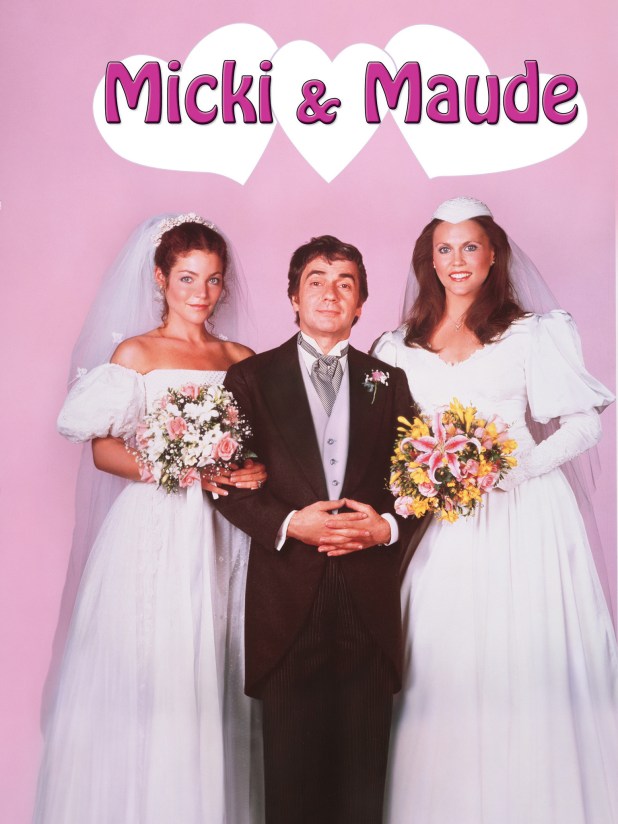
EDITOR’S NOTE: Micki & Maude was on the CBS Late Movie on February 17, 1989.
Rob Salinger (Dudley Moore) is happily married to lawyer Micki (Ann Reinking, who is mostly known for her dancing career). He wants a child but she wants a career. While interviewing cellist Maude Guillory (Amy Irving), he falls in love and gets her pregnant. Her father, pro wrestler Barkhas Guillory (Hard Boiled Haggerty), is beyond happy and starts to plan their wedding.
Our protagonist plans to tell Micki that he wants a divorce, except that she’s pregnant and kept the child for him. With help from his boss Leo (Richard Mulligan), Rob has a wife at day and at night. They may never have found out the truth if they didn’t both go into labor on the same day, in the same floor of the same hospital.
Yet somehow, these women become friends and kick Rob out of their beds. They both go on to great careers, but by the end of the film, it’s revealed that Rob has had several children with both of them.
Directed by Blake Edwards and written by Jonathan Reynolds, this film had Moore win a Golden Globe for Best Performance by an Actor in a Motion Picture – Comedy/Musical. And for those who love pro wrestling, this has appearances by Gene LeBell, Chief Jay Strongbow, Jack “Wildman” Armstrong, Big John Studd and Andre the Giant.
If you enjoy Edwards’ sexual screwball films — this is very close to The Man Who Loved Women and Skin Deep— you’ll enjoy it. And while Wallace Shawn is in the cast, he and Andre didn’t do any scenes together. You’ll have to watch The Princess Bride for that.
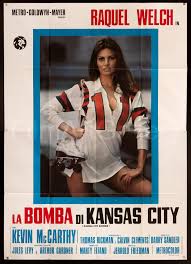
EDITOR’S NOTE: Kansas City Bomber was on the CBS Late Movie on September 11, 1975; December 6, 1976 and February 10, 1978.
Barry Sandler wrote Making Love, the first mainstream American film to deal with homosexuality and Crimes of Passion. His film script — written as his Master’s Degree thesis at UCLA — was for this movie. He always had Raquel Welch in the lead and said, “”Raquel was a huge star at the time — kind of like the pop culture goddess. I just thought it would be great to see her as a roller derby queen; it seemed like a perfect meshing of pop culture with that role.”
Sandler personally delivered the script to her house and her husband Patrick Curtis bought the script for their production company, Curtwel Productions.
The original idea changed somewhat, as Sandler told Stone Cold Jeff, “It was a dark, gritty, character piece, more in the vein of Requiem for a Heavyweight. It’s about this young woman from Kansas City who goes out to Hollywood dreaming of fame and fortune, making it in the movies, and she’s really not good enough to do so, but she’s desperate to make her name and to get attention. She struggles and struggles, and never makes it, and then one day, she meets this kind of beat up, bruised up, burnt-out ex roller derby queen who kind of takes her under her wing and coaches her, and tries to get her involved in the roller derby. It sort of shows her becoming a roller derby star, and the irony is that she makes it in the roller derby, but as a black-trophy … as a bad girl who gets hissed at, beat up, and spit on every week. The irony is that she is able to find the stardom she desperately yearned for, but not as a movie star–as a star on the roller derby track getting booed at and spit at every week. And so it’s kind of dark, and much grittier and different, kind of almost along the lines of Midnight Cowboy.”
It was originally to be made at Warner Brothers and he believed that they would have stayed true to what he wrote: “Warner Brothers was a much more adventurous studio at the time. They were making The Devils and A Clockwork Orange, Performance. They stuck with those kinds of movies. MGM wanted to sell Raquel Welch in a tight roller derby jersey, running around the track. Listen, they weren’t stupid, they were smart to do that. It certainly made them a lot of money, and it would have been a much riskier project to go the other way. They weren’t sure whether Raquel could pull it off. I think she could have, but they wanted to play it much safer and go with a much more straight-on roller derby story.”
Roller derby used to be a totally different sport than it is today. Imagine if pro wrestling won over women and they decided to do it for real. That’s exactly what happened with roller derby.
The sport has its origins in the banked-track roller-skating marathons of the 1930s. It became a competitive sport thanks to Leo Seltzer and Damon Runyon. Yes. The short story writer.
In 1940, more than 5 million spectators watched in about 50 American cities. Eight years later, Roller Derby debuted on New York television and by the 1960s, it aired on several national networks. Of the competitors to Seltzer — who owned the name roller derby — Roller Games was started by Herb Roberts and bought by Bill Griffiths Sr. and Jerry Hill.
By the mid 1960s, Roller Games had teams in Baltimore, Chicago, Cleveland, Detroit, Philadelphia, Florida and Hawaii, with leagues in Canada, Mexico, Australia and Japan. The biggest team — and where the TV was taped — was in Los Angeles with the L.A. Thunderbirds. It was such a big deal that in 1972, an interleague match between the Thunderbirds of Roller Games and the Midwest Pioneers set a roller derby attendance record of 50,118 at Chicago’s Comiskey Park.
Yet by 1975, Roller Games disbanded and many of the skaters started local circuits, kind of like how pro wrestling has survived the ups and downs of popularity. In the late 80’s, RollerJam and RollerGames both aired on television, but the revival didn’t take except with people that remembered watching the original games on UHF TV.
Welch understood what the sport was all about, telling the New York Times, “The game is almost show business, it’s a carnival atmosphere, but I can understand its popularity. Most of the spectators are basic people and there’s something cathartic about watching people get dumped. The yelling creates a certain kind of intensity. The type of violence draws you in, makes you involved. The skaters are tough but I think all women are tough. The skaters aren’t any tougher than most of the women in the world, underneath. Skating is a batchy, sweaty, funky life. I don’t want to do another film about it. I’ve done my number. But I enjoyed it.”
Welch played K.C. Carr, who has just left her team in Kansas City to start life all over again in Portland to skate for the Loggers. It’s all because their owner, Burt Henry (Kevin McCarthy), wants her. She dates him without knowing how he manipulates the team, like sending her best friend and roommate Lovey (Mary Kay Pass, Nurse Sherri) to another team and gets the crowd to drive “Horrible” Hank Hopkins (Norman Alden) crazy after he realizes that the older player has a crush on K.C. He has a plan to get out of Portland and go to Chicago, bringing her along. He sets up a match between her and Jackie Burdette (Helena Kallianiotes), which will lead to her leaving, just as she lost a match at the start of the movie with “Big Bertha” Bogliani (Philadelphia Warriors skater Patti “Moo Moo” Cavin) but by this point, she knows he’s a liar and instead of throwing the fight, she wins. The actual fight got out of hand between Welch and Kallianiotes, with the sex symbol getting punched in the face. She also suffered bruised knees, a spasm in her trapezius, hematomas on her head, several headaches and a broken wrist that delayed filming for two months.
The most harrowing scenes are when K.C. stops in Fresno to visit her two children who live with her bitter mother (Martine Bartlett). Her son Walt (Stephen Manley) refuses to speak with her, as he worries about her getting hurt. Her daughter Rita is a young Jodie Foster. And when Hank confides that he hates riling up the crowd and confesses how beat up he is, it made me think of the many aging heels I’ve met through wrestling.
The battles between K.C. and Jackie make up most of the film, including one battle where they tumble down a hill and are nearly hit by a train before being saved by team coach Vivien (Jeanne Cooper, Katherine Chancellor from The Young and the Restless). Kallianiotes earned her Golden Globe nomination for this movie.
Real roller derby venues in Kansas City, Fresno, and Portland were also used for key scenes and stars Judy Arnold (the captain of the Philadelphia Warriors and the skating double for Welch), Ralph Valladares (the holder of every important scoring, speed and endurance record in the history; “The Living Legend” was a member of the T-Birds as a player, coach and manager for 38 years), Danny “Carrot Top” Reilly, T-Bird Ronnie “Psycho” Rains, T-Bird and later New York Bomber Captain Judy Sowinski, one of the best jammers in the game “King” Richard Brown, “The Body Beautiful” Tonette Kadrmas, announcer Dick Lane and John Hall, a former skater who became the in-field manager for the Detroit Devils.
Director Jerrold Freedman mainly worked in television, directing TV movies like A Cold Night’s Death, Unholy Matrimony, The Boy Who Drank Too Much, The Comeback and The O.J. Simpson Story(as Alan Smithee). He also helmed episodes of The X-Files and Night Gallery. Oh yeah — he also wrote and directed the Charles Bronson movie Borderline. The script was written by Thomas Rickman (Coal Miner’s Daughter) and Calvin Clements Sr. (who wrote 66 episodes of Gunsmoke) from Sandler’s story.
Perhaps most odd, Phil Ochs was originally approached to write a theme song for this movie. His song was rejected but A&M Records released it. He hoped to publicly debut the song at the Olympic Auditorium during a Roller Games television taping at Los Angeles’ Olympic Auditorium. Thunderbirds owner Bill Griffiths Sr. said no thanks.
Welch claimed that this was the first of her movies that she liked. She isn’t always the heroine in this and despite her looks, she comes off as tough. I wish she’d made more films like this.
Roger Corman found out this was getting made and created his own roller derby film, Unholy Rollers. It’s very similar to this movie but has the benefit of Claudia Jennings as its star. She’s even wilder than Welch and ends the film attacking the entire audience and flipping off the cops. It’s great.
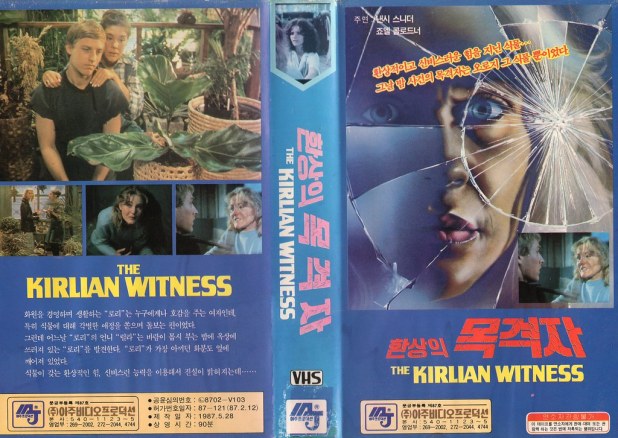
EDITOR’S NOTE: The Kirlian Witness was on the CBS Late Movie on August 13, 1986 and July 20, 1987.
“For the first time on the screen a strange thriller that takes you into the psychic world of plants.”
Yes, in 1979, people were talking to their plants, using biofeedback devices to hear from them and even singing to them. For everyone obsessed with the 80s, let me tell you, the 70s were way better.
Director Jonathan Sarno did post-graduate work in playwriting and directing at the Yale School of Drama under directors Arthur Penn, George Roy Hill, Elia Kazan, Roberto Rosselini and novelist Jerzy Kozinski. He’s an artist and yet here he is, making a horror movie about psychic plants, but life is great that way. Sarno wrote this, along with Lamar Sanders, and also produced the movie and acts in it.
I don’t even know where to start with this movie. I mean, the phrase Kirlian is because the photographer detective at the heart of this movie, Rilla Hart, has a photo in this style that represents the energy field of the exotic plant that her sister Laurie owned before her death. And oh yeah, her sister could literally talk to that plant.
An occult low budget movie about talking plants and a psychic named Dusty who brags about how he has surpassed human existence and is one with the plants despite mainly working the night shift loaded trucks and also knows the exact moment that they will expire? What could make this better? How about a cameo by Lawrence Tierney as a police detective? Yeah, that’ll do it.
There’s another release of this called The Plants Are Watchingthat cuts a fair amount of footage, so go for this one. It’s so twisty and oddball that it could pretty much be classified as an American giallo, what with its dream logic and ending which reminded me of The Cat o’ Nine Tails. It’s a relatively sexless journey through the same end of the world New York City as Driller Killer, but you know, with plants.
Honestly, this movie is way better than it has any right to be. In a perfect world, it would have been the first film that Sarno turned into a cult film and we’d be celebrating everything he made afterward instead of him going into making travel videos. There’s honestly nothing else like it.
Oh yeah, one more thing.
In the credits, it thanks the owner of Day of the Triffidsfor the use of a scene from that movie. That man? Philip Yordan, whose strange movie Night Train to Terror is a nexus point in my strange film obsessions. Much like how the Church of Satan connects The Car, Tippi Hedren’s Roar and Jayne Mansfield, that movie is the crux of so many of the pathways that researching weird films has led me down.
Here’s a drink for this movie.
The Plants Are Drinking
1 oz. Midori
1 oz. vodka
1 oz. white rum
5 oz. lemonade
Stir the first three ingredients in a glass with ice.

 B&S About Movies
You must be logged in to post a comment.