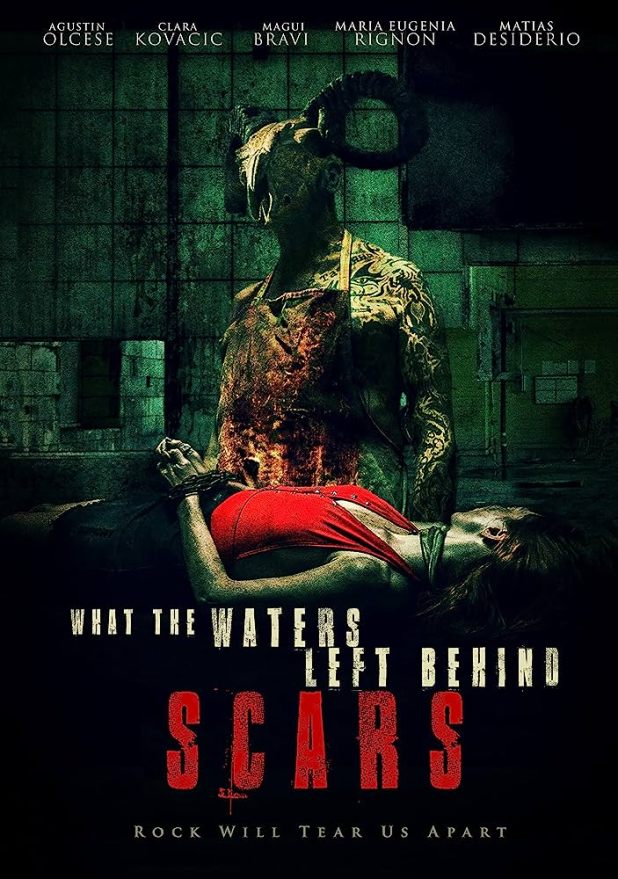
The sequel to What the Waters Left Behind takes place in the bizarre city of Epecuén. Director Nicolás Onetti (who made the original with his brother Luciano, who composed the film’s music; they also made Abrakadabra, Francescaand The 100 Candles Game together) and writer Camilo Zaffora founded the rock band The Ravens.
Drummer Billy Bob (Matías Desiderio) is the one they all can’t stand, and he’s already slept with a groupie named Carla (Magui Bravi), who asks for a ride home and promises a barbecue. Singer and bassist Jane (Clara Kovacic), guitarist Mark (Juan Pablo Bishel, his girlfriend Sophie (Eugenia Rigón) and their manager Javi (Agustin Olcese) are already sick of their bandmate, but follow him and, as you can imagine, this becomes another cover version of the Sawyer Family’s Greatest Hits. The tension within the band is palpable, adding an intriguing layer to the narrative.
Like the first movie, the real star is Epecuén, a former spa that spent thirty years submerged before the waters rolled back and left a desert in their wake. It looks like the end of the world and makes the movie feel way more significant than it is.
Carla has a grandfather named Tadeo (Mario Alarcón), who makes the best barbecue. However, it’s for him and his family — Antonio (Germán Baudino), Chimango (Chucho Fernández) and Tito (David Michigan)—and it’s going to be anything but locally sourced. Instead, the Ravens are on the menu and may never escape the final stop on their tour.
The first movie seemed to be trying to remake Tobe Hooper’s classic, and this one is more of the same. But hey—it’s got a great location, loud and proud of its gore, and has an intriguing idea of an arguing virus that passes through the band and the family. I believe the Onettis have something great in them someday soon. Their potential is evident, leaving me hopeful for their future projects.
EDITOR’S NOTE: The Legend of Lylah Clare was on the CBS Late Movie on March 15, 1976.
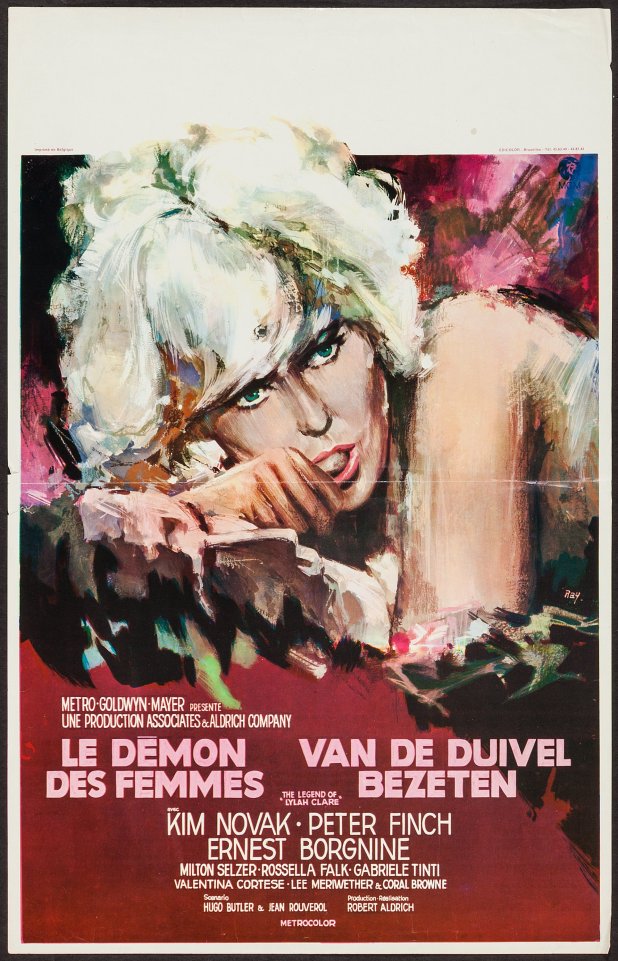
The Legend of Lylah Clare was based on a 1963 DuPont Show of the Week co-written by Robert Thom (Wild In the Streets). It’s about Elsa Brinkmann (Kim Novak), an actress who looks and sounds exactly like Lylah Clare, a star who fell to her death twenty years ago. Agent Bart Langner (Milton Selzer) gets Lylah’s ex-husband, Lewis Zarkan (Peter Finch), to meet her. Once he’s won over, they convince studio boss Barney Sheean (Ernest Borgnine) to make a movie with Elsa becoming Lylah as they make the movie of her life.
As the movie’s shooting begins, Lylah takes on the role to almost a Method degree while dealing with Hollywood’s pressures. She sleeps — and falls in love — with her director, battles gossip columnist Molly Luther (Coral Browne) and avoids the attention of her acting coach, Rossella (Rossella Falk). As filming continues, her identification with her role gets more intense.
She has become the role by the end, doing things Lylah would do, such as sleeping with a landscaper (Gabriele Tinti, who did the best out of anyone in this movie by marrying Laura Gemser) and making sure that she’s caught to make Zarkan jealous and finally killing herself by falling, again, from a high wire. That makes her a star all over again, but amid her newfound posthumous fame, her would-be lover Rossella murders Zarkan.
Here’s where the film gets audacious. The entire movie stops for a dog food commercial, a deliberate and unexpected break from the narrative that serves as a commentary on the commercialization of Hollywood. I’m sure people who saw it then were enraged at director Robert Aldrich. It’s the best thing in the entire movie, which is overwrought at times and ridiculous at others, but I love Aldrich and his work. Some moments in this made me laugh out loud because they’re so melodramatic.
I also have to confess that I’m a sucker for old Hollywood and glamour, so when Novak shines in this movie or stands in the cement footprints of a long-dead actress, she embodies the essence of classic Hollywood. Her performance and the film’s nostalgic elements evoke a sense of reverence for the golden age of cinema, and I’m definitely loving this movie.
The director had announced that he would make this movie five years before as part of a $14 million production program of eight films from his new company Associates and Aldrich, including Cross of Iron, Whatever Happened to Cousin Charlotte? (which became Hush…Hush Sweet Charlotte), The Tsar’s Bride, Brouhaha, Paper Eagle, Genghis Khan’s Bicycle, and There Really Was a Gold Mine (a sequel to Vera Cruz). He had also planned to make Now We Know, Vengeance Is Mine, Potluck for Pomeroy, The Strong Are Lonely, Pursuit of Happiness, a TV series called The Man and Too Late the Hero.
Before making those movies, he had to direct The Flight of the Phoenix and The Dirty Dozen. In between, he worked on the script with Hugo Butler and Jean Rouverol before saying, “It got terribly disjointed, and the big problem was to make it legitimately disjointed and not arty-crafty disjointed.”
Kim Novak was signed on to star. She hadn’t been in a movie since Eye of the Devil, in which she was injured in a riding accident during a crucial scene. This accident led to a significant delay in production and may have contributed to the film’s lukewarm reception. This, coupled with a series of personal setbacks, including a divorce and financial losses, had taken a toll on her.
He saw Novak as a gamble and dealt with the well-regarded original in which Tuesday Weld played Marilyn Monroe.
The movie was poorly reviewed and did poorly in theaters. In the years that followed, Aldrich reflected on it several times, blaming Novak’s performance and bad editing for its failure.
He was pretty diplomatic when he spoke to Film Comment in 1972, “I was about to bum rap Kim Novak when we were talking about this the other day, and then I realized that would be pretty unfair. Because people forget that Novak can act. I really didn’t do her justice. However, some stars have a motion picture image so firmly and deeply rooted in the public’s mind that an audience enters a movie with a pre-conception about that person. And that pre-conception makes “reality” or any myth contrary to their pre-conceived reality impossible. To make this picture work, to make Lylah work, you had to be carried along into that myth. And we didn’t accomplish that. You can blame it on a lot of things, but I’m the producer, and I’m the director. I’m responsible for not communicating that to the audience. I just didn’t do it.”
Five years later, Aldrich took full responsibility for the film’s failure, acknowledging that, as the director, he bore the ultimate blame.
As for Novak, she regretted her decision to make the movie, calling it ‘a weird little picture.’ Her distress was evident when she discovered that Aldrich had Hildegard Knef dub her in some scenes. She candidly confessed to The Washington Post, “God, it was so humiliating.”
This would be her last starring role in an American film.
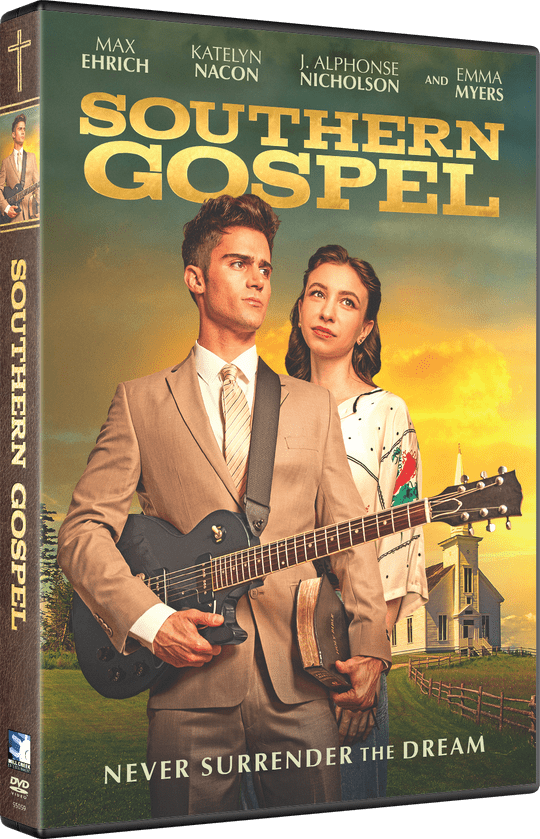
Rock ‘n roller Samuel Allen (Max Ehrich) finds himself in jail, a consequence of his anger-filled youth and disdain for organized religion. However, a moment of divine intervention occurs when a judge dismisses the drug charges against him because Samuel shares his story with local schools and churches. This marks the beginning of a transformative journey from rebellion to redemption.
Given a second chance, Samuel embarks on a journey to follow in his father’s footsteps. He overcomes the influence of an influential church leader who has a vendetta against his father, Pastor Joe (Gary Weeks). Despite the challenges, he decides to become a preacher, a testament to the power of second chances. He also wins Julie’s heart (Katelyn Nacon).
Directed and written by Jeffrey A. Smith, who plays Pastor Clayborn, this faith-based movie set in the 1960s doesn’t deny that staying on the right side is filled with temptation. Samuel Allen, Dream Church’s founder, walked the path shown in Southern Gospel. There’s even a tragic drowning, the idea that electric guitars are tools of Satan and the idea that the church elders fight more to keep their power than to help save sinners.
I don’t love many faith-based movies—outside of the films of Ron Ormond and Donald W. Thompson—but even I can recognize the lessons in this one.
NPRmageddon is a ten-part post-apocalyptic sci-fi arthouse radio show audio drama adjective-rich podcast in the style of public radio, broadcast from the United States of Lost Angeles. Featuring human interest stories, non-human violence stories, regime-approved propaganda and traffic reports. It’s a tough, brain-sickening, uncompromising work of art.
I had the opportunity to chat with its creators and am excited to share the interview with you.
B&S About Movies: How did you guys come up with the idea of the podcast?
Peter Podgursky: My comic book writer friend, Jackson Lanzing, told me about an audio series called Welcome to Night Vale. The show is very H.P. Lovecraft and it’s very good, but I wondered, “How could I create the Cannon Films version of this?” Something a lot more action-packed but with the conceit of it taking place at a public radio station. I called Bryan to pitch the idea of a post-apocalyptic, public radio-style audio series. And then Bryan said…
Bryan Keithley: You mean like anNPRmageddon?
Peter: I had been trying to come up with a title for a day and he did it in three seconds. He’s like, “Oh, NPRmageddon.” So that became the title! (laughs)
B&S: You loosened the jar of pickles for him.
Peter: Then we took a few months writing it. We got serious and with something like this, you get far enough along and it’s like, “Okay, this is a real thing.”
Bryan: We wrote the whole thing, and then we rewrote the whole thing. We rearranged it because we wanted the story to be super solid. It was the writing that attracted a lot of the voice talent that we got.
B&S: There’s a ton of talent on the show! Who was the best person for you to work with?
Peter: The most fun we ever had recording was Harlan Ellison.
Bryan: We recorded at his house.
Peter: He had had a stroke, so we were worried. But he did great. He was one of the very first people we recorded, and he is in almost all the episodes.
Bryan: Yeah, eight out of ten.
Peter: We went into that house like, “Okay, this guy had a stroke the year prior. Is this session going to be usable?” And you know, gosh darn it, he gave us the goods! We hired him and he did not mess around. He told us, “You’ve hired me for a job. I’m gonna do that job to the best of my ability.” So it was all very professional.
Bryan: And he critiqued our writing over and over. “You shouldn’t have written it like this.” (laughs)
Peter: It was such a wild, great time that almost all the other sessions paled in comparison. Nothing was going to be quite as magical as going to Harlan Ellison’s house. He was just tearing our script up and down as he recorded it. He’s insulting us and taking a certain amount of glee in our panic. (laughs)
Bryan: I think he knew that we were nervous. We were in the presence of genius here. And I’ll always remember because he was correcting our grammar along the way. He’d say, “Why would you say “rise up”? It’s redundant. You don’t have to rise up. You wouldn’t have to rise down. You just rise!”
Peter: The easiest person we recorded was Fred Willard. The recording session went by really quickly because we just had to record his parts twice, for safety. Man, the guy had done his homework.
Bryan: He was prepared, and it was such an honor for me to act opposite him. And I think another secret to working with a person like that is that we had him in mind for the role – as the spokesman for NPRmageddon’s evil corporation. He was such a great “used car salesman” type in all of his movies and TV roles, and he always played such a great liar. A snake oil salesman. And he just took to the role like a duck to water.
Peter: We have pretty good luck with actors. I think we got 75% of the people we went after. We were intent on gathering a very eclectic cast.
Bryan: A lot of the roles were written with a person in mind and then with some of the roles we said, “No, this is just a character we’ve invented and we have to find an actor that fits.”
Peter: Like Andrew Bowser. Bryan had written this great pop culture history segment and I said, “Oh, I know the exact guy we should get for this.” And I brought up Andrew Bowser, who I knew from his viral videos. He could nail this. We then spent the next month trying to get him and eventually did.
Bryan: He has a Micro Machines style of delivery. He can get a rapid-fire amount of words in, which the part needed.
B&S: What influences went into making the podcast?
Peter: RoboCop was a big influence because it has such brilliant media commentary in it.
Bryan:RoboCop is in the top five of our favorite films. That’s a movie I had on VHS and I watched like 100 times and as far as the black comedy and satirical aspects of it, you can trace back to certain sketches of NPRmageddon. That, andStarship Troopers.
B&S: A lot of Paul Verhoeven…
Peter: I do like his comedy and his biting satire. And another influence was the work of Walter Lippmann. His book Public Opinion is about the media and about how the sausage is made. And Edward Bernays, who wrote a book called Propaganda, which is about the joys and uses of propaganda. He was the nephew of Sigmund Freud and his big media accomplishment was convincing women they could smoke cigarettes, too. “You can do it, too, baby!”
Bryan: I’m a lifelong gamer and I love the Fallout video games. In several of them, there are even radio stations. You can tune into radio stations as you walk through the game world. And my day job is in game design. I’ve always cherished that type of post-apocalyptic humor – you know, finding the humor and the hubris and the humanity in a shattered post-apocalyptic landscape. The setting fascinates me and I think we found a lot of material that way as we wrote the episodes.
B&S: Did you write it pre-pandemic?
Peter: Yes.
Bryan: We recorded it bit by bit depending on the actors’ availability. Then COVID hit and we didn’t want to release this post-apocalyptic show when it was feeling like the real thing! So we sat on it for close to two years.
B&S: Was it strange for you to spend so much time in your fictional end of the world and then have to live it?
Peter: It was hilarious. Something would happen on the news that would be similar to something that we wrote. We have this bit where this revolutionary named Guitarro is tearing down statues, right? And our reference to that was stuff that happened in Communist countries where they were tearing down statues of Lenin. And then we saw statues of Confederate soldiers being torn down during COVID. And it just like the sketch we wrote… it wasn’t all that safe. There was one guy who got paralyzed when a statue fell on him and now he can’t walk. It’s really dangerous to pull down giant statues!
Bryan: We were never going to write about Trump versus Biden or something like that. We never dipped into actual politics and actual people because this is a fantasyland, right? Like, who knows how long in the future it will be heard? So we made a conscious effort to not do something like dunk on Sarah Palin because that’s not going to be relevant in three years.
Peter: I’ll listen to an episode of The Shadow – some of them are nearly a hundred years old. And it still smokes, right? When you’re creating an audio piece, you can think to yourself, “Would it be possible for someone to listen to this in a hundred years and still get something out of it?” And I hope we accomplished that.
Bryan: We connect ourselves DNA-wise to those old radio plays. Like Peter said, you can still listen to those on YouTube and they’re still cool. The stories are timeless and then they’ll be an ad for cigarettes or something, which is interesting. They’re artifacts.
B&S: I like the show a lot because you’ve created your own world and the real world doesn’t have to intrude all that much.
Bryan: We always wanted it to feel big. Part of that is we assembled a cast of over 80 actors so it was definitely something bigger than just a podcast. As the show visits these different parts of Lost Angeles, we wanted it to feel very big. It was important to us that we didn’t cut any corners.
Peter: Beyond the cast, we had an extremely talented mixer named Amy Reed. Most podcasts don’t have professional mixes, but we wanted NPRmageddon to sound extraordinary. I would stack our show against anyone else’s. I don’t care how much money you’re pouring into it, you’re not going to sound better.
Bryan: We were very ambitious with many of the science fiction sketches, with people transforming into monsters or getting their heads ripped off or gigantic beasts in the ocean battling each other. We did not limit ourselves. And that’s the fun of being purely audio. You do not have to limit yourself like you would if we were trying to do this as a live-action movie.
B&S: It has the feel of NPR without being a complete parody of just NPR, so you don’t need to be a fan of their programming to understand the humor.
Bryan: Yes! Early on, we refused to confine ourselves to just being a parody of NPR.
Peter: And actually, it’s the people who watch your show and read your blog and watch your streams who I think will truly enjoy NPRmageddon. We’re making efforts to find our crowd and connect with them in places like your site. One of the people who have helped us find that audience isHart D. Fisher, who was one of our actors. He has a channel namedAmerican Horrors on Roku. Some of our most ardent fans discovered us by watching our ads on Hart’s movie channel.
I had a blast talking with Peter and Bryan. The show is a ton of fun and you should definitely listen, particularly if you love post-apocalyptic movies. Check out the show now at NPRmageddon!
EDITOR’S NOTE: Signpost to Murder was on the CBS Late Movie on February 23, June 22, 1972, and July 20, 1973.
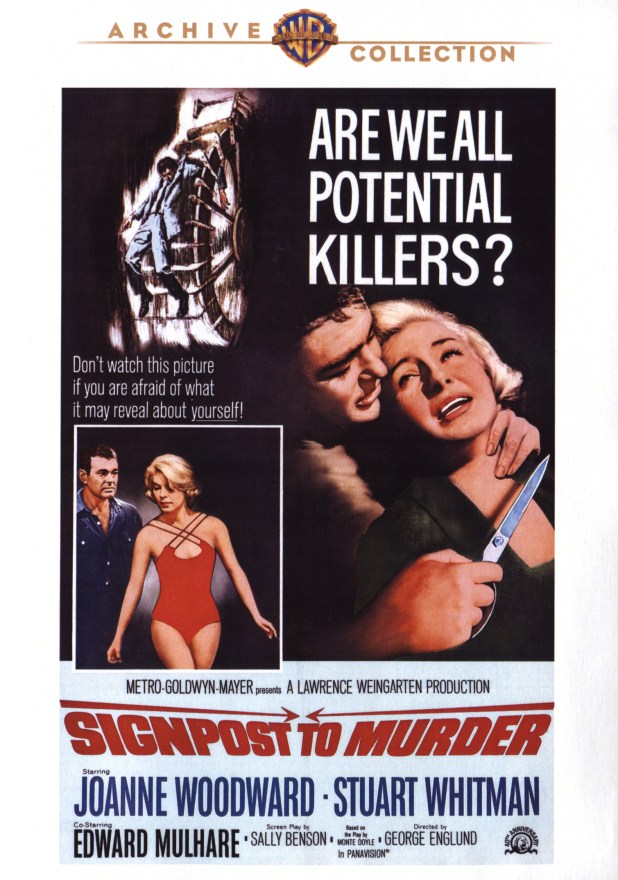
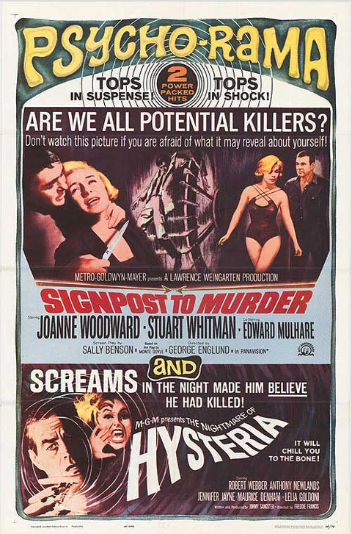
“Are we all potential killers?” What a great tagline! That idea is the basis for this film, directed by George Englund (A Christmas to Remember, Zachariah, The Vegas Strip War) and written by Sally Benson (Viva Las Vegas, The Singing Nun) and Monte Doyle.
Alex Forrester (Stuart Whitman) is a mental patient who killed his wife ten years ago and has been rehabilitated in an asylum. He feels that way, at least, but no one else does. So he takes matters into his own hands, unmercifully beats his therapist, Dr. Fleming (Edward Mulhare), and runs into the foggy night. Maybe that doctor shouldn’t have told him about an old law that gives a new trial to escapees who elude capture for two weeks.
Who would come up with such a law?
He goes to the house he’s stared at for ten years from his cell and hides there as Molly Thomas (Joanne Woodward) waits for her husband to return from a business trip.
He easily kidnaps the woman but is shocked by what he finds outside the house: a dead body, throat slit, stuck in the water wheel. Who killed this man? Was it him? Why can’t he remember? And when the body disappears, who took it?
Even as the police and the local clergyman (Alan Napier, Alfred from TV’s Batman) come to the house to search for Molly’s husband’s body or comfort her, she starts to fall for Alex. As you can imagine, this movie is utterly ridiculous in the best of ways and throws twists and turns at the viewer.
Do you know who loved it? India. While the movie started as a stage play, they re-adapted it into another stage play, Dhummas, which was made into three different movies — in Gujarati, Marathi and Hindi — all starring Sarita Joshi. It was also made as Ittefaq in 1969 and was remade as Ittefaq in 2017.
MGM also released this as a Psycho-Rama double feature with Hysteria. The poster for it makes me want to watch both movies again.
EDITOR’S NOTE: This episode of Kolchak: The Night Stalker didn’t air on the CBS Late Movie. It wasn’t offered to CBS because ABC made a TV movie from it and “Firefall” and titled it Crackle of Death. As a completist, I’m covering the episode this week.
The new, modern Lakefront Hospital is supposed to save lives. But why don’t its machines work correctly? How are there cracks in the foundation and walls already? And why have so many people died from horrifying deaths in a place of wellness?
These are the kinds of questions that Carl Kolchak would like the answers to.
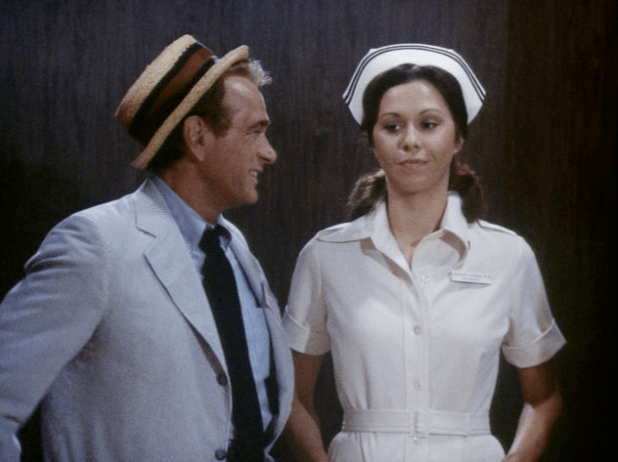
He gets his answers from one of the foremen who left the construction before it was finished, Jim Elkhorn (William Smith!), who explains that he and the rest of his Native American crew didn’t want to anger Matchemonedo, an invisible bear spirit that Kolchak must send back into hibernation.
Joyce Jilson (Superchick) and Elaine Giftos (Angel) also appear in the cast. Beyond being in danger, they’re two conquests for Elkhorn, who seemingly is as interested in lying down with lovely women as he is in erecting buildings.
The episode’s highlight is when Karl takes two of his paper’s most expensive cameras to get a photo of the monster. Vincenzo stops him and wants to know what’s happening.
Vincenzo: What are you doing with two of our best cameras?
Kolchak: I’m gonna hock ’em, what do you think? You ask a stupid question, you get a stupid answer.
As Elkhorn is helping Karl do research, he translates some French. Smith could do that, as he was fluent in Russian, French, German and Serbo-Croatian, languages he learned while serving as an Intelligence Specialist for the U.S. Air Force during the Korean War.
This episode was directed by Alexander Grasshoff and written by Arthur Rowe, who wrote thirteen episodes of Fantasy Island and nineteen episodes of The Bionic Woman and served as a producer on those shows. It also has scripting by Rudolph Borchert, who wrote five Kolchak episodes.
While not the best episode, this does have Kolchak trying to freeze the basement floors and foundation, which is pretty impressive as he’s just one man against a Native American spirit that has been murdering humans since we first showed up on this planet.
EDITOR’S NOTE: Santee was on the CBS Late Movie on October 16, 1975 and January 5, 1977.
Here’s some trivia you can use on your friends. Santee was one of the first motion pictures to be shot electronically on videotape, a groundbreaking technique at the time. This was achieved using Norelco PCP-70 portable NTSC cameras and portable Ampex VR-3000 2″ VTRs, marking a significant shift in film production technology.
Director Gary Nelson mainly worked in TV before this, but he has some interesting films to his credit, like the original Freaky Friday, The Black Hole and the Mike Hammer TV movies.
Jody’s long-awaited reunion with his father takes a dramatic turn when he discovers that his father is an outlaw on the run from a relentless bounty hunter named Santee (Glenn Ford). The story takes an unexpected twist when the two adversaries, Jody and Santee, find themselves forming an unlikely bond, realizing that they share a deeper connection than they could have ever imagined.
Santee boasts a diverse and intriguing cast, including Dana Wynter (Invasion of the Body Snatchers), Jay Silverheels (Tonto himself, who for some reason has been showing up in nearly every movie I’ve watched lately), Robert Donner (who also is in Nelson’s Allan Quatermain and the Lost City of Gold), Dark Brothers repertory actor Jack Baker, X Brands (the oddly named actor who may have been of German descent and from Kansas City, but always played Native Americans), Chuck Courtney (who played Daniel Reid Jr. on The Lone Ranger, the character who would grow up to be the father of The Green Hornet) and Lindsay Crosby (Bigfoot).
Edward Platt, the Chief on Get Smart, produced this film and played a crucial role in financing it. Platt raised the money to buy the video cameras, a significant contribution to the film’s production. One can only assume that his involvement also led to Nelson’s directorial role in the TV movie Get Smart, Again.
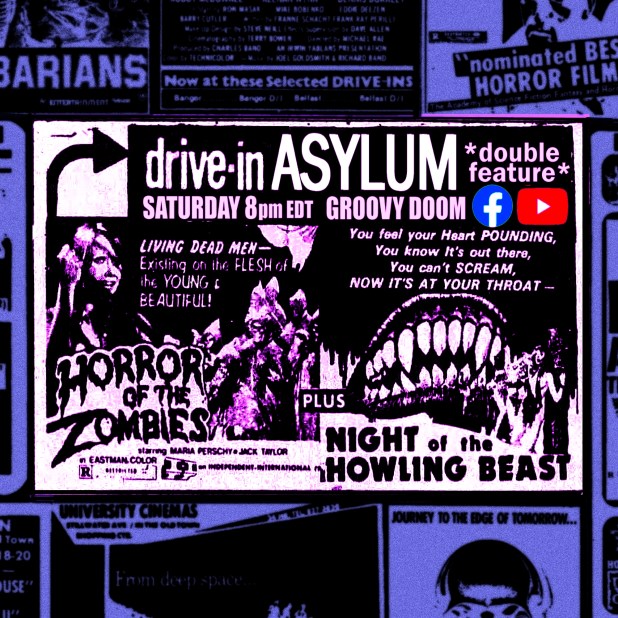
This Saturday at 8 PM EST on the Groovy Doom Facebook and YouTube channels, Bill and I will be recreating a double feature that played drive-ins all over the country.
The first movie is Horror of the Zombies, which is also The Blind Dead 3, Horror of the Zombies, Ship of Zombies, The Ghost Ship of the Swimming Corpses, The Ghost Ship of the Blind Dead and The Ghost Galleon. You can watch it on YouTube and Tubi.
Every week, we watch two movies, discuss them, look at the ad campaigns and make two themed cocktails.
Here’s the first one.
Spanish Zombie
1 oz. Midori
1 oz. Malibu rum
1 oz. spiced rum
.5 oz. apricot brandy
.5 oz. Cointreau
3 oz. orange juice
2 oz. pineapple juice
.5 oz. lime juice
Mint
Shake all ingredients like you’re on a boat surrounded by fog and the waves have grown larger.
Pour over crushed ice and top with mint.
The next movie is a Paul Naschy werewolf film that is listed as Night of the Howling Beast. It’s also known as The Curse of the Beast, The Werewolf and the Yeti and Hall of the Mountain King. You can watch it on Tubi.
Here’s the second recipe.
Werewolf In Tibet
.5 oz. 99 Bananas
1.5 oz. cherry brandy
.75 oz. lemon juice
2 oz. iced tea
.5 oz. orgeat or almond syrup
Shake all ingredients in a shaker with ice as if you’re battling a yeti in an ice cave.
Pour it out, savor it and dream of Paul Naschy’s lustrous hair.
EDITOR’S NOTE: The Clones was on the CBS Late Movie on November 7, 1975, and April 18, 1977.
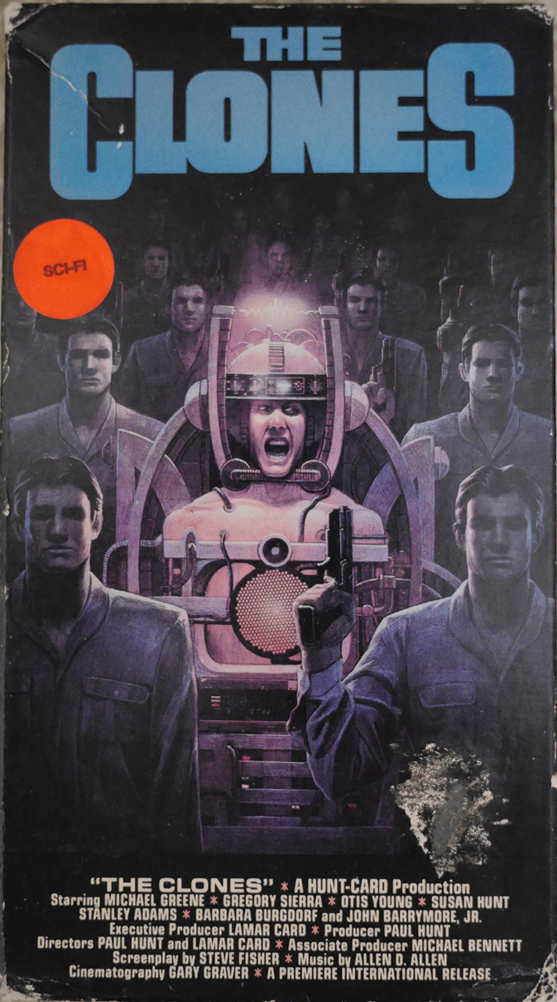
Dr. Gerald Appleby (Michael Greene) finds himself in a perplexing situation. He believes he’s been cloned. His conviction stems from a near-fatal escape from his lab’s explosion and the unsettling reports of his sightings in places he’s never been. This sets the stage for a gripping narrative as he goes on the run, pursued not only by the deranged scientist Carl Swafford (Stanley Adams, Cyrano Jones from the original Star Trek) but also by the ruthless thugs Sawyer (Otis Young, Blood Beach) and Nemo (Gregory Sierra, a stark contrast to his usual role as the virtuous Det. Sgt. Chano Amenguale on Barney Miller).
Directed by Paul Hunt (he also directed Twisted Nightmare and produced Demon Wind) and Lamar Card (who directed Supervan and Jukebox AKA Disco Fever, as well as the producer of Nashville Girl, Savage Harvestand Project: Metalbeast), who co-wrote the film with Steve Fisher, who started writing movies back in 1938 with Nurse from Brooklyn. He also wrote the novel and screenplay for I Wake Up Screaming, Hell’s Half Acre, Johnny Angel and episodes of Peter Gunn, McMillan & Wife, Cannon and Fantasy Island.
Most people will watch this movie and see a slow-moving film that goes nowhere, filled with fish-eye lens-addled drug scenes and an overwhelming sense of conspiracy doom. As for me, I read that sentence and only see the positives. Young and Sierra are having a blast; the ending is as cynical as it gets, and a lot of the ending takes place inside an amusement park that runs itself. It’s a movie that came out on VHS, has had no major DVD release and has never come out on Blu-ray.
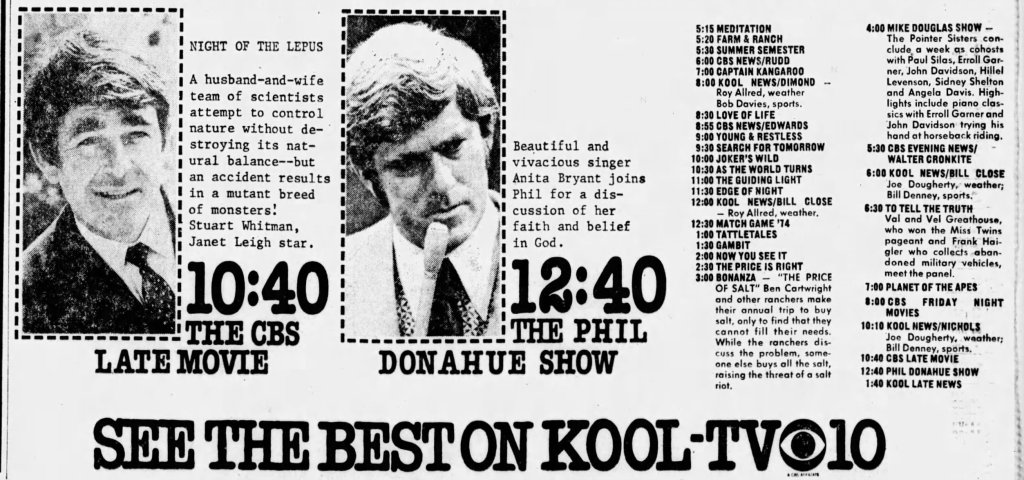
EDITOR’S NOTE: Night of the Lepus was on the CBS Late Movie on September 13, 1974; October 17, 1975 and June 13 and August 24, 1976.
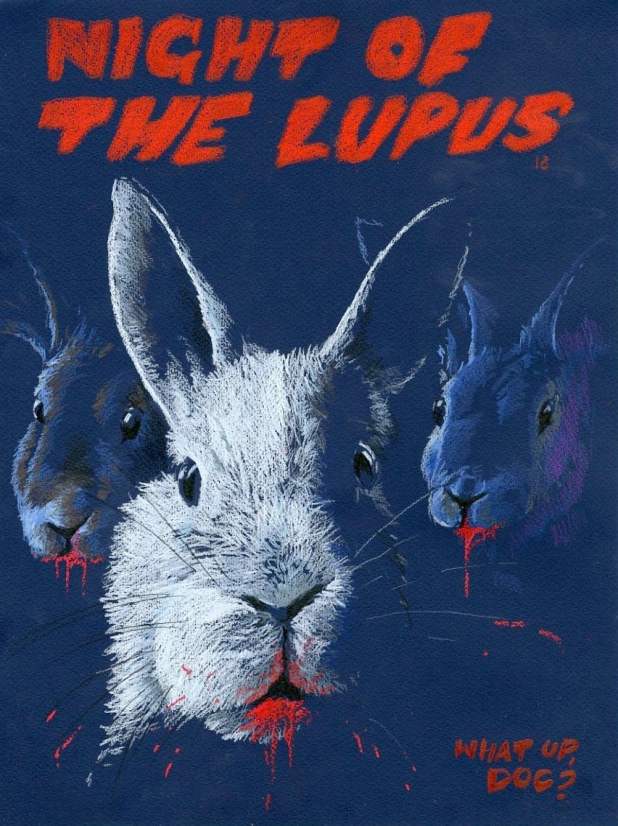
Based upon Russell Braddon’s 1964 science fiction novel The Year of the Angry Rabbit, this movie pits mankind against mutant rabbits and, well, if you can get past that idea, you’re probably going to love this movie.
Director William F. Claxton and producer A. C. Lyles came from Westerns, which explains the cast of this movie, which includes Stuart Whitman, Rory Calhoun and DeForest Kelley being in the cast as well as the shooting location, the Old Tucson Studios. It does not explain the effects, which are a combination of regular-size rabbits on miniature sets and people dressed in rabbit costumes.
Janet Leigh, who is also in this, told Starlog, “No one put a gun to my head and said I had to do it. What no one realized was that, no matter what you do, a bunny rabbit is a bunny rabbit. A rat, that can be menacing — so can a frog. Spiders or scorpions or alligators, they could all work in that situation, and they have. But a bunny rabbit?! How can you make a bunny rabbit menacing?”
Rancher Cole Hillman (Calhoun) seeks the help of college president Elgin Clark (Kelley) when thousands of rabbits invade his farm after their natural predators, coyotes, are killed off. Roy and Gerry Bennett (Whitman and Leigh) are brought in and they work on using hormones to disrupt the rabbits’ reproduction cycles but their daughter falls in love with the bunny and switches it out; the mutant bunny runs away and pretty much declares war on humanity.
The towns of Galanos and Ajo are eaten by the giant rabbits before the strange team of a drive-in audience and the National Guard trap the gigantic hares in an electrified field that kills all of them. And good news, because regular rabbits — and the coyotes — are back at the end of the movie.
They tried to hide the rabbits on the poster — even changing the title from Rabbits — and then changed their mind at the last minute and gave away rabbit’s feet with the film’s logo on it.
Check out this ad for the CBS Late Movie show from Bill Van Ryn of Groovy Doom and Drive-In Asylum!



 B&S About Movies
You must be logged in to post a comment.