Cinematic Void January Giallo 2023: Deadly Games (1982)

EDITOR’S NOTE: Cinematic Void will be playing this American giallo on Saturday, January 14 at 9:30 PM at the Sie Film Center in Denver, CO with CV’s Jim Branscome in person (tickets here). For more information, visit Cinematic Void. There’s also a great blu ray of this movie from Arrow that you can get from MVD.

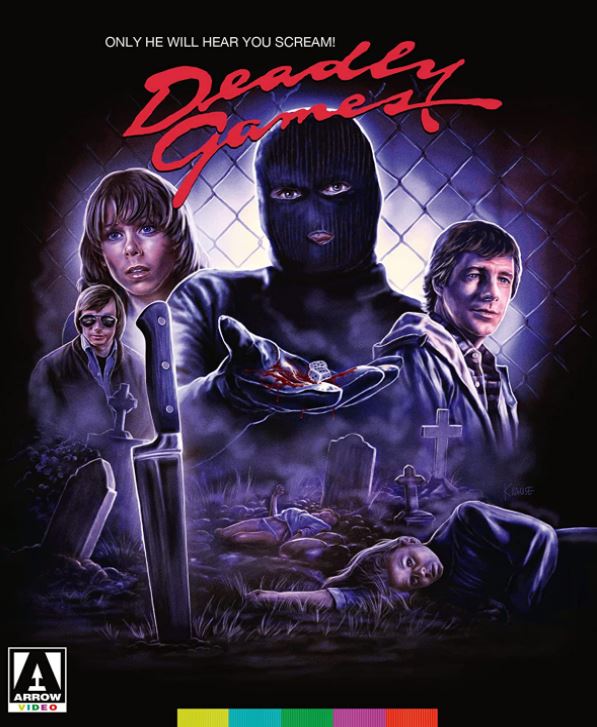
Deadly Games may have been sold as a slasher, but it’s more of a murder mystery. Sure, the killings are pretty intense — a long drowning, burying a victim alive — but it’s maybe even less a murder mystery and more a late 70s, early 80s small town romantic drama where lots of people swing and one of them — either a cop or Vietname vet — is a masked killer.

It’s interesting how little this movie cares about fitting into any neat and clean box.

Clarissa Jane Louise “Keegan” Lawrence (Jo Anne Harris) is a rock journalist back home after the death of her sister, a murder that she’s out to solve. After all, her sister didn’t jump out of a window like that, right? She had to have been thrown.

Dick Butkis, the Chicago Bears linebacker legend that had such a long career after that as a kid I just thought he was an actor, owns a coffee shop in town. That’s where a lot of the exposition happens, like how strange Billy Owens (Steve Railsback) is, a Vietnam soldier not back home all in one mental piece who is obsessed with monster movies and his horror-themed game of Chutes and Ladders and oh yeah, he also lives in an old movie theater and sounds like someone I’d go out of my way to be friends with. That said, it’s set up that he has to be the masked killer. Certainly the killer can’t be Sheriff Roger Lane (Sam Groom), because he’s nice and plays on the swings and romances Keegan.

Director and writer Scott Mansfield seems out to make a movie that makes you believe it’s a slasher and then pulls the rug out from under you with an ending that completely predates Scream — without spoilers, but man, that does feel like a spoiler.

The board hame in this is Universal monsters inspired and I love that Roger and Billy have been playing it for decades, as well as the killer somehow knowing way too much about it. I can only wish I still had friends ready to play a board game that often.

Coleen Camp and June Lockhart are in this as well, so my casting brain was quite impressed by who Mansfield got to be in this movie.

It’s not perfect, it’s probably too long and too talky, but I enjoyed the laid back vibe of Deadly Games. The last ten minutes are worth the time that it takes to get there and I was pretty surprised by the leap that the film makes.

Cinematic Void January Giallo 2023: No One Heard the Scream (1973)

EDITOR’S NOTE: Cinematic Void will be playing this movie on Tuesday, Jan. 10 at 7:00 PM at the Music Box Theatre in Chicago, IL (tickets here). For more information, visit Cinematic Void.

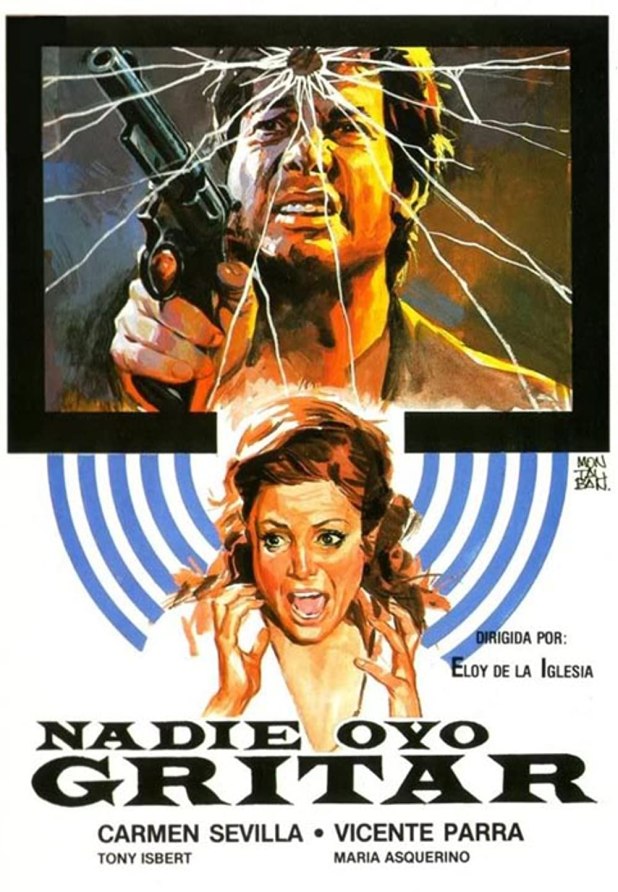
Elisa (Carmen Sevilla) may be in her thirties yet she lives a life filled with the type of comforts younger women could never have, her entire life paid for in exchange for one weekend a month with her elderly lover Óscar (Antonio Casas). Yet she’s sick of him and decides to break things off, despite the fact that she could lose everything. Trying to relax before her luxury is gone, she is interrupted by her next door neighbor Miguel (Vicente Parra) who is waving around a gun and demanding that she help him get his dead wife Nuria (María Asquerino) out of the elevator shaft and disposed of.

Somehow, as they evade the police and deal with all sorts of twists in their pathway, these two fall in love. Miguel had dreams of being a writer once and settled for being a husband. Perhaps Elisa feels something of the same. She nearly drowns him at her estate at the lake as they throw his dead wife into the water and then decides to save him. The sexual tension is too much, eclipsed only by the longing that it sems like Miguel has for her nephew Tony (Tony Isbert) who isn’t just her nephew — or maybe he isn’t, this is a Spanish giallo — but also her lover.

Nonetheless, the two decide to finally become lovers and make love, then follow that up with plenty of pills and champagne. And then Elisa wakes up to a dead body sleeping next to her.

Director Eloy de la Iglesia, who wrote this with Antonio Fos and Gabriel Moreno Burgos, uses the voyeurism and murder within the giallo form to really get into his favorite subjects: socialism, the caste system and hot naked men. As you can imagine, this made the conservative film censors of Francisco Franco lose their minds.

This movie looks great and plays even better. It’s thanks to Severin that this movie ever made it to America. You can get it from them or watch it on Tubi.

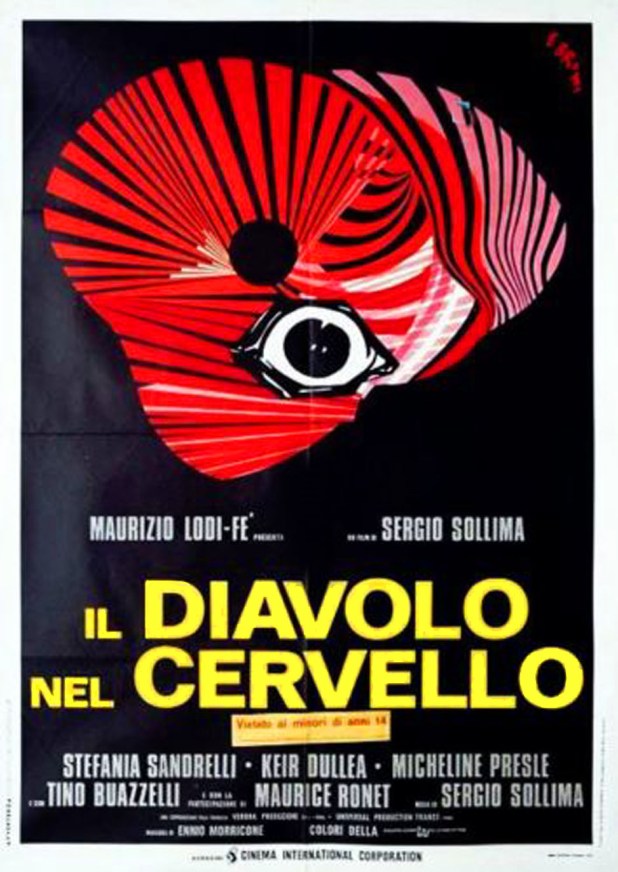
Devil in the Brain (1972)

Oscar Minno (Keir Dullea, who in addition to 2001 has a career filled with odd films like Welcome to Blood CityFull CircleBunny Lake Is MissingDe Sade and Black Christmas to name a few) has come back from overseas and seeks out an old love, Sandra (Stefania Sandrelli, Divorce Italian Style) who is now a widow confined to her family estate, her husband potentially killed by her son Fabrizio (Maurice Ronet, Bloodline) and now in the care of the domineering Countess de Blanc (Micheline Presle). Meanwhile, Doctor Emilio Bontempi (Tino Buazzelli, who played Nero Wolfe on TV) believes that Ricky, now confined to the care of nuns, may be innocent of the murder.

Directed by Sergio Sollima (Violent City), who co-wrote the script with Suso Cecchi d’Amico (Bicycle Thieves, Brother Wolf Sister Moon) with a soundtrack by Ennio Morricone, this has a higher pedigree than most giallo. It has no black gloved killer, little nudity and hardly any blood. Instead, this deals with class conflict, as Oscar was never considered a viable husband for Sandra and yet he still wants to save her — and maybe her son — from the stigma of mental illness. But when the working class proletariat interferes in the world of the bourgeois, nothing but pain can arrive.

I have no idea why more people aren’t watching and discussing this one. It’s probably not sleazy enough and has no interest in ripping off Argento. Instead, it emerges from a slow start to become a wonderful detective tale.

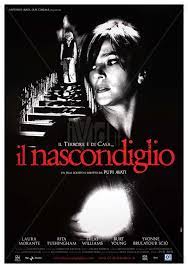
Il nascondiglio (2007)

Italian directors in America is one of my favorite subgenres, so imagine my joy at discovered that Pupi Averti made this haunted house giallo in Davenport, IA and the Warner Castle in Orion, IL.

Francesca Sainati (Laura Morante) moved to Iowa 15 years ago to open her own restaurant, but after the suicide death of her husband, she’s struggled at even being able to live a normal life, spending some time in an asylum. Now, as she attempts to open a second business, she learns of a fifty-year-old murder conspiracy.

Beyond its Italian cast — Giovanni Lombardo Radice and Sydne Rome (Some Girls DoThe Pumaman) made the trip to America — this also stars Treat Williams, Burt Young and Rita Tushingham, who played the grandmother in modern giallo Last Night In Soho and was also in Doctor Zhivago). A warning, however. Nearly every line in this movie is whispered, as if this were proto-ASMR. And there are also two orphans that have somehow — and this is a major spoiler, mind you — who stayed alive by drinking rainwater and eating rats within the walls of the decaying mansion where Francesca thinks people are going to come and eat. I mean, half of restaurants go out of business in the first year and she’s going to open hers in a place called Snake Castle?

While not a perfect film, Averti made The House With the Laughing Windows, so I will watch anything that he directs. And hey — it has a score by Riz Ortolani!

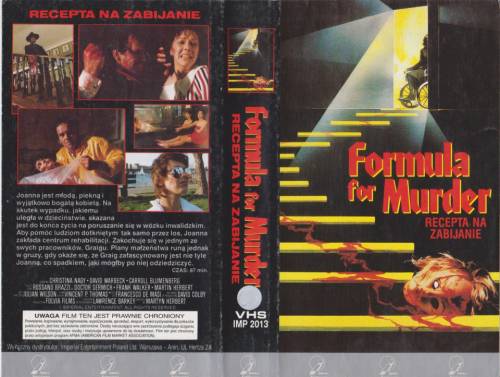
Cinematic Void January Giallo 2023: Formula for a Murder (1985)

EDITOR’S NOTE: Cinematic Void will be playing this movie on Monday, January 9 at 7:00 PM at the Los Feliz 3 in Los Angeles (tickets here). For more information, visit Cinematic Void.

Also known as 7. Hyden Park – La casa maledetta (7 Hyde Park – The Cursed House), this movie comes to us from Alberto De Martino, the man who made The AntichristStrange Shadows in an Empty RoomMiami Golem and Holocaust 2000.

David Warbeck plays Craig, who has recently married Joanna, a woman crippled by mental and physical issues. Well, she’s in a wheelchair, but still comes to him to learn fencing and archery, so she’s trying to stay active.

That said, there’s something horrible that’s happened in her past, but guess what? Something horrible is happening now too. That’s because after Craig gets that ring, he plans on killing her for her riches.

That horrifying event, by the way, was when a faceless priest tried to give our heroine a doll and then decided to take things a little too far. As he chased her, she fell down the steps and broke her back, which is why she’s in a wheelchair now. And as for the priest, he may be dead or he may be the person who is dressed in vestments and carrying the doll from her childhood.

Also: there’s a good chance that if Craig churns some butter with her, she’ll have a heart attack when her body relives the abuse. I can promise you that there was no mental health counselor or expert on this film to verify this diagnosis.

If the house that is so cursed looks familiar, that’s because Phantom of Death and Body Puzzle were both shot there. Also, if your ears hear something they have before, that’s because Francesco De Masi decided to reuse some of his theme for The New York Ripper and thought that no one would notice.

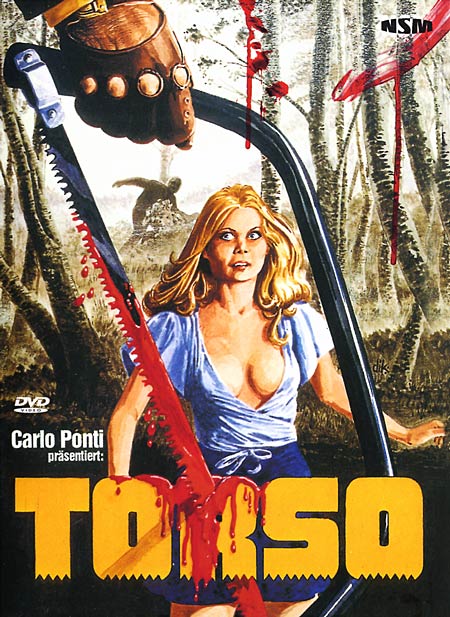
Cinematic Void January Giallo 2023: Torso (1973)

EDITOR’S NOTE: Cinematic Void will be playing this on Saturday, Jan. 7 at Coolidge Corner Theatre in Brookline, MA (tickets here) with CV’s Jim Branscome in person. For more information, visit Cinematic Void.

Torso is such a simple title. I’d rather call this film by its Italian name: I Corpi Presentano Tracce di Violenza Carnale, or The Bodies Bear Traces of Carnal Violence. Either way, it was directed by Sergio Martino and features none of the cast that he had come to use in his past films like George Hilton, Ivan Rassimov or Edwige Fenech.

It does, however, star Brtish actress Suzy Kendall, who played the lead role of Julia in Dario Argento’s seminal The Bird with the Crystal Plumage. She’s so associated with giallo that she appeared as the main character’s mother in 2012’s ode to the genre, Berberian Sound Studio.

This is a film that wastes no time being strange. Or salacious. A photographer is shooting a soft focus lovemaking session between three women amongst creepy, eyeless baby dolls. By the time we register what is happening, we’re now in a classroom, where swooping pans and zooms refer us to the main cast of the film as we overhear a lecture and later a discussion about Pietro Perugino’s painting of Saint Sebastian. Did he believe in God? Or was he just trying to sell sentimentality? Could an atheist find himself able to translate religion to those with faith?

We cut to a couple making out in a car as a figure stalks them through the eye of the camera, making us complicit in the act of the killer. Quick cuts reveal the white-masked face of this maniac. The man runs after him while the girl doesn’t even care that they had a voyeur watching. As she waits for him to return to the car, but grows impatient. The headlights of the car cast her shadow large across the columns of a bridge. And their light is quickly extinguished by black-gloved hands. The camerawork here is really striking, keeping us watching for the killer, as we’re no longer behind his eyes. His attack is swift and ruthless, juxtaposed against the images of fingers penetrating the eyes of a doll.

The art professor (John Richardson, Black Sunday, The Church) and Jane (Kendall) meet by chance at a church where she challenges him to change his views on Perugino. As she returns from their somewhat romantic afternoon, Jane spies her friend Carol arguing in the car with a man who she believes is married.

Meanwhile, ladies of the evening walk the street, ending up with Stefano, a student who has been stalking Julie. He has trouble performing and the prostitute he’s with tells him that all the men with hang-ups always come her way. That said — even if he’s queer, he better pay the money. He flips out and attacks her, but she makes her escape.

We’re then taken to a hippy party that looks like it’s taking place inside Edward Lionheart’s Theater of Blood. There’s weed, there are acoustic guitars, there are bongos, there are dudes with neckerchiefs, there are motorcycles. Truly, there’s something for everyone. But after leading on two men, Carol just walks out into the mud. They try and chase her, but she makes her escape into the foggy night. We hear her footsteps through the swamp as she walks, exhausted and covered in mud. What better time for our white-masked killer to return? We see glimpses of him through the fog and then he is gone. Whereas in past films Martino ignored the murder scenes instead of story, here the violence is extended, placing the killer and his actions in full view. After killing the girl, he rubs mud all over her body before stabbing her eyes — again intercut with the baby doll imagery. Her blood leaks into the mud as the score dies down.

This scene really feels like what the first two Friday the 13th movies were trying to achieve, but of course several years before they were made.

A police detective is in front of the art class, showing images not of art, but of the crime scene. A piece of cloth has been found under the fingernails of one of the murdered students, Flo. And that same scarf was found on Carol’s body. It’s their duty to report seeing anyone who wore this scarf to the police, who want to cooperate with the students who normally riot and throw rocks at them.

Two of the men in the class — Peter and George — were the last two people to be seen with Carol, the ones who she turned down at the party. Meanwhile, Stefano continues to stalk Jane. The music in this film is so forward-leaning — tones play when the killer shows or during moments of tension.

A man calls Daniela and tells her that if she ever tells where she saw the red and black scarf, she’s dead. Fearing for her life, she tells her uncle, who lends his country home to her and her friends so that they can get away from the city while the killer is at large.

Oh yeah — I forgot the pervy scarf salesman, who the police are leaning on. Right after talking to the police inspector, he calls someone and asks for money to buy his silence. Whoever it is, they bought the scarf from him and wouldn’t want anyone else to know. They’ll also get out of town and head to the country. Coincidence? I think not!

Stefano is all over Dani, telling her that he needs her. She wants nothing to do with him. When she stares at him, she remembers seeing him wear the red scarf. She escapes — slamming the door in his face. She tells Jane that she remembers seeing him wear the scarf — and never again — the day Flo died. The whole time, the creepy uncle is watching the two girls. Jane offers to speak to Stefano, then meet the girls at the vacation home.

The street vendor is flush with cash, creeping along in the dark. A car starts to follow him. We see the black-gloved hands again as the car hits its victim again and again, bright red gore pouring all over the screen.

Jane goes to speak to Stefano, finding only strange baby dolls and letters to Dani asking her to love him and remember the promise that she made as a little girl. Jane is surprised by Stefano’s grandmother, who tells her that he left town.

The other girls are asleep on the train as someone watches them. A strange man enters their train car and sits down.

The camerawork in this movie feels as predatory as the perverts and killers that exist within it. Speaking of pervs, when the girls arrive in the countryside, the local men pretty much lose their minds, particularly over Ursula (Carla Brait, the man wrestling dancer from The Case of the Bloody Iris). She and Katia make out as a peeping tom watches, only for the killer to show up and off the leering man. There’s an amazing scene of the killer dumping the pervert into a well, shot underwater and staring upward as the body falls toward the lens.

Man, every man in this movie is scum. They’re either frightened boys or perverts wanting one chance to knock up a woman or scarred from past sexual encounters. None of them are positive, as even the uncle who gives Dani the villa seems way too interested in her. Every man is a predator at worst and a leering pervert at best.

Jane hurts her ankle when she gets overly excited about breakfast. A doctor arrives — the mysterious man from the train — and he gives her a pill, which knocks her out.

The girls go sunbathing while Jane recovers. Dani thinks she sees Stefano — complete with the red scarf — watching them. They return home and drink champagne, which Jane uses to wash down her sleeping pills.

A few minutes later, the door rings. It’s Stefano — the girls all scream — but he’s dead — the girls scream again — and the killer is behind him, holding the red scarf — now scream even louder! Instead of showing us the murders, Martino switches form, cutting to a ringing bell and Stefano being buried.

Jane wakes up, asking where her breakfast is. She’s obviously slept late as a result of the pills. She walks around the apartment, looking for Dani, Ursula and Katia, only to find a mess. Tossed chairs, bottles of beer and every single one of her friends murdered. Suzy Kendall is amazing in this scene, caught between fear and nausea. Unlike so many wooden giallo performances, she’s actually believable.

She hides as the killer comes back, forced to stay quiet and watch as he saws her friends into pieces. Even the ordinary world routine of the milkman arriving cannot stop the butchering of her friends, with her trapped just feet away.

This final act is completely unexpected, as up until now, the film had played by the rules of the giallo, the large number of victims versus a large number of red herrings.

In fact, this film is so packed with red herrings, even the cast had no idea who the killer was. Martino wouldn’t tell them who it was, so each of the actresses had her own theory as to who the killer was. And in the original script, the killer survived.

Now, instead of that traditional giallo structure as I mentioned above, it is the last survivor — a near prototype for the final girl — against a killer. Throw in that Julie can’t move well due to her leg and Martino has set up quite the suspenseful coda.

Trapped in the house, Julie tries to signal with a mirror, using Morse code. But it totally misses the heroic doctor’s sight. He places a call, but it doesn’t seem like it’s to Julie. She looks out the window and sees the killer coming back.

It turns out that the killer was the professor, who saw a childhood friend die trying to reach for a doll. He compares the other kills to dolls, with only Julie as a flesh and blood person. Everyone else was a bitch or played games with him or blackmailed him. He hacked Ursula and Katia to pieces like dolls as a result. Dani saw him. Carol may have seen him. And he killed Stefano when he saw him in the village. Death, he says, is the best keeper of secrets and then he sees Julie as a doll and tries to hang her. She’s saved at the last second by the doctor.

They battle into a farmhouse, across the yard and to a similar rock where we saw the younger professor watch his friend die. We hear a screen and have no idea who has been killed — but luckily for Jane, the doctor survives.  He discusses whether fate or providence had kept him in town, where he could save her. Perhaps it was written in the stars. Julie replies that Franz, the professor, would have been a realist and called it a necessity. Franz is dead and the dreamers live on.

The more times that I’ve watched this film, the more that I appreciate it and how it flips the genre conventions on their head and moves toward more of a slasher, with many of the giallo elements feeling tacked on somewhat to stay within the expected pieces of the form. A real clue that it’s really a slasher? The killings are more important than who the killer is.
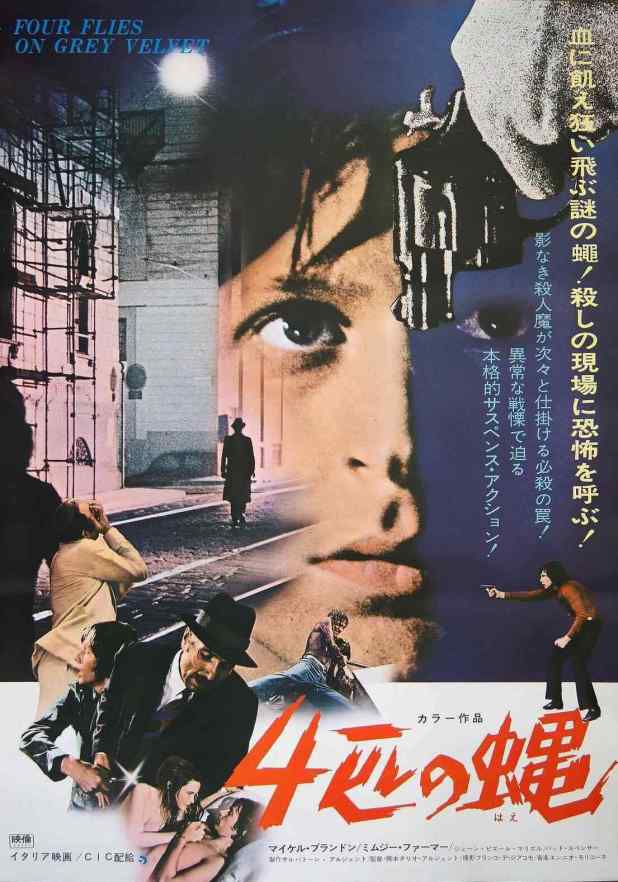
Cinematic Void January Giallo 2023: Four Flies On Grey Velvet (1971)

EDITOR’S NOTE: Cinematic Void will be playing this on Saturday, Jan. 7 at 7:30 PM at the Sie Film Center in Denver, CO (tickets here) with The Corruption of Chris MillerFor more information, visit Cinematic Void.

After The Bird with the Crystal Plumage and The Cat o’Nine Tails, Argento had one more movie left in his “Animal Trilogy.” Luigi Cozzi (Starcrash) would both write and assistant direct the film and the results are…interesting. It’s a lot funnier than his other giallo and was considered his swan song to the genre until his movie The Five Days failed at the box office.

Rock drummer Roberto Tobias is being stalked and as he finally catches up to his pursuer, the man pulls a knife. A struggle ensues and Roberto accidentally stabs the man while another masked figure laughs and takes photographs.

The next day, Roberto reads about the man’s death — Carlo Marosi — and gets a letter with a photograph of him murdering the man. He begins having reoccurring dreams that he’s being decapitated. Even worse, he wakes up to a masked man attacking him, who tells him that he won’t kill him because he isn’t finished with him.

Roberto’s wife Nina (Mimsy Farmer, Body CountAutopsy) returns home and he confesses the murder to her and tells her that he can’t go to the police to stop the harassment. He does turn to his artistic friend “God” Godfrey (Bambino from They Call Me Trinity) and a con artist named the Professor (Oreste Lionello, The Case of the Bloody Iris and the Italian voice for Woody Allen) for help.

Whoever is behind Roberto’s stalking and harassment is a troubled soul who had a horrific childhood and spent some time in an insane asylum. Roberto’s maid Amelia knows who it is, but she pays for it with her life, as the killer uses a straight razor to slice her apart.

Later that night, Dalia (Francine Racette, Donald Sutherland’s wife, so well done Donald) comes to stay with Nina and Roberto, despite him wanting her not to be there. It also turns out that our hero never really killed Carlo, who has been working with his blackmailer, who dispatches him with razor wire.

Roberto then hires Arrosio, a flamboyant investigator who has never solved a case, but hopes that this is the one that he will solve. Amelia’s murder has been discovered and the cops are on the case, so Nina says that she’s leaving town, feeling unsafe in her own house.

It turns out that Dalia has always loved Roberto, so they have sex. As you do. Look, it’s a giallo. Other strange things are afoot, like Roberto’s cat getting kidnapped and beheaded, Nina getting an inheritance, strange photos of Nina and Dalia’s family and more nightmares.

That’s when giallo science intrudes: the killer was in a mental institution called Villa Rapidi, where they were considered dangerous until their father died. This knowledge — and discovering the killer’s identity and finally cracking a case — leads to Arrosio’s death.

Dalia then notices that Roberto and someone in a photo with his wife look quite similar. Just as she puts it all together, she’s stabbed and killed.

Ready for more giallo science? The police perform an optographical test that takes a photo of the retina to show the last image that Dalia saw before she died. Even Argento — a man who made a movie about a girl who can physically speak to insects and becomes friends with an orangutan — thought this idea was stupid until Carlo Rambaldi showed him how the special effect would look.

The last image that Dalia saw? Four flies on grey velvet. No one knows what this means.

Roberto waits for the killer to come for him but then Nina arrives. He tries to get her to leave because the killer is coming when he notices her necklace: a fly. As it swings, he sees it: four flies. In true giallo fashion, the killer is someone who we obviously didn’t ever consider.

A fight breaks out and she repeatedly shoots her husband as she explains how she was placed in the asylum by her abusive stepfather — who raised her as a man — and was only cured when the man died. When she met Roberto, what she felt wasn’t love, but the madness that her stepfather caused within her. She finally would get her revenge by using Roberto as the replacement for the man she couldn’t get back at.

Nina runs away as Godfrey arrives to save Roberto, but she rams the back of a truck. She’s decapitated as the car explodes.

Deep Purple almost did this movie (several members of the Beatles were considered for the role of Roberto), but their schedule didn’t allow it to happen. Ennio Morricone, who worked with Argento on The Bird with the Crystal Plumage worked on the film, but had a huge argument with the director about the score. Goblin would come in and work with Argento for the first time here. Morricone and Argento finally reconciled and worked together on The Stendhal Syndrome.

This film wasn’t commercially released for the home market until 2009, other than an incredibly hard-to-find French VHS version. That’s because the rights to this film in America are owned by Paramount Pictures, which had chosen not to release it. Shameless did put out a UK release that is all region a few years back.

This is one strange giallo. The ending car crash took twelve cars to get right and combined with the music in the scene, it’s really unsettling. This is also one of the first movies to use high speed cameras to shoot bullet time, years before Hong Kong movies and The Matrix. I love the killer’s rant at the end of the film, particularly because big chunks of it are still in Italian! This might be hard for you to find, but it’s worth tracking down.

Crystal Eyes (2017)

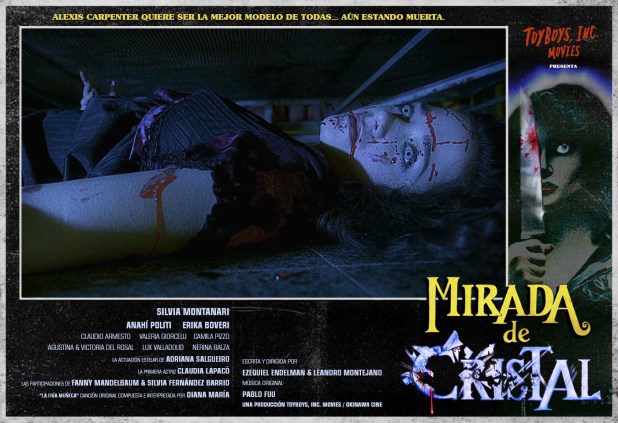
Mirada De Cristal feels like it was made in 1987, influenced by 1970 and filled with neon, sleaze and murderous intent. In other words, it was exactly what I was looking for. Directed by Argentina natives, co-directors and co-writers Ezequiel Endelman and Leandro Montejano, this takes place in Buenos Aires in 1985. As the fashion world mourns a year without supermodel Alexis Carpenter (Camila Pizzo), who died one night after a backstage rampage that saw her take the eye of a makeup girl named Barbara (Valeria Giorcelli), do tons of coke and then get burned alive on the catwalk after she douses the lights with champagne.

Now, fashion editor Lucia L’uccello (Silvia Montanari) must choose between two supermodels — Eva Lantier (Anahí Politi) and Irene del Lago (Erika Boveri) — to honor the lost Alexis on the cover of her magazine. However, the night before the shoot, the dress for the cover image disappears, soon to be followed by the deaths of anyone connected to the magazine and that night, all at the hands of a masked diva who wears a long leather coat and strikes poses as they kill, baby, kill.

This is a film that understands the giallo obsession with duality, frequently showing characters in matched costumes when two people appear on-screen at the same time. It also isn’t shy about its influences, with a Hitchcock book in a desk drawer, a setting borrowed from Blood and Black Lace, a set that echoes Suspiria, a blind man named Lucio and a black cat sharing the name Decker with the feline in Mas Negro Que La Noche. It’s also filled with smoke and neon, probably more than you’ve seen since Cinemax stopped showing smut after midnight on Fridays.

While this looks and feels like a giallo — hell, it even literally has a bird with crystal plumage kill someone — it doesn’t feel slavish to the genre but instead a celebration of it, as well as later entries like TenebreDressed to Kill and Delirium.

WELL GO BLU RAY RELEASE: The Ambush (2021)

Directed by Pierre Morel (Taken) and written by Brandon and Kurtis Birtell, The Ambush is the story of Emirati soldiers caught in an ambush which has destroyed their armored vehicle patrol, but its all a trap to take out more soldiers and an Apache chopper that is coming to rescue them.

Morel is great at getting across the action in this, as the troops have to avoid rocket fire, a sniper and landmines if they want to survive. It looks like someone will have to make a sacrifice if anyone wants to survive and if more losses won’t be added to the day.

If you’re looking for a modern war film, this will definitely fit the bill. It’s not anything groundbreaking, but the action is pretty thrilling and I was biting my nails watching the helicopter avoid all that rocket fire!

The Ambush is available on blu ray and DVD from Well Go USA.

Can’t Be Stopped (2022)

Graffiti art may have started with a bad name, but has become a revolution throughout the world and has cemented itself as one of the largest art movements in history. Hollywood’s Can’t Be Stopped crew is one of the most influential and recognizable graffiti crews of all time and this movie tells both the history of the art itself and how this group has contributed to it.

As their Skate works to create a surrogate family that can protect these artists from the streets, they all learn lessons in integrity, morality and respect. Unbeknownst to these young artists, the tagging that they were doing was a pioneering force and would shape the art world for the future.

Directed by Cody Smith over a ten-year period, this features 2Mex, Marc 7, alchemist, Brandon 2 Tone,  Anger, Ares, Atlas, Aura, Awol One, Mickey Avalon, Beri, Baba, Bleek, Blosom, Chaz Bojorquez. Hex Cbs, Tony “Az” Carmona, Chip, Circus, Simon Chan, Cisco, Clae, Joe Connolly, Creeper, Crook, Demno, Dime, Duel, Dytch, Esel, Evidence, Yaniv Evan, Exel, Exer, Kelly “Risk” Graval, Haste, Ash Hudson, Rakaa Iriscience, L.A. Jae, Jigs, Just, Kasl, Krash, Andre Legacy, Louiche Mayorga, Mek, Mers, Myk, Myka 9, Nace, D.J. Rob One, Mear One, Alex Pardee, Pastime, Peri, Perk, Phever, Pjay, Plek, Posh, Power, Prae, Pyro, Quake, Raymond Roker, Saber, Sandman, Seen, Shifty. Shot, Greg “Craola” Simkins, Simple, Size, Skate, Skego, Manny Skiles, Snoe, Spanto, Strip, Take, Tezer, Hex Tgo, Topr, Tren, Trigz, Tyer, Unit, DJ Lethal, Pink Uti, David Arquette, Jon Bernthal and Xpres and is narrated by Everlast.

If you want an overview of the scene or want to learn more about graffiti, this is a great start.

You can get this from MVD.