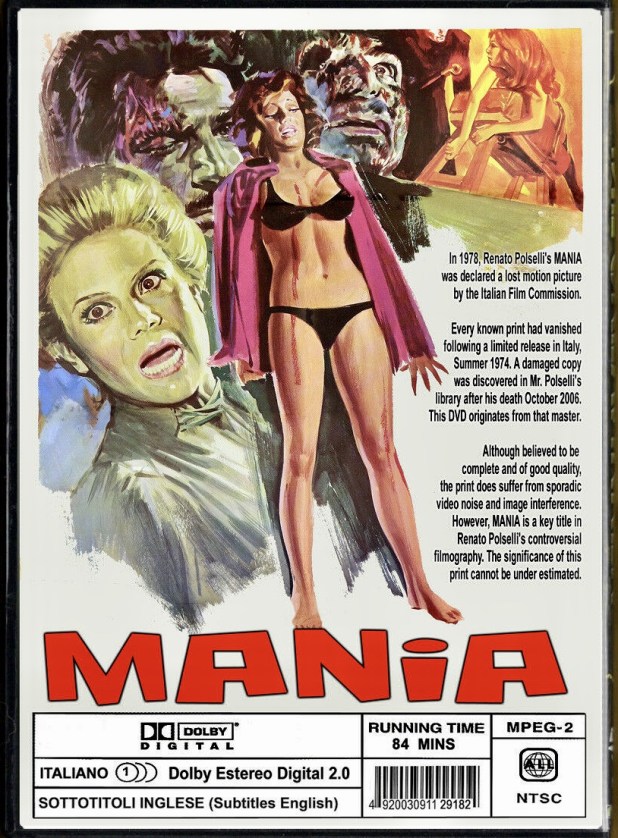
Barely released in 1974, Mania was once a lost giallo until a 35mm print surfaced in 2007 at the Cineteca Nazionale film archive in Rome, which keeps every movie submitted to censors. It’s somehow all at once a giallo, gothic horror and science fiction and refuses to make sense.
We start by meeting Lisa (Eva Spadaro) and her fiancée Lailo (Isarco Ravaiolo) as they speed along the highway with her remembering how she cheated on her husband Professor Brecht (Brad Euston, who also starred in the director’s Oscenità, a movie that is supposedly an allegory of female oppression yet contains corncob masturbation, bestiality and a lengthy lesbian orgy) with his twin brother Germano (also Euston), who is now in a wheelchair because his brother was caught in a mad scientist lab fire and his brother — not Lisa — could save him. Now she’s lost her mind and is with her twin brother-in-law but also another man but oh yeah, there’s also a ghost car chasing them and Lisa is always taking her insanity up to 11.
That very same ghost attacks the housekeeper Erina (Mirella Rossi) with a plastic bag that is filled with blood by the end, but it doesn’t kill her, just scar her and take away her voice. For some reason, this makes Germano hate her and abuse her further with his wheelchair. Someone has also dropped off a model of a coffin — the same one her husband was buried in! — and her doctor tells her that the best mental health thing to do is go back to the now haunted house and face her fears.
Oh yeah. Lisa also has another maid, Katia (Ivana Giordan), who is her secret lover and when they hook up, the camera spies Erina pleasuring herself with a bottle while she secretly watches. Just in case you needed more sleaze, I guess. This somehow turns into a catfight and ends up Erina running in terror and right into Germano, who tortures her some more before using his burned-up hands to feel her up.
If it needs to get stranger, well, Lisa is attacked by a net full of snakes in the attic, saved by Erina and then those two go at it while Katia goes out into the garden and makes love to Germano atop his wheelchair.
This involves her reading mash notes from her deceased hubby who soon arrives as a zombie because why not? This is followed by her going into his crypt and this briefly being a Hammer movie until Germano decides to torture both Lisa and the housekeeper inside a futuristic BDSM machine because, look, I don’t know, this movie is awesome.
And by awesome, I mean weird as fuck.
I hesitate to give away any more. Trust me, there’s so much more. According to Eurofever, the fumetti of this movie shows page after page of graphic sex scenes that were taken from the final print. Like, you know how Erich von Stroheim supposedly shot crazy stuff that the Hayes Commission would never allow in his films? This goes there. And then it goes so much further. I mean, this is a movie that ends with a character leaping to her death and landing in a tree that — you won’t believe it — tears all of her clothes off.
The blame — or the thanks — for this goes to Renato Polselli, who also made The Vampire and the Ballerina, The Vampire of the Opera and two movies nearly as wild as this, Delirium and Black Magic Rites AKA The Reincarnation of Isabel. He pushes everyone in this cast to just go wild, so wild that Alucardamight appear and ask them to tone down all the screaming.
Claudio Fragasso was the assistant director. Do you need more to get you to watch it? How about Euston wrote it and, according to Roberto Curti’s Italian Gothic Horror Films,1970–1979, “provided most of the money for the film himself on the condition that he was cast as the protagonist.”
This is absolute trash with a wild acid rock soundtrack that was made by a maniac, has actors overacting to a degree that they nearly destroyed reality and gorgeous women in fishnets making love just because they can. They need to invent a new galaxy for how many stars I give this movie.
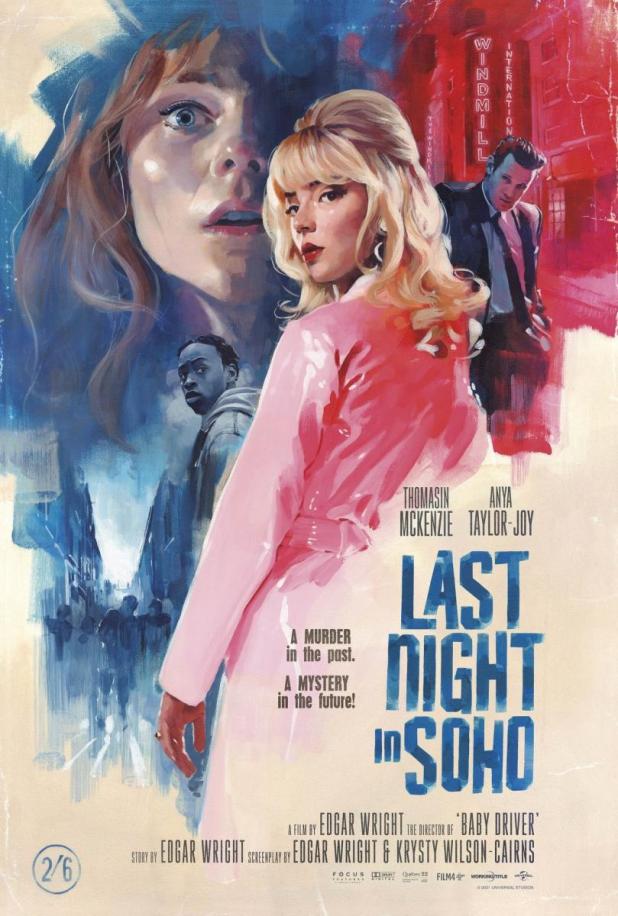
Director Edgar Wright, who also co-wrote this with Krysty Wilson-Cairns, said, “Something that I find truly nightmarish — and I guess there’s an element where I’m sort of giving a sharp rebuke to myself — is the danger of being overly nostalgic about previous decades. In a way, the film is about romanticizing the past and why it’s … wrong to do that.”
He based this on the stories his parents told him of growing up in the 60s, how their albums made him feel and that his mother said that she was once chased through Soho, which wasn’t always very nice. As much as this film feels giallo, it also feels very Pete Walker, which makes this other quote by Wright make sense: “A lot of films of that period are about the darker side of Soho or of show business. You still have to question where they’re coming from, because there’s a lot of them, which are more the sensationalistic ones, that take this kind of punitive approach to the female characters. There’s a lot of movies where it seems that the genre is “Girl comes to London to make it big and is roundly punished for her efforts.”” Come on, Edgar, just say the movie you’re talking about: Walker’s Cool It Carol!
Then again, it’s so giallo that it was originally titled Red Light Area and The Night Has a Thousand Eyes. Wright also explained the influence to Rue Morgue by saying, ” I’ve always enjoyed that genre; I’ve found it really entertaining throughout my life. Probably the first ones I saw as a teenager were The Bird With the Crystal Plumage and then Deep Red. I think Deep Red is actually the best of all of them, in fact. SUSPIRIA is fantastic, but I believe Deep Red is Dario Argento’s best movie, maybe because the story is just brilliant. And over the years, I’ve gone on a deeper and deeper dive of trying to watch all of them. But in a way, with this movie, I was sort of going backwards, being just as inspired by the movies that inspired them. I’d say that the Italian giallo movement is their interpretation of movies by Alfred Hitchcock or Michael Powell, so when writing this, I was more looking back at the inspirations for that movement, some of which are British films.”
Well, it does have a lot of the trappings of giallo, what with the predominate bright red and blue color hues in the more horrific scenes, as well as its stranger in a strange land heroine Eloise “Ellie” Turner (Thomasin McKenzie) who has left behind a small town to study fashion — not dance, that would be too simple a steal for this story — in London, the place she has dreamed of and also where her mother lost her grasp on reality and committed suicide, leading to her being raised by her grandmother (Rita Tushingham, who was in the gialloIl nascondiglio).
What moves this away from giallo and into the fantastic is that she’s always been able to see her mother’s ghost, so when the dead world of today transforms into 1960s Soho, a gorgeous world of gigantic movie theater marquees and dancing escape sequences, it isn’t out of the ordinary for her.
At night, she sleeps in her single room in the rundown flat owned by Ms. Collins (Diana Rigg!) and dreams of singer Alexandra “Sandie” Collins (Anya Taylor-Joy) who has been brought into the dark orbit of manager Jack (Matt Smith). As the dreams grow more sinister, Ellie does what giallo heroines do: she tries to solve the murder of Sandie, a death she is sure that has happened. And that’s when she suffers the fate of so many of those Italian psychosexual heroines: she has missed a very vital clue and the truth is not what she believes it to be. That means that she must stand by in silence — at least she doesn’t have needles under her eyes — and watch murders happen before her eyes.
The bars of the past, gorgeous dancehalls and showplaces, are now the squalor and ordinary pubs like the one she works at, the place where she fears the silver haired man (Terence Stamp!) who has to be Jack, who has to be a murderer, who has to pay. Meanwhile, she struggles in school until taking the fashions of the past into today, battling with rival student Jocasta (Synnøve Karlsen) and falling for John (Michael Ajao).
What I love about this film is the feeling that nostalgia is dangerous and will come to destroy you if you do not escape it. Somehow, it can be about that and also be a movie that has an entire dance sequence made with nearly all practical effects despite having magical moments where a dreamming character can switch places with a woman from before her birth. The dangers of said nostalgia are not lost on me, someone who mostly watches Italian movies from the 70s and recognizes that the Vesper drink that Sandie orders (gin, vodka, lillet blanc and a twist of lemon) was invented by Ian Fleming for the character that Ursula Andress played in Casino Royale. Also: I think Wright loves Don’t Look Now as much as I do. And yeah, that alley that gets run through is where the first murder in Peeping Tom happens.
This is the kind of movie that I can — and already did — go on and on about. I get that I’m supposed to hate all the CGI at the end and that this is a movie made in 2021, but I’m trying to remain open that the movies of today can be as good as the ones I have seen so many times.
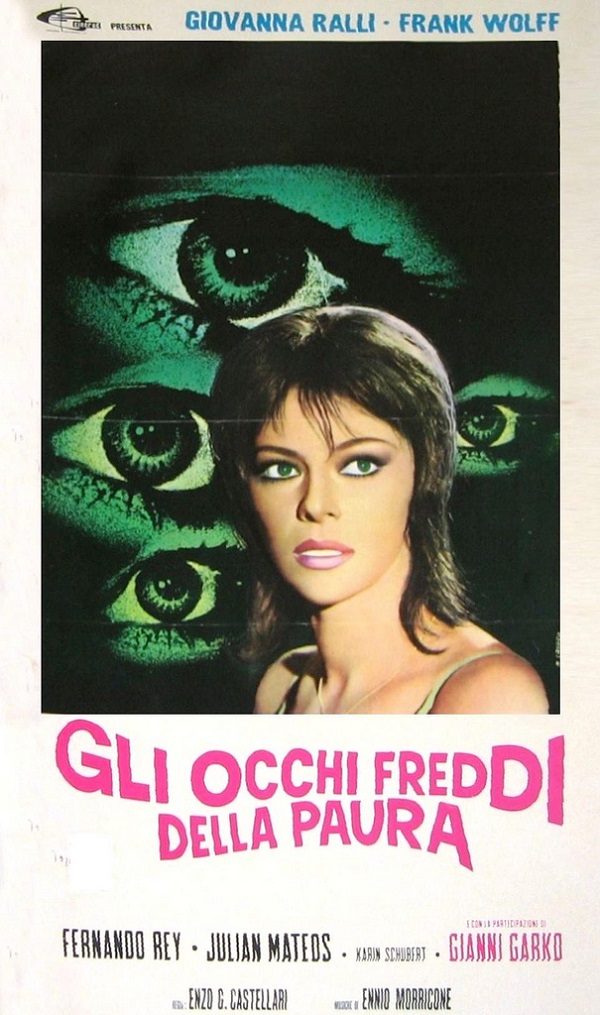
This would be his only giallo, written with Tito Carpi after being inspired by the all-in-one-apartment feel of Wait Until Dark as well as The Boys in the Band and The Desperate Hours, which explains its alternate title Desperate Moments.
When Peter Flower (Gianni Garko, Sartana in my mind forever) picks up the gorgeous Anna (Giovanna Ralli, What Have They Done to Your Daughters?) — or maybe hires her? — and takes her back to his uncle Juez’s (Fernando Rey) house. He doesn’t realize that Arthur Welt (Frank Wolff) and Quill (Julián Mateos) have been stalking the house, as the uncle was the judge who sent them all to jail.
An American star who stayed in Europe to act in tons of movies — thanks to the advice of Roger Corman — Wolff would sadly kill himself weeks after finishing this film. His wife wrote the American dialogue, as this was filmed for foreign audiences, but then she left him. He was clinically depressed; she found another man; he found a younger women who supposedly didn’t return his affection. He literally cut his carotid artery with two razors. He was in tons of great movies — Once Upon a Time In the West, Carnal Circuit, Death Walks On High Heels — and it makes seeing him in this quite sad.
Welt dresses as a cop and continually tells Peter that they are both above Anna and Quill. After all, they both drink J&B, right? That makes them a higher class. By the end of the movie, he’s totally unhinged and that makes sense, as his wife left him during the shooting and he never recovered.
This starts with a scene that seems giallo — a gorgeous woman is menaced with a switchblade — but that’s the first plot twist as this is simply an S&M show. It also has full on jazz freakout music by Ennio Morricone and Castellari pulling off insane things like shooting scenes through glasses of ice. It slows down for some parts, but the sum is greater than the parts, so I ended up really being entertained.
EDITOR’S NOTE: Cinematic Void will be playing this more slasher than giallo movie on Thursday, Jan. 19 at 7:30 PM ET at The Little Theatre in Rochester, NY (tickets here). For more information, visit Cinematic Void.
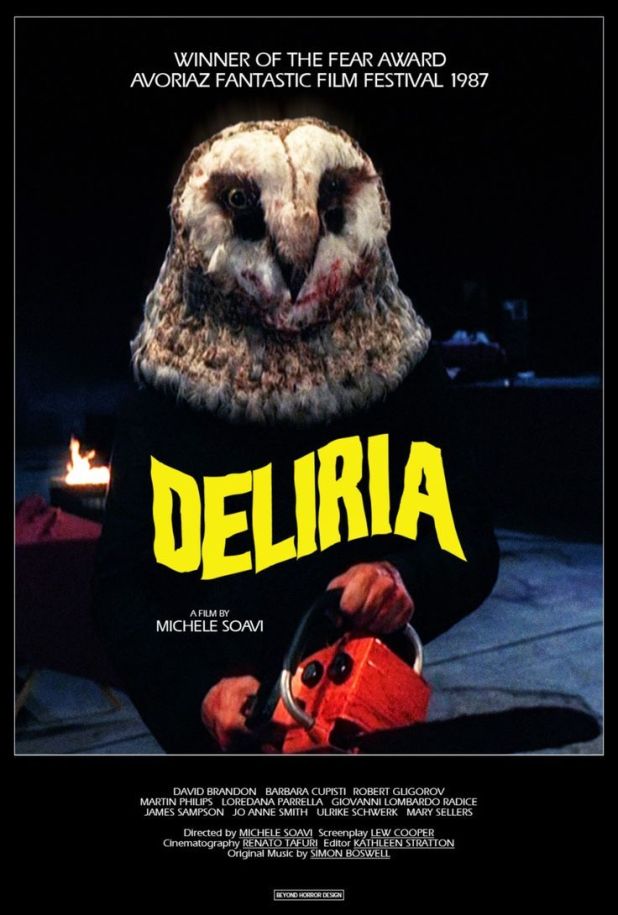
There was a moment two minutes into this movie, when a slasher-like scene turned into a Cats-like play, that my mind was blown. And there was a moment halfway through when a body was torn in two that I jumped off my couch, screaming, “Soavi, I love you!”
There’s no other way to say it — this movie is completely crazy. Is it because of Michael Soavi’s (The Sect, Cemetary Man) direction? Or the script from George Eastman (better known Nikos Karamanlis from Antropophagus and, well, kinda sorta Nikos in Absurd, a movie so brutal that it inspired a murderous black metal band)? Why ask questions? Why not just sit back and enjoy the mayhem?
The entire movie takes place in a theater, where actors and a crew are creating a musical about the Night Owl, a mass murderer. Alicia (Barbara Cupisti, The Church, Cemetary Man) sprains her ankle, so she and Betty sneak out to a mental hospital to get some help. While there, they see Irving Wallace, a former actor who went on a murder spree, which has continued in the insane asylum. He uses a syringe to kill an attendant and hides in Betty’s car.
Because Alicia left, the director fires her while Betty is killed with a pickaxe outside. Alicia finds the body and calls the police (one of them is Soavi, who spends an extended scene asking if he looks like James Dean), who lock them inside the theater and guard the premises. Because, you know, that’s the way the police handle these things.
The director is inspired — the play will now be about Irving Wallace and everyone must stay the night to rehearse, even the rehired Alicia. While rehearsing the first scene, Wallace dons the killer’s owl costume and strangles, then stabs one of the other actors in front of everyone.
Then, Wallace cuts the phone and starts killing one person at a time. It’s at this point that this movie goes off the rails and does some rails. A power drill going through someone? Yep. Hacking someone up with an axe? Yep. A woman cut in half that sprays blood all over an entire room full of people? It’s got that, too. A dude getting chainsawed until the saw runs out of gas and then getting decapitated? Oh yes.
Wallace takes all of the bodies and blares the theme from Sergei M. Eisenstein’s Battleship Potemkin while feathers fall. Alicia finds the key to escape and a gun while Wallace pets a black cat, his face covered by the owl mask.
Alicia has no idea how a gun works and can’t take the safety off. Wallace chases her, even stabbing him in the eye ala Halloween. The higher in the theater Alicia climbs, Wallace keeps following, in a POV shot that makes it feel like he’s climbing toward us. She cuts the cord he is climbing and he falls to his death. But this is a slasher — albeit one through the eyes of Soavi — and the killer comes back until he is set on fire.
The next day, Alicia goes back to the theater to find her watch. Willy, the janitor, tells her that they took eight bodies out, which makes her realize that Wallace is still alive. He shows up, unmasked, and tries to kill her all over again. After hearing Willy tell her how she didn’t even have to think to kill him and that the gun would do it all once the safety is off, she unloads a bullet “right in-between the eyes.”
Alicia wanders out of frame, toward a bright white doorway that we first saw just before Wallace attacked her. And in this scene, we can really see why Soavi stands ahead of the pack when it comes to horror. That doorway offers escape, not just from Wallace, but from the film itself, as her fictional character, her final girl, is removed from our minds. The killer lives long after the victims and survivors, so the camera pans down to reveal Wallace, blood pouring from behind his eyes, and he begins to laugh. Soavi said that he intended this to be a wink to the conventions of the slasher, where the killer never really dies.
This film was produced by Joe D’Amato, who had a scene from this movie play within his 9 1/2 Weeks rip-off Eleven Days, Eleven Nights. Also known as Aquarius and Deliria, it features an amazing soundtrack by Simon Boswell. And Soavi — in his first time as a director — shines with intricate camera work (it’s very Argento), complete with a wordless final twenty minutes of Alicia fighting against Wallace.
The end of this film approaches near surrealism within the horror narrative. This gets the highest review I can give. It’s a slasher that transcends the genre to become real art.
EDITOR’S NOTE: Cinematic Void will be playing this film — my favorite giallo — on Thursday, Jan. 18 at the Central Cinema in Knoxville, TN. For more information, visit Cinematic Void.
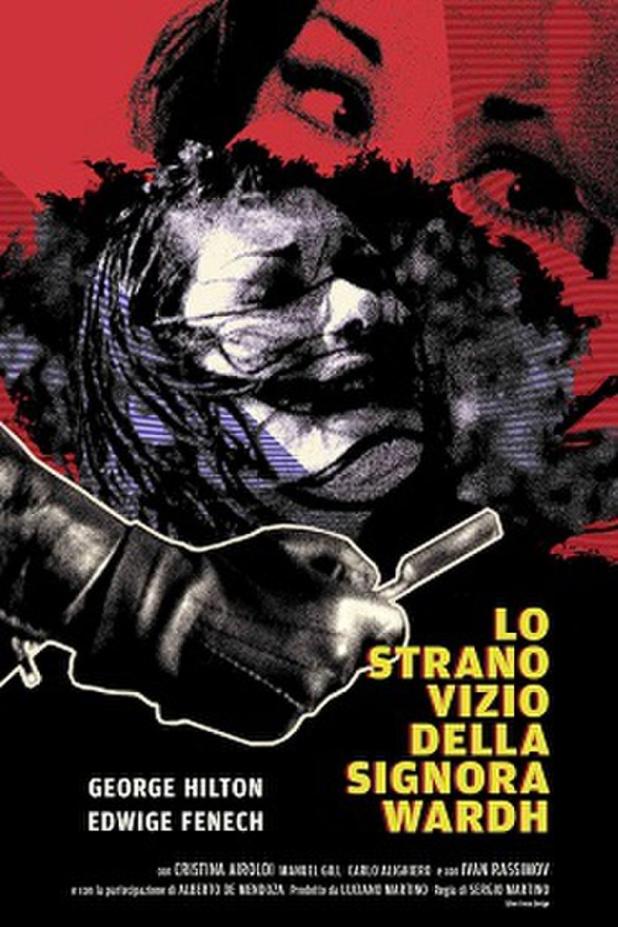
Sergio Martino’s directorial efforts have run the gamut — from straight exploitation (Mondo Sex and Mountain of the Cannibal God, which features Stacy Keach and Ursula Andress, as well as real animal mutilation which we’d never endorse) to horror (Island of the Fishmen, which in addition to starring Barbara Bach and Joseph Cotten, was re-edited by Jim Wynorski and re-entitled Screamers), post-apocalyptic action (2019: After the Fall of New York and Hands of Steel, which is more Terminator rip off than Road Warrior), spaghetti westerns, crime dramas, war films, comedies and even Italian TV, where he’s worked for the last several decades. But this week we’re here to discuss his contributions to the world of giallo.
This is his first effort and the start of the ensemble case in which he’d use in his films. George Hilton would appear in four of his films, Ivan Rassimov in three and one of the queens of the giallo, Edwige Fenech, would star in three (in fact, she was married to Sergio’s brother, the late producer Luciano Martino, at one time).
Wondering why this film isn’t just titled The Strange Vice of Mrs. Ward? Turns out a woman named Mrs. Ward sued before the release, claiming that the film would ruin her good reputation, so they changed the title. Yes, Italy, the country where you can make a movie called Zombi 2and have nothing to do with the original film still has legal settlements such as this. You can also find this movie under the titles Blade of the Ripper, Next! and The Next Victim.
Julie Wardh (Fenech) is the wealthy heir to a retailing company. But she’s also a fragile flower, back in Vienna, a city packed with memories and former lovers. She’s married to Neil (Alberto de Mendoza from Horror Express and A Lizard in a Woman’s Skin), a man so wealthy and powerful that he leaves for business the moment they land.
As Julie rides alone in the rain, her car is stopped by the police who are on the hunt for a killer. The sound of the wiper blades reminds her of the last time she was here, recalling a vicious fight between her and a lover who repeatedly slapped her around before they made love in the rain. There’s a gorgeous shot here at the end, where the lovers are to the left of the camera while rain descends on them, almost illuminating them and a sports card pushes into the right foreground. Compared to other giallo which seem content to merely ape Argento or seem like boring police procedurals, Martino aspires to art within his direction (which honestly is why this site is planning on a week of his films).
A green light and honking horns snap Julie from her reverie and she returns to her apartment, where she takes strange notice of a car. Her apartment has been left exactly as it was the last time she was here — it’s a white pop art explosion of metallic, green and blue lines contrasted with oval windows — and just as she’s getting ready to take a bath, the buzzer rings. A dozen roses with a note attached: The worst part of you is the best thing you have and will always be mine – Jean.
We cut to a party, where Caroll (Conchita Airoldi, who would go on to produce Cemetery Man) is trying to hook Julie up with her cousin George (George Hilton, All the Colors of the Dark, The Case of the Bloody Iris) as a catfight between two girls in paper dresses goes down. Tell you what — if I am to learn anything from giallo, it’s that every party in 1970’s Italy was packed with drugs, crazy music and the chance that anything from a fistfight to an orgy could happen at any minute. People had to be exhausted all the time. Jean (Ivan Rassimov from Planet of the Vampires, Your Vice is a Locked Door and Only I Have the Key, Eaten Alive!), the guy who sent the roses and was the man she remembered in the earlier flashback, is there extending a salute. This enrages Julie, who leaves the party, but he follows her into the street. He reminds her that she belongs to him, but she counters that she married Neil to escape him, which is cemented when Neil shows up and punches the dude. Jean just laughs, looking at both of them, knowing that he owns Julie body and soul.
This leads to a flashback where Jean pours champagne all over her, soaking her dress, then smashes the bottle of champagne, showering her in glass shards. He uses what’s left of the bottle to slice up her dress and skin before he takes her. Their coupling is a mix of pleasure and pain, covered in blood, that she had to escape. But did she want to?
So what then is Mrs. Wardh’s strange vice? Is it for men that are bad for her? Is it for pain and dominance? Or some combination of both? As we learn, she’s caught between three men — her husband, whose cool indifference and emotional (and physical) unavailability is just as cruel as her former lover Jean, who owns her to the point that she is nearly his again before Neil showed up to hit him. And the third side of this love rectangle (is there such a thing?) is George, who is the porridge to her Goldilocks — the just right combination of both. Yet there is a fifth side to this — making it a love pentagon (!?!) — with Julie wanting to be a good woman, true to her vows and not to her need to be beaten, bloodied and forced. She is torn between her desire and her need to fit into the moral code of the world. So much of giallo is based on this — created in a country where the Holy Seat of a religious empire sits smack dab in the middle of Rome. Religion and morality nearly shook hands with the sexual revolution and excesses of the pre-AIDS 1970s.
Ah, but let’s not forget that a proper giallo needs a murder, which this film delivers with a quick slash in the shower. That said — what strikes me about Martino is that unlike Argento, he cares more about the story and the characters than creating murder art set pieces. The conversation between Carol and Julie isn’t just words on a page, they’re vital clues into her mental state. Whereas Carol’s casual amorality is revealed, saying that the killer — who we just saw attack the showering girl — is taking out her competition, Julie worries about her values. She married Neil for security and protection, but not the monetary or physical kind. She wanted protection from herself, as she feels that her loss of control and willingness to submit to the violent impulses of men makes her a sinner.
George shows up to meet Julie and get to know her better. He even tells her that he loves to court women when their husbands are around, cuckolding them. Julie claims that that leaves her cold, while Carol claims that she’d bed him, family or not. They decide to go to lunch together, which seems to be more about George staring at Julie than sustenance. Julie demands that George take her to the bus station, but instead he takes her all over the countryside on his motorcycle (What is it with Fenech’s character and dudes that ride bikes? Is it the freedom that it represents?) while he wears white leather fringe, a look that is very 1971. He calls her the moment that she enters the house and she tells him that she likes him way too much, so she can never see him again. Of course, he’s already there and enters the front door before kissing her. She tries to get away, but he keeps telling her that he is in love with her. She begs him to not complicate her life, that she is not the girl he thinks she is. Their kiss is artfully compressed into a second kiss that occurs much later that same day — an intriguing way to show the passage of time and the growth of their relationship.
As they kiss in the dark, a car nearly hits them, which Julie is sure is Jean. She tells him to take her anywhere, which ends up being his apartment. The car returns and its driver watches from the window as Julie and George make love (or, more to the point, she knees him in the crotch while laying upon him, but whatever works for them, I guess).
Later, Julie gets more flowers from an anonymous admirer. Her husband asks who they are from and she wishes aloud that they came from him. There’s another note attached — “Your vice is a locked door and only I have the key.” She tells him that she realizes that diplomats only love other diplomats. He replies that she feels that he has always failed and wronged her. He asks if she is content. “I’m more than content,” comes her reply.
The black gloved killer is watching her and calls her to blackmail her, saying that he will tell her husband. She goes to talk to Carol and claims that it’s Jean. Carol responds that the killer’s last victim was “that whore at the party” and Jean couldn’t be the killer, as he doesn’t go after women like that. Carol embraces free love and says that if Julie is into George, then why should she have to hide it? Also: Carol just walks around her apartment naked (and also has a crazy cover up that is all black with red feathers) and Julie is just fine with it. Carol offers to go to where the blackmailer/killer wants her to drop off the money.
Julie nervously chainsmokes while watching a motorcycle race, a scene intercut with Carol going to meet the killer. To show the escalation of worry, Martino piles on the jump cuts and quick switches between the two women. Whereas Julie is trapped within her worry and the walls of her apartment, the carefree Carol is all alone within a huge park. Alone until the killer reveals himself, slashing her with a straight razor. Again — the killings are rather matter of fact in contrast to the set-ups in this film.
The police get involved, finally investigating Jean. They go to his apartment, which is covered with photos of naked women and exotic animals. Then, they interrogate him with her in attendance. It’s just an excuse for him to keep trying to seduce her and inform the police that Julie has a blood fetish, so she could be the killer, too. George has also been brought in for questioning, to which Jean says, “Now I know why my flowers have no effect on you.”
Neil arrives to take Julie home, but later George says that he wants to speak to her husband and take her away from the city. She says that she has to see this out, she has to discover who killed her best friend when it should have been her.
As Julie returns home, she finds herself in a dark parking garage. The headlines of a car cut into the inky blackness before she is nearly run over. She runs for the elevator, watching for the killer and the numbers of her floor to get closer. Yet the doors open to reveal the killer! Julie runs from him, even attempting to hit him with her car. She barely makes it inside the apartment, screaming at the door. Her husband lets her in but she’s in hysterics. There’s a lot of this scene that feels like it influenced Halloween 2‘s elevator scene. I’m not alone in feeling like that sequel is a giallo. Check out this awesome article from Bill at Groovy Doom to see what I mean.
Neil has had enough and decides to go to Jean’s house and confront him. He tells Julie that he will go alone, but she is afraid and rushes to be with him. They explore his dark house, finally finding Jean’s body in the tub. Julie is overcome and passes out in her husband’s arms. When they get outside, Jean’s car is gone and flowers have been left in the backseat with another poem. Neil throws the flowers down in disgust.
We cut to a dream sequence of George, a laughing Carol and Jean covered in blood, slapping her around. Her husband wakes her up and shows her the photo of the killer. She asks her husband to protect her, but he leaves. She calls and begs George to come get her. He promises to take her to Spain, a place that will make her forget the rest of the world (people continually promise this to Julie, such as Carol’s offer that a place will make her forget she’s on a diet or that an affair will make her forget her sadness).
Neil comes back home to learn that Julie has left. Meanwhile, the killer tries to attack another woman, who unmasks, disarms and stabs him. He makes one last attempt to kill her, but passes out from blood loss.
Meanwhile (!), George and Julie are spearfishing. The camera work here slows down, turning around our lovers (You can’t tell me that DePalma didn’t watch at least a few giallo, even though he claims to have only seen The Bird with the Crystal Plumage and has been dismissive of Argento’s work. Sure, all of his films and giallo betray the and of Hitchcock, but some of these films seem way too close). They discover that the killer has died, but George disappears and someone starts following Julie. She arrives back at their apartment to hear the sound of dripping water. We follow the sound to the bloody curtains of the tub as water and blood spill out. The camera begins to spin back and forth before she sees Jean’s dead body, screams and passes out. George arrives and tries to wake her up, but she’s catatonic. George finds the cause of Julie’s worry — rust had been dripping onto the floor, looking like blood.
Julie awakens and her mood gives way to madness. She’s sure someone is there and yet there is no one. As she realizes this, she attacks a wall and is chloroformed from behind by…Jean! George is rushing a doctor to see her, explaining her vice for blood that excites and repels her at the same time. But Jean is too busy dragging her to the kitchen, where he duct tapes the window shut. He opens a gas line and locks the door (using an ice cube?), leaving her to die. We hear her heart beating out as it’s cut with shots of the doctor and George rushing to her. She makes an attempt to stand but cannot. And it’s too late — Julie is dead.
Neil comes to see the police and blames George for what the police are classifying as a suicide. Jean waits in a secluded area for George, who greets him with a smile. He asks him for the money — turns out that they were in this together. Even after explaining that they both have an alibi, Jean asks again for the money. George shoots him and leaves a gun in his hand, making it look like a suicide.
Turns out that Neil and George were in on this too — Neil has paid off his debts and with Carol gone, George is the only heir to a fortune — much like Hitchcock’s Strangers on a Train. As they drive away laughing, Neil sees Julie on the side of the road and demands that Neil turn around. To their surprise, it is her — followed by the police. A chase leads them off the side of the road to their death. The doctor has saved her life and it seems like he’s fallen for her.
Wow. The Strange Vice of Mrs. Wardh was but the first of Martino’s giallo films, but it’s great. It kept me guessing until the end with none of the b roll travelogue footage and red herrings that plague so many other films in the genre. What a movie to spend the middle of the night into the morning with!
Here’s a drink recipe.
The Strange Cola of Mrs. Wardh (tweaked from this recipe)
1 1/2 oz. J&B Scotch
5 oz. cola
4 dashes Angostura Orange Bitters
An orange wedge
Put on your black leather gloves and use a switchblade to slice an orange wedge.
Fill a tall glass with ice and pour in the J&B and cola.
Add the bitters, then squeeze in the orange juice and use the rest of the wedge for a garnish.
EDITOR’S NOTE: Cinematic Void will be playing this movie on Tuesday, January 17 at the Music Box Theatre in Chicago, IL (tickets here).For more information, visit Cinematic Void. It’s also available in The Complete Lenzi/Baker Giallo Collection set from Severin, which has plenty of other great films like Orgasmo, A Quiet Place to Kill and Knife of Ice.
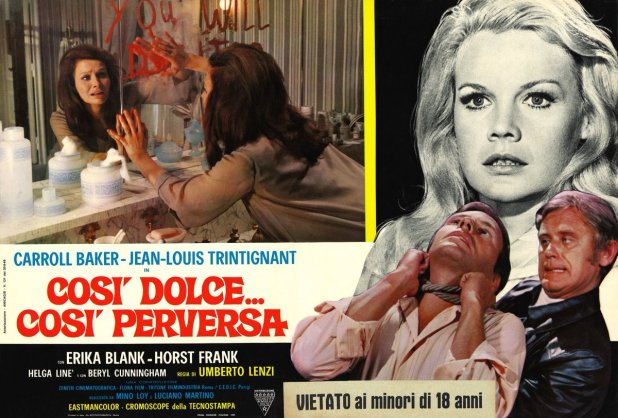
Umberto Lenzi’s early giallo — before the Argento-influenced Seven Blood Stained Orchids — feel more like film noir than the standard films of the genre. Speaking of that same movie, it would also use the J. Vincent Edward song “Why.” And while we’re discussing influences, this movie is definitely feeling all sorts of Les Diaboliques.
Jean (Jean-Louis Trintignant, Amour) is a rich socialite who has come to the aid of Nicole (Carroll Baker!), a gorgeous woman mixed up with Klaus (Horst Frank, The Dead Are Alive). Sure, Jean is married, but that doesn’t stop him from falling for her, even when he learns that she’s been paid to kill him. Of course, his wife Danielle (Erika Blanc!) is mixed up in this, but Nicole is smarter than she seems. Beryl Cunningham (The Salamanders) is also in this as a dancer and Helga Line (Nightmare Castle) is on hand as well.
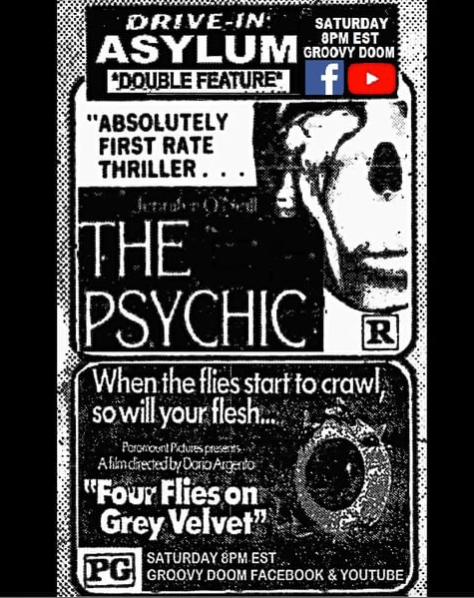
This week, Bill and I are reopening the DIA balcony and showing two giallo classics by two of the best directors ever to get our 2023 season started just right. It all starts at 8 PM EST on the Groovy Doom Facebook and YouTube pages.
Up first — Lucio Fulci’s Sette note in nero AKA The Psychic. You can watch it on YouTube.
If you haven’t watched the show, what we do is discuss each movie, show the ad campaign and then share a drink recipe. Here’s the cocktail for the first film:
Seven Sweet Notes In Black Cola
2 oz. J&B (what else?)
6 oz. cola
4 dashes, Angostura Orange bitters
Orange wedge
Pour the ice in a tall glass, then top with J&B.
Add cola and bitters, then squeeze in your orange wedge. Have a flash back or a flash forward with your first taste.
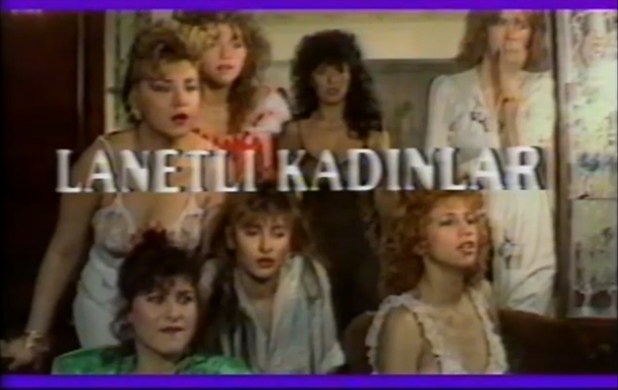
That title means Bloody Mansion Deathand A Knife for Seven Cursed Women and man, this movie is… well, it’s something. For one, it looks like a shot on video 1990s adult film but one with no penetration and featuring its entirely female — save for a man in the beginning — cast in lingerie for its entire running time, except when they’re not showering. Is director and writer Kadir Akgün the Turkish Jim Wynorski?
Seven women — a lingerie model (Silver Türk), a sex worker (Ayşin Soylu), a belly dancer (Ayla Tuncer), a homemaker (Hicran) an actress (Hülya Konuk), an ingenue (Figen Aydoğdu) and an ex-wife (Nur İncegül) — have all received the same letter from the same old man banker lover. They are to come to his mansion and get a gift that’s only for them. What, the lead role in his movie Audra?
When they get there — all by boat, of course — he’s already dead in the bushes. Instead of doing the sensible thing and getting out of there, they all start fighting and then decide to all put on lingerie, which is kind of what you do when you’re a fancy underwear model, but these ladies all have different jobs. They do all shop at Frederick’s and not Victor’s Secret if you know what I mean and I think you do.
Then the news comes on — it uses the theme from Raiders of the Lost Ark because of course it does — and then they all get a bloody note: “You are all going to die!” One of them dies quickly and everyone runs outside to get a weapon instead of you know, getting the fuck out of there. They also all put on fresh lingerie.
With each death — by poisoned liquor, by garotte, by poisoned food, by necktie, oh man this killer has just a few tricks until someone else gets shot and another gets stabbed — the girls drag the dead body to a room, cover it with a sheet and keep partying. There’s also a Psycho shower scene that turns sapphic, accompanied by the theme from Jaws.
A Turkish SOV giallo/Sorority House Massacre ripoff with hardcoded Greek subtitles starring big-haired 80s women all screaming at the top of their lungs at one another for forty-five fifth generation video quality minutes until one is killed. Fuck you James Cameron, this is my Avatar 2.
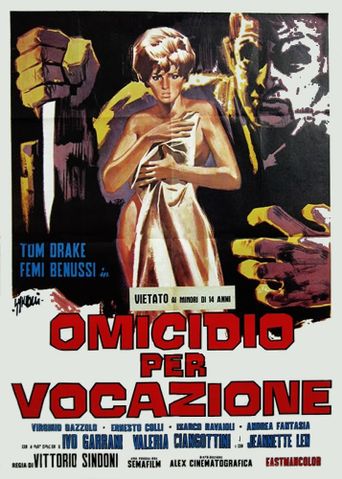
A pre-Argento giallo, Omicidio per vocazione is about a railroad worker killed by a train and the deaths of his heirs as they attempt to claim his fortune. Directed by Vittorio Sindoni, who wrote the script with Aldo Bruno and Romano Migliorini, this has Inspector Greville (Tom Drake) trying to figure out who is killing off all these people.
Give it points for giallo originality. It takes place in a small village in France and steals more from Agatha Christie than Edgar Wallace. That said, it’s very by the numbers until the end reveal, but at least the bad people are beyond bad and it has a great alternate title: L’assassino ha le mani pulite (The Killer Has Clean Hands). It also has more than one — maybe — deaths by train. Also: death by golf club.
EDITOR’S NOTE: Cinematic Void will be playing this film on Monday, Jan. 16 at 7:00 PM PT at Los Feliz 3 in Los Angeles (tickets here). For more information, visit Cinematic Void.
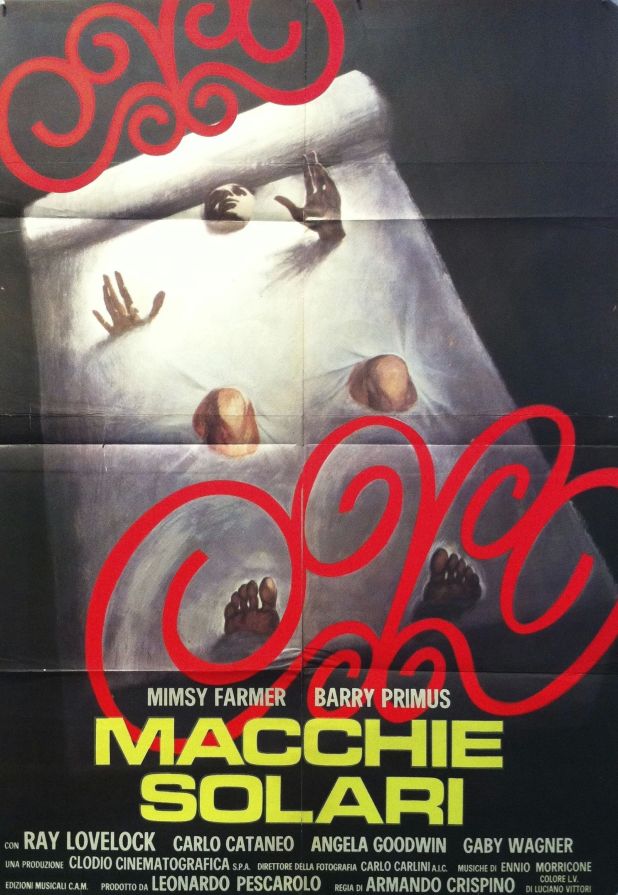
Armando Crispino really only did two horror films, 1972’s The Dead Are Alive and this 1975 giallo, which is a shame, as this is a pretty decent entry in the genre. Known in Italy as Macchie Solari (Sunspots), it does indeed feature sunspot footage from space before we see any major murders. And if you’re looking for a movie packed with autopsy footage, good news. It totally lives up to its title.
Simona Sana (Mimsy Farmer, who is also in Argento’s Four Flies on Grey Velvet and The Perfume of the Lady in Black) is a pathology student who is trying to work on a theory about suicides, one that’s disputed by a young priest, Father Paul, whose sister — Simona’s dad’s latest fling — has recently killed herself. It turns out there’s been a whole series of self-killings which are being blamed on, you guessed it, sunspots.
I mean, what can you say about a movie that starts with several of said suicides, like sliced wrists, a self-induced car explosion and a man machine gunning his kids before turning the gun on himself? Obviously, this is a rather grisly affair, with real corpse photos spread — quite literally — throughout the film.
In between all of the gore, corpse penises, two bodies falling to their deaths and crime museums, there’s also Ray Lovelock (The Living Dead at Manchester Morgue) as Simona’s boyfriend, an out there Morricone score and a heroine who hallucinates that the dead are coming back to life.
The plot gets pretty convoluted, but if you’re on this site, you obviously appreciate films like this and will get past it. This is an Italian 70’s murder movie, though, so if you get easily upset about the way men behave, well, be forewarned.
 B&S About Movies