JEAN ROLLIN-UARY: The Living Dead Girl (1982)

EDITOR’S NOTE: This first was posted on November 18, 2022.

Jean Rollin had such a rough introduction to film — being chased by the forces of Generalissimo Francisco Franco while making a documentary, running out of money, causing scandals, suffering an accident during the filming of  La Vampire Nue which left him traumatized — that the fact that his movies ever came out is nothing short of a marvel.

After 1971’s Requiem for a Vampire he finally became a success, making a movie that he called a naive film, one that had a simplified story, direction and cinematography. And yet he made movies he knew would fail, like La Rose de Fer (The Iron Rose) and would work in adult films as Michel Gentil to pay the bills. Yet he would keep making absolutely deranged movies like Les démoniaques — two women are assaulted and killed by pirates and then have sex with Satan to return and get their revenge — and Lèvres de sang in which a man is obsessed with a childhood memory that could really be a dream.

He’d go between getting close to success with movies like Les raisins de la mort and then having to go back to make adult films to pay the bills. Even the artistic success of Fascination was poorly distributed meaning more Michel Gentil or Robert Xavier porn films.

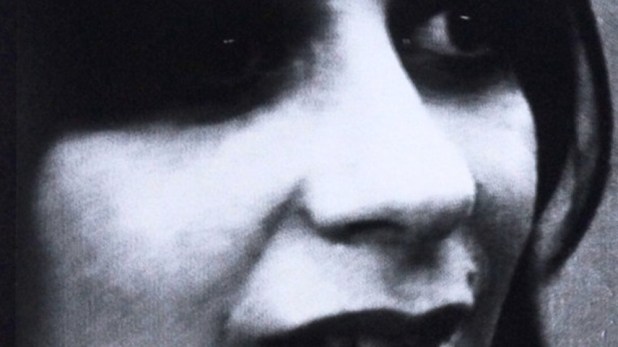
In 1982, however, he made La morte vivante which may be his most commercial and successful film.

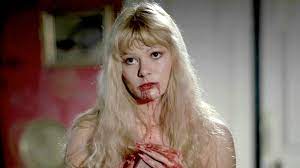
Catherine Valmont (Françoise Blanchard) has been dead and buried in her family vault beneath the Valmont mansion before grave robbers, some dumped chemicals and a tremor awakens her. She can only live by drinking blood and fades in and out of reality — much like one of the director’s films — remembering her childhood friend Hélène (Marina Pierro) who ends up helping keep her alive. There’s also Barbara(Carina Barone), a photographer obsessed with the image of Catherine.

This movie is probably the most accessible Rollin movie. Sure, it moves at the same languid pace as his other films, but it has a story, one drenched in sadness and childhood nostalgia and perhaps even young love. It has more gore than much of his other movies and no small amount of nudity, yet the true reason this succeeds is that it’s the most potent of all strains of Eurohorror drugs. Watching Rollin is like finding out that joint has been laced and you keep waiting for the real drugs to kick in and before you know it, it’s too late and there’s nothing you can do to stop the slow creep of the high and before long you’re enveloped by it and love it but also unnerved at the very same second. By the end, that same love has destroyed everything. A woman has been set ablaze and Hélène has given of herself to Catherine’s unending need to drink blood, cracking her open like some kind of delicacy. Françoise Blanchard went so over the limit in this scene that the crew thought that she had really lost her mind.

Supposedly, there’s an English version that was shot with the same cast and crew, directed by Gregory Heller who would shoot his scene right after Rollin. It is a lost film.
You can watch this on Tubi or Kino Cult.

JEAN ROLLIN-UARY: The Escapees (1981)

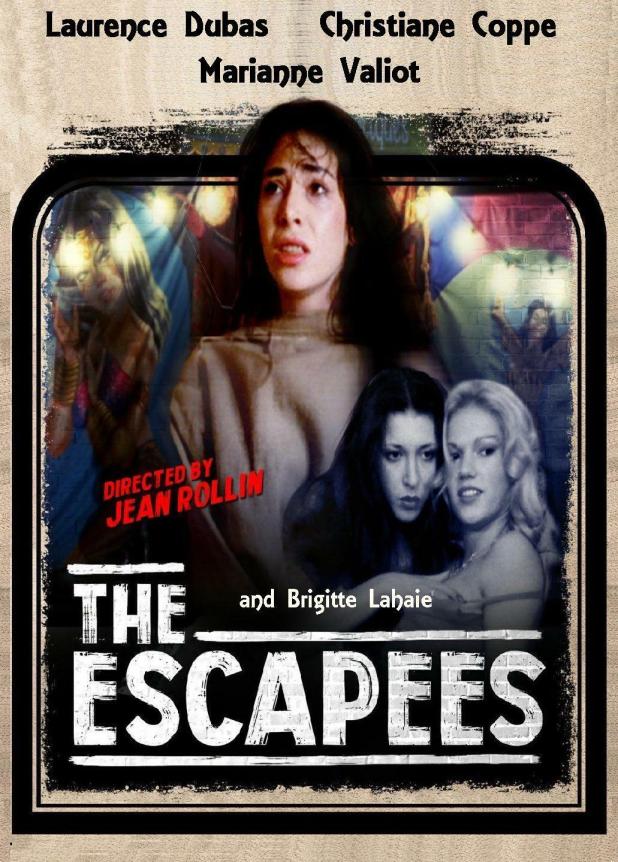
Also known as Les paumées du petit matin (The Dawns of the Early Morning) and The Runaways, this begins in a mental asylum run by nuns. There, Michelle (Laurence Dubas) has returned after escaping and is placed in a straitjacket. She’s soon freed by a new patient named Marie (Christiane Coppé) and the two run off for a series of adventures, such as watching a burlesque show, meeting a thief named Sophie (Marianne Valiot) and becoming part of a sailor crew who promise to take them away. Yet at the bar of Madame Louise (Louise Dhour) a series of rich people — one of them is Brigitte Lahaie — take our heroines to a mansion and attempt to assault them. What follows is death, both murderous and suicidal, as the runaways attempt to escape a world that won’t allow them to.

I’m a big fan of movies where women find friendship and escape in doomed journeys. Beyond Thelma and Louise, we can also add Baise-moi and Times Square. There are many more, but this feels very close to the punk of the latter, as Jean Rollin leaves the beaches and castle behind but doesn’t forget to have doomed and dreaming girls as they wander and seek something, anything.

There are no vampires in the world of this film but can these two women find magic? Perhaps not. There is an incredible figure skating sequence which is not something that I thought I’d ever say about a Jean Rollin film.

Night Gallery season 2 episode 1: The Boy Who Predicted Earthquakes/Miss Lovecraft Sent Me/The Hand of Borgus Weems/Phantom of What Opera?

As Night Gallery moved into its second season, it would start becoming schizophrenic, caught between the darkness and the light of pained comedy or more to the point, creator Rod Serling versus producer Jack Laird. Yet when it works, well, man does it work.

I think about “The Boy That Predicted Earthquakes” so often. Directed by John Badham, years before he’d make Saturday Night Fever, it was written by Rod Serling from a Margaret St. Clair story. Clint Howard is astounding as Herbie Bittman, a young boy who simply talks like a real little kid going on and on about telescopes before dropping apocalyptic knowledge on TV audiences. What kid could hopefully deliver a message of hope when he knows that the world will end horribly the very next day? What a Satanic moment in a series known for so many, a child delivering the burnt out worldview of Serling to the masses. A near-perfect segment worth endlessly rewatching.

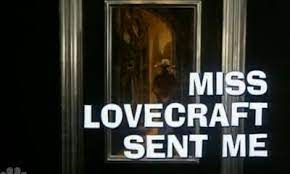
Less can be said about “Miss Lovecraft Sent Me,” the first of too many “black out” gags which has Joseph Campanella as a vampire and Sue Lyon as a babysitter. Director Gene R. Kearney wrote Night of the Lepus and would go on to contribute to the beloved 1979 series Cliffhangers, but the fact that he was involved in Laird putting his insipid fingerprints all over a masterwork is a strike against him. At. least Lyon is gorgeous; she did better work in Lolita and Murder In a Blue World.

“The Hand of Borgus Weems” has that most horrific and hoary of horror tropes: the haunted human hand. Peter Lacland (George Maharis) claims that his hand is possessed and demands that Doctor Archibald Ravadon (Ray Milland) amputate it. It’s simple and effective, with assured direction by John Meredyth Lucas, a producer on Star Trek and the director of several episodes of the Planet of the Apes TV series. Its writer, Alvin Sapinsley, also wrote Moon of the Wolf.

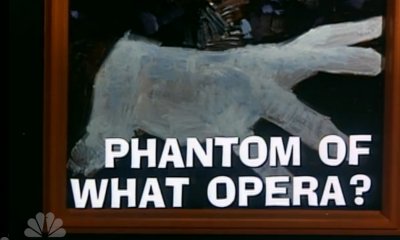
Sadly, “Phantom of What Opera?” is another gag with Leslie Neilsen as the Phantom and Mary Ann Beck as his victim. Directed and written by Kearney, it’s exactly the kind of two-minute silliness that would continue to mar this show all season long.

What do you think of this episode? Which story is your favorite? Let me know in the comments.

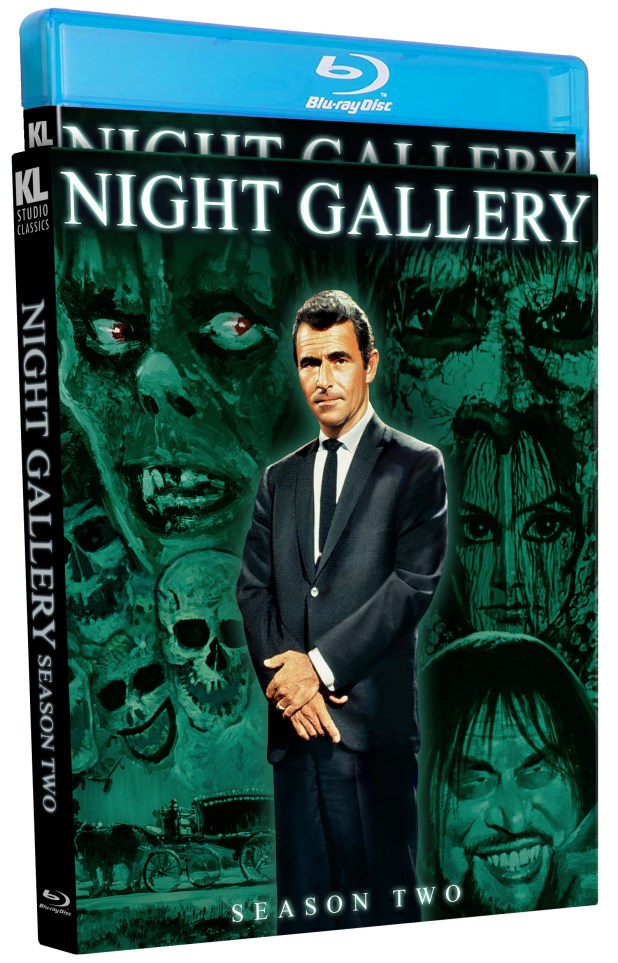
You can buy the second season of Night Gallery on blu ray from Kino Lorber.

JEAN ROLLIN-UARY: Night of the Hunted (1980)

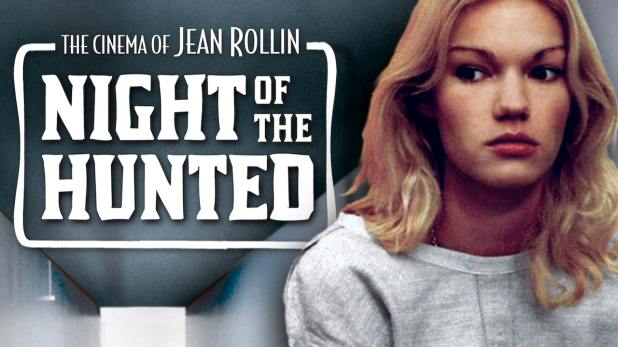
While she was still working in adult films, Brigitte Lahaie met and worked for Jean Rollin on the movie Vibrations Sensuelles (Sensual Vibrations). He noted that she had a “distinctly different personality” and an “incredible charisma,” so he remembered her when he made The Grapes of Death a few years later as well as Fascination. He’d also go on record saying that she was the perfect woman.

In this movie, she plays Elizabeth, a woman suffering from a disease that is slowly taking away her memories and will soon make her a walking corpse. A man named Robert that meets her by accident believes there’s no way that can be true and attempts to save her from a very Cronenberg-esque clinic where doctors are keeping her under observation at all times. There, the patients make love and kill one another in equal measure as they descend into madness because all they can remember is the chemical rush of sex and death.

This is a film that starts out as a softcore, goes into noir, emerges into science fiction and then becomes something else, something uniquely Rollin as memories and connections are explored amongst horrific imagery and a bleak ending that maybe is hopeful depending on how you think about it.

Written in a day, shot in two weeks and a film that has no vampires, no beach, no ruined castles and just the coldness of the city — along with Lahaie’s moving performance — this is a departure but a rewarding one.

You can watch this on Kino Cult.

JEAN ROLLIN-UARY: La nuit des horloges (2007)

Ovidie, who stars in this film, was a “very active militant feminist” when she started her adult career. At first, she thought that porn was filled with injustice for women but was shocked by how the women were powerful sexual beings. Seeing how that worked with her feminist ideals, she started acting and said, “I am interested in these sort of experiences not just because I am perverse, which as you have seen I can be when I want to be. No, it’s because not everyone can achieve them.” After a year as a performer, she started directing movies by women for women, just like the adult store that she owns, as well as crossing over to mainstream in movies like All About Anna, in which she performed explicit and unsimulated oral sex on mainstream actress/singer Gry Bay.

That’s who Jean Rollin picked to play Isabelle, the heroine of his next to last film and this makes sense, so much sense, as so much of his work has been about the juxtaposition and duality of the virginal and the sexual. He’s a man who strove to make fairy tales about vampires, castles and beaches and yet had to pay for them by changing his name and directing dirty movies. Yet no matter what he makes, there they exist, the innocent and the profane.

Isabelle has inherited a home from her uncle, who was a writer and filmmaker. Within that home, she discovers the lost memories of a dead man, a place forever haunted by not only his characters and fantasies but the movies and moments of Rollin.

So while this has a title that means The Night of the Clocks and that sounds vaguely Italian, you should also know that this is Rollin’s very own Cat In the Brain as he brings back the people and times and memories of a man who at the age of seventy is looking back at the struggles of attempting to create myth that can last.

So Ovidie steps into the shoes of Brigitte Lahaie, another actress that Rollin took from adult and found his perfect woman and then brings back so many images and feelings and yet also has so many new things, like the wax sculptures that show how the body decays, surely a fact that was weighing on him. Indeed, Rollin had but three years left on Earth when he made this movie. And that wax museum was to be all that he was to film, but he was so inspired when he saw it that this film came from it, financed all with his own money.

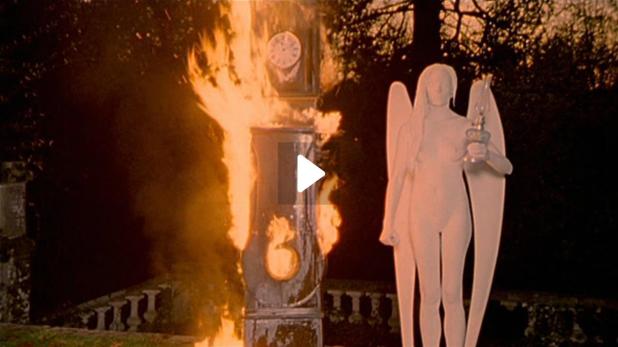
Between the moment when the clock coffin catches on fire and realizing that this was shot in the same cemetery as The Iron Rose, not to mention how much fun everyone seems to be having, I have to confess tearing up a few times. It’s disconcerting to watch someone’s entire film output within just a few days and then have this resolution, although Rollin would make one more movie. I have no idea what the word for this emotion is. It’s sadness mixed with happiness that it happened. Maybe it’s just life.

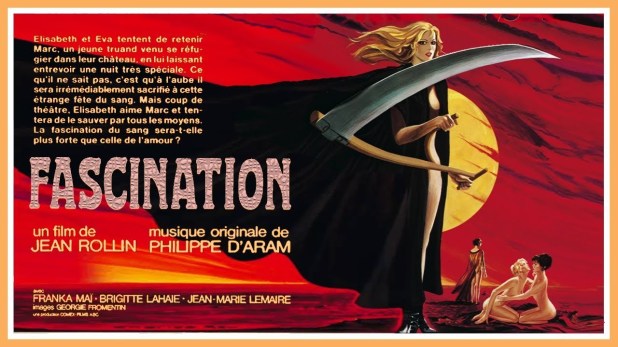
JEAN ROLLIN-UARY: Fascination (1979)

EDITOR’S NOTE: This was originally posted on October 11, 2017.

Jean Rollin was a master of the fantastique, the way that the French refer to a mixture of science fiction, horror and fantasy. What’s the difference between fantastique and fantasy? The former is more concerned with the intrusion of supernatural phenomena into an otherwise realist narrative. In this genre, the supernatural may be met with doubt, disbelief and fear; yet it always exists.

After a decade marked by working under a pseudonym in the porn industry to make ends meet, Rollin saw Fascination as an attempt to return to his roots. It’s based on Jean Lorrain’s Un verre de sang (A Glass of Blood), a poem about rich people drinking the blood of bulls in order to cure anemia. It’s also a tribute to a French magazine that explored eroticism in art.

In 1905, a group of wealthy women waits for bulls to be slaughtered so that they can drink their supposedly curative blood.

A gang of thieves pursues Mark (Jean-Pierre Lemaire), who is trying to leave France for London with a bag of gold coins. He finds a secluded mansion in the mountains that is empty, save for two chambermaids, Elizabeth (Franca Maï) and Eva (Brigitte Lahaie, who started working with Rollin on adult films before memorably appearing in his last movie, The Grapes of Death), who await the arrival of their Marchioness and her servants.

The women, who are lovers, aren’t afraid of Mark. Instead, they seem attracted to him. Eva eventually sleeps with the thief, making Elizabeth jealous to the point that she puts a gun in her mouth.

A shot rings out, but it is not Elizabeth’s death. The thieves have found where Mark is hiding and have begun shooting at the house. Eva goes out to give the men Mark’s gold. While they count it, a female thief demands her dress.

Eva makes love to one of the thieves before stabbing him, then wiping out the rest with a scythe. Once the film tastes blood, it picks up in intensity and purpose. Eva returns to find the woman who stole her white dress, now clad in black and carrying the giant bladed weapon. Single frame close-ups of their eyes, lips and blades show the difference between the women. While the thief was once in control and confident, now she is facing death. Her outstretched knife is tentative and finally drops as Eva laughingly decimates her, the former virginal white dress awash with blood as the camera pulls back from the drawbridge to show the carnage.

Soon, the Marchioness later arrives, whom Mark refers to as the grand danger. She tells him that death often takes the form of seduction (and Elizabeth had said that death itself would be coming). If Mark stays — and she knows he will — he’ll be the only man there…except for Satan, of course.

Mark jokingly says, “Midnight! Satan! Death!” as he finds the situation very amusing. Mark tries to take her by force, as she intimates that he’d like to try, but she responds by biting his lip.

Four more women arrive, excited at the possibility of Mark being at their annual reunion. They go to meet him as Elizabeth and Eva light a room full of candles. Mark asks if it’s for the arrival of Death, but gets no answers.

As music plays, one of the women tells Mark that he is about to learn what seven women can do to one man. He takes the music from slow to fast, dancing with a near mania. Suddenly, he has the attention of every woman in the room, dancing with each of them one at a time. He is blindfolded and spun around until he has no idea where he is, laughing and seeking the touch of each woman as they begin to disrobe him. He staggers around the room, blind, seeking to touch each woman.

They’re playing a game, where if Mark can pick out the woman by touch, she can be his. Mark finds the Marchioness and tells her that he wants her to be his slave for fifteen minutes. She tells him to meet her in the study.

All of the women confront Elizabeth, who wants to save Mark as she feels something for him. The other women taunt her before handing out the costumes for midnight.

Mark meets the Marchioness, who undresses for him. He makes her get on her knees and teases her with a cigar. She rises and tells him that the fifteen minutes are over. He walks outside where he finds the body of the final thief, covered in blood. He presents it to the women, who are all wearing veils that barely cover their nudity. He demands to know their secrets and says that he belongs to the real world and their world.

The Marchioness tells Mark to go to the stables, where she has a horse waiting for him. Yet the stables are empty. Eva was waiting for Mark, but Elizabeth shoots her several times. Eva asks why, telling her that she loved her before dying. She crawls back to the house where the rest of the women converge on her and devour her.

Elizabeth and Mark hide in the stables, where he confesses that he loves her. She does not return that love and kills him. Then, she and the Marchioness walk into the sunrise.

Is Fascination a vampire movie? Maybe. It’s more the tale of a ritual, repeated year after year. It’s about how love and sex and madness can be intertwined and how fickle it can all be. It’s about man’s sexual power being laughable when faced with a powerful woman. “The blood cult is strange and bizarre. The love of blood is stronger than the body in which it flows,” says Elizabeth as she shoots Mark. “I never loved you, but what I liked about you was…” she trails off, eyes mad.

After his hit The Grapes of Death, it looked like Fascination would be a change of fortunes for Jean Rollin, lifting him from the porn gutter. Sadly, all of the screenings were canceled at the last minute and the film went from something everyone was dying to see to a film that no one could find. Again, Rollin would lose nearly all of his money and return to adult films.

That’s a shame because this is a film that’s literally brimming with dread, doom and otherworldliness. It starts slow, but by the end it really gets going.

You can watch this on Kino Cult.

JEAN ROLLIN-UARY: The Grapes of Death (1978)

The difference between a Jean Rollin zombie adjacent movie and one made by any other director should be obvious: this is going to be a descent into madness and an exploration of how the end will come not because of the supernatural or a virus, but because humankind is, well, humankind.

All Élizabeth (Marie-Georges Pascal, incredible and sadly lost way too soon and way too senselessly) wants to do is get the vineyard her fiancee Michel (Michel Herval) owns, but the train to get there soon turns into insanity thanks to a man with a boil on his neck, which near instantly destroys a woman she’s just become friends with named Brigitte (Evelyne Thomas). From there on, nearly everyone she comes upon is either covered with horrific boils, has gone insane or has already been killed.

One of those people is Brigitte Lahaie, who shows up long enough to make us think she’s going to help our heroine only leaving her to die. She then dramatically disrobes to show others that she isn’t one of the insane group of people killing everyone, only to do exactly that.

Lahaie had worked with Rollin in his adult films before making horror with him. He felt that she had a “strange presence” which turned into a sort of fascination for him. He described her as “the perfect example of womanhood” and the way he captures her in this warms my heart like when Franco would worship his Lina with his lens too. Why else would he capture her in the same way Bava did Barbara Steele when he showed her off in Black Sunday?

She was also so cold in that scene where she disrobes that she couldn’t get her lines out.

When Élizabeth finally gets to her man, she discovers that this was all his fault. He invented the pesticide and worse, he employed illegal workers so he never told the police what was happening. Now, it’s too late, much too late, with the movie ending with our heroine going mad, killing everyone around her and allowing her lover’s blood to pour all over her face.

I guess this is as much a zombie movie as The Crazies is. That’s a compliment.

JEAN ROLLIN-UARY: Suce-moi Vampire (1976)

The themes of childhood memories and wanting the world of fairy tales over real life empowers Lips of Blood and it was disconcerting to see so many of those scenes remixed and placed into and around clinical pornography in this movie, which was forced upon creator Jean Rollin, who used the name Michel Gand to make this.

Instead of an image of the past reminding Frédéric of a lost past, here he reads through a book and explains how vampirism is just another perversion. I realize that Rollin had to make this to make back the money that Lips of Blood lost at theaters, but it had to be just pain upon pain for him to prostitute his memories and his beloved vampires for just a simple suck and fuck.

Where in the last movie Claudine was taking photos of a nude model, here she’s filming a couple that has nothing to do with the first film as they make boring love. That same Asian woman ends the film going down on our hero and maybe he should watch out for her fangs.

I guess you could see that this fits within the first movie but I really feel sad about all of this. And it’s not for some puritanical reason. If someone like D’Amato or Franco did the same — hell Franco did the same — I would understand and realize that those guys moved past the question of art and commerce and decided mostly on the latter. I feel empathy that Rollin had to answer that as well.

I guess we all have our Lisa and the Devil, huh?

JEAN ROLLIN-UARY: Lost In New York (1989)

Two girls find a magical wooden device called a Moon Goddess — which looks like something Lina Romay would dig up in a Franco movie — and it transforms them into adults — or were they old women transformed into kids all over again? — in this under an hour made for TV ultra personal Jean Rollin film, which kind of feels like a greatest hits of his most striking moments.

This movie feels like the kind of fast forward nostalgia I had as a kid when I was made emotional by love songs I had no understanding of at the time.

Years later, Clams Casino would release a music video with footage of this film, which has been attributed to people struggling with depression and the video itself helping them.

In the same way that childhood ends and I am confronted by feelings within it to this day, this movie makes me feels things that I understand more with each watch. It is ghost-like. It is etheral. It is magic.

JEAN ROLLIN-UARY: Douces pénétrations (1976)

Jean Rollin is Michel Gentil, this film’s director and writer (he also appears for a few moments) and this was one of the many periods in his life where he found himself making adult films and not for the love of it like Jess Franco or the understanding that he was a capitalist like Joe D’Amato but because he wanted to survive when the films he really loved making just didn’t make him enough money.

Martine (Tania Busselier, who was also in Franco’s Ilsa the Wicked Warden and Countess Perverse) is a  writer of erotic novels who can’t find peace, quiet or inspiration until she stays at a hotel and the guests give her more than enough to write down.

Those guests include Eva Khris, Eva Kwang (who is in several of Rollin’s adult films and shows up uncredited in Madame Claude), Martine Grimaud (the doomed photographer from Lips of Blood) and the Castel twins, Catherine and Marie-Pierre. Yes, this is an adult film with them, yet their participation isn’t as full as others.

Jean-Pierre Bouyxou, who wrote the narration for this, would play Orloff in Franco’s Female Vampire and also shows up in Killing CarThe DemoniacsThe Living Dead Girl and The Grapes of Death.

It’s not really all that erotic or well-made, but it is another Rollin film to watch and explore. If anything, it seems like when women have their clothes on, he’s more interested and therefore, their scenes actually live up to being arousing. But once it gets down to the basic push and pull, he checks out and starts thinking of beaches, always beaches, and his beloved vampires and asks if they’re done yet.