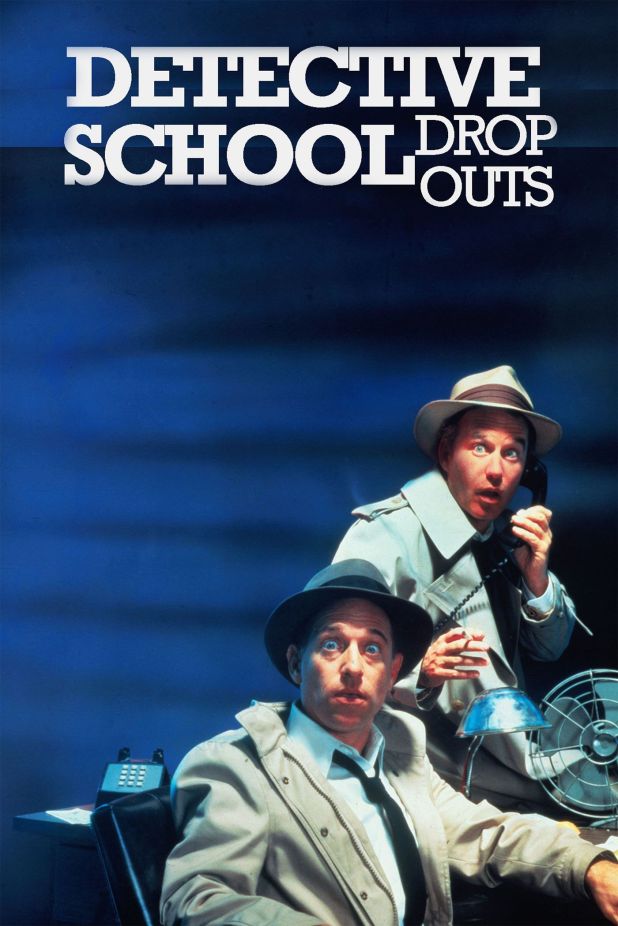
CANNON MONTH: Detective School Dropouts (1986)

David Landsberg and Lorin Dreyfuss — the older brother of Richard — teamed for this movie and Dutch Treat and I have no idea who was clamouring for their duo to be in any films. They wrote and starred in this movie, which was directed by Filippo Ottoni, who wrote A Bay of Blood.

Three mob families — the Lombardis, the Zanettis and the Falcones — don’t want either of two of their children — Carlo Lombardi (Christian De Sica) and Catherina Zanetti (Valeria Golino, Gina Piccolapupula from Big Top Pee-Wee) — to get married, all while Landsberg and Dreyfuss, as detectives Donald Wilson and Paul Miller, try to keep their families from ending their relationship and lives, thanks to wildman killing machine Bruno Falcone (George Eastman, the only reason I stayed with this movie for so long; have I ever told you how much I love George Eastman?).

While I’m no fan of the slapstick in this movie, at least I can play spot the Italian actor. There’s Giancarlo Prete (Scorpion from Warriors of the Wasteland)! Hey it’s Western henchman Mario Brega! Rik Battaglia of Deported Women of the SS Special Section! Alberto Farnese from Scalps and the shot at the same time White Apache!  Voice of female giallo stars Carolyn De Fonseca as a tourist! Mickey Know from Cemetery Man! John Karlsen from Footprints on the Moon and The Church! Andrew Louis Coppola from Hands of Steel and Escape from the Bronx! Man, watch those movies instead of this one!

Humor is subjective and I’ve read plenty of reviews that love this one. Maybe it hit me wrong. That said, I aways love seeing George Eastman and it’s so strange to see him in a comedy.

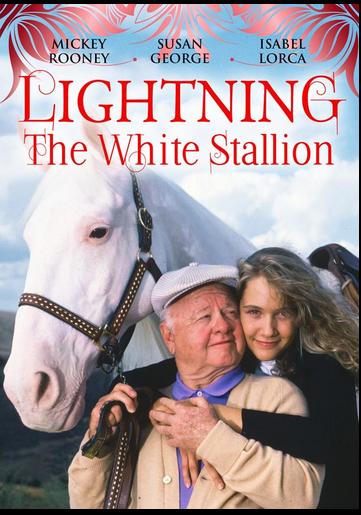
CANNON MONTH: Lightning the White Stallion (1986)

I can’t find this movie anywhere, but I’m petty mindblown by the fact that this children’s movie was written by Harry Alan Towers, a man who not only was part of an alleged vice ring with Stephen Ward, Peter Lawford and the Soviet Union, but also the producer and writer of several Jess Franco movies including 99 WomenThe Girl From Rio and Venus In Furs.

The husband of Maria Rohm may not be the first person I’d choose to write a kid movie about horses, but then again, I’d probably not think to hire William A. Levey, who made Wam Bam Thank You SpacemanBlackenstein and Skatetown U.S.A. either.

Then again, if only for the sake of having several obsessions of mine in the cast, I wonder if this movie was made just for me. I mean. Murray Langsdon and Susan George are in this.

Barney Ingram’s (Mickey Rooney) prize stallion Cloverdale III has been stolen by creditor Emmett Fallon, but the horse runs away and two kids end up with it and name it Lightning. Also, the girl is going blind like a Melvins song. Or maybe not. I don’t know, any time Mickey Rooney shows up I’m reminded how much he hated Silent NightDeadly Night and then ended up starring in Silent Night, Deadly Night 5: The Toymaker.

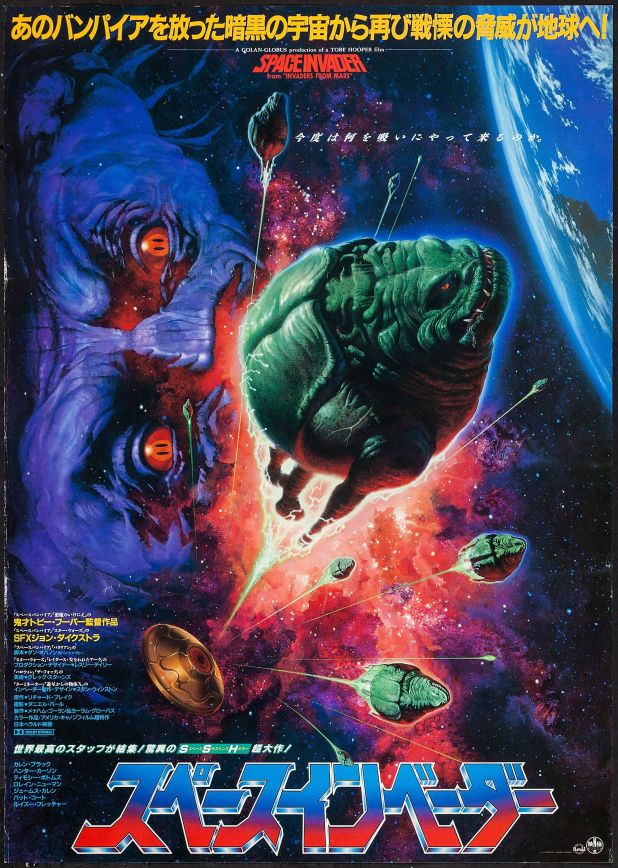
CANNON MONTH: Invaders from Mars (1986)

EDITOR’S NOTE: We originally wrote about this movie on September 12, 2017 as part of a tribute to Tobe Hooper. It’s one of three movies that he made for Cannon and one of our favorite movies.

Following the failure of Lifeforce (at least commercially, I’m on the side of it being an interesting affair), Tobe Hooper turned to a remake of 1953’s Invaders from Mars. After several writers took a shot at the script, Dan O’Bannon (the USC film student who famously created Dark Star with John Carpenter, left for Europe in the hopes of making Dune with Alejandro Jodorowsky, then came back to the U.S. to write AlienDead and Buried and Total Recall, write and direct Return of the Living Dead and then die way too young from Crohn’s Disease) and Don Jakoby.

Instead of the adult oriented gore and sex that Lifeforce presented (which shows up here as a movie within a movie, main character David is watching the film and man, he’s super young for that movie), Invaders is a return to the themes of 1950’s science fiction. That said — whereas the originally intended directed Steven Spielberg would have focused on the sweetness with a slight edge, Hooper delivers plenty of edge. In fact, this entire film feels like a nightmare that the main character, David Garden (Hunter Carson, the son of The Texas Chainsaw Massacre 2 writer LM Kit Carson and Karen Black, who we’ll get to in a minute) can’t wake up from. It’s unnerving the sheer torture that this kid goes through!

After watching a meteor shower, David sees a spaceship land behind his house. Throughout the film, the entire town gets taken over by aliens, including his parents (Timothy Bottoms and SNL’s Laraine Newman). It’s true terror — what child doesn’t have the fear that his parents will no longer love him? It’s even worse when they coldly plot your doom.

They’re not the only ones — every teacher is against him, none more than the meanest teacher in school, Mrs. McKeltch. She’s gone from that to something much, much worse — the human face of the alien invasion.

The only person who believes David is the school nurse, Linda Magnuson (Karen Black, The Pyx, Burnt Offerings, Killer Fish and so much more). Together, they rally the Marines, learn how the alien guns work, defeat the Supreme Intelligence and blow up the UFO.

Or do they? Much like its 1953 inspiration, David wakes up and the entire movie is revealed to be a dream. However, this isn’t a William Cameron Menzies film (the director of the original, whose name is given to the elementary school in this film); this is Tobe Hooper, who ends the film just like it began. David sees the UFO land again, runs to his parent’s bedroom and screams as an alien noise is heard. There is no resolution — just the return of abject terror.

This part is particularly interesting to me, as I’ve had the same dream of a UFO showing up outside my window since I was a child. I always wake up screaming, knowing that I’m looking at an object made from pure evil.

Invasion is an odd duck. Horror buffs wanted to see Hooper make another The Texas Chainsaw Massacre (they’d get their wish, but probably not in the way they’d want it within a few weeks). Moviegoers didn’t know who Hooper was enough to be a mainstream draw (Poltergeist was made three years before Hooper got his three picture Cannon deal). And fans of the original probably wouldn’t be pleased with the darker bent of this remake (despite original star Jimmy Hunt making an appearance as the police chief and the original Supreme Intelligence showing up on a warehouse shelf).

That’s not to say it’s a bad film. It’s packed with elaborate practical effects from Stan Winston (who was working on Aliens at the same time) and John Dykstra, including the amazing alien drones. The drones are literally two actors walking independently under a suit, so their movements feel more feel than today’s computerized creatures. The Supreme Intelligence doesn’t look silly; instead it’s a mix of menace and cartoony evil, like a Mars Attacks! trading card brought to life. And the film is replete with references to other films — it takes place in Santa Mira, home to Invasion of the Body Snatchers (and Halloween 3: Season of the Witch) and the house that the Gardners live in was built for 1948’s Mr. Blandings Builds His Dream House.

This movie lost a lot of money — it made $4.8 million on a $12 million dollar budget. You know who did make money on this? Science fiction fan and sometimes writer/producer/director Wade Williams, who bought the original film in 1978. Airing the original film via television, cable and video releases made plenty of money. Add in the rights to this — Williams got a producer credit — and he may have made up to fifty times what he paid for the film. This isn’t the only film in the Wade Williams collection. He also owns the distribution rights to the films of Ed Wood, Robot MonsterThe Killer Shrews, Bava’s Hercules in the Haunted World and a near infinite amount of other films.

Maybe that’s why Menahem Golan and Yoram Globus, those insane masters of moviemaking that made up Cannon, hated the film. They claimed it was nothing like what they were promised. That said — Hooper often spoke favorably of his time with Cannon, comparing it to the old studio system days.

With two films down and his back to the wall, Hooper had to turn back to some old friends and his old neighborhood. Within a few weeks (he made the film in June and it was released in August), he’d make the film everyone wanted to see anyway — The Texas Chainsaw Massacre 2. But that’s a story for another time.

You can listen to The Cannon Canon podcast about this movie here.

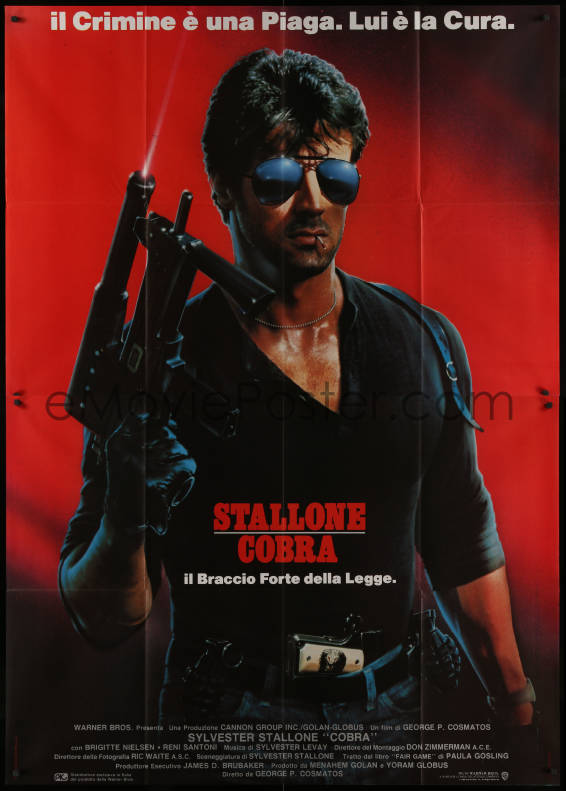
CANNON MONTH: Cobra (1986)

EDITOR’S NOTE: You can read another take on this movie from R. D Francis that was originally posted on August 14, 2019.

Crime is the disease. He’s the cure.

I’ve opined that if we compare the two God-tier action stars — Arnold and Sly — Arnold may have the best overall catalog, but Stallone has the better individual films. One wins the battle, the other wins the war. Or as he’d say, “Don’t push it, or I’ll give you war you won’t believe.”

Somehow Stallone was going to be in Beverly Hills Cop and wanted it to be not so funny, then he wanted to be in an adaption of Fair Game by Paula Gosling — which got made nine years later and the less said the better — and then he ended up making a movie that pretty much is every 80s over the top — no pun intended — action movie cliche all in one film.

And you know what? It’s great.

Like honestly, non-ironically great.

It’s Stallone suddenly deciding what if a slasher movie broke out in the middle of a one cop against the world movie? Zombie Squad cop Marion Cobretti against an entire cult of lunatics called The New World, led by the Night Slasher (Brian Thompson, who had to buy his own ticket to see the film), all to save the life of Ingrid Knudsen (Brigitte Nielsen)? Do you have any idea how many times I watched this movie? Stallone stealing Steve McQueen lines and saying, “This is where the law stops and I start, sucker!” is the kind of thing that made a young me continually watch and rewatch and take notes.

There’s a two-hour plus X-rated — for violence — cut of this movie that I’m dying to see. Throat cuttings, hands sliced clean off, children discovering said hands, David Rasche getting killed with axes and an extended ending — these are the things I want to see! We live in a world of re-releases, so why isn’t this happening? Shout! Factory had a collector’s edition release of this and nope, no footage!

Stallone has talked about making a sequel with Robert Rodriguez — as late as 2019 — but it just seems like cutting the robot out of Rocky IV, Sly sometimes likes to play with my heart.

In case you think George P. Cosmatos’ name is familiar, his son — using the royalties from this movie — would go on to make Mandy and Beyond the Black Rainbow. And I’m not the only fan of this movie, as Nicolas Winding Refn used a toothpick in the hero’s mouth in Drive to show his fandom.

So how is this Cannon? After all, the Cannon logo isn’t anywhere in the movie. Golan and Globus only get a production credit, as it was mostly a Warner Brothers movie, but they got that title in return for voiding a prior agreement the Cannon had with Stallone.

Finally: I am a movie gun nut, so just like another Cannon actor, Charles Bronson, Stallone had his own custom gun made for this movie, a 9mm Colt Gold Cup National Match 1911 that fires Glaser Safety Slugs. This bullet was designed in 1974 in response to the possibility of having to use a handgun on an airplane by the Sky Marshals and having to deal with ricochets on hard surfaces and possible excess penetration. It’s a pre-fragmented bullet that uses a traditional copper jacket, which means that instead of a solid lead core like conventional hollowpoint ammunition, it has a compressed core of lead shot.

It does not shoot through schools.

Finally, action movies are mirrors upon themselves. While Cobra reunites Dirty Harry actors Andrew Robinson and Reni Santoni, Sylvester Levay’s song “The Chase” would end up in trailers for Bloodsport and Marked for Death.

You can listen to The Cannon Canon commentary and watchalong here.

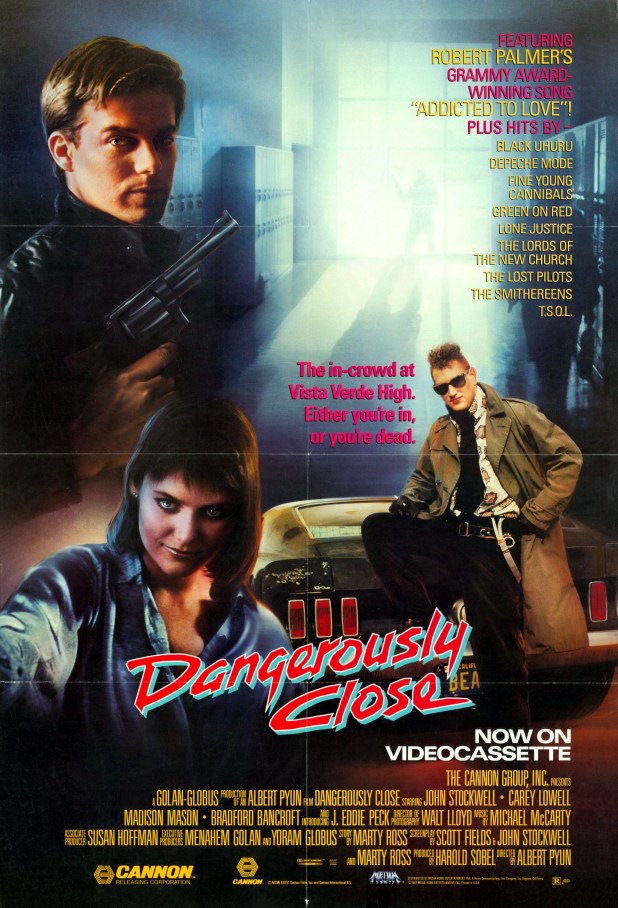
CANNON MONTH: Dangerously Close (1986)

Is it strange how much Dangerously Close feels like the last few years of life? I mean, life is high school, right? And aren’t The Sentinels, the far right student villains of this movie, pretty much anyone that does their own research and demands to know why they can’t have white history month? Man, between this movie and Avenging Force, Cannon was hitting this subject head on while also getting to roll around in the muck, which is how all good exploitation must behave.

Written by Scott Fields (who also wrote Under Cover), John Stockwell (who stars in this and yes, also wrote Under Cover and directed it too) and Marty Ross (who was one of the New Monkees a year later and that fries my brain) and directed by Albert Pyun, who would make CyborgAlien from L.A. and Down Twisted for Cannon, Dangerously Close is the kind of weird movie I get obsessed by.

I mean, Roger Ebert said that the Pyun “devoted a great deal of time and thought to how his movie looked, and almost no time at all to what, or who, it was about.”

That’s my jam.

At the private school Vista Verde — a nightmare for me, as my parents frequently debated sending me to a school just like this — The Sentinels have gone from a student group to a military unit that assaults the undesirables of the student population thanks to the leadership of Randy McDermott (Stockwell).

I’d like to think that I’d have been Donny Lennox (J. Eddie Peck, who was Kevin “Blade” Laird in Lambada), a poor kid who got in because he knew how to write. He and punk rocker Krooger Raines (Branford Bancroft, 3:15Bachelor Party) are just two of the kids who don’t fit in and they’re soon joined by Brian (Thom Matthews, Tommy Jarvis himself), who has left behind the group after they go too far and McDevitt’s ex-girlfriend Julie (Carey Lowell, Law & Order), who splits from the group leader after she screams at him that all he cares about is using her mouth and wow, that language is shocking exploitation dialogue even years after this was made.

Let me tell you, I love this movie. It’s so odd because the town where it takes place is perfect and yet has more fog than any place in California other than the Sunset Strip. It’s got a cast that includes Debra Berger, Angel Tompkins (The Teacher playing a teacher?), Dedee Pfeiffer (making this a mini-The Allnighter cast meet-up with Bancroft, who played Bartender Joe in that Susanna Hoffs vehicle), March 1982 Playboy Playmate of the Month Karen Lorre, Miguel A. Núñez Jr. (making this a Return of the Living Dead reunion with Matthews), Don Michael Paul (who would go on to direct so many direct-to-video sequels like Kindergarten Cop 2Death Race: Beyond AnarchyThe Scorpion King: Book of Souls and Tremors: Shrieker Island) and Gerard Christopher (the syndicated Superboy). Everybody in that group is way too attractive to play high school students and teachers. And it has a wild soundtrack, with everything from T.S.O.L., The Lords of the New Church, Lone Justice, Fine Young Cannibals, Depeche Mode and The Smithereens, whose “Blood and Roses” is nearly the theme song for the film.

Also, the Keanu Reeves and Kiefer Sutherland made-for-TV movie Brotherhood of Justice is strangely the exact same story and also has Don Michael Paul in it.

More people should be talking about this movie.

You can listen to The Cannon Canon podcast about Dangerously Close here.

You can watch this on Tubi.

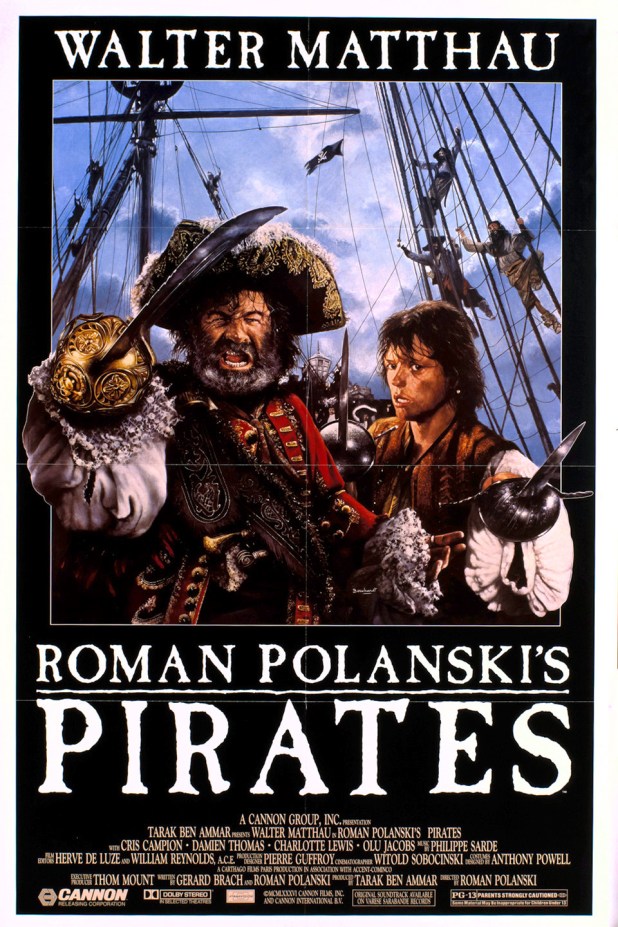
CANNON MONTH: Pirates (1986)

Roman Polanski said to the New York Times, “The people who finance films don’t care what your personal problems are, your image, whatever. They’re interested in figures. They look them up the same way an insurance company does. And they know that if they spend $5 million or $6 million, $10 million on a film by me, their risk is quite limited. But once you have a subject complicated, more ambitious, like Pirates, even if you have a delightful script and great enthusiasm, even if you promise them heaven, they are afraid. That has nothing to do with my legal problems in America. What do they care for it? Do you think that they have a moral streak in them, that they really hesitate?”

Those legal problems?

In 1977, Polanski was arrested at the Beverly Wilshire Hotel for the sexual assault of 13-year-old Samantha Gailey, who had modeled for him the day before at the home of Jack Nicholson. He pled not guilty, Hollywood came to his defense and his attorney set up a plea bargain where five of the six charges would be dropped. The charge that was left would be unlawful sexual intercourse with a minor.

He had to serve 90 days of psychiatric evaluation and his time served ended up being 42 days. Somewhere along the way, the judge on the case told several people that he was going to ignore the plea bargain and make certain Polanski died in jail.

The day before he was to be sentenced, Polanski left the country on a flight to London then Paris. And that’s where he’s stayed, making major movies, a French citizen protected from extradition with all those charges still pending.

In 1988, Gailey sued Polanski for sexual assault, false imprisonment, the seduction of a minor and intentional infliction of emotional distress. Five years later, he settled with her.

In 2009, he was arrested in Switzerland and in jail for two months. The United States were denied extradition and he was a free man again. Strangely, Polanski blamed Harvey Weinstein for the new focus on his sexual abuse case in the 2000s and claimed that the now-disgraced producer brought up the rape accusations again to stop him from winning an Oscar for The Pianist.

As of late, Gailey has said, ” It’s been 40 years. Enough.”

Polanski replied, “She is a double victim: My victim, and a victim of the press.”

Anyways…Pirates.

After Chinatown, Polanski wanted to make a movie that wasn’t loaded with messages and education and with that, I think we can all agree that he succeeded. Polanski intended Jack Nicholson to play Captain Thomas Bartholomew Red and he would pull a page out of The Fearless Vampire Killers and play the sidekick.

The problem? Nicholson wanted paid. When asked how much he wanted, he just said, “I want more.”

It took until 1980 for the film to get to any stage of production. In between, he made The Tenant with Isabelle Adjani, then the arrest happened and then he made Tess with Nastassja Kinski — who he started dating when she was 15.

After that, Filmways and producer Arnon Milchan announced they would finance the movie, to be shot in Tel Aviv at a $24 million dollar budget, which would also include building a new studio and water tank. All the money would go to special effects and there would be no stars.

Then that didn’t happen either.

Carthago Films and producer, Tarak Ben Ammar took over the production and spend $8 million over the next half decade or so as the movie stayed in development. Luckily, just before shooting was to start, Dino de Laurentiis made a deal to release the movie in Europe and in the U.S. with MGM/UA. Ammar got three more banks to put up more money.

Numerous stars were picked for the lead role and finally Walter Matthau came on board. He would say, “”I didn’t like the script. I didn’t understand the script. First it was the ship against the pirates, then the pirates against the ship, then the ship against the pirates. I didn’t think it was funny or adventurous or anything.”

Things had to get better after that, right?

The budget went to $40 million, storms made the shoot pretty much out of control and Ammar kept on a happy face, because they were bringing jobs to Tunisia even if Polanski was, in his words, “disaster prone.” And then he was unhappy with MGM/UA, paid off their investment and brought in Cannon Films.

Things really had to get better after that.

Did they get better after that?

“We make mistakes. Pirates was one of them,” Yoram Globus told the Los Angeles Times.

The movie made s $1.64 million and $6.3 million worldwide on a budget of somewhere above $40 million.

Yes, it failed, even after it opened Cannes, during which the Neptune sailed into the Cannes harbor on the festival’s opening day, with all the cast on deck in their pirate costumes. And then nobody had any idea what to do with that ship, so it sat in the harbor at Cannes or sixteen years, a reminder of just ow much of a failure this movie was.

We should probably get to the movie.

Pirate Thomas Bartholomew Red (Matthau) and his cabin boy Jean-Baptiste (Cris Campion) start the film lost in the middle of the ocean on a raft (not a rat thanks for catching the typo! They do eat a rat later though) when they’re picked up by a Spanish ship known as the Neptune. They’re immediately placed in the brig along with the sip’s cook (Olu Jacobs) who may have tried to kill the ship’s captain (Ferdy Mayne, who made this movie the year after he was in Night Train to Terror, which are both choices and a journey)because there’s Aztec gold inside the ship.

The captain dies and Don Alfonso de la Torré (Damien Thomas) takes charge of the ship. He’s in love with a noblewomen’s daughter, Maria-Dolores (Charlotte Lewis), who Jean-Baptiste has also fallen for. Our protagonists try to enact a mutiny, which leads to a rebellion and a massive fight scene and then Maria-Dolores is nearly assaulted because this is a movie that “young audience will enjoy more than the adults” to quote Polanski.

Shenanigans ensure and this movie ends up feeling like two years instead of two hours. The ship looks great though, right? It makes me wonder why Polanski made this movie look so realistic — I mean, there’s a rat eating scene and everything looks absolutely caked in filth — when everything else in it is a farce.

I’d been warned by how bad this movie was and despite me continually testing my resolve by watching the full filmographies of Bruno Mattei, Joe D’Amato, Jess Franco and way further down the chain of so-called bad movies and you know, this is the very definition of a bad movie. And I don’t believe in the term so bad it’s good. This is bad. From now on, I will compare every bad and boring movie that I watch to Pirates and they will become better by that comparison.

Of course, this movie has accusations of its own. Lewis said that Polanski had forced himself on her while she was auditioning for a role when she was 16 and he was 50. But then again, se claimed at the time that she was the one who pursued him, telling News of the World, “I knew that Roman had done something bad in the United States, but I wanted to be his mistress. I wanted him probably more than he wanted me.”

Obviously, she’s in this movie as María-Dolores de la Jenya de la Calde, appeared arm in arm with Polanski at Cannes a year after the incident and said in an interview, “I’d love to have had a romantic relationship with Polanski and a physical one. You can’t help falling in love with him. But he didn’t want me that way.”

That said, the world has changed a lot since 1986. So I really and honestly have no idea who to believe and the only ones that know are the people directly involved. I can dislike Polanski’s character as much as I want to and so much of watching exploitation film — most film — is to not whitewash what any individual has done. But I can definitely say that Pirates is a horrible movie that I suffered throughout.

You can listen to The Cannon Canon suffer through Pirates here.
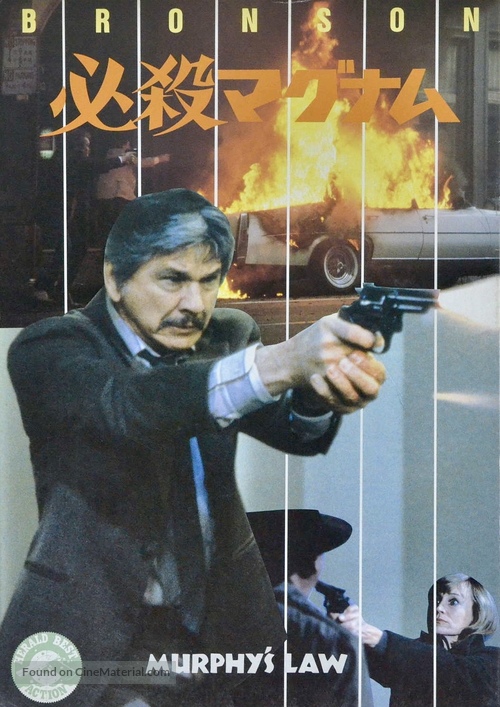
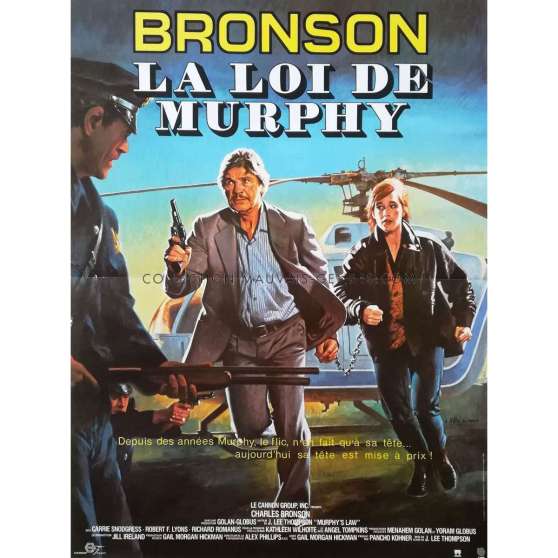
CANNON MONTH: Murphy’s Law (1986)

EDITOR’S NOTE: We just reviewed this as Kino Lorber has put it out on blu ray. That article was on February 13, 2022, but it’s Cannon Month, so let’s get more Bronson!

Lee J. Thompson and Charles Bronson wore together several times. Six, to be exact, with this movie, St. Ives, The White Buffalo, Caboblanco, 10 to Midnight and The Evil That Men Do making up the full list of their collaborations.

Writer Gail Morgan Hickman’s (The Enforcer, Death Wish IV: The Crackdown) script was one that Cannon liked, but at this point, they’d started to overspend, so they weren’t forthcoming with the money the film would need, as producer Pancho Kohner, Thompson and Bronson. The team took the movie to took Hemdale and were immediately given the green light with a much better deal.

Cannon sued for breach of contract and claimed that they had already pre-sold most of the worldwide rights and stated that it would damage their company if someone else made it. After all, Cannon often pre-sold movies based on loglines and pasted together ads well before the movies were made.

A lawsuit was avoided, allowing Cannon to financed and released the movie, with Hemdale getting foreign video rights. As for Bronson, Kohner and Thompson, they got a three-movie deal with Cannon, which ended up being the aforementioned Death Wish 4: The Crackdown, Messenger of Death and Kinjite: Forbidden Subjects.

Bronson plays Jack Murphy and at 65 years old, you really get the sense that just like his character, he’s exhausted. Indeed, he was often frustrated at the delays between takes and would shout, “Let’s shoot! Let’s shoot!” as he wanted to get back to his family. As for Murphy, he has no family, as his ex-wife (Angel Tompkins, who was the titular The Teacher and also was in The Farmer) has started dancing at a men’s club frequented by other cops, making him the target of their jokes. So he drinks away his days and wastes his nights watching the woman he chased away attract other men.

Meanwhile, a woman he put away named Joan Freeman (Carrie Snodgress, who Stallone wanted to be Adrian in Rocky, with Harvey Keitel as Paulie, but money was a major issue; she’s best known for her role in Diary of a Mad Housewife; Neil Young wrote the songs “A Man Needs a Maid,” “Harvest,” “Out on the Weekend” and “Heart of Gold” about her) is out of jail and conspiring to ruin his life, as if it can be further ruined. She begins killing those close to him — mostly cops, as she blames them just as much as him — ending with his ex. Soon Murphy’s headed for jail with many of the criminals he put there.

Somehow, as Murphy is first arrested, he’s handcuffed to Arabella McGee (Kathleen Wilhoite, Road HouseFire In the Sky), a potty mouthed homeless girl that he’d recently arrested. As she repeatedly verbally abuses Murphy with phrases like butt crust, monkey vomit, jizm breath, sperm bank, dildo nose and snot-licking donkey fart, Arabella doesn’t speak like anyone in any movie ever, which is why I find her so endearing and this movie just so delightfully odd. Wilhoite was a method actress and felt that probably her character should have looked more homeless, but she got to keep all of the designer clothes that her character wore, so that probably made wearing it in the film much easier.

Before fiming started, Thompson and Kohner coached Wilhoite all about how to best get along with the tempermental Bronson, which worked, because they got along well according to reports.

She also sang the movie’s theme song!

That said, she wasn’t the first choice for the role. Supposedly, Madonna was up for the role but wanted a million bucks. So was Joan Jett, who had just been in Light of Day. While she didn’t get the part, she ended up growing close to Bronson’s wife Jill Ireland. In a Q&A on her official fan site, Jett answered the question “How did the song, “Don’t Surrender” come about? And who is Jill Ireland?” with the following:

“Jill was Charles Bronson’s wife, also a wonderful actress. We met over the possibility of me co-starring with Charles B. in a movie. We became great friends, she turned me on to crystals, etc. and taught me a lot during our friendship. When she died, I was very upset, but channeled that (what I saw in Jill: strength, honor, dignity) and wrote “Don’t Surrender” with Desmond, inspired by Jill.”

Handcuffed together, the two go on the run, stealing a helicopter and landing on — and crashing through, Demons style — the growhouse of some well-armed marijuana farmers, which gives Murphy the chance to save Arabella from a group assault, making me wonder if Michael Winner directed this movie. You can tell he didn’t because it’s quick, they don’t succeed and the camera doesn’t linger like a lunatic.

Then again, Thompson also made Kinjite

Anyways, the duo ends up getting along better and better, with even the hint of romance by the end. They take up in the home of one of one of his old partners, but the killings move there too.

Of interest to fans of Jason Vorhees, the growhouse is a location from Friday the 13th Part III and his partner’s house is from Friday the 13th: The Final Chapter.

Murphy thinks that the killings are the result of a vendetta between him and mobster Frank Vincenzo (Richard Romanus) before making his way back to the Bradbury Building in Los Angeles, the same place where Freeman was arrested for shooting her boyfriend, a security guard at the building.

The Bradbury is a historic LA building and you may recognize it from noir movies like the original I, the Jury and D.O.A. as well as a more futuristic take on the genre, Blade Runner. The building demanded that no food or drink was permitted on set during filming, but not having craft services was worth it, because the close is tense, with the cops working for Vincenzo gunning for Murphy and Freeman stalking him with a crossbow and then attacking him with an axe.

Murphy’s Law is also filled with roles for plenty of great tough guy actors, like Lawrence Tierney, Robert F. Lyons and Bill Henderson. It’s a movie that both embraces and escapes many of the things you expect from a Bronson movie It’s violent, profane and removed from reality, but I love how it has both a female protagonist and antagonist, lightening the normal testosterone-filled world of Bronson just enough to make things a little different. The dialogue is beyond ridiculous, which made me love this movie even more. It’s beyond quotable, including the line, “Don’t fuck with Jack Murphy!”

You can get the new blu ray release of this film from Kino Lorber. It has some great extras, like commentary by Wilhoite and film historian Nick Redman, an interview with Robert F. Lyons, two radio commercials and a trailer.

Ghost Story Episode 11: “Touch of Madness”

Janet (Lynn Loring) has inherited her mother’s house after her death in a mental institution, a home that she must share with her aunt Hattie and uncle Jonathon (Geraldine Page and Rip Torn, who were married when this was filmed). She decides to move in and fix up the home so that her family can stay there. But of course, this is an episode of Circle of Fear/Ghost Story and that means that everything is going to wrong quickly.

After all, when Janet’s mother died, she told her, “You’re just like me.”

So when Janet sees the home, she sees what it was and perhaps what it could be instead of the shambling wreck that it has become. So when she’s cradling the family cat, perhaps she’s really giving love and attention to a rat. If you’ve read this site for any time, you may realize that I absolutely love any movie where women slowly go psychotic.

This episode was written by Richard Matheson and Halsted Welles, who also wrote 3:10 to Yuma and plenty of television, including episodes of Suspense and Night Gallery. It was directed by Robert Day, who you may know from his work on movies like the 1966 version of She, several Tarzan movies and The Initiation of Sarah.

You can watch this on YouTube.

Interview with Jeff Wallace, director of Angel By Thursday

Jeff Wallace is the captain of Angel By Thursday, a Hawaii-set movie that was on the site on March 8, 2022 and was well-reviewed. In fact, I said, “I was surprised just how much this movie made me consider my life and the roles of those within it.”

You can watch it now on Tubi and we had the opportunity to as Jeff some questions about the movie.

B&S About Movies: How long had you been looking at bringing Angel By Thursday to the screen?

Jeff Wallace: Ten years start to finish. A labor of love for sure for all involved.

B&S: Where do you start – with a screenplay or with finance-hunting?

Jeff: It began with a screenplay. In fact, it started with title alone. I had no story, but  something about “Angel by Thursday” rang true and our story developed around it.

B&S: How long did that screenplay take to complete?
Jeff: With rewrites and tweaking, a year.

B&S: And is the shooting script different from that early draft?

Jeff: Yes. There were twenty-one rewrites, and with each revision, it got tighter and more refined. Fun fact; early versions had no boat scene ending. I can’t even imagine that now.

B&S: Did you encourage your cast to share ideas and their vision for the film?

Jeff: One hundred percent. Film is collaboration on all levels. This being my first feature, and not ashamed to admit, I had a vision but no experience on the intricacies a feature-length project. I was fortunate to be surrounded with those who did (cast and crew) and they were a tremendous resource to draw upon both in front and behind the camera.

B&S: Is there anything you had to compromise on, maybe for budgetary reasons?

Jeff: Everything except food. It was self-funded by my wife and I, and with limited resources, made do with what we had. A must “shout-out” here to our cast and crew who gave so much in terms of time and gear to make it happen.

B&S: Did you have an idea on who would play the lead pretty early on?

Jeff: Yes casting call, day one. Another fun fact. Olga Kalashnikova (Julia) and Ken Matepi (Clint) came in to audition only for the love-making scene. But their chemistry was electric, and we knew on the spot, they would carry the movie. Best decision made.

B&S: Being an independent production, I’d think you probably ended up wearing more hats on it than credited. Was that the case?

Jeff: Absolute understatement of all time for both my wife and I. In fact, it got embarrassing when we made up the “credit roll”. But the great thing about ten-thousand hats is, we learned so much. The experiences gave a greater appreciation for all the moving parts hidden under the higher profiles.

B&S: If an awards ceremony were going to show a moment from the film, what moment would you ask them to play?

Jeff: For me I’d have to say on the boat when Julia watches Toby write on the lantern and realizes it was him who brought all together. The mystery of “how” is still out there, but Julia now accepts a higher calling at work here.

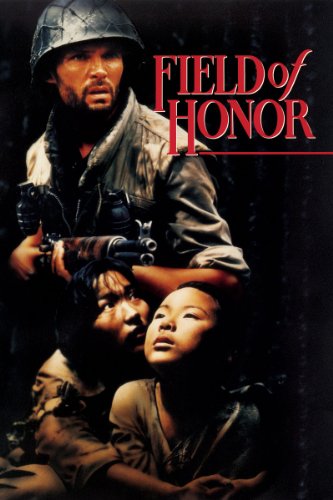
CANNON MONTH: Field of Honor (1986)

Dutch mercenary Sergeant De Koning (Everett McGill) has been left alone in Korea after his platoon, who have been committing numerous war crimes, are attacked. Then the Korean girl he’d pushed into prostitution ends up becoming more important to him and he tries to help her little brother alive. De Koning also makes the journey from the kind of soldier who would get everyone drunk on the front lines — leading to that deadly attack by the Red Chinese — to some level of redemption.

Directed by Hans Scheepmaker and Dae-hie Kim, who co-wrote the script with Henk Bos, Field of Honor was delayed in its native Netherlands for more than a year because of the bad reception it got at the Cannes Film Festival. It’s not as horrible as reviews at the time suggest, but in no way as good as other similar war films of the 80s like Platoon.