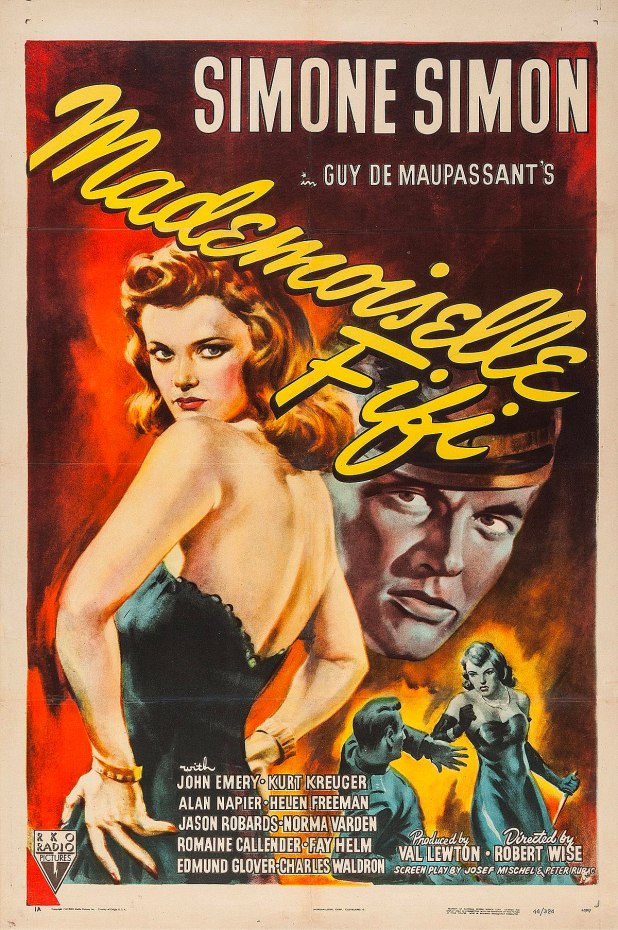
One of the few failures of Val Lewton’s RKO era, Mademoiselle Fifi is based on two Guy De Maupassant tales, with Boule de Suif being the main inspiration. This was his shot at breaking out of horror and RKO had suggested a period film with Erich von Stroheim directing and Simone Simon and George Sanders as the stars.
Instead, Robert Wise directed. He’d stepped in to work on scenes for The Magnificent Ambersons when Orson Welles was called to South America. Welles had been working on that film and It’s All True at the same time for RKO when he was personally asked by Nelson Rockefeller to make a film in Latin America as part of the wartime Good Neighbor Policy. But the story of how Welles’ films were taken from him is one for another time. Wise’s directing here — and taking over for Gunther von Fritsch on The Curse of the Cat People got him this job.
With just a $200,000 budget — low for a period costume picture — Lewton had Wise study the paintings of Toulouse-Lautrec, Delacroix, Daumier and Detaille to bring out the details that they could in spite of the lack of funding. Some of the sets from The Hunchback of Notre Dame were used, but if you look closely, you can see that many of the sets are made from cardboard.
The story takes place during the Franco-Prussian war of 1870, though it’s obvious that the film is about World War II. Indeed, it was released on D-Day and would be the first film shown in France after the Allies liberated the country.
Mademoiselle Fifi refers to a Prussian officer (Kurt Krueger) who has taken over a village. When a stagecoach comes into town, they are all detained by the man, with the passengers pushing Elizabeth (Simon, who wore false breasts that for this film, calling them “her eyes,” yelling “Bring me my eyes!” before each scene) to give her body to the madman so that they can be free. She’s amused by the way that the passengers treat her, as they’d looked down on her as a woman of loose morals before, but now depended on that very same lack of modesty to save their lives. The truth is, she’s too loyal to France to allow any Prussian to invade her southern border.
While this was the worst Lewton would perform at the box office, he would soon release four more films for RKO — Youth Runs Wild, The Body Snatcher, Isle of the Deadand Bedlam — before RKO head and Lewton supporter Charles Koerner died in 1946. Lewton himself would have a minor heart attack from the stress and leave the studio to work at Paramount and MGM. A failed attempt at starting an independent production company with former protégés Wise and Robson left Lewton in the cold after no one could agree on which production to start with, leading to him working at Universal and Columbia before two heart attacks would end Lewton’s life way too early at the age of 46.
Don’t ask me how, but I’ve somehow never seen Donnie Darko. Now, thanks to the 4K re-release from Arrow, I’ve really fixed that. I mean, we all know how I feel about Southland Tales, so it’s high time that I get this one crossed off the list.
Richard Kelly had graduated from film school and started writing his first scripts when he got the idea of a jet engine falling onto a house. Even though he was an unproven director, Kelly insisted that he make the film himself, struggling to get funding until Drew Barrymore’s Flower Films produced it.
The film came and went without much notice outside of critics, as a movie with part of a plane crashing into a house being released a month after 9/11 — not to mention Donnie shooting a gun so close after Colombine — didn’t seem like something audiences would want to see. Yet Kelly’s vision — he wanted an “ambitious, personal, and nostalgic” look back at the 80’s before everyone was doing that — finally found an audience as it was reissued.
It’s not an easy movie to wade through and that’s pretty much why it’s so beloved by the people who discovered it.
On October 2, 1988, the Middlesex, Virginia bedroom of Donald J. “Donnie” Darko (Jake Gyllenhaal) is destroyed by a jet engine. As for Donnie, he has been sleepwalking and speaking to a monstrous rabbit named Frank who informs him that the world will end in 28 days, 6 hours, 42 minutes and 12 seconds. He begins to follow Frank’s instructions, which often involve destruction and mayhem.
How else do you escape a small town where infomercial pitchmen’s words are taken as religion and teachers are either fired for being individuals or become wrapped up in their own power? There’s also a former nun turned author, once named Roberta Sparrow but now called Grandma Death, who whispers to Donnie that “Every living creature on Earth dies alone.”
Frank’s instructions grow darker, including setting the home of the inspirational speaker — Patrick Swayze! — ablaze, which reveals that the man is a child molester. And Donnie begins to fall for Gretchen Ross (Jena Malone), who is in town to escape from her brutal stepfather. But as a cycle of violence begins to continually spiral out of control, Donnie realizes that the only way to stop the end of the world is to change the flow of time.
But man, that’s just one of the many ways you can take this movie. In the foreword to The Donnie Darko Book, Jake Gyllenhaal wrote, “What is Donnie Darko about? I have no idea.” Even Kelly admits that the film needs Cliffs Notes.
According to Dan Kois’ Everything you were afraid to ask about Donnie Darko, the movie takes place in a parallel universe, which exists only during the 28 days — it also took 28 days to film the movie — of the film. The main idea is that Donnie must erase the Tangent Universe — and die as a result — in order to save reality.
Roberta Sparrow’s book The Philosophy of Time Travel exists, if not only in the world of the film, then also on the website that went with the movie and the director’s cut. In it, she writes, “If a Tangent Universe occurs, it will be highly unstable, sustaining itself for no longer than several weeks. Eventually it will collapse upon itself, forming a black hole within the Primary Universe capable of destroying all existence.”
Or is it about Donnie being a paranoid schizophrenic? That solution is up to you.
Or you could see it as the fact that Gretchen and Frank — the human being dressed as the rabbit that Donnie shoots and not yet the rabbit — are dead as the result of knowing Donnie and they lead him into this situation to gain super powers and send the engine back in time, saving themselves at the cost of his life.
Also — the web site had information about the characters that perhaps belonged in the movie. After the events of the universe being righted, Jim Cunningham would kill himself, realizing what a horrible person he was. Roberta Sparrow would die in December of 1988. And although Dr. Monnitoff would eventually marry Ms. Pomeroy, he would die under mysterious circumstances in 1999. She would send his copy of The Philosophy of Time Travel to the Library of Congress.
So why does Donnie smile before lying down to seemingly die? In my opinion, he’s no longer dying alone. He has connected better with his parents, found a first love and finally become not a disaffected youth but the secret hero who saves everything at the cost of his own life. That’s not just the kind of story that gets remembered. It’s the kind that becomes a cult movie.
I’m glad I finally watched this.
The 4K UHD Arrow Video release of Donnie Darko is pretty much exactly as amazing as you’d expect a release from this label to be. The set includes new 4K restorations of both the Theatrical Cut and the Director’s Cut from the original camera negatives by Arrow Films, supervised and approved by director Richard Kelly and cinematographer Steven Poster, plus a 100-page hardcover book featuring writing by Nathan Rabin, Anton Bitel and Jamie Graham, an in-depth interview with Richard Kelly, an introduction by Jake Gyllenhaal and contemporary coverage, illustrated with original stills and promotional materials. As if that’s not enough, there’s also a double-sided poster with art by Luke Preece, six double-sided collector’s postcards and multiple audio commentary tracks and documentaries on the film. Still not enough? You also get The Goodbye Place, a Kelly short film, twenty deleted and alternate scenes, trailers, a music video and, well, beyond much more. You can get it directly from Arrow.
Despite the fact that we live in a world with less physical releases, the ones that do come out are made for film lovers like, well, you and me. If you love this film, you owe it to yourself to own this.
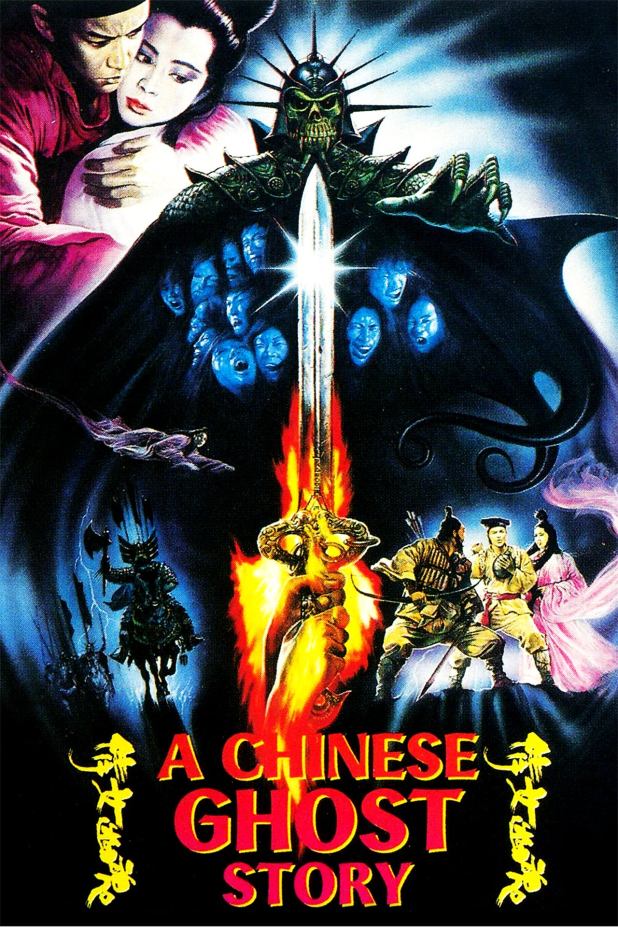
Based on a short story about Nie Xiaoqian from Qing dynasty writer Pu Songling’s Strange Stories from a Chinese Studio and inspired by the 1960 Shaw Brothers movie The Enchanting Shadow, A Chinee Ghost Story inspired more than just two sequels, an animated film, a television series and a 2011 remake. It also created an entire genre of folklore ghost stories.
Its director, Ching Siu-tung, studied in the Eastern Drama Academy and trained in Northern Style Kung Fu for seven years. His father, Ching Gong, was a Shaw Brothers director. While producer Tsui Hark got most of the credit for these films, Siu-tung has done well for himself, also directing The Swordsman series of movies and choreographing House of Flying Daggers and Shaolin Soccer.
In the first film, tax collector Ning Choi-san (Leslie Cheung) fails at his job and must sleep in a deserted temple. There, he falls in love with Nip Siu-sin (Joey Wong), yet discovers in the morning that she is a ghost forever enslaved to a tree demoness. When Ning tries to save her and fails, her soul goes to the underworld.
This film is a gorgeous meditation on unrequited love. Even with the help of Taoist priest Yin Chik-ha (Wu Ma), the best our hero can do is secure a better afterlife for his one true love.
1990’s A Chinese Ghost Story II starts with Ning and Yin parting ways, with Ning heading back to his hometown that has been overrun with cannibals. After being jailed and condemned to die, an ancient scholar reveals that he has dug an escape tunnel. He gives Ning a book and a pendant, then shows him the way to freedom.
In this film, Ning joins with Autumn (Jacky Cheung) and the rebel sisters Windy (Joy Wong) and Moon (Michelle Reis) to battle a demon that has taken over a mansion. And by demon, a mean a gigantic centipede that requires fighters to separate the souls from their bodies to defeat it.
Recently, Apple pulled the theme song of this movie from the Apple Music Store, as it features a reference to the masscre at Tiananmen Square Massacre:
“The youth are angry, and heaven and earth are shedding tears,
How did the rivers and mountains become a sea of blood?
How did the road to home become the road to ruin?”
Why would Apple pull a song that rightfully condemns China for their role in killing protesters? Well, you know how money works.
1991’s A Chinese Ghost Story III brings back the tree demon from the first film, a creature that is destined to return in a hundred years. This film is also about Monk Shi Fang (Tony Leung Chiu-Wai) and Swordsman Yin (Jacky Cheung), named after the original Taoist. The tree demon also has a ghost in its thrall, Lotus (Joey Wong).
This is the kind of movie where towers rise to block out all the sun on Earth and Shi Fang’s body is coated in his own golden blood, which allows him to channel the power of the Buddha to bring the sun back. Basically, things get nuts.
If you fall in love with these movies, remember that there was a cartoon and a 2011 remake to keep you watching.
Also known as Disciples of the Master Killer or Master Killer III, this is the third film in a loose trilogy of movies that began with The 36th Chamber of Shaolin. Like those movies, this was written, directed and choreographed Lau Kar-leung.
Hsiao Ho (Mad Monkey Kung Fu, Legendary Weapons of China) takes on the role of another legendary hero of the martial arts, Fong Sai-Yuk. He’s a troublemaker and keeps running into trouble with the Manchu warlords. To save his family’s honor, his mother asks San Te (Gordon Liu) to allow her son to study in the 36th chamber, the place where non-monks may train. However, Sai-Yuk’s pride and lack of respect make quite a headache for the monks.
Sai-Yuk keeps going into town at night, which is forbidden and becomes friends with the Manchu. They are using him to get the secrets of the Shaolin, so that they may destroy the temple. The film closes with Sai-Yuk poisoned and all of the monks trapped inside the Manchu fortress for what they believed was a wedding. The battle that closes the film is absolutely astounding, with every art show in the film paying off in a final battle that is as much about the Shaolin’s refusal to hurt anyone and help one another as it is combat. Nearly every cast member is involved in a gigantic battle that simply must be experienced.
ABOUT THE AUTHOR: Jennifer Upton is an American (non-werewolf) writer/editor in London. She currently works as a ghostwriter of personal memoirs for Story Terrace London and writes for several blogs on topics as diverse as film history, punk rock, women’s issues, and international politics. For links to her work, please visit https://www.jennuptonwriter.com or send her a Tweet @Jennxldn
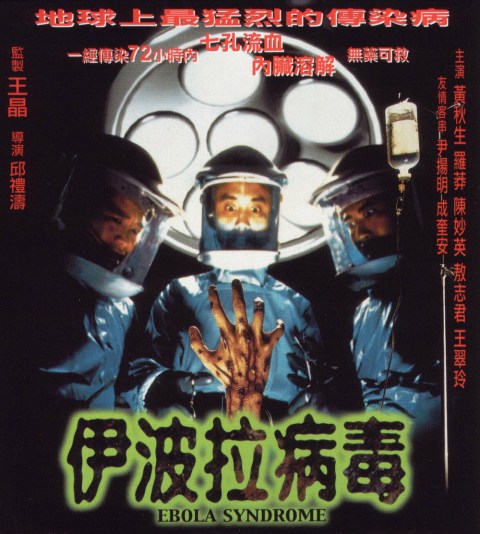
The 1990s were the golden era of the Category III film in Hong Kong. Category III was the HK equivalent to an X or NC-17 where absolutely no one under 18 could view the film in question and many were relegated to playing in porn theaters. While it would be unfair to label all films produced the region as being distasteful (Wong Kar-Wai’s brilliant Happy Together received a Cat III), it would also be remiss to ignore the power that exploitation films held at the HK box office during the category’s heyday. Many of these films were notorious back in the ‘90s for featuring lots of action, gratuitous nudity, sex, and over-the-top violence, including lots of rape. Anyone who paid to see one of these films back in the day would likely be disappointed if the movie they’d bought a ticket for didn’t deliver. Thus, the creators of these films often went to great lengths to push the boundaries with audiences. Following the commercial and critical success of the 1993 Cat III classic The Untold Story, star Anthony Wong Chau-Sang reunited three years later with writer/director Herman Yau to see if they could re-capture lightning in a bottle with Ebola Syndrome.
Beware: this film has a notorious reputation for a reason. True to its rating, the film features a lot of really depraved behavior on screen. Some of it is extremely offensive. There’s a shit ton of racism, too. It is not for the faint-hearted or easily triggered.
As in the notorious duo’s previous collaboration, Wong once again plays a depraved rapist vivisectionist who feels justified in his killing people because he doesn’t like to be “bullied,” i.e. asked to behave like a normal human being.
Released the year after the international hit film Outbreak (1995), the story remains perhaps even more relevant today in a world ravaged by Covid-19. The plot concerns a criminal named Kai (Wong) who goes on a killing spree, dispatching most of his boss’s family. He murders everyone except for their youngest daughter with whom Kai will cross paths later as an adult. He flees to South Africa for the next decade and becomes a cook in a Chinese restaurant owned by Shaw Bros. star Lo Meng. Everyone hates Kai. Justifiably so. He’s a real scumbag.
One day while visiting a nearby village to buy cheap pork (no pun intended) he happens upon a very ill-looking African woman whom he unceremoniously rapes. Unbeknownst to Kai, the woman was dying from the Ebola virus. Unfortunately for everyone else in the film, Kai is one of the few people who become asymptomatic carriers. Turning him from a normal run-of-the-mill amoral psychopath into walking death.
Predictably, in a re-hash of The Untold Story, Kai kills his new employers after they criticize his work habits and he makes burgers out of their newly Ebola-infected flesh. Of course, the customers gobble them up, declaring them “delicious!” Believing the coast is clear back home, Kai returns to Hong Kong where, for the rest of the movie we get to see Anthony sneezing and spitting on people while maniacally shouting “Eeeebolaaa!” Not to mention spreading the deadly virus to a bunch of hookers via his semen and saliva. Right about now you’re probably thinking “But why would I want to see this?” There’s really only one reason. Because Anthony Wong is awesome. Yes, Kai is reprehensible. Hell, he’s downright vomit-inducing. But Wong plays him with such zeal that he makes one viewing worth it. Overall, the tone isn’t as horrific or nihilistic as, say, A Serbian Film. Far from it. It’s more like a very, very dark comedy. Eliciting the occasional awkward sanity-questioning chuckle is pretty impressive considering there’s so much nasty stuff going on. Fans of the Grand Guignol will likely enjoy this aspect. Will I be watching it again? No. The cinematically sane should probably tread lightly not only into this title but into the larger HK Category III library.
Twelve years ago, a married couple purchased an antique vase that possessed the wife, which led to her death from demonic-driven homicide after some cloven-hoofed arrdvarkery and also her husband throwing himself out a window after he also turned into a goopy faced demon.
Now, that very same demon has fulfilled its curse and come back to possess their nephew.
This isn’t the kind of possession film that you’ve come to expect here in America. This is Hong Kong Category III sleaze where people tear their own faces off to expose maggots, where family dogs are eaten intestines first, cakes are filled with worms, real eagles get killed proving that Italy does not have a copyright on real animal violence in films which is usually my tipping point and then, a monk shoots lasers.
ABOUT THE AUTHOR: Jennifer Upton is an American (non-werewolf) writer/editor in London. She currently works as a ghostwriter of personal memoirs for Story Terrace London and writes for several blogs on topics as diverse as film history, punk rock, women’s issues, and international politics. For links to her work, please visit https://www.jennuptonwriter.com or send her a Tweet @Jennxldn
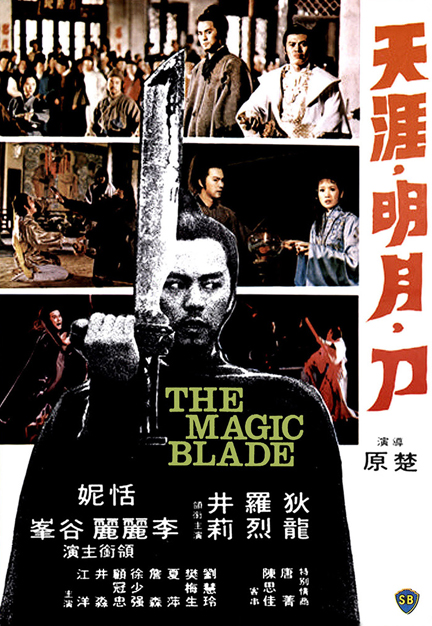
The Magic Blade is a Wuxia tale starring Ti Lung as Fu Hung Hsueh and Lo Lieh as Yen Nan-Fei. Fu is a stoic and extremely skilled wandering swordsman. The story (based on the novel by Gu Lung) opens with Fu engaged in a showdown with Yen over a previously unresolved dispute. The two men put their rivalry aside when an unseen evil sorcerer named Yu sends warriors to attack Yen. Fu saves Yen’s life and the two join forces against Master Yu in a race to find the ultimate weapon – the exploding peacock dart! If Yu gets it first, he will rule the underworld.
After fighting more henchmen in a wonderful scene set up like a game of Chess, Fu and Yen procure the peacock dart from its keeper. Along with the beautiful pure-hearted Chiu Yu-Cheng (Cheng Lee) the two men set off to find the elusive Yu. Eventually Fu and Chiu are separated from Yen, leaving Fu to carry the rest of the film on his broad shoulders.
Fu and Chiu fall in love and meet many people along their journey to find Yu – all of whom also want the dart. The story is filled with as many plot twists as wire-flips, and Fu gets through it all by his wits as much as his swordsman prowess.
The end battle with the as-yet-unseen Yu in Tien Wai mansion is a real showstopper. Ti Lung proves once and for all that although they were a great on-screen pair, he never really needed David Chiang as a co-lead. His physicality and acting are in top form here.
Director Chor Yuen wisely made sure there was something for everyone in this film. Compared to other Shaw Bros. classics, The Magic Blade contains more splatter and nudity than its predecessors, and there’s even a quick lesbian scene at Yu’s mansion.
While this production isn’t as grand as some of the older Shaw Bros. pictures, it appears to have had a somewhat significant budget. The sets, costumes, choreography and supporting actors are top notch. As with many Shaw titles, the filmmakers lifted much of the music from other sources, including several famous cues from the original Planet of the Apes. The result is very enjoyable regardless. The weapons are some of the most creative in the genre, with the best being Ti Lung’s sword – a very effective combination of a nightstick plus spinning machete. In our hero’s hands, it is definitely a “magic blade.”
ABOUT THE AUTHOR: Jennifer Upton is an American (non-werewolf) writer/editor in London. She currently works as a ghostwriter of personal memoirs for Story Terrace London and writes for several blogs on topics as diverse as film history, punk rock, women’s issues, and international politics. For links to her work, please visit https://www.jennuptonwriter.com or send her a Tweet @Jennxldn
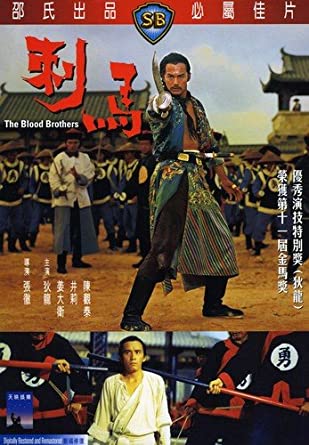
Three men, who are as close as brothers are forced to endure the ultimate test of friendship as one of them gives in to corruption and his love for his brother’s wife. Based on a purported true court case, the epic story is told via flashback.Chang, (David Chiang) is on trial for murdering General Ma Hsin I (Ti Lung.) Chang tells his story to the court of how he and his brother Huang Chung (Chehn Kuan Tai) met Ma during their days as bandits on the road. Unable to defeat Ma, the three of them quickly bond and become best friends. As the story progresses, Ma falls in love with Huang’s wife Mi Lan (played by Ching Li ) who reciprocates. Ma then leaves the group to join the Imperial Army.
Three years later, Chang, Huang and Mi Lan are called by Ma to join him in the field. During their time apart, Ma has changed. He’s become a corrupt, power hungry General who, following a successful battle, commences a secret love affair with Mi Lan. Who could blame her? Her husband Huang is a drunken boar who cheats on her regularly. Ma is educated and disciplined. When he takes his shirt off, he could charm the eyes of a rattlesnake.
The friendship of the three men soon takes a turn for the worse as Ma plots the death of Huang. Nothing will stand in his way. The film continues on to the end with aseries of betrayals and wonderfully executed fight scenes ending with the death of Ma at Chang’s hands.
The film is a showcase for Ti Lung’s exceptional acting ability. Ma starts out charismatic and loveable but transforms into a man blinded by his own ambitions.
Blood Brothers was shot during the glory days of Shaw Brothers Studios and has all the markings to show it. It is lavishly photographed using a rich color palette and fantastic outdoor locations. The interior sets and costumes are strikingly detailed.
Chang Cheh was Shaw’s Spielberg While this is largely considered his best work, during his time for the studio, he created one masterpiece after another for future generations to emulate.
Thematically speaking, John Woo’s Bullet in the Head owes a lot to this film. The comparisons are undeniable. Slow motion bloody death scenes abound in the work of both directors. Notably, Woo served as apprentice under Chang Cheh before moving on to direct his own films.
Ti Lung was one of Shaw’s greatest starts of the ‘60s and ‘70s along with frequent co-star David Chiang. He was born in 1946 and began studying Wing Chun under Master Chu Wan as a boy. In 1969 at the age of 23 he appeared with Jimmy Wang Yu in Chang Cheh’s Return of the One-Armed Swordsman. Shaw Bros. studio saw potential in the earnest young man and trained him in the arts of swordplay, acting and horseback riding. The investment paid off, as Lung’s relationship with the studio remained fruitful for many years to come. At the 11th Annual Golden Horse Awards, Lung won he Special Award for Outstanding Performance for his work in Blood Brothers. Following a career lull in the early ‘80s when Kung Fu films fell out of fashion, John Woo cast him in A Better Tomorrow whichserved to introduce him to a whole new generation of filmgoers. Blood Brothers is not to by missed if you are even a little curious about the Shaw Brother’s Kung Fu catalog. Amazon has the Celestial Pictures transfer which boasts a beautiful widescreen transfer. While I prefer the Cantonese version with English subtitles, the English soundtrack for this title is pretty decent compared to some. The true scope and beauty of a movie like this cannot be fully appreciated in a cropped, poorly dubbed version.
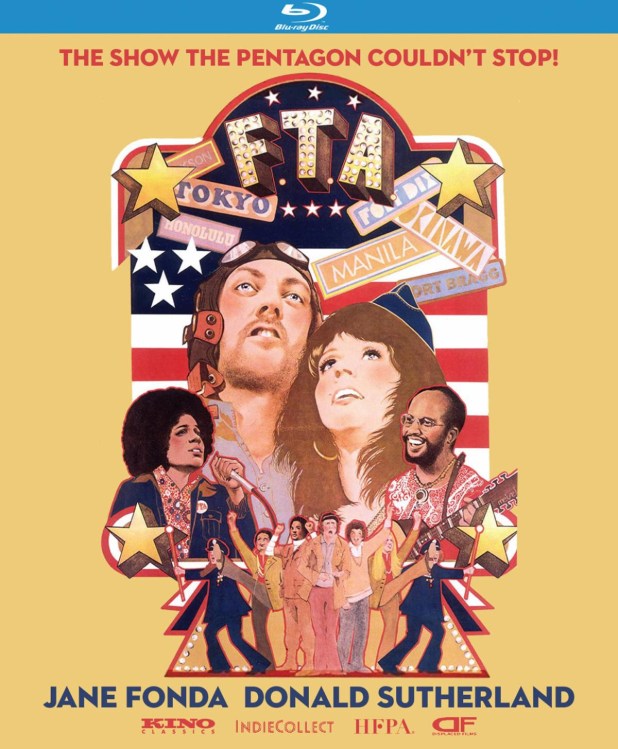
In 1971, at the height of the Vietnam War, Jane Fonda and Donald Sutherland did more than just become part of an anti-war comedy tour across Southeast Asia. They also reached out directly to enlisted soldiers who were critical of the war.
The documentary of this tour, F.T.A., shows the tour as it goes to Hawaii, The Philippines, Okinawa and Japan. It was directed by Francine Parker, who was only the eleventh woman to join the Director’s Guild.
In addition to Fonda and Sutherland, Paul Mooney, Peter Boyle, Steve Jaffe, Holly Near (The Magical Garden of Stanley Sweetheart), Pamela Donegan, Len Chandler, Michael Alaimo (Mr. Mom), Rita Martinson and Yale Zimmerson all appear.
While the tour was a success, the film was incredibly controversial and opened the same week that Fonda made her trip to Hanoi. Within a week of release, American-International Pictures withdrew it from circulation, with Parker saying that this was the result of “calls were made from high up in Washington, possibly from the Nixon White House, and the film just disappeared.” David Ziegler, whose documentary Sir! No Sir! appears on the blu ray of this movie and was part of the team that helped restore F.T.A. said, “There’s no proof, but I can’t think of another reasonable explanation for Sam Arkoff, a man who knew how to wring every penny out of a film, yanking one starring Jane Fonda and Donald Sutherland from theaters at a big loss (and, apparently, destroying all of the prints, since none were ever found).”
Now, the film has now been fully restored by IndieCollect in 4K and is available from Kino Lorber, along with a new introduction by Fonda, a 2005 interview with the actress, the documentary Sir! No Sir! and a booklet with essays by historians David Cortight and Mark Shiel.
Regardless of your politics, this is a piece of history that I feel that everyone should watch.
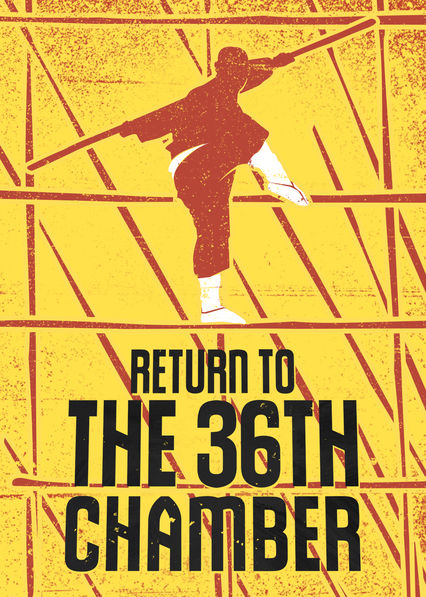
Shimmy shimmy ya, indeed. If there’s one thing Hong Kong movies have in store, it’s always plenty of sequels. And yet, we welcome those here with open arms.
Directed by Lau Kar-leung, this is the spiritual second film in a trilogy. Unlike the first and last movie in said triad, Gordon Liu does not play San Te, but instead an imposter monk Chu Jen-chieh, who just so happens to look like the master of the 36th chamber.
After using his likeness to the famed warrior to help his friends — a scheme that doesn’t last all that long — Jen-chieh runs to the temple, where he’s soon kicked out. Only when he meets San Te is he given the opportunity to build scaffolds all around the temple and renovate the entire complex.
From high above the school, Jen-Chieh is able to watch all of the forms of the monks. Finally, when asked to dismantle his work, he rebels and runs through the chambers with ease. That’s because he changed his work to practice each of the forms, which was exactly the plan of the smiling San Te.
In spite of himself, our hero has become an expert at kung fu. Another lesson from San Te. Jen-Chieh saves his village and continues his training.






 B&S About Movies
You must be logged in to post a comment.