The Devils (1971)

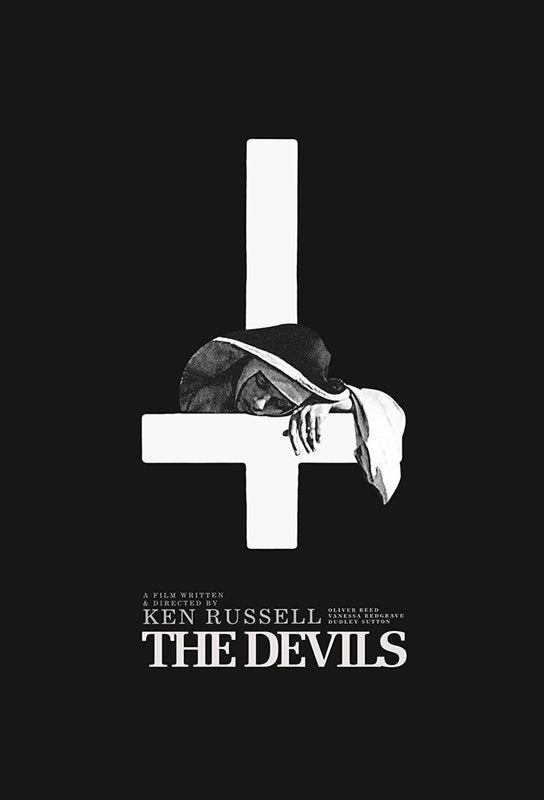
Partly adapted from the 1952 non-fiction book The Devils of Loudun by Aldous Huxley, which was turned into the play The Devils by John Whiting, United Artists had already given up on this movie after seeing how controversial Ken Russell’s screenplay was. Warner Brothers then took over but its rough sexual and violent nature, not to mention how it presented religion, led to major issues. It’s since been banned in several countries and was heavily edited for release in many countries, with several places never seeing its original uncut version.

Two scenes were cut and have rarely been shown, one where nude nuns sexually use a statue of Christ while Father Mignon watches and masturbates, as well as another that showed Sister Jeanne (Vanessa Redgrave) masturbating with the charred femur of Grandier (Oliver Reed) after he is set ablaze for his crimes.

As for Rusell, he said, “I was a devout Catholic and very secure in my faith. I knew I wasn’t making a pornographic film… although I am not a political creature, I always viewed The Devils as my one political film. To me, it was about brainwashing.”

Behind the very human — and at times occult and otherworldly — moments of the film, the dramatic narrative behind The Devils is Cardinal Richelieu working to influence Louis XIII and get him to stop the Protestants from rising up. However, Louis forbids Richelieufrom destroying the town of Loudun, having made a promise to its Governor to keep the town intact.

Whiole Loudun’s Governor has died, the town is now controlled by Urbain Grandier (Reed), who may be a popular man of God, but is also a man who has secretly married a woman. Meanwhile, Sister Jeanne des Anges, the deformed abbess of the local Ursuline convent who is sexually obsessed with Grendier, grows upset that the man she is in love with has not taken her.

The cardinal gets what he wants by accusing Grandier of witchcraft, bringing in Father Pierre Barre, a professional witch-hunter whose exorcisms are even more salacious than the crimes he has been sent to investigate. He unleashes a sexual firestorm amongst the nuns and a mockery of a trial that somehow finds Grandier convincing Barre that he is innocent. Yet it is too late. Despite his innocence, the town is destroyed.

How metal is this film? Ministry sampled it for their song “Golden Dawn” and other artists such as Belphegor and Skinny Puppy have also used dialogue from this movie.
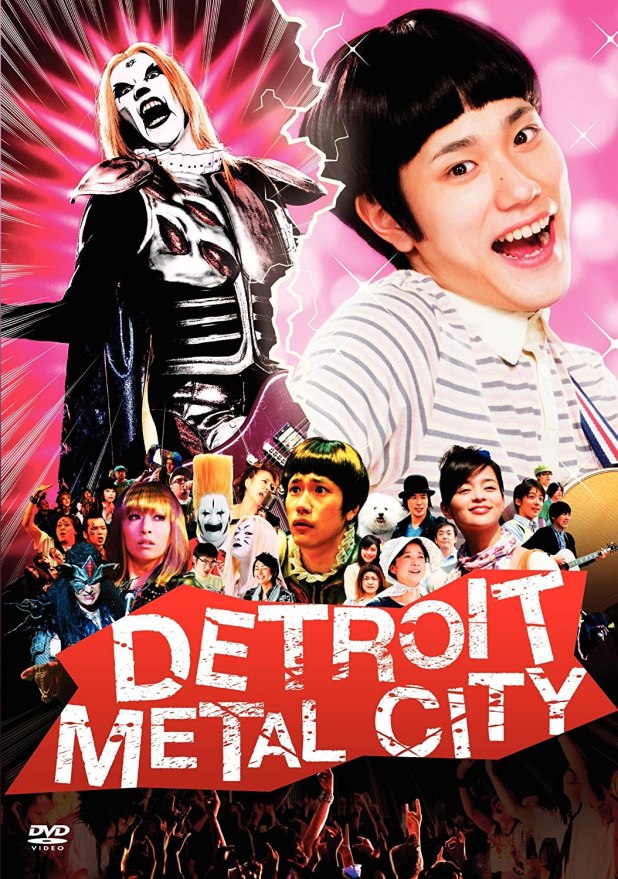
Detroit Metal City (2008)

Soichi Negishi may be a shy young man who loves pop, but he’s found success as the demon known as Johannes Krauser II, lead singer of Detroit Metal City. He hides his anger over never getting further as a normal musician behind this character, but is slowly becoming Krauser.

He’s in love with Yuri Aikawa, who enjoys his old music and hates Detroit Metal City. But is the lure of huge crowds and being rock star the goal or will it be true love?

Based on the manga and anime, Detroit Metal City was a blast. Directed by Toshio Lee and starring Ken’ichi Matsuyama (L from the Death Note films), it’s silly but isn’t that the point? And Gene Simmons is awesome as the Emperor, a metal god whose last show in Japan is about challenging Detroit Metal City.

I think if you like metal, you’re probably going to like this a lot more than people who aren’t into the musical form. But hey, I can barely hear any more, so what do I know?

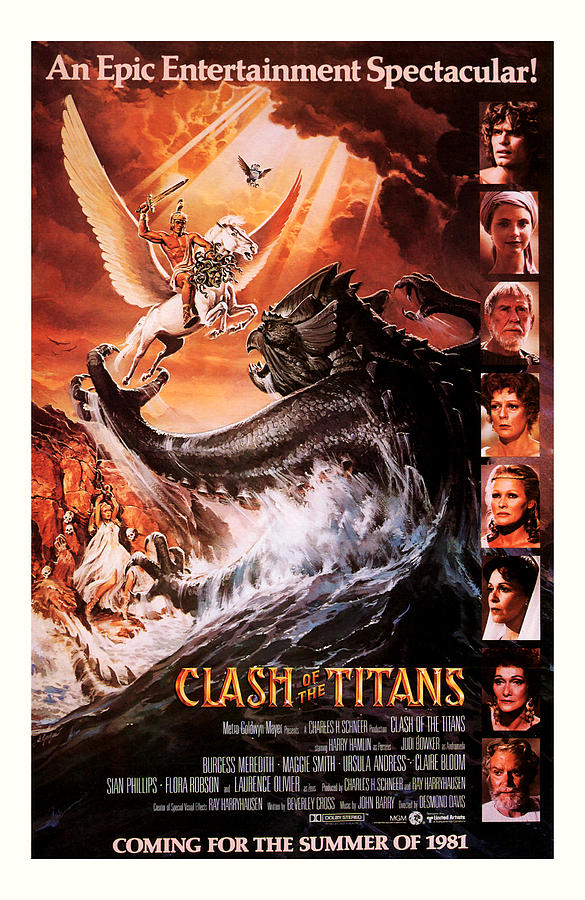
Clash of the Titans (1981)

I saw this day one in the theater, all of nine years old, and ready to scream and yell and drive any adult near me insane with the sheer force of my absolute bliss at seeing a Ray Harryhausen movie in the theater and not on TV.

Columbia Pictures, who had distributed so many of Harryhausen and producer Charles H. Schneer’s films. But as always, change happened and the new heads of the studio no longer wanted to pay for such a big budget. Schneer took it to Orion Pictures, who insisted on Arnold Schwarzenegger playing the lead, but at that point, Arnold was unproven at dialogue. So that took the movie to MGM.

The producer wanted better-known actors to play the Gods in order to improve the film’s chances at the box office. He got exactly what he wanted, thanks to Maggie Smith as Thetis, Claire Bloom as Hera, Ursula Andress as Aphrodite and Laurence Olivier as Zeus. But the real star in this movie is Harryhausen, making his final film and giving us Calibos, Pegasus, Bubo the mechanical owl, Dioskilos, Medusa, the scorpions and the Kraken, which was a toy that I asked for to no avail.

While this film came out at the same time as Raiders of the Lost Ark, it was still one of 1981’s biggest hits. The story of Perseus (Harry Hamlin) and his love for Andromeda became one that 80s kids would know by heart. Sure, the Kraken is from Norse mythology and Calibos is from Shakespeare, but why argue?

Director Desmond Davis mostly worked in TV, but he does a fine job here. Even decades later and so many advances in animation and I still thrill to the release of the Kraken.

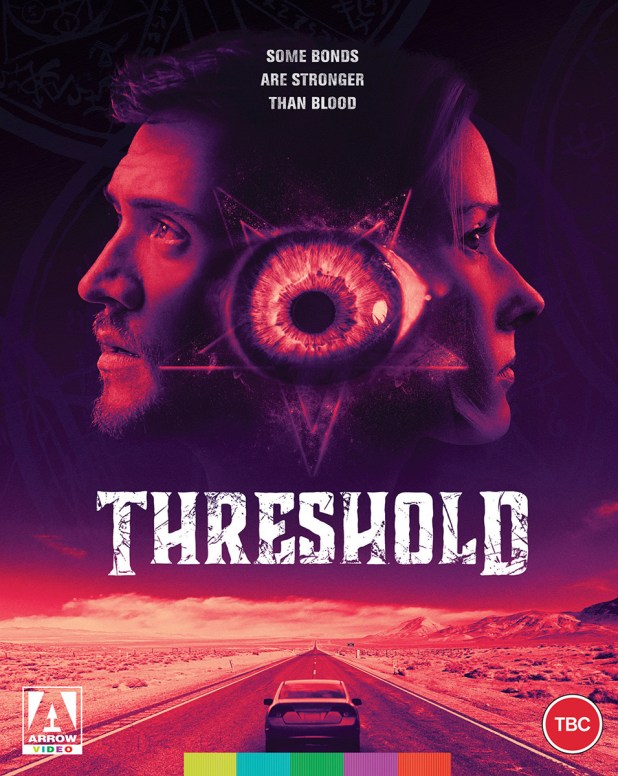
REPOST: Threshold (2020)

EDITOR’S NOTE: We first shared this entertaining and innovative film on May 7. Now that Arrow Video is releasing it on blu ray, we’d like to remind you of it so that you don’t miss it.

After years of no contact, a phone call reconnects Leo (Joey Millin) with his sister Virginia (Madison West). Their estrangement comes from her years of drug abuse and when he finds her, she’s seemingly going through an overdose. However, she tells him that she’s been clean for eight months thanks to a mysterious group that has revealed themselves to be a cult. Worse, they have tied her emotions and feelings to a dark man that she has never met. She begs Leo to help her find him. She agrees that if her story is not true, she will finally go to rehab. Yet in the midst of this emotionally charged time, Leo starts to realize that Virginia may be finally telling the truth.

Threshold was improvised and shot on two iPhones over the course of a 12-day road trip with a crew of just three. It’s the second movie by co-directors Powell Robinson, Patrick R. Young and producer Lauren Bates. It’s not a traditional horror film, but builds to a dense and dark ending. And hey — it’s 78 minutes, which is pretty much the perfect length.

You can now get Threshold on blu ray from Arrow Video. It comes with two different commentary tracks (the first with directors Powell Robinson & Patrick R. Young, producer Lauren Bates and lead actors Joey Millin and Madison West as well as a second one with the directors Powell and editor William Ford-Conway); a making-of documentary; a color correction breakdown; an indie director roundtable moderated by Scott Weinberg with directors Robinson and Young along with Brandon Espy (We Follow You), James Byrkit (Coherence), Zach Donohue (The Den) and Elle Callahan (Witch Hunt); another roundtable about acting in indie horror moderated by Zena Dixon with the actors West and Millin (Threshold), plus Kelsey Griswold (Followed), Gabrielle Walsh and Ryan Shoos; the soundtrack to this movie; the script; the trailer and orginal teaser; and an image gallery.

They Live (1988)

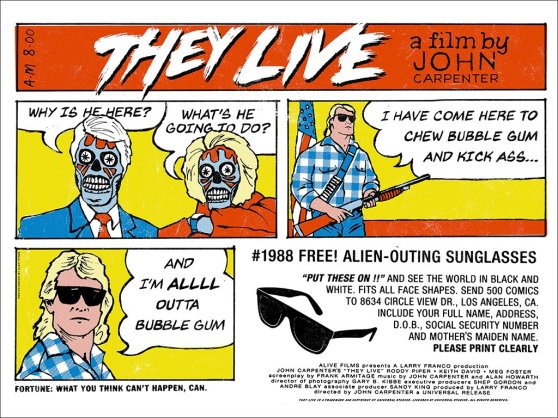
Sure, They Live is a science fiction movie based on the 1963 short story “Eight O’Clock in the Morning” by Ray Nelson, but isn’t it really just another western by way of John Carpenter? Nada (Roddy Piper) is a man who Carpenter can work his hatred of the end of the Reagan era out with. So how did he decide to make that into a movie from a major studio? Television.

“I began watching TV again,” Carpenter told Hero Complex. “I quickly realized that everything we see is designed to sell us something. It’s all about wanting us to buy something. The only thing they want to do is take our money.”

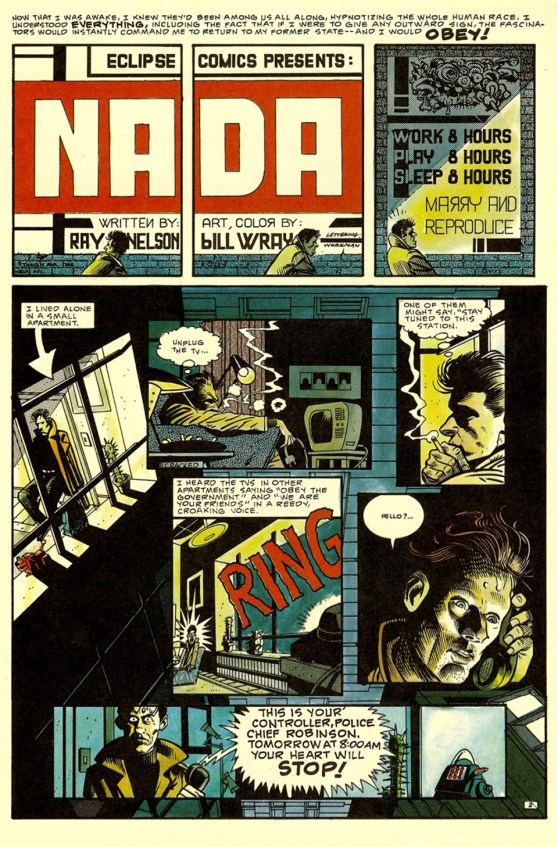
Carpenter also saw the story in Alien Encounters, a comic book that Nelson appeared in, rewriting his tale and working with artist Bill Wray. He acquired the film rights to both the comic book and short story and wrote the screenplay himself.

Carpenter made the movie for $3 million and selected Piper because he looked like he had lived a life. Keith David’s part was written just for him, as Carpenter had enjoyed working with him on The Thing.

Nada’s name means, of course, nothing. He has nothing, he has no one and yet, he is the man that humanity must rely upon when facing an enemy that is already us. When he views the world through special glasses, he can see the messages that the unseen they have kept hidden from us for so long.

How long? Why? And to what end? Well, look. This is an exploitation picture through and through. You can see it from the left — that’s where Carpenter seems to be coming from — as the aliens are terraforming our world through pollution and global warming. Or maybe you can see this as the original fake news if you’ve on the other side.

This is a film with both a sad and happy ending. I guess you can just call it a John Carpenter ending, a place where tough men see a middle finger until the closing curtain as the only way to end up on the winner’s side of the balance sheet.

Despite being critically savaged — you can xerox that line for nearly every post-Halloween Carpenter movie — time has been beyond kind to this movie, which seems more and more based on real life and less a work of fiction.

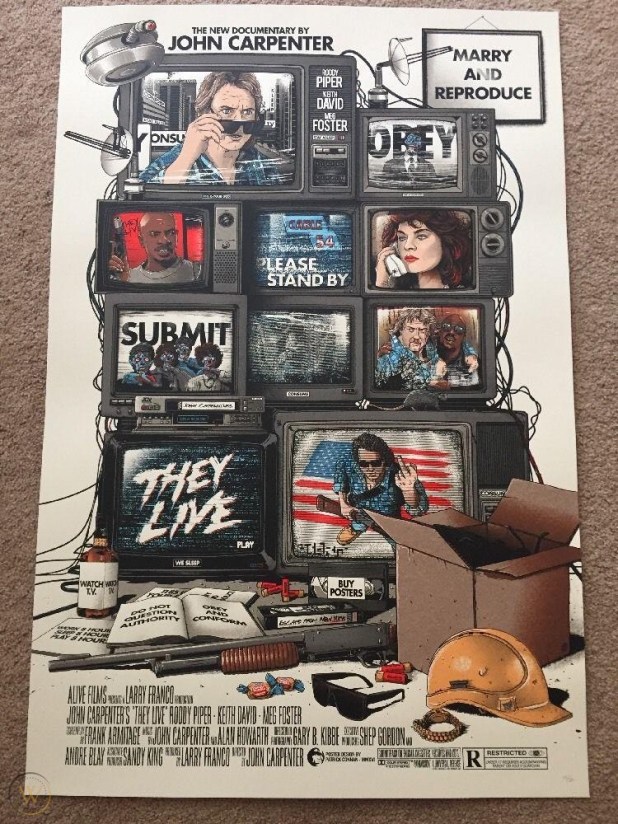
This Alan Hynes poster is amazing.

There’s been a lot made of the fact that Roddy Piper claimed that this movie was based on fact. He’d bring up — it’s on the commentary track he did — that in the 1950s, a company manufactured a TV that planted subliminal messages in women’s brains and he’d seen a doc about it. Well, he may have seen that movie, but he didn’t realize that L’affaire Bronswik was a parody.

Speaking of different groups seeing this movie in their own light, several white supremacist groups have taken to this film as an allegory for how Jewish people run the world. Carpenter even responded to this on Twitter by saying, “They Live is about yuppies and unrestrained capitalism. It has nothing to do with Jewish control of the world, which is slander and a lie.”

Caligula (1979)

Caligula is a movie that several wanted to make their own, but only its producer could fully own.

Scriptwriter Gore Vidal had intended to call it Gore Vidal’s Caligula, writing a script that had a strong focus on homosexuality and only one heterosexual scene. That one was between Caligula and his sister Drusilla. He was paid $200,000 for his work and received the credit that the movie was adapted from his script, but he wanted nothing to do with the film.

Tinto Brass ended up being the director, selected after elaborate sets, costumes, jewelry, hairstyles, wigs and makeup were created by production designer Danilo Donati. John Huston and Lina Wertmüller had already turned down the movie, but after Salon Kitty, it was decided that Brass would be a good fit, despite the knowledge that he was difficult to work with. He would only do the film if he could rewrite Vidal’s script, which is hilarious to me, and added plenty of orgies, female nudity and male genitalia pretty much in every scene.

In an interview for Time, Vidal called directors parasites and claimed that screenwriters are the true makers of the film. Brass demanded Vidal not be allowed on set and Vidal filed a lawsuit against the film. The battle between Brass and Vidal is, quite frankly, better than the movie, as Vidal wanted ten percent of all profits, calling the director a megalomanic while Brass would say, “If I ever really get mad at Gore Vidal, I’ll publish his script.”

The real power we alluded to earlier?

This was the only feature film produced by the men’s magazine Penthouse. The magazine’s founder, Bob Guccione, dreamed of making an erotic feature film narrative with high production values and name actors. He’d helped fund Chinatown, The Longest Yard and The Day of the Locust, but now it was time to make the Citizen Kane of adult films.

Vidal wanted the idea of absolute power.

Brass saw Caligula as a born monster.

Guccione wanted to see hardcore coupling on the big screen, something that neither Vidal or Brass wanted.

Well, Bob got what he wanted, locking Brass out of the editing process and shooting his own hardcore inserts — hell, most of the movie — with his Penthouse Pets as extras and using cameraman Giancarlo Lui as the director.

Caligula (Malcolm McDowell) is the next in line for the throne of the Roman emperor, but his uncle Tiberius (Peter O’Toole) is still on the throne, despite being absolutely mad due to advanced venereal disease. He wants to kill the boy, who is protected by Marco (Guido Mannari), who ultimately kills the old man to hasten Caligula’s path to power.

Caligula is proclaimed the new Emperor, then tells all that his sister and lover Drusilla (Teresa Ann Savoy, Salon Kitty) is his equal. To prove that he is his own man, he has Marco killed, which should show the world that maybe this kid is not alright.

His sister, who he cannot marries, picks one of her Isis priestesses — Helen Mirren! — to wed her brother, who soon goes wild, assaulting husbands and wives on their wedding days and coming up with all manner of off the wall tortures and gladiator affairs. After barely surviving a fever and enduring the death of his sister, Caligula fully gives in to the madness inside and destroys everything about Roman society before he is killed, his blood washing down the marble steps as the film closes.

The big disagreement between Brass and Guccione was over each person’s taste in women. Yes, this really happened.

When the film came to America, it battled pornography laws in nearly every place it played. It’s also one of the few movies that Roger Ebert ever walked out of.

Here’s a fact that I love about this movie: According to McDowell, Peter O’Toole’s first words to Sir John Gielgud were, “Hello, Johnny! What is a knight of the realm doing in a porno movie?” When McDowell first saw Gielgud, he asked him if he’d seen the set, to the reply of “Oh, it’s wonderful. I’ve never seen so much cock in my life.” Gielgud later told McDowell that he liked the movie so much, he paid to see it twice.

This movie was legendary in my high school days, as there was only one copy available in our very small Western Pennsylvania town and it was in the dreaded back room of Prime Time Video. Kids who may — or may not — have seen it spoke breathlessly of the wonders and horrors that it contained.

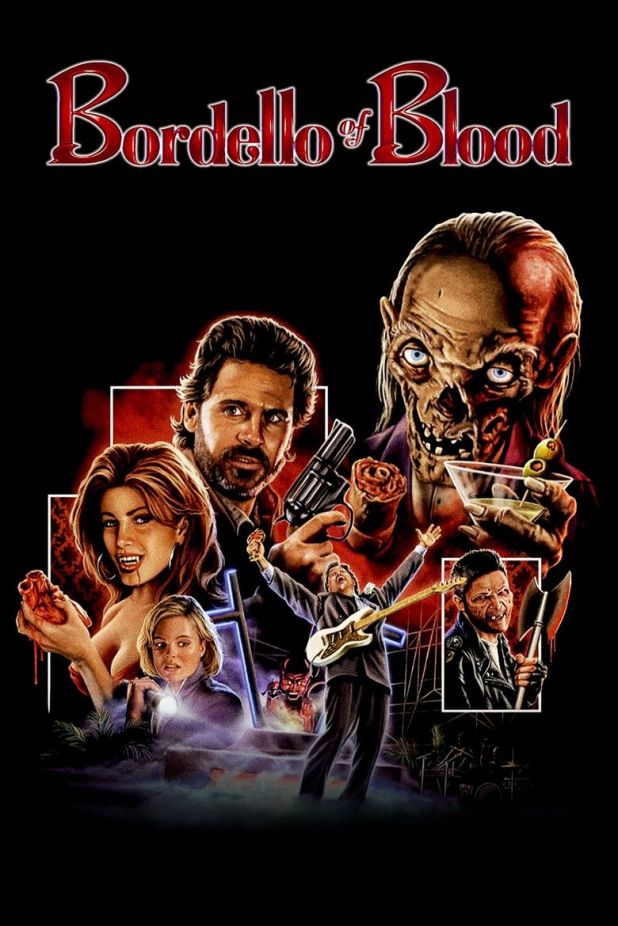
Bordello of Blood (1996)

After Bob Gale and Robert Zemeckis graduated from USC, they wanted to break into movies and decided that an exploitation film was the easiest way in. They pitched this script to John Milius, yet ended up debuting with 1941.

When Tales from the Crypt — the TV series — started becoming a series of movies, instead of mining the old EC Comics, like the show and movies based on it, like Creepshow did, the idea was to make longer stand-alone films that were not adaptions. I could be cynical and say that it was just using the brand name to make movies that no one wanted otherwise, but Demon Knight was so good that I couldn’t think that way.

Bordello of Blood is exactly the kind of junk I figured they’d make. This script was picked instead of others considered, including Peter Jackson’s The Frighteners and Quentin Tarantino’s From Dusk till Dawn.

At a budget of $2.5 million dollars, the film looks cheaper than the TV series that gave it life, which is quite backward. And while Joel Silver was the producer, that led to all manner of questionable decisions, like his idea that supermodel actresses was what would change Hollywood and hiring Dennis Miller, who did not want to be in the movie and said he’d only do it for a million dollars. The studios said no, so Silver played fast and loose with the books and took $750,000 out of the special effects budget. You can really tell. During the holy watergun fight with the evil sex workers, the effects go from really good to beyond horrible, often within the same shot.

Further problems came up when Erika Eleniak — who had left Baywatch because she wanted to be taken seriously as an actress —  allegedly did not want to play the character of Catherine. What a movie! Two actors that had no interest in being in it, a sliced and diced special effects budget and a movie shot in Canada due to Silver’s past union issues, which further had a non-union crew angered by the fact that Miller would rarely show up, working around the schedule of his Dennis Miller Live TV show, keeping them from seeing their families on weekends. Oh yeah — the script supervisor who was Miller’s stand-in — lots of the movie was shot without him — couldn’t remember all of Miller’s dialogue, which he’d frequently ad-lib, so the movie is filled with continuity issues.

The film starts on a great note, as some treasure hunters find the grave of Lilith, the queen of all vampires. They’re all killed by her except for the one who has the key from Demon Knight. Speaking of that film, its hero William Sandler has a cameo as a mummy in the Crypt Keeper segment.

Then, Caleb (Corey Feldman) and his buddy Reggie get attacked by vampires in a house of ill repute, revealing Lilith as Angie Everhart — that supermodel idea — and Tallulah as Juliet Reagh, Penthouse Pet for April 1987. Caleb’s sister — Eleniak — hires Rafe Guttman (Miller) to find her brother, bringing him to the titular bordello of blood.

Hey, the movie at least is good for trivia, as you have two of the stars of the 80’s bigger vampire movies — Feldman from Lost Boys and Chris Sarandon from Fright Night — in the cast. It also has a completely non-sensical ending that ignores all traditions of vampirism. And oh yeah — Reggie is played by Matt Hill, who was the voice of Raphael to Feldman’s Donatello in the Teenage Mutant Ninja Turtles movies.

This is the only movie Gilbert Adler would direct, although he produced Constantine and wrote Children of the Corn II: The Final Sacrifice.

As for this being a heavy metal movie, it does have a soundtrack with Anthrax doing the theme song, Sweet’s “Ballroom Blitz” — everyone used that in their movies at one point — and Redd Kross covering Kiss’ “Deuce.”

Honestly, this movie could have an entire soundtrack by Black Sabbath and I’d still hate it.

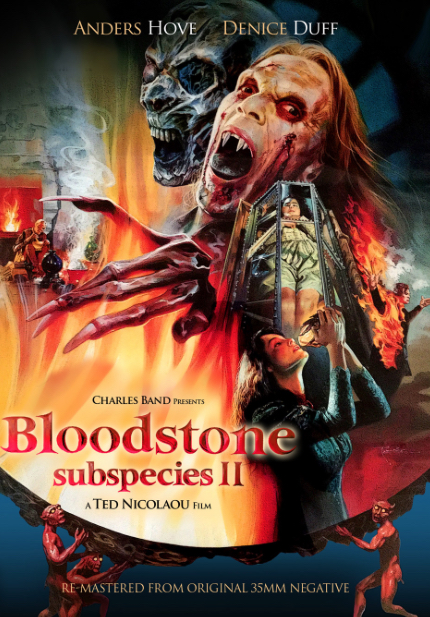
Bloodstone: Subspecies II (1993)

Didn’t Radu die in the first Subspecies?

Well, yeah. But now his minions have simply reattached his head and taken the stake from out of his heart, allowing him to Hicks and Newt the hero of the first film, Stefan, killing him within moments of the film’s opening, sending heroine Michele to Bucharest with the titular Bloodstone in the hopes of getting help from her sister Becky.

Meanwhile, Radu’s mother — yes, known as Mummy — comes on the scene and tries to help him turn Michele to the side of the vampires, which leads directly into Bloodlust: Subspecies 3, which was shot at the same time as this film.

A rare sequel that is even better than the original, this starts strong and gets even better, with actually scary moments and a multi-layered antagonist. I don’t own the box set and action figure of Radu for nothing.

You can watch this on Tubi.

Billy Jack (1971)

You may have thought that Billy Jack was dead after The Born Losers, shot in the back while trying to do the right thing. The truth is, he was just getting started. An anti-authority film, this movie struggled to be made, with American International Pictures pulling out while it was being made. Then, 20th Century Fox stepped in but refused to distribute the film. Auteur Tom Laughlin would not release the sound for the film, making it unreleasable until he could own the film himself, getting Warner Brothers to distribute it. He was unhappy with how Warner Brothers sold the film, so he sued them and finally released the movie himself.

At the heart of the film, the movie presents a conundrum: the only way to achieve peace is to repeatedly beat the stuffing out of people.

Also, the Navajo Green Beret Vietnam War veteran and hapkido master known as Billy Jack is played by director (as T.C. Frank), producer (as Mary Rose Solti) and co-writer (as Frank Christina) Tom Laughlin, who is totally white. That said, the role of Billy Jack is anything but the way that Native Americans had been portrayed up until the early 70s.

Laughlin was also a muckraker, really in the best of ways. He’d written the film nearly two decades before after seeing the way Native Americans were treated in Winner, South Dakota, the home of his wife Delores Taylor. What took so long to get it to screen? Well, beyond building his acting career, Laughlin also quit acting in 1959 to start a Montessori preschool in Santa Monica, California.

After the school went out of business, he went back into acting and after the Billy Jack series, he was set to change the world with Billy Jack Enterprises, which had plans for a new Montessori school, a record label, an investigative magazine, books, a distribution company and more message-laden movies, including films for children. Yet the last movie, Billy Jack Goes to Washington, didn’t connect with audiences. Or, as Laughlin charged, it was the fault of Warner Brothers illegally selling the television rights to his films. Or even Senator Vance Hartke, who he said told him that, “You’ll never get this released. This house you have, everything will be destroyed.” in front of Lucille Ball, angered that the film correctly pointed out how senators were owned by lobbyists.

There was going to be a fifth film, The Return of Billy Jack, that ended in the 2000s when Laughoun got hurt and the money ran out. He claimed for years that it would get made with the title changing to Billy Jack’s Crusade to End the War in Iraq and Restore America to Its Moral PurposeBilly Jack’s Moral Revolution and Billy Jack for President, with the plan to have Billy Jack and President George W. Bush debate each other.

Man, I wish that was made.

That said, the original Billy Jack is an incredibly strange movie, a film made of a singular vision.

Billy Jack is the defender of the Freedom School, a school full of happy children taught my Laughlin’s real-life wife Delores, who are assaulted from all sides by the horrible folks of the redneck town where, for some reason, they have decided to make their home. A movie this strange demands a run-on sentence like that to describe it.

This is the kind of movie where the hero must face off with a snake and purposefully be bitten with venom so that he can become brothers with the snake, as well as have a theme song “One Tin Soldier (The Legend of Billy Jack),” which was recorded by Jinx Dawson and her band Coven, whose album Witchcraft Destroys Minds & Reaps Souls is as metal as it gets, even featuring a black mass as its second side.

You don’t really watch Billy Jack. It washes over you. The words I use to describe it aren’t enough. It’s absolutely ridiculous in the finest of ways and I really want you to experience it.

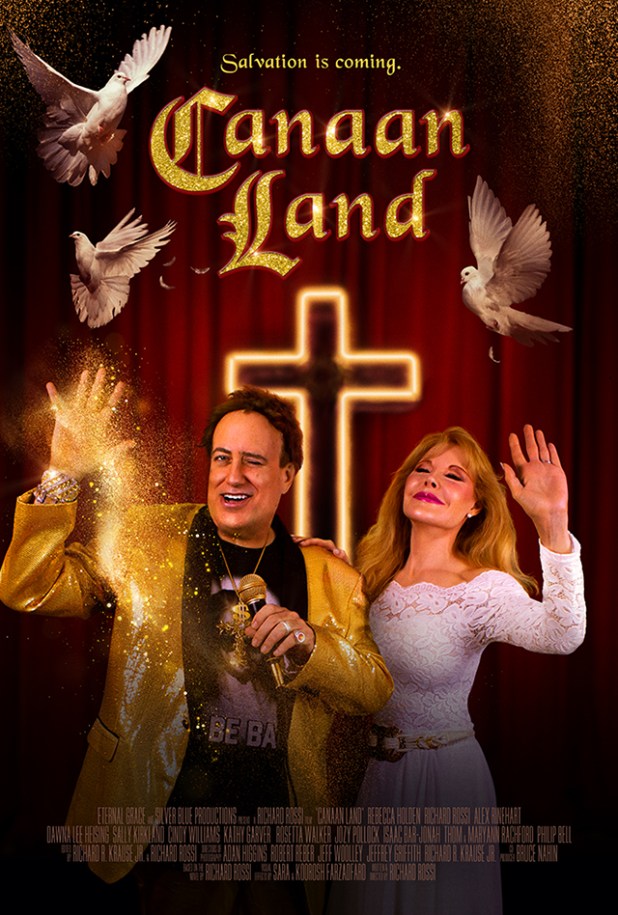
Canaan Land (2020)

Brother Billy (Richard Rossi, who also wrote, directed, produced, ran the camera, composed the music, edited and performed most of the songs for this movie) is a con man who has found his way into becoming a man of the Lord thanks to falling in love with Sister Sara (Rebecca Holden, who was April Curtis on Knight Rider and also appeared in Loverboy and The Sisterhood), whose preaching comes from a much more sincere place.

Rossi was a minister in Pittsburgh when he discovered televangelists faking miracles for money. I can only imagine he learned this during the making of His Place at WPCB-TV40 outside North Versailles. He turned the story of that moment into a play and after making two documentaries — Sister Aimee about Aimee Semple McPherson and Baseball’s Last Hero: 21 Clemente Stories — he decided to film Canaan Land.

According to the film’s website, this is a movie that answers a few questions, such as “What happens when a traumatized Christian who is a talented showman takes out his hurt and anger on God’s people by swindling them? What happens when he falls in love with a woman who loves God and wants to help people?”

This is a faith-based movie, but I’ve watched plenty of those, so I was sure that this would get way too preachy. Actually, it’s the opposite and does a great job of pointing out the bad parts of evangelism while showing that so many actually do have their hearts in the right place.

What’s really surprising are the cameos this film has, including Cindy Williams, Sally Kirkland, Elvis’ last fiancee Ginger Alden, Louis Gossett Jr., Karolyn Grimes (the real Zuzu Bailey!), Kathy Coleman (Holly from Land of the Lost) and Lynda Carter. It also has a packed cast, including Dawna Lee Heising, who has been quite good in several recent horror films I’ve seen (and this movie as well).

You can give it a try on Amazon Prime and learn more at the film’s official site.