Toshiharu Ikeda is best known in the U.S. for Evil Dead Trap, but he was making adult films in Japan for years that were horror-influenced before going all the way there wwith films that have giallo in their DNA like XX: Beautiful Beast, XX: Beautiful Prey and The Man Behind the Scissors. He also directed a remake of the Female Prisoner Scorpion series called Female Prisoner Scorpion: Death Threat, which has legendary Japanese female wrestling heel Dump Matsumoto in it.
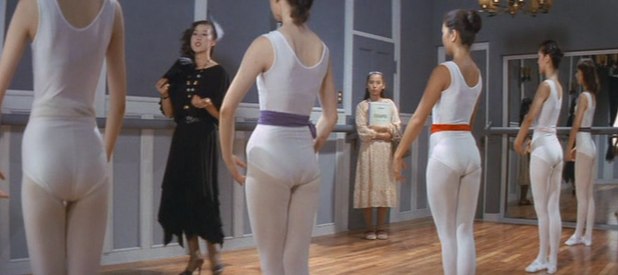
Many point to the influence of Dario Argento’s Suspiria on this movie, seeing as how it takes place in a dance academy that is way more than meets the eye. That said, Ikeda did claim in an interview never to have seen any of Argento’s films, as he hated horror and had never even watched his own Evil Dead Trap.
Miki, much like Suzy Bannion, is a talented dancer who has been accepted into an exclusice and mysterious dance academy by a woman named Akiko, who is the sister of her boyfriend Genichiro. Seeing as how he’s been missing since an accident, she decides to accept the offer in the hopes that she’ll improve her skills while finding the man she loves.
But kind of like a Japanese funhouse mirror version of one of those randy tales, Akiko has plans to keep Miki against her will and use her henchmen to transform her from the virginal dancer she is now to a sex-craving being that her brother will reject and run right into her loving arms.
By the way, if this upsets you, turn back now.
As for Genichiro, he’s also kept hidden inside the school, in a wheelchair since a recent car crash. He has no idea what’s happening, which goes from BDSM games to outright torture.
Nikkatsu studios, who made this movie, were certainly no puritans, but even they were upset by this movie, demanding that Ikeda tone things down for his next film and sending him to Okinawa with the demand that his next movie, Blue Lagoon: A Summer Experience, have some actual romance.
I debated including this movie in this week of giallo, but decided to include it as it fits in alongside other films we picked like Bizarre and Eyes Behind the Wall. I would definitely include the warning that this is beyond reprehensible in moments, yet still includes some moments of high art, such as the scene where Miki and Genichiro reconnect and make love in the mountains, which you should never do if you’re in a wheelchair. Let this film be a warning (and don’t let it ruin Coca-Cola for you forever, as this has perhaps the most upsetting product placement for that beverage of all time).
Sadly, Ikeda fought depression in his later years and ahis body was found floating in the sea near Shima on December 26, 2010. There was no note and his death could have been an accident, but he had expressed a wish to die in this area in the past.
As for the aforementioned Suspiria comparisons, outside of the setting, the inversion of the characters at the end, with Miki rising above her torment, and the climactic rainstorm feel like they could have been inspired by the film. Otherwise, this is a dark film that hints at the talent that Ikeda would use in his career as he moved out of adult and into more mainstream films.
1983 is pretty late for the giallo, but hey — I’ve been trying to expand into the period before and after the major years for the genre.
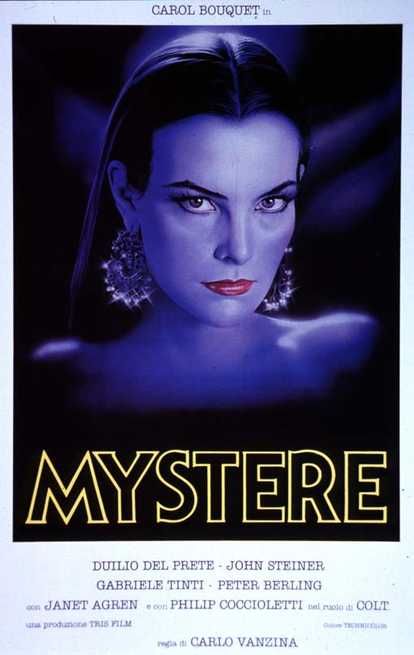
Also known as Dagger Eyes and Murder Near Perfect, this film was written and directed by the Vanzina brothers, Carlo and Enrico. They loved the 1981 French thriller Diva, a film that moved away from the realist 1970s French cinema to the more colorful style of cinéma du look.
Mystère is divided into chapters, starting with a prologue, then each section is one of the four days that follows, then an epilogue. The producers demanded this happy ending, while the brothers wanted something more cynical.
Mystère (Carole Bouquet, For Your Eyes Only and the face of Chanel No. 5 from 1986 to 1997) is a high class call girl in Rome who comes into the possession of a mysterious lighter when her friend Pamela (Janet Ågren, City of the Living Dead) and one of her customers are killed over it, as inside the lighter are images of a political assassination.
Unlike the normal giallo — or adjacent giallo or whatever this is — the hero, Inspector Colt, ends up killing the assassin (John Steiner, Shock) and his bosses and then leaves behind our heroine, who ends up tracking him down to Thailand and making up with him. He was good with nunchucks, maybe?
I mean, how many movies are you going to see that somehow take the spirit of the good parts of 1970’s giallo, mix in the Zapruder film, throw in some Eurospy and still end up looking like a super expensive perfume ad?
Also — thanks to BodyBoy on Letterboxd who called out that Mystère’s apartment looks like something straight out of Messiah of Evil.
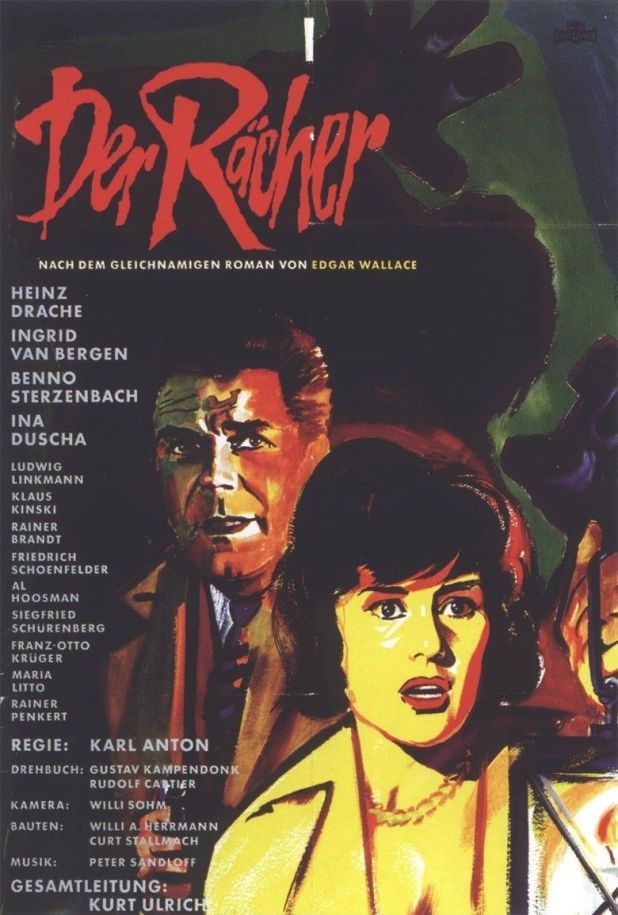
In The Avenger, a killer is slicing the heads off of his or her victims, then sending them right to Scotland Yard, which seems pretty ballsy.
This pre-giallo was directed by Karl Anton, who made the 1957 German remake of Viktor and Viktoria and based on the 1926 Edgar Wallace novel of the same name.
The Executioner, the killer of this story, has been sending packages of those disembodied heads from different locations, along with letters taunting the police. When a Scotland Yard employee is one of the victims — who all seem unrelated — Detective Mike Brixan of Special Branch is called in.
There are just a few clues, like the black sedan seen at the scene of the crime and that two letters are offset in every letter The Executioner writes. Those letters match a script being written for a movie, which means that the murderer just might be one of the cast or crew.
Ingrid van Bergen, who plays the niece of one of the victims, has a giallo-like real life, as she shot her lover, money broker Klaus Knaths, dead and served five years of jail time, being released for good behavior, at which point she went back to acting.
You should also keep an eye out for a very young Klaus Kinski!
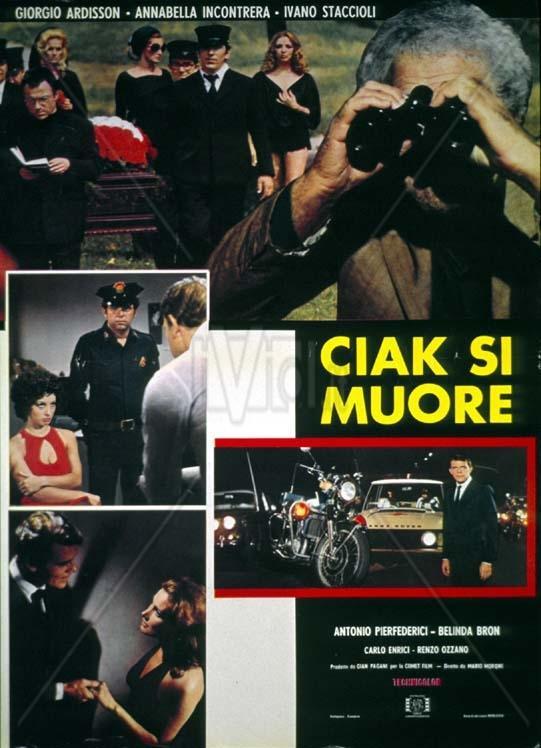
A giallo that takes place on a movie set, the title of this film (Clap, You’re Dead for those that speak English) refers to the “clapper” that stops a scene from being filmed. It’s directed by Mario Moroni, who also made Mallory Must Not Die!
The director of said movie, Benner, has some of the best outfits a man has ever worn in a giallo. Seriously, the dude’s fashion sense is completely off the rails.
That said, this is more of a comedy giallo which unfortunately has a police chase that ruins any good will that the movie has built up with its funky soundtrack and frequent bursts of sleaze. The ending is pretty fun, with every character all wearing the same costumes and a punchup breaking out and all the misdirection.
It’s not great, but hey, it’s definitely a giallo you may have not seen before.
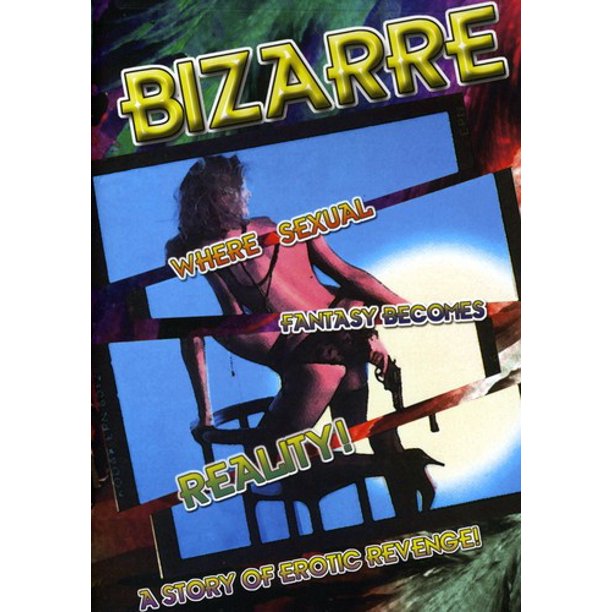
Man, I don’t know if this is strictly a giallo or just plain sleaze. But hey, I watched it, you’re going to read it and then we’ll all go about our way. Seriously, I always thought The Devil’s Honey had the most ridiculous sex scenes in a quasi-giallo and here we are with Profumo, which has nothing to do with the British sex and politics scandal, and was also known as Bizarre.
Florence Guérin (Top Model, Faceless, Too Beautiful to Die, The Black Cat) plays Laurie, a woman who is pretty much haunted by a violent lover named Corbi. No matter how far away from him she gets, he always pulls her back in.
Yet now she’s found a new lover named Edward (Robert Egon, the only actor I can think of who is in a Marvel movie*, My Own Private Idaho and two Fulci films**, Massacro and Sodoma’s Ghost), who she feminizes and sodomizes when she isn’t pouring Coca-Cola all over his pubes and licking it off. Yes, this is that kind of movie.
Corbi is never far behind, sending men to attack Laurie and Edward before she decides to take matters into her own hands. But is she strong enough to leave him? Even sixteen years after The Strange Vice of Mrs. Wardh, giallo heroines are still having trouble dumping the abusive men who give them the kink they need. Oh Laurie. Your vice is a locked door.
Frankly, I’m shocked Severin has put this out yet, but this may be because not that many people know about it. Maybe we can do something about that. I’ve honestly never seen Russian roulette used as foreplay before, so I guess that late model giallo has wonderful things to teach us all.
*To be fair, it’s just the 21st Centurt post-Cannon Captain America.
**You could say three, as he also shows up in the mashup of these movies, Cat in the Brain.
ABOUT THE AUTHOR: Herbert P. Caine is the pseudonym of a frustrated academic and genre movie fan in Pennsylvania. You can read his blog at https://imaginaryuniverseshpc.blogspot.com.
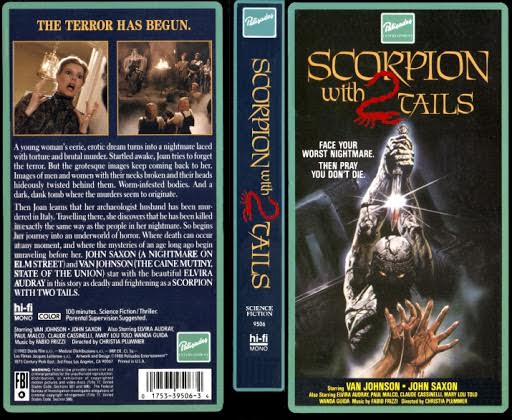
When I was a young child, roughly nine or ten years old, my parents decided to put on a Saturday afternoon movie showing on one of the local broadcast channels, The Scorpion with Two Tails. The film held little interest for me initially, until one very “special” scene came on. In it, a woman has a vision of some of her friends being murdered by an unseen figure who snaps their necks from behind. Meanwhile, the eyes of an ancient statue fall out with the sockets spewing maggots. My parents were unimpressed, with my mother grumbling, “This is gross.” Young me, however, was scared and quickly left the room.
Roughly thirty years later, I sought out The Scorpion with Two Tails, also known as Assassinio al cimitero etrusco (Murder in the Etruscan Cemetary). It proved to be a largely unmemorable giallo, albeit with some good atmosphere and brief appearances by well-known actors. The film revolves around a young woman (Elvire Audray) investigating the murder of her husband, played in an all-too-brief appearance by John Saxon. Saxon’s character, an archeologist, is briefly seen investigating an Etruscan tomb in the Italian countryside, which he thinks may be the find of the century. Unfortunately, his neck is broken by a hidden assailant after a phone call with his wife, who has a premonition of his death.
When Saxon’s wife travels to Italy, her visions intensify, culminating in the scene that scared me as a child. She gets a pendant that her late husband retrieved from the tomb, a scorpion with two tails. She soon learns that she perfectly resembles an ancient Etruscan painting of an immortal woman. Could she be the woman’s reincarnation? More importantly, are the murders connected to the heroin she finds hidden in the tomb, or is something supernatural afoot?
The film wavers between supernatural horror and real-world suspense, never finding a balance between the two. The main story following Audray’s character and her visions is grafted to a sub-plot involving drug smuggling, with the two plot lines never really gelling together. Spooky scenes in the Etruscan tomb are juxtaposed with gunplay and car chases. Furthermore, in the last five to ten minutes, there are scenes implying that the Etruscans had some sort of advanced technology involving anti-matter and anti-gravity, an element that is never really developed. (To be fair to the director, Sergio Martino, the film was originally intended as a miniseries, so it may just be suffering from the truncation.)
The film’s performances are mixed. John Saxon does his usual good work, but his part is little more than a cameo. Elvira Audray, who plays our protagonist, has a tendency to overemote, although that may simply be the way her character was dubbed. Although some might claim that you shouldn’t watch a giallo for the acting, this ignores the role acting plays in keeping us invested in the story. If we care about the characters, we feel greater suspense.
These plot difficulties are to some degree alleviated by the film’s good use of atmosphere. The Etruscan tomb, which figures prominently in Audray’s visions, is genuinely creepy, with lots of shadows and a sulfurous fog emanating from a pit. The visions themselves are disturbing, even as an adult, with necks being broken all too realistically. The film also boasts a good soundtrack, although some themes seem to have been lifted from Fulci’s City of the Living Dead.
The Scorpion with Two Tails is available on YouTube.
“The Christian community has kind of left the art world on the back burner. My vision would be them treating the art world, the film world, with the same sense of urgency as they’re treating, for instance, an overseas mission. . . . This is an emergency for our culture, to be able to influence our film, our arts, the American pop culture in this way [through Christianity].” — Director T Jara Morgan, in an interview with Life Site News
Ah, those ’90s-halcyon Miramax and Fox Searchlight days of driving to an outside-of-the-big-city six-plex with a screen or two dedicated foreign films. Films that you had to see that week — that Friday, in fact — before the manager, seeing the low box office, banished the celluloid from the silver screen, for the film never to be known beyond a few film dorks: like moi.
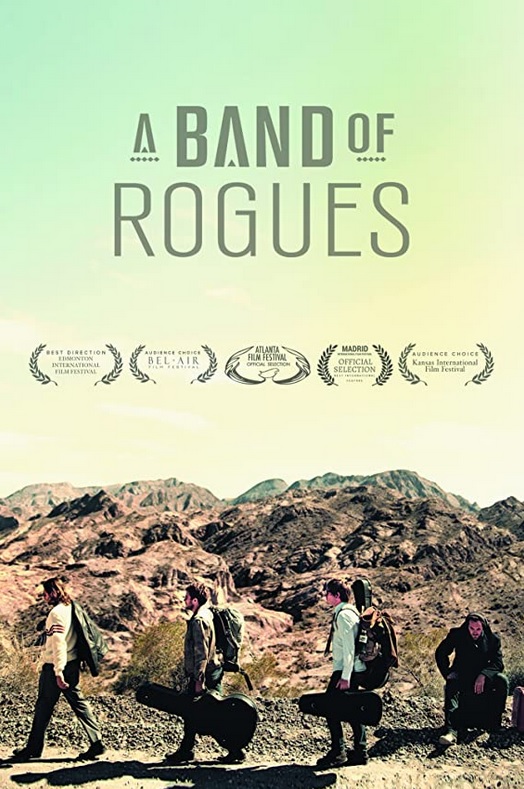
In the case of this feature film debut by writer-director T Jara Morgan, his Argentinian-shot, music-driven comedic adventure has bounced around the worldwide festival and indie circuit since 2012. And finally, thanks to the fine folks at Indie Rights Films (who always seem to be rescuing just the right films from celluloid obscurity to digital recognition), A Band of Rogues finally makes its well-deserved U.S. streaming and hard-media bow.
Hey, but wait second . . . all of these actors, as well as director T Jara Morgan, hail from Atlanta, Georgia, in the good ‘ol U.S.A. Uh, okay, so . . . then we’re reliving the ’90s-halcyon Miramax and Fox Searchlight days of driving to an outside-of-the-big-city six-plex with a screen or two dedicated to indie films. Films that you had to see that week — that Friday — before the film vanished from the silver screen.
In other words: Different film genre, but the same ol’ hard-road-to-mainstream-distribution travels for the non-Tinseltown film.
And the jailer man and sailor Sam, were searching everyone.
As a film academic and critic, I watch a lot of (new) films — and I end up not reviewing more that I review. Sadly, while I realize the writers and directors behind each and every film I watch have depleted their internal organs and inner essence into their digital images, there are just some films that I can’t get behind; there is no common good served by eviscerating the vision of a filmmaker: I ain’t Roger Ebert nor Rex Reed. I’m R.D Francis and R.D don’t play that.
But then . . . along comes A Band of Rogues: an obscure film on the run that deserves to be seen. Reviewing T Jara Morgan’s IMDb page, while he is still producing various video products for television and other outlets, he hasn’t made another feature in the ensuing nine years of the first festival appearance of A Band of Rogues. And that’s a shame. For a director to transition from two short films, to creating a film with an all-original soundtrack of songs (crafted by brother-producer Matthew D. Morgan and actor Luke Micheal Williams) tailored specifically to the character’s personalities and plotting of the film and — with a László Kovácian eye — expertly capture the Argentinean countryside to convey an analogy of the South American expanse to one’s spiritual freedom, is a film that deserves to be experienced.
As with his Christian message-based shorts that are worthy of investing your fifteen minutes, A Band of Rogues is a bit more quiet of a film; a not-so-heavy-handed, faith-based tale regarding the fate of one’s decisions, the importance of the guidance of friendship, and discovering your moral compass that a mass audience — both religious and non — can enjoy. No matter your belief system, man requires faith to survive. Faith has nothing to do with God. It has to do with man. Faith is what keeps us, keeping on. We all have to believe in an endgame to have purpose in our lives. And you can never have enough films pushing that message.
“Live a good life. For you. For me. For both of us.” — Gabriel Consisco
It’s always five o’clock somewhere, even in Argentina.
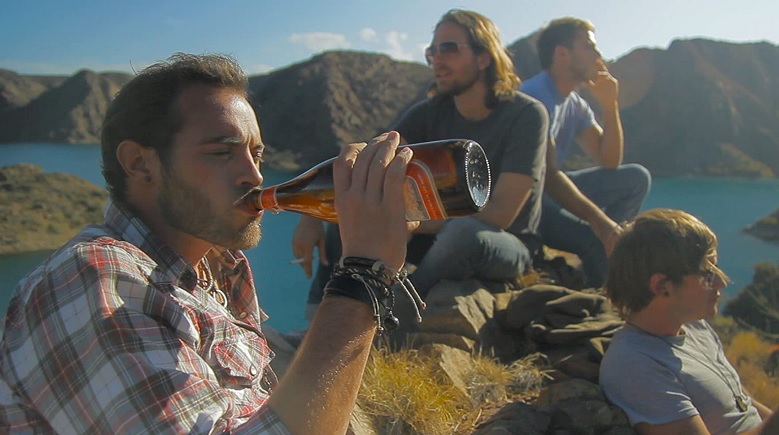
Our “rogues” are a trio of American indie musicians touring their latest album in Argentina — when they’re arrested for drug possession (pot, coke, prescription drugs) and property damage at their hotel. Unable to make financial restitution, and to escape deportation to the U.S. where they’d be locked up for their prior drug records, they accept sentencing to a rehab center for six weeks before their court date. But since these “Ugly Americans” can’t assimilate nor contribute to the rehab’s society, they’ll be kicked out and sent to prison by the end of their first week. So the band decides, with the help of Gabriel, a sympathetic, English-speaking native Argentinean (standout Italian-Argentine actor Leonardo Santaiti of the Divergent series), to shanghai an old kitchen-delivery truck and make a (causal) run for the Chilean border.
The most fascinating aspect of A Band of Rogues is, that unlike most indie films about an indie rock band’s adventures, the film’s music isn’t just plopped into the film willy-nilly: our wayward musician’s personal stories unfold as chapters analogous to one of the tracks on their album — a Beatlesesque acoustic album rife with ukuleles, mandolins, and upright basses, just like the indie ’90s used to make.
Dude, I really enjoyed this movie — and its music. It made me laugh. It made me smile. It made me contemplate. It made me remember my radio and band roadie days. A Band of Rogues is filmmaking at its finest brought to us from an exemplary contingent of filmmakers, actors and musicians who deserve bigger and better things in their respective careers. Remain encouraged, ye mighty band of analog and celluloid rogues. Keep that Tinseltown faith alive, my brothers, for we all walk a common road in our love of telling stories.
Courtesy of the You Tube page of Rocky Farm Studios, we discovered two of Morgan’s shorts: Volition(2008) and The Life of a Ditchdigger (2006). His third short is All the World is Crying Out (2007). You can learn more about T Jara Morgan’s work at his official website. You can keep up with the latest on A Band of Rogues courtesy of Indie Rights Films and at the film’s official Facebook page and website. You can stream the film on Amazon Prime or as a newly-debuted free with-ads stream on TubiTV, and enjoy the original soundtrack on Apple Tunes and Amazon Music.
About the Author: You can learn more about the writings of R.D Francis on Facebook.He also writes for B&S About Moviesand publishes short stories and music reviews on Medium.
Disclaimer: We did not receive a review request for this film. We discovered the trailer on social media, were intrigued by the film, and requested a screener. We truly enjoyed the film.
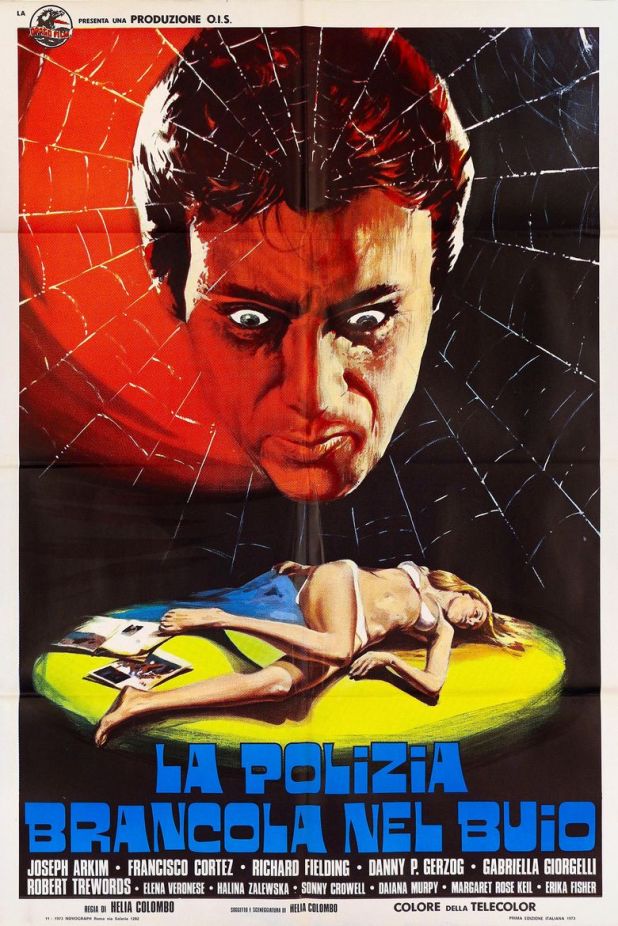
A young nude-model is stabbed to death with a pair of scissors, the third in a series of victims who had all had their photos taken by Parisi, a potentially mentally unhinged individual who claims that his camera can photograph people’s thoughts.
Director and writer Helia Colombo made one giallo and here it is, rarely seen outside of Italy until today. It really has the best title — The Police Are Blundering In the Dark — because if you think about it, the police never do a great job in these films.
Now, reporter Giorgio D’Amato meets his friend Enrichetta at the photographer’s villa, but when he arrives, he learns that she’s the model we watched die at the beginning of the movie.
She’d been begged by Parisi — who is in a wheelchair and looks quite frail — to come to speak to him about his magical camera. And just like Clue — you know, but with plenty of graphic murder and no short supply of nudity — we meet the suspects, ranging from Alberto the butler to the photographer’s lesbian wife Eleonora, his niece Sara and the sexed-up maid Lucia, who is the next to be killed.
I have no idea why that camera figures in, but maybe the filmmakers thought that Four Flies On Grey Velvet was going to force everyone to have science fiction photography as part of their plot, so they ripped it off. There’s also little police involvement, but it’s not like there’s an actual rule that giallo titles have to make sense. I prefer when they don’t.
You can get this as part of the Vinegar SyndromeForgotten Gialli Volume 1 set.
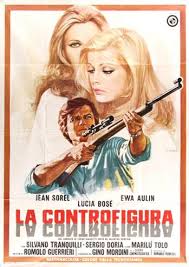
Giovanni (Jean Sorel, Perversion Story) is shot in an underground car-park by a mysterious man and as he dies, he flashes back on his life — including jealousy, adultery and worse — in this 1971 giallo known here as The Double.
While vacationing in Morocco with his stunning girlfriend Lucia (Ewa Aulin, Candy, Death Smiles On a Murderer, Death Laid an Egg), Giovanni grows jealous of an American named Eddie (Sergio Doria, Cave of the Sharks). In retaliation, he forces himself on Lucia’s mother Nora (Lucia Bose, The Legend of Blood Castle) and then becomes obsessed all over again that she’s also in love with Eddie. To top all of that off, he soon finds the American’s body in her apartment, so he disposes of the body to protect her. But if she wasn’t in the country when it happened, who killed the man?
Oh yeah, and between being caught in a mother-daughter triangle with Lucia and Nora, there’s also the gorgeous — and face-painted in one scene — Marilù Tolo to deal with.
Romolo Guerrieri also directed another giallo I really enjoyed, The Sweet Body of Deborah, and his artistic sensibilities elevate this film as well, starting with the Sunset Boulevard conceit of the main character getting killed off before we discover anything about him. And even more interesting is the fact that the more we learn of him, the less we like Giovanni.
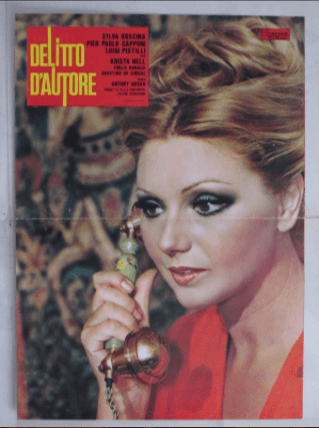
Translated as Crime of Author, this giallo has pretensions to high class, as it’s all about a wealthy countess named Valeria Volpi Gerosi has been warned that if she gives away a valuable painting that she will be killed. Instead, the painting is stolen, she is still murdered, her niece Milena (Sylva Koscina, Hercules, Lisa and the Devil, Deadlier Than the Male) is kidnapped and the police, as always, blundering in the dark.
Director Mario Sabatini also made A Gunman Called Dakota, Squillo, Sheriff of Rock Springs and Peccato Originale, as well as shooting second unit on 1989’s Blue Island.
 B&S About Movies
You must be logged in to post a comment.