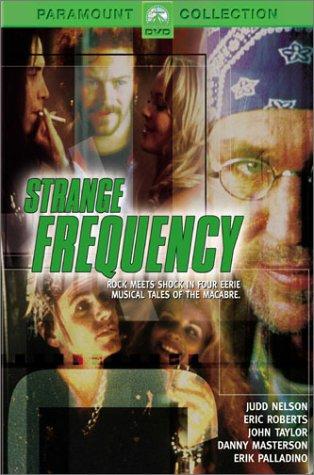
Mary Lambert (Pet Semetary) and Bryan Spicer (McHale’s Navy) came up with this VH1 series, of which this movie was the pilot and also provided four episodes. Unlike Tales from the Crypt, which used the old comic books for inspiration or the morality plays of The Twilight Zone or Night Gallery, this show turned to rock and roll to create its stories.
The Who’s Roger Daltry serves as the narrator for this first go-round, which originally aired on January 24, 2001.
The first story, “Disco Inferno,” finds two rockers stuck within their own personal hell — a disco that never stops playing the music they hate. Penthouse 1992 Pet of the Year Brandy Ledford appears, as does That 70’s Show actor Danny Masterson.
“My Generation” has Danny’s brother Chris matching wits with Eric Roberts (here he is again) as two serial killers with deadly taste in music.
“Room Service” has a real rock star, Duran Duran bassist John Taylor, who is trying to destroy his hotel room but the maid always fixes it.
“More Than A Feeling” has Judd Nelson as a music producer who keeps breaking new artists who sadly die right after they find their success.
Sadly, the follow-up series only lasted ten episode, with “Daydream Believer” never airing. It was a good concept, if you ask me. But then again, I love anthologies, so put another dime in the Mystic Seer, baby.
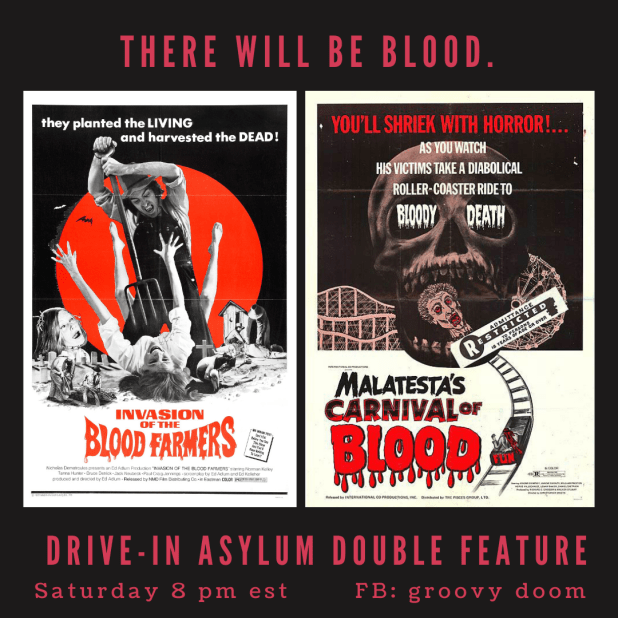
This Saturday, we’re back to the digital drive-in after a week off and we’re bringing two incredibly odd movies with us on Saturday at 8 PM on the Groovy Doom Facebook page.
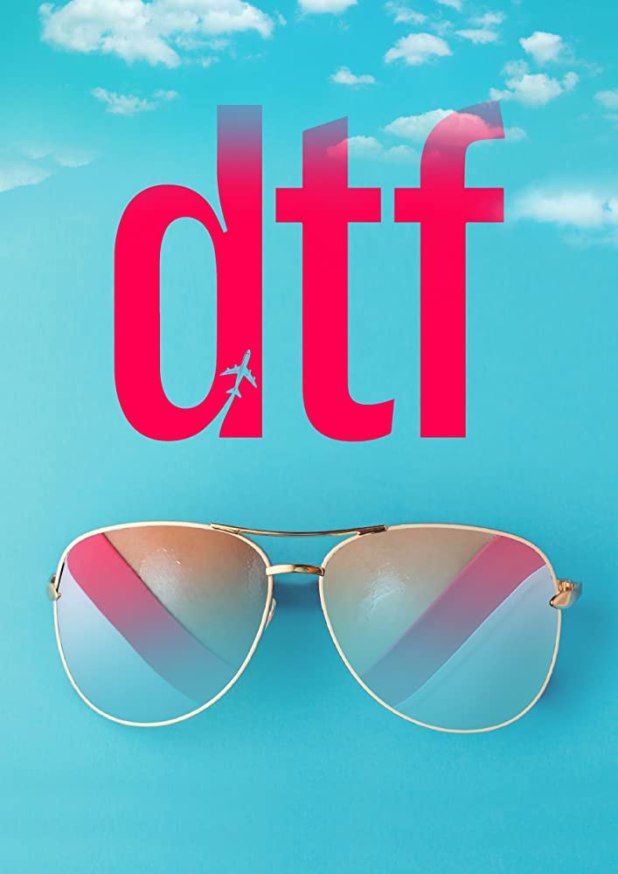
I’m not so sure I’d be friends with Al Bailey. Or if I was, I wouldn’t let him direct a documentary about my life. Or I’d at least not be a maniac like his airline pilor Christian.
Then again, I’m not an airline pilot constantly criss crossing the globe using Tinder to find new people to sleep with. I’m just a guy who likes to watch Spanish werewolf movies.
Over a year and a half, Al and Christian — a widowed airline pilot — meet up in various cities and countries in the pursuit of love for one night or at least a good buzz. This also puts their friendship to the test, which you’d think will probably not survive the pilot seeing this film.
That’s because while the materials for this film describe at as a quest for love, Christian succumbs — more than once — to the lure of easy sex and gradually becomes someone that the director no longer seems to like all that much. In fact, Al seems like he doesn’t even want to be part of his own film at times.
Things get worse after a trip to San Francisco and beyond the point of no return in Vegas, where Christian buys sex toys and even rubs a used one into the director’s face after drugging him at a club. Honestly, I started to wonder if the film was staged way before this point and I’m honestly not sure that it wasn’t. The punch up at the Denver Airport makes me think that either this is the best real footage ever captured or a really good version of a mockumentary.
I think you should honestly check it out for yourself. It’s not an easy watch, but I feel like no good documentary ever is.
DTFwill premiere at LA’s Dances With Films before being able to rent or own on September 15 on Amazon, iTunes, Comcast, Spectrum, Vudu and more. Thanks to its PR company for sending it our way.
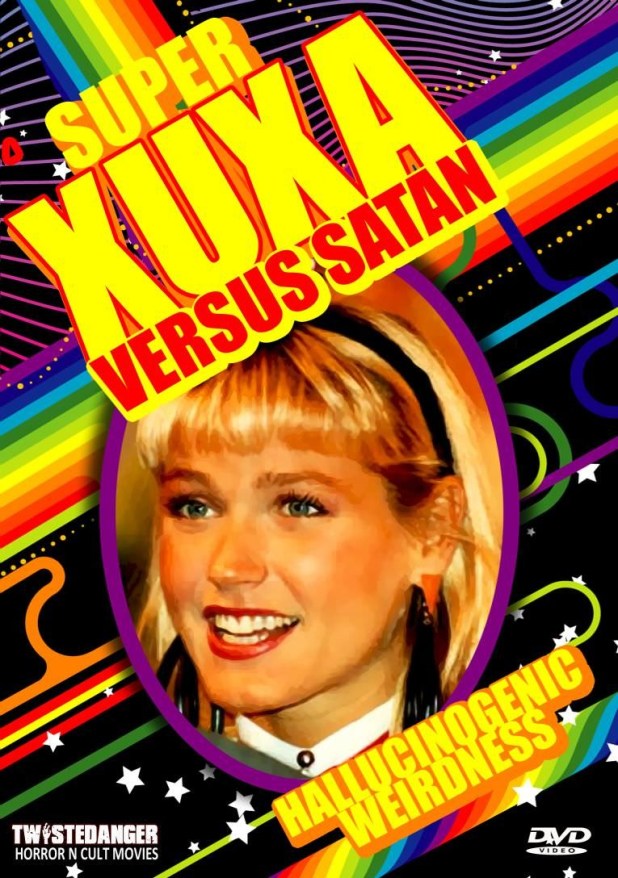
Despite starting her career starring in erotic films, Maria da Graça Xuxa Meneghel became known as Xuxa, the Queen of Children. With messages like “Want, Power and Reach!”, “Believe in Dreams” and “Drugs do Bad,” Xuxa has left a mark on the hearts and minds of kids all over the world in the same way that her Xuxa Kiss left lipstick on their faces. Her American-produced Xuxa show seems like the most action-packed, frenzied show of all time and sadly only lasted 65 episodes on The Family Channel. I’ve watched nearly all of them on YouTube and am thrilled that I was able to find this movie. Xuxa may not be well-known here, but in Brazil — and worldwide — she’s more than a star.
This movie is, to be perfectly honest, pure drugs.
Xuxa has angered the villain Baixo Astral — or Satan or the Bad Mood — by asking children to color the world. Working with his henchman Titica and Morcegão, he kidnapped her dog Xuxa, who yes, is really a puppet.
Xuxa, with the helmet of a turtle, a pink dolphin and a caterpillar, crosses through the River of Delusion, the Tree of Knowledge and all manner of traps to win the day, even if she’s tempted to the dark side.
As Xuxa would say, “I want to know if stars don’t fall from the sky, if somebody can answer what there is to fear?” If that makes sense to you, you’re going to love this movie as much as I do.
If Labyrinth wasn’t weird enough for you, perhaps this will be.
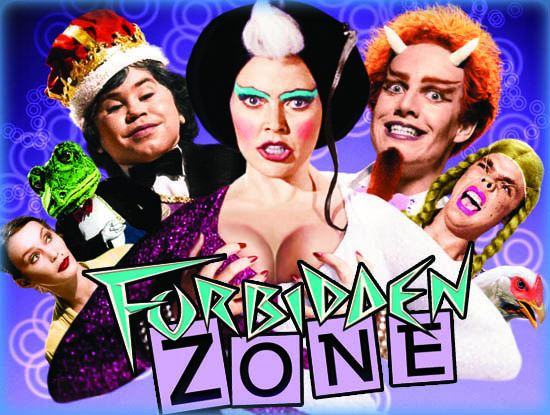
Somehow, Forbidden Zone was filmed in 1978 and 1979, but could really have come from any time after. It feels like a nuclear bomb that set off waves of influence well beyond and past its origination point. It was created by Danny Elfman and his childhood best friend, Matthew Bright, who would go on to make the two Freeway movies.
Based on the stage performances of the Los Angeles theater troupe The Mystic Knights of the Oingo Boingo, this is the kind of movie that everyone believed in, so much so that every SAG actor — including Hervé Villechaize, who even painted sets — gave their money back to keep the movie going (with the exception of Phil Gordon).
This was Elfman’s retirement from popular music to scoring films, as well as Oingo Boingo’s move from cabaret-style music to New Wave. It’s also astoundingly weird, even 40 years or more after it was made.
Richard Elfman, who started the Oingo Boingo troupe, directed this (he also made Shrunken Heads for Full Moon and used the pseudonym Aristide Sumatra to make the martial arts movie Streets of Rage). It’s literally an assault on all that anyone could hold dear, made in a time when rallying against values wasn’t crass or used to shove into people’s faces. It was a different time, I guess. That doesn’t excuse some of the worry that you’ll feel with seeing blackface, one of the few things that Elfman would take back, telling Dread Central, “From today’s perspective, if I could go back forty years, I certainly wouldn’t have included the brief blackface bits in Forbidden Zone. It was just one of hundreds of visual absurdities not at all important to the film and not worth its particular hot-button reaction. Although I have grown up in and around the African-American community (and have a racially diverse family), I don’t claim to know exactly what it is like to stand in a black person’s shoes and feel the effects of their particular oppression over the centuries.”
Man, how do I even explain this movie, one that starts with a Sixth Dimension hole inside a drug dealers’ house that leads to the kingdom of King Fausto (Villechaize) and Queen Doris (Susan Tyrrell)? I mean, for all the mindblowing things about this one, perhaps it isn’t even strange any longer to learn that Villechaize and Tyrrell had dated and warred throughout the making of this movie.
You get Warhol superstar Viva, a human frog, an apperance by Joe Spinell and Danny Elfman himself as Satan, all playing music from four decades or more before this movie was created. Marie-Pascale Elfman, who plays Susan B. “Frenchy” Hercules, also designed all of the sets and helped fund the movie by flipping houses with Richard, who was her husband at the time.
What started as black and white is now a colorized film that you can watch on Tubi. With it’s mixed of animation, song and dance, comedic violence and a willingness to offend in the most fun way possible, this is a movie worth setting aside time to view. Richard Elfman lost his house and all of his money making this happen, but after viewing it, I’m sure ypu’ll agree that it was all worth it.
Allan Arkush based most of his early films on his real life. Rock ‘n Roll High School is pretty much about going to New Jersey’s Fort Lee High School. And this film is all about his experiences working at The Fillmore East as an usher, stage crew member and in the psychedelic light show Joe’s Lights, which got him on stage with everyone from The Who, Grateful Dead and Santana to the Allman Brothers and Fleetwood Mac.
I have no idea what experiences helped shape Heartbeeps, Caddyshack II and Deathsport, which he helped finish.
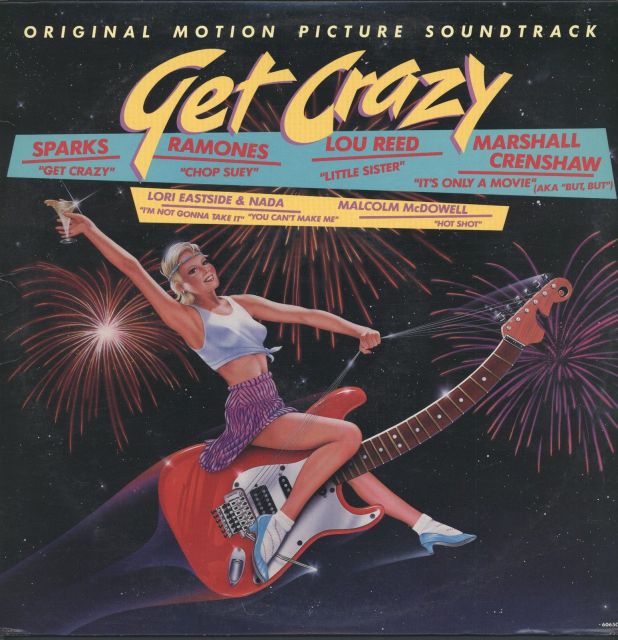
That said — Get Crazy lives in the exact heart of everything I love: hijinks movies, huge casts, rock and roll and cult films. It’s pretty much, well, everything.
This movie takes place on one night, December 31, 1982, as the Saturn Theater is getting ready for its annual New Year’s Eve blowout when its owner Max Wolfe (Allen Garfield, who sadly died of COVID-19 this past April) has a heart attack when arguing with concert promoter Colin Beverly (Ed Begley Jr.), leaving his stage manager Neil Allen (Daniel Stern) in charge, along with past stage manager Willy Loman (Gail Edwards). Man’s nephew Sammy (Mile Chapin) is trying to find his uncle so that he can get the rights to the club and sell them while everyone else tries to put on one last show.
This is a movie packed with familiar faces, like Bobby Sherman and Fabian as Beverly’s goons, who continually try to destroy the building and ruin the show. Seriously, there are so many people to get into, like Stacey Nelkin (Ellie Grimbridge!), Anne Bjorn (The Sword and the Sorcerer), Robert Picardo, Franklyn Ajaye, Dan Frischman (Arvid!), Denise Galik (Don’t Answer the Phone), Jackie Joseph (Mrs. Futterman!) and Linnea Quigley..
At this point, you may be saying, “Where are Clint Howard, Dick Miller, Paul Bartel and Mary Woronov?” They’re here. Of course they’re here.
I haven’t even gotten into the bands in this!
Nada (Lori Eastside from Kid Creole and the Coconuts) has a 15-member girl group that plays New Wave, garage rock, bubble gum and when Lee Ving jumps on stage, punk rock. Beyond Ving, Fear members Derf Scratch and Philo Cramer also appear.
King Blues is, well, the King of the Blues. He’s played by Bill Henderson (who was also Blind Lemon Yankovic and the cop in Clue, which also features Ving as Mr. Boddy).
Auden (Lou Reed!) is Bob Dylan, hiding from his fans, driving in a cab all night trying to write a song.
Reggie Wanker (Malcolm McDowell) is Mick Jagger, bedding groupies the whole show before he has a moment of mystic revelation. His drummer, Toad, is John Densmore of The Doors.
Captain Cloud (the Turtles’ Howard Kaylan) and the Rainbow Telegraph have a van just like Merry Pranksters and drugs just as powerful.
I mean, how can I not love a film that has a theme song by Sparks? Come on!
This was directed at the same time that Arkush did Bette Midler’s cover of “Beast of Burden,” complete with an appearance by Stacy Nelkin.
Anyways — forgive the fanboyishness nature of this. Actually. don’t. We should all love movies this much and feel this strongly about them.
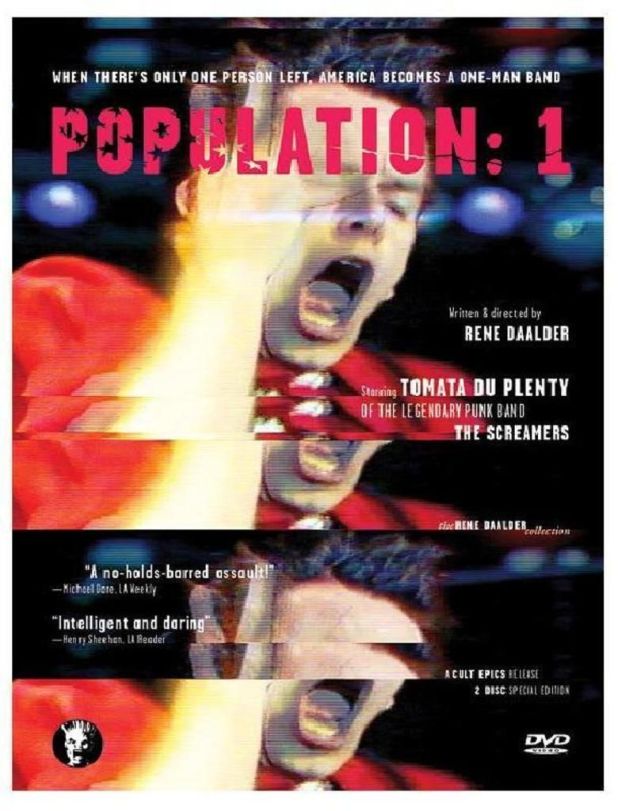
Rene Daalder made Massacre at Central High before becoming a pioneer of virtual reality and digital motion picture technologies. He started as a protege of Russ Meyer, even writing an initial script for Who Killed Bambi?, Meyer’s canceled film with the Sex Pistols (a movie that Russ explained to Roger Ebert, who wrote another script, “We can go wild on this. I’ve got a couple of big-titted London girls already in mind.”).
He also innovated what we would one day called music videos alongside Tomata du Plenty and the electropunk band The Screamers. In this film, Tomata is the last survivor of the end of the world, a defense contractor left alone to put together the history of the world.
This is a movie packed with musicians and artists, including El Duce, Carel Struycken (the giant from Twin Peaks, who was a producer and editor on this movie), production designer K.K. Barrett, Penelope Huston from The Avengers, composer and Beck’s father David Campbell, Fluxus artist and Beck’s grandfather Al Hansen, Beck and oh yeah, Maila Nurmi who we all know much better as Vampira.
It’s definitely an art project, but there are moments of real brilliance here, including the floating tools that follow Tomata and groom him for his State of the Union. It’s amazing that the tech in this was so advanced at one point, yet look quaint today. Such is the sadness of the forward progress of time.
Learn more at the official site or watch this on YouTube.
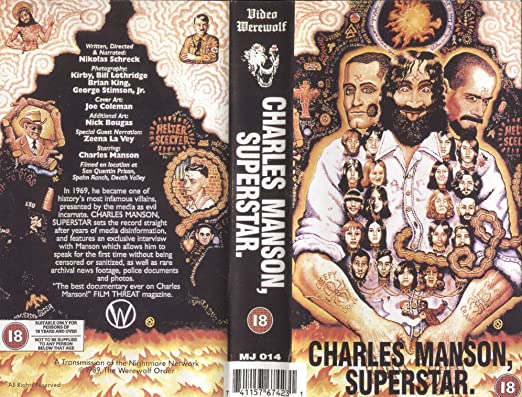
Nikolas Schreck founded the musical magical recording and performance collective known as Radio Werewolf, which also included his former wife Zeena LaVey Schreck. He’s also worked with NON, Death in June and Christopher Lee, with whom he conceived and produced the album Christopher Lee Sings Devils, Rogues & Other Villains.
Schreck also worked with the Church of Satan and was a member of the Temple of Set before renouncing Satanism in 2002. This film is part of his study of the philosophy, music and spiritual ideas of Charles Manson, including his ATWA ecology theory and Gnosticism. One of Schreck’s main beliefs is that Manson was set up by the media.
For example, Schreck states that the murders of Sharon Tate and the others were the result of a deal gone bad between Charles Watson and Jay Sebring. If anything, Schreck’s theories come from a researched place and not sensationalism, which is difficult to do when it comes to Manson.
This film features a 90-minute interview with Manson, edited down to what one can only surmise are the easiest to comprehend moments. The actual breakdown of his life and the influences on his mindset are much better, including the destruction of the claims in The Family that the Process Church had anything to do with Manson and the somewhat tenuous link between the Church of Satan and the subject of this movie.
That said, Manson comes off as, well, Manson. A dope who was able to win over impressionable teens and rock stars looking for some magic in the waning days of the hippies. The best part of it all is the Rising Forth ritual that LaVey used to hopefully bring about the end of the age of free love: “Beware you psychedelic vermin! Your smug pomposity will serve you no longer! We know your mark and recognize it well. We walk the nigh as the villain no longer! Our steeds await and their eyes and ablaze with the fires of Hell!”
For what it’s worth, LaVey did speak on Manson: “”These people are not Satanists. They are deranged. But no matter how many they do, they’ll never catch up with the Christians. We have centuries of psychopathic killing in the name of God.”
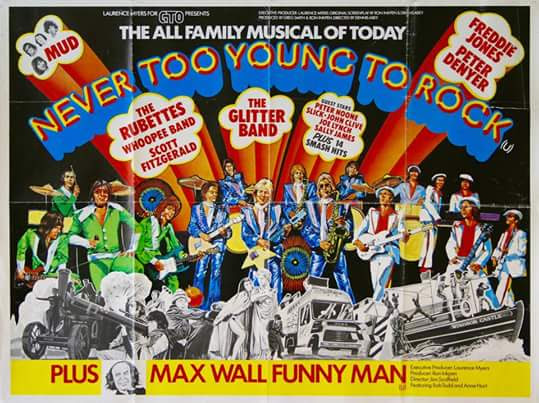
In the future, music is banned from TV. That leads to Hero (Peter Denyer) and his driver Mr. Rockbottom (Freddie Jones, The Baron from Son of Dracula, as well as appearances in Goodbye Gemini, The Satanic Rites of Dracula, Krull and many others) turn an ice cream truck into a Group Detector Van that can find pop groups that they want to play at a big concert that will save rock and roll.
If you’re a fan of the British glam scene of 1975 — including bands like Mud, Slik, Hello, The Glitter Band, Slide, The Rubettes, Scott Fitzgerald, Bob Kerr’s Whoopee band and The Silver Band — then you’re in the right place. In fact, Slik also has a very young Midge Ure before the days of Ultravox and Visage. Ure also wrote Thin Lizzy frontman Phil Lynott’s song “Yellow Pearl,” which was the theme for Top of the Pops, and co-wrote “Do They Know It’s Christmas?”
Mud are pretty fun, what with their wacky trousers and dance moves. And you may not know Hello, but you definitely know their song “New York Groove,” which was covered by Ace Frehley. The Glitter Band were also known as The Glittermen and were, of course, the back-up for Gary Glitter (the same creative team that made this movie also were behind Glitter’s film Remember Me This Way). The Rubettes were a studio band that had two hits, “Sugar Baby Love” and “Your Baby Ain’t Your Baby Anymore.” Their keyboard player Bil Hurd was in Suzi Quatro’s band. Bob Kerr’s Whoopee Band was an offshoot of the Bonzo Dog Band. Finally, Scott Fitzgerald represented the UK in the 1988 Eurovision contest — alongside Jigsaw’s Des Dyer, Julie Forsyth and her husband Dominic Grant — coming in second to Switzerland’s winning entry, “Ne Partez Pas Sans Moi” performed by Celine Dion. He’s best known for his song “If I Had Words,” which is in the film Babe.
This is one of those movies where my mother-in-law walks in and says, “What weird movie are you watching now?” and I find myself explaining how amazing mid-70’s British glam is to someone who has no idea what I’m talking about. Oh mama, weer all crazee now. And so crazee for it that we reviewed it twice, during our first “Rock ‘n’ Roll Week.” Yeah, it’s that fun!
Boy Howdy! Another rock-doc about Detroit? We’re still coming down from the high of Detroit’s Suzi Quatro’s career chronicle with the Australian-made Suzi Q. And how can we forget Louder Than Love, the chronicle on Detroit’s famed The Grande Ballroom?
Before the D.I.Y punk ethos of Britain in the late ’70s, that D.I.Y spirit began in the late ’60s with a staff of overworked and underpaid writers, editors, and photographers back by a mascot—Boy Howdy—a faux beer label designed by Robert Crumb, the underground comic book artist behind Fritz the Cat. (Crumb’s life and career is preserved in 1995’s Crumb; you can see Crumb characterized on film by James Urbaniak in 2003’s American Splendor.)
Originally known as Boy Howdy: The Story of CREEM Magazine, this Scott Crawford-directed rock doc chronicles the seminal music magazine from its 1969 launch in Detroit to the untimely death of its publisher Barry Kramer in 1981—and to the magazine’s 1989 demise. And the tale began in a ramshackle office in a burnt-out building in 1967 post-riot Detroit (when it ended: 43 people were dead, 342 injured, nearly 1,400 buildings had been burned and 7,000-plus National Guard and U.S. Army troops had been called into service) as the underground, counterculture newspaper rose to national prominence to go head-to-head with the “sellout” rock publication, Rolling Stone magazine. CREEM covered the bands the mainstream press dared to touch and gave said bands their first national coverage.
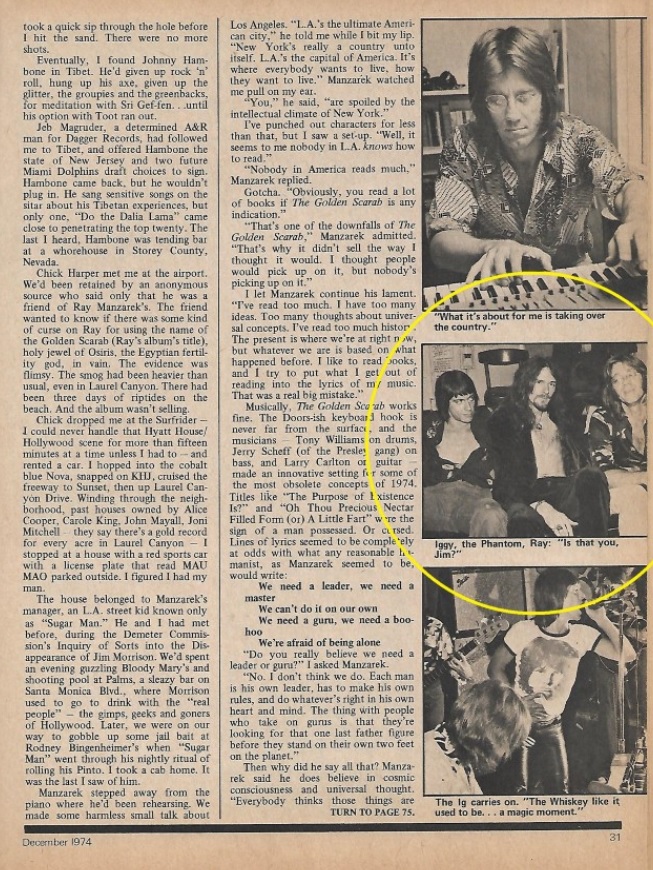
December 1974 issue of CREEM featuring Iggy Pop and Ray Manzarek with Jim Morrison’s fabled “ghost,” the Phantom.
While we get to see archive footage of the iconic Lester Bangs (portrayed on film by Philip Seymour Hoffman in 2000’s Almost Famous; Patrick Fugit was Cameron Crowe), along with those in the CREEM bunker and Detroit trenches with writers Crowe and Dave Marsh, along with Alice Cooper, Wayne Kramer of the MC 5, and Suzi Quatro—as any film on Detroit should—we get a little bit too much of the impressions and “what CREEM meant to me” insights from its musician-readers, such as Thurston Moore of Sonic Youth, Pearl Jam’s Jeff Ament, Chad Smith from the Red Hot Chilli Peppers, Metallica’s Kirk Hammett, Chris Stein of Blondie, and the J.Geils Band’s Peter Wolf.
Sure, those musicians played shows in Detroit and the magazine supported their early careers, but the film needed a little less of them and more from the Detroiters—regardless of their obscurity or lack of national fame—in the proceedings. Gene Simmons and Paul Stanley of KISS also offer their insights; however, not only was Detroit a major tour stop for—and early supporter of—the band, Simmons was a part of the “scene” as result of his clandestine recording sessions at Detroit’s Fiddlers Music with that studio’s engineer, Scott Strawbridge. (Scott Strawbridge discusses his Detroit reflections in the Medium article “Happy Dragons, Phantoms, Fiddlers, Rockets, and Spliffs: The Career of Scott Strawbridge.”) And do we really have to mention that KISS song?
While some of the Detroit scenesters I’ve spoken with from back in the day have their passionate qualms about the film, as to whom was in the film and who wasn’t, it’s my feeling those omissions are the result of the unavailability (and sadly, deaths) of those individuals and not cinematic ineptitude—not when one considers the filmmaking pedigree behind the film. Plus, I’d have to add: Clevelanders I know—who were close friends with the late Stiv Bators—were none too happy with Stiv (2019), the document on the late Dead Boys’ singer; in fact, MTV’s Martha Quinn, who dated Stiv Bators in the ’80s, was absent from the film.
And so it goes . . . you can’t please everyone when it comes to rock docs. There’s always going to be detractors who feel the film is “incomplete,” one way or another.
Screenwriter Jaan Uhelszki, an American music journalist who was the co-founder of CREEM, was one of the first women to work in rock journalism. Uhelszki’s August 1975 feature article, “I Dreamed I Was Onstage with KISS in My Maidenform Bra,” documents the night she performed in full costume and makeup with KISS—the only rock journalist ever to do so. She also traveled with Lynyrd Skynyrd for a feature article about their second-to-last tour (be sure to check out our review of the 2020 Lynyrd Skynyrd bio flick Street Survivors). And I’d have to point out: Jaan Uhelszki was born and raised in Detroit and worked as a “Coke Girl” selling sodas at The Grande Ballroom—yet, she does not appear in the documentary Louder Than Love about the Grande. (FYI: Suzi Quatro also started out as a “Coke Girl” at Detroit’s Hideout Ballrooms operated by Bob Seger’s manager, Punch Andrews.)
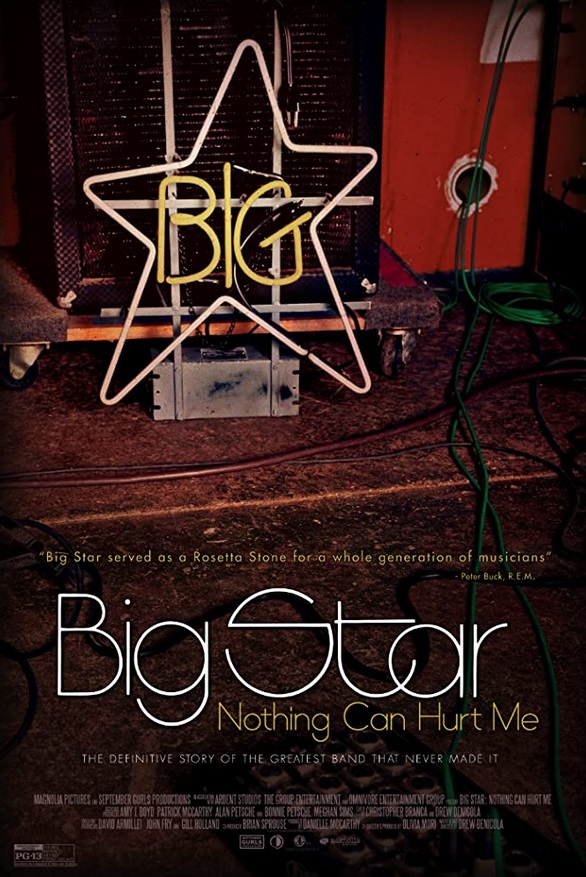
You’ve seen Jaan Uhelszki’s film work before with the absolutely stellar documentary about the tragic, unsung career of Chris Bell, along with Alex Chilton, with Big Star: Nothing Can Hurt Me (2012). (You can catch the film as a free-with-ads stream on TubiTV.) You can spend more time with Jaan and look through her photo archives at her personal website.
Director Scott Crawford made his feature film debut with the worldwide, critically-acclaimed document, Salad Days: A Decade of Punk in Washington, DC 1980-90. If you’re a fan of Bad Brains, Minor Threat (Ian McKay of Another State of Mind), and Scream (Dave Grohl’s band before Nirvana), then that film is a must watch. Crawford grew up in the Washington, D.C. area and published his own CREEM-inspired ‘zine in his teen years; he understands the mid-western D.I.Y ethos that also drove the punk scene of his hometown.
This is a truly great, American Rock ‘n’ Roll Movie about America’s Only Rock ‘n’ Roll Magazine. Watch it.
You can learn more at the film’s official website and you can stream it at Amazon Prime, You Tube Movies, and other VOD platforms. For the hardcopy version, you can check out CREEM writer Robert Matheu’s 2007 book of the same name, available on Amazon.
Update: As of November 24, throughout the U.S. and Canada, you can purchase the DVD of CREEM: America’s Only Rock ‘n’ Roll Magazine through Kino Lorber. You can learn more about Kino Lorber’s complete roster of films at their official website and Facebook, and watch the related film trailers on You Tube.
From the Shamless Plugs Department: Since we’re on the subject of Detroit rock ‘n’ roll and honoring those fading memories of the musicians and the times: I wrote two books about the 1974, Detroit-born mystery and myth of Jim Morrison’s etheral doppelganger, The Phantom—with the books The Ghost of Jim Morrison, The Phantom of Detroit, and the Fates of Rock and Tales from a Wizard: The Oral History of Walpurgis. Both books are available worldwide through all online retailers for all eReader platforms, and as Amazon-exclusive softcovers.
About the Author: You can learn more about the writings of R.D Francis on Facebook.He also writes for B&S About Moviesand publishes on Medium.



 B&S About Movies
You must be logged in to post a comment.