Slipstream (1973)

“If I ventured in the slipstream
Between the viaducts of your dreams.”

— Van Morrison, “Astral Weeks” (1968)

My attendance of the recent Saturday Night Drive-In Asylum Double Feature Watch Party on September 5 — which featured The Redeemer (1978) — brings us to this review. And I have to admit that, until this most recent viewing of The Redeemer and digging deeper into the film’s history, I had no idea of that occult-slasher’s connection to this Canadian radio drama by way of actor Michael Hollingsworth. If we are to believe the digital content managers at the IMDb, Hollingsworth, in the role of the hippy Billy, made his acting debut in Slipstream—and vanished from the business after his portrayal of the gay actor, Roger, who met his fate at the hands of The Redeemer.

The writer of Slipstream, William Fruet, aka the “Roger Corman of Canada,” is a name oft mentioned around these ‘ere parts of Steel Town, U.S.A., if not in a direct review, such as for his works Funeral Home, Baker County, U.S.A., Killer Party, and Blue Monkey, we’ve mentioned his work in passing within the context of other canuxploitation flicks.

One day, we’ll get to three of my personal favorites of Fruet’s oft-run, ’80s HBO and Showtime oeuvre with the Perry King and Don Stroud Vietnam-slanted serial killer drama, Search and Destroy (1979), the Peter Fonda and Oliver Reed-starring giant serpent romp, Spasms (1983), and, what I consider Fruet’s crowned jewel: the home-invasion classic, House by the Lake, aka Death Weekend (1976), which also stars Don Stroud, along with Brenda Vaccaro as the damsel-in-distress. Of Fruet’s seven writing credits, among his thirty-nine directing credits, he directed House by the Lake and Spasms. He already proved his skills as a director on his first feature film: Wedding in White (1972), a film starring Donald Pleasence and Carol Kane which he also wrote. Why the reins of Slipstream were turned over to first-time director David Acomba, who never expanded his recognition beyond the Great White North’s borders, sans his work on The Star Wars Holiday Special (1978), is a reason lost to the ages.

Now, looking at the theatrical one-sheet, we’re sure your eyes perked up at the sight of Macon, Georgia-born actor Luke Askew, who first came to widespread acclaim with his role as Boss Paul in his third feature film, Cool Hand Luke (1967) starring Paul Newman, and the Charlton Heston western follow-up, Will Penny (1967). In addition to appearing in the war flicks The Devil’s Brigade (1968) alongside William Holden and The Green Berets (1968) with John Wayne (Hey, Pops!), Askew delved into Italian spaghetti westerns as a first-time leading man with Night of the Serpent (1969), and the annals of bikerdom with the likes of Easy Rider (1969), and Angel Unchained (1970) with Don Stroud. By the time of his role as troubled DJ Mike Mallard in Slipstream, Askew began his long-fruitful transition as a well-respected U.S. television actor, appearing in both series and TV movies. But Askew took the time to work with David Carradine in The Warrior and the Sorcerer (1984) and Ciro H. Santiago’s Mad Max rip, Dune Warriors (1991). Oh, and there’s Paul Schrader’s Rolling Thunder (1977) with William Devane.

Yeah, we could go on and on with all of the great movies we’ve watched with the late Luke Askew. . . . Oh, almost forget: he was a recording artist that Bob Dylan likened to blues great Bobby Blue Bland.

And that brings us to this Canadian film that’s mismarketed as “featuring” the music of Van Morrison and Eric Clapton”; in reality, it features only a snippet of one Morrison song — the title cut from his breakthrough album Astral Weeks (1968) that bookends the film — and one Clapton song in its entirety — “Layla” from Derek & the Dominos.

Askew is Mike Millard, a popular but brooding-reclusive Albertan DJ who runs his popular pirate radio station from a remote wilderness farmhouse. As with Clint Eastwood’s Dave Garver on KRML in Play Misty for Me (1971), Millard is all about mood; he spins off-beat tunes interjected by poetic passages that connect with the youth counterculture. Millard’s soul rolls with the independent spirit of Wyatt Williams from Easy Rider; in lieu of a motorcycle, Mike uses the airwaves; his on-air style is one where he sticks the studio’s microphone outside the window to capture the sounds of a thunderstorm as he begins the refrains of “Layla” by the then “hot” Derek & and the Dominos.

The mysticism and mystery of his secluded broadcasts — a gimmick devised by his producer to develop an audience — has led his listeners painstakingly searching the wilds of Alberta to find him — one listener, Kathy, does, which Mallard begins to romance. Adding to Millard’s aggravation: as the show’s popularity grows, his producer wants him to play “more commercial music,” so as to expand the audience even more — even if it alienates the listeners who made his career.

Unlike the genre’s most popular film, the Michael Brandon-starring FM (1978), William Fruet dispatches with that radio chronicle’s slapstick moments for an introspective examination on the psychology; the need of a DJ being on the air and the responsibility of connecting with one’s audience through integrity and not gimmicks; about the creative, audio war where the commercial needs of the bean counters clashes with the artistic needs of a radio station’s airstaff. Fruet’s anti-hero soon comes to realize the allure of the “glass booth” that once gave him freedom is now a psychological prison.

The walls of that prison become more evident as the now emotionally-crumbling Mallard shatters the illusions of his beloved on-air persona with a half-baked interview that crushes the fandom of a young journalist-fan who successfully tracked down his broadcast.

As with most Canadian-made films, the recently reviewed Terminal City Ricochet in particular, Slipstream had a virtually non-existent VHS release south of the border and no (possibly limited; I never seen it) UHF-TV or ’80s HBO or Showtime replays. This is one of those films that — being a radio DJ and big Luke Askew fan, with a desire to see this lost Canada radio drama — I had no choice but to purchase it as a grey market taped-from TV VHS. And as with most of those back-of-magazine grey market distributors utilizing low-grade VHS tapes in multi-packed, shrink-wrapped bricks and churning out copies via high-speed dubbing machines, I lost that cherished copy of Slipstream to the blue screen of death. Chatting with one of my Detroit-based radio contemporaries who’s lived in Canada for a number of years, tells me Slipstream has never been issued on DVD and rarely airs on Canadian TV; not only has it been years since he’s seen it on TV, he hasn’t seen a VHS for as long.

My hats off to Bill Van Ryn of Groovy Doom and Sam Panico of you-know-who for their joint Drive-In Asylum Double Feature Watch Party nights and screening The Redeemer, affording me the opportunity to revisit a radio film — and one of my favorite films overall — that is truly lost for the ages.

About the Author: You can learn more about the writings of R.D Francis on Facebook. He also writes for B&S About Movies.
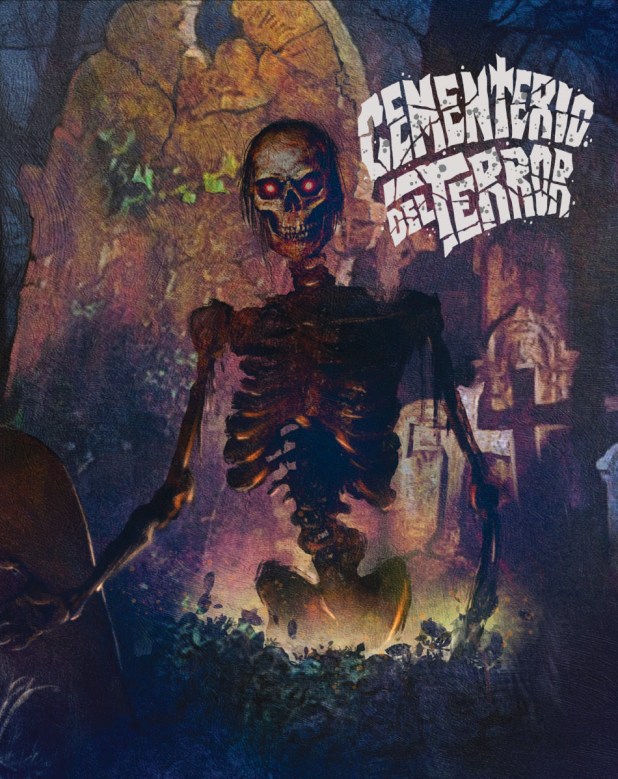
REPOST: Cementerio del Terror (1985)

EDITOR’S NOTE: This is now on Shudder!

We couldn’t be more excited that Vinegar Syndrome is releasing this astounding blast of Mexican VHS horror on blu ray. If you love Fulci-esque blood-splattered movies that leap genre and feel through their running time, you need to see this movie. This article originally ran in Drive-In Asylum #19, which you can buy on their etsy store

I was hunting for the perfect movie for this issue of Drive-In Asylum. My goal with each thing I write for this twisted tome is to discover something new. A film that perhaps people have missed. And certainly one that no one is talking about.

Cementerio del Terror is the perfect movie to answer all of those needs and more.

Directed by Rubén Galindo Jr., who also helmed the utterly baffling Don’t Panic! and Grave Robbers, this película de terror combines so many influences and films that it feels like the best DJ mix you’ve never heard of Evil Dead, Halloween and a children’s film while still boasting all of the grisly rojo gore that you crave.

Set in Texas, filmed in Spanish and utterly unconcerned with things like good taste or common sense, this movie appeals to every level of what I demand in cinema. Let me set it all up for you, muchacho: Dr. Cardan (Hugo Stiglitz, whose half-century movie career has led to roles in beloved junk like Tintorera…Killer SharkGuyana: Cult of the Damned and Nightmare City) has left behind the scientific method to become a religious maniac determined to stop Satan himself from resurrecting the dead.

Then there’s Devlon, who has just killed seventeen people and his parents before being stopped by the police. Dr. Cardan knows that this is the exact body that El Diablo needs to begin his nefarious scheme, screaming “He’s not a man like you and me – he’s a demon!” as if he’s the Loomis to Devlon’s Miguel Myers.

If only six hard-partying teenagers armed with a book of spells didn’t steal the body of said serial killer. If only they hadn’t taken it to la casa junto al cementerio. If only they hadn’t accidentally raised the living dead.

This is the leap in logic this movie demands that you make: These sexy ladies were promised a rock ‘n roll concert by these moronic men and they make due with the body of a dead convict and rituals in a graveyard. These women were promised a rock concert and a jet set party and are instead rewarded with a bearded zombie who uses his fingernails to massacre every single one of them.

Everyone dies in the most bloody fashion possible, but only after they drink and dance to some of the worst disco you’ve ever heard, which makes this movie even better.

Just when you say to yourself, “The entire cast of this movie is dead!” a bunch of kids, led by one in a Michael Jackson tour jacket, enter the house and comically discover the disemboweled bodies of every one of the Satanic teens before they face off mano y mano with Devlon himself.

Throats are slashed. Blood is sprayed. Axes find their way into faces. Entire rooms get possessed. Kids goof around and hide behind tombstones as the film wildly shifts tone and becomes the goriest episode of Scooby-Doo ever.

Cementerio del Terror is unbridled joy, made by someone who it feels like got to play with all the toys that he always dreamed of owning. It shamelessly steals from so many films that it makes you throw up your hands and enjoy the ride. I mean, how many movies start off with buckets of crimson viscera and end with little kids saving the day before tossing in a shock ending?

There is no cynicism here, no winks to the camera that horror needs to be elevated and escaped from. That’s why I seek out stuff like this. These kind of flicks are a drug that I try and mainline into my veins at any opportunity. I suggest you do the same.

Rock and Roll Fantasy (1992)

Before he helped start The Asylum, David Michael Latt made this sex comedy which way more comedy than sex. Attila plays Jamie Z., a rock star who is too much of a headache for his manager, so he’s marked for death. He lives in a girl’s sorority and you’d think that’d be the recipe for way more hijinks than it is, but nope. Perhaps I’ve been spoiled by the excessives of 1980’s post-Porky’s madness, but this was too tame, too simple and, well, too filled with actors literally screwing up their lines and it not being edited.

There are many early 90’s direct to video and cable ladies on hand, such as Avalon Anders, as well as April Lerman, who was on Charles In Charge before ending up here in her last acting role.

I want to find something to like here, something to make it all worthwhile. But sometimes, there is nothing but entropy and the void. The more you stare at it, the more it screams back in your face.

You can watch this on Tubi.

Rialto (2019)

Colm is in his mid-40’s, married, has two teenagers and has never gotten over the death of his father. He doesn’t get along with his own son and his job is falling apart while his wife has no real interest in him. You can see why he’d drift into another world and find comfort in the hidden sex he has with a prostitute named Jay. This is his story.

Between drinking and risky sex, Colm (Tom Vaughan-Lawlor, Thanos’ henchman Ebony Maw in the last two Avengers movies) finds something in Jay (Tom Glynn-Carney, Dunkirk) that he can’t find anywhere else. Whether or not his life emerges in one piece doesn’t matter any longer.

Based on the play Trade, a play written by Irish playwright and screenwriter Mark O’Halloran (GarageAdam & Paul), this is another very human movie from Peter Mackie Burns, whose Daphne was another tale of a life in crisis that needs a major change. The sex between the men isn’t even about sex or money or power by the end, but the shared need of a moment that allows them escape the pressures of being men, of being fathers, of expectations and worries and disappointments.

Rialto will release to digital cinemas Friday, September 18 and on demand and on DVD Tuesday, October 20. We were sent a copy by its PR agency, but that has no bearing on our review.

Valley Girl (2020)

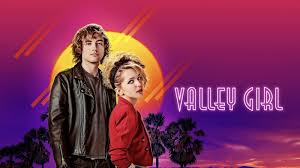
The new version of Valley Girl sat on the shelf for about two years, supposedly due to the bad publicity surrounding Logan Paul, but his role is so minor, I’m certain that’s not the issue. The sad fact is that this is not a good film. Whereas the beauty of the original film is that it could completely be a cash in on a hit song and it has a heart all its own, this movie depends on 80’s songs to give it any identity outside of a pale shadow of Pitch Perfect.

That said, I really like Jessica Rothe, as she made Happy Death Day worthwhile and she does her best here as Julie Richman, our lead (Alicia Silverstone shows up as the older version). Josh Whitehouse has the hardest job, trying to fill the shoes of Nicolas Cage, which isn’t easy or even possible.

At times, this wants to be a shot for shot remake. Then it wants to remove any of the controversies of the first movie, like Suzi and her stepmother fighting for the same guy. It wants you to remember the past, as E.G. Daily plays heel Mickey’s (Paul) mom and Deborah Foreman shows up in a cameo. But as happy as I am to see Judy Greer and Rob Huebel, they are wasted as Jessica’s parents, whose nuanced characters from the original have been jettisoned. There’s also a very Scott Pilgrim nature to Randy in this film, right down to the lesbian bandmate who is his wingman.

You know how you know it’s bad? Cage turned down a cameo. Yes, we’ve finally found the movie that the California Kinski will not be in.

Valley Girl (1983)

Valley Girl should be a joke.

It should be a cheap cash in on the novelty song that Frank Zappa had recorded with his daughter Moon Unit. Recorded when she was just 14 and appearing on his album Ship Arriving Too Late to Save a Drowning Witch, it’s his only top 40 hit despite a career in music.

It’s not typical Zappa, staying mainly in conventional 4/4 time (until the end) and being mainly all about the conversations Moon Unit had overheard at the mall, but meant to be a deliberate attack on typical Valley Girls.In fact, Zappa saw the San Fernando Valley as “a most depressing place.”

While he was distressed that this song would make hi a novelty act, Zappa did try to see if a film could be made. He’d later try to stop production of the film through a lawsuit, claiming that it infringed on his trademark.

Regardless, no one got the point of the song. It wasn’t cool to be a Valley Girl. Try telling that to everyone else.

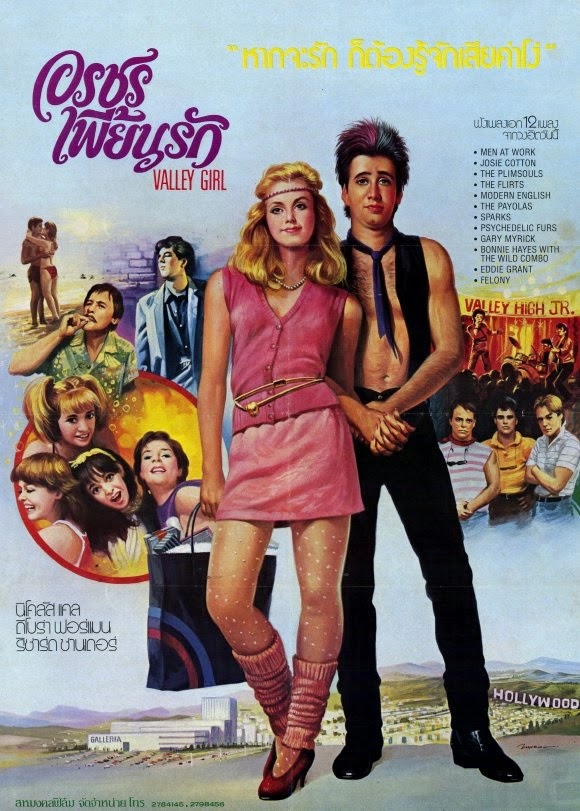
Speaking of music, the songs in this movie ended up costing $250,000 over the film’s $350,000 budget. As a result, some of the clearances — like “Who Can It Be Now?” by Men at Work, which was replaced by Josie Cotton’s “Systematic Way” — changed the songs and ended up canceling the original Epic Records soundtrack. Some copies did get out and there’s also a bootleg with the title Valley Girls that are both collectors’ items. There was a six-song mini-LP that Roadshow Records — a one-off Atlantic imprint — put out and that was all fans got until 1994 and 1995, when Rhino released two CDs of the movie’s songs.

The songs are what drive this music, as it’s powered by KROQ, taking that station’s playlist to the entire county with standouts like Cotton’s “Johnny Are You Queer?,” Bonnie Hayes’ “Girls Like Me,” The Plimsouls’ “A Million Miles Away,” The Payolas’ “Eyes of a Stranger” and, of course, Modern English’s “I Melt With You,” which appears twice in the movie. Director Martha Coolidge heard it on the ROQ and felt that it was the song for her story, but since the station didn’t announce songs, she was forced to call them and sing it to have it be identified. Cotton, the Plimsouls and the Psychedelic Furs all show up in the actual movie, too.

The actual story is a mix of Romeo and Juliet with an allusion to The Graduate at the end, as the Valley side — Sherman Oaks Galleria being their Mecca (and the home of CommandoChopping Mall and many, many other films) — is represented by Julie (Deborah Foreman, whose credits endear her to horror fans everywhere with April Fool’s Day and Waxwork on her resume) and Hollywood being personified by Randy (California Kinski Nicolas Cage). Their relationship begins as just looks at a beach — hints of Grease, huh? — but progresses to show the difference between classes that has only grown since 1983.

There’s also a subplot between Suzi (Michelle Meyrink, the female nerd Judy in Revenge of the Nerds) and her stepmother Beth (Lee Purcell, Necromancy) vying for the same boy. A more conventional relationship exists between Julie and her parents (Coleen Camp, who has been in everything from the Police Academy series to Wicked StepmotherSliver, Apocalypse Now and The Swinging Cheerleaders along with Frederic Forrest, who was also several Coppola films, including One from the Heart), who despite owning a health food business really want their daughter to experience life.

Joyce Hayser is also in this and she’s made quite the career of showing up in teh pop culture moments of my life. She’s the girl in the Dan Hartman video for “I Can Dream About You” (which comes from the soundtrack for Streets of Fire), she’s in the strange as hell Saturday Night Fever sequel Staying Alive and if you were 13 in 1985, you’d know her as Teri/Terry from the cable juggernaut Just One of the Guys.

Oh! Valley Girl has even more! E.G. Daily — who would also appear in the aforementioned Streets of Fire, a movie that I cannot implore you enough to watch — is here. Most folks know her as Dottie from Pee-Wee’s Big Adventure, but she was also in Better Off Dead, provided the voice for Babe the Pig and Tommy Pickles on Rugrats, was in the video for Rod Stewart’s “Young Turks” and was Sex-Head in Rob Zombie’s 31. She also dated Jon-Eric Hexum before his untimely death and was married to Rick Salomon. Yes, the same guy in the Paris Hilton sex tape, who was also married to Pam Anderson and Shannen Doherty. Hollywood is crazy.

The club scenes in this movie were shot at a place that was once called Filthy McNasty’s and The Central. Today, you would know it as The Viper Room. Seeing the Sunset Strip in this movie made me dream of one day being there, surrounded by all this energy and rock and roll. I mean, just look at the marquees — Kitten Natividad is dancing!

Mona et Moi (1989), aka Mona and I

Guitarist Johnny Thunders and vocalist David Johansen were the garage-punk coefficient of the Rolling Stones’ “Glimmer Twins” Keith Richards and Mick Jagger. They were the “Toxic Twins” before Aerosmith’s Joe Perry and Steven Tyler. Before there were Sex Pistols, there were New York Dolls. As with those British-screaming snots, the “Gemini Snots” defined a scene: the ‘Dolls were New York. Bands such as Siouxsie and the Banshees, formed out of “The Bromley Contingent,” the Sex Pistols’ fan-clique based around London’s 100 Club. The Buzzcocks (!) birthed because of the ‘Pistols. There’d be no Clash or the Ruts or the Stranglers without ‘Pistols. In New York, bands formed out of the ‘Dolls’ audience at The Bowery-based CBGBs. There’d be no Blondie, Ramones, Television, or Talking Heads without the Thunders-Johansen dichotomy.

But not every gunslinger of the six-string electric is destined to be Thomas Edison: sometimes you’re Nicola Telsa.

While their Todd Rundgren-produced (Meat Loaf’s Bat out of Hell was the ex-Nazz leader’s big one; he produced Sparks (of Rollercoaster fame) as well) eponymous debut on (Mercury, 1973) is regarded as a “rock classic,” no classic rock radio station will ever play them. (Nor will any of today’s alt-rock stations spin the ‘Dolls’ as “golds” analogues to classic rock radio’s spins of the Rolling Stones.) The ‘Dolls’ debut was—as with most “innovators”—a resounding marketing failure compounded by the release of their appropriately-titled sophomore-final, Too Much Too Soon (Mercury, 1974). And, with that, the New York Dolls—along with, to an extent, their Detroit-based inspirational precursors the MC5 and Iggy and the Stooges—singlehandedly soured major records labels on punk snot . . . at least until some blonde-haired kid from the Pacific Northwest decided (well, the X-Generation decided) to become the new Jim Morrison. By the time the Sex Pistols first took to the stage in 1976, the ‘Dolls’ were punk vestiges, but not enough in ruins that megla-Svengali Malcolm McLaren (The Great Rock ‘n’ Roll Swindle) didn’t want to sink his fangs and extract the last ounce of snot. But it gave him the idea to “form” the Sex Pistols <eye roll>, so it all worked out.

In the midst of the fad-driven major-label mania over rock “supergroups” (that run the gambit from Blind Faith in the 60’s to KBG in the ‘70s to Asia—the last of them—in the ‘80s), there was (before some kid named Tom Petty absconded it as a suffix-moniker) (The) Heartbreakers—a ‘Dolls’ phoenix stoked by Johnny Thunders and Jerry Nolan with ex-Television (formed out of the ‘Dolls’ audience, natch) bassist Richard Hell. As with all supergroup outings (Fastway comes to mind: UFO’s Pete Way was out before Motorhead’s Fast Eddie Clark and Humble Pie’s Jerry Shirley recorded their debut album proper and became the “No False Metal” voice for Sammy Curr in Trick or Treat), Hell was out before Thunders and company recorded their first album in England (where the ‘Dolls’ had a rabid fan base as much as they had an indifferent fan base in America), L.A.M.F (1977). And, with that, Richard Hell was off to form the Voidoids.

Could you imagine—if he wasn’t so ambivalently indifferent in perpetuity—Kurt Cobain being talked into taking an acting role, say like the Kurt-divergent Eddie Vedder appearing in Cameron Crowe’s “grunge Friends” flick, Singles?

Well, Thunder’s ex-Heartbreakers’ mate Richard Hell used his infamy for a quick stage-to-film transition in Blank Generation (1979). It would be a decade before Thunders repeated the cinematic leap made by Hell (and Debbie Harry in Union City, Iggy Pop in Cry Baby, or the Ramones in Rock ‘n’ Roll High School)—and Thunders had to cross an ocean to do it.

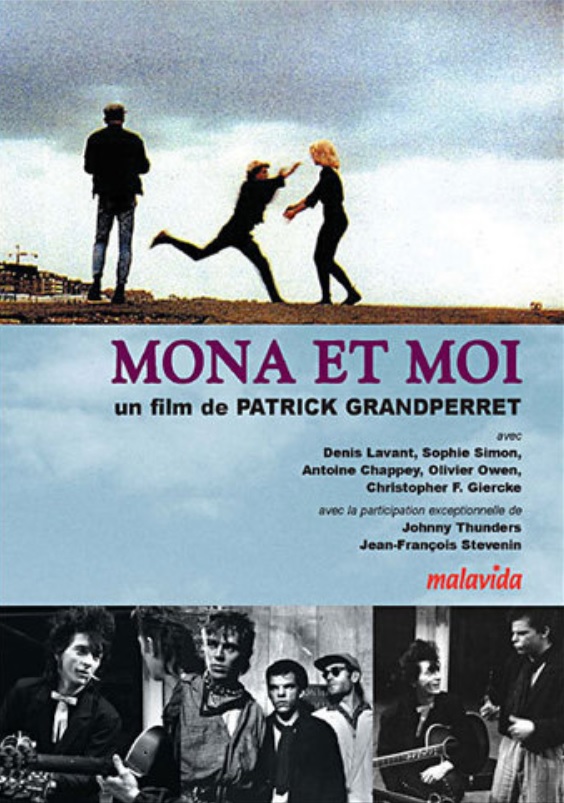
Initially shot in 1984 in a start-stop-start, financially-plagued production schedule (and released three years before his 1991 New Orleans death; it was released in 1988 in France; then Europe in 1989), this acting debut by Johnny Thunders is, needless to say, an extremely rare VHS that’s impossible to find outside of its native country of origin. Alongside with a little-to-nothing to say Jerry Nolan and Billy Rath from Heartbreakers, Thunders stars as Johnny Valentine: a troublesome New York rock star (not far removed from his own self, natch) that’s left in the charge of a music manager assigned to “babysit” the hard-living artist for a week. The thin premise for the drama is a down-and-out rock promoter flying Johnny into Paris to headline a concert. The romantic triangles tinkle as Thunders falls in love with Mona, the manager’s girlfriend. And if that sounds a lot like the character and pseudo-plot of Richard Hell’s Blank Generation, then it probably is. And if the “babysitting” manager angle sounds too much like Get Him to the Greek (with Russell Brand’s obnoxious-oblivious-rocker Aldous Snow—only with less heroin sheik and more Apatow raunch), then it probably is.

While Hell was clean (we think) and coherent in his role in Blank Generation, it’s hard to watch Thunders swagger-stagger through the film either drunk, stoned—or both. Regardless of the cool factor in having one of punk’s forefathers in an acting role (and truth be told, Thunders isn’t half bad at it), it’s nonetheless heartbreaking (sorry) to see a clearly broken Thunders squeezing out (or manipulated into) his last ounce of fame infamy—especially when considering the mainstream film appearance of his clean and sober ‘Dolls’ mate David Johansen in hit films such as Scrooged and Married to the Mob.

While Thunders was (always) a musical-footnote oddity in the States, he was, nevertheless, a celebrity in France—alongside ex-U.S. punks Stiv Bators of the Dead Boys and Willy DeVille of Mink DeVille. So, in that country, he continued to record and perform in concert—long after the early ’70 glam and late ‘70s punk halcyon days. In a historical twist, his solo debut, So Alone (1978), featured the backing of ex-Pistols Steve Jones and Paul Cook. Director Lech Kowalski (D.O.A) examined the troubled life of Thunders in Born to Lose (1999) and offered additional insights with the direct-to-video New York Doll. The Polish director also shot and recorded a pair of shows with Thunders for his heroin-document Gringo, aka The Story of a Junkie; while that film-music partnership floundered, the footage ended up in Lech’s subsequent Thunder-documentaries.

An extremely clean rip of the Mona Et Moi—with subtitles—is offered on the You Tube page of Cult Fusion TV — and we found an extended clip to enjoy. You say you need more Johnny Thunders? Then check out the fictitious take on his life with Room 37: The Death of Johnny Thunders, available on DVD/Blu-ray and Amazon from Cleopatra Entertainment.

About the Author: You can learn more about the writings of R.D Francis on Facebook. He also writes for B&S About Movies.

Lisztomania (1975)

Honestly, this movie is crazy. I have no idea how Ken Russell talked people into giving him money for this.

Actually, I do. David Puttnam’s Goodtimes wanted to make six movies about composers with Russel, with the first being 1974’s Mahler. He also planned to make films of Vaughan Williams, Berlioz and Gershwin, which was to star Al Pacino.

There was just a 57-page script and Puttman and Russell weren’t always on the same page. Seeing Liszt as the first rock star — the term Lisztomania refers to the sexual mania that female fans felt when in his presence — led to Russell making a movie where he eventually felt that “The symbolism…is a bit too relentless and the fantasy sequences tend to submerge the reality of the characters.”

Well, yeah.

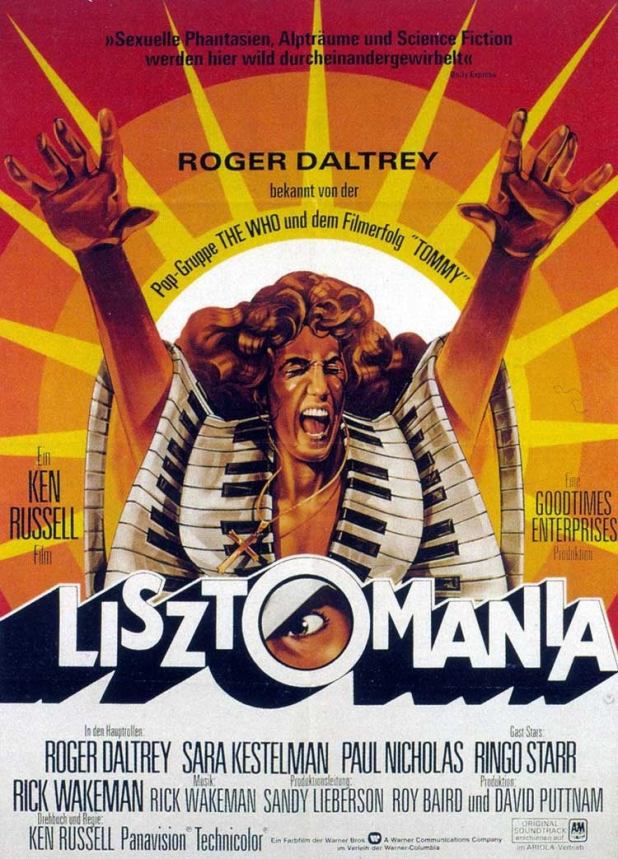
Based somewhat on the book Nélida, a story in which Marie d’Agoult — played by Fiona Lewis in the movie — wrote a barely hidden confession about her affair with Liszt, the movie is barely a narrative and more a series of misadventures, starting with d’Agoult’s husband catching her in bed with the composer and the duel that ensues. After leaving the two trapped inside a piano on the train tracks, the movie quickly moves to the start of his rivalry with Wagner (Paul Nicholas), who hates the showmanship that Liszt uses to win over crowds.

Liszt is now married to Marie and constantly battling with her over his infidelities, unable to write music. He hopes to meet Satan so that he can sell his soul to be inspired again, a fact that his daughter Cosima prays for.

This makes him to Russia, where Princess Carolyn and her court seduce him into growing a ten-foot-long erection, which is taken to a guillotine, where he must give up his carnal needs if he is to create again.

How does one explain what follows? That Wagner is a vampire that uses Superman for propaganda and attempts to suck the musical soul from Liszt? That the Pope is Ringo Starr, who demands that our hero — who has failed at being an abbott of the church because he sleeps around — must stop Wagner and his daughter Cosima and their Reichian zombie death cult? That Rick Wakeman plays Thor? That a zombified Wagner — armed with a symbolic electric guitar machine gun — kills all of the Jewish people while Cosima uses a voodoo doll to kill Liszt, who goes to Heaven and reunites with all of his lovers — as well as his daughter, who has a change of heart in the afterlife — and flies back to Earth where he destroys Wagner and flies into space in his spaceship?

I have no idea what I just watched, but I loved it.

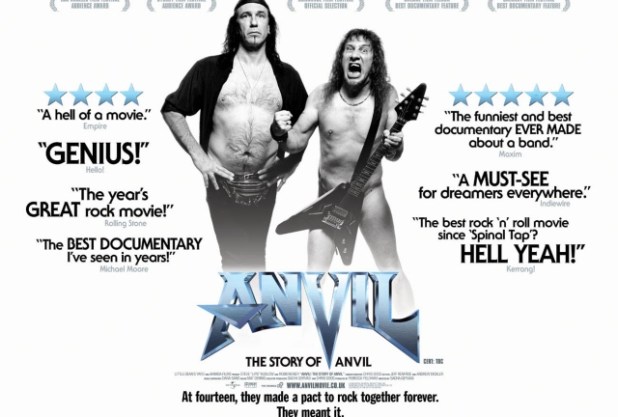
Anvil! The Story of Anvil (2008)

Super Rock ’84 in Japan was a touring rock festival that had Bon Jovi, Whitesnake, Scorpions, Michael Schenker Group and Anvil playing. Of these bands, Anvil had the least success, but it wasn’t for lack of effort. At the time of this movie, Steve “Lips” Kudlow is working for a catering company and Robb Reiner is in construction. Their real lives are in constant juxtaposition with what being a rock star promised them, which is the story of this film.

Sacha Gervasi wrote the Tom Hanks movie The Terminal, but two decades before, he had been a roadie for Anvil. Who knew that someday he’d make the movie about them that would let the world know they existed, as well win an Independent Spirit Award and an Emmy?

It seems like every time the band gets close to their dreams, things go wrong. It always makes me think, when I wonder what it would have been like to be a rock star instead of having a day job, exactly how it would all turn out. This movie is a sobering reminder that not everyone makes it. Until, well, they do.

I kind of love the moment where Kudlow and Reiner nearly kill a promoter for not paying them. I had a similar moment happen when I first started in pro wrestling. A promoter wanted to pay us in checks and I didn’t know any better. That’s when I learned to always get paid in cash. A vet taught me that, as he grabbed that promoter, shoved a revolver in his face and demanded that the two of us get our money right now. I was kind of shocked by it all, but it was nice to drive home with actual cash, even if a man’s life had to be put in jeopardy. I remembered all of that when I watched this.

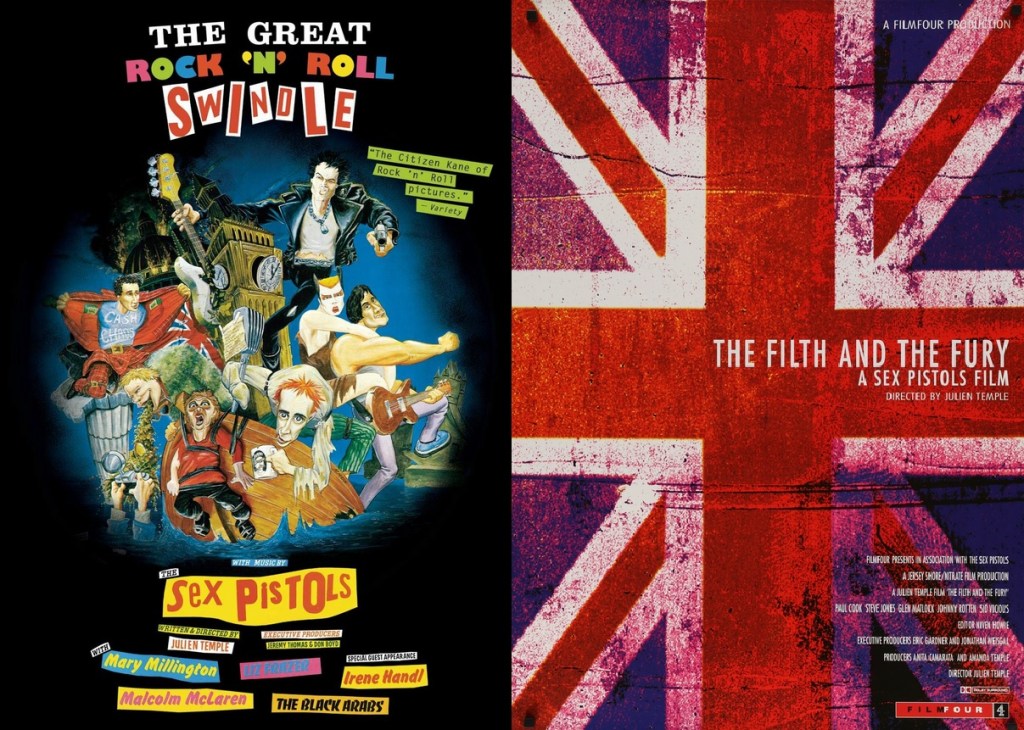
The Great Rock ‘n’ Roll Swindle (1980) and The Filth and the Fury (2000)

“The gospel according to the Ayatollah Malcolm.”
— Johnny Rotten

So agent provocateur and clandestine entrepreneur Malcolm McLaren owns a London fashion shop called Sex . . . eh, we don’t need to go that far back. . . . So co-founder/bassist/chief songwriter Glen Matlock is kicked out the Sex Pistols for “liking the Beatles. . . .” No, we don’t need to go that far back. . . .

When it came to the Sex Pistols, it was all about the marketing manipulation and McLaren the Machiavellian squeezed out every last drop of the group’s nihilistic sociopolitical ejaculate from their fourteen-month existence (November 1976 to January 1978). Regardless of their extensive discography that, by 1990, swelled to 20-plus albums, the group recorded only one actual studio album: the high-expectation and commercially-disappointing Never Mind the Bollocks, Here’s the Sex Pistols (1977). (The “flop” in the U.K. and Euro-markets was result of the album’s composition from the band’s already released 45-rpms and a “legal” 1977 bootleg album, Spunk.) And part of McLaren’s high-profile manipulations was to create a punk version of Richard Lester’s A Hard Day’s Night—with Johnny Rotten refusing to have anything to do with the project. The “project” was initially developed by—of all peoples—Russ Meyer, with snobby film critic Roger Ebert as the screenwriter, in tow—both who had a little experience in the rock ‘n’ roll genre with their “epic” about the rise and fall of the Carrie Nations, 1970’s Beyond the Valley of the Dolls . . . but Meyer also had lots of experience with large-breasted women (1965’s Motor Psycho and 1966’s Faster Pussycat! Kill! Kill!).

Yeah, this is going to work just fine. . . .

Well, it didn’t.

So, two-plus years later of false starts and stops with an array of people and footage shot here and there—which produced the Meyer-unfinished Who Killed Bambi?, British music video-artist, filmmaker, and ‘Pistols running mate Julien Temple (1989’s Earth Girls are Easy) got the Alan Sacks job of “doin’ a duBeat-eo” with the hours upon hours of narrative footage and concert clips of the Pistols during their heyday, along with surreal Kentucky Fried Movie-esque skits (that go beyond the funny into the silly . . . and the outright stupid).

Now, for those of you wondering: “What da frack does ‘Doin’ a duBeat-eo’ mean . . . and who is Alan Sacks . . . and what does this all have to do with the friggin’ Sex Pistols?” Well, impatient one, here’s your answer:

Alan Sacks came to fame as the creator of ’70 TV’s Welcome Back, Kotter; you know, that’s the show with the “Ooo! Ooo! Mr. Kotter!” pop culture catch phrase . . . the show that gave John Travolta his start. (He was most recently in the one-two punch bombs The Fanatic and Gotti.) And Alan Sacks got the job of taking the analogously dead pet-project of America’s Malcolm McLaren-doppelganger, record producer-songwriter Svengali Kim Fowley who, ironically ripping off McLaren’s idea, wanted to put his own “female” version of the ‘Pistols, the Runaways, into a “Beatlesesque” movie. (Remember: the ‘Pistols had “Anarchy in the U.K.” while the Runaways had “Cherry Bomb” as their signature tune.) Failed-developed as We’re All Crazy Now, Sacks got the Julien Temple-job of creating coherency out of chaos—and came up with duBeat-e-o, a film that has as much to do with the Runaways as The Great Rock ‘n’ Roll Swindle has to do with the Sex Pistols.

So, what did Temple come up with?

Well, he cut Who Killed Bambi? into the film. Sid Vicious—post-Sex Pistols—cut an album, Sid Sings (1979), and cut a video for that album’s centerpiece: a cover Elvis’s and Frank Sinatra’s signature tune, “My Way”—so Temple cut that into the film. (Warning: Sid pulls a gun and shoots into the audience.) And since Johnny Rotten wanted nothing to do with the project from the get-go, Temple opens the film with the snotty lead singer burned in effigy . . . and created an animated sequence that chronicles a beating the vocalist behind “God Save the Queen” took at the hands of Queen Mum-lovin’ thugs. And guitarist Steve Jones’s Rio de Janero visit with infamous British bank robber Ronnie Biggs is cut in. (Jones, ironically, along with Paul Cook and Glen Matlock, worked with Joan Jett on her self-titled solo debut, aka Bad Reputation.) And yeah, and Kurt Cobain Sid Vicious and Courtney Love Nancy Spungen, aka the punk rock John and Yoko, go through their own little psychodrama safety-pin voguing on screen. And, instead of Sex Pistols tunes: you get disco versions of Sex Pistols tunes by a group called the Black Arabs.

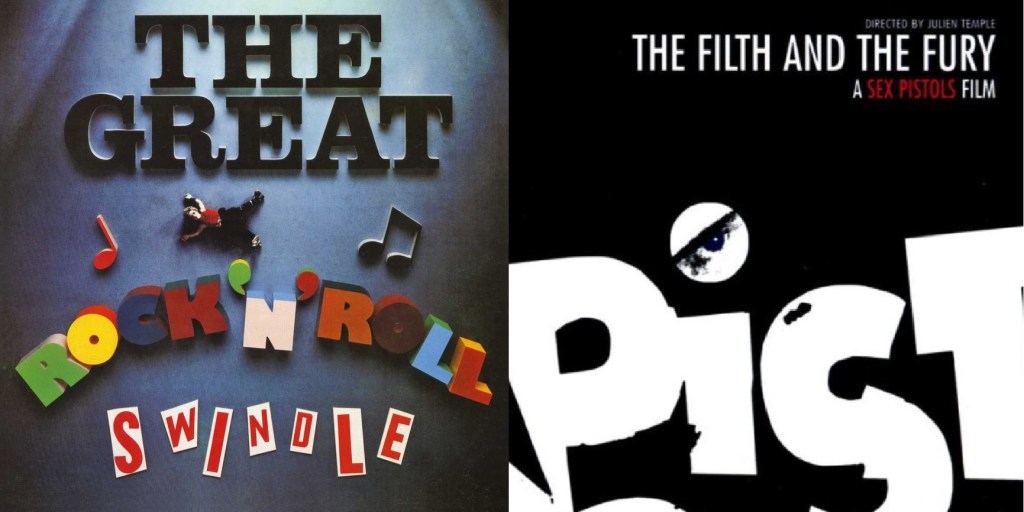
You can check out the track listings for each soundtrack on Discogs: Swindle and Fury.

. . . and the ‘swindle’ continues . . .

So Temple decided to commemorate the 20th anniversary of the film with a “sequel”. . . that cut The Great Rock ‘n’ Roll Swindle’s footage into the—admittedly—more coherent The Filth and the Fury (1990). And, if you’re keeping track . . . marks the third film chronicling punk’s most notorious band: the second was Alex Cox’s (Repo Man, Tombstone Rashomon) spunky, but not wholly historically accurate, Sid and Nancy (1986)—which Johnny Rotten also hated, natch.

With The Filth and the Fury—and without Malcolm McLaren’s marketing imperialism (. . . did you know he embarked on a “solo” career: with producer Trevor Horn, he assembled (McLaren never creates; he can’t. He thieves.) 1983’s Duck Soup)—Temple secured the full cooperation of Johnny Rotten, along with drummer Paul Cook, guitarist Steve Jones, and ex-bassist Glen Matlock, each who provide a new series of interviews, along with “new” interview footage of the late Sid Vicious not seen in Swindle. The interviews are well-executed: Temple peels Rotten-Lydon’s acidic layers and exposes his emotions over Sid’s decline and death. And there’s plenty of “new” footage, albeit, sometimes (most times) with grainy and out-of-sync sound, but kudos for Temple preserving those decrepit 16 mm and shot-on-videotape analog artifacts for the now, digital generations.

Temple was also able to circumcise McLaren’s cultural plundering of punk’s esthetics by showing us that punk rock wasn’t just about flogging the dead horse of Black Sabbath-inspired progressive rock and replenishing the wheezing lungs of rock ‘n’ roll. Punk was an artistic expression of the frustrations the British working class and unemployed (which include Rotten-Lydon’s contemporaries) against the stodgy and greedy British class system (a country where everyone’s on the dole, in poverty; meanwhile, Princess Di and Prince Charles have a huge matrimonial blowout). To that end, Temple also includes new footage of the protests, riots and unrest of the times (think of today’s Black Lives Matter movement and the upheaval in today’s Portland, Oregeon). So while Swindle was a “Swindle” to a point—which wasn’t Temple’s fault, he did a great job with whom and what he had to work with—Fury gets the facts straight and conveys the spirit of the times. So, as you watch both films as a double feature all these years later: you get Malcolm McLaren’s side . . . and the Sex Pistols side. And the twain shall never meet. Not even in the hands of Alex Cox.

The Great Rock ‘n Roll Music Trivia Swindle (you knew there was going to be a trivia sidebar): Before McLaren sunk his incisors into the Sex Pistols, he managed a down-and-out and ready-to-implode New York Dolls, which culminated with the 1975-recorded live, Euro-only album, Red Patent Leather (1984; which features new tunes not available on their two Mercury studio albums).

Also in Mal’s Svengali-stable was the burgeoning Adam and the Ants, who he subsequently “broke up” to provide musical backing for his own “Runaway” embodied in fifteen-year-old singer Annabella Lwin. Upon the eventual implosion of Bow Wow Wow (You do remember “I Want Candy,” right?)—as McLaren turned his Runaway into a singular-named solo artist, you know, like Madonna (not!)—guitarist Matthew Ashman formed Chiefs of Relief. And that band features another musician from the McLaren stables: Sex Pistols’ drummer Paul Cook (produced one eponymous debut album for Sire in 1988).

Prior to the Chiefs—and post-Sex Pistols (by the end of that band, only Steve Jones and Paul Cook were left to finish off a light smattering of tracks to close out that band’s career)—Jones and Cook formed the Professionals (with guitarist Ray McVeigh and bassist Paul Meyers). And, if you’re keeping track of your rock ‘n’ roll flicks, the “band” appeared—sans McVeigh and Meyers—with Paul Simonon of the Clash and British actor Ray Winston in their places, in Ladies and Gentleman, the Fabulous Stains.

Steve Jones’s solo career culminated with his forming a band around Iggy Pop, which recorded a couple of “comeback” albums for Detroit’s Jim Osterberg in the burgeoning years of the Year of our Lord Kurt Cobain. Johnny Rotten, as you know, reverted to his given name of Lydon and created the band Public Image, Ltd. with ex-Clash guitarist Keith Levene. Ex-Pistols’ bassist Glen Matlock formed the less-punk-more-Knacky new wave the Rich Kids with future Visage and Ultravox members Midge Ure and Rusty Egan, which scored a minor hit single with the title cut song from their lone album, 1983 Ghosts of Princes in Towers. Matlock eventually ended up in Concrete Bulletproof Invisible (an outgrowth of Doll by Doll that recorded one album for MCA Records) which released one pre-grunge album, Big Tears (1988).

Both films and their related soundtracks are easily available as DVDs and CDs, with the films as VODs and PPVs on multiple, international online platforms (hopefully, since these are “official trailers,” we won’t lose them to the black box of death!).

Update, August 2022: Our gratitude for the kindness and positive vibes from Aaron Hunter and his You Tube-based video blog on film (1.7 million followers and counting!), citing this review in his materials.

About the Author: You can learn more about the writings of R.D Francis on Facebook. He also writes for B&S About Movies.