A small rural community has been quarantined by aliens as two police officers — including an expatriate from Toronto — fight to keep the peace. But with mass panic spreading and strange behavior the order of the day, saving this small British town may be impossible.
This film is from British FX artist Neil Rowe and has plenty of great visuals despite its small budget. I liked that it has a very claustrophobic and dark look, which befits the end of the world nature of the story. The mechanical devices the alien uses and the main humanoid one appear quite otherworldly. It’s an effective film and just by virtue of its effects, it stands above the majority of most direct to streaming movies.
Alien Outbreak is available on demand and on DVD from High Octane Pictures.
DISCLAIMER: We were sent this movie by its PR company.
Editor’s Desk: Upon the news of his medical hardships, we’ve seen an uptick in our reviews of Tom Sizemore films, which is no way for anyone to discover an actor’s films. Regrettably, Tom—whose credits included the major studio films A Matter of Degrees, Natural Born Killers, True Romance, and Black Hawk Down—has died at the age of 61 after having been been hospitalized in a coma for two weeks as result of a brain aneurysm brought on by a stroke.
If not mentioning Tom in passing in another review, we’ve reviewed many of Tom’s films, which you can easily discover at B&S About Movies.
Tom Sizemore November 29, 1961 —March 3, 2023
Here’s what we had to say back in 2020 of this lost film on Tom’s resume, as part of our “Box Office Failures Week” feature.A once-lost interview from 2007 with filmmaker Leo Grillocloses out our review.
June 2023 Update: As result of its 2023 free-with-ads stream debut on Smart TV platforms, we updated this post on June 22 with our full review of the production-confused Zzyzx, also released in 2006.
Three aspiring actors have a dream to take Hollywood by storm and become movie stars.
One of those actors was named Billy Bob Thornton.
He made a vanity-starring projected called Slingblade. If you don’t know how that movie turned out, you deserve to be banished to Hell’s Video where you’ll check out copies of Breakin’ 2: Electric Boogaloo and Corky Ramano—and all other SNL-bred movies—for all eternity. (“Eh, sorry, sir. All of the copies of John Travolta’s Gotti are rented at the moment. Can I interest you in a copy of The Fanatic? Perhaps Ben Affleck in Gigli? Oh, and welcome to video hell.”)
The second actor was Tommy Wiseau.
He made a vanity-starring projected called The Room. In spite of its critical panning, it became a worldwide hit that is still playing in theaters around the world to this day. The film’s production was chronicled in a New York Times best-selling book that was adapted into a critically-acclaimed film: The Disaster Artist.
Then there’s the fate of Leo Grillo.
He’s an actor who knocked around the industry since his 1977 film debut with a bit part in Between the Lines, a little seen film that featured the pre-stardom bound John Heard and Jeff Goldblum. On TV, Grillo made his debut with a bit role in George Peppard’s Banacek (NBC-TV, 1972-1974).
Oh, it’s “dead ahead” alright.
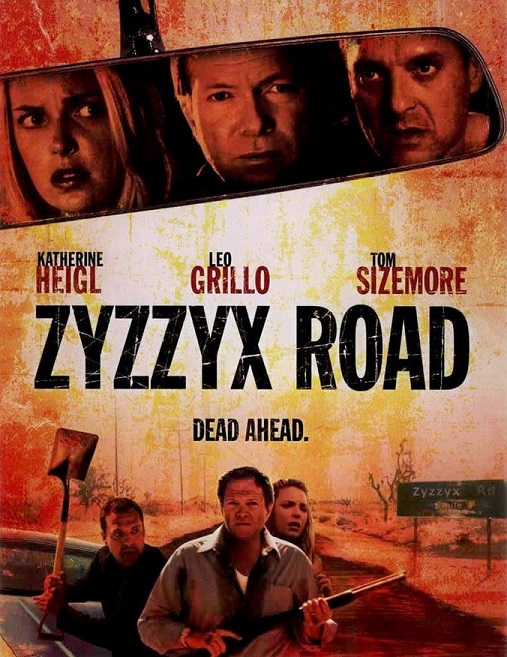
And Leo produced a vanity project called Zyzzyx Road—a film that earned the distinction as the lowest-grossing movie of all time*, earning a measly $20 dollars in domestic box office against its $1.2 million budget. Adding insult to injury: It would have made $30, but Grillo personally refunded $10 bucks to a crew member who purchased two tickets. Adding more salt in the wound: Grillo had to pay a $1000 week-long theater rental fee for the screening (at Highland Park Village Theater in Dallas, Texas), in order to comply with the Screen Actors Guild’s release-distribution regulations regarding low-budget movies (shot for under $2.5 million).
Huh? But why was the film premiere held over 1,400 miles away from Los Angeles, where it should have debuted?
To hear Grillo tell it all these years later, Zyzzyx Road was never intended to be released theatrically.
It’s a dark side of the film industry: Low budget productions sign the dotted line on SAG’s low-budget agreements with the nefarious purpose of low-balling their actors—and “legally” not have to pay them the full SAG rates. Then, once the production fulfills the agreement by showing the film in at least one theater, once a day for one week—they issue their film on DVD**. Those DVDs were released later that year in 23 countries across Eurasia, South America, and Indonesia and cleared just under $400,000 in sales—still a long “road” to recouping its original production cost (and the cost of the DVD production). Inspired by its mildly successful overseas showing, four years after its (purposeful) failed theatrical release, Zyzzyx Road was issued on video for the first time as a 2010 DVD in the U.S., while the first online streams appeared stateside in 2012. (The DVDs are currently out-of-print and the streams are no longer commercially available. You can find used DVDs in the online marketplace.)
It almost makes the film’s bad luck and unwanted attention as the lowest-grossing movie of all time more deserving, doesn’t it?
That bad luck for the film that was to be Leo Grillo’s industry calling card began in the summer of 2005 (as a writer-producer-actor, Grillo gave it one more, final-go with Magic, a 2010 film about angels and talking dogs). During the course of its 20-day shoot in the Mojave Desert, lead actor Tom Sizemore and his friend/personal assistant Peter Walton were arrested for failing drug tests while on probation. Fortunately, Sizemore was able to make bail (out of his own pocket or the film’s production budget?) to complete filming. Walton’s bail was revoked when police discovered he had a warrant out for his arrest—for child pornography*˟ (keep this factoid handy for the later, production irony, coming up).
According to Grillo’s promotional materials, Zyzzyx Road is a Tarantinoesque road where Death of a Salesman meets Lolita—he being the “Willie Loman” and Katherine Heigl being the “Lolita.” In reality: Zzyzx Road (yes, that’s another unfortunate problem with the film: they misspelled the name of the road that’s the title of their own movie!) is a mostly dirt, rural collector road in the Mojave Desert that runs just over 4 miles long—and has an infamous, creepy reputation for its use by various criminal elements to dispose of bodies.
What a great place to dump this movie.
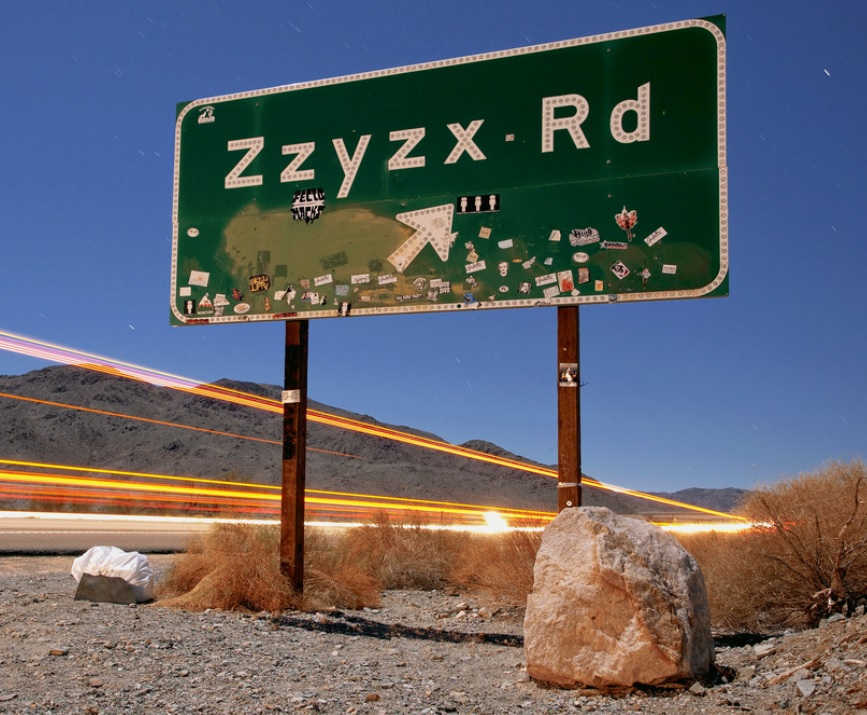
The real road sign . . . with the correct spelling. Courtesy of Wikipedia. It’s pronounced “Zizzix” (Zzz-icks; rhymes with Issac’s), by the way.
It’s along this road were we meet Grant (Leo Grillo), a philandering accountant with a young daughter who’s stuck in a bad marriage. While on a road trip to service his clients, he starts a torrid affair with Marissa (Hegyl): a constantly sucking, candy-flavored baby pacifier-loving femme fatale he meets in a Las Vegas casino. When Marissa’s violent ex-boyfriend Joey (Sizemore) shows up to kill the lovers, Grant ends up killing Joey in self-defense—and Marissa convinces him to drive into the Southern California desert to bury Joey. Of course, Joey isn’t dead. . . . Er, I don’t know about you, but a chick that knows about a dumping ground in the desert . . . no “boink” can be that good!
The post-Hegyl stardom overseas DVD version—with the much better title— that kicks Grillo and Sizemore in the ass. Ouch. Zyzzyx Road’s overseas titles are, in their respective languages, Road of the Death, Dead Road, Side by Side Lies, A Corpse in the Desert, and Road to the End of the World.
Granted, the biggest “star” of the film enticing a rental or Goodwill salvage is Katherine Hegyl (of 2001’s Valentine) who, shortly after filming Zyzzyx Road, found herself cast in a lead role on ABC-TV’s Grey’s Anatomy. Then she found A-List stardom on the big screen with 2007’s Knocked Up.
Ah, but the real reason I picked up Zyzzyx Road at Goodwill for a buck (along with Ground Rules, starring another one of my favorite actors, Richard Lynch): Tom Sizemore. Tom always delivers the goods in films such as Bruce Willis’s Striking Distance and Sly Stallone’s Lock Up. By the time of Zyzzyx Road’s production: Tom was five-years down from the A-List, Ridley Scott-directed and Jerry Bruckheimer-produced hit, Black Hawk Down (2001); his last, major studio film was the Mel Gibson-produced flop, Paparazzi (2004). These days Tom specializes in direct-to-video features and is currently working on his 226th film, Circle of 3s. He most recently starred in 2019’s Abstruse and The Pining.
Oh, and get this: Rickey Medlocke—from ’70s southern-rockers Blackfoot and Lynyrd Skynyrd˟*—stars as a crazed desert meth dealer who doesn’t take to kindly to those city folk poking around his lab. (And we wished there was more Medlocke and less Grillo.)
“Okay, so much for the backstory,” you say. “Is the movie any good?”
Well, the trailer pretty much sums up the whole movie. And since there’s no online streams available for the film (at least until 2023!) it’s all you really need.
Well, let me put it another way: In the various articles written about Zyzzyx Road over the years: Heigl and Sizemore refuse to comment on the film—and they didn’t show up for its Dallas premiere.
And yet another way: Have you ever read one of those reviews that inserts an actor’s name into the phase: “For ____________ completists only? This is one of those films. And in this case, it’s Tom Sizemore’s name that completes the sentence. His deciding to go deliciously hammy and overboard as the villain is this film’s only saving grace (well, that, and Ricky Medlocke showing up), but it’s also Grillo’s demise. Against Sizemore, Grillo’s dry and woefully out of his element. It’s not that he’s incompetent. He’s not “Neil Breen” bad, as some have said. Grillo would do well with an under-five bit part on say, a Law and Order or Blue Bloods—but not as a lead actor carrying a feature film.
“Hey, what about the ‘irony’ regarding child pornography you mentioned earlier?”
Oh, right.
So, throughout the film it’s implied that Hegyl’s character is underage (under 18, that is, carrying multiple I.Ds in a purse where she keeps her supply of candy-nipples), which means that Sizemore’s and Grillo’s characters (again, Grillo’s a father with a young daughter) are both pedophiles—and rapists by definition.
Ick.
We’ve seen Hegyl’s work before and we know what she can do on screen. Sadly, at the time of the production, Hegyl was already 27 years old—and she’s unconvincing as an evil, high schooled-age seductress (and, again, her baby nipple-sucking “character development,” in lieu of the usual chain-smoking cliche, is annoying). What the film needed was a Christina Ricci (who excels in that type of chain-smoking, film noir vixen role; see her Dedee Truitt in 1997’s The Opposite of Sex) or a Thora Birch (of Ghost World fame; Thora was initially offered the role—and turned it down).
Is Zyzzyx Road Really That Bad?
No, it’s not.
For all the bad press heaped upon Zyzzyx Road from various online critics: professional journalist and bloggers both, their QWERTY-bashing is based on the film’s box-office notoriety and not the film’s production quality, itself. Thus: bad box office means inept film. No, not always.
Sure, the one can name drop the fellow box-office failures of Heaven’s Gate, Ishtar and Plan 9 From Outer Space in a sentence alongside Zyzzyx Road, but writer-director John Penney is no Tommy Wiseau in either department and Leo Grillo is no Neil Breen in the thespin’ arena.
As Jeffrey Ressner accurately opined in his February 2007 review on the digitized pages of Time-CNN, Zyzzyx Road aspires as a noirish road picture in the vein of Red Rock West (a stellar, 1993 John Dahl film starring Nic Cage) or U-Turn (a not-as-stellar Sean Penn-starrer directed by Oliver Stone).
What rises Zyzzyx Road to that Dahl-Stone comparison (at least in its visual quality): Director John Penney hired Kevin Smith’s go-to cinematographer, David Klein, who framed Clerks, Chasing Amy, Cop Out and Red State (he’s since moved on to multiple episodes of HBO’s True Blood and Disney’s The Mandalorian). (The “Kevin Smith” connection of the film also carried through to the film’s casting: Tom Sizemore’s role was initially offered to Smith’s go-to actor, Jason Lee.) Together, with production designer Dorian Vernacchio (Hellraiser: Bloodline and TV’s Babylon 5), they effectively capture the remote, Mojave parcels, making great use of an existing desert dumping site and its abandoned buildings, as well as an old mine left over from the days when the lands past Zzyzx Road was a hick town-mining community. Shooting in the desert—under direct sunlight, where lens-flares are the norm—the proceedings are far from amateur.
John Penney’s script—while far from being an Arthur Miller-inspired “Greek Tragedy” it wants to be—deploys a non-linear approach and begins In medias res—and probably inspired by the likes of Humphrey Bogart’s Dead Reckoning (1947) and the William Holden-starring Sunset Blvd. (1950)—and, of course, more so: the film adaption, Death of a Salesman (1951). Structurally, Penney’s debut rises not to neither of those classics; for it unspools as a extended, ’60s episode of The Twilight Zone (or HBO’s ’80s mystery-horror variant, The Hitchhiker) that leaves the proceedings not as noir cut-and-dry as most reviewers lead us to believe. Yeah, this would have worked much better as a 20-minute anthology segment (rife with sub-text) than a full-length feature film.
And to say more would be plot spoiling.
So,Who’s John Penney?
Director John Penney’s writing and directing resume—Zyzzyx Road was his debut—includes 2011’s Hellgate, which stars William Hurt (Altered States) and Cary Elwes (Saw, Kiss the Girls), 1993’s Return of the Living Dead III, and a baker’s dozen of direct-to-video flicks, such as 1996’s Past Perfect starring Eric Roberts. As a film editor, Penney worked on the U.K “video nasty” The Dorm that Dripped Blood and Return of the Living Dead. His early co-scripting credits include the production-related The Kindred and The Power.
His casting director, Valerie McCaffrey, worked on 1998’s American History X and 1999’s Detroit Rock City, and made her own directing debut with 2001’s Wish You Were Dead.
Zzyzx (2006)
What’s this, pray tell? Is this an alternate DVD reissue—with the correct spelling of the road?
Did this movie—as did Leo Grillo’s passion project—bomb, as well? Eh, without digging into it: we’ll guess it probably did, since we never heard of it until reviewing Grillo’s film. It’s doubtful that it even “broken even” against its million dollar budget—and it’s still swimming in red ink. The only reason it’s remembered: it’s confused with Zyzzyx Road.
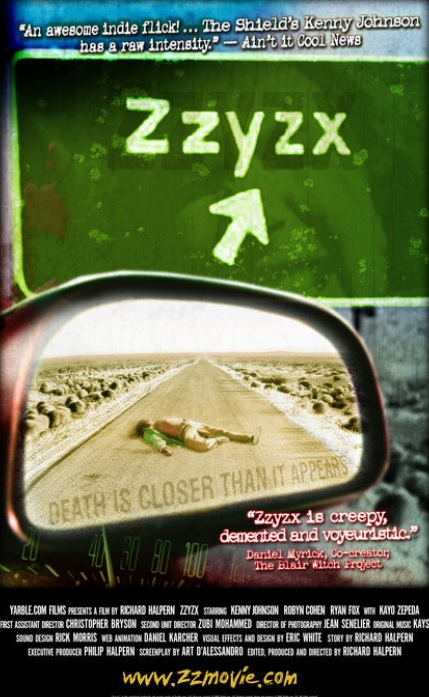
Also known under its alternative title of Burned, it turns out Zzyzx is an unrelated, low-budget romp about more desert-bred greed and corruption—one that stars Kenny Johnson of the FX Channel’s popular series, The Shield. It’s directed by Richard Halpern, whose most recent film (at the time of this writing) is the 2019 Lifetime-styled thriller, Suburban Nightmare.
According to this 2007 article at the Sun Chronicle, Zzyzx, shot in nine days, is the first feature-length film to eschew a conventional theater premiere or DVD distribution that’s accessible-only as a paid-Internet download.
The confusion between Penney’s and Halpern’s films are comically chronicled at CHUD.com with the 2007 articles “CRISIS ON INFINITE ZYZZYX ROADS,” “FURTHER DOWN ZYZZYX ROAD,” and “AMERICA HAS ZYZZYX FEVER!” by Devin Faraci (he’s the online journalist who first reported on the film’s misfortunes . . . and other, major media outlets, such as Variety, pinched without credit).
We Finally Watched Zzyzx(with plot-spoilers)
As a result of not attending the third-string festivals where Zzyzx initially screened, then being unaware of its landmark, Internet-only pay-to-play download-release via the film’s now defunct website: I never watched this movie. During this film’s sixteen year digital trek—from its 2007 download release, to its Amazon Prime debut, to its 2023 free-with-ads stream debut on the Tubi and Plex platforms—in a world where all low-budget flicks of no-name actors, major studio flops (how many copies of Matthew McConaughey’s The Beach Bum are there?), and direct-to-DVD flotsam (starring Bruce Willis, Eric Roberts . . . and Tom Sizemore!) go to die on the shelves of the Big Lots and Dollar Tree discount chains and Walmart’s $5.00 electronics department barrels (speaking of “video hell”)—I never came across the 2009 DVD-version issued by the boutique documentary shingle Passion River. In the overseas markets, one of the alternate DVD titles is Estrada sem Volta: Road of No Return—though I have no idea why a foreign market would be interested in an American film with a no-name director and cast; at least the other one had a director with a track record and a Heigl and a Sizemore as a marketing gimmick—its later, “lowest-box office, ever” tagline, be damned. Well, I do: team Zzyzx can complain about the mix-up, but they played off the confusion of being the film with “the lowest-box office, ever,” so as to hornswoggle, you the consumer, into buying their DVD.
So, was it worth the sixteen-year wait to see Zzyzx on Tubi?
Well . . . it’s better than I expected . . . and exactly what I expected. It streamed neither with a bang nor a whimper . . . but with a shrug. Movies that market themselves as “starring” actors who portrayed minor characters in “hit” TV series and films—that most people aren’t aware of in the first place (who went to see the Wes Anderson’s 2004 bomb The Life Aquatic with Steve Zissou . . . to even know who Robyn Cohen is?)—have that shoulder-twitch and nose-crinkle way about them.
Zzyzx and Zyzzyx Road are essentially the same desert-based neo-noir sparsely populated by humans enchanted or possessed by the arid landscapes fracturing their psyche, inspiring them to indulge their darkest desires based in revenge and deceit, sex and blood. The former is the more graphic, The Hills Have Eyes-inspired of the duo (right down to the motor home). Both have small casts of three main characters: two men (one macho, one wimpy) and one femme fatale. And someone—in the middle of the desert where there’s no traffic or pedestrians—still manages to get hit by a car. And both center on schmucks hittin’ it big in Vegas—and scoring an ulterior-motives babe, natch.
In Zyzzyx Road: As its non-linear shenanigans unfurls, Leo Grillo’s character spirals as result of a guilt-based breakdown . . . or a haunting by Tom Sizemore’s ghost-boyfriend of Heigl’s Marissa . . . or Sizemore is Grillo’s serial killer-split personality . . . or Heigl’s femme fatale is an otherworldly succubus that ensnares men making the Bonzai Run from Los Angeles-to-Las Vegas. (Did you know there’s another desert movie that deals with that? It’s 1987’s Bonzai Runner starring Dean Stockwell.)
In Zzyzx: As its non-linear monkeyshines unspool, Kenny Johnson’s Lou is a macho, already-tweaked Gulf War veteran (the war flashbacks are toy-store inaccurate-cheap) in a The Grapes of Wrath-styled relationship with his “Lennie Small” (okay, 1988’s Rainman): Ryan (who Lou demeans as “Mitch” because it rhymes with “bitch”), a wimpy (possibly gay) computer store clerk enamored with the “Blair Witch” web-based mysteries surrounding Zzyzx: a deserted town on the southwestern edge of the Mojave Desert. A Mansonesque cult leader (who we never meet) resides out there, Spahn Ranch-style, broadcasting static-filled sermons from a remote radio station (who we never hear, except for garbled static)—which leads us to believe a possible “supernatural comeuppance” awaits. (The “legend” of Zzyzx told in the film—by text-on-screen, no less—is a fugazi; there is no “mystery” about the town (we provide links to articles and videos at the end of this review with the true story); the shooting style reminds of that Daniel Myrick low-budget blockbuster; he, and this film’s director, Richard Halpern, have worked together on four films.)
Traveling down Zzyzx Road, Lou and Ryan bicker behind the wheel; they hit Manny: a heavy-set Native American man stumbling in a drunken stupor along the roadside; Candice, our femme fatale appears: she’s looking for her newlywed husband who went to get help, as their RV is stuck in the sand. And Lou hatches a plan—and harangues Mitch the Bitch—to cover up Manny’s death.
Is our Candice (Lou classifies her as “hot”) just another desert succubus: a desert siren leading men to their doom? Is she just another cold, greedy bitch—with a couple of ice-cold six packs and psychedelic mushrooms in the fridge and a coke-filled Altoids tin?
The film opens with a creative, opening title cards sequence: as Lou and Ryan travel out of Los Angeles toward the Mojave, credits appear on road signs and billboards amid their dialog. In a Letterboxd review, a user calls out Richard Halpern’s directing credit appearing on a truck’s bumper sticker: “How’s My Directing? Call ###-###-####.” As a gag: they called the number. Not only did the number pick up, you could leave a message . . . and Halpern called them back!
While many critiqued the cinematography as “amateur,” “shot on a phone,” and “too Blair Witchy” I was surprised to see—via the IMDb—that I wasn’t the only one who thought the camera work reminded of the V-Cinema style of Takashi Miike (Gozu)—itself rooted in the ‘70s “Golden Age of Porn” migrating to the ‘80s SOV format (that gave us “Big Box” films such as John Howard’s porn-slasher hybrid, Spine—which Zzyzx visually resembles).
I agree with the 2023 opines at The Land of Obscusion blog: The soft-focus cinematography’s “gritty, rough and hazy images” are an artistic choice—not technical ignorance—that work hand-in-hand with the hot, dusty environs; the handheld shakiness of the camera lends to the film’s disjointed, surreal vibe. Art D’Alessandro’s scripting—in conjunction with director Richard Halpern’s editing—develops an interesting visual style in structuring the film’s drug-fueled flashbacks (by all three characters) as a rewinding VHS tape—complete with washouts, squeals and scratches (reminding of Christopher Nolan’s 2000 noir, Memento). How was this shot: film or video? Did cinematographer Jean Senelier break out an old Bell & Howell 16mm camera to achieve the guerrilla-documentary-style of the film, à la 1972’s The Last House on the Left?
While the proceedings aren’t as “abysmal” as others have stated, proclaiming Amazon Prime needs “quality control” when programming films, Zzyzx is, unfortunately, another never-heard-of low-budgeter suffering credibility issues as result of the filmmakers (cast, crew, studio; friends and relatives of all) stacking the IMDb decks with 9s and 10s—from accounts that have reviewed one movie in the past sixteen years: this movie. The online hater-volleys between Leo Grillo and Richard Halpern—using CHUD.com, the blog that broke the whole Zyzzyx Road boondoggle in the first place, as their defacto mediator—acting as their respective indies were destined as the next Napoleon Dynamite, swings those low-budget forgiving critical meters more toward the Razzies than the Oscars. Films that are more desert-analogous to the supernatural folk horror of 1966’s Manos: The Hand of Fate than the Internet ‘90s The Blair Witch Project tend to have that shoulder-twitch and nose-crinkle way about them.
Zzyzx is certainly not the “Best Indie Film Seen in a Decade”—as proclaimed by one of those one-and-done bogus IMDb reviews. It’s just not the worst indie film seen in a decade. And now, in the year 2023 of our Lord, you can stream both online for the first time—and decide which side of Zzyzx Road you’re on.
Leo Grillo Interview(with plot spoilers)
On June 10, 2006, the now-defunct Katherine Heigl Online fan website published a six-page interview with filmmaker Leo Grillo. As we all know: the Internet is fickle; articles, pages and sites vanish into the 404-verse without warning. While this interview has since been preserved by The Internet Archive Wayback Machine, depending on the browser used and the hyperlink accessed, the subsequent pages of the full interview may not be accessible. We’ve opted to repost the interview, in full, as one-complete read to offer our readers the opportunity to learn more about the film.
Prior to filming Grey’s Anatomy, Katherine took a leading role in the independent film Zyzzyx Rd. portraying a beautiful seductress named Marissa.
Zyzzyx Rd. was produced by Leo Grillo, who also had a starring role in the film as Grant, a married accountant who falls for Marissa’s charms.
We called Leo to chat about the movie, take a peek behind the scenes, and to discuss Katie’s involvement in the film—which also features Tom Sizemore.
How would you describe Zyzzyx Rd. to our readers?
It is a suspenseful and twist-filled thriller that begins after a married accountant (Leo Grillo) is caught in a roadside motel having an affair with a beautiful seductress named Marissa (Katherine Heigl) that he met in a Vegas casino. When her enraged boyfriend (Tom Sizemore) busts in on them, he is forced into hand to hand combat and inadvertently kills him. Faced with the harsh reality of betrayal and murder they are forced into the desert to dispose of the body. He needs to make a conscious decision, and does . . . with ultimate consequences in an unpredictable story that will keep you guessing all the way to the end.
How did you become involved with the film?
I was interviewing John Penney (the writer) to commission him to write a script, which incidentally he has written and we are shooting in another week, called Magic. As an afterthought, I asked him what he was working on and he jumped out of his chair and he told me that he was working on this film called Zyzzyx Road—three people in the desert—and I thought, “Wow, what could it cost? That’d be great!” So I read the treatment and said, “Okay, let’s make yours.” So we went ahead and made Zyzzyx Road and, of course, it’s so creative, and cost a lot more than I thought, because three people in the desert means you have to do a lot of interesting stuff to keep people’s attention. It is a scary thriller.
Your involvement in the film was both in front and behind the camera—as an actor and the executive producer. Was it difficult to combine both roles and which did you find most challenging?
Yes, and I’m getting better at it, because that is my combination: an executive producer and actor. I made one mistake on that movie: I signed the checks. So even though I tried to pretend I was only an actor during the shoot, everybody came to me with problems because it was my name on the checks. So, in a week, when we start shooting our next movie, Magic, my name is not on the checks and nobody is going to know that I’m anything other than an actor. But yeah, it was challenging. Fortunately, when I go out there when they say “action,” I’m in character and I can do it, but it’s not as pleasant as it is to the other actors who are just focusing on their acting. On the business side there’s constantly problems, so yeah, that is a challenge.
Was both acting in and producing the same project a new experience for you?
No, I did a movie before that when I was an actor and producer, and when I was in college I had a theater company: I was producer, actor and sometimes director. So I’m very used to being a producer to create projects for me to act in. That’s what the stars do and that’s kind of a natural thing that just comes to me.
What attracted you to John Penney’s script?
It was exciting: 3 people in the desert! How much could it cost?!
The majority of the film is set in semi-desert type locations with barren terrain and desolate roads. Was it difficult to film in those conditions?
It’s not a “semi” desert, it IS the desert: the Mojave Desert. It’s a mining community, they were very active in the ’20s and ’30s; they mined silver and gold and it was the “Silver Queen Mine,” which has became the “Golden Queen Mine,” and when I got the location, it was because I knew we had everything there. We shot entirely on location, including in an active mine and abandoned mines. It was incredible.
What were the challenges that you faced?
It was hot, about 110-degrees outside and then when we went in the mines it was freezing, it was in the 40s. Rattlesnakes were a constant problem: we had to have constant rattlesnake awareness, we had a rattlesnake wrangler on the set to collect them and release them in another area on the property. The heat was difficult for some people, but you do get used it in a few days. But I love the desert so ultimately it was fine.
When and where was the film shot? What was the duration of the shoot?
It was a three week shoot, an 18-day shoot, with two insert days, with a combination of one day out on location and one day on an insert stage. It was shot last year in Mojave, California, at the “Golden Queen Mine” during the summer.
When did the casting process take place for the film and how did Katherine get involved with the project?
You have to sell a film with names that will be recognized out of the United States. So you get lists of names and when I saw Katherine Heigl’s name I remembered her from Prince Valiant (1997), because when I saw her she was fabulous as this warrior queen or princess and I thought “who is she?” I forced myself to remember her name for future reference.
When her name came up on a casting list, frankly, I just said, “get Katherine Heigl.” Nobody knew who she was except one manager friend of mine, and he said, “you’re getting Katie?” He worked with her before and he said, “this is going to be great . . . you and Katie Heigl, this is going to be great, I can’t wait to see this!” He knew the chemistry would be there.
What was it like working with Katherine? How did you find her as a person?
Katherine and her mother and her sister were on the set a lot together. When Katherine was not working, she was in her trailer with her sister. She is very professional. She comes out, does her thing, and then goes back and prepares for her next scene.
Her mother Nancy and I struck up a friendship because we both have daughters, so we talked quite a bit. I like her mother a lot. Her mother had been a guardian to her in the business when she was a child actor, so her mother is very familiar with the business and shooting. She is a very pleasant lady. We had many conversations about Katherine, about professional stuff and about personal stuff.
I think Katherine is very solid, very rooted, she has a very solid family. She’s real. She’s not affected. There’s no pretense, she’s not all hung up on herself, she does not have a huge ego, she’s very solid, she’s a professional. She’s good stuff. Katherine spent the first week in her Lolita outfit which was very skimpy lingerie, so for a third of the movie, she was running around a very scary desert with cacti, Joshua trees, black widows, tarantulas and rattlesnakes. When she is given a job to do, she fearlessly gets it done! She is courageous and she really is a great sport.
Would you like to work with her again in the future?
Oh, in a heartbeat, sure. Katherine is a doll!
Could you tell us about your experiences shooting the film?
Do you want an anecdote? I worked with Tom Sizemore, and [PLOT SPOILER #1] he is my alter ego in the film. Tom and I would go to very strange places in the script. What we ended up having on camera, was not necessarily what the director had in mind. We experimented a lot. Something happens between actors sometimes and you get an actor like Sizemore and an actor like myself and we both like to discover what the scene is about and create. And if he throws a snowball at me, I’m going to duck and pick one up and throw one at him, and he’s going to pick one up and throw one back . . . so when actors do that, anything that happens is unexpected and exciting. So that was a wonderful experience going to strange places with Tom Sizemore. He had fun, I had fun. We want to work together again.
Was the filming process an enjoyable one?
All filming is enjoyable. Anyone who says it’s not is just simply not a real actor, they’re just collecting their paycheck, and wanting to move on to the next project. All acting is enjoyable, therefore all of the film process is enjoyable. The behind the scenes and the filming process of producing, is people management and you’re dealing with people with talent so you’re dealing with an unusual mix. You’re having to find out that you’re dealing with something that is not measurable on paper, you’re having to find out who really has talent, and who to get rid of and who you need to replace. They’re always mixing and firing and coming up with new people and then, ultimately, you come up with the best people that you’re ever going to get by the time you start shooting. And if you had another month, you’d probably fire them and bring in someone even better. I like the whole process very much. It’s a collaborative effort to tell a story and exciting when all the minds come together and get excited about the characters and what the movie is about and everyone gets behind it.
Any behind-the-scenes stories you would like to share?
That was really my shotgun in the movie. Props brought a shotgun and it was ugly and terrible and fake so I brought my real one. I shoot a lot, so I did a safety exercise for everybody every time we went to use the shotgun. I opened the chamber, put my finger up the barrel, to show everyone that it was empty before we used it, which is not only courtesy, it’s safety, so that no actor is going to get hurt.
Without giving too much away [PLOT SPOILER #2]: Katherine effectively has two roles to play in the film. She seemed to have a lot of fun portraying the Lolita-esque Marissa. Did you enjoy the contrasts in her portrayal?
Between the two, it was, of course, much more fun working with the Lolita-esque Marissa, because here’s this very beautiful, adult woman, playing this teenager doing the teen thing and it was fun dealing with Katherine as a teenager.
We had one scene where Katherine plants a kiss on me as part of the scene. We’re both one or two-take actors so we move right along really quickly. There’s no rehearsing, she’s a pro and I’m a pro and we just do it. When you get your head spun around by a Katie Heigl kiss, you kind of wish you were a method actor and had to do the thing twenty times!
The contrast in her portrayal, well, let me share a behind the scenes anecdote—and tell you the level of her commitment. Both Katie and I did a lot of our own stunts. In the last scene of the movie, when Katie is crossing the road, she trips and falls into the sandbank on the side of the highway, and of course they had to film her falling into the bank three or four different ways; they had to do the scene several times because of all the action that was happening, so Katie did her own stunt and fell into the side of the road. And every time she did, her forearm would break her fall, and she picked up little tiny cactus hairs from the cactus that was in the ground. When the scene was over, back at her trailer, she had a million little cactus things stuck in her arm and little red bumps. I taped her arm and stripped it off like a wax job. She was in pain, but she just kept doing the fall over and over again because that was what we needed. That’s the kind of girl you want in your movie.
Similarly, as the film evolves, the viewer sees personality changes in your character Grant and the whole perspective of the film switches several times. As an actor was it challenging to show those differences?
Whatever that mechanism inside of you is that makes you an actor and lets the people see who the character is through you, you just trust that that is going to work. The interesting thing was to know where we were in the film at any one time. As you know: a film is shot out of sequence. If you read this film in sequence, it was difficult enough to figure out what the hell was going on in the script, but to then to shoot it out of sequence, many times even the director would come up to me and say, “Okay, now what are you doing in this scene again?”
That was very challenging. But as long as Grant knew what was going on, I could trust Grant and Grant would tell me what was going on. Challenging, but nothing insurmountable, it all worked out quite well. There were some things that people questioned . . . they’d say, “Ummm, what happened there?” and I’d tell them to just trust, because I knew it was true, and even though it looked wrong to them, I knew it was true, therefore it was right. And later in editing, they knew it was right.
For instance: there’s a moment when Marissa’s hysterical, she’s totally flipped out in the car, she was so scared because she thought she was almost just killed, and Grant comes back in the car and just holds her and gives her a “There, there, everything is going to be fine.” It was so weird that he was not empathizing with her on a different level and was very detached from her. And people watching the scene wanted to know why it just went flat like that, and I told them to just trust it. Later, you learn of course why he did what he did and what he was responding to, and it makes sense. Yeah, following this kind of thriller out of sequence is a challenge.
Did working with a small cast make it easier or more difficult to film?
Easier to film with a small cast because you fly right along and you have a comradery. You cover each other and without getting specific, there are times when actors are generous enough to cover their partner. If something happens that throws something off and it’s not as good as it should be, or something definitely interfered with the performance, even if the director thinks it’s fine, you can read it and pick up on it, and sometimes you tell the director, “Oh, I don’t know if you saw that but I slipped and the camera picked up my ‘whatever’.” So they do it again. You’re really into each others head. It’s a dance. It’s better with smaller cast, I think.
What did you learn from making this film?
I learned to take my name off the checks so nobody knows I’m a producer when I’m on the set and I can focus on acting only. I learned that when I disagree with a Director of Photography, yet again, that I’m right, because even though they have the title, I know a lot about the equipment and the photography. So when I catch mistakes and they deny it, we find out later I was right, so I trust me over them. I suppose we all learned a lot.
I learned that with an 18-day schedule, and a motivated director, you can deliver a saleable film that you’re proud of; you have to have a non-prima donna in the director’s chair, someone who wants to get it done and wants to get it right and fast and not sit there trying to get it better and better—and running over schedule. I learned that the little engine can really climb the mountain.
Will a DVD of the film be available in the future? If so, do you have any news on a release date?
Yes, it will. It is being sold foreign right now. It’s in Spain, France . . . they will show it on TV first, and then do whatever else they want with it, which includes going to DVD.
You have a production company, Leo Grillo Productions. How did you get involved in production?
I make my own product. I formed my own theater company. I was in video tape when it was on reels. I’ve always wanted to make my own stuff. I’m smart enough to know that I’m not God’s gift to filmmaking in all departments, and that I would bring in a camera operator to frame better, bring in a DP to light better, a director to direct better. I bring in a writer to write better, but when it comes to acting and producing, I am on very solid ground. The producer is the conductor who brings the whole orchestra together.
Tell us about your business and some of your upcoming projects.
Magic begins shooting mid-June. It’s about a ten-year-old girl who must protect a very special dog from a malevolent research scientist as she journeys to reunite with her long lost mother. We have a documentary this summer and a couple of other feature film projects to follow, as well.
END
The Real Zzyzx Road
So what’s really down the infamous Southern California road?
You’d rather watch than read? Okay, this 15-minute documentary on You Tube sorts out the mystery and history of that paved road to Vegas.
References and Additional Reading
Zyzzyx Road CHUD.com/January 2007 interview with Leo Grillo by Devin Faraci Entertainment Weekly/February 2007 article by Rob Brunn Time Magazine-CNN/February 2007 interview with John Penney by Jefferey Ressner Variety/January 2007 article by Dade Hayes The Land of Obscusion/April 2023 “B-Side: Zzyzx vs. Zyzzyz Road”
Katherine Heigl’s Netflix Comeback Giant Freakin’ Robot/February 2023 article by Rick Gonzales Nicki Swift/February 2023 article by Dianne Gebauer Far Out Magazine/June 2023 article by Arun Starkey
Box OfficeFailures Mental Floss/September 2013 “11 Movies That Made Less Than $400 at the U.S. Box Office” by Jennifer M. Wood Pajiba/September 2013 “10 Movies That Debuted With Less Than $1000 at the Box Office in 2013” by Dustin Rowles Screen Rant/May 2017 “25 Lowest-Grossing Movies of All Time” by Mike McGranaghan
Where to Watch!
As of January 2023, you can watch a rip of Zyzzyx Road on the Internet Archive, and as of April, watch Zzyzx on Tubi and Plex. Proceed into the Mojave, if you dare.
Footnotes
* Indiana-based writer-director-actor Glenn Berggoetz proclaims in the online press that his vanity project, The Worst Movie Ever! (2011)—which made $11.00 in U.S. domestic box office by selling one ticket (and that “sale” is in question by online film critics)—is, in fact, now the “lowest-grossing movie” of all time. A dubious distinction, indeed, as Neil Breen and Tommy Wiseau—as well as Joe Penney, or Ed Wood, or modern-day low-budget auteurs Stephen Groo and Cybela Clare, for that matter—did not strive to earn a “worst movie” or “lowest box office” distinction; those filmmakers were sincere in their efforts. Coleman Francis (The Skydivers) also tried; he didn’t set out to become a “cult filmmaker” or create a film “worse than Ed Wood”—although, all these later, critics classify him as such. John Penney and Leo Grillo never asked for their notoriety. On the other hand, Berggoetz, it seems, blatantly created a Breenesque film that would fail, so as to achieve a Wiseauean “cult status” tagline; for audiences create “cult movies,” not filmmakers.
Ironically, another of Berggoetz’s films, The Room-ripoffesque “dramatic thriller,” Evil Intent (2013), also appears on critical “lowest-grossing films” lists—as result of making a measly $205.00 during its brief U.S. box office run (which was, most likely, a pay-to-play “four-wall” vanity release by the filmmaker); for studio shingle boondoggles and contractual snafus create “low box office” results, not filmmakers.
** Other films suffering this box office failures fate include Christian Slater’s Playback and the Jason Patric-fronted The Beast. As part of his July 2023 Screen Rant piece on Zyzzyx Road, writer Bill Dubiel notes two, additional films that made less than $100.00 in U.S. Box Office: Daniel Myrick’s sci-fi/horror The Objective (2008), which cleared $95.00, and the British-made Storage 24 (2012), which made $72.00—each as result of low-budget distribution SAG-agreements.
*˟ This dark factoid to the film regarding Peter Walton’s proclivities has since been scrubbed from references, such as Wikipedia: the film’s page had a major update in June 2023; the reference still appears as part of a 2016 Newstalk.com review and at TV Tropes.com; the accusation becomes even more uncomfortable, when considering Tom Sizemore had his own molestation charges, as chronicled in a 2017 Daily Beast article.
˟* We reviewed Artimus Pyle’s 2020 bio-film about his band, Street Survivors.
Remember Alex Proyas? He directed The Crow and the promise of that movie led to chance after chance, with films like I, Robot and Knowing baffling folks and still making money. He also made Dark City, a movie that I’m still kind of shocked emerged out of Hollywood. And in trivia that only my pal R. D Francis would care about, he also directed Crowded House’s video for “Don’t Dream It’s Over.”
Way back in 2016, before cancel culture became a thing, I remember sitting in the theater and seeing the trailer for this movie and saying, “Oh no.” Even back then, in the unenlightened world of five years ago, people realized that all white people playing Egyptians was just plain wrong.
This movie would have been eviscerated today.
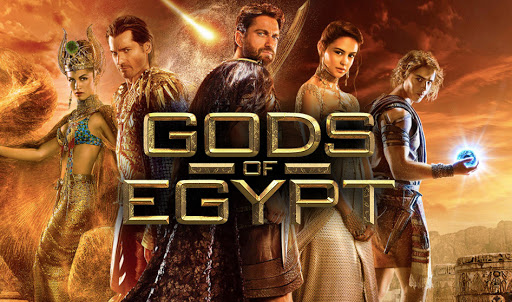
Gods of Egypt grossed $31.2 million in North America — and $119.6 million in other countries — for a total of $150.7 million against the $140 million it cost to make the film. But when you throw in the marketing, the studio lost around $90 million and their dreams of making this a franchise.
So let me try and make sense of this movie, which looks like it’s a SyFy Original more than a movie that cost more money than my entire bloodline has ever and will ever earn.
Bryan Brown plays Osiris and before you can say, “I loved you in F/X!,” he’s killed by his brother Set, who is played by Gerard Butler, who was once a thing. Remember when he was going to be Snake Plissken? Yeah. Me too.
A thief named Bek is given the plans for Set’s pyramid by his lover Zaya and this is where I really lost any sembleance of caring about this movie. But let’s try. Bek steals of our Horus’ eyes, his lover is killed and he gets to bring her back to life by giving the god back his eyeball. Who wrote Egyptian mythlogy, Lucio Fulci?
Nearly every god is either Austalian or British, kind of like Nazis usually are in other movies. Like Geoffrey Rush plays Ra. At least one African-American person, Chadwick Boseman, shows up and the Hollywood Illuminati was probably like, “Please be in this horrible movie and we promise, some day you can be Black Panther.”
I’m sure there were dreams that kids would someday scream, “I want to be Bek for Halloween!” But it was not to be. Not even a $10 million dollar Australian tax credit could make anyone feel good about this movie.
This is a movie that feels fifty years old, with none of the great Ray Harryhausen effects or Lawrence Olivier yelling things to make you feel better. I’m still kind of shocked that this movie is only four years old, because it truly feels like it came from another planet, a world of glossy metallic CGI and a yearning to be better than Prince of Persia.
Even the logo sucks.
Proyas would later do what all great directors do, turn to Facebook, where he ccused critics who usually hate his films of having an axe to grind with him and using claims of white-washing to do exactly that before calling those who dared critique his film “diseased vultures pecking at the bones of a dying carcass…trying to peck to the rhythm of the consensus. I applaud any film-goer who values their own opinion enough to not base it on what the pack-mentality says is good or bad.”
I value my own opinion just fine. And if it looks like a turd and walks like a turd and smells like a turd, guess what?
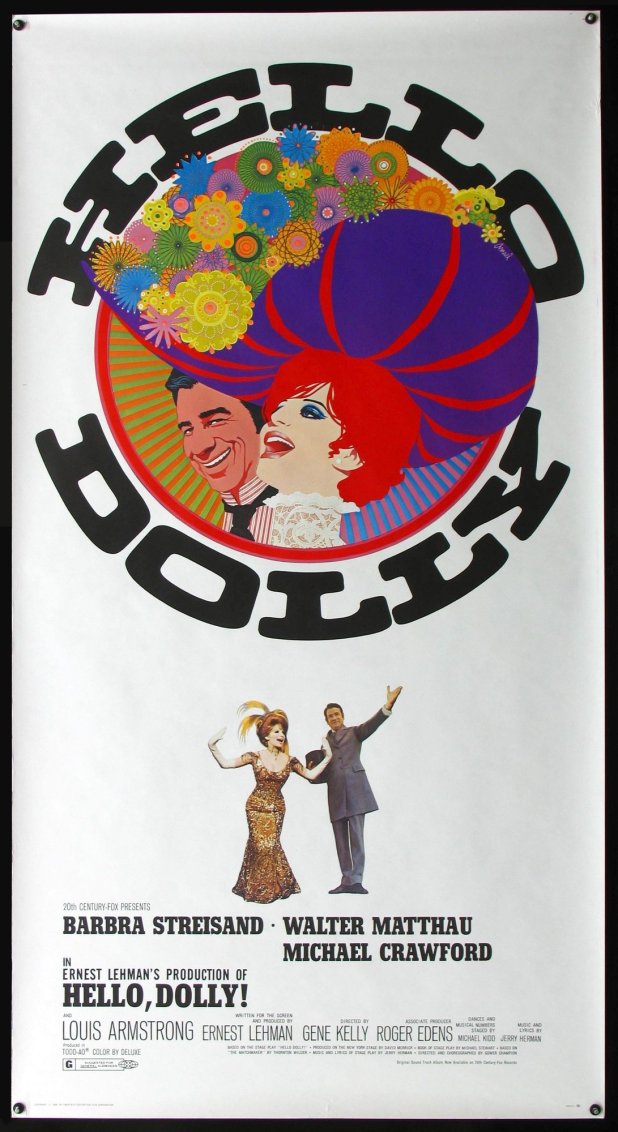
While Hello, Dolly would win three Academy Awards for Best Art Direction, Best Score of a Musical Picture and Best Sound — while also being nominated for four other Academy Awards including Best Picture — the movie was a failure and took years to finally break even.
The filming of the movie was filled with arguments between nearly everyone. Co-stars Barbara Streisand and Walter Matthau came to blows on the hot June day with Robert Kennedy was killed. All it took was a sneeze to set the cantankerous Matthau off, who supposedly yelled, “You might be the singer in this picture, but I’m the actor! You haven’t got the talent of a butterfly’s fart!”
Streisand remembered it differently, that Matthau just went off on her, leaving her crying for days.
Director Gene Kelly saw it as a typical dispute about stepping on each other’s lines and thought that a quick meeting resolved everything.
But to the public, the story became the diva Streisand against the henpecked and suffering Matthau.
Matthau definitely had no love lost for the singer. When he and co-star Michael Crawford visited a nearby racetrack and noticed that a horse named Hello Dolly was racing. Matthau refused to bet on it because it reminded him of Babs. Crawford placed a bet anyway and that horse won the race. As a result, Matthau now also refused to talk to Crawford.
That said, Streisand also battled Kelly over the “Before the Parade Passes By” scene, with the singer going over the director’s head and bringing in the producer, behind Kelly’s back.
To top all that off, choreographer Michael Kidd warred with costume designer Irene Sharaff and Kelly to the point that he and the legendary song and dance man were no longer speaking to one another.
This was an incredibly expensive film and the costs started when the movie hadn’t even been filmed yet. In order to get the play off Broadway — a clause in the 1965 film sale contract specified that the film could not be released until June 1971 or when the show closed on Broadway, whichever came first — Fox had to pay $2 million dollars for an early release escape payment.
The film’s final budget — $24 million dollars ($186 million in today’s money) nearly took down 20th Century Fox.
But hey — the movie is awesome. Seriously, it’s the loudest, biggest, play it to the back row musical extravaganza ever. Just by 1968, did the kids want to see a musical like this any longer? One wonders, as the same studio also released Star and Doctor Doolittle, two more musical stinkers. Only a re-release of The Sound of Music in 1973 would reverse the studio’s fortunes.
All of New York City is excited because Dolly Levi (Streisand) is back in town. Never mind that Barbara was about twenty or more years too young to play this part, robbing the original play of its emotional resonance.
She’s here to find a wife for Yonkers-based half-a-millionaire and full grump Horace Vandergelder (Matthau), but of course, she really wants him all for herself. There’s also the matter of artistic Ambrose Kemper (Tommy Tune), a young artist who wants to marry Horace’s niece Ermengard. And then there are the two employers of Vandergelder’s Hay and Feed, Cornelius Hackl (Michael Crawford, yes, Condorman) and Barnaby Tucker (Danny Lockin, who played the role on Broadway afterward; he was killed after being stabbed a hundred times in the 70’s) who are looking for love themselves.
One of the women they’re after is Irene Molloy, who is played by Marianne McAndrew. After this movie, she’d marry Stewart Moss and star with him in The Bat People. The other is Minnie Fay, who is played by E.J. Peaker, who is also in Graduation Day.
The highlight of the film is the Harmonia Gardens scene, where Dolly arrives to great bombast and Louie Armstrong singing in a scene that never fails to make me cry. Hijinks, of course, ensue and everyone winds up with the person they deserve and all live happily ever after, even if it seems like Matthau’s character will always be cantankerous.
Seriously, that Harmonia Gardens set is unlike anything we’ll ever see again. In all, this sequence took an entire month to film. It filled an entire sound stage and had three levels, with a main section, a dance floor and an upper mezzanine. It’s so massive that the wall behind the check-out girl is the same wall as the ballroom from The Sound of Music and the ornate glass windows were reused to create the dining room skylights in The Poseidon Adventure. You can also see the sets reused as the mutants’ Grand Central Station tribunal room and ruined St. Patrick’s Cathedral in Beneath the Planet of the Apes. And the fountain also shows up in The Towering Inferno.
If we didn’t have this movie, how else would WALL-E learn about love? And believe it or not, this was the first movie commercially released on home video in the United States.
BONUS: You can listen to us discuss this movie on our podcast.
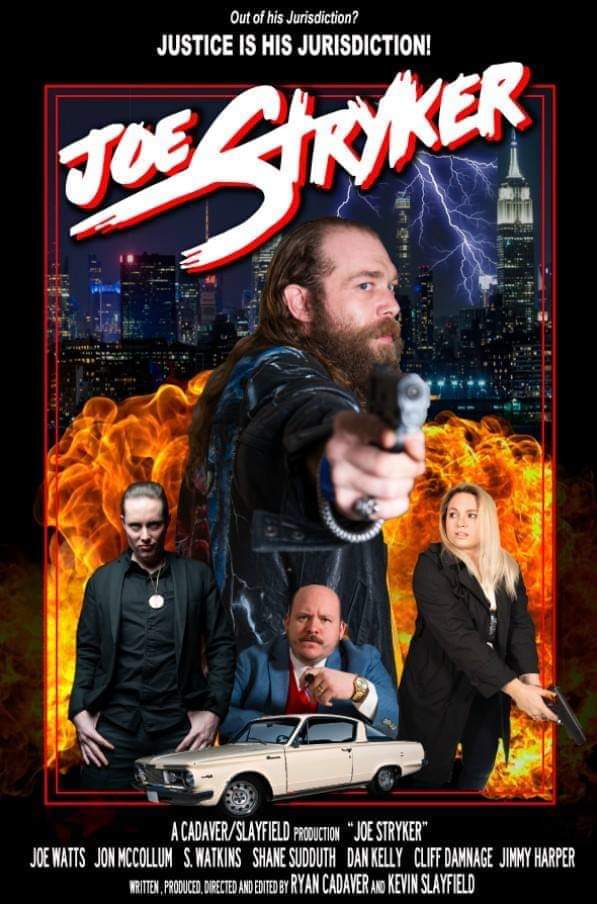
There used to be a time when Joe Stryker was the best damn cop in the business. Then his wife got killed by a bunch of drug pushers and he spiraled out of control, just as the city he served fell apart. Now, Joe’s on the comeback, ready to make the people who made his life hell on Earth pay. And that receipt? Yeah, it’s gonna be paid in blood, baby.
The brainchild of Ryan Cadaver and Kevin Slayfield, Joe Stryker is what happens when you let a bunch of maniacs loose with movie-making equipment and what can only be several nights worth of intoxicants.
You ever drive through a small town that only has bars, four Dollar Generals and a run-down convenience store and wonder what kind of shenanigans go down once the sun fades away and the lower tier booze starts flowing? Well, I grew up in a place exactly like that and can tell you that Joe Stryker would have fit right in.
Training montages? Glowing green drugs? Drug-dealing devil dudes? A band called The Casket Creatures? Gratuitous nudity of both the breast and ball variety? Montages of the neon city at night? Dudes wearing Zubaz with face tattoos carrying bazookas? Plenty of scenes set in bars? Faces getting smashed into a mucky paste? Rusted out storage units? Lots of swearing? Car trunks full of semi-automatic weapons? Yeah, this movie has all that and then some, including dialogue like, “We’re just here to party. You know, do drugs? Fuck goats?”
It’s shot on video and has the budget of my last big date with my wife, but don’t let that hold you back. If you love the kind of movies that I do — and if you’re on this site, I think that you do — then this is the kind of movie that I think you’re going to love.
I’ve had nights like this at the bars of my hometown, except, you know, I never had to hide someone’s ripped off leg in the back of my toilet tank. Yeah, I’m no Joe Stryker. Not many people can be.
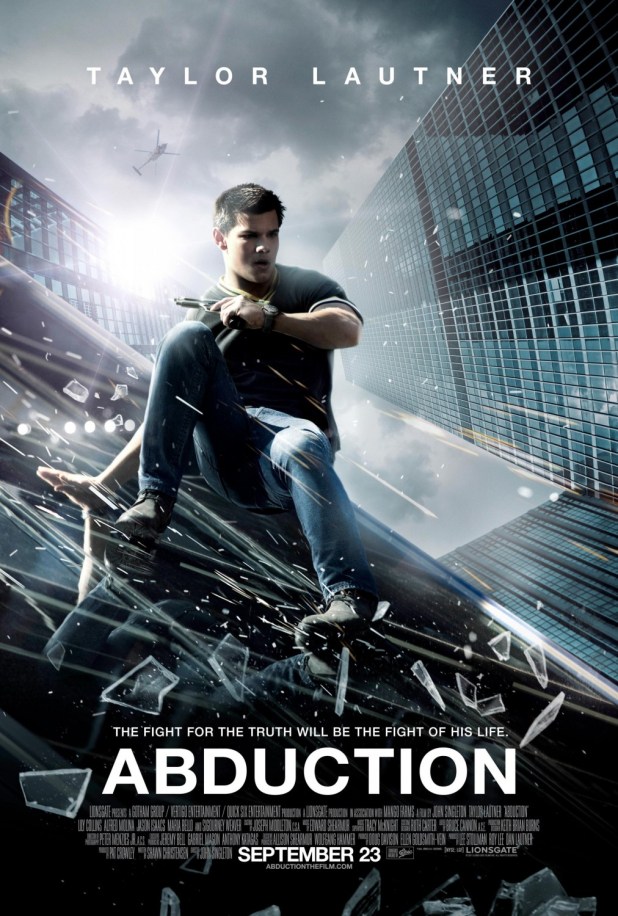
So this whole month is about flops. And this movie, well, it made $82 million worldwide against its $35 million production budget, so that’s anything more than a flop. But it’s also John Singleton’s last movie — a career that had the promise of Boyz n the Hood ended with a vehicle for the werewolf boy from Twilight. Then again, he also made Four Brothers and 2 Fast 2 Furious, so maybe I’m being too generous to his promise.
Maybe I’m just upset because Abduction is the limpest of limp action movies and has the balls to be set in my hometown of Pittsburgh. Then again, most of it was shot in Hampton and Mount Lebanon, two neighborhoods rich with privileged folks who look down on our town’s yinzer soul. None of this will mean anything to you if didn’t grow up within earshot of the voice of Myron Cope, but Taylor Lautner is exactly the kind of kid who hung out at South Hills Village or Ross Park before his dad’s pals from the country club got him a cushy job so he could ogle and harass the interns, always a step ahead of you because there is no middle class here.
Ah, maybe I’m being hard on Taylor. After all, he was a wolf boy. And here, he plays a kid with Jason Isaacs and Maria Bello as his adoptive parents and a kindly Sigourney Weaver as a therapist who maybe isn’t all that kindly, but lives in one of those wacky houses you always stare up at Mt. Washington and wonder — who lives there?
Soon, his kinda sorta parents are dead, his house has been blown up real good and Alfred Molina is trying to kill him. What’s there to do but fall in love with Phil Collins’ daughter and try and find your real dad, only to discover that he’s Dylan McDermott or Dermot Mulroney?
Michael Nyqvist, who played Mikael Blomkvist in The Girl With…films, is also in this. Perhaps this is out American take on these spy thrillers, where instead of sexy and fashion-forward Lisbeth Salander, we get young Taylor rocking out his best American Eagle duds?
This movie got the kind of reviews that I can only dream of making, with one claiming that Bert from Sesame Street had more range than Taylor and the fact that an actual abduction would be preferable to watching this film.
Abduction and Lautner won the Teen Choice Awards for Choice Action Movie and Choice Action Actor. Meanwhile, the man who was once Jacob Black lost his bid to win a Razzie to Adam Sandler, who had the year actors like Cash Flagg could only dream about, as in 2011 he made Jack and Jill and Just Go With It.
If you want to hear exactly how much I hate this movie — and didn’t get the gist from reading the above words — then you should listen to our podcast where I basically went off on the movie for nearly an hour.
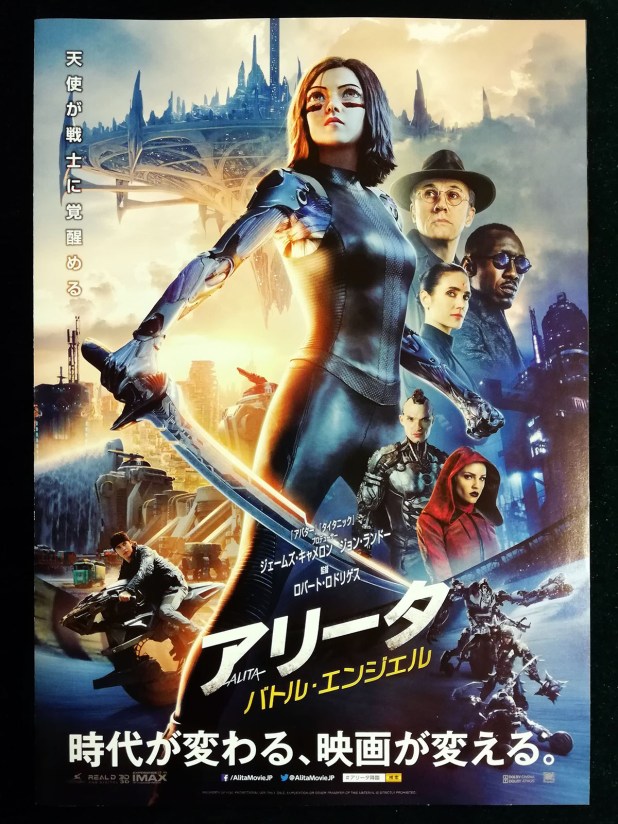
When I saw the first trailer for this movie, I thought, “No one but me is going to go see this movie.” But you know, it’s the most successful movie Robert Rodriguez ever released. And I guess it was a success — the film grossed $85.7 million domestically and $319.1 million in other territories for a worldwide total of $404.9 million.
That’s good, right?
Well, to break even against marketing costs, the movie had to make around $500 million, so it either lost $53 million or barely broke even. Dude, I’m sweating making my minimum payments on my credit cards and these dudes are farting around with figures where $53 million — the amount of money that Mario Bava could have made Danger: Diabolik thirteen times.
PS: I had to do the math for what that movie cost in Italian lira versus U.S. dollars, then do the inflation calculation from 1968 to today. I laugh, because I once said that I would never use math.
So yeah — how did a movie based on Japanese manga artist Yukito Kishiro’s 1990s series Gunnm and the 1993 original video animation adaptation Battle Angel ever make it to U.S. screens?
Guillermo del Toro told James Cameron about it — way back before Avatar. The film sat for years before Cameron asked Robert Rodriguez to condense and combine his 186-page screenplay as well as 600 pages of notes into a shooting script. That work led to Rodriguez getting the directing job and hey — we have a movie.
2563 and we’re already three hundred years after the Great War nearly killed everyone on Earth. That’s when cyborg scientist and part-time bounty hunter Dr. Dyson Ido (Christoph Waltz) finds a disembodied female cyborg in the scrapyard of Iron City. He names her Alita after his dead daughter and saves her human brain.
Alita is in love with the city and meets all manner of people, from Ido’s ex-wife Dr. Chiren (Jennifer Connelly) and a kid named Hugo who introduces her to the sport of this new world, Motorball.
However, Hugo has a big secret: he really works for Vector (Mahershala Ali, who was astounding in the third season of True Detective), the man who runs Iron City and Motorball.
Alita also learns her father figure’s secret — he’s a bounty hunter — and when she trails him one night, she saves him from a gang of cyborg killers. One of them, Grewishka (Jackie Earle Haley), hounds our heroine for the rest of the movie. Alita dreams of bigger things and her past life where she was a Berserker, one of the soldiers of the enemy United Republics of Mars.
You know, maybe reading the manga would have made this all much easier.
Alita goes off and registers herself as a Hunter-Warrior, but is unable to rally any of the other hunters to help her stop Grewishka, who is working for Nova (Ed Norton). Alita’s body is nearly destroyed by the killing machine before Ido, Hogo and dogmaster McTeague (Jeff Fahey!) save her.
Now in a new Berserker body, Alita soon takes over the Motorball league, but loses the love of her life due to the machinations of Nova and his soldiers. The film ends with Alita as a Motorball star, promising that she will someday get her revenge.
You know all that money I mentioned at the top? It didn’t really matter in the long run. That’s because this ended up being the last Fox movie ever made, as Disney purchased the studio, moving us closer to the corporate-controlled world that this movie portrays.
I enjoyed this, but I have no idea how anyone else would react to a movie based on a manga from the 90’s made for a worldwide audience. It’s one of those movies where it cost so much that there’s no way that anyone would see any money from it. But man, it looks really cool, right?
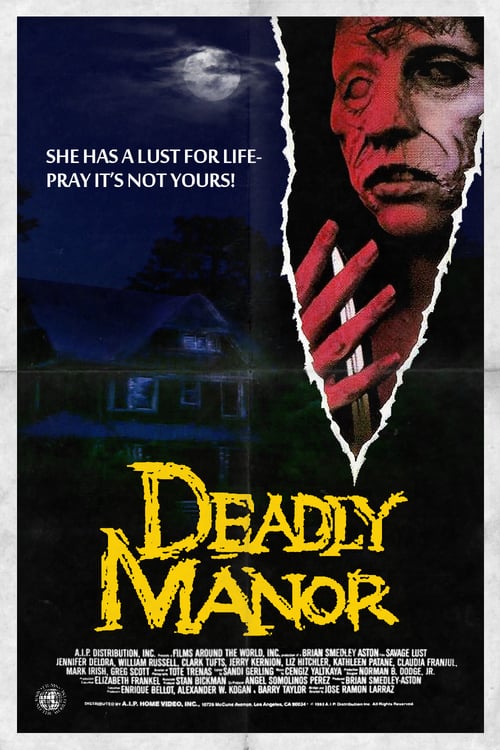
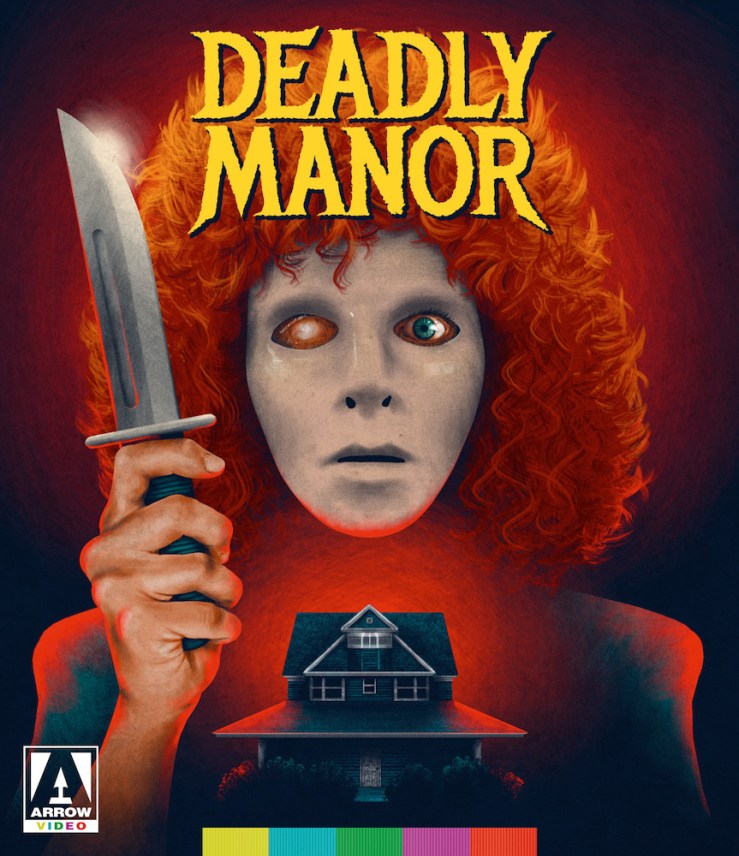
Arrow Video put out José Ramón Larraz’s Edge of the Axe earlier this year and I loved every minute of it. While Deadly Manor isn’t quite as good, it’s still plenty strange. Just when you’re lulled into near-sleep by the numbers slasher plot, something absolutely and wonderfully bizarre happens, like the flashback to the bikers causing the accident or shocking nude photos of living, dead and perhaps not so dead people that show up throughout the film. Seriously, if nudity bothers you, this is not the movie for you.
On their way to a lake that no one can pronounce, some kids pick up a drifter with a dark past — don’t they all have those — and head to an abandoned mansion that has a car shrine up front, coffins in the basement and a closet full of scalps. And oh yeah — the same gorgeous yet evil woman has a photo up every few inches.
Everybody is soon about to be snuffed, but you knew that just from the first few seconds of the movie.
Greg Rhodes is in this movie and Ghosthouse, which would make a great movie to pair this up with if you’re looking for a fun evening. Jerry Kernion, who is Peter, has had a pretty nice career after this debut. And Jennifer Delora, who is pretty fun as the killer, was the second woman in Miss America history to be dethroned after her nude scenes in Bad Girls Dormitory became fodder for those easily upset. She’s also in all manner of genre favorites like Robot Holocaust, Suburban Commando, Bedroom Eyes II and Frankenhooker.
Seriously — hang out for the first hour or so of this movie. You’ll be rewarded with something really special when it comes to the final girl and the last twenty minutes or so.
As always, Arrow has gone all out for a movie that not many people were all that concerned about. So what! This features a new 2K scan, interviews with actress Jennifer Delora, Brian Smedley-Aston and Larraz (archival, not new, as he died in 2013) and a trailer for the Savage Lust VHS release. There’s also a commentary track with Kat Ellinger and Samm Deighan.
You can buy Deadly Manor from Arrow Video, who were kind enough to send us a review copy.
We, the music and film loving dorks at B&S About Movies, remember Sorcerer for Tangerine Dream’s accompanying soundtrack*, which served as the Krautrocker’s first Hollywood film score and ninth album overall. The law-degree carrying Hollywood bean counters remember Sorcerer as a $22 million picture that made $15 million during its initial release and ended up losing the studio $42 million in production costs.
While William Friedkin’s instant classics The French Connection (1971) and The Exorcist (1973) raked in the cash and the critical raves, Sorcerer gained mixed to negative reviews on the worldwide critical front. Today, while it is critically lauded as one of Freidkin’s finest, and considered an amicable follow up to his influential hit, The Exorcist**, it bombed at the box office as result of Universal and Paramount underestimating the potential of 20th Century Fox’s new science fiction-fantasy that was released one month prior: Star Wars, George Lucas’s follow up to his own 1973 hit, American Graffiti.
Luckily, for Tangerine Dream the film’s poor critical showing didn’t trickle down to their soundtrack work. The album reached the U.S Top 200, a domestic-retail milestone for the band. In the U.K the album went to #25 on the charts and became their third highest-charting album. The critical and sales plateaus reached by the band with their soundtrack debut so impressed Hollywood, it led to the band’s fruitful career of soundtrack work.
As for William Friedkin: he bounced back with the Al Pacino-starring Cruising.
Sorcerer, in addition to poor scheduling, also suffered from bad casting choices. Reflecting on the film in the pages of Easy Riders, Raging Bulls: How the Sex-Drugs-and-Rock ‘N’ Roll Generation Saved Hollywood (a highly recommended read for you movie lovers), Friedkin believes he shouldn’t have done Sorcerer at all, once plans with Steve McQueen fell through, as the film’s leading role was written specifically for the Bullitt star. The fallout was the result of McQueen wanting his new wife, Ali McGraw (Convoy), to be either cast in the film or hired as an associate producer. Friedkin said no and McQueen left the project. While Roy Scheider recently came off the back-to-back hits of 1975’s Jaws*** and 1976’s Marathon Man (where he was only a co-star and not a lead), it wasn’t enough to entice ticket buyers, considering the rest of the cast were international names unknown to U.S domestic audiences.
Don’t be title and director duped: it’s not a horror movie, as this TRAILER, shows.
While Friedkin disagrees with the assessment, this second adaptation of Georges Arnaud’s French novel Le Salaire de la peur (1950) carries the majority of critical opinion that Sorcerer is not so much a Friedkin reimaging of the novel than it is a straight remake of Wages of Fear (1953), the first film based on the novel. Initially conceived as a $15 million project, the film’s Dominican Republic shoot went “Heaven’s Gate,” near doubling its budget and required the resources of two studios—Universal and Paramount—to complete it.
Both of the Arnaud-inspired films are concerned with four unfortunate outcasts of varied backgrounds from around the globe running from their individual demons. They come to work together when they find mutual employment transporting cargoes of unstable, aged stocks of “nitroglycerin sweating” dynamite across a treacherous South American jungle. Sorcerer, as with Werner Herzog’s (excellent!) similar jungle romps Aguirre, the Wrath of God and Fitzcaraldo, is an intelligent thriller—beyond the usual Hollywood action tripe—that ponders the questions of man’s control over his own fate and the absurd situations one can find themselves cast as result of their poor life choices. It’s certainly an apropos lesson, considering this film’s fate and the effects it had on Friedkin’s post-Exorcist career.
While we look upon Sorcerer today as a forgotten masterpiece, it came at a price beyond the financial: In an Esquire magazine interview about the film, Freidkin stated he contracted malaria in the Dominican Republic jungles and fifty crew members had to be replaced for contracting gangrene and other various jungle-based diseases.
About the Author: You can read the music and film reviews of R.D Francis on Medium and learn more about his work on Facebook. He also writes for B&S Movies.
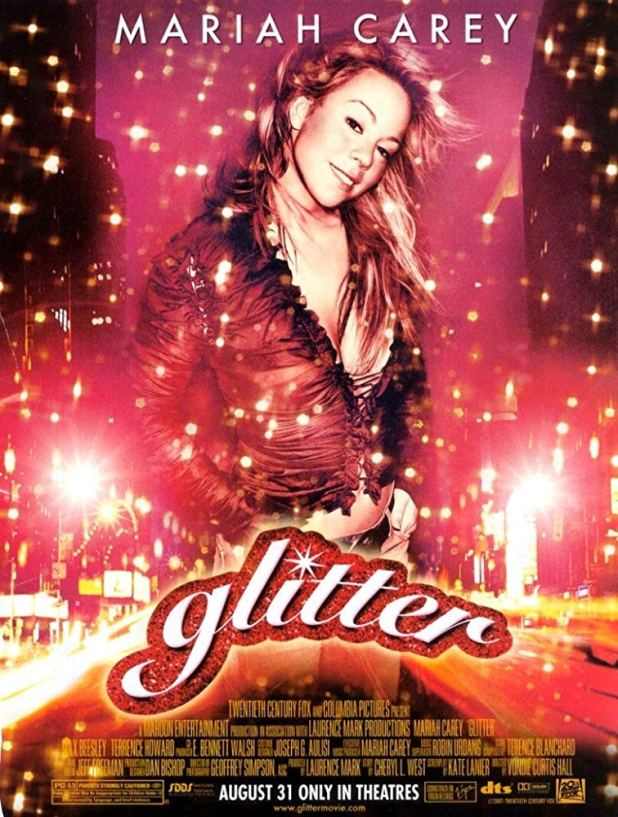
Mariah Carey went into this movie as probably the biggest diva on the planet, having emancipated herself from her first marriage to Tommy Mottola and her contract with Columbia Records to become exactly who she wanted to be.
She also pretty much lost her mind.
As she started the publicity tour for this movie, she’d leave long and rambling voicemails to her fans — her lambs, as she called them — on her website. And then there were the TV appearances. On BET’s 106 & Park, she hid behind pillows and claimed that she was living “one day that was continuous.” There was also the infamous TRL appearance on MTV, where she emerged in a nightshirt giving away ice cream to the audience before discussing therapy and stripping on stage, ending with her yelling, “Mariah Carey has lost her mind!”
See — I told you.
By the end of the month, Carey was hospitalized for extreme exhaustion and had both a physical and emotional breakdown. The movie and soundtrack were delayed for a few weeks, then the attacks on September 11, 2001 happened. And no one wanted to think about music or fun or Mariah Carey going bonkers for a while.
I’m lying. I was ready for this trainwreck the whole time.
Carey herself said, “Here’s the thing that a lot of people don’t know, that movie was released on September 11, 2001 – could there be a worse day for that movie to come out? … I don’t even know that many people even saw the movie.” She’s since referred to the movie as the biggest mistake of her life.
Mariah is Billie Frank, the daughter of a 1970’s nightclub singer who once set their house on fire. She grew up in an orphanage with her two best friends, Louise and Roxanne (Da Brat and Tia Texada), but now all three girls are the backup singers to the host of Top Chef (Padma Lakshmi, the only person in this movie to probably has read The Satanic Diaries, much less be married at one point to its author).
Billie falls for Dice, a DJ who gets her out of her contract with Timothy (Terence Howard) for $100,000, an action that ends up costing him his life just as Billie is about to finally play Madison Square Garden. Man, I fast-forwarded the plot, but that’s pretty much it. Think A Star Is Born without all the crying in bathtubs.
As amazing a singer as Carey is, her five-octave voice does not translate to her ability to emote or carry the lead role. No one else is ready, willing or able to carry her. And look, I may be writing this in my sweatpants, but even I know that some of the fashions in this movie do anything but glitter.
Director Vondie Curtis-Hall — he’s also an actor, you may have seen him on Chicago Hope as Dr. Dennis Hancock — has mostly moved into TV movies about celebrities. Here’s hoping he goes meta and makes a Mariah film.
This movie has left me with so many questions. How old is Billie’s cat? It has to be at least twenty years old or longer. How did she and Dice learn how to telepathically write songs together? Why is no one interesting in this movie? Why did Ann Magnuson sign up for this? Why has the two-and-a-half hour length original cut never surfaced? Could Dice’s pants be any tighter? Are they perhaps his skin? And what’s up with that bicycle outfit that Mariah wears?
Glitter made $5.3 million on a $22 million dollar budget and the soundtrack album ended up being the worst selling record Carey released up until that point, so she was dropped from her Virgin contract, losing around $100 million dollars. Man — I can’t sleep and my total debt is so insignificant next to that amount. And I’ve never showed up and thrown ice cream sandwiches to Carson Daly yet. Maybe there’s hope for all of us. Thanks for showing us the way, Mariah.



 B&S About Movies

You must be logged in to post a comment.