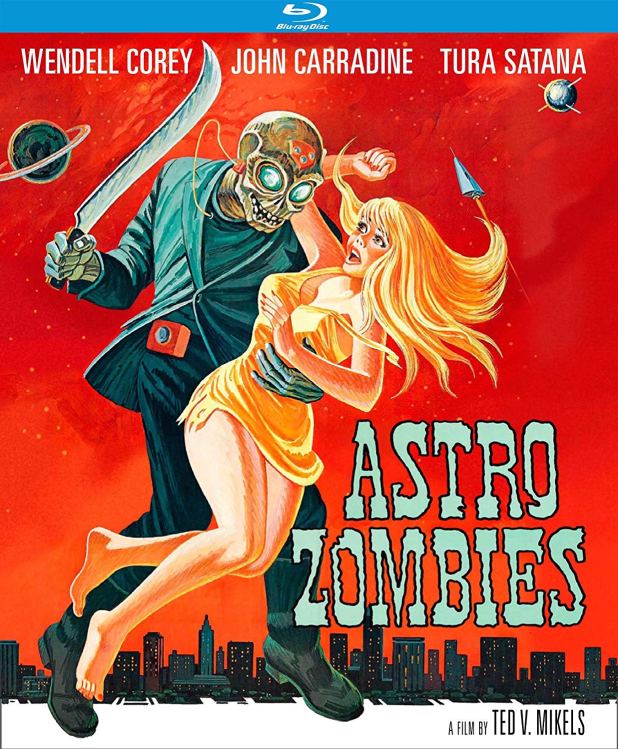
Ted V. Mikels had the body of a Greek god with a giant handlebar mustache, lived in a castle in the Nevada desert populated with live-in women (his Castle wives) and made astoundingly crazy movies. He was a magician, acrobat and fire eater before he started making movies and once he began filming them, he left this planet with pieces of insanity such as Girl In Gold Boots, The Black Klansman, The Corpse Grinders, Blood Orgy of the She-Devils, The Doll Squad and many, many more.
Dr. DeMarco (the ever-job hungry John Carradine) gets fired by the space agency. Not NASA. The space agency. So he does what any of us do when we get downsized. No, he doesn’t develop a case of the shakes and contemplate how to kill himself so his wife can take advantage of his life insurance because he’s failed yet again.
He makes superhuman monsters from the body parts of innocent murder victims that can be controlled by flashlights to the side of the head.
That said, those undead, well, astro zombies get loose and the CIA and an international gang of spies all get mixed up.
This is Wendell Corey’s last film, an ignominious close if I ever saw one.
Wayne Rodgers, who would become a star on M*A*S*H* co-wrote and co-produced this movie, the last time he’d work with Mikels.
But come on. You’re watching this for Tura Satana. Seriously, of all the women to walk the millions of years on this Earth, there could be only one Tura, the women who studied martial arts so that she could go back and get revenge on the men who assaulted her as a child, like a living and breathing version of They Call Her One Eye.
“I made a vow to myself that I would someday, somehow get even with all of them. They never knew who I was until I told them,” said the goddess herself.
She also survived being shot, breaking her back in a car wreck and a wedding proposal from Elvis Presley. Seriously, my love for Tura Satana knows no boundaries.
She’s why I watched this movie.
As Glenn Danzig once sang in the song “Astro Zombies” — which more people know than probably this movie — “With just a touch of my burning hand, I’m gonna live my life to destroy your world. Prime directive, exterminate the whole fuckin’ race!” The Misfits were the perfect band to convey the junky charms of this film.
You can watch this on Amazon Prime. The Rifftrax version is available on Tubi.
Steven Spielberg had never failed on this level before. In fact, he’d never really failed before.
He’d been given some advice about the movie from John Wayne, who had declined to act in it due to ill health. Spielberg would recall that the Duke “said he felt it was a very un-American movie, and I shouldn’t waste my time making it. He said, “You know, that was an important war, and you’re making fun of a war that cost thousands of lives at Pearl Harbor. Don’t joke about World War II.” Charlton Heston also turned down a role in the movie. They were the lucky ones.
While only the fifth full-length film Spielberg would release theatrically, he was already growing self-referential, with Susan Backlinie getting nude and reprising her role as the first victim (just like Jaws), the gas station from Duel showing up and reusing Lucille Benson in a similar role.
Spielberg would later cede that personal arrogance is why the movie failed. That and the fact that he gave up control over the second unit and effects shots would be lessons he’d take with him for the rest of his career.
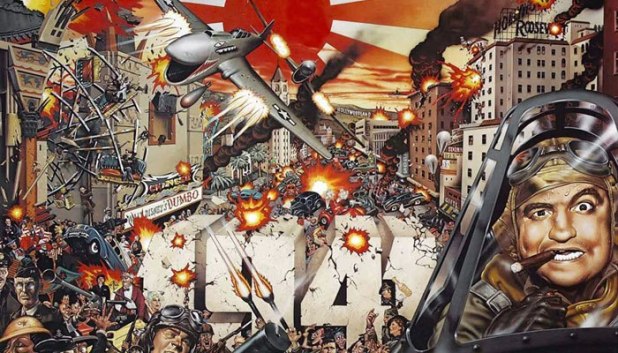
The movie begins six days after Pearl Harbor, as a Japanese submarine surfaces off the coast of Califonia. This is somewhat based in fact, as there was an event that has come to be referred to as the Great Los Angeles Air Raid of 1942. The commander of that sub, Commander Mitamura ( Toshiro Mifune, in the only Western movie where he used his real voice and wasn’t dubbed by Paul Frees) and Nazi general Wolfgang von Kleinschmidt (Christopher Lee!) have come to America to destroy Hollywood.
Later that morning, the 10th Armored Division M3 Lee tank crew, consisting of Sergeant Frank Tree (Dan Aykroyd), Corporal Chuck Sitarski (Treat Williams) and Privates Foley and Reese (John Candy and Mickey Rourke) are having breakfast where Wally and Dennis (Bobby Di Cicco and Perry Lang, who was in The Hearse) work as dishwashers. They all get into a fight, which Sitarski breaks up, because he can’t stand Americans fighting Americans.
Meanwhile, the maniacal United States Army Air Forces Captain Wild Bill Kelso (John Belushi, who fell off his plane at one point and was in the hospital for a while; it was so funny that it’s in the movie) lands his Curtiss P-40 Warhawk fighter near that aforementioned Duel gas station and blows it up real good. And, if you’re still paying attention, Major General Joseph W. Stilwell (Robert Stack) is trying to calm the public who is convinced that World War II has come to America. Because, well, it is, a point hammered home when the romantic hijinks of Captain Loomis Birkhead (Tim Matheson) and press agent Donna Stratton (Nancy Allen) releases a bomb on the stage.
There’s a lot to keep track of.
While all this is happening, Ward Douglas (Ned Beatty) and his wife Joan (Lorraine Gary, also of that shark blockbuster) are allowing the military to install a gigantic gun on their front lawn. His daughter Betty dates Walter, who we met before, but now she’s only allowed to dance with soldiers. Oh yeah — Wendi Jo Sperber shows up as well, as she did in nearly every movie after 1979 that had a curvy best friend role.
Of course, all hell breaks loose, ending with a house going into the ocean as Robert Stack intones, “It’s going to be a long war.” Dude. It was a long movie and I’ve only summarized part of it.
This movie is overloaded with actors, like Murray Hamilton (are you sick of actors who were in that shark film yet?), Warren Oates, Eddie Deezen, Slim Pickens, Patti LuPone, Penny Marshall, Frank McRae (who pretty much invented the angry police captain role that every 80’s movie stole), Lionel Stander from Hart to Hart, Lenny and Squiggy as Willy and Joe (better known as Michael McKean and David Lander), Iggie Wolfington (who is also in Hex, a movie I love that no one remembers), Count Floyd himself Joe Flaherty, Lucille Benson (Mrs. Elrod!), Elisha Cook Jr. (Rosemary’s Baby), directors Samuel Fuller and John Landis, Robert Houston (who not only was in The Hills Have Eyes, but also made the bootleg Lone Wolf and Cub remix Shogun Assassin), frequent Clint Eastwood co-star Jack Thibeau, Andy Tennant (who would go on to direct Ever After and Fools Rush In), an uncredited James Caan, Jerry Hardin (Deep Throat from The X-Files) and, of course, Dick Miller.
The Japanese submarine crew was made up of laid-back Southern California dudes who were hired just because they were Asian. Mifune was infuriated by their attitudes, so he asked Spielberg if he could speak to them. An actual Japanese World War II veteran and one of the greatest actors of all time, Mifune spoke to them about getting in line before he became screamed and slapping them around, Needless to say, he was in charge from then on.
There’s a really awesome comic book adaptation of this that Heavy Metal released, with story and art by future Swamp Thing talents Steve Bissette and Rick Veitch. I had a copy as a teenager and much like how I saw most movies as Mad Magazine stories before the actual films, it’s how I experienced this movie for a long time.
Spielberg even wrote the intro to the comic, in which he said, “Columbia and Universal forced me to spend $30 million on 1941. The film’s actual cost was $12.5 million. The rest of the budget was spent on prostitutes and drugs. I can see 1941 more as a cleansing experience. The one possible way I can make you forget all the good things I’ve done in motion pictures. Be merciful.” You can still buy it directly from Heavy Metal.
So was it a bomb? Not according to co-screenwriter Bob Gale: “It is down in the history books as a big flop, but it wasn’t a flop. The movie didn’t make the kind of money that Steven’s other movies, Steven’s most successful movies have made, obviously. But the movie was by no means a flop. And both Universal and Columbia have come out of it just fine.”
That’s true — it made $92 million on a $35 million dollar budget. That seems like a success to me, at least financially. For his part, Belushi found the whole thing hilarious and was seen wearing a t-shirt that said, “Steven Spielberg 1946-1941.”
Perhaps the best review of the film came from Kubrick, who said that the movie was great. But it really wasn’t funny. Spielberg would agree and say that it would have been better marketed as a drama.
If this movie gave us anything, it’s this: Robert Stack remarked, after meeting Belushi for the first time, “That’s the craziest SOB I’ve ever met.”
Every time he did stand-up, every time he was on a talk show and in nearly every movie he was in, it was a constant case of “Look at me! I’m the center of attention! No one else is as important as me!”
I feel bad that the man took his own life after dealing with depression and by and large, I’ve heard wonderful stories of how he truly was as a human being.
But his movies make me physically sick.
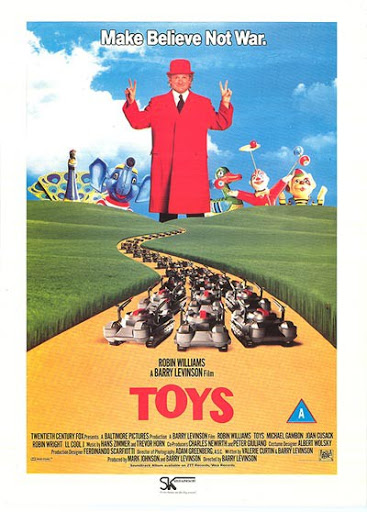
The worst of them is 1993’s Toys, a movie so bad that I worry that the last 27 years of my life have been a Jacob’s Ladder situation that I will soon wake up in the Boardman, Ohio Movies 8 and be forced to take my college girlfriend to Pizza Hut before I am chastised for how sloppy I am for several hours by her mother.
Who can we blame for this flop? Surely not designer Ferdinando Scarfiotti, who labored for more than one year designing the film’s sets, taking over every sound stage at Fox Studios in Los Angeles. He based so much of it on the art of Magritte and Italian Futurism, Modernist art and Dada. It looks gorgeous.
I still hate this movie with the combined inverse energy that I use to love giallo, Joe D’Amoto, George Eastman and Lon Chaney Jr.
Kenneth Zevo, the owner of the Zevo Toys, is dying. He’s played by Donald O’Connor, who deserved way better for his last film role. Instead of giving the reigns of power to his son Leslie (Williams), he will give them to his son Leland (Michael Gambon, who also deserves…you get the idea). Leslie’s childlike ways won’t serve him well in the ways of business and even a romance with Gwen (Robin Wright) can’t mature him.
Where can I start with this movie? Like how Alsatia (Joan Cusack) is really a robot all along? That LL Cool J has a long diatribe about being a military man and eating his peas in a certain way (I have been known to quote this scene often as I describe my pure bile for this entire filmmaking enterprise)? That there’s a monster called the Sea Swine? That Tori Amos music gets wasted in this? That talent like Jamie Foxx, Debie Mazar, Yeardley Smith and Wendy Melvoin (yes, Wendy who was once with Lisa in Prince’s band The Revolution) are all forced to somehow be in this movie that meanders on and on and on?
Happy toys versus military weapons? If you want to see that, be my guest. Robin Williams mugging like a cocaine-addled lunatic while robotic sisters battle aquatic drones? Turn it on, if you feel like it.
Don’t include me.
It took writer, producer, and Director Barry Levinson a decade to get this — his dream project — to the screen. Looking back on his IMDB list — Home Fries; Good Morning, Vietnam; Rain Man and more — and I see so many movies that have bullied me. This entire article triggered me worse than if I ran into the previously mentioned ex-girlfriend and she’s been deceased for several years, so imagine how traumatic this all is.
EDIT NOTE: Thanks to midnightmoviemonster for pointing out I said Robert, not Robin Williams. I was thinking about the artist probably, who I love. Thanks!
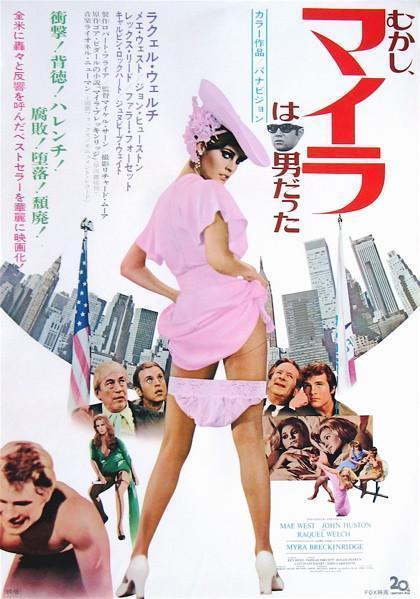
Gore Vidal’s 1968 novel Myra Breckinridge was a landmark novel, an attack on the traditional norms of gender and sexuality, while also a biting satire of Hollywood. It was also seen as incredibly pornographic, so the idea that a movie could be made from the book seemed pretty out there.
After all, two weeks into writing the book, Vidal decided to make his main character transgender — and if you think transpeople are an issue today, you can only imagine how the world felt about them fifty years ago. An interesting trivia note — the name Breckinridge was taken from Bunny Breckinridge, who played The Ruler in Plan 9 From Outer Space. He was an openly gay man in a time when it was dangerous to be homosexual and was even jailed several times as a result. His desire to become a woman was ruined by the legal system and even a car accident on the way to get an illegal transition surgery in Mexico. In his later years, he’d open his San Francisco Spanish bungalow-style home to hippies and regale them with the history of closeted Hollywood.
Somehow, this got made, with Vidal making $750,000 ($5 million in today’s money) for the rights and screenplay. Original director — and Pittsburgh native — Bud Yorkin was replaced by Michael Sarne, an auteur who had made all of one film, 1968’s tale of swinging London Joanna. Somehow, he got complete creative control over this project.
Sarne quickly went over budget. One reason is that he’d often lock himself in a room while union cast and crew made money outside, thinking of what he’d do next for up to seven hours as a time. He also famously spent several days filming close-ups of food instead of handing that task off to a second unit. He also was big on getting the cast members to fight amongst themselves.
A former singer — who had a novelty #1 hit with “Come Outside” in the UK, somehow Sarne was able to do whatever he wanted, at least until this movie flopped. He never directed a movie in the U.S. again, but has acted in several films since this movie bombed oh so badly. And his movie The Punk did well, but it took decades to revive his career.
I mean, Sarne trashed the entire cast long before the movie even came out. Welch was “useful only as a joke” and “an old raccoon.” Rex Reed was “faggy, prissy and unpleasant.” John Huston was “an old hack.”
When asked by The Independent about the film, Vidal minced no words. “One of the worst films ever made. A disaster. Myra was the most pre-publicized film since Gone with the Wind. It made the covers of Time and Newsweek. But you could tell it was going to be a disaster from reading Sarne’s script.”
So how bad is it? Well, somehow this 94-minute film feels like it takes 94 years to unspool. It ridicules old Hollywood for shock tactics, leading many of the Golden Era film actors who appeared in the movie to be angry that their old films were being used to punctuate puerile gags and a woman on man pegging assault. It got so bad that the White House asked for footage of Shirley Temple — now a U.S. ambassador — to be removed. Loretta Young successfully sued to have herself cut out of the film.
Yes, it’s a movie so bad that actors sued to get themselves on to the cutting room floor.
The film begins with Myron Breckinridge (critic Rex Reed, who also shows up in another megaflop, Inchon) has gone to Copenhagen to become the gorgeous Myra (Racquel Welch, who is, well, Racquel Welch and nearly melts the screen with each appearance). When he returns to the U.S., he heads off to his/her (Myra has no set gender pronoun) uncle Buck Loner’s (John Huston, who I would say deserves better, but he’s also in Tentacles, Bermuda Triangle and The Visitor, so he obviously would do anything; also all three of those movies are a billion times better than this) acting school, where he/she acts as his/her own widow to try and get half the school or a half a million bucks.
Somehow, Myra ends up becoming an etiquette teacher at the school, which means that he/she discusses mainly the Golden Age of Hollywood and female domination, all with the end goal of “the destruction of the last vestigial traces of traditional manhood in the race in order to realign the sexes, thus reducing population while increasing human happiness and preparing for its next stage.” Oh yeah — Myron also shows up as his/her conscience.
Myra has also grown obsessed with lovebirds Rusty and Mary Ann (Roger Herren, whose career was ruined after this lone role, and a very young Farrah Fawcett), who she sees as everything old fashioned, apple pie and America. To destroy them, she first pegs Rusty, who leaves his girl behind, then enters a lesbian relationship with Mary Ann, who wishes that Myra was really a woman so they could have a complete life. Ah, 1970.
Also — Mae West — pre-Sextette — is in here as a casting agent who is pretty much Mae West redoing all of her old routines. After auditioning plenty of men — look for a young Tom Selleck — she ends up getting the used up and presumably dilated Rusty as her next boy toy.
Buck is convinced that Myra is a liar and keeps trying to trip him/her up. These machinations end when Myra reveals that she hasn’t lost all of Myron, who then manifests himself and hits her with a car.
Myron awakens — in black and white thanks to a re-edit made to the DVD release to show us this was all a dream — and was never a woman at all.
All manner of people are utterly wasted in this movie, which I’ve come to respect in the same way that one looks up to rats for being able to get into social media eating pizza on a near-weekly basis. There’s Dan Heyada in a young role as a mental patient, Toni Basil more than a decade before her hit video “Mickey,” The Monkees’ actor Monte Landis, Helda Hopper’s son William, former pro wrestler Buck Kartalian, Kathleen Freeman (Microwave Marge from Gremlins 2), Grady Sutton (who was often in W.C. Fields movies and often played “sissy” roles), Andy Devine (who was Cookie, the sidekick of Roy Rogers), John Carradine (are you shocked?), Jim Backus, Calvin Lockart (The Beast Must Die), George Furth (Blazing Saddles) and Roger C. Carmel (Harry Mudd himself!).
Raquel Welch claimed that she was fascinated by Mae West, as she could never fully decide if West was a man or a woman. That seems like sour grapes, as West had a contract that allowed her to pick her costume colors above anyone else in the cast, leading to many of Welch’s outfits needing to be picked all over again.
And hey — Rex Reed refused to say the movie’s best — or worst — line, “Where are my tits? Where are my tits!?!” until he was told they’d just have someone impersonate his voice. He did it anyway.
As we’ve seen numerous times over Box Office Failures Week, many movies that were flops didn’t really flop. And some of the ones seen as poor films are actually pretty good. This is not the case. Not even a little bit.
One day when I was shopping at Walmart, my wife noticed a Valerian t-shirt. She said, “I have no idea what this is, put it looks like something you’ll be into.” I was already primed for this movie, which came and went in no time at all. I’m glad I bought that shirt — I’m wearing it now and it’s inordinately soft and comfortable, thanks for asking — but I’m not so sure about the movie itself.
This was written and directed by Luc Besson, who famously brought the world The Fifth Element, La Femme Nikita and Léon: The Professional and perhaps not so famously The Extraordinary Adventures of Adèle Blanc-Sec, a movie that this resembles not only because it is based on a comic book that few Americans know, but because it so deliriously cares so little about not making any sense whatsoever.
Valerian has been a comic book that ran in France from 1967 to 2010. One of its artists, Jean-Claude Mézières, worked with Besson on The Fifth Element and asked him. “Why are you doing this shitty film? Why you don’t do Valerian?”
It would take years for the technology to catch up to the point where all the many races of the comic could be depicted on the big screen. Besson was worried about the challenge, continually rewriting his script, which follows much of the sixth volume of the series, Ambassador of the Shadows.
The beginning of the film sets you up for magic, as it details how the International Space Station grew to meet more alien races and how the human race changed to adapt, with Rutger Hauer acting as the face of humanity. It’s totally awesome and packed with imagination and probably the last part of the movie that isn’t non-stop action.
Now that space station is called Alpha and its explored by the United Human Federation. Two of the best agents are Major Valerian and Sergeant Laureline. This movie is about their adventures to save the alternate planet Müi after Valerian gets a telepathic message from the now-deceased Princess Lihö-Minaa.
What follows is a delirious odyssey, dealing with the deceptive Commander Arün Filitt (Clive Owen), meeting a shapeshifting entertainer named Bubble (Rhianna) and getting to the bottom of the end of planet Müi.
I want to love this movie — I mean Herbie Hancock plays a military leader and John Goodman is the voice of a gangster alien — but man, it’s all over the place. It’s confusing enough figuring out where you are in the movie when suddenly people are in more than one place at the same time and it’s playing tricks of people appearing and disappearing, as well as alternate worlds and duplicitous leaders. It’s as if you’re suddenly dropped into a sequel of a franchise you’ve never watched before — because that’s exactly what is happening.
This would work if everyone knew the story of Valerian, but nope. They don’t.
Besson is still holding out hope for a sequel, despite this movie costing $400 million and only making $225 million back. That’s the perils of big time moviemaking.
But man — I don’t hate it, the more I think about it. It’s audacious, with two hundred different alien species appearing and so many major set pieces that it took seven soundstages to film it all. Besson is a maniac — he wrote a detailed six hundred-page about the aliens and the worlds they’d be filming that the actors had to read before they appeared in the movie.
My biggest problem with the movie is Valerian himself. Dane DeHaan seems to be channeling Keanu Reeves and not in a good way. He comes off as perhaps the most unlikeable character and you never get any true sense why Laureline would have any interest in him whatsoever.
Despite the change in hair color from red to blonde, I have fewer qualms about Cara Delevingne’s acting. You may remember her as The Enchantress from Suicide Squad. She’s also in Her Smell and Paper Towns.
There’s also a Jessica Rabbit cameo, played by Sand Van Roy, an actress who has accused Besson of sexual assault. Delevingne has also discussed how Harvey Weinstein tried the same with her.
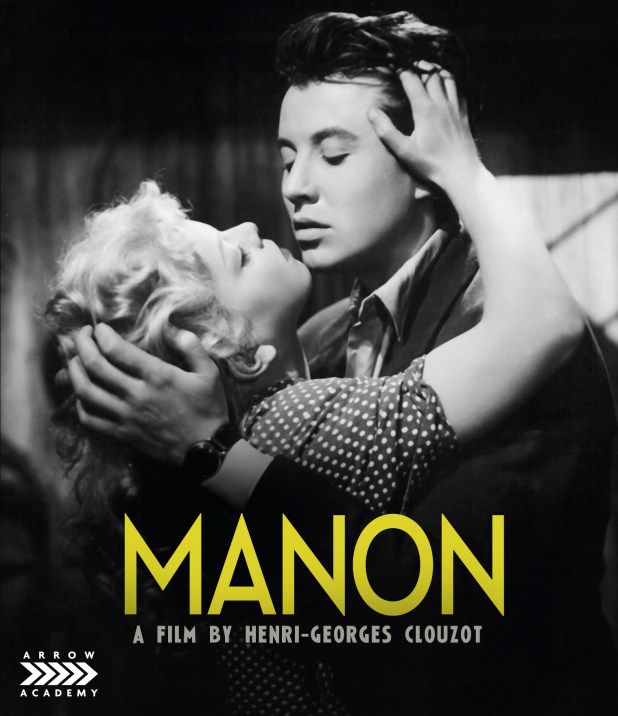
Based on Prévost’s 1731 novel Manon Lescaut, Manon was directed by Henri-Georges Clouzot, who is better known for the thrillers The Wages of Fear and Les Diaboliques.
He moves this tragic romance to the end of World War II, as young Manon (Cécile Aubry, The Black Rose) is accused of working with the Nazis. A former French freedom fighter named Robert Dégrieux (Michel Auclair, The Day of the Jackal) rescues her, but when they get to Paris, they must deal with all manner of sin to just survive. In fact, they’re pretty much doomed.
Manon is a striking indictment of post-World War II France. Where there was once the promise of heaven on Earth, now there’s only profiteering and prostitution. Before the end of the film, Robert leaves that Manon isn’t the angel that he wants her to be. And her amoral and duplicituous ways are about to lead him down the path that all good intentions lead to.
Aubry’s first major film role, she’d only make six more films before marrying a Marrakech prince named Si Brahim El Glaou and becoming a writer. Today, she may be best known for French TV series Belle etSébastien, which also lent its name to the band. Her son Mehdi El Glaoui would play the lead male role on that show.
This is probably the only movie on this site that can claim that it won a Golden Lion in Venice. While this isn’t one of Clouzot’s best-known works, that hasn’t stopped Arrow Video from releasing a version that has all their trademark extras.
Beyond the high def 1080p blu ray presentation, there are also interviews with Clouzot discussing the relationship between literature and the screen, as well as a video appreciation of the film by critic Geoff Andrew.
You can order Manon from Arrow Films, who were nice enough to send us a review copy.
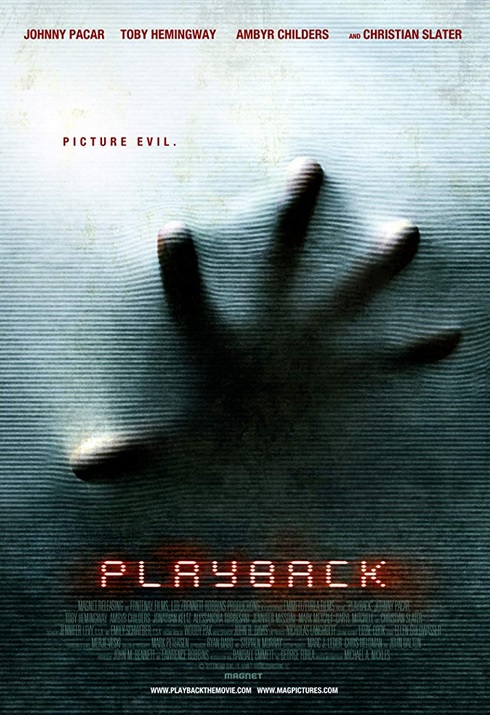
If his name is on the movie, I’ll watch it. Call it bad choices or bad luck, but the Slate does not suck. Granted, most of the movies he’s done of late do, but he himself, does not. He, like Bruce Willis (Precious Cargo), Nicolas Cage*, Eric Roberts (Lone Star Deception), and Tom Sizemore (The Pining) before him, may have fallen on hard times, and some may say he’s gone from heartthrob to has-been, but he always delivers the goods on screen. Always. And while Playback does suck and deserves to be noted as 2012’s lowest-grossing movie of the year, netting under $300 in U.S domestic box office against its $8 million budget (its worldwide gross was just over $57,000 during its 41 weeks in release), it’s not Slater’s fault—although all of the critical reviews on Playback make a point of driving home that Slater once worked along Tom Cruise and now he’s ended up in the lowest-grossing movie of the year.
Long before many came to know Christian Slater for his three-time Golden Globe nominated and 2016 winning role in the USA Network’s Mr. Robot, and a wealth of low-budget indie and direct-to-video films (Alone in the Dark, Bullet to the Head), he was on Hollywood’s A-List with roles alongside Kevin Costner in Robin Hood: Prince of Thieves and he headlined Quentin Tarantino’s True Romance. Slater admirably traded acting chops in John Woo’s Broken Arrow with John Travolta, In the Name of the Rose with Sean Connery, and Interview with a Vampire with Tom Cruise. Then, after starring with Morgan Freedman in the 1998 action thriller Hard Rain, his “star,” as with Nicolas Cage, started to slip. Call it age. Call it changing times. Call it problems with alcohol, drugs, guns, and assault.
Honestly, I don’t care what you call it. The Slate always delivers. And he deserves a Robert Downey, Jr.-styled second chance back to the bigs. His Golden Globe work on Mr. Robot is proof of that.
Okay, so you’re wondering how in the hell does a film with a seven-figure budget earn a three-digit U.S box office? Well, hopefully, you read our previous “Box Office Failure Week” review for Zyzzyx Road, because, Playback suffered from the same exact rollout snafu. (Another is the excellent Jason Patric war film, The Beast). Playback—most likely to fulfill a clause in a SAG or IATSE agreement—played in one theater (location unknown), once-a-day for one week (March 16 to 22) (the bare minimum, theatrical-contractual requirement) and sold approximately 35 tickets. As with Zyzzyx Road, Playback was never meant to be a theatrical feature: it was always intended to be a direct-to-video release.
Coutesy of Mike McGranaghan, with his May 2017 piece, “25 Lowest-Grossing Movies of All Time” at Screen Rant: We come to understand Playback was released by Magnet Releasing: a company that gives most of its films a token theatrical release to promote the digital on-demand release. Magnet debuted the movie on Amazon, iTunes, and satellite/cable services a full month before releasing the film in a solitary theater—effectively giving no one a reason to pay to see it on the big screen. McGranaghan additionally states Magnet utilized the same release-rollout for another of their “lowest-grossing” efforts: The Walking Dead-connected, Sarah Hyland (TV’s Modern Family) bomb, Satanic (2016), which earned a mere $252 in three theaters. It, as did Playback, earned a 0% Rotten Tomatoes score.
Yeah, not a Hyland fan, in whole, or Modern Family—with Sofía Vergara’s Charo-cum-Eva Gabor ripoff annoyances—and way over the whole walking dead cacophony, so whatever. However, the Slate deserves better.
The truth: This isn’t even a Christian Slater flick. His part is little more than an extended cameo (see Eric Roberts’s extensive 500-plus credit resume as an example) to help an indie-production market their film. So what you do get is an unrecognizable bit-player cast of relative nobodies (Ambyr Childers from TV’s Aquarius, Toby Hemingway from The Black Swan, Jonathan Keltz from HBO’s Entourage, Johnny Pacar from TV’s Make It or Break It, and Alessandra Torresani from TV’s The Big Bang Theory) carrying the film via their “legal loophole” low-balled below-SAG rates paychecks.
The story, such as it is, is an obviously rip-off of The Ring—as if we’re not having enough problems with all of the nobody-asked-for-them Americanized sequels and reboots of the superior J-Horror hit. (A more accurate comparison is one of Wes Craven’s lesser known and less successful post-A Nightmare on Elm Street and pre-Scream works: 1989’s Shocker (a failed horror movie written off as a “black comedy” to hide its failure as a horror movie), about an executed “supernatual killer” who becomes “pure electricity” and travels to his victim’s homes via powerlines and home outlets.)
Frank Lyons, a morally-void cop (Slater), gets a second change with an investigation of a missing local teen and comes to discover the town’s dark secret and that an evil spirit—a supernatural slasher—has been unleashed—from a VHS tape. That evil is unleashed by a group of teenagers producing their own indie-horror film when they stumble onto the VHS tape collection of a killer who videotaped the murders of his own family.
I don’t care who you blame Playback on: the writer, director, the producer, or the actors. But don’t blame the Slate: he’s barely in it, and when he is, he, as always, delivers the goods. The truth: his superfluous pedophilia-addicted police officer is the most engrossing character of the film—and seems like it was spliced in from a different movie; it offers no “plot twist” and has no reveal or revelation to the story. Slater fared much better with the two direct-to-DVD movies he did in the same year with Donald Sutherland (who rocks in everything he does): the action-thriller Assassin’s Bullet (trailer/full movie; You Tube) and the western Dawn Rider (full movie; TubiTv).
You can currently catch Slater on the small screen with his role as Dan Broderick on Bravo’s new limited-series Dirty John and Robert Rodriguez’s upcoming superhero action-fantasy, We Can Be Heroes.
* Be sure to check out “Nic Cage Bitch,” our Nicolas Cage blowout written by Paul Andolina of Wrestling with Film. It’s a must read for all fans of the Cage, so check it out and learn about some Cage films you may have missed, such as A Score to Settle, Between Worlds, Kill Chain, Outcast, Rage, and Seeking Justice.
About the Author: You can read the music and film reviews of R.D Francis on Medium and learn more about his work on Facebook.
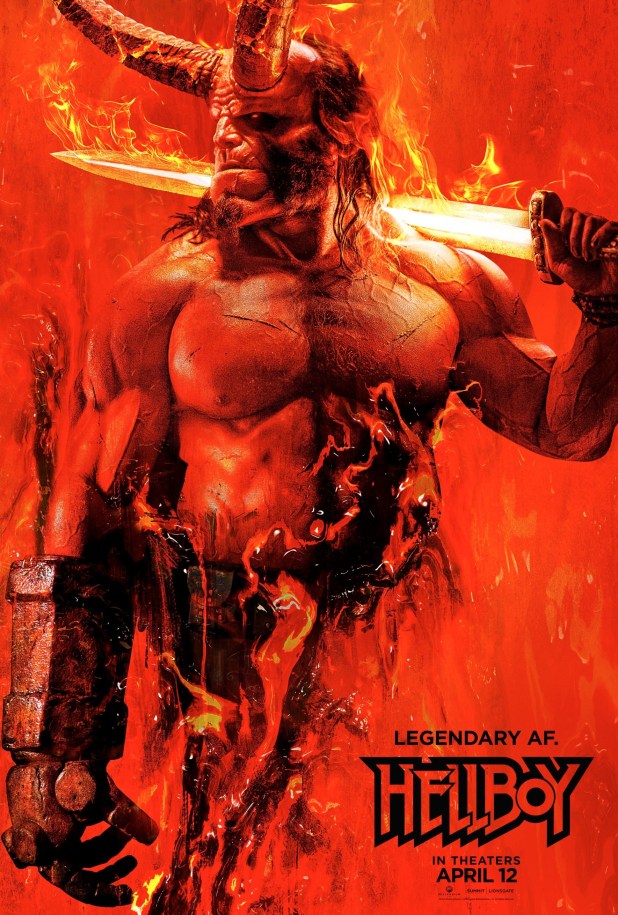
I wanted in my heart of hearts to love this movie. I mean, it starts with a Spanish-language version of “Rock You Like a Hurricane” while the titular Hellboy battles a lucha libre vampire. That bloodsucker turns out to be Esteban Ruiz, an agent for the Bureau for Paranormal Research and Defense. His last words are a prophecy of the end of the world, as related to the Blood Queen Vivienne Nimue (Milla Jovovich), the mother of all monsters, who was once destroyed and vivisected all over England by King Arthur.
So why did I feel like I ate dollar store candy — a lot of dollar store candy — and now feel kind of woozy?
Because this movie follows the two Guillermo del Toro Hellboy films. And those movies? The finest chocolate you’ve ever tasted. And I’ll admit it. I was prejudiced against this movie the moment that del Toro’s role was diminished and then he walked away.
After that mission, Hellboy’s father — B.P.R.D. leader Trevor Bruttenholm (Ian McShane) — asks his adopted son to assist the Osiris Club as they hunt three giants. This is when we learn that Hellboy came to our world as the result of a Nazi experiment, but instead of killing him, Bruttenholm decided to raise him.
Meanwhile, a pig fairy named Gruagach and the witch Baba Yaga — no relation to the Italian bonkers 1970’s film outside of name and cultural origin — are gathering the pieces of Nimue. And oh yeah — those hunters decided to kill Hellboy because they also feel like he’s going to cause the end of the world.
Luckily, Hellboy gets back on his feet and fights the giants until he’s saved by Alice Monaghan, a witch who he saved from fairies — including the pig man, which is why he hates our hero — when she was a child. There’s a flashback and at this point, if you’ve read the Hellboy comics, you’re either up to speed, upset with deviances in the movie or you haven’t read them and are utterly lost. Or perhaps you’re drunk and just enjoying the gore, as I enjoyed this film with a huge buffet of cheladas at 7 AM.
There’s also M11 agent Ben Daimio, who has a special bullet that can kill Hellboy, just in case he’s taken in by Nimue, who comes back to life and starts a plague that spreads throughout England.
Oh yeah — somehow Hellboy is the Anung un Rama, the literal heir of Arthur through his mother, who is now trapped in Hell by his father. He can carry Excaibur but refuses to, assured that it will lead to the end of the world.
So — the good: I liked David Harbour in this. He seems like a decent guy and goes all in on his roles. He was frustrated by the failure of this movie, saying, “We did our best, but there’s so many voices that go into these things and they’re not always going to work out. I did what I could do and I feel proud of what I did, but ultimately I’m not in control of a lot of those things.”
Speaking of all those voices, Hellboy creator Mike Mignola bowed out early, missing the behind the scenes feuding between director Neil Marshall (The Descent, Dog Soldiers) and producers Lawrence Gordon and Lloyd Levin, who went so far as to interrupt the director in front of the cast and crew during rehearsals to give his own direction to them. The production team also fired Sam McCurdy, Marhsall’s cinematographer. This was to send a message — note the word allegedly should be that, as Levin’s lawyer has decried these claims — to the director that he was not really in charge.
I also loved seeing Thomas Haden Church as Lobster Johnson and the Abe Sapian cameo at the end. It’s not a perfect movie — far from it, it has a very inconsistent tone — but I wasn’t bored. And hey — the actors, particularly Jovovich, seemed to be having a blast. Maybe it didn’t make back its $50 million dollar budget, but it got close.
For her part, Jovovich would say that her “raddest films have been slammed by critics” and argued that this would become a cult classic. I mean, who are we to deny the star of Ultraviolet?
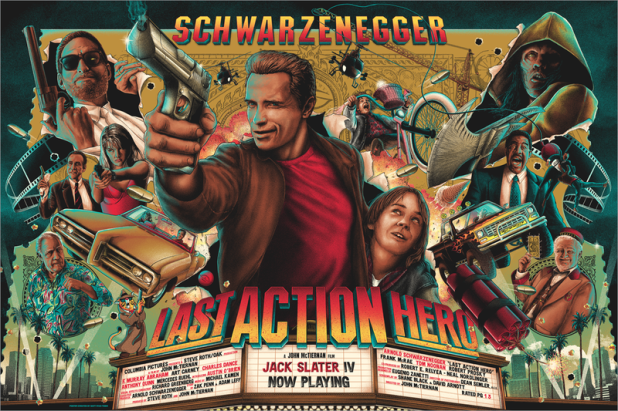
After Terminator 2: Judgement Day, the monolith known as Arnold Schwarzenegger could do no wrong. But where do you go after you move from Austria to here with no money, take over the world of bodybuilder and then become the biggest movie star in the world?
You make fun of yourself.
That’s where the original script for Last Action Hero — written by Zak Penn and Adam Leff — came in. Penn has since gone on to write PCU, X2, X-Men: Last Stand, The Avengers, Ready: Player One and Elektra while directing his own movie, Atari: Game Over. Leff hasn’t been as lucky, as his only other writing credits are PCU and Bio-Dome. That said, their screenplay was set in the movie world and concerned a hero named Arno Slater who tries to deal with the never-ending world of violence that takes the lives of everyone around him. Pretty much, it’s a meta-aware Shane Black parody.
How weird is it that Black was brought it to do the rewrite, leading to Penn and Leff only getting a story — and not a screenplay — credit?
In Nancy Griffith’s How They Built the Bomb, the reasons for this film’s failure go beyond it’s biggest issue: was it a comedy or an action movie? Sure, it could be both, but the film seems wildly schizophrenic in what it wants to achieve. What are the rules in Jack Slater’s world? What are the rules in the real — real as in the movie — world? Why can some people keep their powers and Jack can’t? What the hell is going on here?
The issues that Griffith pointed out include Universal moving Jurassic Park to a week before this film would open, negative publicity caused by initial screenings going so poorly, an out-of-control ad campaign that included a NASA rocket that never launched with the movie’s logo and being the first film released in Sony Dynamic Digital Sound, which didn’t even work in the tiny subset of theaters that even had this set up.
A $26 million loss and the first real bomb on Arnold’s record. It stung.
Let me set that up even better: it made $137 million at the box office (over $220 million in today’s money) and still was a loser, thanks to the budget, the overruns and the advertising.
Arnold even placed the blame on a shifting geopolitical theme in the United States, telling Business Insider, “It was one of those things where President Clinton was elected and the press somehow made the whole thing kind of political where they thought, “Okay, the ‘80s action guys are gone here’s a perfect example,” and they wrote this narrative before anyone saw the movie […] The action hero era is over, Bill Clinton is in, the highbrow movies are the “in” thing now, I couldn’t recuperate.”
Danny Madigan (Austin O’Brien, Prehysteria!) is a kid living with his widowed mom (Mercedes Ruehl) in the dingiest, most crime-challenged part of New York City. He escapes by watching Jack Slater movies and gets to see the new one when Nick the projectionist (Robery Proskey, Gremlins 2) gives him a ticket that once belonged to Harry Houdini.
This ticket allows Danny to enter the world of Slater, where he meets his talking cat Whiskers (Danny Devito!) and wonders about his friend John Practice (F. Murray Abraham), who Danny instantly doesn’t trust because he was also Salieri, the man who killed Mozart in Amadeus.
Of course, because this is a movie, Slater’s supervisor Dekker (Frank McRae, playing a role named for Fred Dekker and basically playing the exact same part that he did in 48 Hrs.) assigns Danny as the supercop’s new partner and sends them after mobster Tony Vivaldi (Anthony Quinn!?!).
After plenty of 80’s cop hijinks, Charles Dance — as henchman Benedict — gets the golden ticket and leaves for our world, stranding Danny, Slater and his daughter Whitney (Bridgette Wilson). And Benedict hatches a plan — kill Arnold so that no more Slater movies can be made. And that means that Tom Noonan can show up as Slater’s big bad, the Ripper. Man, Tom Noonan can be in every movie ever as far as I’m concerned.
The moviemakers wanted Alan Rickman, who was too expensive, so they got Dance instead, who showed up with a shirt proclaiming “I’m cheaper than Alan Rickman!’
Also: Death from The Seventh Seal shows up and instead of Bengt Ekerot, it’s Ian McKellen. This movie plays fast and loose with cameos, with everyone from Tina Turner (the mayor of Los Angeles), Sharon Stone (playing Catherine Tramell from Basic Instinct), Robert Patrick (as the T-1000), Sylvester Stallone as a Terminator, Maria Shriver, Little Richard, MC Hammer, Leeza Gibbons, James Belushi, Damon Wayans, Chevy Chase, Timothy Dalton, Jean-Claude Van Damme and Wilson Phillips showing up.
What can you say about a movie that was still filming a week before it was due in theaters? This was a film against incredible odds, odds that got even worse when negative press got in the way. Director John McTiernan would tell Movieline, “Initially, it was a wonderful Cinderella story with a nine-year-old boy. We had a pretty good script by Bill Goldman, charming. And this ludicrous hype machine got hold of it, and it got buried under bs. It was so overwhelmed with baggage. And then it was whipped out unedited, practically assembled right out of the camera. It was in the theater five or six weeks after I finished shooting. It was kamikaze, stupid, no good reason for it. And then to open the week after Jurassic Park— God! To get to the depth of bad judgment involved in that you’d need a snorkel.”
McTiernan would follow this up with Die Hard with a Vengeance, so that worked out a bit better for him. Then again, he’d also film the bombs Rollerball and The 13th Warrior.
Sadly, Arnold would later say that this was the beginning of the end of his movie career. But you can’t make a movie this big in nine months. Seriously — it just doesn’t happen.
But hey — you can see both Art Carney and Professor Toru Tanaka in their last roles. And it’s not a completely horrible movie. It just doesn’t know what movie it wants to be. And when that much money is on the line, this is what happens.
The art for this article comes from Matt Ryan Tobin and you can purchase it on this site.
Nobody is demanding the Snyder cut for this, his most revealing film, a total exploration of the id that presents a dual world of women battling against, well, something while they’re also being abused in what we’re to assume is the more real of the two fake worlds. But throughout, it just looks like you’re watching someone else play a video game and that’s about as exciting as watching someone play a video game.
Yes, in this world, girls that are being used in a brothel and kept in an insane asylum prove their worth as women by jumping out of planes and battling robots while wearing fetish outfits. Surely it all means something, but it totally doesn’t.
Snyder said, “How can I make a film that can have action sequences in it that aren’t limited by the physical realities that normal people are limited by, but still have the story make sense so it’s not, and I don’t mean to be mean, like a bullshit thing like Ultraviolet or something like that.”
Dude, you should be so lucky as to make something as incoherent as Ultraviolet.
Despite the film being as CGI as it gets, every one of the actresses spent twelve weeks training to get ready for it. That’s right — six hours a day, five days a week, learning martial arts, how to deadlift 250 pounds, shoot firearms and look cool pole dancing, because, well, Zack Snyder.
This would have made a much better Fox Force Five origin story than a movie, trust me.
On one hand, Snyder has said that it’s all about “fetishistic and personal” while he’s also said that it’s a critique of the way that geek culture objectifies women. By, you guessed it, objectifying women. Sure, they have big guns and swords, but they’re missing that most crucial of all weapons: actual empowerment.
Let me try and make sense of this all.
At some point in the 60’s, Babydoll (Emily Browning, The Uninvited) is placed in a Vermont mental institution by her stepfather, who has probably killed her mother and assaulted her sister. To add to that, he pays the asylum’s Blue Jones (Oscar Isaac, way before he was Poe Dameron) to lobotomize her.
Babydoll then escapes into a world where she’s a sex slave for Jones, who is now her pimp. She’s joined by Amber (Jamie Chung, the most successful Real World cast member), Blondie (singer Vanessa Hudgens), Rocket (Jena Malone, The Neon Demon) and her sister Sweet Pea (Abbie Cornish, Three Billboards Outside Ebbing, Missouri). Dr. Gorski, who is the main doctor in the first world, is now the girl’s dance instructor and is played by Carla Gugino (she was also in Snyder’s Watchmen). Also — Babydolls virginity is about to be sold to a client played by Jon Hamm, which is totally how real life and prostitution looks and works.
But wait! There’s another world where Scott Glenn shouts cliches at the girls while they battle giant Japanese samurai robots, dragons and a steampunk version of World War I.
The story ends with Glenn’s character somehow coming into our world and the heroine getting lobotomized and nearly assaulted, which is some kind of paradise in one of these three worlds, I guess. But again, it’s totally not.
It looks really cool though. Which is kind of Snyder’s stock in trade. I have no idea who this is for, other than developmentally challenged men who can’t get the women in the film, so they objectify them. It’s kind of like the guys who defend and white knight girls that they pay $20 to see in their underwear on Patreon or onlyfans when guys demand they show more nudity. No one is friends here and this is all just a transaction. In the same way, this film says nothing, is nothing and desperately wants to be something — yet is as lofty as the cover versions of much better songs that it employs in some grasp for something, anything.




 B&S About Movies
You must be logged in to post a comment.