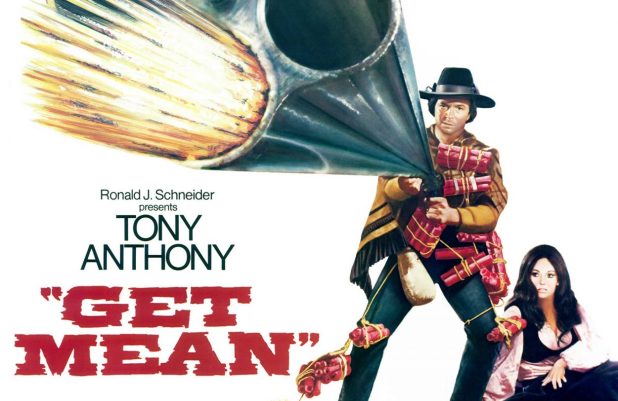
Get Mean (1975)

Tony Anthony played The Stranger in four films — Stranger in TownThe Stranger Returns, The Silent Stranger and this film — plus he’s also in the Zatoichi by way of Italy film Blindman (Ringo Starr is in it!) and wrote, produced and starred in Comin’ At Ya! and Treasure of the Four Crowns, movies that’d start a short 3D boom which ended with Anthony claiming that he made an estimated $1 million worth of lenses before Jaws 3D, the film that ended the trend.

This movie is just crazy — closer to a fantasy movie than a Western — and has no care at all about the fact that it doesn’t follow any rules at all. It’s directed by Ferdinando Baldi, who also made the Mark Gregory-starring Ten Zan: The Ultimate Mission.

The Stranger gets dragged into a ghost town by his horse, who promptly dies. That;s when a family of gypsies pays him to escort Princess Elizabeth Maria de Burgos (Diane Lorys, Blue Eyes of the Broken Doll) back to Spain. There, the Stranger does battle with Vikings, Moors, barbarians, ghosts, a bill and a hunchback. That’s when he lives up to the alternate title — The Stranger Gets Mean — and lets the guns and dynamite do his talking.

Raf Baldassarre is in this, who you may have seen in everything from Hercules In the Haunted World and Eyeball to plenty of Westerns like Dakota Joe, The Great SilenceSartana Kills Them AllArizona Went Wild … and Killed Them All! and even played Sabata in Dig Your Grave Friend … Sabata’s Coming. He’s also in both of Luigi Cozzi’s incredbly entertaining films based on Greek myth, Hercules and The Adventures of Hercules.

Morelia is played by Mirta Miller, who somehow unites so many film genres that I love — HBO After Dark semi-sleaze (Bolero), Mexican wrestling films (Santo vs. Dr. Death), giallo (Eyeball), shark movies (The Shark Hunter), sword and sorcery (Battle of the Amazons) and Spanish horror (Vengeance of the ZombiesCount Dracula’s Great Love and Dr. Jekyll vs. the Werewolf).

So yeah. An Italian Western with a four-barrelled shotgun carrying hero traveling through time who doesn’t respect the princess he’s trying to save. If this sounds like Army of Darkness at all to you, please remember that it came out 17 years before that movie.

You can get this from Blue Underground or watch it on Amazon Prime and Tubi.
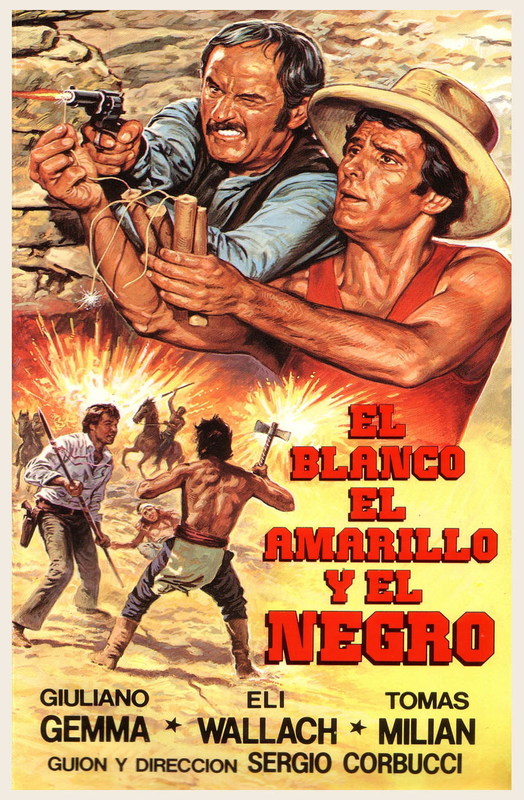
The White, the Yellow and the Black (1975)

Also known as Samurai and Shoot First… Ask Questions Later, this is the last Italian Western that Sergio Corbucci would make after a career that brought the world DjangoThe Great SilenceCompaneros and The Hellbenders. It is the gateway to his next career of making comedy films, often with Adriano Celentano and Terence Hill, such as 1980’s Super Fuzz.

I was wondering how this movie got away with such a racist Japanese interpretation, with Tomas Milian playing an Asian man named Sakura in the ost stereotypical way possible. I hate to say, “It was a 1975 exploitation movie made in Italy,” but you can also explain that this is a parody of the much bigger film, 1971’s Bronson and Mifune vehicle Red Sun.

Long story short, a Japanese horse that was to be given to the government of the United States is stolen and Sheriff Edward “Blackjack” Gideon (Eli Wallach), outlaw Blanc de Blanc (‘Giuliano Gemma, Ringo himself) and Sakura have to get it back.

Milian must have liked playing this role, because he brought it back for the movie Delitto al Ristorante Cinese, the eighth chapter in the Nico Giraldi film series, which was also directed by Corbucci. Also — keep an eye out for Mirta Miller as a redhead in the saloon.

There’s a cute moment at the beginning of the film as the Sheriff and his wife have an argument and she replies, “For a fistful of dollars. For a miserable fistful of dollars that are not even already your share! At least I did that for a few dollars more… but “vamos a matar”, compañeros! Always around in the good, the bad and the ugly times! Head down, dear; you’re at the day of reckoning, now!” If you get the joke, you’re my kind of person.

You can watch this on Amazon Prime.

My Name Is Nobody (1973)

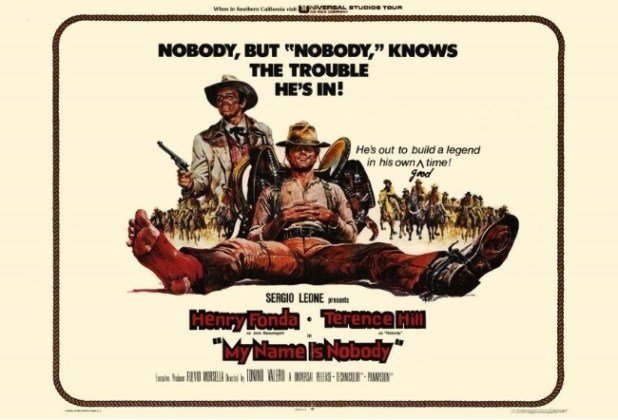
Jack Beauregard (Henry Fonda) is an aging gunslinger who wants to retire. After quickly shooting three gunmen who attempt to ambush him in a barbershop — he has no chance to rest ever, constantly being challenged by people to prove themselves — the barber’s son asks if there is anyone in the world faster. The reply? “Faster than him? Nobody!”

There is a man named Nobody (Terence Hill), who dreams of being better than Beauregard. But instead of challenging the gunslinger, he plans on taking out all 150 members of the Wild Bunch — no relation — on his own. They’re led by Geoffrey Lewis, who was a character actor par excellence.

While this movie is a comedy, the idea at the end, where Nobody is now as chased and tested as Beauregard, speaks to the violent life of the Italian Western hero, who is continually threatened by not only death, but by the advent of the technological twentieth century, which will end his way of life.

Tonino Valerii, who was Leone’s assistant director on A Fistful of Dollars, directed this film. He also wrote The Long Hair of Death and directed films like My Dear Killer and Day of Anger.

There’s some dispute that Leone directed much of this film, which was made mostly in the United States. It arose when Henry Ford’s costumes were stolen, which would have delayed the movie by more than a week. Leone, who came up with the idea for the film, offered to shoot second unit to keep the movie moving.

Neil Summers, who played Squirrel, and John Landis, who claims to have been an extra, stated that Leone directed most of their scenes, often on horseback. However, screenwriter Ernesto Gastaldi (TorsoAlmost HumanAll the Colors of the DarkOnce Upon A Time In America) told Robert Curti, the writer of Tonino Valerii: The Films, that “Tonino shot the whole film, absolutely ON HIS OWN” and that Leone “organized a second unit crew and shot a couple of sequences, which in my opinion are the weakest in the film…Nothing else.”

Sergio Donati expanded on this, stating that some photographers were sent to America and they asked Leone, on his lone set day, to sit behind the camera in a director’s pose. Donati said, “Inevitably, from that moment on, everyone, in and outside the movie business started saying “Yeah, actually the real director of the film was Leone, who saved it from the disaster of an incapable director”.”

Tobe Hooper and Tonino Valerii would have had a lot to talk about.

For anyone that thinks that Italian Westerns are dumb, I’d just like to raise one point. The title refers to The Odyssey, as Odysseus tricks Polyphemus into believing his name is “nobody.”

You can watch this on Daily Motion.

Coming at Ya! (1981)

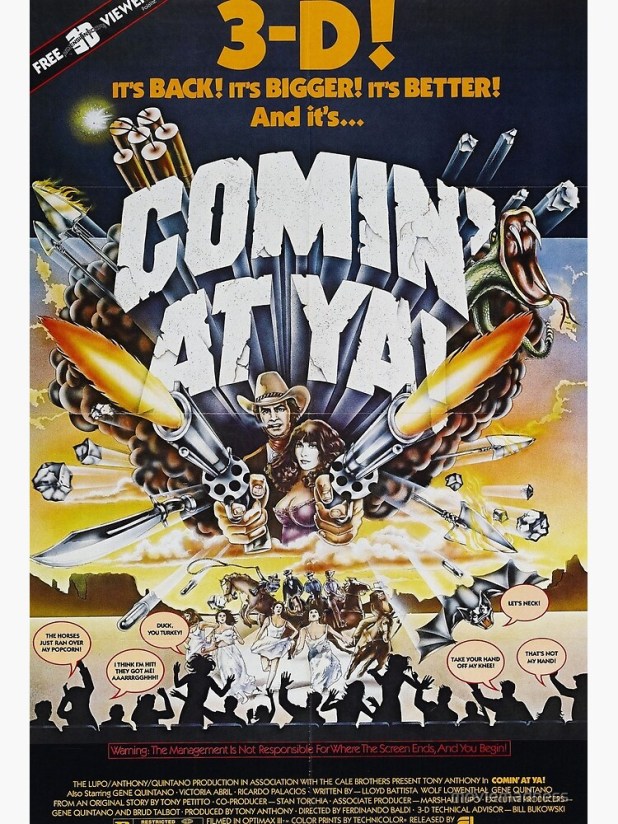
Every few years, 3D comes back in vogue. This 1981 film led a new wave of movies with enhanced depth and mostly stuff coming, well, at ya Dr. Tongue-style that included ParasiteFriday the 13th Part IIIJaws 3-DAmityville 3-DSpacehunter: Adventures in the Forbidden Zone and Treasure of the Four Crowns, which comes from the same people who made this movie.

It came about when Xerox salesmen Gene Quintano and Lupo took their office supply company into filmmaking, along with actor Tony Anthony, who had appeared in plenty of Italian Westerns like the increasingly, err, strange series of The Stranger films.

Filmed in a process called both SuperVision and WonderVision, the real star of this movie isn’t the acting or the story, but the very in your face 3-D effects. Even the actors joked about that, with Anthony saying, “You wouldn’t make Citizen Kane in 3-D. This is escapism. This is The Perils of Pauline. It’s a laugh. It’s enjoyment.”

They went so far as to have one of the film’s producers, Gene Quintano, play the film’s villain Pike Thompson. In 1981, he told The Washington Post that he appeared in the movie “mostly as a matter of economics. Tony is the star and he’s very good but this is not an actor’s film. I mean, Robert Redford is not going to be sweating it out. The real star is supposed to be the 3-D.” He would go on to write King Solomon’s Mines for Cannon, as well as Police Academy 3: Back in Training and Police Academy 4: Citizens on Patrol, as well as writing and directing Honeymoon Academy and National Lampoon’s Loaded Weapon Part 1, two films that I missed out on during our week of Police Academy movies. Also, if he ever comes to Pittsburgh, he could probably get a beer at any bar for free just by telling them he wrote Sudden Death, which along with Night of the Living Dead and Striking Distance form pretty much the holy trinity of movies made here (you can also claim that FlashdanceSlap ShotDawn of the DeadCreepshowMartinRoboCopThe Silence of the Lambs or Kingpin and could be on this list, but never Stigmata, which was actually filmed mostly in Vancouver. Also, ironically given Anthony’s quote, the original The Perils of Pauline was shot in Yinzer Country.). Man, I went off on a tangent.

Filmways bought this movie and it ended up becoming a minor success, easily using up the 90,000 3-D glasses they thought they’d need. 1981 was a big year for that company, as they bought out AIP and released The Fan, Blade Runner, Halloween II and Ragtime.

Bank robber H.H. Hart (Anthony) loses his wife (Victoria Abril, who would one day be in Tie Me Up! Tie Me Down!) to kidnappers on the day of his wedding in a scene that feels like it had to have influenced Kill Bill. She ends up being sold as a prostitute to the evil Pike Thompson (Quintano) and our hero has to rescue her. That’s pretty much the whole story, but you’re really here, like we already said, to see stuff fly out of the screen and the film’s strange monochromatic style mixed with bursts of color.

Anthony and director Ferdinando Baldi had also worked together on Blindman — an Italian Western ripoff of Zatoichi — and the incredibly weird Get Mean.

If you listen carefully, during the bat attack scene, some of the screams have been recycled from Argento’s Inferno.

Anyways, like everyone has told you, this movie is really just about fun and not the idea that it’s going to change your world. If you want to see darts, snakes, guns, beans, rats, spears, hands, spiders, a bowling ball, bats, gun barrels, swords, cowboys, a yo-yo, a pinwheel, gold coins, apple peels, flaming arrows and a baby’s ass come at you, well, this would be the movie you are looking for.

You can watch this — not in 3D — on Amazon Prime and Tubi.

W Django! (1971)

We’ve discussed before that Edoardo Mulargia made movies called CjamangoShango and Don’t Wait, Django… Shoot! As you can read, he really, really liked Django.

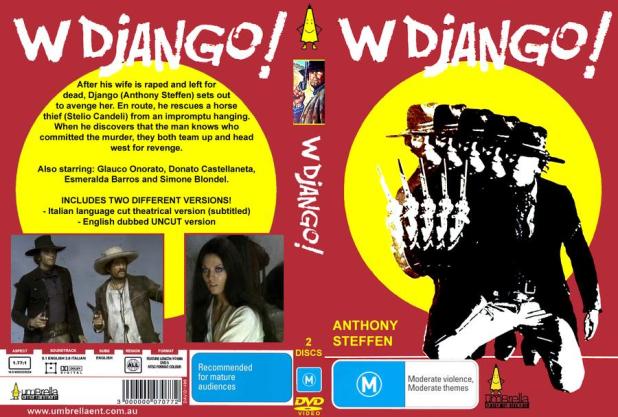
This time, Andrew Steffan takes the role, tracking down and killing the men who killed his wife. He’s helped by a horse thief named Carranza (Glauco Onorato, who was mostly known for his dubbing work). Of course, that criminal may not be telling all he knows about the night Django’s old lady went down.

This one is also known as A Man Called Django! and Viva! Django, a fact that I learned as I made it a minute into each of those films before realizing that I had already seen this movie.

While this is also called Viva Django!, don’t confuse it with the 1968 Ferdinando Baldi film, which was originally intended to star Franco Nero, but has Terence Hill in it (he’s listed as Django, Joe Cassidy and Trinity in the SWDB) and George Eastman as one of the men who must pay.

You can watch this on YouTube.

Sukiyaki Uesutan Jango (2007)

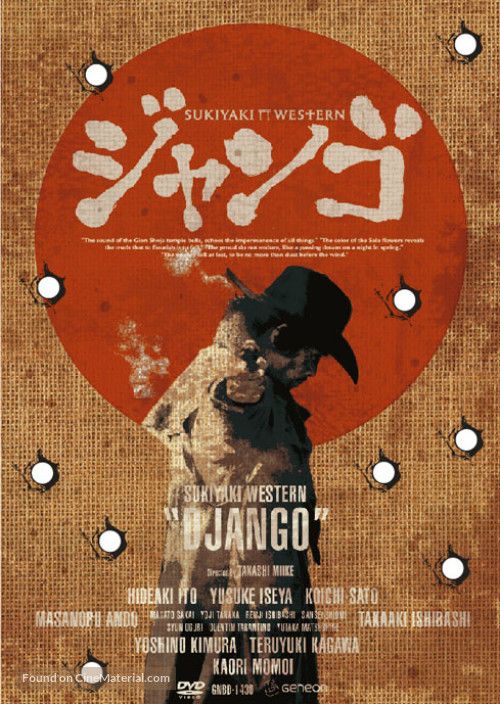
It’s only fair, as the Italian Western ripped off Yojimbo as A Fistful of Dollars that the genre should migrate back east once more. The sukiyaki in the title refers to the dish of thinly sliced beef which is simmered at the table in a shallow pot in a mixture of vegetables, soy sauce, sugar and mirin. Often, the ingredients are dipped in raw, beaten eggs before being cooked. Western audiences probably know the word more from Kyu Sakamoto’s song “Ue o Muite Arukō,” which was retitled “Sukiyaki” for Western audiences, selling 13 million records worldwide. His follow-up, “China Nights (Shina no Yoru),” made it to #58 in the U.S. and was the last Japanese artist to chart here until Pink Lady’s 1979 song “Kiss In the Dark.” A Taste of Honey’s 1981 cover charted even higher, reached #3 on the Billboard Hot 100 and it’s been covered by everyone from Selena to The Ventures.

In the same way, this movie was renamed Sukiyaki Western Django for America.

I tell you all this because the word is a nonsense mishmash word to our gaijin ears and that may be the way this movie appears to many eyes, as the films of Takeshi Miike are often inscrutable. His fans — of which I count myself — like it that way.

Beyond Yojimbo and Django, this movie is inspired by the historical rivalry between the Genji and Heike clans, which ushered in the era of the samurai. Much like an Italian Western, a nameless gunman has come to town to help a prostitute get revenge on the warring gangs.

What can you say about a movie that has Quentin Tarantino as an ancient man in a wheelchair with Stuntman Mike’s duck on it and who refers to himself as an anime otaku? Or a movie that seems to exist in multiple timeframes, embracing both the samurai and the cowboy while a nearly all Japanese cast speaks mostly English? Where women become Kali, the goddess of death, in the midst of gunfights, so fearsome that they become actual anime? Or the fact that we finally get to see what was inside that coffin that Django was always dragging around?

Even Tarantino’s opening speech can be traced back to the epic The Tale of Heike: “The sound of the Gion Shouja bells echoes the impermanence of all things; the color of the sala flowers reveals the truth that the prosperous must decline. The proud do not endure, they are like a dream on a spring night; the mighty fall at last, they are as dust before the wind.”

And you have to be a real Corbucci otaku to make the cross that kills the final bad guy read Mercedes Zaro.

The cast boasts stars like Yûsuke Iseya (13 AssassinsCasshern) as the main villain Minamoto no Yoshitsune, Kaori Momoi (Memoirs of a Geisha) as the vengeance-seeking Ruriko and Hideaki Itō (Umizaru) as the gunman. Masanobu Ando (Battle Royale), Shun Oguri (who played Lupin in 2014’s Lupin the Third), Takaaki Ishibashi (Hiroshi Tanaka from Major League 2!), Renji Ishibashi (who was Zatoichi and Lone Wolf and Cub films, as well as Tetsuo: The Iron Man) and Yōji Tanaka (one of the Crazy 88’s in Kill Bill).

Three years later, Tarantino would make his own take on the Italian Western. This makes the perfect double feature to play along with it.

You can buy this on blu ray from MVD. The new collector’s edition has an extended cut of the film and a gorgeous looking 1080p transfer of the film

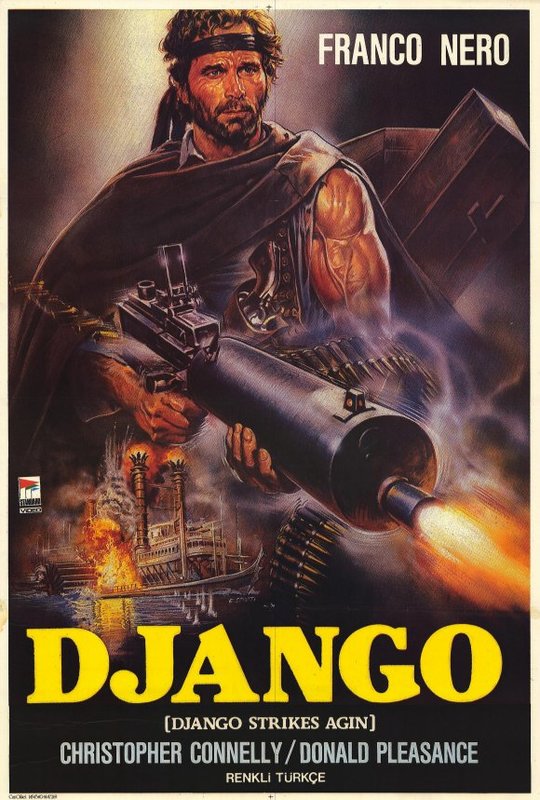
Django Strikes Again (1987)

After waiting two decades for a sequel, in 1987 Franco Nero and director Nello Rossati (Alien Terminator) finally delivered the sequel that Italian Western fans had been craving (and had kind of received with thirty unofficial sequels).

Where was Sergio Corbucci, the director of the original, who had co-written the sequel and had initially agreed to direct it? Well, Django Strikes Again was dreamed up and produced in parallel with Duccio Tessari’s Tex and the Lord of the Deep. The hope was that this would lead to a revival of the Western in Italy. But when Ted failed, Corbucci bowed out, possibly not wanting to soil the legacy of what is probably his best-loved film.

Nero had already entered in El Topo territory in Keoma. This feels like a similar tone — at least at first — as Django has left behind the life of the gunfighter — indeed, the movie starts by mentioning all of the cowboys that are dead (that’s William Berger in a cameo) — to become a monk. Yet when he learns from an old lover that he has a daughter that he has never met and that she has become a prisoner of El Diablo Orlowsky (Christopher Connelly in his last role), he has to pick up his guns one more time.

I’ll be blunt. This movie is a pale shadow of the original. That said, there are moments of greatness here, like El Diablo’s butterfly obsession, Django burying his machinegun in a grave with his name on it, Rodrigo Obregón from the Andy Sidaris movies as a henchman, a small role for Donald Pleasence and Nero acting like Stallone as he single-handledly blazes away an entire army with that gigantic gun.

Oh well. At least the ending, where Connelly is ripped to shreds by the slaves he’s treated so wrong rise up and tear him apart as if they were zombies, is pretty great.

How weird is it that I can point to at least two fake Django films that are way better than this, though?

Massacre Time (1966)

Massacre Time was originally supposed to be an Italian-Spanish co-production with Ringo co-star George Martin playing Tom Corbett. According to Troy Howarth’s book Splintered Visions: Lucio Fulci and His Films, the Spanish side withdrew their involvement and funding after Fulci refused to tone down the script’s violence.

Fulci instead cast Nero at the suggestion of his assistant director, Giovanni Fago, based on his look from the production stills of the recently completed Django. George Hilton was cast in the other lead and had difficulty dealing with Fulci as a director.

This was written by Fernando Di Leo, who co-wrote A Fistful of Dollars, For a Few Dollars More, A Pistol for Ringo and The Return of Ringo, with the title taken from Franco Enna’s book Tempo di Massacaro.

Speaking of the violence in this film, Fulci would later claim that he pushed Di Leo to make the film as violent as possible, which Di Leo refuted, stating “I don’t know anything about Fulci’s claims that he insisted that I write a very violent movie. Fulci only directed well what was already on the page. The script was good and ready and he liked it the way it was, otherwise I’d have complied to his demand if there had been any”.

Nero and Hilton play the Corbett brothers, with Tom (Nero) coming back to their hometown to find it under the iron rule of Mr. Scott (Giuseppe Addobbati, billed as John MacDouglas for American audiences; he’s also in Nightmare Castle) and his son, Junior Scott (Nino Castelnuovo, Strip Nude for Your Killer).

Linda Sini is also in this. She also is in Fulci’s Don’t Torture A Duckling as Bruno’s mother.

Although an English-language version was made, AIP made their own dub of the film and released it as The Brute and the Beast, making it one of only two Italian Westerns released in the U.S. by the studio (the other is God Forgives… I Don’t!). In the UK, this is known as Colt Concert and in Denmark and West Germany, it was released as Djangos seksløber er lov (Django’s Six-Runner Is Legal) and Django – Sein Gesangbuch war der Colt (Django – His Hymnbook was the Colt). My favorite alternate title has to be what it was called in Hong Kong, Ghost Gun God Whip, and Spain, Las Pistolas Cantaron su Muerte (y fue Tiempo de Matanza) (The Pistols Sang His Death (and it was Time for the Killing).

You can watch this on YouTube.

Django (1966)

Next to the Leone films and Ringo, Django is perhaps the most influential of all Italian Westerns. Thanks to the Quentin Tarantino release of Django Unchained, today it is probably even more well-known in the U.S.

While making Ringo and his Golden Pistol, Sergio Corbucci was approached by Manolo Bolognini to make this film. Bolognini wanted to make back the money he had lost on his first film as a producer, The Possessed, and since Westerns were hot, it seemed to be a good genre to get into.

Much as how Yojimbo had influenced A Fistful of Dollars, Corbucci wanted to make a movie that would echo the work of Kurosawa. As for the idea of the coffin-dragging protagonist, assistant director Ruggero Deodato — hmm, wonder what that guy did after this? — claimed that the director took the idea from a comic book that he had read.

Strangely enough, in Japan, this film was Continuation: Wilderness Bodyguard, marketed not only as a remake of Yojimbo but a sequel to A Fistful of Dollars, which was distributed in Japan by Kurosawa as the result of the lawsuit between he and Leone. As a result, the Japanese auteur won 15% of the worldwide receipts and over $100,000.

The Japanese/Italian Western connection continued with Yojimbo star Toshiro Mifune appearing in Terence Young’s Red Sun, which also featured another Leone player, Charles Bronson.

The idea for — spoiler warning — Django’s hands to be ruined before the end of the movie came from the notion that guitarist Django Reinhardt became legendary despite not being able to move the third and fourth fingers of his left hand.

Walking into a war between Major Jackson’s Red Shirts and General Hugo Rodríguez’s revolutionaries, Django starts the film by dragging a coffin behind himself and then dispatches several of Jackson’s soldiers who are attempting to crucify a prostitute named Maria (Loredana Nusciak, Tiffany MemorandumSuperargo versus Diabolikus).

Our hero then eggs Jackson on, making him bring most of his forces to town, where he opens the coffin to reveal a machine gun that he uses to kill nearly everyone. This has all been for revenge, as Jackson had murdered Django’s lover Mercedes Zaro.

What follows is a meditation on the needs of love versus material wealth, which ends up costing Django nearly everything. The gold that everyone is dying over almost costs even our once-thought invincible hero his life. This is an incredibly bloody installment of the Western genre, with a body count of 180 people, including 79 personally dispatched by Django.

To get an indication of the success of this film, you only need to realize that more than thirty unofficial sequels were made to it, often only using the name to sell tickets. We’ll be covering some of the better installments this week, such as Django the Bastard and Django Kill… If You Live, Shoot! 

There was also a planned sequel in 1968 called Django, Prepare a Coffin that ended up featuring Terrence Hill before Nero returned to the role one more time in Django Strikes Again, which was filmed at the same time as Corbucci’s Tex and the Lord of the Deep.

The end of this movie, as Django’s ingenuity prevails against physical pain and the realization that his need for money over love caused this, is poetic and bloody in a way that very few films — much less Westerns — can ever hope to capture. Amongst the blood, mud and dust, there is art.

You can watch this on Tubi.

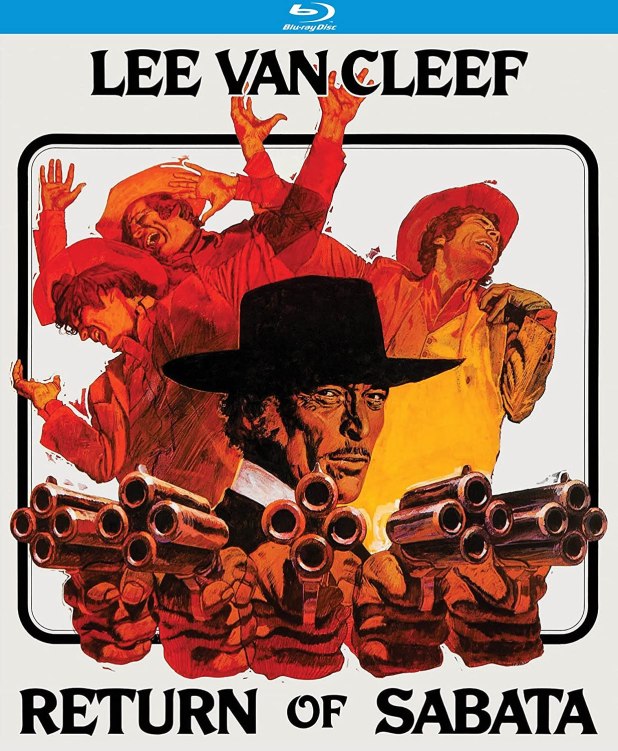
Return of Sabata (1971)

Back for the third film, Lee Van Cleef is Sabata again in a movie known in Italy as È Tornato Sabata … Haichiusoun’altra Volta (Sabata is Back … You’re Finished Again). Now, our hero is working for a traveling carnival as a trickshot. However, when he runs into an old war acquaintance who owes him $5,000, well…people get shot.

Sabata ends up fighting an entire town that puts a tax on everything he loves — gambling, drinking and prostitution. Ignazio Spalla plays another friend, this time named Bronco, and Aldo Canti plays an acrobat who aids our black-wearing protagonist.

As his theme song says, “If you wanna get money and if you wanna get rich and if you wanna get life, you gotta be a son of a…” And so Sabata is. That same song also refers to him as a nine-fingered man. That’s actually true, as Van Cleef lost a large portion of his middle finger while building a playhouse for his daughter.

Director Gianfranco Parolini would go on to make God’s Gun and Yeti: Giant of the 20th Century, a movie that I definitely need to get to.

This movie ended up in The Fifty Worst Films Of All Time by Harry Medved with Randy Dreyfuss. Over the years, I’ve come to love so many of the movies in this book, including Airport 75The AmbushersGodzilla vs. HedorahThe Last MovieRobot MonsterThe OmenThe Story of Mankind and Valley of the Dolls.

You can watch this on Amazon Prime.