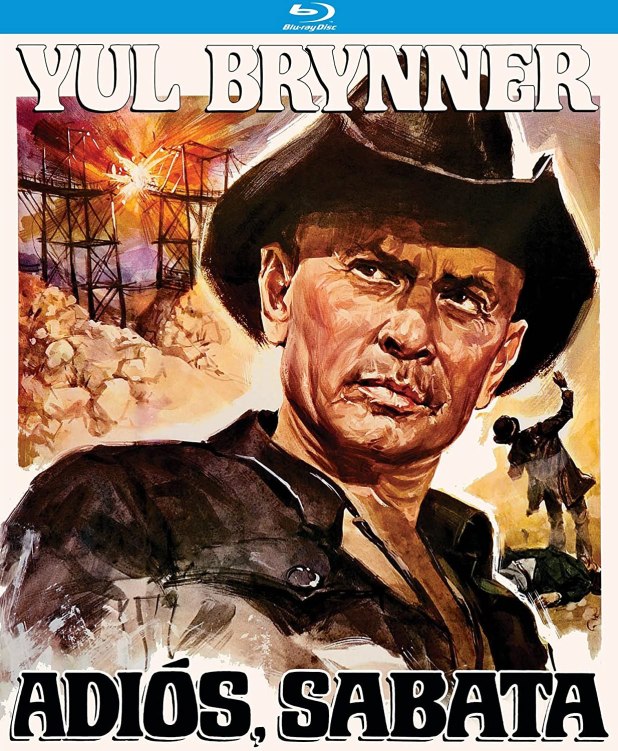
Known in Italy as Indio Black, sai che ti dico: Sei un gran figlio di (Indio Black, you know what I’m going to tell you… You’re a big son of a…), this is the second Sabata entry for director Gianfranco Parolini but switches out the lead role of Sabata.
This time, Yul Brynner is the man in black, taking over for Lee Van Cleef.
Set in Mexico under the rule of Emperor Maximilian I, Sabata/Indio Black is hired by the Señor Ocaño (Franco Fantasia, Zombi) to steal some gold, but our hero and his partners Escudo (Ignazio Spalla, who is in every Sabata movie) and Ballantine (Dean “Red Elvis” Reed, who defected to East Germanty a few years after this movie and continued his singing and acting career) soon learn that they’ve only got sand. Colonel Skimmel has the gold and their money, so they set out for revenge.
It’s not bad, but nowhere near as good as the original. That said, it wasn’t intended to be a sequel, but the name change was because Sabata did so well in the U.S.
I love Hillybillys In a Haunted House, but I had no idea that this film came out before it. It features Ferlin Husky as Woody Wetherby and Mamie Van Doren (!) as Boots Malone (Joi Lansing would play the role in the sequel).
Woody is a Tennessee wood hauler — feels like a song coming on — who inherits a Las Vegas casino only to discover that he’s also been gifted with a $38,000 debt from some shady sources. How shady? They have Richard “Jaws” Kiel as their enforcer.
Don Bowman plays Woody’s friend Jeepers in both films. You know who is only in this one? Jayne Mansfield, playing Miss Tawny Dawn, a singer who decides to help our hero in his bid to fix up the gambling joint that he was just awarded. This would be her next to last film, which still makes me sad.
You can also listen to plenty of musical numbers from Sonny James, Roy Drusky, Del Reeves, Bill Anderson, Connie Smith, Wilma Burgess, Duke of Paducah, Jr. Carolina Cloggers and The Jordanaires.
This movie is about as cheap as it gets, all mostly shot in a static shot in one room. Even the “Vegas casino” is an obvious set.
Director Arthur C. Pierce is better known for the movies he wrote, including The Human Duplicators, The Navy vs. the Night Monsters and The Astral Factor.
Sadly, Jayne and Mamie never appear on screen together. I think that’s because the world would have stopped spinning and we would have all died screaming from that much volcanic energy in the same area. They were doing their duty staying that far apart from one another.
Bonus points for the stock footage of Vegas. Old Vegas is the best, the kind of cigarette smoke stale, beer smelling, dead bodies in Lake Mead den of sin that I always dreamed that it would be.
BONUS: Along with The Terror of Tiny Town, Doctor of Doom, Ski Fever, Santa Claus Conquers the Martians, Robot Monster, The Crawling Hand, Untamed Women, They Saved Hitler’s Brain, Bride of the Monster, Project Moonbase, Rocket Attack U.S.A. and The Slime People, this was one of the 13 films featured on the Larraine Newman-starring and Dr. Pepper-sponsored syndicated series The Canned Film Festival.
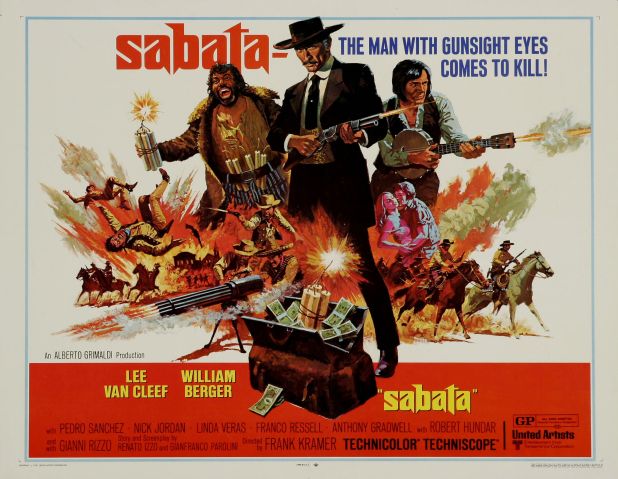
That title translates as Hey buddy…That’s Sabata. You’re Finished! Gianfranco Parolini had gone from making Eurospy films to If You Meet Sartana Pray for Your Death, which was a success but the series ended up being given to director Giuliano Carnimeo.
Producer Alberto Grimaldi then got in touch with Parolini to make a new series. He had a great actor to star in it, too. Lee Van Cleef, whose work in Leone’s films is the stuff of legend. What may not be known to many is that a car crash in 1958 nearly cost the actor his life and career. He actually went into interior decorating with his second wife before getting back into movies three years later, but any time he rode a horse, he’d always be in great pain. That’s kind of amazing, because for someone so well-known for being a cowboy, he gutted through it to give us all these awesome roles. What can you say for a guy whose tombstone literally says, “Best of the bad?”
Sabata is basically a man who can’t be stopped. He can hit any target and has really no morals, which is a great combination for the Italian West. He carries a four-barreled derringer and a rifle that he uses to wipe out just about everyone he meets.
The one enemy that he doesn’t immediately kill is Banjo (William Berger), who keeps trying to play every side against each other. He also has a great weapon that he hides in the music instrument that lends him his name.
There’s drunk Civil War vet Carrincha, who throws knives at people, and his only friend, a Native American named Alley Cat who can escape anyone and is the master of acrobatics.
The bad guy here is named Stengel, one of the town’s leaders who is robbing the bank to buy a railroad. Sabata learns the secret and has to deal with thugs being sent his way for the rest of the film. Stengel has a dart gun in a cane, which is pretty awesome, and he’s played by Franco Ressel, who was in 121 movies, a resume which includes Hercules the Avenger, Blood and Black Lace, Password: Kill Agent Gordon, Have a Good Funeral, My Friend… Sartana Will Pay and Naked Girl Killed in the Park.
This movie is a blast — everything great about Sartana but with Lee Van Cleef as the hero instead of Gianni Garko (or George Hilton, George Martin, Jeff Cameron, William Berger, Hunt Powers, Johnny Garko, George Ardisson, Robert Widmark or the lack of anyone playing the role in a movie named Let’s Go And Kill Sartana).
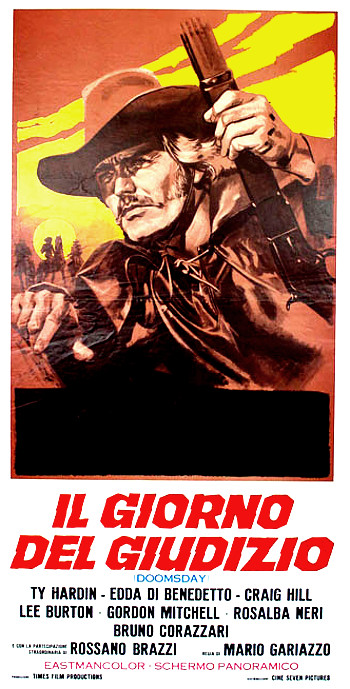
I love spaghetti westerns, something about them has intrigued me since first viewing The Good, the Bad and the Ugly. I go through spurts where I watch a slew of them and then get a bit burnt out or my viewing interests take a huge leap in another direction for a while. I spend hours sometimes going through Amazon Prime’s catalog and looking for spaghetti westerns and I came across Day of Judgement.
Day of Judgement from 1971 is about a yankee soldier who returns to find his homestead destroyed and his son and wife murdered. All that is left in the rubble is a small tin windup drummer. He sets to carve a vengeful path through those that perpetrated the heinous act. Each man he encounters is met with the strange noise of the tin drummer and told to make their play when the drummer stops.
Ty Hardin plays the stranger who comes into town and starts paying the gravedigger and undertaker to keep digging and making coffins until he tells them to stop. It’s a violent western with typical tropes, the stranger coming to town to seek vengeance, a sheriff that may or may not be on the up and up and plenty of bullets flying throughout its runtime. It has a few small moments of nudity as well which may interest some folks. I like that the sheriff is pretty much sleeping with prostitutes the entire movie and saying he’s trying to find the man who is killing all the folks.
It’s a decent little Italian western with its most notable feature being that it lifts Ennio Morricone’s score from Hellbenders and drops it into this film. I think the drummer is enough of a gimmick to keep those looking for something to watch in this genre interested in it. I was drawn in by the soundtrack which I was vaguely familiar with as I bought a few volumes of the spaghetti western Cds that compile themes and main titles from spaghetti westerns. I’ve yet to see Hellbenders but I do plan on watching it soon. I think those who are looking for decent time with a western will find much to like about Day of Judgement especially the gravedigger who constantly warns everyone that judgment day is upon the town.
You may have had to cancel your vacation this year, but next Saturday at 8 PM on Groovy Doom‘s Facebook page, we’ll take you to the ocean with two brutal assaults on humanity. Up first, 1978’s Slithis!
We don’t believe you have to drink during our show, but we do love sharing our recipes with you.
Nuclear Kool-Aid (from the book 11,000 Drinks by Paul Knorr)
1 1/2 oz. Southern Comfort
3/4 oz. amaretto
1 oz. lemon-lime soda
1 oz. cranberry juice cocktail
Put it all in a shaker with ice. Do your thing and shake it.
Strain over ice and enjoy.
Pretty simple, right? Well, get ready because we have another film and another drink to get you through it! Humanoids from the Deep!
Monster on the Beach (from the book 11,000 Drinks by Paul Knorr)
1 1/2 oz. tequila
2 oz. cranberry juice cocktail
Splash of lime
Splash of grenadine
Shake it up with ice.
Pour and enjoy!
We can’t wait to see you next week! Here are the links so you can watch the movies along with us!
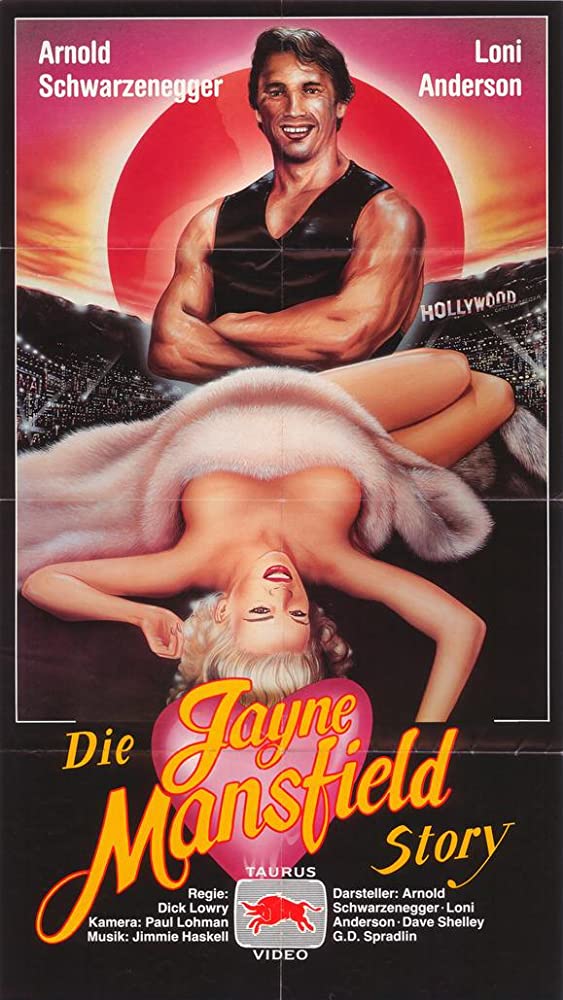
Dick Lowry has worked in made-for-TV movies for some time, working on many projects with Kenny Rogers (The Gambler, The Coward of the County) and connected movies like In the Line of Duty and Jessie Stone, as well as the Project ALF TV movie reunion and Archie: To Riverdale and Back Again.
Based on the Martha Saxton book Jayne Mansfield and the American Fifties, this is — at best — a fictionalized accounting of her life. John Wilson’s book The Official Razzie Movie Guide as one of The 100 Most Enjoyably Bad Movies Ever Made.
Arnold Schwarzenegger — four years before The Terminator — plays Mansfield’s second husband Mickey Hargitay, who is telling a reporter the story of her life. Mansfield is played by Loni Anderson, who is perhaps the worst person — outside of bust line — to play her. She just seems wrong, from how she approaches the role to look. Maybe she identified with Jayne, seeing as how she started as a sex symbol and struggled to get her intelligence across. I’m not really sure, but it just doesn’t work.
Ray Buktenica plays her manager Bob Garrett. Buktenica was best known as Benny Goodwin, the rollerskateing toll-booth working boyfriend of Brenda Morgenstern on Rhoda. Also in the cast are Kathleen Lloyd (who memorbaly is killed by The Car as it flies through her kitched window) as Carol Sue Peters and G. D. Spradlin, who mostly plays cops in movies, as Gerald Conway.
Jayne Marie Mansfield is played by Laura Jacoby, who beyond being in Rad is also Scott Jacoby’s sister. The younger version of the character was played by Deirdre Hoffman, Anderson’s daughter.
If you look close enough, Lewis Arquette — the man whose loins gave the world Rosanna, Patricia, Alexis, Richmond and David — shows up as a publicity man.
There were no fact checkers in 1980. After all, how can you explain a movie that purports to tell the life story of Mansfield report that she was 36 when she died when the truth is that she was 34? Or that Jayne is shown making Las Vegas Hillbillys which is supposed to be a Western, which it is not, much less the fact that it was made two years after she and Mickey were actually divorced, yet they are married here? Shouldn’t that be The Sheriff of Fractured Jaw? And while we’re on the matter of facts, how great is it when Jayne is getting a new convertible sometime in the mid-1950’s, you can clearly see a 1980 Honda Civic roll by?
Much like how Jayne is dying to play the lead in The Jean Harlow Story, Valerie Perraine wanted this role. Surely she would have done better than imitating the worst vocal tics of Mansfield and none of the brains behind the glamour. Also, of all people to narrate this movie, Arnold in 1980 would not be the person I’d pick.
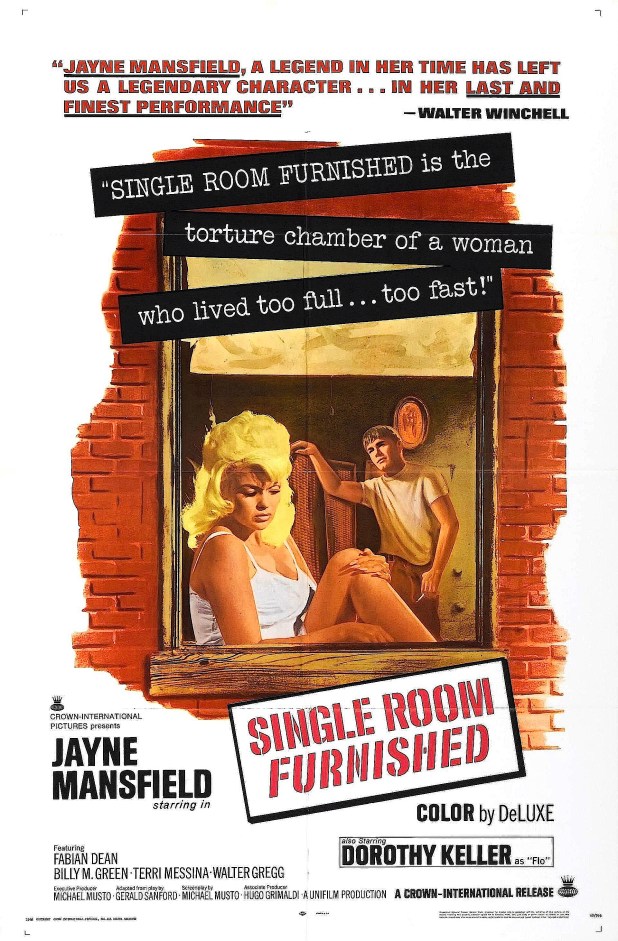
Italian directors used to change their name to Americanized names so that people wouldn’t think their movies were Italian. Matt Cimber? He used the name Matteo Ottaviano when he directed this.
This was Jayne Mansfield’s final filmed starring role, shot by Cimber, her thrid and final husband. It briefly came out in 1966, but was pulled from theaters and re-released a year after she died. The only other film that she technically did after this was a cameo role in A Guide for the Married Man.
Mansfield shines here, despite the darkness of the story, as she plays three roles of three women who may closer than you’d think. It starts with innocence and ends with prostitution, all within one rundown New York City tenement.
I love that this movie begins with a speech from Walter Winchell, packed with hyperbole, as he describes how this is the gift that Jayne left behind for us. Between the Crown International Pictures title card and this soliloquy, I was already in love with this movie before it even began.
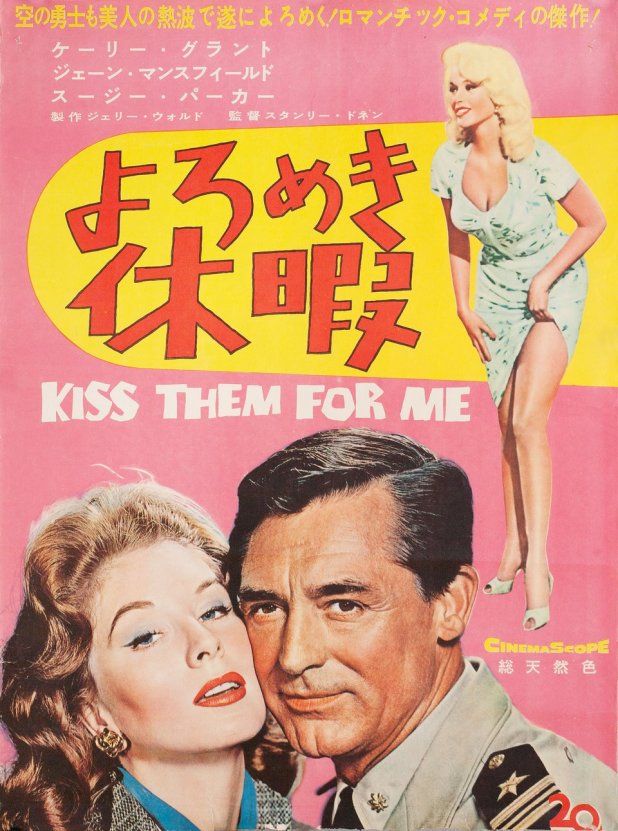
Stanley Donen has one hell of a directorial resume: On the Town, Singin’ In the Rain, Seven Brides for Seven Brothers, Damn Yankees and so many more. Here, he’s working from a 1945 Luther Davis play that was in turn based on the Frederic Wakeman Sr. novel Shore Leave.
Wakeman had worked in advertising until the war and as he healed up in a hospital, he wrote his first novel about a fellow crew member but called him Andy Crewson instead of his true name. Critics tore this movie apart and the studio punished its stars. Actually, it mainly punished Jayne Mansfield.
It’s all about three Navy pilots — Lieutenant McCann (Ray Walston, in his film debut), Mississip (Larry Blyden, a Broadway star who would become a game show host) and Commander Andy Crewson (Grant), who is a master grifter — who are enjoying the spoils of war while trying to adjust to what the world will be afterward.
A ship company owner named Eddie Turnbill (Leif Erickson) wants the men to give speeches to his workers to keep them on the job, but they’re all burnt out, despite the fact that Turnbill offers to set them up for life.
While all the men are on the make, Crewson only has eyes for Turnbill’s fiancee (Suzy Parker, who is in the Twilight Zone episode “Number 12 Looks Just Like You” and married Bradford Dillman later in her life), which makes sense when you see the scene where she removes her nylons. Actually, it’s a wonder anyone can look at any other woman in this film when Mansfield is firing on all cylinders, delivering sly comedy while making her way through nearly every male member of the cast.
Look for Werner Klemperer (Col. Klink from Hogan’s Heroes) as Lieutenant Walter Wallace, Kathleen Freeman (Mother Mary Stigmata!), Harry Carey, Jr. and Frank Nelson, who starred in The Malibu Bikini Shop right before he died.
Siouxie and the Banshees recorded the song “Kiss Them for Me” in 1991, not only referencing the way she said “divoon” but also discussing her heart-shaped swimming pool and the tragic way she died. To wit:
“It’s divoon, oh, it’s serene In the fountain’s pink champagne. Someone carving their devotion In the heart-shaped pool of fame, oh.”
Based on the title, you might be expecting a scathing documentary about child actors and singers. And, in a way, you do. But just not in the way you expected. And that’s what makes this film so amazing.
What we get is a very welcomed reminder of Superstar: The Karen Carpenter Story, a 1987, 45-minute documentary-short by Todd Hayes chronicling the last years of ’70s pop singer Karen Carpenter’s life — via Barbie dolls-as-actors, along with artistic footage. (Hayes also made the 1998 Iggy Pop-David Bowie “what if” rocker, Velvet Goldmine.)
Reviewers and thread comments accurately drop the word “disturbing” and “entertaining” when describing this feature film debut by Nicole Brending that chronicles the rise and fall — with dolls and puppets (that affectionately reminds of Gerry and Sylvia Anderson’s Supermarionation ’60s TV series) — of fictional child pop star Junie Spoons (i.e., Britney Spears and Lindsay Lohan) in a ’90s VH-1 Behind the Music-styled format.
There’s no way a studio would greenlight a live-action comedy film with this much feminist power — without mucking it up into a groan-inducing rise-and-fall-and-back-again comedy ala Bucky Larson: Born to be a Star or Dickie Roberts: Former Child Star. This one has it all: faux-Britney Spears bubble gum pop, loss of virginity, sex tapes, 24-hour over-and-done-marriages, drugs, booze, a Patty Hearst-styled kidnapping, bank robbery, bankruptcy, and murder.
But there’s more to Dollhouse than just being an animated comedy.
This isn’t a film of chuckles, groans, or guffaws. This is a comedy of intelligence told from the perspective of — not the invasive paparazzi and the media meat grinder to which we are accustomed — but by Junie Spoons herself (voice to perfection by Nicole Brending), as she reveals the hypocrisies of an opportunistic society that preys on the talents and contributions of women.
Powerful stuff that’s worth the streaming price.
Now, we have a rare treat with this review . . .
Between the theme weeks and the new releases coming into B&S About Movies, there’s that occasional review/scheduling snafu when one of the new releases is reviewed twice (ugh, we did it again with Immortal). So, in the spirit of a little ’80s Siskel & Ebert tomfoolery in the B&S About Movies’ offices out in the back wilds of Allegheny County, it seems Sam and I are fighting for aisle seat (and the drink blender).
Who’s the “Siskel” and who’s the “Ebert” in this collaborative review with Sam? Only the movies gods in the analog ethers shall know. . . . (I’m the “Siskel,” dadgummit it!)
Sam’s Take:
Dollhouse is the feature debut of director Nicole Brending. Subtitled The Eradicationof Female Subjectivity from American Popular Culture, she also created all of the dolls, props, and sets, wrote and performed much of the music, and did many of the voices herself.
Fictional child pop star Junie Spoons lost her virginity in a sex tape, had a 24-hour marriage, was kidnapped like Patty Hearst and was even involved in the murder of her mother. While this starts as a Britney-esque tale, it spirals out of control.
Quite honestly, I can see the talent behind this and the ability that it took to create it, but it just went on a bit too long for me. I hate saying that knowing the work that it took to make it. But often, so many of the satirical elements feel too sledgehammer. There’s Superstar: The Karen Carpenter Story as a high watermark for films like this. And while moments of it caused fleeting enjoyment, others made me cringe.
Perhaps I’m not the audience for this, so let me say that you may enjoy it much more than me, as R.D did.
Rock Salt Releasing via TriCoast Releasing will begin streaming Dollhouse: The Eradication of Female Subjectivity from American Popular Culture onto various digital platforms (Amazon, inDemand, Fandango, FlixFling, and Vimeo on Demand) on August 11.
Disclaimer: We were sent a screener by the film’s PR company. That has no bearing on our review.
About the Authors: You can learn more about the writings of R.D Francis on Facebook. He also writes for B&S About Movies. Sam Panico is the curator of B&S About Movies.




 B&S About Movies
You must be logged in to post a comment.