Nightfire (2020)

What a happy, accidental discovery—considering B&S About Movies is in the midst of its “James Bond Month” extravaganza.

Filmed in the popular cinematic location of Verona, Italy, one of the locations for the 2008 James Bond entry, Quantum of Solace, Nightfire is a timely story about the plight of the Ukrainian people and the United States’ involvement in that country’s conflict.
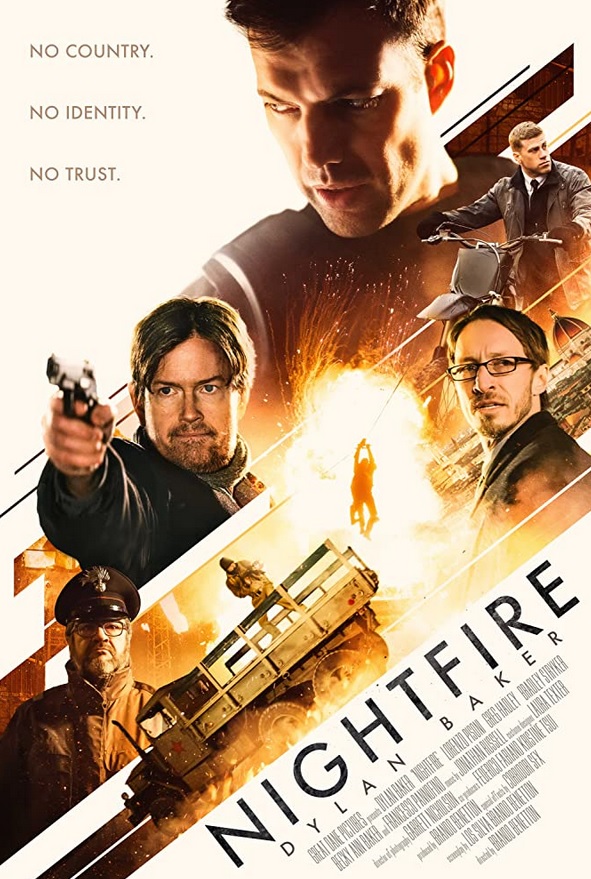
At the Sokov Military Base, located 32 miles from the Ukrainian border of the country of Belarus, the mission of CIA operatives Carter (Lorenzo Pisoni; guest star on U.S TV’s The Good Wife, Law & Order: SVU, and Elementary) and Ross (Greg Hadley; new to the scene and very good here) to retrieve two military chips containing top-secret content goes awry when they compromise their mission objective to rescue Olivetti, an international political prisoner. And Carter comes to discover it’s never about the freedom of a country and its citizens: it’s always about greed. And no one is who they say they are.

The marquee name here is the-you-watch-anything-he’s-in Dylan Baker, as Olivetti. Dating back to his support role in Steve Martin’s Planes, Trains & Automobiles, you’ve come to know Baker as he delivered the goods countless times on U.S television series, such as Law & Order: TOS and the Chicago P.D./Fire franchise, along with his starring roles on Blindspot, The Good Wife, and Homeland—and his role as Dr. Curt Conners in Sam Raimi’s Spider-Man franchise. The cast is rounded out by Bradley Stryker (guest roles on TV’s Arrow, Cold Case, and CSI:NY) and Becky Ann Baker (star of HBO’s Girls, as well as The Blacklist and Hunters).

Nightfire is the fifth student-short production by French-born writer-director Brando Benetton and, considering this is a college thesis project shot on a low budget in 14 days—the quality is of an astounding, major studio quality. That quality comes courtesy of the production’s use of Red Epic Dragon cameras and the implementation of non-CGI practical effects. The car chases and real explosions are masterfully executed by the Corridori Brothers—you know their work; nothing too exciting: just films like the The Italian Job, Mission: Impossible III, and Spectre (the team also worked on maestro Dario Argento’s Do You Like Hitchock? and Giallo). Considering the 45-minute runtime, the spy action-thriller adventures of Lorenzo Pisoni’s Agent Carter can easily be picked up by a major U.S television or grittier cable network and expanded into an hour-long drama. If not, there’s definitely a feature film in its experimental, truncated frames.

Benetton is currently working as a Second Assistant Director on a very intriguing feature film—his first feature—currently in post-production. Voodoo MacBeth concerns the young and arrogant Orson Welles staging the first all-black production of Shakespeare’s Macbeth in 1936 Harlem.

You can learn more about Nightfire and the career of Brando Benetton courtesy of a three-minute behind the scenes vignette on the Vimeo page of Great Dane Productions. You can watch Nightfire as an Amazon Prime and Hulu stream beginning May 1. It has since become available on the free-with-ads steam service, Tubi. Benetton has since worked as a first assistant director on the indie drama Voodoo Macbeth and thriller, The Summond (both 2021).

Disclaimer: This movie was sent to us by its PR company and, as you know, that has no bearing on our review.

About the Author: You can read the music and film reviews of R.D Francis on Medium and learn more about his work on Facebook. He also writes for B&S About Movies.
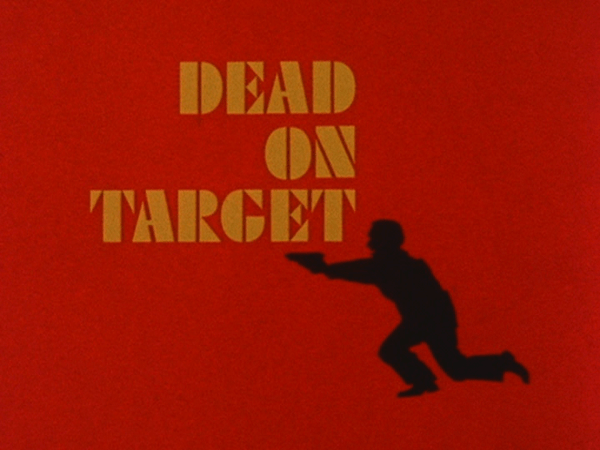
Our Man Flint: Dead On Target (1976)

Originally airing March 17, 1976 on ABC, this forgotten third Derek Flint movie sadly deserves to be that way. A pilot for a weekly series, luckily it wasn’t picked up, if the quality of this effort was to be any indication of how bad the show would be. Dead On Target indeed.

Ray Danton — who became a director for TV after this (he also helmed Deathmaster and Psychic Killer) — is Flint. He had a long career in Eurospy films like Secret Agent Super DragonCode Name: Jaguar and Lucky, the Inscrutable. This would be his last acting role.

What the film fundamentally gets wrong is the fact that Derek Flint is a man continually looking to better himself and seek a higher plane. Why would he decide to become a normal everyday private investigator? Maybe he was following in the footsteps of Matt Helm, whose Tony Franciosa-starring TV series had him become a gumshoe.

Well, he does exactly that, helping Benita (Gay Rowan, The Starlost, the Robert Fuest-directed Revenge of the Stepford Wives) learn to be a private dick and battle the terrorists known as B.E.S.L.A. (Bar El Sol Liberation Army). They’ve kidnapped an oil tycoon named Wendell Runsler, who must be rescued, which again seems like something Flint would probably have an issue with.

There’s a blink and you’ll miss it appearance by a nascent Kim Cattrall as a secretary. Otherwise, I can’t find much here to recommend to you. Truly, this is the lowest of the low where the Flint movies are the highest of the high.

One of Flint’s lines is “It’s like the blind man said when he passed the fish market. “Hello, ladies!”” That makes no sense. This movie being so horrifically bland doesn’t either.

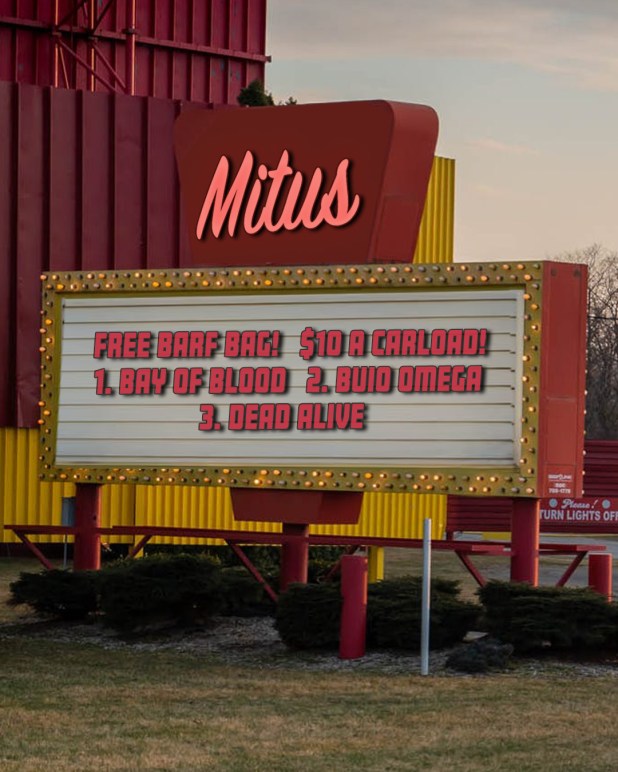
DRIVE-IN FRIDAY: Sean Mitus

EDITOR’S NOTE: Thanks to Sean Mitus for sharing his drive-in night. He’s a big fan of the Mahoning Drive-In, so it was great to have him share these with us.

MOVIE 1: Bay of Blood (1971, Mario Bava): Bay of Blood is the often-imitated Bava proto-slasher often imitated (spear through the couple in bed scene stolen for F13, anyone). Directed by the master, Mario Bava.


MOVIE 2: Buio Omega / Beyond the Darkness (Joe D’Amato, 1979):  for the sheer creep factor. No hiding who the killer might be; just pure “what will he do next”. It even has the weird twinning later seen in Cemetery Man.


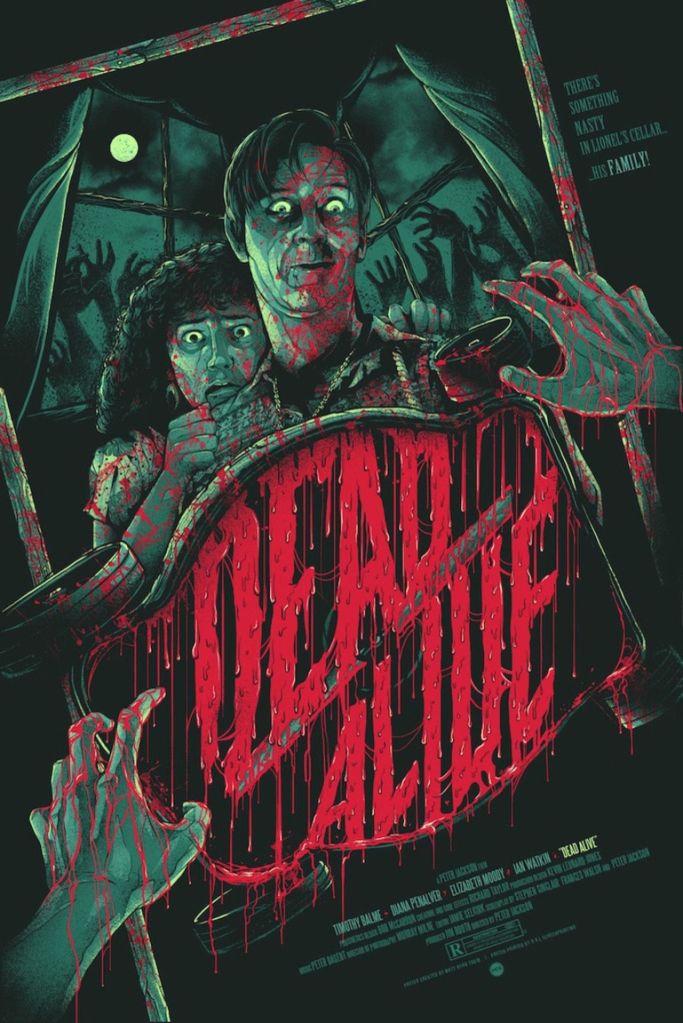
MOVIE 3: Dead Alive (Peter Jackson, 1992): Dead Alive is pure fun for horror geeks! More blood and guts than most zombie movies. The lead is subjected to far worse than Job for the love of his life. Plus you have a kung-fu priest!

Thanks Sean. Do you want to share your movies? Comment below or write to us at bandsaboutmovies@gmail.com

Dear Guest (2020)

I’ve long since surpassed my Hollywood-mainstream film attendances with my affection for the new breed cultivated in film festivals: I love going to film festivals, seeing short films, and acting in short films: the camaraderie of the indie environs is pure electric. It’s oxygen. It’s life.

I got my start in the entertainment industry by way of radio broadcasting, where I was able to support indie-labeled bands and unsigned local musicians. And that affection for the independent spirit carried over as I started acting in indie shorts (I even supplied props, wardrobes, and “roadied” them). And watching a film like Dear Guest makes me jealous, and nostalgic at the same time, as none of my writer-directors possessed the skills of Megan Freels Johnson.

I appreciate that Johnson understands the concept of a short film. Short films should be just that: short. Dear Guest is well-written and edited, and gives us full-character arcs and development in the space of 10 minutes: exactly as a short film should. No, this won’t turn into a college thesis on the craft of screenwriting, and act structure, and etc., but take my word for it: Megan Freels Johnson knows her stuff—and a bag o’ chips.

Currently making the rounds at a film festival near you, Dear Guest is a psychological noir-thriller of the Alfred Hitchcock-cum-Twilight Zone variety—with a twist of Polanksi (and one more of our favorite writer-directors)—where nothing is at it seems.

The “dear guests” are Maria and Jules (Ashley Bell of The Last Exorcism and Noureen DeWulf of NBC-TV’s currently-airing Good Girls), a couple who checks into a beautifully furnished rental for a long-awaited vacation, only to discover they’ve walked into an elaborate mouse-trap tended by its anonymous host.

“I’m so happy I made you take time off work,” kisses Maria.

“You didn’t make me,” scowls Jules.

Uh, oh. Maria needs a rethink . . . in more ways than one. This vaycay is going off the rails, one way or another.

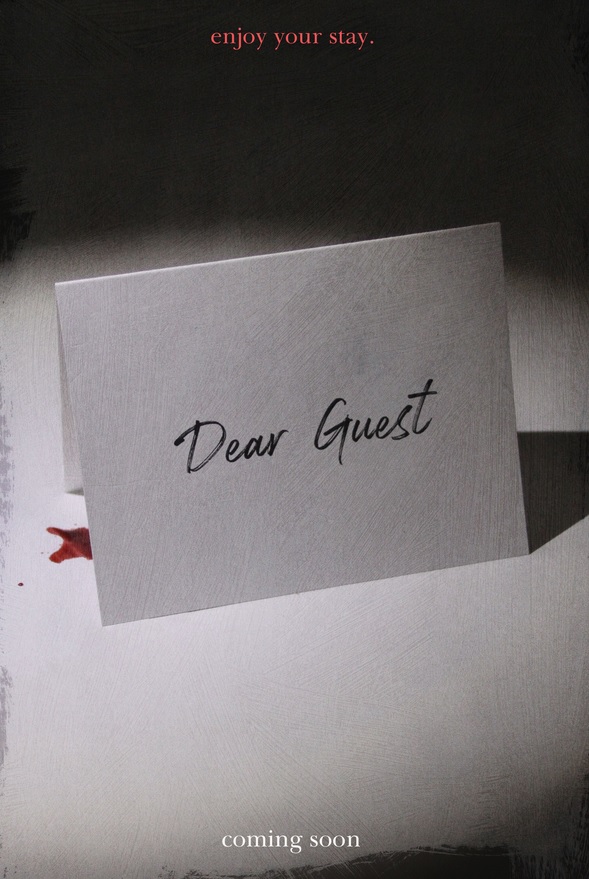
Then, as Jules goes off to check out the bedroom and put away their bags—she vanishes. Then the front door to the house is locked—from the outside. And a plain white “Dear Guest” place card appears in the empty bedroom—with a riddle held within its crease.

Jules discovers she’s a game piece and she needs to follow the clues: such as that theatrical one-sheet for Ann-Margret’s The Swinger . . . and that Hot Wheels car on the floor. . . . Maria’s been kidnapped, bound and gagged in the garage, inside a car . . . and the card is rigged to go up in flames.

As the couple tries to escape, another card appears on the rear kitchen door—with bullet-soundproof glass, and the house is covered in it. What will happen during the next three days, discloses the place card.

When the camera slowly zooms—in conjunction with the ambient tinkles of a xylophone backed by ominous strings—on that stoic, poolside griffin through the prison-like wrought iron fence . . . wow. That’s a pure—and welcomed—Dan Curtis vibe, he the master of ‘70s psychological and supernatural thriller TV movies. And we should know: we waxed nostalgic for a whole week over his resume (shamless plug: check out our last month’s Exploring: Dan Curtis featurette roundup).

Here’s to hoping the plans to expand this chiller into a feature film come to fruition, as we want more. And that is exactly what a short film should do: leave you wanting more. . . .

You’ll also remember Ashley Bell from her guest appearance on a rerun of CSI: Crime Scene Investigations (I’m currently binging on it) and Showtime’s United States of Tara. You’ll also recognize Noureen DeWulf from her role as “Lacey” on Fox-TV’s Anger Management and her support roles in the theatricals Ghosts of Girlfriends Past and The Backup Plan. The point: you know the acting in Dear Guest is top-notch.

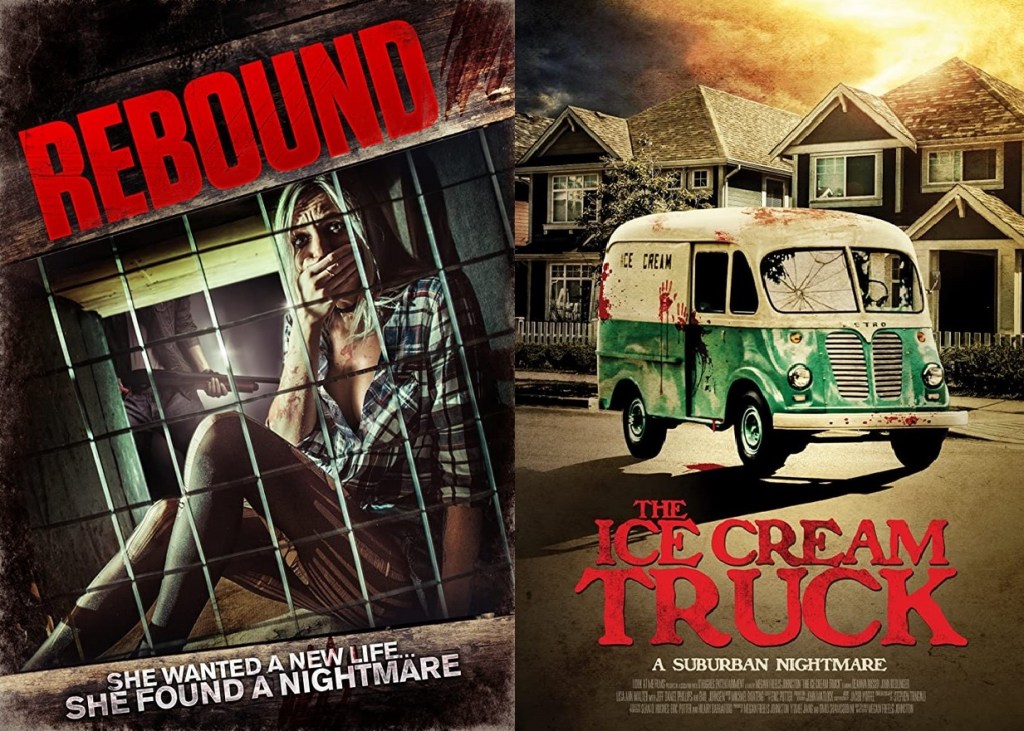
You can watch Megan Freels Johnson’s feature film writing and directing debut, 2014’s Rebound, for free—via a legal stream with limited commercials—on TubiTv and Vudu, or via your Amazon Prime, iTunes, and Google Play accounts. Her follow up to Rebound, 2017’s The Ice Cream Truck, is also available on the TubiTv and Vudu platforms, as well as Amazon Prime, iTunes, Google Play, and You Tube Movies.

Johnson’s third and fourth feature films in her horror oeuvre, Hunting Season and Asking for It, are currently in pre-production. And Hunting Season sounds really good, as any movie with Bruce Davison, from the horror classic Willard, usually is (and we get Meadow Soprano, aka Jamie-Lynn Sigler, in the bargain): Deanna Russo of The Ice Cream Truck stars as a young woman on a weekend getaway with her new boyfriend, only to discover “hunting season” is all year round. Who’s the cat and who’s the mouse? Who’s the hunter and who’s the prey?

I have to admit: I wasn’t aware of Johnson’s work until writing this review for Dear Guest, so I’m going to let you go. It looks like I’ve got some movies to watch.

Oh wait! Sorry, but we have to click bait you with another shameless plug before you go. (Send your complaints to Megan: she’s the one making movies about ice cream.) So, when you get a chance, check our B&S reviews for one of my favorite films, Clint Howard’s Ice Cream Man, and Sam’s, Santa and the Ice Cream Bunny.

Okay. Now class is dismissed. See you on Monday. Beware the Ice Cream Man, kids.

About the Author: You can read the music and film reviews of R.D Francis on Medium and learn more about his work on Facebook. He also writes for B&S About Movies.

Disclaimer: This movie was sent to us by its PR company and, as you know, that has no bearing on our review.

Goldfinger (1964)

If From Russia With Love was big, Goldfinger is the Bond movie that nearly everyone sees as the greatest success in the series.

With the court case between Kevin McClory and Fleming surrounding Thunderball still in the High Court — more on that this week — producers Albert R. Broccoli and Harry Saltzman picked this story as the third film. They enjoyed a budget that was pretty much the same as both Dr. No and From Russia With Love combined.

However, Terence Young was out after a pay dispute and Guy Hamilton, who had turned down Dr. No, came on board. His idea changed the series — no longer was Bond nearly superhuman; instead his villains would be stronger than him. Hamilton would make three more Bond pictures: Diamonds Are Forever, Live and Let Die and The Man with the Golden Gun.

It also saw the return of stunt coordinator Bob Simmons and production designer Ken Adam, whose presence can be felt in every frame. Before Goldfinger, Bond had a few gadgets. After, gadgets would be one of the reasons to show up for his movies.

After destroying a drug dealer’s operation in Latin America, Bond (Sean Connery, coming back for his third film) goes to Miami Beach on what should be a vacation. Instead, CIA agent Felix Leiter (Cec Linder, taking over the role from Jack Lord) asks him to observer Auric Goldfinger (German actor Gert Fröbe, whose dialogue was dubbed by Michael Collins; he also dubbed him in Chitty Chitty Bang Bang, another movie made from an Ian Fleming book), a rich man obsessed with gold.

Orson Welles was going to play the role, but he asked for too large of a salary. Oh, what could have been.

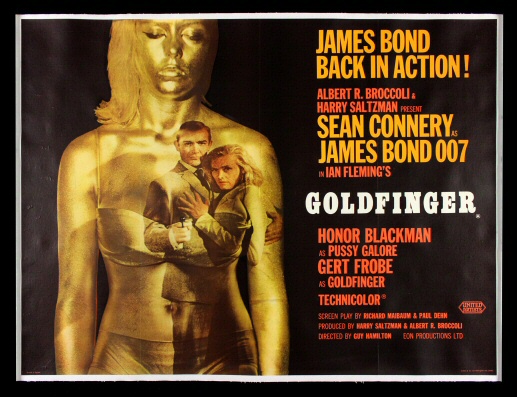
Goldfinger is cheating at a game of gin rummy — a simple illustration that he corrupts even the most idle of pursuits — with the help of his employee Jill Masterson (Shirley Eaton, who is also in The Million Eyes of Sumuru and The Girl From Rio; she was already a sex symbol but the imagery of her from this film took her to another level). Bond, of course, seduces her and wins the game. Goldfinger wins the whole war by having his henchman Oddjob (former pro wrestler Harold Sakata) knock out 007 and then paints Jill gold, killing her from skin suffocation.

Seriously — we’re a few minutes in to this movie and it already blows away everything that came before.

Here’s a strange story: Fleming had based the villain on Modernist architect Erno Goldfinger, who threatened to sue when he found out he was to be a spy villain. Fleming’s publisher begged him to change the character’s name, to which Bond’s creator offered to change it to Goldprock. The case was settled out of court.

This sets off several stories — Bond trying to determine how Goldfinger is stealing gold and getting richer; Oddjob determined to kill Bond with his steel-rimmed hat; Tilly Masterson’s vendetta against Goldfinger to get revenge for her sister’s death, only to be killed by Oddjob; Goldfinger attempting to rob Fort Knox and his henchwoman Pussy Galore (Honor Blackman, who was Mrs. Gale on The Avengers before this).

Galore was based on Fleming’s friend, mistress and muse Blanche Blackwell. As his wife disapproved of the Bond novels, Fleming grew closer to Blackwell. She inspired not just Galore, but also Dr. No‘s Honeychile Rider. Her son Chris Blackwell would go on to form Island Records.

In the book, Galore runs an all-lesbian Harlem gang known as the Cememnt Mixers. Well, in the movie, she’s the leader of a Flying Circus of acrobatic, judo fighting and plane flying women. Yes, only in the world of Bond.

You also have to adore that the movie ends with a battle where Goldfinger is pulled out the window of a jet. As the plane crashes, Bond and Galore hide under a parachute. Despire her being a criminal, Bond seems like the one who doesn’t want to be found — a theme that will continue as the series goes forward.

I’d be remiss if I didn’t mention that Shirley Bassey’s “Goldfinger” song is astounding. To hit the note at the end of the song, she had to take her bustier off in the studio. And you know who is playing guitar on it? Jimmy Page.

The Aston Martin. The laser scene. “No, Mr. Bond. I expect you to die.” Oddjob. Suggestively named ladies. The playful fighting between Q and Bond.

If you’re going to watch one Bond movie, this should be it. Me? I’m watching hundreds of spy movies all month long.

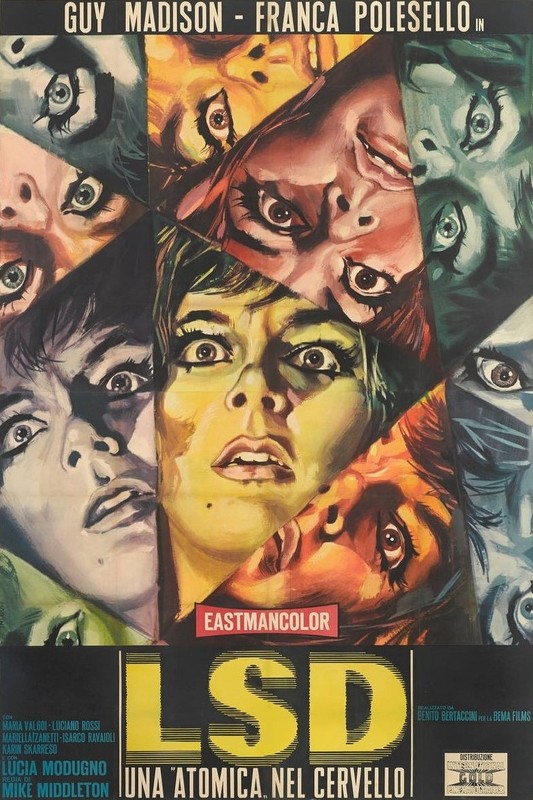
LSD Flesh of the Devil (1967)

ECHO and Mr. X want to take over the world with LSD. LSD is back, people. It’s bad!

To get to that part of the story, we have to go back to when our hero, Rex Miller (Guy Madison, TV’s Adventures of Wild Bill Hickok) used a toy car and a blow gun to kill two adult men in front of a little girl. Normally, that would send you to some kind of juvenille faciity but Rex ended up becoming a spy.

Before you can say Merry Pranksters, army regiments are getting dosed, which means they start praying, hugging one another and throwing down their weapons. Something has to be done about this if we want to fight the Red Menace!

Mr. X’s goal is to stop  dividing people and to create a Utopia. So, you know, he’s the bad guy.

This is the first Massimo Mida movie I watched. It wasn’t all that great, except for the insane moments that just burst out of nowhere, like a man being burned alive in front of your eyes. Then, after thinking the movie will be good, fight scenes happen without seeing any of the punches and numerous people just stand around. Honestly, the fight scene at an hour and three minutes in is one of the most ineptly shot things I’ve ever seen, which makes me want to watch this movie all over again.

You can see it for free on YouTube. I even found it for you.

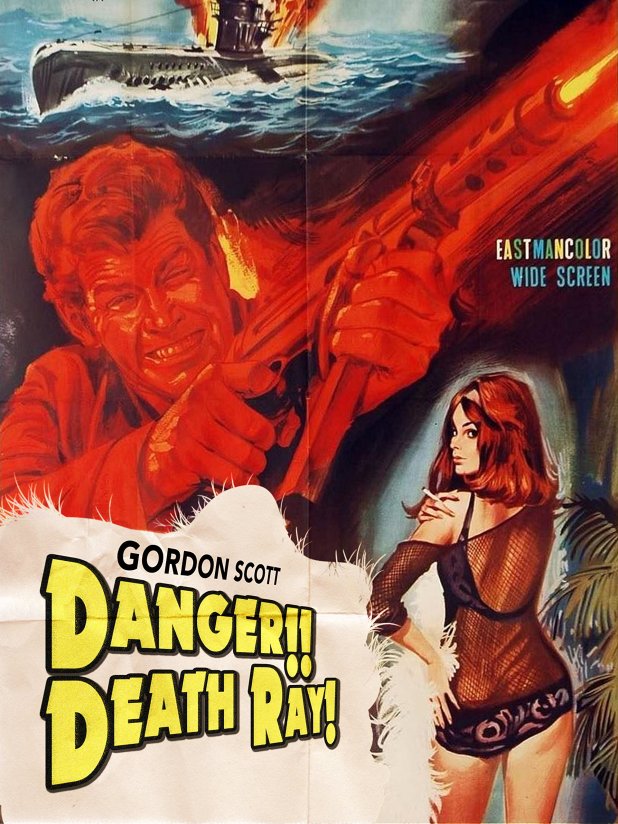
Danger!! Death Ray (1967)

Also known as Il Raggio Infernale (The Infernal Ray), Nest of Spies and Death Ray, this Italian espionage film was directed by Gianfranco Baldanello, who bounced around grenres, creating Spaghetti Westerns like Long Days of Hare and Colt in the Hand of the Devil, as well as the Bond-sounding Zorro movie Man with the Golden Winchester and the sex comedy Very Close Encounters of the Fourth Kind. He also wrote the giallo The Girl In Room 2A.

Professor Carmichael has invented a death ray for, you know, peaceful purposes. Tell that to the henchmen dressed as NATO soldiers who have kidnapped him and taken the weapon for their own use. Luckily, Agent Bart Fargo (Gordon Scott, who played Tarzan in six movies) skips out on his vacation and heads to Barcelona, where he wins hearts and minds for the cause.

If you see this in Spanish, Bart’s name is Jim Benson. In German, he’s Mike Morris. And in real life, Gordon Scott went broke and lived in one of his fan’s houses until he died in 2007.

You can watch this on Amazon Prime and Tubi, complete with riffing from Mystery Science Theater 3000. Trust me. You’re going to need it. This movie has vehicle effects that make Gamera movies look like 2020’s finest CGI.


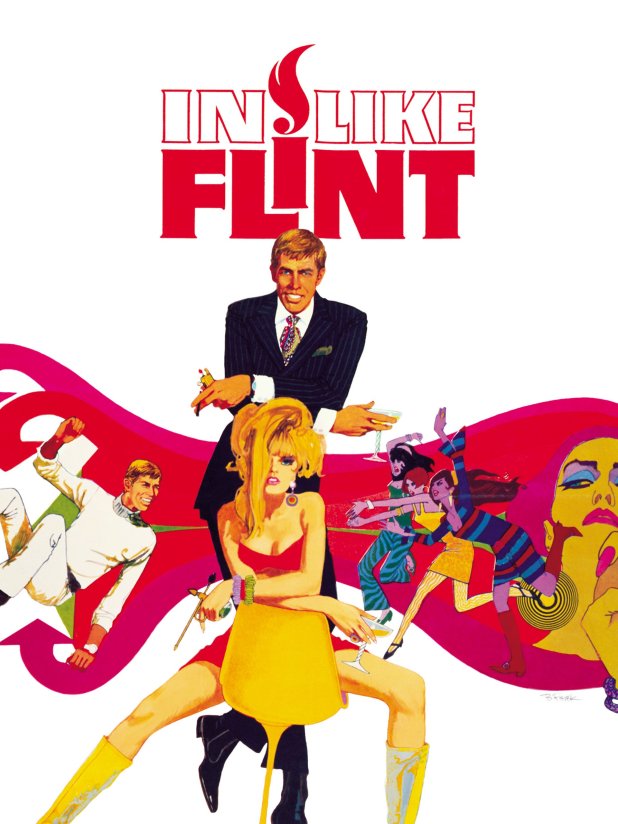
In Like Flint (1967)

This film, along with Caprice, marks the end of an era. They were the final movies to be CinemaScope, as Fox would move on to Panavision.

1967 was the end of many eras. And this film reflects it, as instead of men continuing to run the world, In Like Flint features an international feminist matriarchy that conspires to destroy the American ruling class.

Ah, the Flint films. James Coburn and Lee J. Cobb are back and this time, any semblance of reality has been thrown out the window. What a magical time to be alive and spying.

Z.O.W.I.E. (Zonal Organization for World Intelligence and Espionage) Chief Lloyd C. Cramden (Cobb) and President Trent (Andrew Duggan, who is in many of Larry Cohen’s movies like BoneIt’s Alive and The Private Files of J. Edgar Hoover, where he’d play LBJ) are outsmarted by the Fabulous Face organization. The President is replaced with a surgically altered actor, the nuclear space platform is taken over and Cramden is soon discredited.

That means that Derek Flint (Coburn) is back on the job. And thanks to Fabulous Face taking his three girlfriends — he’s downsized somewhat — hostage, he has a personal stake in the game.

While not as amazing as the original film, that one didn’t have Flint swimming and talking with dolphins, nor did it have a cigarette lighter with 82 different gadgets inside it. Or a Flint ballet dancing with Yvonne Craig. Or him showing up in Cuba, where just about everyone looks like Castro.

Jean Hale (who was in Roger Corman’s The St. Valentine Day’s Massacre) plays Lisa, a Fabulous Face operative. Also on hand is Anna “The British Bombshell” Lee, who was the goddaughter of Sir Arthur Conan Doyle. She was Mrs. Bates in Whatever Happened to Baby Jane? and appeared on General Hospital from 1977 to 2003.

The villainous Carter is played by Steve Ihnat, who would go on to direct Coburn in the movie The Honkers. Sadly, he would die before that film was released into theaters at the young age of 37. He’s probably best known for playing Fleet Captain Garth of Izar in the original Star Trek episode “Whom Gods Destroy.”

Who else is in this? Helena is played by Hanna Landry, who was Grace Cardiff in Rosemary’s Baby. Jan is Diane Bond, who was Liza in the Vincent Price-starring House of 1000 Dolls. She’d become a feminist artist years after making this. And  the Russian Premier is played by Herb Edelman, who would go on to be Bea Arthur’s ex-husband Stanley on The Golden Girls.

In Like Flint was rushed into production after the success of the original film. By the time it was made, the studio — and director Gordon Douglas (Them!Viva Knievel!) — had no interest in the movie. Coburn and stunt arranger Buzz Henry ended up directing most of the movie. After this, the star would turn down the opportunity to make a third Flint film.

EXPLORING: Bond girls in giallo films

The world of the giallo — and of James Bond — is filled with violence and gorgeous women. So it’s really no wonder that there’s some level of crossover between the actresses in the films.

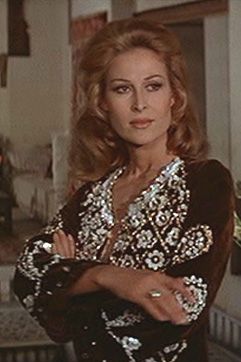
Ursula Andress: The original Bond girl, Andress wowed audiences as Honey Ryder, emerging from the water with a bikini and a knife. She’d go on to appear in the 1977 Steno-directed giallo Double Murder alongside Marcello Mastroianni and Peter Ustinov. If you’d like to see her in an Italian cannibal film, look no further than The Mountain of the Cannibal God.

Claudine AugerThe actress who played Dominique “Domino” Derval in Thunderball would go on to star in two giallo films: Black Belly of the Tarantula and Mario Bava’s proto slasher A Bay of Blood.

Luciana Paluzzi: In Thunderball, she played Fiona Volpe, the henchwoman killed while dancing with Bond. She would go on to star in the Spanish-Italian giallo , The Two Faces of Fear, alongside George Hinton.

Barbara Bach: Bach would play Anya Amasova in The Spy Who Loved Me, but before that, she was in Black Belly of the Tarantula and Short Night of Glass Dolls. On the non-giallo horror and science fiction sides of the genre, she also appears in Sergio Martino’s Island of the Fishmen and Aldo Lado’s The Humanoid.

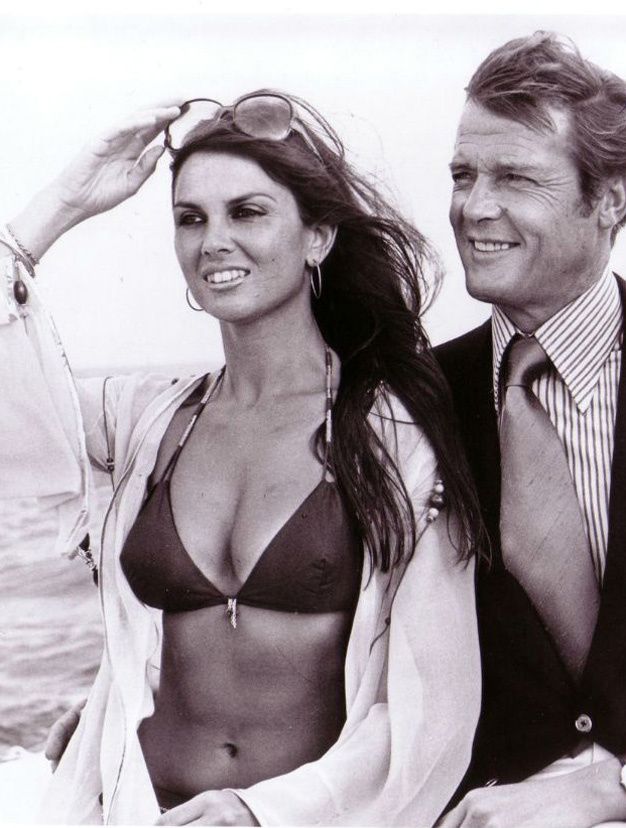
Caroline MunroWhile you can’t consider either of the Phibes films or Maniac giallo, I guess you can make an argument for Jess Franco’s Faceless. That said — anyone that complains about having to think about Ms. Munro — who played Naomi in The Spy Who Loved Me — is a moron.

Olga Bisera: Felica gives her life to save Bond in The Spy Who Loved Me. Ms. Bisera is also in the giallo films A Whisper In the Dark and Eyes Behind the Wall.

Helena Ronee: After playing the Israeli member of Blofeld’s Angels of Death in On Her Majesty’s Secret Service, Ronee also shows up in Mario Bava’s Five Dolls for an August Moon.

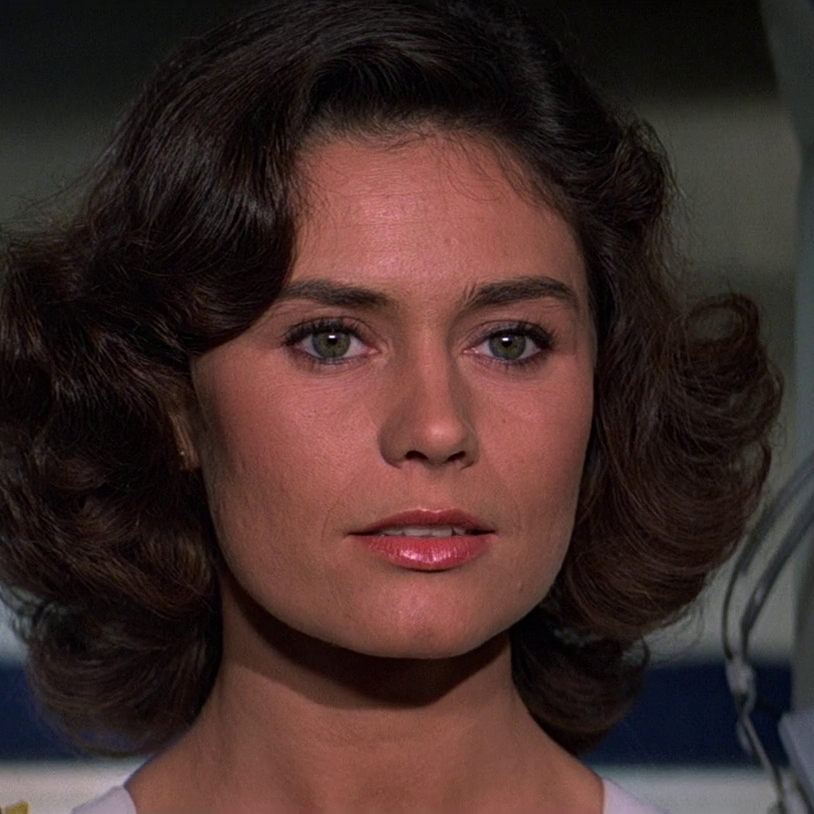
Corinne Cléry: Corinne Dufour was Hugo Drax’s personal pilot in Moonraker before she was seduced by 007 and killed by her boss’ dogs. As for the actress who played her, she’s in Plot of Fear, a 1976 giallo. She also shows up in two of my favorite strange films, Fulci’s The Devil’s Honey and Yor Hunter from the Future.

Tonia Sotiropoulou: This actress shows up as a lover of Bond in Skyfall, but she also makes plays Elena in Berberian Sound Studio, a movie set in the Italian film world of the 1970’s as the giallo The Equestrian Vortex is being filmed.

BONUS ROUND…

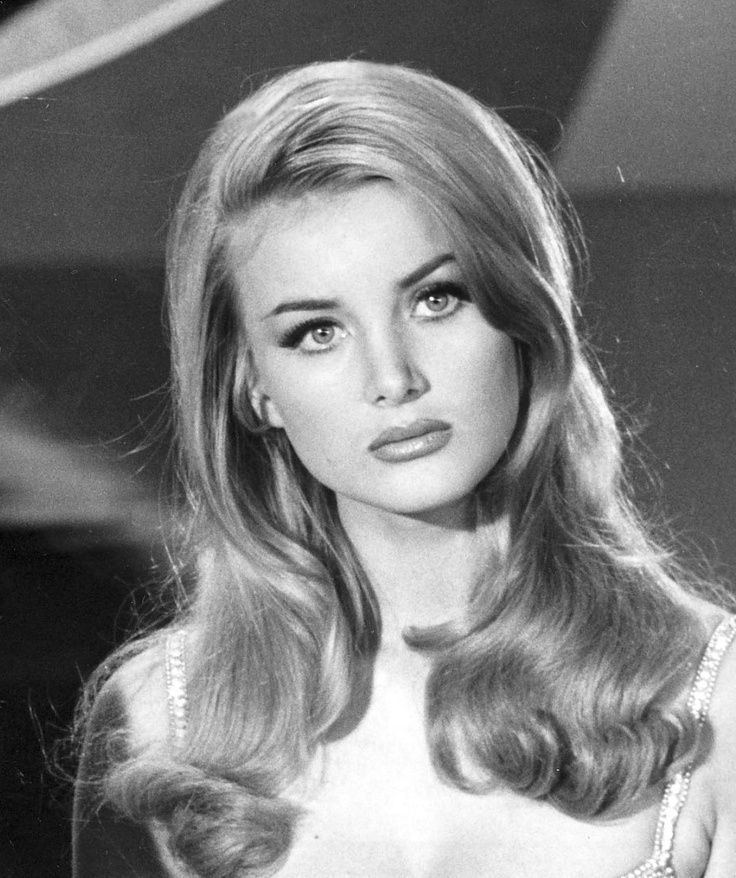
Barbara Bouchet: Although Casino Royale is not an official Bond film, the star of giallo such as The Man With the Icy EyesBlack Belly of the TarantulaAmuck!The Red Queen Kills Seven TimesDon’t Torture a Duckling and 2009’s Giallo plays Moneypenny. She’s also in the Eurospy movies Surabaya Conspiracy, Agent for H.A.R.M. and Danger Route.

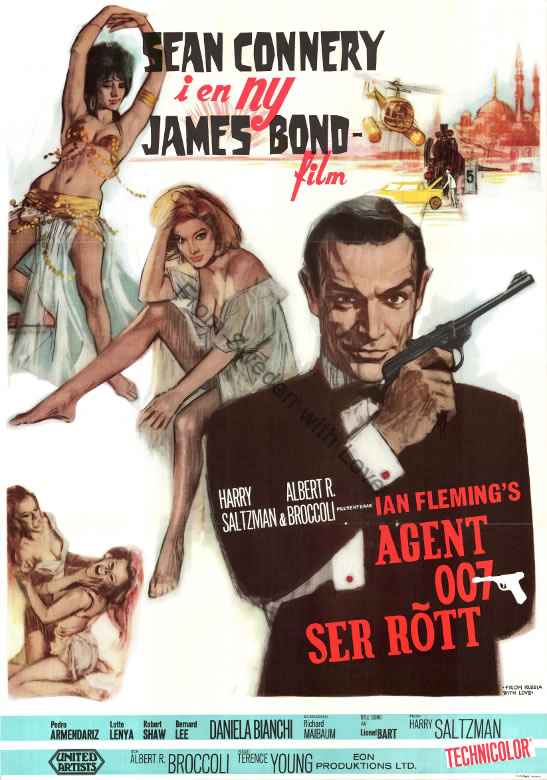
From Russia With Love (1963)

Was this movie a success? Well, it made $78 million on a $2 million dollar budget, which would be like $661 million in today’s money. Yeah. This is the very definition of success.

United Artists had doubled the budget available of Dr. No, which allowed them to film on location for the first time. There was a mad rush to get this done by October 1963, with production running over budget and past schedule.

President John F. Kennedy had named this Fleming’s novel as one of his ten favorite books of the year and it would be the last movie he’d view at the White House before his death.

Most of the crew stayed on, except for production design genius Ken Adam, who went on to work with Kubrick on Dr. Strangelove; title designer Maurice Binder and stunt coordinator Bob Simmons, who still found the time to do a few stunts in the final film.

From Russia With Love is the movie that introduced many of the Bond trademarks, like the pre-title action sequence, a major villain in Ernst Stavro Blofeld (who is only given a number and a ? as to who played him; it’s Anthony Dawson with Eric Pohlmann’s voice), bravura stunt action, gadgets, a catchy theme song with lyrics and the proclamation that “James Bond will return…” in the credits.

Think Marvel has the trademark on franchises? These guys pretty much wrote the rulebook.

After James Bond (Sean Connery) killed Dr. No, SPECTRE (Special Executive for Counter-intelligence, Terrorism, Revenge and Extortion) has begun training agents to kill off 007, starting with Irish killer “Red” Grant (Robert Shaw, Jaws), who starts the film by killing off a Bond lookalike. He’s a formidable foe for our hero, continually saving him throughout the film so that he can have him all to himself. The fight between the two — actually done mostly by Connery and Shaw — worried many making the film for its sheer brutality.

SPECTRE’s other goal is to use Bond to steal a cryptography advice from the Russians and then finally kill him. In Bond’s way are chess garndmaster Kronsteen (Number 5), Rosa Klebb (Number 3) and the mysterious Number 1, who will eventually be revealed as Bond’s chief nemesis Blofeld.

At least Bond has Ali Kerim Bey (Pedro Armendáriz, one of the many actors on The Conquerer to die from cancer; he’s noticably in pain for much of the film and gutted out his scenes until he was admtted to the hospital. He snuck in a gun and killed himself when the pain became too much) and love interest Tatiana Romanova (Daniela Bianchi, who also appears in the spy films Operation Kid Brother, Special Mission Lady Chaplin and The Last Chance) on his side.

Grant has the plan to blackmail Bond, as he has a video of him making love to Romanoval Bond responds by killing the man with his own weapon. Only Klebb remains, what with her knife shoe, but Romanova shoots her and heads off with Bond on a romatic getaway.

From Russia with Love also sets up Q as Bond’s weaponsmith and the soon to be trademark opening of the series with scantily clad women and superimposed titles. It’s the last film where Sylvia Trench, Bond’s would-be girlfriend, appears.

For many Bond fans, this is the holy grail for what Bond is all about. It was also Sean Connery’s favorite film of the series (as well as being the most highly regarded by Lois Maxwell, Timothy Dalton and Daniel Craig). Indeed, the scene in which Bond and Romanova first meet in his hotel room is so classic Bond that it’s the go-to audition scene for potential Bond actors and Bond girls.

It’s also the last Bond project that Connery would appear in. Wondering how that’s possible? Well, in 2005, Electronic Arts made a game adaption and Connery not only allowed his likeness to be used, but came back to re-record dialogue more than twenty years after his last Bond role in Never Say Never Again.