With over 100,000 documented disturbed burials, the owners and operators of Louisville, Kentucky’s Eastern Cemetery reused the same graves over and over, taking advantage of low-income families.
25 years after the cemetery was left abandoned, the Friends of Eastern Cemetery was formed to take care of the graves, so that those buried there would at least have some dignity.
This movie tells their story.
The overburying at Eastern Cemetery began all the way back in 1885. To give an idea of how bad of an issue this was, the cemetery was nearly thirty acres in size. The funeral industry recommends a thousand bodies by buried by acre, but thanks to the mass pauper graves in Eastern, some feel believed that at least 138,000 are buried there. That’s nearly 100,000 more bodies than should be, if you don’t feel like doing the math.
This is director Tommy Baker’s first documentary and he’s picked a fascinating topic. Perhaps not the escape you’re seeking in these dark times, but worth a watch.
Facing East is available on demand from Uncork’d Entertainment.
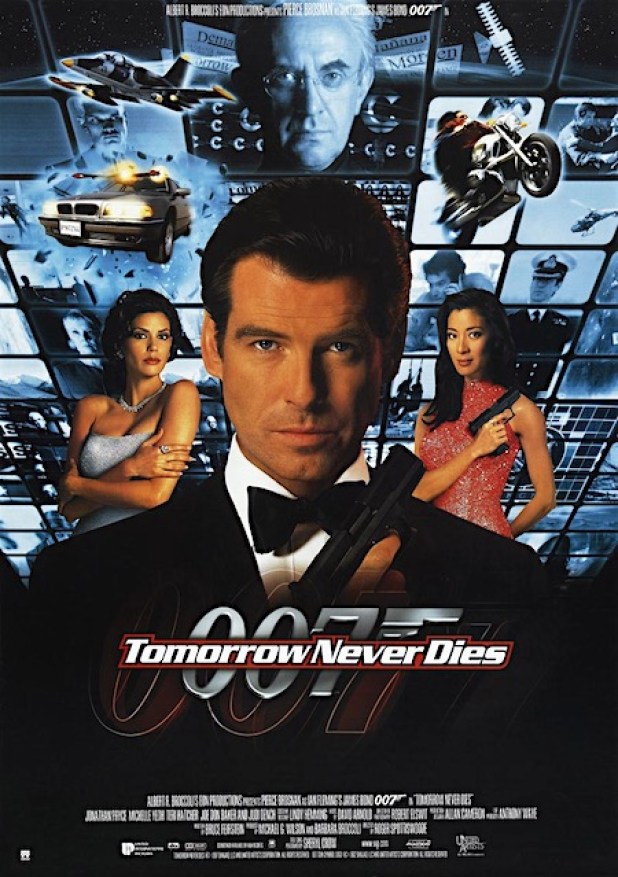
Roger Spottiswoode directed Stop! Or My Mom Will Shoot, which does not seem like a movie that would prepare you for making a Bond film. Nonetheless, this is a fine offering, particularly because of Michelle Yeoh, who plays Chinese spy Colonel Wai Lin.
This time, Bond is up against Elliot Carver (Jonathan Pryce), a media mogul who is trying to start World War III to increase his ratings. To top things off, his trophy wife Paris Carver is one of Bond’s many ex-girlfriends.
After she’s killed by Carver’s henchman Dr. Kaufman (Vincent Schiavelli), Bond is out not just to solve this case, but for revenge.
Ricky Jay shows up in this as cyberterrorist Henry Gupta. He’s always a welcome face in films. I’d recommend that you watch Ricky Jay and His 52Assistants, a filmed version of his stage show of card magic. Between acting, writing and becoming the collector of magic information and history, Jay was a fascinating human being.
I also find it amusing that Yeoh wasn’t allowed to perform all of her own stunts. If you’ve seen her in movies like Supercop, you’ll realize that she’s more than the equal of anyone that was doubling for her. That said, she did some of her own fighting. For the fight scene in the bicycle shop, the producers had to call in Jackie Chan’s stunt team, because none of the stuntmen wanted to do the full contact style that she had perfected while a member of that group.
Here’s a strange thing: Sir Anthony Hopkins was cast as Carver, but quit after three days because it was so chaotic. There was big pressure on EON Productions to finish the movie on time, so the script was being written on the fly and new pages were being sent every morning. He chose to be in The Mask of Zorro — directed by GoldenEye‘s Martin Campbell — instead.
If there was ever a film that definitively proves film is a universal art form that defies the roughly 6,500 languages in our world, it is this 38th directing effort from Chun-Ku Lu: This Life, I am a flower pot.
Unknown in the United States, outside of the most discriminating martial arts connoisseur, director Chun-Ku Lu is a respected, major star in China and the Pacific Rim territories with 80-odd combined credits as a writer, actor, and director. He’s best known to U.S audiences for his work during the martial arts heyday of ‘70s cinema for The Black Dragon’s Revenge, along with the popular ‘80s video rentals Bastard Swordsman (1983) and its sequel: Return of the Bastard Swordsman (1984).
After a 20-year retirement from the business in the late ‘90s, Chun-Ku Lu returns with this touching, beautifully-shot drama about a single mother and her portly, young son who leave Taiwan to live in the U.S. The title of this Mandarin language short out of Taiwan is pronounced Zhè bèizi, wǒ shì huā pén, which is also understood as: This world is a small bonsai.
Even without subtitles, this voiceover-related story is easy to digest by understanding the universal symbolism of the art of bonsai: a minimalist approach practiced in Zen Buddhism where one strives for peace, harmony, and balance; a maintaining and ordering of thoughts, so as to remove clutter from one’s life; an art that teaches man—like trees—must fight against the elements of nature (and his unbalanced fellow man).
The voiceover is provided—it seems—by Jimmy, who tells the story of how he and his mother left Taiwan for a better life in the United States. Of course, in their new land, they are “Guizi”: a xenophobic slang in their language to describe a foreigner. Jimmy quickly becomes the target of bullies; his mother is also a “ghost man”: one who lives an invisible existence, in her case, as a janitor, to provide for Jimmy; she can provide him only the simplest of birthdays (in Buddhism the candle represents the aware, enlightened mind). The receipt of a small wooden box—with three gold symbols—for his birthday from a relative in Taiwan becomes the catalyst for the next phase of young Jimmy’s life.
The Canadian cinematographer behind this stunner is Jimmy Wu. Relatively new to the film world, Wu made his debut three years ago with the 2017 Canadian-Chinese language short, The Molecule. He’s since shot seven shorts, served as an Assistant Camera and 2nd Assistant Camera on eight more, produced two, and has also composed music for the 2017 surrealistic, animated comedy, Love Ninja. You can view Wu’s superb reel featuring scenes from those projects on his You Tube page.
The bright lights of Hollywood aren’t far behind for Wu: we’ll be seeing more from him very soon. You can watch his and Chun-Ku Lu’s This Life, I am a flower pot in its entirety on You Tube (also embedded below).
Disclaimer: This movie wasn’t sent to us by its production company or PR department. We discovered the movie all on our own—courtesy of its Chun-Ku Lu connection—and genuinely enjoyed the movie.
About the Author: You can read the music and film reviews of R.D Francis on Medium and learn more about his work on Facebook. He also writes for B&S About Movies.
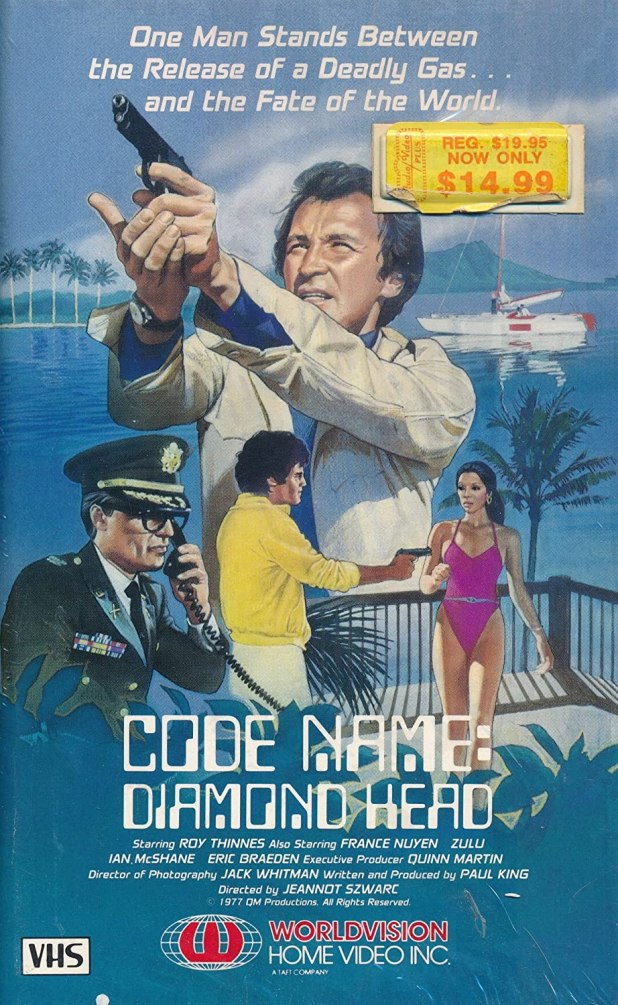
Quinn Martin (The Fugitive, The Streets of San Francisco, Barnaby Jones) produced this failed pilot, which stars Roy Thinnes (The Invaders, The Norliss Tapes) as Diamond Head, a secret agent who must stop double agent from stealing a chemical weapon.
He also goes by Johnny Paul, with his cover of being a gambler and ladies’ man living in Hawaii. The double agent, known only as Tree, ends up being Ian McShane.
France Nuyen (Alma from Battle for the Planet of the Apes) is in this, which is ironic, as she was also in the 1963 Charlton Heston movie Diamond Head. She’s joined by Zulu (Kono Kalakaua from Hawaii Five-O), Ward Costello (Bloody Birthday), Eric Braden (Victor from The Young and the Restless) and Eric Christmas (The Changeling).
It was directed by Jeannot Szwarc, whose strange resume saw him making all manner of movies from The Devil’s Daughter, Bug and Jaws 2 to Somewhere In Time, Supergirl and Santa Claus The Movie.
You can watch the Mystery Science Theater 3000 version of this movie on Amazon Prime and Tubi. It’s also on YouTube.
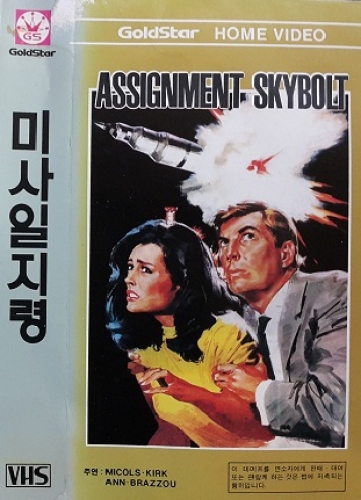
Welcome to the Greek James Bond. Written and directed by Gregg Tallas, who was also the man behind Espionage in Tangiers and the Cataclysmpart of Night Train to Terror.
Agent Dan Holland is in Greece looking for the hydrogen bomb stolen from a NATO base in Turkey. It turns out that they want to start a Third World War. And Dan’s brother Jack may be behind it all.
I really liked The Mermaid, the club in the movie. There’s even a dancer covered in balloons that need to be popped by the patrons. Well, get used to the bar. That’s where the majority of the film takes place.
This is one of the oldest films I’ve seen with an implied oral sex scene, much less priests being distracted by breasts and a sexually suggestive whipping scene. Ah, those wild Greeks…
This is a lot darker than most spy films of this era. But maybe you’ll enjoy that.
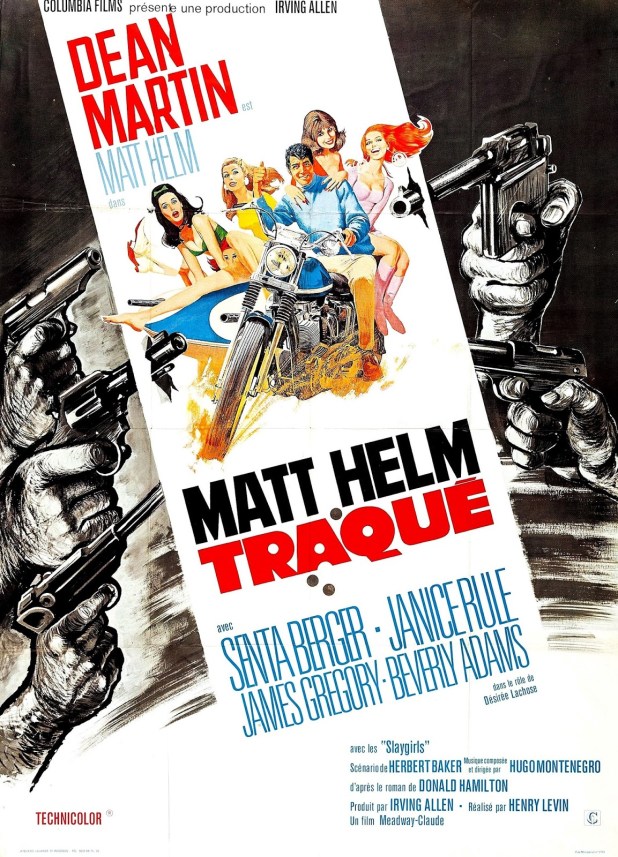
When a government-built flying saucer — yes, really — is hijacked by Jose Ortega (Albert Salmi, Inspector Sturgess from Superstition), Matt Helm (Dean Martin, who else?) must work with the ship’s former pilot Sheila Sommers (Janice Rule, The Swimmer) to recover it.
Originally known as The Devastators, this was the first Matt Helm movie I ever heard of, thanks to the Medved’s The Fifty Worst Films of All Time. I think by now we’ve all learned just how off those guys were about movies. When doing my research on this I also found a Judith Crist review that called it, “the nadir of witlessness, smirky sexiness and bad taste.” And Janice Rule said that she regretted appearing in this film, saying that it was the worst movie she was ever in.
You know that I loved this movie, right?
Matt Helm is sent to the ICE (Intelligence and Counter Espionage) Training Headquarters to uncover a traitor and meet the aforementioned Sheila Sommers, a test pilot who is the only person that can fly that stolen saucer. After all, its electo-magnetic power means that only a woman is able to fly it, because men are killed by all the energy it shoots off.
This was Beverly Adams’s final appearance as Matt’s secretary, Lovey Kravezit.
Look — this isn’t the best movie ever. But I love it. I love that Dean’s stumbling his way through it, singing and drinking and winking at the camera. It’s perfect for what I need to watch right now. I don’t care what TV Guide’s greatest critic Judith Crist has to say.
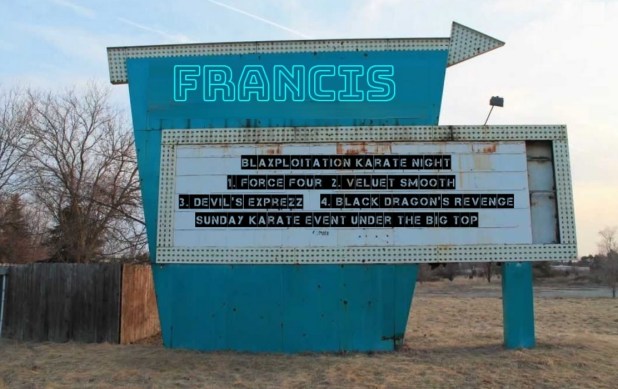
If I had a video store, there’d inevitably be a martial arts section. And that section would be next to the Blaxploitation section. And the shelf-transition between those two sections would feature a “Karate Blaxploitation” sub-genre shelf.
Sure, you’d find all the obvious films in there and you’d probably go looking for Black Belt Jones (shot by Kent Wakeford, who worked with Eric Roberts on Power 98; our debut review for “Radio Week” that ran March 15 to 21) or Black Samurai starring Jim Kelly of Enter the Dragon fame. You may even look for Kelly’s Three the Hard Way or Golden Needles.
Sorry. No Swap Shop this Sunday. All day Karate exhibition fights under the Big Top!
But we aren’t throwin’ back to the video ‘80s. This Friday feature is all about the Drive-Ins of the ‘70s. And we need to go deeper than a Jim Kelly theme night for our Friday’s “Karate Blaxploitation” night at B&S About Movies. (Be sure to check out our “Radio Week” review of 1972’s Melinda, which features plenty of karate courtesy of Jim Kelly.)
The two of the films on the schedule star a smooth ass-kicker by the name of Warhawk Tanzania. And after his work in Force Four and Devil’s Express, he vanished into the eastern red sunset. What happened to the man who was born Warren Hawkins? No one knows; is he dead or alive? But the last word was that he was a businessman in residing in Brooklyn, New Work. What we do know is that Tanzania was a practitioner of the “Nisei Goju-Ryu” karate method, a martial art form developed by Hanshi Frank Ruiz, who served as the fight director on both of Tanzania’s films—and one more, as you’ll soon see.
And don’t forget: Junior’s always hungry, so stop by the snack bar.
The tale is a simple one: A jive-cool New York crime lord’s prized African artifact—a mystical voodoo doll—is stolen. And he wants it back. So he hires an all-black squad of martial artists to retrieve it at all costs, because, well, “it can’t fall into the wrong hands.”
The awfulness of this kung-fu battle begins with acting by graduates of the Ed Wood Thespian Academy, and goes downhill from there . . . with inept fight chorography, out-of-sync dubbing, and sound effects more ludicrous than all of the “punches” and “blows” in all Asian Kung-fu flicks combined. Basically, all the things you want in a Drive-In Kung fu marathon. Is this just inept or a homage to the films from the Orient? You decide.
Also known as Black Force, this big screen debut of Tanzania also served as the second and final movie of director Michael Fink, who made his debut with Velvet Smooth. And in a twist only a B&S About Movies reader can appreciate: Fink went on to become an acclaimed visual effects supervisor, choreographing the fight scenes in Stallone’s Tango & Cash and Mel Gibson’s Golden Globe and Oscar-winning Braveheart.
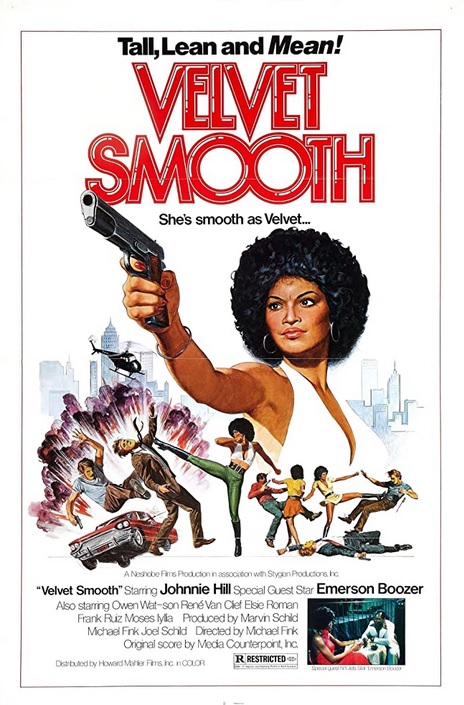
First, there was the black Kung fu fightin’ babes you know and love: Pam Grier (Jackie Brown) in Coffy, Foxy Brown, and Friday Foster, and Tamara Jones in Cleopatra Jones. But not too many remember Johnnie Hill in her one and only film as Velvet Smooth.
‘Ol Vel is a detective-for-hire contracted by another inner city crime lord, the arrogantly named King Lathrop, who wants to know who’s muscling-in on his turf. Of course, King double crosses Vel, so she brings on the whoop-ass. What did you think was going to happen?
This debut feature by Michael Fink is the second installment of the unofficial “Nisei Goju-Ryu” karate trilogy, since all three films utilize the martial arts form developed by Hanshi Frank Ruiz.
You can watch Velvet Smooth on Daily Motion HERE and HERE or on You Tube.
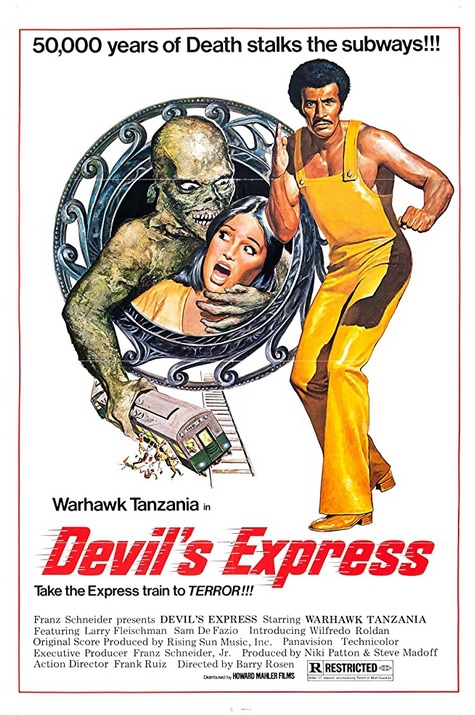
Warhawk Tanzania is back for the final film in the “Nisei Goju-Ryu” trilogy that made the VHS ‘80s rounds as Gang Wars. He’s Luke, a New York martial arts sensei who takes Rodan, his ne’er-do-well, drug-dealing student to China to complete his training. And while exploring an ancient cave, Rodan finds an amulet. And he takes it home. And the demon guardian of the amulet comes to New York retrieve the trinket. And only Tanzania can stop the . . . well, you thought the xenomorphs in the Alien knock-offs of the ’80s were inept. . . .
While director Barry Rosen finished his directing career with his second and final film, the bouncing teen-driven T&A flick The Yum Yum Girls (1976), he went onto produce the highly rated UHF-TV ‘90s syndicated series Highlander and Zorro. (We explore some of those T&A Drive-In flicks with our review of Crown International Pictures’ Van Nuys Blvd.)
You can watch Devil’s Express for free on You Tube. Damn right it so good we reviewed it twice!
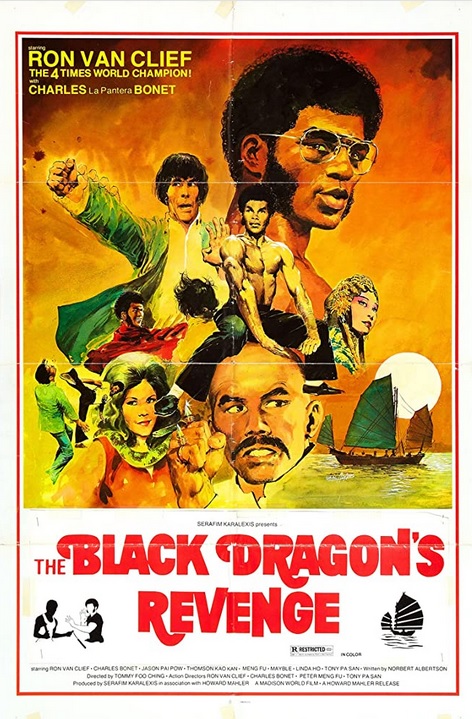
Movie 4: The Black Dragon’s Revenge (1975)
Martial arts legend Ron van Clief received top billing in his fourth film, a tale about three rival karate street gangs (is there any other kind in New York) searching for a lost “finger fighting” manual written by the master himself: the late Bruce Lee. Does Ron sport a fro and sideburns that makes Jim Kelly jealous? You bet!
Unknown in the United States, outside of the most discriminating martial arts connoisseur, director Chun-Ku Lu is a respected, major star in China and the Pacific Rim territories with 80-odd credits as a writer, actor, and director. After retiring from the business in the late ‘90s, he’s back with a new film as a director: 2018’s This Life, I am a flower pot.
And Ron “The Black Dragon” van Clief is still going strong at the age of 77 and is currently filming Snow Black. His most recently released film was 2018’s retro-romp, Hot Lead Hot Fury (trailer; You Tube).
Do Sam and I need to write and direct a Kung fu blowout starring the 91-year old Leo Fong, who currently working on Pact of Vengenance, and Ron van Clief? If only we had the money and the connections . . . if only.
We finally got around to one of our Karate Exploitation favorites with Dynamite Brothers (1974) — brought to us by the production team of Al Adamson and producer Cirio H. Santiago. Yeah, we just blew our nut! Uncle Al and Uncle Cy, in one movie? Oh, hell yes and a bag ‘o chips and a supersized Dr. Pepper!
About the Author: You can read the music and film reviews of R.D Francis on Medium and learn more about his work on Facebook.
“Algorithm and reality may not end up coinciding.” — Eva
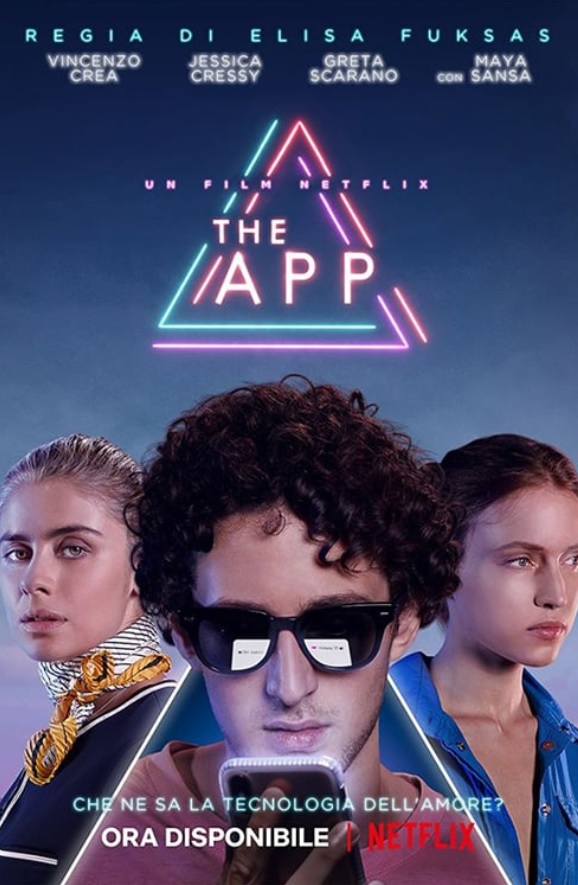
The App is a relevant-for-the-times techno-noir about loneliness and alienation brought on by one’s addiction to social media. It’s a tale about not trusting another’s digital identity; a philosophical exploration that makes us aware that, regardless of how much one achieves in life, they’ll always be riddled with self-loathing, never finding true happiness in their moments; for man is a creature always pining for something more, something different.
And that “more” comes in the form of the mysterious Maria, a digital femme fatale who takes over young Nick’s life.
Nick Melfi (Vincenzo Crea) is “Italy’s most famous heir” and an up-and-coming Hollywood actor (think actor-oil scion Armie Hammer or actress-sport scion Kate Mara) who defies his father’s wishes to be part of the family’s industrial empire alongside his brother and sister. His father even goes as far as to send the company’s attorney to Rome whilst Nick prepares for his first leading man role.
To fill his loneliness while away on location, and to help his girlfriend, Eva (Jessica Cressy), with her college thesis, Nick agrees to help her test a new dating app. “US, is the future of self,” she tells Nick. “It’s for people already in relationships, but curious.” And they each sign up under the aliases of “Lorenzo” and “Sara.” And you know what they say about “adventure. . . .”
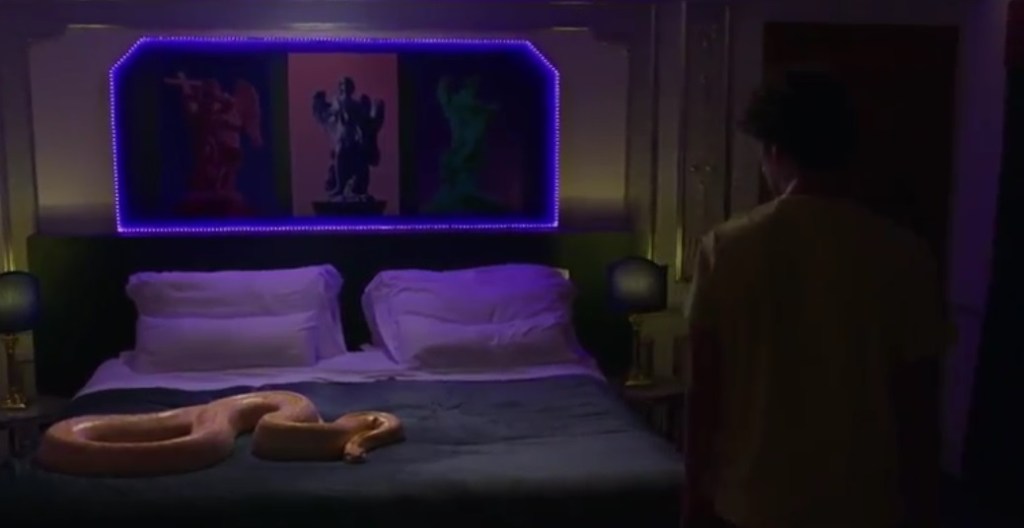
Keep in mind that Nick is portraying Jesus Christ in an Italian production The Life of Jesus (directed by the acting-cameo Abel Ferrara as Paolo; yes, he of the U.K. Section 1 video nasty Driller Killer), and that Eva is Nick’s “Eve,” the phone app is the “apple,” Maria is the “serpent,” and Ofelia, the attractive, Catholic-practicing hotel concierge (Greta Scarano), is “Mary Magdalene.” And that, as Eva reminds Nick, “. . . a lot of actors have gone a little mad playing Jesus.” So Nick has ventured into the isolated, digital wilderness of the New Testament’s parable of the “Temptation of Christ.”
Will Nick experience a reboot-resurrection and be upgraded-reborn in spirit?
As the unconventional narrative of The App streamed (ironically) on my laptop, I was reminded of Italian filmmaker Michelangelo Antonioni’s L’Avventura (1960), La Notte (1961), and L’Eclisse (1962), his trilogy-statement regarding the alienation of man in the modern world; each dealt with the failure of the self and their relationships—his first color film, Il deserto rosso (1964), in particular. As with that film’s Giuliana, writer-director Elisa Fuksas’s Nick desires to end his spiritual conflicts (with his father), and while Giuliana resists her “lover” Corrado’s advances, Nick also resists, then accepts, Maria’s advances. And while Fuksas’s Maria is a cloud-based entity, Nick still makes “love” to her. For, as Antonioni said in the past, “When sexuality fails as a means of communication and provides only physical relief, then Eros is sick.”
And Antonioni was right.
Why do we, as humans, eschew physical contact for technical contact? Why will we stare for hours on end into plasma, but not into the eyes and hearts of the other? Why does one gratify the self by the “idea” of another self—a fantasy? It was Antonioni’s belief that man’s technological development did not cause his alienation, but his failure to adapt to his changing environs caused his neuroses. And here we are today, with man’s current state of illness: an illness caused by our multi-media environs. The new and most dangerous “pandemic” we face isn’t an organic disease, but an inorganic sickness. And the inorganic sickness exacerbates our (current) organic pandemic through rumor and falsehoods. For Antonioni was right: “. . . it is the men who don’t function properly—not the machines.”
Considering writer-director Elisa Fuksas’s father, Massimiliano, is an award-winning Italian architect who oversees the Euro-renown Studio Fuksas with his wife, it seems there’s a biographical element in Elisa’s work: she eschewed the family business for filmmaking. And while Antonioni’s incorporation of modern landscapes in his works shines in Fuksas’s, there’s no doubt her work serves as homage to her father and mother’s architectural influences. Her visually pleasing, mood-driven plotting in The App can be best described as a 21st century meeting of the Baroque/Rococo-infused fantasies of Federico Fellini, the sweeping color palates of Dario Argento, and the neo-noir storytelling of Abel Ferrera (look over Ferrera’s ever-evolving resume; he’s come a long way since Ms. 45).
Elisa Fuksas made her feature film debut in 2013 with the multiple-nominated and award-winning drama, Nina. Based on The App, it’s a film that I’ll seek out as I look forward to her future works. You can watch The App on Netflix in Italian with English subtitles or dubbed into English (the dub is well done).
Disclaimer: We didn’t receive a screener copy of The App from the film’s PA firm or distributor. We discovered this movie all on our own and genuinely loved the film.
About the Author: You can read the music and film reviews of R.D Francis on Medium and learn more about his work on Facebook.He also writes for B&S About Movies.
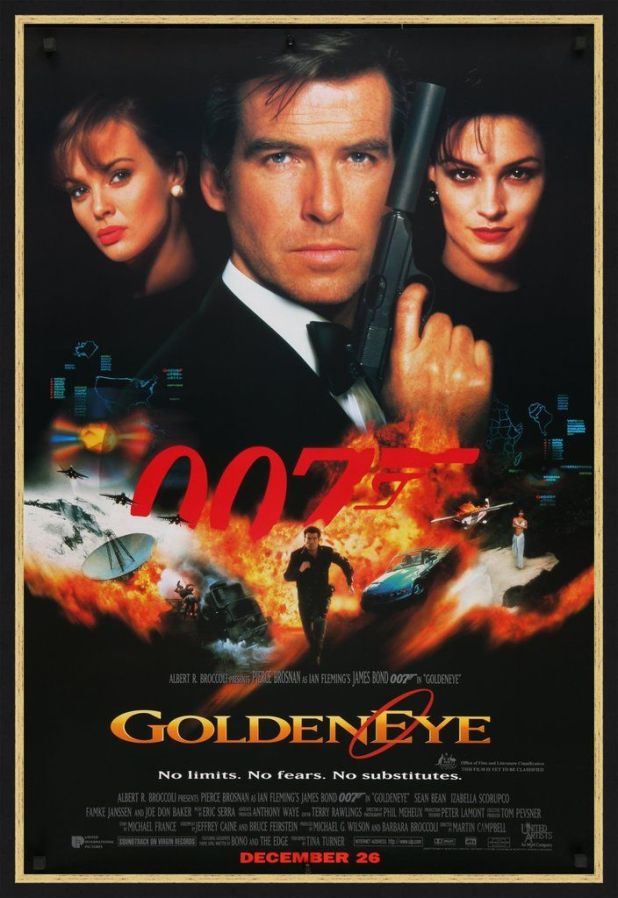
After Licence to Kill was released, pre-production work for the seventeenth James Bond film — the third to star Timothy Dalton — began. There was even a poster shown at Cannes. But soon, producer Albert R. Broccoli would stop working with long-time writer Richard Maibaum and director John Glen.
Metro-Goldwyn-Mayer, the owners of the series’ distributor United Artists, and Broccoli’s Danjaq, owners of the Bond film rights, then fell apart. MGM/UA was sold to Pathé Entertainment, who attempted to sell off the broadcast rights to the studio’s films to pay for the buy out. The problem was that they were selling them for firesale prices and were denying Danjaq any of the profits.
By the time the legal issues were settled, six years had passed. While Dalton was still Broccoli’s choice to play Bond, the star’s original three-movie, seven-year contract expired in 1993. That means that Pierce Brosnan could finally be Bond.
John Woo was originally selected to direct, but Martin Campbell — who directed two Zorro films, two Bond films and, perhaps not so successfully, the Green Lantern movie — finally took over.
This is the first Bond film to be made after the fall of Communism. One of the movie’s big changes was to cast Judi Dench as the new female M, who refers to Bond as a “sexist, misogynist dinosaur” and a “relic of the Cold War.” The fall of Russian is also shown in the opening titles, which upset plenty of people in those countries to see the symbols of their past decimated by girls in bikinis.
GoldenEye begins with James Bond and Alec Trevelyan (Sean Bean) infiltrating a chemical weapons facility in Russia. Trevelyan is caught and presumably killed by Colonel Ourumov. While Bond manages to destroy the site before escaping, the truth is that Trevelyan and Ourumov come together to create the Janus crime syndicate.
Famke Janssen makes for a great henchwoman as Xenia Onatopp, a fighter pilot and killer who loves to crush men between her thighs. She’s awesome in this and even did all of her own driving stunts. There are also great turns by Joe Don Baker, Robbie Coltrane and Alan Cumming.
So what is GoldenEye, other than Ian Fleming’s estate? It’s a satellite that the Russians are using to destroy targets with a nuclear electromagnetic pulse.
Perhaps more people in the U.S. know this movie as the inspiration for the Nintendo 64 game, which was a huge multiplayer game.
This is a film of many firsts and lasts. The first Bond film to use CGI. The first to switch the roles of Moneypenny, M and Bond all in the same film. And the last that Albert Broccoli would live to see. Luckily, with Brosnan, the series was in stable hands.
Susanna Fogel wrote and directed this film. She also was the writer of Booksmart, which is a movie I recommend you check out.
It’s all about Audrey Stockman (Mila Kunis), who is dumped by her boyfriend Drew (Justin Theroux) via text. Her best friend Morgan (Kate McKinnon) convinces her to burn all of his stuff, but she soon learns that he was a spy. Now, she’s thrust into the world of espionage.
This is a fun movie, filled with everything I love from spy movies. I really liked Ivanna Sakhno, who played Nadejda, a gymnastic hitwoman. There’s a great fight between her and McKinnon that was a blast.
There are also some great cameos, like Gillian Anderson as the spy boss Wendy and McKinnon’s parents, played by Jane Curtin and Paul Reiser. Working in Edward Snowden was also pretty fun, too.
You can watch this on Amazon Prime, where it offers a bubbly and goofy break to the hardcore spy action that we’ve been watching this month.







 B&S About Movies
You must be logged in to post a comment.