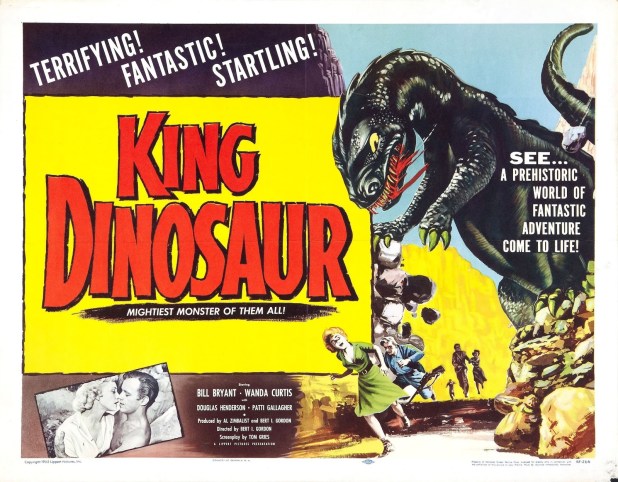
This shot-in-one-week effort was Bert I. Gordon’s first solo movie as a writer-director (he co-directed the previous year’s Serpent Island, which he wrote), made with borrowed equipment and the cast of four all working on deferred salaries. The rest of the footage is all stock, including a mammoth taken from One Million B.C. And it takes 10 minutes — of educational space exploration stock footage and narration — before the first actor steps foot on the newly discovered planet.
It takes place five years in the future, which would be sixty years in our past.
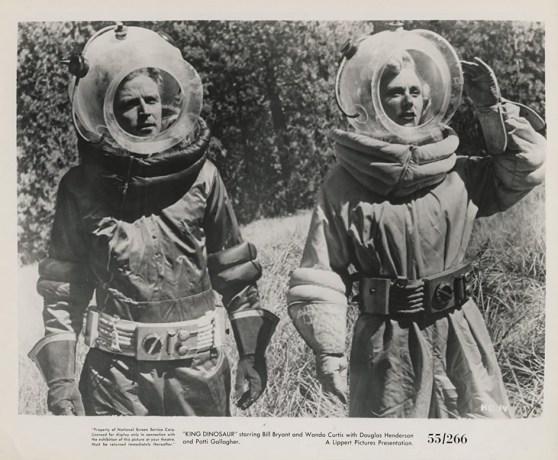
Zoologist Dr. Richard Gordon, geologist Dr. Nora Pierce, medical specialist Dr. Ralph Martin, and chemist Dr. Patrica Bennett (while the men wear baggy flight suits and military-issue boots, the gals wear sensible gauchos and knee-high boots) are on a space voyage to the planet Nova in the hopes of starting a new Earth colony. It’s filled with animals (bears, elk) that are way bigger than they should be — remember that Burt I. Gordon directed this one — including King Dinosaur, which is really an iguana. So the scientists do what any good researcher should: they nuke the processed-shot and floating-matte planet, and leave.
Is there a deeper message about Manifest Destiny and American Imperialism in the frames? Is this a plight of the American Indian allegory? Nope. Burt just likes big creatures on film and blowing up stuff: for this is a world where, regardless of the intelligence of smartly-dressed women (clad in ballet flats and wedged mules with their tailored flight wears) conquering space — just like in The Angry Red Planet and Gog — they’re still screaming and imploring the men to “do something” and to shoot everything they survey.
The funny thing about this movie is that Ray Harryhausen and Ray Bradbury wanted to provide the dinosaur effects, so they brought in some footage. Gordon watched it, didn’t acknowledge them and just walked out. Harryhausen and Bradbury were obviously upset, but a few years later, at the premiere, Bradbury allegedly approached Gordon and said, “Remember me? Ray Bradbury. It won’t make a dime!”
If you wonder, “Have I heard this music before?” then you’ve probably seen Ed Wood’s The Violent Years. Actually, you should just watch that movie. It’s way better than this. Even at its short running time at a measly 63 minutes — 43 if you cut out the opening stock-narration salvo. And if you recognized the narrator, that’s Marvin Miller, who was the voice of Robby The Robot in Forbidden Planet and was Mr. Proteus on Commander Buzz Corey and the Space Patrol. And if you recognize the rocketing landing from King Dinosaur, that’s because it ended up in Fire Maidens from Outer Space.
You can watch the Mystery Science Theater 3000 version of this movie on Amazon Prime and Tubi. It’s also available without the commentary on Daily Motion.
ABOUT THE AUTHOR: An American living in London, Jennifer Upton is a freelance writer for International publishers Story Terrace and others. In addition, she has a blog where she frequently writes about horror and sci-fi called Womanycom.
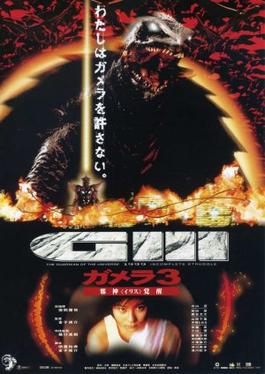
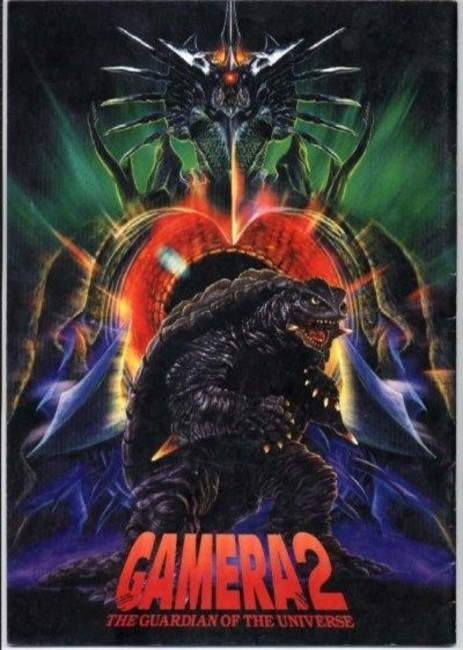
In the mid-1990s, Japan’s Daiei (later Kadokawa) films resurrected their 1960s competitor to Toho’s Godzilla series, Gamera. A giant flying turtle-like creature nicknamed “the friend to all children.” 1995’s Gamera: Guardian of the Universe was a considerably more adult film than its predecessors and was a hit with adults and youngsters alike, prompting the sequels Gamera: The Advent of Legion in 1996 and Gamera 3: The Awakening of Iris in 1999 – all written and directed by the very talented Shusuke Kaneko.The first two films in the trilogy are very good. This movie is great.It’s not just a monster movie, it’s an art picture. It’s the Kaiju film that set a new standard in Japanese production for the genre, by which all others that came after we would measure it.
In the first two installments of the trilogy, Gamera derives his strength through his psychic link with a young teenage girl named Asagi played by Ayako Fujitani and fights off other invading monsters – including the giant bird-like reptilian Gyaos who preys on people like mice – not just a friend to children but as an ancient guardian of humanity. In this third installment, Gamera is a much darker deity. The people of Japan are sick of dealing with the destruction and unintended casualties from all our hero’s battles. Our new heroine, 13-year-old Ayana (Ai Maeda) holds him personally responsible for the accidental death of her family (including her beloved cat Iris) three years earlier, during a fight with Gyaos. Rather than see him as a saviour, she wants him dead. When she finds a large mysterious egg in a cave, she nurtures the ancient being and names it Iris. The theme of blossoming feminine maturity emerging in parallel with supernatural abilities is overt. As Asagi did in the first two films with Gamera, Ayana – a dark and brooding girl on the brink of womanhood – psychically bonds with the new entity who absorbs her malice for Gamera fully. The monsterIris grows into maturity simultaneously with Ayana and when she enters adolescence, attacks Gamera viciously.
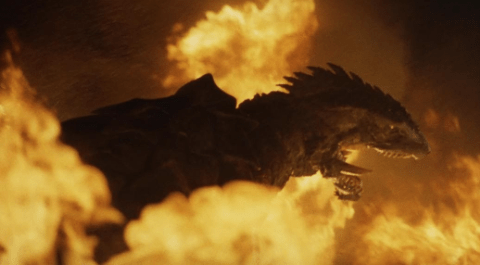
At the film’s climax, physically absorbs Ayana’s entire body in a marvelous sequence of soft dissolves. The soundtrack cuts a single heartbeat as Ayana rests in the fetal position inside Iris in an amniotic-like fluid. The amazingly hypnotic scene that concludes with the mortally wounded Gamera rising to rescue her by ripping into Iris’s womb. He gets his right arm blown off in the process, proving once and for all to Ayana that he is the benevolent kaiju we’ve all come to know and love. Seeing the error of her ways, Ayana thanks Gammy in a quiet moment as emotionally effective as any interactions Fay Wray had with King Kong. Just then, a massive flock of Gyaos approaches the city. His strength depleted, our weary hero marches off to fight for mankind – probably for the last time. Fortunately for us, Gamera isn’t the first or last of his kind as evidenced by the ancient Gamera skeleton graveyard found at the bottom of the sea at the start of the film. He is one is a long line of guardian deities. Sadly, this would be the final time Kaneko would helm a Gamera movie but he explored the ideas of kaiju as Japan’s “old ones” further in 2001 with Godzilla, Mothra, King Ghidorah: Daikaijû soukougeki, which was also very good.
Gamera 3 uses both the tried-and-true Suitmation/miniature model methods of classic Kaiju special effects in combination with ‘90s CGI to admirable results. Although few and far between, every action sequence is thrilling. No matter. The plot and characters are interesting. The film’s only deficiency lies in an underdeveloped sub-plot involving a mystical doomsday cult that worships Iris and attempts unsuccessfully to take control of her from Ayana.
When the credits to this film rolled at the American premiere at the Egyptian Theatre in Los Angeles in 1999, the audience awarded Kaneko-san with a 5-minute standing ovation. When the lights came up, he stood up a few rows in front of me, turned toward the audience and bowed, his face filled with emotion. Many people think Japanese giant monster movies are silly. If any film can change that viewpoint, it’s this one.
Gamera 2: Legion sees Gamera once again defending the planet against an attack, this time from outer space. There is a meteor shower over Japan. The investigating of the giant meteor crash site, however, reveals no meteor! It turns out the meteor was a bunch of evil alien insectoid creatures, who have come to take over the planet. They attack a warehouse full of beer and steal the bottles, they burrow under the subway as well and cause a ton of mayhem, they even plant a strange flower pod that will launch seeds carrying the creatures from city to city.
Gamera attempts to stop these creatures destroying the flower pod that has taken over the city but is swarmed and taken down by the insectoids. Because there are so many of these creatures swarming, a soldier quotes the book of Mark, specifically the part where Jesus encounters the demon who calls itself Legion. From then on the creatures are referred to as such. Gamera eventually revives and defeats the giant Queen of Legion.
There are parts of this movie that make it feel more like a horror film than a typical kaiju film, especially the subway attack scenes, which were bloodier than I expected, when one of the legion bugs kills a subway engineer, the engineer’s body splatters against the glass. The legion insectoids even look horrifying. When the bugs attack the film takes a pretty dark turn. I had a lot of fun with this movie, maybe even more than it’s predecessor. The only thing I didn’t totally love about this movie was the end theme song.
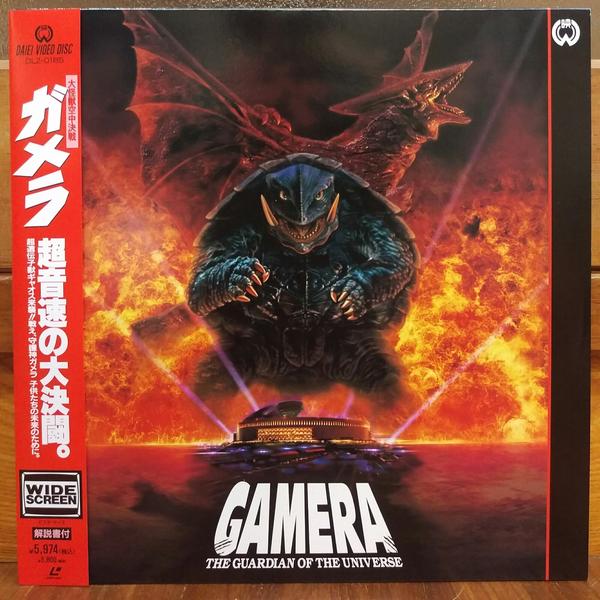
I am not an expert on Kaiju films. I dabbled very briefly with some of the Godzilla films years back but I never dove into it to the extent that some people have. I do enjoy them when I do see them and when Sam mentioned he was doing a mini Gamera marathon, I thought it was a good of a time as any to break out my Millcreek Entertainment set of the films. I was assigned Gamera: Guardian of the Universe from 1995.
I’ve never watched a single Gamera film so I really lucked out on getting this film as it is basically a reboot of the franchise. It is about the discovery of Gamera, who keeps floating into the way of ships, and ancient evil genetically engineered carnivorous birds that have been attacking people.
The film opens with a couple of ships on their way back to Japan that come across a mysterious moving atoll that almost tears a ship carrying plutonium right open. An investigation team is set up and they climb aboard the atoll where they find odd otherworldly metal comma shaped pieces and a very old looking plank with strange runes that read, “We commit to the cradle of time the Last Hope, Gamera. May he awaken with the Shadow of Evil, Gyaos.”There also was a team sent to the island to investigate the bird attacks. They are ordered to capture the birds and they do so using flash photography, tranquilizer guns, and a baseball stadium with a retractable dome. Unfortunately one of the birds escape but a giant tortoise arises from the sea and batters the escaped bird.
Everyone is straight freaking out about the tortoise thing because it is going to be a bigger threat than the birds. They’re a bunch of dummies though because it turns out that inscription is about that tortoise Gamera who is there to protect the world against the birds Gyaos. Along the way a young girl is gifted one of the strange metal pieces and becomes psychically linked to Gamera. Gamera’s injuries even appear on the young girl’s body!
There is a lot to digest in this film. It is well-paced which I’ve noticed isn’t always kaiju movies’ strong points, and apart from some early CGI looks beautiful. In fact even with that early CGI I feel like it stands the test of time. The monster mayhem is top form stuff, with some physical fights and elemental blast effects. Gamera’s fireball breath and Gyaos’s steel melting bad breath are really neat. Gamera even has rocket boosters in its appendages! The icing on top of the cake that is Gamera: Guardian of the Universe though is its end theme, Myth performed by Bakufu Slump. A rocking little song that I would have definitely blasted loud in my Toyota Camry back in college had I discovered this movie then. I am looking forward to also watching the sequel to this film, Gamera 2: Attack of Legion. If you don’t feel like going all the way back to 1967 to get a fix of Gamera, this is the best starting point and you can work backwards or forwards from here.
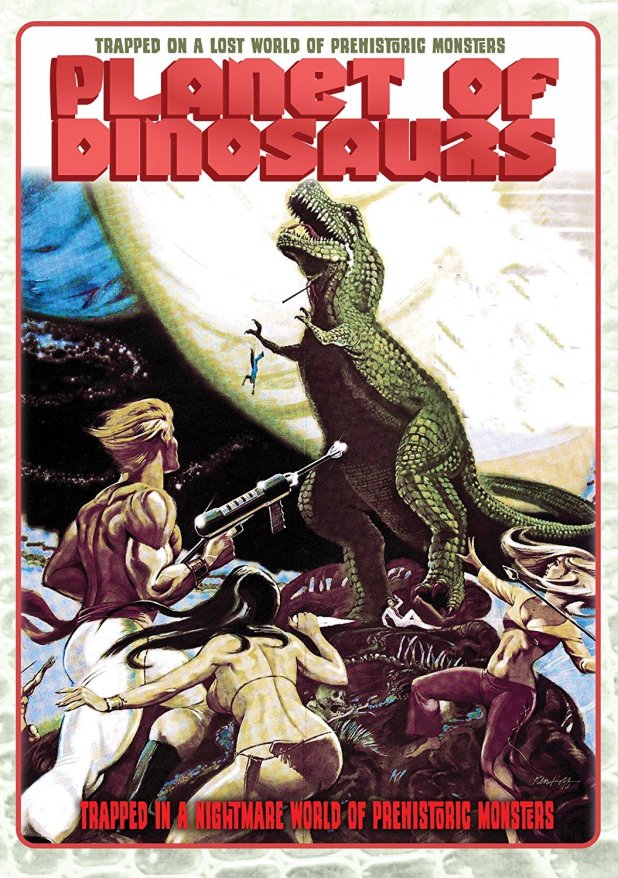
Most of the budget of this movie went toward special effects, with stop motion dinosaurs that pay homage to the work of Ray Harryhausen. Hardly any of the budget went to the actors or the props, including the Kool-Aid that was used for the film’s berry juice. That said — the locations look great. The Vasquez Rocks area of California’s desert have been used in several other films and TV shows. You’ll recognize them mostly from Star Trek and as a result, the primary rock formation has been named Kirk’s Rock.
The spaceship Odyssey crashes on a planet that seems much like Earth but is many light years away. Within moments, the ship has sunk, the communications offer has been eaten by an undersea dinosaur and the radio is gone. Captain Lee Norsythe (Louie Lawless, who under the pseudonym Leo Rivers was the cinematographer and associate producer of the 1973 documentary Manson; of note is that due to his thick Canadian accent, director James K. Shea dubbed all of his dialogue, which is mixed much higher than anyone else’s) is in charge, but the remaining crew soon realize that they’re up against some pretty tough odds.
Then one of them drops the laser gun in the swamp.
Then one of them drops all their food off a mountain.
Then one of them tries to steal dinosaur eggs.
Then they all fight about whether or not they should establish a new civilization instead of doing something about it.
Yes, welcome to a movie with heroes so idiotic that you’ll boo when they finally kill the Tyrannosaurus Rex and win the day.
The only actors other than Lawless that had any previous experience were Max Thayer, who played Mike and his previous experience was Ilsa, Harem Keeper of the Oil Sheiks; James Whitworth, who was Jim, was in The Hills Have Eyes as Jupiter, The Candy Snatchers and Bury Me an Angel; and Harvey Shain had been in some softcore movies like 2069 A.D., Office Love-In and The Secret Sex Lives of Romeo and Juliet under the name Forman Shane.
Derna Wylde, who played Derna Lee, the crew member who dumped the laser blaster, went on to be a researcher on Chained Heat. Charlotte Speer, who was smart enough to discover what plants were poisonous, was in one other film, the 1985 slasher oddity Appointment with Fear. And Pamela Bottaro, who was Nyla, who lost all of the food, shows up in Al Adamson’s Death Dimension, which has Jim Kelly, Harold Sakata, George Lazenby, Terry Moore from Mighty Joe Young and Aldo Ray. That movie, I gotta see!
Here’s another weird fact. Writer Ralph Lucas also was behind the screenplay of The Child! And James Aupperle, who co-wrote the story, also wrote Flesh Gordon and would go on to be the lighting technical director for the Twilight films, as well as the digital effects artist for the first Hellboy movie and various effects work for The Gate II: The Trespassers, RoboCop2 and many more movies.
The best actor in this movie? The Rhedosaurus, which was The Beast from 20,000 Fathoms. Harryhausen himself visited the studio and gave his consent for his creature’s cameo appearance.
You can watch this on Amazon Prime. It’s also available with commentary by Rifftrax on Amazon Prime and Tubi. How much do we love this movie? We also reviewed it back December 2019 as part of our “Ape Week.”
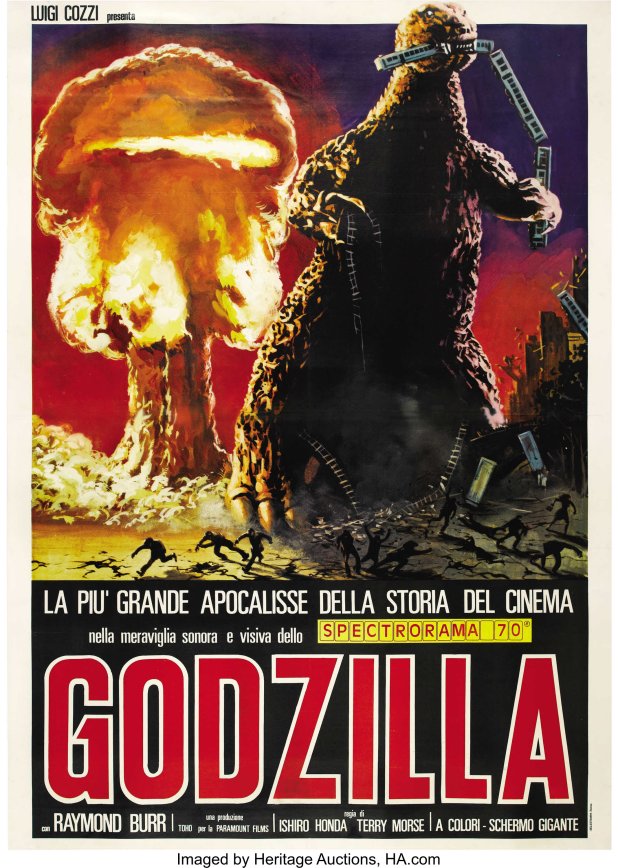
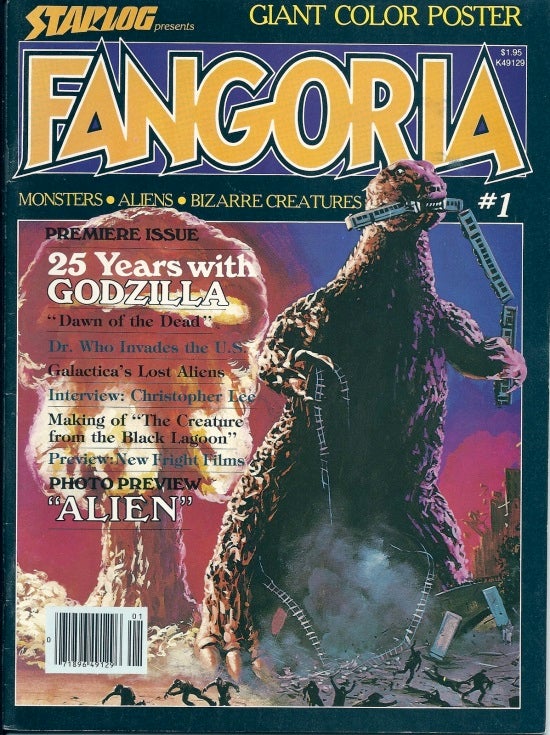
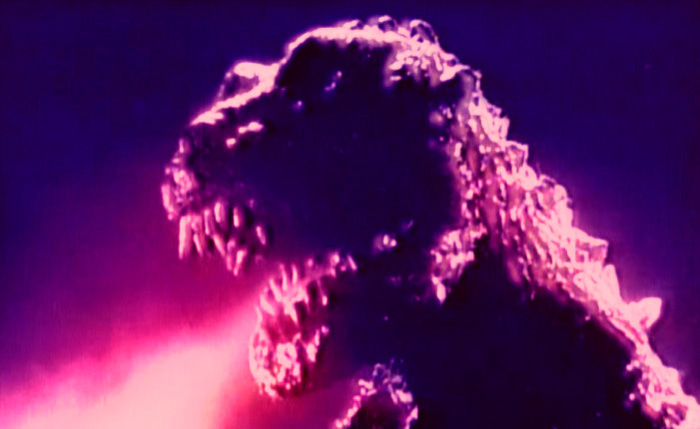
All the way back in 1979, the first issue of Fangoria came out with a psychedelic cover of Godzilla. I always wondered where this image came from and now I know — the strange and alluring 1977 Luigi Cozzi led version of the original film.
Yes, Italian filmmaker Luigi Cozzi (Starcrash, Contamination, Paganini Horror) created this colorized version of the original Godzilla, complete with a soundtrack that used a magnetic tape process similar to Sensurround.
Due to the success of the 1976 remake of King Kong, Cozzi attempted to cash in on the film’s success by re-releasing Gorgo, but it costs too much. Toho gave him a good price, but were only able to provide negatives for the 1956 American version of the film. Cozzi’s distributors refused to release the film, after discovering it in black-and-white.
At this point, Cozzi got the approval from Toho to colorize the film, provided they get the new negative when he was done. He had final approval over the stock footage, music, and choice of coloring.
To pad the film’s running time to 90 minutes, Cozzi added stock footage, saying “The decision to insert extra footage was because the original picture was 1 hour and 20 minutes. This was normal length in the fifties but in the mid seventies a picture to be shown theatrically had to be at least 1 hour and 30 minutes long. So we were forced to add material to it in order to reach that length. Its final length was 1 hour and 45 minutes.”
Cozzi wanted to give an old film an “up-to-date and more violent look,” so the director added real footage of death and destruction from war-time and Hiroshima stock footage, as well as scenes from The Train, The Day the Earth Caught Fire, The Beast from 20,000 Fathoms and Godzilla Raids Again.
To make the movie even bigger, Cozzi added Sensurround effects that would be blasted from giant loudspeakers specially placed in each theater. Composer Vince Tempera wrote the film’s additional score on electric piano, with synth music being used to give the film a more modern feel.
Image from SciFi Japan
Then, the film was colorized by Armando Valcauda frame-by-frame using stop motion gel photography, a process that took three months. The effect isn’t really seeing the movie in color, as later colorization efforts would accomplish, but pretty much providing a tripped out version of the film that is constantly being splashed with neon colors.
So what was Spectrorama ’70? Cozzi told SciFi Japan, “Spectrorama 70” is just a name I did invent to help advertising. It refers to colorization but also gives a feeling of 70mm which at that time was typical of every big budget Hollywood blockbuster. This invented name, in the style of William Castle, helped to give a “bigger” look at my Godzilla theatrical re-release advertising materials.”
This is one of the hardest kaiju films to find and one that’s probably one of the weirdest and most interesting. There’s really nothing like this movie and you can say that about just about every film that Cozzi created.
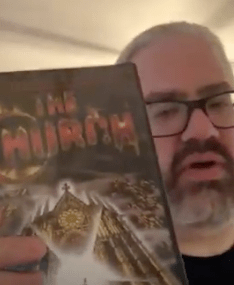
I figured since we’re staying in, you can come into our home to check out our DVD collection with us. I’ve had a few people ask to see our collection, so here to go. Want to see more? Just ask!
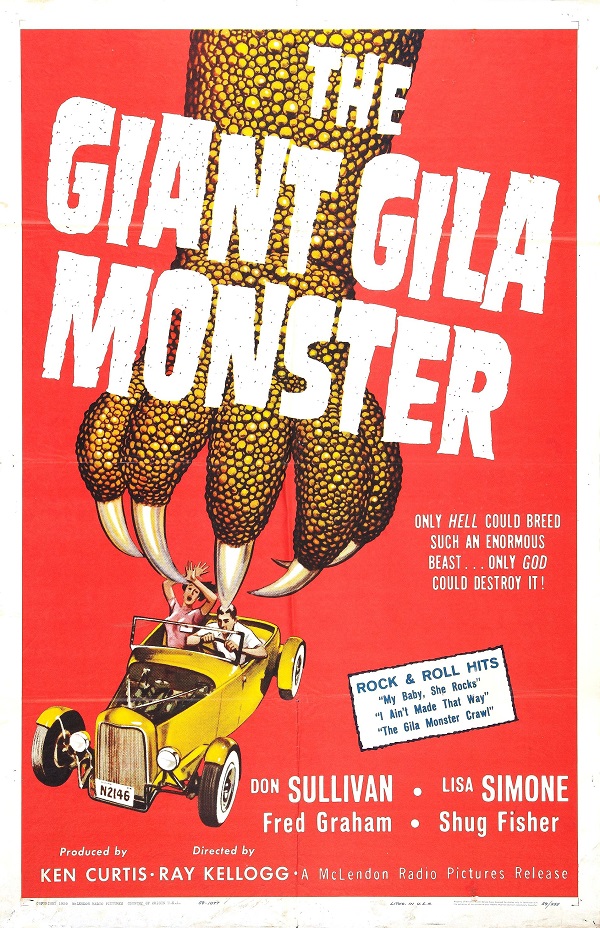
Filmed near Dallas, Texas, this movie was produced by Dallas drive-in theater chain owner Gordon McLendon who wanted his own movies. This was shot back-to-back with The Killer Shrews. Unlike most regional drive-in films, both received national and even foreign distribution.
This movie is also a lie. That’s no Gila Monster. It’s a Mexican Beaded Lizard.
A young couple are pre-arrdvarking as they overlook a ravine when the giant Gila Monster appears and murders them. The rest of the movie is spent with their friends alternatively looking for them and running from the lizard.
If you ever wanted to see a small lizard play with a model train set and then bother some teens as a sock hop, then this is the movie for you.
Luckily, Chase Winstead is on hand, ready to drive nitro-filled hot rod dead center into the monster, blowing it, as they say, up real good.
Ray Kellogg, in addition to the previously mentioned The Killer Shrews, also co-directed The Green Berets. He got to direct this movie in exchange for creating the special effects. It was produced by Ken Curtis, who played Festus on Gunsmoke.
This movie features Don Sullivan (The Monster of Piedras Blancas), French Miss Universe 1957 contestant Lisa Simone (she’s also a Moon Girl in Missile to the Moon), former Sons of the Pioneers member Shug Fisher, Fred Graham (who falls to his death at the beginning of Vertigo) and local disc jockey Ken Knox, who helped pick the music for the movie.
You can watch this on Amazon Prime or download it from the Internet Archive. There’s also a colorized version on Tubi. You can also watch the Mystery Science Theater 3000 version on Amazon Prime and Tubi.
And the theme weeks at B&S About Movies collide once again—with our review of the currently in pre-production of Karn Evil 9 for our “Radio Week,” and Sam’s insatiable appetite for all strange beasts from beyond the lands of the rising sun.
Welcome to “Kaiju Week.”
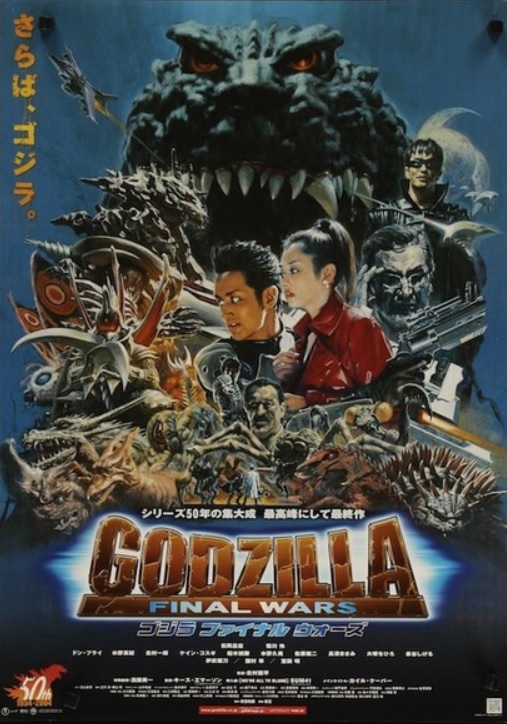
Keith Emerson’s full soundtrack to Godzilla: Final Wars!
Huh? What, pray tell, does the 29th film in the Godzilla franchise and the sixth and final film in the franchise’s Millennium period, as well as the 28th Godzilla film produced by Toho Studios overall, have to do with Emerson, Lake and Palmer’s fifth album, 1973’s Brain Salad Surgery?
Please, don’t say “who” when I say, “Keith Emerson,” ye youthful movie and music fan.
As result of today’s classic rock FM radio eliminating the ELP catalog from their playlists (come on, even “Lucky Man”?), all you horror hounds most likely know Emerson through his Italian giallo soundtrack work for Dario Argento’s Inferno (1980), Lucio Fulci’s Murder Rock (1984), and Michele Soavi’s The Church (1989). In addition to Sylvester Stallone’s Nighthawks (1981), Emerson also composed the soundtrack for Toho Studios’ Godzilla: Final Wars (2004)—which serves as his final work as a film composer.
And that musician analogy continues as director Ryuhei Kitamura (Clive Barker’s 2008 TheMidnight Meat Train starring Bradley Cooper; 2012’s No One Lives) compares his contribution to the Godzilla cycle to that of a musician’s “best of” album; Kitamura picked what he felt were the best elements from the past Godzilla movies that he loved. He chose that approach as result of his being unsatisfied with the Godzilla films of the ’80s, ’90s and 2000s and he wanted to bring back the messages and themes of the times those films reflected in their plots.
And “greatest hits” he gave us . . . and then some!
In addition to the big guy, Kitamura brought back Angurius, Ebriah, Gigan, Hedorah, Kamacuras, King Ceasar, Kumonga, Manda, Minilla, Monster X/Keizer Ghidorah, and Mothra—along with a slew of others monsters via stock footage and toy placements throughout the film. And the alien Shobijin twins—from 1961’s Mothra—and the Xiliens—from 1965’s Invasion of the Astro-Monster—are back. Then there are the ships! Yeeeessss! The Gotengo from 1963’s Atragon (and 1977’s War in Space) is back—along with the all-new kaiju-battling weapons: the Earth Defense Force’s Éclair, the Karya, and the Rumbling. Then there are the new, reversed winged Dogfighter jets, and the good ‘ol Heisei and Millennium-era Type 90 Tanks and Type 90 Maser Cannons are back.
Mada watashi no kokorodearu: I am in Kaiju Tengoku.
So film kazu 29 picks up where the initial attack on Tokyo in 1964’s Godzilla left off: the green guy trapped under the Antarctic ice after losing the fight against the original Gotengo battle ship. As the years pass, the Earth’s environmental changes (yes, the “message” is back) results in the mutations of more giant monsters and superhumans, aka “the mutants,” the genetic off-spring of humans and the Xiliens.
One of those returning classic monsters, the Manda, from 1963’s Atragon (aka, Destroy All Monsters in the U.S.), goes up against the Gotengo once again, and the drilling battleship, piloted by Captain Doug Gordon (MMA and UFC, and New Japan Pro-Wresting champion Donald Frye!?)—loses the battle and Gordon is stripped of his command.
Helping in the battle are the mutant solider Shinichi Ozaki (Japanese musician Masahiro Matsuoka of top-selling pop-rockers Tokio), who protects U.N biologist Dr. Miyuki Otonashi (Rei Kikukawa, the lead in the awesome action flick, Crazy Gun: 2 Beyond the Law; You Tube clip), as she studies a mummified monster.
And a deus ex machina teleportation device zaps them to Mothra’s planet and the Shobijin twins warn of a coming battle of good and evil. Then the Haisetsu-mono wa fan ni atarimasu and all manner of monsters and aliens attack.
I’m on Kitamura’s side: I’m an Old Milwaukee or Miller Beer guy; get away from me with that fancy imported swill. I want the Godzilla monsters of my youth and not so much the ones from the ‘80s or ‘90s.
So, Keith Emerson brought me here . . . but Ryuhei Kitamura made me stay to see the show. It’s a sushi-splashing kitchen sink of craziness that rivals the hard to beat insanity that was the pseudo Planet of the Apes romps Godzilla vs. Mechagodzilla (1974) and Terror of Mechagodzilla (1975)—my favorites of the franchise (Kitamara cites the first as his favorite of the franchise as well)—that I watched in the darkened duplex all those years ago. The kaiju special effects—all shot in-camera with no CGI assists—combined with the present-day Mission: Impossible and The Matrix-inspired live action sequences, only enhances the film’s awesome retro-throw back qualities . . . and you get a ripping Sum 41 tune, “We’re All to Blame,” too?
Wow! What a way to celebrate the 50th anniversary of the Godzilla franchise!
Looks like a Kitamura marathon night! Life does not suck.
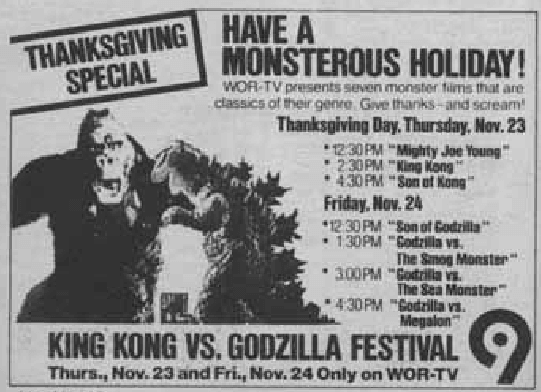
Those were the UHF-TV days. . . .
Hey! Don’t stomp off yet, green guy! There’s more ‘Zilla!
If you jump on Netflix, you can check out the Reiwa-era trio of the latest animated Godzilla flicks: 2017’s Godzilla: Planet of the Monsters, and 2018’s Godzilla: The Planet Eater and Godzilla: City on the Edgeof Battle. The first Reiwa-era film, 2016’s live action Shin Godzilla, is available on Amazon Prime and Vudu.
Of course, the whole reason for this “Kaiju Week” blowout is Warner Bros. Studio’s Godzilla vs. Kong coming in 2020 that, if you’re nuts for the green guy and keeping track, is the fourth film in Legendary Studio’s (made their debut with 2005’s Batman Begins and 2006’s Superman Returns) “MonsterVerse” and serves as a sequel to Hollywood’s Godzilla: King of the Monsters (2019) and Kong: Skull Island (2017).
About the Author: You can read the music and film reviews of R.D Francis on Medium and learn more about his work on Facebook.
Here’s some of the other Kaijus (and sorta-kinda Kaiju) that we’ve reviewed. For the rest that we’ve recently reviewed to commemorate the March 2021 release of Godzilla vs. Kong, enter “Kaiju Day Marathon” in our search box to the left to populate that list of films (you may see a few reposted Godzilla reviews, but many new film reviews concerning Godzilla, Kong, and other creatures from the Lands of the Rising Sun).
Uh, oh. The Constanzaian Worlds are colliding once again at B&S About Movies, as “Kaiju Week” rear ends April’s “James Bond Month.”
Yes. There’s a Godzilla movie with James Bond-styled spies. And Apes. And not just one movie, but two movies. And my love for each, especially the first, is unbound.
Toho Studios had Godzilla. 20th Century Fox Studios had Pierre Boulle’s apes. And the American studio was kicking the Big Green One’s ass in the Pacific Rim box office. So what does Toho Studios do? They created their own race of sentient humanoid-ape aliens to introduce into the series.
Toho Studios celebrated the Great Green One’s 20th anniversary in style with this everything-plus-the-kitchen sink monster romp featuring the return of Anguirus from Ishiro Honda’s first Godzilla sequel, 1955’s Godzilla Rides Again, a new monster in the form of the good kaiju dog-deity, King Caesar, and a James Bond-inspired Interpol superspy to defeat the aliens. (Angie and King C returned in 2004’s 50th Anniversary blowout, Godzilla: Final Wars, and they should: director Ryuhei Kitamura cites Godzilla vs. Mechagodzilla as his favorite Godzilla film.)
And if that wasn’t enough: they brought on the apes.
Toho’s new breed of intelligent apes, who hail from the “Third Planet from the Black Hole,” built a secret, underground high-tech base in Okinawa. And they have the ability to build robots. And they construct Mechagodzilla, a robotic doppelganger of Godzilla equipped with a wide array of weapons and flight capabilities.
Oh, yeah. And these apes enjoy their wine. And they can morph into human form.
The fun begins as an Oriental priestess has a vision of Japan’s destruction by a giant monster. Cue to a spelunker who discovers a chunk of never before seen metal in a cave. A subsequent archaeological excavation to find more of the metal unearths a chamber with a biblical-like prophecy of a forthcoming battle between huge monsters on the Earth.
Of course that errant hunk of metal is the work of The Simians and was used to construct Mechagodzilla to spearhead their conquest of Earth.
As crazy as it seems, it wasn’t 20th Century Fox who sued over this—but Universal Studios. When the film was released in the U.S in March of 1977 under the title Godzilla vs. the Bionic Monster, Universal took issue over the use of the word “Bionic,” as they owned the rights to The Six Million Dollar Man and The Bionic Woman TV series. That led to the title that we U.S kiddies saw it under: Godzilla vs. The Cosmic Monster.
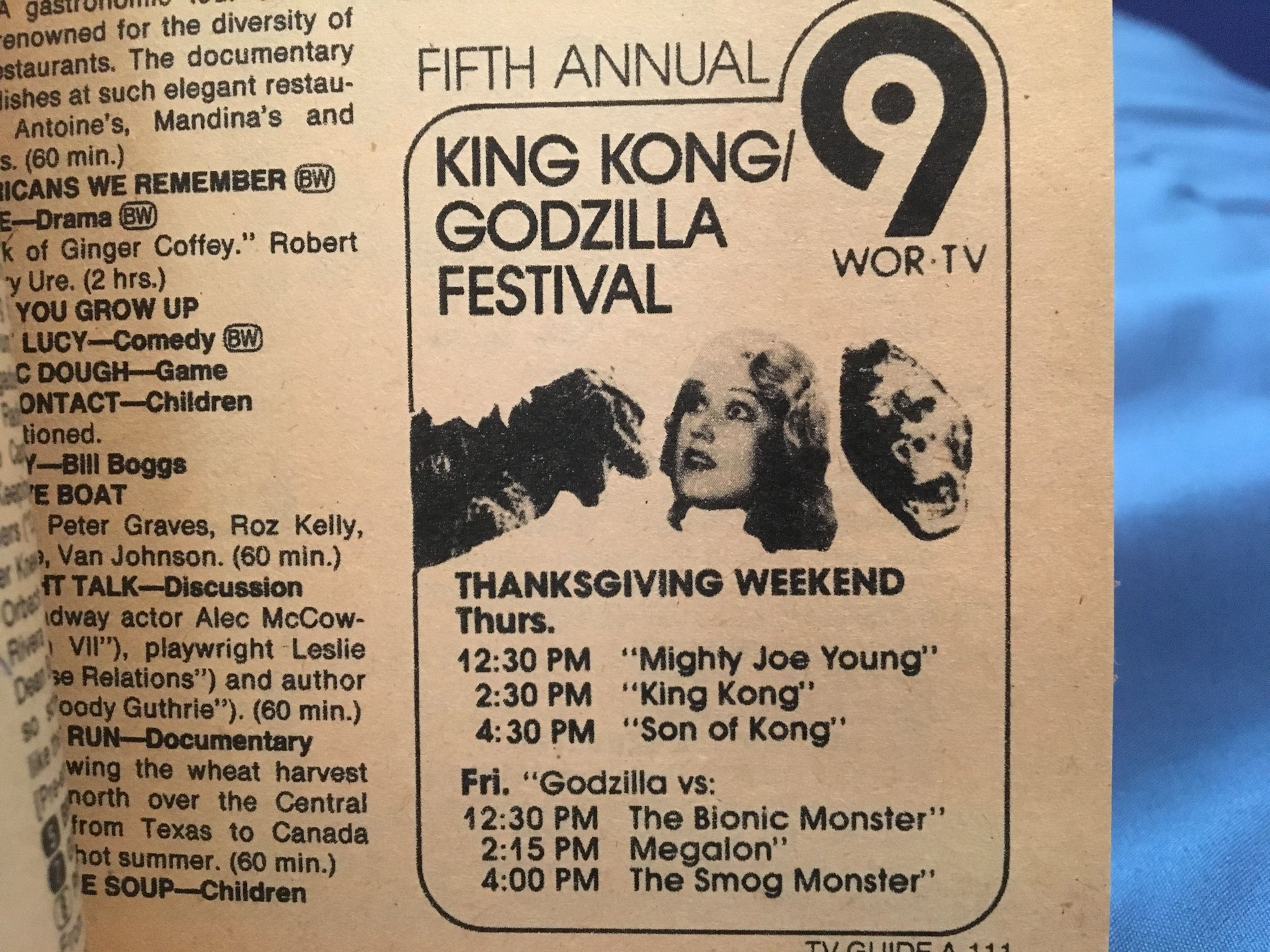
Those were the UHF-TV days. . . .
Keeping with their “borrowing” of the 20th Century Fox franchise, another race of Toho aliens from the third black hole planet returned in the 1975 sequel, Terror of Mechagodzilla. This time the aliens “aped” the underground disfigured mutants from Beneath the Planet of the Apes—and hid their disfigurement under rubber masks. Oh, and they brought along another, new monster-partner: the aquatic, non-mechanical Titanosaurus. The Mechagodzilla sequel would prove to be the last of the films until the Big Green One’s 30th anniversary started a new wave of Godzilla films.
If you must have Godzilla vs. Mechagodzilla in your collection, there’s the 1988 restored Japanese cut with English audio on a 1988 VHS, a 2004 DVD with both English and Japanese audio, and a 2019 Showa-era Blu-ray issued by the Criterion Collection alongside 15 other Godzilla films released from 1954 to 1975. Terror of Mechagodzilla also appears in that collection, along with its three singular DVD forms issued in 1998, 2002, and 2007.
The epic battle! This stuff rocks no matter how old you are!
About the Author: You can read the music and film reviews of R.D Francis on Medium and learn more about his work on Facebook. He also writes for B&S Movies.
* This review first appeared on January 3, 2020 as part of our “Ape Week” retrospective.
Here’s some of the other Kaijus (and sort of Kaiju) that we’ve reviewed. For the rest that we’ve recently reviewed to commemorate the March 2021 release of Godzilla vs. Kong, enter “Kaiju Day Marathon” in our search box to the left to populate that list of films (you may see a few reposted Godzilla reviews, but many new film reviews concerning Godzilla, Kong, and other creatures from the Lands of the Rising Sun).



 B&S About Movies
You must be logged in to post a comment.