George Gale has mostly worked as a post-production guy, but he also produced and directed two strange 1970’s Fortean documentaries, Mysteries from Beyond Planet Earth and Are We Alone in the Universe? Narrated by character actor Lawrence Dobkin, this movie pretty much hits every single theory in its 94-minute whirlwind of info.
Your host stays calm through it all as we rush past every single theory anyone has ever had about anything, basically.
UFOs, Atlantis and Cayce talking about Atlantis? We’ve got that.
Planes getting lost in the Bermuda Triangle? Sure.
Telepathy, ESP, firestarters, Kirlian photography that captures auras and plants being able to communicate? Sure, we can talk about that.
But wait! Do you have time to talk about witchcraft and Satanism, including a Black Mass? Of course. And then we’ll have to speak about the Hollow Earth, Bigfoot, black holes, genetic engineering, clones, freezing people and maybe we’ll even get to aliens again. How much time do we have left?
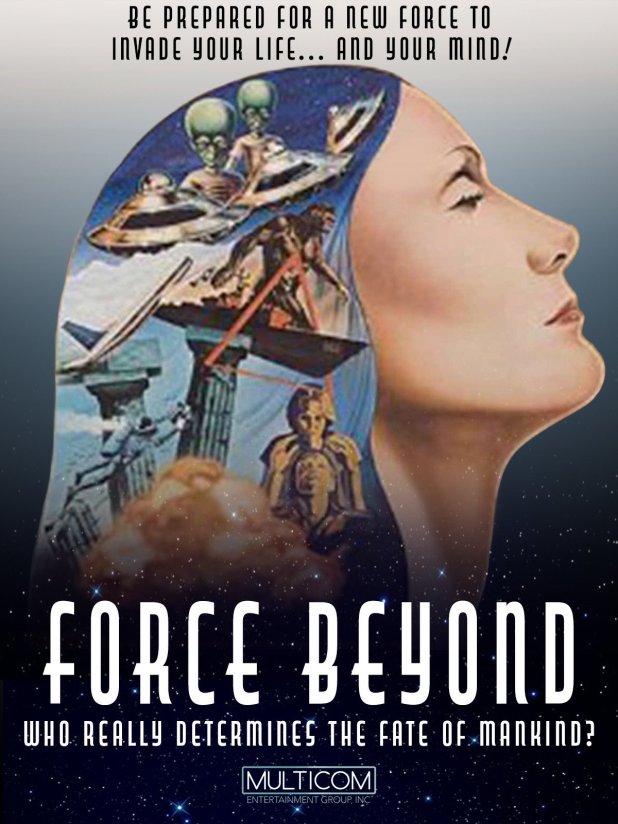
This is a movie that from its very tagline asked, “What is the message from beyond the stars, which has been kept secret from our world until now?” Indeed. What is that message? Or messages?
This one is bought to you by American National Enterprises, who also blessed us by distributing She, Ironmaster, Endgame, Encounter with the Unknown and more. These guys had taste. None of it good. All of it amazing.
You can get this piece of 70’s strange from Cult Action.
The Weekly World News was launched in 1979 by The National Enquirer publisher Generoso Pope, Jr. as a means to keep using the black-and-white press that when that higher profile tabloid went to full color. Unlike any of the other rags you’d get at the supermarket, The Weekly World News was unafraid to wildly speculate on aliens, monsters and Elvis. It also introduced Batboy to the world and has been sadly lamented since it ceased publication in 2007 (although you can still read it online).
The Force Beyond is like watching an issue of that long lost tabloid without the smell of the pulp or getting black ink all over your fingers.
Producer Donn Davison did it all. He was a yo-yo master and a professional magician, while also a producer for Film Ventures International. He was a huckster who voiced the pitch to buy how-to sex manuals in roadshows and he ran the Dragon Art Theater in California, all before he did the voiceovers for The Crawling Thing and Creature Of Evil. Now, he’s our host, presenting the words of his wife, Barbara Morris Davison, who also was behind the movie Honey Britches. Whew!
Guess who else brought this movie your way? William Sachs, who also directed The Incredible Melting Man. Strap in. This movie is a non-stop deluge of info, where things are just thrown at you with no set order or reason. Grown men trying to make their own UFOs? Yeah, but did I tell you about the barn in Bangor that just suddenly disappeared?
Meanwhile, the soundtrack is a combination of Moog and chopped and screwed interpretations of Christian music made years before anyone knew who DJ Screw was.
My favorite part of this movie is that it’s voiced by Emperor Rosko, the son of Hollywood mogul Joe Pasternak. He started his career in 1964 on Radio Caroline, a pirate radio station broadcasting from a ship off the coast of Britain. He was joined on the air by his pet bird Alfie and would nearly rap his American-style music intros. He was also the inspiration for the character that Philip Seymour Hoffman played in Pirate Radio. He sounds like a verifiable maniac in this movie.
Honestly: this movie is one of the most ridiculous films I’ve ever witnessed, a whiplash tour through everything from Cayce to Bigfoot, Atlantis and MUFON. It’s the visual version of open calls back when Art Bell was still alive and people would call from Area 51 or the Antichrist would call in. Say it with me: “West of the Rockies, you’re now on Coast to Coast AM with Art Bell!”
You should read the above paragraph as me jumping up and down telling you that you should call off work, cancel any plans and watch this as soon as possible.
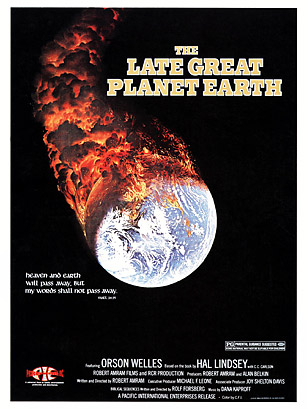
The Late, Great Planet Earth started as a best-selling 1970 book, released as the hippie occult generation’s dreams flamed out at Altamont and was annihilated on Cielo Drive. Written by Hal Lindsey with Carole C. Carlson, it was adapted by Rolf Forsberg and Robert Amram and became the film we’re about to get into.
That’s the thing about tabloids in the 1980’s. The world was constantly about to end. One of my first tabloid memories was in a SHOP ‘n SAVE near Ross Park Mall when I was probably 11 or so. A man was cutting the UPC codes off tabloids near the registers and I asked him what he was doing. He explained to me that he was removing the Number of the Beast and handed me a mimeographed explanation before security dragged him away.
The world was on the constant brink of collapse — pre-millennial tension — and from an unhinged Catholic church in New Castle that was eternally battling Communism to finding copies of Jack Chick tracts that promised the endtimes were coming soon (“HAW HAW HAW”), I was sure that Armageddon was happening before I’d get into middle school.
The Late, Great Planet Earth was the first Christian prophecy book to be published by a secular publisher (Bantam, if you’re interested). By 1990, it sold 28 million copies. This is the movie that resulted.
On Wikipedia, they refer to The Late, Great Planet Earth as “literalist, premillennial, dispensational eschatology.”
Literalist: A reading of the Bible that takes it literally and doesn’t attempt to determine the meaning or symbolism behind the Word.
Premillennial: Before 2000, the world kind of went crazy for a bit. It didn’t recover.
Dispensational: This religious interpretive system and metanarrative for the Bible divides time into eras.
Eschatology: A division of theology that is devoted to studying the endtimes.
By studying passages in the books of Daniel, Ezekiel and Revelation, Lindsey suggests that there are signs that Armageddon started when Israel was formed in 1948. Throw in an increase in war, famine and natural disasters, then you can see why tabloids routinely featured doomsday predictions. Soon, the European Union would be ruled by the Antichrist and go to war with Russian over Isreal. It was just a matter of time.
The beauty of this movie is that it doesn’t just feature interviews with authors like Tal Brooke and Paul Ehrlich or experts such as Dr. Emile Benoit and Dr. Norman Borlaug. It has a witch in it named Babette who explains why people are starting to believe in the occult and even claims that most New Age gurus are part of the Bible’s prophecy of false prophets. And then it gets even better, because Orson Welles lends his amazing voice to the film, making even the flimsiest of thoughts into concrete truths.
Imagine a movie that infuses Biblical ravings with the mondo framework. Congratulations — you’ve just envisioned what this movie is all about. If none of these revelations ever came true, that’s fine. Lindsey would be back with a new book every few years, ready to explain to you that he wasn’t wrong and what would be happening next. As for Orson, the money for this probably went right into one of his unfinished projects.
If you’re enjoying what this movie is revealing, Lindsey and Carlson wrote several sequels, including Satan Is Alive and Well on Planet Earth and The 1980s: Countdown to Armageddon. Today, he hosts a right-wing news report on the TBN network known as The Hal Lindsey Report.
Scorpion Releasing put out a blu ray of this and you can get it from Diabolik DVD.
There’s nothing like a band that you love showing up unexpectantly in a movie. Here are some of our favorite moments when a band showed up, blew our minds and rocked our eardrums. Keep in mind for this list, the band or artist had to actually be playing themselves. When it comes to musicians showing up as characters in movies, that’s a whole other list.
1. Cannibal Corpse playing “Hammer Smashed Face” in Ace Ventura: Pet Detective: Jim Carrey asked for the Buffalo, New York by way of Tampa, Florida death metal masters of offense album covers and even more upsetting lyrics to play a scene in this film. Turns out he was a legit fan, even name dropping their name and Napalm Death on the Arsenio Hall Show that same year.
2. Ministry playing “What About Us?” in A.I. Artificial Intelligence: I love this moment in this bloated film as much as I dislike the rest of it, as the Detroit synth rockers turned industrial drug taking menace to society known as Ministry are transformed into broken down machines that play the Flesh Fair, where humans protest against robots.
3. My Life with the Thrill Kill Kult playing “After the Flesh” in The Crow: Speaking of Detroit, no band is a better pick to play Devil’s Night at Top Dollar’s club than this Chicago based disco/Satan/industrial/movie quoting collective. Their music is also all over Cool World, too. ”
4. Gwar playing “Saddam-a-Go-Go” in Empire Records: Of all people to show up in this 90’s teen ensemble, the last you’d expect to see is a band that spent thousands of years trapped beneath Antarctica before giving the people what they want, which can only be the senseless slaughter of the gutter-slime that litters this nation. Gwar was made for movies, but them being in this one still is a shocker.
5. The Donnas playing the prom in Jawbreaker: Remember when The Donnas were all over the place? Jawbreaker is a reminder of 1999, a time when four tough girls could battle the entire world.
6. The 5,6,7,8’s play the House of the Blue Leaves house band in Kill Bill: If you’re going to run a Yakuza bar and earn the rage of Beatrix Kiddo, you better have the right band playing for the battle that soon follows between her and the Crazy 88’s. Luckily, these ladies are able to provide the perfect soundtrack for all the bloodshed that follows.
7. Digital Underground in Nothing But Trouble: I’m so happy that people are starting to discover just how amazingly wonderful and ridiculous this 1991 Dan Aykroyd comedy is. It’s one madman assembling an army of artists to create something strange that nobody wants to see on an incredibly immense scale. You could call it a folly. I’d call it a secret success — and Tupac’s first movie role, too.
8. Sorcery in Stunt Rock: Sorcery was more than a band. They also had two master magicians who would battle it out as Merlin and Satan while they played. I was literally seconds into the trailer for this movie when I bought it and that was all because of this part, where Merlin blasts explosions across the stage. Is magic real? Watch this and find out for sure. Also: Stunt Rock is a “death wish at 120 decibels.” I’d recommend watching it a hundred times.
9. Motörhead playing “Eat the Rich” in Eat the Rich: Only Lemmy could rhyme Shetland pony with extra pepperoni. This The Comic Strip Presents… movie may have flopped hard, but the song lives forever.
10. Queens of the Stone Age as Gown in Hot Rod: Yep. That’s the desert rockers playing the intro for the final stunt in this ode to falling off motorcycles and beating up your stepfather.
There’s also The Afghan Whigs in Beautiful Girls, Alice Cooper’s awesome speech in Wayne’s World and Anthrax in the movie Calendar Girls.
Honorable — or dishonorable — mention goes to every 1990’s pop punk band that showed up in a movie, such as Good Charlotte in Not Another Teen Movie, Simple Plan in New York Minute, The Offspring getting killed in Idle Hands, Smash Mouth in Rat Race, Mighty Mighty Bosstones in Clueless, Save Ferris in 10 Things I Hate About You, Bowling for Soup in Britney Spears’ Crossroads (not the Ralph Macchio Crossroads, which has Steve Vai as Satan’s guitarist) and Blink-182 in American Pie.
Based on The New York Times bestseller of the same name by J. Randy Taraborrelli, this movie proves that sometimes, Lifetime will actually put money into their movies. Or mini-series. You know what I mean. This is about as A-list as this channel is ever going to get, but of course, it’s not to be afraid to be totally scummy to, which is exactly as you like it.
Kelli Garner is Marilyn as we take the journey of her life from Norma Jean to the most famous actress in the world, along with the trials, tribulations, loves and hates. Sadly for those Anton LaVey fans out there, we never see him show up — if so, I would have thrown my Roku remote in the air and danced under it like a majorette — but all of her most important lovers show up.
Somehow, Jeffrey Dean Morgan is the trivia answer to who played Joe DiMaggio and Negan from The Walking Dead. Maybe he’s good with baseball bats. Another Grey’s Anatomy star, Giacomo Gianniotti, plays Marilyn’s first wife, Jimmy Dougherty. And then there’s Stephen Bogaert as Arthur Miller, Marilyn’s third husband.
Susan Sarandon is great as Gladys Monroe Mortenson, Marilyn’s mother, who owns big chunks of this movie with her certified insanity. And Emily Watson is really good as Grace McKee, Marilyn’s foster mother, who didn’t take any medicine due to her religion and still killed herself with a drug overdose.
It’s all held together by a therapist leading Marilyn through the journey of her life on the last day she’s alive. If you know the story of Marilyn well enough, you’re not going to be surprised by anything. Joe DiMaggio definitely comes off horribly in this one. Nearly everyone does.
Do you have like four hours in your life to watch this? Then check it out on the Lifetime Movie Club. Part one is here and part two is here.
Remember when movies used to be a tight, compact 90 minutes or less? There was a moment during this one — this has happened more than a few times lately — where I paused the movie and figured there could only be twenty minutes left. Nope. There were still 51 intolerable minutes of bonecrunching, screaming into the microphone pain, drunk fighting in the tub ennui left to go.
You know how you can tell this movie is a bloated mess? Even the trailer is more than three minutes long.
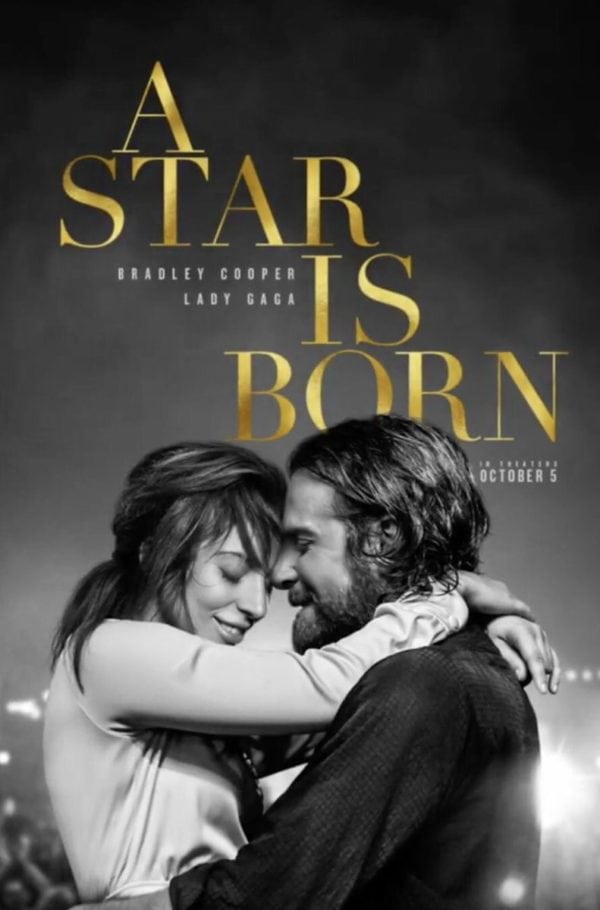
The first time A Star Is Born was made was way back in 1937, when Janet Gaynor played a young actress and Fredric March the star who introduced her to the industry. It was remade in 1954 with Judy Garland and James Mason, then most famously in 1976 with Barbra Streisand and Kris Kristofferson, perhaps less famously in 2013 as Aashiqui 2 with Aditya Roy Kapur and Shraddha Kapoor and now, we have Lady Gaga and Bradley Cooper.
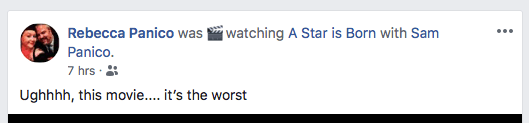
Let’s get the nice parts out of the way: Lady Gaga is amazingly talented as a singer and is a pretty decent actress, too. I’m all for anything she wants to do with her career, as she’s been really solid in just about everything I’ve seen her try her hand at. But man, this movie…I was about an hour into it and looked over at my wife, who was overly enthused about watching it due to how attractive she finds Bradley Cooper. Throw in a beard and a cowboy look and I had been told numerous times just how attractive Mr. Cooper was to the point of near absurdity. Surely she would be enjoying this film. Nope. She shot me a look and then said, “There’s no way you can be enjoying this horrible movie.”
Proof of just how much Becca liked A Star Is Born.
Jackson “Jack” Maine (Cooper, who also directed and co-wrote this film) is a country music star battling addictions and tinnitus who we first meet on stage. He’s in California and just looking for a bar when he ends up at a drag bar that of course features a real woman singing as the lead performer, which is how I assume all these things work out. Ally (Gaga) and he fall quickly in love, despite the fact that she punches a guy in a cop bar for reasons that are never really disclosed. Pretty much everyone’s behavior in this movie is like the bars in my hometown around 1:55 AM. If they can’t get some action, they’re gonna punch you right in the puss.
Jack invites Ally to his next show, where she plays hard to get for all of seven seconds. He brings her on stage with him, then passes out right when they’re about to make love. She’s upset, because after all, she took the special time to go into the bathroom and dry her lady business and underarms down with a hotel towel for this.
Somewhere in all of this, they visit the ranch where Jack and Bobby — his older half-brother tour manager played by Sam Elliot, who really deserves better — grew up. Turns out that Bobby sold the land, so the brothers get in a fist fight. Then, Ally meets Rez, a combination music producer and manager who takes over Ally’s career, taking her from country to pop.
This is where the film shows how out of touch it is with culture, as these days, pop and country are pretty much the same thing. After all, just ask Hootie, who did more than just fine becoming a country artist. Jack starts getting drunker and angrier and drunker and saltier and angrier and passes out after doing drugs at a pharmacy trade show he plays for money. I mean, first off, if you’re gonna do a pharmacy trade show, that’s the best place to smash up some Somas with your boot and do rails of them. Also: if your entire character arc is that you want your girl to have artistic integrity, have some yourself. But let me get to that in a bit.
This is where Dave Chapelle shows up for no real reason at all as an old bandmate named Noodles. Jack proposes to Ally with a ring made out of guitar string and they get married by Eddie Griffin. You might think that I made up most of the previous sentences, but no. I didn’t. Other films non sequiters are the plot of this rambling mess.
As Ally’s star goes up — she’s on SNL with Alec Baldwin! — Jack goes down. They get in a fight about one of her songs being about a guy’s ass and he calls her ugly while she’s in the tub. If it can get any worse, he gets wasted before his tribute to Roy Orbison — who again, deserves better — and then pisses himself on stage while Ally wins the Best New Artist Grammy. I literally yelled from the kitchen, “I predict he pees on himself at the Grammys,” because most of my humor is of the grade school variety. Imagine my glee when I was shown that I was correct.
Ally’s dad — Andrew “Dice” Clay! — yells at Jack and our hero, such as he is, goes to rehab where we learn that he’s tried to kill himself since he was thirteen. Look, I know alcoholism is a disease and all that, but throughout the entire film, Jack has been nothing but selfish. There are no moments where you see goodness in him, only someone who becomes an ogre to his wife when she achieves her dreams. Even after he gets out, she puts her entire career on hold for him. After all, the mean music producer/agent doesn’t want her husband on tour so she just cancels everything.
Jack responds to the love of a good woman by hanging himself while she plays the biggest concert of her life, again proving that he’s nothing but a complete waste of humanity. The dog he adopts is the only good thing about him.
Ally then takes his name and sings the love song he wrote to her at a tribute, which is some redemption, one would think. But really, after way more than two hours of a drunk treating her horribly, it all just makes her seem pretty weak. I mean, at no point did Ally realize that her career success was all due to her hard work and talent. Somehow, all of Jack’s behavior is worthy of cannonization.
Did you get the idea that I didn’t like this one? Oh man — you’d be right. Brevity is the soul of wit and this bloated mess just went on and on, pretty much like this review. Lots of people loved this, it’s going to win plenty of awards and I honestly don’t get it. It’s not for me. It may be for you, if you want to suffer through a clueless woman dealing with a manipulative man child on her way to fame that may ultimately be soulless.
No one speaks — everyone either mumble whispers or screams loudly directly into your ear, which rings with the sound of deafness. This movie is as subtle and interesting as a drunk warbling an Alan Jackson song at supersonic volume, then crying about what a loser her man is before peeing into a garbage can in the bar’s bathroom.
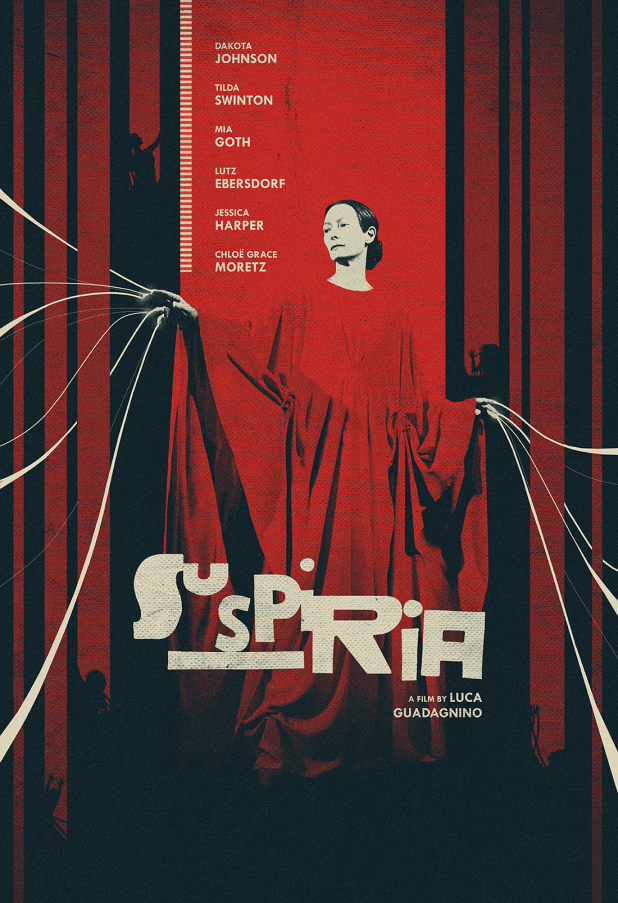
You may — or may not — have noticed that for all the Argento films I’ve reviewed, I’ve never spoken about 1977’s Suspiria. This supernatural horror — not giallo — movie is hard for me to write about because it’s above reproach. It is, as I’ve mentioned about other films, an absolute movie, one whose kaleidoscopic and sonic assault — courtesy of Goblin — blast you from the moment the film begins. I can’t really say anything new or add anything that hasn’t been said and I doubt anyone wants to read me gushing about the colors or murders in the film ad nauseam. If you haven’t seen it, do so. Please watch it instead of this movie.
That’s the hardest part of this article. I am predisposed to hate this movie. And I’ve tried to be objective and open-minded, because in the past, I’ve hated movies before I even had the chance to watch them. I didn’t want this to be the case. I wanted to not be taken in by the hype or other reviews and watch this on its own merits. But I’ll be honest: it really has none. If it were a movie by any other name, no one would care about it.
Life is short and there isn’t enough time to tell people how much you love them or to enjoy all the magical art and fun there is in the world, so wasting two hours and thirty-two minutes on this meandering slop has me a little peeved. And that’s when I remember the indulgent reviews and the top movies of the year list that this topped. Have the standards for what makes a great movie really slipped so much in the last decade or two? Of course, they have. That’s a rhetorical question.
Now, I could raise issues like the fact that at no time did I know or care about the characters and their motivations, but in truth, the original has the same problems. It’s kind of patently ridiculous to complain about narrative structure when you’re discussing a film inspired by Argento.
Maybe I never danced. Maybe I don’t speak enough German. Or French. Maybe I don’t appreciate winter colors. These are the questions that, well, pirouetted through my head as I endured this movie. It had that dreaded moment where I paused the film, sure that this had to be the conclusion of the proceedings, only to discover I still had fifty-one minutes of pain left, minutes that would feel like the hand on the stove versus the time spent with a beautiful woman.
Let me see if I can summarize this: Susie Bannion (Dakota Johnson, who has darkened my screen way too many times recently and yet I give her chance after chance, perhaps because her dad was the voice of Chuckles in GI Joe: The Movie and her mom was both Cherry 2000 and Holly Body) is a Mennonite from Ohio who gets into the Markos Dance Academy in West Berlin. The school is still recovering from the loss of another student, Patricia (Chloë Grace Moretz) who disappeared after she told her therapist Josef Klemperer that all of her teachers are witches.
Just a moment here to let you know that Tilda Swinton as Madame Blanc, Mother Helena Markos and Dr. Josef Klemperer (which she is credited for as Lutz Ebersdorf, with Eber meaning boar/swine and dorf meaning town, hence the last name is Swinton). You won’t be snowed by this stunt casting. In fact, you’ll notice it and keep wondering about it and it will make you escape the flimsy plot and wonder when you can put another movie in your blu ray player. It’s amazing to see Swinton in what manages to be an Eddie Murphy role, ala Nutty Professor II: The Klumps, where you keep saying, “Look, there she is. She’s in a man costume. Now she’s herself. Now she’s an old woman! Wow!” Except you don’t really say wow. There’s no moment that I uttered those three letters and I had plenty of running time to get them out of my mouth.
The truth is that the Three Mothers — Mater Tenebrarum, Mater Lachrymarum, and Mother Suspiriorum — are running things. Susie will be their instrument of taking out others, like Olga, who is basically turned inside out by dance. Supposedly this scene upset people so badly that they left. I have no idea why. I mean, it’s certainly gross, but nothing that blew my mind as was promised.
Also: why is there so much pee in this movie?
The witches all have an argument about who is in charge and decide that Mother Markos, an ancient crone who has controlled the coven for as long as anyone can remember, will remain in control and get a new body. All of the witches taunt a cop who comes to investigate and also have knives that look like rib bones.
All sorts of exploration — by another student named Sara — leads to her leg being broken and her switching eyes with Susie, then they all dance this performance called Volk. Sara dances robotically, controlled by the slowly giving in to evil person who we’ve been led to believe is our heroine. The dancing nearly kills everyone, because like fashion, dance is danger. As Klemperer escapes the performance, he meets up with his wife (original star Jessica Harper) who he thought long dead. In truth, she leads him back to the school.
I have no idea how to put together the end of all this, but damn, I’m gonna try. Susie renounces her mother, who dies somewhere in Ohio, just as that old woman — who has been on her deathbed for the entire movie — mentions that her daughter is the stain that she let loose on the world. That’s because everyone else is a false mother and Susie really is Mother Suspiriorum. Nearly everyone dies by being danced to death. There’s also so much red light in this scene that it becomes difficult to watch. This aspires to high art, one assumes. I could also be totally off and there’s some intricate meaning that I haven’t grasp, but I also compared this movie to an Eddie Murphy fart movie a few paragraphs ago.
Somehow, Blanc and Klemperer survive. Then, Susie comes to his bedside and explains how his wife died in a concentration camp before erasing his memories. Actually, I had no idea that that was what happened and Wikipedia was my friend, so there you go.
After the credits, Susie breaks the wall of reality and erases the audience’s memories, which is an awesome idea, because then they can forget the sheer boring snail race that they just crawled through. Sadly, I shut the movie off before this happened so I will have to always live with the Bataan Death March-like pain of this inept piece of offal.
Other than that, Mr. Lincoln, did you enjoy the play?
Thanks for asking.
Before Luca Guadagnino directed this, David Gordon Green was attached, in his bid to ruin every auteur horror film that I have ever loved. He had to settle for last year’s Halloween, another movie I hope I never have to see ever again. Then again, seeing as how my wife just bought the DVD, all hope is gone.
I also have no idea what the Red Army Faction and Lufthansa Flight 181 subplot had to do with any of this. Maybe I’m on the side of Richard Brody from the New Yorker, who said that this movie “…has nothing to say about women’s history, feminist politics, civil violence, the Holocaust, the Cold War, or German culture. Instead, Guadagnino thrusts some thusly labeled trinkets at viewers and suggests that they try to assemble them. The result is sordid, flimsy Holocaust kitsch, fanatical chic, with all the actual political substance of a designer Che T-shirt.”
Suspiria desperately wants to be about something, anything, to appear to be a movie that matters. It is, to use that hoary old chestnut, full of sound and fury, signifying nothing. As much as I like Radiohead, that sound here is blah. As much as I like drone, it doesn’t work here, as the soundtrack is bleats and blips against a grey canvas that does not inspire.
It might be about women. It might be about 1977. It might be about witches. But ultimately, it is a film about nothing. It has convinced some of the filmgoing public that it has deep and meaningful things to say. I’ve always seen the original as a haunted house on film — a bewildering odyssey into colors, noise and terror. It ends just like a real-life scarehouse — Jessica Harper’s Suzy is running away from the burning school, a smile on her face, breathlessly alive despite all she has witnessed. It’s the exhilarating thrill of someone working as hard as they can to scare you and the release that comes from that. None of those feelings were conjured here. The only one I received was relief that I could finally turn this off as the credits ran.
Plus, there’s also the issue of the film being sued for copyright infringement by the estate of artist Ana Mendieta, with a total of ten images being mentioned as direct lifts of the artist’s work. A settlement has been reached, but I guess true art still steals?
Guadagnino has mentioned making prequels and sequels to this film. There are no films I look forward to watching less, unless someone forces me to watch this again.
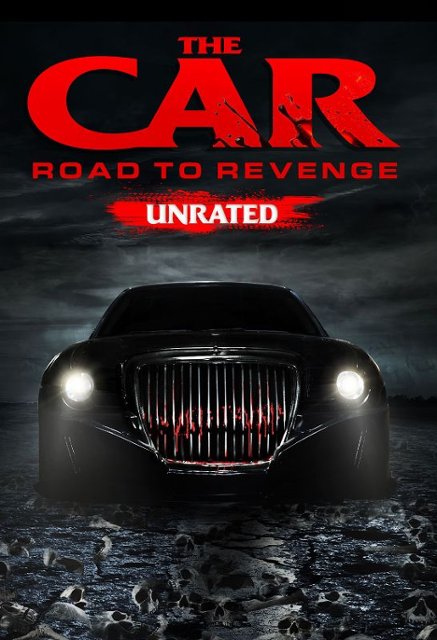
In a post-apocalyptic cyberpunk city of the future that’s been destroyed by crime and corruption, a District Attorney finds the information he needs to finally arrest a gang of cyborg criminals. Too bad he’s killed before he can do anything about it. But then again, his car has come back, looking for revenge. And that’s how the kinda, sorta sequel to The Car begins. If you were expecting another Anton LaVey quote to kick this off, you picked the wrong movie.
Where the original film hinted that the titular vehicle may or may not be powered by Satan — seriously, this was a never-ending debate in the HBO fueled 1980’s in our immediate family — this movie has a very simple motivation. Well, two of them. Revenge and misguided love, as the DA pretty much has been stalking his ex. And it turns out she likes it, no matter how much her friend tries to explain how crazy their relationship was.
Soon, though, the police, both good and corrupt, as well as an army of cyborg ruffians, including a cowboy, several punks and some guy who wandered in from A Clockwork Orange are after her. And yep, The Car is both there to protect and pretty much continue stalking her. It gets blown up real good, but a mechanic (played by Ronny Cox, who was in the original) uses old parts to make it look a lot more like the 1971 Lincoln Continental Mark III that it should be.
This felt way closer to Upgrade that to The Car. That said, I’m still wondering how any movie that has cybernetic gangs and killer women can leave so little of an impression.
The Car: Road to Revenge was directed by G.J. Echternkamp, who also directed last year’s Death Race 2050. As long as genre titles have some life, it seems like we’re going to see direct to Redbox and streaming sequels. This has the smallest of connection to the film that inspired it, so if you’re hoping for more marching bands being chased through cemeteries, sadly you’ve come to the wrong place.
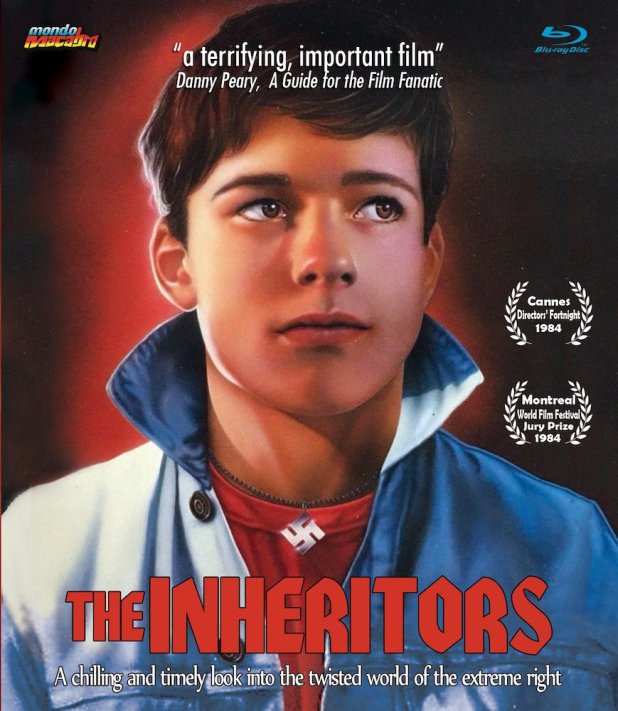
In 1979, Austrian film director Walter Bannert was simply enjoying a meal at a Vienna cafe when he was beaten by a gang of neo-Nazis. That’s when he determined that he would research these groups by convincing their leaders that he was making an objective documentary. He ended up spending three years with these groups in West Germany and Austria.
The Inheritors is what emerged, a film based on real people, events and conversations that Bannert actually experienced. Obviously, the film was controversial, with theatres screening it threatened by neo-Nazi sympathizers. Sadly, while it’s over thirty years old, the rebirth of right-wing extremism means that it may even be more relevant today.
On his way home from school, Thomas helps Charly escape from the police. They couldn’t be more different, as Thomas comes from a rich home, where his self-made father and music-loving brother are both dominated by his mother. Charly is poor and doesn’t have much of a future.
Soon, the two are dreaming of a revitalized fatherland based on happy families, free from corporate control and dedicated to the environment, one that will be free from the influence of the West. They discover that they find a better family and friends within the party, as the rest of the world throws them away as they become more and more dedicated to the Nazi cause.
This is not an easy watch. But it’s certainly one that will make you think.
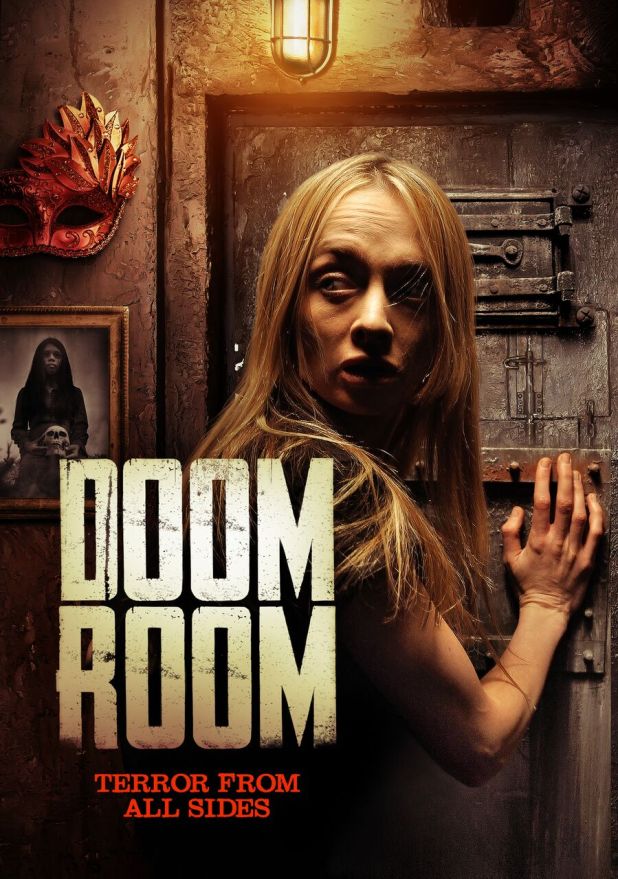
Scream queen Debbie Rochon stars in Jon Keeyes’ (The Harrowing) latest* film, which is all about a woman (Johanna Stanton) who wakes up locked in a small room with no memory of how she got there. She can’t escape and is taunted by paranormal entities who are keeping her from learning how she got there and who she really is.
The beings that the nameless woman encounters have names like Husband, Wife and Innocence. Some of them are kind to her and others are anything but. So what are they? Figments of her insane imagination or actual demons?
The entire movie feels like a stage play that’s been captured for film. It’s way artier than you’d think and I really had the feel of British horror and BDSM infused in every frame. It’s talky at times, but I took that as a way of dealing with the small budget and have seen plenty of grindhouse-style movies of old that felt the same way.
There’s plenty of slut-shaming and male on female coarse dialogue here though, so if these things disturb you, this probably isn’t the movie for you. I’m sure that six years ago, that felt pretty cutting edge when it was filmed, but today it feels rather forced and shock for shock’s sake.
That said — it has a great look and feel, as well as a unique story unlike many recent direct to streaming films I’ve seen. I stayed with it until the end and wasn’t ever bored, which is certainly a good thing.
*While this film was originally created in 2013 as Nightmare Box, this is the first actual release of the film, however.
Doom Room is available January 15 on demand.
NOTE: We were sent this movie by its PR team but that has no impact on our review.




 B&S About Movies
You must be logged in to post a comment.