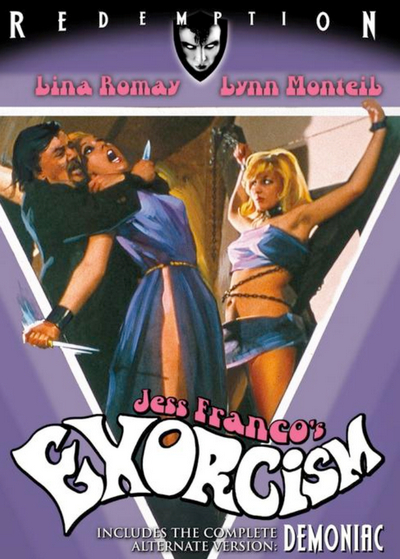
Exorcism (1974)

Anne (Lina Romay, muse of this film’s director, Jess Franco) is a performance artist who specializes in recreating Satanic rituals and spicing them up for old rich folks to savor. She also writes for a magazine, Garter and Dagger, that appeals to people who like this kind of dreck.

Turns out that Mathis, one of the writers at the magazine (yep, Franco himself), was a priest kicked out of the church for following Old Testament beliefs instead of Vatican 2. After overhearing Anne and her assistant planning a Black Mass (not an actual one, more like a sex party, which come to think of it, why is a man of the cloth working for a porn magazine? And wouldn’t an orgy be just as bad as a Black Mass?), Mathis kills each and every person involved.

There’s another cut of the film, Demoniac, which is just death and gore with none of the sex. It’s 69 minutes long. And there’s another version called Sexorcismes that remakes this film with added hardcore footage, including Franco himself showing up for the party. And Franco remade it again as El Sádico de Notre-Dame.

Under any title, this movie is the absolute shits. It fails at horror. It fails at being sexy. It fails at being interesting. It even fails at being an Exorcist clone because it has nothing to do with exorcism!

Look — when I tell you a movie is bad, trust me. It’s bad. Real bad.

Seriously — I found a movie about Satanic sex crimes boring. If that’s not a recommendation to avoid, I don’t know what is!

Don’t watch this. Even if it’s free on Amazon Prime.

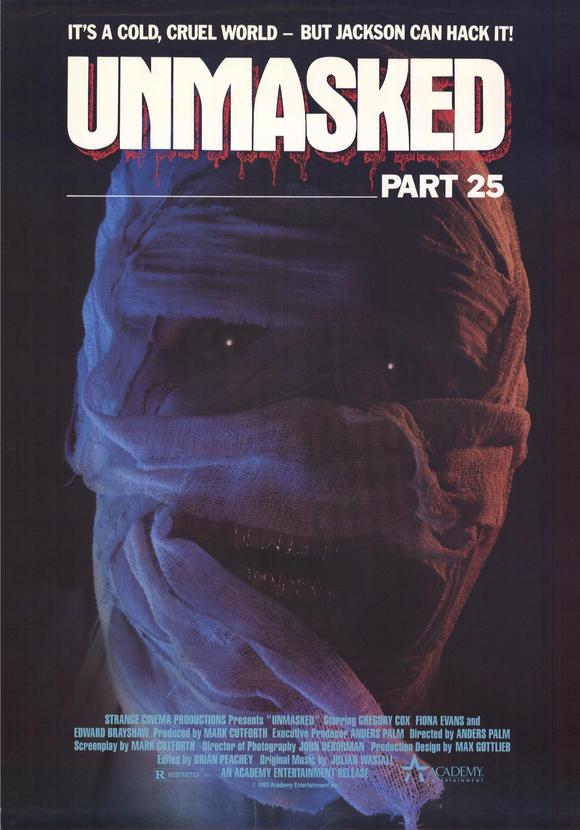
Unmasked part 25 (1989)

I wonder, quite often, why hasn’t there been a new Friday the 13th for nearly 9 years? Then I watched every single one of the films, back to back to back (and back) and I can tell you that they’re endless repetitive movies that ended up relying on gimmicks to get by. Is there a new idea that can make them fresh (yes, there is Hollywood, comment right here to get my ideas)? Has anyone even asked Jason Vorhees if he even wants to come back?

Unmasked part 25 is all about Jackson, a serial killing maniac with a hockey mask who is tired of killing. He can’t even remember why he started killing, other than a horrible childhood that he feels absolves himself of all guilt. Nothing makes sense until he meets Shelly, a blind girl who makes him see that there can be more to life than ripping out peoples’ hearts.

The world knows so much about Jackson’s life that his murders have been filmed in a series of films called Unmasked (or Hand of Death, if you’re watching the film’s other title. This makes no sense when we get to the marquee at the end, but I doubt they had the budget to film that scene twice.). His father was a killer too, one who could have been the world’s greatest if only he had the heart to kill his wife and son. Instead, they moved to America, where Jackson was believed dead after drowning at a summer camp (if you didn’t get the reference, this is so not the film for you). Now, he lives with his drunkard of a father who constantly laments the days when he was a killing machine and how bad of a son he has.

Shelly offers an escape — as a blind woman, she can’t see his scarred face. She even understands his need to wear a mask at all times. In fact, she blindly — pardon the pun — understands everything that Jackson throws at her.

Unmasked part 25 is a wildly uneven film to say the least and perhaps that’s part of its charm. At times, like when Shelly is trying to introduce Jackson (clad in red boxers with “bad boy” written on the ass) to BDSM, it’s played like a broad comedy. At other times, such as when he reads her Byron or talks about how everyone wearing a mask at Halloween angers him, it reaches a grimy paw at the heartstrings. And there are also moments — like when Jackson literally tears a man’s face off (played by Christian Brando, whose ill-fated life could have been a horror movie) — it’s a straight-up slasher movie with more than decent special effects.

Once Jackson learns that Shelly is pregnant with his child and that the more time he spends around normal people, the more he wants to kill. As the film spirals to its downbeat ending, the masked killer learns that he can never walk away from his fate, not when there’s an Unmasked part 26 on the marquee.

Unmasked part 25 has some moments that made me cringe — the BDSM scene is played for laughs and Jackson can’t understand why his partner would enjoy sex and roughness together, yet he can only be aroused after killing. It’s an oversimplification of a much more complicated mindset, but then again, you don’t watch gore movies for subtext, right? But it’s also way better than you’d expect, attempting to tie the murders of a masked maniac to the real world. It’s also never been released on DVD, so if you want it, you’re going to have to search iOffer or eBay.

UPDATE: If any label was goign to get this on blu ray, it was going to be Vinegar Syndrome. Run to your internet device and order this NOW!

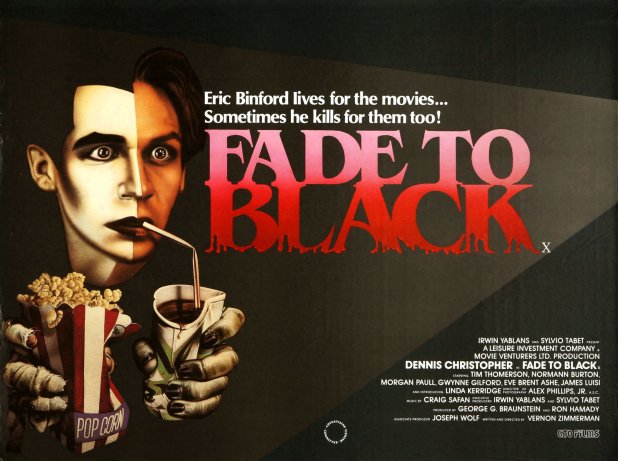
Fade to Black (1980)

A movie about a socially awkward, totally obsessed film fan whose love of old films borders on the obsessive, with nights filled with movie after movie after movie? This one hits a little too close to home.

Eric Binford (Dennis Christopher, Breaking Away) works in a Los Angeles film distributor warehouse by day and watches movies by night. He’s the guy I was referring to earlier — someone so into movies he gets bullied by his family and co-workers. And when he meets Marilyn O’Connor, who looks like Marilyn Monroe, he finally finds someone whose looks are similar to the movie ideal that life does not always achieve. Or maybe he’s just so crazy that when he sees her, he goes into a fantasy fugue state and only sees what his brain will allow him to see.

Somehow, Eric is able to ask her out, but she stands him up by accident. This makes him go completely out of his mind, transforming himself into various film icons to destroy his enemies.

First, he re-enacts Kiss of Death by pushing his Aunt Stella (who is really his mother) down the steps, showing up to her funeral as Tommy Udo, the role Richard Widmark played in the film. No one gets it. No one has seen the movies that Eric loves. There is no one to discuss them with. They can’t even put her grave next to Marilyn Monroe’s grave in Westwood Village Memorial Park Cemetery.

Eric then becomes Count Dracula, attending a midnight showing of Night of the Living Dead. Eric then goes to Marilyn’s house in a scene that’s taken from Psycho. She screams, he drops his pen into the water and the ink becomes the blood. “I only wanted your autograph,” he yells as he runs.

Eric then goes back to find a hooker who had been rude to him. He chases her, she falls and dies, then he drinks her blood. Obviously, Eric has not seen MartinActually, the way this scene is intercut with scenes from old black and white horror films, I am certain that the makers of this film have seen Romero’s vampire film.

Now that Eric has gone this far, why not dress up as Hopalong Cassidy and kill off Richie (Mickey Rourke in an early role), a co-worker who bullies him.

Oh yeah — Tim Thomerson is a criminal psychologist who is working with a policewoman (they’re having sex, because 1980 and all) to find what he believes is a serial killer. The big problem is that his captain wants all the glory for himself.

Eric talks to his aunt as if she were still alive, then after watching Halloween (producer Irwin Yablans also produced that film), he pleasures himself to a photo of Marilyn Monroe.

Eric’s dream has been to own his own movie theater and to make his own movie. He tells a sleazeball named Gary Bially his idea, Alabama and the Forty Thieves and you get the feeling not much good can come of it.

Eric’s boss fires him and won’t allow him back into work to get his posters. As his everyday self, even when trying to talk like a movie character, Eric is impotent. But when he’s dressed as The Mummy, he can frighten his boss into a heart attack.

After seeing Gary Bially on a talk show, talking up the movie Eric created as his own, Eric shows up to the producer’s birthday party. Dressed as James Cagney’s character from White Heat, he fires a submachine gun at everyone in the room before killing the man who stole from him.

The cops are on to Eric, but he’s hired Marilyn for a photo shoot and is all set to re-enact The Prince and the Showgirl when Thomerson’s character arrives. Eric runs to Mann’s Chinese Theater and makes it to the roof before dying just like Cagney in White Heat, yelling, “Made it, ma! Top of the world!”

Writer and director Vernon Zimmerman also created Unholy Rollers, but this movie is way beyond that. It shows how only seeing the world as the movies can be a danger to yourself and everyone else. Eric goes from shy and withdraw to dark and mean by the end of the movie, as he slowly becomes a new character. I wonder what he would have thought about the movie that they made his life into?

You can catch this on Amazon Prime. You should do so right now.

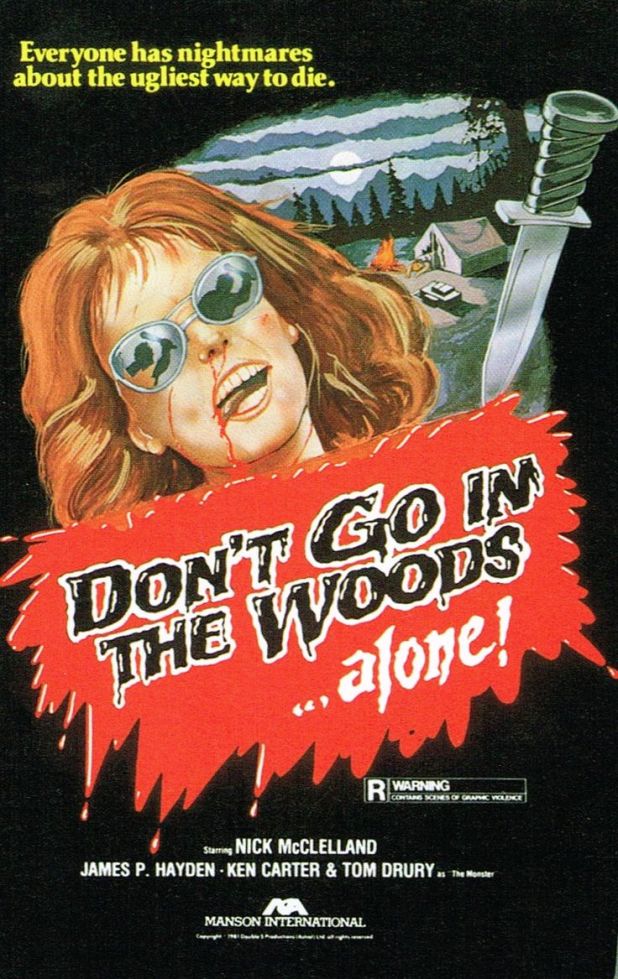
Don’t Go In the Woods (1981)

Some slashers take their time getting to the first kill. Others start James Bond style, with a kill or two at the beginning before settling into the formula. Don’t Go in the Woods starts with murder and never stops. There are characters you’re supposed to get behind. But mostly, there are just random people who are killed in increasingly horrific ways while comedic synthesizer music bleets and boops and at times, goes silent. It’s a crude, brutal and at times, hilarious film. It also feels like it was made by either amateurs or maniacs. Maybe both.

There is one rule in this movie: Don’t go in the woods. Every single person that dies ignores this rule, so they are to blame for whatever happens next.

A woman screams and is killed.

A bird watcher watches birds and is killed.

Four friends — Peter, Joanne, Ingrid and Craig — are traveling through the woods.

A tourist is thrown over a waterfall, landing near our heroes having a splash fight (they don’t notice). Our intrepid foursome set up camp for the evening as two honeymooners in an RV are killed, followed by an artist being offed and her daughter kidnapped.

Of note here — it seems like the couples should be boy/girl, but through a combination of outfits and hairstyles, it is truly up to you to determine the non-binary combinations that they may be.

Two more campers get killed, then Peter watches while a fisherman is slaughtered, finally revealing the antagonist, who is a wild man covered in rags and fur with a big spear, known only as Maniac in the credits. He runs to warn his friends, but the Maniac follows and kills Craig with a spear.

Peter and Ingrid finally find the Maniac’s cabin, but accidentally stab a hitchhiker they believe is the killer. Our two heroes — minus the missing Joanne — make it to the hospital where they alert authorities, including the Sheriff (Ken Carter, a career rock ‘n roll DJ), who might as well be the cousin of Troll 2‘s Sheriff Gene Freak.

Peter feels guilty about leaving Joanne behind. As for her, she wanders into the Maniac’s house and is killed via multiple machete strikes. The killer doesn’t stop, beheading a man in a wheelchair, before Peter and Ingrid find him and go full on crazy, stabbing him numerous times while an entire crowd of lawmen watches.

Meanwhile, that kidnapped baby everyone forgot about? She’s up in the woods with an axe, all alone and ready to grow up to be the next Maniac.

Whew. This movie is a whirlwind of dubbed dialogue, bright red ketchup made with BBQ sauce and red food coloring, all shot on $400 worth of film stock (look for light bleeding through at numerous times).

Director James Bryan is a jack of all trades, having worked as an editor, a production manager, a post-production supervisor, a director of photography, a production assistant and more. He even filmed the pick-up shots for Lemora: A Child’s Tale of the Supernatural! Plus, his resume includes films as diverse as The Executioner, Part II and sex films like Sex Aliens and The Hottest Show in Town.

Should you watch it? It depends. Are you willing to endure some of the worst dialogue and outfits in the history of film — all non-ironically created, mind you — and enjoy a story that makes no logical sense? Then yes. You should watch this on Shudder!

After all, how can you dislike a movie that ends with a song like this?


The Sect (1991)

Between Ed Sanders’ book The Family — which examines the origins of Manson’s Family — and Maury Terry’s The Ultimate Evil — which suggests that a worldwide network of Satanists is responsible for the Manson family and Son of Sam murders, we’ve come to accept the notion of an organized army of evil. But who are they?

In the revised 2002 edition of The Family, Sanders referenced the Process Chuch of the Final Judgement as the “satanic group of English origin” behind these killings. The Process successfully sued Sanders’ publisher to remove this reference.

That said the die was cast. By 1980, books like Michelle Remembers suggested a deep conspiracy of Satanic ritual abuse. The Satanic Panic of the 80’s found sacrifice and worship around every corner. Perhaps the author you’re reading now was targeted. Yet no real evidence has ever been found.

Michele Soavi’s The Sect concerns that network of Satan as they prepare the way for the Antichrist. From a commune being slaughtered in the early 1970’s — a scene with references to the Rolling Stones that repeat throughout the film — to multiple modern murders that follow, including a heart being left on a train and a suicide in public, the devil’s helpers are organized, know how to plan and are well ahead of the rest of society.

Just a note — as cheesy as Sympathy for the Devil reads today — The Rolling Stones were at the forefront of the occult 60’s thanks to their association with Kenneth Anger.  If you’re interested in learning more, I’d heartily recommend Gary Lachman’s Turn Off Your Mind: The Mystic Sixties and the Dark Side of the Age of Aquarius.

But let’s get back to The Sect. In modern Germany, schoolteacher Miriam Kreisl (Kelly Curtis, sister of Jamie Lee) saves Moebius Kelly (Herbert Lom, Hammer’s The Phantom of the Opera) after an accident and brings him back to her house. Within a few hours, he’s injecting her and shoving beetles up her nose while she sleeps and giving her nightmares of a giant bird having sex with her.

From there, the film descends into more of a series of nightmares than a fixed narrative. That makes sense once you realize that its origins in three different scripts that producer Dario Argento, director Michele Soavi and writer Gianni Romoli couldn’t finish. So you’re left with a film with a giant glowing blue gateway to Hell in the basement, a plot to conceive the Antichrist much like Rosemary’s Baby, an evil Shroud of Turin that can kill and bring people back from the dead and, oh yeah, a super smart rabbit named Rabbit who can use a TV remote.

The Sect has some references to other films, with the first victim being named Marion Crane (Psycho) and another named Martin Romero (obviously, George Romero and his Braddock vampire film Martin).

Following Soavi’s Stagefright and The Church, this film offers less of the pure insanity that he’d bring to bear in his next film (and sadly, final horror film) Cemetery Man. Yet a restrained Soavi is still more visually inventive than a hundred lesser directors. From images of animal-masked children to the evil Jesus that smokes up and annihilates hippies in the flashback, there’s a continual undercurrent of menace and doom.

Strange symbols just appear. People disappear even after we see them arrive. Or they die in airplane accidents and still appear. Kathryn (Mariangela Giordano, Evelyn from Burial Ground, she of the incestual zombie child relationship) shows up to get smothered by the previously mentioned evil shroud. Worms show up in the water. A possessed Kathryn convinces a trucker to kill her. Rabbit symbolism abounds. Kathryn gets back up off the operating table and attacks Miriam before killing herself again, which a doctor tries to explain as a commonplace thing. Long black tunnels lead to a sinister mortuary. The doctor who couldn’t save Kathryn and Damon, the Jesus-like killer from the opening, are working together. A woman’s face is ripped clean off, Hellraiser-style. Even trusted detective Frank is taken over and wants to kill Kathryn now that he knows her secret. Whew. I hope these short bursts of words give you an idea of just how much happens in this movie. It never really lets up, becoming more and more unreal.

Moebius comes back to life to tell Miriam that every moment of her life has been planned, that they own her, that everything has been for this moment of indescribable joy. The cult gathers as the doctor injects her, sending her to sleep.

Finally, the devil comes to take Miriam. In shadow form, he appears to be human, but what attacks her is a giant bird that pecks at her neck and has his way with her. The cult lowers her into a pit as Moebius raves, screaming that he is her father and that she will give birth to the Antichrist. As she waits in the blue basement water, midwives swim around her, facilitating the birth as the moon slowly goes dark.

A giant amniotic sac with a child inside is lifted as the moon goes completely black.

In a shot straight out of Rosemary’s Baby, Miriam moves through the crowd to see what Moebius refers to as their “revenge against God.” He offers her the chance to raise the child.

Cut to her kneeling, beatific in white, as she stares into the blue waters of the well below. The doctor attempts to be tender to her, but Miriam tosses her down the pit.  She makes her way to the rest of the cult and accepts her child, running with it as a motorcyclist chases her and crashes, creating a giant wall of fire.

Moebius screams that they are ger family now. Miriam kneels into the flames of the crashed motorcycle and sacrifices herself to destroy the baby and Moebius.

Fire crews put out the bodies as we see their charred remains wash away — except Miriam is still alive under all of the ash. An eagle circles the sky as Miriam believes that her son saved her.

The Sect is crazy, but it still doesn’t feel as strange as The Church or Stagefright. Yet again, when compared to any other film, it’s odd as hell. It flies by, a mix of imagery and ideas that takes you on a whirling dervish of a ride. It’s hard to find — Shameless put out a UK only DVD this year — but there are plenty of not so legal ways to find a copy. I’d recommend that you do so.

UPDATE: You can get The Sect from RoninFlix.

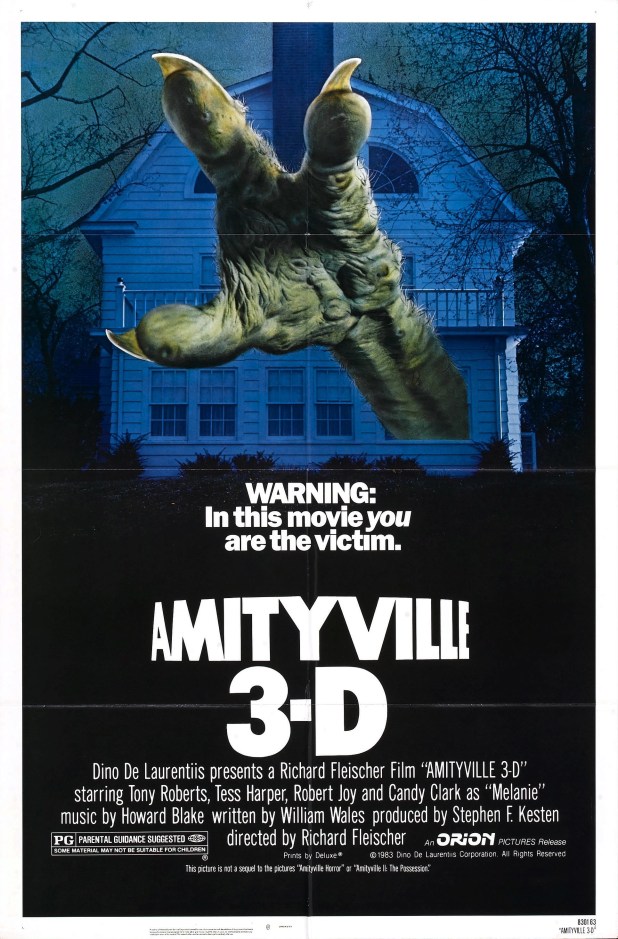
Amityville 3-D (1983)

The poster for this movie says: “WARNING: In this movie, you are the victim.” It’s factually correct, because if you were planning on being entertained, you’re out of luck. You’d be better off throwing $5 at the register and running out of your used video store than buying this DVD.

But really, Sam, why not tell us about the film first…

John Baxter (Tony Roberts, Annie HallPopcorn) is all about exposing psychic con artists, like James Randi with a white man afro. Along with his partner Melanie (Candy Clark, ex-wife of Marjoe Gortner and as well as acting in Cool as Ice, Q, 1988’s remake of The Blob and providing the voice of Stella Star in Starcrash) he busts up a special effects-aided seance at 112 Ocean Avenue (dum dum dum in Amityville!). The lady running the show spits right in his face and then, he decides to but the place after his real estate agent talks him into it. But guess what? Flies attack and kill that agent, turning him into a rotting corpse.

He buys the house anyway.

All manner of accidents befall John and Melanie. The worst one? Well, I guess that’d be when Melanie gets killed in a car wreck after seeing a demon’s face in a photograph and rushing to show John. But that dude just thinks it’s all a coincidence. Oh, John.

What would make things worse? What if John’s daughter Susan (Full House’s Lori Laughlin), her friend Lisa (Meg Ryan!) and their boyfriends play Ouija in the attic.? The game tells them that Captain Howdy just got a promotion to Admiral. Just kidding. The game informs Susan that her life is in danger, but she ignores it and dies in a boat accident. Her mom, Nancy, sees a vision of her walking up the stairs of the dock, but nope. She’s a goner.

John still thinks this is all make believe, even when his ex-wife thinks her daughter is still alive and he keeps having dreams about the old well in the basement. So he brings in Doctor Elliot West (Robert Joy, Desperately Seeking Susan) and his team, who succeed in getting the demons in the house to show up. Elliot asks for whatever in the well to reveal itself and bring Susan back to life, but in one of the few bright spots in the film, a demon leaps out — right at the viewer — and burns the doctors face and drags him to Hell. The house implodes and only a few of the team, Nancy and John escape. The well keeps glowing as we hit the credits.

Due to a lawsuit between the Lutz family (the original owners of the Amityville house) and Dino De Laurentiis, this is film does not refer to them at all and had to be listed as not a sequel to the original film. That said — the DeFeo family who lived in the house before the Lutz’s are referenced more than once. But hey — weren’t they called the Montelli family in Amityville II: The Possession? At least John is based on someone real —  Stephen Kaplan, who was investigating the film at the time of filming as he was sure that the Lutzes’ story was a hoax.

Look, you may enjoy this film. But after the complete and utter insanity that is the second film in the series, it feels like a step backward. But where can you really go after part 2? It’s a film that throws you down the steps and laughs at you.

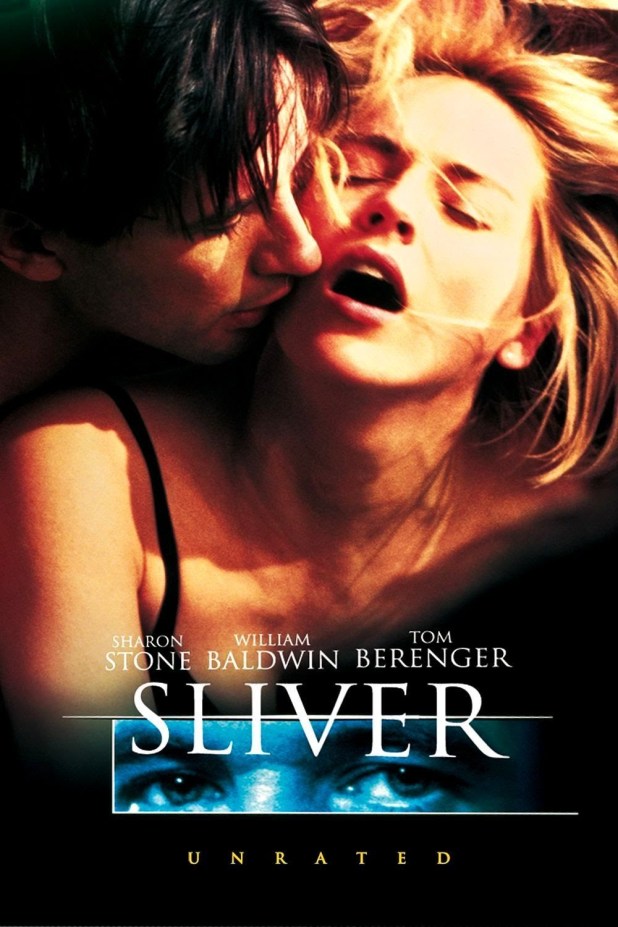
AMERICAN GIALLO: Sliver (1993)

Remember Joe Eszterhas? The writer who pretty much owned the theaters in the late 80’s and early 90’s with films like FlashdanceBasic InstinctJade and Showgirls?  In addition to Sliver, at least two of the films above — Basic Instinct and Jade — could qualify as giallo-style films. When reviewed through the lens of 2018, his films seem puerile at worst and silly at best, gradually becoming goofier the sexier they claim to be.

Directed by Phillip Noyce (Dead CalmThe Saint), based on a novel by Ira Levin (Rosemary’s BabyNo Time for SergeantsDeathtrapThe Stepford WivesThe Boys from Brazil…man, did Ira have his finger on the pulse of pop culture or what?) and produced by Robert Evans (Ever wonder who owns the IOU on my writing style? Wonder no longer, baby. Also, watch The Kid Stays in the Picture to learn how the producer of The Godfather and Rosemary’s Baby was often more interesting than the stars of his films), Sliver was originally rated NC 17 due to its sex scenes and some male frontal nudity. Also, there was an original ending — we’ll get to it in a bit — that audiences hated.

Carly Norris (Sharon Stone, Basic Instinct) is a book editor that never seems to go to her job. While she is there, she spends most of her time gossiping and bemoaning the fact that she never gets to have sex, despite being oh so fashionable and, you know, looking like Sharon Stone in 1993.

Somehow, she gets to immediately move into the best New York apartment ever, as the previous tenant (Naomi Singer, who looks exactly like Carly, which is a giallo staple if I’ve ever heard of one) has recently fallen to her death from her balcony.

Everyone in the building wants to get to know her, no one more than Zeke (William Baldwin, Flatliners). Within, oh let’s say a day or two, they’re having sex all over the place and talking about flying a plane into a volcano. He says that he designs “computer video games” and she’s just happy to have a younger man interested in her, despite the fact that she has a six-figure clothing budget (giallo fashion alert) and, you know, looks like Sharon Stone in 1993.

Carly also has another suitor, a writer named Jack (Tom Berenger, Major League) who is the most sexist character in the film, but certainly not in Eszterhaus’ oeuvre. As more neighbors begin to die, she begins to distrust both Zeke and Jack.

Oh yeah — there’s also Vida Warren, who is a model, but also a hooker, and also has the worst cocaine snorting scene in the history of film, treating it as a child would Pixie Stix.

At the close of the film, we learn that Jack killed Naomi, the original tenant because he was jealous of Zeke, who actually designed and owns the building. Zeke knew Jack killed her because of his network of security cameras, but he didn’t want his secret getting out.

Zeke invites Naomi to enjoy the cameras, but she eventually destroys his control room, telling him to get a life before she leaves both him and her home.

Joe Eszterhas’s original ending — where Zeke turns out to be the killer, revealed to a sympathetic Naomi as they fly over and perhaps into a volcano — was “incomprehensible to test audiences,” which led to Eszterhas writing five different endings. The re-shot ending, where actors Tom Berenger and Polly Walker wear S&M fashions, had to be filmed with body doubles as the actors did not agree to this in their contracts. Eszterhas hates the film, particularly the new ending and final line.

The sex scenes were a big deal when this came out. During the filming of them, Sharon Stone bit William Baldwin’s tongue “with such force that he couldn’t talk properly for days afterwards.” This may be why neither actor would speak to one another by the end of the filming. What remains on the screen is coupling that is at best robotic and at worse, ridiculous. It’s still not the worst sex scenes in an Eszterhaus film.

Sliver is filled with that trademark Eszterhaus wit. Witness dialogue like Carly saying, “You’ve been spending too much time with your vibrator.” Her friend’s reply? “I certainly have – I’ve been getting a plastic yeast infection!” By wit, I mean copious amounts of the kind of sex talk that CEO’s that have been removed thanks to modern thinking and the #MeToo movement would find humorous or normal.

Oh yeah! Martin Landau is in this and utterly wasted! There’s no reason for him to even be in this movie! He does absolutely nothing other than make you look at the screen and say, “Martin Landau is in this.”

The giallo themes that the film starts with — Carly being a dead ringer for a murdered woman, high fashion, the promise of kink — pretty much go nowhere. The film was a commercial, if not an artistic success. But it seems like there was so much promise that goes undelivered and the film begs for an Argento or even DePalma touch. Even a late in the movie knife murder reminds you that this film could be all masked faces and black leather gloves, but never goes all in.

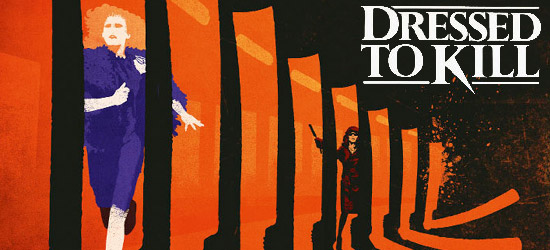
AMERICAN GIALLO: Dressed to Kill (1980)

Let’s get this out of the way: Brian De Palma, much like Giallo, was heavily influenced by Hitchcock. In fact, when an interviewer asked Hitchcock if he saw the film as an homage, he replied, “You mean fromage.” That said — Hitchcock died three months before the film was released, so that story could be apocryphal (it’s been said that the famous director made this comment to either a reporter or John Landis).

What is true is the interview that De Palma did after Dressed to Kill (Rolling Stone, October 16, 1980).  The director claimed, “My style is very different from Hitchcock’s. I am dealing with surrealistic, erotic imagery. Hitchcock never got into that too much. Psycho is basically about a heist. A girl steals money for her boyfriend so they can get married. Dressed to Kill is about a woman’s secret erotic life. If anything, Dressed to Kill has more of a Buñuel feeling.”

However, I’d argue that this film has more in common with Giallo than anything the “Master of Suspense” directly created. That’s because—to agree with DePalma above—this film does not exist in our reality. Much like Argento’s The Bird with the Crystal Plumage, it exists in its dream reality, where the way we perceive time can shift and change based on the storyteller’s whims.

Yet what of DePalma being dismissive of Argento in interviews, claiming that while he saw the director as having talent, he’d only seen one of his films? Or should we believe his ex-muse/wife Nancy Allen, who claims that when she told DePalma that she was auditioning for Argento’s Inferno, he said, “Oh, he’s goooood.”

Contrast that with this very simple fact (and spoilers ahead, for those of you who worry about that sort of thing, but face facts, this movie is 37 years old): DePalma rips off one of Hitchcock’s best tricks from Psycho: he kills his main character off early in the film, forcing us to suddenly choose who we see as the new lead, placing the killer several steps ahead of not just our protagonists, but the audience itself.

And yet there are so many other giallo staples within this film: fashion is at the forefront, with a fetishistic devotion to gloves, dresses, spiked high heels, and lingerie being displayed and removed and lying in piles all over an apartment or doctor’s office. This is the kind of film that makes you stop and notice an outfit, such as what Kate Miller (Angie Dickinson, Big Bad Mama, TV’s Police Woman) wears to the Metropolitan Museum of Art or the blue coat that Liz Blake (Nancy Allen, CarrieStrange Invaders) wears to meet Dr. Robert Elliot (Michael Caine, how could we pick any movie other than Jaws 4: The Revenge).

Then there are the music cues from Pino Donaggio, who also scored Don’t Look Now, Fulci’s The Black Cat, and Argento’s Do You Like Hitchcock? The film not only looks the part, but it has intense sound, too.

We also have characters trying to prove their innocence, investigating ahead of the police. Or the son of the murder victim who wants to discover why his mother really died. Or her doctor, who has an insane patient named Bobbi who has stolen his straight razor and demands that she give him more time than the rest of her patients. All of them could be the killer. Giallo gives us no assurances that just because we see someone as the protagonist, there’s no reason they couldn’t also be the antagonist.

Let’s toss in a little moral ambiguity here, too. Kate is a woman who is bored with her life. She’s raised a son and seen her marriage lose any hope of sexual frisson. Liz is a prostitute — no slut shaming here, she’s a strong businesswoman more than anything  — but she’s also a practiced liar, as a scene shows her deftly manipulating several people via phone to get the money she needs to buy stock based off an insider tip she receives from a client. Dr. Elliot is obviously attracted to Kate but claims that his marriage prevents him from having sex with her. Yet it seems like he has secrets beyond informing the police of the threats of his obviously unbalanced patient, Bobbi. And then there’s Peter, Kate’s son, who has no issues using his surveillance equipment to spy on the police or Liz. If this character seems the most sympathetic, remember that he is the closest to the heart of DePalma, whose mother once asked him to follow and record his father to prove that he was cheating on her.

Finally, we have the color palette of Bava’s takes on giallo mixed with extreme zooms, split screens and attention to the eyes of our characters. The blood cannot be redder.

The film opens with Kate in the shower. While the producers asked Dickinson to claim that it’s her body, it’s really Victoria Johnson (Grizzly) as a body double. Her husband comes into the shower to make love to her, but she finds it robotic and not the passion she feels she deserves. Directly after, she tells Dr. Elliot that she’s frustrated and attempts to seduce him, but he rejects her.

More depressed than before the appointment started, she heads to the Metropolitan Museum of Art. Despite being surrounded by inspiration, such as the statue of Diana by Saint-Guadens, West Interior by Alex Katz and Reclining Nude by Tom Palmore (a tip of the hat to the amazing I Talk You Bored blog for an insightful take on the film and the research as to what each work of art is), she absentmindedly writes entries in her schedule. Planning the holiday meal gets her through the mindlessness of her life, flowing penmanship reminding her to “pick up turkey” instead of slowing down and appreciating not just the artwork around her but the people. There’s a young couple in lust if not love. There’s a young family. And then, a man with dark glasses catches her eye before brazenly sitting down next to her.

We are used to male characters chasing after female characters who aren’t defined by anything other than being sex objects. Instead, we have Kate pursuing the man, making the first, second, and even third moves until we realize that she was just following the man’s breadcrumbs.

Of note here is that color plays an essential role in the scene, as do expected manners. Kate is a wife and mother. She is who society expects to have virtue, and she is clad in all white, but her intentions are anything but pure. She finally has what she wants—the thrilling sex life that she may have only read about in trashy paperbacks.

This scene is a master class in pacing and movement. Imagine, if you will, the words on the page: Kate follows a mystery man through the museum. And yet, those are just eight words. We get nearly nine minutes of wordless pursuit, yet it never grows dull.

Finally, Kate follows the man out of the museum, but she loses him until she looks up and sees her glove dangled from a taxi. But blink, and you miss death in the background as Bobbi blurs past the camera.

When we catch up with Kate, it’s hours for her but seconds for us because this movie is a dream universe. She wakes up in bed with a stranger. There’s a gorgeous camera move here as DePalma moves the camera backward, an inverse of how a lesser director would have treated this scene. Instead of showing the two lovers tumbling through the apartment and removing clothes at every turn, we see Kate reassembling herself to move from her fantasy world to reality and toward her real world, which will soon become a nightmare. The camera slides slowly backward as she gets dressed, remembering via split-screen and sly smile how she doesn’t even remember where her panties have gone. She’s still wearing white, but under it all, she’s bare, her garments lost in a strange man’s house. A man whose name she doesn’t even know.

So now, as she emerges from realizing her sexual fantasies, she feels that she must make sense of it. She wants to write a note to say goodbye but doesn’t want to overthink it. Maybe she doesn’t even want it to happen again. And then she learns more about the man. It starts with his name and then becomes more than she ever wished to find out: his health report shows that he has multiple STDs.

Kate leaves the apartment and makes her way to the elevator, where she tries to avoid anyone’s eyes. In the background, we see an ominous red light, ala Bava. Bobbi—death and punishment for sin—is coming.

The death scene — I hold fast to my claim that The New York Ripper is close to this film but made by a director who doesn’t have the sense to cut away from violence — DePalma stages his version of the shower scene. But more than Psycho, we’ve come to identify with Kate. She’s a woman fast approaching middle age who wants a thrill, and yet, she’s punished by disease and death. She didn’t deserve this, and her eyes pleaded not to the killer as much as they did to the camera. And to us.

Here’s where we have to wonder aloud about DePalma’s long-discussed misogyny. This film was protested by women’s groups, who stated in this leaflet that “FROM THE INSIDIOUS COMBINATION OF VIOLENCE AND SEXUALITY IN ITS PROMOTIONAL MATERIAL TO SCENE AFTER SCENE OF WOMEN RAPED, KILLED, OR NEARLY KILLED, DRESSED TO KILL IS A MASTER WORK OF MISOGYNY.” Is DePalma guilty of the slasher film trope of “you fuck, and you die?” Maybe. Perhaps if she had remembered her marriage, at best, she wouldn’t be here. At worst, she wouldn’t have forgotten her ring in the stranger’s apartment and would have survived.

The way I see it, the death of Kate allows us to make the transition from past protagonist to new heroine, as the doors open post-murder to reveal a grisly scene to Liz and her john. The older man runs while Liz reaches out to Kate, their eyes meeting and fingers nearly touching. Kate’s white purity has been decimated by the razor slashes of Bobbi, the killer. As their transference is almost complete, Liz notices Bobbi in the mirror. Remember that we’re in a dream state? Time completely stops here, so we get an extreme zoom of both the mirror and Liz’s face. She escapes just in time, grasping the murder weapon and standing in the hallway, blood on her hands as a woman screams in the background, figuring her for the killer.

At this point, the film switches its protagonist. Unlike the films of David Lynch, like Mulholland Drive, this transference is not a changed version of the main character, but her exact opposite. Kate wore white, was older, and had a marriage and child, yet she slowly came to feel like an object to the men in her life. Liz wore black, was young and single, but was wise to the games of sex and power. She isn’t manipulated, turning the tables on men by using their needs for personal gain. Kate may have seen sexual fantasy as her greatest need, but for Liz, it’s just a means to an end.

Kate and Liz are as different as can be. For example, Kate goes to the museum to find inspiration. Liz only sees art as commerce, and she spends plenty of time explaining to Peter how much money she could make by acquiring a painting.

Dr. Elliott discovers a message from Bobbi on his answering machine (these machines and the narrative devices they enable must seem quaint and perhaps even anachronistic to today’s moviegoers). Once, Bobbi was his patient, but he refused to sign the paperwork for their (as the pronoun hasn’t been defined, so I’ll use they/their) sex change. In fact, Dr. Elliot has gone so far as to convince Bobbi’s new doctor that they are a danger to herself and others.

The police, however, have arrested Liz, and Detective Marino (Dennis Franz, TV’s Hill Street Blues and NYPD Blue) doesn’t believe a word she has to say. There’s a great moment here where Liz goes from wide-eyed ingenue to knowing cynic in the face of Marino’s misogynistic tone. Meanwhile, Kate’s son Peter (Keith Gordon, Jaws 2Christine) uses his listening devices in the station to learn more about his mother’s death than the police are willing to let on.

He begins tracking Liz, obsessively noting the times that she comes and goes from her apartment. He’s doing the same to Elliot’s office. But he’s not the only one tracking people. Bobbi has been stalking Liz, including a sequence where our heroine goes from being chased by a gang of black men to talking with an unbelieving police officer to Peter saving her from Bobbi with a spray of mace.

Because Peter has seen Bobbi also emerging from Dr. Elliott’s office, so he joins forces with Liz to discover who she is. That means that Liz uses her chief weapon — sex — to distract the doctor long enough to discover Bobbi’s real name and information. We learn that Liz’s mental sex game is as strong as her physical attributes here — she says that she must be good to be paid as well as she is. She knows precisely the fantasy Dr. Elliott wants to hear. But perhaps she also knows the fantasy that the mainly male slasher/giallo viewer wants: the woman submitting to the killer holding the knife.

Peter watches outside in the rain when a tall blonde pulls him away. Has he been taken by Bobbi? No — Liz returns to have sex with Dr. Elliott; he has been replaced by the killer. Bobbi lifts the razor as Liz helplessly crosses her arms in front of her face for protection. But at the last minute, the blonde who grabbed Peter outside is revealed to be a police officer, as she shoots Bobbi through the glass. That shattered pane also breaks Bobbi’s illusion and mask, revealing that Dr. Elliott is the man under the makeup and clothes.

The killer is arrested and goes into an insane asylum; Dr. Levy explains that while the Bobbi side of his personality wanted to be free, the Dr. Elliott side would not allow them to become a true woman. Therefore, whenever a woman broke through and aroused the male side of the persona, the female side would emerge and kill the offending female.

Inside the mental asylum, a buxom nurse attends to the male patients. The room is bathed in blue light, a cool lighting scheme that echoes Mario Bava’s films. The movie has moved from a dream version of reality to a pure dream sequence. It intrigues me that Carrie and Dressed to Kill both start with a shower scene and end with a dream threat to the surviving secondary heroine.

Within the asylum, Dr. Elliott overcomes the nurse and slowly, methodically, folds her clothing over her nude form. As he begins to either dress in her clothes — or worse, molest her dead body — the camera slowly moves upward as we realize that there is a gallery of other patients all watching and screaming. This scene reminds me of the gallery of residents watching a doctor perform surgery, yet inverted (have you caught this theme yet?) and perverted.

Bobbi emerges once again, and because she is dead, she cannot be stopped. Liz is bare and helpless in the shower, and nothing can protect her from being slashed and sliced and murdered — except that none of this is real. She awakens, screaming in bed, and Peter rushes in to protect her. And for the first time in the film (again, thanks to I Talk You Bored for noticing), she is wearing white.

Many find this a hard movie to stomach due to its misogyny. I’ll see you that and tell you it’s a misanthropic film that presents all of humanity, male and female, negatively. The men in this film are actually treated the way women usually are in films, as either silent sex objects (Warren Lockman), sexless enemies (Kate’s husband), shrill harpies that need to be defeated (Detective Marino) or sexless best friends who provide the hero with the tools they need to save the day (Peter). Seriously, in another film, one would think Peter would have a sexual interest in Liz, but despite her double entendres and come-ons, he remains more concerned with schedules and numbers and evidence.

Bobbi, the combination of male and female, comes across as a puritan punisher of females who benefit from sex, either emotionally or monetarily. Or perhaps they are just destroying the sex objects that they know that the male side of their brain will never allow them to become. Interestingly, Bobbi’s voice doesn’t come from Michael Caine but from De Palma regular William Finley (The Phantom of Phantom of the Paradise).

What else makes this a giallo? The police seem either unwilling to help at best or ineffectual at worst until they tie things up neatly at the end. And the conclusion, when the hand emerges not from the doorway — but the medicine cabinet — to slash Liz echoes the more fantastic films in the genre, such as SuspiriaAll the Colors of the Dark and Stagefright, where reality just ceases to exist. At the end of all three films, the heroine has confronted the fantastic and may never be the same.

In the first, Suzy narrowly escapes from hell on earth and emerges laughing in the rain. Is she happy that she survived? Has she achieved a break from reality? Is she breaking the fourth wall and laughing at how insane the film has become, pleased that the torture is finally over?

In the final scene of All the Colors of the Dark, the fantasy world is all a ruse, yet our heroine, Jane, is now trapped in the dream world. She can tell what will happen before it does; she knows that her husband has both slept with and killed her sister, but he has saved her from a fate worse than death. Yet all she can do is shout, “I’m scared of not being myself anymore. Help me!”

In Stagefright, the final girl walks out of the scene and out of reality as she defeats the killer. She has transcended being an actress to removing herself from fiction.

In all these films, the characters are not unchanged by their experiences with the dream world. In Dressed to Kill, the final dream sequence renders Liz truly frightened for the first time in the film. It’s the only time we see her as vulnerable — even when faced with an entire gang of criminals on the subway, she retains her edge. As Peter reaches out to comfort her — the only sexless male in the film and not just a sublimated one like Dr. Elliott — she recoils from his touch before giving in to his protective embrace.

In the same way, the film changes us. It has thrilled us, made us think, or even made us angry. True cinema—true art, really—makes us confront what we find most uncomfortable. Sure, we can deride and decry many of this film’s choices, but the fact that I’ve devoted days of writing and over three thousand words to it speaks to its potency. Thanks for reading if you’ve made it this far.
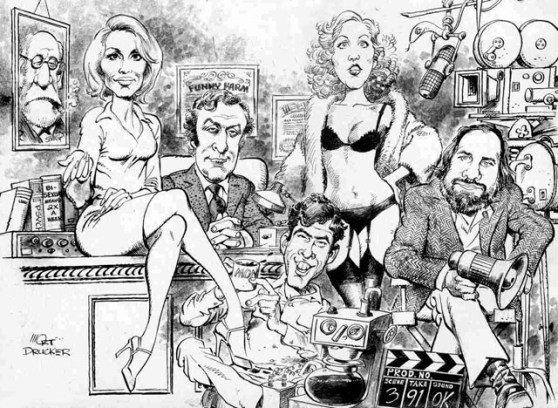
PS—I’ve often discussed—in person and on podcasts—that I experienced so many R-rated movies for the first time via Mad Magazine. I’m delighted I could find the Mort Drucker illustration for his skewering of Dressed to Kill.
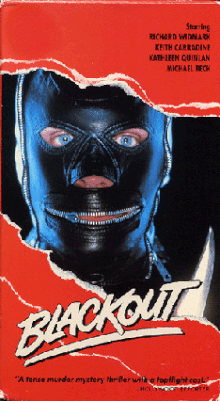
AMERICAN GIALLO: Blackout (1985)

Douglas Hickox directed one of my favorite films, Vincent Price’s Theater of Blood. And he also directed this — a TV movie turned video store favorite thanks to its striking box art.

Joe Steiner (Richard Widmark, whose portrayal of Tommy Udo in Kiss of Death would inspire Eric Binford in 1980’s Fade to Black) is a cop who can’t let go. A brutal slayer of an entire family on a child’s birthday has scarred him and he promises the dead family that he won’t rest until he brings their killer to justice.

Allen Devlin (Keith Carradine, Nashville) is a man without an identity. He was in a car crash that destroyed both his face and memory. He wakes up with a scarred visage that upsets nearly everyone that sees it except for his nurse, Chris Graham (Kathleen Quinlan, Airport ’77).

Mike Patterson (Michael Back, Swan from The Warriors) is another cop who was Chris’ boyfriend and lost her to Allen. He can’t let go.

All three men are trapped by the past: Steiner believes that Allen is the family killer. Mike wants Chris back at nearly any cost. And Allen might be a new person, born on the day of his car crash, but he may also be that killer. Even he isn’t so sure.

So how is this a giallo? It doesn’t have the expected psychosexual and fashionista elements, nor the camerawork showing the killer’s POV. However, it does feature plenty of identity confusion and a main character who may or may not be the villain.

Come to think of it, this film has a strange narrative in that there is no real hero of the piece, with all three men and Chris serving as characters within the story framework instead of a sole protagonist for us to root for.

For a TV movie, this gets pretty dark, with some uncomfortable male on female violence at the end. There’s also a great steadicam sequence where Chris opens door after door to try and find either her children or the killer, with the smooth movement of the camera slowly increasing her worry and making the scene quite claustrophobic.

Originally airing on July 28, 1995 on HBO, Blackout gained even more notoriety as it inspired Ed Sherman’s murder of his wife Ellen in August of that year. Sherman also used an air conditioner to slow the decomposition of his wife’s dead body in an attempt to establish his alibi.

Blackout has never been commercially released on DVD, but you can find it at the VHSPS, a great source for all films that have been forgotten.