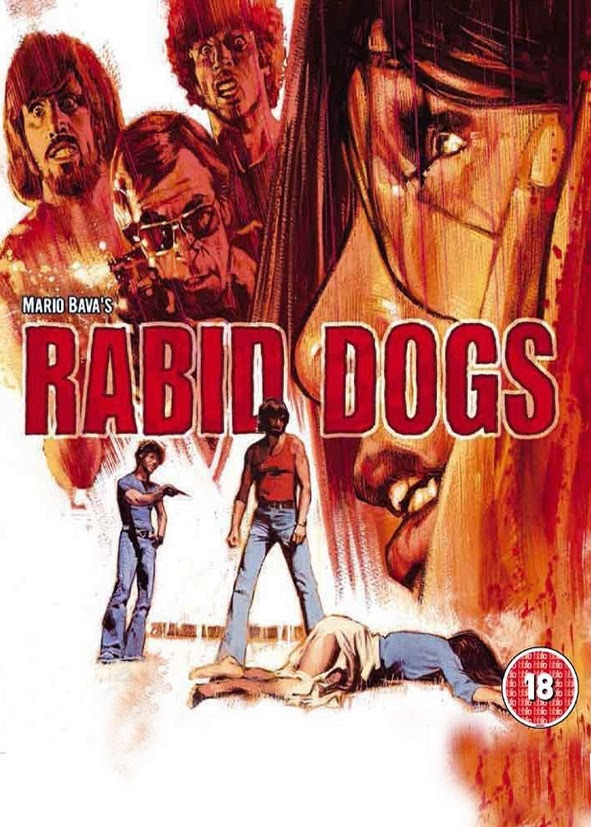
MARIO BAVA WEEK: Kidnapped/Rabid Dogs (filmed in 1973, released in 1998)

Lisa and the Devil was shelved after a negative reception at the Cannes Market. Bay of Blood was a box office disappointment. So Mario Bava decided to do something unlike any of his other films — developing a “poliziotteschi” film.

According to Roberto Curti’s Italian Crime Filmography, 1968-1980, poliziotteschi films “generally featured graphic and brutal violence, organized crime, car chases, vigilantism, heists, gunfights, and corruption up to the highest levels. The protagonists were generally tough working class loners, willing to act outside a corrupt or overly bureaucratic system.”

Bava filmed the entire film in chronological order, but the shoot was filled with issues. Original star Al Lettieri (The Getaway) was replaced after three days, mostly for showing up drunk. The replacement, Riccardo Cucciolla, spoke no English and had to read his lines from a script hidden inside the car (so Wikipedia says, but my copy is in Italian, so I have no idea why this was an issue).

Additionally, Bava’s son Lamberto, who was the assistant director on the film, has claimed that producer Roberto Loyola bounced all of the checks to the crew, who still finished the film within three weeks. All that remained were some cutaways and a pre-credit sequence, but Loyola went bankrupt and the film was lost in the courts.

There are numerous versions of this movie that were released in the mid 1990’s. For the interests of this article, we’ll focus on the Anchor Bay release of Kidnapped that was assembled by Alfredo Leone and Lamberto Bava.

After four crooks rob an armored truck, their getaway car is damaged and one of them is killed. The three that remain — Doc, Blade and Thirty-Two (George Eastman! Do I really need to tell you how much I love every movie this guy is in? Our site is literally his entire IMDB catalog, with movies like Stage FrightBlastfighterHands of Steel1990: The Bronx WarriorsWarriors of the Wasteland and more) — run into an underground garage, kill a woman and kidnap another named Maria (Lea Lander, Blood and Black Lace). They then steal another car driven by Riccardo (Cucciolla), who is trying to get a sickly child to a hospital before it’s too late.

The criminals force the man to drive them to their hideout. The film grows incredibly tense as Maria is on the verge of mania as she’s kept under gunpoint the entire way. Somehow, Ricardo remains calm. The heat is on, meaning that both the cops are on their tail and that the city is in the middle of summer. Doc forces the windows up on the car, keeping the nerves inside high.

Maria tries to escape after asking to be allowed to relieve herself outside, which leads to Blade and Thirty-Two capturing her and forcing her to do the act in front of them. It’s due to dogs, wandering the streets and barking, that she is caught (someday I have to do an IMDB list of movies that have dogs randomly wandering the streets).

These are base, horrible men who only know evil acts. After stopping for food and drink, Thirty-Two becomes drunk and attempts to rape Maria, an action that causes other motorists to notice the car. Doc replies by shooting his partner in the neck. The criminal lives, but now cannot move and is even more trapped than everyone else in the car.

The car stops to refill at a small town gas station, where the owner won’t even wait on them until his lunch is up. Doc tries to threaten him, but the old man has a gun at the ready. Blade finally resolves the situation by showing the sick boy inside the car and the old man decides to get back to work. However, a hitchhiker shows up and asks for a ride. As she gets in the car, the old man sees Thirty-Two’s bloody body, but he simply shrugs. It’s not any of his business.

The hitchhiker will not shut up, annoying everyone. When she removes the blanket and reveals Thirty-Two, Blade killing her feels like a relief. Doc asks Riccardo to pull over and they dump the body. And Blade carries out his friend Thirty-Two’s body and finally puts him out of his misery by shooting him.

Finally, they reach the group’s hideout, where Doc has another car and the papers that will allow he and Blade to leave the country. Then he reveals that he planned to kill Riccardo, the child and Maria. Riccardo begs for the boy to live, but Doc refuses and asks him to get him from the car. As Riccardo holds the boy, he pulls the gun he had inside the blanket all along, killing Doc and Blade, whose machine gun burst kills Maria. He takes Doc’s car and money, then leaves, only to reveal that he had been a kidnapper all along, holding the child for ransom. And the boy? Now he’s inside the trunk.

While this film has none of Bava’s trademark magic camerawork, it’s still taunt and well made. For example, in the scene where Doc shoots Thirty-Two, Bava uses tight close-ups of Doc and Riccardo’s faces, as well as the gun that Doc holds, then cuts to black as the car enters a tunnel. In that moment of no light or color at all on the screen — such a contrast to the dynamic hues we expect from the master — we simply hear the report of the gun being fired, stopping Thirty-Two’s rape of Maria. As we return to reality, Blade deals with his rage against Doc by screaming at his friend, only to discover that he is still alive. The flashbacks are relayed to us via voiceover instead of some dramatic camera move. Again — out of character, but this proves that Bava was not all special effects and tricks. He is filming the story as it should be filmed. The action inside the car is claustrophobic. And it had to have been even more so as it was filmed, as there’s real background zooming past behind the actors, so the camera was inside the car.

Also, this is a movie where you notice the acting so much more than in other Bava work. He takes a backseat to the true sense of dread and terror that his actors tell with their performances. I know that I’m a big Eastman fan, but he’s great in this film, a gigantic man child devoted to the id, barely restrained by the adult in the car, Doc.

Following this film, Bava would only work on one more film, 1977’s Shock. He would also do special effects work and uncredited direction on Dario Argento’s Inferno before his death in 1980.

In his later years, Bava left behind many unfilmed ideas. He was about to start filming a science fiction movie called Star Riders with Luigi Cozzi. That movie may have been the much-talked about sequel to Starcrash, which would have starred Caroline Munro and Klaus Kinski as the evil Baron Waak. Munro said of the film at Cannes, “With (her husband) Judd as my comical robot sidekick, El, we have a new mission. To help Baslim, a faithful officer in a dead king’s army, to unravel a mysterious plot of assassination and deceit-and save the life of a beautiful young princess.”

According to this amazing article, Bava had several science fiction films in mind, including the Dardano Sacchetti (The Beyond, A Bay of BloodThe House by the Cemetery, as well as just about every amazing Italian horror movie that is near and dear to your heart) scripted Anomalia, a Lovecraftian script about astronauts who find a wall at the end of the universe that separates good from evil. Holy shit, this is a film screaming to be made. There was also a plan to make The Space Wanderer, based on the Philip José Farmer book Venus on the Half-Shell, that sounds even more insane than that!
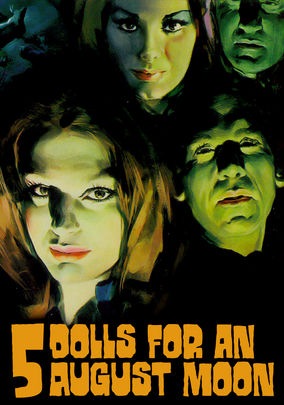
BAVA WEEK: Five Dolls for an August Moon (1970)

Bava believed this was one of his worst films. It wasn’t released in the U.S. until 2001. And yet, I found plenty to like about this murder-filled affair. It also taught me an important lesson: if you invent a new chemical process, don’t go to a rich industrialist’s vacation island.

George Stark is one of those industrialists and he’s invited a bunch of guests to his private island, including Professor Farrell, who has created an industrial resin. Several of the guests want him to sell it. Here’s where the hijinks ensue.

Stark’s wife Jill is sleeping with Farrell’s wife, Trudy (Ira von Fürstenberg, The Fifth Cord). Stark’s partner Nick treats his wife, Marie (Edwige Fenech!) horribly, but allows her to sleep with Charles, one of the servants. Isabelle (Ely Galleani, A Lizard in a Woman’s Skin) is a teenage girl along for the ride. And Jack and Peggy just seem to get along, unlike everyone else.

The men beg Farrell for his formula, sending away the only way off the island — a motorboat — away until the deal is done. So when Charles is killed, they simply hang him in the freezer until they can get the radio working to call the mainland. As you do.

Then, teenage Isabelle kills Farrell, but the others only know he’s dead. The killings now pick up, with Peggy being shot to death, Marie being stabbed and Jill being electrocuted in the bathtub. One by one, their bodies are added to the freezer.

With Isabelle having gone missing, Stark, Jack, Nick, and Trudy decide to stay in the same room for the night, as one of them has to be the murderer. Nick takes off after an argument and is found dead the next day, so of course, as is custom, he is also added to the freezer.

Stark has a boat, which makes you think he’d be the suspect. But as he comes back to the house, Jack reveals that he has killed everyone else to steal their checks. He kills Stark and meets with Trudy, who was the real boss. She’s got the resin formula. He has the checks. But they’re both out for themselves and end up killing one another. Isabelle makes herself known and takes everything.

That’s not the whole story. Isabelle also shows up to see Farrell in prison. He didn’t die, but had come up with the whole scheme with Trudy. Turns out he wasn’t the good man that he appeared to be and had stolen the formula. He got Isabelle to be part of his plan, but she gave him a drug that would make him appear to be dead, then pushed him out to the sea. Rescuers found him and he was so messed up on the drug that he confessed. She laughs about the whole thing and leaves the prison, finding it all rather funny that he’ll be hung in the morning while she’ll enjoy three million dollars.

There are better Bava films to be found, but there are plenty of twists and turns in this film. It’s certainly entertaining and you know, Edwige Fenech is in it. So there are way worse movies to spend your time with.

Just remember. If you come up with a great formula or steal one, just keep it to yourself. And don’t go on vacation. Stay at work.

UPDATE: You can watch this for free on Amazon Prime.

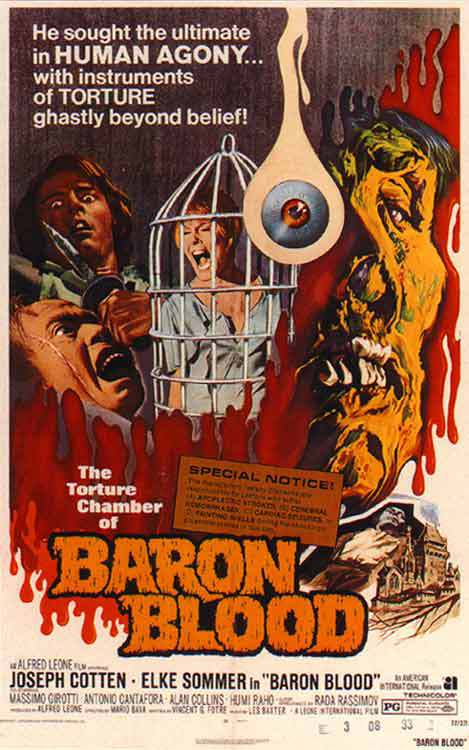
BAVA WEEK: Baron Blood (1972)

There’s an urban legend called The Well to Hell, which claims that you can hear Hell through a hole in the earth, and there have even been audio recordings posted as proof. Those recordings have been revealed to be the soundtrack to this film. That should tell you what you’re getting into.

Peter Kleist arrives from America to take a break and study his family’s history. His uncle Karl allows him to stay at his large mansion and refuses to discuss their ancestor, Baron Otto Bon Kleist, better known as Baron Blood for the torture and murder he inflicted on the village. His foremost crime was burning a witch named Elizabeth Holly at the stake as she cursed him to rise from the dead again and again, knowing no rest, so that she could take her revenge on him over and over again. The Baron’s castle is being remodeled for tourists, so Peter asks his uncle to take him there.

At the castle, Peter meets Eva (Elke Sommer, Lisa and the Devil), who works with Dortmund, a businessman who is fixing the castle. She is there to ensure that Blood’s castle retains its original beauty. Eva comes to Karl’s house for a meal, where we learn that Baron Blood has been seen in the woods near the castle. And Peter has found an ancient spell that will awaken the spirit of the Baron. Karl warns him of dabbling in the occult, and seeing as we’re only a few minutes into the movie, we know he won’t listen.

Of course Peter and Eva go to the bell tower and read the spell at midnight. The bell tolls two, not twelve, symbolic of the time of day that Blood’s victims rose and killed him. Eva begs Peter to reverse the spell, but a gust of wind blows the spell into a fireplace as the Baron emerges from his grave.

The Baron is born with the same wounds he died from, wounds even a doctor cannot heal. He then goes on a killing spree, starting with the doctor and a gravedigger, then hanging Dortmund and smooshing the castle’s caretaker inside a spiked coffin.

The next day, Alfred Becker (Joseph Cotton, The Abominable Dr. Phibes), a disabled millionaire in a wheelchair, purchases the castle. He seems decent, so Eva stays on long enough to have the Baron attack her again. She quits her job and moves to the city, only for the black-clad Baron to follow her, chasing her through the foggy streets in a pure Bava scene. She escapes to Karl’s home and luckily, he finally believes that the Baron is still alive.

A local medium helps them bring back Elizabeth Holly, who gives them a magic amulet and the knowledge that only they can destroy the Baron because Peter and Eva brought him back. The moment they leave, the Baron kills the psychic.

The Baron also chases Karl’s young daughter. She then realizes that the Baron and Becker are the same man, as their eyes burn like fire. When they confront the man who uses a wheelchair with this revelation, he denies it and shows them his castle, which now has dummies impaled on stakes as decorations. As they debate what to do next, he rises from his wheelchair and knocks all of them out, taking them to his torture chamber.

Eva learns that when her Blood and the amulet unite, the Baron’s victims all return from the dead. They rise and tear him apart limb by limb as Peter, Eva and Karl escape. As the film ends, we hear Elizabeth Holly’s laughter.

Critically, this is not considered one of Bava’s best. However, I found plenty to like, including the Baron’s quite frightening design. And how can any movie that features Elke Sommer running through the fog be bad?

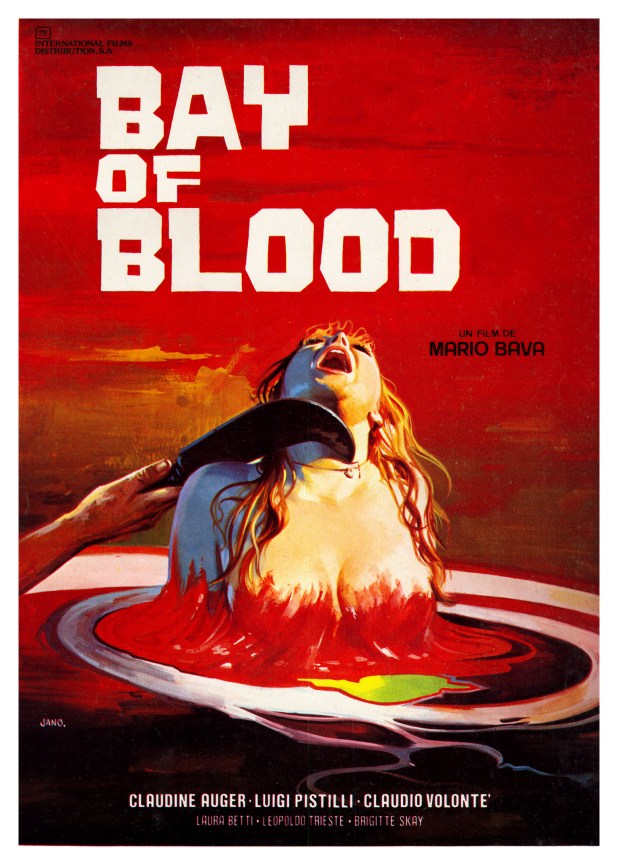
BAVA WEEK: A Bay of Blood (1971)

Also known as Ecology of CrimeChain ReactionCarnageTwitch of the Death Nerve and Blood Bath, Last House on the Left – Part II and New House on the Left, this is the most violent and nihilistic of all of Mario Bava’s films. It started as a story idea so that Bava could work with Laura Betti (Hatchet for the Honeymoon) again, with the original titles of Stench of Flesh and Thus We Do Live to Be Evil, but had a virtual litany of writers get involved, including producer Giuseppe Zaccariello, Filippo Ottoni, Sergio Canevari, Dardano Sacchetti (who co-wrote all of Fulci’s best films, like Zombi 2 and House by the Cemetery) and Franco Barberi.

Bava was devoted to the film and its low budget meant that he would also be his own cinematographer, often creating innovative tracking shots with a toy wagon and relying on in-camera tricks to make it seem that the location was much more expansive than reality. 

There are thirteen murders in the film — many of which are incredibly gory thanks to the skill of Carlo Rambaldi — occur as several characters in the film vie to inherit the titular bay. The film divides critics and fans, who see it as pure gore versus the nuanced films that Bava is known for. For example, Christopher Lee went on record stating that he found the movie to be revolting.

It also gave rise to the slasher genre, as every film that follows owes it a debt of gory gratitude. And some owe it plenty more, in particular, Friday the 13th Part 2, which copies two of the kills in this film shot for shot.

The story is all over the place and has a mix of dark humor and pure meanness at its core, starting with Filippo Dontai strangling his wife, Countess Federica, before being stabbed and killed scant seconds later. His corpse is dragged to the bay, where his murder goes undiscovered as detectives begin their investigation into the death of the Countess.

That’s when we meet Frank (Chris Avram, Enter the Devil), a real estate agent, and his girlfriend Laura, who plot on taking over the bay. They were working with Donati to kill his wife and now need his signature, but don’t realize that he was killed.

Meanwhile, four teenagers hear about the murders and break into the mansion. One of them, Brunhilda, skinny dips in the bay until the dead corpse of Donati surfaces and touches her. She screams and runs toward the mansion, only to be killed by an unseen murderer holding a billhook. That killer uses that same weapon to kill her boyfriend, Bobby, then he impales Duke and Denise together with a spear while they’re having sex. Here’s a good lesson that I always yell: don’t fuck in the woods, don’t fuck in a haunted house, don’t fuck when a killer is about.

The killer ends up being the Countess’ illegitimate son, Simon, who is wiping everyone out under the orders of Frank. Renata (Claudine Auger, Thunderball) shows up to throw a wrench in the work, as she’s the Countess’ real daughter. Along with her husband Albert, she begins to make plans to kill her half-brother.

What follows is a near Grand Guignol of back and forth murder: Frank attacks Renata, who turns the tables and stabs him with a knife. Paolo, the entomologist who lives on the estate grounds, sees the killing but is strangled by Albert before he can call the police and his wife is decapitated with an axe. Laura shows up, but Simon strangles her to death before Albert kills him. Frank shows up again, but Albert takes him out, leaving Renata as the sole heir.

They return home to await being awarded the money, but as they get to the front door, their children shoot them with a shotgun, thinking they are playing with their parents. Bored with the game and how long their parents are playing dead, the kids run out to play another game in an ending that can either be viewed as pure comedy or a sad comment on humanity. Maybe both.

Bay of Blood isn’t the art of past Bava films, but it’s not trash. It’s also been claimed to have been Bava’s favorite film that he directed. And Dario Argento adores the movie so much that he literally stole a print of it from a theater!

You don’t have to resort to larceny. You can just watch this on Shudder.

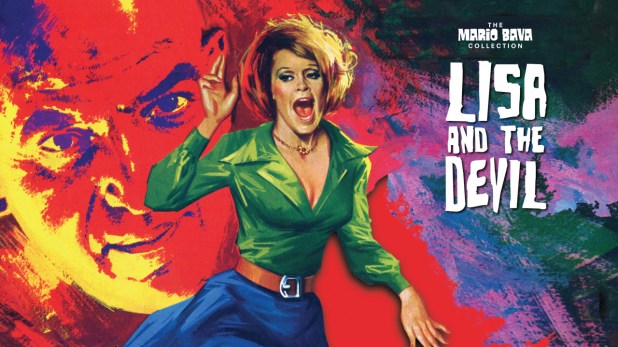
BAVA WEEK: Lisa and the Devil (1973)

By the late 60’s, a series of commercial failures caused Mario Bava to lose his deal with American International Pictures, but the successes of Twitch of the Death Nerve and Baron Blood turned his fortunes around. Now, he was allowed to make movies without studio interference.

Bava was allowed to create Lisa and the Devil as a non-commercial film, but it flopped in Italy and the U.S., where it would be retitled House of Exorcism with twenty minutes of the film cut and a new scene with Elke Sommer and Robert Alda would rip off The Exorcist. Producer Alfredo Leone wanted this new footage to have profanity and strong sexual content, which Bava refused to do. He even tried to get Sommer to not be in these scenes and dropped out of the film. The re-edited (that’s being really fair to what is a hack job) version also flopped. For a much more in-depth telling of this story, please visit Groovy Doom.

So what is Lisa and the Devil about? Well, Lisa is a tourist who wanders away from a guided group tour to explore an antique store where Leandro (Telly Savalas, who if you ever get the chance to visit Pittsburgh, is featured in an epic photo in the Hollywood Bowl area of the famed Arsenal Lanes bowling alley) is purchasing a dummy. She looks at the man — who looks just like a demon she saw in a fresco — and runs. She then meets a mustache wearing man who recognizes her, but she bumps him into falling down the stairs to his death (or maybe not).

Lisa can’t find her way back to her tour, so she follows a couple and their driver (who is secretly dating the wife), but they break down at a mansion where Leandro coincidentally  (or maybe not) works as a butler for the blind Countess and her son Maximilian, who begs his mother to let them stay.

The mustache man may (or maybe not) still be alive, as he stalks Lisa. There’s also a mystery guest in the mansion who may be a prisoner and Lisa may (or maybe not) be Elena, Maximilian’s long-lost lover. And oh yeah, the mustache guy is really Carlos, the Countesses second husband and Elena or Lisa (or maybe not) was sleeping with him.

This next part needs some careful wordsmithing. Carlos — that’s mustache man’s name — is being prepared for burial by Leandro while still being alive. Lisa freaks out as he tries to take her away from the mansion, but he’s killed by Maximilian, but then he’s not even real, but the dummy Leandro bought at the start of the movie.

If that made you say, “What the fuck?” then get ready. The young driver loverboy is killed while fixing the car, but Leandro offers to cover it all up if he can take care of the body. The husband demands that his wife leave with him, so she runs him over with the car. Then, she is murdered by Maximilian. Whew.

Lisa is knocked out by all of this and Leandro dresses her like Elena. Turns out he is a demon indebted to the Countess and Maximilian and forced to help them play out their lives again and again and again, using dummies to represent each of them. As Lisa arrived and interrupted his shopping for new dummies, her real form must now become Elena. But wait? Isn’t Lisa Elena? That’s what Maximilian thinks, as he takes her to the secret room, where we learn that Elena’s corpse and ghost are the mystery guest. He drugs Lisa and starts to rape her when the ghost laughs at him, causing him to stop and tell his mother what he has done: he killed Carlos for betraying his mother by sleeping with Elena, but imprisoned her rather than letting her get away. When his mother tells him the only next logical step is to kill Lisa, he kills her instead.

He then finds every dead person all gathered at a table for dinner. His mother tries to kill him, so he jumped out a window and is impaled on a fence. Leandro appears behind the dead bodies.

Lisa escapes, but not before she sees Leandro refuse to accept a doll of her. On an amazing 1960’s plane, complete with spiral staircase, she discovers that the entire plane is empty, except for the pilot — Leandro. She collapses and becomes the dummy that he carries back to the house.

Lisa and the Devil was Bava’s dream project turned nightmare. The end result — which didn’t play in wide release in the director’s lifetime — is a waking dream of doom, dread and predestined death. I wouldn’t recommend it if you’re looking for a straight narrative, but it’s a strong film for those seeking to explore and be mesmerized.

UPDATE: You watch this for free on Amazon Prime.

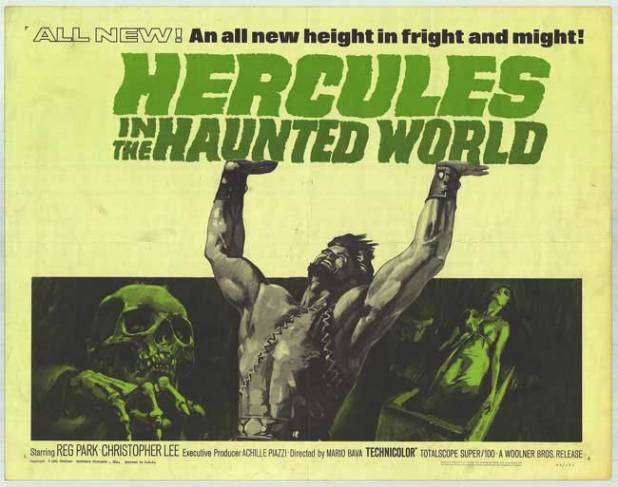
BAVA WEEK: Hercules in the Haunted World (1961)

Using some of the same sets from Hercules and the Conquest of Atlantis, Mario Bava (Blood and Black LaceBlack Sunday) created a masterpiece with this film. Featuring Reg Park (who appeared in four Hercules films and was considered a mentor to Arnold Schwarzenegger) and Christopher Lee (The Satanic Rites of DraculaThe Wicker Man, everything good and right about horror movies), this would influence every sword and sandal movie that would follow, as well as films like Flash Gordon.

Despite the size of the budget and the cheapness of the sets, Bava crafts a totally unique world, filled with rich colors and billowing smoke. And with Lee as King Lico, there’s finally a villain that feels worthy of Hercules’ bold heroics.

As Hercules returns from many adventures, he discovers that the love of his life,  Princess Deianira, has lost her memory. Unbeknownst to him, Lico is responsible. Working with the forces of the underworld, he wants her for himself (and Hercules out of the way). He sends Hercules, Theseus and Telemachus on a suicide mission to steal the Stone of Forgetfulness from a small island within a lake of fire. For love, Hercules will dare anything, diving headfirst into what normal men fear. 

Indulge me in hyperbole for a moment, but Bava could be seen as very much the same. He made a bet with himself on this film, “attempting to shoot it with one segmented wall containing doors and windows and four movable columns.” Facing down a challenge and attempting to outdo the past Steve Reeves Hercules films while crafting a visual style all his own — Bava exceeds expectations here.

To me, the heart of the film is the differences between Hercules and Theseus. Hercules is driven by duty, devotion and love, while Theseus is addicted to new experiences, whether they be violent or sexual. When he is turned against Hercules, you know that our hero will forgive him, no matter what. His strength goes beyond physical — it extends to his heart.

There’s a scene in the film where the Queen of the Hesperides tells Hercules this advice: “Believe only what you do, not what you think you see.” That’s a perfect thought for this film. You may see fake rocks, silly costumes and a goofy plot. Or you can enjoy this film’s simple pleasures, wild colors and otherworldly feel. 

There’s always a divide in how I see movies and how others do, which often leads me to not always want to share a film. Do you know what I mean? I honestly adore a film like Holy Mountain or The Beyond, but I know that by telling someone who isn’t willing to accept some of the faults, to simply see it as a dumb movie instead of a treasured story, I’m just going to get upset. This L.A. Weekly article sums it so well. Bava was operating on a small budget, with a small script, but delivered beyond measure. A story where one of the main characters must realize that in order to find true happiness for all, he must give up his own happiness? That’s deeper than the papier-mâché boulders and wooden performances here hint at.

Within the confines of what is expected, Bava is able to move us, to inspire us, to wow us, to take us to another, better world — one filled with smoke and lava and neon and beauty. We are limited now by the fact that every film must look perfect and clean and realistic. I’ll take one Hercules in the Haunted World over every movie that will play in moviehouses this year.

UPDATE: You can watch this for free on Amazon Prime.

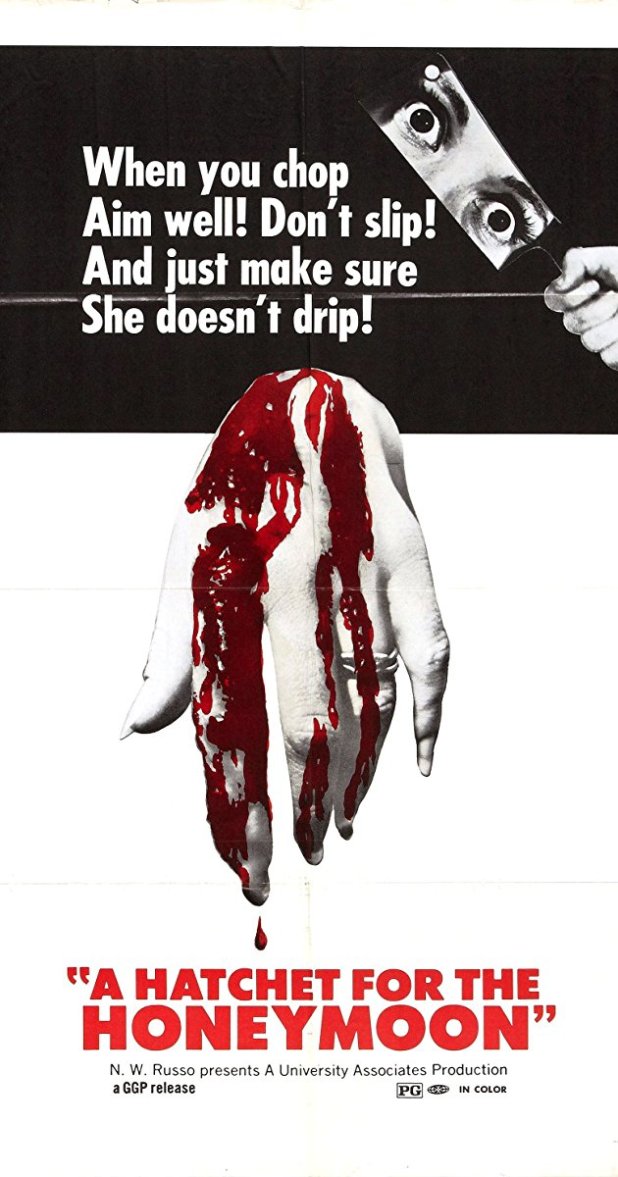
BAVA WEEK: Hatchet for the Honeymoon (1970)

Do you need to love, trust and care about the hero of the movie? Mario Bava is here with Hatchet for the Honeymoon in an attempt to craft a story where the hero is the absolute worst person in the entire film.

Meet John Harrington. He’s 30, runs a bridal dress factory, lives in a gorgeous villa near Paris and kills young women to overcome his impotence and Oedipus complex. His wife, Mildred, refuses to divorce him. And he’s instantly smitten with Helen (Dagmar Lassander, Forbidden Photos of a Lady Above Suspicion, The House by the Cemetery), a young model who has come to replace a missing girl.

Why is she missing? She was one of the models at the salon who John took a liking to, giving her one of his dresses for her wedding. The moment she tried it on, he hacked her up with a meat cleaver, burned her corpse and used it to fertilize the plants in his greenhouse.

Inspector Russell knows that something isn’t quite right. After all, how can six models disappear from the same dress company? If only there was some evidence…

John, however, is falling in love with Helen. And he finally decides to do something about his wife. That something entails him putting on a wedding dress and killing her. But there’s one problem. Here’s where Bava twists the film from giallo into supernatural territory: she won’t stay dead.

While John can’t see or hear his wife, everyone else can. Even after burning her remains and placing them in a handbag, she keeps coming back. He takes the handbag with him to a club, where an attempt to bring another woman home fails when she sees his wife. Beaten by a bouncer and ejected, he cannot even use his charms to win over women. He throws his wife’s ashes into the night, but she remains with him

If John can’t be happy, at least he can murder Helen. He convinces her to wear a wedding dress and tells her that he never wanted to hurt her. She avoids the final blow of his cleaver, which unlocks a flashback where we learned the truth: John loved his mother and that love grew as he became the man of the house after his father’s death. But when she remarried — and started having sex again — he couldn’t take it and murdered her and her new husband. His mind erased the evidence until now.

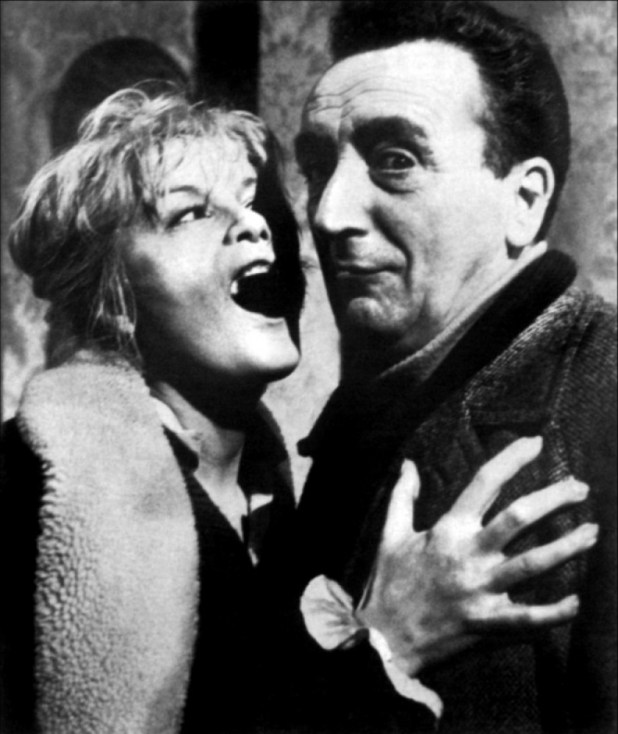
Helen was an undercover cop all along, leading Inspector Russell and his men back to arrest John. While being transported to prison, he’s happy knowing that his many trials are over. Then, to his horror, he sees the handbag and notices his wife sitting next to him. Now, he’s the only person who can see her. She promised to be with him forever, even in Hell. He goes insane before accepting his fate.

Hatchet for the Honeymoon predates the slasher, yet many of its conventions can be found here and in other early Bava works. This film is a masterwork of both style and substance, with gorgeous fashion, sets and camerawork creating a gorgeous tableau. I love the scene where John uses Bava’s Black Sunday, playing on the TV, as an excuse for the screams that come from his apartment. And as his wife’s blood drips down onto the ground floor, it’s almost as if Bava dares you to empathize with a hero who is completely contemptible. What a predicament to be in!

FeedShark

MARIO BAVA WEEK STARTS TOMORROW!

Starting tomorrow, we’ll be spending a week celebrating one of our favorite directors and his remarkable filmography!

Here are the movies we’ve picked to share with you:

Hatchet for the Honeymoon: Fashion. Oedipal complexes. Murder. Wedding dresses. And even a meta wink to past Bava films. This one truly has it all.

Hercules in the Haunted World: Bava elevates the simple sword and sorcery to the heights of magical operatic power.

Lisa and the Devil/House of Exorcism: Telly Savalas is the devil, living in a house of corpses and tormenting Elke Sommer.

A Bay of Blood: Bava invents the slasher genre while giving the creators of Friday the 13th one and two plenty of stuff to outright steal.

Baron Blood: Don’t do rituals in old castles. You should know better. But luckily, Bava was around to film what happened next.

Five Dolls for an August Moon: If Edwige Fenech is going to be in a Bava movie, of course Sam is going to watch it.

Kidnapped/Rabid Dogs: Bava’s last film, released several years after his death, is unlike anything else he’d ever made.

Can’t get enough Bava? We’ve already watched these films directed by the master of light and color:

Danger:Diabolik!: What would happen if Bava did a comic book movie? Only the best one ever made.

Shock: The last Bava film released in theaters, this is also known as Beyond the Door II and is a pure terror freakout!

We’ll see you tomorrow! We can’t wait!

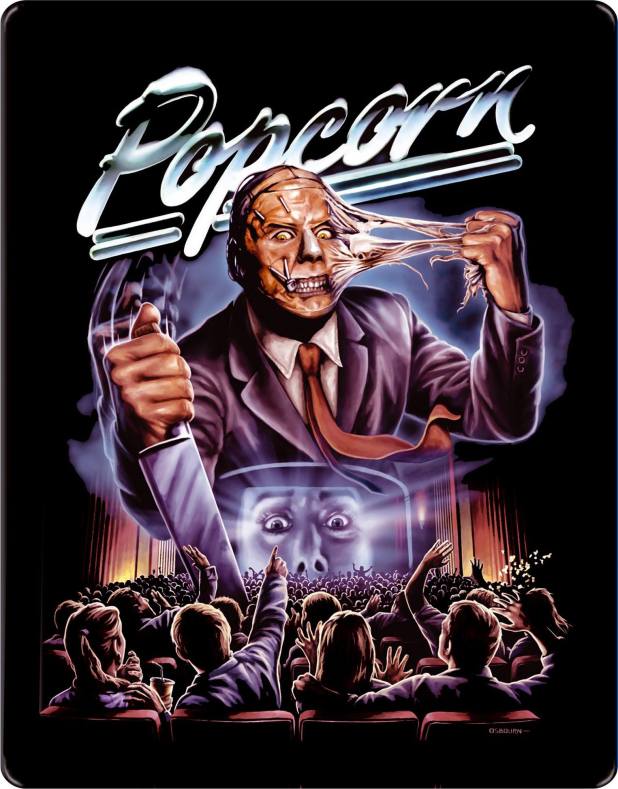
Popcorn (1991)

Sometimes, you end up loving a movie for what it could be way more than for what it is.

Popcorn would be one of those films.

Buried somewhere in its slasher framing story and four films within a film, there are some great ideas that should have been explored further. And the closer the film gets to its conclusion, the more it starts to explain itself. I’m more in the John Carpenter camp when it comes to too much information — I’m often just fine not needing to know every motivation of a film’s villain. To wit — I don’t need to know that Michael Myers made papier-mache masks to assuage his pain. I don’t even need to know that he’s a human being. I just want the story to thrill me.

Popcorn was filmed entirely in Kingston, Jamaica — which explains the later dance numbers. That’s right. Dance numbers. The more you watch this film, the more incongruous it becomes. The production was also fraught with changes, as Alan Ormsby was originally the film’s director, before being replaced by Porky’s actor Mark Herrier several weeks into filming.

Ormsby has a crazy bio — in addition to working with Bob Clark on Children Shouldn’t Play with Dead Things, Deranged and Death Dream, he also wrote Paul Schrader’s remake of Cat People and My Bodyguard. And strangely, he’s also credited with creating Kenner’s 1975 action figure Hugo: Man of a Thousand Faces!

At the same time, Jill Schoelen (The Stepfather) replaced original lead, Amy O’Neill. In fact, Schoelen barely was in scenes with the rest of the cast because so much had already been filmed, so she mostly appeared in reshoots! Even the title had something to do with a plot element that was edited from the final film, but the producers and distributor liked it so much, it was retained.

The film begins with Maggie Butler (Schoelen), an aspiring movie writer and college student, who has recurring nightmares that she is a young girl named Sarah. These dreams — in which a strange man stalks her — happen so often that she has an audio diary of them. Those very same dreams may or may not be connected to the prank phone calls that her mom Suzanne (Dee Wallace Stone, The Howling, E.T., Critters and many more) has been getting.

Sarah is also dating Mark (Derek Rydall, Eric from Phantom of the Mall: Eric’s Revenge), who tries to get her to come to his dorm room. She can’t — the script that she’s writing based on her dreams is more important. And so is the all-night horrorthon (JOIN US FOR THE HORRO-RITUAL!) that the school’s film department is putting on. It’s all Toby D’Amato’s (Tom Villard, who was one of the first 90s actors to openly admit that he was dying from AIDS) idea — with the goal of purchasing new editing equipment. NOTE: One assumes that Toby is named for Joe D’Amato, director of Emanuelle and the Last Cannibals, Antropophagus, Absurd, Troll 2 and the Ator the Fighting Eagle series, plus 200 or more films.

The kids convert the Dreamland Theater — due to be destroyed in three weeks — with the help of Professor Davis (Tony Roberts, Annie Hall, Amityville 3-D) and a quick cameo from Ray Walston as Dr. Mnesyne, the provider of the props that will go with the films.

Ah, those films — these movies-within-a-movie provide the best part of Popcorn. They are:

Mosquito: This 3-D film is a tribute to nature gone wild and nuclear terror movies of the 1950s. Even better, it pays tribute to Emergo, the technology (well, as far as sliding a skeleton down a rope can be called technology) that William Castle used to gimmick up The House on Haunted Hill.

The Attack of the Amazing Electrified Man: A callback to films like The Amazing Colossal Man, while at the same time it’s a nod to German expressionistic camera angles (certainly an odd blend). There’s a great scene here where the Electrified Man battles a gang of greasers armed with switchblades. There’s another gimmick here called “Shock-o-Scope” which is another tribute to William Castle and his film The Tingler.

The Stench: This is obviously a dubbed Japanese film, ala The Green Slime, but with the added gimmick of Odorama. There have been actual movies that use this technology, such as Scent of Mystery and, more dear to this author’s heart, John Waters’ Polyester.

Possessor: Found within Dr. Mnesyne’s — his name translates as memory — equipment, this short film is the most interesting part of Popcorn. It’s supposed to be a snuff film made by a Mansonesque cult of acidheads, but it looks and feels like something straight out of José Mojica Marins’ oeuvre (known as Coffin Joe, he’s made some of the strangest and best-titled films ever, such as At Midnight I’ll Take Your Soul and This Night I Will Possess Your Corpse). Seriously, this strange little film, in which a voice just says “possessor” over and over and over while blood fills the screen is awesome. If only the rest of the film — and one scene I’ll get to shortly — had been as imaginative and odd as this, we’d have a real winner on our hands.

Just by watching Possessor, Maggie passes out and has another nightmare. Upon awakening, Professor Davis informs the class that the film comes from Lanyard Gates (Bruce Glover, father of Crispin Hellion Glover), the leader of the aforementioned cult who ended his final film by killing his family onstage while the theater burned down in flames around the audience. There were no survivors and no explanation for why the film survived.

As Maggie grows more and more obsessed with the film, her mother becomes upset, telling her to just quit the film festival. That night, her mother gets a call from Lanyard Gates, telling her to meet him at the festival and to bring a gun.

The next day, when Maggie mans the box office, a man buys a ticket and calls her Sarah. She freaks, thinking it’s Gates. Meanwhile, just as the Professor is about to launch the mosquito prop during the film cue, a shadowy figure takes control of it, impaling him. Then, we see the same figure making a mask of the dead man’s face.

Oh yeah — Maggie’s mom shows up to the theater with a gun and in the best scene of the film, Gates takes over reality, transforming the marquee to read “POSSESSOR.” That said — this scene has NOTHING to do with the rest of the film, as our villain has no such psychic or reality warping powers.

No one will believe Maggie’s story and the films continue. A student named Tina (Freddie Marie Simpson, who along with Megan Cavanagh and Tracy Reiner, appeared in both the movie and TV series A League of Their Own) has been having an affair with the Professor, whose doppelganger kills her and then uses her body to electrocute wheelchair bound Bud while he sets off the buzzing seats during the next film.

When Maggie finds his body, she runs into Gates and has a flashback. Turns out that she’s really his daughter, Sarah Gates and Suzanne is not her mother, but her aunt who saved her. She tells all to Toby, who turns out to not be Gates, but his imitator. He was badly burned at the only showing of Possessor and holds Maggie and her aunt responsible. He prepares them both for his final act…of murder!

While setting up the Odorama, Leon is killed by Toby (but not before he pees all over him), yet he stops from killing Joanie when she confesses her unrequited love for him — an odd choice for a slasher film.

Whew. There are so many unnecessary characters and extra girlfriends and weird asides like a landlord who wants to be an actor which, honestly, take away from the film. Long story short, Toby reenacts the end of Possessor to the jeers of the crowd, revealing his full face — a gruesome visage of wires and burned flesh. Luckily, he’s killed by the Mosquito prop just in time to save everyone — which is either a cheap repeat or a previous kill or a sly comment on sequels. Let’s go with the former. That said — it has a really nice pre-Go Pro mounted camera effect as Toby dies, but not before hearing the cheers of the crowd.

Honestly, Popcorn is a mess. But it’s an enjoyable mess. It’s simultaneously a tribute to 1950s black and white gimmick films while attempting to be meta commentary on the slasher genre, with none of the teeth of a film like Scream. There are ridiculous parts, like death by toilet and a way too long musical number where a reggae band plays while a cosplay heavy crowd dances and Toby going from quiet kid to Freddy Krueger clone in the too quick conclusion to the tale. Throw in a balls out bonkers end song — “Scary Scary Movies” — that features lyrics like “psycho on the move got a blade two feet long, kisses for his wife while he slices the bitch….so long!” screamed at the top the rapper’s lungs and you have something worth watching.

As an aside, the rapper Kabal has been doing entire albums of cheesy rap songs from horror movies. He even covered the theme from Popcorn!

There’s a heart and inventiveness to the film. There’s a real love for movies in here, particularly the fun promotional style of William Castle. It’s definitely worth a watch, as the 90 minute or so runtime practically flies by. And while this film was impossible to find for years, Synapse Pictures has finally released a Blu Ray, so no need to buy bootlegs!

This article originally appeared in Drive-In Asylum.