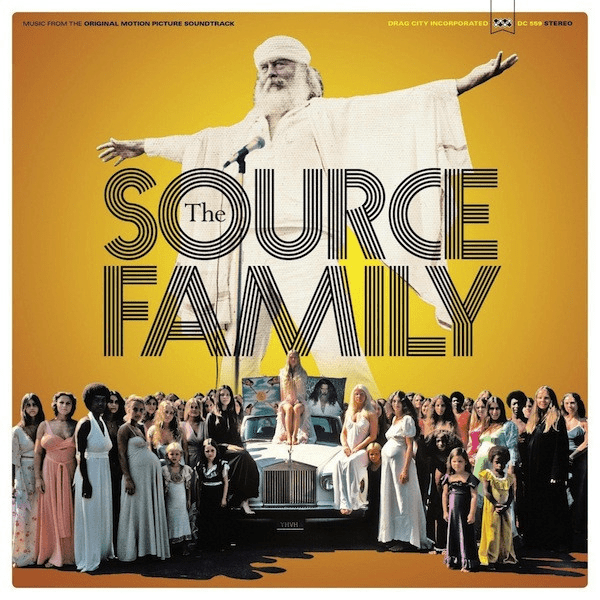
People always wonder, why would someone join a cult? How could someone give away so much of their freedom to get nothing back into return? A few minutes into watching this film and your answer will not be so clear.
The Source Family was an attempt at creating a utopia. Between a famous health food restaurant on the Sunset Strip to an outlandish rock band and constantly being surrounded by gorgeous women, you can see how their leader, Father Yod, started to believe he was some sort of prophet.
This isn’t one of those documentaries made by people ready to laugh and not understand the mindset of the group. It was inspired by the book The Source: The Story of Father Yod, Ya Ho Wa 13, and The Source Family, which was written by Isis Aquarian and Electricity Aquarian and edited by Jodi Wille (who co-directed this film with Maria Demopoulos).
Once the group flees to Hawaii, things get out of control, leading to their demise, as well as the death of Father Yod. All of this is captured on film, as the Source Family recorded everything.
Even more amazing is that so many members of the group have gone on to lead amazing, fulfilling lives. Between the music, a large amount of actual footage and the way that it’s all sewn into an engaging storyline, this documentary does more than unfold. It inspires.
If I were alive in the early 70’s, I wonder if my spiritual journey would take me to a group like the Process or the Source Family. When we were young, a journey to the Krishna Temple of Gold in West Virginia was enlightening and frightening at the same time. So were the many visits to churches and shrines across the country. At times, I wish that I could find that childlike wonder and worship that adulthood seems to take away. That’s why I don’t laugh or wonder why anyone joins a group like this.
Day 9 of the Scarecrow Psychotronic Challenge is Unseen Terror. You barely see it but it still terrifies you. This one was really rough, as I didn’t want to cover a Predator movie as that was just too simple. So I reached out to Bill from Drive-In Asylum and Groovy Doom for help. I’m using this challenge as a way to see movies I’d normally never watch, after all!
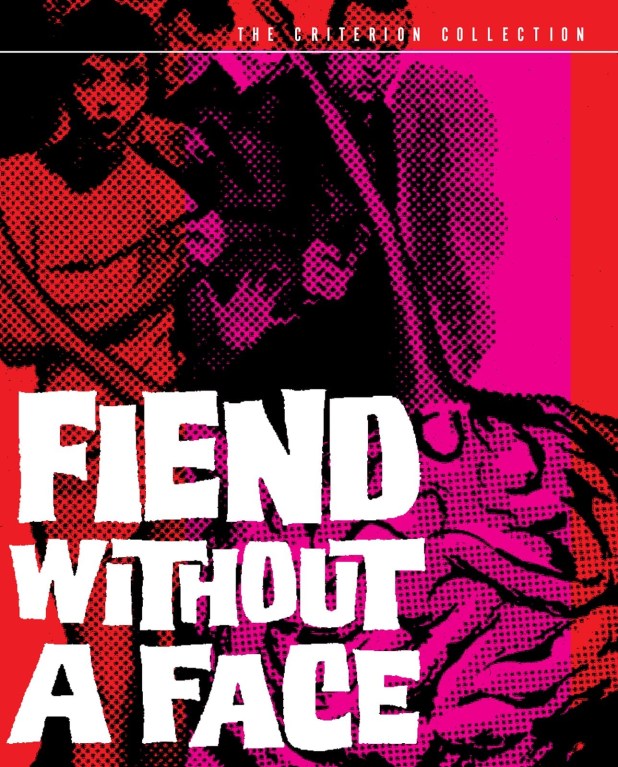
Based upon Amelia Reynolds Long’s 1930 short story “The Thought Monster”, originally published in the March 1930 issue of Weird Tales magazine, this independent British film played in the US on a double bill with The Haunted Strangler.
U. S. Air Force Interceptor Command Experimental Station No. 6 is a long-range radar installation located in the fictional town of Winthrop, Manitoba, Canada, which is a farming village that’s been plagued by unexplained deaths. It turns out that people are being killed with their brains and spinal columns being taken. The townies are up in arms, as they feel that the radiation experiments are to blame.
That leads Air Force Major Jeff Cummings starts to investigate the murders and quickly fingers Professor R. E. Walgate as a person of interest. Turns out that the Professor has been experimenting with telekinesis and thought projection for some time. That said — the radiation from the base has turned his thought projections into an entirely new life form that is attacking the locals and using them for host bodies. Of course, those bodies are mostly invisible, but also show up from time to time as moving brains with spinal columns with eyes at the end of extended eye stalks. They’re creepy as hell and led to a public uproar after its British premiere, with the public and critics angry over the films horrifying levels of gore (for the time, at least).
When this movie debuted at the Rialto Theatre in New York City, it came complete with a sidewalk exhibit of a “living and breathing Fiend” that moved and made sounds. The crowds that gathered to watch the caged Fiend created large crowds that the NYPD had to disperse.
It’s a pretty effective picture. Maybe that’s not even due to the film’s director, Arthur Crabtree. He believed that science fiction was beneath him and walked off the set at one point, with star Marshall Thompson finishing the direction of the movie.
If you like 1950’s atomic science fiction, scenes of people boarded in a room trying to hide out from pulsating brains and stop-motion blood and guys, well, this is the movie for you.
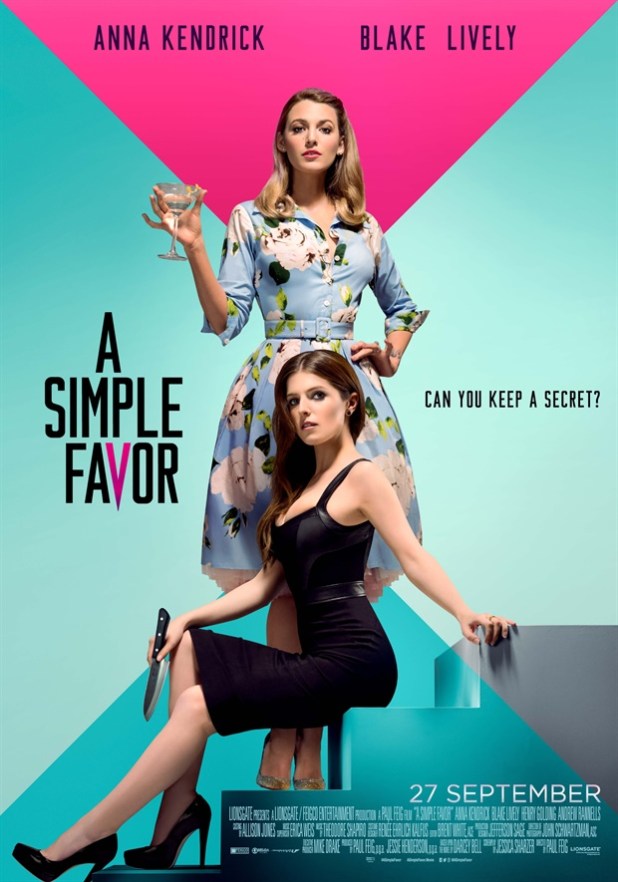
We really do go see new movies sometimes. But as late, our luck has been horrible. The Nun was painful, after all. But we’d seen the trailer for this film a few months back and it looked like Becca’s favorite kind of movie (and Sam’s least) — Gone Girl-style suburban true crime murder mystery. The actual movie, however, deviates wildly from the promise of the trailer.
I saw this movie under protest. After all, I wanted to see Hell Fest. Or The Predator. I could have even hate watched Venom. Because I have been the unfortunate recipient of Gone GIrl — not to mention movies like it such as The Girl on the Train and other works by its author like Sharp Objects and the upcoming Widows — viewings in the triple digits. The funny thing is, I ended up liking it way more than Becca.
Stephanie Smothers (Anna Kendrick from Twilight and Pitch Perfect) is a craft vlogger and single mom who constantly outdoes every other parent through sheer energy. But under her mania lies some pretty dark secrets and little to no real friends, not to mention a man. Emily (Blake Lively) is also a working mom, but is more known as a PR director for a major fashion company. These women couldn’t be more different — Stephanie prefers to hide in the background and apologize while Emily isn’t afraid to stand out and offend everybody.
The friendship between their children brings them together and the playdates their kids have to build the foundation for their fast friendship. They are soon trading confessions: Emily is frustrated with her husband’s lack of success. And Stephanie slept with her half-brother and may have had a child with him, which led to the death of both him and her husband.
Emily then asks for that simple favor: can Stephanie babysit Nicky while Sean is in London and she has to tend to a work emergency? That favor extends for days as Emily goes missing. And once her body is found in a Michigan lake, all hell breaks loose.
That’s when this movie descends into the twists and turns of a whodunit (but not a giallo, as much as I was wanting some black gloved killings and Ivan Rassimov to show up), with Stephanie caught in the midst of Emily’s psychotic ways, Sean’s devotion to her and her suddenly growing popularity amongst the local moms and her internet audience.
The film goes way over the deep end, bringing in the giallo staples of the unknown twin (actually triplet) and a family history of violence and insanity. Jean Smart shows up for all of a minute as Emily’s mother here.
A Simple Favor is the first movie that Paul Feig has directed since his divisive Ghostbusters reboot. I enjoyed the style in the film and the soundtrack, particularly the usage of Brigitte Bardot and Serge Gainsbourg’s Bonnie and Clyde (actually, the film has multiple Bardot songs).
This is a movie unsure of what movie it really wants to be. Is it a mystery? Is it a comedy? Is it both? It never truly becomes anything, wildly shifting in tone to the point of absurdity — and not in a good way. That said, Lively and Kendrick are quite good in this, much better than anyone else in the film.
I always ask Becca if she has anything she wants to add to our review. She said that she’d give this movie a D or an F, because she wanted it to be closer to the thriller the trailer promised. And she wonders if Anna Kendrick only plays the parts of ditzy nice girls who apologize too much and get into shenanigans all the time, to which I answered, “Yes, I think that’s pretty much who she is in real life.”
Also: I call bullshit on a major plot point. Emily pays cash to rent her car from Budget Rent-A-Car, which doesn’t allow vehicle rentals without a credit or debit card, much less a valid driver’s license. They would have had a full record of Emily renting the car. It would have been much simpler if she had someone else rent her the car and then paid that person. I realize that I’m being anal retentive about plot holes while I let gigantic ones in Argento movies pass by like bullets through the doorhole in Opera. But come on, people!
Of note, this was based on a novel by Darcey Bell, which has wildly different plot points, such as Emily only being a twin and being less complicit in the death of her sibling, as well as a completely different ending.
Postscript: As we left the theater, we noticed that there were only three other people there. One was an older gentleman in a full three piece suit who sat in front of us. Behind us was a younger couple that Becca asked about their feeling on the film. No one really liked it all that much and the older fellow called me sir while we talked and remarked how much better he likes Agatha Christie than modern mystery. We walked out of the theater late and alone on a Sunday night only for us to realize that the older gentleman was driving his son to a date. His son had to be in his late 20’s/early 30’s and the older man waited in the car for his son to embrace his date and kiss her goodnight. When we said goodbye, he said, “Have a nice week.” It was perhaps the sweetest and strangest thing that has happened to us in some time.
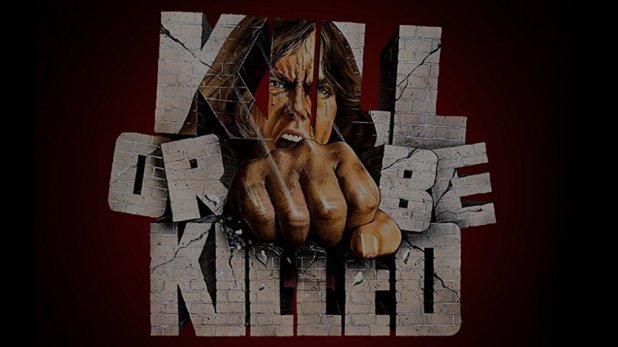
If you think the United States is in bad shape today, perhaps you should check out this film, made well beyond the news bubble and the 24/7 headline cycle. The 1970’s were fucking bleak.
If you thought mass shooters were because of video games or that we just suddenly became a more violent society, sit through this movie. It’s brutal. It will assault you. It will take your name. It will own you.
Director Sheldon Renan suffered from depression for a year after he finished this film, as was editor Lee Percy. Even the John Lennon vigil at the end, added at the request of Japanese producers to help the movie end on a positive note, had people shoot at one another. That ending is somehow even more downbeat than anything else, after a movie where Sirhan Sirhan cries about killing RFK and you see more of the Zapruder film than you knew existed.
How destroyed was Renan? He went on to write the screenplay for 1990’s Lambada. What the actual fuck.
The voice of this film is incredible and it comes from Chuck Riley, who did the voiceovers for these trailers: The Godfather, Child’s Play 2, Die Hard and many more.
The writing comes from Leonard Schrader, brother of Taxi Driver writer Paul, who was inspired to do this movie after writing a film called Hollow Point for Roger Corman. As he researched that movie, he met so many hitmen and spent so much time with them, he learned exactly how killers planned and executed hits.
There’s even a one-on-one interview with the Edmund Kemper, where he calmly discusses killing his mother and young women. That said — the goal of this film isn’t Mondo Cane exploitation.
According to a New Republic article, it wanted to erase the line between killers and the audience. Renan said Schrader “wanted to turn the audience into murderers. He wanted [viewers] to recognize that in themselves, ostensibly so that they would do something about it.”
As they worked on the film, Reagan and Lennon were both shot. Things did not get better. Things are bad now. So often I use film to hide from reality, but this movie makes you face it.
There is a lot here I never knew about, like Tony Kiritsis, an Indiana man who held a mortgage broker hostage while hosting a press conference in the most polite manner possible. Of course, he also had a shotgun wired to the man’s head that was ready to go off if he was shot by the police.
Some feel that this movie glamorizes the killers. I would refute that and say that it makes you see the senselessness of their action. As the former president of a Zen meditation center, Renan gave them a forum because he believed that “you just have to feel compassion for everybody — you just do. I do, anyway. For me, it was a journey into the depths to try to get some understanding.”
This is a movie that I think everyone should watch. It’s sobering. It’s maddening. And it approaches art.
This film was never released, distributed, televised, or made available for sale in the USA until it finally received an official release from Severin Films. You can also watch it on Amazon Prime.
The Scarecrow Psychotronic Challenge for today is THE EYES HAVE IT. This pick must have an eye specific scene. I’ve already covered the granddaddy of all eye torture, Fulci’s Zombi, as well as his other paean to ocular decimation,The New York Ripper. There’s also Demonia, where nuns eat a dead baby’s eyeballs. And Cat in the Brain, with a whole plate of eyeballs. Oh, Fulci. You do love seeing the eyes get killed, as they have seen so much.
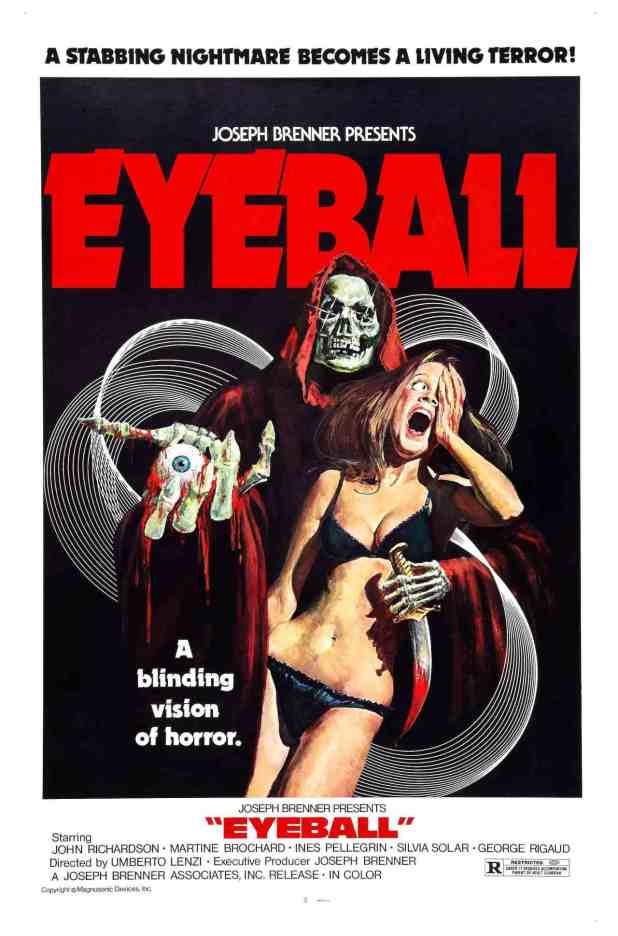
I already hit Dead and Buried, which has an eyeball impalement that upsets many. And Lamberto Bava’s Demonia, where a woman looks like a giant eyeball. So that leaves Umberto Lenzi’s Eyeball, where a killer in a red raincoat kills tourists in Barcelona.
Any of the main characters could be the killer, one with this amazing motive: “I was like you… before this friend of mine ripped out my eye playing doctor with me… leaving an empty socket!” That means with each kill, the killer keeps an eyeball.
Unlike most giallo, the killer is all in red, with red gloves, which is a rarity unless we’re considering The Red Queen Kills Seven Times. Like most giallo, it has the worst cops ever on the case. And for 1975. it’s pretty woke, considering one of the couples is an interracial lesbian duo.
Seeing as how this is a movie with an Italian director and a Spanish crew, you just know that the dubbing is going to be great. Witness this exchange:
“Spanish or Italian, it makes no difference to me. He made a terrible mistake. You don’t think America’s worth all that trouble do you?”
“Oh my God! You’re not a communist, are you?”
That said, I came off really enjoying this. There’s a lot of red highlights hidden in every scene, which for a Lenzi movie is as close as he’s going to get to art. Then again, I tend to love all of his films way more than most people.
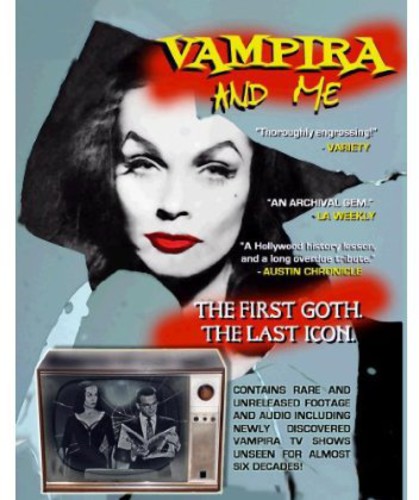
Maila Nurmi was the first goth. She was Elvira before that was even a name. She was used up, spit out and stomped all over by Hollywood. But she still continues to inspire.
Vampira was an icon. Starting on May 1, 1954, The Vampira Show (the show actually premiered the night before, but it was not called that names and it was considered a preview) opened each night with the pale goddess walking as if in a trance down a foggy hallway, screaming, then reclining on a couch where she would make fun of the movies she was about to show.
She became a star, appearing in LIFE Magazine, running for Night Mayor of Hollywood, being used as the model for Maleficent in Disney’s Sleeping Beauty and being nominated for a Los Angeles area Emmy Award as Most Outstanding Female Personality in 1954. She lost to Lucille Ball. And as soon as fame came to her, it went away.
She appeared in films like Too Much, Too Soon, The Magic Sword, I Passed for White, Sex Kittens Go to College, The Big Operator and The Beat Generation in a role that was as close to the real Maila Nurmi as any she would play. She started to refer to Vampira as another person. And her role as Vampira in Ed Wood’s Plan 9 from Outer Space has lived on and on.
What hasn’t lived on are video versions of her in the role. Many TV stations constantly retaped over expensive videotapes, so until her later years, Maila never saw herself in the role.
That’s why R.H. Greene’s documentary is so good. He took his 2010 radio documentary (first broadcast by NPR channel KPCC and available here on their site) to the next level, including an extended interview with his subject from a 1997 interview.
The story is not happy. By 1962, Nurmi was making a living installing linoleum flooring and running an antique store called Vampira’s Attic. Years later, in 1981, she was asked by KHJ-TV to revive her Vampira character. Working closely with the producers of the new show, she was due to be the executive producer but left the project over creative differences.
The station chose Cassandra Peterson to play the part, but was now unable to use the name Vampira. Renaming her Elvira, she shot to fame overnight.
Nurmi sued, by lost when a court ruled that “likeness means actual representation of another person’s appearance and not simply close resemblance.” Peterson stated that Elvira was nothing like Vampira. After all, the only similarity was that she wore a black dress and had black hair. Right? Wrong. Nurmi claimed that the entire Elvira persona, which included her pun-filled patter, was based on her. And she lost. It’s still amazing to me.
After that, Nurmi nearly disappeared, other than playing with the band Satan’s Cheerleaders and appearing with Tomata du Plenty of The Screamers in Rene Daalder’s punk rock musical Population: 1 (in the interview on the film, the director said, “There was a wild lady living out in back in a shed. Tomata befriended her and found out she had played Vampira.).
In the early days of the internet — 2001 — she started running her own site, selling autographs from her small North Hollywood apartment.
The film doesn’t shy from the saddest parts of her life, such as her rumored love affair with James Dean or the stalker who attacked her in 1955, years before the media even knew what a stalker was.
This is more than a documentary. It feels like a labor of love. I learned so much about the person behind the icon, which is what a true documentary should be all about.
Thanks to the British Film Institute, there’s a list of films that played Scala. To celebrate the release of Severin’s new documentary, I’ll share a few of these movies every day. You can see the whole list on Letterboxd.
The Scarecrow Psychotronic Challenge for today is 7. HELL ON EARTH. Watch a post-apocalypse movie. Bonus if it has punks (see the Destroy All Movies definition of punk) in it. We’ve watched so many post-apocalyptic movies that it was hard to find one that we hadn’t had on the site. And punks made it an even bigger challenge. That said, we’re all about trying to find movies no one else is talking about. And that leads us to 1977’s Jubilee.
Queen Elizabeth I (Jenny Runacre, Son of Dracula, The Witches) asks her occultist John Dee (Richard O’Brien of Rocky Horror fame) — an advocate of British imperialism that spent the last thirty years of his life learning the secret language of angels — and Ariel from Shakespeare’s The Tempest (David Brandon, Delirium, Stagefright) to show her the future.
That future? The no future of the punk rock era, a place where Queen Elizabeth II was killed in a mugging and a gang of punk rock survivors, including Amyl Nitrate (Jordan, the model who was of the creators of W10 London punk look), Bod (Runacre in a second role), Chaos (French singer, writer and tightrope walker Hermine Demoriane), Mad (singer Toyah Willcox) and Crabs (Little Nell from Rocky Horror, who even gets in the line “Don’t dream it, be it.”). When they’re not talking about boys or music, they’re talking about how history can be manipulated. And then Amyl Nitrite says that her heroine has always been Myra Hindley (Hindley and Ian Brady were responsible for the Moors Murders, which occurred in and around Manchester between mid-1963 and late-1965, claiming five child victims and inspiring the song “Suffer Little Children” by The Smiths).
Things making too much sense? There’s also Borgia Ginz, who shares a house with Hitler, runs the world and has transformed Buckingham Palace into a recording studio and Westminster Cathedral into a disco where Jesus performs.
Beyond the nihilism and lack of hope in this film, there’s also plenty of punk rock stars, like Adam Ant and Wayne County along for the ride and gamely performing songs, as well as blink and you miss it moments for Siouxie and the Banshees and the Slits. And hey — the music is by Ol’ Sourpuss himself, Brian Eno.
Director Derek Jarman may have based this movie in punk rock, but he was against the scene’s fascism fetish, as well as its love of stupidity and violence. Many punks weren’t pleased with the film, such as fashion designer Vivienne Westwood, who created an open letter T-shirt that denounced the film because of how she felt it misrepresented punk.
Jubilee is definitely a time capsule of Thatcher-era England. It’s loud, obnoxious and strange, which are all wonderful things to be. I’m glad that I didn’t watch something easy like Cy-Warrior and chose this movie.
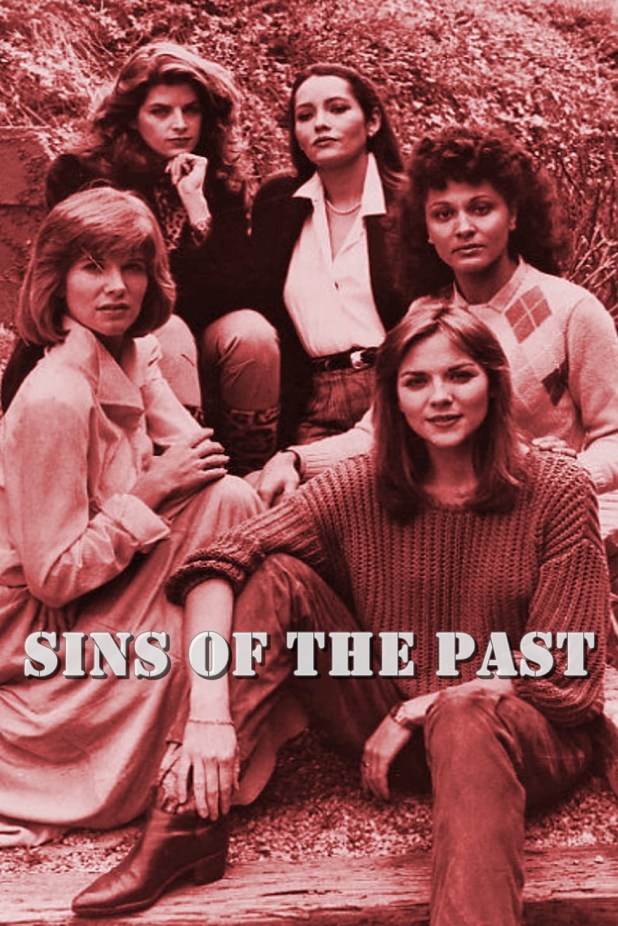
A group of call girls all decide to quit the business when one of them is killed. They change their names, leave town and make lives for themselves over the next 13 years. Then, one of them is killed and the rest soon learn that her killer is looking for the rest of them.
Originally airing on April 2, 1984, this TV movie is pretty much a giallo without black gloved hands or tremendous amounts of gore and nudity. But stylistically, it’s very close in tone.
Terry (Barbara Carrera, Never Say Never Again) was once the leader of the girls, but now she’s fighting for custody of her son. The other girls have all grown into different lives, like Paula (Kim Cattrall), who is a doctor that is being considered to run a hospital, Patrice (Kirstie Alley), an actress and Clarissa (Debbie Boone), who sings gospel music as part of a televangelist’s ministry. None of them can afford to lose their station in life by the — SINS OF THE PAST — coming back.
Anthony Geary from General Hospital is also on hand as a detective that somehow worms his way in Barbara Carrera’s pants. This is one of those films where cops can be total pricks and still lead with the heroine because it was the 1980’s and that’s how writers thought women acted.
Director Peter H. Hunt also directed adaptations of Danielle Steele’s Secrets. This is a very similar type of story, with plenty of red herrings, like the father who killed his daughter that caused all of the girls to go into hiding. This is difficult to find, but there’s always YouTube if you want to check it out.
Martial arts movies make little to no sense most of the time. Then, there’s this movie.
Steve Chase is a martial artist who goes to the desert for what he thinks is an Olympic style meet. Nope. An ex-Nazi general was defeated at the 1936 Olympics by a Japanese martial artist named Miyagi, so he’s out for revenge. Luckily, Steve and his girl Olga escape.
To fix up his team, von Rudloff’s miniature henchman Chico goes around the world to recruit a new team. And Steve ends up meeting Miyagi and joining his team, which leads to the madcap fight between he and his girl when she is kidnapped and forced to join his team.
Finally, Steve must fight and defeat Luke, the ultimate fighter, leading the Nazi to killing himself rather than face defeat.
I’ve given you a straight reading of the film. To see it is to know how different it is, as it’s either filmed by someone who wants to be an artist or someone who has been in the sun too long. This is often the same thing.
This movie was a success for four years in its native South Africa, where many Japanese martial arts forms were done to perfection. Yes, that makes no sense to me either. Neither does the sequel, but trust me, I’ll be covering that one soon enough, too!
With so much of television now just fodder for streaming services, we may never have the days of Halloween specials and strange movies like this ever again. The world is a worse place for this.
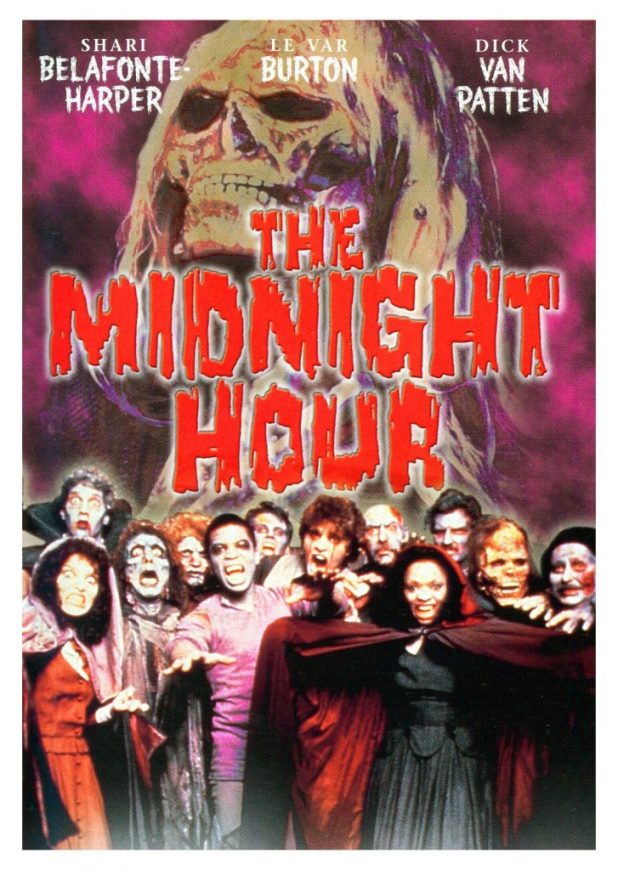
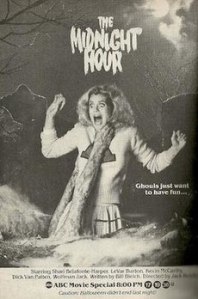
Originally airing on ABC on Friday, November 1, 1985, The Midnight Hour is all about five teenagers causing hijinks in Pitchford Cove. Those kids, Phil (Lee Montgomery, Davey from Burnt Offerings all grown up!), Mary (Dedee Pfeiffer, Vamp), Mitch (Peter DeLuise, son of Dom), Vinnie (Levar Burton!) and Melissa (Shari Belafonte, Time Walker) steal all manner of costumes and artifacts from the town’s historical museum. But then they go too far and read a spell in the cemetery, which causes the dead to rise, led by Melissa’s great-great-great-great grandmother Lucinda Cavender.
While everyone else is having fun at a Halloween party, Phil hooks up with a mystery girl named Sandy who ends up being an undead cheerleader. Lucinda is also turning everyone into vampires to the sounds of “How Soon is Now?” by The Smiths, which is pretty amazing music for a 1986 TV movie (yes, I am that Charmed used this song too, but this is only one year after it was released and long before the mainstream found it).
The only way our heroes can stop the curse is to find a spirit ring that is in the grave of witchhunter Nathan Grenville, who is, of course, Phil’s great-great-great-great grandfather and perhaps more troubling, the former slave owner of our main villain. If Phil and Sandy don’t stop the spell by midnight, the town will be cursed until the end of time.
I can best describe this movie as a combination of recognizable talent like Cindy Morgan (Lacey Underall from Caddyshack), Kurtwood Smith (sure, he was on That 70’s Show, but we remember him best as Clarence Boddicker from RoboCop), Dick Van Patten, Wolfman Jack and Invasion of the Body Snatchers’Kevin McCarthy with musical numbers and comedic scenes while also containing some truly horrific and frightening scenes. It’s a mishmash. A monster mash?
It’s interesting to say the least. It’s the kind of movie that wouldn’t get made today, a movie that crosses genres and emotions while trying its heart out to entertain you. Director Jack Bender has gone on to direct episodes of Lost, The Sopranos and Game of Thrones.
This was released on DVD in 2000, but has become really hard to find, with prices as high as $400 on ebay!
Here’s a drink for the movie.
Sandy’s Jacket
1 oz. pineapple vodka
1 oz. rum
2 oz. orange juice
2 oz. pineapple juice
1 tbsp. passion fruit simple syrup
1 tbsp. cream of coconut
Club soda
Maraschino cherry
Pour all ingredients in an ice-filled glass.
Stir and top with a cherry. This one is easy and still casts a spell.



 B&S About Movies
You must be logged in to post a comment.