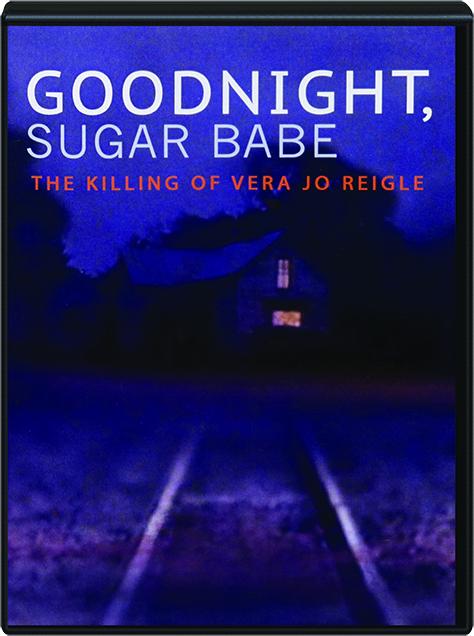
Just a warning. Of all the documentaries I watched this week, including Mondo Cane, this is the one that upset me the most. It starts with the police discovering the mutilated body of a mentally challenged young mother. And ends with a family so monstrous that it defies description and believability.
Director J. David Miles (Dead Silence) went to the heart of darkness, which ends up being Findlay, Ohio — which is also the home of Steelers quarterback Ben Roethlisberger. There, Cheri Brooks is the matriarch of a family that seems to be the stuff of Rob Zombie movies. She’s as horrible a person as it gets — her children Scottie, Michael, Maria, Joshua, and little Cheri were all taken away from her and all molested by her except for the youngest, who was taken immediately after her birth.
Meanwhile, Vera Jo’s life was one of pure terror. At the tender age of eleven, she was raped by her own father, Willard Reigle. It was suspected that she had ADHD and had an IQ in the mentally retarded range, which made learning difficult. She did, however, graduate high school but then began dating 13-year-old Zachary Brooks. This was a relationship that his mother Cheri actually encouraged because it allowed her to collect Vera Jo’s disability checks as well as get another child in the house, as she not only desired them, but wanted the perfect male child.
Vera Jo was basically a servant and scapegoat for the family and despite police calls and numerous people knowing that she was being abused (and this is all from a family that had a pig that lived in the house and was allowed to defecate anywhere it wished), when she was murdered people reacted with a mixture of surprise and we saw that coming. Yet no one did anything. At all.
The depths that Cheri pushed on Vera are heartbreaking, like forcing castor oil on her to induce labor, telling everyone that Vera’s child Willadean was hers, refusing to allow the new mother to hold her child, encouraging her own children and their insignificant others to abuse Vera and blaming her for the accidental death of her son Punky, which may have led to her death.
There’s also the matter of the family — backwoods as they may be — being part of the Crips. Yep. The same ones as South Central L.A.
This isn’t an easy movie to watch, based on the subject matter. The way it’s filmed is also completely all over the place. They had full access to so many people, so the subject matter is certainly compelling. But between the bad camera work, horrible font choices and rough editing, this could have been such a better film. Yet you can’t look away and I’ve recommended it to many true crime buffs.
I’d compare this to The Wild and Wonderful Whites of West Virginia if that family was only concerned with abuse and torture instead of drugs and dancing. You can find it on Amazon Prime.
Day 13 of the Scarecrow Psychotronic Challenge is And on the 13th Day There Was Only Black and White. Greyscale is also acceptable. There was no choice for me other than the master’s finest work: Mario Bava’s seminal Black Sunday.
This was Bava’s directorial debut — although he had already directed several scenes without credit in other films. By 1960’s standards, this is a pretty gory film, leading to it being banned in the UK and chopped up by its US distributor American International Pictures.
In the 1600’s, the witch Asa Vajda (Barbara Steele, creating her legacy as the horror female supreme) and her lover Javuto are put to death by her brother. Before she is burned at the stake and has a metal mask hammered to her face, she curses their entire family.
Several centuries later, Dr. Thomas Kruvajan and his assistant, Dr. Andre Gorobec (John Richardson, Frankenstein ’80) ae traveling to a medical conference when their carriage breaks down. Of course, they’re in a horror movie, so they wander into an ancient crypt and release Asa from her death mask and getting blood all over her face.
That’s when they meet her descendent Katia (also Steele), whose family lives in the haunted castle that of the Vajdas. Gorobec instantly falls for her and really, can you blame him?
All hell literally breaks loose, with Asa and Javuto coming back from the dead, possessing Dr. Kruvajan and concocting a plan to make Asa immortal by stealing Katia’s youth. Can good triumph against evil? Can you kill a vampire by stabbing wood into its eye socket? Which one is hotter, good or evil Barbara Steele?
A note from reader Edgar Soberon Torchia: “The blood from Dr. Kruvajan’s hand does not get all over Asa’s face. While fighting a bat he breaks the glass covering her face in the tomb. The blood in a piece of glass elegantly falls drop by drop into the empty cavity of Asa’s right eye.”
Thanks for setting us straight!
A lover of Russian fantasy and horror, Bava intended this film to be an adaption of Nikolai Gogol’s 1835 horror story “Viy.” However, the resulting script owes more to Universal Studios-style gothic horror. AIP cut or shortened the branding scene, blood spraying from the mask after it was hammered into Asa’s face, the eyeball impaling and the flesh burning off Vajda’s head in the fireplace. And in the Italian version, Asa and Javutich are brother and sister in an incestuous relationship.
Black Sunday has left quite an impression on fans and filmmakers alike. Francis Ford Coppola’s Bram Stoker’s Dracula contains several shot-for-shot homages, as does Tim Burton’s Sleepy Hollow. And Richard Donner based the cemetery scene in The Omen on the moment when Barbara Steele appears with her hounds.
For a director who is so well known for his work in color, Bava has just as much skill in black and white. The sets were actually created in monochrome, with no color, to add to the dark mood.
My favorite scene in the film is when Bava creates a split screen effect where Steele’s two roles come together, as Asa intones, “You did not know that you were born for this moment. You did not know that your life had been consecrated to me by Satan. But you sensed it, didn’t you? You sensed it… That’s why my portrait was such a temptation to you, while frightened you. You felt like your life and your body were mine. You felt like me because you were destined to become me… a useless body without life.”
You can watch this for free with an Amazon Prime subscription or on Shudder.
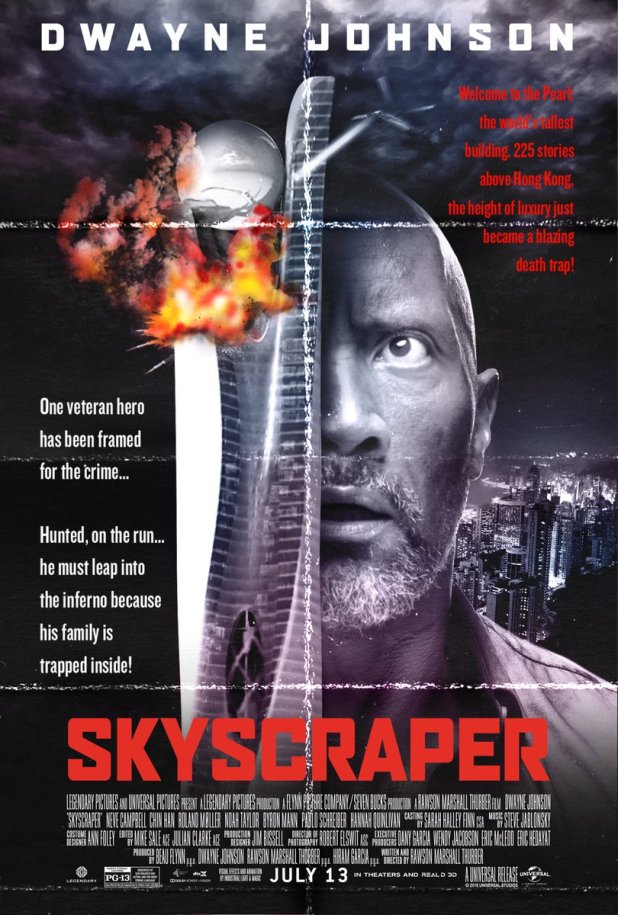
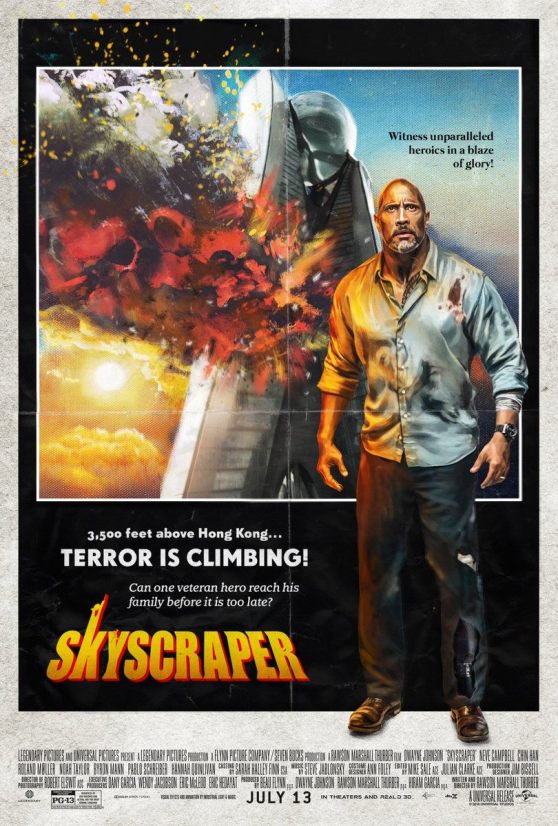
How close is this movie to The Towering Inferno and Die Hard? Just take a look at one of two posters that its star, Dwayne “The Rock” Johnson, commissioned to celebrate those films when this was released. Look — this is a summer blockbuster. If you’re going to worry about how much it steals or how stupid it is, you picked the wrong movie.
Wealthy Chinese financier and entrepreneur Zhao Long Ji is building the tallest skyscraper in the world in Hong Kong called The Pearl. To solve some of the building’s security issues, he hires former U.S. Marine and retired FBI Hostage Rescue Team leader Will Sawyer (Johnson). Even though he’s built a new life for himself, Sawyer is struggling with the past, including a mission where a suicide bomber took his left leg.
Once he gets the job of inspecting the Pearl, Sawyer, his wife Sarah (Neve Campbell, Scream) and twins Georgia and Henry move in. It seems like the building’s fire and security systems are secure, but he doesn’t trust the building’s offsite security center. Zhao gives Sawyer a tablet that gives him full access to the security system, but our protagonist is set up by his former partner, ex-FBI agent Ben Gillespie.
Now, a cadre of terrorists and criminals led by Kores Botha has taken over The Pearl, with Sawyer’s family trapped inside. Soon, the building is on fire, loved ones are trapped and the film becomes extended stunt sequences where The Rock jumps from a crane into a burning building hundreds of feet above the Earth. Your enjoyment of this film will depend on how many times you want to see The Rock cheat death.
We watched this with Becca’s parents, who were a divided lot. Her mother enjoyed this film more than any living being has ever loved a movie before, jumping and yelling with every single stunt, literally on the edge of her seat. But her father was upset the minute the movie started, sure that it was going to be unrealistic. Well, he was right. He’s also someone unafraid to loudly drum his opinion into your ear for the entire running time of a film, so he threatened to rage quit watching it. It’s not often that you get to watch a movie with two people who have such opposite opinions, yet are sitting so close.
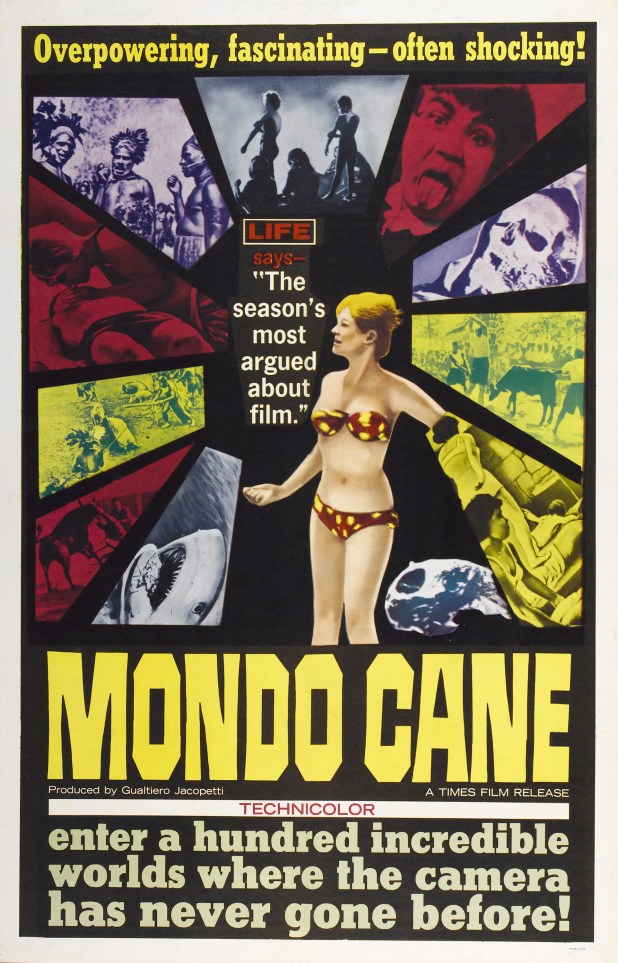
I’ve always been afraid of Mondo Cane. It’s the kind of film that is not afraid to manipulate you. So many of its scenes were staged or manipulated. And so much of it lulls you into a stupor as you watch it unfold like a kaleidoscope, then it decides to assault you with moments of pure barbaric intensity. This is a movie out to upset you.
The entire mondo subcategory comes from this film, a documentary written and directed by Italian filmmakers Paolo Cavara, Franco Prosperi, and Gualtiero Jacopetti.
Cavara and Jacopetti came up with the concept, with Prosperi credited as second director. To make this film, Cavara went on a dangerous quest, traveling the planet to obtain the necessary footage. The two men also met in Las Vegas at one point, where they were involved in the crash that ended actress Belinda Lee’s life (a troubled soul whose affair with married lover and papal prince Filippo Orsini led to a dual suicide attempt that cost his family the hereditary title of Prince Assistant to the Papal Throne).
After Mondo Cane’s appearance at the Cannes Festival and worldwide popularity, Jacopetti claimed sole credit. Cavara would leave the team, going on to challenge himself with different genres and filming styles throughout his career as a director, including The Wild Eye, where a documentary filmmaker has a crisis of conscience as he pushes his crew to new limits of depravity (an obvious comment on how he felt about former associates Jacopetti and Prosperi) and the well-regarded giallo, Black Belly of the Tarantula.
Jacopetti’s life is the kind of tale that could make its own movie. After fighting alongside the Italian Resistance against Mussolini, he co-founded the influential liberal newsweekly Cronache. However, he was forced to shut down the magazine after being charged with pornography for publishing photos of Sophia Loren. Jacopetti was punished with a year-long prison sentence before journeying through a series of careers, finally landing on being a director.
After Mondo Cane (which roughly translates to the Italian curse, a dog’s world), Jacopetti and Prosperi would go on to use discarded footage to make Women of the World (dedicated to the aforementioned Lee, a lover of Jacopetti asked to be buried next to), Mondo Cane 2, Africa Blood and Guts and the beyond depraved pseudo-documentary Goodbye Uncle Tom.
As time went on, the mondos had to outshock one another, constantly topping themselves. The entire crew was nearly executed while making Africa Blood and Guts while filming in Zaire. A scene from this film led to Jacopetti being charged with murder in Italy. He was acquitted of the crime after proving that the killing was unstaged.
This all led to Goodbye Uncle Tom, a film that David Duke, former leader of the Ku Klux Klan, claimed was a Jewish conspiracy to incite blacks to violence against whites. Presenting itself as a documentary, the film begins with Jacopetti, Prosperi and crew traveling backward through time! Sure, this may have been intended to be an anti-racist attack on the evils of slavery, but it was made with the full cooperation of Haitian dictator Papa Doc Duvalier. Prosperi may have claimed that his films angered many because “the public was not ready for this kind of truth,” but it’s difficult to defend a movie where hundreds of anonymous Haitian extras re-enact vicious scenes of abuse and torture.
The original ending of the movie occurs in the modern era, where a radical black activist reads William Styron’s The Confessions Of Nat Turner and has a fantasy of breaking into a suburban home and murdering a white baby. This was supposedly Jacopetti and Prosperi’s comment on racism, but when you realize that so much of this film basically used slaves to depict the evils of slavery, it’s kind of understand what they were going for. The American distributors of the film certainly didn’t get it and cut all of this.
I mean, this is a movie that claims to be a documentary about a time-traveling crew of Italians who somehow get to meet Harriet Beecher Stowe and Samuel Cartwright, but somehow there’s also a scene where the narrator takes the virginity of a thirteen-year-old teenage prostitute on camera. A commercial and critical failure, this was the end of Jacopetti’s big run of films, although the duo did work together on a cover version of Candie called Mondo Candido. Jacopetti would move back to the world of print while Prosperi would direct Gunan, King of the Barbariansand The Throne of Fire.
But what of Mondo Cane? This film takes your eye on a savage journey, starting with a dog being dragged through the pound as other dogs bark at him. From a statue of Valentino to women tearing off the shirt of actor Rossano Brazzi (Fulci’s Dracula in the Provinces), men being hunted by women becomes the theme, juxtaposing New Guinean tribal rituals with bikini girls on the Riviera.
If you love animals, you can pretty much leave the room now. Because Mondo Cane is going to laugh at those who mourn their pets at a cemetery, going so far to highlight other dogs pissing on their graves. From pigs being slaughtered to dogs being skinned alive in Taiwan, chicks being dyed for Easter and geese being force-fed, the film begins its descent into man’s inhumanity to, well, everyone.
Animals are dying from radiation. Fishermen shove toxic sea urchins down the mouth of a shark. And then people get drunk. More girls in bikinis. Massage parlors. Hulu dances. Skulls, dying, death and cars being smashed. Bullfights, bull beheadings and soldiers dressed in women’s clothes. My chronology is screwy now, but the film has become a barrage, assaulting my eyes and sense of reason.
The film ends with a cargo cult, a term given to South Pacific based aboriginal religions that would build airplanes and military landing strips as part of rituals hat they hoped would summon the gods that had brought them supplies during World War 2.
Mondo Cane predates and prepares us for the never-ending news cycle that we find ourselves in today. Yet even though it’s nearly sixty years old, it remains a rough testament. It doesn’t just show you the mud and filth, it pushes your face into it and laughs at you as you struggle to maintain your footing in the muck.
Yet this is also a film that was considered for the Palme d’Or at Cannes and was nominated for best song, thanks to “More,” the theme that was written by composers Riz Ortolani and Nino Oliviero. I don’t think that it’s any coincidence that Ortolani would go on to create the theme song to an even more depraved film — Cannibal Holocaust.
Should you watch Mondo Cane? That’s up to you. The voiceover may say, “All the scenes you will see in this film are true and are taken only from life. If often they are shocking, it is because there are many shocking things in this world. Besides, the duty of the chronicler is not to sweeten the truth, but to report it objectively.” But we also know that so much of this was staged or presented from many angles for maximum effectiveness. So what is truth? You’re not going to find it in a film like this that goes right for your jugular. Crash author J.G. Ballard said that mondo films are a place where “Nothing was true, and nothing was untrue.” Are you ready for that?
If so, you can watch Mondo Cane for free with an Amazon Prime subscription.
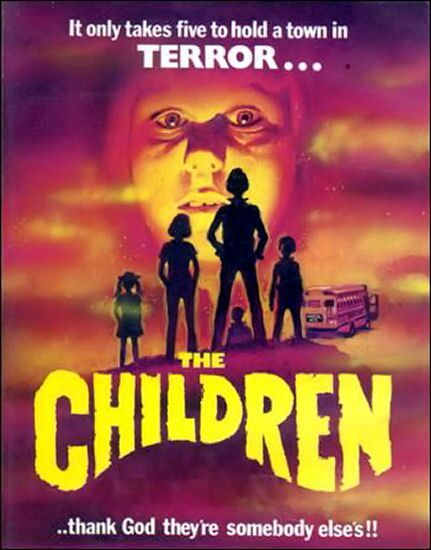
Day 12 of the Scarecrow Psychotronic Challenge is Too Soon: Kids 12 or less meet an early demise. Geez, grim. Who Could Kill a Child seems like a pick that everyone would pull out, so I decided to go 80’s.
The best thing that I can say about this movie is that nearly every person in it is a horrible person. There are cops that don’t do their jobs well, expectant mothers that smoke and other parents that could care less if their kids have come home yet. Even the nice people in this movie only exist to be snuffed out. This is the blackest of comedies and also the most nihilistic of films.
Jim and Slim, a couple of workers at the Ravensback chemical plant decide to finish work early and head to the bar, neglecting the pressure gauge warnings and allowing a cloud of yellow toxic smoke to escape.
That yellow cloud finds its way to a school bus full of innocent children who are so well behaved that they even sing a song to compliment their bus driver. Suddenly the bus passes through the yellow cloud and the kids get turned into zombie-like monsters with black fingernails.
The townspeople only think the kids have disappeared, so they shut the town down and try and keep out any outsiders until things clear up. Boy, this town…there’s Billy the local sheriff, who is in over his head. There’s Harry his deputy who only seems to want to get it on with Suzie (and who can blame him, what else is there to do in a small town?). And then there’s Molly, who runs the general store and is also the police dispatcher, because that makes sense. She’s played by Shannon Bolin, a singer who was once known as The Lady with the Dark Blue Voice in the 1940’s.
Even though this was made in 1980, it’s both woke and exploitation enough to give zombie Tommy two mommies. One of them, Dr. Joyce, is among the first to be burned alive by one of The Children. Not the last — as the kids all come home, they burn their parents and most of the town alive.
I guess John is our hero and his wife Cathy is pregnant (and pats her stomach and says, “Sorry…” before smoking a cigarette), so he’s obviously worried about her. That’s when this movie shifts into one that totally lives up to today’s theme. Kids get killed left and right with impunity. Roasted in closets, zombified hands chopped off, shotgunned…it’s pretty much open season on children. And when The Children die, it sounds like a cat in heat.
After all that, John falls asleep and wakes up to deliver his wife’s baby. We get a peaceful scene of the many, many dead bodies with the children all lying there looking peaceful and not dismembered. That’s when John noticed that his newborn child has black fingernails.
Director Max Kalmanowicz only has one other credit, the weirdo sex comedy Dreams Come True, where “a young couple masters the supernatural art of astral projection which allows them to travel through dreams, explore their fantasies and make a whole lot of love.” Hopefully nobody cuts off a ten year old’s hand in that movie.
You can watch this for free with an Amazon Prime membership.
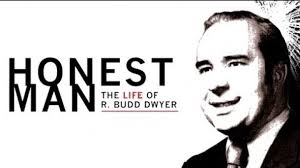
I was 15 years old when R. Budd Dwyer killed himself on live TV. Many stations refused to show the full footage, like KDKA, WPXI in Pittsburgh broadcast the footage uncensored on an early newscast, as they believed that kids wouldn’t be home to see it. That said — there was a snowstorm so many of us were home early. Many kids reacted just like they did to the Challenger crash, with dark humor being the only way to deal with it. I’ve since learned that a study of the incidence of the jokes showed that they were told only in areas where stations showed the uncensored footage.
Honest Man: The Life of R. Budd Dwyer attempts to tell the story behind the man who killed himself with a .357 Magnum after being implicated in a scandal with Computer Technology Associates (CTA)
The Treasurer of the Commonwealth of Pennsylvania, Dwyer had run as a common man from a small town and throughout this documentary, this fact — and the feeling that he let down his hometown and the people that believed in him — is drummed home.
Everyone has a side to their story in this, including the last interview filmed with his wife before she died and his children. There’s also some incredible scenes William T. Smith, the person whose testimony convicted Dwyer. I wonder how much of the Breaking Bad/Better Call Saul character of James Morgan “Jimmy” McGill/Saul Goodman is based on this guy. He really seems to be a real-life Bob Odenkirk character.
This is a balanced documentary that really lets you come to your own conclusion. Sadly, I feel like politics have only gotten worse since Dwyer’s death.
The film also impacted me because Dwyer was often at the center of tape trading in the days before the internet. I’m a big fan of sites like the Found Footage Festival, who recently discussed with David Cross how he started trading tapes. My history of video mix tapes is similar — there was always someone who had a VHS tape at a party that had something you had only heard of. There were things like Pastor Gas, where televangelist Robert Tilton was overdubbed with fart noises. There was always Faces of Death. And there was always grainy footage of R. Budd Dwyer ending his life on live television.
We became desensitized to it. As each progressive generational dub was made, the footage became as hard to see as our morals. There was always a race to find the next crazy thing, to see something we shouldn’t see. At that time, there was just a strange subculture that wanted to own these moments. I’m not saying that everyone wanted to see extreme things. But the majority of mixtapes were often chock full of things like this.
Watching this film, I remembered seeing Dwyer more times than I’d like to think. And the suicide has reverberated throughout pop culture, inspiring songs like Marilyn Manson’s “Get Your Gunn” (complete with a sample of Dwyer’s voice), Kreator’s “Karmic Wheel” and Filter’s “Hey Man, Nice Shot.”
This film made me think about my ethics and about tape trading before the internet blew finding a clip wide open. And most importantly, it made reconsider a man that I’ve always thought was guilty and took the coward’s way out because his back was to the wall. Trust me — it’s not as simple as that.
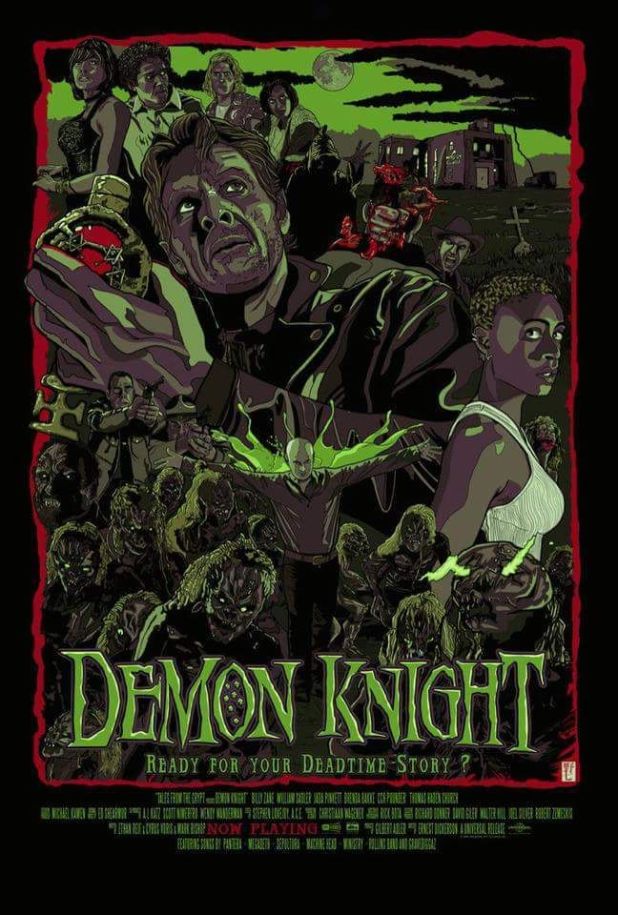
Day 11 of the Scarecrow Psychotronic Challenge is 11. That Soundtrack Though. One where the soundtrack is more impressive than the movie itself. And while I really love Tales from the Crypt: Demon Knight, I can also admit that I think the soundtrack is way better than the movie it plays during.
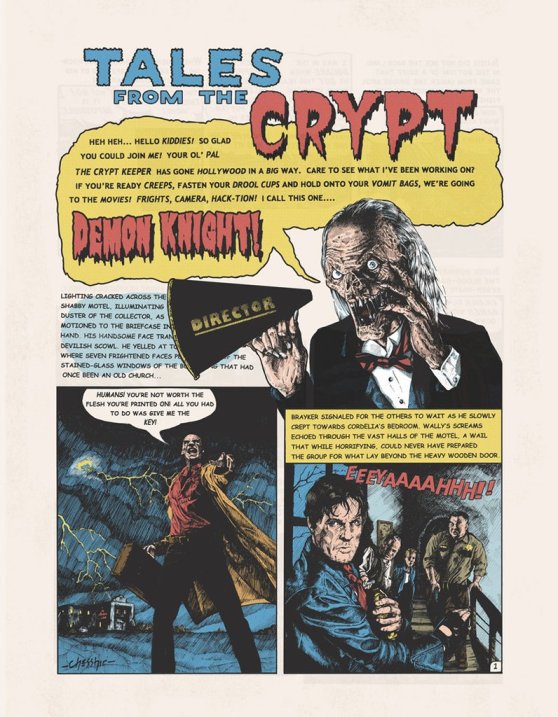
Unlike the HBO series and Amicus film, this story isn’t based on an EC Comic. Instead, it was intended to be Tom Holland’s follow-up to Child’s Play, then it was passed on to Pumpkinhead writer Mark Carducci, Pet Semetary director Mary Lambert and Charles Band’s Full Moon Features. finally, it was optioned by Joel Silver as one of three Tales from the Crypt spin-offs (the other two, Dead Easy and Body Count were never made).
Due to its low budget, two versions of the script were written — one with and one without demons! In the non-demon film, the Collector was a Bible salesman with “killer yuppies” as his henchmen. Luckily, that one never made it to the silver screen.
One night in the desert, The Collector (Billy Zane, chewing the scenery like no one else) is chasing after Frank Brayker (William Sadler, one of my favorite character actors). After a car crash, Frank escapes to a deconsecrated church turned boarding house thanks to town drunk Uncle Willy (character actor par excellence Dick Miller). And that boarding house is filled with even more great acting talent for such a small film: owner Irene (CCH Pounder), Wally the postal clerk (Roger Rabbit himself, Charles Fleischer), ex-con Jeryline (Jada Pinkett Smith), prostitute Cordelia and Roach, the cook (Thomas Haden Church, again, another incredible character actor).
Meanwhile, Sheriff Tupper (John Schuck from TV’s McMillan & Wife) and his deputy Bob meet The Collector near where he crashed. He convinces them that Brayker is a dangerous thief and that he needs their help. It seems Brayker has an important artifact, but when the cops confront him, they arrest both men for stealing cars. The Collector responds by punching the sheriff through the brain.
Brayker uses the key to drive The Collector outside the boarding house, so our antagonist uses his own blood to call upon demons. Now, everyone is trapped and must wait out the night. He then tells everyone in the house exactly what is going on: After God created Earth, demons used seven keys to steal the power of the cosmos. That’s why God created light, which scattered them and their keys across the galaxy. However, the demons have six of the keys now, with the artifact that Brayker holds being the last one they need to reclaim their power. At the Crucifixion, God had a thief named Sirach fill it with Christ’s blood and become the first guardian. Each guardian remains immortal while they hold the artifact, refilling it with their blood when they die. As proof, Brayker explains that he’s been alive since World War I, when his commanding officer passed the artifact to him.
What follows is a night of terror with the Collector pitting everyone against one another. At the close, there’s a new protector of the artifact and a new Collector, who walks away whistling the theme from the HBO series.
At the end of the closing credits, the Cryptkeeper returns to announce the next film, which ended up being Bordello of Blood, which has nothing to do with Demon Knight other than a scene where the artifact appears.
You know, Demon Knight isn’t horrible — it’s a cable TV late night watch, but the promise of a new Tales from the Crypt movie was ruined by having this be only one story (although the Crypt Keeper does interact with a slasher played by an uncredited John Larroquette).
But hey — enough about the film. Let’s discuss the soundtrack!
With Pantera’s closest thing to a single “Cemetery Gates” to “Hey Man, Nice Shot” by Filter, you get two songs nearly everyone knows. But then the soundtrack expands to include industrial stuff like Ministry, heavier metal from Biohazard, Sepultura, Megadeth and all over the map stuff like the Melvins, Rollins Band and the Gravediggaz. It reminds me of the great soundtracks to Spawn (which took the Judgement Night trick of combining metal with another genre, here with metal vs. techno, giving us Filter with the Crystal Method, Marilyn Manson with Sneaker Pimps, Slayer with Atari Teenage Riot and more) and Escape from L.A. (a movie I actually like, but the soundtrack boasts appearances by Tori Amos, Ministry, Clutch and the Deftones).
Drive-In Asylum #13 is now available for order! Early orders will include a die-cut Curtains-inspired sticker, while supplies last, so order today! The third-anniversary issue is bursting with sinister intent and the pulpy newsprint nostalgia you’ve come to love about DIA.
We’re so pleased to bring you an interview with Lynne Griffin. An accomplished stage actress, Lynne’s film credits include legendary slasher pioneer Black Christmasfrom 1974, as well as 1983 cult classic Curtains, which has been building its own reputation thanks to a recent HD blu ray release from Synapse Films. (PS – I did some art for this article!)
Filmmaker/author Bret McCormick returns in this issue, this time with a memoir about how his childhood years as a “monster kid” led to his pursuit of a career in the movies. Stephen Pytak has a critical retrospective of the I Spit On Your Grave franchise, and Victor C Leroi’s Video Nasty series takes on 1981 slasher Don’t Go In The Woods.
In the spirit of the season, newcomer Robert Freese (from Scary Monsters and Videoscope) examines the rare 1979 novelization of Halloween, as well as its connection to 1981 sequel Halloween II and the influence its ideas had on later films in the franchise. Another newcomer, Paul Werkmeister, comments on 1972 occult flick A Name For Evil.
Many of our usual suspects also return with reviews, including Lana Revok, Sam Panico, Dustin Fallon and Mike Haushalter with reviews of Looking For Mr. Goodbar, Demonoid, Terror, Dunwich Horror and The Alpha Incident.
Each issue of DRIVE-IN ASYLUM comes with a 4×6 b&w matte print of a random vintage movie ad, and we’ve also got some fantastic die-cut CURTAINS stickers, too — limited supply of these, so order early to be sure you get one!
5.5 x 8.5, black and white (some pages are printed on colored paper), 52 pages.
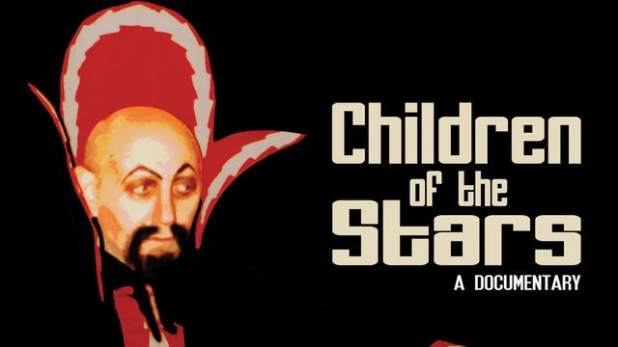
Unarius means Universal Articulate Interdimensional Understanding of Science. Since 1954, from their headquarters in El Cajon, California, they’ve worked to advanced a new “interdimensional science of life” based upon “fourth-dimensional” physics principles. This is not just the story of their church. It’s the story of the love between Ernest Norman and his wife Ruth across the galaxies and eons of time.
My question is, if the church doesn’t harm anyone, if they live as good people, what’s wrong with their love for space brothers? What’s the harm in the movies that they make? They seem much more well adjusted than many churches I’ve attended.
The other teaching of the church is the belief loop, where they can see a movie, see it as a past life experience and then create their own film documenting that fact. That means Star Wars is real. Any movie that you love can be as real as The Bible to you.
Then, there’s Charles Spiegel, Ruth’s longtime assistant and eventual successor. One day, while traveling cross-country, she confided in him that he was Lucifer. Seeing as she called herself Archangel Uriel, one wonders what their relationship was really like.
Some members also see themselves as the Roman soldiers who crucified Jesus and they are making up for that in this life by following Ernest Norman. Hey — is that any stranger than what others believe?
Ruth Norman predicted — many times — that 33 alien ships would land here on Earth, starting in 1974. Charles Spiegel predicted 1980 and was wrong as well. After numerous dates came and went, they began to focus more on improving humanity here on Earth.
I’ve been interested in the Unarius Church since seeing them on Letterman in the 1980’s and compilations of their videos at the long-lost Mondo Video in Los Angeles. This film only confirmed my suspicions of how magical they really are.
Want to learn more? The Unarius Church website is a great place to start. And if you want to watch the film, it’s available on Amazon Prime. Or you can visit the film’s official site.
Day 10 of the Scarecrow Psychotronic Challenge is Unhead Until…It’s too late! Your last second will be your loudest. We’re looking for the quietest non-silent movie or one where the enemy hunts by sound. It seemed like most people would just pick A Quiet Place and since I’ve been using this month to discover new movies, I again reached out to help. Bill from Drive-In Asylum and Groovy Doom was, as always, gracious and full of knowledge. He also knows just how much I love Ingrid Pitt.
In the Greek countryside, archaeologist Dr. Pete Asilov and Professor Andre are trying to find a treasure in an abandoned cave. This uncovers a reptile-like creature that soon vanishes.
Andre’s housekeeper Calliope warns him that there are curses and angry spirits and monsters in the cave, but he doesn’t listen. When the rest of his business partners arrive — bringing Ingrid Pitt in her first screen role — he keeps pushing, despite further warnings, the decayed body of a cavewoman, a set of bones and one of the men being killed by the creature. Soon, they’ll be more worried about staying alive than they are as to whether or not they get the gold.
For a movie that bills itself as an SQ Picture (Shiver and Shake, Quiver and Quake), this is a pretty silent affair. That is, until the girls just randomly decide to dance for the boys. Oh yeah — the professor’s niece Maria is played by Jess Franco’s muse Soledad Miranda, so that makes this movie a million times better than it would be otherwise.
There’s a great near-silent sequence where Calliope is stalked by the reptilian monster (which could also have fit into yesterday’s there). And hey, look at that lobby card! So I guess perhaps there’s a little more going for this film — like the tension when everyone is barricaded in the house and the allusions to the atomic age — than just Ingrid Pitt and Soledad Miranda.




 B&S About Movies
You must be logged in to post a comment.