Necropath, the feature film debut of writer and director Joshua Reale, has had a long, strange trip . . . on a path that begins in 2014 as a short that found a wider audience as part of its inclusion in the 2016 indie-anthology Empire State of the Dead. Now, that short has been combined with two other award-winning short films to create the feature-length version of Necropath.
Warning: If you enjoy zombie movies, you’re not going to like this movie. Now that doesn’t mean it’s not a good movie, because it is a good movie. A great one, in fact. But this ain’t your pop’s traditional George Romero or Lucio Fulci zombie movie. And it’s not one of the many indie-streaming pieces of zombie slop clogging up Amazon Prime. Necropath is a zombie movie run through an unconventional, Bigas Luna surrealistic filter with a smidgen of Alejandro Jodoroswky’s impressionism and José Mojica Marins phantasmagoria. So, if their off-beat brand of psychedelic ambiguity open to interpretation (as with our recent reviews of 2021’s Blood Freaks and Welcome to the Circle) with their respective films Anguish, Santa Sangre, or the fubar’d supernatural exploits of ol’ Coffin Joe isn’t your cup ‘o joe, well, then you’re already dead. So stand tall in the mortuary corridor and let one of the Tall Man’s flying cuisinart balls take you the red planet . . . if Scag doesn’t slice off one of your ears, first.
We, well moi (Did your read our reviews of?), have been down this less-dialog-is-more narrative (that isn’t everyone’s cup of Coffin Joe) before with Jason Lester’s High Resolution and Vahagn Karapetyan’s Greek horror Wicca Book. As with those films, Reale’s debut feature is a film of sight, color, and sound that pushes the visual medium envelope of film; an art form that, at its core, is a craft based in “showing” and not “telling.” In the case of Necropath, Reale tears the ubiquitous 90% visual and 10% dialog film rulebook (stage is the reverse) in half, tosses it into Scag’s needle-strewn drug den, and goes for broke and allows his actors — through their use of props and body language — to bring on the hopeless fear and dread.
Well, what exactly do we mean by an “unconventional” serial killer-cum-zombie movie?
Well, this ain’t no A-List Brad Pitt-starrer or AMC-palpable living dead romp. Necropath is a film of darkness and nihilism (and FYI: the third act goes uber-brutal). It’s a film rife with odd-ball light sources, queasy-inducing framing, and a soundtrack that forgoes the trite and trope route of Blumhoused screeching-crescendo shock scare soundscapes for, well, a bunch of disconnected noises. And Necropath also forgoes with the prattling exposition on how we got here, in fact, the characters rarely speak at all. (And when they do speak, it’s none of that lazy, wild lines “Quick, run!,” “Look out!,” “He’s right behind you!” dialog daggit dung.) Ultimately, Necropath answers the felicitous question: What if Micheal Myers and Hannibal Lecter — or any criminally insane individual — were allowed to wander unchecked amid the chaos of a global pandemic. And what if he’s also infected with the zombie plague?
When that mysterious zombie plague rips across the globe, the virus’ spread is exacerbated by corruptions within an opportunistic pharmaceuticals industry. Amid the imminent demise of society occurring around him, a serial killer known as Scag (a stellar Moe Isaac) — a needle-pushing drug addict that’s also zom-infected — continues his murderous rampage with impunity . . . until he meets his match from the most unlikely person: a little girl who survived the slaughter of her family. And she’ll do whatever it takes to save her baby sister from Scag and his girlfriend/hoe, Crack Hag (Natalie Colvin, in another stellar turn), whose own zom-morphin’ kicked in her motherly instincts: she wants the baby. And, regardless of her age, our young “final girl” has to stand up, as the police officer on Scag’s trail, obviously, can’t kill him. And her dad? A useless puss-bag who, even with his briefcase and tie, is as morally corrupt as Scag: even in the face of a zero-game plague where compassion is key, ol’ pop is still a profanity-abusive husband and father threatening to divorce his wife.
An unlikely heroine: actress Lillian Colvin
While her name isn’t marquee-positioned on the theatrical one-sheet, the most recognizable name here is Cassandra Hayes, whose work we’ve enjoy in the B&S About Movies cubicle farm with the low-budget indies Amityville Death House, Mark Polonia’s Revolt of the Empire of the Apes, and Amityville Island. In fact, it was Cassandra’s presence that advanced Necropath to the top of the digital review stack. Courtesy of my Law & Order: SVU fandom, it was also nice to see her co-star, New York-based actor Nathan Faudree (great here as the dickhead dad), who appeared in “Hell’s Kitchen,” (which just had an off-network rerun this week that I re-watched; so that’s a sign right there) a 2018 episode of that long-running NBC-TV series.
And we’re glad it we advanced the film to the top, as we discovered Joshua Reale has a unique narrative vision and a great cinematic eye. Now, that — it seems — Necropath has reached the end of its path, we look forward to what Reale has in store with his next feature film.
While Necropath is comprised of three shorts — each dealing (realistically) with the opening throes of a zombie outbreak — Reale’s feature film debut isn’t an anthology film. And since I’ve never had the pleasure to watch those three shorts as standalone films, I have no way of knowing where one ends and one begins (since the film runs an hour and a half, we’re assuming each short is at least 30 minutes, with minimal, addition-connective frames shot). And if Reale never disclosed the fact that Necropath — the feature film version — was comprised of three shorts, you’d never know it.
As of late, a lot of short films trickle across the streaming-verse and those filmmakers, looking to increase their opportunities to have their works seen by a wider audience, have worked together to thread their films into a feature film narrative. Of course, most of these “feature films” culled from shorts, tend to have editing issues, inconsistent cinematography, and plots stymied by weak linking devices. Our beloved Amicus omnibuses of the ’70s, with linking crypt and shop keeps, and evil elevators and train passengers, are one thing: those films were scripted that way. It’s another thing to take a grouping of unrelated pieces-parts to make a feature film. And it doesn’t always work. (Editor’s Note: We have not seen the short-anthology Empire of State of the Dead and we are not taking that work to critical task in the context of the opinions expressed in this review.) One of the few times it works (beautifully) is when you have skilled artisans at the center, such as Argentinean Giallo-purveying brothers Nicolas and Luciano Onetti with their 2019 offering, A Night of Horror: Nightmare Radio. And Reale’s film works at that level, even more so, because, as the Onettis required a ne’er-do-well disc jockey to thread a narrative, Necropath has no linking-character for consistency. Reale’s skills in the editing suite is the “consistency” that keeps the viewer engaged in the narrative. No linking required.
And it’s a narrative that is nauseating. I haven’t felt this unsettled by a film since Gaspar Noé’s arthouse-homage upending of the ’70s rape-revenge cycle with 2002’s Irréversible, courtesy of its brutal mix of sound, music, and images. Reale’s utilization of odd-ball lighting, gore, and a crazed sound pallet of perpetual, atmospheric hums, screeches, buzzes, and distorted, disembodied voices (we assume, from the head of Scag), and wailing emergency alert clarions, you’re left feeling as hopeless as the innocents victimized by a serial killer in the midst of a global zombie pandemic. The hopeless darkness of Alexandre Aja’s 2003 New French Extreme hit High Tension, also comes to mind in the frames of Necropath, even a touch of Ryûhei Kitamura‘s brutal (Am I the only one who liked it?) serial-killer trope-upending, No One Lives (2012). (You may see hints of Rob Zombie’s retro-homage oeuvres, as well, and as some who’ve watched Necropath have said. But it’s best not to mention that point and get Sam, the boss, started on Rob Zombie tear. Please, do not get him started on a Rob Zombie tear, for life is too short. Wink: Mum’s the word.)
Necropath is a fucking arthouse war zone that leaves you praying to God that a zombie plague never comes to fruition. Necropath is a film that raises the bar on indie-horror streaming norms — then takes the bar and plunges it through the arduous, rotten corpse of all other poorly-shot and edited and acted indie streaming horrors in its path and forces those filmmakers to step it up to an A-Game or just spare us the pain and go sling faux-Tex Mex food at a Chili’s. (And our irritable bowels kick in and we wipe our asses with their bogus film school degrees.) Necropath lets you know it ain’t gonna be a cool-verse with Jeffrey Dean Morgan swingin’ “Lucille” around and Norman Reedus being all sexy-smoldering, grungy-hot for the ladies in the audience. Necropath is a Private First Class Hudson “Game over, man!” world where you’re fucked. You die. Everyone fucking dies by virus, by drug addiction, by zom, and bye-bye. There’s no Operation Warp Speed to save you. End of story.
Necropath becomes available on all digital platforms on February 9th from Gravitas Ventures and Kamikaze Dogfight. You also can learn more about the film at Cayo Industrial Horror Realm’s official Facebook page and website. You can also visit the film’s official Facebook and Instagram pages for more photo stills. Another Kamikaze Dogfight release we’ve recently reviewed is Don’t Look Back.
Disclaimer: We received a screener from the distributor’s P.R. firm. That has no bearing on our review. We would have loved this movie even without the freebie. And that’s no feldercarb.
Editors Note: Necropath has since made its July 2021 free-with-ads-streaming debut on Tubi. And don’t forget to read our interview with the writer and director, Joshua Reale, for more about the film.
About the Author: You can learn more about the writings of R.D Francis on Facebook.He also writes for B&S About Moviesand publishes short stories and music reviews on Medium.
Katrina “Hellkat” Bash (Sarah T. Cohen) has hit rock bottom, but then she learns that the bottom goes even lower when she finds herself entering a no holds barred MMA tournament against men, beasts and even demons, all to save her soul and the soul of her dead child.
Directors Scott Jeffrey (The Bad Nun) and Rebecca Matthews (The Candy Witch) have a fun script by Michele Pacitto (Jurassic Dead, Monster Force Zero) and Jordan Rockwell to work from and they’ve delivered a dark night of hell for the soul.
There haven’t been many mixed martial arts versus Satan movies, so let’s consider this one the very first. That in itself is more than a good enough reason to check this one out.
I liked how the filmmakers did not shy at all away from the fact that their heroine is incredbly damaged while still remembering that she’s a hero.
This movie is available from Uncork’d Entertainment. You can check it out on demand and on DVD.
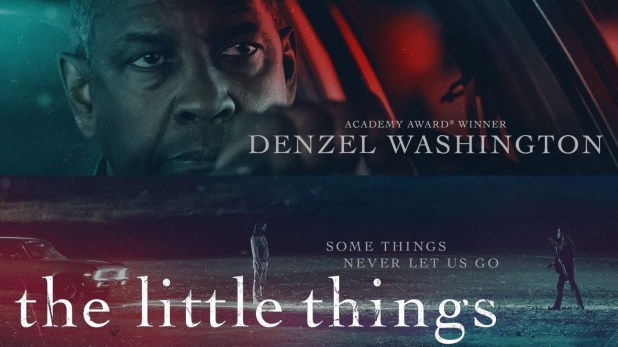
IndieWire’s review of this movie compared it to Seven, which is not only lazy, but it’s the most basic of all connections: young hotshot white cop teamed with world-weary black cop to find a killer who keeps eluding the police. Except that, you know, Seven* is the kind of movie that will live on in cinema lovers’ minds for, well, ever and this movie won’t stay in your brain longer than it takes to watch it. Hopefully.
Ah, HBO Max. For all the sturm and drang and handwringing given over to your plan to play movies at the same time they make it to theaters. Well, between this and Wonder Woman 1984, they’re exactly zero for two.
The comparisons between the films went the whole way to interviews with writer and director John Lee Hancock, who claimed that he wrote this way before Fincher’s movie forever transformed serial killer procedurals. It was originally to be a Clint Eastwood vehicle and then a Steven Spielberg movie and then, well, it sat around for some time.
This movie is set in 1993, which you’ll know because there’s a No Doubt flyer on the victim’s fridge but not because the lead detective’s house looks like it was built last year. That time incongruity is the least of this film’s problems. In fact, if you told me it was set in 2020, I’d believe you just as quickly as if you’d say 1993.
Joseph “Deke” Deacon (Denzel Washington) is a man whose detective career has ruined his life and the lives of everyone around him, pushing him away from Los Angeles and into the outskirts of town, dealing with crimes as simple minded as the Black Angus Restaurant continually needing to replace the g.
While back in the city to pick up evidence, Deacon comes into the orbit of the man who replaced him, Detective Jim Baxter (Rami Malek). You know how that works, what with people being able to move from county to county on cases, jurisdiction be damned.
There’s a killer painting ip his victims and that killer might be Albert Sparma (Jared Leto), who fits every expectation of what a loner killer should look and act like. But is he guilty? He’s an unreliable suspect who is so obsessed with criminal behavior that he confessed to a crime he could have never committed once before.
So what do two good — we hope they are — men do to put away one bad — we hope he is — man? A lot of nothing, as it turns out.
Far be it from me to condemn movies where nothing happens for long stretches of time. That would pretty much describe 99% of the drive-in and grindhouse movies I love, which feature travelogue footage, unnecessary b-roll and long go nowhere scenes that follow each performer each time they walk anywhere.
This film somehow feels longer than five of them in a row while overdosing on Klonopin.
The thing is, if this were a small budget film with no name actors, it wouldn’t make a blip on the rader. But this feature three acting powerhouses and a well-considered writer and director at the helm. And for all that gasoline in the tank, the car is going nowhere fast. And even worse, the car is not special nor does it possess anything that you haven’t seen in every other car that looks exactly like it.
I realize that not every movie can rock your world. But they should at least try. This has Leto playing, well, Leto. At least I hope that he didn’t send used condoms and dead rodents to Denzel and Malek like he did to his co-stars in Suicide Squad.
Also, and this is a silly complaint, but I couldn’t understand a word Malek said. In Bohemian Rhapsody, I chalked that up to him having to get teeth like Freddie Mercury. I can more easily divine what Bane says than his character in this movie.
Movies can be dumb. They can have plot holes. They can have horrible special effects, bad continuity, laughable performances. But the worst thing a movie can be is boring. And I fear that this entire day has all been a dream and somewhere, I am still watching this movie and will soon find myself waking up to having to watch it all again.
*I know I’m supposed to write this as Se7en but that makes my fingers hurt.
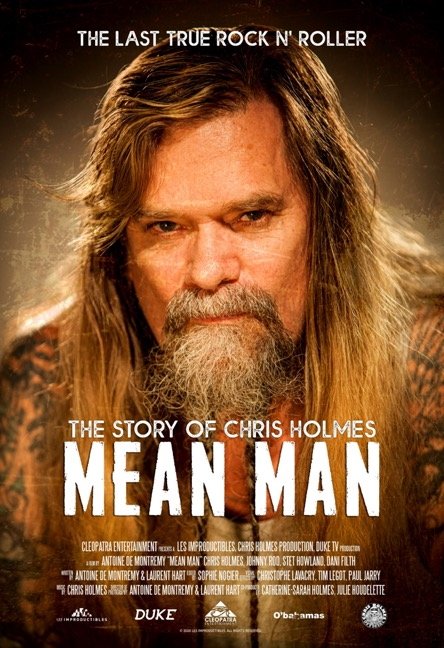
Anyone who watched The Decline of Western Civilization Part II: The Metal Years can tell you that Chris Holmes is the highlight of that film. When we finished watching it, my wife asked when he died. I said, “Believe it or not, Chris Holmes is still alive.”
As the guitarist for W.A.S.P. — if you’ve seen The Dungeonmaster, they’re in it — Holmes was as much a maniac on stage as off. He wasn’t a founding member, as the band rose out of the ashes of Blackie Lawless and Randy Piper’s other band, Circus Circus, along with Rik Fox (who soon left to be in the band Steeler) and Tony Richards (who left the band Dante Fox to join, which became Great White).
By the time the band’s self-titled first album was released, Holmes had joined, also played on The Last Command, the band’s best selling record and one that brought Steve Riley from Keel* and King Kobra bassist Johnny Rod into the lineup.
Although Inside the Electric Circus was a commercial success (and critical failure) and The Headless Children was a critical success (and at the time, a commercial failure), Holmes wouldn’t last. He married Lita Ford and then left the band, saying, that he wanted to “have fun, you know.” Lawless responded by saying, “Some guys want to stay at home and wear aprons.” He would also claim that he was going to play the T-1000 in Terminator 2: Judgement Day, which sounds like a completely ridiculous apocryphal story.
While Holmes would rejoin for a brief period from 1996-2001, he and Lawless were not destined to get along.
The movie finds the guitarist reflecting on a life of the highest highs and lowest lows, as he has lost the publishing rights of his own songs and must start over again with a new band named Mean Man while living with his mother-in-law in Nice, France. Unlike other films like I Am Thor, Holmes doesn’t come across as a buffoon or unaware of his place in the world.
This is a man that weather the storm of the Sunset Strip, of six DUIs, of sex, drugs and rock and roll, yet has remained alive, despite all common sense saying that there’s no way that should be true. Yet here he is, hugging his dog Ugg, enjoying being married and screaming at cars in traffic. It’s too good to be true, but sometimes, that actually happens.
A film that evokes William Fruet’s Funeral Home, along with Dan Curtis’s Burnt Offerings and Don Coscarelli’s Phantasm (via the old Dunsmuir House) gets a fast pass to the top of the streaming stack of films up for review in the B&S About Movies cubicle farm. Yeah, we’re all in on this feature film writing and directing debut by Mauro Iván Ojeda (who got his start with the short films La de Messi and La nueva biblia).
And no: this isn’t a remake the Fruet Canuxploiter. Remember, since that’s a Canadian film, its “polite” so as not to upset the video nasty police. And it’s not so much a funeral home in that movie as it is a haunted country inn that was once a funeral home — with supernatural unrest in its cellar. And while Fruet’s film holds a special place in our ’80s VHS hearts, Ojeda’s debut feature is easily the far superior film.
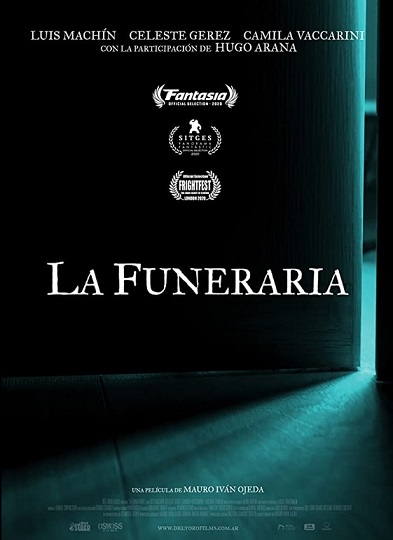
The U.S. one-sheet/lobby card.
Bernardo is an undertaker who goes through his birth-school-work-death existence like a figurative zombie. While his wife Estela pops pills to deal with her depression, his step-daughter Irina — still mourning the loss of her father — rebels with a teenager’s vigor, frustrated with her mother and stepfather’s surrender to exist in a home with ghosts. They’ve given up: she wants to live . . . with her grandmother, who might be a witch who hates her new daughter-in-law and, it seems, cursed the family; grandma’s disdain carries over to her son Bernardo for taking up with Estela, who had a “history” with her late husband.
While the acting from all quarters is top-notch, the call-out actor of this horror-import is the just-starting-out-in-the-business Camila Vaccarini, as Irina. She’s absolutely stellar in her feature film debut, with only a supporting role in the Argentinian film Paisaje (2018) and a starring role in the Disney Channel Latinoamérica series Bia on her resume. Here’s to hoping Tinseltown calls her up to the major studios, courtesy of Ojeda crafting her an industry calling-card role.
Original overseas one-sheet. Also known as The Undertaker’s Home in other markets.
While this Argentinean import (thankfully subtitled and not dubbed) is as well-shot as any box-office popular A24 (Midsommar) or Blumhouse (You Should Have Left) horror released into the mainstream American marketplace, Ojeda’s debut forgoes the gore and shock scares of those films, instead choosing to utilize set design, sound and shadows, along with (beautiful) cinematography and camera angles to convey the funeral home’s cold, insidious fear.
Unlike its major studio American horror brethren, The Funeral Home is not a film of gloss, but of the atmospherics we recall from our Amicus and Hammer Studios films of old. This is a film of metaphor, as we meet a family as decayed as the decrepit funeral home they reside in; this isn’t a family that’s living: they existing. This is a financially desperate, dysfunctional family of ironic, soul-filled vessels that are as empty and tortured as the (supernatural) spirits that haunt them. When you’re this miserable, shouldering sacks of your own ghosts and skeletons, who needs ghosts of the supernatural variety? Courtesy of the family’s new residence — as depicted in its U.S. artwork — we know this family deals with spirits of both the emotional and supernatural variety — as they come to discover the supernatural ones aren’t from the interred that have passed through their home’s mortuary over the years, but something much deeper that’s buried in their new home’s past.
Disclaimer: We were provided a screener by the film’s P.R firm. That has no bearing on our review.
About the Author: You can learn more about the writings of R.D Francis on Facebook.He also writes for B&S About Moviesand publishes short stories and music reviews on Medium.
Unidentified Flying Object (UFO) sightings didn’t start with Kenneth Arnold in 1947. They’ve been part of our history as long as it has been recorded. Yet they’ve always been top secret at best and ridiculed at worst.
As the Pentagon released declassified information and videos about potential alien craft visiting our planet — yes, this happened and it was buried amongst all the other insanity that was 2020 — are we closer to disclosure than ever before?
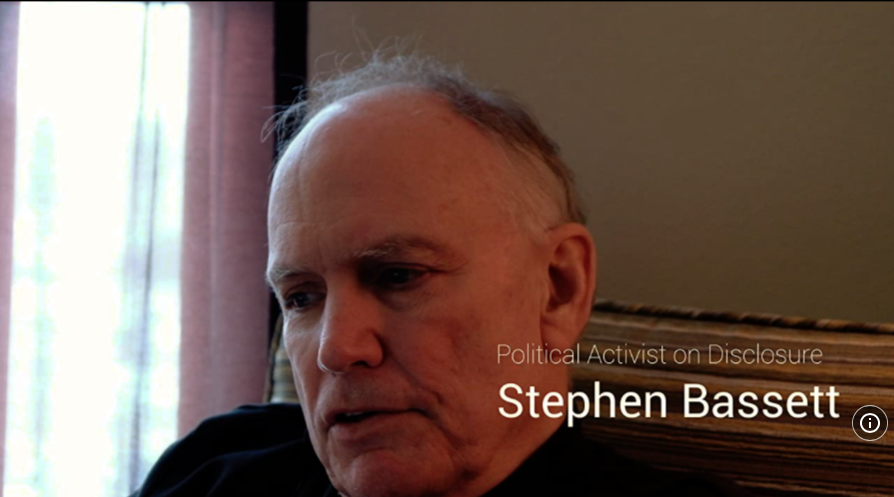
We had the opportunity to spend some time with Volcanic UFO Mysteries director Darcy Weir and Stephen Bassett to discuss the film, UFOs in pop culture and exactly what Jackie Gleason has to do with alien lifeforms.
B&S ABOUT MOVIES: What was the impetus behind me making this movie?
DARCY WEIR: The subject matter of UFOs showing up around active volcanoes is underrepresented. Furthermore, UFO sightings in Latin America are both pretty prevalent and very much under-represented. I wanted to share that story and bring Stephen in with me to talk about his work on ending the truth embargo and the disclosure of the UFO presence from the government to the public.
I find him to be a fascinating subject. All the work he’s been doing in terms of UFO reporting and journalism for over 40 years is very interesting to me.
B&S: It’s intriguing because you always see footage of UFOs around military bases or nuclear power plants.
DARCY: Let’s take the Pentagon’s release of the videos that came out. They were first revealed through the To The Stars Academy (editor’s note: the group formed by Tom DeLonge, Harold E. Puthoff and Jim Semivan) in 2017. The “Gimbal” video or the “Tic Tac” video, which was fully unclassified and confirmed by the Pentagon in April 2020.
Those videos are recorded on aircraft, you know, state of the art military aircraft, in infrared light, in a light spectrum we can see and they are recorded with state of the art cameras that basically are supposed to track objects that move really, really fast.
When when you see a video like that come out, and you hear pilots say, “That’s not one of ours,” and then eventually the government confirms that suspicion. You look, you listen, you learn and you take it seriously.
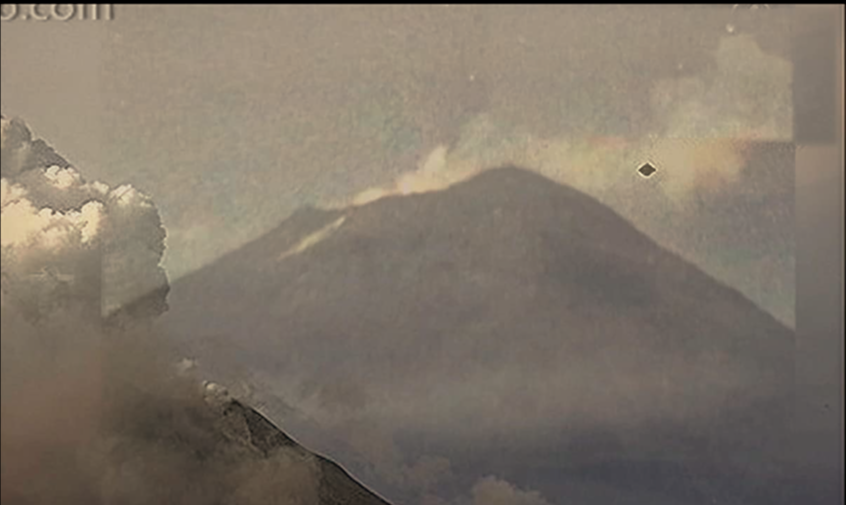
With the UFO videos that we’re capturing around volcanoes in Latin America, these volcanoes are active. And you, for example, can see a UFO that flies through an ash cloud slowly,. It just hovers through and then it waits by a volcanic crater as erupting pyroclastic molten lava shoots rocks into the air, with the environment at probably 1000s of degrees Fahrenheit. And this object just flies through it. No civilian or military aircraft that we know of can perform in that environment.
What is it? Is it ours? What’s it doing there? And that’s a really strange mystery.
The UFO phenomenon is just not limited to the United States. But the United States has some of the most incredible cases. I’ve made a documentary about UFOs in space, you know, that NASA has recorded. I’ve made documentaries with events that have happened in Australia, China and Latin America. And I kind of want to tell even more of those stories that people haven’t heard as much here in the United States.
B&S: Stephen, what do you feel the importance of this movie is?
STEPHEN BASSETT: Darcy is what I call a content provider. In the UAP (Unidentified Aerial Phenomenon)/E.T./research activist journalism genre, the government has been denying the truth of this issue now for 74 years. And so the people were on their own.
They had to do the research, create and write their own books, magazines, documentaries, podcasts, broadcasts and so forth. In spite of the fact that the government said, “No, there’s nothing to this.”
These content providers have kept the issue alive, expanded public awareness worldwide and helped to ensure that ultimately we will get a confirmation from the government of this E.T. presence.
Darcy, of late, has been quite prolific* creating documentaries. I’ve been wanting to do a documentary for twelve years and I haven’t gotten to it yet. He’s made seven or eight in the last two years.
And so I’m here to support. I’m supporting that and happy to join him. Because these docs are critical to people getting a reasonable understanding of this issue. But also, I should mention — given you are all obviously cinephiles you may or may not know this — but I did a research project in 2013. Essentially, I researched every great high grossing film. In fact, I basically researched the top, I don’t know 5-800 films in terms of their gross international take and then converted that to today’s inflation.
Anyway, the upshot is that the most lucrative genre in all of film — in terms of gross revenue — is films with E.T.s in them. Not just science fiction. Just films with E.T.s in them. That tells you a lot, doesn’t it? Think of all the billions of people that have watched films with extraterrestrials in them over the last 50 years. Obviously, the idea of them existing does not seem particularly striking at all anymore, does it?
B&S: I remember first hearing the theory — probably around the first or second season of The X-Files — that alien-related mass media is all about preparing and opening people’s minds up to eventual contact. How do you feel about that theory?
DARCY: I think that, well, whether it was intended or not all of the sci-fi films about extraterrestrials, in one form or another, have helped to acclimate the world to the idea of extraterrestrials. Plus, as you know, the film’s got better the CGI got better.
These movies, for some time now, all the way back to Star Wars, literally take us out into space. They take us to other planets with strange beings. We’ve all been there. Now it’s being done with virtual reality on Oculus. So yeah, it’s acclimatization.
Was it intentional? I think most of it was Hollywood producers making money.
Again, it’s the most lucrative genre and all of film. You’re going to make lots of these movies and you’re going to spend more and more money on them. In fact, the two top-grossing movies of all time, maybe three are Avatar and the two Avengers movies. So yeah (laughs). You’re gonna make money.
Now, it’s possible that the government has somehow encouraged something. The government has been cooperative on some of these movies. And there’s been a CIA Film Industry Liaison for a long time.
To be honest with you, there have been other efforts in which the government has given this field information, some of which was in fact intended to bump things along and some of it was disinformation. By and large, the acclimation comes from the creative geniuses of Hollywood and the desire to make lots of money.
A lot of Hollywood writers are very in touch with the theories, the sort of conspiracy theories and possible facts that are surrounding this subject. You know, I was talking on another podcast the other day. I was asked, what one documentary or one fictional science fiction film do you think gets the closest to reality?
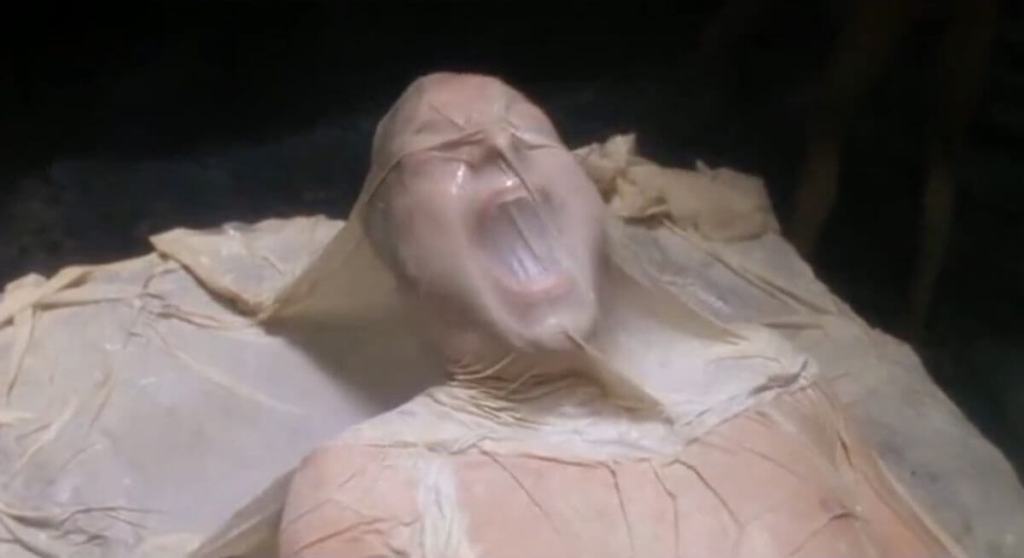
For sure, Fire In the Sky. It’s based on the book that’s about his encounter. That said, it got turned more into a horror movie with the case of how he was abducted, and them shoving things and stuff into him, strapping him down to a table in the movie version. But in the book and his lectures, none of that happened. He was not dragged by his feet around a dirty alien ship by these monstrous fiendish looking things. They looked like humans, a group of them that he saw, and another group looks like grey aliens.
That’s an example of a real tale that has manifested in Hollywood. Another one is Close Encounters of the Third Kind, the French character that is represented as one of the head scientists, hunting down abductees or experiencers, The French character, that scientist is, he’s based on Jacques Vallée. He was doing the real thing for different government groups and NATO trying to figure out the UFO issue.
Noy everything in that film is based on reality. But there are hints and elements here that prove that Steven Spielberg is very interested in the UFO question.
If you look at his film resume, obviously, he’s been gearing for disclosure in some way or another by bringing out so many films that are based on extraterrestrial science fiction.
He’s been in touch with generals and pilots and all kinds of things, met so many different people to have his films be closer to real things that have happened in this history.
Fire in the Sky
STEPHEN: There are no theatrical films — there are documentaries — that are that significant to this subject in my opinion. There’s the Paul Davids’ Roswell: The UFO Cover-Up where there was very little embellishment. It played it straight with history and it got very close. But by and large, the movies that are true to an actual extraterrestrial experience are few.
The reason is — and this is cool — is that the phenomena as it’s been recorded and researched, the truth is that it’s not interesting enough.
In other words, if you made a straight film about a particular case, pick Rendlesham Forest, you would really struggle to make it that kind of compelling, dramatic thing. And so they don’t do it.
There’s this thought with the E.T. issue, they think that everybody is afraid and going to panic when the truth is known. But the real truth is that the fundamental elements and aspects of the actual E.T. reality, including most contact and abductions, is that the truth is not interesting enough or dramatic enough for Hollywood.
So that tells you something, doesn’t it? And another reason why the truth embargo** really has become quite absurd.
B&S: You brought up Spielberg. E.T. started as a much darker script called Night Skies. And the sequel would have been even darker. But for some reason, Spielberg went to the lighter side, telling us that the aliens would be our friends. And that hanged a lot of mass media after that.
DARCY: Yeah, absolutely. E.T. was supposed to be much darker. And there was also going to be a Man In Black that worked for the government who wanted to capture him and his craft.
That’s the biggest secret fact about the UFO issue. We have captured crafts, we have possibly captured entities and found dead bodies. And all of that is Steven Spielberg writing reality.
He’s trying to put that into the cinema because it’s a little-known fact that he wants to expose people to something that’s stranger than fiction. Sometimes that can be fact, you know?
Obviously, he went for the happy family movie, right? You don’t want to make people’s stomachs churn and question reality and not want to go to work the next day after they watch the dark version.
Rick Baker’s abandoned Night Skies alien makeup.
B&S: Speaking of the truth, your documentary is about the truth being unveiled. What do you think the next step is?
DARCY: I’ll leave that one for Mr. Bassett. He has 74 years and thousands of books magazine articles, research reports, hundreds and hundreds of documentaries, hundreds of thousands of millions of websites. And so many articles, probably as many as 40,000 articles in the English language. So he’s got some great insights into where disclosure may go from here.
STEPHEN: I think the truth embargo is about to end.
That’s based upon developments of the last three years which I’m following pretty closely. Let me alert your readers. Watch very carefully for any new developments in the media on the E.T. issue involving politicians and scientists.
The craziness of the last four years is not over yet. After the Trump trial in the Senate is over — that’s going to completely preoccupy the Congress, along with obviously some of the early actions to the Biden administration — I would have expected this to happen already.
I believe the stage has been set in advance now for hearings to finally take place in the U.S. Congress, on the extraterrestrial and UAP issue. And these would be the real thing, not not like the last hearing that we had in 1968 that lasted one day.
These will be extensive hearings and multiple committees, the witnesses will almost exclusively be military, either active or retired personnel, discussing a range of encounters and phenomena, primarily from the context of national security. Once this series has been underway for a while — and they will be viewed by countless millions of people around the world — I think the situation will be such as the President can finally confirm the E.T. presence to the American people and the world.
It is very possible that we’re going to have disclosure and final confirmation of E.T. presence this spring, which I’m pretty sure is going to generate a rather substantial number of scripts pouring into producers all over Hollywood. And we will hit the golden age of extraterrestrial cinema.
When I did that research on the highest-grossing movies, that was just English language movies. I did not include foreign language films related to E.T. subjects. So the total number that these movies have made in profit is billions of dollars.
These films are in the consciousness. Everything is there. And they have been pouring into the human consciousness for pretty much every developed country. Actually, even less developed countries, given the availability of TV and video so forth for decades.
So to me, the idea that people are going to be shocked when they’re told that extraterrestrials exist, that the real ones are here and have been since the beginning, well…it was silly. Now it’s absolutely ludicrous.
It’s time for the people to know.
By the way, let me add that the big shots in Hollywood, particularly the science fiction ones like George Lucas and Christ Carter and Spielberg, they’re the ones that are informed. They have people lined up outside their office all day to tell them things. They mix with high-level politicians.
When Spielberg’s Taken miniseries premiered in 2002, it was at the Ronald Regan Building in Washington, DC. I was there — it was an event with white-gloved waiters and fantastic hors d’oeuvres.
I can say with high confidence that every one of the people I’ve just mentioned and others absolutely know. Now, I’m not suggesting that they were taken to the Pentagon and shown bodies or anything. I’m simply saying they were tipped. But it’s not in their interest to challenge the government’s embargo. But it is in their interest to make movies about the E.T. issue.
One of the reasons that these movies generate so much money is because there are some people who are convinced already that the E.T. presence is real or that it would be cool if it was. So Guardians of the Galaxy comes out and they have to see it.
On the other hand, contrast that with the E.T.-related journalists who have been working so hard for seventy years who make no money doing this and pay a heavy sacrifice. It hasn’t been a picnic for these people. Yet their work has generated a mindset that Hollywood has turned into an industry that makes billions.
How much has Hollywood invested in the disclosure activism? How much have they paid into the cause to end this embargo and bring the truth to the American people? To my knowledge? Nothing.
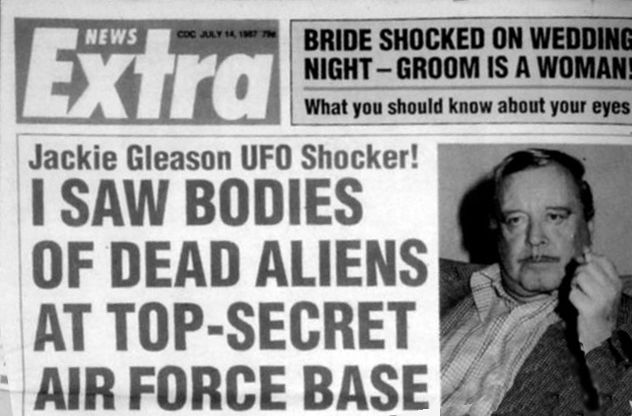
B&S: I think the first celebrity I ever heard that was interested in it, strangely enough, as Jackie Gleason, who early on was really pushing to learn more from politicians.
STEPHEN: I don’t think he pushed. But it’s a great story. It’s a wonderful story.
He told the story to his wife, who told it to Shirley MacLaine, who told me and put it out in her book.
Gleason was a legend back then and he was a good friend of Nixon. I imagine he supported him politically. I’m not positive, but I think he did. And Nixon was a Florida guy. He would visit Florida all of the time, where Gleason lived and they would play golf together. So one night after they played, he called him up and said, “Hey Jackie. Come with me.” And he picked him up! Nixon is driving, he must have slipped his Secret Service and they went to an Air Force Base*** to see the bodies.
He knew that Jackie had a huge interest on this subject, he had one of the largest private libraries of books on this subject****
It was a way of showing off to his buddy a little bit. He knew him well enough to know he wouldn’t talk about it. And basically, he didn’t, but eventually, it came out.
It’s a fantastic story. So that confirms that Nixon was pretty much briefed. He knew about the E.T. issue. He was probably given substantial inside classified information. And they knew Nixon would never go public, because Dick was a statesman. He was a pure politician as well. The Cold War was still underway. The embargo was in place, primarily because of that Cold War. He had a good relationship with the military. And so he had plenty of things on his plate, China and everything else.
Of course, then he got embroiled in some pretty awful scandals. And so the idea that he would suddenly decide, I think I’m gonna engage the E.T. issue, well, absolutely not. He would have viewed it as another huge negative on his legacy, which he desperately wanted to rebuild.
But as President, he got brief. We know some Presidents got briefed and some didn’t. Some got nothing at all. Some were actually denied and stonewalled information, which by the way, is not Constitutional. It violates the norms of the way our government is supposed to run, but it was all justified on the basis of national security as so much else was.
Footage from Volcanic UFO Mysteries.
B&S: So often conspiracy theory and UFO theories go hand-in-hand just because of the way that the media treats them. We’ve had a crazy last four years where conspiracy has dominated the news. So how do you think people are going to truly react to disclosure? Are they going to believe it? Are they going to think it’s just fake news?
DARCY: That’s a really important question. Because, as you know, we have flat earthers that are now a huge thing. I’ve spoken about this and Steve says, “Leave the flat earthers alone.”
But you know, I believe the flat earthers and Q on those two examples of stupid conspiracies. They are a byproduct of the distrust that’s at an all-time high with the governments of the world and their citizens. People are watching everything that’s going on right now. And they’re saying, you know, I’ve got a story. I think this is more true than what’s going on in reality, but the fact is that there’s too much noise. There’s too much disinformation out there, like Q-Anon.
Don’t get me wrong. People like Jeffrey Epstein are real. They did have their pedophile rings. But Q-Anon extends into this grand and crazy conspiracy. And with flat earth, there are so many things that disprove that.
If UFOs are coming here and are piloted by extraterrestrials, then they have to come from another planet just like ours, another spherical planetoid.
Yet people are super paranoid and these ideas run rampant. They allow their imaginations to get away from them too much.
The truth embargo issue is already enough to deal with. And that requires some imagination for many people. And I think with disclosure, that will actually allow for some trust and an opening for the government to buy back some goodwill.
They’re investing in a future where the public can trust them a bit more . And disclosure is a good starting point. It’s going to be a place where they can say, “Look, we have kept this quiet for a long time. We weren’t sure fully sure about it. But here’s what we can tell you.” And that will be nice, you know, that will vindicate a lot of people out there that have been studying this for their whole lives.
Stephen Bassett, he’s seventy-four years old. I’m thirty-six. And he wants to see this in his lifetime. So do I. I think it’s a hopeful thing.
If it comes from the government, I think it’s going to be something for people to look at, listen and learn about more. So as things develop, as we become a spacefaring nation and as we start going into the stars and trying to colonize other planets in our solar system, we’re going to be learning about what’s actually out there waiting for us. And there’s some hope surrounding that. There are some great advantages to the possible technologies that we will eventually have that will make our lives easier, healthier and safer.
STEPHEN: The last twenty-five years have been interesting to say the least. But there has been a very significant confluence of two very important trends.
One trend has been going on for some time getting all the way back to the 60s. And that’s the erosion of trust in the United States government, which eventually started spreading to other institutions outside of government. It’s reached a point where it’s actually threatening the country, it’s threatening the republic. It’s a real problem.
But then you have the onset of the Internet, and then even bulletin boards and email, and then ultimately, social media. And so the combination of this diminishing trust in government, combined with the ability of virtually everybody in the developed world to interact with everybody else in the developed world in real-time and give their opinion about anything — or create something out of nothing — while operating behind anonymous handles has created the golden age of populist driven — or citizen-driven — propaganda.
We’ve always had corporate propaganda and government propaganda. Now we have a situation where everybody can be a propagandist. And as a result, the internet has become a polluted river.
It’s a massive river of information, which is significantly polluted. And it’s polluted to the point where if you just drink the water and don’t filter it, it’ll kill you. And this is a huge problem, right?
It isn’t going to be solved anytime soon.
But the good news is that the extraterrestrial reality, the truth embargo itself is not a conspiracy. So don’t worry about Q-Anon pushing it. It’s not. It’s simply a legal policy of the United States government, instituted and formulated between 1947 and 1952, and carried forward to this day for national security reasons.
It’s not illegal. So it’s not a conspiracy. I always try to object to this — whenever conspiracy theories are attached to the E.T. issue — I try to correct them that the government conspired with some illegality to fake a moon landing or the moon landings. That would be a conspiracy, though not an awful one. But it would be a conspiracy.
However, that might have been justified by national security, of course. So all I can say is, folks if you want to get away from misinformation, disinformation and a whole lot of nonsense on the internet and focus on the extraterrestrial issue…and the high-end authors, researchers and so forth on this, well, there’s a hell of a lot of truth there. And while there is some silliness to be sure, as things go these days, it’s some of the better water in that river.
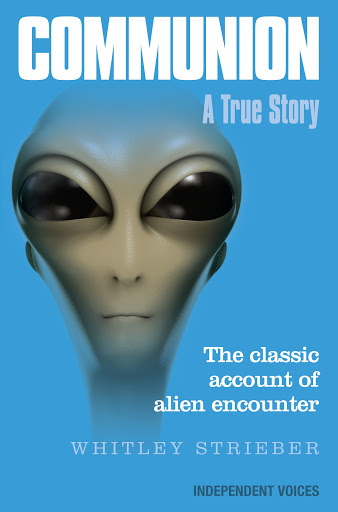
B&S: Finally, how much stock should we put into Whitley Strieber?
STEPHEN: I’ll answer that quickly, but his story is a very complex story. Very complex. He’s a brilliant man and he was a highly successful New York Times bestselling author in the genre of, I guess you could say paranormal. And he’s a contactee, of which I have no doubt whatsoever.
So here you have an example, and this is one of the interesting things about the contact phenomenon, of the fact that E.T.s pretty democratic. They directly interact in these encounters we call contacts. And some of those contacts take the form of what people would probably justifiably call abductions.
They don’t take a general. They’ll take a cashier at Denny’s. And they’ll have a politician, a writer, a guy working on a shrimp boat. Whatever their agenda is, it’s fairly democratic. So imagine that you are somebody who is just a basic person, maybe you’re a garage mechanic, and you’ve been taken by E.T.s since you were five years old. Imagine how that might unfold in your life, how it manifests.
Now, imagine if you’re a nuclear physicist.
Now imagine if you’re a brilliant writer, maybe even a fantasy writer. And so one of the things people don’t take into account is that the way it worked the way it manifests and the way then is reported by people who have gone through this.
There is an enormous spectrum of reports and interpretations.
Whitley’s was extremely complex and very literary. And for that reason, a lot of people say, wait a minute, that’s just wildly crazy. I mean, this, this nice waitress that I know is a contactee and she told me a story. And it was pretty basic.
Hey, Whitley is Whitley. So I think you have to respect all contactees in their stories before challenging their veracity. And that Whitley’s, the problem was that his complex accounts of what happened to him, they challenge people. And so they push back.
Now, that doesn’t mean that as a contact that he’s not capable of misinterpreting what happened to him. Remember, these are extraordinary events. In most people, their memories are actually blocked by the E.T.s themselves.
They’re able to do that and suppress it. For many people, they never even know that they were contactees. Something comes out in dreams, sometimes it comes out in flashes or something. And so this idea that they might misinterpret what’s happened to them. Obviously, that could happen. Nothing surprising there. But because of the truth embargo, and the fact that the government has denied, there’s no there there. The contactees have had a rough time. They’ve been ridiculed.
It’s been getting better, but you go back 20-30 years and it was brutal. They’re victims of the government truth embargo. There have been many. So I always defer to their stories and am very respectful. And unless I’m confronted with some really compelling evidence that something’s being made up…
Look, I realize there have been some, they want attention. But until I realize they’re lying — and I’m given compelling evidence that they are — I feel that I have to be very respectful of their stories and I’m prepared to take them at face value.
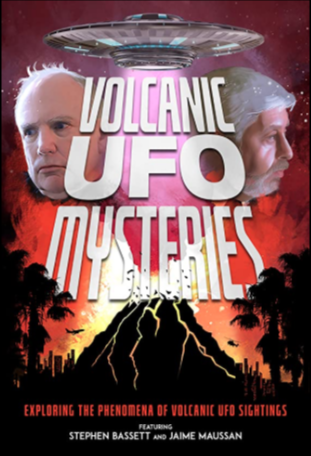
As for the movie, it features director Weir helping Jaime Maussan to uncover the truth behind a series of UFO sightings at active volcanos throughout Latin America, as well as Mr. Bassett as he works to break through the truth embargo.
This film has some astounding footage of the volcano UFO visitations. It also raises the question if these same interplanetary craft have been visiting and depleting nuclear weapon stockpiles around the globe.
Between the believer side that is Maussan and Bassett’s more political take on the reason why UFOs have remained part of our hidden history, it’s a fascinating watch. And I have to state for the record how truly honored I was to get to speak to both of these experts.
**The “truth embargo” is a term that Stephen Bassett uses to refer to the government silence in regards to extraterrestrial visitation.
***According to the National Enquirer article that came out in 1983, the base would be Homestead Air Force Base. Supposedly, Gleason only told his ex-wife Beverly, who told the tabloid before a planned book, and Larry Warren, who was an eyewitness to the Rendlesham Forest UFO and a subject of some controversy. And even he didn’t spill the beans. Instead, the story started because of Timothy Green Beckley and this article.
****He really did. It’s part of the University of Miami’s Jackie Gleason Collection, which “consists of approximately 1,700 volumes of books, journals, proceedings, pamphlets and publications in the field of parapsychology.”
To watch the movie:
Volcanic UFO Mysteries is available now on iTunes, Amazon, Google Play and Video On-Demand.
For more about Stephen Basset and his quest to end the truth embargo, visit Paradigm Research Group and listen to his new podcast The Disclosure Wire. That new show also has a Facebook page that has even more info.
I have no fancy words to add, really — I’ll try — but I was absorbed by every twist and turn of this movie.
From its description, “A man with a mysterious past flees the country to escape his own personal hell… only to arrive somewhere much, much, much worse,” I wasn’t expecting all that much. Imagine my surprise when I was on the edge of my seat from frame one.
Rex (Ben O’Toole, Nekrotronic) is a hero to some and a villain to others. That’s because when fate literally fell into his lap during a bank heist, he went over the top wiping out all of the masked criminals, which may or may not have led to the death of one innocent bystander. So imagine his surprise when he has to spend five years in jail, which all seem to lead him to a horrific destiny somewhere in Finland. After all, he wants away from the press and the constant attention he gets everywhere he goes.
Well, the attention doesn’t stop once he arrives. That’s because he’s become the next meal of a family of cannibals that are more Von Trapp than Sawyer family. They’ve already taken one of our hero’s legs and if he stays around too long, that would be all they eat.
Rex has two people on his side — maybe. One is the voice inside his head, which is sarcastic and cruel at times, but does have a vested interest in both of them getting out of Helsinki alive. The other is the black sheep of the family who has kidnapped him, Alia (Meg Fraser). But can she escape the family she has cared for her entire life? And will she run off with a man she barely knows who only has one good leg?
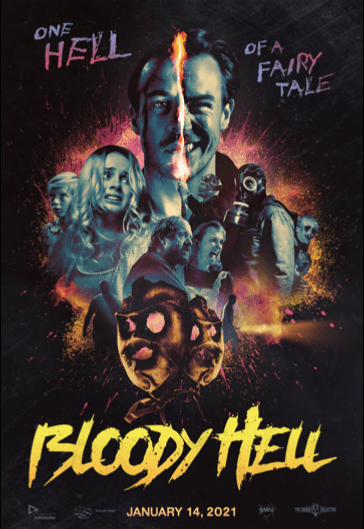
Bloody Hell is a movie in love with film, referencing and quoting so many other movies along the way, but in a way that celebrates the joy of movies instead of making you want to go back and watch something else.
Science Fact: During the January 20 to 21, 2019, lunar eclipse, a meteorite did, in fact, smash into the Moon at 38,000 miles per hour and carved out a 50-meter crater.
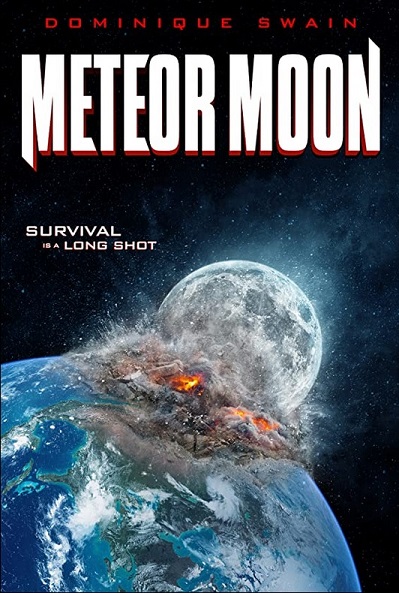
Science Fiction: That same meteor — in The Asylum-verse — shifted the Moon off its axis and Earth’s gravity pulls the Moon into our planet. And don’t worry about the collision: the friction of the moon against Earth’s atmosphere will heat up the planet and burn all that we survey into ash. But man can stop it: we have that newfangled anti-matter spaceship that creates artificial black holes. Yes! We can correct the moon’s orbit. We have the technology . . . uh, oh! There’s earthquakes, and floods, and magnetic storms! Oh, my, Toto! Auntie Em! It’s a METEOR MOON!
So, in the grand design of the everything-and-the-kitchen sink-disaster-mockbuster Final Draft template from The Asylum: While this was probably put into production when the utterly, A-List abysmal Moonfall was announced: what we’ve got here are pinches from the studio’s own Asteroid-a-Geddon and Collision Earth — along with a dash of the recent A-Lister Greenland that’s mixed with a salt shake of the 1998 battle of the Earth-destroyed-by-asteroid-epics-that-just-keep-on-giving-in-the-Asylum-cubicle farm, Deep Impact vs. Armageddon, along with smidgens of the anti-matter junk science of (the craptastic-and-still-can’t-finish-it-after-three-attempts) Event Horizon* and the black hole babble of (the equally-shatty-and-never-finshed-it) Supernova*. And let’s not forget that scene-snip that was even improbable in its original form in Brian De Palma’s Mission to Mars (meh). But in their quest to always one-up themselves: Asylum pinches from their own The Fast and the Furious franchise rip off with Fast and Fierce: Death Race by putting a Ford Mustang into space, à la Universal Studios. Or was that Columbia Studios?
Whatever. Kudos to The Asylum producer-punkin’ Neal Mortiz before he could put Vin Diesel and Michelle Rodriquez into space. But what the hell, Universal, do it anyway: Chris “Ludacris” Bridges in a space suit roarin’ out of the ass end of space shuttle in an anti-matter injected-Mustang is a movie I’d pay to see.
Yeah. Fuck you, Moonfall. I’m all in with Meteor Moon!
Look. It’s easy to kick the dorky kid of the streaming-verse in the nuts, leave ’em wallowing in pain on the playground, and hit the 7-11 for a Cherry Slurpie and nuked Bean Burrito with a smile on your face for a bully-job well done. But we’re not cinematic bullies here at B&S About Movies. We’ve watched enough American International and Crown International sci-fi flicks and we are uber-hep to the ludicrous and outlandish, ridiculous inconsistencies of the retro-vibe The Asylum is selling with meteors crashing into moons and high-performance cars shatting out the back end of a United Space Force shuttle under the command of Col. Dominique Swain** spewin’ techno-babble like nobody’s business (and doin’ the Eric Roberts bit of standing/sitting in one room, natch).
Screenwriter Joe Roche — in his second credit after Collision Earth — does his research and the physics, while improbably, sounds accurate, and his actors “sell” the science with confidence, so I’ll certainly watch Roche’s future QWERTY escapades. And, while The Asylum loves to recycle actors, we have to call out that we did notice that Daniel O’Reilly from the studio’s equally ludicious-but-fun Airline Sky Battle is on board (and he was also in Collision Earth).
Look, don’t pick on the dork of the cinematic playground. Be a pal. Buy an extra Slurpie and burrito, sit down and hang out with the kid, and take a ride together on some crappy, CGI’d hard rocks and heavy metal and be a “Radar Rider.” You can watch Meteor Moon as a PPV-premiere across all U.S. cable television systems or stream it as a VOD on Vudu.
** All this week — from Sunday, January 24 to Saturday, January 30 — is our “Matriarchy in Space Week” celebrating women in space. Join us, won’t you?
Disclaimer: We weren’t provided with a screener nor received a review request from the producers or their P.R firm. We streamed the movie out of our own pocket and enjoyed the movie.
About the Author: You can learn more about the writings of R.D Francis on Facebook. He also writes for B&S About Movies and publish music reviews and short stories on Medium.
So, after stream-stumbling into Omar Jacobo’s enjoyable, Mexican-made horror FUBAR that is Blood Freaks, I began picking through distributor Rising Sun Media’s Facebook page — and this feature film debut from writer/director Eric Eichelberger caught my eye (and dislodged from its socket). And from what I can see, while GSZM was released to VOD streaming in 2018; it’s now offered as a new, free-with-ads stream on Tubi in 2021 (or at least the tail end of 2020): I should know, as I am constantly farming the Tubi platform for films to watch — especially new and off-the-reservation flicks — and this film never populated on my previous digital excavations. Ah, wait . . . the film, in fact, hit the festival circuit in 2018 and debuted on streaming platforms in October 2020. So there you go. Roll ’em, Dano!
Here’s the plot synopsis from the Rising Sun Media marketing department:
Four girls find themselves in a reform school run by an evil woman that joins forces with her equally demented scientist brother who creates a serum to turn attractive rocker guys into lobotomized slaves for his underground movie business. The scientist brother laces Girl Scout cookies with the serum while his sister offers full pardons to the girls to sell them. They are aware that they aren’t your average cookies and agree. The evil plan backfires and the rocker guys turn into flesh-eating zombies and terrorize the town. It’s up to the girls to clean up the mess and restore peace before it’s too late!
Now, with a synopsis like that, what’s not to watch? Plus, more drug-laced cookies and zombies, like in Blood Freaks? And reform school girls in girl scout uniforms. Lobotomized sex slaves. A scientist running an underground porn business. A zombified rock band. This sounds like a John Waters Pink Flamingos joint.
Of course, I’m all in. And it’s the latest film from the guy who rebooted Death Race back to its campy-beginnings with Death Race 2050! Oops, wait. That’s G.J. Echternkamp who wrote and directed that cheezy-campy-crazy fest. This cheezy-campy-crazy fest is the feature film debut by Eric Eichelberger. (Hey, I’m the guy, despite how much how I adore them both, perpetually confuses the German bombshellness and Swedish schwingness of Elke Sommer and Brit Elkland in reviews, so cut me a break!)
Eichelberger’s debut feature film (he’s worked primarily as a reality television editor; he was an art director on Stuart Gordon’s King of the Ants (2003), if that’s a film you’ve seen; I haven’t) is all about perspective: If you’re a 20-something digital streamer that never experienced the analog SOV-VHS ’80s (e.g, pick up a Don Dohler flick, watch films like Spine; or, in a horror perspective, Curse of the Blue Lights) and the celluloid La Brea tar pits’ ass jawbone-dislodging of ’70s grindhouse and exploitation flicks onto brick-and-mortar home video rental shelves (check out Bloodsucking Freaks), or woke up late-nites on Fridays and Saturdays to watch Cinemax’s “After Dark” programming blocks rife with sexed-up Basic Instinct-clones (Harry Tampa’s Fleshtone is an example) and X’d-up T&A comedies of the Porky’s variety (we did a “Drive-In Friday” tribute to those ’80s teen-sex comedies), then of course — you’ll hit your favorite streaming platform or review site and christen GSZM as the “worst movie you’ve ever seen.”
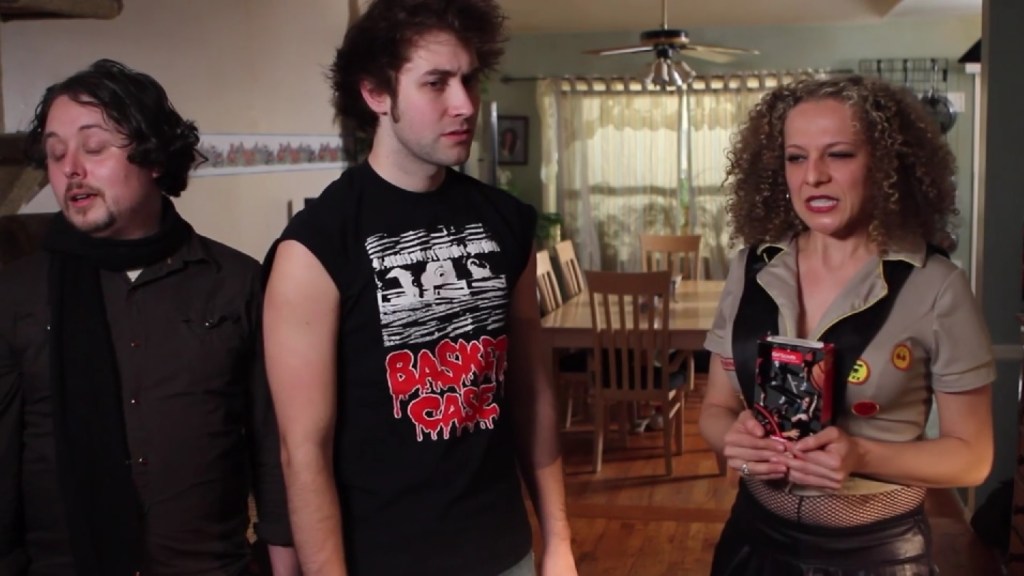
If the tee-shirt of Frank Henenlotter’s Basket Case doesn’t clue you in, all hope is lost.
Ha! Then ye digital reviewer, thou has never tossed back a sour ale of the Eddie Romero or Godfrey Ho variety, or noshed on Hard Rock Zombies (which is GSZM’s closest celluloid relative for this reviewer) and other (awful) ’80s heavy metal horror ditties of the Blood Tracks variety.
Eichelberger is one of us: he’s watched way to many Italian zombie movies (your poor mom!). He’s probably watched Lucio Fulci’s Zombie (1979) more than myself and Sam the Boss, combined. And it’s a foregone conclusion the ‘Eich also partakes of the zombie cheap-slop, such as Jess Franco’s Oasis of the Zombie (1981), Jean Rollin’s guacamole-smeared living-dead romp Zombie Lake (1981), and (ugh) Bruno Mattei’s Hell of the Living Dead (please, Bruno, just stop it already). Did the ‘Eich watch Wendy O. Williams in Reform School Girls (1986)? You bet he did.
All of those film come to play in the frames of GSZM. And like those films, this one is also strictly for adults only: it’s lewd, it’s lascivious, it’s gratuitous, and nudity is at forefront (and back!) for extended periods. (You’ve been warned.) However, unlike most of those films, which were not homages to anything other than cinematic ineptitude-by-low budget, Eichelberger’s debut, while admittedly production-bad with tragic thespin’, is supposed to be “bad” to mimic the bad films in which it’s tipping its hat. (And a couple truths: This is actually a well-shot film, void of any of that annoying, fish-eyed handheld lensing of the i-Phone variety cloggin’ up Amazon and Tubi. And that Eric Eichelberger is on his way to being the new David DeCoteau (who we worship at B&S, so know your Ellen Cabot, ye reader). And that the most experienced actors on board, leads Vance Clemente (makes me think he’s Crispin Clover’s brother) and Jessica Mazo, are actually quite skilled; here’s to hoping they move onto larger roles or nail a guest-starring network series gig. Oh, and adding to the meta: GSZM features the last ever screen performance fromthe late Bloodsucking Freaks director, Joel M. Reed, who we lost this past April.)
No, Girls Scout Zombie Massacre is not a 10-star film by any means. It’s also not a 1-star film, either, you IMDb’ing Amazon scamps. It’s also not Shaun of the Dead or Return of the Living Death nor Re-Animator or Severed Ties, either (and what films are, as they’re zombie-horror-comedy gold standards). GSZM is what it is: an intentionally bad, campy-comedy-horror movie — and it’s inherently preposterous to give Eichelberger’s film a bad review. Look, if you’ve sat through any Troma Team film (shite, don’t get Sam started on a Troma tear) and you’re into Charles Band’s direct to video oeuvres, with their soupçons of gore, a dashes of comedy, and smidgens of T&A, then there’s something for you to watch. The only thing that’s missing is Eddie Deezen (Beverly Hills Vamp) as our mad scientist and, along with Michelle Bauer, Linnea Quigley (The Good Things Devils Do), and Brinke Stevens co-starring, we’d have ourselves another USA’s Up All Night romp with back-to-back showings of Hollywood Chainsaw Hookers, Sorority Babes in the Slime-Bowl-O-Rama, and Nightmare Sisters.
The only downside to the film — IMO, so take it as you may — is that the film is a bit too long and would have been better served by a cut to a more first-time-director-streaming-friendly 80-minutes. But this is a self-financed and produced film with none of those “no, thou can not do that on film” pesky studio suits or distributors to rein it all in. But that’s par for the streaming course in the digital lawless wastelands of the 21st Century VOD-tundras. A couple reviewers mentioned a 70-minute running time, which would be one hour eleven minutes. So, we’re assuming, what we are able to currently free-stream on Tubi must be a “director’s cut,” because that cut runs 111-minutes, that is, a one hour fifty-one minute running time. But it’s the steaming verse, so we give the widest of wide berths to the new kids sailing the seven seas of the Amazon-fed oceans.
All in all: A job well done, Eric, we look forward to your next film; definitely make another one. And you’ve inspired us to watch — finally, the one Gordon film I haven’t watched — King of the Ants, on Tubi. Of course, the whole reason for this review is for you, dear B&S reader, to check out Ghoul Scout Zombie Massacre on Tubi courtesy of Rising Sun Media. You can learn more about the film on GSZM’s official website.
And be sure to check out our recent interview with director Eric Eichelberger.
Disclaimer: No, we do not know the filmmaker. And we didn’t receive a review request, either. We discovered this film on our own and genuinely enjoyed the film.
About the Author: You can read the music and film reviews of R.D Francis on Medium and learn more about his work on Facebook.
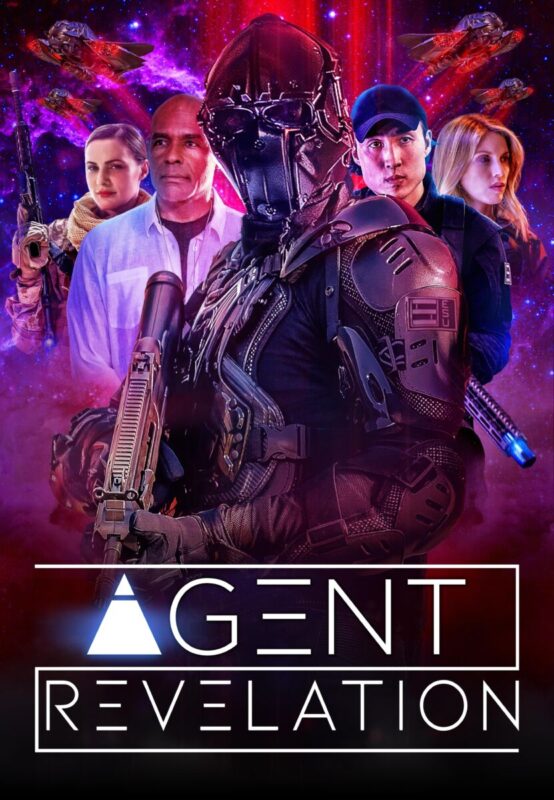
Also known as Agent II, this is the story of an ancient dust that controls humans getting unleashed. However, Jim Yung (writer, director, producer and star Derek Ting, who also made the 2017 film Agent that this is the sequel to) gains superpowers from the red dust, which will come in handy, as Earth is currently in a secret war against the Kinians, a race of evil aliens.
That’s when he meets Alastair (Michael Dorn, Worf from Star Trek: The Next Generation), an AI firm owning billionaire who has created his own private army to fight the aliens that we’ve already seen stop a guy named John (also from Agent) and killing the farmers that he’s controlling. He plans on training Jim to be his greatest soldier.
This movie gets a ton out of its budget, with scenes that look like first person shooters, massive use of bullet time and some good fight scenes. I kind of dug that the aliens are here for the mana that humans use to power their fighting skills. It’s a metaphysical lizard alien fistfight movie and you don’t get too many of those.







 B&S About Movies
You must be logged in to post a comment.