We’ve all seen Hellraiser, I hope, by now, but if this movie has eluded your collection, as it once did mine, this Arrow Box set is incredible and will fit the bill. As the Cenobites say, “We have such sights to show you.”
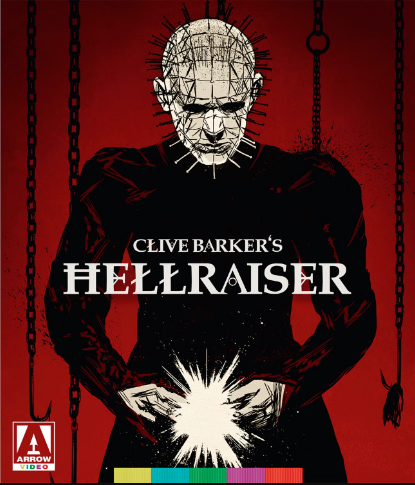
Hellraiser (1987): Horror movies don’t scare me. Not anymore. Some of them disturb me, like the cannibal films. But only one still kind of scares me. And that would be Hellraiser.
There was a time, before the eight sequels to the film and BDSM became well-known fodder on shows like Law and Order that Hellraiser seemed like it came from some alien land more than its true origins. The monsters of the piece, the Cenobites, looked like nothing we’d never seen before, all leather, blood and open festering wounds. The idea that sex and pain could be united wasn’t trite back in 1987, so it’s difficult to convey the power and fear this film had. It feels wrong. It feels dirty. It feels evil.
How this movie was made for $900,000 blows my mind. It looks lush and gauzy at times and at others, like when we see Frank’s heart and veins being formed, positively nightmarish. It shouldn’t be this good — it was Clive Barker’s directorial debut after seeing two of his stories, Underworld and Rawhead Rex, get made into films he didn’t agree with. What kind of deal with the devil did this guy make to turn out something so perfect on his first try?
The misconception that many people have of this film is that the Cenobites are the villains or the horrific part of the film. If we go to the poster for proof, it says “Demon to some. Angel to others.” Pinhead and his gang are there to move the story forward and certainly look frightening, but they are bound by the rules of Hell and the Lament Configuration, the puzzle box that sets the events of the film in motion. Matter of factly, these rules aren’t truly defined yet — is Pinhead a tortured soul stuck in the wheels of some hellish bureaucracy? Who created these boxes? None of this matters — “You solved the box. We came.” Yes, it can be that simple. You don’t need to know all of those answers right now. When Frank buys the box and Morocco and solves it, he gets the answer to limitless pleasure and the drug of all drugs — as Frank says, “I thought I’d gone to the limits. I hadn’t. The Cenobites gave me an experience beyond limits. Pain and pleasure, indivisible.”
That’s one of the real horrors of this film: people will do anything to chase a high. That high may be drugs. It may be pain. It may be a sexual experience that makes the mundane life you’re stuck in — like Julia, bored with a suburban life with a husband she never really wanted in the first place. The chance to be with Frank again, no matter if she has to seduce and kill for him, is everything. Notice that as he gains more muscle and skin with each drop of blood, she becomes more and more attractive, her skin gaining new color.
The main horrors of this film are family and other people. The Cotton family had issues before the Cenobites took one step out of Hell. The most horrific part of the film comes when Frank wearing Larry’s skin, stares at his niece in a moment of sexual longing and says, “Come to daddy.” Sure, there are horror film trappings, but this type of morally bankrupt behavior isn’t something confined to the cinema. So much of the betrayal and madness of Frank and Julia could happen. It happens every day.
Hellraiser exists on the border of reality. It’s fantastic, but it feels like it could happen. It’s the dangerous fiction that could overwhelm your truth if you go too far. In that it’s quite similar to Barker’s Candyman, which posits that saying the name of its titular character three times in a mirror is all it takes for him to come for you. That seems too unrealistic, but do you want to take the chance? And much like the black leather garbed creatures in this film, Candyman must adhere to a dream logic that only comes into our reality when you allow the genie from the bottle.

Hellbound: Hellraiser II (1988): Most of the cast and crew of Hellraiser returned to make this movie and you know, despite the reduced budget, the dark tone of this movie and continuation of the themes from the original makes this one of the better horror sequels.
Kirsty Cotton (Ashley Laurence, returning from the first movie) is admitted to a psychiatric hospital where Doctor Channard and his assistant Kyle MacRae listen to her story. She begs them to destroy the bloody mattress her stepmother Julia Cotton (Clare Higgins) died on but Channard ends up being a man who has been obsessed with the Lament Configuration. After a patient slices himself open upon that cursed object, Julia comes back to our reality.
Channard and Julia have been luring mentally disturbed men to his home so that Julia can feed off of them. Meanwhile, Kirsty meets Tiffany, a girl skilled at solving puzzles who is forced by the doctor and his demented mistress to open the gates of Hell with the infernal box at the heart of this story.
Within the dimension of Leviathan, the humans are more duplicitous than the demonic Cenobites that carry out the orders of their master.
Barker had plans to show how each of the Cenobites had once been human and how their own vices lead to their becoming angels to some, demons to others. You’d think that with the success of the first film they could have had a little more money here.
Another intriguing notion is that Julia was originally supposed to rise from the mattress at the end of the movie as the queen of hell and be the recurring character. As the first movie gradually became a success, Pinhead ended up becoming the favorite.
Back in the video rental days, I may have brought this home more than twenty times. I was obsessed by the look of Leviathan’s dimension and the strange sound that it makes — Morse code for God — blew my teenage mind. It still holds up today, despite a litany of lesser sequels.

Hellraiser III: Hell On Earth (1992): Anthony Hickox made both Waxwork movies, so that qualified him to take on the third trip to visit the Cenobites, which was necessary as the two films that had already come out were huge rental successes.
Series creator Clive Barker reprised his role as executive producer, though he was largely uninvolved until post-production, while Tony Randel at least contributed the story.
At the end of the last film, as Pinhead tried to reclaim his humanity, he finds himself split into his demonic form and as the limbo-trapped British Army Captain Elliot Spencer. As for Pinhead, he and the Lament Configuration remain within the Pillar of Souls that appeared as the last movie finished.
The pillar is bought as art by a club owner and when one of his sexual conquests is dragged into it and absorbed, Pinhead emerges and demands more blood. Without the influence of Spencer, Pinhead has become true evil and is using our reality for his own pleasure, which is against the regimented laws that the Cenobites live by.
Ashley Laurence returns for a cameo, as her Kirsty character explains the events of the previous films. And hey — Armored Saint plays the club!
Between the Barbie and CD Cenobites and the more American locale, this film suffers in comparison to the first two movies. That said, when viewed against what was to come, it ends up being pretty decent. The idea that Pinhead lost his faith in humanity after war rings true even many decades later.

Hellraiser: Bloodline (1996): Directed by Kevin Yagher and Joe Chappelle, this is the last Hellraiser to play theaters, only has one returning character in Pinhead (Doug Bradley), the last to involve Clive Barker and is both a prequel and a sequel.
Yagher left the production after Miramax demanded new scenes be shot. This is a theme that will appear in nearly every 90s horror movie that Miramax got their weird creepy hands on. The new scenes and re-shoots changed several characters’ relationships, gave the film a happy ending, introduced Pinhead earlier and cut 25 minutes of the original cut Yagher turned in. These were enough changes that he was able to use the Alan Smithee credit.
Dr. Paul Merchant has designed a space station to be in the shape of a giant Lament Configuration. Yes, within four movies, the Hellraiser franchise does what it took Jason Voorhees ten to arrive at. Yes, we’re in space. And we’re also going back in time, as Merchant’s ancestor creates the original box that starts all of these demonic events.
The Merchant bloodline has been cursed ever since they helped open the gates to Hell. There’s also a new Cenobite, Angelique, who tempts people and this puts her into conflict with Pinhead, who only believes in pain. There’s also a Merchant ancestor in 1996 that has created The Elysium Configuration, an anti-Lament Configuration that creates perpetual light and will close the pathways to Hell forever.
Bruce Ramsay ended up playing all of the Merchants and I kind of like that the end of this movie attempts to close the story. How crazy is it that this was Adam Scott’s film debut?

As you can imagine, Arrow has gone wild on this, packing this set. You get brand new 4K restorations of all four films from the original camera negatives by Arrow Films, as well as a 200 page hardback book, Ages of Desire, with new writing from Clive Barker archivists Phil and Sarah Stokes. There’s also a limited edition layered packaging featuring brand new Pinhead artwork.
Here are the extras by movie:
Hellraiser
Brand new audio commentary featuring genre historian and unit publicist Stephen Jones with author and film critic Kim Newman, an archival audio commentary with writer/director Clive Barker and actor Ashley Laurence moderated by Peter Atkins, another archival audio commentary with writer/director Clive Barker, a brand new 60-minute discussion about Hellraiser and the work of Clive Barker by film scholars Sorcha Ní Fhlainn (editor of Clive Barker: Dark Imaginer) and Karmel Kniprath, a brand new visual essay celebrating the Lament Configuration by genre author Alexandra Benedict (The Beauty of Murder), a brand new 60-minute discussion between acclaimed horror authors Paula D. Ashe and Eric LaRocca celebrating the queerness of Hellraiser and the importance of Clive Barker as a queer writer, a brand new visual essay exploring body horror and transcendence in the work of Clive Barker by genre author Guy Adams (The World House), newly uncovered extended EPK interviews with Clive Barker and stars Andrew Robinson, Clare Higgins, Ashley Laurence, and effects artist Bob Keen, shot during the making of the movie , with a new introduction by Stephen Jones and Kim Newman, the original 1987 press kit, archival interviews with Sean Chapman, Doug Bradley and Stephen Thrower on the abandoned score by his band Coil, trailers, TV ads, an image gallery and drafts of the screenplay.
Hellbound: Hellraiser II
Brand new audio commentary featuring Stephen Jones and Kim Newman, archival audio commentary with director Tony Randel, writer Peter Atkins and actor Ashley Laurence, another audio commentary with director Tony Randel and writer Peter Atkins, a brand new 80-minute appreciation of Hellbound, the Hellraiser mythos and the work of Clive Barker by horror authors George Daniel Lea (Born in Blood) and Kit Power (The Finite), a brand new appreciation of composer Christopher Young’s scores for Hellraiser and Hellbound: Hellraiser II by Guy Adams, archival on-set interviews, behind the scenes footage, archival interviews with Sean Chapman, Doug Bradley, barker, Randel, Keen and Atkins, trailers, TV ads and an image gallery.
Hellraiser III: Hell On Earth
Alternative unrated version (contains standard definition inserts), brand new audio commentary by Stephen Jones and Kim Newman, archival audio commentary with screenwriter Peter Atkins, archival audio commentary with director Anthony Hickox and actor Doug Bradley, previously unseen extended interviews with Clive Barker and Doug Bradley, FX dailies, archival interviews Paula Marshall, Anthony Hickox and Doug Bradley, a trailer and an image gallery.
Hellraiser: Bloodline
Brand new audio commentary featuring screenwriter Peter Atkins, with Stephen Jones and Kim Newman, a brand new featurette exploring the Cenobites’ connection to goth, fetish cultures and BDSM, a newly uncovered workprint version of the film, providing a fascinating insight into how it changed during post production — this is worth the price of the entire set! — as well as an archival documentary on the evolution of the franchise and its enduring legacy, featuring interviews with Scott Derrickson, Rick Bota and Stuart Gordon, an archival appreciation by horror author David Gatwalk of Barker’s written work, from The Books of Blood to The Scarlet Gospels and a trailer.
You can get this on 4K UHD or blu ray from MVD.






 B&S About Movies
You must be logged in to post a comment.