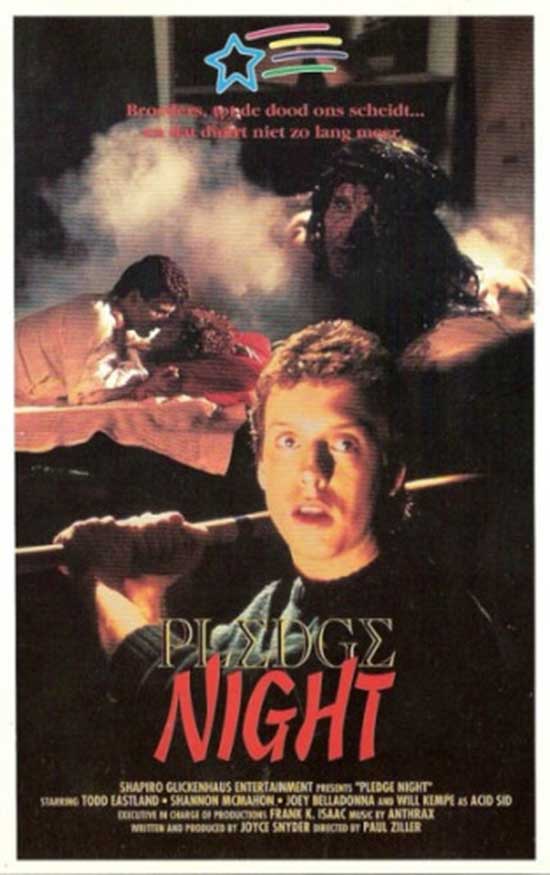
If you didn’t get enough of hazing gone wrong in Slaughter High, good news.
Way back in the 1960s, Sidney Scheider was one of the pledges who got hazed, having to bathe in cornflakes, coffee and vinegar, but someone replaced the water with pure acid — which of course didn’t eat the pipes or tub — and Sidney died a melty death. Also, Sid was played by Joey Belladonna, one of the seven singers the band has had (John Connelley who formed Nuclear Assault with former Anthrax member Dan Lilker, Jason Rosenfeld, Neil Turbin, Matt Fallon, a brief period of time where Scott Ian sang and the band called themselves The Diseased, Joey Belladonna and John Bush, before Belladonna returned to the band).
The rest of the movie is your typical college-aged slasher, albeit with an evil Joey Belladonna clone stabbing people with a sword from Medieval Times. One cast member quit right before shooting, as he took offense with the homoerotic nature of the hazing practices featured in this film. So there’s that.
The crazy thing is, most of them are based on reality, as writer/producer Joyce Synder meticulously researched the truth about fraternities. She also wrote the adult film Raw Talent starring Jerry Butler, which was also the title of that noted cocksman’s book.
So if you want some frat boy moments and gory kills set to Anthrax, head on over to Vinegar Syndrome.
Day 18 Only on VHS: Watch something on the true psychotronic format
Editor’s Desk: Upon the news of his medical hardships, we’ve seen an uptick in our reviews of Tom Sizemore films, which is no way for anyone to discover an actor’s films. Regrettably, Tom—whose credits included the major studio films Natural Born Killers, True Romance, and Black Hawk Down—has died at the age of 61 after having been been hospitalized in a coma for two weeks as result of a brain aneurysm brought on by a stroke.
If not mentioning Tom in passing another review, we’ve reviewed many of Tom’s films, which you can easily discover at B&S About Movies.
Tom Sizemore November 29, 1961 —March 3, 2023
A Little History of Grunge . . .
By 1988, underground “college rock” bands began to bubble under the mainstream and crossed over onto mainstream AOR stations still waste deep in the likes of the hair metal bands Winger, Slaughter, and Poison. And while the audio nimrods didn’t play the newly “major label signed” Husker Du (to Warner Bros.) and The Replacements (Sire), and gave record-industry guru David Geffen of Asylum Records (home of classic rock mainstays, the Eagles) the snub when his new label, DGC, signed New York noise-merchants, Sonic Youth, those spandex bastions did begin to “experiment” with the “more commercial” likes of the Cure, Jane’s Addiction, and Love and Rockets. Yeah, they spun Alice in Chains, but were still not quite ready to pluck Soundgarden from Seattledom.
Then, slowly, while those stations still bowed to the dynasties built by Led Zeppelin and Hendrix, you began to hear less Winger and more of the “false grunge” of Candlebox, Pearl Jam and Stone Temple Pilots, and (B&S Movies’ proprietor Sam’s favorite bands) Creed and Bush. Then, instead of Slaughter ad nauseam, you heard a little trio out of Seattle ad nauseam—and overnight America became a nation of coffee houses with hep-baristas adorned in $50 JC Penny designer flannel shirts and $150 Macy’s faux Doc Martins.
I started my radio career in the early breakers of the Seattle new-wave, working at a small, technically inept, stodgy and dying non-commercial FM that somehow, we, the staffers, convinced our clueless “L7” bosses to give an all-“alternative” format a try and dare rock ‘n’ roll lovers—not interested in blues babbling, folk hootenannies, jazz noodling, plunked banjos, and book reviews—to tune into our audio graveyard left of the dial. And it worked.
And thanks to an indifferent “voice of a generation” who blew his brains out a few years later, the two battling classic (ass-ic) rock stations in town became “rock alternative” outlets overnight and decided the alt-nation wanted to hear the (bane of my existence) Crash Test Dummies and Spin Doctors, and some chick named Torn Anus, I mean, Tori Amos, caterwauling like humping cats on a hot summer night about girls and corkflakes.
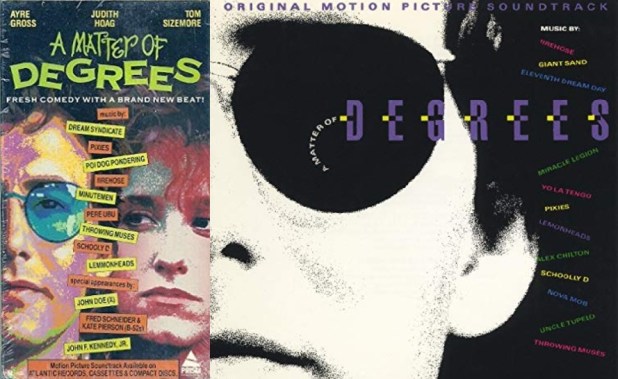
So, the tales of WXOX 90.6 Providence, Rhode Island, in the frames of A Matter of Degrees are near and dear to this DJ’s heart. The new film through 20th Century Fox’s specialty arm, Fox Lorber (Independent Magazinearticle), along with its accompanying soundtrack on Atlantic (the track-listing read like the playlist of one of my airshifts), was heavily promoted in all of the alt-rock mags of the day: Alternative Press, B-Side, CMJ, and Option (good reads!). It was probably even in the alt-section of the mainstream radio trades The Hard Report, FMQB, and Rockpool; it’s been so long, I can’t recall.
The staff of my radio station was stoked. The film was directed by W.T Morgan, who directed the alt-essential concert doc,X—The Unheard Music, and X’s John Doe was starring (later of the radio-connected The Red Right Hand). Fred Schneider and Kate Pierson from the B-52s had roles as DJs alongside Doe, and North Carolina’s hottest college-rock band, Fetchin’ Bones, who just got bumped up to Capitol Records, had a role.
And we were eventually crushed. What we thought was going to be a 1990 college rock radio version of the 1978 progressive rock radio chronicle FM—ended up being Friends: The College Campus Years. Then, we got alt-fucked again, by Cameron Crowe, with Friends: The First Year out of College, aka Singles (1993). Yeah, we got more “radio” with Airheads (1994)—but got more caterwauling cats in the “false grunge” screeches of 4 Non Blondes instead of Throwing Muses and the Breeders. At least Christian Slater’s alt-rock pirate in Pump Up the Volume (1990) cleaned out our Eustachian tubes. And I don’t need any Reality Bites (1994) from Lisa Loeb, either.
Well, at the time, courtesy of our Husker Du and Sonic Youth snobbishness, A Matter of Degrees seemed like a mainstream boondoggle produced by the same “suits” who decided to program songs about frolicking princes, chicks into cornflakes, and creepy, long-haired baritone Dean Martins humming stupid Canadian shite that was giving us A Flock of Seagulls when we wanted the Ramones. But as the VHS box patinas and the tape forecasts snow, I have come to love A Matter of Degrees—and its VHS and CD are a prized part of my collection because: it’s a time capsule that I wished never dissolved into the past.
The Review
A Matter of Degrees, written by Brown University alumni Jack Mason and Randall Poster, we come to find out, wasn’t about a radio station: the radio station served as a backdrop-linking device to a clever, ‘90s version The Graduate (1967), only with The Lemonheads (who ironically cut a cover of “Mrs. Robinson” for an early ‘90’s DVD reissue of the Dustin Hoffman hit) instead of Simon and Garfunkel backing the life-undecided, college campus hippiedom tales of Maxwell Glass (Ayre Gross; House II, Minority Report).
For Max, Providence, Rhode Island, isn’t a place: it’s a state of mind and that “mind” has been rattled by his being accepted into law school (he applied only to the hardest schools so he’d be rejected; he gets accepted to Columbia, the hardest of them all). Then he discovers his cherished campus radio station, which employs his friends Welles Dennard (the incredible Wendell Pierce; USA Network’s Suits, HBO’s The Wire, NBC’s Chicago P.D, Nicolas Cage’s It Could Happen to You) and Scuzz (the amazing-in-his-small-role Tom Gilroy; went onto work with R.E.M’s Michael Stipe and taught at Columbia University) is going to be torn down to make way for a research laboratory backed by a corporation that services the military. And when the station is rebuilt: the free-form format is out.
So, with an Abbie Hoffman-tenacity augmented with coursework titled “Interdisciplinary Approaches to Ethnicity,” Max is going to save the radio station—with arguments invoking the name of infamous ‘80s insider trader Ivan Boesky as a verb: Max speaks ill of the boyfriend of his feisty, Jerry and Elaine-styled best friend, Kate Blum (Judith Hoag; April O’Neill in Teenage Ninja Mutant Turtles, pick a U.S TV series), who runs the radio station: “[Roger] Ivan Boeskied it for them.” Not even their college-dropout/car mechanic roommate, Zeno Stefanos (Tom Sizemore, Zyzzyx Road), who has a propensity to lug car bumpers through the house and make sandwiches by slapping undiluted Campbell’s pea soup between two piece of white bread, can’t get Max off his disillusioned, high sparklehorse: “Remember, women and animals hold up two-thirds of the sky,” Zeno zens. (Now I had my share of Ramdan noodles and peanut butter sandwiches for dinner back in the day, but raw soup sandwiches? I’m glad I didn’t get accepted into Brown.)
“Hey, whatever happened to John Doe? I thought he was in the movie?”
Doe is Peter Downs, the founder of the station who “blew five years in San Francisco recycling the hits like a goddamned monkey” (been there, done that) and returned to his job as the program director of WXOX because, “this is paradise.” Oh, and Peter has a bitch-be-crazy girlfriend, Isabella Allen (Christina Haag), who has Max’s nose wide open. (See what I mean about the Friends-relationship dithering and not enough radio station? Get the Aniston out of here!) In the end, the station and sounds of “Peter Downs and WXOX 90.6 Providence” that Max man-love croons from a shark-toyed bubble bath to a toilet-perched Kate, serves as a plot-character linking device (just like Taj Mahal’s Dix Mayal on WKOK in Outside Ozona).
A Matter of Degrees is a case of “you had to be there.” If you never experienced college campus life and being enamored by the left-of-the-dial “hits” crackling over the airwaves of its tin-can station or a local non-com, you’ll have a lukewarm response to the film. The fun Mason and Poster-penned script reminds me of The Graduate; however, it won’t be in the same classic league as The Graduate when it bounces off your retinas. Your gray matter will populate it as a Singles rip-off—only this film came first. It is, in fact, the first Gen-X, well “grunge,” film in our $5.00 cup-of-coffee flannelled landscape (and you can visit with those films in our “Exploring: 50 Gen-X Grunge Films of the Alt-Rock ’90s” overview.).
Chalk it up to nostalgia fogging my sight; with eyes that see all of my friends from the grunge epoch as I flashback to my views from the glass booth (as I cracked open a new album called Bleach by some band called Nirvana) in the spot-on-miscreant Scuzz, the cucumber-cool Welles, and the rest of the WXOX satellites.
“Rock and roll can save you!” urges Peter Downs.
It did, Peter. More than you will ever know.
Where to get and how to hear the CD soundtrack and see the VHS movie:
While A Matter of Degrees tanked as a theatrical feature (the Sundance crowd shrugged), it blossomed on the international home video marketplace, carrying the titles of Louco Por Rock (Crazy for Rock, Brazil), A tutto rock (Too All, Rock Italy), and in Poland, Radio Maxa (Maximum Radio), or, more accurately, “Radio to the Max.”
As with most of the failed films in the pre-DVD era unceremoniously dumped to VHS, A Matter of Degrees has never been released on DVD—not officially nor as a grey market DVD-R—and there are no online VHS rips. There are no CD rips (of the non-vinyl) soundtrack, but you can listen to this re-creation of the soundtrack I patched together on You Tube. You can also see the soundtrack’s liner notes at Discogs. Multiple copies of the CD soundtrack, the even rarer cassette version, and the VHS can be found on numerous seller sites, eBay in particular. Not finding it won’t be a problem.
Caveat Emptor: John Doe’s incredible theme song for the film, “A Matter of Degrees,” which appears on his debut solo album, Meet Joe Doe (1990; DGC) and the promotional EP single, A Matter of Degrees, does not appear on the soundtrack, which is baffling, considering he’s one of the leads of the film. You can watch John Doe perform the single on the study-helper-for-the-late-night college crowd (good times): The Late Show with David Letterman (there is just something “off” seeing John Doe as a “traditional” lead singer clutching a mic-stand and not wearing a bass). Let the video play through to watch David Letterman’s 1983 clueless-awkward interview with X (really, Dave: alphabet jokes?) as they promote “Breathless,” the soundtrack single to the Richard Geer remake of Francois Truffaut’s film (1960) of the same name. X also covered the ‘60s hit “Wild Thing” for Major League (1989).
As with John Doe: Fetchin’ Bones are in the film—performing their MTV 120 Minutes hit, “Love Crushing,” for a “Save WXOX Benefit” (where John F. Kennedy, Jr. shows up and serenades a girl with an acoustic guitar)—but their song doesn’t appear on the soundtrack. Go figure. And the film is dedicated to D.Boon (backed by Doe’s title-cut song in the film only), the late guitarist-singer of the Minutemen. Why does the post-D.Boon outgrowth of the Minutemen, Firehose, appear on the CD soundtrack, and the Minutemen do not? Double go figure. And don’t bother (poi-dog) pondering how the B-52s got soundtrack skunked. Seriously, this film needed to pull a Dazed and Confused (1993) and release an “Even more . . .” Volume 2 to contain all the great “college rock” in the film. (Oh, hey Kris Erikson, Uncle Tupelo made it onto the soundtrack!)
You can also learn more about Randall Poster’s success as a music supervisor, the art behind movie soundtracks, and his longtime collaborations with director Wes Anderson (2014’s Grand Budapest Hotel) courtesy of these print interviews conducted by WIPO Radio, The AVClub and New Music Express. As it seems there will never be a DVD restoration replete with a commentary track, these interviews are the only way to gain insights on how A Matter of Degrees was and came to be made. (Jim Dunbar, who portrayed DJ Frank Dell, also amassed over 60 credits as a music supervisor, some in the company of Poster.)
In Poster’s post-1990 interview with the alternative music trade NME—New Music Express, he had this say on why he gave up on screenwriting and producing to work exclusively as a music supervisor on films (2012’s Skyfall, 2013’s The Wolf of Wall Street; he won a 2011 Grammy for “Best Compilation Soundtrack” for HBO’s Boardwalk Empire):
“I was always a big music lover, a record collector and an avid movie fan. I got through university studying English Literature, and I found myself without any professional direction. I wrote a screenplay with a friend of mine [Jack Mason] about a college radio station. We did a lot of new songs for it, and we did a record and I just felt that that was really what I wanted to focus on. I wanted to work with great directors, so I figured if I made music my focus, and that would enable me to do [work with great directors; like Wes Anderson].”
Poster also tells us that his college radio love letter was not only filmed in Providence: much of it was shot at Brown University. Poster and Mason were inspired by the college’s campus radio station, WBRU, changeover from a free-form to commercial format in 1985. They wrote the screenplay after graduation. It took them five years, but they got it made. And that’s awesome.
How beloved is A Matter of Degrees? This post at the Radio Survivor blog, written by fellow AMOD fan, Jennifer Waits, proves this cherished time capsule of ‘80s college radio has fans that want, and need, a DVD release of the movie (hint to Kino Lorber!).
Then there’s new fans—of this almost 30 year old movie—like General Manager Sharon Scott of the streaming-community station Art x FM. When she put the new, low-powered community FM (LPFM) outlet in Louisville on the air, she was granted the WXOX-LP call letters. According to Sharon, she didn’t know about A Matter of Degrees or its fictional radio station until well after the station received the call letters. Then, she spotted the movie’s promotional sticker on the door at WRFL and was taken aback that it was the same call letters she had chosen.
It looks like Louisville has found its audio salvation! “WXOX Louisville can save you!”
You can learn more about the new WXOX and Sharon Scott’s fight to save WRVU-FM, Vanderbilt College’s radio station, after students lost access to its terrestrial signal. The Radio Survivor article also provides links to learn more about the history of Brown University’s WBRU.
Peter Downs was right: “Rock ‘n’ Roll Can Save You!”
(And don’t believe the Hype! (1996; full movie/TubiTV) they’re selling!)
Editor’s Note: This review re-ran on December 21, 2020 (with updates), as part of our “John Doe Week” of reviews. You can watch the trailer for A Matter of Degrees on You Tube.
About the Author:You can read the music and film reviews of R.D Francis on Medium and learn more about his work on Facebook. He also writes for B&S Movies.
DAY 12. THE FRACAS AND THE FUZZ: Something revolving around cops and criminals.
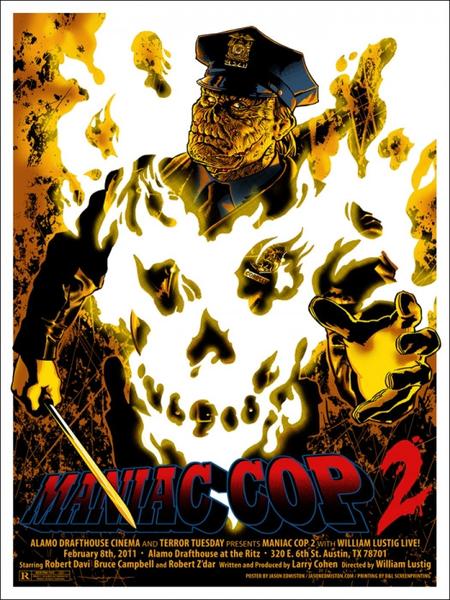
Bill Lustig and Larry Cohen return to tell the next adventure of Maniac Cop Matthew Cordell, who somehow survived being skewered with a pole and a dunk in the rivers of New York City last time. Now, he’s got a junked out police car and is patrolling the city and killing past enemies like officers Jack Forrest and Theresa Mallory (Bruce Campbell and Laurene Landon).
Officer Susan Riley (Claudia Christian, Calendar Girl Murders) is now on the case of not only the Maniac Cop, but a killer named Steven Turkell (Leo Rossi, Bud from Halloween II) who has joined forces with the titular character. Turns out that for some reason, the Maniac Cop wants an entire army of criminals on his side. Look for Clarence Williams III from Mod Squad as one of those crooks named Joseph T. Blum.
Detective Lieutenant Sean McKinney (Robert Davi!) is also trying to stop the Maniac Cop, even promising him an honorable burial and exoneration for his crimes. For what it’s worth, our antagonist gets to kill the three inmates who scarred him and then takes our Turkell in a fiery explosion.
Of course, the credits roll with Maniac Cop’s hand bursting out of his coffin. You can’t keep a bad cop down.
Charles Napier, James Earl Jones, Danny Trejo and Hank Garrett, who once wrestled as The Minnesota Farmboy before going into comedy and appearing as Officer Nicholson on Car 54, Where Are You?
Sadly, Joe Spinell was to play Turkell the murderer, which would have united Maniac Cop with Maniac. However, Spinell died before filming began and the film is dedicated to him.
Although top billed in the credits and on the posters, Bruce Campbell is killed 17 minutes into the movie and has about 3 minutes of screen time. He also hates when people bring this movie up, as it reminds him of a painful time in his life. He always fires back — in a hilarious way — on hecklers who don’t follow this rule at conventions, which has led to goofballs purposefully asking queries about it just to get roasted by him.
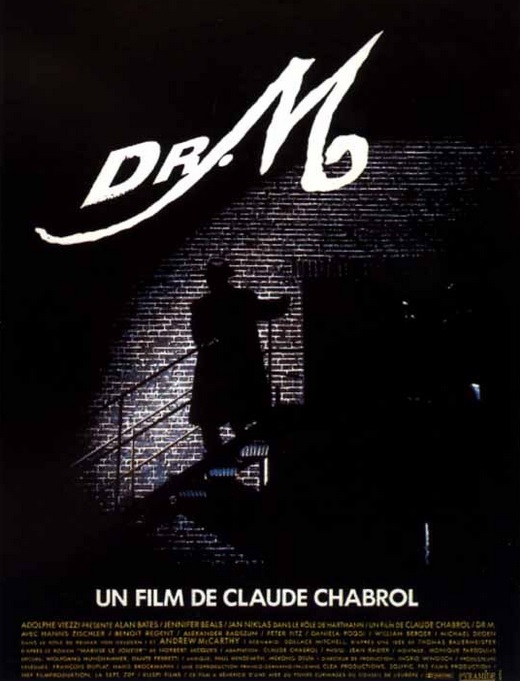
While not a household name in the U.S., director Claude Chabrol (with films like Bluebeard and 1975’s Innocents with Dirty Hands) is revered in his homeland—and throughout Europe—alongside other prominent, “mainstream” filmmakers birthed from the ‘50s French New Wave: Francois Truffaut (1966’s sci-fi Fahrenheit 451) and Jean-Luc Godard (1965’s sci-fi Alphaville).
Inspired by German Expressionist filmmaker Fritz Lang (1932’s apoc-futuristic Metropolis) and Alfred Hitchcock’s oeuvre, Chabrol is best known to U.S. audiences for his 1969 (written/directed) foreign hit, La Femme infidel (The Unfaithful Wife). A Fatal Attraction-esque husband-murders-lover-of-cheating-wife thriller, Chabrol’s film received renewed interest when remade by that film’s director, Adrian Lynne, as Unfaithful (2002; with Richard Gere and Diane Lane).
When the centenary year of Lang’s birthday came around, Chabrol decided to pay tribute to his cinematic idol with a futurist-Metropolis spin to Fritz Lang’s 1922 silent, two-part mystery-masterpiece, Dr. Mabuse: The Great Gambler and Inferno*. Most likely—with a cast featuring Jennifer Beals of Flashdance fame (as Sonja Vogler) and Andrew McCarthy (as an “assassin”; his appearance, so brief, it doesn’t warrant his top-billing)—this admittedly low-budget yet engrossing film (titled Dr. M throughout Europe) was criminally slapped with a hackneyed, U.S. teen-slasher title due to its American-based stars: Club Extinction, for its domestic home video bow.
In a cost-effective, not-too-distant Bladerunner future, Berlin (remember, the Berlin Wall didn’t fall until November 1991; so it is still standing in this “future”), a police inspector (as in the aforementioned-linkedAlphaville) traverses the city in his investigation of an “outbreak” of shocking-spectacular suicides that “plague” the city. Clues soon lead him to a “Big Brother” multimedia combine (as in Kamikaze ’89). The combine employs his lover, Sonja, as the spokeswoman for a series of commercials with a sinister, clandestine purpose (as in John Carpenter’s They Live; more accurately, David Cronenberg’s Videodrome): to hypnotize and control, and eventually destroy humanity (in Charbrol’s case: a Hitler metaphor).
The “Fuhrer” behind the plot: Dr. Mardsfeldt (the always incredible Alan Bates; Paul Newman’s post-apoc bow, 1979’s Quintet), who passes himself off as a self-help guru at a remote holiday “health” resort—complete with a “life support system” in a control room (read: brainwashing) for a Jim Jones-styled religious cult. And, Crazy Imagery Alert: One that only Chabrol can dream and commit to film: Bates and Beals having sex—intercut with images of war and destruction (interpret that how you will).
This examination of the life of Adolf Hitler and the goals of a Fascist dictatorship reminds us that, while the world reviled him as evil incarnate, Hitler saw himself as sane, righteous and justified. In most films, we encounter evil, cackling, mustache-twisting Castor Troy’s (Nicolas Cage in Face/Off). That is not how an “evil reality” thinks or operates. Dr. M doesn’t see himself as evil. In his mind, his goal is a logically sane endgame (and Bates plays it close to the chest; no histrionics). And technology, in the wrong hands—as we now experience in today’s modern world (as with the current vaping epidemic)—can be detrimental to humanity.
* Lang brought the character back for two sound-sequels: The Testament of Dr. Mabuse (1933) and The Thousand Eyes of Dr. Mabuse (1960), each starring Rudolf Klein-Rogge as the doctor. Then, five more German sequels were made, after Lang’s final Mabuse film in 1960 and prior to Chabrol’s variant: The Return of Dr. Mabuse (1961), The Invisible Dr. Mabuse (1962), The Testament of Dr. Mabuse (1962), Scotland Yard Hunts Dr. Mabuse (1963), and The Secret of Dr. Mabuse (1964). Dr. Mabuse fans will, of course, note, there are other sequels: The Vengeance of Dr. Mabuse (1972), along with sequels in 2013, 2014, and 2020.
Update: April 2022: Arrow Video has since honored Claude Chabrol‘s career with two box sets: Twisting the Knife and Lies & Deceit—sets which we have reviewed in full. Within those reviews, you’ll find individual reviews for each film in the set. Other Chabrol films we’ve reviewed include his Eurospy romp, Blue Panther, and his retelling of Alice in Wonderland, as Alice or the Last Escapade.
About the Author: You can read the music and film reviews of R.D Francis on Medium and learn more about his work on Facebook.
The bolo tie-wearing Prescott (Adam West) runs a “Special Police” force in the year 1999 from a one-room set (that he never leaves) via a couple of Commodore 64s and some 60s-era blinking props to protect the post-apocalyptic wastelands of Southern California. Keeping Adam West company in the washed-up actor’s camp are Troy Donahue (the metal epic Shock ‘em Dead) and Stewart Whitman (Guyana: Cult of the Damned, Demonoid, and Bermuda Triangle). Helping out on the stunts and working as one of the “wasteland scavengers” is the always reliable and entertaining Sean P. Donahue (of the awesome Ground Rules).
And how did we get here, you ask? Well you’ll have to listen to West’s voice over narration (that he wrote himself!) at the beginning of the film as he educates you on the ozone layer, the greenhouse effect, the rain forests, and the solar flares that plagued the world (“. . . half the world just didn’t give a shit. . . .”).
Anyway, when West catches wind of an illegal slave auction of women run by some “bad-ass” named Wraith (clad in a predictable Nazi SS uniform), he sends in the resident “Mad Max”: John Travis (Ron Marchini of the 1976 kung-fu classic and popular video rental, Death Machines). During the course of breaking up the slave ring — with his high-tech, multi-barrel shotgun — his team is killed: Travis is the last police officer on the force! So, with his high-tech ‘80s-era jeep, Travis takes the two surviving slave women to a utopia of clean air and water in Montana . . . and kicks some ass along the way. (Travis may have been double-crossed by Adam West, who really ran the slave ring . . . does it really matter?)
If you’re a post-apocalypse completest — or an Adam West fan that needs to slide a copy of Omega Cop next to Zombie Nightmare (with Jon-Mikl Thor!) and One Dark Nighton your shelf — then this film is for you.
Say what you will about its production quality and shortcomings in catching some Mad Max-inspired post-apoc love, but Omega Cop isn’t boring and was popular enough on the video store circuit that Ron Marchini and writer Denny Grayson returned with a 1991 sequel: Karate Cop — costarring David Carradine (Future Force,Death Race 2000) in place of Adam West — which has something to do with people forced into gladiator-arenas by street-terrorist gangs. But get this: the director is sexploitation purveyor Alan Roberts of Young Lady Chatterley (1977) and The Happy Hooker Goes to Hollywood (1980). But don’t let his soft-porn presence deter your watch: as with any Marchini flick, Karate Cop is a fun watch.
Director Paul Kyriazi, who made his debut with the aforementioned Death Machines and vanished from the film world after Omega Cop, which served as his fifth and final film, has returned to the writing and director’s chair with the 2018 sci-fi movie, Forbidden Power. You can learn more about Kyriazi’s return and his new film courtesy of a favorable review at HorrorGeekLife.
About the Author: You can read the music and film reviews of R.D Francis on Medium and learn more about his work on Facebook. He also writes for B&S Movies.
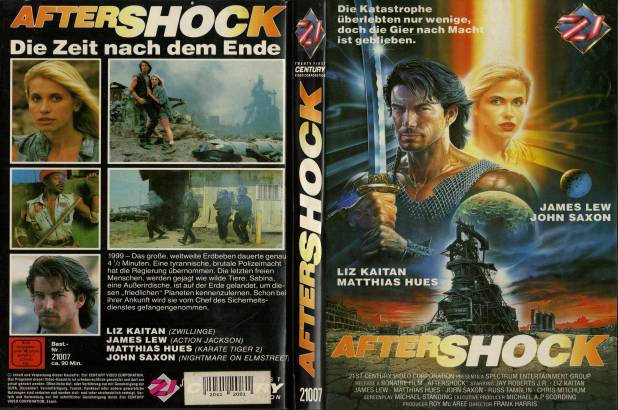
Anti-intellectual paramilitary forces rule the post-World War 3 landscape, which is directed by Frank Harris, who was behind Killpoint and The Patriot (not the Mel Gibson movie) and Lockdown (not the Sylvester Stallone movie).
Into this world arrives an alien named Sabine, played by Elizabeth Kaitan. Oh Elizabeth, you’ve been in so many movies that I’ve savored. You watched Lance Henriksen battle bikers in Savage Dawn. You dated Ricky Caldwell in Silent Night, Deadly Night Part 2. You were Candy in four Vice Academy movies and showed up in Beretta’s Island, an attempt to transform Arnold Schwarzenegger’s friend, the recently deceased Franco Columbu, into an action star. I mean, Ken Kercheval even showed up. But the rest of the world — well, the part that watches slashers — knows you as Robin in Friday the 13th Part VII: The New Blood. You know her — the one who calls Tina Marilyn Munster before heading upstairs to get killed.
Sabine upsets the balance of power and the forces that have worked so hard to consolidate said power now need to keep her controlled. Such is the world of Aftershock.
The rebels want to protect Sabine and get her back to the portal that will bring her home. And the baddies, well, they want to dissect her.
This is the kind of movie where the supporting cast is the entire reason to watch the film. I mean, there’s a black rebel played by Chuck Jeffreys that 100% is doing an Eddie Murphy impression for the entire movie. Then there’s Deanna Oliver, who was the voice of The Brave Little Toaster, one of the most frightening and strange movies I’ve ever encountered despite its outer trappings as a kid-friendly movie. Russ Tamblyn and Chris Mitchum are here! And Matthias Hues, Talek from Dark Angel (what’s up with this post-Mandela Effect world where I only knew this movie as I Come In Peace?), is a gang member along with everyone’s go-to mutant, Michael Berryman.
The main reason I liked this movie — let’s be honest and say the only reason — is that John Saxon and Richard Lynch play the leaders of the bad guys. To be fair, Lynch is barely in the movie in his role as Commander Eastern. He shows up in one major scene, where he orders around Saxon, holds a small dog and has a missing eye. Trust me, this scene alone boosted this movie up at least 40%.
This was written by Michael Standing, who memorably blew a van to smithereens in The Italian Job. He also plays Gruber in the film. It’s not the best end of the world movie, but with a cast like this, there was no way that I could miss it.
I hoped against hope that David Carradine wouldn’t have to be in another David Prior movie, but you know how it goes. You have to do the movies that are paying for you. Actually, I don’t know. No one is asking me to be in horrible movies all that often.
Remember John Tucker? Yeah, that guy Carradine played in Future Force. Well, he’s back. And this time, his son Billy has traveled through time to help him. Billy’s played by David Prior’s brother Ted, so there’s that. He’s named for the wheelchair-bound friend of John from the first movie, in case you remember that movie. I hope you don’t.
I guess I should try and say something nice. Well, Charles Napier and Jackson Bostwick, the original Captain Marvel on the Shazam! TV series, show up.
You can watch this on Amazon Prime with and without help from Rifftrax. Just like the first movie in the series, you’re gonna need all manner of aid to get through this. Trust me, more help than you’ll find at the liquor store.
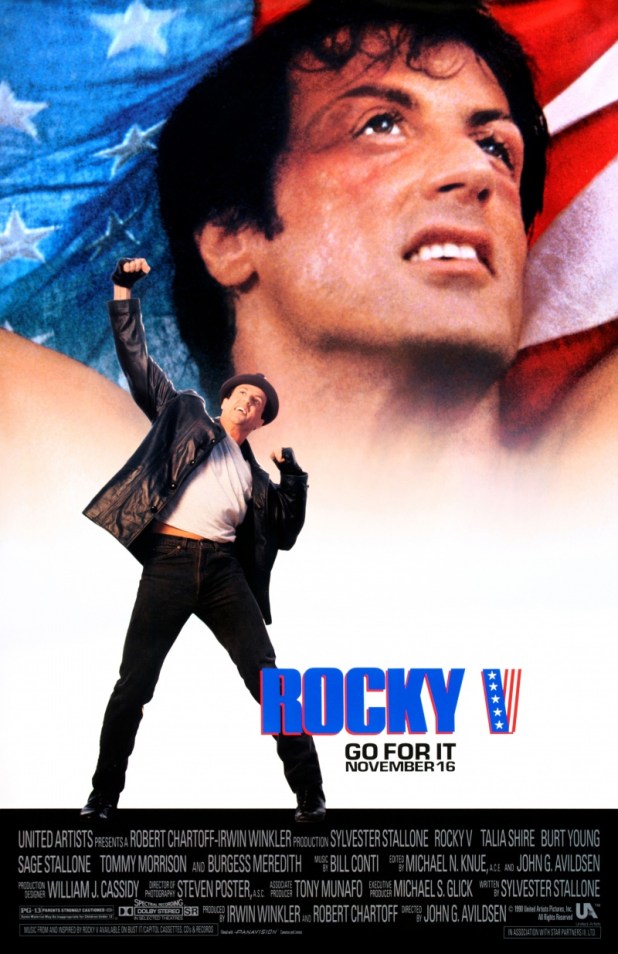
I’ve avoided this movie for some time, due to its bad reputation and just the general feeling that I had no interest in seeing Rocky slide back into the sad life that he escaped. This week of Stallone movies has given me the opportunity to watch this one, however, and while it’s not my favorite of the films, it’s not as bad as I feared.
Director John G. Avildsen — who directed the original — returns to direct this one, which finds our hero go right back to the same streets that he once trained on. Avildsen clashed with cinematographer Steven Poster during the making of the film, feeling that the realism of the movie was threatened by over-lighting instead of using a single spotlight to create a mood. Poster told Avildsen that the original film “looked like a cheap documentary,” to which the Oscar-winning director replied, “Exactly.”
A week after Rocky defeats Ivan Drago in Rocky IV, he returns to the United States. However, he’s not whole — the fight pretty much has finished him off, leaving him feeling broken inside. As he conducts a press conference, promoter George Washington Duke (Richard Gant), who is pretty much Don King, tries to get Rocky to fight his man Union Cane (pro boxer Mike Williams).
The pain isn’t over for Rocky — not by a long shot. It turns out that thanks to bad advice from Paulie (Burt Young), the boxer gave power of attorney to his accountant, who pulled a Bernie Madoff on him, leaving him with a foreclosed second mortgage and six years of unpaid taxes.
It gets worse, too. Rocky has a brain injury that was further compounded by the blows he endured defeating Drago. Now, he can never fight again, so he must sell his home and all his belongings, moving back to the streets he thought he escaped.
After a night of drinking, Rocky enters his old gym and sees a vision of Mickey (Burgess Meredith) appear to him, telling him a speech much like the one that Cus D’Amato told Mike Tyson after his first fight. This leads to rocky reopening the gym and eventually becoming the manager for Tommy Gunn (boxer Tommy Morrison), a young man from Oklahoma who becomes Rocky’s surrogate son.
But doesn’t Rocky already have a son? He sure does and his kid Robert (Stallone’s real life son Sage, who would one day help form Grindhouse Releasing) must adjust from private school to the tough inner city school, getting his ass kicked every step of the way. Even worse, he has a dad who only wants to get in the ring and train his fighter.
Of course Tommy Gunn is going to give in to the dark side, falling under the sway of Duke. It’s brutal when Rocky watches on TV and Gunn extols the angel on his shoulder that the promoter has become, language specifically used to try and bring the retired champion into the ring. Instead, the two brawl in a brutal street fight that ends with Rocky victorious.
That fight, however, is awesome. That’s probably because pro wrestling legend Terry Funk choreographed it, which explains the German suplex spot. Amazingly, the fight was originally going to end with Rocky dying in Adrian’s arms. Eventually, Stallone decided to rewrite the ending, as he believes that Rocky is all about perseverance and redemption. A death in a street fight? That isn’t how a hero goes out, right?
Michael Williams and Tommy Morrison were scheduled to have an actual boxing match about a month after this was released, hyped as “The Real Cane vs. Gunn Match,” but Williams was injured and could not compete.
Speaking of Morrison, he had a pretty interesting life. His nickname, “The Duke”, comes from a claim that he was either the grand nephew or grandson of John Wayne, which may or may not have been true. He started doing tough man contests at the age of 13 before going into boxing, where he amassed a 202-20 record and won the Gold Medal at the Seoul Olympics. His pro career included wins over George Foreman for the WBO title and a 48-3-1 record.
At one point, Morrison was married to two women at the same time and had two children by the age of 19. Those sons, Trey Lippe Morrison and James McKenzie Morrison, have grown up to be pro boxers themselves.
His life took a sad turn in 1996 when he failed a blood test before a fight. He had HIV, which he said came from his permissive, fast and reckless lifestyle, saying “Wilt Chamberlain had nothing on me. Infidelity was one of my biggest battles in life. I couldn’t overcome it.”
Morrison tested negative for HIV in 2007 and began boxing again, even though some of those fights were supposedly staged. He also dealt with probation issues from past arrests that led to him serving nearly two years in jail.
In August of 2013, Morrison’s mother claimed he had full-blown AIDS, even if the boxer’s mother didn’t agree. Morrison died a month later from cardiac arrest, resulting from multiorgan failure due to septic shock caused by an infection.
In the years following the film’s release, Stallone acknowledged that the brain injury angle was inaccurate. Instead, it’s a mild form of brain damage, such as CTE, and it wouldn’t have prevented Rocky from gaining a license to box or put his life in danger.
When asked to rate all of the Rocky films by British host Johnathan Ross, Stallone gave this one a zero. I kind of love that he also has stated that Tommy Gunn left boxing and become a “third rate pro wrestler” afterward. I’d love to see that movie.
This is the only boxing movie I can think of with MC Hammer and Elton John on the soundtrack. It wasn’t as bad as I feared, but wasn’t as good as I wanted it to be. But man, that last fight is great.
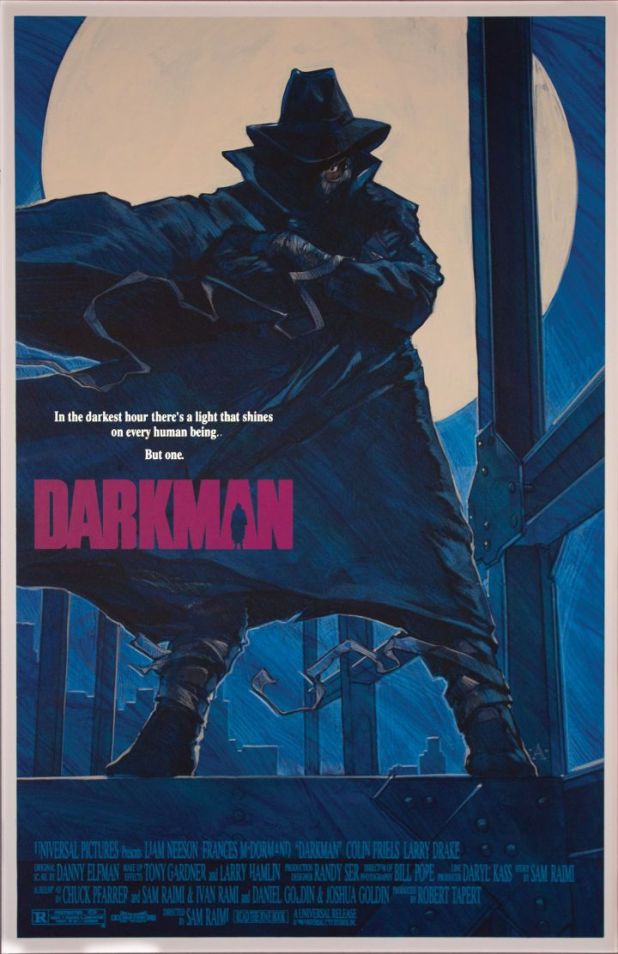
Before he had the chance to make Spider-Man, Sam Raimi had wanted to make a comic book movie. Having failed to get the rights to The Shadow and Batman, he just decided to create his own hero. Drawing inspiration from Universal Monsters like The Phantom of the Opera as well as The Elephant Man, he created The Darkman, the tale of a once noble man driven to savagery as well as a tragic love story.
Raimi submitted the treatment to Universal Pictures, which was greenlit for a budget of $8-12 million dollars. Over twelve or more drafts — working alongside writers like Chuck Pfarrer, brothers Daniel and Joshua Goldin, and Raimi’s brother Ivan (a doctor who ensured that the medical and scientific aspects were authentic) — Raimi and his producer Robert Tapert pushed the character and movie further and further until they ended up with a three-part character arc: It starts with a sympathetic hero being destroyed, then him becoming filled with hatred before finally hating who he has become as he fades away from humanity.
Despite the movie performing worse than probably any Universal movie ever in test screenings, a great ad campaign — the Who Is Darkman? posters are amazing — and decent reviews allowed this film to make $49 million on a $16 million dollar budget.
Dr. Peyton Westlake (Liam Neeson) is working on a new type of synthetic skin that will help burn victims. However, every time the skin is exposed to light for more than 99 minutes, it disintegrates.
Meanwhile, his attorney girlfriend, Julie Hastings (Frances McDormand) has discovered information that proves that developer Louis Strack Jr. has been bribing zoning commission members to build a brand new city. When she confronts him, he confesses that it was necessary to create new jobs while warning her of Robert Durant (Larry Drake, who is incredible in this), a mobster who also wants the evidence to use against him.
At Westlake’s lab, our hero and his assistant Yakatito continue to test the skin when Durant and his men — including Ted Raimi as Nicky, Nicholas Worth (The Glove, Don’t Answer the Phone) as Pauly, Dan Hicks (Evil Dead II) as Skip and Dan Bell (who you’ll remember from Wayne’s World) as Smiley — break in to take the documents that Julie has found. Yakatito is killed and Westlake is torn to shreds — his hands are burned, his face is dipped in acid and an explosion throws him through the building as Julie watches from the street.
Westlake is found and brought to a hospital that experiments on him with a treatment that severs the nerves of the spinothalamic tract. Now, he no longer feels physical pain and the lack of sensory input overloads his adrenaline, giving him enhanced strength. However, he’s now susceptible to frequent bouts of alienation and madness. Look for Jenny Agutter (Logan’s Run,An American Werewolf In London) in a cameo here as the doctor who treats Westlake.
The rest of the world thinks he’s dead, so Westlake starts creating a mask of his original face to cover his burns. Seriously, the makeup by Tony Gardner are great. As he works away in his skid row lab — an homage to the Tesla coil filled lairs of Universal movies — he also works on wiping out Durant’s henchmen one at a time.
Darkman balances horror and superheroics in equal measure, along with romance and pathos. The end of the film, as Westlake fully disappears into his new identity as The Darkman and escapes from Julie into a crowd, is the best comic book ending I’ve ever seen in a film. Raimi gets it, even ending the film with dialogue where the hero finally accepts his name: “I am everyone and no one. Everywhere. Nowhere. Call me … Darkman.”
I love that Raimi took a somewhat Hollywood budget and turned in a movie that’s pretty much a modern take on Dr. Phibes, while keeping the spirit of Universal Monsters, filtered through the hyper colors of Bava and the kinetic zooms of Fulci. It’s also a movie that presents a hero that has completely and utterly lost his mind, yet we still are with him every step of the way.
Darkman would return in two direct to video sequels without Neeson playing the lead role, Darkman 2: The Return of Durantand Darkman 3: Die, Darkman, Die. There was also a thirty-minute pilot for a TV series made in 1992 that never aired.
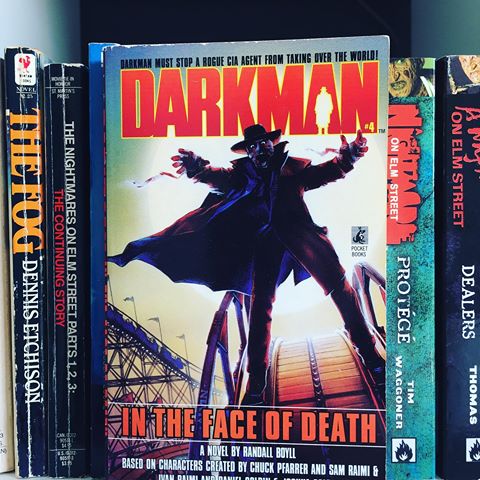
Marvel Comics also published an adaptation of the movie and a sequel mini-series. Darkman would return to comics in 2006 in a crossover with the Evil Dead and Ash Williams (Bruce Campbell was the original choice for the lead and shows up at the end). There were also four Darkman paperbacks — The Hangman, The Price of Fear, The Gods of Hell, and In the Face of Death — published in 1994.
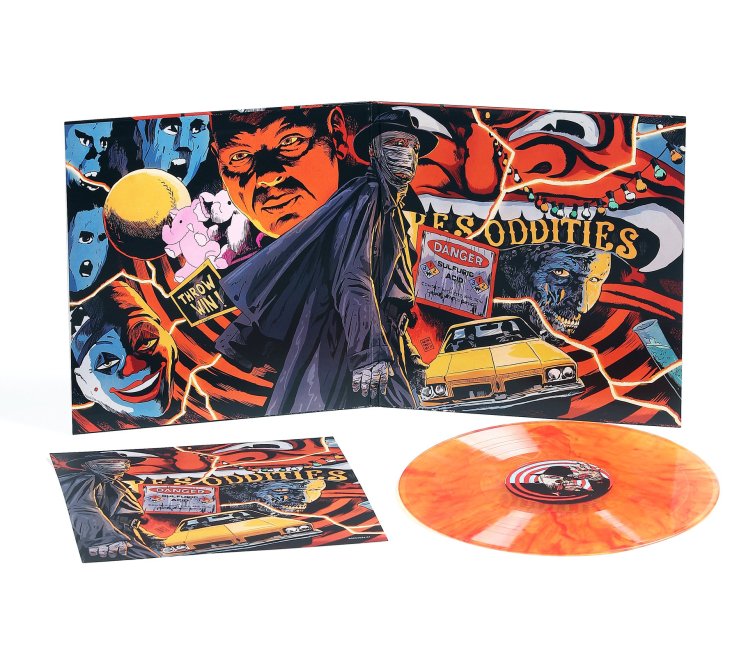
The cover art for this article comes from the vinyl release of Danny Elfman’s soundtrack. Like everything Waxwork Records releases, it’s incredible, boasting two gatefolds of Francesco Francavilla’s breathtaking artwork.
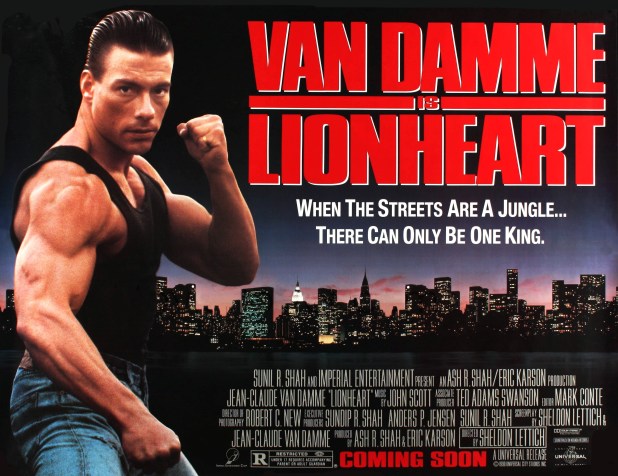
Lionheart follows the basic plot of all Van Damme films. Our hero loses a family member in some horrible way, he must go AWOL or leave behind some responsibility and then must fight — even though he doesn’t want to — before a big battle that redeems everything. My wife — having suffered through the makings of JCVD week where I’ve watched double-digit Van Damme films over several weeks of prep — remarked, “These are all the same movie. Everyone wants him to fight. He doesn’t want to fight. We want to see him fight. He still doesn’t want to fight. Then he fights and kicks everyone’s ass. He should just fight.” She gets it.
You have to love a movie that starts with the main character’s brother screwing up a cocaine deal and getting set ablaze. Then, we meet French Foreign Legionnaire Lyon Gaultier (Van Damme, but really, who else could that be?), who has gone AWOL when he learns that they’ve been keeping letters from home from him.
For some reason, instead of just going to Los Angeles, Lyon starts in New York City, where he becomes a street fighter working with a man named Joshua (Harrison Page, who was Sledge Hammer’s boss on that TV show).
Soon, they meet “The Lady.” Her real name is Cynthia (Deborah Rennard, Sylvia Lovegren from TV’s Dallas) and she’s the person running fistfights inside parking garages for the one percent rich. At this point, I started laughing as loudly as possible, because this movie has grown beyond ridiculous. That just means that I knew I had picked the right movie for a Saturday afternoon.
As Lyon fights his way to Los Angeles, he learns that his brother is dead and his wife won’t accept any help. She blames him for deserting the family and her husband turning to drugs. That just means that Joshua has to act as a life insurance agent and give her the money Lyon owns from fighting in the no holds barred fight circuit. This ends up upsetting Cynthia for some reason. Also, the French Foreign Legion catches up to our hero and breaks one of his ribs.
Our hero must finally fight a dude named Attila, who kills all his opponents. Cynthia also meets with the French Foreign Legion and sells out our hero. Things get sad, when Joshua says that he bet against Lyon in the hopes that he could make some money for his family. But no worries — Van Damme kicks ass, gets court-martialed but still ends up staying in Los Angeles.
This movie is all fights. And it also has Tae Bo® expert Billy Blanks battling JCVD. Also, for those of you who love pro wrestlers in movies — I’m speaking directly to my friend Paul Andolina here — Tony Halme, who was once Ludvig Borga and a member of Finnish Parliment, makes an appearance.
Much like a 1970’s grindhouse movies, it has plenty of titles: Full Contact, A.W.O.L Absent Without Leave, Wrong Bet and Leon.
It’s also the first appearance of Van Damme’s naked booty on film. In an interview with Asian Movie Pulse, director Sheldon Lettich said, While we were filming the scene in Lionheart where he takes a shower in Cynthia’s apartment, he (Van Damme) asked me if he might casually “drop his towel” and show off his butt for a brief moment. My reply was “Sure, if you’re willing, why not? We can always use a different take later if we decide it’s not a good idea.” So we did one take where he casually lets the towel drop away, and then we later decided to go ahead and put that shot in the movie. Well, that became a very memorable moment for the ladies in the audience, and for the gay guys as well. Showing off his butt (clothed or unclothed) almost became a signature trademark of his after that.”






 B&S About Movies
You must be logged in to post a comment.