Man, Nico Mastorakis made some crazy movies. Like this one, in which a bunch of teens on a Greek vacation discover an entirely new kind of drugs: audio cassettes that deliver orgasms via hallucination filmed music videos. No, really. What is this, The Digital Underground’s Sex Packets: The Movie?
It also has a soundtrack filled with songs by Chris de Burgh, the guy who wrote “Lady In Red,” so it has that going for it. Also, Seiko paid big money to get their Data 2000 watch into this movie, as if the people who watch Nico Mastorakis movies are looking to upgrade their digital watches.
This is a movie about an old man inside the cassettes trying to get the three heroes to find the second tape, which will weaponize the music video orgy inside. So basically Porky’s meets Videodrome but Debbie Harry never puts out a cigarette on her breast.
The actual date for the release of this movie is under some debate, as director Robert Altman — yes, the same one who did Nashville — shot the film in 1983, it was copyrighted in 1985, then shelved until it got a small theatrical release in 1987 and 1988.
Now, we could debate whether Altman is the right person to shoot a National Lampoon magazine, but then again, I kind of like this movie, which has a ramshackle all over the place feel to it.
Loosely based on stories written by Ted Mann and Tod Carroll. O.C. and Stiggs were recurring characters in the magazine, with the entire October 1982 issue being about “The Utterly Monstrous Mind-Roasting Summer of O.C. and Stiggs.” One of the big differences is that the print version of the characters are destructive while their film versions are a little more socially redeemable.
O.C., which means Oliver Cromwell Oglivie (Daniel H. Jenkins), and Stiggs (Neill Barry) are two Arizona teens whose idea of a great night is driving their car, the Gila Monster, to pick up girls, get booze from Wino Bob (Melvin van Peebles) and pick up some ladies. And oh yeah, drive the Schwab family — Randall (Paul Dooley), Elinore (Jane Curtin), Randall Jr. (Jon Cryer) and Lenore (Laura Urstein) — nuts.
Altman’s argument is that while audiences to see his take on Porky’s, he saw through the fake outrage in those movies and was delivering a satire. But yeah. No one else wanted that. As the director himself said, “It was a satire of teen sex comedies, gosh darn it, not an example of that dubious breed!”
But hey! Ray Walston is great as always as Gramps and it’s kinda inspired to get Dennis Hopper to be in one of these movies. He even flies his helicopter so Mark can woo Cynthia Nixon.
It’s kind of fascinating to me that this movie was even made and that’s pretty much the charm of it.
Mel Damski mainly did TV — episodic and movie — but man, this movie, he hit it out of the park for every teenage male in 1985, who all probably taped it off Cinemax. The number of folks I know that had a copy of this and know about this movie is pretty astounding. It was written by Noel Black, who directed the classic Pretty Poison as well as the not as much of a classic Private School.
The reason for all the attention to this movie was, well, we didn’t have the internet and the love making scene with Jonathan Bellah (Doug McKeon) finally hooks up with his crush Marilyn McCauley (Kelly Preston) was like a bolt from heaven. I’m not proud of it, but porn magazines didn’t always just turn up in the woods in those days. But some days, they totally did.
His friend, Gene Harbrough, is in love with their friend Bunny (Catherine Mary Stewart), who already has a man in Kenny Brubaker (D. W. Brown). Plus, Jami Gertz is in this, as is Terry O’Quinn as Jonathan’s father. We had not yet arrived where the thought of O’Quinn as a father was a terrifying concept.
There’s a great soundtrack as well with so much of the music of the time, like Fats Domino, Chuck Berry, Buddy Holly, Gene Vincent, The Platters, Bill Haley and the Comets, The Skyliners, Elvis Presley, Little Richard and more.
When you watch this movie in 2021, you realize that the hero is pretty much a jerk, not understanding that no means no, that women aren’t just objects to be grabbed, that if a date agrees to sleep with you that you’re responsible for birth control and if you agree on the pull out method, actually pull out. I kind of hate him, to be perfectly frank.
Krishna Shah made Hard Rock Zombies, which was supposed to be the movie within this movie, which is a movie all about a drive-in, in case you couldn’t figure that out from the title. The film moves from car to car, with each one telling a different story that all adds up to a very low end version of American Graffiti.
That may not prepare you for the fact that the movie is also about a country girl who continually gets near-assaulted by some greasers and her boyfriend gets put in the hospital but the tonal shifts in this movie are all over the place, so humor intertwines with a female revenge movie and none of it really adds up.
Also, Hard Rock Zombies basically plays in real-time, so since I already saw it, this felt like being forced to watch that movie all over again.
I’m not mad that I bought this movie nor that I’ve endured it. Emily Longstreth, who plays the country girl named Bobbie Ann, was also in Star Crystal, Hardbodies, Gimme an F, Pretty In Pink, Private Resort and Wired to Kill, which is a B&S About Movies all-star list if I’ve ever written one. Speaking of great resumes, another actress who was in this, Mike, is also in Candyman, Hard Hunted, Girls Just Want to Have Funand Sword of Heaven.
Bob Gale and Robert Zemeckis came up with Back to the Future five years before it got made, but at that time, it wasn’t raunchy enough to get greenlit. After their film Used Cars came out, Gale was looking through his father’s high school yearbook. His mother wondered if he would have been friends with his father. Time travel was the only way they’d get the answer.
The duo wanted to make a time travel film that showed that the past could change the future. And sure, Professor Brown was once a video pirate and the time machine was going to be powered by Coke, but the main story remained the same as the movie was finally sold.
Then the movie went into turnaround and forty different studios turned down the movie. Other time travel films like Time Bandits and The Final Countdown had underpeformed and Disney was put off by the fact that the hero made out with his mom. I mean, well, yeah.
Steven Spielberg believed in them and the script. And that ended up being enough.
That and the fact that Zemeckis had a success with Romancing the Stone and had the clout to make the movie. And a grudge against the studios who turned him down, so he sold the movie to Spielberg’s Amblin, who set the project up at Universal Studios. However, that’s also where Frank Price, the first person to say no, worked. Spielberg didn’t like Price either — he’d passed on E.T. — so Sidney Sheinberg became the chief executive to oversee the studio’s investment.
For his part, Sheinberg wanted to rename the movie Space Man from Pluto because he believed Back to the Future wouldn’t sell. Everyone worried how to deal with the venerable elder man until Spielberg diffused the situation by sending a funny memo that said, “Hi Sid, thanks for your most humorous memo, we all got a big laugh out of it, keep ’em coming.”
Michael J. Fox was the first choice to play Marty McFly, but the producers of his hit show Family Ties didn’t even let him see the script. Eric Stoltz ended up with the role, but he was too intense. The filmmakers realized they hired a great actor for the wrong role. Stoltz also was a method actor and stayed in character the entire time, refusing to answer to any name but Marty, which led to the crew hating him. 34 days of shooting were lost — they kept shooting with the actor despite Fox being hired — and Stoltz was paid his entire salary.
Another perhaps exaggerated story is that Thomas F. Wilson, who played Biff, almost had his collarbone broken in the scene where he fights Marty in the cafeteria. Take after take, despite Wilson asking Stoltz to calm down, the actor kept roughing him up. Wilson planned to get a reciept in the car parking scene outside the dance, but Stoltz was gone before that happened.
Despite the issues behind the movie, audiences loved the story of Marty McFly going back in time thanks to Doc Brown (Christopher Lloyd) and having to put back together the events that introduced his parents (Lea Thompson and Crispin Glover). What audieces really liked was the DeLorean, a car that was unlike any time machine they’d ever seen in a movie before.
The one thing I never liked about this movie is that it posits that a white man now creates rock and roll. I know it’s a minor part, but even as a kid, it upset me.
Speaking of music, when Marty pretends to be Darth Vader from the planet Vulcan, he plays a tape labelled “Edward Van Halen.” It’s not any existing Van Halen song, but an untitled song that was written for The Wild Life, which also starred Eric Stoltz (and where producers discovered Lea Thompson as they studied Stoltz’s work).
Bonus: You can listen to Becca and me discuss this movie on our podcast.
June 1: Junesploitation’s topic of the day — as suggested by F This Movie — is ’80s action! We’re excited to tackle a different genre every day, so check back and see what’s next.
Words cannot express how important ninjas were in 1985. Every single day, American kids drew pictures of them during class, beat on one another with their weapons and watched their movies, which could nearly have an entire shelf of your local video store all to themselves.
Pray for Death is Sho Kosugi’s vehicle and he makes the most of it. You may remember him as the villainous Hasegawa who fought Franco Nero in Enter the Ninja, but here he’s graduated to become the hero. He plays salaryman Akira Saito, who has decides to follow his wife’s dream and immigrate from Japan to the United States along with their two sons Takeshi and Tomoya (Sho’s sons Kane and Shane).
What his family does not know is that Akira is a ninja and has kept the temple’s secrets, even killing his own brother Shoji as he tried to steal from their adopted father Koga (Robert Ito, Sam Fujiyama on Quincy, M.D.). His master tells him to leave Japan behind and erase the guilt he’s felt over what happened.
Purchasing an old store from a kindly man named Sam Green (Parley Baer, the mayor of Mayberry!) that will become Aiko’s Japanese Restaurant. But before they can see any success, two crooked cops hide a necklace inside the floorboards, leading to Akira’s children being attacked, Green being murdered and eventually, our hero’s wife being injured and then killed inside the hospital while she recovers.
This all means that Akira must return to the ways of the ninja and literally force a man to pray for death before impaling his hands and sawing him in half. Yes, this form of ninjitsu is not quiet in any way.
As we’ve said many times amid the digital pages of B&S About Movies: the backstories on movies are sometimes more engaging than the actual movie itself. And this Alien-cum-E.T. VHS-hybrid is one of them. And, in spite of that fact, I still love this movie.
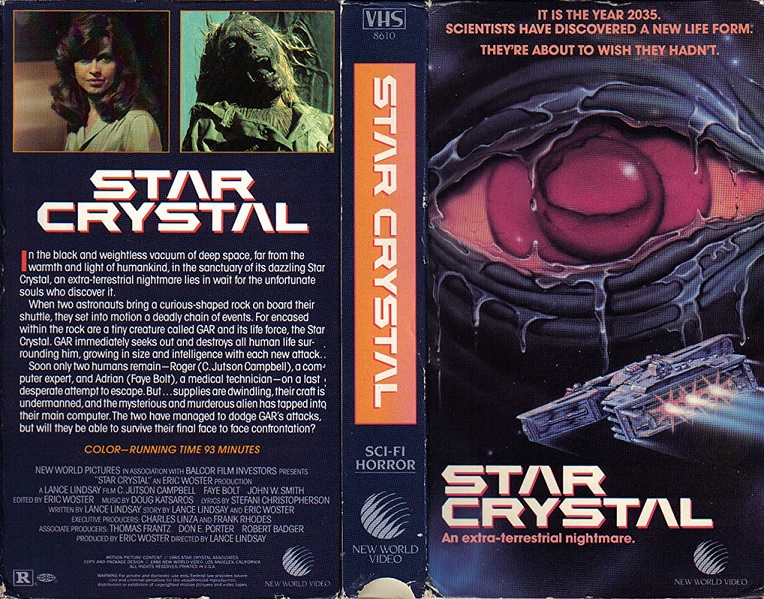
Of course, the danger with these theatrically-shot but ultimately released as direct-to-VHS flicks from the ’80s, when reissued, first, to DVD, then Blu-ray, then into the Amazon-cum-Netflix streaming-verse: instead of sticking to the original artwork, those ’80s ditties are redressed with flashy artwork that grossly oversells the movie — and accomplishes in destroying the film’s only endearing quality: its nostalgia.
Then, ye, the dear B&S reader, say to yourself: “Those B&S guys are full of B.S. This movie sucks the feldercarb off the DeLorean flux capacitors. Frack them and their ‘nostalgia’ daggit-dunged memories.”
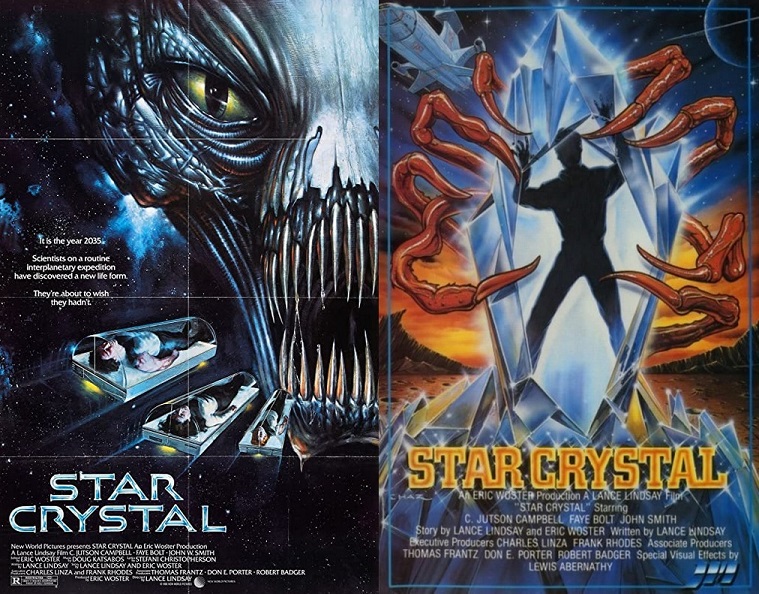
Hey, we get it, ye more-youthful-than-us readers. If our first exposure to Star Crystal were these two, home-video promotional one-sheets — and then we watched the movie — we’d feel hornswoggled, as well. For no one is encased in any “crystal” coffins or tombs, and nothing in this particular crystal’s clarity looks nothing like Tobe Hooper’s theatrical-distributed and thus, better known, Star Wars-cum-Alien rip from 1985, Lifeforce. And check that Gigeresque alien with toothy grin at the next asteroid, Buck.
Yeah, leave it to Roger Corman’s lipstick-on-a-pig art department minions at New World to dupe you into renting a movie. But, to be honest, I’ve never felt duped by this movie. Again, damn me and my nostalgia: I love this movie.
So, who came up with the idea to mesh Alien with E.T, you ask?
Would you believe an ex-video director (Toto was one of his clients) and Cheech and Chong associate? It’s true! While he ended up acting in a space flick we’ve never, ever seen nor heard of, Space Chase (1990; and we sense a tingling in “The Force” that it’s recycling sets and etc. from Star Crystal . . .), in addition to writing, directing and starring in a horror film we also never, ever seen nor heard of, Sandman (1993), the late Eric Woster (1958 -1992) made his feature film debut as a screenwriter with Star Crystal, a film that also used his past music video skills as an editor. Yes, you’ll see Eric’s credits in the C&C movies Nice Dreams, Still Smokin’, Things are Tough All Over, and Far Out Man (okay, only one “C,” and with another “Eric”: the everywhere Roberts one). According to his obituary in the February 21, 1992, edition of the Great Falls Tribune: Woster, majored in film production at Montana State University, later working for Columbia and Warner Bros. Pictures, as well as having his own production company, 58 Productions, named after his birth year. While the IMDb does not list it, Woster wrote, directed and acted in his last production, Common Ground, most of which was filmed in and near his hometown of Columbia Falls, Montana, before his death.
As for the director behind the script: It’s TV actor Lance Lindsay (the IMDb lists only one credit: a 1976 episode of TV’s McCloud, but surely he did more series) in his directorial debut. It is said his (step) mother is actress June Lockhart. June was, in fact, originally married to John F. Maloney until 1959; they had two daughters: Anne (of Battlestar Galactica: TOS fame) and June Elizabeth. In 1959, June married an architect by the name of John Lindsay, divorcing in 1970. As with Eric Woster, Lindsay took the celluloid bull by the horns to write, produce, and direct, yet another film we’ve never heard of nor seen, Real Bullets (1988). And has anyone ever seen Lawrence Hilton-Jacobs’s (Freddie “Boom Boom” Washington from TV’s Welcome Back, Kotter) acting-directing effort, Quiet Fire (1991)? We haven’t. Well, Lindsay apparently acted in that film, as well.
So, that’s the full resumes on the writer and director put to bed.
Now, for the actors: This is one of those films where no one was very good at their job, so they subsequently vanished from the business (it turns out the actors were also investors in the film; or the unskilled thespians hornswoggled their acting gig by investing). The only actor able to develop a resume (who’s quickly dispatched in the film’s opening salvo) is an actress we’ve named dropped a few times at B&S: Emily Longstreth. Em starred in Private Resort (with Johnny Depp), the abysmal American Drive-In, and had a support role in John Hughes’s essential ’80s comedy watch, Pretty in Pink (1986). Oh, and we can’t forget the uttery-forgettable Wired to Kill (1986) — that, if not for starring Kim Milford (Laserblast), we’d probably wouldn’t have reviewed it at all.
Set design and visual effects-wise, Star Crystal — courtesy of SFX Supervisor Lewis Abernathy (wrote Deep Star Six, directed House IV, bit-acted in James Cameron’s Titanic) — when considering its budget, looks pretty darn good. The SFX team also includes Steven P. Sardanis; his work goes back to Charles Bronson’s The Stone Killer and 1974’s The Towering Inferno, and Chuck Comisky; he worked on Battle Beyond the Stars, Star Knight, and James Cameron’s Avatar.
So, granted, the proceedings maybe not be as effects-craftsman-good as William Malone’s quintessential low-budget Alien rip, Creature(1985), but just as good, if not better, than the space station interiors of the Canadian apoc-romp Def-Con 4 (1985). Considering Def-Con 4 also carries the New World imprint, it probably is the same set, if not the same set retro-fitted to a degree; it looks like it to me. As John Levengood, our fellow VHS dog over at John’s Horror Corner pointed out: About 10 minutes into the running time, watch out for sculptings of the Millennium Falcon on the doors of a space station. The repurposing of popular model kits is impressive. The practical, in-camera model work is also impressive and fun to watch, as well (yes, the ship reminds of — but is not — the “Hammerhead” from Corman’s Battle Beyond the Stars, as some reviews have stated; it’s original to the film, but kitbashed nonetheless, as was the Hammerhead, from other popular, over-the-counter model kits).
The reason this all looks so good on camera is cinematographer Robert Caramico*. He got his start with Ed Wood’s Orgy of the Dead (1965) and Lemora (1973). The spacesuits (we’ve learned another “recycling” are the spacesuits used during the film’s opening scene on Mars: they’re repurposed from 1977’s Capricorn One**) and various jumpsuits and wares are also well-made. And the alien tendrils and humans-sucked-dry gore effects (that, considering the film’s R-rating, could of be bit more gorier) are pretty decent. And, when we finally meet the once evil alien that becomes a friendly alien, he-she-it looks pretty good, too — granted, it can’t run and just oozes and goozes in one spot, but, it does blink and glow!
Then there’s the acting . . . oh, whoa the thespin’ that just kills all of that hard-SFX work. And the “suspenseful” chase scene between alien and human in the ship’s conduits/tunnels — as depicted by ’80s DOS-level video arcade blips on a rudimentary computer-map of the ship watched by the crew members . . . yikes! And what’s the deal with the ship not having any actual corridors or decks that forces the crew to crawl on their hands and knees through tunnels to get from compartment to compartment, e.g., from the bridge to the lab? Why couldn’t Mr. Corman lend out the Battle Beyond the Stars sets? Since when is ol’ Rog apprehensive to set loaning-recycling? He gave them to Fred Olen Ray for Star Slammer, after all.
Anyway, if you’ve seen Alien — or any of its ’80s knockoffs (but this really isn’t as “Alien” as you may think) — you know the tale: In the year 2032, a routine expedition of a crater near Olympus Mons on Mars discovers a mysterious rock. And the crew of the SS-37 cracks it open. And it has a crystal inside (that acts as the alien’s “life force” and its “intelligence” . . . and an alien organism that grows . . . that leaves a gooey, “lemon” scent during its rampage. . . .
When the Nostromo-light (aka, the SS-37) shows up at the L-5 space station (aka, Gateway Station-light; yes, it’s also a “spoked-spinning wheel” station, but it is not the same space station from Creature, as some reviewers have stated) — with everyone on board dead-by-suffocation — a five-man (three women, two men) military-civilian technical crew is dispatched to run a systems check on the ship. Then the alien sabotages the station and the tech crew escapes the destruction aboard the damaged-not-repaired SS-37. With not enough food to last the two-year shuttle trip back to Earth or a (hopeful) one-year rescue mission, they decide to search for supply depots in orbit between Mars and Earth to make the trip home. But not if the alien, known as GAR, has anything to say about it: it’s poisoned the ship’s water supply and now there’s not enough to make it to the first supply depot. The alien wants the ship to get back home — and not to Mars. But when a meteor storm damages the ship and neither homo sapien or xenomorph can get home, they realize they need to bury the galactic light-hatchet.
Ah, the ol’ used and beat-to-hell ’80s VHS that I burnt into blue screen.
Truth be told: While the acting and its (many) bad bits of dialog detracts from the script, the story itself is intelligent and heartfelt, and the last act when GAR and the two surviving humans become friends and must depart to their individual destinies, is actually heartbreaking. But then . . . oh, that friggin’ song kicks in — that’s not as bad as the theme song to The Green Slime(1968) or as hokey as the eco-theme to Silent Running (1972), but still, it’s pretty bad — has to ruin that tear-jerking moment. If you take away the strained thespin’, you’ll discover there’s actually a great movie in the frames of Star Crystal, with its sci-fi poignant message regarding humanity’s ways that’s ripe for a big-budgeted remake. Yes, Jesus Saves — even aliens. Come on, now: a film with an insight about love and freewill among the (alien) races? How can you hate on that message? (Personally, I enjoy a chunk of religion and philosophy chocolate in my sci-fi peanut butter.)
In my discussions with Sam, the Bossman of B&S, about the film: He takes this film to task for the bad alien changing its xenomorphic ways after reading the human’s Holy Bible, and for playing chess with a human (moving pieces with its mind) as a rip on the Dejarik hologram game from Star Wars. My irritations result from the overbearing “futuristic” soundtrack by Doug Katsaros, later of the ’90s animated series, The Tick (it’s mixed to loud, IMO). Then there’s the British-accented, smart-mouthed ship’s computer, the Bechdel test fails of the ship’s engineer cast an unattractive bitch (the “Lambert”), the ubiquitous hot blonde being a weeping willow of the “what are we gonna do now” variety (ack, King Dinosaur), and the hot brunette being a strong-willed bitch (aka the “Ripley”). Lastly, the men are dismissive, sexist dickheads: dicks who assign the women the grunt work (such as being in charge of the kitchen; ack, Flight to Mars) as they kick back on the bridge to spew chauvinistic dialog and crack bad jokes. Oh, and our Captain kissing the passed out/knocked out female crew member: icky!
What Sam and I do agree on — and everyone calls out — is “Crystal of a Star,” the caterwauling-awful end-credits song by American-Icelandic singer and actress Stefanianna Christopherson, aka Indria. And if not for her starting out as a child-teen actress with roles in the Jacqueline Bisset-starring The Grasshopper (1970) and TV’s Mayberry R.F.D., and becoming best known for her work as the first voice of Daphne Blake in Scooby-Doo, Where Are You!, no one would probably have called out the song at all. (Well, yeah. They would have.) Hey, we even found the film’s opening-titles theme song by Doug Katsaros.
You can enjoy the full film (seriously, you will enjoy it) as a commercial free-stream on You Tube. The fine folks at Kino Lorber (2017) offer Star Crystal as an HD-restored DVD and Blu-ray (Ack! Not with the Giger-cum-Tobe Hooper faux artwork on the cover?). Used VHS tapes are still easily obtainable in the online marketplace. If you like to caveat your Blus before you buy, you can get the technical low down at Blu-ray.com. There’s also an older (2003), bare-bones Anchor Bay DVD in the marketplace, which also proliferate the online marketplace.
And that’s the saga of Star Crystal!
*As Bill Van Ryn at Groovy Doom and Drive-In Asylum has said, “Robert Caramico has, as a DP, given us so many great films!” But Bill, Sam, and myself have never seen, nor been able to find, a copy of Robert’s lone theatrical directing effort: the faux “adults only” documentary Sex Rituals of the Occult (1970). So, to say “the search is on” in an understatement. He also shot Octaman and Kiss Meets the Phantom of the Park, so to say Robert “makes chicken salad of the daggit dung” is an understatement — and if you’ve seen those two films, you know what we mean!
**Speaking of space suit recycling: The suits from NBC-TV’s 1991 telefilm, Plymouth, have also made the rounds on other low-budget productions.
Update: Never say never, young star warrior. Once a movie gets stuck in our heads . . . we finally gave Space Chase a full review proper, and it runs at 8 PM this evening to close out our “Space Week” of film reviews. So join us!
Update, February 2023: Our thanks to a few of the makers behind this film for reaching out with their appreciative insights for the review and backstories (such as the trivia about the suits and the June Lockhart connection) which now appears in this review.
About the Author: You can learn more about the writings of R.D Francis on Facebook.He also writes forB&S About Movies.
Also known as Disciples of the Master Killer or Master Killer III, this is the third film in a loose trilogy of movies that began with The 36th Chamber of Shaolin. Like those movies, this was written, directed and choreographed Lau Kar-leung.
Hsiao Ho (Mad Monkey Kung Fu, Legendary Weapons of China) takes on the role of another legendary hero of the martial arts, Fong Sai-Yuk. He’s a troublemaker and keeps running into trouble with the Manchu warlords. To save his family’s honor, his mother asks San Te (Gordon Liu) to allow her son to study in the 36th chamber, the place where non-monks may train. However, Sai-Yuk’s pride and lack of respect make quite a headache for the monks.
Sai-Yuk keeps going into town at night, which is forbidden and becomes friends with the Manchu. They are using him to get the secrets of the Shaolin, so that they may destroy the temple. The film closes with Sai-Yuk poisoned and all of the monks trapped inside the Manchu fortress for what they believed was a wedding. The battle that closes the film is absolutely astounding, with every art show in the film paying off in a final battle that is as much about the Shaolin’s refusal to hurt anyone and help one another as it is combat. Nearly every cast member is involved in a gigantic battle that simply must be experienced.
Ellen Burstyn has no luck with her movie children, let me tell you.
In this movie, she stars as the Canadian mother of a college student who drives a beat up van from Canada to the United States and then disappears. The police barely help, so she hires her own detective (Robert Prosky, Christine, Grandpa Fred from Gremlins 2) to learn the truth.
The search for the van takes the retired detective to Maine, Nebraska, Colorado and Utah. For some reason, the cops offer no help at all and actually get angry that he’s on the case.
Into Thin Air was based on the real life case of Eric Wilson, who disappeared after driving from Ottawa to Colorado for a summer college class. It’s fictionalized somewhat, as was the documentary Just Another Missing Kid that came out the same year. In that film, director John Zaritsky had the interview subjects recreate their actions for the camera, which isn’t really a documentary, right?
ABOUT THE AUTHOR: Herbert P. Caine is the pseudonym of a frustrated academic and genre movie fan in Pennsylvania. You can read his blog at https://imaginaryuniverseshpc.blogspot.com.
The Rape of Richard Beck, also known as Deadly Justice, is a far more serious film than its exploitation-style title would lead one to assume. Far from the Death Wish wannabe its alternate title suggests, it is a serious examination of one man’s response to being raped, highlighted by an award-winning performance from Richard Crenna.
Crenna plays Richard Beck, a jocular homicide detective with a mean streak towards rape victims. Like many police officers back then – and far too many now – Sergeant Beck regards rape as a less important crime that victims bring upon themselves. When Beck allows a rape suspect to go free in exchange for information about the whereabouts of a murderer, he is forced to join the sex crimes unit, where his insensitivity comes to the fore, to the disgust of a community representative played by Meredith Baxter.
Then Beck himself gets raped by two criminals whom he chases into an underground passageway….
The main selling point of this film is Richard Crenna’s performance as Sgt. Beck. This role is the polar opposite of his stolid performances in the Rambo movies as Col. Trautman, requiring Crenna to display a wide range of emotions as Beck struggles with his traumatic experience. As Crenna described in an interview with the Television Academy, many people advised him against taking the role due to its disturbing content. He wisely ignored them, going on to win an Emmy for his performance. Crenna is backed by an excellent supporting cast, with George Dzundza as a fellow officer, Meredith Baxter as an anti-rape activist, Joanna Kerns as his girlfriend, and Frances Lee McCain (the mother from Gremlins) as his ex-wife.
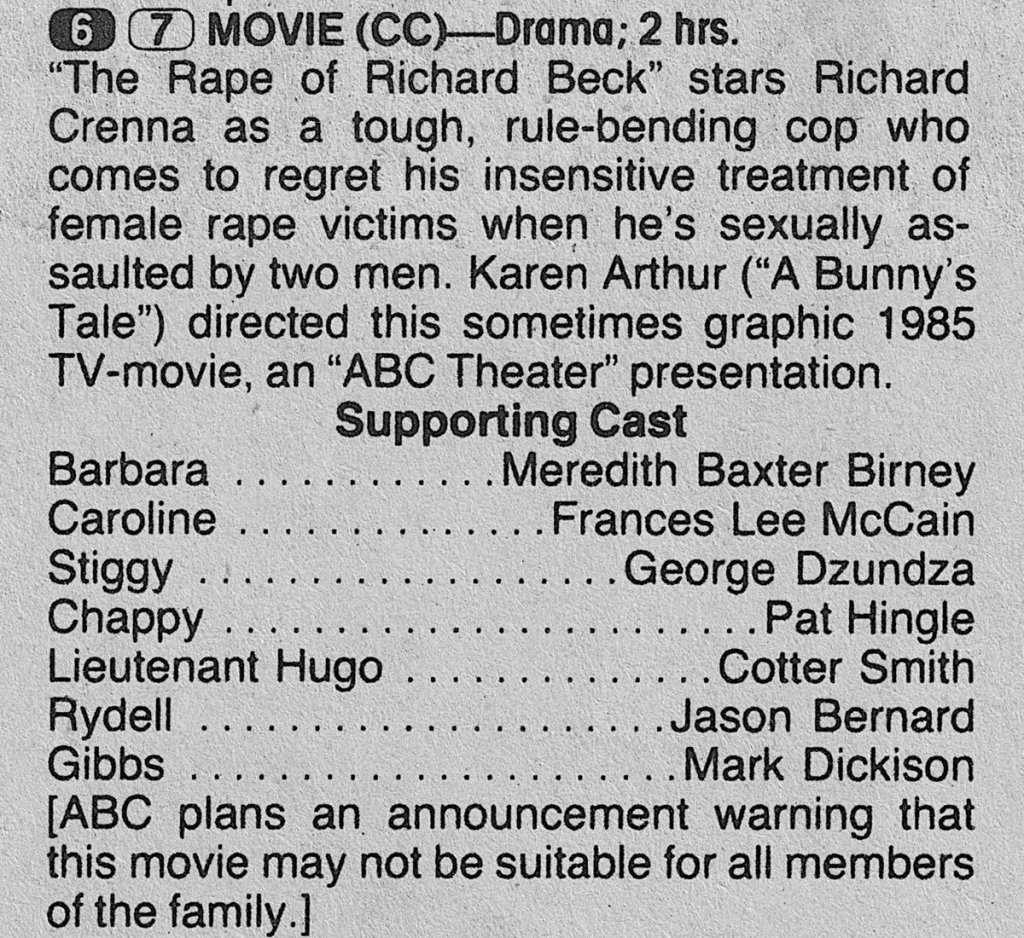
The film is as graphic as could be gotten away with on 80s broadcast television, to the point that the TV Guide listing from its first airing noted that “ABC plans an announcement warning that this movie may not be suitable for all members of the family.” Although the rape is not depicted, we see the build up to it as the criminals threaten and terrorize Beck. Director Karen Arthur does well at making the film as disturbing as she could given the limitations of network censorship, as in scenes where we see a woman and later Crenna examined following their rapes.
The Rape of Richard Beck also deserves praise for its realistic depiction of the trauma caused by rape. The movie traces his emotional struggles in the immediate aftermath of the incident, as well as the social ramifications when his fellow police officers find out. The character is inspired by Sgt. Richard Ramon, a police officer who gave talks to police cadets about the best ways to treat rape victims.
The Rape of Richard Beck can be seen for free on YouTube.




 B&S About Movies


You must be logged in to post a comment.