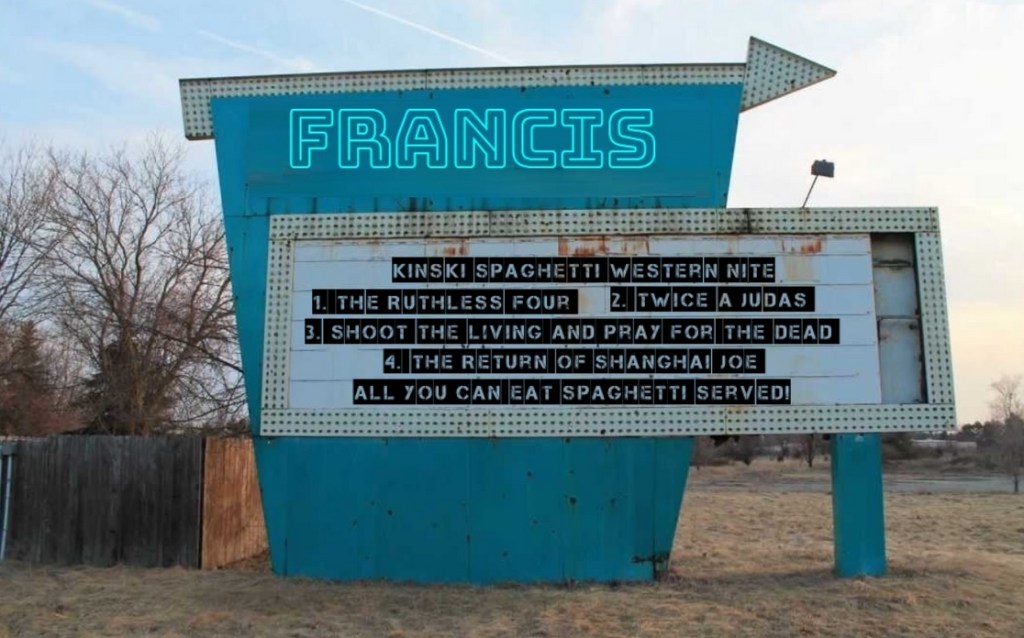
2019 Scarecrow Psychotronic Challenge: Day 16: duBeat-e-o, aka Du-Beat-e-o (1984)

Day 16 Rock ‘n’ Roll Miscreants: Give some screen time to the punks and/or metal heads

The elusive VHS and Soundtrack.

Strap yourself in. Get ready for the rock ‘n’ roll adventures of film and television visionary Alan Sacks (aka Alan ‘duBeat-e-o’ Shapiro) and the film debut of Joan Jett. (And fair warning: this review is admittedly unhinged . . . before you dive in. You’ve been warned, ye reader: for unhinged movies need like-minded reviews.)

While the pioneering, all-female rock band the Runaways were unable to repeat their explosive, overseas radio and retail chart acceptance (they were huge in Japan and the Pacific Rim countries) in the U.S, the Suzi Quatro-inspired rockers nonetheless became ubiquitous, sexy fodder for the late ‘70s U.S rock press — especially in the teen-oriented pages of Circus, Crawdaddy, Creem, and Hit Parader (dude, do I miss those mags!).

Were those magazines’ Runaways-centerfold posters on this wee-tween’s walls? You better f’in believe it: right alongside the tear-outs of my motocross idol, Roger DeCoster. My Runaways albums spun alongside Frampton Comes Alive and Kiss’ Dressed to Kill.

“Hey, why don’t we make a female version of A Hard Day’s Night to promote the band?” rubbed the greedy little hands of their songwriter-svengali, Kim Fowley. “Frampton did that dumb Sgt. Pepper movie; Kiss did that Phantom of the Park mess, so why can’t we make a disaster-rock flick too? This dumb kid with the DeCoster pictures on his wall will eat it up.”

Check out our three-part series on Beatles-inspired films.

“Turning the Runaways into the Beatles? You’ve done it again, K.F!” says KROQ disc jockey Rodney Bingenheimer. “It’ll make millions! And to stick it to Capitol Records and the Knack, you should title it: Eight Days a Week.”

So, in a September 22, 1979, issue of the radio & records industry newspaper, Billboard, the marketing-machine genius of Kim Fowley began to grind:

LOS ANGELES—Production has started on the feature motion picture “We’re All Crazy Now,” loosely based on the career of the all-girl rock act the Runaways. The Zane-Helpern independent production stars Arte Johnson, Runaways’ member Joan Jett and former Herman’s Hermits leader Peter Noone. Cheryl Smith, along with Karen and Kathy Fallentine, round out the cast as the remainder of the original Runaways.

Okay, so did you hear the one about the on-the-downward-slide comedic actor from the ‘60s TV variety show, Laugh-In, a washed-up Beatles clone, and Rainbeaux Smith from the infamous women-in-prison flick, Caged Heat (1974), walking into a bar?

Oh, this is going to work out quite well, Mr. Fowley.

And we trip in Doc Brown’s DeLorean to a 1984 where Joan Jett scored a worldwide #1 solo hit with “I Love Rock & Roll” and formed a faux-rock band with Marty McFly and David St. Hubbins from Spinal Tap to sing a Bruce Springsteen-penned song in a film written by the guy who dreamed up Travis Bickle — who inspired Mark David Chapman to assassinate John Lennon so he could impress Jodie Foster — who starred with Cheri Currie of the Runaways in Foxes alongside keyboardist Greg Guiffria and his band, Angel.

My mind is in FUBAR crash mode. I need a Dr. Pepper and Pringles sleeve reboot.

“So, Mr. Du-beat-e-o. How about you make me a movie?” says Uncle Leo from TV’s Seinfeld to Ray Sharkey from The Idolmaker.

And out of the Fowley-chaotic womb, instead of birthing a Beatlesque twin, an acid-infused, bizzaro-Jerry version of the Monkees’ incomprehensible debut film, Head, was born. It turns out Jack Nicholson was right: dropping acid while making a narcissistic rock ‘n’ roll movie without a script and no mainstream commercial appeal, actually works.

“. . . a punk movie that matches it’s style to its music.” — Filmex

“Aesthetically with its heavy doses of callous violence and flashy technique, the film recalls ‘A Clockwork Orange’. . . .” — Variety

Thank you, Uncle Leo, for giving me an f’d-up Stanley Kubrick punk rock movie! I’m all in! 

And . . . what the hell is with all these breakaways to porno-smut Polaroids? Why are their pictures of dead animals? Who’s this weird, punk-rock Stevie Nicks chick dancing around in black lace? And where’s Joan Jett? Where’s Malcolm McDowell and the rest of the Droogs? Where’s the Laugh-In dude and the Beatle-wannabe? Why is there so much El Duce of the Mentors in this film? You’re telling me the guy who dreamed up the loveable characters of Vinnie Barbarino and Arnold Horseshack, and paired Jack Albertson from The Poseidon Adventure with Freddy Prinze — 

“You made this?” interrupts the unknown actress who supported Johnny Depp in Private Resort (1985), starring as duBeat-e-o’s actress-valley girl-hostage in the editing room.

“Take a flying fuck to paradise, Derf Scratch,” duBeat-e-o barks his ubiquitous quote to anyone who doesn’t understand his “artistic vision” — even the bad ass, take-no-crap-o bassist from the L.A punk band, Fear. duBeat-e-o clutches a gun to the head of Derf, forcing his editor-character of Benny to feverishly splice a psychotic montage of five year old, left over footage of Joan Jett, along with porno-smut Polaroids, religious kitsch images, and El Duce of the Mentors providing voiceovers.

So, Nora Gaye, I think the real question is: Why did you agree to star in this? But I get, Nora. You were duped. But you really should have stuck to the Trapper John, M.D guest spots.

It turns out the guy who really made this sack-o-crap-o was Alan Sacks: Yes, the creator of the hit ‘70s TV sitcoms Welcome Back Kotter and Chico and the Man was given the job of somehow turning the half-of-a-movie celluloid table scraps of We’re All Crazy Now into a functioning, full length feature film. And he gave the cinematic sewing gig to his writing partner, Marc Sheffler, a former actor who starred in Wes Craven’s The Last House on the Left.

“Hey, let’s hire that Sacks kid,” ponders the cigar-chompin’ executive over his desk-perched wing tips. “He did a pretty decent job with that skateboard movie, Thrashin, the one that starred that kid who grew up to be George W. Bush in that movie directed by that guy who made The Doors movie. He’ll make this steaming pile work. Look what his little Sweathog show did for that kid in the Bees Gees disco movie.”

“I think a more contemporary reference for the younger readers is to reference Josh Brolin’s work in the Deadpool and Avengers universes,” mentions Marc Sheffler to the executive.

“Don’t tell me how to do my job,” kid,” chomps down the leg breaking financier on his stogie.

So, in a typical life-imitating-art fashion, the reimaging of We’re All Crazy Now . . . also ran out of money . . .  just like original We’re All Crazy Now did. And when you’re brimming with the über cool, nihilistic I-don’t-give-a-fuck altitude of Alan Sacks, what do you do?

You “F” the bastards by having the art-imitate-your-life: Director Alan “duBeat-e-o” Sharpiro (read: Alan Sacks) is given the job by Hendricks, a greedy, leg breaking producer-financier (read: loan shark; played by Len “Uncle Leo” Lesser) with no film experience, to make a movie about “Joanie Jett.”

That’s it. That’s the plot.

And where in the hell is Joan? So far, all I’ve seen is Ray Sharkey fluttering around on a cheap, one-set stage play environment that would give the makers of Bela Lugosi’s worst cardboard-films pause, screaming at Derf Scratch and Nora Gaye, with an occasional appearance by Uncle Leo in a wheelchair —  all backed by a musical accompaniment courtesy of a couple of Social Distortion tunes and some punk band, Even Worse, lamenting “We Suck,” while another band, Dr. Know, sings about giving someone a “Fist Fuck.”

What in the hell did I rent?

That’s right. Squint and look at the monitors on Derf’s editing suite, because that’s how Joan “stars” in this “movie” — via the five year old footage shot in 1979 by Bernard Girard (more on him, later).

“Okay, well, that’s ten minutes of a movie,” says Sheffler to Sacks. “What do we do to fill out the remaining 80 minutes?”

“Here, start spicing-in images of these,” duBeat-e-o suggests with the toss of a stack of Polaroids.

“Smut photos?” says Derf.

“Yeah, I took them during one of my sex-coke binges. And create stills from that stack of porno magazines over there and, uh, yeah, use that shelf of old porn movies over there . . . and I have some random stock newsreel footage around here, somewhere,” creates duBeat-e-o on his stumble-bumble apartment search for the reels. “Oh yeah, and see if you can find or take some pictures of fresh road kill.”

“Road kill? Alan, are you okay?”

“And give El Duce from the Mentors a call. I want him to roll around in the sack with Johanna Went and that Linda Texas Jones chick from Tex and the Horseheads in a nightmare sex scene where El talks about foreskin and uncircumcised appendages.”

“Okay?”

“And Ray will think he’s having sex with Johanna and Linda, but it turns out he’s bangin’ El Duce.”

“And what I am supposed to do for dialog, Alan?” Marc wonders.

“After you splice it all together, we’ll have El invite over some of his friends, we’ll all watch it, and make funny comments. You know, it’ll be a like nihilistic, punk rock version of Mystery Science Theatre 3000.”

“Alan, Joan will sue us if we do this to her. And I don’t think Tomata du Plenty will be happy we stole the Screamers’ Gary Panters-designed band logo,” reasons Marc. “I mean, the Screamers aren’t even on the soundtrack, let alone in the movie. And I might add that Kim’s rights to the Runaways’ songs are so screwed up, we can’t use them on the film’s promotional soundtrack album.”

“Look, Marc. This project was a flea-bitten piece-o-dog crap-o when I got snookered into doing it. So we might as well have some fun and ‘fist fuck’ the producers. As for Joan: She can take a flyin’ fuck to paradise. That’s what she gets for getting involved with Kim Fowley in the first place.”

“Well, you better hope R.D Francis, the reviewer, doesn’t mention duBeat-e-o in the same breath as the Camp Rock and Jonas Brothers: The 3-D Concert Experience movies you’ll make later on. He already reminded the B&S About Movies readers you made Thrashin’.”

“Hey, Thrashin’ was certainly better than Space Mutiny, that Battlestar Galactica rip-off piece-o-crap-o that David Winters has on his directing resume. He should be thankful for the gig I gave him directing that one.”

“This thing is nuts. It played in theatres!” — The Psychotronic Video Guide

And so, there it was, five years later, on this writer’s local video store’s shelf alongside the 1984-released copies of Rocktober Blood and Terror on Tour. It seems the mullet-haired and acne-scarred, video-clerking film dorks of America couldn’t even make head or tails of what the hell was up with duBeat-eo — and filed it in the horror section.

So how did Joan Jett get into this mess, running around Hollywood surrounded by faux-Runaways like it was 1964 Liverpool — sans the Beatles’ touring school bus breaking down at, what seems to be, a woodsy summer camp filled with butch motorcycle-riding lesbians? Are Joan and the rest of the Runaways floating around inside a spaceship? They were abducted by aliens? What in the hell is going on?

Well, it’s no secret the Runaways’ career was a tumultuous one amid the creative differences-brew that was Joan Jett and Lita Ford — with Joan wanting to take the band in a punk direction (she saw that vision through with guys from the Sex Pistols and Blondie backing her eponymous solo debut, also known as Bad Reputation) that conflicted with Lita’s metal urges. They were, however, united in their Cheri Currie-resentment: she sang most of the songs they wrote — at Fowley’s insistence — and his referring to Cheri as the band’s “Cherry Bomb,” didn’t help either.

So, as with Jimmy Page left holding the contractual bag with the Yardbirds and making the best of it . . . Joan Jett stayed with the project. And where’s Fowley? He ran away with the Runaways’ Laurie McAllister to form another all-girl group, the Orchids.

Subsequent Billboard production teasers reported We’re All Crazy Now would be directed by James Roberson, known in the Drive-In exploitation trash universe as the cinematographer who worked on the low-budget portmanteau Encounter with the Unknown (1972), along with Charles B. Pierce’s Winterhawk (1975), The Town that Dreaded Sundown (1976), and Grayeagle (1977), The Great Lester Boggs (1974; aka Redneck Country), and the big kahuna of rock ‘n’ roll trash films: Don Edmonds’ Terror on Tour (1980; not released until 1984 on video).

Then Billboard reported Roberson was out and the industry-respected Bernard Girard — who directed James Coburn in Dead Heat on a Merry Go Round (1966), Burt Reynolds in Hunters Are For Killing (1970), an early Christopher Walken film, The Happiness Cage (1972; The Mind Snatchers), and Robert Culp in A Name for Evil (1973), along with the Sammy Davis, Jr. and James Caan co-starrer, Little Moon & Judd McGraw (1974; aka Gone with the West) — was behind the lens.

And we know how that worked out, don’t we?

“Hey, what’s the deal with the artwork from the Screamers you were talking about earlier that appears on the theatrical one-sheets and video boxes,” you ask. “Who are the Screamers?”

The legendary L.A underground punk band the Screamers began in Seattle grunge country fronted by Tomata du Plenty and some guy named Eldon Hoke — who became El Duce of the Mentors (their 1981 debut single, “Get Up and Die,” appears on the duBeat-e-o soundtrack). El Duce received his infamous “mainstream” recognition as result of his suspicious death via a drunken-stupor-train track-nap two days after completing an interview for Nick Broomfield’s sensationalistic and unauthorized Nirvana documentary, Kurt & Courtney. In the film, El Duce claimed Courtney Love offered to pay him to kill Kurt Cobain — which led rock ‘n’ conspiracy theorists of the Jim Morrison variety to believe the train death was, in fact, a murder set up by Love.

“You watched this and know all of this trivia about the movie?” Nora Gaye scrunches her face at this writer like I’m some kind of loser duBeat-e-o groupie. “Do you, like live in the basement of your mother’s house or something, reading film books all day?”

Yes, Nora, I did, I do, and I am. And I love every continuity-confused and logic-out-the-window minute of duBeat-e-o. Why? Alan Sack is epitome of “punk rock” and understands the ethos like no other writer-director before or since. He’s proof you can sans a guitar and take a camera and screw with the establishment. Sacks did with duBeat-e-o what Nicholson did with Head: he gave us a punk rock Monkees movie.

“. . . duBeat-e-o is destined to become a cult classic.” — L.A Weekly

And with that . . . I’ll go into my Mom’s basement and spin my vinyl copy of the duBeat-e-o soundtrack and pop my VHS copy into the VCR and take a pleasurable, flyin’ ‘you-know-what’ to my trash-cinema paradise. (Add this one to the “10 Movies That Were Never Released on DVD” or soundtracks never released on CD, for that matter.)

Need more Alan Sacks? Here’s a Proudly Presents podcast interview with Alan — who went from creating Welcome Back, Kotter, to going deep into the LA Punk scene, to making Disney Movies. Need to know more about El Duce? Check out this documentary on his life and career with The Mentors: The Kings of Sleaze (2017) and you can watch his insights in Kurt and Courtney (1998), both on TubiTV.  He’s also the subject of a new 2019 document, The El Duce Tapes (you can learn more about the film with this review at POV Magazine).

UPDATE, July 2021: Thanks for the social media heads up, my fellow fans! Turns out, Anubisswift, one of the best movie portals on the ‘Tube — and near 9k subscribers-strong — uploaded an age-restricted sign-in copy of the film. And here’s the VHS trailer — courtesy of another great movie portal, MySickThingsofHell — to get you started. Hats off to you both! (Now, someone needs to upload the soundtrack vinyl-rip!)

About the Author: You can read the music and film reviews of R.D Francis on Medium and learn about his work on Facebook. He also writes for B&S About Movies.
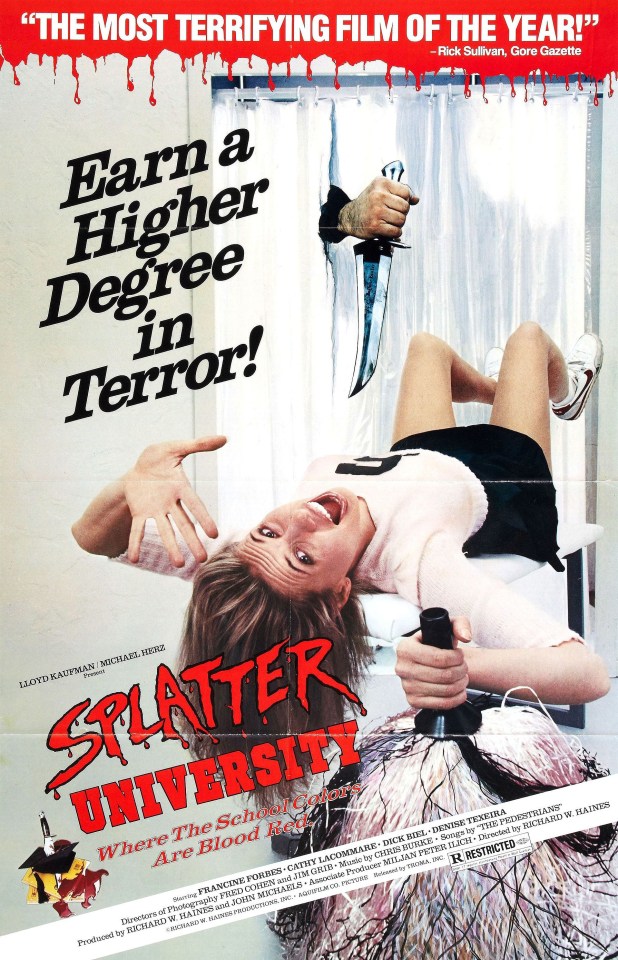
Splatter University (1984)

Richard W. Haines edited Stuck On You! and The Toxic Avenger and directed Class of Nuke ‘Em HighHead Games and this slasher film, which features actress Elizabeth Kaitan (Robin from Friday the 13th Part VII: The New Blood and Candy from the Vice Academy series) on the poster when she’s not even in the movie!

Years ago, a killer named William Graham escaped from a mental hospital and killed numerous students at Saint Trinian’s College. Years later, new sociology teacher Julie Parker has just started at the college but she can already tell that something just isn’t right. Much like a giallo, this foreigner must become the detective as bodies pile up around her and she becomes the killer’s next potential victim.

This movie was made for around $25,000 and originally called Thou Shall Not Kill. It came at the end of the slasher boom and is a pretty standard stalk and slash, save for a few cool scenes like when Parker discovers her best friend’s body, which has been festering in a locker for several days. It feels all over the place as several of the kills were added after the original running time only came in at 65 minutes, so the padding is evident.

For all of the faults you can find in this movie — the effects aren’t that great, the kills aren’t very spectacular, the characters are pretty much universally annoying — the ending makes up for all of it, transforming what has been a pretty campy affair into pure nihilistic bleakness.

Known as Campus Killings in the UK, this film played double bills with An American Werewolf In London. If you want to see it for yourself, you can grab the blu ray reissue from Vinegar Syndrome or watch it on Amazon Prime.

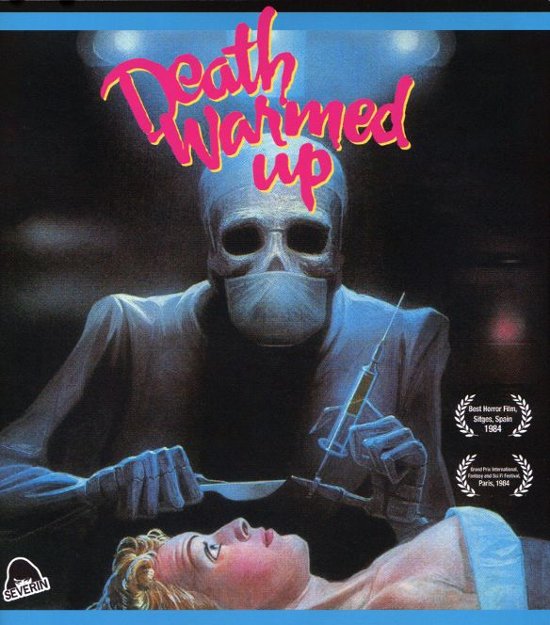
Death Warmed Up (1984)

New Zealand was ready to represent when it came to the slasher boom, thanks to this bonkers entry into the canon. It’s so violent that it was banned in Australia, a country that was originally made up of convicts.

Director David Blyth’s film predates Peter Jackson’s Bad Taste, seem as perhaps the first homegrown Kiwi horror film. Blyth has been called “New Zealand’s master of transgression” by Fangoria and “one of the great mavericks of New Zealand film” by NZ Listener. He also created the movies Angel MineWoundTransfigured Nights and Moonrise, which is also known as Grampire and stars “Grandpa” Al Lewis.

Years ago, Dr. Howell — a mad scientist trying to prolong human life past death — dealt with his harshest critic by mind-controlling that man’s son into shotgun blasting his parents.

Now, Michael Tucker (Michael Hurst, Iolaus from Hercules: The Legendary Journeys) has emerged from seven years in a mental ward. He somehow has acquired a loving girlfriend named Sandy and has taken her on a holiday along with their friends Jeannie and Lucas. However, that sojourn is really a front to get him to the remote island where Dr. Howell’s clinic is located and gain bloody revenge.

What follows is a descent into the caves of the island, where the doctor’s horrible creations live. That’s when the film turns into a strange mix of The Hills Have Eyes and Mad Max packed with an equal mix of nihilism and gore.

I really have no category that easily fits this film. It’s kind of a slasher. It’s somewhat a punk rock biker post-apocalyptic film. And it’s also science fiction. It’s a glorious mess, all over the place and unafraid to have its hero completely fall apart by the end.

If you want to check this out, Severin has recently re-released it in the best quality ever available for home video. It’s packed with trailers, commentaries with Blyth and writer Michael Heath, and an interview with David Letch.

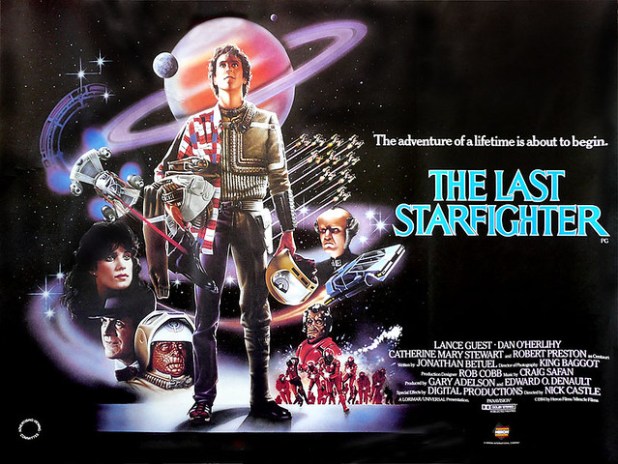
2019 Scarecrow Psychotronic Challenge Day 9: The Last Starfighter (1984)

DAY 9. DIGITAL S(T)IMULATIONS: A pre-2000 movie using computer generated “special” effects.

As much as we decry practical effects over CGI — in the same way we demand physical media over streaming — there are times when it doesn’t have to be all that bad. I decided that instead of finding a poor example of computer generated animation, I’d share something that I love.

While the first CGI in mainstream film was probably 1976’s Futureworld (several modern techniques were innovated in this film, from an animated CGI  hand that was taken from Edwin Catmull’s 1972 experimental short subject A Computer Animated Hand and an animated face from Fred Parke’s 1974 experimental short subject Faces & Body Parts to an early example of digital compositing to place live actors over a previously filmed background), the two movies that I can really remember to use extensive computer-generated imagery were Tron and The Last Starfighter.

In place of physical spaceships, 3D rendered models were used to depict this film’s Gunstar and spacecraft. Their designs came from artist Ron Cobb, who also worked on Dark StarAlienStar WarsConan the Barbarian and wrote the initial script for Dark Skies, which Steven Spielberg rewrote into the mich friendlier E.T. He’s also listed in the credits for Back to the Future as DeLorean Time Travel Consultant.

There are over 27 minutes of effects in this film, which was a tremendous amount of computer animation for its time. However, this animation required half the time of the traditional miniature special effects, allowed the film to be made for just $14 million dollars.

That said — there are still plenty of practical effects, like the creature and Beta Unit special makeup, as well as the Centauri’s Starcar, which was a real vehicle created by Gene Winfield, who also created the spinners for Blade Runner and the 6000 SUX for RoboCop. His car design for The Reactor was used in a variety of TV shows, including Catwoman’s Catmobile on the Batman TV show, the Jupiter 6 car in the “Bread and Circuses” episode of Star Trek, Bewitched and Mission: Impossible, where it was part of a scheme to make a bank robber believe that they’d been asleep for 14 years.

The idea that video games were recruiting players for some high end military service started as an urban legend that games like Missile Command were saving information on its players so that they’d be ready to defend America from the inevitable Russian ICBM strike that was coming in the 1980’s. There was also the There’s also the weird tale of Polybius, a video game that never existed — or did it? — that was an MK Ultra style experiment unleashed on Portland, Oregon arcades that led to addiction, hallucinations and visits by the Men in Black. Obviously, those legends led to this film or this is all an elaborate piece of disinformation to hide the truth in plain site. I leave your version of reality up to you, dear reader.

Alex Rogan (Lance Guest, Halloween 2) is going nowhere, stuck in a trailer park taking care of everyone else. His scholarship has been rejected and he has to keep fixing things and watching his little brother instead of getting to spend time with Maggie (Catherine Marie Stewart, The Apple).

The only fun he has is playing the Starfighter arcade game in the trailer park, which allows him to pretend that he’s defending the Frontier from Xur and his Ko-Dan Armada.

After Alex becomes the game’s highest-scoring player, the game’s inventor Centauri visits, offering him a ride in his fancy car as a prize. He’s played by Robert Preston, who is really just reprising his role as Harold Hill from The Music Man, which is an ingenious gambit.

The car is really a spaceship and Alex is taken to meet the Rylan Star League while a Beta Unit is used to replace him on Earth. That’s when he learns that the game is actually a training unit meant to find starfighters ready to battle very real Ko-Dan Empire.

Alex is expected to be the gunner for the Gunstar along with the reptilian navigator Grig (Dan O’Herlihy, who pretty much owned the 1980’s between this movie, playing Conal Cochran in Halloween 3: Season of the Witch and the Old Man in RoboCop). However, all our hero wants to do is go home.

It takes alien assassins attacking the trailer park and the death of all of the other starfighters and Centauri — who takes a laser blast meant for our hero — for Alex to join the cause. While he fights the Armada in space, Beta and Maggie battle the Zando-Zan killers back down on good old Mother Earth.

Of course, Alex has the gift that all great starfighters need and saves the day. He lands his ship on the trailer park and takes Maggie into space with him, while his brother starts playing the game in the hopes of joining his brother.

This is a film with real heart, beyond its aspirations of being a blockbuster. It’s directed by Nick Castle, who you probably already know played Michael Myers in the original Halloween. What you may not know is that he wrote the movie Skatetown U.S.A. or directed Tag: The Assassination Game, The Boy Who Could Fly and Dennis the Menace. Plus, he, John Carpenter and Tommy Lee Wallace all formed The Coup De Villes and played much of the music for Big Trouble In Little China.

Despite the film being based on the idea of an arcade game, there never really was one despite the promise in the closing credits of an Atari created edition. The game was actually started and would have been Atari’s first 3D polygonal arcade game to use a Motorola 68000 as the CPU. It would have used the Star Wars arcade controls and been much like the game Lance Guest plays in the film, but it was cancelled once Atari representatives saw the film in post-production and decided it was not going to be a financial success.That said there were Atari home versions in development and they were eventually released as Star Raiders II and Solaris.

There is an NES game — it’s a reskin of the computer game Uridium — and Rogue Synapse created a freeware PC game in 2007 that’s very close to the game in the film.

The themes of The Last Starfighter have been repeated in plenty of other stories, like Orson Scott Card’s Ender’s Game and Ernest Cline’s Armada, which is pretty much a note for note reboot of the same story. Of course, Cline wrote Ready: Player One and works in a reference to the original film, but he wears his influences on his sleeve. Interestingly enough, Wil Wheaton read the audio version of this book — which will be a movie soon enough that’ll cost a hundred times what The Last Starfighter did and have a sliver of the soul — and he appears in this film.

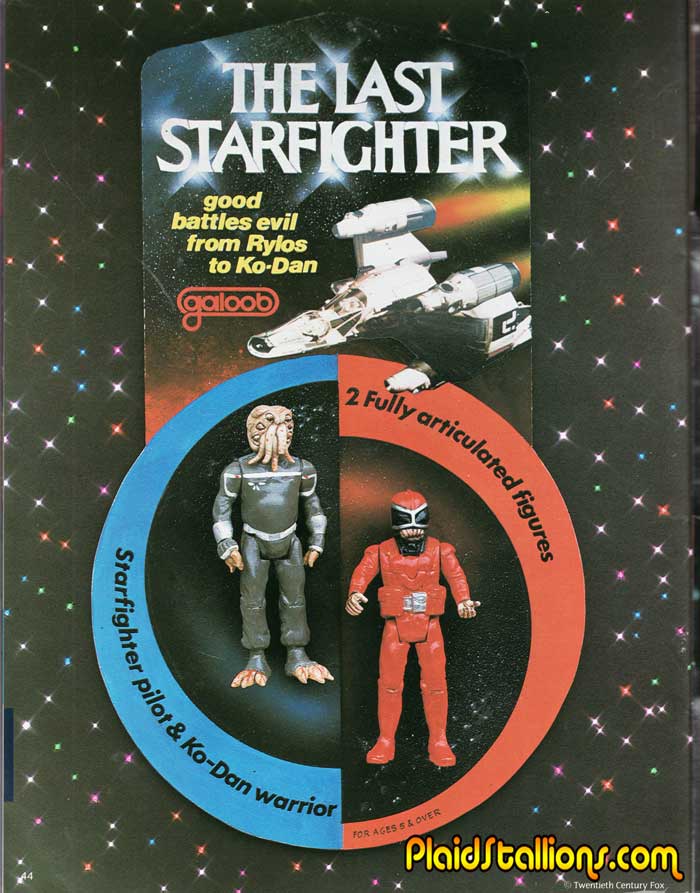
Galoob planned to create a toyline for this movie that sadly never came to be. You can see images of it and learn more about it at Plaid Stallions.

If you’re looking for a great slice of 1984, you can’t go wrong with this movie. I love that it has a lizard best friend, fun spaceship designs, the Music Man conning people for money in the midst of a galactic war and even the promise of a sequel which never came. It’s the kind of movie that would always be a rental that everyone could agree on or the perfect film to veg out whenever HBO showed it for the two hundredth time.

The Hills Have Eyes II (1984)

Seven years after the original film, Wes Craven would return to the desert, bringing more folks back into the near apocalyptic territory lorded over by the mutants from the first film. In fact, if you liked that movie, you’re in luck, because clips from it play throughout this one’s running time.

Wes Craven has disowned this movie, which started filming A Nightmare On Elm Street. Though it was released after that film, only two-thirds of it was finished when the studio halted production due to budget issues. Once Freddy Krueger became a household name, that convinced Craven to finish the movie using only the footage that he had in the can. That’s why so much of this film comes from the original, a point I will continually bludgeon throughout this article.

Robert Huston, who played Bobby in the original (and brought Lone Wolf and Cub to American screens) returns, as does Janus Blythe (she’s also great in Eaten Alive). She was Rachel in the first film and now everyone calls her Ruby. They now own a motocross team and have invented a super fuel. The team’s latest race takes them through the same stretch as…yes, I know I keep saying the original film, but this movie keeps referencing it.

Bobby’s psychiatrist wants him to go, but he chickens out with Rachel taking his place along with Beast the dog. Yes, from the first film.

The team — blind Cass (who brings a blind girl motocross racing?), her boyfriend Roy (Kevin Spritas from the Subspecies films and Friday the 13th Part VII: The New Blood), Harry (Peter Frechette, The KindredThe Unholy and T-Bird Louis DiMucci in Grease 2), Hulk(John Laughlin, Footloose and The Rock), Foster (Willard E. Pugh, Harpo from The Color Purple), Jane (Colleen Riley, Deadly Blessing) and Sue (Penny Johnson from TV’s Castle and 24) — head off to the desert but get lost.

Harry takes a shortcut through an old bombing range, which Ruby should have protested way more than she does. This leads them to a mining ranch where Pluto (Michael Berryman) comes back — yes, from the first movie — and attacks her. Everyone thinks she’s crazy until he also steals one of their bikes. Roy and Harry give chase but Harry gets killed by a boulder and a new cannibal named Reaper (John Bloom — who isn’t Joe Bob — the Frankenstein’s Monster from Al Adamson’s Dracula vs. Frankenstein) knocks out Roy.

Reaper is Papa Jupiter’s older brother and he isn’t here to mess around. Seriously, he wipes out everyone — including Ruby or Rachel or whatever she was calling herself these days — in short order, using spearguns, machetes and improvised traps. However, Craven didn’t like John Bloom’s voice, so he’s dubbed by Nicholas Worth, who we all know as Kirk Smith from Don’t Answer the Phone!

Sadly for Pluto, he’s still no match for a dog and gets dropped off a cliff.

The end of the film gets pretty thrilling, as the survivors use the bus itself as a trap for the gigantic mutant leader. There’s an amazing fire stunt at the end, which made me really happy. And hey — Kane Hodder was one of the stunt people for this!

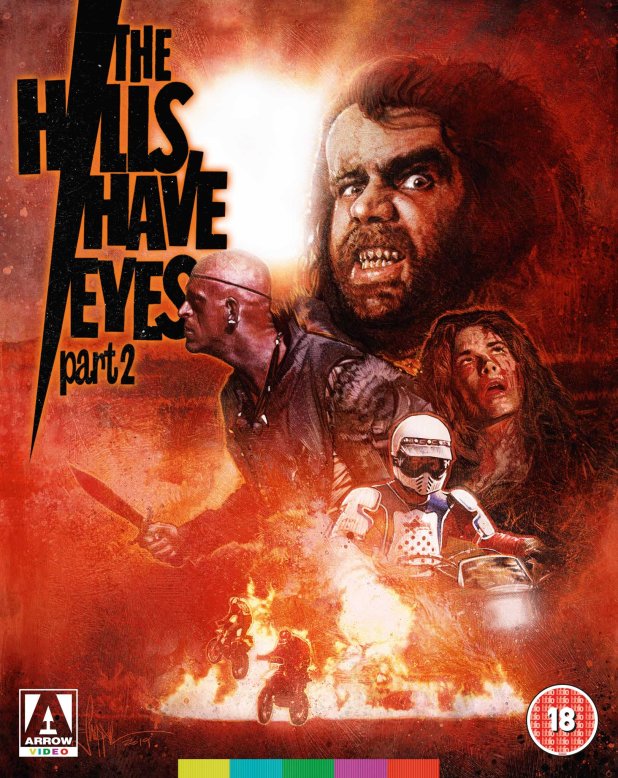
You can buy this from Arrow Video but keep in mind that it’s limited to 3,000 copies! It’s packed with extras, like brand new audio commentary with The Hysteria Continues and Blood, Sand, and Fire: The Making of The Hills Have Eyes Part II, a new documentary that has interviews with Berryman, Blythe, composer Harry Manfredini and more.

Like everything Arrow puts out, it’s a high quality release well worth your money. And despite being told for years how bad this sequel is — it’s certainly not the dark and brutal classic that it’s forebearer was — it’s entertaining.

DISCLAIMER: We were sent this movie by Arrow Video, but we would have bought it anyway. That has no impact on our review.

Calendar Girl Murders (1984)

Originally airing on April 8, 1984 on the ABC Network, this made-for-TV movie aspires to be a giallo just as much as it is a slasher, but it’s hamstrung by network TV limits. Sure, there’s murder and mayhem, but it’s a bloodless affair.

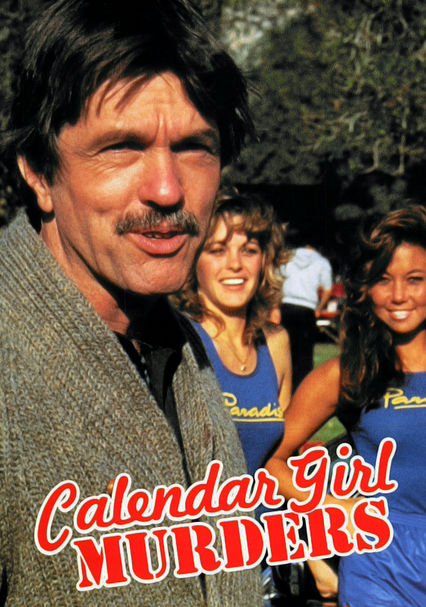
Speaking of affairs — Tom Skerritt stars as Lieutenant Dan Stoner, a married cop who falls for Cassie Bascombone, one of the girls pursued by a killer. She’s played by an incredibly young Sharon Stone. If you look this movie up, chances are you’ll see plenty of foreign VHS covers that make it seem like Stone is the main reason this film was made.

Millionaire Richard Trainor (Robert Culp) is pretty much Hugh Hefner in this. However, on the very night that he announces his calendar girls for this year, Miss January falls from her hotel room and Miss February gets stabbed.

There are — as there always are — many red herrings, as well as Alan Thicke, who shows up as a photographer. And oh look — it’s Barbara Perkins from Valley of the Dolls and The Mephisto Waltz.

If I were Hefner, I may have been peeved at this film. That said, it’s as toothless as it is bloodless, but it’s also a fun romp through early 80’s TV. It’s directed by William Graham, who was also behind Elvis’ last movie Change of Habit and Return to the Blue Lagoon.

Interestingly enough, the Stoner character would appear again in the HBO made-for-TV movie Red King, White Knight. That case is even brought up by Stoner’s captain at the end of this film.

You can watch this on Amazon Prime.

City Limits (1984)

Actor Don Opper (Black Moon Rising, Critters franchise) and director Aaron Lipstadt (prolific; too many U.S TV series to mention), the writing and directing team that brought us the very clever and entertaining Alien/Star Wars knockoff Android (1982; starring Klaus Kinski*) returned with this not so clever and entertaining post-apocalypse knock off set “15 years from now.” So, considering its year of release, it seems we’re in the year of 1999, across the continent from where Snake Plissken is dealing with Commander Hauk and hookin’ up with Season Hubley in a Chock Full o’ Nuts coffee shop.

As is the case with most-low budget apoc flicks, this means the “future” of City Limits pretty much looks like our present, except for a few techno-accoutrements to make it seem this is “the future.” And while that approach works to great success in films such as Kamikaze ’89 (1982) and Fahrenheit 451 (1967), City Limits lacks those films’ narrative focus to hold an apoc-rat’s interest.

You guessed it: As with the geographical alerts for post-apocalyptic films made in Canada and South Africa (Survival 1990, Survival Zone), this is a warning to proceed with caution with this U.S knock off of an apoc-flick . . . that’s a knock of the Italian pasta-flicks . . . that are knock offs of John Carpenter’s Escape from New York.

In this “universe” a plague has killed off most of the world’s adult population (I know that’s a plot device I’ve seen before, but I am too lazy to research those films, but I do remember Michael J. Pollard and Kim Darby starred in a ‘60s Star Trek episode with that plot) that leaves Los Angeles in the hands of two teenage biker gangs . . . who raided an Italian clothing designer’s ratty-apoc Broadway collection of costumes, complete with Skeletor-like motorcycle helmets. Can the Italian apoc-gangs the Riders and the Tigers kick their ass? Put it this way: The City Limits dweebs would be running around in pissy-pants if the rag-wearing and whitefaced Scavengers and the roller skating-metal hockey stick swinging Zombies showed up.

As with the Enzo G. Castellari apoc-universe set up in 1990: The Bronx Warriors and Escape from the Bronx, the ubiquitous “evil” corporation has moved into Los Angeles to restore civilization. The man to accomplish this goal is . . . teen idol-actor Robbie Benson (?) who, in the grand tradition of an ‘80s Adam West film (Zombie Nightmare and Omega Cop) does this from a one-room set, behind a run-of-the-mill wooden desk in an office with wood paneling . . . which is great if you’re a manager of a Walmart — not going into a post-apoc battle to restore civilization. Is Benson’s retail retaliation enough to inspire the gangs to unionize and fight back? You bet.

Considering this is a U.S production with a solid roster of U.S actors (John Stockwell of Christine, the apoc-drivel Radioactive Dreams, My Science Project; John Diehl of TV’s Miami Vice), along with a bigger budget and slicker production values than the Italian pasta-romps it aspires to be . . . there’s no Fred Williamson, Henry Silva, or Vic Morrow thespin’ against an endless barrage of fights and explosions and deaths by impalement, shotgun or, most importantly — flamethrowers. Yeah, John Stockwell is a great actor (and has become a successful director in his own right), but a movie in the apoc-genre needs a Mark Gregory discovered in a Rome shoe store, or ex-drug running merchant sailors like Michael Sopkiw running through the rubble and kicking the silver jump-suited minions of Henry Silva’s “Disinfestations Squads” to make it all work.

City Limits is a fond VHS memory of the ‘80s and it’s not a total waste of time, but it’s just that it could be so much better. You can watch it on You Tube, although the MST3K version on TubiTv makes for the more entertaining watch.

Tom Servo . . . Crooooow!

*Click through the images to check out our two Klaus Kinski tributes!

About the Author: You can read the music and film reviews of R.D Francis on Medium and learn more about his work on Facebook. He also writes for B&S Movies.

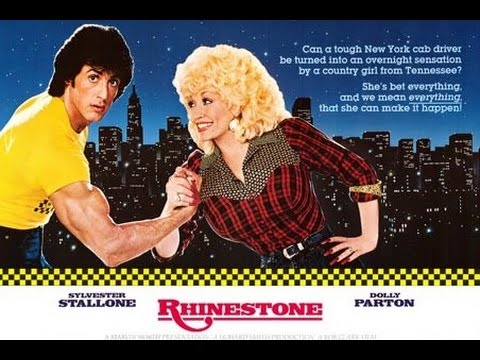
Rhinestone (1984)

I thought I knew what bad movies were all about, but I never knew it could be like this. Rhinestone achieves a level of bad movie that even I didn’t know was possible. It’s as if it sets a bar and then continually trips over it, again and again, taking down the talents of Dolly Parton, Sylvester Stallone and Bob Clark in its wake, like an endlessly swirling toilet that has transformed into a black hole where no goodness can escape.

This is the kind of movie that Ed Wood and Claudio Fragrasso would make fun of. In the grand totality of bad movies, this might very well be the worst that I have ever endured. Just imagine that statement — I am someone that has sat through Troll 2 numerous times, has endured multiple Jess Franco movies in one night and has even made it through countless direct to video films that haunted the shelves of Blockbuster and West Coast Video.

How bad can it get? Real fucking bad.

Phil Alden Robinson made his screenwriting debut with this film and luckily, he didn’t quit, as he went on to write All of Me and Fletch before writing and directing Field of Dreams and Sneakers. He was so offended by Stallone’s rewrite that he briefly considered having his name removed from the film’s credits, but was convinced that it would look good on his resume.

Stallone had plenty to say about this film when he spoke to Ain’t It Cool News: “The most fun I ever had on a movie was with Dolly Parton on Rhinestone I must tell everyone right now that originally the director was supposed to be Mike Nichols, that was the intention and it was supposed to be shot in New York, down and dirty with Dolly and I with gutsy mannerisms performed like two antagonists brought together by fate. I wanted the music at that time to be written by people who would give it sort of a bizarre edge. Believe it or not, I contacted Whitesnake’s management and they were ready to write some very interesting songs alongside Dolly’s. But, I was asked to come down to Fox and out steps the director, Bob Clark. Bob is a nice guy, but the film went in a direction that literally shattered my internal corn meter into smithereens. I would have done many things differently. I certainly would’ve steered clear of comedy unless it was dark, Belgian chocolate dark. Silly comedy didn’t work for me. I mean, would anybody pay to see John Wayne in a whimsical farce? Not likely. I would stay more true to who I am and what the audience would prefer rather than trying to stretch out and waste a lot of time and people’s patience.”

Dolly plays Jake Farris, a country singer stuck in a long-term contract performing at The Rhinestone. She gets into an argument with the club’s manager Freddie (Ron Leibman, whose career is one of the highest highs — winning a Tony in 1993 for Angels In America and being in Norma Rae — to the lowest of the lows, being in movies like Michael Winner’s Won Ton Ton: The Dog Who Saved Hollywood and the abortive Mad Magazine film, Up the Academy), putting five more years of her contract and a night of sex on the line if she can’t turn a regular man off the street into a country star. That said, if she wins, she’s out of her contract.

Freddie gets to pick that man and grabs New York cabbie Nick Martinelli (Stallone), who has no talent and hates country. So she takes him home to Tennessee to teach him how to be country. They constantly argue, which is supposed to remind us of the sparkling dialogue of the 1940’s romantic comedies, but instead just reminds us how little chemistry two of the biggest stars of the 1970;s have with one another.

Tim Thomerson — yes, Jack Deth from Trancers — shows up as Jake’s ex-fiancee Barnett Kale. Richard Farnsworth, who was so magical in Misery and The Straight Story is forced to be in this movie possibly at gunpoint, playing Jake’s dad. Actually, I assume that this movie was some sort of SLA terrorist action where everyone had Stockholm Syndrome and had to make this movie and gradually fell into loving what they were doing.

How else can you explain Stallone turning down Beverly Hills Cop and Romancing the Stone to make this movie? They must have had his family, dog and the turtles from Rocky held at gunpoint.

In her autobiography My Life and Other Unfinished Business, Dolly said tha the soundtrack for Rhinestone is some of the best work that she has dever one. The song “What a Heartache” is a personal favorite of hers, as she’s re-recorded it twice, and the singles “God Won’t Get You” and “Tennessee Homesick Blues” topped the country charts.

That said — this movie also features Stallone singing “Drinkenstein.” I date you to make it through this little number with your sanity intact. Here is just a hint of the lyrics in this, well, song:

“Budweiser you created a monster and they call him Drinkenstein. And the tavern down the street is the labba-tor-eye-ee where he makes the transformation all the time!”

This really happened. This was really filmed. This actually exists.

Dolly also utters a line so mystifying that it had to have been written by an alien race: “Freddie, there are two kinds of people in this world, and you ain’t one of ’em!”

I have no idea how Bob Clark — the same director behind Children Shouldn’t Play With Dead ThingsBlack ChristmasA Christmas StoryPorky’s and Deathdream — was behind this movie. Relatedly, I can’t even comprehend how Dolly Parton — who I love enough to have seen live on multiple occasions and who has proven herself as an able comedy actress — and Sylvester Stallone — whose movies I’ve spent weeks of this site discussing — could all be pulled into such a nightmare.

I really can’t stop you from watching this movie. In fact, I’ll probably watch it again. If you come to my house, I may even suggest that we watch it together. But I’ve come to realize that I enjoy painful movies. This movie makes the worst regional drive-in movie look like the finest New Hollywood soul searing tearjerker. It makes Manos, The Hands of Fate look like a Frank Capra movie. From here on, when someone asks how bad a movie is, I will use this film as the measuring stick for just how bad it can get.

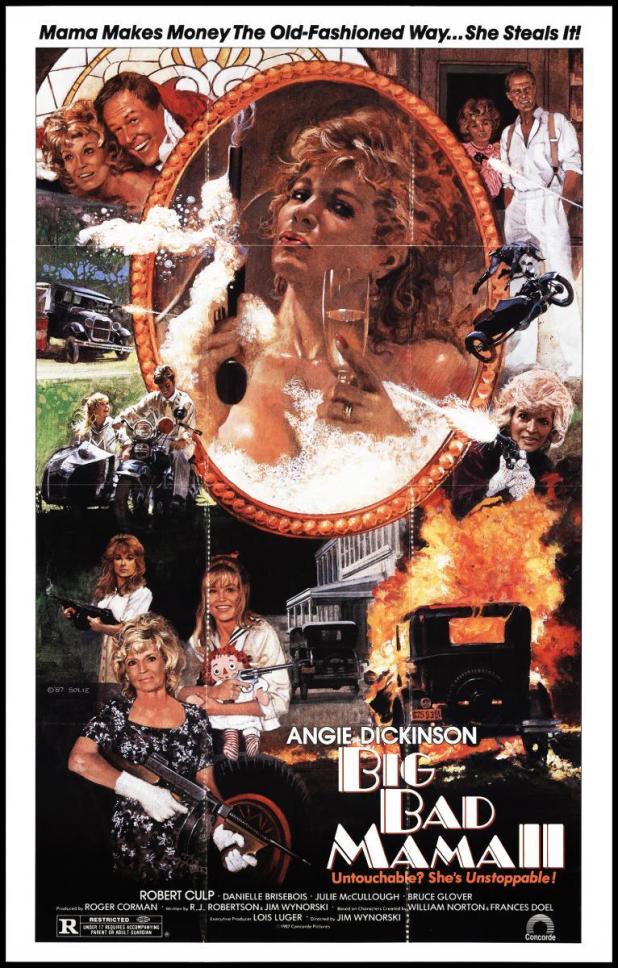
Big Bad Mama II (1984)

Roger Corman and Angie Dickinson are still on board for another Big Bad Mama a decade later, bringing on Jim Wynorski as the director. Yes, the writer of Forbidden WorldSorceress and Beastmaster 2: Through the Portal of Time as well as the director of Chopping Mall and so many more. Remember when the Medved brothers decried Dickinson being nude in the first Big Bad Mama? They must have been in full cringe mode for this one, even though Monique Gabrielle was her body double for this sequel effort.

Despite dying at the end of the original, Wilma McClatchie’s (Dickinson) home is foreclosed on, her new man shot and killed and she and her daughters Billie Jean (this time played by Danielle Brisebois, who was in The Premonition, TV’s Archie Bunker’s Place and a member of the band New Radicals) and Polly (Julie McCullough, Playboy February 1986 Playmate of the Month who also appeared in the 1988 remake of The Blob and was on TV’s Growing Pains until being fired once Kirk Saving Christmas Cameron converted to evangelical Christianity) return to a life of crime.

Crispin Glover’s dad Bruce is in this, as are Robert Culp, Charles Cypers (Sheriff Leigh Brackett!) and Lin Shaye in a brief part as a bank teller. It’s nowhere near as good as the originally, which wasn’t all that good to begin with, but when it’s 2:43 AM and you’re up all night with a toothache, you could really do worse, I guess.

You can watch this on Tubi and Amazon Prime.

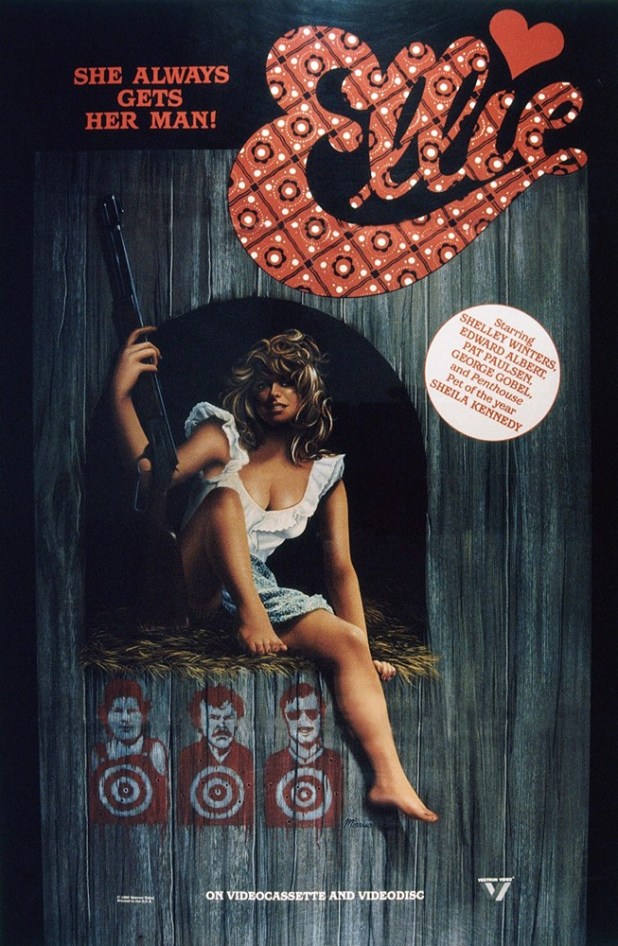
Ellie (1984)

If there’s a hicksploitation hall of fame, Shelley Winters should probably be in it. She’s in one of the movies that defines so many of the genre’s themes, The Night of the Hunter, as well as some of its best — and most exploitative examples — films, such as Bloody Mama and Poor Pretty Eddie. She also plays a housekeeper Katy who has also had a space baby sometime in the past in the astounding 70s blast of odd called The Visitor.

Somewhere in the Deep South, this is all about barefoot farmer’s daughter Ellie (Sheila Kennedy, Penthouse Pet of the Month for December 1981 and the 1983 Pet of the Year) getting revenge for her father’s murder at the hands of her stepmother (Winters) — who killed the kindly old man while she chowed down on fried chicken.

She only has one weapon. Her body. And she knows how to use it.

George Gobel, Edward Albert and Pat Paulsen all show up, but the main thrill of the film is its rampant nudity. Somehow, this movie is also a version of the Greek myth of Elektra, if you can wrap your mind around that.

Director Peter Wittman was also behind exactly one other movie, Play Dead, where a woman kills with her brain and her dog. It’s not great or even good, but it’s the kind of movie that you stayed up to watch on a Friday night on Cinemax. If you never did that, you’re probably going to hate this. If you did, you have a near limitless capacity for enduring boring films. Not that I would know or anything.

You can watch this on Amazon Prime.