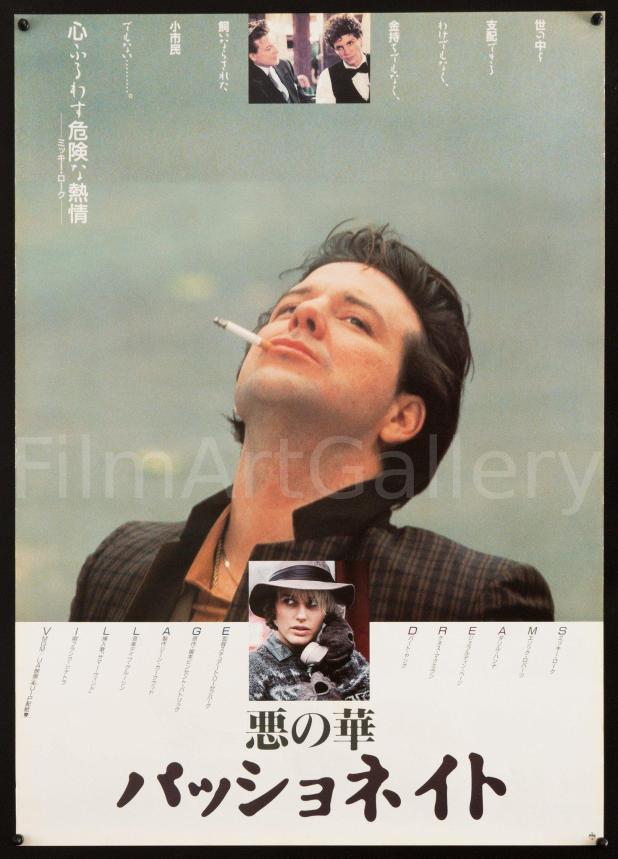
The Pope of Greenwich Village (1984)

ABOUT THE AUTHOR: Jim LaMotta is one of Pittsburgh’s premiere wrestling announcers, as well as a great writer. This article originally appeared on Steel City Underground. You can follow Jim on Twitter.

The first article that I penned for this site late last year was about Robert De Niro’s debut as a director, A Bronx Tale, the 1960s street saga based on Chazz Palminteri’s one-man stage show. As mentioned in that original review, I discovered the film when my dad put a copy that he taped from HBO into the VCR. This time, I’d like to discuss another movie that I originally watched from a home recorded copy, The Pope of Greenwich Village. Another street saga, this 1984 release shifts to another famous location in New York, the Greenwich section of Manhattan. With the screen play written by Vincent Patrick, adopted from his novel of the same name, the film blends together tense moments of uncertainty with occasional comic relief, as two wise guys find themselves lost in the shuffle of the hustle of the streets.

Directed by Stu Rosenburg, who has the classic Cool Hand Luke on his resume, the production brought together a tremendously talented cast, including the two main characters, Charlie and Paulie, played by Mickey Rourke and Eric Roberts respectively. At the time the film hit theaters, Rourke, a sharp and charismatic actor, was on an upswing with titles like 1982’s Diner and the Coppola-directed Rumble Fish on his resume. Eric Roberts, the brother of famous actress, Julia, played the role of Charlie’s clumsy sidekick perfectly to give the narrative more depth as the film progressed.

The opening scene finds Charlie swaying to the rhythm of Frank Sinatra’s “Summer Wind” as he files through his closet to pick a snazzy suit to wear for his shift as a manager at a high-end restaurant. In a slight example of foreshadowing, his carefree jam session set to Frank’s suave voice is interrupted by his search of several pairs of his Italian-made dress shoes to look for extra cash to make a payment to one of the loan sharks waiting at the restaurant. As he strolls into the eatery, a co-worker gives his supervisor the heads-up that the crusty owner of the establishment plans to check tabs that night to make sure the waiters aren’t excluding items on the bill in exchange for better tips. This is where we’re first introduced to Paulie, Charlie’s third cousin, who naively disregards the same warning from him. Roberts’ character decides to skip the high-priced items on the bill, which the owner obviously notices and fires both cousins since the manager didn’t catch the underhanded tactic first. The confrontation outside of the establishment when Charlie angrily informs Paulie that his mishap resulted in the pair of cousins getting their walking papers sets the tone for their dynamic in the film. Charlie is a hustler trying to stay above water with hopes of owning his own restaurant someday. Paulie immaturely tries to explain his rational for skipping items on the check before the audience sees that he legitimately feels bad that he costs his cousin the job.

The next scene finds a distressed Rourke at his kitchen table shuffling through bills and late notices in the apartment he shares with his girlfriend Diane, played by Daryl Hannah, who went on to work in dozens of roles in TV and film, including the 2003 cult favorite, Kill Bill. Adding to his financial struggles are alimony, child support payments, and credit card debit. Unwavering, Diane assures Charlie everything will work out for the best, prompting Sinatra’s “Summer Wind” to rejoin the film as we find the freshly unemployed cousins playing stick ball in the neighborhood the next day. The good times were short-lived, as his visit to the bank for a loan was denied and when he arrives home, more pressure was heaped upon him with the news that Diane is pregnant. Back to bop around the village, Paulie tells Charlie about his next outlandish venture in an attempt to hit it big. The dim-witted waiter explains that he bought into a race horse that was conceived through “artificial inspiration” without realizing that he misspoke on the terminology while he makes himself a comically large sandwich. Paulie claims the thoroughbred has the “champion gene,” but the out-of-work waiter needs to score some big cash to bet with, revealing his next narrow-minded scheme.

The two meet Barney McMillian, an eccentric and edgy clock dealer, in a bar. The Irishman explains his work repairing clocks gave him the tools to pick locks. Before the trio can discuss details of a heist of the safe of a shipping company, the hard-nosed officer that patrols the streets tows Paulie’s car, despite his pleas to accept a ticket without getting the car impounded. Finally Charlie agrees to the heist, with the mounting financial pressures in his life as the determine factor.

During the next scene the audience is introduced to Jack Kehoe’s Walter “Bunky” Ritter as he shuffles through the crowded sidewalk into the local mafia hang out. Similar to Kehoe’s character in the film, Serpico, “Bunky” Ritter is a crooked cop on the take, paid to drop off mob collections in exchange for a piece of the pie. Detective Ritter meets with “Bed Bug” Eddie Grant, the local kingpin, to discuss details for his next pick up. “Bed Bug” is portrayed by Burt Young, who famously played Paulie as Sylvester Stallone’s pal in Rocky. Despite the boxing corner man as probably his most well-known role, the Eddie Grant character shows that Young has depth to his acting repertoire, replacing the good natured Rocky role with a sense of danger on-screen as a ruthless mob ruler.

The tense introduction of “Bed Bug” Eddie is contrasted in the next scene when the patrolman that had Paulie’s car towed was back on the street writing tickets when he stopped into the bar to use his position of authority to get a free drink after he used the bathroom. While the cop was taking care of business, Paulie slipped in the bar and put a packet of horse laxative in the cop’s whiskey. The gluttonous patrolman emerges from the restroom, downs the free drink, and goes back to the street to gleefully write more citations. Within seconds, the stomach tremors hit him and he attempts to waddle like a penguin back toward the bathroom before his digestive track can’t offer any more resistance. Paulie rushed to a pay phone and called in an officer down, prompting squad cars to swarm the street, only to find the diarrhea-stricken cop holding his stomach. As an Irish folk song crescendos, Paulie proclaims to the public that the cop defecated on himself.

Back to business, Paulie, Charlie, and Barney meet up that night to break into the shipping company’s offices to crack the safe, hoping to score the $150,000 inside. As fate would have it, as those three prepare to begin work on the safe, Bunky Ritter is shown at the apartment he shares with his mom getting ready to go pick up the same money. Geraldine Page, an actress that had a 40-year career through the stage, film, and television, was nominated for an Academy Award for her role as Mrs. Ritter. Page does such a stellar job with this character, as she authentically presents a no non-sense character, but still brings a caring side to it. Different from Kehoe’s role in Serpico, Detective Walter agreed to the collections as a way to ensure a retirement fund for himself and his mother, who worked as a housekeeper for several years. Bunky’s actions might not be legal, but his intentions are noble, a recurring theme in the narrative of the film.

It’s revealed that Bunky keeps a wire on him during all meetings about the collections as an insurance policy for his safety, and as he drives to the office for the pick up, he acknowledges the other detectives involved in the bribes. Unaware of Bunky’s impending arrival, Barney is cracking the safe while Paulie sips on a coffee and watches the parking lot. Tense drama builds as the former waiter tells his accomplices that someone is walking up to the building. With the lights out, the trio hide as Detective Ritter enters the office that has equipment strewn around the room since the building was being remodeled. The tools don’t phase him, but the hole drilled into the safe is a red flag. Unsure of how recent hole was made, Bunky uses his detective skills to see how warm Paulie’s coffee was. Immediately, Bunky takes out his gun, knowing the fresh coffee meant someone was still in the room. As he backs up and yells for the person to reveal themselves, he fires a shot before he accidentally falls down an unfinished elevator shaft. The trio attempt to check on him, but realize that Walter is dead, with Charlie retrieving the tape that was used to record the audio from the wire the cop wore to the meetings. Despite Charlie’s objections, Barney finishes the safe job, garnering the $150,000 that Paulie promised would be there.

Charlie found the detective’s arrival too suspicious so he confronts his cousin about what else he knew about the situation. With a little pressure, Paulie admits that the shipping company is run by Eddie Grant, which meant they just stole from the local mafia crew. Charlie is almost hysterical as he questions why his cousin would want to steal from the “Bed Bug.” Again, we see the naive side of Paulie because he thought that including his cousin in the heist would make up for getting him fired, but it actually put his life in danger.

The news of the safe cracking and the aftermath have a ripple effect throughout the film, as word of Detective Ritter’s wire makes his fellow officers concerned about their future if their involvement in bribes is revealed. Two gruff cops visit Mrs. Ritter to attempt to search their apartment for the missing recordings. Again, Geraldine Page does such an incredible job in this scene, mixing her grief by clutching a rosary with a tone of toughness, as she aggressively puffs on an unfiltered cigarette and sips a whiskey. When the cops try to intimidate her with the threat of trying to withhold Walter’s pension, she promptly kicks them out of her house before she tearfully hold the rosary close to her, the wall of grittiness finally tumbles down from the waves of grief at the death of Walter at the office. At the same time, Bed Bug Eddie gets word from the street that Paulie and an unknown partner were the ones that stole the cash. A member of Bed Bug’s crew knows Paulie, but Uncle Pete as the waiter affectionately calls him, insist his nephew isn’t a safe cracker. Eddie Grant wasn’t the only one to take the news hard, as Charlie visits Diane at the studio where she teaches dance classes and tells her that he landed $50,000 from the robbery. Diane is livid that Charlie allowed his cousin to get him in another jam, and an argument ensues before Charlie leaves, the situation with her unsolved.

Eventually, Paulie is at the stables to check on his horse with the “champion gene” that he plans to race soon, wagering the cash he lifted from Bed Bug’s safe. He was faced with a game of chance sooner than expected, as Uncle Pete and a few of Eddie Grant’s goons, including Frank Vincent, who made a career of supporting roles in mafia dramas, including Casino, Raging Bull, The Sopranos, and others, were there to meet him. Uncle Pete takes a walk with his nephew, informing him that someone identified him as one of the thieves. Bed Bug Eddie had a reputation for slicing people up, and Pete tells Paulie that the only way for him to leave the stables alive is to tell him who his partner was in the safe job. Paulie begs for a reprieve, but Pete assures him there are only two options in this scenario. As the tension builds, Paulie leaks the information that Barney cracked the safe, but doesn’t mention Charlie in an attempt to protect his cousin from the wrath of the Bed Bug. As Uncle Pete hugs Paulie, the previously mentioned Frank Vincent approaches and cuts off Paulie’s thumb, the penalty for robbing the head of the mafia crew.

With Barney revealed to be the partner, the crooked cops are sent to retrieve him, but the savvy clock dealer was a step ahead and escaped through a side door. Later, Barney gives Charlie his share of the robbery and asked him to mail it to him after he escaped the city. During this conversation, Barney’s motivation for the heist is explained, as he plans to use the extra cash to provide for his wife and care for his special needs child. Again, not exactly legal, but a noble cause.

Charlie finds himself in a cash flow problem of his own, as he returned home with flowers for Diane to smooth over the earlier argument at the dance studio. A message from her on the answering machine tells Charlie that she took $45,000 of the money for their unborn child and decided to leave him. Enraged being the victim of his own theft case, Charlie begins smashing the furniture, pummeling the refrigerator and breaking chairs. The next morning, with a half empty bottle of wine next to him, Charlie is awoken by a faint knock at the door. When he answers, his cousin is standing there delirious with his hand wrapped up from the Bed Bug form of justice. Only after rambling on about his decision to give up Barney as the partner does the medicated Paulie ask what happened to all the broken appliances. Upon hearing the news that Diane ran off with most of the cash, Paulie rants for a while before the reality of his missing appendage sets in when he looks at his hand. In one of the most memorable lines of the film, Paulie proclaims, “Charlie! They took my thumb!” collapsing to the floor after taking too many pain killers before he arrived.

Despite the lovable dork’s mistakes, Charlie immediately tends to his cousin, as the next scene shows him feeding Paulie soup. To make up for the theft, Paulie will have to serve coffee at the mafia hang out and within days, the Bed Bug interrogates him as to the number of people involved in the robbery. After Barney skipped town, another measure of revenge was being plotted, and after tense questioning, Paulie finally cracks, naming his cousin as the third participant in the robbery. As was usually the case, the new coffee server had a plan to get his cousin out of this predicament. With his race horse, “Starry Hope ” set to run at the track, he bought two tickets for Miami as an escape plan for the cousins after they hit it big on the horse bet. Unaware that the Bed Bug knows about him, Charlie bets Starry Hope across the board with his remaining share of the theft, a safer bet than his cousin makes, who put everything on the horse to win. After an exciting race, Charlie’s place or show bet pays off, as he lands $20,000 from the horse’s second place finish.

To celebrate the victory, the two stop at a bar where Paulie nervously confesses to Charlie that he had to give up his name to the mafia crew. Totally irate,  Charlie screams at Paulie and throws trash cans through the street, storming off as Paulie tearfully tries to explain the tickets to Miami are a way to leave. As Charlie listens to Detective Ritter’s wire tape again, he realizes he has evidence and leverage that proofs of Bed Bug’s involvement in crime. There’s a montage that shows Charlie getting ready for an eventual showdown with the kingpin. His finest suit, a manicure, and a hair cut prepare him as he walked into the mob club for the confrontation. He sits across from Eddie Grant and explains that the Bed Bug will give him a pass on the robbery because he has a tape that can link him to the police corruption in the city. Implying that he plans to severe Charlie’s hand, Grant claims, “Nobody but the Pope could walk out of here with this hand.” Without hesitation, Charlie’s response is a nod to the title of the film, “This might be your church, but right now, I’m the Pope, I’m the Pope of Greenwich Village because I have a tape.”

Just as it looks to be seconds away from a physical confrontation, Paulie shows up to serve coffee. A tense stare down takes place between Grant and Charlie, as the mafia leader looks to signal his henchmen. As Bed Beg confidently finishes the expresso in split second, he suddenly grabs his throat and charges through the door and down the street as most of his crew follow him. Paulie exclaims, “Lye! I packed his expresso with lye!” The abrasive chemical rendered the mob leader useless, allowing Charlie the chance to escape. Paulie stood up for him cousin, despite Charlie’s claims that he had things going his way before the expresso ended the conversation. Once again, “The Summer Wind” can be heard as the two walk down the street, presumably on their way to Miami to relax on the beach and enjoy their winnings from the horse race.
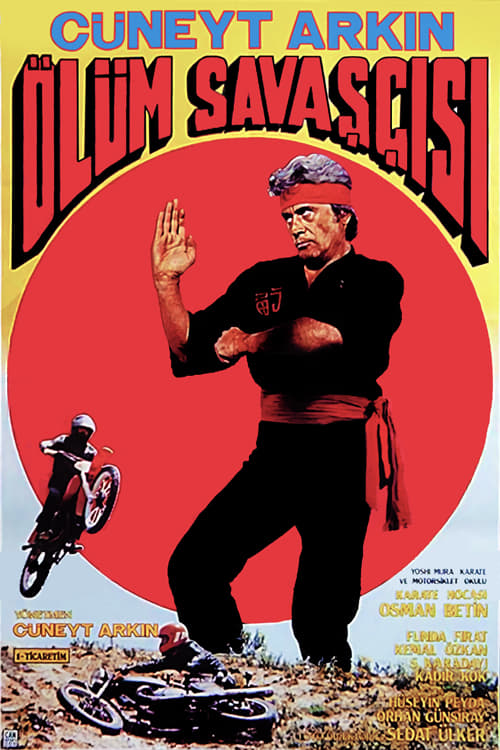
Ölüm Savasçisi (1984)

I don’t care if you’ve made it through the collective worlds of Willie Milan, the Shaw Brothers, Godfrey Ho, Takeshi Miike and any number of film directors and creators and think you’ve seen it all. You’ve seen absolutely nothing because none of these creators would be able to create a movie quite like the absolutely demented world that Cüneyt Arkin has crafted. Trust me, over the next week, we’re going to share so many of his films, but it feels best to start here with 1984’s Death Warrior.

Think Godfrey Ho is transgressive because he mashes together two films at the same time? Cüneyt Arkin laughs as he makes every movie he has ever seen all at once, like those insane kids that didn’t understand that you can’t play with G.I. Joe, He-Man and your wrestling figures all at the same time because they’re all different sizes, but grown up and with a camera and a team of stunt people ready to die just to get all this lunacy committed to film.

This is why I love movies.

Beyond writing and co-directing this movie with Cetin Inanc, Cüneyt plays Murat, who is the Death Warrior. Years ago, he learned the ways of the ninja in Korea, after the war, and saved one of his sword brothers, who holds a grudge that this gaijin saved him so he’s spent the last few decades creating a gang of other ninjas who are destroying Italy. So the Italian cops decide to bring in Murat and unleash him on his one-time friend.

This plot sounds simple, but instead of delivering this Snake Eyes and Storm Shadow story to you straight, Cüneyt has created a film that mixes the neckbreaking zooms of Fulci, the nightmarish landscapes of Argento, the non-stop brawls of the Hong Kong films and the psychobabble of a 1960’s drug film and overfills 65 minutes of time with way too many ideas, like Jack Kirby when he was unleashed upon the Fourth World after a decade of pretty much making everything that made everyone say “Make Mine Marvel.”

Even crazier is that most of the footage in this film was originally used in 1982’s Arkin and Inanc joint Son Savasci (Last Warrior) but in a more linear fashion. Man, I didn’t know that they knew the Dada cut-and-paste technique in Turkey, but at the rate these guys were cranking out movies, I’m not surprised by anything, like how much of this rips off The Enforcer. These guys were making a hundred movies a year. I would have seen every one.

This is a movie that somehow has cars blasting through brick walls, ninjas who can use playing cards as weapons as if they were written by Frank Miller and trained by Ricky Jay, ninjas that are also zombies, evil plants, wizards, women that turn into frog creatures, a melty faced beast that is part vulture and a climax that offers a fight between Death Warrior and ninjas that is literally one third of this movies entire running time.

A normal person would think, “Is this too much?” Arkin and Inanc decided to throw in a bad guy who wipes out his own people just to show how twisted and powerful he is (by the way, in my dreams, he is in a support group with Maizon, the one-eyed cyborg werewolf from Mad Warrior, Velvet Von Ragner from Never Too Young to DieAlby the Cruel from Nine Deaths of the Ninja and Tarzan from Intrepidos Punks), music stolen from Psycho and that aforementioned last final battle scored with the disco version of the Jaws theme.

The editing in this film is exhausting. You may never be able to watch another movie after this because it’s going to destroy your sense of pacing, your attention span and your understanding of how a speedball works.

Just stop reading all these words and watch this on YouTube and please write back to me and tell me just how much you loved this. My absolute highest recommendation.

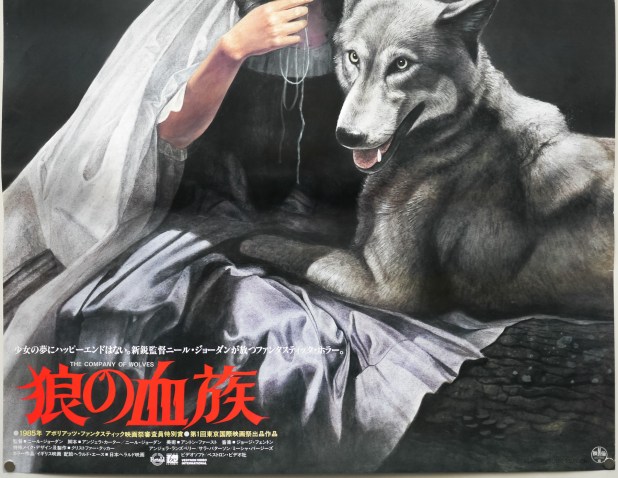
The Company of Wolves (1984)

Back before Neil Jordan made The Crying Game, he made an adaption of one of the stories in Angela Carter’s The Bloody Chamber. The author had already made a radio version of the story and worked with Jordan on the script.

This was Jordan’s second film and it was made on a very low budget. In fact, to get across the idea of multiple wolves in some scenes, most of the monsters shown in the film are actually Belgian Shepherd Dogs*.

The narrative device that drives this film concerns Rosaleen, a modern girl who dreams that she is in the past, a strange place where her sister Alice is hunted and killed by wolves. Her grandmother (Angela Lansbury!) warns her, as she gives her a red cloak, to beware men whose eyebrows meet. As the villagers soon hunt a wolf whose dead body reveals a man, this dire proclamation takes on some truth.

She soon meets a huntsman, who dares her to a race to her grandmother’s house. He arrives first and eats the old woman, yet our heroine can’t hate the man. Even though she wounds him, she still cares for him and ends up becoming turned into a lycanthrope herself. Finally, the story breaks into today’s time, as the wolves crash through the windows of Rosaleen’s modern world, symbolizing the end of her pre-pubescent innocence.

This framing story also allows the grandmother and Rosaleen to tell stories that concern wolves, man and desire. They include a young werewolf (Stephen Rea) running from his wife and young family, the devil (Terrence Stamp!) showing ip in a Rolls Royce, a witch that transforms a family of noblemen and a wolf woman (experimental musician Danielle Dax) treated kindly by a priest.

The film also offers some truly horrific and bloody transformation scenes that were featured prominently in the advertising when this ran in the U.S. I remember seeing these commercials and being horrified by them, but they are just part of the overall journey for a movie that is more allegory than genre film. And hey — David Warner is in it and he always makes everything he’s in so much more interesting for his presence.

*There were also two wolves used in the film, which required snipers to also be on set. That’s because these wild animals can never truly be tamed.

Yellow Hair and the Fortress of Gold (1984)

Matt Cimber is an example of the individuals that I refer to as a nexus point, as he unites so many different films that I end up writing about so often. Blaxpolitation? He made The Candy Tangerine Man and The Black Six. Late 60’s and early 70’s pre-porn revolution sex movies? As Gary Harper, he made The Sexually Liberated FemaleHe & She and Man & Wife: An Educational Film for Married Adults (an “educational” movie made in Sweden that does have actual intercourse). Strange “it’s kinda, sorta horror”? He made The Witch Who Came from the Sea with cinematographer Dean Cundey. Sword and sorcery? He made Hundra. He was also pivotal in the lives of Pia Zadora (Butterfly) and his wife Jayne Mansfield (Single Room Furnished) and helped create the Gorgeous Ladies of Wrestling.

So when it comes time to write about Italian-style Westerns, it stands to reason that Matt Cimber should have made one of these films as well.

The best reason to watch this movie is Laurene Landon, who has been in more movies on this site than I realized. She was a featured skater in Mark Lester’s Roller Boogie before showing up in the wrestling film …All the Marbles, Full Moon HighAmerica 3000Maniac CopManiac Cop 2Wicked Stepmother and in one of the commercials in The Stuff. She was also in Cimber’s Italian-American-Spanish barbarian film Hundra, complete with an Ennio Morricone score, pretty much making it a legitimate Italian film.

Here, she plays the titular blonde half-Native American Yellow Hair, who is out to find the gold of Tortuga and battling numerous outlaws and Mexican soldiers, including her arch-nemesis Colonel Torres. Helping her out is her sidekick the Pecos Kid.

This is a weirdly put-together film, as it starts like a movie serial and ends like one, including crowd noise and cheers as the characters are introduced. Even the final movies are told like a cliffhanger instead of a narrative and the violence is often staccato in nature, with gunshots and people being shot shown numerous times in succession.

While this film seems like it could be one of the kids — seeing as how basic and silly the story is — it’s also filled with plenty of ultraviolence, including people being launched off cliffs, lynched and their heads dipped in hot gold before being lopped off.

How Italian is this movie? Numerous snakes and horses have had to have been hurt making it. That said, it is nowhere near the highpoints of the genre, but I read someone say that if you happened upon this movie when you were a pre-teen on a Saturday afternoon, you’d be obsessed about it as an adult.

You can watch this on Amazon Prime and Tubi.

White Fire (1984)

Also known as Vivre Pour Survivre and Le DiamantWhite Fire is a movie that is crazy from literally first few moments of the movie, where Bo and Inga (soon to be played by Robert Ginty from The Exterminator and Belinda Mayne from Alien 2: On Earth) watch as their father is burned up by a flamethrower and their mother shot in the back. Fast-forward a few decades and now they’re jewel thieves who are after White Fire, a diamond so hot that it sets people on fire when they grasp it. Oh yeah — they have the hots for each other.

I can’t even begin to explain the story of this movie, where Bo recreates his soon-to-be dead sister by having a prostitute get plastic surgery so that he can finally sleep with his sister, I mean, get revenge. The only trouble is that this new sister is wanted by Noah Barclay (Fred Willaimson!), who has to take her back for his boss.

This is the kind of movie that randomly throws a chainsaw fight in ten minutes in and you wonder, how can this top that? And it does. Again and again, it does, including diamond mine workers who have accessorized leather belts straight out of the disco era. Even better, Mirella Banti (Tenebre, D’Amato’s Top Model 2) is a completely heartless villain.

Gordon Mitchell is here, which makes sense, seeing as how this film — like many of the Eurospy movies he was in — is a United Nations-like effort, uniting Turkey, Italy, France and America to make one of the oddest films that has graced by blu ray player in a while.

Director Jean-Marie Pallardy was a male model before becoming a director. I love how his credit is his signature, as if this was going to be something classy. Then I remembered that Harry Novak did the same exact thing. Most of Pallardy’s work was in the soft core genre, but seriously, the dude is a maniac. This movie is fetishy as hell.

And check out this theme song by Limelight.

Arrow’s new release of this film is pretty much perfect, with a 1080p high def version of the movie, interviews with the director, editor Bruno Zincone and Williamson, and commentary by Kat Ellinger.

This gets my highest recommendation. Please watch this movie — where Turkish oil wrestling is background noise and not even a highlight — so we can discuss just how out of control it is.

You can get this from Arrow Video.

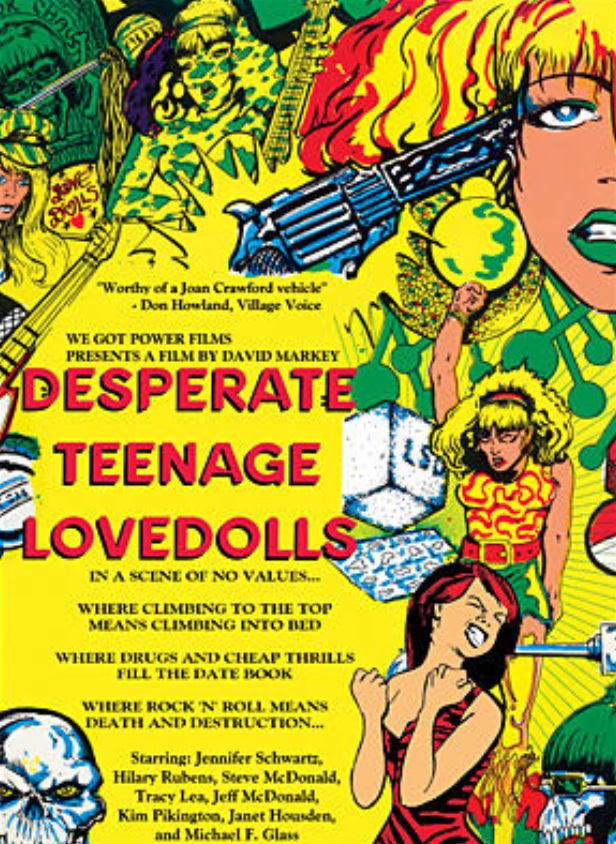
Desperate Teenage Lovedolls (1984)

“Thanks for killing my mom.”
“Hey, no problem.”

— Kitty Carryall and Patch Kelly

What do you get when you shoot a film for less than $300 on Super-8 film with a bunch of your friends from the L.A. punk scene (Dez Cadena of Black Flag and DC 3, Jeff and Steve McDonald of Red Kross, Vicki Peterson of the Bangles)? You get Dave Markey’s amateurish — but much loved — campy mirco-classic about the rise and fall of punk rock band.

Watch the trailer.

When the mothers of lead singer and guitarist Kitty Carryall (know your Brady Bunch trivia!; portrayed by screenwriter Jennifer Schwartz), bassist Bunny Tremelo (Hilary Rubens), and drummer Patch Kelly (Janet Housden; later became a legal consultant on films) decide that punk rock isn’t proper for young ladies, the trio runs away to fulfill their rock ‘n’ roll dreams.

Out on the (comical) mean streets of Los Angeles, the Lovedolls are forced to fend for themselves against gangs (Kurt Schellenbach of the Nip Drivers) and rival bands. Also working against them is their sleazy manager Johnny Tremaine (Steve McDonald of Redd Kross) who uses them for sex and his own personal gain, and a rival girl gang, the She Devils (Annette Zilinskas, then of the Bangles and later with Blood on the Saddle; became a film animator) who work at sabotaging the Lovedolls. The girls finally decide they had enough and decide to strike back at those who wronged them.

Director Dave Markey has made this available as a free stream on his official You Tube channel, along with the director’s cut of the sequel Lovedolls Superstar, also on his You Tube channel. You can enjoy a playlist re-creation of the soundtrack to Desperate Teenage Lovedolls on You Tube and an upload of the soundtrack to Lovedoll Superstar on You Tube. Both the DVD and CD of Desperate Teenage Lovedolls are readily available in the online marketplace, as well as used copies of the ’80s-issued VHS and LP versions. (Thank the analog gods for comic books stores renting odd-ball VHS titles, and record stores carrying used vinyl . . . why did I sell the album? Ugh! Oh, because of bought it for $10 and sold it for $80 because the car needed gas.)

You also also can watch Markey’s punkumentary, 1994: The Year Punk Broke — starring Nirvana, Sonic Youth, Babes in Toyland, and Dinosaur, Jr. — on Daily Motion and (as a 15-part upload) on You Tube.

You need more grunge flicks? Be sure to check out our “Exploring: 50 Gen-X Grunge Films of the Alt-Rock ‘90s” featurette chronicling a wealth of films from the era.

About the Author: You can learn more about the writings of R.D Francis on Facebook. He also writes for B&S About Movies.

Another State of Mind (1984)

Upon the advent of the DVD format into the VHS-driven (Betamax lost that analog throwdown) market, the rock ‘n’ roll documentary market became flooded with one smug and pretentious, paint-by-the-numbers vanity ego-doc unfurling at a mind-numbing pace with unrelatable and emotionless subjects spewing historically-skewed “facts” that were in desperate need of an editor: insert a brevity-lacking, babbling head here, a photo here, a backstage dust-up here, a performance clip here, etc., and so on. . . .

The end result: welcome to Walmart’s $5.00 electronics’ department cut-out barrels. Or be lost, swirling along the digital rims of TubiTV’s or Amazon Prime’s backwash.

That is not this movie.

Image of the 1991 reissue by Time Bomb Records courtesy of moosehorncorp/eBay

This is a movie that, if somehow Mike Ness and French filmmaker Jean Rouch, the father of cinèma vèritè (who was still alive and cinematically active at the time), became friends, Another State of Mind would have been the movie they made.

This debut effort by the writing-directing team of Adam Small (later the writer of Pauly Shore’s Son in Law and In the Army Now, Jamie Kennedy’s Malibu’s Most Wanted, Disney’s upcoming hidden camera experiment, Epic Offenders) and Peter Stuart (became a prolific TV documentarian) should be held in the same regard as American documentarian D.A Pennebaker*, who applied his truthful, vèritè eye to rock ‘n’ roll and gave us an inside look at the life of Bob Dylan in Don’t Look Back (1967). Small and Stuart should be as revered as the Maysles Brothers, who upped vèritè game with their chronicle of the Rolling Stones in Gimme Shelter (1970). If staunch independent filmmaker John Cassavetes filmed Faces (1968), his Academy Award nomination for Best Original Screenplay, not as a vèritè tale of a middle-aged couple’s disintegrating marriage, but of an indie-punk band’s disintegrating tour, it would be Another State of Mind: a tale that, although it’s classified as a documentary, has more of a three-act, dramatic-narrative arc (like the just released 2020 chronicle of the life of Suzi Quatro, Suzi Q).

Front image of the original 1984 VHS issues by Magnum Entertainment courtesy of Jim Idol/Depop.com

If you, like myself and everyone else of middle school and high school age at the time, were exposed to this — not via the poorly distributed Magnum VHS — through its mid-to-late ’80s multiple airings during the USA Network’s “Night Flight” weekend programming block (I watched it the first time and was hooked; the second time it ran, I taped it . . . segueing out of, of all things, the 1975 Dr. Who arc “Genesis of the Daleks,” courtesy of PBS), you know the story: a tale of how the good intentions of a group of friends disintegrates against life’s harsh realities of their career choices as musicians.

It all began when Small and Stuart became involved with The Better Youth Organization of Los Angeles, a family-operated record label (aka BYO Records) by the brothers Stern: Shawn and Mark of the band Youth Brigade**. Tired with the now poignant issues of police brutality (against youths) and the negative views by local city governments toward punk music and the scene (explored in the 2020 documentary Desolation Center starring ’90s alt-bands Sonic Youth and Firehose), the Stern’s decided to fight back: not with brawn, but brains.

The Better Youth Organization logo/courtesy of BYO Records

So the Stern’s decided to join forces with their friend, Mike Ness, who fronted his own band, L.A.’s Social Distortion**, on a cross-county tour of the U.S and Canada — along the way, they meet up with their friend, Ian MacKaye, who fronted his own band in D.C., Minor Threat** — to promote punk music and the burgeoning “alternative” youth culture in a positive light: to prove that not all “punks” are criminals; that they are caring, articulate, and responsible for the world around them.

The six week, ten thousand mile tour from Los Angeles, up through Calary, Canada, and into D.C., among the 11 friends comprised of bands members and roadies, quickly falls apart amid clashing egos, overbearing political pontificating, cancelled shows, and a broken down and unrepairable old school bus that leads to poverty and hunger. Not only did the tour destroy the friendship between Ness and the Stern’s: Mike’s band broke up and left him stranded in D.C. Everyone returns to Los Angeles with bruised egos and hard feelings, victimized by the very unity they wanted to promote to the world.

Back image of the original 1984 VHS issue by Magnum Entertainment courtesy of Jim Idol/Depop.com

As pointed out in my recent review of Liam Firmager’s perfectly brilliant Suzi Q: Adam Small and Peter Stuart eschew the predictable “talking head” pedestrian cookie cutters that slice away at so many doughy rock docs. They chose to tell a story that, while a “document” per se, it unfolds as a musical biographical drama. However, unlike other rock bioflicks, (the popular The Doors, Ray, and Walk the Line, along with emotionless-mimic Bohemian Rhapsody and the overly arty-pretentious Rocketman), Another State of Mind is a real story: one of no sugar-coated filtering to sweeten their subjects; one of no compression or compositing of characters or fabrication of pseudo-events for “dramatic effect” to present their subjects in a positive light. Rock stars aren’t the “superhero” savors of humanity: that’s the commercialized-attitude that crushed Cobain’s soul. Musicians are mortal human beings with hopes and dreams, success and regrets, joys and pain.

And that’s how you a make what many have said, is the “greatest rock ‘n’ roll documentary every made.”

Only it’s not a documentary. It’s one of the greatest rock ‘n’ roll dramas ever made — Bohemian Rhapsody and Rocketman be damned.

Where to watch: Say what? No official online streams? Not even on TubiTV? Bogus! This should be streaming alongside Surburia, which they carry. Not even on You Tube Movies alongside The Decline of Western Civilization, X: The Unheard Music, Ladies and Gentleman: The Fabulous Stains, and Breaking Glass (all USA Network “Night Flight” also rans)?

Eh, no worries! We found three clean (free) rips direct from the uncut VHS (not from the edited USA “Night Flight” broadcast) on You Tube to choose from HERE, HERE, and HERE (caution: mild, brief female nudity courtesy of the gorgeous, sandwich shop-working death rocker, Valerie). But if you want the nostalgia of the “Night Flight” version, you can watch it HERE.

Caveat Emptor, ye ol’ tosser: While the 1984 Magnum Entertainment VHS clamshell version is available in the online marketplace, they’re ultra-rare and pricey. The 1991 cardboard-sleeved Time Bomb Records/Filmworks reissue version is more readily available and affordable. The 2004 U.S. DVD version by the Bicycle Music Company is easy to find and affordable. Euro-customers can pick up the Time Bomb/Epitaph and Kung Fu Europe versions (but know your regions and shipping fees).

Oh, and if you’re a VHS purist (like me) and eschew the DVD format whenever possible (I still rather watch my VHS-taped-from USA Network’s “Night Flight” version over my official VHS), you may want to yield to the DVD version: Mike Ness, the Youth Brigade’s Sean and Mark, along with Small and Stuart provide insightful commentaries.

And if you’re wondering: there’s no LP or CD soundtrack available (official or bootleg; one was never issued). But no worries, I re-created it on You Tube for you to enjoy.

Uh, oh. Here comes the asterisk non-sequiturs:

* Speaking of D.A Pennebaker: Since this is “Rock ‘n’ Roll Week” at B&S About Movies — and we can’t get to everything — be sure to check out his rock chronicles Eat the Document (1966; also with Bob Dylan), the iconic Monterey Pop (1968), and David Bowie’s Ziggy Stardust and the Spiders from Mars. There’s a reason why Pennebaker was granted an Academy Honorary Award Oscar in 2013. If you’re a rock dog: watch these movies.

** “These are real bands?” face-squinches Cindy, my then Aqua-Net poufed, non-punk versed girlfriend, her adorable ears awashed in the AOR spews of Loverboy, The Cars, and Quiet Riot. She actually thought Another State of Mind was all made up. . . . Which reminds of my ol’ stoned, college buddy, Steve. He thought This Is Spinal Tap was a real document on a real band: “No, dude. I’ve seen their records in the cut out bins. I definitely remember seeing Intravenus de Milo.” And his brilliant insight (laughing) when Nigel Tuffnel broke out the violin bow: “What a loser! Look! He’s trying to be Jimmy Page!” What can I say: weed, followed by a two servings cheesy-jalapeno nachos and Mr. Pibb chaser, don’t mix well with mockumentaries.

Anyway, to school ye masses on which bands are real and which bands are fake: Check out our “Ten Bands Made Up for Movies (and a whole lot more)” featurette. You need more rock flicks — both of the real and fake variety? Then check out our “Exploring 50 Gen-X Grunge Films of the ’90s” featurette.

Yes, Cindy. There really is a Social Distortion, Youth Brigade, and Minor Threat. And Santa Claus. Chicks.

Oh, and Steve runs a roofing company these days. Don’t call on him to fix your roof . . . not unless you want Jeff Spicoli swingin’ hammers on your abode.

About the Author: You can learn more about the writings of R.D Francis on Facebook. He also writes for B&S About Movies.

Down on Us (1984) aka Beyond the Doors (1989)

I have great memories of hearing the commercials on my local rock radio station for Down on Us when it played at the—then—behemoth six-plex in the big city as a midnight movie. Our hopes were high. We loved the Doors. We all dog-eared our copies Jerry Hopkins’s No One Here Gets Out Alive. We loved those midnight showings of AC/DC: Let There Be Rock, Led Zeppelin’s The Song Remains the Same, and Sam Raimi’s The Evil Dead. This was going to be an epic night where the classic rock spewed from the speakers, mixing with the waft of nacho cheese congealing over tortilla chips and the sweet flow of Mr. Pibb. . . .

To say we were disappointed at what unfurled across the silver screen would be an understatement. This wasn’t Rock ‘n’ Roll High School. This was Plan 9 from Outer Space: The Rock Musical. Yes, if Ed Wood made a rock ‘n’ roll flick, it would be this Larry Buchanan hot mess of a movie. Where’s Roger Corman and Allan Arkush when you need them?

While we’re on the subject of the Ramones: The modern-day doppelganger for Down on Us is Randall Miller’s muddled bioflick boondoggle, CBGB (2013). Randall Miller, the first film director in history to be convicted in the U.S. for the death of a cast or crew member (during the production of Midnight Rider, his Gregg Allman bioflick), was unable to secure permissions from the estates of Joey and Johnny Ramone, so faux “Ramones” tune were created—and Ramones tunes were absent from the accompanying soundtrack. (A movie about CBGB’s without the Ramones? Why bother making the movie at all?)

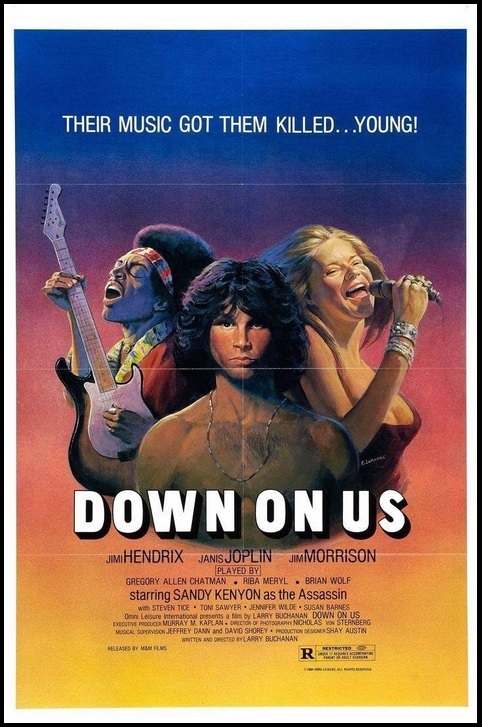
Original 1984 theatrical one-sheet courtesy of IMDb.

As for American exploitation filmmaker Larry Buchanan: He proudly wore his self-professed “schlockmeister” honor on his chest, an award he earned for his beloved (blue-jelled) day-for-night shoots trash-classics of Curse of the Swamp Creature, The Eye Creatures, In the Year 2889, Mars Needs Women, and Zontar: The Thing from Venus (need we say more: he made the Planet of the Apes rip-off Mistress of the Apes). Buchanan’s faux-biographical drama format—mixed with his ubiquitous speculations and conspiracy appendixes—that he utilized in Down on Us dates back to his “exposés” on the Kennedy assassination with The Trail of Lee Harvey Oswald (1964), the gangster chronicles The Other Side of Bonnie and Clyde (1968) and the life Charles “Pretty Boy” Floyd in A Bullet for Pretty Boy (1970), and the “romance” between billionaire Howard Hughes and actress Jean Harlow in Hughes and Harlow: Angels in Hell (1977). Buchanan also twice explored the life of Marilyn Monroe with his same theories-vigor in Goodbye, Norma Jean (1976) and Goodnight, Sweet Marilyn (1989). Not even folklore dinosaurs are immune from the depths of Buchanan’s conspiracies: he made the speculative-drama The Loch Ness Horror (1982).

Courtesy of its chintzy-muddy production values, Down on Us looks like a porn movie—only backed by a cover band sloggin’ through some “originals” they wrote that ersatz-as-tunes for Jimi Hendrix, Janis Joplin, and The Doors. Yikes! This wasn’t Oliver Stone’s The Doors—not by a longshot. This was Ferd and Beverly Sebastian’s Rocktober Blood—only with Jim Morrison instead of Billy Eye Harper (and Nigel Benjamin) fronting Sorcery. And if not for Oliver Stone going into production with his 1991 biography on the Lizard King, even with the home video market’s voracious appetite for analog delights to line their shelves, this Buchanan conspiracy faux-fest would most likely have never made it to video on the cusp of the grunge decade.

Although many critically attacked Buchanan’s film that explores Jim’s paranoia of the government—not so much a theory, but more a cinematic license playing with a “what-if” story line—as rubbish, it seems those critics are not familiar with the legend of Jim Morrison. For Morrison, it was a real, believed threat: American Government agents were after him; that he was marked as “Number 3”—after Hendrix and Joplin. Therefore, Morrison left America for Paris to find shelter and reject the legal controversies of his life. Except, in Buchanan’s bizarro-Jim world, Morrison didn’t die in a Paris bathtub: Jim fled to Spain and took up residence in a monastery.

And speaking of legal controversies: It’s one thing to craft a bogus dramatical document about the psychedlic rock triumvirate of Hendrix, Joplin, and Morrison. It’s another to licensing their music. So Buchanan contracted musicians to forge replicates of those artists for the film. Oscar nominated and award-winning director Gus Van Sant exceptionally and effectively executed this same approach with 2005’s Last Days, his faux-Kurt Cobain docudrama concerning actor Michael Pitt’s eerily portrayed pseudo-grunge rocker, Blake, fronting the film’s scripted Nirvana substitute, Pagoda (featuring stunning Nirvana simulations composed by Pitt; it all goes back to poet William Blake, one of Jim Morrison’s lyrical inspirations. The circle completes). The man Buchanan hired to mimic Jim Morrison was a musician also speculated as one of the possible musicians behind the Phantom mystery of March of 1974; an enigmatic Morrison-ersatz that released the album Phantom’s Divine Comedy: Part 1 on Capitol Records: Richard Bowen.

Richard Bowen’s other musical offering, starring Fabian!

Courtesy of Bowen, it was Buchanan’s film—not Oliver Stone’s The Doors—which offered the first on-screen interpretation of Jim Morrison, as done by actor Brad Wolf, who lip-synced to the music written and performed by Bowen. Bowen construct haunting Doors mimics with “Knock So Hard,” “Sorcery,” “Old Pictures,” “Holding On,” and “Phantom in the Rain”—each sounding like doppelganger leftovers from Phantom’s Divine Comedy: Part 1, or as outtakes from the recording career of Jim Morrison’s alleged son, Cliff Morrison. (Cliff Morrison—in a career-analogous path to Jimi Hendrix’s “son,” Billy Yeager (and to a lesser extent, Frank Marino of Mahogany Rush and his Hendrix-medium myths)—evoked his “dad’s” memory with two, late-nineties albums: Know Peaking and Color of People, fronting his Lizard Son Band.) Not only were the vocal similarities between Morrison, the Phantom, and Bowen contributing to the theory that Bowen could be the Phantom: the songs titles composed by Bowen for Down on Us also fueled the theory. Again, Bowen wrote two songs: “Sorcery” (which is what a “wizard” performs—and ties into the lead track on Phantom DC’s “Tales from a Wizard”), and the second song that appears in the film, “Phantom in the Rain.”

Image of 1989 reissue by Unicorn Video courtesy of Paul Zamarelli/VHS Collector.com and user 112-Video.

The first theory about Morrison’s demise was murder: In the backwash of Oliver Stone’s 1991 document, another film sloshed the brackish tributaries first navigated by Buchanan, a film that played it very fast and very loose with the Morrison-was-murdered theory: the 1992 direct-to-video rock flick Sorority House Party (You Tube). In this case, three hotties thwart a managerial plot to kill Attila, and unpredictable, high maintenance, costly ‘80s rock star, to boost album sales. This murder theory regarding Jim was the direct result of Hendrix and Joplin doing great sales numbers after their deaths. Moreover, with Jim flaking out on the band and a split of the Doors proving costly to both the band and the label, knocking off the Lizard King doesn’t seem like an implausible idea. (Also known as Rock and Roll Fantasy, Sorority House Party served as the directing debut of David Michael Latt, who came to incorporate the successful mockbuster purveyor, Asylum Studios.)

Other movies in the 1980s also tailored the mysterious threads of Jim’s death as cinematic narrative inspiration.

The second theory regarding Jim’s “demise” was a death hoax: Jim, tired of the dealing with the band and his Miami indecency trial ending in a possible jail sentence (like counterculture comedian Lenny Bruce), paid a French doctor to create a phony coroner report and death certificate. The cable movie-rock flick favorite Eddie and the Cruisers played with this myth—no doubt inspired, in part, by the last chapter of No One Here Gets Out Alive, the 1980 best-selling, first biography on Jim, which theorized Jim Morrison may have faked his own death. In Eddie and the Cruisers, a Rimbaud-inspired rocker of the Sixties, distraught over band infighting and record company hassles, bailed out with an elaborate death ruse. In the eventual Eddie sequel, the rocking protagonist, Eddie Wilson, ended up as a construction worker in Canada; not exactly ranking with the romanticized rumors of Jim running away to Africa—then returning to music in 1974 as a mysterious rocker, the Phantom; or as the Circuit Rider (that’s a whole other Jim-tangent that we won’t get into here).

And that brings us to best of the Jim-inspired conspiracy rock films: Down on Us (1984), eventually reissued to video as Beyond the Doors (1989). And we say “the best” because it’s all about the schlock n’ trash at B&S About Movies. (Honorable mention going Michael A. Nickle’s portrayal of the Lizard King in Wayne’s World 2, of course, living out his life as a sage beyond the immaculate perimeters in the desert.)

Larry Buchanan’s film speculated Jim was not murdered, nor did he fake his death: he went underground to avoid assassination. The plot line: President Richard M. Nixon, despondent over the antiwar sentiments agitated by the hippie icons of Hendrix, Joplin, and Morrison, sanctioned the F.B.I to kill the trio. Morrison apparently caught wind of the plot and “got out alive.” And, to complete the final cover up of the plot: the agent (Sandy Kenyon) who carried out the sanction is murdered. When his son discovers his dad’s files, the plot unfolds via flashback, then the son tracks down Morrison in Spain . . . .

While Buchanan’s film doesn’t get into it: The alleged “F.B.I murdered Jim” scheme has been in circulation since Jim’s death in 1971, cobbled in a basket with theories alleging the American government assassinated Dr. Martin Luther King, Malcolm X, and Marilyn Monroe (Hi, Larry!), along with Robert Kennedy and his brother, President John F. Kennedy (Hey, Mr. Buchanan!).

One of the earliest critics of the Warren Commission report regarding President Kennedy’s assassination, Mae Brussell, the late counterculture public radio personality of the Carmel and Monterey, California, radio stations KLRB and KAZU, most likely influenced Buchanan’s screenplay. The former host of the nationally syndicated Dialog: Conspiracy program compiled her government conspiracy theories in an unpublished November 1976 report: From Monterey Pop to Altamont, Operation Chaos: The C.I.A’s War Against the Sixties Counterculture (it was online to read in full; now it’s gone again). This report, along with current Doorsphile conspiracy theorists on social media platforms, contend there was a coordinated effort initiated in 1968 by the F.B.I’s Counter Intelligence Program and the C.I.A’s “Operation Chaos” to undermine the counterculture movement. These theories point out that Jim Morrison knew Charles Manson, through his mutual acquaintanceship of the Beach Boys’ Dennis Wilson and music producer Terry Melcher, and Morrison composed “Riders on the Storm” about Manson’s “murderous” followers.

Additionally, theorists opine the membership list of the 27 Club (with its own outlandish conspiracies; e.g., Courtney Love hired El Duce of the Mentors to murder Kurt Cobain) ties into the military service of the rockers’ parents. In addition to the high-ranking, classified naval service of Jim Morrison’s Admiral father, Lt. Col. Paul James Tate, the father of Manson Family murder victim, actress Sharon Tate, also served in the military. Theorists also point to Lewis Jones, the father of the Rolling Stones’ Brian Jones, a PhD mechanical engineer, who served as a military aeronautical engineer for Bristol Aircraft . . . et cetera, one may read the extended theories online, but the point: the deaths of their famous children were “assassinations.” The “theory” concludes: Charles Manson and his family were either hired as “actors” for the “plot,” or Manson himself was a patsy—like Kennedy assassin Lee Harvey Oswald (Oy! Larry!)—set up to take the fall for the Tate “assassination.”

It all began, according to Brussell, with the 1966 death of anti-establishment comedian Lenny Bruce (1967 memoirs: How to Talk Dirty and Influence People)—the first victim of the “operation.” The critical and financial success of the Monterey Pop celebration in the summer of 1967 simply solidified the government’s resolve to snuff out the counterculture’s icons. Brussell goes onto state that, between 1968 and 1976, many of the most famous names of the counterculture movement, were dead: Mama Cass Elliot of the Mamas and the Papas, Otis Redding, Jimi Hendrix, Brian Jones, and Janis Joplin all participated in or attended the Monterey Pop Festival. The report’s assassination roster also “stars” Duane Allman and Berry Oakley of the Allman Brothers (Hey, Randall?), folkie Tim Buckley, Jimi Hendrix’s manager Michael Jeffrey and the Beatles’ manager Brian Epstein, along with Graham Parsons of the Byrds, Ron “Pigpen” McKernan of the Grateful Dead, blues musician Jimmy Reed, and, of course, Jim Morrison, along with his wife, Pam Courson. All became victims of coordinated mind control tactics via Lysergic Acid Diethylamide (LSD)—a poisoning that altered the icons’ personalities and behaviors, encouraging their accidental “deaths-by-misadventure. . . .”

I know . . . I know . . . tangents and non-sequiturs. Let’s get back to the movie! But wait! There’s one last tangent: what’s this all have to do with Rocktober Blood?

Riba Meryl, who co-wrote the faux-rock epic “Rainbow Eyes” with Sorcery’s Richard Taylor, became an actress and portrayed Janis Joplin in Down on Us. Surprising, Riba, an accomplished singer in her own right, lip-syncs the faux-Joplin tunes “Easy Now” and “No Way” written-performed by Janet Stover (her lone film credit). Riba also repeated her Joplin character in a 1987 episode of the syndicated rock ’n’ roll U.S television series Throb (You Tube). After her lone, non-Janis character acting role in 1987’s Banzai Runner, Meryl concentrated on television and film session work and contributed the song “Brand New Start” to a 1987 cop-murder drama, The Jigsaw Murders (You Tube). Sadly, Riba passed away in 2007 at the age of 52 from breast cancer. (And why didn’t Riba Meryl provide the vocals for the song she wrote for Rocktober Blood? We may never know.)

The studio band who helped create the faux-soundtrack for Down on Us was comprised of the members of the American-New Jersey hardcore punk band Adrenalin O.D (they also as appeared as musicians-background actors). If you’re familiar with the Slickee Boys (their punky-take on Status Quo’s “Pictures of Matchstick Men”) or the Dead Milkmen (remember “Punk Rock Girl”?); AOD are goofy like that. How else can you describe a band who releases an album Crusin’ with Elvis in Bigfoot’s U.F.O that features “Bulimic Food Fight” as a lead single? Formed in 1981, AOD broke up after the failure of their “big rock move” on Restless Records, their fourth album, Ishtar (1990) (they do Queen a hell of a lot better than Metallica; it’s like the Monkees on crack. And they played CBGB’s several times).

And we never heard again from the acting-musician duo behind faux Hendrix: Gregory Allen Chatman mimed to the music written and performed by David Shorey (he also served as the film’s music supervisor): “Today or Tomorrow,” “Looks Like You,” “Crystal Wings,” “Three Day Rain,” “Poet’s Reprise,” “Just My Size,” and “Seriously Shot Down.”

We did, however, hear from two of the film’s lead actors, again: Sandy Kenyon, as government agent Alex Stanley, and Toni Sawyer as his wife; neither let there involvement with Buchanan dissuade their careers. Kenyon continued to work up until his 2010 death, amassing over 130 credits on a wide array of TV series since the 1950s (. . . I’ll never find a copy of the 1974 TV movie Death in Space starring Kenyon and Cameron Mitchell, will I? Nope: The only known surviving English language print is stored at Library of Congress, alongside Kim Milford’s lost TV rock flicks Song of the Succubus and Rock-a-Die Baby). Toni Sawyer’s latest (her 74th project), the family-adventure, When the Moon was Twice as Big (Facebook), is currently in post-production.

Both versions/titles of the movie are exactly the same: so don’t fret over which VHS issues you decide to buy. Although, in all my years, I’ve never seen a post-1984 VHS on the shelves as Down on Us, only the 1989 Beyond the Doors version. And I only found the ’89 VHS, out of six video memberships —once—at a 10,001 Monster Video. The VHS pops up in the online marketplace from time to time, Amazon and eBay in particular. However, beware of those DVDs: they’re all grey market rips-from-the-VHS.

As for online streaming: There’s only two choices to watch this online—via You Tube, natch. There’s a multi-part upload (of 13, 10-minute segments) HERE that was the only choice for many years. However, someone recently uploaded the complete film in one upload HERE.

“Our assignment: neutralize the three pied pipers of rock music.”
— F.B.I Agent Alex Stanley

Indeed. And you “neutralized” the after effects of my cheesy nachos and Mr. Pibb, Agent Stanley. (I miss you, John, my brother. Good times.)

About the Author: You can learn more about the writings of R.D Francis regarding Jim Morrison’s doppelganger, the Phantom of Detroit, on Facebook and Medium. He also writes film reviews for B&S About Movies.


Post Script: Down on Us is a movie that never ceases to keep on giving. Check out Bill Burke’s new, February 2022 take on the film at Horror News.net.

Firestarter (1984)

If you live in the world of Stephen King and meet Martin Sheen, run the other way. He’s never a positive person. That’s the life lesson that Firestarter has taught me.

During the filming of The Thing, Universal offered this movie to John Carpenter, but when that failed — you know that story — they gave it to Mark Lester. Did it work? Well, King told American Film that the movie was “flavorless; it’s like cafeteria mashed potatoes.”

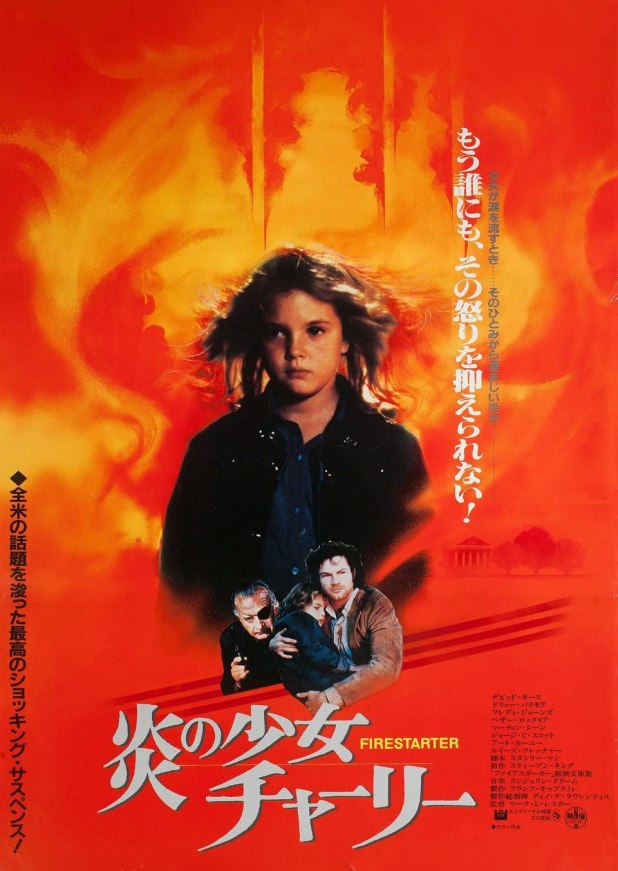
When Andy (David Keith) and Vicky (Heather Locklear) were in college, they earned extra cash by getting dosed with LOT-6, a drug that gave him the ability to take over minds and her the talent of reading people’s thoughts. Once they had Charlie (Drew Barrymore), she could see into the near future and start fires with a thought.

Of course, The Shop created her and they want her back. Everyone in this government group is horrible, from Sheen to John Rainbird (George C. Scott), who comes off as a grandfather but is the worst of them all.

Tangerine Dream composed the music for this film and if you’re wondering, “How does the crew at B&S About Movies feel about Tangerine Dream?” the answer is, “We did an entire week of their movies and you can read about it here.”

They composed the music without ever seeing the movie. They sent no directions to Lester, only a note that said “use the music wherever you like, it fits wherever you want it to.” As he was editing it into the movie, he was shocked. Their music really did fit anywhere he placed it.

Another question you may ask is, “Didn’t Stranger Things pretty much rip off most of this?” The answer would be, “Well, they ripped off a lot of things.” When they eventually remake this, I can’t wait for the hot take articles about how King ripped off Netflix.

Disproving my theory that Old Hollywood only wants to sacrifice you to Satan, the only nice people other than our heroine and her parents are the Manders, played by Art Carney and Louise Fletcher, who is much kinder here than she was in Flowers in the Attic.

While Charlie was modeled on King’s daughter Naomi, Barrymore feels that she was born to play this role, as she resembled the girl on the cover of the book. Barrymore said, “When I read it, I came into the kitchen where my mom was making dinner and said: “‘I’m the Firestarter. I’m Charlie McGee!” But she didn’t know what I was talking about.”

This was the first of many films that built the film industry in Wilmington, North Carolina. You should also look out for two versions of Michael Myers in this movie, both Dick Warlock and George P. Wilbur.

La Muerte del Chacal (1984)

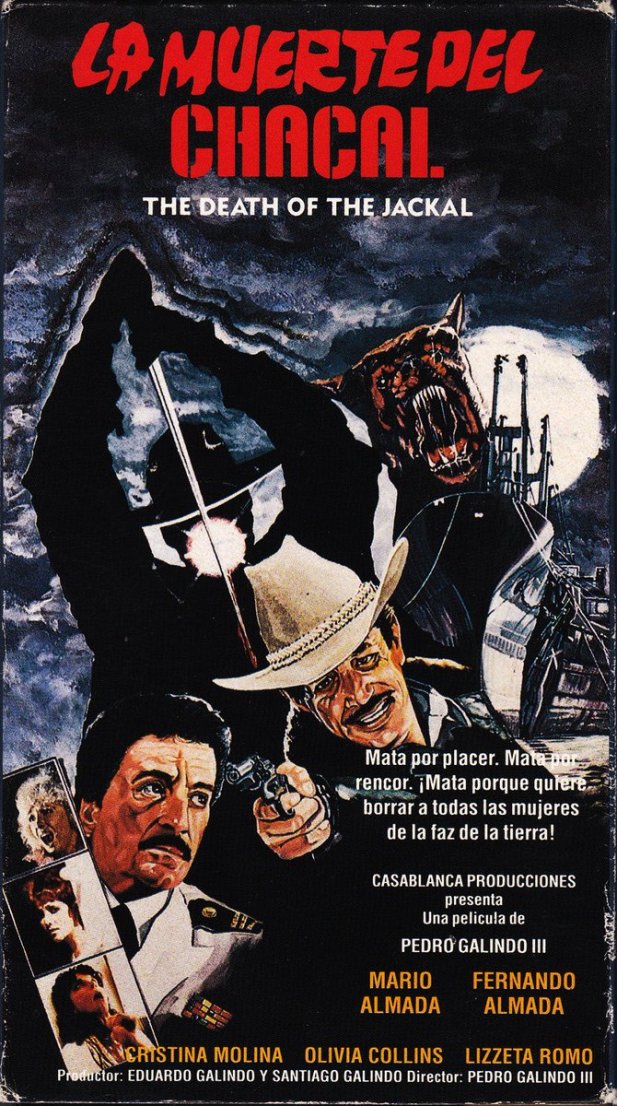
Mario and Fernando Almada are brothers that ended up in the same movie, with Mario as Sheriff Bob (BOB!) and Fernando as the equally epically titled Roy. They had another brother named Horacio who stayed home, far away from this movie that’s pretty much a cop movie that turns into a Mexican giallo. No puedo creerlo!

Speaking of family, this was directed by the father and grandson team of Pedro Galindo and Pedro Galindo III. The elder Pedro was an actor, producer and musician. His song “Malaguena Salerosa” is on the soundtracks for Kill Bill and Once Upon a Time In Mexico. Meanwhile, Pedro III made the crowd pleasing Vacaciones del Terror 2 and Trampa Infernal.

Anyways, there’s a killer loose cane with a sword in it and a giant dog that helps him murder, paying back that mutt who used to talk to Berkowitz.

This has one of the best kills I’ve ever seen in an exploitation movie, where a dead man is thrown through a glass window and on to the stage of a strip club, where his lifeless form collides with a fully nude dancer.

A movie that skirts the edge between slasher and giallo, which is a thin one when you think about it hard enough. This is dark and scummy, which is pretty much exactly what you’d hope it would be.

There’s also a sequel, Massacre In Rio Grande, that I’ve been trying to hunt down. If you can find it, let me know. I’ll be your mejor amigo!