Ghost Warrior (1984)

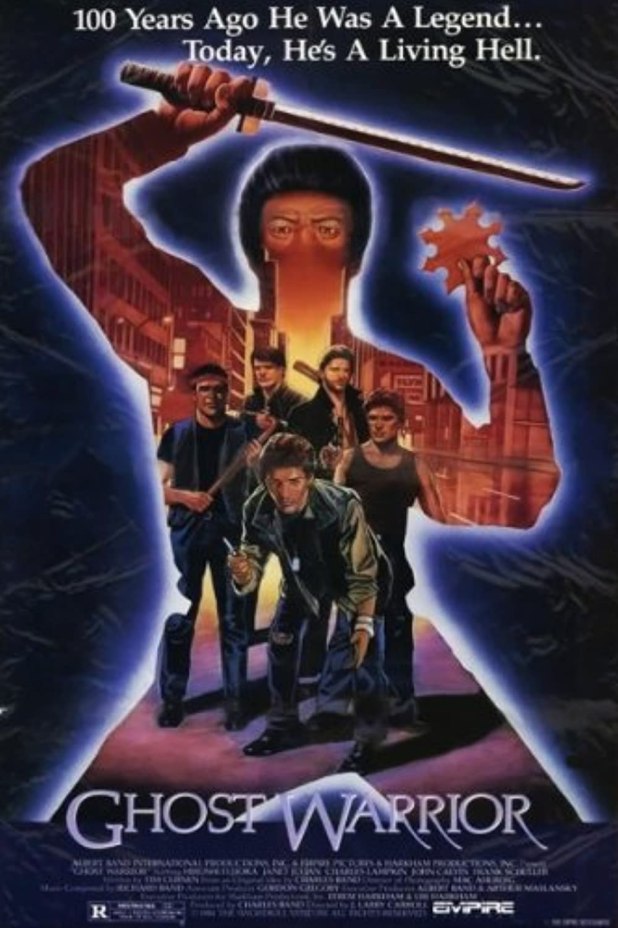
A samurai named Yoshimitsu (Hiroshi Fujioka, the original Kamen Rider) is overwhelmed in battle and falls into a frozen lake where he freezes over the decades before skiier find his body. Soon, Dr. Richard (John Calvin) forgoes the traditional autopsy and revives the swordsman with some blue lights and introduces him to a modern world he can’t come close to understanding even with the help of an Asian studies expert named Chris Welles (Janet Julian, Humongous). Then one night, a janitor breaks in and tries to steal the thawed Japanese swordsman’s katana and gets sliced in half, sending Yoshimitsu on the run (but not before listening to watching the WASP footage of them performing “Tormentor” from The Dungeonmaster).

He wanders Los Angeles, saves an old vet (Charles Lampkin) from a street gang and getting into no small manner of trouble. Unlike so many frozen out of time movies, things in no way go smoothly or end happily.

Also known as Swordkill, this shot in Richmond, Virginia film was one I’ve been trying to find for some time. It was co-produced by Arthur Band, who must have had a calming influence on Charles for this one (Richard did the music making this a Band family effort).

It was directed by J. Larry Carroll, who edited RoarDracula’s DogThe Texas Chainsaw MassacreMassacre at Central High and The Hills Have Eyes before writing Tourist Trap and tons of cartoons, as well as directing only this one movie and written by Tim Curnan, who wrote the wonderful Forbidden World.

It’s 81 minutes long which is exactly how long this movie should be.

Junesploitation 2022: The Surrogate (1984)

June 7: Junesploitation’s topic of the day — as suggested by F This Movie— is Shannon Tweed! We’re excited to tackle a different genre every day, so check back and see what’s next.

Canada, thank you.

Beyond movies like Prom NightTerror Train, Black ChristmasDeadlineCurtainsThe GateFuneral HomeMy Bloody ValentineMeatballs IIIThe Pyx, Pin, the early films of Cronenberg, Prom Night 2 and yes, even Things and Wicked World, not to mention SCTV, we have so much to thank you for.

We should also bless March 10, 1957 because on that day, in Whitbourne, Newfoundland and Labrador, Canada, the Great White North gave birth to Shannon Tweed and any man past puberty from 1981 was better for it. Raised on a mink ranch, third-runner up for Miss Ottawa (I mean, who else was there in Ottawa?) and winner of the singing part of the Miss Canada competition in 1978, Shannon even owned her own metal bar until her modeling career took off. She was the Playboy Playmate of the Month for November 1981 and Playmate of the Year for 1982, as well as appearing in a pictorial with her sister Tracy (who was in Night RhythmsNight Eyes 3 and Johnny Mnemonic).

While starting small with a body double role in Curtains, as well as roles in movies like George P. Cosmatos (the father of Mandy director Panos) film Of Unknown Origin, Hot Dog…The Movie, Meatballs III (she’s the Love Goddess), Steele Justice and Cannibal Women in the Avocado Jungle of Death and TV’s Falcon Crest, Tweed really became famous for a career as “one of home video’s most rented erotic thriller goddesses” in the words of Variety. The movie that changed the roles that she’d appear in was Night Eyes 2, the second Andrew Stevens movie that saw her step into a role similar to the one that Tanya Roberts played in the original.

Night Eyes 3Possessed by the NightIllicit DreamsVictim of DesireBody Chemistry 4: Full ExposureForbidden Sins — if it sounded dirty and had a piece of tape with marker on it that said “Must be 18 to Rent” at your mom and pop video store, it had Shannon Tweed in it.

Tweed went from living in the Playboy Mansion to dating Gene Simmons for decades to even taking him off the market. She even has a street named after her in the Rosewood neighborhood of Saskatoon where I can only imagine saxophones blast all the time and there’s non-stop sexy fog.

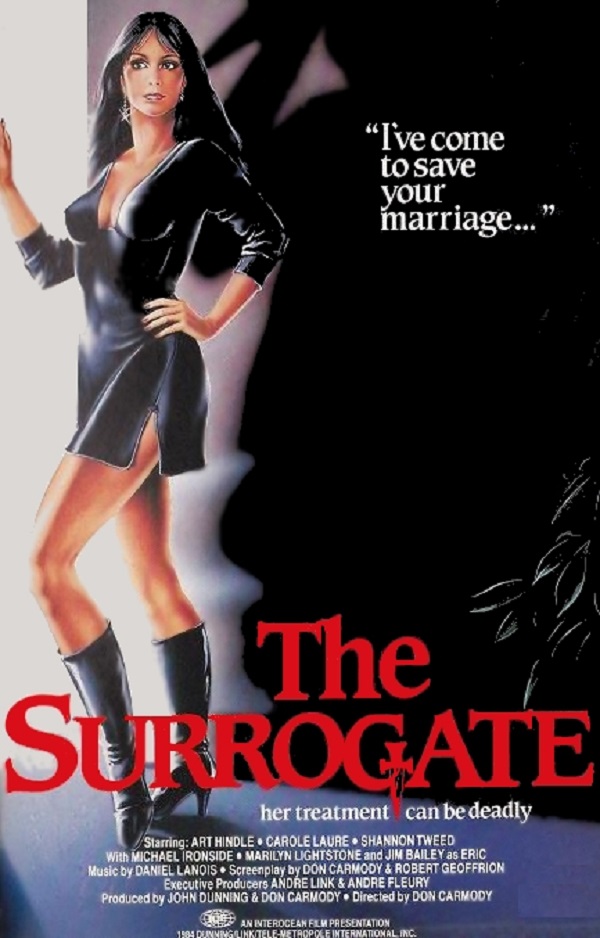
Back when Shannon was just starting her domination of that special section of the video store you don’t need to walk through a special door — or saloon double doors — to see (or anything on Cinemax after 11 p.m. on a Friday), she appeared in the 1984 Canadian erotic film The Surrogate, which is directed by Don Carmody (born in Rhode Island, raised in Montreal and the producer of several of those aforementioned Cronenberg movies). This movie is so Canadian that Art Hindle (born in Nova Scotia), Carole Lauris (born in Quebec) and Jackie Burroughs (born in the UK but moved to Canada when she was nine) as the leads; then doubles down by lensing in Quebec; piling on more Canadian actors in Marilyn Lightstone (the voice of the Answer Box in Abraxas!), Jonathan Welsh (from Canadian disaster movie City On Fire), Vlasta Vrána from Shivers and uber-Canadian Michael Ironside; and even Canuck Daniel Lanois does the soundtrack.

Frank and Lee Waite (Hindle and Tweed) have perhaps the worst marriage in the history of film. He has a high stress job selling Porsches, she doesn’t work because she has a trust fund she never lets him forget about and they can’t get it together in the bedroom because she’s not all that into lovemaking and he’s a pervert.

Get a divorce, guys.

He’s so backed up that he flies into rage-filled episodes that cause him to black out. Instead of, again, instructing them to just get divorced, their marriage counselor suggests they see sexual surrogate Anouk (Laure) who knows how to get couples to fulfill their fantasies while sharing their bed. This sounds like a job invented to get to be on HBOs Real Sex and I have no idea how you would file to get your insurance to pay for this. Maybe in Canada, their public health insurance really does cover everything.

Lee gets really into their first session and it seems like Anouk has some kind of mental powers, but guilt gets the better of Mrs. Waite and the couple dismisses the surrogate — who had to come from The Black Room or be a distant relative of Bridget and Jason — who keeps coming back and making them perform increasingly more violent scenes with her. At the same time, people are getting murdered all over their neighborhood — is this a giallo, eh? — and police officer George Kyber (Ironside) is obsessed with finding out who is causing all this madness. And yes, you guessed it, the murders perfectly line up with every time Frank blacks up.

Meanwhile, Anouk keeps breaking into their home, tying up Lee and making Frank rough her up. I have no idea how her therapy works or why it’s successful, but I do remember that Laure is also in the absolutely berserk Sweet Movie and the definitely a giallo in Canada Strange Shadows in an Empty Room and wonder who her agent was. Anouk somehow has other single patients like Jackie Burrough’s character gets spanked with a giant lolipop while eating candy dressed as a little girl.

Lee’s best friend is Jim Bailey, who was a female impersonator and is the most out person ever to set foot in a Canadian erotic thriller, a point that the film pounds into your brain by having Frank unleash very non-PC four decades-old slurs his way every chance he gets. And then we get to see Bailey do Bette Davis. This has nothing to do with the movie.

In fact, the murder and mattress dancing never really come together, nor does the goofy too cute ending. But there’s a great idea in here about a fantasy surrogate who unlocks the rage-filled fantasies of a couple too repressed to access them. This movie could use its own surrogate to push it into the kind of shadow world of dark erotic thrills that it promises.

Revenge of the Ninja (1984)

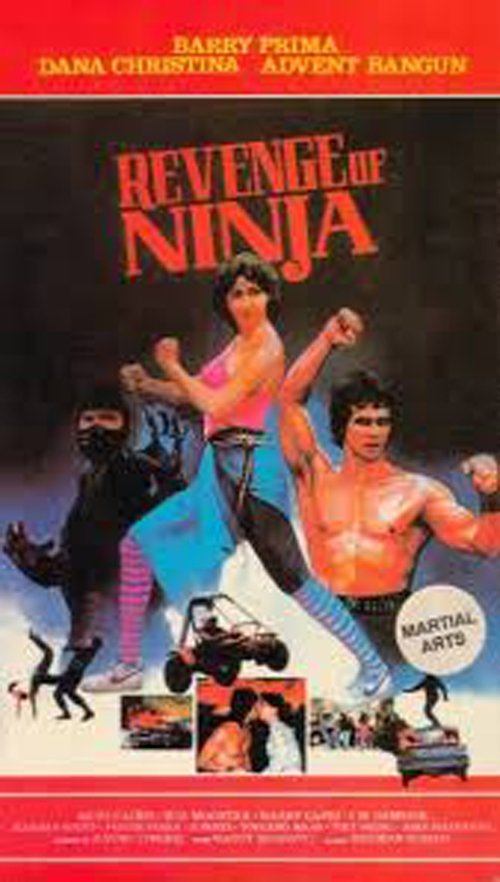
Gadis Berwajah Seribu (Dream Girl) stars Barry Prima, who was in Golok Setan and I don’t believe that he could have been in a normal movie if he tried. This is supposedly about the hero and his magic necklace, but it’s also about a bunch of dudes in a post-apocalyptic vehicle with machine guns and rocket launchers and you’ll wonder, “When is this movie set?” but come on, I’m not watching this for period accuracy. I’m watching it for fistfights. And yet there are hardly any ninjas, but there are zombies.

Prima is Kiki, the muscular hero, Dana Christina is his lover Maya and Advent Bangun (the blind swordsman from — you knew it — The Warrior and the Blind Swordsman) is the man in black with throwing stars which I guess is your ninja. He also stomps a hunchback’s hunch until it’s just a regular back at one point.

There’s also an evil sorcerer, zombies, resurrection by flying bloody heart and skull, organs ripped out of people’s bodies, people blowing up, dune buggies, smoke bombs, torture sequences and yes, the worst in dubbing.

There’s a decimated print on YouTube.

Ninja Thunderbolt (1984)

Joseph Lai and Godfrey Ho may have done their dark ninja magic to hundreds of films but this was the first. Lai had already been redubbing martial arts films for the rest of the world for years, but when he made it to Cannes that year, he saw that Enter the Ninja was a big deal or so the story goes. Yes, we’re in the world where Cannon is the giant to a studio, which is kind of like how The Incredible Shrinking Man eventually fell through dimensions as his atoms decreased in size and mass, changing the rules of how he once saw reality.

Richard Harrison was born in Salt Lake City, made his way to Hollywood and did some smal;l parts before marrying Loretta Nicholson, the daughter of American-International Pictures co-owner James H. Nicholson. Frustrated by his fortunes domestically, he headed off to Italy where he spent the next twenty years, making peblum (Perseus Against the MonstersThe Invincible Gladiator), westerns (the incredibly named God Was in the West, Too, at One Time), Eurospy (Secret Agent Fireball) and even appearing in Joe D’Amato’s Orgasmo Nero and writing Bruno Mattei’s Scalps before working all over Eastern Europe and Asia. Wherever there were movies, there was Richard Harrison. And after Godfrey Ho, well, there were tons of the same movie and similar titles all with his name as the star.

He’s also how Clint Eastwood became a huge star.

When Sergio Leone came to the set fo Rawhide looking for someone to star in his movies, he wanted Eric Fleming to the guy but was put off by his personality. Enter Harrison, who recommended Clint.

“In my opinion, it is a death wish for an actor to be in too many B or should I say C movies. Maybe my greatest contribution to cinema was not doing Fistful of Dollars, and recommending Clint for the part,” said Harrison.

As for working with Ho — who he first met when he made Marco Polo for Shaw Brothers — Harrison would tell Nanarland, “Twice I went to Hong Kong to work for them, and even though the quality of the films were very poor my wife and I enjoyed Hong Kong very much, and the crew was mostly made of nice people. Then Mr. Tomas Tang contacted me to make a film for him. I told Godfrey about the offer in strict confidence, but he told Mr. Lair, who told me I could not do the film. Naturally, I told him that after I finished my contract with him I was free to work with whomever I wished. Mr. Lai contacted a friend who was a tax man and was told I owed quite a bit of money in taxes. When I showed that my contract stated I would not be responsible for any taxes in Hong Kong, the man said it was not valid. I agreed then to do another film for Mr. Lai to pay the taxes. There was no script, only sides. Nothing made any sense, but the stories usually didn’t. Then a young English boy warned me to be careful because they were pulling some type of dirty trick on me. To be quite honest with you I was not too worried as all the work I had done for them was so bad I was sure no one would ever see them outside the cutting room. Also, during this last film or films, our living conditions were not good. My first call came from Germany telling me how bad the films were and they had only bought them because they trusted me. I have no idea how many films they made from my last filming, but some say as many as ten. I put a lot of trust in friendship, so it hurt more than just professionally.”

How hurt was he by this? Pretty hurt: “This experience made me feel very dirty. I really felt like a prostitute. They were thrown in my face all the time. I saw part of one once, it had something to do with witches. I don’t think I had more than a couple of scenes in it…I felt helpless in Hong Kong. This was the reason I stopped caring about acting. I really felt dirty and used. Again, I will say I had no one to blame but myself for being so trusting.”

As with most Godfrey Ho movies, Ninja Thunderbolt has twenty minutes of ninjas spliced into another movie, in this case To Catch A Thief. There’s also an actor named Jackie Chain in the cast. This would not be the Jackie Chan that you know.

The ninjas start the movie with all the rules of belonging to the ninja temple and saying badass black metal lyrics like “When the gods are angry, we must kill the gods! If the spirits of the dead rise against us, we must kill them as well! Our blood is motivated by ninja spirit!”

Then it turns into a caper movie about stealing a jade horse.

Then somehow, after a really explicit and almost pornographic scene — I’m no prude, I was just shocked that it was in this — ninjas on rollerskates chase someone and that’s what I’m watching these movies for.

So where’s Richard Harrison? He’s a cop named Richard Lawman, which of course he is, and he’s also a ninja. A ninja cop. He’s also the boss of one of the characters in the footage from To Catch a Thief and that means that they can only take via the multiversal phone that all Godfrey Ho movies use to bridge years and continents and films.

Whenever a ninja movie has a multicolored smokebomb go off, just know that I am smiling.

You can watch this on Tubi.

The Master Ninja 2 (1984)

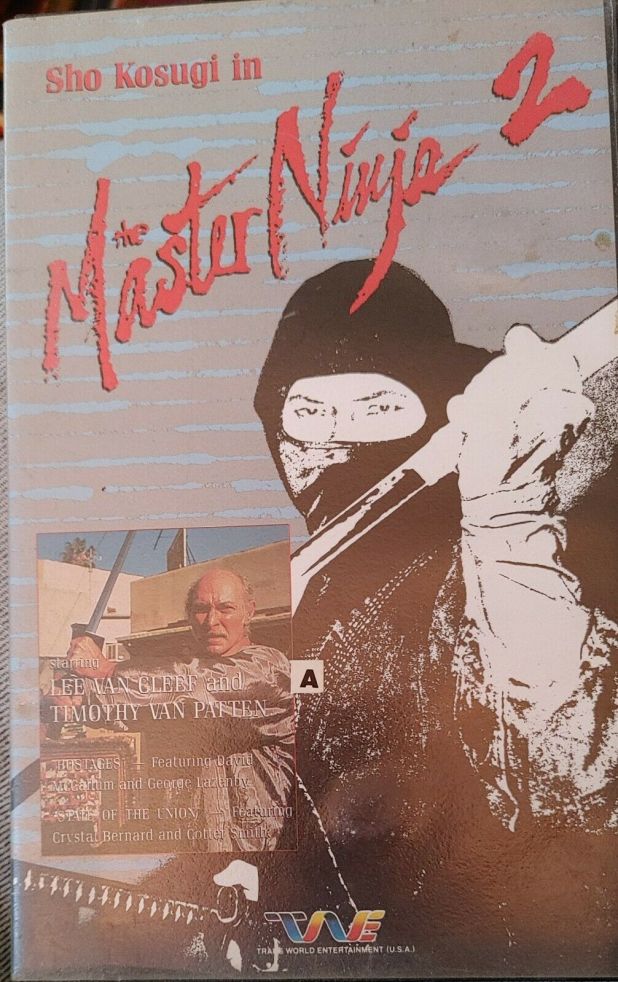
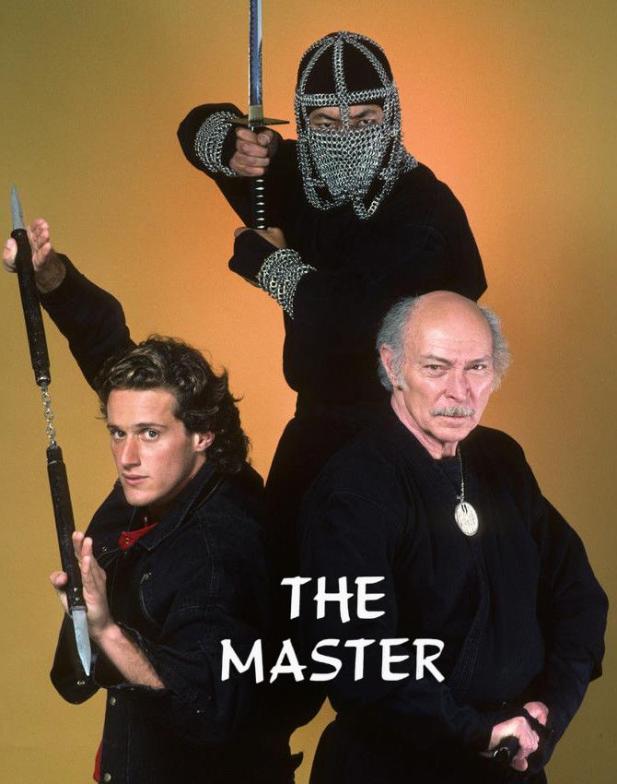
The second movie of The Master — it’s really episodes 3 and 4 of the show — is probably best known for airing on Mystery Science Theater 3000. Yet for those alive in 1984 who loved all things ninja, the idea that we could see Sho Kosugi on NBC once a week was a big deal.

The first part, taken from the episode called “State of the Union,” has McAllister (Lee Van Cleef) and Keller (Timothy Van Patten) dealing with union issues. This may point to my issues as a kid with this series. I had no interest in the human world of this show. I wanted ninja fights. If you read this site on any basis, you will realize this has not changed.

So if you want to see a ninja help Crystal Bernard from Wings then this would be the movie for you to watch.

This section is directed by Alan Meyerson, who also directed Police Academy 5: Assignment: Miami Beach and Private Lessons. The script was from staff writer Susan Woolen.

Woolen would also write the script for “Hostages,” directed by Ray Austin, which has our ninja master and his young student save a senator’s daughter. Randi Brooks (Cherry from TerrorVision), George Lazenby and David McCallum show up as this turns into an espionage film when again, all we want is ninja on ninja.

Of course, I wanted to be Sho Kosugi as a kid.

I still do as an old man.

The Master Ninja (1984)

There was no one more important in middle school than Sho Kosugi. In retrospect, we should have worshipped him even more, because without him bringing the weapons and skills to Cannon’s Enter the Ninja, we would not have the ninja elements that have been used in everything from G.I. Joe to Teenage Mutant Ninja Turtles, video games and a million Godfrey Ho movies.

You can’t imagine the literal madness when the idea that Sho would be on TV every single week became common knowledge.

From January 20 to August 31, 1984, NBC aired thirteen episodes of the adventures of John Peter McAllister (Lee Van Cleef). Let me just quote the narration at the beginning of each episode: “John Peter McAllister, the only Occidental American to achieve the martial arts discipline of a ninja. Once part of a secret sect he wanted to leave, but was marked for death by his fellow ninjas. He’s searching for a daughter he didn’t know he had; pursued by Okasa, once the Master’s student, now sworn to kill him. That Master found a new student. That’s me, Max Keller. But we knew Okasa would be behind us, in the shadows, ready to strike again.”

Max Keller may have been the unexciting Timothy Van Patten but the evil Okasa? That’s Sho Kosugi. Actually, Sho also was Van Cleef’s fight double, the series’ fight choreographer, ninja technical advisor and stunt coordinator.

While the show was cancelled in less than a year, seven movies were made out of the episodes.  In the U.S., they had the simple title of The Master Ninja, but in Europe they got rad names like Ninja – The Shadows Kill and The Ninja Man.

The first film is episodes one and two of the series. In the first, Peter meets Max and together they help the Trumbulls (Claude Atkins and Demi Moore) save their airport from the sheer evil that is Clu Gullagher. And if you wondered, does Gene LeBell show up, you have seen more than enough American kung fu movies. This was directed by Robert Clouse, who certainly understood how to shoot martial arts thanks to being the director of Enter the DragonGame of DeathGolden NeedlesBattle Creek BrawlGymkata and Deadly Eyes (actually, that was has chihuahuas dressed as killer rats). It was written by series creator Michael Sloan, who also created The Equalizer and wrote for the reboot of Kung Fu in the 90s.

The second part, “Out-of-Time-Step” finds the Master and Max helping a dance club as he searches for his daughter. Lori Lethin (Bloody Birthday), Brian Tochi (Takashi from Revenge of the Nerds; more to the point of ninjitsu the voice of Leonardo the ninja turtle) and Swamp Thing Dick Durock all are on hand. This portion was from director Ray Austin, who directed the 80s returns of the Man from U.N.C.L.E. and the Six Million Dollar Man and written by Susan Woolen, who acted in both of those reboots.

Isn’t it strange that in order for western audiences to accept ninjas that we needed Italian western heroes to ease the transition, with Franco Nero battling Kosugi in Enter the Ninja and Lee Van Cleef here? Did no one want to see Jack Palance wear those cool ninja shoes?

Junesploitation 2022: The Philadelphia Experiment (1984)

June 1: Junesploitation’s topic of the day — as suggested by F This Movie — is science fiction! We’re excited to tackle a different genre every day, so check back and see what’s next.

One of the greatest memories of my life is a vacation to Washington D.C. when I was 12. I can’t remember it as being perfect. We didn’t have much money, we had to sleep in our van at least one night, we almost got caught in a flood and it was blistering hot. But that stuff never mattered. And sure, I’d come home to my first days of awkward middle school and wondering if I’d ever fit in. But for one blissful night, I sat under the stars somewhere in Virginia and saw a drive-in double feature while eating snuck in sandwiches we made from ham salad and bread we bought cheap at a local grocery store.

PSA: Don’t sneak food into drive-ins. There are so few in the U.S. and many of them survive based on their food sales. Spend a lot on food. Get a Chilly Dilly, the personality pickle.

The first movie we saw was Indiana Jones and the Temple of Doom, a mind-blasting onslaught of adventure, non-stop shreiking, monkey brains being eaten right out of their skulls and chest tearing gore. Years later, that film’s writers, Willard Huyck and Gloria Katz, would do the same thing to me all over again with their classic Messiah of Evil, a movie I was in no way prepared for at a pre-pubescent age.

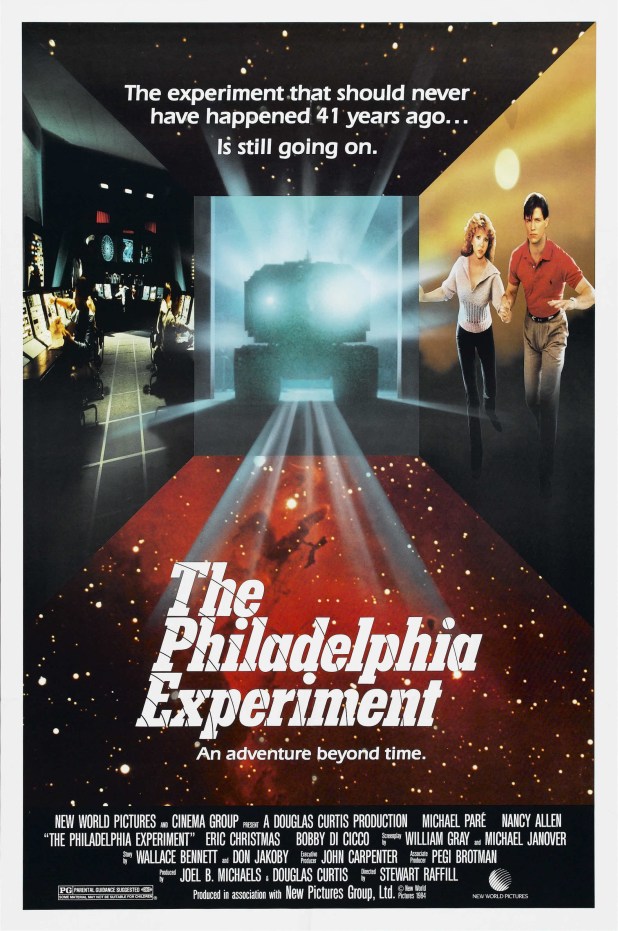
The second film — which we knew nothing about — was The Philadelphia Experiment.

Based on the book The Philadelphia Experiment: Project Invisibility by Charles Berlitz (yes, the very same Berlitz that was part of the family that is The Berlitz School of Languages, as well as a military intelligence officer accused of inventing mysteries and fabricating evidence, which we now call disinformation) and William L. Moore (who circulated the Majestic-12 document that later in my teenage years would overload my Commodre 64 and convince a seventeen-year-old  possibly on drugs me that government troops were coming out of the woods to silence me and kill my family; I woke everyone up and ran into the yard screaming, I was a handful; Moore is also a disinfo agent), the original script for this movie was written by John Carpenter, who couldn’t figure out how it should end, never mind that it was based on a true story.

On that real story: An ex-merchant marine named Carl M. Allen sent an anonymous package marked “Happy Easter” that was Morris K. Jessup’s book The Case for the UFO: Unidentified Flying Objects filled with notes in three blue inks to the U.S. Office of Naval Research. These notes discuss how UFOs fly, discuss alien races and show that aliens are worried that the book knows too much and refer to the Philedelphia Experiment.

Allen then started writing to Jessup as himself and Carlos Miguel Allende warning him to stop studying flying saucers. He claimed that  he was serving aboard the SS Andrew Furuseth and saw the actual event as the ship teleported from Philedelphia to Norfolk, Virginia and then back, during which he saw crewmembers go insane, become intangible and frozen within time. Jessup asked for info which Allen never really proved.

So this is where it gets weird. Well, weirder. Jessup was invited to the Office of Naval Research where he was shown that annotated book and realized that it had the same handwriting as Allen. Why?

Can it get weirder? Sure.

Commander George W. Hoover, one of the members of the Office of Naval Research, showed the annotations to a contractor named Austin N. Stanton, who was the president of Varo Manufacturing Corporation. Stanton got so obsessed that he used his office’s mimeography machine to print multiple copies of the letters and the annotated book. Keep in mind that this was super expensive in the late 50s and also went against so many laws and levels of security clearance.

So what happened to Jessup? No one wanted to read his books, he lost his agent and he eventually committed suicide. As others tried to find Allen, his family would only say that he was a master leg puller. He was also from New Kensington, Pennsylvania — so close to Pittsburgh. They gave researchers tons more of his handwritten notes on the subject.

Whew — yes I will get to the movie — the Varo annotations were used in several conspiracy and UFO books, finally gaining some interest thanks to Berlitz and Moore. Then the movie got made. And then, another sailor named Alfred Bielek claimed he was also on the ship and that the movie was totally accurate. That’s funny because the book ripped off another book, George E. Simpson and Neal R. Burger’s Thin Air.

Let me stop for a second and tell you that this movie has even crazier DNA.

That’s because it was directed by Stewart Raffill.

Sure, he made The Ice Pirates the same year. But afterward, his career is filled with the kind of movies that crush minds. Movies like Mac and MeMannequin 2: Mannequin on the MoveTammy and the T-Rex.

Yes, all the same director.

By the time he got to this movie, the script had been written nine times. Despite Michael Janover (who wrote the horrifying Hardly Working), William Gray (HumongousProm Night) and Wallace C. Bennett (The Silent ScreamWelcome to Arrow Beach) being in the credits for the script, Raffill says that he dictated the script and had someone type it.

As for the story, United States Navy sailors David Herdeg (Michael Pare) and Jim Parker (Bobby Di Cicco in 1943 and Ralph Manza in 1984) are on the USS Eldridge in 1943 as Doctor James Longstreet (Miles McNamara in the past, Eric Christmas — who was Mr. Carter in Porky’s — in 1984) makes the ship invicible to radar, but as things go wrong, David and Jim jump overboard and end up in the future — or our past are you confused? — and kidnap Allison Hayes (Nancy Allen) and get into military related hijinks before Jim gets zapped back in time.

There’s some wild science in here as David eventually has to go into a vortex and smash stuff with a fire axe to free the ship, which ends up with burned sailors and men being fused into the ship.

A sequel came out in 1993 with Brad Johnson from Nam Angels as David going up against Gerrit Graham as well as 2012 SyFy reimagining that Pare shows up for. Man, Michael Pare also made Streets of Fire the very same year and really should have been better considered.

This movie went from theaters to video stores faster than any movie had before. Maybe people thought that they had already seen it as The Final Countdown.

None of that is important to me. I have a wonderful memory of sitting in movie theater seats — outside no less — and getting to see two wild movies that I’ve thought of so many times since. We should all have a vacation so wonderful.

You can watch this on Tubi.
The Evil That Men Do (1984)

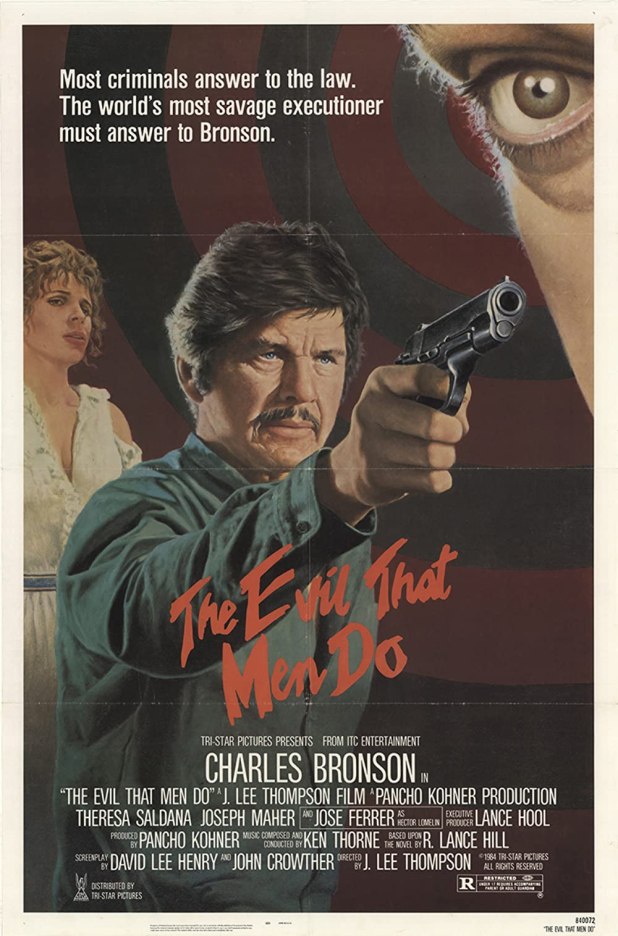
Charles Bronson, his wife Jill Ireland, J. Lee Thompson and producer Pancho Kohner had purchased the rights to this novel in 1980 and tried to bring it to Cannon after Death Wish 2, but they didn’t want to pay for all of the costs, so Bronson used it as the last movie on his contract with ITC.

The writer of the book. R. Lance Hill, wrote the first draft under the name David Lee Henry, with the script being finished by John M. Crowther (who was a MAD cartoonist and also wrote Kill and Kill Again). Don’t feel bad for Hill, who went on to write Road House.

Fielder Cook (How to Save a Marriage and Ruin Your Life) was the original director, but he was dealing with late career Bronson who had his whole family on set and would work eight hours a day and then be done. Obviously, J. Lee Thompson would need to come back and direct.

Clement “The Doctor” Molloch (Jospeh Mahler) isn’t a healer. He’s an expert in torture used by governments all over the world. He kills anyone in his way, like journalist Jorge Hidalgo (Jorge Humberto Robles) and can even outwit the Mossad.

When Holland (Bronson), a retired killer for the CIA, learns of his friend Hidalgo’s death, he decides to make it his business to do what assassins worldwide have never been able to do: bring Molloch to justice. His plan involves taking Jorge’s widow Rhiana (Theresa Saldana; Ireland was originally going to play this role, but as associate producer she advocated for Saldana, who had survived being stabbed ten times with a hunting knife by an obsessive stalker only two years earlier) and her daughter Sarah (Amanda Nicole Thomas) into Guatemala, where the Doctor is based, under the guise that they are a family.

Holland is a deadly and driven man, someone willing to physically manhandle a man who gets too close to Rhiana and then work with her to lure a henchman to their hotel for a threeway and then immediately stab the man right in the neck as she looks on absolutely shocked.

It turns out that Moloch has more power — and connections — than Holland believed, but then again, Holland is also Charles Bronson. No matter the setbacks, he’s going to do all he can to stop a man who he may have more in common with than he’d like to admit.

Hey — Jose Ferrer and John Glover are in it too, so Bronson and team weren’t skimping when it came to the supporting cast. And the ending is stark and totally perfect.

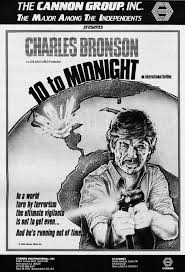
10 to Midnight (1984)

EDITOR’S NOTE: The Cannon Canon has been celebrating Bronson Don’t Like May(onnaise) all this month, which is the perfect time to watch lots of Bronson movies. This originally ran on the site on March 18, 2022 as part of Cannon Month. In August we’ll have our second Cannon Month so get ready.

You can listen to The Cannon Canon 10 to Midnight episode here.


Producer Pancho Kohner had worked with Charles Bronson and director J. Lee Thompson several times, so when they purchased The Evil That Men Do, it seemed the perfect movie to pitch to Cannon, who wanted to make more films with Bronson. However, the rights to that novel and the screenplay were way more than Cannon wanted to pay, so as Menahem was in Cannes, he asked Kohner to come up with a new movie and title, which ended up being 10 to Midnight, which was sold at the festival with no script and just Bronson. It sold immediately.

Warren Stacey (Gene Davis) is an incel before we knew what that meant, a man that has taken the rejection of women so hard that he starts killing them, showing up nude in their homes and butchering them, usually after they turn him down. We first see him kill an office worker named Betty Johnson after she makes love to her boyfriend in a van. Stacey easily takes out the man, then chases Betty through the woods, making her beg for her life before snuffing it out.

Stacey even attends her funeral, where he hears that her diary — which goes into detail on all of her sexual conquests — is somewhere in her home. He breaks in to find it and ends up killing her roommate, Karen.

The diary is already gone and in the possession of Detective Keo Kessler (Bronson) and his partner Paul McAnn (Andrew Stevens). They think Stacey is the killer, but he always has an alibi and as he does his killing nude and with gloves covering his hands — and this was made in the days before DNA, mobile phones and surveillance cameras watching our lives — so he evades being jailed.

Kessler becomes even more involved once Stacey targets another nurse: the hardened cop’s daughter Laurie. His mania over catching the killer even makes him plant evidence to get the man arrested, a plan that McAnn disagrees with. As a result, Stacey kills all three of Laurie’s roommates.

As a naked Kessler is finally caught, surrounded by police cars, he tells Kessler, “Go ahead, arrest me. Take me in. You can’t punish me. I’m sick. You can’t punish me for being sick! All you can do is lock me up. But not forever. One day I’ll get out. One day I’ll get out. That’s the law! That’s the law! That’s the law! And I’ll be back! I’ll be back! And you’ll hear from me! You and the whole fucking world!”

Kessler replies, “No, we won’t,” and blows his brains out.

Shot both as a hard R rated and TV-friendly film — in which Stacey’s nudity is covered — this movie is wild, with Thompson fully unleashed and Bronson waving masturbatory devices in criminal’s faces screaming, “You know what this is for, Warren? It’s for jacking off!” while Wilford Brimley tries to get him to simmer down. I mean, Roger Ebert called it “a scummy little sewer of a movie” and that seems like him telling me to watch it as many times as I can.

You’ll also see appearances by a very young Kelly Preston, future Orange County Real Housewife and ZZ Top video girl Jenna Keough, Michael Jackson’s girlfriend in “Thriller” Ola Ray, Robert Lyons as the D.A. and Geoffrey Lewis as Stacey’s lawyer.

You know, in real life, I’m very measured in how I view police militarization and brutality. But when it comes to Bronson, I cheered when he shot a criminal surrounded by police right in the forehead. I don’t know what that says about me.

For more info on all this great film, get Austin Trunick’s The Cannon Film Guide Volume 1: 1980-1984.

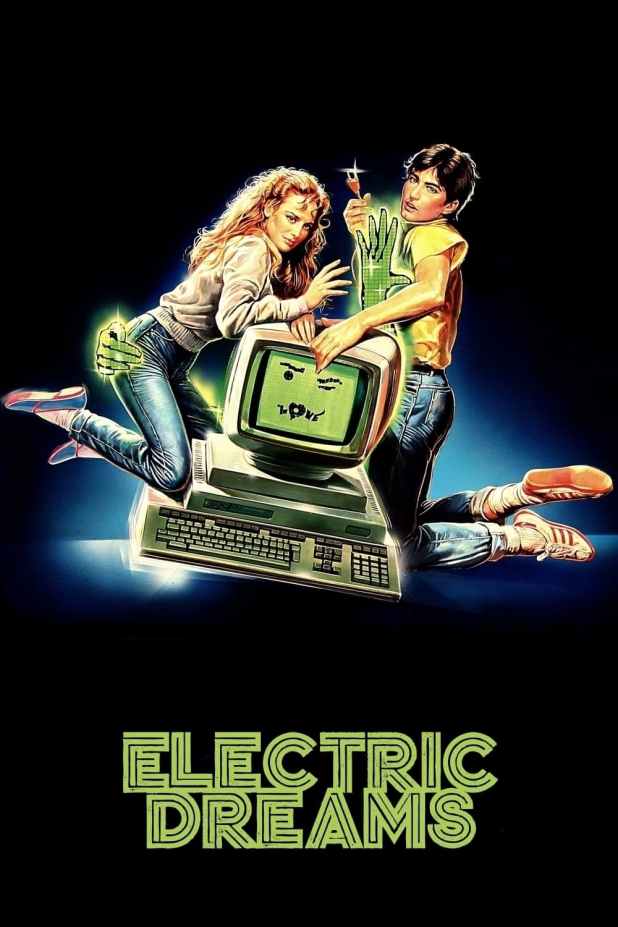
APRIL MOVIE THON DAY 26: Electric Dreams (1984)

Steve Barron directed some of the most famous videos like “Billie Jean” by Michael Jackson, “Money for Nothing” by Dire Straits, “Electric Avenue” by Eddy Grant, “Don’t You Want Me” by The Human League, “Africa” by Toto and “Take On Me” by A-ha. This was his first film, which was written by Rusty Lemorande, who also was behind Captain EO, Cannon’s Journey to the Center of the Earth and the Patsy Kensit and and Julian Sands-starring The Turn of the Screw.

Barron often shared his music videos with his mother Zelda. Now, that isn’t him being a mama’s boy. She was at the time doing continuity on Yentl with Lemorande — she also directed the movie Shag and Culture Club’s* videos for “I’ll Tumble 4 Ya,” “Miss Me Blind,” “The Medal Song” and “It’s a Miracle” — and showed showed him a video that Barron made for Haysi Fantayzee, which led to this movie.

The film is very much an extended music video and has lots of artists of the era, such as YB40, Jeff Lynne, Phil Collins, Heaven 17 and, most importantly, Giorgio Moroder, who was hired as the composer.

Barron would later say, “(Mordoer) played me a demo track he thought would be good for the movie. It was the tune of “Together in Electric Dreams” but with some temporary lyrics sung by someone who sounded like a cheesy version of Neil Diamond. Giorgio was insisting the song could be a hit so I thought I’d suggest someone to sing who would be as far from a cheesy Neil Diamond as one could possibly go. Phil Oakey**. We then got Phil in who wrote some new lyrics on the back of a (cigarette) packet on the way to the recording studio and did two takes which Giorgio was well pleased with and everybody went home happy.”

Miles Harding (Lenny Von Dohlen, Harold Smith on Twin Peaks) is an architect who wants to build earthquake-proof building, which is why he buys a computer to help him and goes overboard, buying everything he can to allow it to run his house. However, he screws up his own name and it calls him Moles. As the computer downlaods more information and it starts to overheat. Miles pours champagne on it, which is not how to fix a computer and it becomes self-aware, gains the voice of Bud Cort (Barron didn’t want Cort to be seen by the other actors so he did his lines in a padded box on a sound stage) and the name Edgar.

Miles and Edgar are both in love with neighbor Madeline Robistat (Virginia Madsen), with Edgar even playing cello along with her in a duet, a performance that Miles takes credit for. He even asks the computer to write a song for Madeline, but that takes things too far and soon man fights machine.

Yet don’t take this to be a horror movie. It ends up being quite sweet at the end and is a cute romance. You can even see Moroder show up as a record producer. This movie has one of my favorite movie things in it: computers that at once look dated and yet do more than they can today.

*Harold and Maude fan Boy George visited the set of this movie just to meet Bud Cort. George also helped compose the song “Electric Dreams” and contributed his band’s songs “Karma Chameleon,” “Do You Really Want to Hurt Me,” “Love Is Love” and “The Dream” to the soundtrack.

**The Human League’s singer.