88 FILMS BLU RAY RELEASE: Kid from Kwangtung (1982)

Luo Yihu (Hwang Jang-Lee), the master of the Northern Legs Clan, has killed the master — Mr. Zhang (Yen Shi-Kwan) — of two young students — He Jiayu (Wong Yu) and Wu Dezhi (Chiang Kam) before letting them know that they’re next. They’re also idiots who would rather argue and prank one another than get better at fighter, so this will not be easy.

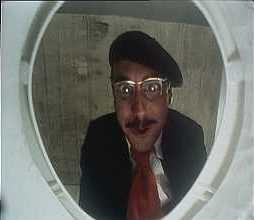
Directed by Hsu Hsia, Kid from Kwangtung, this takes its time to get to that fight, as it spends so much of the running time having He Jiayu and Wu Dezhi dress like roosters and a centipede to do costumed battle. You also get incense as a weapon, hopping vampires, an appearance of some of the synth effects from Flash Gordon, lots of blood and more silliness than ultra serious Shaw Brothers lovers may want. As for me, I had a blast, as this movie jumps from scene to scene and is devoted to entertaining you and making you laugh. What else can you ask for?

South Korean martial artist Hwang Jang-Lee was only in two Shaw Brothers movies, this film and Ghosts Galore. He’s also in Drunken MasterSnuff Bottle ConnectionBruce Lee Fights Back from the GraveMillionaire’s Express and many more. He was scheduled to direct a film for Shaw Brothers but disagreements with actor Wong Yu led to him ending his contract.

The 88 Films limited edition blu ray of this movie has a slipcase with new artwork by Sam Gilbey, lobby cards, a trailer, an image gallery and a reversible sleeve with the original artwork.

You can order it from MVD.

Vice Squad (1982)

Princess (Season Hubley, who was Nikki in Hardcore) is walking the streets to make money for her daughter Lisa losing her job. Sunset Boulevard is dangerous, as you know if you’ve watched the same movies that I have, but never more dangerous when pimp Ramrod (Wings Hauser) is running things.

LAPD vice squad sergeant Tom Walsh (Gary Swanson) brings Princess down to the morgue to look at the body of her dead friend Ginger (Nina Blackwood, former MTV VJ) and tell her that she’ll be busted for cocaine and lose her daughter if she doesn’t help. Yeah, every cop is a criminal and all the sinners saints.

Even when she helps the cops catch Ramrod, he easily escapes, starting a reign of terror on the Sunset Strip looking for Princess, promising that she will be killed. He even castrates her former pimp, Sugar Pimp Dorsey (Fred “Rerun” Berry losing his dick? No!), and beating men and women alike into the great beyond all as he gets closer and closer. At the same time, Princess is turning tricks in fancy mansions, getting into coffins with old men who like to pretend that they are dead. That’s because she knows that the vice squad will never be able to change what happens on the streets.

I would not deserve this site and you reading it if I didn’t mention that one of the working girls is Cheryl Rainbeaux Smith.

Gary Sherman should get more credit than he does. I’ve never seen a boring movie from him. Wings Hauser is also an absolute maniac beyond all other lunatics in this and even sang “Neon Slime,” the song that plays at the end.

Supposedly, Martin Scorsese got in a fight with Dawn Steele over this movie, saying that it deserved to be the best movie of the year.

The opening says, “The motion picture you are about to see has been produced with the cooperation of law enforcement authorities. Though a work of fiction, it is a composite of events that have actually taken place on the streets of Hollywood.” That’s true. Producers Brian Frankish and James Robert Dyer approached Sandy Howard about making a realit documentary about prostitution with interviews from pimps, sex workers and the LAPD Vice Squad. The project eventually became a movie with Howard, Kenneth Peter and Robert Vincent O’Neil working on the story.

You can watch this on Tubi.

Here’s a drink.

Neon Slime

  • 1.5 oz. Midori
  • .5 oz. Southern Comfort
  • .5 oz. sweet and sour mix (or .25 oz. lemon juice and .25 oz. simple syrup)
  • .25 oz. egg whites
  • 1 oz. lemon lime soda
  1. Put all ingredients in a shaker with ice. Shake it up.
  2. Let it sit for a moment, then shake it again. Pour over ice and enjoy.


2024 Scarecrow Psychotronic Challenge Day 21: Disco Dancer (1982)

21. STAGEFRIGHTS: Musicals are hell to endure. Can I get a hell yeah!?

In his childhood, Anil (Mithun Chakraborty) watched helplessly as a rich man named P.N. Oberoi (Om Shivpuri) beat his mother in the streets and then had numerous thugs slap him around. All Anil wanted to do was dance and sing. Now, he has to live with this memory.

Yet dance and sing he does, as he’s noticed by David Brown (Om Puri), a manager who wants to replace his current disco star Sam (Karan Razdan) as his ego has grown too big. Now known as Jimmy, our hero becomes a disco star while falling in love with his enemy’s daughter Rita (Kim)

Oberoi is one of the most brutal villains I’ve seen in a movie in a long time. He hooks Jimmy’s guitar up to an electrical current in the hopes of killing him, but it fries his mother instead. Now, Jimmy can’t play the guitar and thanks to Oberoi’s henchmen, he can’t walk either. Rita must nurse him back to health and get him ready for the stage.

The film ends at the International Disco Dancing Competition, where Jimmy gets on stage and can’t sing. Rita gets up and starts screaming at him, trying to force him to sing. Finally, Jimmy’s uncle Raju (Rajesh Khanna) throws him a guitar and tells him that his mother is in his music. He plays like he never has before, winning the contest, just in time for Oberoi’s killers to rush the stage and shoot Raju.

This has stopped being disco.

Jimmy goes for revenge, killing every single guard through dance fighting, before getting justice in the most perfect way possible. Electrocution.

Disco Dancer was a huge hit, not just in its own country, but in Southern and Central Asia, Eastern and Western Africa, Japan, the Middle East, East Asia, Turkey and the Soviet Union. There’s even a Jimmy statue in Osaka! It also inspired the Devo song “Disco Dancer” and “Jimmy Jimmy Jimmy Aaja” appears in You Don’t Mess With the Zohan and was covered by M.I.A.

The soundtrack may not always be pure disco, but at times it has some wild sounds, like how “Koi Yahaan Nache Nache” samples “Video Killed the Radio Star,” French disco star Marc Cerrone’s “Cerrone’s Paradise” is used — probably without permission — and “Krishna Dharti Pe Aaja Tu” used parts of “Jesus” by Tielman Brothers, who were the first Dutch-Indonesian band to successfully venture into the international music scene. There’s another French disco song that’s sampled in this, Ottawan’s “T’es Ok T’es Bath.”

This movie has all the colors, all the drama, all the disco dancing. Seriously, it’s incredible even if the music isn’t all that disco at times. If you’re just starting to get into Bollywood films, this is a great place to start, because this truly has some mind destroying scenes.

You can watch this on YouTube.

The Sizzlin’ Something Weird Summer Challenge 2024: Basket Case (1982)

69 EsSINtial SWV Titles (September 15 – 21): Klon, who came up with this list, said “This isn’t the 69 BEST SWV movies, it isn’t my 69 FAVORITE SWV movies, my goal was to highlight 69 of the MOST SWV movies.” You can see the whole list here, including some of the ones I’ve already posted.

Frank Henenlotter is an instrumental figure in grindhouse and exploitation film lore. In addition to rescuing many low-budget sexploitation and exploitation films from being destroyed, he made three Basket Case movies and Brain Damage. This is one of the few movies that upsets Becca so much that she refuses to watch it.

Duane Bradley arrives in the grimiest and scummiest New York City with a locked wire basket that contains his formerly conjoined twin, Belial. They were separated against their will and Belial has always resented it, pushing his brother to get revenge on the doctor who cut them apart.

Our hero — well, such as it is — falls in love with a nurse named Sharon, but Belial tries to rape her, can’t perform and kills her instead. Is it any more frightening if I tell you that Belial is basically a rubber glove on Henelotter’s hand? Duane attacks his brother and they fall out of the apartment to their death.

Don’t worry — the brothers survived to make it to the sequel, as well as another film after that where Belial got a powered exo-skeleton. The brothers also show up in the subway in Henenlotter’s Brain Damage.

Critic Rex Reed’s was quoted on the poster for this movie, saying “This is the sickest movie ever made!” He had heard how gross the film was and sought it out. As he left the theater, someone asked him what he thought. He didn’t realize that that person was Henenlotter and as a result, he was furious that he was being used to promote this movie.

The bar scenes were shot in The Hellfire Club, an S&M bar in Manhattan. The crew had to hide all the sex toys and swing, but left behind the buzz saw that killed the boys’ father as a gift. That very same crew was so offended by Sharon’s death scene that they all walked out rather than continue filming it.

CANNON MONTH 3: The New York Ripper (1982)

This is a movie whose writer, Dardano Sacchetti, said came from a director who “nurtures a profound sadism towards women.” The New York Ripper isn’t an easy watch. In fact, a UK censor claimed was “simply the most damaging film I have ever seen in my whole life.” For all the times I wonder why some reviewers feel the need to list the trigger warnings in a film, I can admit that the entirety of this movie is basically one big trigger.

It’s also a movie that came out at the end of the slasher fad in the U.S., at a time when mainstream critics were finally confronting films that had been playing grindhouses and drive-ins for years. It barely played the U.S. in 1984 before being released in censored form on VHS in 1987. It still hasn’t been released uncut in England.

I have a slightly different view of the film than most. In a world where people obsessively watch Law and Order at all hours of the day and night, The New York Ripper offers a very similar story with one glaring difference: there is no center of morality. There’s not a single redeeming character, save perhaps Fay Majors and Susy Bunch. There isn’t a sympathetic killer nor a beaten down cop with a hidden heart of gold. This is New York City standing on the brink of Armageddon at the end of the 20th century. There isn’t room for goodness, just a struggle to survive.

Beyond Fulci unleashing every evil impulse he has when it comes to gore and destroying human bodies, the real part of this film that makes it so hard to swallow is the overwhelming feeling of misery that imbues every frame. No one is getting out alive or unscathed. Cops choose their own careers over the prostitutes that they may or may not be able to admit that they love. The very same cop, whose morality is very much in question, rails against the open marriage that is the closest thing to romantic love in the film. And the movie ends with a dying child in a hospital bed repeatedly calling out to a father who now cannot answer her. There’s grim and then there’s this film.

However, I feel that it’s an important part of Lucio Fulci’s career. It’s nearly a bookend with another of his giallo works, Don’t Torture a Duckling. Unlike his giallo contemporaries like Argento and Martino, Fulci has no concern with fashion or hyper colors. Instead, he uses the framework of the genre — hidden killers, red herrings, psychosexual motive — to rail against the inhumanity of morality and religion, while at the same time fascinatingly being as immoral as it gets.

After this film, Fulci would create Conquest, a baffling fog-entrenched take on the sword and sorcery film that I absolutely adore, and Warriors of the Year 2072, which is the final film he’d work with Sacchetti on. It’s the beginning of a downward slide in quality and health for the Godfather of Gore, although I like some of his later period films more than others, such as Murder RockAenigma and The Devil’s Honey.

The New York Ripper is the hardest, roughest, bloodiest and sleaziest of Lucio Fulci’s films. That’s saying a lot. It has a lot to live up to, with the horrors that had come before. If you backed off of the gore and roughness of the film, you’d be left with a somewhat decent detective film. But what got made…

It’s like Fulci watched William Lustig’s Maniac and said, “This movie is for pussies.”

Literally, the photo below is the very least of what happens:

Seriously, as upset as people get by some movies these days, I’d like to warn anyone easily upset to avoid this movie at all costs. Some see it as Fulci’s rock bottom, reaching out to the lowest common denominator. But once his violence is removed from the fantastic, it seems much more horrifying. It’s also a film where all of Fulci’s tics — especially injuries to the eye — are not held back. In fact, fucking nothing is held back by this film. It’s brutal. This isn’t a warning like at a fun house or sideshow, hyping up what is to come inside with overblown carny barker snake oil. This is legitimately a brutish, punishing film.

An old man complaining about his balls hurting is walking his dog, who finds a rotting human hand that once belonged to a prostitute. Fulci predates Law and Order with this beginning, which is how every episode starts. Police detective Lieutenant Fred Williams is on the case, but he’s been beaten down by New York City. This isn’t the NYC of today, this is 1982 end of the world cesspool that Fulci would travel to as a tourist. This is a bleak, nihilistic world with people that are either taking advantage of one another, being taken advantage of or so cold that they have shut off all humanity.

As Lt. Williams investigates, he learns that the first victim had set up a meeting with a john who used a Donald Duck voice. Yep — this is the first hint that you are watching Fulci at his most insane. It’s either going to freak you out, draw you in or shut off the movie because it’s too strange. Me? I’m in.

A young woman rides her bike through the city. She’s tough. She’s spunky. She gives it right back to guys who come at her with sexual misogyny, particularly a man who nearly hits her with his car. She notices his car on the ferry and scratches up his car. As she commits her vandalism, a man walks up to her. She tries to speak to him, but his duck voice stops her, as well as his knife. She’s brutally slashed open and this being Fulci, the gore is not off camera. It’s as in your face as possible.

Cut to the morgue, where a pathologist tries to link this killing to the body that started the film and another murder in Harlem. Lt. Williams informs the press that a serial killer is at work, which upsets the chief of police (Fulci) and starts phone calls from the Ripper. Realizing he needs help, the cop turns to Dr. Paul Davis (Paolo Marco, The House by the Cemetery), a psychotherapy professor who wants to help him create a profile for the killer.

Meanwhile, Jane Lodge (Alexandra Delli Colli, Doctor Butcher M.D.) attends a live sex show along with her tape recorder. She’s much better dressed than anyone else in the theater and is obviously out of place.

The dangerous looking man with two missing fingers is not out of place, however.

Meanwhile (I feel like with all of the detours that this movie takes, I’ll overuse this word), the female performer (Zora Kerova, who was infamously hung by her breasts in Cannibal Ferox, as well as Anthropophagus and The New Barbarians) we just watched on stage is decimated by the Ripper, who has a broken glass bottle as his weapon. Kerova did interviews afterward where she claimed that Fulci didn’t hate women and was really warm to her, but that’s nearly impossible to conceive upon watching this scene.

Lt. Williams goes to see his girlfriend Kitty — or at the very least, his favorite prostitute — where he gets a duck-voiced call from the Ripper.

Remember Jane? Well, she has an open marriage with Dr. Lodge, who likes to listen to the recordings she makes. She goes to a rough bar where two men taunt her. One uses his foot on her — yep, exactly what I just wrote — and exposes her to the entire bar before she runs away.

Finally, we meet our heroine. Fay Majors rides home alone on the subway when she notices the man missing two fingers. She runs into a dark alley where the quacking Ripper attacks her by stabbing her in the leg and slashing at her. She escapes into an apartment building and locks the door before passing out. She has a vision of watching cartoons in a movie theater as her boyfriend, Peter Bunch (Andrea Occhipinti, Ilias from Conquest), arrives and slashes her throat with a straight razor. She awakens in the hospital, where Lt. Williams and Dr. Davis determine that the killer is left-handed and has to be the man missing two fingers.

Remember Jane? Well, she gets picked up by the man with two missing fingers for some rough bondage, which includes him beating her and making whispered phone calls to other people, but she’s also pretty insane, so it’s left to your own judgment as to whether she wants this treatment or not (positive depictions of BDSM relationships, of which this is not one, are rarely presented in any cinema, much less grindhouse films). Post-sex, as the two sleep next to one another, she hears a radio DJ ask the Ripper, the man missing two fingers, to leave those ladies alone. It sounds so much like the DJ from The Warriors that it can’t be an accident (Fulci would use a similar narrative device in Zombi 3). This is the best scene in the film, as Jane has to untie herself without waking up the man who, worst case, is the killer and best case, is a maniac, next to her. There’s a ton of suspense here. As she finally makes her way into the hallway and gets away, she walks right into the Ripper, who stabs her to death.

Lt. Williams listens to Dr. Lodge defend his open marriage as they tell him that his wife is dead. Williams takes the man to task, as obviously the recordings she made were for him, possibly against her will. The police determine that the killer is Mickey Scellenda, who has an apartment filled with porn, drugs and photos of most of the Ripper’s victims. But Dr. Davis has his doubts, as the Ripper is intelligent and Mickey isn’t.

Also, there’s a long scene of Davis buying male pornography here, revealing that he’s a repressed homosexual. He goes to ask more questions of Peter and Fay, which keeps him suspicious. After he leaves and Peter goes out, Mickey attacks Fay. Peter returns just in time to save her.

Lt. Williams then gets a call where the Ripper dedicates a kill to him. The police set up a trace and Williams keeps him on the phone until they find the telephone booth where they think the killer is, but it’s just a walkie talkie. The killer is really at the home of William’s favorite prostitute, Kitty, and taking his time killing her. This is where Fulci gives in to his worst impulses and has a long, gory razorblade sequence. If his previous eye injury gore has ever upset you, well, you shouldn’t even be watching this film. This is the hard part of watching Fulci. So much of this is indefensible sleaze, but so much of it is also well done, as Williams fighting to get to the crime scene and save Kitty, with traffic getting in the way and even his body giving out are powerful. I’m not sure how many people will get past the grimy murder scene to appreciate it, though.

Days later, Mickey’s body is found. He’s killed himself by what looks like self-suffocation. That said, the coroner thinks that Mickey has been dead for eight days, which means that he can’t be Kitty’s killer. Dr. Davis explains that this fits into his theory — the Ripper hates women and is an incredibly intelligent man who has used Mickey to keep the police off his trail.

Fay visits a hospital where Peter’s daughter from his previous marriage, Suzy, is dealing with a rare bone disorder that has led to her losing her left arm and right leg. Williams and Davis later visit the girl and notice her nurse reading Donald Duck stories to her, which leads to them racing to Peter and Fay’s place to arrest both of them.

At their house, Fay has disappeared after a call from the Ripper. Peter leaves dinner only for her to attempt to stab him, which makes you think that she is the killer. However, he rises and begins quacking, throwing her down the stairs. He grabs the knife and just as he is about to kill her, Williams arrives and shoots him in the face — another incredibly graphic scene that shocked me.

As Fay is taken away by an ambulance, Williams explains that her boyfriend hated sexually active women because his daughter would never get to enjoy the chance to live life.

The film ends with Suzy calling for her father, begging for him, as her voice is covered by the traffic of New York City.

Again, imagine Law and Order filled with beyond graphic gore, sex scenes and a lack of any heroes and you’ll have something close to The New York Ripper. Except that it’s so rough, it’s going to take a strong stomach to get through it. There have been people upset with mother! earlier this year, as it feels like a movie that attacks the audience. This film does less of that. But as upset as people get about things today, this is a hard movie for me to tell others to watch. It’s a giallo, sure. But where so many of those films are satisfied with the flash of the blade and the suggestion of gore and sex, Fulci wallows in it.

This isn’t a movie for everyone. It’s maximum Fulci without the benefit of the supernatural to dull the edges of the sadism on display. Yet it’s a well-made film that keeps you guessing and takes you on a near mondo tour through the uncertain haze of the death throes of New York City before Times Square was reinvented as a tourist-friendly paradise. For lovers of extreme cinema and Italian exploitation, there’s plenty to quack about here.

This film was briefly played in grindhouses by 21st Century. Most in America wouldn’t see it until it was released on video in 1987 and wouldn’t see it uncensored for decades to come.

CANNON MONTH 3: The Forest (1982)

EDITOR’S NOTE: As the journey through Cannon continues, this week we’re exploring the films of 21st Century Film Corporation, which would be the company that Menahem Golan would take over after Cannon. Formed by Tom Ward and Art Schweitzer in 1971 (or 1976, there are some disputed expert opinions), 21st Century had a great logo and released some wild stuff.

The Forest is unlike any other slasher you’ve ever seen. Sure, it has murders in the woods, campers and stalking scenes. But it gets weirder than almost any other slasher would dare, pushing itself to the edge of absurdity while subverting anything you’d expect.

The killer — John — is played by Gary Kent, a stuntman whose work extends from his debut in Battle Flame through the films of Al Adamson and Roger Corman, emerging as the inspiration for Cliff Booth in Once…Upon A Time In Hollywood and the subject of the documentary Danger God. He’s not just a killer in this. He’s not just a cannibal. He’s a killer cannibal haunted by the wife and children that he murdered in a fit of rage.

Two couples — Steve and Sharon plus Charlie and Teddi — have decided to go into the woods for a vacation. The girls meet the ghosts the first evening, as they first meet the kids and then are confronted by their mother. If a ghost can be insane, hers definitely is.

When they were all still alive, the woman slept around on her husband to the point that he killed her, took off for the woods with his kids and watched them commit suicide, which was finally made him lose his mind and became the hermit human flesheater we meet in this film, the kind of maniac who’d feed a man his girlfriend.

The craziest thing about this movie is that Sharon ends up being the real hero — not just a final girl — and the two men are shown to be, at best, victims and at worst, total morons. Only she is capable, strong and able to survive, perhaps because she has connected to the dead children of the killer.

Even stranger, she was played by Tomi Barrett, who was the wife of Kent.

Shot in 13 days, this movie doesn’t get mentioned enough. Don Jones, the writer and director, would also Who Killed Cock Robin?The Love Butcher, Schoolgirls In Chains and Sweater Girls — all quality films.

21st Century rereleased this as Terror In the Forest.

CANNON MONTH 3: Bloodtide (1982)

EDITOR’S NOTE: As the journey through Cannon continues, this week we’re exploring the films of 21st Century Film Corporation, which would be the company that Menahem Golan would take over after Cannon. Formed by Tom Ward and Art Schweitzer in 1971 (or 1976, there are some disputed expert opinions), 21st Century had a great logo and released some wild stuff.

When you see the names Brian Trenchard-Smith and Nico Mastorakis listed as producers, you know that you’re probably getting into something good. Also known as Demon Island, this film was directed by Richard Jeffries, who is probably better known for the films that he’s written like Scarecrows and Cold Creek Manor. He’s only directed one other film, the 2008 TV movie Living Hell.

It’s funny, when I discussed this movie earlier today with Bill from Groovy Doom, he referred to it as “the monster movie with no monster.” That’s an apt description.

It’s also about a treasure hunter named Frye (James Earl Jones) whose underwater scavenging brings back an ancient sea monster that demands virgin blood.

Meanwhile, Neil and Sherry (Martin Kove and Mary Louise Weller, who appeared in Q The Winged Serpent the same year as this movie) have come to the island looking for his missing sister Madeline (Deborah Shelton, who also sings the song over the end credits with her then-husband Shuki Levy). Plus, Lydia Cornell stops hanging out with Cosmic Cow on Too Close for Comfort and shows up as Jones’ girlfriend.

Inexplicably, Lila Kedrova from Zorba the Greek and Jose Farrar — well, he’s less of a surprise as Jose may have been the first actor to win the National Medal of Arts, but he’s also in spectacular junk like The SentinelBloody Birthday and The Being — both appear.

Arrow’s write-up promised “blood, nudity and beachside aerobics.” This delivered, as well as some great dream sequences and moments where beachfront rituals seem to go on forever. That said, I had a blast with this movie, as any film that has Martin Kove skipping around the waves holding a miniature engine while the ladies go wild and James Earl Jones yells at everyone will hold my attention.

CANNON MONTH 3: Eye of the Evil Dead (1982)

EDITOR’S NOTE: As the journey through Cannon continues, this week we’re exploring the films of 21st Century Film Corporation, which would be the company that Menahem Golan would take over after Cannon. Formed by Tom Ward and Art Schweitzer in 1971 (or 1976, there are some disputed expert opinions), 21st Century had a great logo and released some wild stuff. Also, this is Manhattan Baby

Reviews call this film one of Fulci’s worst films, using phrases like “an impenetrable mess” and “uninspired.” Even the liner notes on the Anchor Bay release say that the film “doesn’t add up.” Woah boy — that would put off anyone else. But me? I’m excited to dig in. Get it? Dig in.

Susie Hacker is in Egypt with her archaeologist father, George (Christopher Connelly, The Norseman1990: The Bronx Warriors, the Peyton Place TV series), and journalist mother, Emily (Martha Taylor, better known as Laura Lenzi, who was in The Adventures of Hercules) when a blind woman gives her an amulet. Just as she takes it, her father is blinded while he enters a previously unexplored tomb (but not before he shoots the shit out of a snake).

They return to New York City, where we meet Susie’s younger brother, Tommy (oh fuck, it’s Giovanni Frezza, Bob from The House by the Cemetery), who didn’t go on the trip, and au pair Jamie Lee (boy, naming a babysitter Jamie Lee is in no way a coincidence, right? She’s played by Cinzia de Ponti from The New York Ripper). Susie and Tommy have somehow gained supernatural powers from the amulet (Susie could speak telepathically to her mother before she left Egypt). And laser beams blast George’s eyes, giving him back his vision.

Check out this brother and sister interaction, Tommy’s introduction to the film. Also, if you’re wondering why a little boy is dubbed with the voice of a small girl, then you’ve never watched a Fulci film before.

Susie also has a scorpion — referred to in the beginning as a symbol of death as George captures it to give it to his daughter as a gift — and is playing with it. Wiler, a colleague, talks to George about what he saw in the tumb.

Meanwhile, Emily is working with her wacky colleague Luke (Carlo de Mejo, City of the Living DeadThe Other HellThe House by the Cemetery) at Time and Life on a story when Jamie Lee calls in a panic. She can’t unlock the kids’ bedroom door and when she tries to enter the room, she sees snakes. Also, we know Luke is wacky because he has on Groucho Marx glasses when we first see him, then he has on googly eyes later. Oh, Luke.

Meanwhile, a security guard is stuck in an elevator. He bloodies his fingers trying to open the doors — thanks, Fulci! — before the floor drops away.

Luke offers to enter the locked door, acting like a goofy magician, when he screams. Jamie Lee runs upstairs but he’s nowhere to be found. That’s because he’s been sucked into a dimensional gateway and is now in the deserts of Egypt, a place where that madcap ponce will eventually die from exposure and dehydration. The funniest thing? Everyone thinks it’s a practical joke. No one ever discusses it again! I mean, Jamie Lee finds a handful of sand in the room and sees scorpions walking all over the place, but all the kids care about is eating dinner. Cue the Fabio Frizzi (who also composed music for Zombi 2City of the Living DeadThe Beyond and more) music! Obviously, this was all some kind of practical joke, right? Why should anyone call the police?

Speaking of that Frizzi music, it plays as we see Susie’s hand begin to smoke and burn her bed. Then, she levitates. Nothing at all strange, please move along!

Jamie Lee then takes the kids to Central Park, where they all take Polaroids — note to millennials, selfies used to take three minutes to develop. A woman finds one of the photos, which ends up being the amulet instead of the kids. She shows the photo to Adrian Marcato (Cosimo Cinieri, Murder Rock and The New York Ripper), who puts his name and number on the Polaroid and ensures that the woman gives it to Mrs. Hacker. He’s a mysterious man with a mysterious study filled with mysterious books.

Susie and Tommy have now learned how to go on voyages, trips that allow them to appear and reappear at will. Not everyone is able to do this — Jamie Lee goes on a voyage and never returns. And more weirdness starts happening — George’s colleague Wiler looks at the Polaroid of the amulet and then a snake appears and bites him. We even get an awesome snake POV camera in this scene, which I reacted to with pure, ebullient joy. That same photo teleports into Susie’s hand as she has a fit and collapses. Also — how did Fulci, in a film filled with eyeball symbolism, resist the urge to have the snake bite the old man in the eyeball? What a show of restraint!

Groege and Emily decide to go to Macato’s antique shop, which is filled with stuffed birds. And he’s stuffing another one while talking to them. He explains the evil inside the amulet and how it has now infected their daughter and son.

They find the amulet — and a live scorpion that everyone just kind of ignores — in Susie’s bedroom door. She knocks out all of the lights in her room and appears covered in a blue glow before she faints. Marcato appears and tries to link minds with Susie, but he can’t handle the strain. He falls to the ground, bleeding and foaming at the mouth. He’s able to link minds with George, though, showing him the Egypt that his children have been visiting and tells him that Susie is trapped by the stone.

Susie goes into a coma, where she is examined by Dr. Forrester (Dr. Clayton Forrester? No, but he is played by director Lucio Fulci, listed as anonymous in the credits), who finds a cobra mark in her x-rays.

Tommy is left alone in the apartment, his eyes intercut with Marcato’s, who is concentrating on the amulet (there’s some nice Bava-esque blue to red lighting here, with tight shots of the psychic’s eyeballs). Suddenly, blood pours through a wall and Jamie Lee comes busting through, covered in gore (again, Fulci is really restraining himself here). Susie’s machines start to flatline before she awakens, choking and spitting up blood. Blue light links Tommy, Susie and Marcato’s home as he recites an Egyptian spell.

Marcato tells George that his children are safe. He’s removed the curse and taken it upon himself, so that it will not harm anyone else. He asks that George throw the amulet into the deepest part of the river.

After an entire film of holding back on the geysers of fluid and exploding eyeballs that we know and love him for, Fulci goes insane with the ending. We see shadows of the dead birds come to life before they fly at Mercato, slashing at his face. He mixes in some pecking POV shots and then goes completely over the top with repeated shots and a slowly lifting zoom, mixed with more interwoven POV shots, leaving the antique store owner a bloody corpse. The camera pulls back on a slow jazz song as we see the dead man bleed out and lift high above the store, before zooming to one of the stuffed birds. If I’ve learned anything from a Fulci movie, it’s to never work in a library or antique bookshop, because animals are going to eat your face.

Seriously, this jazz song, it’s like the kind of interlude Billy Joel would play before starting “New York State of Mind.”

George throws away the amulet, but now we’re back in Egypt, repeating the cycle as another young girl is given another amulet.

Whew. Manhattan Baby was written by longtime Fulci collaborators and husband and wife duo Dardano Sacchetti and Elisa Briganti. Originally called The Evil Eye and The Possession (it was also released as Eye of the Evil Dead), they settled on the changed title to evoke Rosemary’s Baby. Even the name Adrian Mercato comes from that film. He’s one of the witches mentioned in the book Rosemary reads, All of Them Witches, as he practiced black magic in the Bramford building and is the father of Roman Castevet. The budget would get cut throughout the film — as much as 75% — so that may be why the gore feels so restrained.

This is the final film that producer Fabrizio De Angelis and Fulci would work on together. Fulci disliked the film and felt that he had no choice but to make it; De Angelis was obsessed by it.

Manhattan Baby doesn’t seem like a failure to me. It makes good use of locations like the faux Egyptian pyramids and market, as well as New York City. And the restraint leads to a great climax. That said — it’s a mishmash of The OmenThe Exorcist and The Awakening, with a dash of The Birds. Sure, it’s not a great film or even a good one, but it’s an interesting one. And that’s what I want to watch!

You can watch this on Tubi.

You can listen to the podcast episode here.

CANNON MONTH 3: Dragon Force (1982)

EDITOR’S NOTE: As the journey through Cannon continues, this week we’re exploring the films of 21st Century Film Corporation, which would be the company that Menahem Golan would take over after Cannon. Formed by Tom Ward and Art Schweitzer in 1971 (or 1976, there are some disputed expert opinions), 21st Century had a great logo and released some wild stuff.

Before Cannon popularized ninjas, they were still showing up in movies like this one, also known as Powerforce and directed by Michael Mak, brother of Johnny and also the director of Sex and Zen.

It stars Bruce Baron (The Atlantis Interceptors, several Godfrey Ho movies like Ninja Champion) as Jack Sargeant, who eventually becomes a member of Dragon Force after facing off with two men dressed as a Chinese dragon, a flute-playing girl and a kabuki fighter, which makes me wonder if this wants to have every Asian stereotype in one breath. He’s protecting Princess Rawleen (Mandy Moore, no not the singer of “Candy”) from a criminal empire who has been killing all the members of the Mongrovian royal family (which is right next to Moldavia). In fact, when she’s hiding out at a friend’s house and trying to take a bath, ninjas show up and kidnap her.

Tan Lung (Bruce Li) is in charge of the Dragon Force and no, Herman Li, Sam Totman, Marc Hudson, Gee Anzalone and Alicia Vigil aren’t in this. Instead, they are a G.I. Joe karate force of extraordinary magnitude. It turns out that in order to win the space race, Russia is going to use acupuncture to take over the mind of the Princess. Russia has ninjas? How will we ever win the Cold War?

Dragon Force even has uniforms and an arms maker, Ah Chu — yes, that joke gets lobbed — who makes them bulletproof t-shirts. Yet this movie is all about the ninjas. Someone says, “Blood will flow from the body’s five holes!” but it’s more like “Ninjas will show up non-stop for the last ten minutes.” A giant tower of ninjas. Ninjas on wires. Ninjas getting their arms ripped clean off. Ninjas blowing up real good. Ninjas having their guts spray all over the screen. All different colored ninjas, all dying in the most incredible ways.

This was distributed not only by 21st Century, but also Bedford Entertainment, who seemed driven to distribute movies that I am crazy about, like SlashersHouse On the Edge of the ParkAnaza hevun and even Messiah of Evil as Dead People.

This movie is amazing. You know how they put Criterion blu rays out that are always really stuffy movies that people have long discussions about and we’re supposed to just believe that those are all cinema is? Do any of them have ninjas or good guys who hide in a bakery called the Good Fu King Bakery Co? There are also two attractive women all over Jack at one point and one says, “We don’t have sergeants here, we’re only interested in privates.”

21st Century licensed this to Planet Video.

You can watch this on Tubi.

CANNON MONTH 3: The Slayer (1982)

EDITOR’S NOTE: As the journey through Cannon continues, this week we’re exploring the films of 21st Century Film Corporation, which would be the company that Menahem Golan would take over after Cannon. Formed by Tom Ward and Art Schweitzer in 1971 (or 1976, there are some disputed expert opinions), 21st Century had a great logo and released some wild stuff.

Since childhood, Kay has constantly suffered from horrifying dreams, some of which are just frightening landscapes that leave her feeling uneasy and others that show loved ones being killed by a supernatural force. Those dreams have come and gone, but now they are happening more often, growing in intensity and impacting her work as an artist.

Worried that all of this stress may hurt her newfound success as an abstract artist, Kay decides to vacation on a small island, along with her husband David (Alan McRae, Three Ninjas), her brother Eric and his wife Brooke. As their pilot drops them off on the island, he mentions that a hurricane is on the way and he has to leave as soon as possible. Even stranger is the fact that the island — which they expected to be a resort town — is a deserted ruin. And not just any ruin, but the one in Kay’s dreams, leading her to feel that everyone is in danger.

David, Eric and Brooke are then killed one after the other. But who killed them? The film gives us three possible stories, each of which are plausible: the pilot never left the island and just dropped them off there to kill them (a theory that is somewhat proved when the pilot is seen later); Kay believes that a monster from her dreams can cross over into reality thanks to the island (which could be true, as the murders only happen when she is asleep) and finally, that Kay is really the killer, falling into a trance and acting out repressed resentment.

After everyone else dies, Kay locks herself into the beach house and tries to stay awake, even burning herself with cigarettes. But that night, the pilot makes his way into the house. She shoots him with a flare gun, killing him and sending the house up in smoke. As she tries to leave, a flaming skeleton is waiting for her.

But wait! It was all a dream, as Kay awakes on Christmas morning in bed. After telling her parents about the dream, they hand her a black cat to her horror. Huh? Supposedly Kay is killed by the Slayer and this is a flashback, but it certainly doesn’t seem that way.

Director J.S. Cardone says that he was inspired by H.P. Lovecraft and the idea of dreams versus reality, but the movie doesn’t have much to do with Lovecraft. That said, this movie looks way more expensive than its budget would lead you to believe, there are some good death scenes and it has a bleak atmosphere.

Here’s a drink.

Hurri-Kay

  • 2 oz. white rum
  • 2 oz. dark rum
  • 2 oz. passion fruit juice
  • 2 oz. orange juice
  • .5 oz. grenadine
  • .5 oz. simple syrup
  • .25 oz. lime juice
  • Maraschino cherry
  1. Add all your ingredients — other than the cherry — in a shaker filled with ice.
  2. Mix it up, pour over ice and toss in that cherry.