I’ve watched plenty of Steven Hilliard Stern movies, like The Park Is Mine, The Ghost of Flight 401, Miracle On Ice, Mazes and Monsters, Still the Beaver, Not Quite Human (written by Alan Ormsby!), I Wonder Who’s Killing Her Now? and Murder In Space, but he’s probably best known for his redneck opus, Rolling Vengeance. It’s probably the best — and only — movie where a man reacts to the death of his wife and children by making a monster truck and killing everyone responsible.
This is Showgirls with the sleaze dialed down for TV consumption. But hey — it’s got Rita Moreno as Rosella DeLeon, an old dancer trying for one more run and in love with Joey DeLeon (Tony Curtis). Then there’s Jillian Brooks (Lesley Anne Warren), the New York dancer. And newcomer Marci (Dianne Kay, Eight Is Enough) as the innocent girl new to Vegas.
It’s not going to change your life, but it’s definitely a great Sunday afternoon watch. Does anyone still do that? Well, I do.
Editor’s Note: Mill Creek also includes Liar’s Moon on their B-Movie Blast box set; and it’s back — with a new, second on the film — as part of its inclusion on the Excellent Eighties set. Why? Because we love Susan Tyrrell!
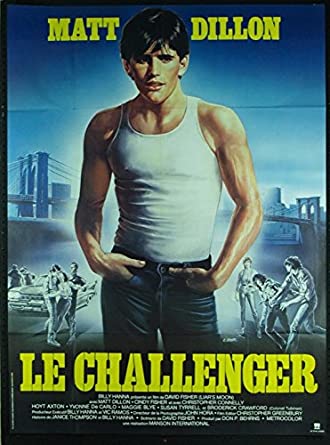
In East Texas, young lovers Jack (Matt Dillon) and Ginny (Cindy Fisher, who was already menaced by a one-sided love affair in Bad Ronald) realize that the world will never let them be. Jack’s mother (Margaret Blye, The Italian Job) was once in love with Ginny’s father (Christopher Connelly, who speaking of Italian shows up in some of our favorite movies from that country, including Manhattan Baby and 1990: The Bronx Warriors) and knows how these things end. But our loveable scamp head off to Louisiana, where they can get married without permission and Jack starts working in the oil fields, just like his dead father, who was played by Hoyt Axton.
This tale of a working class boy and a banker’s daughter is livened up by some casting that genre fans will appreciate, like Richard Moll — who must be in every 80’s movie as the heavy that Robert Englund turns down — as well as Molly McCarthy (from one of the strangest film noir movies ever, Blast of Silence), Jim Greenlead (Tag: The Assassination Game, Surf II, Joysticks), Yvonne De Carlo (Guyana: Cult of the Damned, Silent Scream, The Munsters), Dawn Dunlap (Barbarian Queen, Forbidden World), Broderick Crawford (in his last role) and Susan Tyrrell (who I’ll obviously be making a Letterboxd list all about sooner than later).
Director David Fisher only made one other movie, Toy Solders, which has teens — like Tim Robbins and Tracy Scoggins — join up with Father Karras to escape from terrorists. Yeah, you better believe I’m hunting that one down.
Oh yeah. Liar’s Moon also has a soundtrack by Asleep at the Wheel and two endings. Spoiler mode on*: Jack lives in one and dies in the other. I watched the Mill Creek Rare Cult Cinema version, which has him live. I have no idea how the one on Tubi ends, so why don’t you, as Morrissey sang, find out for yourself?
*Perhaps an even bigger spoiler is…
Seriously…this might ruin the film and I’m shocked that I missed this angle…
Jack and Ginny, remember how I said their parents dated? Yeah, the reason their respective mother and father were so against them dating is because they’re brother and sister. My God, another incest movie. It’s as if our site is…yeah, I guess I did watch that whole VC Andrews set. Two of them, actually.
Wait a second. Nope. The poor mom had been screwing with the rich dad for twenty years so that he’d feel pain for how he treated her. Everyone in this movie is ridiculous. They even shoot a color tinted flashback to show how it happened!
Oh Mill Creek. You brought me into this movie just to complete a box set and you reward me with a rich cup of scuzzy eighties wonderment.
Editor’s Note: Well, we polished off Mill Creek’s B-Movie Blast and Gorehouse Greats movie sets! So, 62 films down and 50 more to go. Here’s our first review as we crack open Mill Creek’s Excellent Eighties 50-Film Pack for the rest of February. We’ll round up that set with all the links at the end of the month.
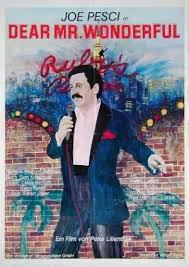
Joe Pesci gets an opportunity to sing in this movie, which is pretty much what I think he’s always wanted to do. By the age of ten, he was already At age 10, a regular on a TV show called Startime Kids with Connie Francis and then, he introduced his friends Frankie Valli and Tommy DeVito to singer and songwriter Bob Gaudio, leading to the forming of The Four Seasons.
While attempting to break into a music career, he worked as a barber. In 1968, his album “Little Joe Sure Can Sing!” came out, in which he sang cover songs before he started a comedy act with Frank Vincent, doing Abbott and Costello mixed with Don Rickles jokes.
While living above and worked at Amici’s Restaurant, Pesci started acting, appearing in The Death Collector alongside with his partner Vincent. Four years after that movie, Martin Scorsese and Robert De Niro remembered his ability and called him to be in Raging Bull. After that, Pesci worked consistently — even if it was in small movies like this and Easy Money — before becoming a star.
He’s still singing. He just put out an album in 2019.
Ruby Dennis (Pesci) is a small-time lounge singer and bowling alley owner who is — like the man playing him — just trying to be a big star. When his sister abandons her son, he struggles to keep him away from a life of crime and has something of a spiritual awakening.
This movie was directed by a German director, Peter Lilienthal, which is odd for a movie so Italian in nature. It’s a dark little film, one on which Pesci’s character has the heart to make it, if not the talent.
Vincent, who is often in films with Pesci, is in this, as is Ed O’Ross (Itchy from Dick Tracy), Richard S. Castellano (Clemenza from The Godfather), Larry Rapp (who was also in Pesci’s short-lived TV series Half Nelson), Paul Herman (Heat), Evan Handler (Harry from Sex and the City) and Tony Martin (the husband of Cyd Charisse).
Most strangely, the character of Ben was played by Ben Dova, the stage name for actor, comedian and acrobat Joseph Spah. Spah not only lived through the crash of the Hindenburg but was a suspect in its destruction. That’s because during the flight, he was granted access to the interior of the zeppelin so he could feed and walk his trained dog Ulla. As the cargo room was not far from the spot in the portion of the ship where the fire started, two different books on the disaster claim that Spah was behind the explosion.
The FBI investigated Spah and cleared him. Sadly, Ulla did not survive.
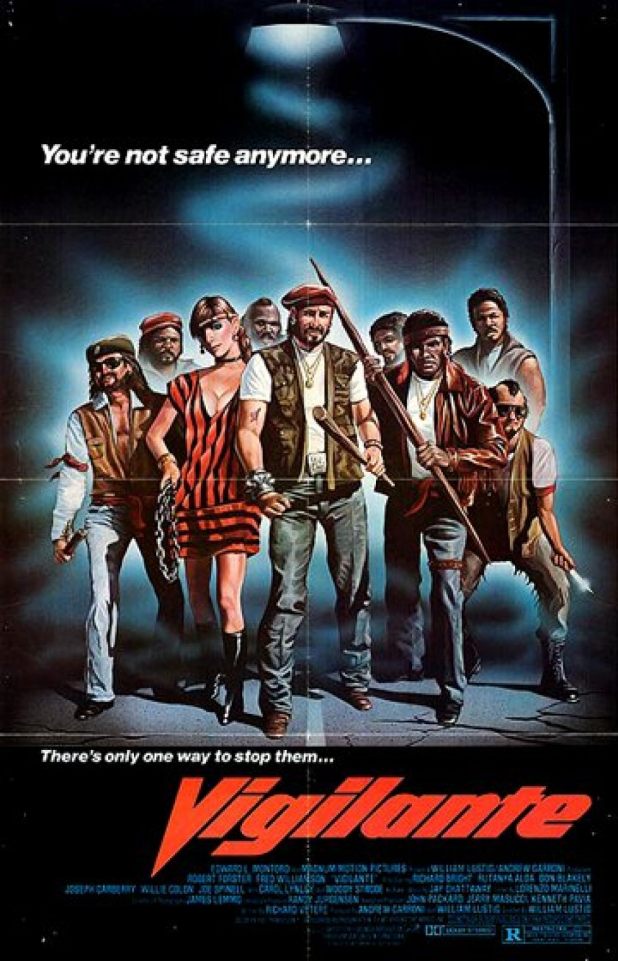
Sure, at its heart Vigilante is Death Wish, but both of those movies are really just westerns updated to fit the decade that they were created for. Plus, where Bronson’s film at least seems to end with some hope, this movie is a nihilistic, cynical and pessimistic journey into hell, which is really the only three ways to properly describe just such a trip.
Eddie Marino is played by Robert Forster in a rare lead role. You know how I always say that every movie should have William Smith in it? Well, let’s amend that by saying that if William Smith doesn’t want to do it, call Robert Forester. Despite living in the end of the world NYC of 1982, he has a good wife (Rutanya Alda, who between Mommie Dearest, The Stuff, Amityville II: The Possession and Girls Nite Out ends up being in so many of my favorite movies) and a cute little kid.
Sadly, he’s not in some coming of age tale or family drama. No, Eddie Marino has the bad fortune to be the hero of a William Lustig movie. And between scalp-lopping serial killers and zombified cops, every Lustig movie I’ve seen is full of tragedy, despair and a casual disregard for morality and the suffering of its characters.
Eddie’s co-workers, Nick (Fred Williamson, always a more than welcome sight), Burke (Richard Bright, Cut and Run) and Ramon (Joseph Carberry, Short Eyes) are fed up with crime, the cops and the system that keeps criminals out of jail. Now, the neighborhood tells them, instead of the police, who is behind the crimes that happen every day.
Eddie refuses to be a part of this, even when he comes home to find his wife stabbed and his son shot and killed. His wife had helped a gas station attendant who was being abused and that’s all it took for Frederico “Rico” Melendez (Willie Colón, a salsa king when not acting) and his gang to snap.
Assistant District Attorney Mary Fletcher (Carol Lynley*, The Night Stalker) tries to get him put away, but another gang member named Prago (Don Blakely), bribes the Judge Sinclair, allowing his defender Eisenburg (Joe Spinell!) to get him off with a plea bargain. Eddie flips out, attacks the judge and ends up being the one to go to the big house.
After being saved from a jailhouse assault by Rake (Woody Strode, the former pro wrestler who was also in Keomaand Once Upon a Time in the West; as if we need any reinforcement that this movie is a western), our hero does his time and emerges ready to get bloody revenge. His wife has left him, his son is dead and now, he has nothing left to lose.
While Vigilante was successful at the box office, Lustig never saw any profits from the film at all. First, Film Ventures International wanted to rename it Street Gang**. Then, as we all know, producer Edward L. Montoro ran away in 1985 with a million dollars in company money and was never seen again.
*This role was meant for Caroline Munro.
**It played in Detroit, Chicago and Pittsburgh with that title.
You can watch this on Tubi or do yourself a kindness and get the 4K UHD and blu ray set from Blue Underground. It has a 16-bit print from the original 35mm camera negative, with Dolby Vision HDR and Dolby Atmos audio, along with three different commentary tracks (Lustig and co-producer Andrew Garroni; Lustig and Robert Forster, Fred Williamson and Frank Pesce; Troy Howarth and Nathaniel Thompson), trailers, TV and radio commercials, interviews with writer Richard Vetere, Rutanya Alda and associate producer/first A.D./actor Randy Jurgensen and a book with plenty of info on the film from Michael Gingold.
Bud Townsend directed Terror at Red Wolf Inn. For this, we should not make too much light of The Beach Girls, a movie with little to no plot and frequent appearances of the boom microphone. We should also realize that this movie is a lot like other beach films, mostly Malibu Beach, which was also a Crown International Picture.
Sarah (Debra Blee, Savage Streets), Ginger (Val Kline in her only movie) and Ducky (Jeana Keough, now a Real Housewive of Orange County) are staying in a beach house. Ginger and Ducky are pretty much degenerates, but Sarah is a virgin. Suddenly, a whole bunch of marijuana washes up and their house becomes an even bigger party palace.
Uncle Carl, who owns the whole place, is played by Adam Roarke from Frogs and Dirty Mary, Crazy Larry. So there’s that, you know?
Honestly, I’ve watched a million of these movies and they’re the cinematic equivalent of smoking the sticky green that these girls found on the beach, then eating like seven bowls of cereal. They used to make so many of these movies and I think I watched them all. Now that I’m way older than all of the kids in this movie, I think, “Man, this would have been a fun movie to make.” So maybe you should think thoughts like that instead of thinking how sex comedies are problematic — all exploitation movies are problematic, that’s why they’re exploitation movies — and just inhale.
ABOUT THE AUTHOR: Herbert P. Caine is the pseudonym of a frustrated academic and genre movie fan in Pennsylvania. You can read his blog at https://imaginaryuniverseshpc.blogspot.com.
Back in the early days of the slasher movie era, Siskel and Ebert hosted a special episode of sneak previews in which they attacked the new genre for what they perceived as its misogyny and tendency to revel in the deaths of its characters. They went so far as to claim there was an entire genre of “Women in Danger” films. These complaints remained a constant theme for the two critics throughout the 1980s, with Ebert writing in shock of going to theaters and seeing audiences cheer as Freddy and Jason slaughtered their victims.
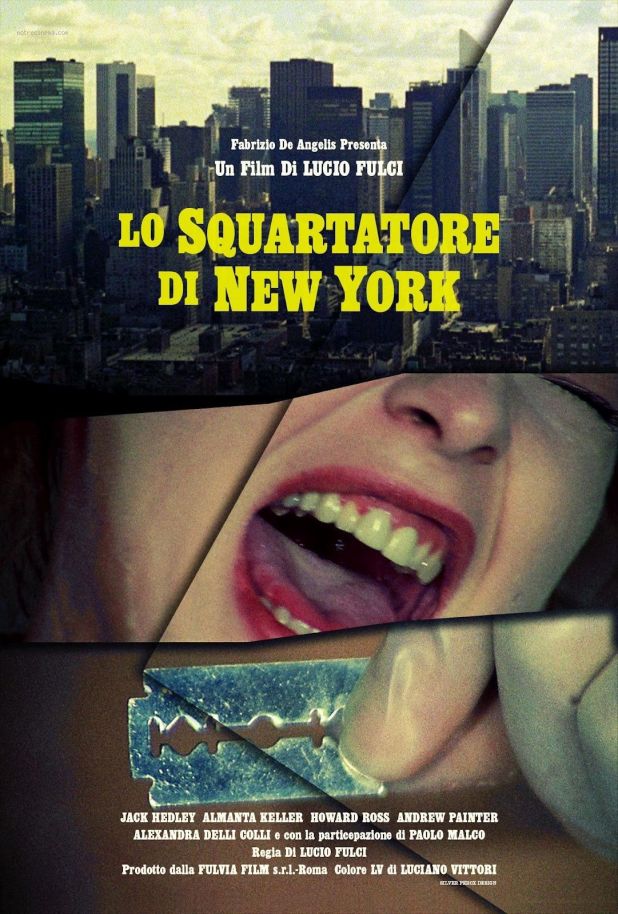
With this in mind, it was perhaps for the best that neither critic, at least to my knowledge, ever got to see Lucio Fulci’s The New York Ripper, which takes all the gore, seediness, and latent misogyny of the slasher genre to their logical conclusions. Depending on your view, this giallo either confirms or refutes Siskel and Ebert’s condemnation of the whole genre.
The New York Ripper traces the efforts of a hard-bitten NYC detective, played by British actor Jack Hedley with his voice dubbed over by Edward Mannix, to catch a vicious serial killer who is mutilating the city’s women. The killer starts taunting the detective over the phone in the voice of a cartoon duck who is totally not named Donald. The suspects soon narrow down to two: a sleazy, drug-addicted loner who frequents 42nd Street sex shows and the clean-cut boyfriend of a surviving victim.
The film owes its notoriety to its explicit scenes depicting the murders. In one scene, a sex show performer, played by Zora Kerova from Cannibal Ferox, gets a broken bottle shoved up what the film’s coroner colorfully refers to as her “joy trail,” resulting in the bottle filling up with blood as Kerova screams. In another memorable scene, a prostitute is tortured to death by having a nipple sliced off and, in an inevitable scene in a Fulci film, her eye cut with a razor.
On one hand, it is entirely understandable that the film is often regarded as misogynistic, given its level of violence towards women and general aura of sleaze. The killings in the film go far beyond anything even Camille Keaton experienced in I Spit on Your Grave. Aside from the sex murders, the film focuses heavily on the degradation of women, as in the scene where a promiscuous woman who records her sexual adventures for her kinky husband gets a non-consensual foot job from two men she meets in a bar. Furthermore, the film conforms all too well to the feminist critique of slasher movies in which sexually liberated women (prostitutes, swingers, strippers) get butchered while the comparatively “pure” character survives. Even the film’s gritty rock theme lends an air of sleaziness.
However, I would argue that the film actually subverts those slasher film tropes. For example, the murders are portrayed so graphically that it is hard to imagine anyone other than a straight-up pervert cheering them, even to praise the special effects. The killer’s sadism is portrayed uncompromisingly, with no attempts to soften it for the audience. Furthermore, the film’s ending highlights the human cost of the killer’s actions. Without spoiling too much, the last human sound we hear before the end credits run is a child crying, a sound that gradually fades into the traffic noise of an uncaring city. Fulci gives the ending a genuine emotional impact that takes this a notch above your typical slasher film.
ABOUT THE AUTHOR: Herbert P. Caine is the pseudonym of a frustrated academic and genre movie fan in Pennsylvania. You can read his blog at https://imaginaryuniverseshpc.blogspot.com.
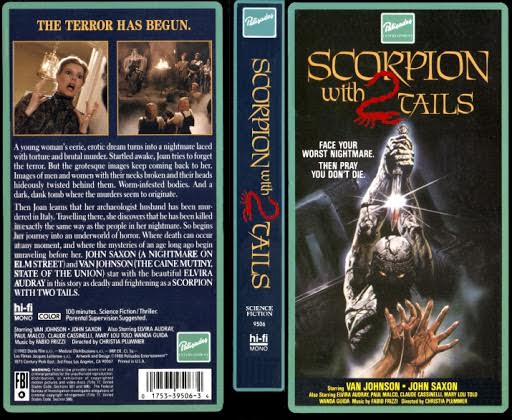
When I was a young child, roughly nine or ten years old, my parents decided to put on a Saturday afternoon movie showing on one of the local broadcast channels, The Scorpion with Two Tails. The film held little interest for me initially, until one very “special” scene came on. In it, a woman has a vision of some of her friends being murdered by an unseen figure who snaps their necks from behind. Meanwhile, the eyes of an ancient statue fall out with the sockets spewing maggots. My parents were unimpressed, with my mother grumbling, “This is gross.” Young me, however, was scared and quickly left the room.
Roughly thirty years later, I sought out The Scorpion with Two Tails, also known as Assassinio al cimitero etrusco (Murder in the Etruscan Cemetary). It proved to be a largely unmemorable giallo, albeit with some good atmosphere and brief appearances by well-known actors. The film revolves around a young woman (Elvire Audray) investigating the murder of her husband, played in an all-too-brief appearance by John Saxon. Saxon’s character, an archeologist, is briefly seen investigating an Etruscan tomb in the Italian countryside, which he thinks may be the find of the century. Unfortunately, his neck is broken by a hidden assailant after a phone call with his wife, who has a premonition of his death.
When Saxon’s wife travels to Italy, her visions intensify, culminating in the scene that scared me as a child. She gets a pendant that her late husband retrieved from the tomb, a scorpion with two tails. She soon learns that she perfectly resembles an ancient Etruscan painting of an immortal woman. Could she be the woman’s reincarnation? More importantly, are the murders connected to the heroin she finds hidden in the tomb, or is something supernatural afoot?
The film wavers between supernatural horror and real-world suspense, never finding a balance between the two. The main story following Audray’s character and her visions is grafted to a sub-plot involving drug smuggling, with the two plot lines never really gelling together. Spooky scenes in the Etruscan tomb are juxtaposed with gunplay and car chases. Furthermore, in the last five to ten minutes, there are scenes implying that the Etruscans had some sort of advanced technology involving anti-matter and anti-gravity, an element that is never really developed. (To be fair to the director, Sergio Martino, the film was originally intended as a miniseries, so it may just be suffering from the truncation.)
The film’s performances are mixed. John Saxon does his usual good work, but his part is little more than a cameo. Elvira Audray, who plays our protagonist, has a tendency to overemote, although that may simply be the way her character was dubbed. Although some might claim that you shouldn’t watch a giallo for the acting, this ignores the role acting plays in keeping us invested in the story. If we care about the characters, we feel greater suspense.
These plot difficulties are to some degree alleviated by the film’s good use of atmosphere. The Etruscan tomb, which figures prominently in Audray’s visions, is genuinely creepy, with lots of shadows and a sulfurous fog emanating from a pit. The visions themselves are disturbing, even as an adult, with necks being broken all too realistically. The film also boasts a good soundtrack, although some themes seem to have been lifted from Fulci’s City of the Living Dead.
The Scorpion with Two Tails is available on YouTube.
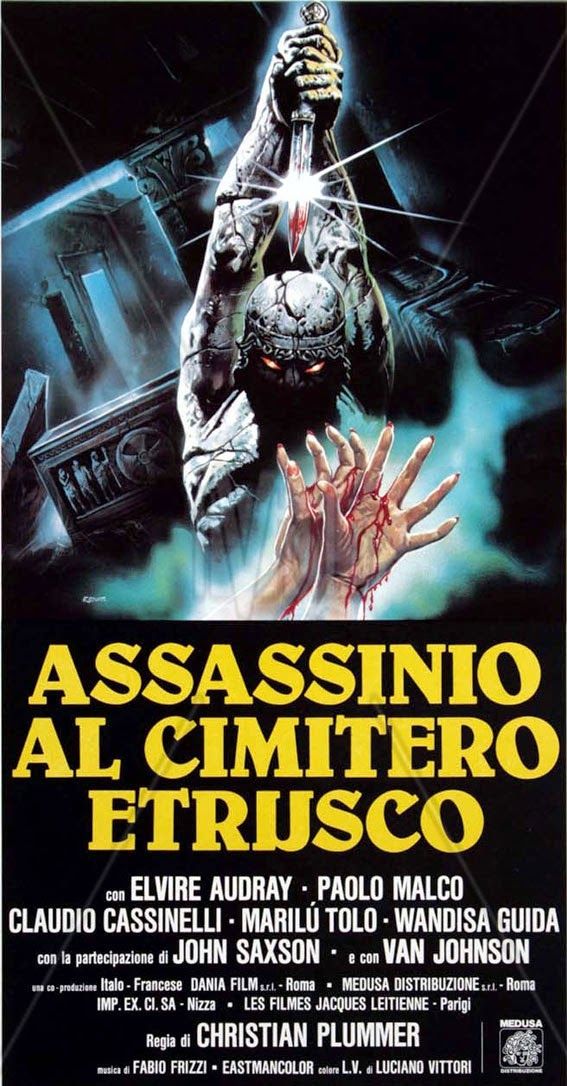
Also known as Assassinio al Cimitero Etrusco (Murder in the Etruscan Cemetery), this is one of the few Sergio Martino giallo films that I had not seen. It was originally to be an 8 episode TV series called Il Mistero Degli Etruschi (The Mystery of the Etruscans) or Lo Scorpione a Due Code(The Two-Tailed Scorpion) before it was made into a full-length film, which was then cut down again to air as a two-part movie in Italy.
Working from a script by Ernesto Gastaldi and Dardano Sacchetti (with screenplay work by Maria Chianetta), Martino tells the story of Joan (Elvire Audray, Ironmaster), who foresees that her husband will die in the Etruscan tombs that they have been exploring. And with that, her husband Arthur dies in just enough time to get John Saxon a special guest star title.
Now, she wants to find the killer, working with her friend Mike (Paolo Malco, Escape from the Bronx, The New York Ripper) and going up against her father (Van Johnson), who may not be involved for altruistic reasons.
I always loved this Enzo Sciotti poster, which looks just like the one for The House by the Cemetery.
Everyone feels like they’re going through the motions here, which is kind of sad. It’s a great idea, mashing up ancient rituals and giallo murders. It should work, but it doesn’t. Even the Fabio Frizzi score sounds a bit like The Beyond, a much better film.
Despite the worries of this past year and my normal thoughts that this is existence can be a prison, the truth is that the world can be a magical place at times. Case in point, I just learned that one of my favorite actors, Michael Moriarty, made a giallo with one of the great ripoff artists, Alberto De Martino. Who knew?
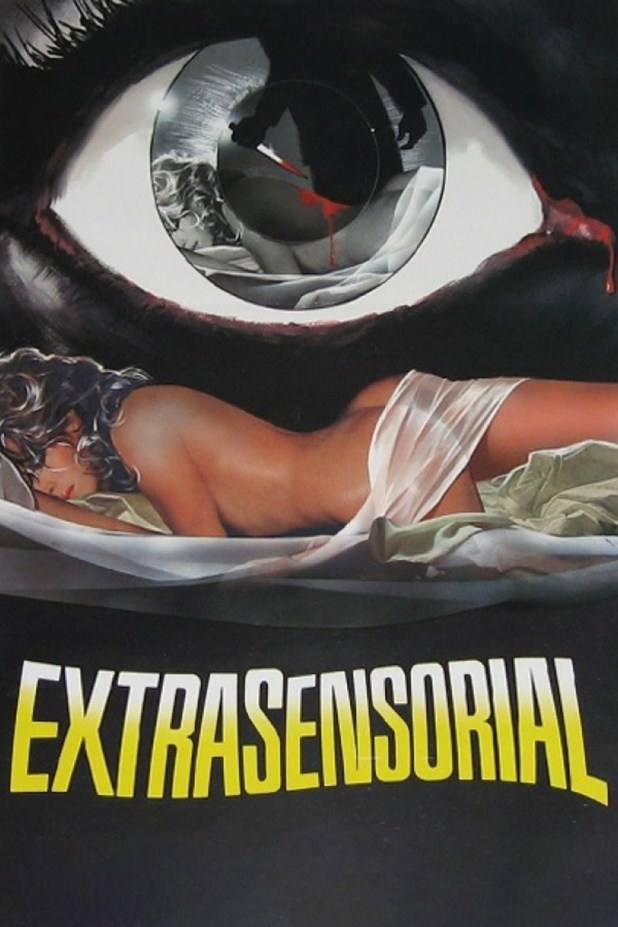
Beyond making movies that take a Hollywood idea and going wild with his own craziness — witness The Antichrist, OK Connery, Holocaust 2000 — this movie goes so far to feature a poster that blatantly lifts from The New York Ripper.
Michael Moriarty plays Craig Manning, a doctor who has visions of women being killed somewhere in Germany by someone who he believes is his thought burned to death twin brother Keith — yes, also played by Moriarty — who he feels that he must stop, despite his girlfriend Julie (Penelope Milford, Coming Home).
How can we make this more of a movie that I’d enjoy? By having Cameron Mitchell play an ex-boxer goaded into a boxing match that Keith kills him in, that’s how. The good twin falls for Mitchell’s daughter. After they aardvark, the bad twin shows up, kills her and lets his brother take the blame for all the killing.
I totally love the ending of this, which leaves it up in the air whether or not Keith had psychic control over Craig, or whether he is calling to him from the grave, or whether they’re all insane or if — my personal feeling — is that there was only one of them all along.
Made in Germany with an all-Italian crew and a Morricone score, this is the kind of movie that you’d rent when the store was closing and the sales clerks were looking annoyed and then when you watched it, you’d be the only one of your friends who liked it and then for years, they’d all make fun of you for enjoying it so much. Hey — it has Moriarty and Mitchell, two guys I thought I’d never see in a movie together. To be fair, when you make as many movies as Mitchell did, those odds aren’t all that high.
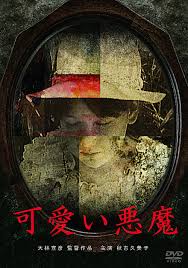
When a young girl named Ryoko traveled to Europa to study music, her lover was killed in a traffic accident. However, she believes that her psychic powers are what killed him and no one believes her, which sends her to an asylum. As she recovers, she is placed into the care of her brother-in-law Kouji and eventually becomes the governess for his daughter Alice.
Nobuhiko Ôbayashi is best known for Hausu in America, but he made plenty of movies, including this 1982 made-for-TV movie, which is just as surreal and wonderfully strange as his most famous film.
I mean, how can you not love a movie that has a wedding end with the bride doing the Oliver Reed Burnt Offerings leap out a window? I’ve seen folks refer to this as Ôbayashi’s take on The Bad Seed and that works for me. It’s a kid with too many powers being watched by a woman who has had too many horrible things happen in her life, now with no grip on reality.
So many matte paintings, plus ghosts wandering the night, people being set ablaze, tons of broken glass and a really gothic feel — dare I say it’s a Japanese Kill, Baby, Kill!— that hits everything I love in film and then just takes it all up to another level.
You can translate the title as Cute Devil or Lovely Devils. Either way, this is a movie worth tracking down.




 B&S About Movies
You must be logged in to post a comment.